
Herbie played a lot of basketball at Bad Kissingen. There were two courts on base—an outside court bathed in floodlight and an inside court with bleachers and a scoreboard. Having made a study of the game in Brooklyn, Herbie deepened what he’d learned in the service. He liked basketball in Bensonhurst, but came to love it in Germany. The game felt like more than a game when he was overseas; it felt like home. It was the prose of Brooklyn translated into the poetry of sport. Whatever happens in life can be seen in miniature on the court. Whatever is true here will be just as true there; what is false here will lead to ruin there. Five players to a side is ideal for teamwork; five members is a military unit, a jazz band, a street gang. Five good players working together will always beat five great players working apart.
Herbie was a regular in the three-on-three games in the gym, where players followed the Brooklyn playground rules: make it, take it; no harm, no foul; one point per hoop; first to ten; win by two; winner keeps the court.
The Colonel staged a three-on-three tournament twice a year. Herbie entered one of these tournaments with two friends from the barracks. Herbie was a good player, but not very good. His gifts were intellectual. He was what they used to call “heady,” meaning more brain than brawn. He did a lot of talking on court. He was a solid defender and played on the edge of dirty. He did not want to injure an opponent, but would if absolutely necessary. His best shot was an old-fashioned hook. There was a spot from which he did not miss—ten feet out on the right side. He played point guard in the tournament, bringing the ball across mid-court, then initiating the offense with a pass. His team over-performed, knocking off several favorites. Herbie coached as well as played. He devised the strategy. Even then he believed that sport is really about tempo. If you prevent your opponent from playing at their preferred tempo, they’ll become frustrated and you can win. If the other team is fast, make them play slow. If the other team is slow, make them play fast.
Herbie’s team reached the final, where they faced what amounted to the Bad Kissingen all-stars, a squad led by “Famous Jimmy” Longo, the Bob Cousy of the German border. Though they’d never spoken, Herbie had tremendous admiration for Famous Jimmy—his size and speed, his power on the boards, his accuracy from outside.
The championship was played on a Friday night. If the Russians wanted to invade, that would have been the time. The patrol towers were half-staffed; the Weasels sat idle. Everyone was at the gym.
The game was surprisingly tight. Smaller, weaker, and not nearly as athletic, Herbie’s team slowed the pace to a crawl, keeping the score low and close enough for Nate Feinstein—he later became an Ivy League law professor—to hit a go-ahead jumper with three seconds left.
Pandemonium.
A player on the other team, hurrying to get down court, threw the ball out of bounds, giving Herbie’s team the final possession.
Herbie called a time-out.
“We make one inbound pass,” he said, “and it’s over.”
Herbie decided he should inbound the ball, not because he was his team’s best player—he was probably the worst—but because he believed himself the smartest, thus the least likely to make a mental error. He dried his hands on his shorts, took the ball from the referee, stepped to the sideline, and waved the ball over his head, looking for an open man. He spotted a player streaking down court, waving his arms, shouting, “Herbie! Herbie! I’m open.”
Herbie wheeled and threw, delivering a bullet, a perfect pass, which the player caught and shot in a single motion. Swish. It was only later—a long moment later, when the people in the seats started laughing—that Herbie realized he had thrown the ball to Famous Jimmy, who’d won the championship with the last shot.
What do you do after such a monumental mistake?
Do you curse and spit and kick the ground and bang yourself on the skull and condemn God and the refs and the life that has brought you to this point?
Herbie was smiling when he got back to the bench.
He said, “I can’t believe Famous Jimmy knows my name!”
He said, “That was probably the best pass I’ve ever thrown. It had to be perfect to beat the clock.”
No. 12
The Colonel summoned Herbie early the next morning. This was unusual, even scary. Colonels don’t summon privates unless something has gone terribly wrong. Herbie’s mind was racing as he walked across the parade ground.
What did I screw up? he asked himself.
But the Colonel greeted him with a handshake and a smile, saying, “That was a hell of an effort yesterday.
“In fact,” he added, “that’s what I want to talk to you about.”
The best basketball players in the American military competed in two European leagues, the alpha league and the beta league. The teams in the beta league represented companies and battalions; a battalion could include as many as two hundred soldiers, a company as many as a thousand. These teams consisted of playground and high school standouts. Some would go on to play at small colleges. The teams in the alpha league represented brigades and divisions; a brigade could include as many as five thousand soldiers, a company as many as fifteen thousand. The players in the alpha league were top level. Some would play at schools like Ohio State, Notre Dame, Michigan. A handful would go on to play or coach in the NBA.
The Colonel understood the nature of Herbie’s accomplishment in the three-on-three tournament, how he’d taken the least talented team to the final by devising a strategy, teaching his players, and getting them to stick to it, greatly outperforming their ability. “I don’t know how you did it, Cohen, but you managed to squeeze sixty pounds into a ten-pound sack.”
He asked Herbie if he could do the same with Bad Kissingen’s battalion team, a perennial beta league loser. There was a scarcity of athletic talent on the border. “I’m not asking you to win a championship,” said the Colonel, who functioned as the team’s general manager. “I’d just like to be competitive.”
From that moment until his military discharge, Herbie had one job: coaching basketball. He organized tryouts. He was familiar with most of the players on base but wanted to see them again—in new situations, with different teammates. And, of course, there’s always the chance of a discovery, a diamond in the dirt. He started with Famous Jimmy, a six-foot-five forward from Baton Rouge, Louisiana, then surrounded him with specialists, assembling the team in the way of an elite unit from a World War II mission movie—this one because he’s devastating from twenty feet, that one because he sets a vicious pick, this one because he’s all elbows and Nietzschean will, that one because he intuits the flow of the game. There was Sam Jones, a six-foot-four white guard who’d later play at Holy Cross; Bobby Morgan, a six-foot-seven black center who’d later play professionally in Italy; Fats Portnoy, a five-foot-seven Jewish guard who later became a legendary high school coach; and Bobby Whitefeather a six-foot-five Cherokee forward who’d later play for a Native American Tribal college.
Herbie ran preseason practice four nights a week. He spent the rest of his time on the road, traveling base to base, ducking into gyms, standing in the back of the bleachers, taking notes as he watched the opposition, writing down names, numbers, tendencies. Bad Kissingen would indeed be outgunned. Being in the Fulda Gap meant putting military need ahead of basketball. Unlike battalions farther from the front, the Colonel could not recruit soldiers with only sports in mind. As a result, Bad K did not match up on court. Even Famous Jimmy, the base superstar, would have been no more than average on most of the other teams in the beta league.
Herbie accordingly devised a strategy aimed less at elevating his team than at degrading—slowing, frustrating, mucking up—the competition, turning the games into slogs from which Bad K would emerge with a victory like a junkyard dog with a bone. “Those we can’t beat,” explained Herbie, “we can get to beat themselves.”
Bad K played like geriatrics that season, at wheelchair or walker speed, passing, passing, passing, passing. They’d slow each moment to what felt like an eternity, then live in that eternity. It drove opposing players crazy. They’d lash out, jump into the lane, go for impossible steals, get into foul trouble. Or else the pace would make them sleepy. They’d lose interest, forget why they’d come. By the end of the second half, they’d be hypnotized—eyes getting heavier and heavier, and here is a soft green meadow, and wouldn’t it be lovely to lie down in the cool grass? At the crucial instant, Bad K would flip on the burners—a fast break, an end-to-end pass, a layup, steal, or fadeaway jumper—scoring just enough to win. Or they’d shift speed, go from fast to slow, then back, keeping the opposition off balance in the way of a junk ball pitcher.
The team spent the winter on trains and buses, crisscrossing West Germany. Würzburg, Heidelberg, Stuttgart, Worms, Wiesbaden, Limburg, Zweibrücken, Saarbrücken. The intimacy of the run-down arenas, the sound of sneakers on hardwood floors, country roads, medieval churches and greens, the forest beyond the last streetlight, nights when it rained, nights when it snowed, clear nights filled with stars, the industrial zones, factories and smokestacks, the somber infrastructure, the camaraderie of the team, Americans together in a foreign land where toilets flush with a chain and rubble from the war is still piled in the squares.
“Was it strange?” I asked my father.
“Was what strange?”
“Being a Jew in Germany so soon after the Holocaust.”
“Just once it was strange,” he said. “I’d spent the night at the house of a German girl. We’d been out drinking, and before I knew it, it was too late to go back to base. I had an overnight pass, anyway, so I slept at her parents’ house in a guest room. When I came down in the morning, I saw a picture of her father on the mantel. He was posed in uniform. I leaned close and studied it. Son of a bitch. He’d been a colonel in the SS. But, you know what, we’d won the war, we’d beat the Nazi bastards, and that meant everything.”
The Bad K team finished 18 and 12, which put them in the playoffs. A single elimination tournament: two victories got you to the final. There was a party on the base the night before they left. Most of the players were hungover when the train reached Düsseldorf, where the games would be played in a gym in the center of town.
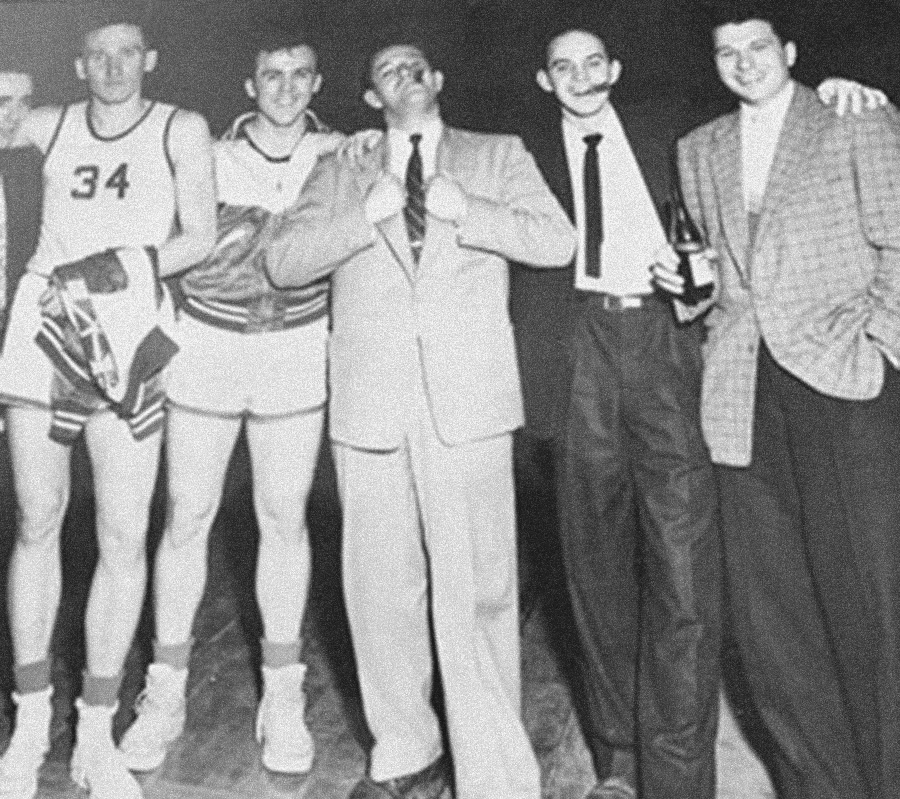
Herbie dressed like a civilian on the bench, in suit and tie, a cigar ready for the postgame celebration. His picture occasionally appeared in The Stars and Stripes, which covered the beta league. He looks skinny in some, chubby in others. His eyes are pale, his face is dark, his brow is furrowed. He coaches with his hands, moving players this way and that. He writes on the sideline, filling a slate with dots and dashes. No matter the situation, he has a plan. No matter the trouble, a solution. No matter the riddle, a story to tell. “You have nothing to lose,” he told his players before the final. “If you fail, you’re doing what everyone expects. But if you win … think of how embarrassed the guys across the floor will be!”
The first game was punctuated by hard fouls and shoving. It was slow, ugly. And Bad K won. The second was even uglier. The opposing coach, an airborne commander stationed in Frankfurt, accused Herbie of playing “tricky New York ball.” Herbie responded by giving him the finger with both hands, the so-called double bird. This led to a melee, at the end of which Herbie was ejected. The crowd booed when they realized Herbie had been kicked out while the airborne commander was allowed to stay. Herbie put Longo in charge, then stood in the hallway that led to the court. Now and then, a Bad K player would walk off the court and through the door, then return. The airborne commander complained that Herbie was coaching “by proxy.” The referee went into the hall, found Herbie, and ordered him to go to the locker room and stay there.
Bad K won on the last shot, a layup off a rebound by Longo. This put Bad K in the final, but Herbie, as per referee decision, would not be allowed to coach. He went to the game as a fan, bought a ticket, and sat in the bleachers, where his players sought his direction, which he shouted through cupped hands, a strange spectacle that was chronicled, in words and photos, by The Stars and Stripes: Fats Portnoy and Bobby Whitefeather standing at the bottom of the seats, looking up, listening. Herbie was accused of “coaching from the stands.” The referees did nothing at first. Then, in the second half, they told him to stay seated and stop talking. He did, but the opposing coach told the referees that Herbie was using hand and eye signals to direct players. Herbie was told to leave the arena. When he protested—“Secret signals? Who does he think I am? ‘The Amazing Randi’?”—the MPs were summoned. The Stars and Stripes ran a picture of Herbie being led out of the arena by armed men. Bad K, unsettled by the spectacle, lost the game by ten points.
No. 13
Herbie was summoned by the Colonel a few days after he’d returned to the base. The Colonel was talking with a thick-set general when Herbie came in. The General had been at the beta league tournament. He was a basketball fanatic, Indiana born and raised, and, as such, had made himself the sponsor of the Second Cavalry’s alpha league team. He’d pulled strings and called in favors to load the squad with talent, yet they underperformed and were in danger of not even making the playoffs. They’d have to win six of their last ten games to avoid regular-season elimination. “And elimination, I have no need to tell you, Private Cohen, is humiliation. And I will not have those stuffed shirts at headquarters laughing at me.” Having fired his coach—a captain from a mechanized unit—the General ordered Herbie to take over the team and “salvage what can be saved.”
Herbie traveled to Frankfurt to see the team the next day. As he watched them lose to a clearly inferior squad, one thing was obvious: the Second Cavalry, though indeed talented, had hardly been coached. There was little passing, no creativity. It was every man for himself out there, which made for a slow game—listless, mechanical—though not in a purposeful way. They played a half-court offense and did not run on defense, as if they were bored, going through the motions. It was the kind of elegant lassitude you get from great athletes who have stopped caring. Lions in repose, dozing in the tall grass.
Herbie took over in Berlin. He said nothing for the first few games, but merely sat on the bench, taking notes. (For my father, taking notes is key—everywhere, all the time—because it lets you learn from the past, lets you keep a record while letting the other side know that a record is being kept, and, on occasion, lets you “hang them with their own words.”)
He watched his team lose in Stuttgart and Mannheim, then called them together before the next practice. He’d devised a strategy based on the skills and deficiencies of each player. It was still tempo he was interested in, only now, after watching the Second Cav in games and practice, it was speed he wanted: play fast, race up and down the court. “You can’t build a team around a random strategy,” he explained decades later. “Maybe in a perfect world, heaven or fantasyland, but in the real world you have to devise your strategy for the talent you actually have. Don’t bitch. Don’t complain. Just play the cards you’ve been dealt. You think I wanted to play slow, play ugly, watch my boys slog in the mire? Of course not! But that was the only way Bad K could compete. We weren’t good, so we had to make the other teams play worse than us. But the Second Cav had talent, which meant we could play fast. You can teach a person to pass and set a pick, but you can’t teach speed. That’s God given.”
He designed his offense around the fast break, transition being the order of the day: get the ball down court more quickly than the defense can follow. When the Second Cav took possession, the guard whipped the ball to mid-court, where another guard caught it, turned, and threw it to a forward breaking for the basket. On occasion, the ball went end to end without touching the floor. It was all about teamwork, anticipation, pinpoint passing, which takes practice, repetition. There were miscues, overthrows, and underthrows in those first games, blown assignments, but when it clicked, the Second Cav became a force in the alpha league. They won several games in a row at the end of the season, then continued winning in the playoffs. They blew out every team in the early rounds and made it to the final, where they faced a Seventh Army squad composed entirely of ringers, including Larry Costello, who’d play and coach in the NBA, where he made six all-star teams.
The final was held in a rickety stadium in central France. The rafters creaked when the wind blew. The seats on the floor were jammed with military brass. It seemed as if every general and colonel in Europe had turned out in dress blues. Privates and sergeants filled the bleachers, where cigarette smoke lingered. Herbie’s center, Bobby Watkins of Albuquerque, New Mexico, a rangy cowboy, went out for the opening tip. The ref blew a whistle, made the toss. Going after it, the players hung in the air for what felt like an age, their arms reaching for a ball that paused between ascent and descent, the crowd, the noise, teammates waiting, coaches prowling, the hardwood shine, all of it frozen in a photographer’s magnesium flare.
The game was a barn burner, the lead changing hands a dozen times. It was tied with two seconds left. The Second Cav had possession at mid-court. Herbie signaled for time-out. Here was the question: Is it even possible to score in two seconds? Herbie called a play the team had been working on. The ref handed the ball to the Second Cav’s point guard, who stood on the sideline, looking to inbound. The two guards raced back as if to receive a pass. The point guard faked, turned, and threw up court toward the hoop, where Bobby Watkins, the rangy cowboy, met the ball in the air—starting the clock—then redirected it off the backboard and into the basket for the win. A primordial version of the alley-oop, the play sent the spectators out of their seats and onto the floor in celebration. Herbie drank champagne in the locker room, then continued on to a local saloon for a party that lasted from can till can’t.
No. 14
He was bleary when he walked into the barracks at Bad Kissingen the next morning. He’d expected rapturous congratulations, but everyone was downcast. Something had happened; he could feel it as soon as he stepped through the door. It woke him up in a moment.
“What’s going on?” he asked, dumping his bag on his bunk.
“It’s DeLuca,” said Nate Feinstein. “They took him away.”
“What do you mean? Who took him away?”
“The MPs.”
Nate Feinstein looked around, then continued in a whisper: “Two guys in black suits came in here yesterday, broke into DeLuca’s trunk and locker, spread all his stuff out on the floor, and took pictures of everything with this tiny little camera.”
“Where’s Tommy now?”
“In the brig. I tried to see him; they wouldn’t let me.”
Herbie went directly to the brig, a concrete jailhouse in the center of the base. It had to be about the Waste, he told himself. He figured DeLuca had broken some ordinance by mixing officers and enlisted men and faced a charge on rule violations. Herbie was right, and wrong. It was about the Waste, only it wasn’t a rule violation. DeLuca had been charged with treason.
Herbie figured he could use his position at Courts and Boards to bluff his way in to see DeLuca, but was wrong about that, too. Private First Class DeLuca was being kept under armed guard in isolation; you’d have to be at least a captain to get in.
Stopping near the door that led to the cells, Herbie called back, “Hey, Tommy? You in there?”
“Herbie, is that you? I’m in trouble, Herbie.”
“I know, Tommy.”
“You got to help me, Herbie.”
“Don’t worry,” Herbie said. “We’re going to fix this.”
For Herbie, it was Moppo turning up at the assembly all over again. There was a mess, a misunderstanding, a crisis, but what is a mess, a misunderstanding, and a crisis but a game, a puzzle in want of a solution?
He started the next morning, talking to every officer in the chain of command, working his way up the ranks until he found himself back in the office of the Colonel, who agreed to talk about the case only after Herbie had given him the blow-by-blow of the alpha league final.
“Now for your friend,” said the Colonel, who’d had his secretary retrieve the file.
The Colonel grimaced as he read through it, muttering, “Jesus Christ” and “Great God Almighty.”
“This looks bad,” the Colonel said. “They’re going to send him to Leavenworth. Once upon a time, he would have been stood against a wall and shot for this.”
“I don’t understand. What did he do?”
The Colonel described the Waste as it appeared to the military: Private First Class DeLuca formed a secret subversive organization on the East German border, recruited officers into that organization, placed those officers beneath enlisted men in a separate command structure, undermining military readiness at the Fulda Gap with probable intent to aid the enemy.
A Russian spy had apparently infiltrated the Waste, written reports on DeLuca’s secret meetings, copied DeLuca’s rule book and roster, and carried it all back to Russian intelligence, who leaked it to the Soviet press. The Waste made Pravda, where it was reported as evidence of dissent within the U.S. Army.
Herbie laughed when he heard this, then stopped laughing. Over the next few days, he made it his mission to prove that Pravda and the Russians were wrong, that DeLuca could not possibly have organized such a plot, because, as Herbie put it, “Tommy DeLuca is an idiot.”
Herbie explained this first to the Colonel, then to the officer who ran army intelligence on the border, making the case that punishing DeLuca would do more harm than good. “The Russians think they’ve exposed this big plot,” Herbie explained. “If you prosecute DeLuca, you’ll prove them right. And they win. But if you show DeLuca to be the idiot we all know him to be, you’ll make the Russians look like fools.”
Having noticed a stuffed largemouth bass on the wall behind the intelligence officer’s desk, and believing that people best understand solutions phrased in their own language, Herbie went on: “The Russians think they’ve hooked a marlin. They’re bragging about it. If you charge DeLuca with treason, you’ll tell everyone they’re right and there is a problem in the American army. But if you charge him for what he actually did—act like an idiot—then everyone will see that the Russians caught a tire but they’re such fools they’ve put it on their wall and are telling everyone it’s a marlin.”
When the criminal report was released, DeLuca had been accused of nothing more than insubordination. He was knocked down to private and cashiered from the military. He’d been given an OTH, an “Other Than Honorable Discharge,” which was not the best but also not the worst thing in the world. He wept in Herbie’s arms when he returned to the barracks, then got dressed for a goodbye dinner at a local beer garden. He was leaving months ahead of his friends, disgraced and alone. Nietzsche said, “That which does not kill me makes me stronger,” but this wasn’t the case with Tommy DeLuca. The talk of treason scared him, and he stayed scared. He was still scared when I met him decades later. He became a regular presence in our lives in his later years. He was with us at Thanksgiving and Hanukah and on family vacations. He felt safe around Herbie. Herbie had rescued him once and, Tommy believed, could rescue him again.
No. 15
For many years, Herbie’s favorite piece of writing was “The Eighty-Yard Run” by Irwin Shaw. The story takes place in the mind of Christian Darling, a once promising youth who, having amounted to nothing, sits on a hill on the campus of his old college, looking down at the football field, where he’d achieved the great success of his life, returning a kickoff eighty yards for a touchdown. It did not even happen in a game, but in practice, and yet, looking back, he can see that everything was downhill from there. That’s what Herbie was afraid of at the end of his military service—that he’d just experienced his eighty-yard run and would never feel so at home in the world again.
He was discharged in October 1955. He’d known the end was near, yet it still came before he was ready. He spent his last weeks in uniform in a funk. He’d been a great success in the army, had found his place, earned his privileges. Who’s to say he’d ever be so accomplished again? Maybe Bad Kissingen had been his eighty-yard run.
He did not want anyone to meet his ship in New York, nor even know his date of return. He planned to slip into Brooklyn, creep in through a side door, and be waiting at the kitchen table when his parents woke up for breakfast. But that’s not what happened. Larry, who’d felt rudderless without Herbie, had been calling the military’s family outreach office twice a week to ask when Private Cohen would return, on what ship, at what pier.
Larry told Herbie’s parents when he got the information, and the three of them—Morris, Esther, Larry—were waiting at Pier 32 when Herbie, a duffel bag thrown over his shoulder, walked down the gangplank into Manhattan.
Larry and Esther talked all the way home. Morris, who was driving, concentrated on the road. Herbie stared out the window—at the West Side Highway, then at the Brooklyn–Battery Tunnel, then at the stores along Hamilton Avenue in Brooklyn. Twentieth Street led to Bay Parkway, which was candy shops, taverns, playgrounds, and street corners all the way back to what Herbie describes as “picturesque Bensonhurst on serene Gravesend Bay, where we played little-league polo and fished bodies from the icy waters of the Gowanus Canal.”
No. 16
Herbie spent his first weeks back home with old friends on the corner, trying to be as he had been, but it was not long before he understood it was impossible. Almost all his friends had left Brooklyn, or were preparing to go.
The Italian futurist Umberto Boccioni painted a triptych called States of Mind. The first work shows the people we have left behind, stranded and aimless in green light. The second work shows the machinery of travel, steam engines, traffic lights, smoke. The third work shows the dislocation of those who have left home, the chaos, hope, and regret, because once you leave, you can never return. Your first world vanishes as soon as you step out the door.
Bensonhurst was like that in the 1950s. You were either gone, going, or had been left behind. Zeke had gotten married while Herbie was in Germany. When Herbie asked why he’d married a person he did not even seem to like—her name was Frada—Larry said, “Because you were in the army, and it was winter, and I was bored.” Who Ha had moved to Long Island, where he worked as something called a “manufacturer’s representative” and married a woman named Honey. Sandy had signed a contract with the Dodgers and would soon make his Ebbets Field debut. Asher Dann, another friend from the corner, had moved to L.A., where, because of good looks alone, he had been signed by Twentieth Century Fox. Asher made a single movie, the 3-D classic September Storm, in which he appears as the nearly always shirtless cabin boy Manuel Del Rio Montoya.
Herbie returned to NYU. He was still living at home and commuting to the Greenwich Village campus, but went at it with a new sense of purpose. His military service—boot camp at Camp Chaffee, riding a Weasel in the Fulda Gap, coaching basketball in the European League—had focused him. And he was not the only one. There were hundreds of veterans at NYU, men attending college on the GI Bill. They were older than the other students, more experienced and more mature, sharks among minnows. Herbie’s crowd lingered in the Cedar Tavern after class, talking about world affairs and domestic politics. Most preferred The New York Times to the Daily News, Adlai Stevenson to Dwight Eisenhower, wine to beer. Having worn his high school letterman’s jacket—he’d been a backup tackle on the football team—or his Warriors colors before the army and an olive-green uniform during, Herbie began turning up for class in suits or sport coats, dark in summer, pastel in spring, hair slicked back, clean shaven and ready.
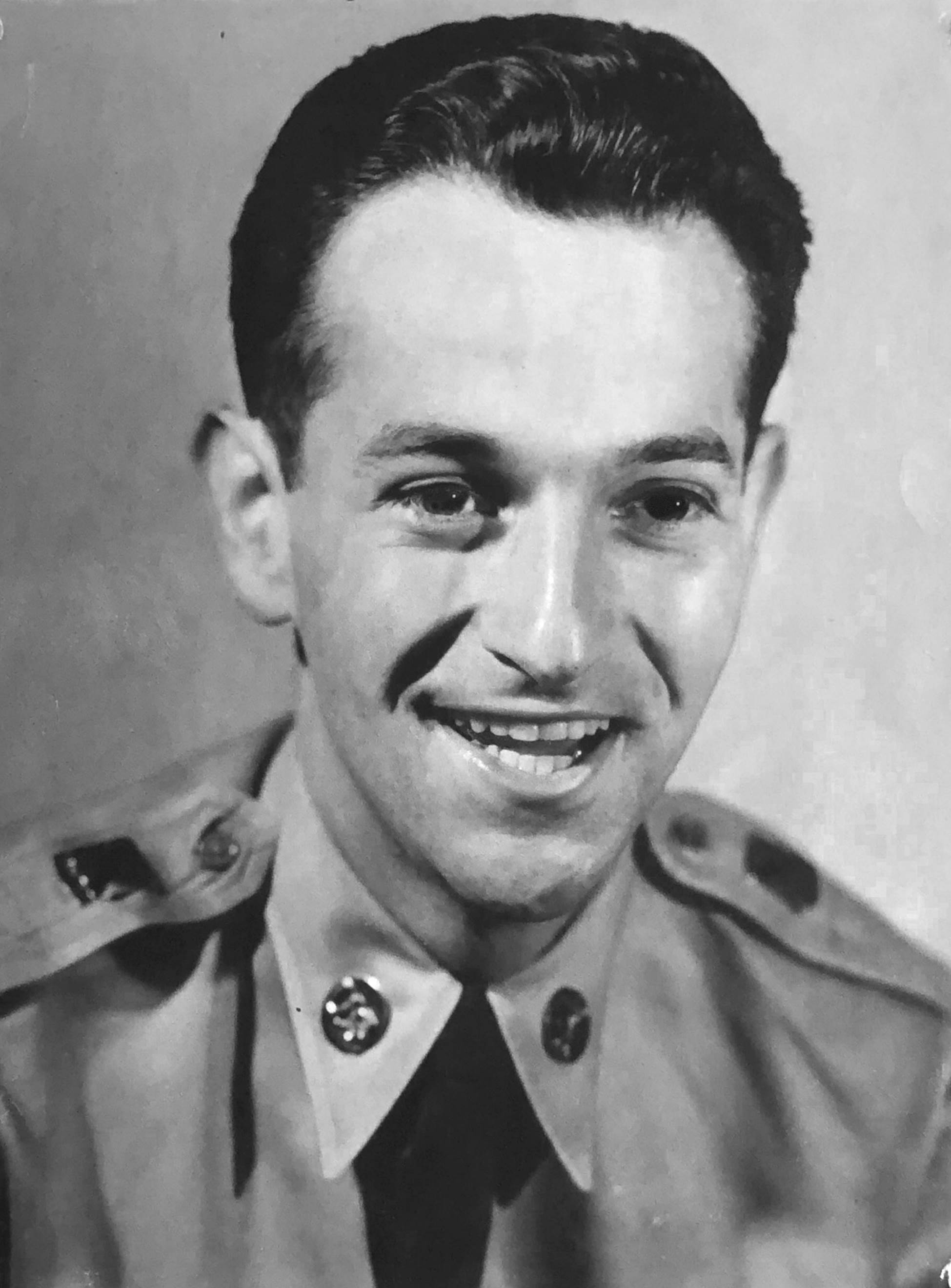
He majored in English and history, his sights fixed on law school. He believed that no matter what happens to a person’s dreams, a lawyer will always “have something to fall back on.” In a bigger sense, he was adrift, waiting for whatever or whoever it was that would give his life direction to appear. It’s at this age, in this mood, that men join motorcycle gangs, concoct universal theories of matter, and develop a passion for poetry or computer programming.
My father met my mother instead.
My parents told different stories about their first meeting, or maybe it was the same story told in different ways, filtered through different sensibilities.
Ellen says it happened in the NYU cafeteria on Washington Square in the spring of 1957. She was eating lunch with friends before an afternoon class. Herbie walked in, scanned the room, caught her eye, came over, sat down. He knew one of the girls slightly. Looking first at this girl, then at Ellen, he said, “Has anyone seen Marty Eisenberg? I need to borrow his Econ notes.”
This was a lie. There was no Marty Eisenberg—Herbie made up the name—and did not take Econ. He wanted to meet Ellen. She was a nineteen-year-old freshman, clever and pretty with short dark hair. They started talking and were soon deep in conversation. They were still talking after the room had cleared out and Ellen had missed her class.
Ellen later said she’d fallen in love with Herbie as soon as he sat down. The girls of her generation were raised on the myth of romantic love—“at first sight,” “you just know,” “one person forever”—and willed such moments into existence accordingly.
She went home that night and told her father she’d met the man she was going to marry.
“Do you love him, Ellen?”
“I sure do, Pop.”
Pointing at his eyes, heart, then crotch, he said, “Is it here, here, or here?”
“It’s all of those places, Pop.”
Herbie’s version is more fantastic. Ellen was sensible, committed to the literal truth. To Herbie, there is truth, and then there is truth, or, as he says, “You see things not as they are, but as you are.” He believes in founding myths and fairy tales, in giving people a story, a poetic reality that supersedes the facts on the ground.
Or it can just be his love of bullshit.
He says it rained the day he met Ellen. Then the rain stopped and the sky cleared and a rainbow appeared over Manhattan. He followed it down Twelfth Street, through the doors, and into the NYU cafeteria, where he first saw Ellen.
“You understand what I’m telling you,” he’d say. “I found your mother at the end of a rainbow.”
Ellen commuted to school from Midwood, Brooklyn, where she lived with her parents, Ben and Betty Eisenstadt, her big sister, Gladys, also an NYU student, and her little brother, Ira. Her older brother, Marvin, was married and living in an apartment on Ocean Parkway.
Ellen was handsome in a way prized by that Jewish generation: she did not look Jewish. “Look at her!” the great-aunts would say. “You’d never even know!”
Her features were delicate. She had long fingers, high cheekbones, and the all-time best laugh. She had the wounded quality of a pretty girl who believes herself ugly because that’s what she’s been told, most frequently by her sister, Gladys, who had suffered Ellen’s birth as a personal rebuke, a wound that would never heal.
The summer of 1957 was the season of courtship for Herbie and Ellen, dinners downtown, Greenwich Village after midnight, subway rides, and cheap tickets to Broadway shows—Damn Yankees, West Side Story. And movies. The 1950s are often depicted as a dull decade, a time of repression and sublimation, Ike on the golf course, the man in the gray flannel suit, but that’s not the whole story. America in the 1950s was as secure as it would ever be, but anxiety was coming out of the rat holes. Frank Sinatra was still center stage, but Bob Dylan was in the wings, lunch counter sit-ins, civil rights, Sputnik, the missile gap, death from above. It could end at any moment, a hard rain, life snuffed out like a candle. It was all in the movies—Vertigo, The Defiant Ones, Run Silent, Run Deep—once you knew how to look.
If Ellen hadn’t taken the initiative and kissed Herbie, it never would’ve happened. She did it on the Eisenstadts’ front porch in Midwood. Herbie was startled. He didn’t know what to do with his hands. He kissed the way actors kissed in movies, mouth closed, face jammed into hers. He called this a “soul kiss.” When it was over, he said, “I think I might love you,” turned, and ran.
Bensonhurst was just a few miles from Midwood, but it felt like another country. The apartment buildings and crowded stoops, pizza parlors and secondhand stores—it was working class, exotic. For Ellen, the relationship took on the thrill of the illicit. Ellen’s world was just as strange to Herbie; she was upper middle class, a rich girl. She lived not in an apartment but in a house! She had a yard and a basement and an attic, and even her mother had been to college. There were times when Herbie looked at Ellen the way Gatsby looked at Daisy: the unattainable, the ladder that could take you above the clouds. There was a green light in the Eisenstadts’ front parlor. Herbie swam for it.
Don’t get me wrong. He loved his neighborhood and toured her through it with great pride. Eighty-Sixth and Bay Parkway, the JCH, the Warriors’ clubhouse. He took her everywhere, introduced her to everyone. Inky, Bucko, Ben the Worrier, Gutter Rat—they did not make a favorable impression. To Ellen, these men were Neanderthals, goons.
Larry introduced himself as “Herbie’s best friend.”
Ellen liked him least of all; there was an emptiness behind his eyes, as if he had no inner life, as if he were only appetite.
“I don’t trust him,” she’d say.
Larry was married to his first wife at the time, Frada. He suggested some of the Warriors go as a group with their girlfriends or wives to see the hot new Broadway show Carousel. Because he had a job near Times Square, Larry offered to go to the box office. Pooling their cash, the friends handed Larry around eighty dollars, more than enough for ten tickets.
Larry led the couples through midtown the night of the show, then, when he should have taken a right, took a left instead.
“The theater is this way,” said Inky’s girlfriend, pointing down Fifty-Fifth Street.
“I know where I’m going,” said Larry.
After much bickering and confusion, he led them to a run-down theater on the corner on Sixth Avenue. All hell broke loose when he handed out the tickets; they weren’t for Carousel but for Uncle Willie, a Yiddish play featuring the vaudeville warhorse Menasha Skulnik. Larry had put the eighty dollars on the wrong horse, then scrounged up just enough cash to get seats to Uncle Willie.
Ellen would never forget it.
No. 17
Herbie took Ellen to meet his parents—Morris and Esther—in August. Esther served a five-course meal on fine china in the small Bensonhurst dining room, where the windows looked out on a strip of red brick and a strip of black sky.
Esther was in her fifties, a short, shapely, gray-haired woman who could turn out a table of delicacies at the flip of a skirt. In Poland, the term for a person like this is balabusta, a nearly mythical creature who, according to Chabad.org, “can host twenty guests for Shabbat in an immaculately clean home, while keeping her kids entertained and well-behaved, simultaneously maintaining a calm composure and a perfectly clean outfit.”
She’d arrived in America by herself at age fourteen, having been sent from Bielsk, Poland, to live with relatives in New York. She was meant to be followed by the rest of her family, but money was scarce, and the war came, and so she was possibly the only survivor, not just of her family, but of her town. As the last of a species, she was determined to carry on its recipes, manners, and traditions. Esther served soup with cliskels, a delicious dumpling the likes of which have vanished from the earth, brisket, lemon cake, and black-and-white cookies from Bensonhurst’s 18th Avenue Bakery.
Morris was a trickster, a pixie with white hair and flashing blue eyes. It would take Ellen years to be comfortable around him. She never knew when he was joking and could never guess what he was going to say. He’d made the trip from Poland twenty years before Esther. He settled first on the Lower East Side, where he worked in the garment industry, eventually making enough money to bring over the rest of his family, his brothers Itzhak and Nathan, his parents, Hannah and Noah. (Another brother, Moishe, had been kicked by a horse and killed in Poland.) Morris and Nathan opened a factory, a fifteen-man shop in SoHo that made bindings for the brims of fedoras, porkpies, bowlers—every kind of hat. The business would be devastated when John F. Kennedy began going around bareheaded.
Morris, who subscribed to a Yiddish newspaper, spoke with his hands, favored Democrats, and feared Communism, was semiretired by the time Ellen arrived on the scene. He spent most of his days with Esther, egging her on and reining her in. If not squeezing you with her warm soft hands, refilling your plate, refreshing your drink, wiping the schmutz off your face, fixing your collar, or wrapping food for you to take home, Esther was gossiping: talking up or tearing down. She could be as mean as Don Rickles, as cutting as Richard Pryor, explaining how this one was dumber than a box of hammers and that one was cold as a fish, taking thirty minutes to tell a story that could be summed up in a phrase, then saying, “That’s it in a nutshell.” Esther had no filter. If she thought it, she said it: “What happened? You used to be good-looking.” “What happened? How did you get so fat?” Morris kept her worst tendencies in check. Laying a hand on her wrist, he’d say, “Enough, Esther. Enough.”
For Ellen, Morris and Esther, though a bit inscrutable, were a blast of sea air. A flash of color, a taste of the lumpen proletariat, lower-middle-class life. While her own parents were well-mannered and soft-spoken and worried what people would think, Morris and Esther were warm and profane. They worried about everything and nothing. In this, they would turn out to be an embarrassment to Betty and Ben Eisenstadt, who hadn’t climbed out of the old immigrant neighborhoods just to have Ellen pull them back in. Morris was only half-joking when he said, “The Eisenstadts covered the mirrors and said Kaddish when Ellen accepted Herbert’s proposal. They considered it a mixed marriage, frowned upon by the community.”
No. 18
For Herbie, stepping through Ellen’s door was like walking into the middle of a movie. He was immediately caught up in the drama, the emotional soap opera of the Eisenstadts, the sibling rivalries and godlike parents, the eleven-fingered maid, the scary basement and smell of mothballs, the screaming and broken dishes, the grandma, the dog, the arguments.
The house was at 3245 Avenue K in Midwood. There were five bedrooms, a living room, a dining room, an eat-in kitchen. The front porch was shaded by a steel awning, and the house itself, which was deep and narrow with a pitched roof, sat amid a stretch of nearly identical brick houses. Approaching it was like entering an Escher drawing.
For Ellen’s father, the house stood for success, his ascent into the middle class. As good as orphaned before his tenth birthday, Ben was passed from uncle to uncle until he was old enough to strike out on his own. He’d put himself through law school, then, not able to find legal work during the Great Depression, had taken a job as a counterman at a Red Hook diner, fallen for a waitress, Betty, who happened to be the owner’s daughter, took over the diner, and moved it to a larger space at the corner of Cumberland Street and Flushing Avenue across from the Brooklyn Navy Yard, where business boomed in the run-up to World War II. For Ben, the move to Midwood was like a move to a posh suburb. He’d gone from an apartment in Red Hook, where hammers pound and steam whistles blast, to a house with its own driveway and yard. He raised his children in that house, Marvin, Gladys, and Ellen. Then Ira.
Ben was on the verge of greater success when Herbie arrived. He’d converted his diner into a packinghouse after the war. It was Ben Eisenstadt who, by taking apart and rebuilding a tea bag, invented the sugar packet, then went on to invent, among other things—he was a wispy-haired blue-eyed genius, a tinkerer, designer, and solver of problems—the soy sauce pack and the vacuum pack. By 1950, Cumberland was packing sugar for refineries, soy and duck sauce for wholesalers, and even fireworks.
But Ben wanted to be a creator. He wanted to fill his packets with his own products, his own elixirs. He also wanted to look good in a suit, as sleek as the men on the billboards. In 1954, he put these ideas together and came up with Sweet’N Low, which started as a fantasy of fake sugar, a way to sweeten your coffee without paying the price. Working with a chemist and his own son Marvin, Ben began concocting solutions—saccharine, cyclamate, cream of tartar—in search of the least unpalatable mix. He was, in addition to taste, after a quality described as “mouthfeel.”
Picking Ellen up for a movie or a show or a basketball game, Herbie was often greeted by a table of coffee mugs, each sweetened with a slightly different Sweet’N Low formula. Herbie was told to sip from each, then decide which tasted the most like sugar. Decades later, when the FDA banned saccharine because it caused cancer in lab animals, Herbie’s first response was “I knew that son of a bitch was trying to kill me.”
No. 19
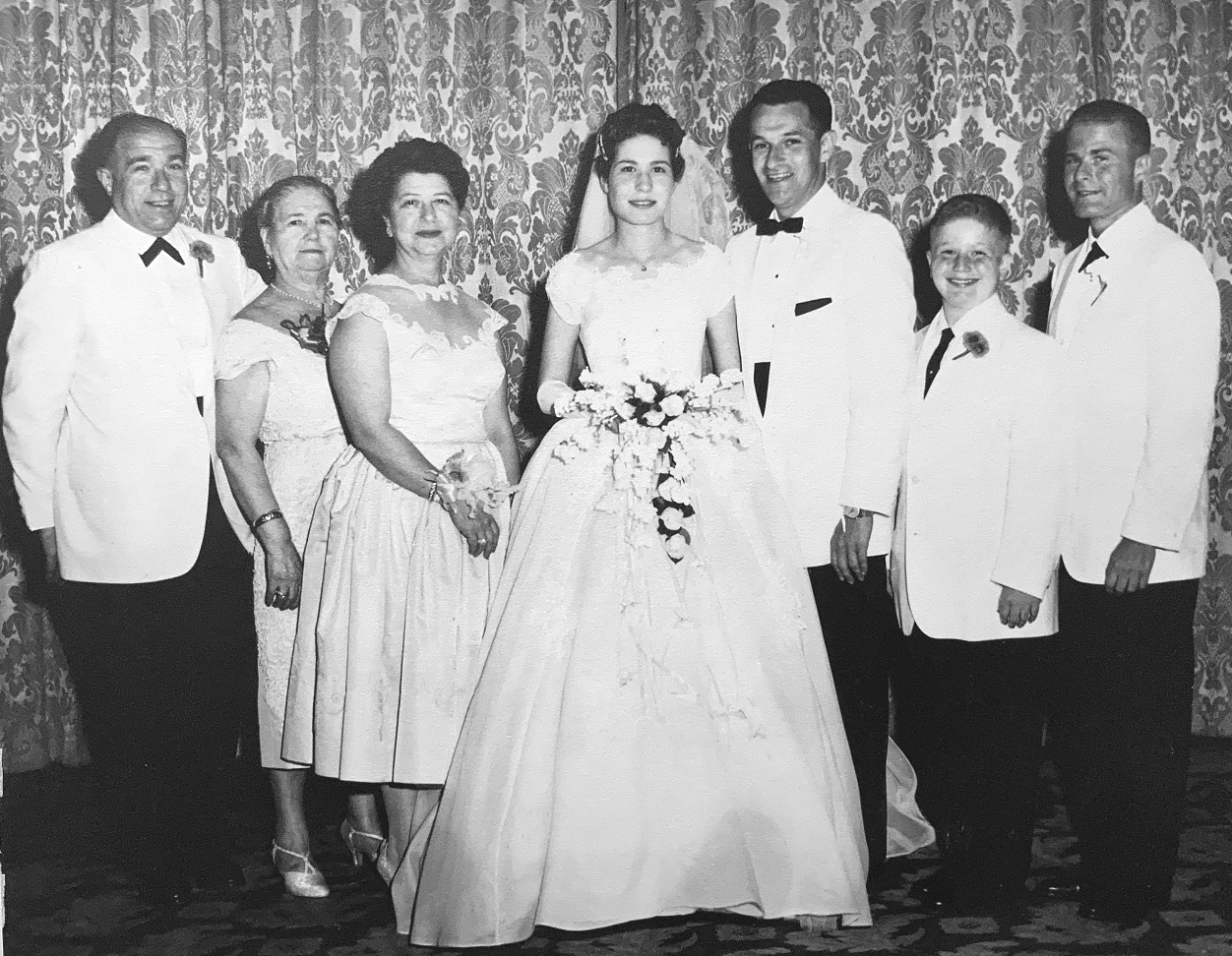
Herbie and Ellen got married in a big hall on Ocean Parkway on June 23, 1957. Nearly everyone in the wedding pictures is now old or dead, even the kids. Some of the guests have been dead for sixty years. Ellen’s sister—my aunt Gladys—either is missing from or looks angry in these photos. She claimed that it was not only strange but immoral and possibly evil for the little sister to get married first. Years later, long after she’d taken to her bed, Gladys said it was Ellen’s marriage that caused her to give up on life.
Herbie and Ellen moved directly from the homes of their parents into an apartment together. Ellen, barely twenty, had never lived with anyone but immediate family members. She was pregnant by the spring of her junior year in college. Their daughter, Sharon, was born in the fall semester of her senior year. Herbie had graduated from college by then. He spent nights at NYU Law School and worked a variety of jobs during the day, eventually taking a full-time position at Allstate Insurance. He started as a claims adjuster, a job that served as a kind of postgrad course in his lifelong study of negotiation. It was in these years, while establishing just how much the company should pay out for water damage, car wrecks, lightning strikes, and fires, that he began to turn what he’d done naturally on the street in Bensonhurst into a career.
Asked to define negotiation on the old Tom Snyder show, he said, “It’s two kids arguing on the corner of Eighty-Sixth and Bay Parkway. It’s a husband and wife fighting about where to have dinner. It’s a mom getting her kid to do homework. It’s John Kennedy talking to Khrushchev and Khrushchev banging his shoe on the table and screaming, ‘We will bury you,’ Khrushchev, who, all the while, has two perfectly good shoes on his feet. It’s not something you learn, but something you’ve always known and have been doing all your life.”
Herbie climbed like a rocket through the ranks at Allstate. He started in his car, driving accident to accident, examining damage, interviewing cops, firemen, experts, claimants, writing reports, determining settlements, then arguing about those determinations. By 1960, he’d been moved into an office. As in the army, progress meant working indoors. He was put in charge of his own crew. He trained new hires, sent adjusters out on jobs, edited and occasionally rewrote reports, stepped in when a claim went sideways. He was the man in the financing shed, the wizard behind the curtain, the closer in the bullpen. He said a key to his success was settling quickly rather than fighting, overpaying a little instead of going to court and overpaying a lot—negotiation.
Because his crew outperformed all others, he was put in charge first of an office, then of a region. He was promoted four times in five years, each promotion meaning a new office in a new town. Between 1960 and 1965, Herbie and Ellen—who now had a son and a daughter—moved four times. They went from a one-bedroom apartment on Aurelia Court in Brooklyn, to a three-bedroom house in Berkeley Heights, New Jersey, to a four-bedroom house in Syosset, Long Island. Every step was a step up, every move was a move forward—a bigger foyer, a flatter yard, a larger sky.
Sweet’N Low had been perfected by the time Herbie and Ellen exited Brooklyn. A pink packet had been chosen to stand out among the white packets of sugar, a logo had been designed, slogans invented and run in advertisements and printed on billboards. Ben, who’d started by distributing the product to pharmacies and health centers where it was presented as an alternative for diabetics and the obese, soon discovered there was a mainstream market for his elixir—a hunger, a need. Modern advertising had made nearly everyone feel the same way about their bodies—not good. If you wanted the taste but hated the shame, the mirror, the way your clothes chafed, Sweet’N Low was the answer. People admitted to hospitals for minor surgeries began stealing Sweet’N Low packets first from the food tray, then from the supply closet. Once released, they called Cumberland to ask if they could buy the product in bulk. By the early 1960s, pink packets could be found on every table in every diner on the East Coast. By the mid-1960s, boxes of Sweet’N Low were stocked in the baking aisle of supermarkets all around the country, as if it were a staple. Market success depends on identifying a personal desire that’s broadly shared. If it’s true for me, it’ll be true for millions. In waging a struggle with his weight, Ben had satisfied a general need. In satisfying a general need, he’d plugged into the zeitgeist and boarded the money train.
But fortunes are double-edged: there is the useful and good; there is the destructive and bad. Useful because money makes everything easier. Destructive because money turns people into jerks. The story of the Eisenstadts is the story of what happens to a typically dysfunctional middle-class American family when a hundred million dollars rains down. Ben became angry, Betty stingy, demanding, and mean, Marvin haughty and unreachable. Ira came to believe it was okay to spend your life in a mansion with a hundred cats. Ellen became insecure, paranoid. And Gladys, who’d been mildly disturbed, went completely insane. She’d had psoriasis since she was a teenager, an autoimmune disorder that turned her skin blotchy and red; psoriasis patches look like scales. According to the Mayo Clinic, 250 million people have been diagnosed with the condition—that is, 2 to 3 percent of the world’s population. It’s highly treatable. Cortisone. Vitamin D. Sunshine. Diet. Exercise. But, with all that money enabling her, Gladys refused to see a doctor, then fixed on the disease to explain her unhappiness. Urged to get outside into the heat and watch her diet, Gladys instead retreated to a dark chilled room on the ground floor of her parents’ house, where she watched TV, talked on the phone, and ordered pizza and Chinese food, with a preference for Hung Chao’s signature dish, Fatty Duck. “The worst goddamn thing for her,” Herbie said, “and she ordered it five, six times a week.”
Ben urged Gladys to get out, get a job, live her life, but the more he urged, the more stubborn she became. She screamed, insulted, threw dishes, and pounded the wall, yelling, “Look at me! Look at me! Look at me! I hate you! I hate you! I hate you!” Untreated, her ordinary case of psoriasis deteriorated into arthritic psoriasis. Her fingers cramped with pain. Finally, a doctor was called. He examined her in the room, then gave her a choice: she could get out of bed, seek treatment, and begin physical therapy or have her fingers surgically fused to relieve the pain. Without Ben’s money, she would have been forced to get up, get out, get going. With it, she was able to afford the surgery, which is why her hands worked less like gloves than like mittens. With minor exceptions, Gladys spent the next forty years in bed.
No. 20
Herbie and Ellen had dinner in Midwood every Friday night. This was not a request but a requirement that Betty called a tradition. It must have been connected to the Jewish Sabbath, but any hint of religion had washed away. Only a few inscrutable rituals remained. There was no God, but there were candles. There were no prayers, but there was music. They were like Spanish conversos, practicing customs that lost their meaning long ago.
Herbie hated the dinners. They were boring and awkward, and it got worse after he made the mistake of asking Ben if he could borrow a few thousand dollars for a down payment on a house. Ben, who was then selling more than a hundred million packets of Sweet’N Low a year, said that though he’d like to help, his assets were tied up in long-term investments and he “wasn’t liquid.”
Also, the waiting. Herbie spent at least an hour alone every Friday night killing time until Marvin and his wife, Barbara, arrived. He was left by himself in the living room while Betty took Ellen upstairs to show off her newest rings and brooches and the children went back to the cold dark room to be propagandized by Gladys.
One night, he’d had enough. After thirty minutes in the living room, he went into the kitchen and crawled under the table, where he was hidden by a long tablecloth. “Let them wait for me,” he said to himself. “Let’s see how they like it.” He stayed there for ten, twenty, thirty minutes. He stayed until he heard Ellen wandering the house, calling his name. She looked in the living room, the dining room, the kitchen. She asked the maid—her name was Edith and she had eleven fingers, with a second pinkie on her left hand that did nothing—then went to look for him outside. Just as Herbie was about to crawl out, two pairs of feet appeared beneath the tablecloth, sensible loafers on this side, glittery pumps on that. Ben and Betty! Ben admonished Betty in dulcet tones. He’d gotten a bill from Edna Nelkin’s jewelry store on Nostrand Avenue. Betty had spent forty thousand dollars at the store in June. “I’m not saying you can’t get what you want,” Ben told Betty. “I’m just asking you to be more discerning.”
Herbie waited under the table long after Ben and Betty had gone. When he finally clambered out, it was into a new world, with a different state of mind. He could hardly look at Ben after that. The Friday night dinners, which had merely been pointless and boring, became excruciating. He began inventing reasons to skip: he said he had to work late on a project, or was coming down with a fever or a sprue. Or he simply didn’t show.
When Ellen called the house, he’d pick up as if there were nothing amiss.
“Hello.”
“Where the hell are you?”
“What do you mean? Where the hell are you?”
“At my parents’ house!”
Pause.
“Wait. What day is this?”
When offered a promotion that would mean relocating to Illinois, he gripped the opportunity with both hands. There were risks and unknowns, but one thing was certain: he’d never have to go to another Friday night dinner.