
Herbie had ascended from Allstate to its parent company, Sears, where he was named to the executive committee. At thirty-two years old, he was the youngest member of senior management, in charge of deal making and training, tasked with representing the company in meetings and teaching the other executives how to negotiate.
Sears began as a mail-order watch company in 1886, grew into a general catalog business, then was built into a behemoth by Julius Rosenwald, a German Jew from Springfield, Illinois. But Rosenwald died in 1932. By the time Herbie arrived thirty years later, the upper ranks had been taken over by Waspy Ivy League business school graduates. Arriving each morning, Herbie would sing out, “Company Jew, passing through!”
Given three weeks to relocate, he flew to Illinois, visited the office—a mirrored glass box beside the Edens Expressway in Lincolnshire, a suburb of Chicago—toured Libertyville, a town where many Sears executives lived, visited a few houses, purchased a split-level colonial in a neighborhood recently pried from a forest, then flew home.
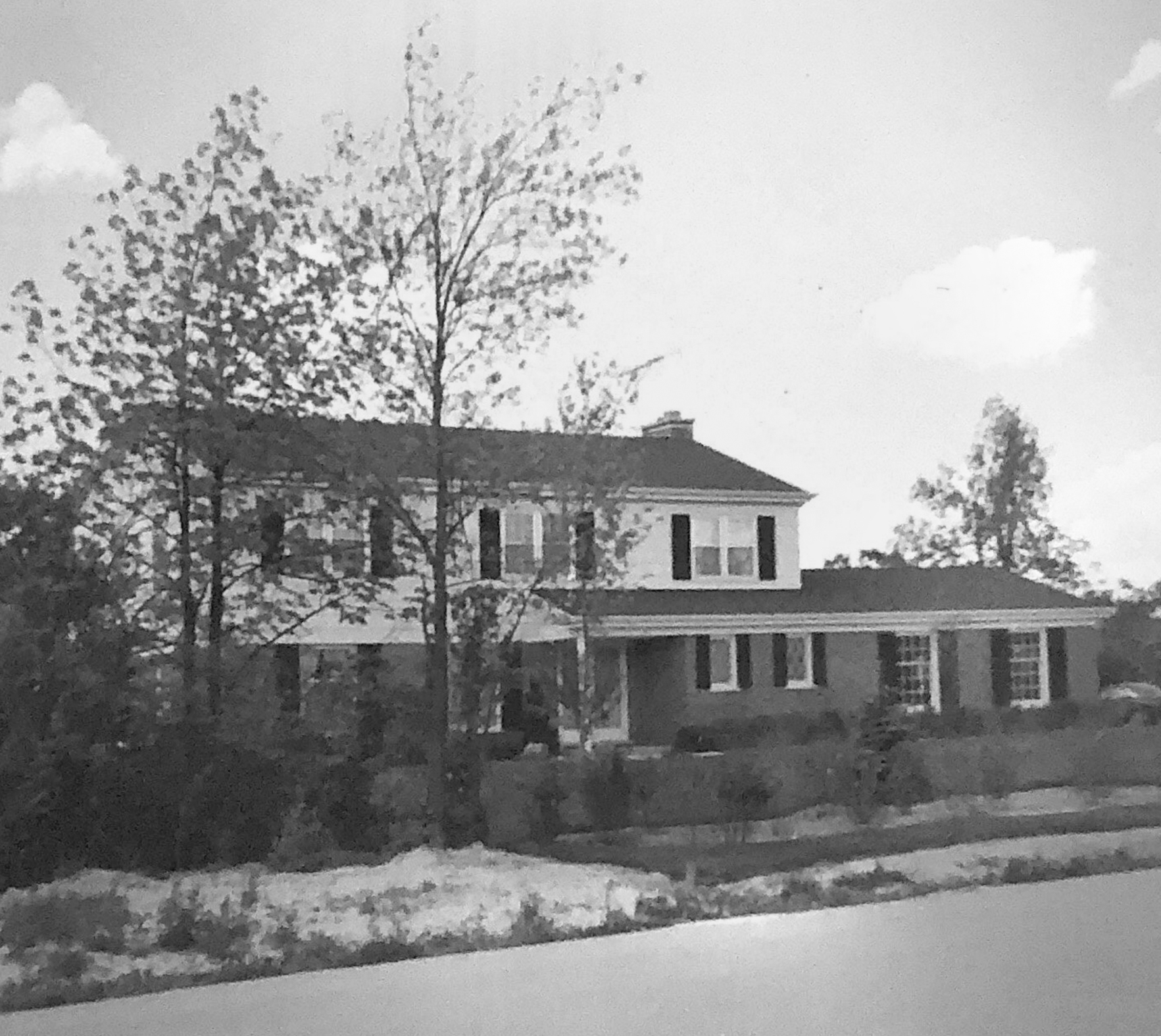
The street was treeless, as exposed to the elements as the Sahara. The Des Plaines River, high and fast in March, sleepy and low in July, thick with ice in February, was a hundred yards from the front door.
Ellen was less than thrilled with the town. She was a Brooklyn girl, a product of subways, diners, Broadway shows. She’d never learned to drive. And here she was, frozen in the snowy semirural sticks.
“At least there are Jews,” she said.
“How do you know that?” Herbie asked, surprised.
“There’s a Chinese restaurant,” she said.
As it turned out, Libertyville was maybe the only American town with Chinese food and no Jews. When asked if he encountered anti-Semitism in Libertyville, Herbie said, “Nah, they were happy we moved in. A neighbor said, ‘Thank God. We were afraid they’d sell to Catholics.’”
Thus was born Herbie’s new identity. He’d been a knock-around Brooklyn guy in Brooklyn, a grizzly in the North Woods. He’d now become a grizzly in town, a fish out of water, a Bensonhurst boy in the provinces. In such a circumstance, most people try to blend in. Herbie went the other way. (“When they zig, I zag,” he’d explain.) He exaggerated his differences, played up and accentuated the Brooklyn parts of his identity. His accent became thicker in Libertyville, his voice louder. He wore sweat suits and his Lafayette letterman’s jacket on the weekends. He greeted strangers in town, stood in line with the cars at the bank drive-through—a human among machines—shouted across the street to friends the way he’d shouted to Inky, Bucko, and Who Ha. People loved him in Libertyville, and he loved them right back. He was a character, a small-town celebrity, the sort of oddball you went to with a problem. He helped neighbors work out their purchases and closings. His art of the deal was never about tricking an opponent. It was about making the other person feel respected, getting a good deal while letting the other guy feel he’d done the same. Win-win. “And it isn’t because I want to be a good person,” he’d explain. “It’s because I want to be effective. If the other guy walks away feeling bad about what happened, the deal is going to fall apart and you’re going to end up with nothing.”
People often asked where he came from.
“Me?” he’d say in his Brooklynese. “I come from Cheyenne, Wyoming.”
If asked what he did for a living in Cheyenne, he’d say, “I’m a Presbyterian minister.”
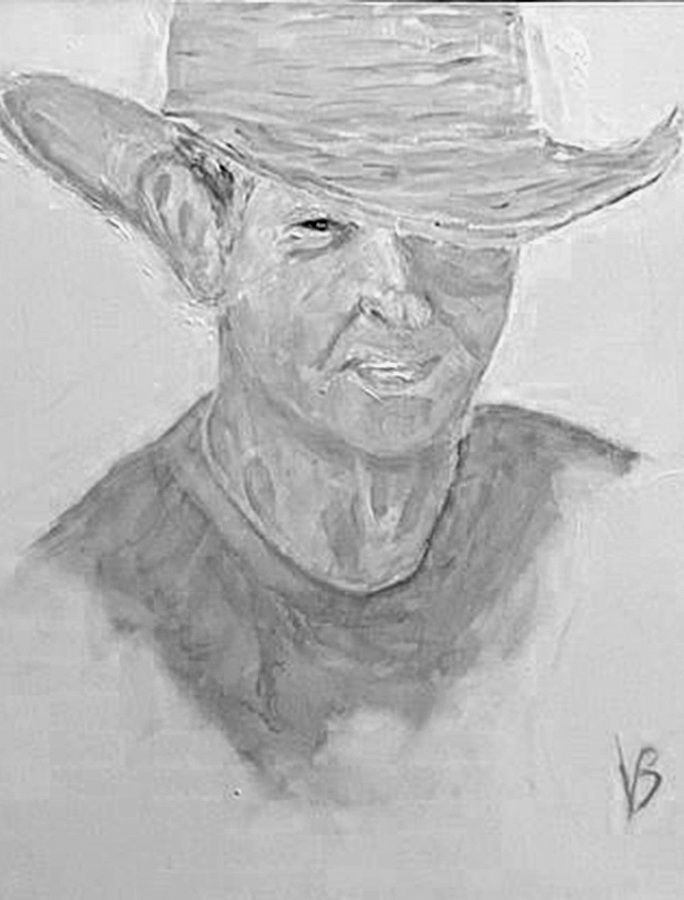
He took to wearing a suede cowboy hat in Libertyville. It became a trademark. He said it identified his true character. He might talk like a Dead End Kid, but he was really a cowboy, a High Plains drifter. “I fix a problem, settle a feud, bring peace to the people, then move on.”
A woman in town became obsessed with him and insisted on painting his picture, which hung in the window of the Liberty- ville art shop for years.
Being the only New Yorker in town, the only street corner guy, did not bother Herbie. In fact, he loved it. It gave him a new shtick—the comedy of contrast.
No. 22
His oldest child, Sharon, was seven when the family moved to Illinois. Herbie and Ellen being the only Jewish parents in town made Sharon the only Jewish kid in school. Mostly it was nothing you’d notice, but not always. If a kid did something stupid, another kid would say, “Don’t be such a Polack.” If a kid did something weak, another kid would say, “Don’t be such a girl.” If a kid did something cheap, another kid would say, “Don’t be such a Jew.”
No one likes to be turned into an adjective, especially when they’re the sole example of the type. This was a childhood far from that experienced by Herbie or Ellen, so there was not much Herbie could say other than “Ignore it.” As for Ellen, she ascribed it, as she ascribed all acts of indecency directed at her children, to jealousy. “They’re pea green with envy,” she’d say.
Ellen took Sharon aside the summer before fourth grade and said, “I’ve got good news.”
“What is it, Ma?”
“There’ll be another Jewish kid in school next year.”
“Who is it, Ma?”
“Your brother Steven.”
Cut to Steven: a tough five-year-old, six-year-old, seven-, eight-, nine-, ten-year-old. His eyes, deep and oddly intense for a kid—one blue, the other green—gave him the look of a grade-school intimidator. It’s a quality he’s never lost: you don’t mess with him for fear of what he’ll do. He was never a cool kid but was never anything other than cool; he was a force apart, surrounded by a small group of worshipful contemporaries who figured he’d always have a plan, an answer, a way out. In other words, he was a lot like Herbie.
Ellen hoped Sharon would look out for Steven in school, but Ellen had it backward. It was not Steven who’d need protection, but the opposite. He’d become a playground big shot by fourth grade, the go-to guy behind the swings, the sort of junkyard fighter Tom Hagen has in mind in The Godfather when he says, “Even Sonny won’t be able to call off Luca Brasi.”
This put him at cross-purposes with Sharon, who, having started as a junior school patrol officer in third grade, climbed the ranks to a senior bus monitor, charged with keeping peace on the very route that Steven kept in turmoil from 3:05 to 3:22 each afternoon.
Sharon, who walked the aisle of the bus in a red sash, warned Steven several times in the fall of 1973. When he carried on, she issued him first an unofficial warning, then an official warning, then a second notice, and finally a pink slip. He was to appear at a meeting with the principal, vice-principal, bus driver, and senior bus monitor. In the meantime, he was banned from the bus. When Herbie and Ellen found out, they were angrier at Sharon than at Steven. For Ellen, it meant she’d have to drive Steven to school each morning and home each afternoon, wait in that line, deal with the snowy roads and her fear behind the wheel. For Herbie, it meant Sharon had failed to understand an essential part of an ancient code. If you have a problem with your brother, you deal with it inside the family. Don’t rat; don’t turn your brother in to the cops.
It was another one of his big lessons. Loyalty. Without that, you have nothing. A fan of Westerns, he used to quote Sam Peckinpah’s The Wild Bunch, tugging at his hat and saying, “When you side with a man, you stay with him, and if you can’t do that, you’re like some animal. You’re finished. We’re finished. All of us.”
No. 23
I was born the day Neil Armstrong took his first “small step” onto the moon—minus a year, plus ten days. July 30, 1968. I’m the only member of the family born in the Midwest. Lake Forest Hospital, where the nurses poured champagne in every room, even delivery. My mother once told me I was “an accident,” quickly adding, “a wonderful accident.”
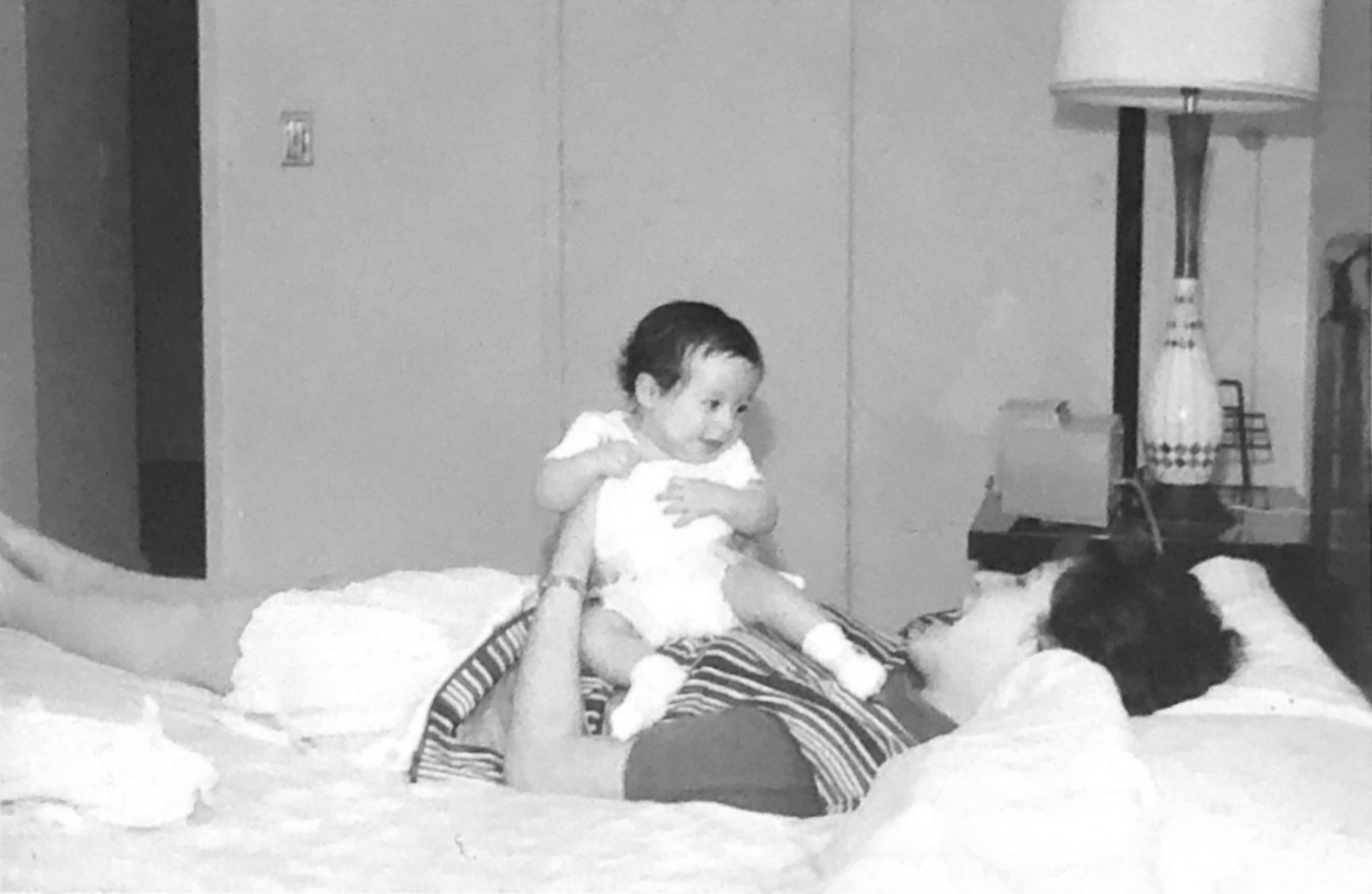
Herbie and Ellen had a perfect family. One girl, one boy—environmentally responsible, replacement numbers. They thought their work in child creation was done in 1963. I arrived like a party crasher ringing the bell at 4:00 a.m., shouting, “I know someone’s in there.”
I was barely four pounds at birth, weak and sickly. My twisted legs took months to repair. Without modern medicine, I would have been like a cripple in Dickens. There was something wrong with my heart, too. “He’s got a bum ticker,” a doctor said. I had to be brought to the hospital every few weeks for an EKG. At some point, a doctor said, “He’ll eventually need a heart transplant.”
My mother went home after getting this news, got out the scissors, and cut off all her hair. As it sometimes turns out, the doctor, though correct in many specifics, missed the big picture. Without going into detail, it’s enough to say that I am fifty-two years old as I write this and still in possession of my original heart.
My sister claims that I was treated better, more gingerly, with greater care, than she and Steven because my parents believed I would not be around very long. Though I can’t prove it, I believe the way I was handled in those early years—my continued existence was accepted after age eight, when a new procedure revealed I’d been misdiagnosed—explains the perfect memory I have for faces, houses, rooms, and voices.
Close your eyes.
Think back.
What’s the first thing you remember?
For me, it’s a family gathering, a bris—the circumcision performed, as prescribed in the Bible, on the eighth day of a boy’s life. (God in Genesis: “Every man child among you shall be circumcised. And ye shall circumcise the flesh of your foreskin and it shall be a token of the covenant betwixt you and me.”)
Whose bris?
My own.
People tell me it’s impossible, that I remember not what happened but what someone told me happened, or what I dreamed or imagined, but I know what I know. The ceremony was performed in the living room in Libertyville. I remember the carpet (burnt orange), the walls (red brick), the buffet (smoked fish, rugelach). I remember my bassinet and my blue outfit. I remember the gargoyle faces of my aunts and uncles. I remember the wine-soaked napkin that, shoved between my lips when the cutting was done, plunged me back into the void.
Then I’m three or four years old, standing in the driveway in front of the house, watching my brother and father play basketball. Herbie is in a wheelchair, having snapped his Achilles tendon while playing in a pickup game with men half his age. He dribbles with one hand while navigating the wheelchair with the other, like a guy in a movie about Vietnam vets. Then I’m in his office and he’s blowing smoke into the aluminum tube that held the cigar and sealing it. Later, when I open the tube, the smoke drifts out, like a transmigration of souls. Then we are driving through a landscape I can’t quite place. My father is playing a Frank Sinatra song on the eight track called “Noah,” which includes the lyric “You’ve got to walk with the lion.”
“What do you have to be to walk with a lion?” he asks.
“You have to be brave,” my brother answers.
“Wrong,” says my father, laughing. “You have to be a lion.”
Some of these might not even be my memories. They might be stories that grew in my mind while looking through the box of pictures my mother kept in a kitchen drawer. My brother, my sister, and I walking in the barren woods in winter.
My father at the wheel of his Karmann Ghia, cigar in mouth, split-level colonials buried in snow. Laundry hung on a cord in Mundelein, Illinois, that clean starchy smell. A circus tent. A Ferris wheel rotating at night.
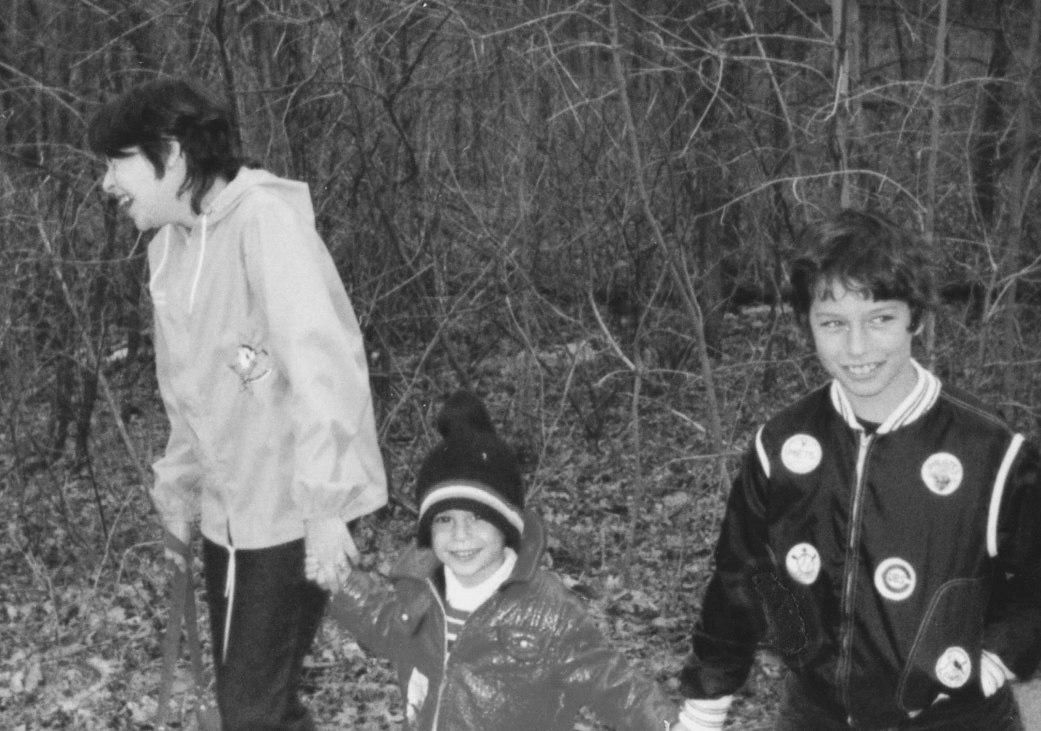
Herbie led a nine-to-five existence at Sears. He was what his uncles would have called a “jobnik,” up at six, heavy-lidded in rush hour, home by the other six, which, from October until March, meant he left in the dark and returned in the dark. His routine was more stable and traditional than it ever had been or ever would be again. He spent weekends around the house, leading us along the Des Plaines River in pursuit of adventure. We searched for the lost treasures of Billy the Kid and Father Marquette. We hunted grouse, snipe, Cornish game hen, turkey. He asked us to follow him onto the frozen Des Plaines River. Steven, having been warned by a teacher about black ice, refused. Herbie jumped on the ice to prove its stability, then fell through. I think of this whenever he quotes one of his favorite sayings: “If you’re walking on thin ice, you might as well dance.”
He told us stories at night. Whereas other kids heard about Hansel and Gretel, Pinocchio, or the Three Bears, we heard about Bucko, Who Ha, Inky, Zeke the Creek, Gutter Rat. Herbie was the hero of these stories. He got his friends into trouble, then got them out. There was no apparent point to his behavior, no reward. It was just about the challenge, the fun. He did it so he could talk about it later. He did it because what is life if not all the crap you did tallied and described? Of course, there was a point, though it was hidden. He’d been training himself for a career in negotiation, for life in the adult world, which was just the kid world amplified and for real.
No. 24
It was all the driving that convinced Herbie and Ellen of the need to move out of Libertyville. The precipitating event happened shortly before my fifth birthday. Because there was no prekindergarten in town, my mother or father or the housekeeper, named Bea, shuttled me to a school in Highland Park twice a week, a fifteen-mile trip each way.
While we were stopped at a red light one afternoon—I had just seen two trains speeding in opposite directions on parallel tracks, for me a premonition of disaster ever since—a car plowed into us from behind. I was in the passenger seat without a seat belt. Bea threw me back at the moment of impact, saving my life but sending her into the steering wheel. Turning to me, she said, “You’re fine,” and as she said this, blood poured from her mouth. I fainted. When I opened my eyes, a paramedic was pulling me from the car. My eyelashes were scattered across my shirt. They’d fallen out from shock. Herbie and Ellen began looking for a house closer to the city—closer to the airport, closer to shopping and schools—the next day.
Herbie quit his job. Sears had been lending him out to other companies, where, for a fee paid to the home office, he’d analyze their operations, negotiate their deals, train their workers. It had been only a matter of time until he decided to cut out the middleman and do this work on his own, selling his services directly. He’d never again work in a single location or office, but in towns and cities around the world. There was some thought of moving back to New York, but Chicago, with its big, centrally located airport—halfway between JFK and LAX—was the best place to headquarter such a peripatetic career.
Herbie and Ellen looked in half a dozen towns—Wilmette, Winnetka, Evanston—before settling on a split-level ranch in Highland Park. Houses, good houses, could be had for a song back then. America is an arrow. In the years that followed Watergate, it was pointing down. A ten-bedroom mansion could be purchased on Chicago’s North Shore for five hundred thousand dollars. The Highland Park house listed at eighty thousand. Herbie agreed to pay sixty thousand dollars, fixtures and furniture included. While waiting for approval from the bank to schedule a closing, he left on a long work trip. Each day, after speaking to executives in office courts or hotel ballrooms in Wisconsin, Minnesota, or Iowa, he’d call Ellen from his motel room and ask, “What happened today?” always wanting and expecting the same answer, “Nothing.”
Then, one day, instead of saying “Nothing,” she said, “I bought a house.”
He corrected her: “You mean that we’re buying a house.”
“No,” she said. “I withdrew that offer and bought a different house. In Glencoe.”
He corrected her again: “You mean you saw a house you like in Glencoe and want to withdraw the Highland Park offer.”
“No,” she said. “I mean I found a house I liked in Glencoe and bought it.”
Herbie stared at the twenty-two-inch Magnavox across the room, saying nothing. February. Frost on the motel windows. Ellen could hear Johnny Carson doing his monologue: “Last night, it was so cold the flashers in New York were only describing themselves.”
“Okay,” said Herbie. “Start again at the beginning.”
Ben and Betty—Ellen’s parents—had flown from New York to help with the children. In the middle of the week, maddened by boredom, Ben told Ellen he wanted to see the new house. They met the realtor in Highland Park. Ben walked through the rooms, examining floorboards, looking out windows, muttering—he was a gruff, opinionated man—then asked the realtor if she had other properties for sale in the area. They followed her into Glencoe, where Ben fell in love with a creaky wreck of a house, a five-bedroom English Tudor that had been through nearly a century of hard weather and rowdy families. It was more than twice the price Herbie wanted to pay, a difference Ben promised to cover. Ben made a first offer that night, handled the negotiation, then closed at $120,000.
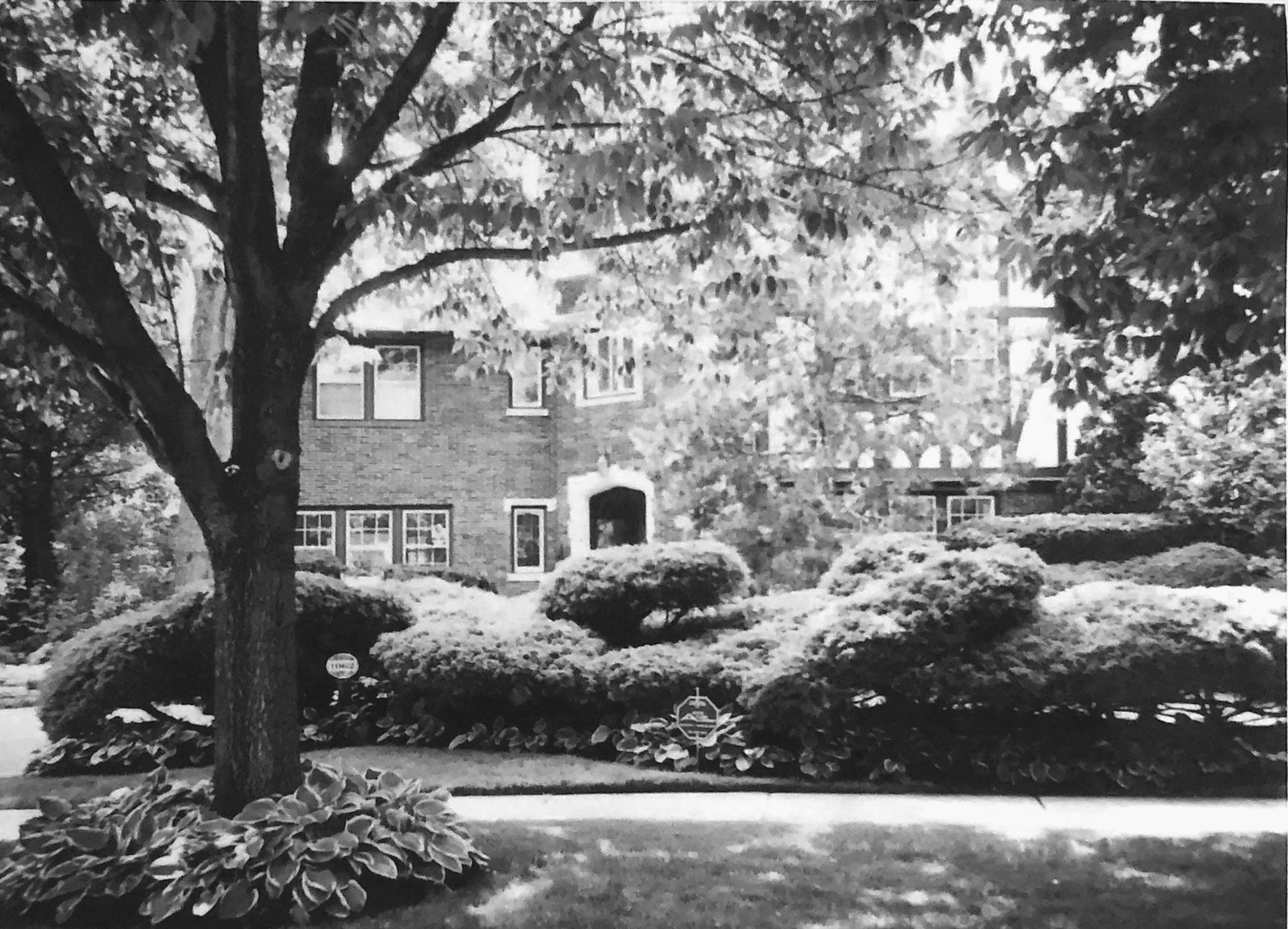
My mother took us to see the house the next day. It was at the end of a root-buckled street shaded by elm trees, many marked for destruction. This was year zero of the Dutch elm blight. The Highland Park house had been mid-century modern, close to new, sensible, well ordered, clean—America as it wanted to become. The Glencoe house was rambling, drafty, and old—America as it actually was. There were hidden staircases, false doors, dumbwaiters, laundry chutes, and a basement that flooded whenever it rained. The kitchen had been remodeled during the Eisenhower administration. Every appliance was state of the art circa 1953. Restaurant-grade keep-hot lights, built-in toaster, and built-in can opener, all of it broken. There were two chimneys, one for the fireplace, one for the incinerator, an industrial-size trash burner, use of which had been banned generations before. If you reached in, you could pull out scraps of the newspaper saved by the reprieve: Chicago Daily Tribune, December 1935: “Gem Plot Exposed as Hoax”; “Britain Washes Hands of Peace Plan at Geneva.”
We had picked our rooms before my father even learned of the purchase. When he tried to back out, my mother said, “We’ll lose the deposit. And Richard’s already made a friend.”
(That would be the kid across the street, Dennis.)
When Ellen called Ben in Brooklyn a few nights before the closing, he cursed under his breath, then said, “I forgot all about it.” He told my mother he did not have the money to give her, that he’d planned to, only to realize, on his return to work, that his money was tied up in investments and he was “not liquid.”
Herbie put in the money he’d been saving for renovations, then called his father, Morris, who, though he was, to borrow a phrase from Miami Beach, “living on a fixed income,” wired the difference without comment. When Herbie promised to pay it back, Morris waved him off, saying, “It’s a gift. Never mention it again.”
And so the Cohens came to inhabit 1062 Bluff Road in Glencoe, Illinois, where the s is silent and the populace hardy. That house was the only place I have ever felt truly at home. It’s where my mind goes when I feel sick, mistreated, sorry for myself, or lonely. I dream I’m back in that house, usually hiding from the new owners, at least once a month.
No. 25
A person from Glencoe will tell another person, usually a person from the East, “I grew up on the beach, just like in that Dick Dale song,” but my wife, Jessica, who is from Connecticut, told me I did not grow up on the beach because the beach means the ocean, which is thousands of miles either way from Illinois, but those of us who came of age on Chicago’s North Shore know Lake Michigan for what it is—a mighty inland sea, subject to storms and tides, ringed by more than a thousand miles of beach. According to a map, Chicago is across the water from St. Joseph, Michigan, but if you’d asked the childhood me what was on the other side, I’d have told you, “Paris.”
Glencoe is nineteen miles north of the city. Its expensive homes are built on the rim of a ravine that overlooks the lake, which, like the sky, changes color with time and season. It’s a mood ring that reveals the temper of the town—black in winter, gray in autumn, green in spring, blue as the Mediterranean in summer. There are harbors and bays along the coast, mooring fields with fishing boats, sailboats, yachts. There are tiny private beaches and a sprawling public beach with a raft and a pier and a lifeguard. A stone path leads from the beach to Park Avenue, which you can follow into town.
We were free in that town in the summer in a way kids will never be free again. Our parents, having released us after breakfast, did not reclaim us until dinner, then released us again. We did not go home until we could see Venus. We roamed in hordes, like gangs, pedaled our bikes to the lake, pedaled our bikes to the forest preserve, pedaled our bikes to the lagoon where the mob dumped bodies. We hung around older kids, big brothers and cousins, listening to their stories about old Glencoe, the way it used to be. If it happened more than three years earlier, it was history. If it happened more than ten, it was Noah and the Flood. We heard about stores that existed before these stores, teachers before these teachers, slang before this slang. We heard about Big Ed Walsh and the Bird Man, Mike Bloomfield and Kenesaw Mountain Landis, about the day the woods caught fire, about the ghost that emerges from the lake on moonless nights.
There were two commercial streets in Glencoe, Vernon and Park. Within a hundred yards of that intersection, you could get anything a person would ever need for a good life—records (Wally King’s), sporting goods (Ray’s), customized T-shirts (You Name It), pizza (Little Red Hen), hot dogs (Big Al’s), hardware (Wienecke’s). When it came to essentials, there was two of everything—two delis, two pharmacies, two banks—which taught you all you’d ever need to know about market economics.
We had lunch at Ricky’s Delicatessen our first day in town. Before we were finished, Herbie knew half the people in the place. He went out to the alley to smoke a cigar with Ricky himself. He was soon as well known in Glencoe as he had been in Libertyville. He had a way of turning every place into Brooklyn.
It was a depressing time in America, post-everything. Post-Vietnam. Post-Watergate. Three Mile Island, stagflation, Billy Beer, malaise—this was the afterpiece, the dregs, the silt bottom. Everything was broken. Everyone’s parents were divorced. Everyone was on drugs or in recovery. Herbie built a bubble to protect us from all the negativity. There was no divorce in our house, nor talk of divorce—no video games, no drugs, no drug talk. My parents didn’t even know the language. At most, my father might mention a “funny cigarette,” or my mother, worried about my sister, might advise her to never “smell cocaine.”
It was less like growing up in the 1980s than in the 1950s. When a consortium of towns asked Herbie to handle the negotiations meant to bring us cable TV, he violated his own rule, striking a deal so favorable it seemed punitive, causing the parent company to pull out. When asked about it—our township remained one of the few in America without cable for years—he’d insist he’d done it intentionally. He said it was his way of “giving the kids around here another decade of the old-fashioned childhood; they’ll thank me when they’re thirty.”
He pranked and goofed on us constantly. In this way, he was expressing another part of his philosophy. Don’t act as if you know what’s going to happen; you don’t. And: the sky is gray and the windchill brutal, but you can still have fun. Leaving a movie theater or restaurant, we’d race through the cold to the car, the station wagon or Cadillac. We’d be frantically tugging on the locked doors when he strolled up, cigar in mouth, whistling a Sinatra tune. He’d go to the driver’s side, unlock the door, get in, fix the rearview mirror, then the side mirror, adjust his seat, fumble with the keys, start the engine, crank up the heat, readjust the vents, all the while ignoring our screams and hammering. He’d put the car in reverse, back up five feet, then suddenly seem to notice us. He’d slap his forehead, unlock the doors, and say, “I didn’t even see you.”
He refused to wear anything heavier than a windbreaker even when it was ten below, explaining, “It’s because of my genetic heritage. Unlike you all, who take after your mother, I come from a hearty stock and was built for cold.”
He was a man of tremendous appetites. For comedy, success, love, and food. He was one of those human yo-yos who can gain or drop a hundred pounds in a few months. Binge and fast. Consume and forsake. Sin and repent. Enjoy and suffer. This was good for his tailor but bad for his blood pressure, blood sugar, knees, and back. I worried about his health constantly. All the needles touched red, but he just went on smoking, bingeing, running, fasting. He read the newspaper while he drove! When trying to scare him straight, I asked, “What will I do if you die?” He did not answer as most fathers would—“You will be fine”—but focused on my second clause, saying, “Nothing can kill me. I will never die.”
He was the worst kind of helicopter parent with my sister. He says the key to success is caring, but not that much, but when it came to his oldest child, he cared too much. He pushed her into clubs, bigfooted her school assignments. She hated sports, but he sent her onto the court or field anyway. He believed the experience would teach her about teamwork and competition, how to handle victory, how to suffer defeat. When she rejected softball, he signed her up for basketball. When she gave up on that, he sent her to horseback-riding camp, where, bucked by a horse named Grandma, she broke her wrist. He’d ride behind her in the car as she trained for track, cigar in mouth, blasting the horn when she slowed, shouting, “Move it!”
The college application process—that was the worst. He wanted her to have the college experience he’d missed, which meant a small school with a nice campus. Amherst. Williams. My sister was accepted by Carleton, a liberal arts school in Minnesota that fit the bill, but she decided to go to Tulane in New Orleans instead, partly because of the weather, partly because of the locale, partly because she knew it would drive him nuts. When people asked where Sharon was going to college, Herbie would say, “She was accepted by Carleton.”
He was tough on my brother, too. When he heard Steven was being tormented by bullies at school, Herbie drove him to the ringleader’s house and made him knock on the door and ask the kid to come outside and fight, the presumption being that bullies are cowards who operate only in packs. (He was right about that.) He pushed him to play ice hockey because “hockey will make you tough.” He insisted on Brooklyn Rules when playing basketball in the driveway, which he explained this way: “If you go over me for a layup, you’re gonna pay a price.”
He gave my brother the same list of colleges he’d given my sister. When my brother rejected these, Herbie, having softened with age, said, “Fine. Go anywhere you can get in, with one exception: NYU. I want you at a college with a campus.”
So that’s where Steven went: NYU.
Having failed to impose his will on my siblings, Herbie let me skate. “Kids are like pancakes,” he’d say. “You should be allowed to throw out the first batch. There’s nothing wrong with the batter; the grill wasn’t hot enough.” He’d wised up when my turn came. And just wasn’t around that much, leaving him little time to mold me. Having experienced a first flush of big success, he’d become fixated on his career. He was giving as many as 250 speeches a year when I was in middle school, traveling from boardroom to boardroom, from convention to convention, and leading negotiations around the world. He’d begun to write columns for the local papers and to appear as an expert on Chicago TV. His funny stories and sayings always seemed to have a message, though it could be inscrutable: “A nose that can hear is worth two that can smell.” “Why ask the monkey, when you can ask the organ grinder?”
He wore two watches, one on each wrist.
“A man with one watch thinks he knows the time,” he’d explain, “but a man with two watches knows he can never be sure.”
He became the subject of magazine articles. His speaking fee doubled, doubled again. He landed a regular gig on Chicago’s ABC TV affiliate, WLS, where, twice a week, he shared his thoughts on everything from Mayor Daley to Super Rats.
Over time, without meaning or wanting to, he gathered a group of disciples. He became a kind of guru. People called at all hours looking for answers: Should I forgive my husband? What should I do with my business? How should I live my life? A woman named Gretchen Ole—she’d been to several of his lectures—phoned whenever something troubled her in the news. There’s a leak at Three Mile Island? Call Herbie. Reagan wants to build a missile command system to blast Russian nukes out of the sky? Call Herbie. It infuriated my mother, who wanted an unlisted number. Herbie wouldn’t hear of it; if you got him on the phone, he was going to talk as long as you wanted. His attitude was this: if you need me, I’ll help. It was my father’s strength and his weakness. He did not want to cut off the disciples, because they made him feel needed.
People went to him for many reasons. He taught them tricks, strategies that could help them navigate life. He taught them how to buy a house, sell a car, end a partnership. Some of his advice was counterintuitive. If you really want a house, you can’t speed the process by offering the asking price, because the seller will think he has set the price too low and back out. If you want to end a war, quit while your opponent is still confident and strong. You must leave him with self-respect if you don’t want an enemy for life.
At the core, all his lessons were about the same thing: empowerment. He tried to wake people up to the power they had without knowing it. He especially loved advising the underdog, the self-defeated who has been crushed by the institution, the machine. “You’re never out of options,” he’d say. “There’s always something to be done.”
His philosophy had been informed by his reading of history, his life in Brooklyn, and the impression made by certain works of art. His favorite passage came from Viktor Frankl’s book Man’s Search for Meaning, where the last human freedom is defined as the freedom “to choose one’s attitude in any given set of circumstances, to choose one’s own way.
“And there were always choices to make,” Frankl goes on. “Every day, every hour, offered the opportunity to make a decision, a decision which determined whether you would or would not submit to those powers which threatened to rob you of your very self, your inner freedom.”
Herbie believed he could talk his way into every kind of office, room, situation. It was all about confidence, he’d say, behaving as if you belonged. Larry told me about the night Herbie bluffed his way into the Democratic National Convention. Madison Square Garden 1992. Larry and Herbie had dinner; then, as he went off to host his show from the convention floor, Larry said, “I wish I could take you with me, Herbie, but the security is insane.”
Herbie: “I’ll meet you on the stage.”
Larry: “No way.”
“And the next thing I know, I’m standing there, talking to Al Gore, and here comes Herbie, walking out onto the stage.”
I figured he’d slipped someone a fifty, or something, but Herbie scoffed at the suggestion. “It’s not money that gets you in,” he told me. “It’s authority. Power.”
According to a reporter friend who’d been there, Herbie had walked up to the head of security and started asking questions about crowd size and deployment. The guard answered each question carefully, in great detail. Then Herbie slapped him on the back, thanked him for his service, and went inside.
When I was in college in New Orleans, he wanted to have dinner at Commander’s Palace, the best restaurant in town. I told him the place was sold out for months, that we’d “never get in.” He insisted we go anyway. He walked to the desk and said, “Herb Cohen, table for three.”
“Do you have a reservation?”
“No.”
“We’re completely booked.”
Herbie threw up his hands, turned to my mother, and said, “I guess Ella was wrong.”
“Ella?” said the maître d’, confused.
“Ella Brennan, a friend of mine. She said I should just come over and you’d seat us. No worries.”
Five minutes later we were at a table for four in the corner.
“Who is Ella Brennan?” I asked.
“She owns this place,” said Herbie.
“Do you really know her?”
“Of course he doesn’t,” said my mother. “There was a story about her in the in-flight magazine.”
We walked by the Museum of Modern Art in New York on my wedding day. I wanted to go in and see a particular painting, but the line went around the corner.
“You don’t have to wait in that line,” said Herbie.
“Of course you do,” I said.
“Well, maybe you do,” he said. “Not me.”
We bet ten dollars. Five minutes later, we were standing in front of the painting on the third floor. He’d gone in the employee entrance in back, where he told the man behind the desk that we’d come from the Governor’s Commission for the Police Athletic League and needed to examine a painting on the third floor.
Bingo.
Some of his tricks were practical. “If you don’t remember a person’s name,” he told me, “ask them if they still live in the same place. Don’t ask them about their children, because maybe they have no children. And don’t ask them about their spouse, because maybe that person died. But if you ask them if they still live in the same place, then either they are still living in the same place and are amazed that you remember, or they’ve have moved and think it considerate of you to inquire.”
It was less advice disciples got from him than a sense of security. That’s what Larry got, too—the sense that no matter how badly he messed up, Herbie could save him. Larry was constantly in trouble when I was a kid. Herbie was constantly getting him out of it, or trying to. At one point, Larry was being extorted by a woman. I don’t remember all the details, but it had to do with pictures and a demand for money. Herbie told Larry they needed to go to the FBI.
“Why?” asked Larry.
“Why? Because this person is committing a crime!”
The FBI arranged a sting. Larry’s bagman would meet the woman on the train platform at Union Station in Washington, D.C., where he’d hand over the cash and get the photos. As soon as the exchange was complete, the FBI would swoop in to make the arrest. Everyone agreed: Herbie would be the bagman. He loved this kind of stuff. The subterfuge, the cloak-and-dagger—it’s how every kid imagines adulthood will be. Told to dress inconspicuously, he turned up in his Lafayette letterman’s jacket and cowboy hat, then was wired for sound. The extortionist had meanwhile tipped the National Enquirer, which had sent a reporter and a photographer. The resulting three-page spread—Herbie looking over his shoulder as he hands over the money, taking the photos, then giggling as he walks way—was denounced as a shanda by my grandma Esther, a careful reader of the supermarket tabloids, but Herbie loved it.
Over time, he became less of a business guru than a comedian and a philosopher. He was for something—win-win negotiation. And he was also against something—life as a zero-sum game, meaning if you win, I lose. Herbie wouldn’t want to live that way even if it were true, but it wasn’t. He came to believe just the opposite: our fates are intertwined; the only way for me to win is for you to win, too.
No. 26
In the late 1970s, my parents started a business called Power Negotiations. Ellen designed the logo: two men shaking hands, each with his thumb up. Win-win. This company sold a single product and derived its revenue from a single source: Herbie. Seminars, keynotes, negotiations. He described his mediation fee as “a minuscule percentage of an astronomical sum.” He did not like to speak at colleges, he said, because colleges gave an honorarium, which means “more honor, less arium.”
Ellen booked the jobs and the travel from a suite in the Ron of Japan building, an office that overlooked the Edens Expressway and the botanical gardens. The business grew by word of mouth. Herbie was soon putting on seminars for the FBI in Quantico, Virginia, where he taught conflict resolution and terrorist negotiation. He went on to lecture agents and advise leadership at the Departments of State, Justice, and the Treasury, as well as at the CIA. He helped design the FBI’s Behavioral Science Unit, famed for the elaborate personality profiles it uses to catch serial killers. In explaining the point of this work, he’d quote Arthur Miller’s play The Price: “You can’t know the price, if you don’t know the player.” This had been his position since the Moppo days: to reach a deal, you have to know what the other side needs, and to know that, you have to know who the other side is.
In 1980, he was brought to the White House to advise Jimmy Carter during the Iran hostage crisis. After meeting with the president and his counselors, Herbie went on TV and predicted the day and time the hostages would be released. He was off by just seven minutes. As much as anything, the accuracy of this prediction made his name. When asked how he’d done it, he explained his reasoning in terms that might be considered offensive today, which doesn’t make them less true.
For the Iranians, the hostages were like fifty-two Persian rugs put on a wall for sale. And here comes the American Jimmy Carter; what’s the first thing he says when he gets into the bazaar? “I’m not leaving here without those rugs.” What just happened to the price? The Iranians made mistakes, too. If they wanted top dollar, they needed to close before the November election, their moment of maximum leverage. They missed it, and the price collapsed, at which point Herbie looked for the next deadline. When was it? January 20, 1981, Ronald Reagan’s inauguration day. The Iranians had been dealing with a peaceful Georgian who’d repeatedly said he had to have those rugs, but who’s coming up the road? Cowboy Dutch twirling his pistols and saying he might just blow up the market instead. “Once you had all that figured out, making the prediction was easy,” Herbie said later. “When will the hostages be released? Three minutes before Ronald Reagan takes office.”
Herbie met with President-elect Reagan and suggested he make a tough statement on Iran to drive the hostage takers to deal with Carter. On December 28, 1980, when asked about the terms he might offer, Reagan said, “I don’t think you pay ransom for people that have been kidnapped by barbarians.”
Herbie went on to advise several presidents, including Bill Clinton and the first George Bush, who put him on the team that negotiated nuclear arms reduction with Russia, later known as START.
As his fame grew, so did the oddness and variety of the tasks he was asked to perform. The dramatist David Mamet sent Herbie a draft of Glengarry Glen Ross, his play about real estate salesmen, for a verisimilitude read. Does it ring true? Herbie loved the play and suggested a single change—second prize for the contest at the end should be a set of new steak knives, a change that made it into the play and has become a staple of the Mamet canon. The steak knives, those goddamn steak knives. “Because that’s what you got if you won the claims adjuster race at Allstate in the 1960s,” Herbie explained. “First prize: steak knives. Second: you don’t get fired.”
But speeches and seminars remained the heart of his business. He ran one- and two-day sessions for businesses all over America, then all over the world. No matter the audience, his message was the same: stay detached, don’t become fixated on a particular outcome, care, but not that much. (Jimmy Carter cared too much.) If you approach a negotiation as if it were a game, you’ll have more fun and be more successful. If you approach life as if it were a negotiation, you’ll care less, achieve more, and live longer.
He who laughs lasts.
There was a lot of setup necessary for a seminar. Packets had to be copied, collated, and handed out, notebooks and stacks of cash distributed; the latter were used in mock negotiations. My sister traveled with Herbie and worked for him on some of these trips. She complained that he made her carry his bags. Then it was Steven’s turn. Then it was mine.
We’d fly from O’Hare to a flyspeck regional airport, then make our way via rental car across the Midwest, traveling from downtown building to suburban office park. Like a rock band on tour, he’d deliver the same show with slight variation—“Hello, Cleveland!”—in each city. His style was less management guru than borscht belt comic, strategy cut with laughter, the elixir hidden in a chocolate egg cream.
I set up chairs and welcomed attendees, then stood off to the side as he wrote on a big flip board.
We were up each morning before six. He’d yawn when he woke, hair wild, knees stiff. His feet hit the floor like hammers. He’d shave in the bathroom with the door open so he could hear the TV. He’d practice new material as we sat at the buffet, then continue as we drove to the next town. He wanted to surprise audiences, to wrong-foot the yokels as in basketball; they think you’re going this way, overcommit; then—whoosh!—you’re gone. “Buy a man a fish, you feed him for a night. Teach a man to fish, he’ll be dead in a year from mercury poisoning.”
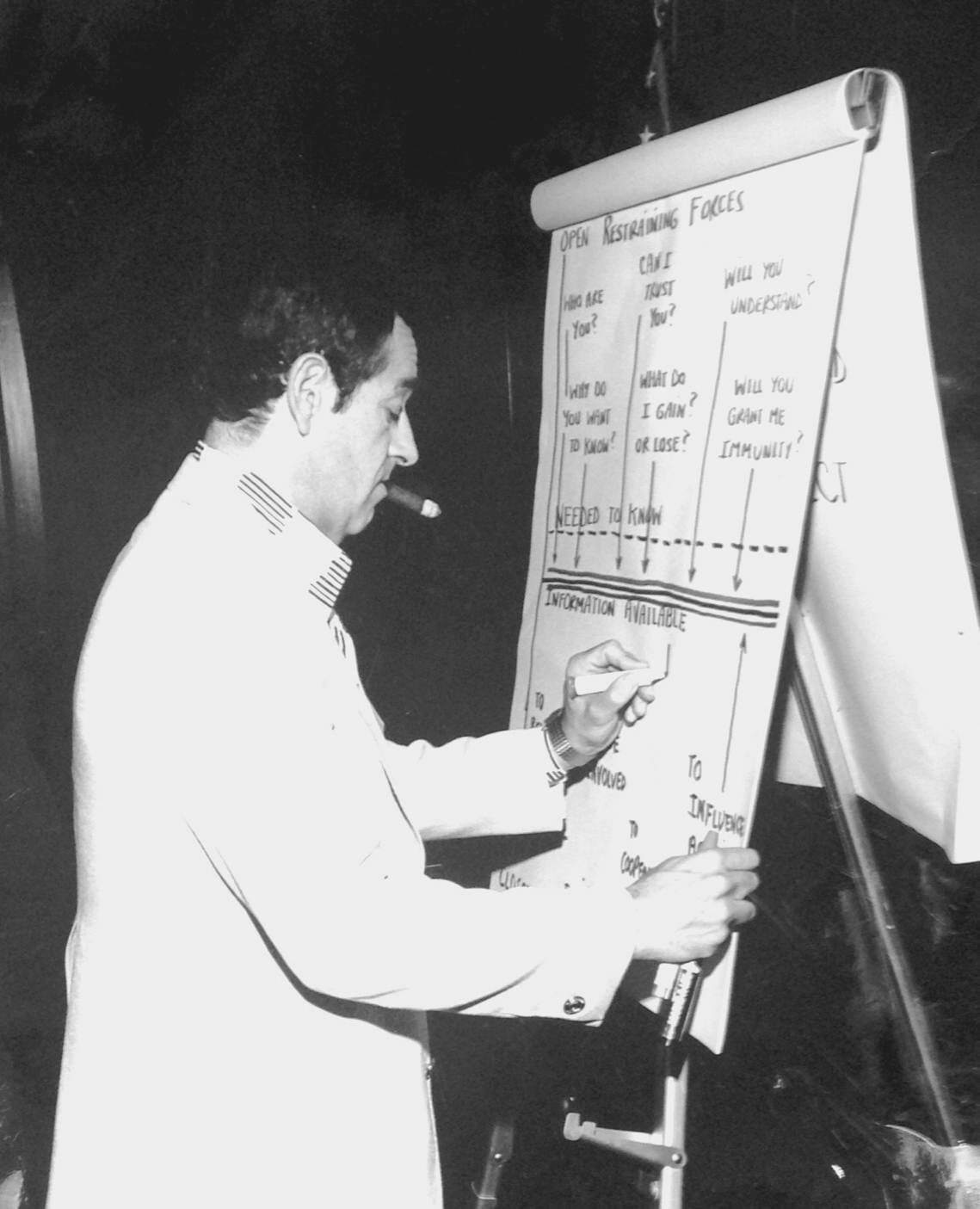
I got to know his routines by heart. Not a dud in the bunch, though of course I had my favorites. Like his story about “history’s first negotiation,” which he says is chronicled in the Bible. “God wanted to wipe out the original twin cities, those desert meccas of sin, Sodom and Gomorrah. Abraham was opposed, but how do you negotiate with the Almighty? Talk about power differential! So what did Abraham do? Did he say, ‘God, what is wrong with you? You’re making a stupid mistake.’ Of course not. He went with a humble, low-key approach. He said, ‘Hi, God. It’s me, Abraham. I was just thinking over your decision to destroy Sodom and Gomorrah. Another good decision, God, right as usual. But then a thought popped into my head. What if I could come up with fifty good men amid all the evil people there? Do you think it’d be okay to kill fifty good men along with the wicked?’
“For sure God will at least respond to Abraham,” Herbie said. “How do we know that? Because you always get a response once you realize that no response is also a response. God said, ‘Okay, Abraham. Find me fifty good men and I’ll spare those cities.’
“Now Abraham has God at the table talking. That’s most of the battle. From there, it’s just about setting the price.
“‘I hadn’t really done a count,’ Abraham adds. ‘What if I’m five good people short?’
“‘Okay, Abraham. Find me forty-five good men in Sodom and Gomorrah. That’ll be enough.’
“‘You know, God, I was speaking figuratively. I was really just making a point. For all I know, there may only be twenty- five good men in Sodom and Gomorrah.’
“‘Okay,’ said God. ‘Find me twenty-five and we have a deal.’
“Abraham got God all the way down to ten, which Abraham couldn’t in fact find, but that’s beside the point. The point is this: Abraham got a great price! And how did he do it? By using his weakness, by appealing to God’s strength.
“By ceding power, you gain power,” he’d explain. “What are the most powerful words in a negotiation? Are they ‘I’m an expert. I know better?’ No. They’re ‘Who?’ ‘Huh?’ and ‘Wha?’ When it comes to negotiating, you’d be better off acting like you know less, not more. In some cases, dumb is smarter than smart, and inarticulate is better than articulate. You want to train yourself to say, ‘I don’t know’ … ‘You lost me’ … ‘Could you repeat that?’ The most powerful words in business are ‘I don’t understand. Help me.’ Divest yourself of preconceived notions, biases, prejudices. Ignorance, even if feigned, will produce curiosity, humility, open-mindedness, and the kind of innovative ideas that may bring people together.”
Being weak does not mean being powerless; that was his point. He’d tell audiences about a prisoner in solitary confinement who wants a cigarette. He asks the guard, and the guard, under the impression the prisoner is powerless, laughs and turns away. “But the situation looks different to the prisoner,” Herbie said. “He knows there is always another option if you’re willing to take risks. He asks again, now in a booming voice: ‘Can I please have a cigarette?’ This time, when the guard turns away, the prisoner says, ‘If I don’t get it, I’m going to bang my head against the wall until I’m bloody. When they ask who did it, I’m naming you. They won’t believe me, but think of all the hearings you’ll have to attend and all the reports you’ll have to fill out, as opposed to giving me one crummy cigarette.’”
Herbie’s method was as old as Aesop: he told stories, and each story had a moral. He taught tricks, too, methods to increase effectiveness. There was, for example, the Nibble: You go into a store, Brooks Brothers at Water Tower Place, say, pick a salesman, and make him show you everything on the rack. Then, just when he’s about to lose patience, you tell him that you’re ready to buy. After you’ve been fitted for a suit and are walking to the register, you say, ‘What kind of ties will you be throwing in with this?’”
He talked about the art of purchasing big-box items, like refrigerators. Trick one: ask when it goes on sale. Everything is always just about to go on sale. You’ll always get that price. Trick two: ask, “What if?” “What if I buy four refrigerators?” Trick three: point out a blemish on the floor model and ask for a blemish discount. If there is no blemish, create one.
A master of telephone negotiation, he explained what to do when everything goes wrong on a call. “I’d never recommend hanging up on another person,” he said. “That would be socially unacceptable. Hang up while you’re talking. How can you convincingly hang up on yourself? Simple. Say the equivalent of ‘Hey, I’m really glad you called. You know, I was just thinking about you yester—’” Click.
On the second day of a two-day seminar, he’d screen the movie 12 Angry Men, because “12 Angry Men dramatizes every type of negotiation.” In the course of the movie, which is set in the deliberation room during a murder trial, nearly the entire jury is moved, at the instigation of a character played by Henry Fonda, from convict to acquit. Herbie broke down each scene, freezing the action at crucial moments to explain how the need of each juror is determined and met.
I sat through this lecture on many occasions, and though it came to bore me, I loved the way he closed the talk, was thrilled, no matter how many times I heard it. Henry Fonda is walking down the courthouse steps into the rain-soaked city at the end of the day. Another juror, seeing him, calls out, “Hey, what’s your name?”
“Davis,” says Fonda.
The men shake hands, smile at each other, then part.
“And that’s the big point, the message of this movie,” Herbie said. “The most important people in your life, the people who have an impact and change everything, and you don’t even know their names.”
I loved it because, one, it struck me as profound and, two, that’s my old man in a nutshell. To him, every good song, movie, or book is never about what it’s about, which might be a deathly ill baseball player, or a shut-in with a prized collection of figurines, or a salesman who’s gone off his rocker. It’s about life. If it’s beautiful, if it moves him, it’s about life. But that’s not how he phrased it. Here’s how he phrased it: “It’s not about a ballpark, you schmuck, it’s about everything.”
Here I speak specifically of his reaction to Frank Sinatra’s version of the Joe Raposo song “There Used to Be a Ballpark.” Every time we listened to it in the car, he’d tell me that Sinatra had improvised the last phrase—“the summer went so quickly this year”—which he considered the most important line in the song, “because it’s not just the summer that goes so quickly; it’s life.”
He spent at least three hundred days on the road most years. We used to flip through his calendar and laugh. If you can name a company, he probably lectured there: IBM, Sony, Atari, Apple, GM, Ford, Hilton, Hyatt, DuPont, Sikorsky, Honeywell, Microsoft, Google. The list goes on and on. Many clients sent thank-you gifts after a seminar. That’s how we got our bench press, our propane grill, our cotton candy machine. Sony sent promotional copies of every record they had in the pipeline; that’s how I first heard the Clash.
The CEO of a company that dealt in antique cars asked Ellen if Herbie had any hobbies. Ellen, unable to think of anything other than cigars, said, “He likes to exercise.”
When the treadmill arrived two weeks later, Herbie was appalled.
“What was I supposed to say?” asked Ellen.
“Oh, I don’t know,” said Herbie. “How about antique cars?”
No. 27
A reporter called the office in early 1980. He’d been assigned to profile Herbie for Playboy, one of the biggest magazines in America. The writer, a smart, young Ivy Leaguer named Andrew Tobias, spent a week following Herbie around—from lecture to office, office to house, house to delicatessen. Watching Tobias work—he talked to us at lunch, hung out as we played basketball, flew with Herbie to D.C.—is what made me want to be a writer, and not just any kind of writer, but a “freelance.” It had the ring of freedom. “Freelance writer” took a place in my pantheon beside “stunt coordinator,” “escape artist,” and “daredevil.”
Herbie was lucky. They could have assigned a hack to tell his story. He got Andrew Tobias instead, a good writer in the golden age of magazines, the age of Hunter Thompson, Tom Wolfe, and the New Journalism, which allowed for tremendous creativity. Tobias constructed the piece in that spirit, not in a standard journalistic voice, or even his own voice, but in Herbie’s Brooklyn patois. Rather than follow the conventional formula, which would have meant opening with a clever lead (“Herb Cohen means business”; “Herb Cohen wants to make a deal”) proceeding to a nut graph (“in the last decade, Herb Cohen has become one of the world’s most famous negotiators”) followed by a stage-setting description (“Herb Cohen, who lives on Chicago’s North Shore with his wife and children, is lighting a cigar, his cavernous features cast in a flickering orange glow”) leading to a section-ending promise (“Herb Cohen can teach you how to be more effective”), Tobias built his piece around Herbie’s personality—not an academic expert, but a Damon Runyon character, a street corner raconteur, a Warrior and a Weasel driver from Bad K, a coach who can’t stay on the sidelines. It was less conventional reportage than mind-meld method writing. Tobias did not depict Herbie. He became Herbie and then, as Herbie, wrote the story.
Each section was named for one of Herbie’s strategies or observations. “The New House,” “The Nibble.” Herbie had wanted to write a book but could never figure out how to turn his talk into prose. As anyone who’s transcribed a joke can tell you, crucial elements are lost in the process. Intonation, body language, emphasis. What had been living in person is often dead on the page. To work, it’s got to be less about copying than about translating. Which is an art. That’s what Herbie learned from Andrew Tobias.
Herbie’s reverence for the written word had itself been an obstacle. He regarded a book as something holy. “When God wanted to tell his story,” he’d say, “it’s not a movie he made.” Tobias brought the process down to earth, showed Herbie that his voice could in fact be a literary voice. And the structure! It was not a grand scholarly thesis that organized the piece; it was the stories and the voice. The big picture emerged from the little stories in the way of a Chuck Close painting. Up close, it looks like a plethora of discrete images, but when you step back, you see that those images come together to form a single picture.
No. 28
Andrew Tobias remained part of our lives even after the story was published. My father admired him and, at some point, amid this admiration, fixed on the idea of setting him up on a date with my sister. Andrew resisted and Sharon resisted, but in the end they realized the only way out was through.
We were spending a week with friends at a house in Arlington, Virginia. The street was beautiful, long, and leafy. Andrew arrived at seven on a summer evening. He was dressed like a Senate page, blue blazer, white shirt, penny loafers, khakis, brown hair swept to the side. He must have been in his mid-twenties, a freelance writer and young politico, a future treasurer of the Democratic National Committee. He held the passenger-side car door open for Sharon; she leaned across and opened his door. We watched them drive away, then stood under a big elm tree as it got dark.
My father stayed up until Sharon returned.
“How did it go?” he asked, when she came in.
“Fine.”
“Do you think you’ll go on a second date?”
“Probably not.”
“Why?”
“He’s gay.”
Andrew Tobias, as we later found out, was not just a gay man but the pseudonymous author of the groundbreaking memoir The Best Little Boy in the World.
My father stared at my sister for a long time, then said, “I have no idea what you’re talking about.”
No. 29
The profile ran in the June 1980 issue of Playboy. Dorothy Stratten was on the cover as “Playmate of the Year.” The issue would become a collector’s item, made valuable by the murder of Stratten, killed that August by her estranged husband, Paul Snider. The cover, widely seen when first published, was seen even more widely when Stratten was killed, then more widely still when Stratten’s story was turned into the movie Star 80, with Mariel Hemingway playing Dorothy Stratten, Eric Roberts playing Paul Snider, and Cliff Robertson playing Hugh Hefner. The cover was remade for the movie, with Stratten replaced by Hemingway, but with Herb Cohen’s tagline—“Winning Through Negotiation: How to Get What You Want”—in place.
Herbie speaks of the rule of three. If someone sees your name three times—initial publication, murder, movie—they feel as if you’re everywhere, so must be famous, and, if people think you’re famous, you’re famous. He says he finally decided to write a book in 1980 because he wanted to retire some of his older bits and hoped to preserve them when they were still fresh in his mind, and while that’s probably true, he must have also felt the wind at his back.
He’s big on lecturing his kids and grandkids about study habits, perseverance, and establishing a routine. He told us to go about our work in a methodical and even boring way, to conduct ourselves in the practice exam or scrimmage as if it were the real test or game; that way, when we got there, we’d feel as if we’d already been there a dozen times before. “Don’t do anything differently,” he’d say. “Make the extraordinary ordinary. That’s the key.”
But that is not at all how he behaved when he wrote his book. He did not go about it as he’d gone about his earlier work on seminars and speeches—casually, at the kitchen table, a few hours at a time. He did not make the extraordinary ordinary. He made the extraordinary super-extraordinary. He set up a cramped office in the basement, said goodbye one morning, went down there, and stayed down there until he’d finished. Eight months in that hole, forty pots of coffee a day, nothing to eat but lettuce and bread, filling dozens of yellow legal pads with neat cursive in calligraphy pen, composing the book just as it was meant to be read, from open to close, starting with the first sentence: “Your real world is a giant negotiating table, and like it or not, you’re a participant.”
Then:
You, as an individual, come into conflict with others: family members, sales clerks, competitors, or entities with impressive names like “the Establishment” or “the power structure.” How you handle these encounters can determine not only whether you prosper, but whether you can enjoy a full, pleasurable, satisfying life.
Summer came and went. Then Labor Day. The first week of school. The autumn leaves. Halloween and Thanksgiving. Peanuts on TV. The first frost. Christmas. Winter storms. Now and then, a cry from the depths: “Ellen! Ellen!” A few air bubbles breaking the surface. Otherwise, nothing. There were days, even weeks, when we almost forgot he was down there.
He was gaunt as a prisoner when he finally emerged. Spring had come. Buds were on the cherry trees—cracking ice, the sound of water. He was dirty and bearded but looked righteous. When he rejoined us, it was in the way of Moses returning with the tablets.
Behold!
Can you imagine a more painful way to write a book? In a single marathon session in a water-damaged suburban basement? Kerouac used Benzedrine. Hemingway drank anisette. De Quincey smoked opium. Hunter S. Thompson dropped LSD. For Herb Cohen, there was nothing but lettuce, bread, and black coffee.
No. 30
Needing to mark the occasion, Herbie told Ellen to pull the children out of school. He was taking us on a drive. He spread a map on the kitchen table and marked the route. He wanted the trip to mimic the trip he’d just taken in his head. We’d go south to Missouri, then head west for the mountains.
The manuscript—a stack of coffee-stained pages—sat beside him in the car. He planned to read the entire book out loud in the course of the drive. That was the trip’s real purpose. He wanted his first audience close and captive so he could gauge each reaction, tell which bits fizzled and which bits landed.
My parents owned a Chrysler Town & Country, a green station wagon with imitation-wood paneling. We folded down the backseats and made a nest of blankets and pillows. We had snacks, video games, Yes & Know invisible-ink books, comics. We left in the dark, Herbie behind the wheel. He took Sheridan Road to Lake Shore Drive, then continued to Interstate 55. The city was on our right, a huge forest of glass and steel. The sun appeared across the lake and lit the towers. The shadows of the tallest buildings—the Hancock and Sears—stretched all the way to Iowa. We descended into a great Gehenna of iron mills and blast furnaces and refineries, the fires burning day and night, the blue flames of chemical smoke, the awesome stacks.
Herbie rolled up his window, put on Sinatra, grinned. Ellen was smiling, too. We followed the interstate through Joliet, famous for its ribs and prison, then continued down the spine of Illinois, factories giving way to towns—Lexington, Bloomington, Lincoln—towns giving way to cornfields that rolled unbroken to the sky.
We got onto I-70 West in Edwardsville, Illinois.
I asked where we were going.
Herbie said, “To the highest peak we can find.”
I asked what we’d do when we got there.
He said, “Turn around and come back.”
“Why?”
“Because that’s life,” he said. “You go, you turn around, you come back.”
This trip confused me at the time, but now, being older than he was then, I think I know what he was doing. He’d written a book, and in the process the book had changed. What he’d envisioned as a business guide had become his own story. He’d put everything he’d done and learned in that book. And it diminished him. You lose whatever you put on paper. He needed to acknowledge this loss with a dramatic gesture. He needed to put an exclamation point at the end of this chapter of his life.
We crossed the Mississippi River in St. Louis, then continued through Missouri. We were in Kansas City by sundown, rolling through a parking lot, looking for a space so we could go inside and eat barbecue. Ellen drove after dinner so Herbie could read us his book. Maybe that sounds boring, but hearing him read those pages out loud—I hung over the front seat, following along with his loopy handwriting—was exciting. It was hard to believe I knew someone who’d actually written a book.
There was a story about me in the first chapter. It did not matter that it made me out to be a nightmare child. I was in a book! I would live forever! “My wife and I have three children,” Herbie read. “At nine, our youngest son weighed fifty pounds, remarkably light for a child his age. Actually, he was an embarrassment to our entire family. I say that because my wife and I like to eat, and our two oldest children have voracious appetites. Then there was this third kid. People would ask us, ‘Where did he come from?’ or ‘Whose kid is that?’”
The story was meant to illustrate how even a person as seemingly powerless as a scrawny fourth grader can get what he wants. Taken against my strenuous objections to a fancy restaurant for dinner, I’d made a public spectacle, crawling under the table, then, when admonished, standing on a chair and shouting, “This is a crummy restaurant!”
“Startled though I was, I had enough presence of mind to grab him by the neck, shove him back under the table, and ask for the check,” Herbie continued. “On the way home, my wife said to me, ‘Herb, I think we learned something tonight. Let’s not ever take the little monster to a restaurant again.’
“What our nine-year-old did on that embarrassing occasion was use information and power to affect our behavior. Like so many of today’s youngsters, he’s a negotiator—at least with his parents.”
Herbie read a hundred pages as we crossed Kansas. I absorbed every word. I’d always loved the way he talked about biblical figures, as if they were modern humans: “Jesus Christ and Socrates … were negotiators. They were Win-Win ethical negotiators, and they were power people.” I loved the way he revealed small acts of control that go unnoticed, like price tags in department stores: “It’s no ordinary sign scrawled with Magic Marker. It’s symmetrical and professionally done: block printed on expensive chipboard. And it appears to have been placed there by the Big Printer in the Sky.” I loved the way he reversed the negative so you could see an old picture in a new way: “Don’t regard yourself as someone who wants to buy a refrigerator. Regard yourself as someone who wants to sell money. Money is the product that’s up for sale. The more people there are who want your money, the more your money will buy. How do you get people to bid for that money? You generate competition.”
I loved the way he returned to a few cardinal rules, the sort that apply not just to business but to life, because, as he’d say, “it’s never about business; it’s always about life.”
“Who’s the worst person to negotiate for?
“Yourself.
“You do a much better job negotiating for someone else.
“Why?
“Because you take yourself too seriously in any interaction that concerns you. You care too much about yourself. That puts you under pressure and stress. When you negotiate for someone else, you’re more relaxed. You’re more objective. You don’t care as much, because you regard the situation as fun or a game—which it is.”
He wrote just the way he talked, with wisecracks and asides. You could hear the accents and shtick. There was something funny and smart on just about every page. He began each chapter with a quotation: “Some people feel the rain; others just get wet” (Roger Miller); “If you think you can or can’t, you’re right” (Henry Ford I); “As long as you get there before it’s over you’re never late” (James J. Walker).
I loved his chapter titles, too. “Weakness as a Strength.” “We Don’t Understand.” “The Power of Risk Taking.” And the way he ended each section with a message or a big idea. “Never see anyone as an isolated unit. See those whom you wish to persuade in context, as a central core around which others move. Get the support of those others and you will influence the position and movement of the core.” Or: “Keep saying to yourself over and over, ‘It’s a game. It’s the world of illusion. A tactic perceived is no tactic. I care, but not that much.’” Or: “The good life is not a passive existence where you live and let live. It’s one of involvement where you live and help live.”
We spent the night at a motel in Goodland, Kansas, had breakfast at Bob’s Big Boy in the morning, then continued, my mother still driving. When people think of Colorado, they think of mountains, but the eastern part of the state is as flat as a griddle, which meant long views from the back of the station wagon: wheat fields and grain elevators, fat cows and billowy clouds, and a real-life cowboy on a speckled horse.
We opened the windows. The air was cool and dry. The Rockies appeared as a jagged line against the sky. We drove south along the eastern front of the mountains, then took the plunge. We were headed for Pikes Peak. We could see the summit from miles away, white and dazzling. Herbie told us about the mountain as Ellen drove: fourteen thousand feet above sea level, holy to the Ute Indians and holy still, the attic of the world.
A two-lane road went up, each switchback opening on an abyss that made your stomach drop. The temperature fell as we climbed; the wind picked up. The car was soon being slammed by the wind. There were dark clouds in the west, far away but moving fast.
Herbie turned on the heat and smiled at Ellen, who was not smiling. She gripped the steering wheel, white knuckling it. Herbie had finished reading his book, and that’s what he was thinking about—not the mountain, or the abyss, or the possibility of a fiery crash, but his work. He believed it was good, possibly very good, and it was this belief, which never wavered, that would give him the confidence to persist despite the rejections that were coming. Quoting Harry Truman, he’d say, “I make a decision once.” And he’d made his decision about the book. In case of rejection, the only thing that would change was his opinion of the publishing house.
There was a cafeteria and a gift shop on top of the mountain; there’s often a gift shop on top of the mountain. We ate at the buffet, bought postcards in the store, then got back in the car. From here on, Herbie did the driving. The storm had arrived while we were eating. Snow roared from the west, the road slick and black, the weather worsening by the minute. We could see flashes of lightning in the clouds. Herbie slowed first to fifteen, then to five, then to two miles an hour. Ice covered the windshield. He leaned out and cleared an opening. He was like a submarine captain, steering by periscope. There were cars on the side of the road. Some drivers had skidded off the pavement. Some had pulled over to wait out the storm. Some were fitting their tires with chains. Herbie continued, chainless and arrogant, confident he could get us down. We could not see beyond the shoulder, but knew the cliffs were there.
Ellen suddenly screamed, “I don’t care what happens to me! I just don’t want the children to die!”
Herbie looked at her, then laughed.
“Bullshit,” he said. “It’s you. You don’t want to die.”
The sky was clear when we got back to the highway. There was a beautiful sunset. It was as if the storm never happened. The rest of the drive was like the victorious drumroll at the end of an Aaron Copland symphony. It was winter, then spring, the countryside blooming as we passed through it, as if our passage were what made it bloom.