
On 14 January 83 BC friends and relatives of Mark Antony’s parents were called to their house. The aristocratic families of Rome liked witnesses to the arrival of a new member and his mother Julia had gone into labour. Only women attended the birth itself, unless things went badly wrong and a male doctor was summoned. Usually, the mother was attended by a midwife and some female relations and slaves. The father and guests waited elsewhere in the house.
Infant mortality was very high in the ancient world, as indeed it was until comparatively modern times. Many children were stillborn or died hours, days or months later. Some Roman tombstones are very precise in the age of the little boys or girls they commemorate. It was also a very dangerous time for the mother and many women died during or soon after childbirth. The Roman aristocracy used marriage to cement political alliances, so women like Julia were usually young – quite often in their mid teens – for their first pregnancy.
In this case everything seems to have gone smoothly. A boy was born and when the midwife laid the infant down for inspection there was no sign of deformity or unusual weakness. Julia would produce two more sons in fairly rapid succession and all grew into healthy adults, and she would herself enjoy a long life. Some children were rejected by their parents, but in well-off families this was usually only the case if they had serious defects or seemed far too weak to survive. There was no question of that in this case and once Antony’s father was shown his son, he and Julia quickly accepted the child.1
Ritual was everywhere in Roman society and marked every stage of an individual’s life. Fires were lit on the family altars in the house. The witnesses would also make offerings when they returned to their own homes. On the night of 21/22 January, the family held a vigil and performed a series of rituals as part of a purification ceremony (lustratio). The next morning priests observed the flight of birds to predict what the future held for the boy. He was also presented with a talisman or charm called the bulla. This was normally of gold and was placed in a leather bag around the boy’s neck. He would wear this until he became an adult.
On the day of the purification the boy was formally named as Marcus Antonius and soon afterwards this was registered officially. ‘Antonius’ was the family or clan name – in Latin, the nomen. Most Roman aristocrats had three names, the tria nomina and thenomen were followed by a cognomen peculiar to that section of the wider family or clan. Julia’s father was called Lucius Julius Caesar. The Julii were a large and very ancient group, and the more specific ‘Caesar’, which first appeared at the turn of the third and second centuries BC, helped to differentiate the various branches of the line. Some families, including the Antonii, never felt this necessary, probably because there were not many branches of the line.2
‘Marcus’ was the praenomen equivalent to our first name (or in Britain, still habitually, the Christian name). Although it was not an absolutely fixed system, aristocratic families tended to employ the same names in the same order for each generation. Antony’s father was also called Marcus Antonius, as was his father. In due course his two brothers were named Caius and Lucius. In formal documents each would also be listed as ‘son of Marcus’.
It was important in Roman public life to identify a man very specifically. The same was not true of women, who could not vote or stand for office. Girls received only a single name, their father’s nomen in the feminine form. Therefore Antony’s mother was Julia because her father was a Julius. Any daughter born to an Antonius was named Antonia and if more than one daughter was born these were simply numbered – at least for official purposes. Families tended to employ nicknames to avoid confusion.
Julia was a patrician, but her husband’s family was plebeian and so were her children. The patricians were Rome’s oldest aristocracy and in the early days of the Republic only they could hold the consulship. Over time many wealthy plebeian families forced their way into politics and were able to demand a greater share of power. It was eventually established that one of the two consuls each year must be plebeian, and as time passed it became reasonably common for neither to be a patrician. Some patrician lines dwindled in wealth and influence, and others died out altogether. By the first century BC the overwhelming majority of senators were plebeian. There were a number of plebeian families who could boast of having been at the centre of public life for centuries. Simply being patrician was no guarantee of political success.
The Antonii were not the greatest of the plebeian lines, but they were very well established as members of the Senate and had done particularly well in the last two generations. Antony’s grandfather Marcus Antonius was famous as one of the greatest orators ever produced by Rome. Cicero claimed that along with one of his contemporaries, Antonius took Latin eloquence to
a level comparable to the glory of Greece.… His memory was perfect, there was no suggestion of previous rehearsal; he always gave the appearance of coming forward to speak without preparation.… In the matter of choosing words (and choosing them more for weight than for charm), in placing them and tying them into compact sentences, Antonius controlled everything by purpose and by something like deliberate art.… In all these respects Antonius was great, and combined them with a delivery of peculiar excellence.3
In 113 BC Antonius was elected quaestor, a junior magistracy with mainly financial responsibilities, and was sent to assist the governor of the province of Asia (modern-day western Turkey). A man became eligible for the quaestorship at thirty. En route to the province Antonius found himself caught up in scandal when he was accused of having an affair with a Vestal Virgin. Rome’s only female priesthood, the Vestals took a vow to remain chaste for thirty years and tended the temple and sacred flame of the goddess Vesta. For a man to seduce a Vestal was a dreadful impurity, which threatened Rome’s special relationship with the gods. If found guilty, a man’s career would be over and he might suffer even worse punishment. The penalty for the Vestals was far more ghastly, for they were entombed alive to bury the impurity.
Trials of Vestals and their alleged lovers tended to occur following some disaster when people were nervous and wanted someone to blame. Three Vestals were accused of breaking their vow in 114 BC, and when only one was condemned the issue was raised again in the next year and a new round of trials begun in a special tribunal presided over by an eminent and stern former consul.
As a magistrate serving on public business, Antonius was exempt from prosecution, but won general admiration when he voluntarily returned to Rome to answer the charge. This did nothing to dampen the enthusiasm of judge and prosecution in pressing for a conviction. Although Antonius staunchly denied the charge, his accusers sensed that a young slave who carried a lantern for his master at night could be coerced into incriminating him. Roman law only accepted the testimony of slaves if they were questioned under torture, since it was assumed that otherwise they would always support their owners. The boy is supposed to have assured Antonius that nothing could persuade him to speak against his master, regardless of the pain. ‘Lacerated with many stripes, put on the rack, and burned with hot plates, he guarded the defendant’s safety and destroyed all the force of the prosecution.’ Antonius was acquitted. It is not recorded whether he rewarded the slave. Our source for the story blamed fortune for such a great spirit being ‘enclosed in the body of a slave’. Two Vestals – it is not clear whether one was the woman with whom he was accused of having an affair – were less fortunate and were condemned to death.4
Oratory was very important in a political career, but the success of Marcus Antonius suggests that he also had considerable military and administrative ability. In 102 BC he went to govern the nearby province of Cilicia as praetor. His command was extended for a further two years by the Senate and he led a tough and ultimately successful campaign against the pirates infesting that area. He celebrated a triumph, which no doubt helped him to win election to the consulship for 99 BC. Two years later he was censor, one of the two magistrates who oversaw the census of Roman citizens completed every five years. Only one in five consuls could hope to reach the censorship and it was an office of tremendous prestige.
THE ORATOR AND THE DICTATOR
Marcus Antonius was one of the leading senators of his day, but prominence would prove to be a dangerous thing in the first century BC. In 91 BC a politician pressing for the extension of Roman citizenship to the allies of Italy was assassinated. Many of the Italian communities chose to rebel and the result was the Social War – the name comes from the Latin socii, meaning ‘allies’ – which was fought at high cost in lives and with great savagery. Roman victory had as much to do with their willingness to grant citizenship to all those who remained loyal, and many more who capitulated quickly, as it did with military skill. It was a conflict that accustomed many soldiers to fighting against enemies very much like themselves.
By 88 BC the rebellion was substantially over and the consul Lucius Cornelius Sulla was given command in the war against King Mithridates VI of Pontus. The latter was exploiting the crumbling of the Seleucid Empire and Roman preoccupation to expand from his heartland on the southern coast of the Black Sea. A campaign in the Hellenistic east offered a Roman general all the glory and plunder he could desire, and Sulla left Rome to recruit and train his army. In his absence a radical politician campaigned to have the command transferred to Marius, the great military hero of the last generation, but now in his late sixties.5
Consul for the first time in 107, Marius had won a victory in Numidia, but was then voted into an unprecedented succession of consulships every year from 104 to 101 BC. This violated precedent and law, which stipulated that ten years should elapse between each consulship. At the time, the Italian Peninsula was menaced by migrating northern tribes who had already slaughtered every army sent against them and there was clearly a strong feeling that the crisis required an extraordinary solution. Marius dealt with the barbarians, smashing them in a final battle in 101 BC. He celebrated a triumph and was rewarded by being voted a sixth consulship by a grateful Rome.
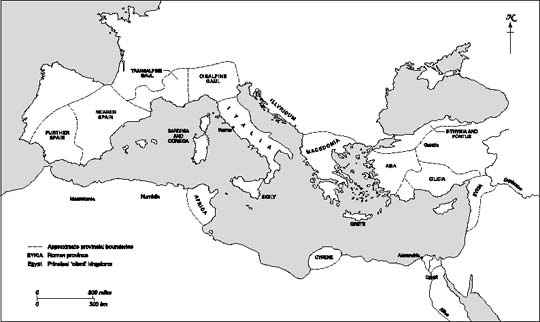
The Roman Empire in the first century BC
It was a spectacular career, especially since Marius was the first of his family to embark on a public career and enter the Senate. He was what the Romans called a ‘new man’ (novus homo), who had had to make a name for himself rather than rely on the fame of his family. Marius revelled in popular acclaim and seems to have struggled to cope when this began to fade. He played a relatively modest part in the Social War and may well have suffered from poor health. Yet in spite of his advanced age he decided that he wanted the command against Mithridates and the Popular Assembly was willing to pass a law transferring it to him. In every respect this was a break with tradition, even if it was not actually illegal. Yet in the past Marius had broken other traditions and gone on to win.6
This time it was different. Sulla was a patrician, but came from a family that had long since fallen away from the centre of public life. He had come to politics at a late age, determined to rise to the top and had secured the plum command against Mithridates. He refused to let this be taken from him, and his soldiers were equally unwilling to lose the chance of the rich plunder likely in an eastern war. The senior officers were less keen and only one man of senatorial rank accompanied Sulla as he led his legions to Rome. Marius and his opponents had no organised force to meet them and could not hope to defend the city successfully. Many were killed, although Marius escaped. Sulla stayed only for a short time before taking his troops off to fight Mithridates and did not return for five years.
Marius came back first, raising his own army and seizing Rome in 87 BC. This time the attack was more violent and the executions that followed more numerous and brutal. Marcus Antonius was one of the victims, although whether because of a long-standing grudge or recent opposition to Marius is uncertain. At first the orator went into hiding and was sheltered in the house of one of his clients, a man attached to him by long-standing obligation or favour. His protector was not especially wealthy, but wanted to entertain his guest in a manner appropriate for such a distinguished senator. He sent a slave out to buy some high-quality wine. The owner of the tavern was surprised at this unusual purchase and, chatting to the slave, discovered what was happening. He then promptly took the story to a delighted Marius, who was at dinner. Our sources claim that he had to be persuaded by his friends not to go and kill Antonius himself.
Instead, he sent a military tribune called Annius with a party of soldiers. The officer seems to have been reluctant to get his hands dirty and sent his men inside the house to perform the execution. He waited, but when the soldiers did not return Annius grew suspicious and followed them. To his amazement his men were listening to the great orator speak, entranced by his words so that some could not bear to meet his gaze and even wept. In one version of the story the men actually left without harming the senator. Annius was less easily enthralled. He stabbed Antonius to death and then decapitated him, taking the head as trophy to Marius.7
The story of the famous orator holding his would-be killers spellbound is repeated by all our main sources for this incident. It may be true or simply a good story and what Romans wanted to believe. Whether or not things happened this way, the basic truth was that a distinguished senator was brutally killed and beheaded on the whim of another man who had seized control of the state by force. Antonius’ head went to join those of other victims of Marius’ purge and was displayed in the Forum. Before that Marius had exulted over the death and
held the severed head of Marcus Antonius for some time between his exultant hands at dinner, in gross insolence of mind and words, and allowed the rites of the table to be polluted with the blood of an illustrious citizen and orator. And he even took to his bosom Publius Annius, who had brought it, bespattered as he was with the marks of recent slaughter.8
Mark Antony was born four years later.9 We do not know whether his father was in Rome during Marius’ occupation of the city. Perhaps he was elsewhere or, as a young man in his middle twenties, not considered worth killing. Marius’ wife was also a Julia, although from a different branch of the family to Antony’s mother, making it unlikely that this on its own would have been sufficient protection. Marius fell ill and died within weeks of storming Rome and taking up a seventh consulship, and this more than anything else brought a halt to the violence. His supporters continued to dominate the Republic, but had now established themselves and hoped for the return of something like normality.
By Roman reckoning, Mark Antony was born in the six hundred and seventy-first year ‘from the foundation of the city’ (ab urbe condita). More usually, they referred to the year by the names of the two consuls to hold office, in this case Lucius Cornelius Scipio Asiaticus and Caius Norbanus. Yet it was Sulla who dominated everyone’s thoughts at the time. Mithridates’ army had been beaten and a peace treaty imposed on him. Sulla and his army were free to return. They landed in southern Italy late in the spring, when Antony was just a few months old.
Marius’ allies had had years to prepare and the fighting now was on a massive scale. In November 82 BC Sulla won a great battle outside Rome and took control of the city. Fighting continued for some time – one of the Marian commanders would continue the struggle in Spain for another decade. Both of the consuls of 82 BC, who included Marius’son, were killed, but Sulla did not replace them. Instead, he was made dictator by a law passed in the Popular Assembly.
The dictatorship was an ancient emergency measure that gave one man supreme executive power. The office lasted for just six months and could not be renewed, so in this way the principle of preventing any individual from gaining supreme permanent power was preserved. A dictator was appointed rather than elected and, unlike a consul, he did not have a colleague but a subordinate known as the Master of Horse (Magister Equitum). The commonest reason to name a dictator was to supervise consular elections when no consul was available. Once these were complete, the dictator resigned his office, often after only having held office for a few days. On a few occasions – for instance at times of crisis during the Punic Wars – a dictator had been appointed to take command in the field. The last occasion was in 216 BC.
Sulla used the old title, but added new powers that would last for as long as he chose to retain them, hence the need for a specific law. He was dictator legibus scribundis et rei publícete constituendae – dictator to make laws and restore the Republic. At the same time he presided over mass executions that were both bloodier and far more organised than Marius’ purge. Lists of names were posted and anyone included on them lost all legal rights. They could be killed with impunity and their murderers granted a share in their property as a reward. We do not know how many men – and it was only men – were proscribed in this way. Some senators perished and many more equestrians, who had fought against Sulla or were associated in some way with his enemies. Others were killed so that their wealth could be confiscated and many of Sulla’s subordinates were believed to have added names to the lists for their own profit. One wealthy equestrian is supposed to have greeted the news that he was on a proscription list with the dry comment that his Alban estates wanted him dead.10
Once again Roman slaughtered Roman, bodies floated in the Tiber and heads were nailed up to the speaker’s platform in the Forum. Alongside the massacres went reform. Sulla tried to legislate to prevent any provincial governor from leading his army outside of his province – in a sense to stop anyone copying his own example. He also severely restricted the powers of the tribunes of the plebs, the office used by the Gracchi and more recently by Marius’ allies to secure him the command against Mithridates.
Sulla’s reforms shifted the balance of power in favour of the Senate and senior magistrates. Yet more important than the legislation was the Senate itself, which was supposed to guide the state. The proscriptions removed a number of senators, and still more had been killed by one side or the other during the civil war. Many new members were enrolled by the dictator, doubling the size of the Senate to around six hundred. With his enemies removed and the council packed with his own sympathisers, in 79 BC Sulla gave up the dictatorship and retired to private life. His health was poor and, in spite of a rapid marriage to a lively young widow, he died a year later. His self-composed epitaph was that no one had ever been a better friend or worse enemy.11
CRETICUS
Antony’s father was part of Sulla’s Senate. We do not know whether he had played an active part on the dictator’s side in the civil war, but the murder of his father clearly made him unfriendly to the Marians. As a member of an established family with a highly distinguished father, he was an important man and stood out from the hundreds of recently enrolled senators. Civil war and proscriptions had also severely thinned the ranks of the former consuls and other prominent men. Sulla’s Senate was larger, but far less balanced than in the past, presenting opportunities for the best connected and ambitious to rise far faster than would normally have been the case. In 78 BC one of the consuls, Marcus Aemilius Lepidus, launched a coup and was only defeated by military force. He and his leading supporters were executed.
Marcus Antonius again passed unscathed through an outbreak of civil war. There is no indication that he had inherited his father’s gift for oratory or, indeed, was notably talented in any direction. Plutarch claims that he was respected as a decent man, but other sources are far less complimentary about both his ability and character. As his father’s son and a member of the Antonii, he did not need to be especially capable to enjoy a reasonably successful career. He was elected as one of the eight praetors for 74 BC. This office could not be held until a man was thirty-nine. It was a point of pride for men from good families to hold office at the first opportunity – the expression was ‘in his year’ (suo anno) – and it is most likely that Antonius managed this.
The family was not especially wealthy by the standards of the Roman aristocracy, and campaigning for office was expensive. Marcus Antonius was heavily in debt, not helped by a tendency to live beyond his means. His generosity was famous – Plutarch tells a story of a time when a friend asked to borrow money. Antonius did not have any to give, so instead summoned a slave to bring water in a particular silver bowl. He then poured out the water and gave the bowl to his friend. Only when Julia began questioning the household slaves about the vessel, threatening them with torture to extract the truth, did her husband meekly confess. Sallust, the historian and senator who knew and disliked Mark Antony, claimed that Antonius was ‘born to squander money, and never cared until he had to’.12
As praetor, Antonius was given a special military command to deal with piracy throughout the Mediterranean. This was a serious problem and his father’s victory had been both temporary and local. In earlier times, the Ptolemies, Seleucids and island states like Rhodes had done much to police the eastern Mediterranean, but now their navies were little more than a memory. Piracy flourished, encouraged still further by Mithridates, who once again came into conflict with Rome. Attacks on ships became common, disrupting trade and making travel dangerous. The young Julius Caesar was taken hostage and ransomed during these years.
Dealing with the problem was a major task, which would normally have been given to a consul. However, the war with Mithridates was a more attractive opportunity and both consuls arranged to be sent to provinces where they could hope to confront the king. There was considerable intrigue surrounding these appointments and that of Antonius. All three men were given larger than normal responsibilities. Antonius was authorised to act all around the Mediterranean and his authority stretched for up to 50 miles inland and would be equal to that of the governor of each specific province. In most cases provincial commands were initially allocated for twelve months and then could be extended by the Senate year by year. Antonius was given three years in his post from the beginning.
One reason why Antonius was able to get such a grand command was his name. The Romans strongly believed that talent was passed on through a family, and since his father had triumphed over pirates it seemed reasonable that his son would also be victorious. On its own this would not have been enough. Antonius was supported by Quintus Lutatius Catulus, a former consul who was very prominent in the Senate during the 70s and 60s BC. Catulus’ father had committed suicide rather than be killed by Marius’ men, and the son was subsequently an important supporter of Sulla. Fellow feeling may have encouraged him to favour Antonius, but more importantly Catulus generally favoured men from established families.
Sulla’s enlarged Senate contained many men who were unlikely ever to be asked their opinion during a debate, yet they could still vote. Since this was done by physically moving to stand near the man proposing a measure, such back-bench senators were nicknamed ‘walkers’ (pedarii). With hundreds of men who had been in the House for less than ten years, patterns of voting and loyalty were not easily predictable. Anyone able to manipulate and persuade significant numbers ofpedarii to vote a certain way gained influence. The slickest operator during these years was Publius Cornelius Cethegus, who never held any of the senior magistracies and was content to remain behind the scenes. Lucullus, one of the consuls for 74 BC, secured his eastern command by lavishing attention and gifts on Praecia, a famous courtesan who was Cethegus’ mistress. It is not known whether Antonius did the same, but he was supported by Lucullus’ colleague, the consul Cotta.13
The command against the pirates was a huge responsibility and gave Antonius considerable power. One later source hints that it was more readily given to him because he was not thought capable enough to be a threat to the state. A successful war against the pirates would bring glory, which every Roman senator craved, and potentially vast profit from the sale of captives and plunder. If he was fortunate, Antonius could hope to both pay offhis massive debts and make himself truly rich.14
All that relied on victory, and victory was not going to be easy. It is possible that the Senate did not give him sufficient resources. There were certainly complaints from commanders fighting in Spain around this time that they were not being adequately supplied by the state. On the other hand, Antonius may have lacked ability and certainly had no experience of conducting large-scale operations.
At first he focused on the western Mediterranean, but achieved little. Critics claimed that his enthusiastic requisitioning caused more devastation than the pirates. A levy of grain in Sicily was commuted to one of money. However, Antonius fixed the price far higher than the current rate at which wheat was selling, since it was just after harvest time and there was glut on the market. Although he certainly needed money to pay, equip and supply his fleets and men, it is hard to avoid the conclusion that one of his main preoccupations was restoring his own fortune.
By 72 BC, Antonius transferred his attentions eastwards and attacked the pirates on Crete. Whether through incompetence or bad luck, the enemy thrashed the Roman fleet in a naval battle. The campaign fizzled out and Antonius negotiated a peace treaty that was very favourable to the pirates and rejected out of hand at Rome. He died soon afterwards without returning home. The Romans sarcastically named him Creticus – successful commanders were often given a name to commemorate the people they defeated or the place they conquered.15
Antony was eight when Antonius left to take up his command and eleven when his father died. Nominally at least, Antony was now head of the family. With that responsibility came his father’s huge debts. One estate was so heavily mortgaged that the family chose not to claim it, something that the Romans always saw as especially shameful. His father was survived by a younger brother, Caius Antonius, but after a while Julia married Publius Cornelius Lentulus Sura and Antony spent the rest of his youth in his stepfather’s house. Lentulus was a rough contemporary of Marcus Antonius and would win the consulship in 71 BC. Julia’s family probably considered it a good match. She was most likely only in her late twenties and it was unusual for aristocratic widows to remain single unless they were substantially older.
Cicero later insulted Antony for being ‘bankrupt while still a boy’. Lentulus may have been a father figure for the teenager, but marriage to Julia did not mean that he had to meet Antonius’ debts, and these remained. Mark Antony was an Antonius, heir to his father, grandfather and the rest of the line. He inherited the expectation that simply as a member of his family he deserved to play a distinguished role in public life. Rome was the greatest power in the world, senators led Rome and a small number of families including the Antonii led the Senate. Bankrupt or not, Antony imbibed this supreme self-confidence from his earliest days.16