
Cleopatra was probably born in 69 BC, or perhaps a little earlier in 70 BC (for Cleopatra’s detailed family tree see page 400). We cannot be more precise as to the year, and have no idea at all of the month or day. It would seem most likely that her mother gave birth in one of the extensive and grand royal palaces in Alexandria, but again we do not know. For Mark Antony we at least have a fair idea of the rituals and customs surrounding a birth in one of Rome’s aristocratic families and can assume these were followed. How the Ptolemies did things is unknown.
Alexandria had a well-established reputation for the skill and knowledge of its physicians – in part because the earlier Ptolemies seem to have permitted vivisection. Cleopatra’s mother is likely to have had access to the finest medical assistance available in the Greek and Roman world. For generation after generation, the Ptolemies and their wives kept producing plenty of children who survived the perils of birth and infancy. The prospects of babies born into the family were probably as good or better than those of any other children in the ancient world, at least as far as natural perils were concerned.1
Not knowing precisely when or under what circumstances someone from the ancient world was born is nothing unusual. Rather more frustrating are the many other things we do not know about her. Cleopatra means ‘distinguished in her ancestry’, but the name had become a common one for the Ptolemies, and it is doubtful that the choice was seen as especially significant in her case. However, it does seem ironic given the difficulty of working out her family tree. We do not know who her mother was, because this is not mentioned by any of our sources. Again, this is not unique for even major figures from this period. We do not know who Cleopatra’s father’s mother was either, leaving two possible gaps in her immediate ancestry. The Ptolemies tended to be far more concerned about the paternity of members of the royal family, and this is reflected in both the surviving official documents and the literary sources about the family. Added to this, the confusingly narrow selection of names and the frequency of incest and successive marriages make it even harder to piece together the family tree.
Cleopatra’s acknowledged father was Ptolemy XII, the last adult male from the family to rule as king of Egypt. He already had one, perhaps two, other daughters, and would in due course have another before finally fathering two sons. Of the five certain children, none was to die of natural causes and four of the deaths occurred as part of rivalry within the family. Cleopatra herself outlived all the others, disposing of three of them herself. Only the sixth child, a possible older sister who was also called Cleopatra, escaped a violent death – assuming she existed at all.
The evidence for this and so many other details of the family is extremely limited and confusing. Were it not for the subsequent fame of our Cleopatra, it is unlikely that it would ever have become of more than academic interest. Yet the appearance of Cleopatra has often fascinated, even obsessed, historians and the wider public. More recently this controversy sometimes assumes a racial element, making discussion even more heated. It is worth reminding ourselves that this had never been much of an issue for the vast majority of other men and women from the ancient world, and is part of the special mystique of Cleopatra.
Later we shall consider the evidence and see if any tentative conclusions can be reached. For the moment it is worth considering her father, whose career was truly remarkable. Ptolemy XII was often vilified and ridiculed in his lifetime, by his subjects and the Romans alike. Yet he was a survivor who was king for three decades and managed the very rare achievement of dying of old age. His reign tells us much about the kingdom Cleopatra would inherit.
BROTHER AGAINST BROTHER
Ptolemy VIII Euergetes II, or Ptolemy ‘Fatty’, died on 28 June 116 BC – for once we have the precise date from a building inscription – after a reign lasting fifty-four years, albeit with a number of interruptions. He was in his late sixties and was survived by both Cleopatra II and Cleopatra III. The daughter would play the dominant role for the next decade and more, but initially one of Physcon’s sons ruled jointly with the two Cleopatras, until the mother died some months later. The new king was Ptolemy IX, also named Soter (Saviour) II, and is usually assumed to be a child of Cleopatra III, although it has been suggested that he was in fact the child of Cleopatra II.2
A brother of the new king – or perhaps half-brother since Cleopatra III was definitely his mother – controlled Cyprus. He was Ptolemy X Alexander I, who in 107 BC managed to supplant his sibling and take control of Alexandria. The positions were reversed and Ptolemy IX fled to Cyprus and eventually captured the island. In Egypt Cleopatra III dominated her son. Her name always appeared first in official documents as she ruled jointly with her son. She became the senior priest of the cult of Alexander, a post never before held by a woman, and was simultaneously venerated as a goddess herself.
Cleopatra III’s remarkable career finally ended when she died in 101 BC. There were rumours that her son had poisoned her. Ptolemy X now jointly ruled with his wife, Cleopatra Berenice. In 88 BC internal unrest expelled the king and queen from Alexandria. Ptolemy IX led an army back to Egypt from Cyprus and defeated his brother, who was eventually killed. Order had broken down in much of Egypt, especially in the south, and it took some time and heavy fighting for him to regain control. The last Egyptian to claim the title of pharaoh emerged in these years, but was not widely recognised and was simply one rebel leader amongst many.3
Ptolemy IX died late in 81 or early in 80 BC. He had two sons, but in 103 BC these, along with a child of Ptolemy X and a good deal of treasure, had been sent to Cos by Cleopatra III. It may be that she wanted them somewhere under her control as security against her son, but in the event the boys and the treasure were all captured by Mithridates of Pontus. For a short while Berenice, widow of Ptolemy X, ruled alone from Alexandria. However, the son of Ptolemy X by an earlier marriage had managed to escape to the Romans and the dictator Sulla sent him to Egypt to become king.
Ptolemy XI had not been to Alexandria or Egypt for more than twenty years and felt no love for his stepmother, whom he cannot have really known. Within a matter of days he had her murdered. Berenice had been popular with many Alexandrians. This, quite possibly combined with other mistakes, prompted a mob to storm the palace some weeks later. Ptolemy XI was dragged to the gymnasium and in this quintessentially Hellenic location was torn to pieces. Official records soon pretended his brief reign had not occurred and the rule of Ptolemy XII was counted as if it had begun immediately on the death of his father, Ptolemy IX. The new king was one of the two boys sent to Cos. Mithridates had betrothed both to a couple of his daughters, but by now the pair had been released and had quickly repudiated these marriages. The older brother was installed as king in Alexandria, while the younger boy ruled Cyprus.
Ptolemy XII styled himself the ‘New Dionysus’ and was also ‘father-loving’ and ‘brother-loving’. As usual, the Alexandrians were less complimentary. Some called him ‘Auletes’, the flute, or better, oboe player, because of his enthusiasm for and skill in playing the instrument. This was not proper behaviour for a king. Others simply called him Nothos (bastard). It is usually assumed that this meant that his mother was not Ptolemy IX’s wife, but an unknown concubine. His father had married in turn two of his sisters, Cleopatra IV and Cleopatra Selene. The first marriage occurred when both siblings were young, and Ptolemy was made to divorce his wife soon after becoming king. No other Ptolemy married his full sister before he was king, and it is possible that the first marriage was not approved by the wider family, and in particular by the domineering Cleopatra III. Marrying his sister was effectively an assumption of kingship and divine status, and so also a rebellion.4
If the first marriage was never considered legal and proper by the rest of the family, then Auletes may have been a bastard because of this. A fragment of a speech by Cicero is usually taken to mean that Auletes was still a ‘boy’, and so no more than sixteen, when he came to power. If so, then he cannot have been the child of Cleopatra IV, since she had gone off and married a Seleucid and then been murdered at the behest of another sister married to yet another Seleucid in 112 BC. This would also mean that he cannot have been one of the princes sent to Cos in 103 BC since he would not yet have been born. If so, then there must have been two more children of Ptolemy IX who were sent to the island and subsequently captured by Mithridates, and yet who subsequently disappear from the record. However, it is perfectly possible that the boy mentioned by Cicero is not Auletes at all, in which case we have no idea of his age.5
Auletes may have been in his twenties when he became king in 81 BC, and his mother may have been Cleopatra IV, but he was the product of a marriage not seen as valid, making him illegitimate. On the other hand, scholars may be right to assume that Ptolemy IX fathered him on a mistress at some point. If this is the case, then we have no idea at all about her identity. It does seem most probable that he and his younger brother were two of the princes sent to Cos. On the whole, the suggestion that Cleopatra IV was his mother fits the evidence marginally better than any other theory, but the simple truth is that we do not know. It is important to remember this.
The Romans were not directly involved in the appointment of Ptolemy XII and his brother as kings. Sulla does not seem to have taken any action in response to the murder of his nominee, Ptolemy XI. Active Roman intervention in Egypt was rare. During his war with Mithridates, Sulla had sent a subordinate to Alexandria to request military aid, and in particular warships. Ptolemy IX ensured that the Roman envoy was lavishly entertained, but sent him away empty-handed, perhaps because he was not sure whether Sulla’s authority was legal or because his sons were held hostage by Mithridates. The Romans were unwilling or unable to insist on the king’s support.6
Roman visitors to Egypt were becoming more common in the late second and first centuries. Some were there on business, others in a more official capacity. There seems to have been a fairly well-established programme of lavish entertainment for more distinguished guests such as senators. These were taken along the Nile to see the sights, including watching the sacred crocodiles at the Temple of Petesuchos being fed and a visit to the pyramid temple at Hawara. The Romans were interested in Egypt, drawn most of all by its wealth, but for a very long time this interest was largely passive. Instead, it was members of the royal family who continually appealed for Roman backing in their disputes with each other.7
One way of strengthening their position was to bequeath their kingdom to the Roman Republic. The aim was to gain immediate support and it is not at all clear how much they were concerned with what happened after their deaths. In 96 BC the Ptolemy ruling Cyrene bequeathed this to Rome. Ptolemy Physcon had already made a similar provision in his will if he died without an heir. Ptolemy X went further and willed the entire realm he claimed – both Egypt and Cyprus – to the Republic.8
The Roman response to these bequests was cautious. They accepted the royal estates in Cyrene, but declared the communities of the region self-governing. Only later, in either 74 or 73 BC did the Senate decree that the region was to be annexed as a province. There does not seem to have been any formal response to Ptolemy X’s will. The Romans were an aggressive imperial power, but that did not mean that they took every opportunity to gain more territory. Expansion occurred in fits and starts, and there was still considerable reluctance to create new provinces. Some of this came from fear that rivals within the Senate would gain too much wealth and prestige if they were in charge of the annexation process. More important was a reluctance to commit the Republic’s resources to new provinces unless this was necessary. There were plenty of opportunities and commitments elsewhere. Egypt and the Ptolemies were simply not central to Roman concerns, especially since they did not pose any threat.
As usual, it was the Ptolemies who tried to interest the Roman Senate in the affairs of their kingdom. In 75 BC two rival claimants to the throne arrived in Rome. They were the sons of Cleopatra Selene. They were not sons of Ptolemy IX, but came from a later marriage to a Seleucid. The basis of their claim was through their mother, who actively supported them. The Senate was unimpressed, and probably none too enthusiastic about the possibility of a union between Egypt and Syria, so it refused to intervene. To add insult to injury, on his way home one of the princes was even mistreated by the Roman governor of Sicily.9
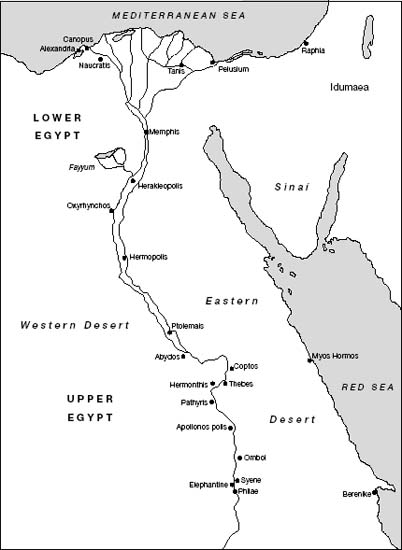
Ptolemaic Egypt
Rejecting this appeal did not mean that the Romans actively supported the rule of Ptolemy XII. There was the real danger that the princes would try again or some other challenger would emerge. As a result Auletes worked steadily to win formal recognition by Rome, spending lavishly to cultivate influential senators. At the same time he put a lot of effort and money into pleasing his subjects, embarking on a grand building programme. Auletes was especially generous to the Egyptian cults and their temples. The costs were substantial at a time when the inundation produced a number of very poor harvests. Added to that was the impact of decades of sporadic civil war and internal tension throughout the two kingdoms. Royal officials needed to squeeze harder than ever to raise sufficient revenue. The recent upheavals had done little to promote efficiency within the bureaucracy and at the same time fostered corruption. There were more outbreaks of unrest amongst the hard-pressed peasantry, even if the priestly aristocracy were generally.10
THE ROMAN ALEXANDER
Pompey – fully, Cnaeus Pompeius – was a maverick general who first came to prominence when he raised an army at his own expense and led them to join Sulla in 83 BC. He was just twenty-three, had never held office and thus had no right to command. The fact of the existence of his loyal army, raised mainly from his family estates, meant that this did not for the moment matter. Sulla employed him, and he repeatedly hammered the older Roman generals he faced in Italy, Sicily and North Africa. Pompey was young and fancied himself a new Alexander, aping the Macedonian’s hairstyle and mannerisms. Sulla named him Magnus (the Great), although he may have intended it ironically. Others called him ‘the young butcher’ because of his alleged enthusiasm for executions.11
When the dictator retired, the Senate he had created also chose to employ Pompey rather than try to force him into a more conventional and legal career. He was sent to Spain to fight a bitter war against Marian supporters who refused to surrender. For the first time Pompey was formally voted the power to command (imperium), although this was a special dispensation since he had still not held any elected office and was not even a senator. In 71 BC Pompey returned victorious from Spain and demanded the right to begin his political career and seek election to the consulship for the next year. He was too young, but his popularity – and the fact that his army was camped not far from Rome waiting to celebrate his triumph – ensured that he was granted this special privilege.
Pompey was elected consul for 70 BC, with Marcus Licinius Crassus as his colleague. The latter had just defeated the slave rebellion led by the gladiator Spartacus, and similarly had an army near the city. Both of them were Sulla’s men and had done well out of the proscriptions, but there was little love lost between the consular colleagues. Crassus was some ten years older and had resented the praise and rewards received by Pompey during the civil war. The situation was not improved when Pompey destroyed a band of slaves fleeing from Crassus and tried to claim the glory for ending the war.
The pair were rivals and disliked each other intensely. They were also for the next decade and more by far the most influential and wealthiest men in the Republic. Crassus worked hard at politics, as he did in his business activities, steadily increasing his fortune. He owned property and maintained a large group of slave craftsmen to repair and construct buildings. Others acted as firemen at a time when there was no fire service in Rome. Crassus was wont to buy up property in the path of a blaze at a bargain price and then send in his slaves to control the fire, usually by demolishing buildings to create a firebreak. Later these could be rebuilt by his craftsmen. Crassus was a shrewd businessman, but did not simply use his money to make more money. He was generous in giving loans to other senators, and was equally generous with his time, often acting as an advocate in the courts. In this way a large proportion of senators were placed under obligation to him. Strikingly, Crassus was considered too dangerous for anyone else to prosecute.12
Pompey had spent most of his life on campaign and did not know how to play the political game anywhere near as well. He relied far more on the glory of his victories. When these began to fade in the public consciousness, he decided that he needed new ones. In 67 BC he was given an extraordinary command to deal with the pirate problem, which had grown even worse since the failure of Mark Antony’s father. Pompey received massively greater resources than Antonius. He was also a good deal more competent, with a true genius for organisation. In a matter of months, he and his subordinates swept the Mediterranean clear of pirates. Looking for a long-term solution, many of the pirates were resettled on land where they could support themselves and their families without resorting to crime.13
Pompey’s success was spectacular, but he wanted far more and in 66 BC was granted another extraordinary command to deal with Mithridates of Pontus. Once again there was more than a hint of poaching the glory of others, because the war had already almost been won by Lucullus, one of the consuls of 74 BC. Pompey used the pretext of the war with Mithridates and his ally, King Tiridates of Armenia, to launch a series of eastern expeditions against various opponents. He expanded Roman territory and then systematically reorganised the eastern provinces. In the process he abolished the last rump of the Seleucid Empire. The Ptolemies were left as the only survivor of the three great Successor kingdoms.14
Pompey did not visit Egypt, but Auletes took care to provide aid to his army, including the supplies necessary to support 8,000 cavalrymen. In addition, he sent lavish gifts, including a gold crown, to the commander himself. In the meantime, Crassus held the censorship in 65 BC and began agitating to have Egypt declared Roman public land, which could then be distributed. He clearly hoped to be placed in charge of the process and so make a substantial profit, as well as placing large numbers of citizens in his debt. Julius Caesar – still only in his thirties, but extremely ambitious – was also involved, although it is not clear whether he supported Crassus or wanted to take charge of the process himself. Crassus was very influential and extremely rich – probably only Pompey could match his wealth – yet other senators had some wealth and some influence, and if enough of them combined to block a measure then there was no means of forcing it through. All proposals about Egypt made at this time were blocked.15
The move to annex Egypt failed, and Crassus and Caesar both passed on to other schemes. It is vital to remember that Egypt was not at the centre of Roman public life. Occasionally it became an issue, usually as part of the personal ambitions of a leading senator, as each struggled to rise to the top. In late 64 BC a law was proposed to make a widespread distribution of publicly owned land to poorer citizens. Egypt was wholly or partly to be included within this, but once again the measure was defeated and public life moved on to other concerns.16
Pompey also discovered that there were limits to his real power when he returned to Rome in December 62 BC. His prestige was colossal, his popularity huge and the triumph he celebrated shortly afterwards more spectacular than any ever seen before. Yet for all that he failed to gain the Senate’s approval for eastern settlement or secure land for the soldiers due for discharge from his army. Time and again attempts to secure these things were blocked. Other senators, including Crassus and the supplanted Lucullus, were eager to cut the great general down to size. None wanted to see the Republic dominated by Pompey, and at the same time thwarting him helped to build up their own influence and reputation. The issues were almost irrelevant. Pompey’s eastern settlement was sensible and thorough, the desire to reward his soldiers reasonable. This did not in any way restrain other senators from blocking them and Pompey was not a skilful enough politician to find a way round.17
It may have been Julius Caesar who came up with the idea of bringing Pompey and Crassus together in a secret alliance known to scholars (although not at the time) as the ‘first triumvirate’. On their own, neither Crassus nor Pompey could get what they wanted. Working together, and with Caesar as consul for 59 BC, all three men were far harder to resist. That did not prevent rival senators – including Caesar’s consular colleague Bibulus – from trying to block them every step of the way. Both sides in turn escalated the conflict, and there was intimidation and violence that stopped just short of serious bloodshed. Pompey’s settlement was ratified and his veterans given land, while Crassus won a favourable deal for the publicani with many of whom he had close connections. Caesar forced through a law redistributing public-owned land in Italy to poor citizens and secured himself an extraordinary military command for five years.18
Auletes had cultivated Pompey for some time and the king scented an opportunity now that the latter and his allies were so strong at Rome. At last Ptolemy XII gained formal recognition, being named as king and a ‘friend and ally of the Roman people’ by a law passed by Caesar in 59 BC. The price tag was enormous. Auletes promised to pay 6,000 talents – somewhere between half and all the annual revenue of Egypt. The bulk of this went to Pompey and Caesar, although Crassus may also have profited. Ptolemy’s representatives borrowed on a huge scale from Roman bankers to make the initial down payment.19
Auletes’ younger brother in Cyprus was unable to afford the cost of similar recognition. In 58 BC an ambitious Roman senator persuaded the People’s Assembly to pass a law granting a free dole of grain to every citizen in Rome. To meet the cost of this, the law authorised the seizure of Cyprus – or at least royal property there – by the Republic in accordance with Ptolemy X’s will. The king was offered comfortable retirement, but chose suicide instead when all his protests were unavailing.20
The Alexandrians seem to have welcomed the formal recognition of Auletes by Rome, but the annexation of Cyprus provoked deep resentment and a sense of humiliation. Auletes had done nothing to save his brother or resist the seizure of one of the oldest parts of the Ptolemaic Empire. At the same time the royal bureaucracy was especially aggressive in its collection of revenue, since the king needed to pay his debt to the triumvirate. Resentment festered. Romans became unpopular – we hear of one member of a delegation being lynched after accidentally killing a cat. Cats were sacred in Egypt (and this is one respect where elements of the Greek population had taken on existing beliefs), but the outburst was probably as much anti-Roman as anything else.21
MOTHERS AND DAUGHTERS
The king himself was seen as weak because he fawned to the Romans, and repressive because of his efforts to pay them. There may well have been other factors at work, and ambitious members of the court scented an opportunity for personal advantage. Late in 58BC, Ptolemy XII Auletes left Alexandria and travelled to Rome, where he claimed that he had been driven out. Certainly, it was some years – and only by force – before he returned. His eldest daughter, Berenice IV, was proclaimed as queen in his absence and clearly against his will. We do not know how old she was, or whether she or her senior advisers were the prime movers in this coup. She was unmarried and took as co-ruler another member of the family called Cleopatra.22
This was definitely not our Cleopatra, who was only eleven at the time. Auletes married his sister Cleopatra V Tryphaena soon after he became king. She may have been his half-sister, especially if he was in fact the son of Cleopatra IV, which would suggest he was some twenty years older than her. In that case, her mother could well have been an unknown concubine. Solving one problem with the Ptolemaic family tree often seems only to create different questions.23
Cleopatra V Tryphaena was certainly the mother of Berenice IV, but ceased to be named in official documents late in 69 BC. From November of that year only Ptolemy himself is mentioned and it has often been assumed that the queen must have died. Reliefs on the temple at Edfu bearing her name seem to have been deliberately covered up at about the same time. This would seem odd if the queen had died and hints that she was withdrawn from public life, either in disgrace or for reasons of health. For whatever reason, Auletes did not marry again. If Cleopatra V Tryphaena was still alive in 58 BC then Berenice may have ruled jointly with her mother.24
The Geographer Strabo, writing at the end of the first century BC, mentions casually that Ptolemy Auletes had ‘three daughters, of whom one, the eldest, was legitimate’. The eldest was Berenice, and this implies that she was the only child the king had with his wife. Our Cleopatra was born before Cleopatra Tryphaena disappeared and therefore it is chronologically possible that the latter was her mother, even if she died soon afterwards. Many slurs and insults were hurled at Cleopatra during and after her lifetime, but it is significant that no other source claims that she was illegitimate — in marked contrast to her father Auletes. It is very hard to believe that something ofthat sort would not have been used against her.
So there are two main possibilities. One is that Strabo’s throwaway comment was correct, even though the point is never mentioned anywhere else. This would make Cleopatra, her younger sister Arsinoe and their two brothers the offspring of a liaison between Auletes and one or more concubines. If Cleopatra Tryphaena was still alive after the end of 69 BC, then she was either incapable of producing more children or the king was disinclined to have them with her. There is no positive evidence for the existence of a royal mistress or mistresses. Since we do not even know whether this woman or women existed, it is important to emphasise that we have no idea at all about their identity. The suggestion made by some that she was an Egyptian from one of the priestly families is pure conjecture.
Alternatively, if Cleopatra Tryphaena survived after 69 BC, but was in disgrace, it is not impossible that she was the mother of some or all of Auletes’ children. This would mean that our Cleopatra’s parents were full brother and sister, which would in turn mean that she had only two grandparents. If Tryphaena was no longer officially queen, then that might just explain Strabo’s statement that only Berenice was legitimate. We simply do not know and should not pretend otherwise.25
A Cleopatra ruled jointly with Berenice IV. If it was not her mother, then the only real alternative is that there was another sister, Cleopatra VI, between Berenice and our Cleopatra. In this case Strabo would have been wrong to say that Auletes had three daughters. Once again, we simply do not know. Our Cleopatra is known as Cleopatra VII, but opinion is divided over whether or not there really was a Cleopatra VI. Whether mother or sister, Berenice IV’s co-ruler died within a year or so.
*
Mystery surrounds almost every aspect of Cleopatra’s family and birth. Our sources are equally blank about her early life. At least until 58 BC, she was probably raised in Alexandria. Tutors for the Ptolemies were often drawn from the scholars of the Museum. In later life Cleopatra would display formidable intellect and erudition. By this period, the royal family gave girls as full and thorough an education as boys. Her first language was Greek, but Plutarch says that she was also able to converse in the languages of the Medes, Parthians, Jews, Ethiopians, Trogodytae, Arabs and Syrians – all peoples living relatively near to her kingdom. Latin is notably absent from the list. Significantly, she was the first of her family to speak Egyptian.
When Ptolemy Auletes left Alexandria, we do not know what happened to the eleven-year-old Cleopatra. She may have remained behind and because of her youth played no part in the new regime. A vague and undated inscription set up in Athens has been interpreted as showing that she went with her father. There is nothing inherently impossible about this. If Ptolemy was suspicious of the loyalty of some senior courtiers and his eldest daughter, he might have preferred to keep some or all of his children with him. That something is not impossible does not mean that it happened.26
Yet there is something intriguing about the idea that the little girl accompanied Ptolemy, for the king would now go to Rome.