
Antony had probably already left Rome long before Ptolemy Auletes arrived late in 58 BC. There would anyway have been no reason for the king to seek out the twenty-four-year-old. Instead, he needed to win over enough influential senators to make the Romans commit to restoring him to his throne. He went first to Pompey, both because of their past connection and because of his obvious importance. A Roman senator’s prestige was reflected by the level of the people who came as clients to seek his favour. It bolstered Pompey’s reputation to have kings coming to him for help and he granted Auletes the hospitality of his own villa in the Alban Hills near Rome.1
The city was bigger than his own capital of Alexandria, bigger indeed than any city in the known world, but a good deal less impressive. Alexandria had been planned and was from the beginning built on a monumental scale. Rome developed more gradually over the centuries and was only now beginning to acquire the grand buildings we associate with it. Pompey had already commissioned a massive theatre complex, almost none of which is now visible, but was originally grander than anything else in Rome. Senators lived in old houses near the heart of the city and their prominence was measured by how close they were to the Via Sacra, the route followed by processions on important occasions. Most Romans lived crowded into high-rise blocks (insulae), paying a high rent and risking disease and fire. Ptolemy may well have found Rome crude and rather squalid, but he had come because he knew its power.
He had also had a recent taste of the blunt manner of some Romans. En route he stopped at Cyprus and went to seek the advice of Marcus Cato, the man appointed by Clodius to oversee the annexation of the island. The tribune had declared that it was vital to send Rome’s most honest man, and Cato had accepted the flattery and the prestigious command. From Clodius’ point of view, it also removed a vocal opponent from Rome. Cato performed the task rigorously and without any hint of malpractice and that in itself was rare enough for any Roman senator of his day. He was an ardent follower of Stoicism, a philosophical school that in the form most favoured by the Romans stressed stern duty and self-discipline. He was famous for his simple lifestyle and refusal to compromise – especially since such traditional virtues were what his most famous ancestor, himself a new man, was also renowned for. Yet there was also a touch of eccentricity about Cato. He was a heavy drinker, and sometimes went barefoot and wore just his toga without a tunic underneath, even on official business.
Ptolemy invited Cato to come to him, but was told that if he wanted to talk then he would have to go to the Roman. The timing of the king’s visit proved especially unfortunate, for Cato was taking a course of powerful laxatives. This may explain why he remained seated when the king arrived and casually told his royal visitor to sit down. His advice was equally surprising, for he told the king to go back to Alexandria and try to make peace. Otherwise not all the wealth of his kingdom would satisfy the greed of the senators if he looked to Rome for aid. Plutarch claims that Ptolemy was at first convinced and only later dissuaded from following Cato’s advice by his own courtiers. This seems unlikely. Cicero had once complained that Cato behaved as if he lived in Plato’s ideal Republic rather than the ‘cess-pit of Romulus’. Ptolemy knew from experience that Rome was, as another king had claimed half a century before, ‘a city up for auction’.2
Yet Ptolemy also knew that active Roman assistance would not come at a low price. Once he reached Rome, he borrowed more money from the bankers there and liberally employed this to win the sympathy of prominent men. Berenice IV and her ministers were not idle, and sent a large embassy of leading Alexandrians to speak against the king. Auletes used his borrowed money to block them: some were intimidated and others bribed into changing their opinion. A number – we do not know how many, but it included the embassy’s leader – were murdered by hired thugs. The violence caused a brief scandal, and Cicero helped to defend one young senator accused of involvement, but no one was condemned. It was perhaps at this time that Auletes removed himself and went to Ephesus in Asia Minor, where he waited in the security of the famous Temple of Artemis. His agents remained in Rome and continued to spend and plead on his behalf.3
Several Romans wanted to be the man tasked with restoring Ptolemy to his throne. That meant there was competition and also that there were plenty of other senators as determined to block them and prevent a rival from winning the prestige and riches which the action would bring. For a while this in-fighting prevented anything from actually happening. Pompey himself wanted to be given the job, no doubt with a new extraordinary command. It is a striking example of the limited power of the triumvirate that he was unable to secure this. Pompey, Crassus and Caesar, who was now in Gaul winning glory in a succession of military adventures, had immense influence, prestige and money, but they could not permanently control public life.
A new complication was added when a Sybilline Oracle – Rome’s ancient collection of cryptic prophecies – was ‘discovered’ and interpreted to mean that Ptolemy should not be restored with the aid of an army. In 57 BC the task was finally given to Publius Lentulus Spinther, consul for that year and due afterwards to go out as governor of Cilicia in Asia Minor. Cicero – now restored from his exile – wrote a series of letters to Lentulus from January 56 BC through to the next year reporting on the debate raging in Rome over the issue. Lentulus was obviously very keen, but in the end decided not to restore Ptolemy, fearing failure if he went without military force and prosecution if he used his army. Either of these outcomes risked wrecking his career.4
In the meantime, Berenice IV and her ministers were attempting to consolidate her position. Her co-ruler Cleopatra, whoever she was, died in 57 BC. The oldest of Berenice’s two brothers was not yet in his teens and, even if he was in Egypt and under her control, he was too young to be elevated to the throne. Only for very brief periods had a queen ever ruled alone and so she and her ministers looked for a suitable consort. A grandson of Cleopatra Selene (who had married a Seleucid) was located, but then inconveniently died before a betrothal had been arranged. Another candidate from the same dynasty was living in the Roman province of Syria, but its governor refused to let him leave.
Finally, a man with the prestigious name of Seleucus and a very loose claim to royalty was brought to Alexandria and married to the queen. The robust Alexandrian sense of humour quickly nicknamed him ‘Salt-fish seller’. Berenice was equally unimpressed and tolerated her new husband’s crude manner for only a few days before having him strangled. As a replacement, her ministers now located a certain Archelaus, who claimed to be the illegitimate son of Mithridates of Pontus, but was actually the child of one of his generals. He, too, had been living in the Roman province of Syria, but was able to get away and went to Egypt. The new consort proved acceptable to Berenice.5
CAVALRY COMMANDER
In 57 BC Aulus Gabinius became proconsul of the province of Syria – it was he who had prevented one of Berenice’s potential husbands from leaving. Gabinius was the man who as tribune had passed the law granting Pompey the command against the pirates in 67 BC. He was still close to Pompey and the triumvirs seem to have backed his successful campaign to be consul in 58 BC. His colleague was Caesar’s father-in-law, and they were clearly eager to have well-disposed senior magistrates to guard their recent reforms. In fact, the two consuls bickered, and again this showed the limitations of the triumvirate’s power. They could not fully control independently minded and ambitious senators.6
Gabinius seems to have passed through Greece en route to his province and recruited the twenty-six-year-old Antony to join his staff. As far as we can tell, this was the first formal public appointment for the latter. Antony had no experience of military life or official responsibility. Nevertheless, he was the son of a senator, the grandson of a consul and an Antonius. He refused to join Gabinius in the junior staff post initially offered to him. Instead, he demanded and got command of some or all of the cavalry in Gabinius’ army — the detail is unclear. His rank was probably prefect of horse (praefectus equitum) and this could involve command of a single regiment (aid) of 400–500 cavalry, or several such units. Publius, the older son of Crassus, was at the same time serving Julius Caesar in a similar capacity.7
Before the year was out Antony led his men on campaign in Judaea. During his eastern campaigns, Pompey had intervened in a civil war between brothers of the Hasmonaean royal family, the dynasty that had ruled since the Maccabees had successfully rebelled against the Seleucids. The Roman army had besieged and captured Jerusalem, and Pompey and his officers had gone into the Holy of Holies in the Temple. Although they did not remove any of its treasure, this was still a violation of sacred tradition, which only permitted priests to enter the inner sanctum, and then only as part of a ceremony. The losing brother, Aristobulus, was taken back to Rome by Pompey and held there in comfortable captivity.
Aristobulus’son, Alexander, had escaped and remained in Judaea, and now raised an army of 10,000 infantry and 1,500 cavalry. He rebelled against his uncle, Hyrcanus, and even began to rebuild the fortifications of Jerusalem. Gabinius moved against him and sent Antony and some other officers on ahead. Our sources imply that Antony was in overall command. Although this is possible, we need to be aware that his later fame may have encouraged them to exaggerate his actual importance so early in his career. It is also unclear whether he at first had with him any of the cavalry he was supposed to command. A good deal of the force consisted of Jewish troops loyal to Hyrcanus. There were also some hastily armed Romans — perhaps businessmen active in the area and impressed into service.
At first Alexander withdrew, and a battle was fought near Jerusalem in which he was badly beaten. The bulk of his troops are likely to have been even less experienced than the Roman force, which included elements of the royal army. More than half of Alexander’s men were killed or captured and he withdrew northeast to the fortress of Alexandrion in the Jordan Valley. Gabinius now joined his advance force and the rebels were defeated again.
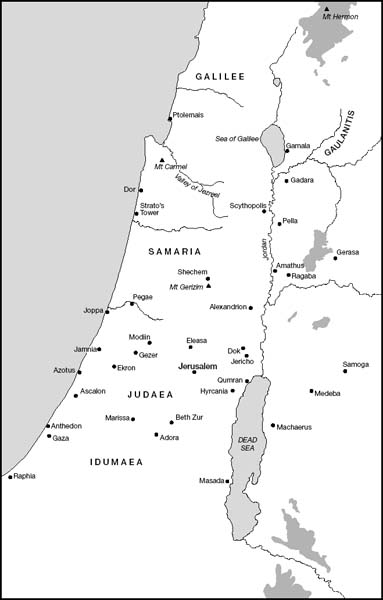
Judea
Antony is said to have killed a number of men in the fighting and displayed conspicuous gallantry throughout the campaign. Virtus – which meant far more than virtue or even courage in English – was one of the most important values expected of a Roman aristocrat. Although inexperienced, Antony was physically extremely fit and well practised with his weapons. At no point in his career would anyone ever doubt his physical courage.
Alexandrion surrendered after a siege when Alexander was persuaded to come to terms. Antony may have been left in charge of the force covering the fortress while Gabinius led the main army in a show of force through the countryside. However, Alexander’s father Aristobulus managed to escape from Rome in 56 BC and seized Alexandrion. Gabinius sent Antony and two other officers – one of whom was his son – with a force to deal with the fresh rebellion. The most detailed source does not suggest that Antony was in overall command.
Aristobulus abandoned Alexandrion as untenable and retreated across the Jordan towards the fortress of Machaerus. On the way he shed those supporters unable or unequipped to fight, leaving him with 8,000, including about a thousand who had deserted from the royal army. The Romans caught up with the rebels and defeated them, killing or scattering most of the army. Aristobulus and around a thousand men made it to Machaerus and prepared to withstand a siege. The Romans were aggressive and assaulted for two days before he surrendered. Once again the Jewish leader went to Rome as a prisoner.8
Gabinius began to look for fresh opportunities for military adventure. Parthia, the powerful kingdom that had emerged in the wreck of the Seleucid Empire, was divided by a civil war between rivals within its royal family. The Roman general scented a chance for glory and plunder, and may already have begun to cross the Euphrates when Ptolemy Auletes made him a better offer. Gabinius was promised 10,000 talents of silver if he used his army to restore the king to power. Antony is said to have been one of the most enthusiastic advocates. As a senior officer he could expect a share of the cash, and that can only have been a very welcome prospect to a man with his great debts.
Sulla’s law forbade a provincial governor from leading an army outside of his province without explicit authority. Gabinius ignored this, as well as the official acceptance of the oracle that stated that Ptolemy could not be restored with an army. His legions moved through Judaea and headed south-west to Egypt in 55 BC. With them went a contingent of Jewish troops from Hyrcanus’ army, led by Antipater, his senior henchman. The grateful Hasmonaean monarch also issued orders for food and other support to be supplied to the Romans. There was a very large Jewish community in Egypt, particularly in and around Alexandria. The pharaohs, the Persians and the Ptolemies had also made considerable use of Jewish mercenaries. Some of these were tasked with guarding the crossing places at the edge of the Nile Delta at Pelusium. Antipater persuaded them to change sides and let the Romans through.
Plutarch credits Antony with the capture of Pelusium, but it may well be that there was no real fighting and the victory was bloodless. Auletes is supposed to have resented this fact as he had wanted to announce his return by a mass execution of his recalcitrant subjects. Antony is said to have restrained him. Some more serious fighting did occur afterwards, and Berenice IV’s husband Archelaus led his men with some determination until he was killed. He did not have much of an army with which to resist the legions. The old system of cleruchies had long decayed and the land was passed on to heirs without enforcement of the obligation to serve. The later Ptolemies had relied heavily on mercenaries, but Berenice and her government lacked the money to hire many of these. Rome’s conquest of the eastern Mediterranean had also reduced the number of soldiers for hire, both by recruiting them as allies for the legions and by making the area more peaceful.9
After a brief fight, Ptolemy Auletes was restored. One of his first acts was to order the execution of his daughter Berenice IV No doubt her leading supporters met a similar fate. Antony won the admiration of many Alexandrians because he insisted on giving Archelaus’ corpse a proper burial. The two men had known each other when Archelaus had come to Gabinius seeking favour, before he had been approached by Berenice’s representatives. Appian, writing in the early second century AD, claims that during this campaign Antony first saw the fourteen-year-old Cleopatra and fell in love with her. This is not intrinsically impossible – she was either with her father and his courtiers, or in Alexandria or another part of Egypt when he returned. She was probably also already striking and charismatic, and there is no reason why Antony may not have found her very attractive. Yet it could easily be just a romantic myth, and even Appian does not suggest that anything actually happened between them.10
The Egyptian campaign confirmed Antony’s reputation for bravery and dashingly aggressive leadership. On at least one occasion he showed some tactical skill, leading his horsemen to outflank an enemy position that was holding up the main force. Again, though, we should beware of making too much of these early exploits. Plenty of young Romans were brave, dashing and liked by their soldiers. Both in Judaea and Egypt, Gabinius’ army was markedly stronger and better equipped than the hastily raised forces opposing them. However stubbornly these fought, they were simply not a match for the Romans. The same was true when Gabinius led the bulk of his army back to his province and suppressed another rising in Judaea, and also in a subsequent campaign against the Nabataean Arabs.11