
Very little is known about Mark Antony’s mother. Plutarch called her ‘as noble and virtuous a woman as any of her day’. Aristocratic women at Rome tended to be married young, usually to older men. If they survived the perils of childbirth, then there was a good chance that they would outlive their husbands. Politicians rarely became too prominent during their father’s lifetime, but many had living mothers and some of these had a powerful influence on their sons. Julia could still change her son’s mind when Antony was in his forties.1
The Romans celebrated mothers who disciplined their sons, trained them in virtue and drove them on to excel. The ideal was more stern than soft and forgiving – although that may simply be because the latter was taken for granted. One of the most famous was Cornelia, wife of a man who was twice consul and censor, and the mother of Tiberius and Caius Gracchus. The brothers had spectacular careers, but each was killed in succession – the first acts in the violence that dominated the last century of the Republic. By that time she had long since been widowed and was said to have turned down a proposal of marriage from Ptolemy VIII. Julius Caesar’s mother Aurelia was held in similarly high regard.2
Julia was fifth cousin to Julius Caesar. The two branches of the family had diverged several generations earlier, to the extent that they were now members of different voting tribes in the Popular Assembly. Her own brother was Lucius Julius Caesar, who was consul in 64 BC and a distinguished member of the Senate. Their father had also reached the consulship, but he and his brother were both victims of the massacre carried out by Marius’supporters in 87 BC. In spite of his failures against the pirates, it is highly likely that her husband, Marcus Antonius, would have reached the consulship had he not died before returning to Rome. Julia’s second husband was consul in 71 BC.
Women could not vote or stand for political office, but senators’ daughters were raised to be proud of their family. Unable to have a career of their own, many did their utmost to promote the career of their husband and sons. On marriage, Julia did not take her husband’s name. She remained Julia, the daughter of Lucius Julius Caesar, and one of the Julii and a patrician. This was reinforced because her property remained her own and so was not eaten away by her first husband’s debts. Her own father dead, Julia enjoyed a remarkable degree of independence even though she married again.
Aristocratic women rarely breastfed their children, and the amount of time they chose to spend with them when they were infants varied considerably – as indeed it does today, especially amongst the more affluent. We know nothing at all of how Julia felt about or treated her three sons – in the same way that we know nothing about her emotions towards either of her husbands. The mother’s role was important in supervising the upbringing of her children, even if this was sometimes done at a distance and their day-to-day care left to nurses, who would usually be slaves. These would also be selected by the mother. Yet, ideally, many Romans seem to have believed that the mother should be more directly involved. Writing at the end of the first century AD, the senator Tacitus claimed that:
In the good old days, every man’s son, born in wedlock, was brought up not in the chamber of some hireling nurse, but in his mother’s lap, and at her knee. And that mother could have no higher praise than that she managed the house and gave herself to her children.… In the presence of such a one no base word could be uttered without grave offence, and no wrong deed done. Religiously and with the utmost diligence she regulated not only the serious tasks of her youthful charges, but their recreations also and their games.3
Education was carried out at home in aristocratic families. Only the less well-off, but still moderately wealthy, sent their children to fee-paying primary schools. The poor had little or no access to education and many were probably illiterate. In contrast, the aristocracy were raised to be bilingual, fluent in Greek as well as Latin. A slave from the Hellenic east would act as the child’s attendant (paedagogus) to begin teaching him Greek (or her — by this period senators’ daughters were usually as well educated as their sons). Along with numeracy and literacy, children were taught about history, and in particular the part in it played by their family. As Cicero put it, ‘For what is the life of a man, if it is not interwoven with the life of former generations by a sense of history?’4
Julia would have made sure that Antony and his brothers knew they were heirs both to the Antonii and Julii. Personal virtue was emphasised. Rome had grown to be the greatest power in the world because of its special respect for the gods, and the courage, constancy and proper behaviour of the Romans, especially the aristocracy and most of all the boys’ ancestors. From his earliest years Antony would have been surrounded by expectation that he would live up to — or better still surpass — the achievements of previous generations. Rome was the greatest state in the world and it had been led to that greatness by its aristocratic leaders. Being born into a senatorial family made a child special, particularly if his family was one of the handful at the centre of public life. Rome had no monarch and senators considered themselves greater than the kings of other countries. Antony will never have doubted that being born to his parents meant that he would be one of the most prominent men of his generation. He was born to distinction and glory.
From about the age of seven he began a practical preparation for this, accompanying his father as he went about his daily business. Senators’ lives were lived very much in public. Apart from meetings of the Senate, there was a daily round of receiving the greetings of clients — people attached to the family, usually as a result of past favours — and meetings with other senators. Boys were supposed to observe and copy the proper way of doing things. They were not admitted to the Senate’s meetings themselves, but were allowed to sit outside the open doors and hear what they could of the procedure and debates. Clustered there were the other boys of aristocratic families, so that from very early on there was a close association with the men with whom a boy would later compete for office.5
Antony can only have spent a few years following his father in this way, before Antonius went off to fight the pirates. After this he may have learned about the conduct of politics by accompanying one of his uncles – either his father’s brother Caius Antonius Hybrida or Julia’s brother Lucius Julius Caesar. We do not know how soon Julia remarried, although at least a year was a common period of mourning, not least because it made clear the paternity of any child. After this Antony may have learned from Lentulus. We simply do not know.
Formal education continued alongside the hours spent observing public life, with the emphasis now on what the Romans called grammatica. This included detailed study of the classics of Latin and Greek literature, as well as written and spoken exercises in rhetoric. Pupils were expected to memorise large chunks of literature and also learnt by rote such things as the Twelve Tables, Rome’s oldest collection of laws. The ability to speak, and in particular to deliver a coherent and convincing argument, was vital for any man entering public life. Although Mark Antony never gained as great a reputation for oratory as his grandfather, he was certainly a capable speaker.6
As usual, senators’sons were expected to learn as much by observing as doing. Public life was carried on in a very public way, with speeches made from the Rostra in the Forum to crowds gathered before an assembly met or on other important occasions. Criminal trials were also conducted in the open air on platforms in the Forum and regularly attracted a wide audience. Many famous orators published their speeches, although Antony’s grandfather refused to do so, saying that it risked something he said in one case being used against him in another. In spite of this he had written a study of oratory. In 92 BC the Senate had decreed the closure of schools teaching rhetoric in Latin. The ostensible reason was the superiority of such teaching in Greek, although it may also have been intended to restrict formal training to the very wealthy alone.7
As a man Mark Antony was very proud of his physique. Like other Roman boys his education included a strong thread of physical exercise and specialised training. The purpose was practical, so that alongside simple exercise in running, swimming and lifting weights, aristocratic boys learned to fence with swords, handle a shield and throw a javelin. They also learned how to ride, probably both bareback and with the four-horned saddle used by the Romans in an age before the stirrup. Ideally the boy was to be taught these things by a male relative – many senators prided themselves on their skill at arms. The ideal general was supposed to be able to control his army as well as he handled his personal weapons. Again, a good deal of a boy’s training occurred in public view on the Campus Martius – the Field of Mars to the west of the Tiber where once the army had mustered. Just as they saw each other waiting outside the Senate’s meetings, boys trained and competed with their peers as a prelude to the competition of public life.8
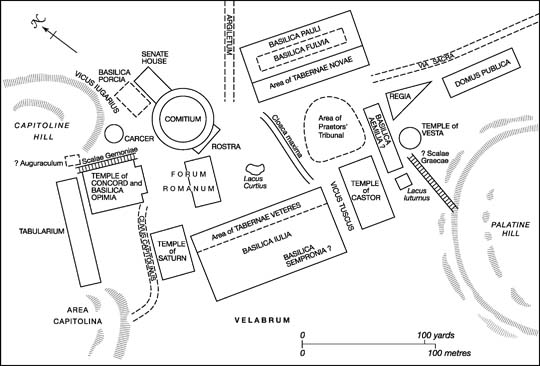
The City of Rome – central area, Forum etc. Some details are conjectural.
Julia raised Mark Antony and his brothers to be leaders of the Republic. It is quite possible that her brother-in-law Caius Antonius and her second husband helped to fulfil the role normally played by the boy’s father. In 70 BC, when Antony was just thirteen, their capacity to do so was severely limited. The censors of that year proved far more rigorous than usual and expelled no fewer than sixty-four senators –just over 10 per cent of the house. These men were condemned as unfit, chiefly for their morals and general character as much as any specific crimes. Both Caius Antonius and Lentulus had their names struck off the senatorial role and had to begin climbing the political ladder almost from scratch.9
WILD YOUTH
As a boy Mark Antony wore the toga praetexta. This had a purple border and was otherwise only worn by serving magistrates. When his family decided, he would lay this aside in a ceremony that marked his formally becoming a man. There was no set age for this, and although somewhere between fourteen and sixteen was usual, some boys became men as young as twelve. The death of his father may have encouraged the family to do things earlier than would normally have been the case. There was not a fixed time of year for the ceremony, although many chose to celebrate it on 17 March, during the Liberalia festival. Tradition dictated that the boy was given a shorter, adult hairstyle, and was shaved for the first time, although in most cases there can have been little for the barber to do. The bulla charm was also removed and never worn again. On the day of the ceremony, Antony donned the plain toga virilis for the first time and was taken through the Forum by relatives and led up to the Capitoline Hill where he would make a sacrifice to Iuventus, the god of youth.10
Although now formally a man, and the paterfamilias, or head of the household, with authority over his younger brothers, Antony continued to live with his mother and stepfather. Not until their late teens was it common for aristocratic youths to move out from the home, usually renting an apartment rather than a house. There was still much for them to learn about public life and the duties of a senator, and they were supposed to keep following relatives or family friends about their daily tasks, as well as watching events in the Forum. At the same time, there was a generally indulgent feeling towards youths of this age. A little enjoyment of the pleasures offered by the greatest city in the world was pardonable, as long as it was not taken to excess and a man eventually grew through this phase.11
Restraint was never a prominent feature in Antony’s character, and this was an age when there were plenty of temptations for the young. Empire brought wealth on a massive scale and there were soon plenty of people eager to sell luxuries of all kinds to those willing to buy. Older senators and equestrians invested in lavish country villas and estates – Cicero continually complained about ex-consuls more interested in their exotic fish than the affairs of state. The young usually wanted quicker thrills.
One of Antony’s contemporaries, himself hounded out of politics on charges of corruption, later railed against the mood of their generation:
As soon as riches came to be held in honour, when glory, dominion, and power followed in their train, virtue began to lose its lustre, poverty to be considered a disgrace, blamelessness to be termed malevolence. Therefore … riches, luxury and greed, united with insolence, took possession of our young manhood. They pillaged, squandered; set little value on their own, coveted the goods of others; they disregarded modesty, chastity, everything human and divine; in short they were utterly thoughtless and reckless.12
As well as indulgence and pleasure, there was also competition, for even the riotous youths remained Roman aristocrats. The young Julius Caesar marked himself out as different by wearing a tunic with long sleeves and so loosely belted that it fell down past his knees. It was a style soon aped by other senators’sons who wanted to be unconventional. Cicero mocked the young men ‘you see with their carefully combed hair, dripping with oil, some smooth as girls, others with shaggy beards, with tunics down to their ankles and wrists, and wearing frocks not togas’. Antony had his own way of standing out. As he grew into manhood he cultivated a neater, thicker beard, and instead of letting his tunic hang low he was fond of girding it up unusually high to show his well-muscled legs. Encouraged by a story that the Antonii were descended from Hercules, he sometimes added a rough, animal-skin cloak, wore a sword and revelled in exuberant, even vulgar displays. Such myths were not uncommon. The Julii claimed the goddess Venus as an ancestor.13
The young aristocrats were determined to enjoy themselves, but men like Antony never lost the utter assurance that in due course it would also be their right to lead the Republic. He soon became the closest of friends with a man of similar temperament, Caius Scribonius Curio, whose father was consul in 76 BC. Plutarch claims that it was Curio who really introduced Antony to heavy drinking, the pursuit of women and an extravagant lifestyle. If this is true, then he was certainly an eager pupil and would remain devoted to all these things for the rest of his life.14
Sex was readily available in Rome’s slave-owning society. Slaves were property and their owners could sell, punish or kill them as they wished. They had no right to refuse any treatment. There were also plenty of brothels, from the cheap and squalid to the lavish and expensive. More important for a young aristocrat were the higher-class courtesans, whose favours were less easy to secure. These had to be cultivated more carefully, lavished with gifts and money to pay for their own slaves and an apartment in which to live. Some were famous – like Praecia, the mistress of Cethegus, who had helped influence the commands in 74 BC – and passed from one famous lover to the next. A story is told of Pompey ending an affair with one courtesan to clear the path of a friend and so place the latter in his debt.15
Courtesans offered far more than just sex. Most were well educated, witty and elegant. They offered companionship and the thrill of an affair. There was an even greater thrill to be had in the pursuit of aristocratic women. Senators’ daughters were too valuable as a means of cementing political alliances to be left unmarried for long. There were almost no young, single and aristocratic women in Rome. Yet many had husbands far older than themselves, whose political career took them off to the provinces for years on end. In an era where girls were as well educated as their brothers, most women were fluent in Greek as well as Latin, had an extensive knowledge of literature of all kinds and especially poetry, as well perhaps as philosophy and music.16
All of these attributes could be seen as virtues, but could also leave a woman bored with the task of raising children and running a household. Just like the men of their generation, many aristocratic women refused to obey traditional conventions and sought more immediate pleasure. The historian Sallust left a full, if jaundiced, description of Sempronia, well known to Julia’s second husband Lentulus, and the mother of Decimus Junius Brutus, a contemporary of Antony’s:
This woman was well blessed by fortune in her birth and physical beauty, as well as her husband and children; well read in Greek and Latin literature, she played the lyre, danced more artfully than any honest woman should, and had many other gifts which fostered a luxurious life. Yet there was never anything she prized so little as her honour and chastity; it was hard to say whether she was less free with her money or her virtue; her lusts were so fierce that she more often pursued men than was pursued by them.… She had often broken her word, failed to pay her debts, been party to murder; her lack of money but addiction to luxury set her on a wild course. Even so, she was a remarkable woman; able to write poetry, crack a joke, and converse modestly, tenderly or wantonly; all in all she had great gifts and a good many charms.17
Aristocratic women were exciting, challenging lovers, and gossip suggested that extramarital affairs were common in these years. Julius Caesar was notorious for his seduction of other men’s wives – he slept with the wives of both Pompey and Crassus, and maintained a long-term affair with Servilia, the mother of the Brutus who would lead the conspiracy against him and the half-sister of Marcus Cato, his bitterest opponent. The poet Catullus wrote of the joys of love with Lesbia, a married woman from a prestigious patrician family, and the bitterness of subsequent rejection.18
We know nothing of Antony’s earliest love affairs, other than that he had them. Cicero claimed that he also let men make love to him, dubbing him little more than a prostitute, until Curio came along and offered him a ‘stable marriage’. This was part of a speech vilifying every aspect of Antony’s character and needs to be treated with caution. Roman politicians habitually threw the most scurrilous abuse at each other – elsewhere, Cicero accused another prominent senator of incest with his sister. The truth is impossible to know, but it was probably just gossip.19
Yet Curio and Antony were certainly extremely close. They spent a lot of time in each other’s company, throwing themselves into a round of wild parties. It was not a cheap lifestyle. Antony inherited heavy debts from his father, but was soon running up new ones of his own. There were plenty of people willing to loan him money, both on the basis of his remaining property and also gambling on Antony having a successful career. If he did well enough then he would be in a position to repay the loan and interest, or alternatively do the lender a favour in future. Even so his debts rose to staggering levels.
Curio stuck by his friend, and personally went surety for the sum of 6 million sesterces. (A senator needed property of at least 1 million, while a soldier had a gross annual salary of just 500 sesterces.) Curio’s father was not impressed and barred Antony from coming to their house. Cicero claims that the undeterred Antony climbed onto the roof and was let down through a hole in the tiles. The orator also says that both the father and son came to see him, the latter imploring him to convince Curio senior to make good on the pledge. He did, but would not permit his son to take on any more of his friend’s debts.20
SAVIOUR OF THE REPUBLIC
Antony was not alone in running up massive debts. Julius Caesar was just one example, but there were many more. The creditors were usually willing to wait as long as the debtor continued to be successful. Serious political failure risked an immediate demand for payment, which could only end in utter ruin. Both Lentulus and Caius Antonius had to spend heavily to get back into the Senate and public life, seeking offices they had already held in the past. They made steady progress and were elected praetor and consul respectively for 63 BC.
Marcus Tullius Cicero was Antonius’ colleague in the consulship. He was a ‘new man’, whose fame rested on his great talent as an orator – in fact, he claimed to have learned much from listening to Antony’s grandfather. Defying one of Sulla’s more brutal minions in a court case, he quickly made a name for himself and continued to play a conspicuous role in some of the most notorious cases of the next decades. He was soon acknowledged – not least by himself– as the finest orator of his generation. Many senators were very grateful for having Cicero defend them or their clients in court. That did not mean that they would always support him when he sought higher office. Cicero remained the new man and could not boast of the achievements of his family. Yet in the elections for the consulship of 63 BC enough influential voters decided that he was preferable to one of the other leading contenders, Lucius Sergius Catiline. They voted for the new man, and for Caius Antonius. The latter was held in very low esteem, but was considered too lazy to be dangerous – an echo of the alleged reason for giving his brother Marcus Antonius the pirate command in 74 BC.21
Catiline tried to win the consulship for the next year and again failed. He was a patrician from an ancient line that had long since drifted away from the centre of public life. In this respect, he was like Sulla – and indeed Julius Caesar – and had the same driving urge to reclaim what he felt was his rightful place at the head of the Republic. Even his enemies had to admit that Catiline had talent, but his reputation was scandalous – again similarities with Sulla and Caesar, and even Mark Antony, are strong. As one of Sulla’s supporters he had been especially bloodthirsty during the proscriptions. There were also persistent rumours that he had murdered his own son to please his new wife and allegations of an attempted coup that failed only at the last minute.22
Catiline had profited from Sulla’s success, but then spent so lavishly that he was soon heavily in debt. He was one of the fast set, mixing with the wild young men and women whose behaviour provided the gossips with plenty of material. Antony must have known him, because Julia’s husband Lentulus was a close associate. It is more than likely that many of his friends were drawn to Catiline, who had a reputation for helping to arrange love affairs and being generous with money. He spent to win supporters and tie them to him. Politics was also hugely expensive for anyone in an era when candidates had to out-spend their rivals to advertise themselves and win votes. Catiline’s three unsuccessful campaigns for the consulship shattered his remaining credit.23
In 63 BC he lost to Cicero, the new man he dubbed a mere ‘resident alien’ in Rome. The details of what followed are only known from hostile sources. It may well be that Cicero did his best to provoke a crisis, backing Catiline into a corner. Yet he did not imagine or create the rebellion that followed. After brazening things out for a while, Catiline fled from Rome and joined an army being raised by his associates. Eventually they would lead two legions, one carrying an eagle of one of the legions that had fought under Marius.24
Mark Antony’s stepfather Lentulus was the leader of the men Catiline left behind in Rome, who were later accused of plotting to murder Cicero and other leading men and then start fires to sow confusion in the city. It was far from being a well-organised and disciplined plot. One of the conspirators boasted to his mistress of how he and his friends were going to take over. She promptly took the story to Cicero and continued to keep him informed. Soon afterwards Lentulus made contact with ambassadors sent to Rome by a Gaulish tribe called the Allobroges. They were there to complain of mistreatment by successive governors. Lentulus tried to persuade them to provide cavalry to support Catiline’s legions. The Gauls decided to trust to the proper authorities and reported what was happening. Cicero was able to ambush and arrest them, along with one of the conspirators and several incriminating letters. Lentulus had even repeated a prophecy to the Gauls which claimed that three Cornelii would rule Rome. Sulla and Marius’ ally Cornelius Cinna were two, and he, Cornelius Lentulus, was destined to be the third.
The Senate having decreed a state of emergency, Lentulus and the other leading conspirators were arrested. A debate then raged as the senators decided what to do. Most favoured immediate execution, but for a while Julius Caesar started to sway their mood in favour of permanent imprisonment. Cato, backed by Cicero and others, managed to convince a majority to enforce the death penalty without formal trial. In honour of his status as praetor, Cicero personally led Lentulus by the hand to the nearby Tullianum, which served as a prison and place of execution. The conspirators were then strangled. Cicero is supposed to have announced simply ‘they have lived’ – the single word vixerunt in Latin.25
Antony does not appear to have been seriously involved with the conspiracy. Perhaps he was also still too young to be taken seriously, since he was only twenty, and had not yet taken any formal steps towards a political career. As far as we know he did not take part in any court cases and would not do so in the coming years. Young men tended to prosecute, in part because this was seen as an aggressive action, since if successful it could well end another man’s career. Established orators like Cicero usually acted for the defence, since it was considered more honourable to defend a friend or associate even if he was guilty.
Julia was once again a widow. Now in her late thirties, she chose not to remarry. Plutarch reports but discounts a story claiming that Cicero refused to let her have Lentulus’ body for proper burial. Her brother-in-law, Caius Antonius, was sent with an army to deal with Catiline. Cicero had helped to secure his colleague’s co-operation by a private deal. He had been allocated the province of Macedonia after his year as consul, but he waived his right to this and let Antonius take it instead. The latter believed that the Macedonian frontier offered the prospect of a lucrative war.26
Antonius pleaded an attack of gout and was not present at the battle when the rebel army was destroyed and Catiline killed. Instead, command passed to an experienced subordinate. It was common for young aristocrats to accompany relatives on campaign, living with their headquarters and learning the business of leading an army by watching it done. There is no evidence that Antony accompanied his uncle either against Catiline or when he went to Macedonia. Indeed, we know almost nothing about his activities in his early twenties. It was probably to his advantage not to have accompanied his uncle. Antonius was defeated by Thracian tribesmen and when he returned to Rome he was brought to trial in 59 BC on charges of corruption. Cicero loyally defended his consular colleague, but Antonius was condemned and went into exile. With father and stepfather both dead – as we have seen, the latter executed as a rebel – and his uncle now a discredited exile, Antony was running out of relatives able to help his career.27
At some point he seems to have married. His bride was called Fadia and was the daughter of a freedman named Quintus Fadius Gallus. There was no political advantage to such a union – and indeed any connection with the family of a former slave was likely to provoke mockery and contempt from the aristocracy. Most likely, Fadius was wealthy, and the marriage helped him to gain respectability while financially assisting Antony. Perhaps the young aristocrat was able to spend some of his wife’s money to maintain his flamboyant lifestyle. At best, any aid made only the slightest dent in his crippling debts.28
Antony certainly knew many of the leading senators, and especially the younger generation now forcing their way into politics. Although he no doubt knew Julius Caesar, there is no hint of any close connection. Early in his career, Caesar had prosecuted Caius Antonius on charges of corruption and although the latter had not been found guilty there was little love lost between the two men. In 59 BC Antony’s friend Curio was a leading critic of Caesar, Pompey and Crassus, enjoying a brief popularity that saw him cheered when he appeared in public. Julia’s close family were hostile to Caesar at this stage in his career.29
For a while Antony was an enthusiastic supporter of Publius Clodius Pulcher – a man about ten years his senior and already becoming a force in politics. A member of the ancient patrician family of the Claudii, Clodius arranged to have himself adopted by a plebeian in 59 BC. The change of status meant that he could now stand for office as tribune of the plebs, while retaining the prestige and connections of his real ancestry. The tribunate could be used as a powerful platform for an ambitious and well-connected man. It was the post that the Gracchi brothers had used, and it was tribunes who transferred Sulla’s command to Marius in 88 BC and gave Pompey his extraordinary commands in 67 and 66 BC. Clodius was easily elected as one of the ten tribunes for 58 BC. He had many supporters amongst the poorer inhabitants of Rome and these proved willing to intimidate and even attack opponents.
The triumvirate assisted Clodius in gaining his plebeian status in this unorthodox way, but it is wrong to think of him as their man. He was soon threatening to attack the laws passed by Caesar during his consulship, before subsequently turning his attentions to Cicero and accusing him of illegally executing the conspirators in 63 BC. The new man was vulnerable and, bitterly disappointed by the lack of support given by other senators and especially Pompey, Cicero fled into voluntary exile. It was Clodius who arranged the annexation of Cyprus to fund the free corn dole he introduced for citizens in Rome.
Clodius was another of the wild-living younger generation, notorious for his womanising. His sisters and brother had a similar reputation. One of the sisters was the ‘Lesbia’ first adored and then hated by the poet Catullus. Clodius himself had once been discovered disguised as a woman and sneaking into Julius Caesar’s house during an exclusively female religious festival. Most people believed he was conducting an affair with Julius Caesar’s wife. Caesar refused to testify against Clodius when the latter was charged with sacrilege. Neverthless, he divorced his wife, and when questioned famously said that this was because ‘Caesar’s wife must be above suspicion’. Clodius was married to Fulvia, herself from a very distinguished family. There were rumours that she and Antony conducted an affair. There may not have been any truth in this, although some years later he would marry her. For whatever reason, Antony broke with Clodius.30
At some point, Antony left Italy for Greece and remained there for a considerable time. Ostensibly this was to study rhetoric, and many Romans including Cicero and Caesar had travelled east to do this at a similar age, but both had also already begun their political careers. Antony had not and was probably held back by the burden of his debts as well as his fondness for pleasure. Pressure from creditors may well have been a strong reason for leaving Rome.