{CHAPTER 9}
Avoid extremes; forbear resenting injuries
so much as you think they deserve
UP UNTIL MODERATION, MY FAILURES ALONG THE PATH OF VIRTUE HAD been modest (as have been my successes). I might not have been lighting the virtuous world afire, but nor was I in danger of being stoned to death by some Ben Franklin cult. At least until Moderation.
{ When in doubt, don’t.}
Moderation threatened me with a heretofore forgotten foe: mediocrity. For once (just once, mind you), I thought I had too much of what Ben sought (or at least some boring mutation of what he sought). There was a successful song from the 1940s called “Accentuate the Positive.” You know it—catchy tune, interesting little lyrics. The refrain is “Don’t mess with Mr. In-Between.” Well, don’t mess with me. I am Mr. In-Between.
I am the epitome of Moderation. For the most part, my life has been governed by very middle-of-the-road behavior. I certainly didn’t set out to be moderate; in fact, I probably expected to be a creature of extremes—extremely successful, extremely happy, extremely everything. The reality is that I am only extremely moderate.
In hindsight, I think my Moderation became a self-fulfilling prophecy. As I navigated my way through moderate successes, I avoided risk for fear of losing the benefits of the moderate success, thereby assuring my Moderation. When Chris and I talked about the week of Moderation, he railed against such careful mediocrity. “Moderation is preached as a virtue precisely because it shuts down revolt and stifles innovation. It reinforces the status quo and casts doubts on those who question the way things ‘have always been,’” he said. Indeed, this was the most animated he had been about any virtue. This one seemed to stick in his craw. Of course, he had not been moderate in his life. He had traveled the world and lived in other countries. He speaks several languages and embraces cultures other than his own. He is not Mr. In-Between.
I understood and appreciated his rant (though I should have encouraged him to tone it down just a little bit—no need to go to extremes). Somewhere inside me, there is an extremist yelling and protesting against the innate conservatism of my existence. Stop being Mr. Cleaver, I tell myself. Jump out of airplanes, go heli-skiing, race cars. But I do none of these things. Instead, I am careful. I walk down the center of the road (ensuring that the road has previously been closed for my safety), find the balance in all things. Even on those occasions when I seek to cast off the chains of my Moderation, I usually just trip over them.
When I was graduating from college, I decided I needed to experience the world outside North America. My university had a small library dedicated specifically to this type of wanderlust. Would it be teaching English in Korea or tutoring in Japan? Maybe I could do some sort of charity work in Africa. The more I researched, the more my moderate self protested, “Whoa, big fella! Let’s not wander too far out of the yard. It’s a dangerous world out there. How about a weekend in the city?”
Finally, I rejected all notions of altruism and decided on a backpacking trip through Europe. I even convinced my cousin to go with me. It was more moderate than my first notions of my postgraduate activities, yet it still had a sense of adventure for me. I scrimped and saved, divested myself of all worldly possessions, and readied myself for my European escapade. I was heading out into the big, bad world. Moderation be damned.
On the first night of the trip, not long after stepping off the plane in Brussels, my backpack was stolen from a locker room in our hostel. “Told you so,” said my inner moderate.
My reaction to this Day 1 theft was to hop on a train and flee Belgium. Actually, not just Belgium but all of Continental Europe. My cousin and I didn’t stop until we had passed through France, crossed a small portion of the Atlantic and all of the Celtic Sea. We didn’t take a breath until we hit Ireland. I think I chose Ireland because it was more familiar. There is enough Irish in me that after my misadventure in Brussels, Dublin seemed almost like home.
Of course, the cost of replacing my stolen clothes meant that my trip money was dwindling faster than I had expected (and replacing clothes for a six-foot-three man in Ireland proved more difficult than I’d expected; the Irish, from whom I am in part descended, are evidently a vertically challenged people). The whole debacle dramatically shortened my time in Europe. Indeed, it would turn the backpacking adventure into an extended vacation. My six-month trip turned into less than six weeks.
I’ve always blamed the early termination of the trip on the cost of buying new clothes, but in truth, it was just a manifestation of a middle-of-the-road personality. An unscripted free-flowing journey across unknown countries was too much for me—too extreme. A nice, long vacation was far more acceptable. It was moderate.
So for me, Moderation should have been just another day. At least I should have had no trouble with the acquisition of this virtue.
But as I approached this, the ninth virtue, I knew that this milquetoast, overly safe vision of Moderation was not what Franklin had in mind. Ben was not Mr. In-Between.
Ben took risks. Ben did things. Ben changed the world. He gambled and was rewarded. These are not the actions of a moderate in any sense of the word. So what did Franklin mean when he instructed himself to be moderate?
Alan Houston explains Franklin’s Moderation as part of his self-created scheme, five decades in the making, of winning people over to his side of any issue. According to Houston, it was simply a form of politeness:
Politeness was the virtue of a sensible man. Franklin’s extraordinary success in politics can be attributed, in no small measure, to his embodiment of this early-eighteenth-century ideal.1
For Ben, Moderation, like politeness, was a method to personal gain. Don’t aggravate anyone too much. Don’t make too many waves. Steer the middle course in the waters of social contact. I’m not sure that it is the most altruistic of Ben’s virtues, but judging by his achievements, it served him well.
Not everyone appreciated it. Again according to Houston, John Adams described Franklin’s Moderation (having seen it in action in France and having himself failed at a more extreme tact) as an affront to good manners and decency. Thomas Jefferson, on the other hand, having the same advantage of observation, recognized Franklin’s amiability as a method of persuasion. In the end, the French loved Ben and hated John Adams.2
Regardless of Franklin’s view of this virtue as a method of persuasion, it is at least more striving than my style of Moderation.
So how, then, could I achieve Ben’s virtue this week? Ben’s autobiography holds a key. Franklin described how over time he modified the way he engaged in discourse. First, recognizing a tendency to argue for argument’s sake (and the inherent dangers of that tendency), he, upon discovering Socrates, took up the ancient philosopher’s method of persuasion. It worked well, to a point. Though he was able to use it to trap others into concessions, he was, at the same time, losing their favor. Thus, he resolved to further modify his style of conversation and developed a habit that he described as a great advantage to him. He adopted a temperament of “modest diffidence,” whereby he avoided words “that give the air of positiveness to an opinion.” Rather he would say, “I conceive or apprehend a thing to be so and so; it appears to me, or I should think it so or so, for such and such reasons; or I imagine it to be so; or it is so, if I am not mistaken.”
Essentially, as it appears to me (see I’ve learned a thing or two), Franklin had adopted the position of never taking a position. In debate or conversation, he became a centrist. Avoid the extremes and hug the middle of the road. Maybe he was Mr. In-Between.
Well, that was a style of Moderation that might prove useful. I have a habit of arguing for sport. As momentarily engaging as debate may be, it does seem to have the distinct disadvantage of annoying people. Thus, in my week of Moderation, I resolved to try to be moderate in my positions, diffident in my expressions, and unassuming in my arguments. It had potential. I could see myself, confronted with some statement of monumental ignorance, biting back a caustic slur and instead asking, “That’s interesting. How did you come to that conclusion?”
Sounds kind of smarmy, I thought, when I said it like that. Oh well, I had a week to work on it.
I was not letting myself off the hook on the other aspect of Moderation. Chris Levan had thrown down a gauntlet against my style of Moderation and cried for a little Dylan Thomasesque railing against the dying of the light. Interestingly, this virtue came on the week in which I was to celebrate my thirty-ninth birthday (more on this later). How ironic that a virtue I may have mastered to the point of stagnation arose in the middle of my life (the last time I checked, the life expectancy of a male in my locale was somewhere in the vicinity of seventy-eight—that made me quite literally middle-aged). Perhaps this was more than irony; maybe this was the subtle hand of fate (guided by Ben and Chris) pushing me to evaluate more than a particular virtue. Was I being goaded into evaluating an entire life? Had my middle-of-the-road choices been the right ones? Had my Moderation served me well? Should I have been a risk taker?
{ He that composes himself is wiser than he that composes a book.}
Two roads in the woods diverged, and I took the one clearly marked on the visitor’s map.
So as I followed Ben to Moderation, I would simultaneously race away from it. I was destined to meet myself somewhere in the middle. At least I’d be walking at a safe pace.
Modest Diffidence . . . Whatever That Is
I tried, on the first day of the week, to develop some plan for how I would approach the method of moderate conversation that marks Franklin’s virtue. I didn’t anticipate much success, and I was right. Imagine going through a day trying to be diffident in your positions. Appreciate, if you can, that this requires you to nod, offer some level of empathetic understanding, and not clearly contradict every stupid, inane, ridiculous proposition put to you by . . . well . . . everyone. There are a lot of people whose opinions demand a belligerent, antagonistic, brash response—a sort of rhetorical beat down. Ben’s method does not allow for this.
After only a few hours of trying this never-take-a-position business, I wanted to tell Ben what I thought of his method of speech.
I resolved, however, to put aside my misgivings and give Franklin’s Moderation a try. I will not, I told myself, under any circumstances, express certainty about any position. Indeed, I would not make it apparent to anyone that I had adopted a position at all. Assuming I had . . . adopted a position, that is . . . which I had not. At least not one that I will share with you.
Maybe I had better review Franklin’s Moderation again. He expressed his Moderation as a method of conversation in which he would eschew words such as “certainly” or “without question” or any other expressions of conviction. Rather he would say:
I conceive or apprehend a thing to be so and so; it appears to me, or I should think it so or so, for such and such reasons; or I imagine it to be so; or it is so, if I am not mistaken.
If I am not mistaken, I told myself, this is going to drive me nuts.
And so it did. As I went through the day practicing this, I experienced both guilt at being untruthful and an uncomfortable feeling of kinship with a former superior. The sense of guilt I can handle—I’ve done enough stupid things in my life that guilt is not an unknown emotion. This course by itself had engendered enough failure that I am almost immune to the effects of guilt and self-doubt.
On the other hand, the feeling of some similarity or association to this past “boss” (I use that word loosely, as he was not a direct superior but several levels of bosses above me) had me shuddering like an alcoholic with the DTs.
I value certain qualities in people: honesty, integrity, and selflessness, among others. In those who occupy positions of leadership, I also appreciate three things: (1) a sense of mission; (2) decisiveness; and (3) a Trumanesque acceptance of responsibility. I want a leader who knows where the buck should go; directs the buck with conviction; and, when the buck goes astray, knows precisely where the buck should stop.
The boss I feared that I resembled, as I attempted Moderation, was no buck stopper.
My clearest memories of him are the interminable meetings. Here is how the meetings would go. He’d state the issue at hand, this would take an inordinate amount of time and might or might not actually address the relevant issue, and in doing so he would use a method of discourse similar to Ben’s. He would never take a particular position, but he would adopt an inquiring posture. He might have intended it to be Socratic, but he was no Socrates. Nothing ever developed of his questions. No wisdom was drawn out from his inquiries. I left whatever meetings I attended with him having no idea what had been decided.
I’m not bitter about this time in my life. What concerned me was that as I spoke to people in my best Franklinian manner, I sounded like that guy!
Here’s an example. On Day 1 of Moderation, a police officer asked me for advice on a question of law. This happens all the time. I’m flattered by their trust in me, and I am mindful of my obligation to provide sound advice. Unfortunately, that week, I was also burdened with trying to master Franklin. Thus, while he expected a clear, if not concise, answer, what the officer got was some garbled, nonsensical inquiry about what the officer knew about the topic. He looked at me as if I were crazy. I suspected he thought I knew nothing about the topic and was just trying to hide my ignorance with some verbal shell game.
I tried again—same result. Finally, I just told him the answer. As he thanked me, I sensed that he thought I was having some sort of breakdown.
Worse, perhaps, than my lack of success with Franklin’s method of communication was my lack of success at hiding that I was trying to use Franklin’s method of communication.
Near the end of the day, I stopped into a colleague’s office. “Am I glad to see you. I need some advice on a file,” she said.
“Shoot,” I replied.
“Remember that sexual assault file we were talking about? Well, the defense lawyer has said his client will plead if we ask for less than two years. What do you think?”
What an opportunity! I could feel the gentle hand of Franklin guiding me toward a moderate approach. I had a view on the question—a strong view. Ben would tell me not to simply state that view. If I wanted my friend to accept my position, I needed to win her over by making it her position. I would do so by using the Franklin Moderation method. My plan started with a simple statement beginning with the words “it appears to me,” or “if I am not mistaken.” Eventually, I would have her adopting a point of view, my point of view, without ever telling her that it was my point of view.
Things did not go as planned.
{ He that would live in peace and at ease must not speak all he knows or all he sees.}
“It appears to me as if you need to consider the positives and negatives of the deal,” I said.
Maybe it was the manner in which I said it, or perhaps I had a smug look on my face, or maybe it was just the weight of her knowledge about what I had been doing over the past two months. Whatever the cause, as soon as I had said it, she replied, “That’s the most inane, obvious thing I have ever heard. This has something to do with that stupid course of virtues, doesn’t it. When will this Franklin thing be done?”
I was beginning to wonder that myself.
Do Not Go Gentle into That Good Night
I was taking a stand. On the week of Moderation, I decided to take up the standard that Chris has passed and I am riding forth. Franklin’s entire course (but for this virtue) calls out for change, for challenge, for chance taking. Chris has preached against Moderation. I have acknowledged a surfeit of“middle-of-the-road” disease. Why then should this virtue be anything different?
For the last five years or so, I have taken my birthday off for the express purpose of trying new things. I try a new drink, I try a new restaurant, and ostensibly, I try a new activity. The reality is that my new activities are generally quite mundane. The first year of my birthday/adventure, I tried ten-pin bowling. As I attacked this new activity, I learned three things: (1) I wasn’t a bad bowler; (2) the average age at a bowling alley at 11:00 a.m. is about sixty-eight; and (3) my idea of a new activity needed some reconsideration.
Unfortunately, it really hasn’t gotten any better over the years. My “new” activities haven’t progressed very far, adventure-wise. I haven’t taken the opportunity to pull the rip cord, either literally or figuratively. Thus, Franklin’s call to Moderation (and Chris’s call away from it) is for me a call to arms.
After my difficult beginning with modest diffidence, I changed my goal for Moderation on the day of my birth. I would jump from that plane (figuratively—it is far too cold here in April to take up skydiving). My new activity needed to be something more than it had been in the past. (I took a self-guided tour of historic buildings last year. Even the sixty-eight-year-old bowling crowd would have fallen asleep on that one.) The problem, however, was what to do (a problem exacerbated by lack of another virtue, Order, as I had done no planning and was thinking about this the morning of my birthday).
Over the years I have considered the obvious ones: skydiving (rejected for already stated reasons and a fear that my bulk and gravity might conspire against any parachute harness); taking up an instrument (hardly a one-day activity); and a spontaneous trip out of town (can’t slip that one past Michelle). Oh well; I’d figure something out, I told myself.
I didn’t.
Figure something out, that is.
I should have considered my options in advance, done some research, made arrangements for something spectacular. I didn’t. No airplanes, no car racing, no derring-do at all. Undoubtedly, my lack of splashy new activity was a product not just of my lack of planning but also of my Moderation. Had I thought about this in advance, had I done some planning, would I have done something irresponsible? Probably not. I would have thought of my children and how they needed a father, or I would have considered the foolhardiness of making some expense for no purpose. I would have been moderate.
In the end, my adventure—my new activity—made bowling look positively extreme. I simply wandered around town looking for anything I had not done before (within acceptable risk limits). I went into a store I had never visited, ate at restaurants that I had previously shunned, and had a drink previously untested (just one, even though I was taking the bus). Hardly a blow struck for living life to the fullest.
Chris was disappointed. Ben, I suspect, would also view this as a failure. He would just put it in moderate terms.
There’s always next year.
As long as I’m careful.
A Moderate Failure
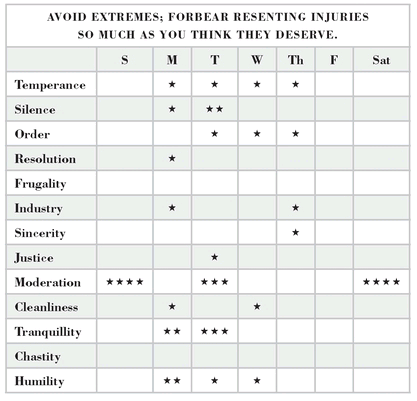
I’m not sure if I failed miserably or succeeded completely. I had really done nothing for the week of Moderation.
Well, that’s not true. I had been absolutely moderate. I lived my life the way that I live my life every week. I followed my daily routine to a tee, avoiding extremes and forbearing resenting injuries. I suppose, then, that I had been moderate. Moderation has been, as usual, my watchword.
Why, then, did I feel like a virtuous failure? Did Ben envision mediocrity as a goal?
Maybe. Maybe Franklin was simply putting a metaphorical brake on himself during his own virtuous journey.
Remember Ben was a believer in the common person. He believed in advancement by achievement. In Benjamin Franklin: An American Life, Walter Isaacson explains the difference between Franklin and Thomas Jefferson. Jefferson believed in a natural aristocracy, while Franklin believed in a meritocracy. He believed in what he called the “middling” people”3 He believed in coming up from the ranks, so to speak. His founding of what would become the University of Pennsylvania was, in part, an attempt to elevate people from all walks of life who wanted to better themselves.4
Maybe all of the change that he was attempting to facilitate in his own course of virtue led to the occasional episode of disengagement. Rush ahead too far from the pack and realize that you are in the wilderness on your own. Maybe Franklin, by advocating Moderation, was just trying to stay within a reasonable distance of the pack—to keep company with his middling people.
Whatever Ben’s motivations, I have been the epitome of Moderation . It hasn’t been particularly fun. No bumps and twists this week, just predictability, mediocrity, and acquiescence.
It was safe, though, and no one got hurt.
I am Mr. In-Between.
Sigh.
MODERATION