{CHAPTER 8}
Wrong none by doing injuries or omitting
the benefits that are your duty
{ A countryman between two lawyers is like a fish between two cats.}
HERE’S A FACT ABOUT BENJAMIN FRANKLIN NOT WIDELY KNOWN. HE was intensely proud of being an Englishman. And by Englishman, I mean a citizen of England. That’s what he considered himself: a citizen of the land against which he would eventually take up arms (metaphorically). Revolution would have been the last thing he would have considered almost up to the point of . . . well . . . the Revolution. He has been called a reluctant revolutionary. He was an Englishman, was proud of it, and felt entitled to the benefits that such citizenship entailed. It is hard to think of Franklin as a Loyalist nearly three centuries later, but that is exactly what he was, at least up to the point where he believed that loyalty was no longer warranted. Indeed, when he was the representative, in England, of several of the colonies, he had a notion that he might permanently relocate there. He enjoyed the rights and liberties of being an Englishman. It was only when he perceived that those rights were being unjustly withheld that he became one of the leaders of the creation of a new nation. How might the world have been different if King George and his boys had simply followed Franklin’s course of virtues?
Though Franklin wrote of Justice long before the American Revolution, some of the reasons for his participation in that historic event can be found in this very virtue. Franklin understood Justice. I, on the other hand, was having another of my moments of self-doubt. Actually, they were adding up to hours at this point. Maybe weeks.
I am in the Justice business, of course, so one would think that this would have been a milestone for me on my way to moral perfection, a banner day on the road to virtue.
In fact, when I enlisted the help of my mentor, Chris, as a sort of expert guide in the land of ethics and morals, I suspected that this would be the one virtue in which I could give him a run for his intellectual money. (He’s much smarter than me, you see. To be frank, most of the time I have trouble understanding what he’s talking about.)
As usual, I was wrong.
It turns out that I was as lost about the notion of Justice (at least in the sense that Franklin meant it) as the average, non-Franklin-following citizen. I’m pretty sure that the Justice to which Franklin was referring had a far more personal, less throw-’em-in-jail quality than my type of Justice.
So what was Franklin’s Justice? The answer lies, I believe, in what Edmund Morgan described as “the end of his pragmatism.” After describing the essential practicality—the pragmatism—that seems to permeate our understanding of Franklin as “a willingness to compromise in pursuit of some goal,” Morgan poses the question, “Where did Franklin’s pragmatism end . . . ?”1 In answering his own question, Morgan acknowledges that even during Franklin’s pursuit of some of his most treasured goals, he remained prepared to be, well, pragmatic. There were instances, however, in which Franklin, refused to give in:
But there were occasions when he dug in his heels and refused to make concessions, occasions when his goal was nonnegotiable, when defeat was preferable to compromise, when his pragmatism came to an end, a stop.2
So what were those “occasions”? Certainly, his fight for the rights of “Americans” and, even before that, his fight against the Penn family in their capacity as proprietors of Pennsylvania. The most compelling to modern sensibilities, however, might be his last fight—his last cause. Franklin made his last act of public service a plea to the first U.S. Congress to end slavery. While some have questioned his sincerity on the issue, it seems to me that in this position, this last act of a public servant, we see Franklin’s sense of Justice. His petition to Congress said that “equal liberty was originally . . . the birth-right of all men.” These were the benefits that he saw as his duty, indeed the duty of his new country, to confer.
So that was the type of Justice that Franklin sought. It was a far more profound, foundational brand of Justice than what I had first envisioned when I examined the virtues. This virtue was going to be tougher than it first appeared.
Discovering My Justice Mantra
On the first day of Justice, Justice and Tranquillity met at a cross-roads and tried to beat each other senseless.
I had spent the better part of the day in a trial with a lawyer whose questioning style can best be described as glacial. What would normally take minutes takes hours, hours become days, and days turn into weeks. This is not good. Like milk, Justice gets smelly if it stays around too long.
But in the spirit of Franklin, I was trying to take a broad view of Justice. Perhaps my opponent on this day understood that too often in the criminal justice system, we settle for expediency when the goal should be truth. Maybe, in fact, my desire, at that moment, to strangle him was a reflection of my own poor character and lack of a holistic view of Justice rather than a reaction to his annoying courtroom style.
As I sat, head in hands, listening to the endless drone of his voice, lamenting the bad luck that assigned me to this court on this day, I realized that this was a Franklinian catch-22.
My obligation to participate in this process, to see that Justice was done, was running headlong into my inability, at the moment, to be tranquil. Justice required a fair trial, and my opponent seemed to have the view that a fair trial required him to ask the same questions of witnesses over and over and over again. In this regard, then, Justice was being served (sort of ).
My adversary, as pedantic as he might have been, brought home to me that I might simply be a cog in a massive wheel rather than Justice Man. The system functions, as I’ve earlier described, a little like an airline that overbooks seats. Airlines hope that not everyone who books passage shows up wanting to fly somewhere. Courts are like that. More trials are scheduled than can be logically dealt with, not enough time is assigned to any event on the docket, and when someone is told to do or not do something as part of the consequence for his or her crime, there is little or no follow-up. To continue the airline analogy, when everyone demands their day in court, the plane can’t fly. There are just not enough seats.
Some days I feel like the system provides excellent value to society. On other days, I feel like a factory worker on the assembly line, putting my one small part onto the big car of Justice—nothing handmade about this baby.
So if my opponent felt it was his duty, his requirement, to do Justice, to ask the same questions repeatedly, then my obligation was to make sure they were asked properly and that our little notion of Justice was fulfilled. At least I think that’s what I thought. It is all something of a blur now. My concentration was lost in the endless droning from my adversary.
As much as Justice, in the best Benjamin Franklin tradition, might have been present in that courtroom, Tranquillity had thrown its things into a suitcase and had run away as fast as its little legs could carry it.
Maybe I need a mantra.
I will not strangle other lawyers. I will not strangle other lawyers.
I Fought Irony, and Irony Won
Justice and irony must be first cousins. They both have a way of sneaking up on you. Just when you think you have the whole notion of fulfilling your responsibilities to others down, Justice walks up behind you, slaps you across the back of the head, and scolds you for letting everyone down.
{ Without justice courage is weak.}
You may remember my pro bono project from an earlier chapter. Well, Justice seemed just the week to dedicate to this endeavor. For an instant, I thought that my dedication to this Justice-based initiative might even have found favor with Franklin himself, for in the middle of the week of Justice I had a metaphorical victory for my efforts.
The catalyst for the idea had been a couple who had been wronged by a government agency. They came to me for help, but given what I do for a living, there was little that I could do for them. I did the best I could, making several recommendations about not-for-profit organizations that might be of some assistance, all the while knowing that these were Band-Aid solutions. Thus, I formulated the idea for our Pro Bono Association.
As I said, in the middle of the week dedicated to Justice, I saw some cosmic hand at work. I was working late in my office again when I ran into the couple who had been my inspiration. They were excited to see me. The husband told me that one of my suggestions had helped and, in the end, saved him $4,000.
As I congratulated him, I thought of Ben and his dictate not to omit our duties and was pleased with the symbolic victory in a week dedicated to Justice.
I should have known that Benjamin Franklin would have scorned symbolic victories. The next day, there were to be no victories, symbolic or otherwise.
Let me begin my tale of Justice woe by giving you a little background. My boss had been away for three weeks. In an office of six prosecutors, the loss of one can cause significant workload strains. One of my colleagues was also out on extended sick leave. Meanwhile, I was under a looming deadline to prepare a legal brief in response to an appeal of a murder conviction. Heaped on that were the regular files, a number of deadlines for filings of documents in future trials, and several requests for advice from law enforcement agencies.
That would have been a busy, if typical, week. But in that week of Justice, nothing was to be typical. On top of all the regular work, I had agreed to assist a prosecutor in a neighboring jurisdiction with the upcoming trial of a brutal double homicide. While this was the work I had dreamed of when I was in law school (as much as I have ever dreamed of work), it also added considerably to my caseload.
Despite the fact that this trial had all the ingredients of a Hollywood movie, the real story was less dramatic yet far more compelling. The family of a murder victim can never be restored to normalcy. They can’t be put back in the position in which they were before the crime. Part of my job, I think, was to prepare them for what lay ahead.
And here is where my hubris at the symbolic victory of the previous day met up in a dark alley with irony. My hubris took a tremendous beating.
The accused in the murder trial, a man who had apparent mental health problems, was returning from a psychiatric exam. The appearance in court was to last no more than a few minutes. A report would be filed and a date set for a hearing on the issue of his fitness to stand trial. Not much for me to do (given that I was what is referred to as “second chair”—kind of Robin to the other prosecutor’s Batman). That was what I had told myself. But I forgot about Justice. I omitted to confer the benefits that were my duty.
One of my jobs, in a system that is complex, overburdened, and confusing, is to be a guide. I should have explained, directed, and managed expectations. I should have prepared the family for what could possibly occur, not what probably would occur. I had led the family to believe that this would be a quick appearance—an “in and out.”
Instead it was a circus.
The accused used this quick appearance to put on a show. Real or contrived, he went on a rant. He tried, unsuccessfully, to fire his lawyer, he taunted the victim’s family, and he rambled at the judge.
Of course, I didn’t know that any of this was going to happen, but I should have known it might. And knowing this, I should have told the family. It would not have changed anything, but at least they would have been forewarned. It was a benefit owed to them, a duty imposed on me. I denied them their benefit and, thus, in the Franklinian sense, did an injustice. It was not even something of which I could make light.
Oh, that the day could have ended there.
As soon as the supposedly short appearance was over, I had to rush to a different courtroom. The circumstance was far less gruesome, the loss less significant. A man with his own emotional issues, and a growing propensity to defraud local businesses, had swindled a hardware store out of several thousand dollars in merchandise. The accused was to have gone to trial on this day but had obtained the services of a legal-aid lawyer. The lawyer was certain, after a brief perusal of the file, that his new client would be pleading guilty but needed more time. Knowing the length of the day’s docket, the likelihood that the judge involved would grant an adjournment whatever my position, and the likelihood of an eventual guilty plea, I agreed to the lawyer’s request. The only thing remaining was to explain what had happened to the business owner and his employees.
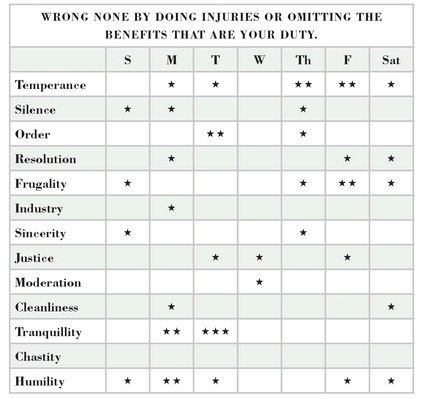
My explanation was anything but satisfactory. As I listened to a mild harangue from the business owner about delays and his general lack of faith in the justice system, I was quite certain that I had been a major disappointment to Ben Franklin on this day. I had slipped in the other virtues; my chart was full of transgressions. This, however, was the first time that the failures meant more than something about which to write. This was a real virtuous malfunction.
As I continued to subject myself to an earful from the business owner, I tried to look on the bright side. At least I was getting to hear what the victim thought about Justice.
Old Knees but Young Hearts
Call this an ode to faded glory or a song for fleeting youth.
{ He that won’t be counseled can’t be helped.}
On the weekend of the week dedicated to Justice, I took part in one of the oldest rituals known to man: a gathering of ancient warriors to test their prowess and relive the days when their arms were strong, their legs swift, and their cares few. The battleground for these heroes of yesterday was a thirty-five-and-over basketball tournament. My team, which had recently lost in the finals of the thirty-five-and-over city league, reunited to take on the best of the rest of the province in their age category for a chance at immortality—“B” division.
As I packed my gym bag and clothes after work on Friday night, I had my usual qualms about going away for a weekend. A young family calls for the presence of its parents, children need the attention of their father, and I have always had a reasonable level of guilt whenever I abandon that responsibility for even the shortest times. Going away for a weekend to play in a basketball tournament with other slightly overweight, creaky-kneed, graying, former athletes seemed an indulgence. There was also the cost. I knew that my beer and pizza bill was going to be substantially larger on this weekend.
In truth, I would probably not have gone to the weekend tournament had my mother not encouraged me. Earlier, when I told her that I was unlikely to attend, she said, “Oh, go. Everyone needs a break.” Her birthday present money to me was the registration fee.
The tournament was being held in a city an hour and a half away from my home, and so my team—a university professor, two IT executives, a grocer, a biologist, a salesman, an educator, and a prosecutor (all of whose knees and fitness had seen better days—crammed our gym bags into our cars and took a road trip. We converged on the site of our first game—lose and end up in the consolation round; win and our hope for glory remained. Forty minutes later, we knew the elation of advancing to the next level (and the anxiety of overtaxing our cardiovascular systems). A trip to a local pub for a celebratory drink, a game of pool, and a late-night pizza and I felt the cares of the week passing away.
I shouldn’t really have been surprised that I was having a good time. I love basketball—any team sport really—and I loved being part of a team again. Maybe it’s the pack mentality of humans or some latent martial instinct that man never escapes, but team sports hold a special place in most men’s hearts (I know I am being sexist, but indulge me for a moment)—no matter how bad the team. And it had been a good year. Our team’s personalities jelled, we played well in our league, and we usually enjoyed some postgame socializing with some of the other league teams.
After our Saturday game, another victory—this time over one of our city league opponents who also made the trip to the tournament—there was a social at a private club. After the meal, as I sat watching some of my teammates hold a pool table against all comers, I marveled at the effect of our short return to the games of boyhood. Grown men, men burdened and blessed with the responsibilities of adulthood, acted like the children they had once been. The jokes were juvenile, the razzing unrelenting, and the competition friendly (for the most part). A sort of euphoria had come over most of us, temporary though it might have been. I could see real joy in the faces of people whose brow wrinkles revealed the effects of age and worry, and I wondered why it is that we lose the joy of youth so easily. Why do we, as adults, deprive ourselves of the fun, camaraderie, and sometimes plain silliness that mark our early years? Maybe if we remembered, and lived, a little more like kids, then the burden of responsibility wouldn’t seem so heavy.
On Sunday, our final game—the Masters “B” Division Basketball Championship—was played in front of a fluctuating but enthusiastic crowd of between four and ten. Despite an early setback, our team rallied, played as stifling a defense as thirty- to forty-five-year-old knees would allow, and emerged as champions. You would think by the high-fives, embraces, expressions of pure joy when the medals were presented, and postgame locker room toast that we had won a tournament for the ages rather then a tournament of the aged. We’d be lucky to garner a one-inch mention in the local paper.
But it wasn’t glory that we were seeking, that kind of glory we all know is in our past (at least as far as sports go). We knew that our real success was in showing up and remembering that we were once kids who ran and jumped and played. Real success was in not just remembering the past but knowing that the future can include still being those kids, if for only part of the time, and never really growing up—not completely. Winning was just icing on the cake. I gave my medals (we asked for extras for those of us with more than one child at home) to my girls—they took them to school the next day to show their friends that their dad was a champion. The looks on their faces when I handed them the medals reminded me that there is glory in being an adult as well. Maybe the secret is in finding the balance.
What, you may be asking yourself, does all this have to do with Franklin’s course of virtues, and particularly Justice? I wondered that myself as I sat in the poolroom listening to my teammates razz me about my inability to knock them off the table. It was then that I realized the real lesson of the week. Citizen Ben warned himself, and by extension those who follow, to do Justice by not omitting the benefits that are your duty. I thought when I first started the week that this virtue was all about doing right by others. As I watched my friends, and felt the real joy in my heart at this gathering, I realized that being virtuous, doing Justice, not omitting the benefits that were my duty, referred not just to others but to me as well.
As my mother said, “Everybody needs a break.” If we are to be virtuous, we need to do virtue to ourselves, to ensure that we remember those things that are the best of ourselves and embrace them and enjoy life. Franklin knew this and knew that in seeking moments of happiness for himself, in not omitting the benefits he owed to himself, he was better able to do Justice to others.
I realize this all might sound like some after-the-fact justification for a weekend away, eating pizza and drinking beer. My attempt to persuade myself that this road trip was somehow related to Justice is perhaps just a self-deceiving rationalization.
Oh well, at least this wasn’t the week of Sincerity.
JUSTICE