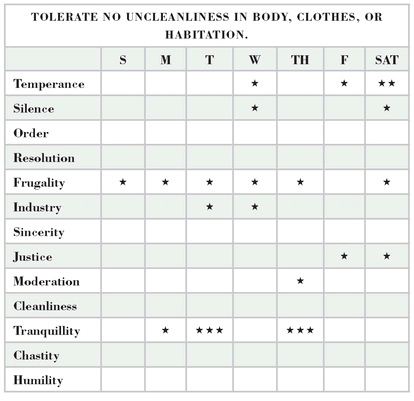
{CHAPTER 10}
Tolerate no uncleanliness in body, clothes, or habitation
I ONCE LIVED IN A CLOSET.
I tell you this because you would think that Cleanliness would be the one virtue of Franklin’s about which there could be no controversy, no question of its efficacy. Undoubtedly in eighteenth-century America, personal cleanliness remained an issue of some debate; in the world’s great cities, unsanitary conditions led to disease and even social unrest. But we, the denizens
{ Clean your finger before you point at my spots.}
of the developed world in thetwenty-first-century, are über-clean. Too clean perhaps. According to some researchers, too much cleanliness is hindering the immune systems of people in wealthy countries.
Thus my closet story. It may help explain my low incidence of illness in college.
During my final year of my first degree, I had to complete a term of student teaching. I did this at a school near my hometown. That was good—I saved a term’s worth of rent by living at home. Unfortunately, the student teaching term was in the fall semester; thus, after Christmas I had to return to college midway through a normal school year. That was bad—I had nowhere to live.
To my good fortune, I had nice friends. They let me move into their apartment at a greatly reduced rent. I would throw a mattress on the floor of one of the rooms and all would be well.
We forgot to factor in my snoring.
After the first night on the floor, my new roomie said, “This isn’t going to work. You snore like a water buffalo.”
Now I had a dilemma. I needed a place to stay, but I didn’t want to inconvenience the very friends who had granted me shelter in my time of want. It was then that I noticed the closet.
The apartment, a two-bedroom on the bottom floor of an aging building, had a strange configuration. The design of the building meant that the closet in the front hallway was approximately three feet by six and a half feet deep. I considered my dilemma, thought of my snoring-averse friend and meager rent, and decided that this particular closet looked like a very small room. Miraculously, my single mattress fit perfectly. It was fate.
Truth be told, I can’t remember how long I actually slept in the closet. I do remember upgrading to the couch at some point. The closet, however, remained, in essence, my room.
Living in a closet is a unique experience. There is a certain womblike comfort to being encased by walls, a sense of coziness. On the other hand, there is literally no way to roll out of bed. When I got up in the morning, I had to squirm down to the end of the mattress and more or less eject myself.
The closet was also a bit of a date killer. I’m not saying that I was trying to pick up girls and bring them home (not while my mother is alive to read this book), but even bringing a date back for dinner, a drink, or a movie all had to happen in the knowledge that they would almost certainly ask, “So which room is yours?”
The biggest problem, however, was the cleanliness. It is difficult to maintain even a college dorm room level of cleanliness in a closet. Hardly Better Homes and Garden.
As I have matured, so have my living quarters. From closet to apartment to marital apartment, I passed through the stages of life as I climbed the evolutionary ladder of Cleanliness. There remains, however, a certain amount of the closet dweller in me. There is still a little “closet” in my house.
I don’t mean that my house is unclean, at least no more so than any house that shelters three young children; it’s just that there seems to be a lot more stuff than there needs to be.
I did not view this as a reason for surrender. Rather, I embraced Cleanliness. Unlike Moderation, I believed that it offered the opportunity for a concrete change in my behavior. Perhaps it is my nature as a pragmatist. My need for concrete results may simply be a virtual hangover from the more abstract concepts of Moderation and Justice. Cleanliness was something I could sink my teeth into.
Indeed, for the first time in weeks, I had a concrete plan of action. Borrowing from my week of Order, I decided to attempt to enforce organization on my personal space. I would sift, sort, discard, gift, and otherwise divest myself of those items of clutter that had been with me longer than my children (note of clarification—I had no plans to discard my children).
There was, unfortunately, an enemy in the camp in this virtue—a spy for the forces of pack rats.
As you might recall from the chapter on Order, my mother refuses to discard things. She doesn’t collect garbage; she just does not believe in “out with the old, in with the new.” In this age of overflowing landfills, she never seems to throw anything out. (I think it is important for me to stop and note that my mother keeps a very clean house; she is in no way unclean—she just keeps stuff ). When she reads this, she’ll probably wonder why she kept me.
My parents’ basement is filled with old chairs, clothes from several people’s wardrobes, and my childhood bed frame. There are paintings and photographs long since relegated to below eye and ground level, a pinball machine in two pieces, magazines and books, and games from before my birth. Trunks full of the stuff I left behind when I flew the nest remain unmoved, and there is furniture enough for a small apartment. It all comes together in something that resembles the storage area at the Smithsonian.
My father laments, out of earshot of my mother, the state of the basement, but he knows that there is little he can do. He’s battling an ingrained need to keep things that’s fueled by a heady mix of nature, character, genetics, and probably some other things my mother never threw out.
And that’s what concerned me about Cleanliness. My mother’s capacity for accumulation may have been part of my DNA cocktail. Franklin and I might have been battling the very forces of creation in an effort to make me more virtuous. Perhaps I was simply not predisposed to having an orderly habitation. Maybe I was doomed to a life of “stuff.”
I would soon find out.
Next to Godliness
After much reflection and rumination, I decided that the secret to Cleanliness was . . . to clean. Each night I would select an area of my house to tackle. Options abounded. My wife complains often about the computer desk and the piles of paper, CDs, and various other items that have accumulated in that small three-by-six-foot area. The junk in my garage means that my car only fits in occasionally, and my clothes closet has become a museum-like collection of life’s trinkets. The only real dilemma was where to start.
In one sense, the choice was obvious. Given how I began this chapter, could I commence my cleaning anywhere other than my closet?
I never gave a single thought to the amount of space I needed for my stuff until I was muscled out of the closet in the bedroom. Ostensibly I was to have half of our closet; however, the encroachment into my closet turf by my wife makes the Middle East conflict look positively sedate. Gradual advances—some clothes here, a book there—have led to massive and widespread incursions. There are girly things among my manly things, and this is cramping my style. For a while I had almost been prevented from accessing my work clothes by a giant green exercise ball.
Until Ben and his virtue of Cleanliness, I had accepted that I had lost the closet war. But now, armed with the excuse of the pursuit of moral perfection, I renewed hostilities in this conflict. I would take back what was once mine. I would repatriate my closet—or at least sort out my side.
As I began my sorting and rummaging through years of accumulated T-shirts, gym shorts, ties, and cuff links, I saw immediate benefits of the virtue. Not only was my closet looking decidedly less like a warehouse, but I had also found things—useful things. An unopened stick of deodorant (as opposed to an opened, used stick, which would have been a little gross), a miniature golf bag full of tees and ball markers, shoelaces, photographs of my children, notes made to myself about writing ideas, and a box full of never-attempted magic tricks.
Of course, all of these treasures were buried under a considerable amount of nonessential stuff. In the process of cleaning my closet, I filled two garbage bags and one fair-size cardboard box full of clothes for donation to a local charity (I can mark that down as a Good for the day), threw away nearly a full garbage bag of useless items, and discovered that I had more than enough room for what was left over.
As I was cleaning, an odd feeling came over me. I had a small sense of euphoria as I discovered that throwing things away sometimes brings things back. I’m back in the closet!
Okay, that sounded wrong.
I was just excited about seeing the floor.
Indeed, by the end of Day 1, I was feeling full of Franklinian virtue! Not since Order or perhaps Sincerity had I felt such a flush of enthusiasm for this project. The virtue of Cleanliness was confirming to me an important personal characteristic. Though I am emotional, sentimental, and a romantic (my wife would clearly disagree with this last trait), I am also a pragmatist. I appreciate the benefits of practical solutions over abstract concepts.
And as any business guru, successful sports coach, or motivational speaker will tell you, success breeds ambition. My Day 1 efforts to clean my closet had filled me with mad notions of the possible. Like Rocky after Mickey cuts him (“Cut me, Mick!”), I could see again. I could go the distance. I could be virtuous.
Indeed, I was so inspired that I decided to step up my cleaning efforts—take them to a new virtuous level. Instead of just cleaning willy-nilly, I would implement a real plan. I would be organized in my cleaning. First step, a surface scrub—get rid of the really useless (and in some cases slightly disgusting) stuff. Next, go a little deeper. Examine the items that were left, ditch any ideas of sentimental attachment, and divide them into piles: (1) things I definitely want to keep; (2) things I believe I can give away in a useful manner; (3) things about which I am unsure; and (4) things I have trouble identifying (or which are moving).
Once I had piles of materials in various states of wantedness (is that a word?), I would apply a level of analysis to my postpile organization. For example, the wanted pile would get subdivided into things that I could put away immediately (in a clean manner) and things that might need some further organizing or even culling.
{ Trusting too much to others’ care is the ruin of many.}
Finally, once I’d organized and kept or discarded items, I could implement some ongoing scheme to ensure that I had a continuous cleaning program. That should make future projects more like tidying up, as opposed to postapocalyptic reconstruction.
Unfortunately, my construction of the plan took too long. I never got around to actually doing this “organized” cleaning. Despite this setback, I remained buoyant.
I might go to sleep in one of the closets to celebrate.
A Little Air out of the Balloon
Oh, this was all too good to be true. I was actually seeing real, concrete results. Cleanliness abounds. I almost didn’t know what to do with myself.
Fresh from my closet-cleaning successes and new cleaning plan in hand, I decided to turn my Cleanliness efforts on my office at work, the computer desk in the basement, and my garage.
As with the closet, I discovered gems long thought lost, memories buried under piles of knickknacks, and projects forgotten and stored away. In the past I might have gotten caught up in a sentimental attachment to many of these treasures. In this case, however, I was determined to apply one of Franklin’s other virtues: Resolution. I was resolved that I would not hang on to things simply because they triggered a memory. Not every picture my children had drawn for me was a masterpiece, not every note poetry, not every photograph a keepsake. I would cull the herd in a Darwinian program of organization.
And again, it worked. I discovered that there was more than enough room in my garage for the car, I had plenty of old CD-ROMs that contained nothing of use, and my office had more than one reference book that was ten years out of date. There was simply no way to justify using reference materials that still viewed Y2K as an impending event of unknown consequences.
By the middle of the week, I was leading a much cleaner (or at least less cluttered) life. In fact, I was so enamored of my success that I decided to revisit my system of organization to see if I could impose some convergence of virtues—a little ethical cross-pollination. Mix a little Order with Cleanliness, add a dash of Resolution, and see what the brew tastes like.
Magnificent! Forty minutes of organizing emails paid off with an empty in-box, out-box, and deleted items. Never before in my career in government had I been so free of the tangled morass of unanswered, useless, will-sucking emails. My in-box was blissfully empty. I felt liberated.
My desk was similarly clear. I had jettisoned the detritus of ten years of accumulated files, stalled projects, and unwanted mail.
At the risk of sounding like I am bragging (Humility is coming up soon), I was all over Cleanliness. I was feeling virtuous. I had applied Franklin’s virtue, and like a contestant on American Idol, I “made it my own.” My closet, my garage, my computer, and my desk were all cleaner. I was happy. I should have been happy with being happy.
Instead, I was so pleased with myself that, against my better judgment, I let Michelle in on the nature of the weekly virtue.
“Did you notice that I’ve been cleaning?”
“Franklin again?” Her voice betrayed her disregard for my efforts.
“Yes. This week is Cleanliness, so I thought I’d tidy up. You know, clear out the clutter.”
Michelle still seemed unimpressed. “Have you noticed a difference?” I asked.
Michelle looked up, and I knew when she smiled that she had set me up. “Not really,” she answered.
Not really! I had cleaned half the house, donated items to charity, found things I had forgotten that I owned, and made more room for what was left. Not really?
“Ahhh,” I told myself. “She’s just jealous.”
At least she hadn’t suggested I move back into a closet.
And the Air Just Keeps Leaking
By Thursday I was downright pleased with myself. I had found a virtue that was showing immediate results (despite what Michelle might say). Here was a nearly three-hundred-year-old edict that still applied. Here was a precept with meat on its bones. In all my self-congratulations, I forgot Ben Franklin’s Quaker friend, who, upon reading Ben’s list of twelve virtues, proposed a thirteenth: Humility.
In the midst of all my cleaning, I made a quick visit to my doctor’s office to have a prescription renewed. It wasn’t meant to be a checkup—I wasn’t even expecting to see my doctor. As I sat and leafed through a magazine, the nurse came in to take a quick history. This particular nurse is a lovely woman, but working in a busy medical practice, she is focused and all business.
She scribbled on my chart as she asked about my diet, my level of exercise, and my sleep patterns. As she took my recent medical history with a disinterested professionalism, I made several attempts at witty repartee. She seemed immune to my charms. Maybe she was laughing on the inside.
As she went about her tasks, I resisted the urge to tell her of my virtuous exercise. No sense in bragging, the efforts must have been obvious. Finally, she asked me to step on the scale. Confident and full of the knowledge that for more than two months I had been temperate, resolute, and moderate, I inquired whether I should keep my shoes on or take them off. I should have guessed what was coming when she, eyeing me up and down, said, “I would take them off if I were you.”
Now you’ll remember that I started this program at about 250 pounds. Over the passage of the previous couple of months I had attempted to find in Franklin’s precepts the motivation to exercise more regularly, make better dietary choices, and generally adopt a healthier lifestyle. Despite occasional setbacks, I was convinced that, like Cleanliness, I was being at least moderately successful. I hadn’t weighed myself—I was planning on saving that for the end—but I was sure that a little midcourse assessment could only provide the type of positive feedback that seemed to be in abundance this week.
As the nurse, that model of professionalism and Germanic sobriety, adjusted the sliding weights, I anticipated the good news.
“So,” I asked as I stepped off, “what’s the damage?”
Without looking up from her note making, she replied, “Two hundred and forty-five pounds.”
I was stunned. This couldn’t be right, I assured myself. Had not people been telling me how slim I looked? Were people not asking me how I had lost weight? Did I not feel better?
“I’ve been lifting a lot of weights,” I said to the nurse. “Muscle weighs more than fat, doesn’t it?”
She gave me a waiting-room-weary look and mumbled something like, “So they say,” as she strapped on a blood pressure cuff. I was leery now. The weight thing had thrown me.
“They always use the larger cuff on me,” I said. “I have big arms.”
Another weary look, a number of pumps on the squeeze ball, and raised eyebrows. “Your blood pressure is too high,” she said. No wonder, I thought, you’ve just told me all my efforts have lost me a measly five pounds. Her disappointment in me was obvious. It was as if I had failed her. She didn’t even know that I was seeking moral perfection, and yet she clearly found me wanting.
And why wouldn’t she? The truth was out. Even with all my self-deprecating jabs about my failures, I’m sure we all hoped at the conclusion of this story there would be a happy ending. But despite all our good wishes, there it was, visceral evidence of my failure to follow Franklin’s virtues. This was more than a check on a chart or a vague sense of unworthiness—this was real, hard, irrefutable evidence that I was not following some or all of Franklin’s virtues.
As I skulked out, prescription in hand, my heart was heavy with the knowledge that not only was I a failure but I would have to acknowledge my
{ The absent are never without fault, nor the present without excuse.}
shortcomings to the world. So here is my acknowledgment.
I am no Benjamin Franklin.
He was at least forty pounds lighter.
A Little Cleanliness for the Soul
One would have thought that the opportunity to meet and speak with a man recognized as one of the world’s leading humanitarians might be beneficial to a person seeking to be more virtuous. I can only blame your lack of understanding on some confusion over my character.
This section of the book requires an understanding of my contemporary ethical guide. As I have said, Chris Levan has a mind that works at somewhere near the speed of light. He juggles multiple projects, constantly thinks of new ventures in a myriad of arenas, organizes countless events, and lends his labor, both physical and mental, to almost any project he thinks would benefit from his help. Sometimes it can be a bit exhausting to watch for people like me, who are a little more temperamentally inclined toward watching rather than doing.
It was in this context that he approached me and another colleague and asked if we would chair a conference entitled “The Politics of Compassion.” “Don’t worry,” said Chris, “I’ll do all the work.” From anyone else, I would’ve taken the statement as disingenuous. From Chris, I took it as gospel.
And he was good to his word. Chris, and a core team of volunteers drawn from the church where Chris is on the ministry team (and where I attend irregularly), handled almost every aspect of the two-day conference. Other than chair a few meetings—my chief responsibility, as I explained to the first-day audience—was to welcome people, introduce a few speakers, and point out the location of the washrooms.
Indeed, I felt a bit like a fraud. Several times over the course of the conference, participants would congratulate me on how smoothly things were running. I did my best to explain that I took no credit for anything, but try as I might, people could not be dissuaded from the notion that I was somehow responsible. Even some of the volunteers, the people who were doing the real work, suggested that I should be proud of what had occurred. I maintained my humility and decried any attempts to foist glory on my shoulders.
And yet, by the time Mr. Stephen Lewis, the keynote speaker, was to give the first of his two addresses on Friday afternoon, I was feeling the tiniest hint of self-satisfaction.
That ended when Mr. Lewis actually spoke.
For those who don’t know, Stephen Lewis is a former politician who has been the deputy executive director of UNICEF and the Canadian ambassador to the United Nations and, at the time of the conference, was UN Secretary-General Kofi Annan’s special envoy for HIV/AIDS in Africa. He was appointed by the Organization of African Unity to a Panel of Eminent Personalities to investigate the genocide in Rwanda, and in 2005, Time magazine listed Lewis as one of the “100 most influential people in the world.” He is, even to those who might not share his political views, an intellectual heavyweight and a humanitarian.
Lewis described, in his first talk, the politics of compassion in the context of his work trying to stem the tide of HIV and AIDS in Africa. It was a stark tale, full of death and misery, interspersed with anecdotes about his encounters with rape survivors, AIDS orphans, and genocidal militias. In the midst of all that, he described his own efforts and the efforts of others like him to put a halt to a disease with infection rates in some parts of the continent close to 50 percent. The common reaction to his talk was a sort of loose-jawed awe: the sense that, though you did not doubt his words, you simply could not believe the message. How can so many be dying, in pain, tortured, and helpless and I have not lifted one finger to come to their aid?
What was more humbling was that this man was doing something. He was dedicating his life to a mission, applying his passion, and not surrendering to the hopelessness that his experiences must have impressed upon him. And all I was doing was accepting false credit for bringing him to town (and successfully pointing out the location of the washrooms).
Things might not have been so bad had he not been scheduled to speak again that evening. The speech itself, once he delivered it, just reaffirmed my interest in his topic and my anxiety at my lack of a meaningful contribution. It was the prespeech meeting that really caused me problems.
Mr. Lewis was brought to Chris’s office. Another member of the organizing committee and I had been given the task of entertaining him, more or less, while he awaited his turn to speak. The benefit, the quid pro quo, was that we had the opportunity to speak with him. I was mindful of the intrusions on Mr. Lewis’s schedule and was determined not to bother him. Graciously, however, he invited some conversation. We talked of his university days, his father, and volunteering. I was invigorated, but at the same time I had a lingering sense of a lack of personal accomplishment.
I’m not sure it struck me at the time, but this is the very force that drove me to take up this virtuous journey—the notion that I just wasn’t doing enough with my time on this mortal coil. Stephen Lewis was just inadvertently reinforcing that feeling.
I am not sure why I said what I said next. Maybe I sensed that this was a chance for some guidance—an opportunity to learn from a giant of virtue. Maybe I was just overwhelmed with the enormity of what he had been talking about at the conference. For whatever reason I said, “Mr. Lewis, as I get closer to forty, I am beginning to feel an impending sense that I should be doing more.”
I’m not sure what I expected him to say. A little pep talk maybe, a gem of moral guidance. What he did say caught me completely off guard.
“How do you think I feel? I’m sixty-eight.”
Here was this man of accomplishment—author, politician, activist, humanitarian, UN envoy, ambassador, philanthropist—expressing his own discomfort over his lack of achievement.
Everyone senses the ticking clock of mortality. Surely Franklin felt it as well. He was a great believer in the common good. He wrote: “As we enjoy great advantages from the inventions of others, we should be glad of an opportunity to serve others by any invention of ours; and this we should do freely and generously.” That is the nature of Franklin’s style of accomplishment, his idea of civic-mindedness—it is simply never enough.
You know by now that I am a believer in coincidence as evidence of the presence of something greater. Surely my few moments with Stephen Lewis, just as I was beginning to feel good about my efforts with Benjamin Franklin, were a reminder from . . . someone . . . that this course of virtues was about more than having a clean closet or a well-ordered desk. The pursuit of virtue was not a selfish journey for Benjamin Franklin, and neither, I was reminded, should it be for me.
CLEANLINESS