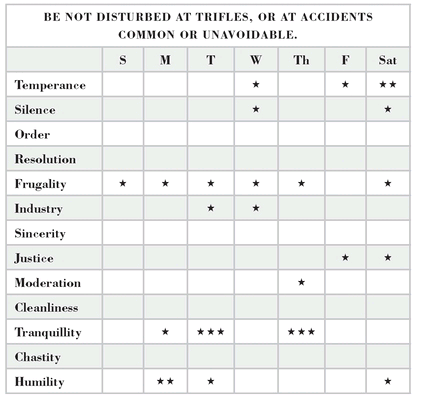
{CHAPTER 11}
Be not disturbed at trifles, or at accidents
common or unavoidable
WHO REMEMBERS ANYTHING MORE CLEARLY THAN THE BIRTH OF THEIR first child? I was in my third year of law school, twenty-five, and barely mature enough to babysit a goldfish when Kelsey arrived. I was not fit to be a parent. But there I was, on the cusp of one of life’s great adventures, unprepared, overwhelmed, and yet filled with expectation and hope.
{ Content makes poor men rich; discontent makes rich men poor.}
What I remember most are the plastic air hoses.
There had been some warning that Kelsey’s birth might not be without drama. Months earlier, while I was working at a summer job about an hour from our apartment, Michelle passed a blood clot. At first we feared she might miscarry, but to our relief the pregnancy continued. Then, when she was just thirty-two weeks along, Michelle’s water broke. The doctor was able to stop the delivery but put Michelle on her back in a hospital bed for the next month. We were young and scared, and still didn’t appreciate what was coming.
When the obstetrician feared she could delay the pregnancy no longer, she set a date for the birth: November 20, 1992. At 8:30 a.m., Michelle was induced.
By suppertime that night, we were still waiting.
It was apparent that things weren’t going according to plan. Michelle was in labor, but Kelsey wasn’t making her appearance. Worse, the fetal heart monitor was showing a heartbeat that was causing clear distress to the delivery team. Finally, as Kelsey made her way into the world, chaos (at least it seemed like chaos to me) ensued. Instead of “It’s a girl!” the only exclamations from the doctor were instructions to the neonatal intensive care nurses. Kelsey wasn’t breathing on her own, and I watched as a nurse, ironically the wife of a law school classmate, assisted her breathing with oxygen from a wall-mounted life support system. Michelle was nearly comatose from the medications she had received during the difficult birth.
Ultimately, some command from the doctor caused the entire delivery team to rush Kelsey from the room, warming bed and all. They wheeled her away so fast that the tubes attached to the oxygen mask pulled loose. They hadn’t even bothered to disconnect them. It was then that the seriousness—the desperation—of the situation struck home. It is those tubes that are clearly and indelibly etched in my memory.
And then I waited. For thirty minutes, I sat by Michelle’s side (she was blissfully asleep and less blissfully now battling some fever), wondering if my newborn daughter was alive or dead. That was not a good thirty minutes.
Finally, a nurse came and led me into the neonatal intensive care unit and sat me in a chair in a corner. The room was full of newborns like Kelsey, too feeble or small or ill to begin life on their own. All of them were hooked up to special monitoring equipment. There was a constant cacophony of alarms. “Don’t worry about those,” said the nurse, “they go off all the time. The doctor will call you over when he is ready.”
The doctor in question was bent over Kelsey’s warming bed, examining her intently. He poked and prodded her as I watched from a distance, relieved that my daughter was alive but terrified about what was to come next. Finally, he motioned for me to join him.
The first words he uttered—the first thing he said to this frightened, confused, unprepared father—were not “She’s going to be fine,” or “We’re very hopeful,” or even “This is your daughter.” The first words he said were, “Does anyone in your family have webbed toes?”
Thus began our life with Kelsey.
Later that night, my parents took me out for a bite to eat. Michelle was asleep, Kelsey was in the neonatal intensive care, and I was exhausted and scared and confused. My parents tried to calm my fears and ease my mind. As my mother, a very experienced nurse, talked about some of what the future might hold, I said, “It doesn’t matter if she’s physically handicapped (not even a word I’d use anymore), as long as she isn’t mentally handicapped.”
All I can say to my past self is: “Watch out what you say.”
The next few months were filled with long nights at the hospital (one of us would always be there while Kelsey stayed in neonatal intensive care), unanswered questions for the doctors (we were awaiting the results of genetic testing), and hope—hope that our very little girl (4 pounds at birth) with the fused toes, crooked fingers, and curly hair would be okay.
Kelsey came home the day before my first Christmas exam. She and I began a pattern of sleeping sitting up (me sitting up, Kelsey lying on my chest) because she couldn’t keep her formula down while lying prone. It made for an interesting exam period and a different first Christmas than we had envisioned.
Finally, the month after Christmas, the pediatrician’s office called to schedule an appointment. The genetic tests were back.
After giving our daughter a quick physical exam, the doctor suggested we sit down (never a good sign) and told us that Kelsey had a rare genetic problem. Her second chromosome was missing a section. The medical term is an interstitial deletion of chromosome 2q. The layman’s explanation was that she had a problem so rare it had no name, was shared (at the time) by only seventeen people in the medical literature, and was likely a death sentence within the first year of life. In that year, he told us, her development would be profoundly delayed, and should she survive, she would likely never advance past one year intellectually.
I remember staring out the window of the doctor’s exam room at the traffic flowing past on the busy street below and thinking, “Look at all those people with nice normal lives, and here I am with a special needs child who will die in a year. It’s not fair.”
I believe that was the one and only time I felt sorry for myself.
Kelsey did survive, though she kept us holding our breath on a few occasions. She developed epilepsy shortly after we moved for my first job after law school, and had her first seizure while friends visited from home. She spent nearly six months in a children’s hospital an hour from the town in which we lived. Michelle lived at the hospital with her during the week, I would drive to visit them at night, then drive home late in the evening to be ready for work the next morning. On weekends we would trade roles. Ultimately, we decided we would have more support back in the city where we had both gone to college. Michelle and Kelsey made the move one week before I did.
On the day before my final bar admission exams, I got a call from Michelle in tears. Kelsey had reacted to one of her anticonvulsants, she was having trouble clotting, and the doctor was asking whether we wanted them to take heroic measures if she were to stop breathing. She wanted me to decide, as she was too upset. As I spoke to the doctor, he suggested I get there as quickly as I could.
For the entire four-hour drive, I expected to be too late. As I pulled into the hospital parking lot, I braced myself for what was to come. But then, through the windows of the entrance of the hospital, I could see my father sitting next to my close friend Stephen. They were talking, and more important, they were laughing. I knew that Kelsey was okay.
And she has been okay for more than sixteen years. There have been health crises, and as the doctors predicted, her intellectual development peaked at the level of a one-year-old. She can’t walk or speak, and she is fed almost exclusively by a tube that goes directly into her stomach. But she is our daughter, she brings us joy, and she is okay.
Life, lemons, and lemonade—Tranquillity is a state of mind.
Every crisis with Kelsey has been like a link in a suit of chain mail for me. When things get tough, I think of what Michelle and I have been through. When I feel down, I remember how hard things have been and how much harder they could have been. Kelsey is my armor. Even when Michelle and I lost our second child less than an hour after her birth, I knew we would survive. Kelsey is my Tranquillity.
If I was ever confident about a week of Franklin’s virtues, this would be it.
An Obsession with Tranquillity
We, as North Americans—the citizens of this globe for that matter—are a great seething ball of self-manufactured stress. For some, it is the stress to be successful; for others, the pressure of a relationship. For many, it is a simple but wrenching daily struggle to survive. That said, much of what stresses us comes from the nature of our commercial, market-driven, materialistic society. It’s clear that we all need a little Tranquillity.
This is the virtue for which Franklin tells himself, and those who might follow: “Don’t worry about the little things” (okay, that’s not a direct quote, but you get the idea). As a man driven to achieve, Ben undoubtedly saw the need for some balance—a little peace to counter the push to succeed.
Even before Kelsey came along, I think I had a leg up on Tranquillity. My parents taught me that there are simply some things you cannot control, that most injuries (physical and psychological) are a long way from your heart, and that good things happen more often than bad. This is the one area in which I felt some sense of virtuous accomplishment. This is the one virtue in which I might educate rather than learn. I felt I should offer something practical—something more than vague platitudes. Being tranquil and teaching Tranquillity, however, are two very different things.
Can I articulate how I manage to be tranquil? What about Ben Franklin? Does he offer anything other than an admonition not to worry?
More than how to be tranquil, Franklin offers an example of why. His life was not without trials and hardships. He lived, of course, in a most unsettled time, but most of Franklin’s tribulations and setbacks were a product of his own willingness to risk and lose. Leaving his hometown of Boston as a young man, he cast himself into the world with virtually nothing and yet eventually managed to become one of America’s most influential citizens. He wrote in his autobiography of the contrast between the young man who arrived in Philadelphia, essentially penniless, and the man he was to become:
I have been the more particular in this description of my journey, and shall be so of my first entry into that city, that you may in your mind compare such unlikely beginnings with the figure I have since made there.
When he was settled in his new city, Franklin began the process of “making” himself. Eventually, on only the promise of credit from the governor of Pennsylvania, Sir William Keith, he crossed the ocean to London to buy supplies for a new printing business. When he arrived, he discovered that Keith’s promise of credit was worthless. Franklin was marooned in one of the world’s largest cities without the means to support himself. Instead of panicking, he went to work for two printers, further educating himself in his trade and developing new and important relationships. This was the nature of Franklin when confronted with crisis or setback. He simply made the best of it and generally emerged the better for the earlier loss. These were the actions of someone who understood the Tranquillity he preached in his autobiography.
All that said, he isn’t very specific about how one goes about not being disturbed at trifles. There are examples aplenty in his book about him forgiving slights or wrongs, but little about how he trained himself to do so. In Tranquillity, as in all the virtues, Franklin did not claim perfection, though he did suggest his descendants might well find that “to the joint influence of the whole mass of the virtues, even in the imperfect state he was able to acquire them, all that evenness of temper, and that cheerfulness in conversation.”
Have his descendants (in the broadest sense) learned his virtue? Have they reaped the benefit of his self-help?
If you were a child, as I was, in the seventies, then when you think of finding Tranquillity, your mind leaps to peace symbols and flower power and Allen Ginsberg. Rather than notions of stoic acceptance of injuries and injustices, I picture protest marches and hippies and hear psychedelic rock. And ironically, that is where the seemingly insatiable American appetite for self-help, happiness, and fulfillment reached its zenith. Though its roots may lie as far back as Franklin and certainly as long ago as the middle of the 1800s, the apex of the American obsession with psychological health was in the “me” decade.
In her book In Therapy We Trust: America’s Obsession with Self-Fulfillment ,1 Eva Moskowitz points out that in the 1970s, self-help books dominated the best-seller lists, and bookstores began to dedicate entire sections to works aimed at people seeking to get in touch with their feelings, express themselves, and find internal peace.2 This generational obsession with the psyche would lead to games dedicated to feelings (the Feel Wheel),3 untold numbers of self-help books (some with titles like It’s Me and I’m Here or I Ain’t Much Baby—But I’m All I’ve Got),4 and therapy groups with dubious treatment theories. My favorite of these, as described by Moskowitz, was the Erhard Seminars Training, or est, which “emphasized experience, authenticity and emotional honesty” over “intellectualizing.”5 They did this, apparently, by charging $250 for sixty hours of training, during which they would call the trainees “assholes” and restrict their food, drink, and bathroom privileges.
Who could have believed this stuff would be helpful? How did primal scream therapy, therapeutic regurgitation, rebirthing, and nude encounter groups become mainstream enough to attract adherents by the thousands?
Of course, there’s nothing wrong with New Age spirituality, but I can say without reservation that it is not for me. I don’t like Yanni, I can’t sit cross-legged, and I just don’t have the patience to meditate (especially if it involves chanting a mantra over and over). I’m sure these things work for some people, but they would have the opposite effect on me. After half an hour of chanting “ooohm” and seeking my center, I would be ready to shoot someone from a grassy knoll.
{ Write your injuries in dust, your benefits in marble.}
So Day 1 ended with me having achieved a dubious honor. Having spent the day considering Tranquillity, I can say, without reservation, I felt less tranquil.
Maybe I should have found a nude encounter group.
Anger Management for the Masses
Day 1 of Tranquillity hadn’t proceeded as smoothly as I would have hoped. The problem, as I saw it, was that I’d been baited by Mr. Franklin on this one. He’s dangled the tasty morsel of Tranquillity, but it’s like eating canapés at a reception—good food, not very filling. I think we need to talk to some criminals.
My job is not the best place to seek Tranquillity. The criminal justice system may be a petri dish for the world, but the amoebas are angry. In fact, after addictions and mental health issues, anger is probably the most common cause of criminal activity. (I have no statistics to back that up, just a lot of experience.)
Part of the prosecutor’s role in the justice system is to try and prevent offenders from reoffending. Almost inevitably in circumstances in which an offender commits an act (usually of violence) out of anger, I recommend, and they are sentenced, to a period of probation with anger management counseling (after whatever incarceration is appropriate). I’ve never really been sure what happens at anger management sessions; I just rely on the probation officers who tell me that it helps. Judging by the rates of recidivism, I’ve never been totally convinced of its efficacy, but to paraphrase the seventies self-help book, “It ain’t much, baby, but it’s all we got.” If anger management is good enough for the nefarious and the ne’erdo-wells, I asked myself, why isn’t it good enough for Ben Franklin’s virtues?
I contacted a victim services worker who administers our court-ordered anger management course to both adults and youths. If anyone could help with anger management, she could. She’s a very calming person—and accommodating. She agreed to meet with me to discuss the program.
The first question was, to me, obvious: “How do you teach Tranquillity to someone who is at your course because he or she broke a two-by-four across a friend’s skull?”
“First,” she said, “participants are told that anger isn’t about anyone else. It is an emotion, and no one else is responsible. They need to own the problem.”
Hum. “Own the problem” has a certain 1990s business speak sound to me, but I didn’t want to be judgmental. “What happens next?”
“Once participants are told that their anger is not the fault of someone else, they are led through self-image exercises.”
“What are self-image exercises?” I asked.
“They think back to their childhood, for example,” she explained, “and consider which parent they are more like. Then they’re asked to think about who else has been a major influence. Then we end that exercise with them trying to remember any major events of their life, both bad and good.”
Okay, I was warming up to this. I liked the idea of influences. I’ve had some good ones, and I’m pretty anger free. Maybe I wouldn’t be quite so tranquil if my influences had been less positive.
“Once participants have a firm understanding of where their anger comes from,” she said, “we try to get them to recognize when it is making an appearance. Knowing how the body reacts when anger occurs is a key to controlling it.”
That made sense, too. Maybe we were getting somewhere with anger management. I even felt better about my part in having people sent off to participate in the course. “Is that it?”
“No,” she said. “One of the keys to anger management is learning to negotiate and communicate—particularly in conflict. Different negotiating styles are reviewed.” Different negotiation styles? Oh, I don’t like those words. An uncomfortable sense of déjà vu washed over me.
During my bar admission course, we were offered instruction in various negotiating styles. One of those, the one advocated by the bar course leaders, had as its central theme rejecting positional negotiating and trying to determine the real interests of the other party. After appropriate instruction we were paired off, given a fictional case to settle, and sent off to negotiate.
My opposite was a mature student. He had already lived life, done things, and been places. He understood the artificiality of the exercise and the inconsequential nature of the whole process. I, on the other hand, got wrapped up in the competitive aspect of it all. Contrary to our training, I staked out a position, made an offer substantially above that, and waited for the give-and-take I expected. Instead my opponent, when hit with my opening salvo, said simply, “Okay, deal. You want another coffee?”
I was taken aback. Not only was there no negotiation, but now I would have to go back and explain how I had ignored our course on interest-based negotiation and taken advantage of an old man.
Thus, when my anger management consultant talked about “different negotiating styles,” it killed my interest in anger management as the key to Tranquillity. It’s probably an excellent course, but like yogic flying, it’s not for me.
I thanked my anger management consultant for her help, and as she was walking out, she said, “Maybe you’d like to sit in on a course sometime?”
I thought about it for all of five seconds before politely declining. Notwithstanding my feelings about the course generally, it seemed unwise. This is a small jurisdiction. Most of the people in the course would probably be there because I helped put them there. Such a course could not end well for me.
It might, however, make for an interesting test of their newfound anger management skills.
The Harrison Gunn Method of Tranquillity
My stab at anger management might not have been the magic bullet on Tranquillity that I was seeking, but it did get me thinking about the source of my own Tranquillity. The course leader had said that, as part of the self-image exercises, people were asked to consider the major influences in their life. If that works for people trying to find the source of their anger, why couldn’t it help me deconstruct the place from whence my Tranquillity flows (that sounded like something you’d see on the Tranquillity websites I visited).
Of course, there are Kelsey and my parents, but there had to be more. When I think of my influences—the people who have helped me not be disturbed at trifles—I see a painting that hangs in my basement. It’s not an expensive painting; in fact, I think it is a mass-produced lithograph. It is not a masterpiece—I don’t even know who painted it. It is, however, one of only two things I was interested in having from my grandmother’s effects when she passed away. To me it is priceless.
The painting depicts a small boy on a horse-drawn wagon crossing a stream near a grist mill. The boy is driving the team, and the old man beside him is leaning in and whispering words of encouragement. From the moment I saw the painting as a young boy, hanging on my grandparents’ wall, it was my favorite in the world, and the boy was me and the man my grandfather. When I think of Tranquillity, I think of him.
Harrison Gunn was a giant in his day. At six-foot-six, he towered over others. Despite his size, however, he was the gentlest of men. He never spoke harshly of others, I never saw him lose his temper, and he never seemed to be unhappy.
Like other people who grew up in the twenties and thirties, he might have had lots of reasons to be unhappy. He was born, raised, lived, and died on the same country road on which his father, and his father before him, had lived and died. He was forced to leave school early—I don’t think he made it past the sixth grade—to work cutting wood for local sawmills so that he could help support his family. He was never rich—the time and the place of his birth would not allow it. He never traveled very far. My grandmother (they had been together since grade school) never liked to travel. She grew up in the same small, rural settlement and seemed satisfied with her little slice of the world, so they stayed close to home.
So why was he happy? Why did he seem so at peace with himself? I’ve never thought much about it until now, and until Chris provided me with his take on the virtue of Tranquillity, I’m not sure I could have articulated it.
Chris told me that there are three principle stressors in the modern Western world: noise, technology, and the need for meaning. I buy that. Picture yourself in the middle of a busy city, trying to answer the hundredth email of the day, while consumed with feelings of existential self-doubt. Sort of sums up modern life. As I think back on my grandfather, it seems to me that he had the recipe for handling these stresses. Here is what I will call the Harrison Gunn formula for Tranquillity:
1. Find a hobby you enjoy and practice regularly. My grandfather loved to garden and to read. Dad once told me that if his father could have been anything, he would have been a farmer. He satisfied this unrequited dream with large household gardens, which provided much of the sustenance for his family. He grew vegetables and apples and berries and in his toil found pleasure. In books he found pleasure of another sort. For a man who worked in a paying job from the time before he was a teenager until his mid-seventies, books were his relaxation. I think they also provided that window to the world that he missed by being so firmly rooted to one place. Of course, it is not lost on me, when I think of the stressors of the modern world, that gardening and reading are activities of peace and simplicity. No noise, no technology, just peace.
2. Don’t let your world be consumed by electronics. I’m not sure how conscious a choice it was, but my grandparents had almost no modern technology in their home. That was, of course, a product of their times, but even late in the twentieth century, they were Luddites of the best kind. No computers, no digital cable. In fact, my grandparents watched almost no television. They watched the news and hockey. I don’t remember anything else. As a young boy, I was driven insane by their house—it was always so quiet. In hindsight, however, I might describe it as peaceful. There is something to be said for the absence of technology.
3. Finally, seek meaning in the present. My grandfather and I didn’t have many deep, philosophical discussions, so my understanding of his belief system is based almost exclusively on what I watched him do. Though the product of a Scots Presbyterian family, he came to a sect of Christianity who called themselves Christians (the more pejorative local term was Go Preachers). They led an austere lifestyle, attended services in people’s homes rather than at churches (thus the Go Preacher name), and had a fundamentalist understanding of the Bible. Apparently my grandparents found this too severe a manner in which to bring up children, so once their family arrived, they left the church. Ultimately, I’m not sure what my grandfather considered himself, spiritually speaking, or if he thought of it at all. I do know that he gave land to a small parish of the United Church of Canada, though I don’t believe he ever attended a service (other than funerals) within its walls. He never spoke harshly of any other person, and he was the least judgmental person I have ever met. He raised his family to respect others, and he found meaning and purpose in his children and in nature.
So there was my recipe for Tranquillity. Perhaps it is too austere for most modern Westerners, but it was okay for my grandfather, so it’s okay for me . . . at least in short bursts. I decided that this would be my formula for the rest of the week. I would follow my grandfather as much as I follow Ben Franklin: limited use of the computer, little television (you’ll remember my last attempt at restricting TV in the house—I wasn’t up to another family mutiny), and as much peace and quiet as I could handle.
{ Anger is never without a reason, but seldom with a good one.}
I was just glad my grandfather didn’t chant.
Don’t Mess with Yanni
The rest of the week was as I had hoped—tranquil. The only problem with a peaceful week is that it’s uneventful. Not necessarily much to report.
I suppose that given my work, an absence of agitation, aggravation, and drama might be a real success. Come to think of it, it might be a miracle. Indeed, just like my success with Cleanliness, I was feeling a little smug about Tranquillity. After I had rather cavalierly sauntered through the week, I should have known that Ben Franklin would not let me off so easily. I got a good old case of comeuppance—Yanni style.
Every year the prosecutors in my jurisdiction gather as a group at an annual meeting meant to be part continuing legal education and part management update. If you asked the attendees, however, they would almost all agree that it is, at its best, a social event. War stories and cold beer, munchies and shared laments. With friendships renewed, there is a general feeling of relief, I think, to know that others inhabit the same world as you, wake up to the same problems, and go off to bed with the same mixture of hope and horror that is the brew of the modern prosecutor.
This year, ironically, the agenda included a session on stress management. As I described above, I have a healthy disregard for the psychological sciences, a suspicion of New Age spirituality, and a high opinion of personal stoicism. “Cowboy up” is my family motto (well, one of them). The simple truth: My excuse for being so offhanded about Tranquillity beyond what I’ve already described is that I am not terribly empathic. I do not see the need for outside assistance to overcome life’s little troubles. I need no purveyor of psychobabble to tell me to breathe deeply and own the emotion. I espouse a minimalist mantra for stress management. Cowboy up!
The afternoon of the stress management lecture arrived, and my jaded view of psychology overcame my fear of my superiors. Attendance at the event was not optional, and generally I would never disregard a mandatory work event, but this was stress management. Come on, I thought to myself, surely prosecutors don’t need someone who has never looked a murderer in the eye during cross-examination to tell us how to cope. I was itching to be elsewhere.
The die was cast when my boss (you’ll remember the Cobra . . . imagine now his views on the efficacy of a stress management afternoon) said, “Let’s go golfing.” Well, I reasoned, if your boss tells you to blow off a session, that’s almost like a direct order. Besides, everyone knows that physical activity is stress relieving. All sorts of happy little endorphins flowing around like little Tranquillity bumper cars. Thus, my boss, me, and four other like-minded colleagues went golfing. What could be more stress relieving than the frustration of trying to knock a tiny round ball into an equally small hole across acres of real estate? As Robin Williams says, there’s a reason they call a shot a stroke.
I’d be lying if I said we didn’t have a good time. It might make for a better story if we got rained on, or someone wrapped a club around a tree. That, however, is not what happened. We might not have played very well, but we enjoyed a stress-relieving afternoon. As we returned to the conference facilities, it was with some confidence that we’d find a group of coworkers who would be required to admit the error of their ways and the brilliance of ours.
That’s not what we found.
When we returned, to my surprise, my colleagues were effusive about the presentation. Great stuff, they said, best presentation of the meeting. To add some further context, I should point out that most of these people would, by experience or nature, have a similar view of the world as the Cobra and I. These are a group of people to whom an admission of anxiety is tantamount to an admission of weakness. We might bemoan the stressors in the system but never its effect on our own psyches. These are prosecutors, the lone wolves of the justice system, guardians of the public safety. Now they were talking like groupies at a Zamfir concert.
What had happened in the few hours that we had abandoned them? What body snatchers had invaded and replaced my battle-hardened friends with sensitive, New Age wimps?
So what was the big deal? I asked. One replied that they appreciated the Life Stress Chart, a stress value scorecard giving values to life’s various events and circumstances. “I had no idea I had so many stressful things going on in my life,” she added. Another liked a handout called “The Wear and Tear Syndrome of Stress.”6 The handout linked stressors to stress and then on to disease. “I’ve got to make some changes,” my friend said. I thought I heard a note of desperation in his voice.
I thought about my week of Tranquillity. I had let Ben down. My own general sense of ease with the ebb and flow of life was easily replicated, I reasoned. People who complained about how stressful life is were just whiners. As I sat and listened to my peers, people who are anything but whiners, unburden themselves about how a two-hour course had shed a ray of light on their own battles with stress, I was overcome with a sense of guilt. How could I have been so callous?
It struck me, as I listened, that they weren’t suggesting that there were great mountains of dismay weighing down on them. Rather, what they described sounded a little like being buried in sand on a beach. A few scoops of sand were just an irritant; a couple of buckets full, an uncomfortable weight but no more. Pile on enough sand, however, and the ability to move, freedom itself, was restricted.
Like sand at the beach, however, they also revealed that a little shift, some wiggling, and enough effort could loosen the sand. The more sand that was cast off, the less its hold on them. “I loved the strategies he gave us for coping with stress.” This was the constant among the group. I decided I had better look at the materials they had been given.
As I examined the resources provided, I was struck with the simplicity of the solution for stress management that was offered. Tiny shifts, little movements, and the weight of the sand was lessened. And now, in the fullness of time, and following my examination of my own family members, the pattern was clear. Simplicity was the key. People generally lament the loss of the old times, but I don’t think it is the past they seek. Rather, they want the simplicity of the past—the slower pace, the absence of constant stimuli, and the chance to just live. For me, these are the lessons of my grandfather and Benjamin Franklin.
I still, however, like golf.
TRANQUILLITY