{CHAPTER 2}
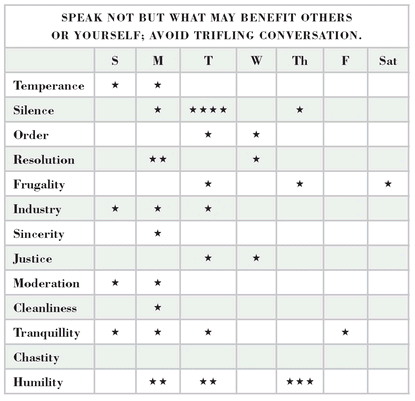
Speak not but what may benefit others or yourself;
avoid trifling conversation
“YOU HAVE SOMETHING IN YOUR TEETH.”
From such sentiments are great romances born . . . or do visits to the dentist begin.
Okay, let me start this story with a little journey into my distant past. After finishing my undergraduate degree, I was making extra money as a bouncer/bartender at a local bar called the Chestnut. It was an interesting place that attracted a mostly blue-collar crowd, with the occasional bikers and, when the live band warranted, university students. On my first shift, after ejecting (gently, or so I had thought) a customer who was clearly unaware of Franklin’s virtue of Temperance, I was threatened with a switchblade. That same night, a female ejectee saluted us by hurling her stilettos at us from across the parking lot and pulling a moon.
{ Silence is not always a Sign of Wisdom, but Babbling is ever a folly.}
It was the best job I ever had.
The principal benefit of working at a place like the Chestnut was its war zone-like environment. There might have been disease, gun-fire, and the constant fear of death, but you formed a real bond with the guy beside you. Friendships, romances, and the occasional business partnership were borne of the shared jeopardy. From my short time at that bar, I met some of my closest friends and, more important, my future wife.
A close friend of Michelle’s was one of the prettier bartenders with whom I worked. Notwithstanding a long line of suitors (or perhaps because of it), she decided that instead of bringing a date to a staff party at a local lake, she would bring her friend.
The staff party was one of those “two roads in the wood” moments. I knew that I was interested in Michelle. She was beautiful, and in our one brief, previous conversation (or at least the one brief conversation I could remember), she seemed bright, but that was all I really knew about her. This was a chance to see if an initial flirtation might be worth a greater investment.
I thought it was going well until Michelle said, “Cameron.”
“Yes,” I replied, more than a little smitten.
“You have something in your teeth.”
How does one “more than a little smitten” respond to such a statement? I learned later that she said it because that is her nature. She says what she is thinking. That is who she is. When she doesn’t like her food, she sends it back; when the service is bad, she says so. When you have something in your teeth, she says, “You have something in your teeth.” (By way of example, when I read her this passage, she said, “I don’t remember it the way you tell it, and that’s not when I said you had something in your teeth.” We’ve agreed to disagree on this point. Go figure.)
Now I realize that Michelle simply understood the power of language. She told me that I had something in my teeth because she wanted her potential paramour to get said something out of his teeth. In doing so, she won a husband. I loved her, and love her still, because she uses language purposefully, not maliciously. I loved her because she told me I had something in my teeth. I love her still because I now know that she would never have told someone else that I had something in my teeth.
That’s the Silence that Franklin wanted. He wanted speech that mattered. He wanted Silence where talking had no purpose. He wanted his acolytes to speak only when it benefited themselves or others.
I was in trouble again.
Remember my self-assessment? I have, in medical terms, a big mouth. I like to talk. I think I inherited it from my mother (okay, I know I did, but my mother is going to read this, and I wanted to ease her into this little confession).
I take little comfort in the fact that I am not alone. North American culture is awash in gossip. There are entire magazines dedicated to news of the dating habits of people famous for being famous. Columns in newspapers are devoted strictly to the foibles and failings of the über-rich. Television shows abound that revolve around tracking the lives of celebrities. It is the modern equivalent of lion feedings at the Colosseum. Think simply of the hullabaloo around Tiger and his dalliances.
Of course, it isn’t just the media that gorge themselves on “trifling conversation.” Gossip is the vernacular of the modern office; it’s what binds people of disparate cultures and races.
Given Franklin’s choice for Virtue No. 2, it must have been no different in colonial America. I bet Franklin had a proclivity for it. He was, after all, a journalist. He acknowledged a habitude of “prattling, punning and joking.” Ben and I may not share many qualities, but there is common ground here. Trifling conversations are us.
At some point, however, Ben understood that “in conversation it (knowledge) was obtained rather by the use of the ears than of the tongue.” So that, at least in the early going, was my goal for this virtue: no gossiping; no prattling, punning, or joking; more listening than talking. Indeed, I decided to speak only well of my fellow travelers. Given that, as a prosecutor, I am paid to describe the nefarious, salacious, and titillating details of people’s lives, this had the potential to be a tough week.
I lasted about two hours.
Let There Be Gossip
I barely had time to wipe the sleep from my eyes and address Powerful Goodness before I was slapping the virtue out of Silence.
On Day 1, I rose with the best of intentions. I had firmly set about to avoid all gossip—to speak only when it was a benefit to me or others. I managed to rise, do the Powerful Goodness thing, wish good tidings upon my family, and make it all the way to work without transgression. That, however, was as far as I got.
My undoing was habit. The very power that Franklin sought to harness pulled me into its awful maw and consumed whole my good intentions. So I blame habit . . . and my work colleagues. They are good and decent people (as I hope I am). Until this virtue was thrust upon me, I would not have thought of them as trifling conversationalists. (My boss’s nickname among the criminal defense lawyers is the Cobra. He is hardly the sort to prattle or pun.) These are generally serious people engaged in serious work. That is, except for first thing in the morning.
This is where habit creeps in. Each morning is the same. Like salmon swimming back to the river of their birth, we end up in my boss’s office to, well, engage in trifling conversation. We discuss the previous night’s events, the day ahead of us, and the goings-on in the world. We speak of our own lives and those of others. In short, we gossip. It was into this mix that I took my good intentions and poor record on Silence.
Of course, I wasn’t wading into this river without knowledge of the current. I knew what awaited. I had possessed an unfounded optimism that I could resist.
Like a journeyman prizefighter, I was smart in the early rounds. I watched for snippets of gossip among our conversation. When I saw them coming, I sidestepped, backpeddled, bobbed, and weaved. And like that journeyman prizefighter, my early success was my undoing. “This isn’t so hard,” I thought, and I dropped my guard.
“Oh,” I thought to myself as we spoke of someone not present, “that was gossip.” Like an old high school classmate passing on a busy sidewalk, I recognized the gossip as it went by, but by the time I was ready to shout it down, it was gone. Oh well, what’s one slip? Then it happened again—a story about a local lawyer. Damn, I cursed myself for not objecting to the usual backbiting. I needed to up my game. Just as I was thinking of how I would deal with the next incident, one of my coworkers asked me a question about someone, a police officer, and before I could stop myself, I was the gossiper. Metaphorically, I clasped a hand over my mouth. I was no longer just an accomplice; now I was Silence’s Enemy No. 1.
I had not even made it through the morning. I started to remember Temperance fondly.
The rest of the day passed uneventfully (relatively), but I knew that if I was to survive the next morning’s session, I would need some help. Just saying I wouldn’t engage in idle chitchat wasn’t enough; I needed to take a more active path. Ben had laid a golden pathway to Silence, but I needed a road map showing how to travel it.
I found some guidance from Lori Palatnik and Bob Burg in their book Gossip: Ten Pathways to Eliminate It from Your Life and Transform Your Soul. They describe the Ten Pathways of Positive Speech:
Speak No Evil. Say only positive statements. Let words of kindness be on your tongue.
Hear No Evil. Refuse to listen to gossip, slander and other negative forms of speech.
Don’t Rationalize Destructive Speech. Excuses like “But it’s true” or “I’m only joking” or “I can tell my spouse anything” just don’t cut it.
See No Evil. Judge people favorably, the way you would want them to judge you.
Beware of Speaking Evil Without Saying an Evil Word. Body language and even positive speech can bring tremendous destruction.
Be Humble; Avoid Arrogance. These will be your greatest weapons against destructive speech.
Beware of Repeating Information. Loose lips sink ships. Even positive information needs permission before being repeated.
Honesty Really Is the Best Policy—Most of the Time. Be careful to always tell the truth, unless it will hurt others, break your own privacy, or publicize your accomplishments.
Learn to Say “I’m Sorry.” Everyone makes mistakes. If you’ve spoken badly about someone, clear it up immediately.
{ He that speaks much, is much mistaken.}
Forgive. If you have been wronged, let it go.1
Oh, gracious. That’s quite a list. Body language? Humility? I would even have to say I was sorry? The way this course was going, I thought, I might never say anything else.
Gossip and the Modern Lawyer
In my quest for moral perfection, I had become transparent. Had I been a wiser man, I would have kept my own counsel on the Great Franklin Virtue Hunt. I would have quietly gone about my virtuous business and waited for the results to speak for themselves. However, as disclosed above, I have never let anything speak for itself.
So, as a result of my big mouth, my colleagues were aware of my intention to follow Franklin’s virtues. Aware and skeptical. Unmoved by my desire to be better, uninspired by my wish to be virtuous, and unimpressed with my chances of success, they had specifically informed me that they would not be involved in my quest for moral perfection. “Don’t drag us into this” had become their collective motto. (Strangely, my wife had given me the same advisory.)
This caused a problem during my quest for Silence. Having dedicated myself not simply to the words of Benjamin Franklin (and my more contemporary guide, Chris Levan) but also to the Ten Pathways of Positive Speech, I had hoped that speaking positively about people would not only make the virtue of Silence more palatable and achievable but also create an environment in which those around me would reflect on the very virtue I sought to achieve. In hindsight, and upon a review of the list, this was more patronizing than humble. That might explain what came next.
As we had done the day before and the day before that and the day before that, we gravitated to our usual prework routine of gossip and occasional griping. This time, however, I was going on the offensive. I monitored the conversation, waiting for an opportunity to knock gossip square in the puss. Opportunity did not take long to knock. A particular name came up, a certain and sure target of negative comment at some point. Seizing the moment, I said something positive about this person. Aha! I congratulated myself. Now I’m rolling. Hopefully the others would follow my virtuous lead.
Rather than the worshipful adulation that I had anticipated, my efforts were met with an incredulous stare, complete silence, and finally the question: “What virtue are you on now?”
This was followed by a discussion, the essence of which was that I was an idiot and that my following a course of virtues was like George W. Bush joining Toastmasters.
At least we weren’t talking about someone else.
Resigned to a certain level of indifference from my colleagues, if not outright hostility, I carried on in Silence. Or so I thought.
To understand what happened next, I need to explain that the criminal justice system seems perpetually overburdened to the point of complete collapse. Not long ago, in one North American jurisdiction, the courts were so backlogged that forty thousand cases were dismissed en masse because of breaches of the accused’s constitutional right to a trial within a reasonable time. We are a ship that sails along, but we are constantly taking on water.
Plea bargaining is the bucket with which we bale our leaky ship. We haggle, barter, and negotiate. We wheel and deal. We sell off charges in exchange for pleas, lighter sentences for the certainty of result. We, both prosecution and defense, become the infomercial pitchmen of justice.
Why do we do it? It’s simple. The system operates on a principle a little like the old Cold War notion of mutually assured destruction. Both sides have an understanding that if everything went to trial all the time, the world would end, at least metaphorically.
Ask any criminal lawyer and he’ll tell you that plea bargaining leaves everyone feeling a little dirty. It’s not wrong, of course; indeed, it’s judicially sanctioned. Still, there is a certain ickiness to it—like taking your sibling to the prom. No law against it, but it just feels wrong. Those of us knee deep in the bilge of the justice system, despite whatever ickiness we feel, are forced to plea-bargain. So when we do it, we demand a certain amount of trust between counsel—an understanding that a deal is a deal. When that doesn’t happen . . . well, on that third day of Silence, it didn’t.
It was a minor thing really. As part of a plea negotiation (that’s what we’re supposed to call them), I had agreed not to submit to the judge a criminal record that was outdated by twenty years. This is consistent with the law in my jurisdiction. Such an old record is of little or no significance to the imposition of a just sentence. It does not mean, however, that the accused has never been involved in the criminal justice system, and the quid pro quo in this deal would include the defense lawyer not suggesting any such thing.
But that’s exactly what my opponent said on this particular occasion.
When it was his turn to address the court, he stood up and said that his client had never been involved in the criminal process before. This was not part of the deal. Worse, it was an outright lie. The trust that the process demands was breached.
The immediate problem was easily resolved. I stood up (after taking a deep breath), advised the court of the fact that I had been misled, and made further submissions on the sentence, which the judge promptly accepted. From a virtuous standpoint, however, matters were not so easily resolved. The lawyer involved, sensing that the wisest course of action was a physical retreat, left the building before I could complete my other trials and wrap my chubby fingers around his neck. This left me with an almost overwhelming desire to vent my frustrations to my colleagues—in effect, to bad-mouth my opponent. As soon as the notion of telling others about how angry I was popped into my head, however, I sensed the warning finger of Franklin waving in my face.
Would venting about the other lawyer have benefited myself or others? Initially, I tried to rationalize the situation. If I didn’t tell my colleagues, they might be similarly duped by this counsel sometime in the future. Then I remembered that rationalizing gossip was a no-no according to the Ten Pathways. Now my virtuous guides were ganging up on me. Giving in to Silence, I said nothing. Until now, that is.
Ben should have put this virtue last.
Of Peter Lorre and Learning to Sit Down and Shut Up
There are two truths that all lawyers know: (1) never ask a question to which you don’t know the answer; and (2) know when to sit down and shut up. Sort of the bar association’s answer to Ben’s virtue of Silence.
Easier said than done.
Once, in the not-too-distant past, I prosecuted a trial in which two otherwise upstanding university students were accused of fondling a young woman in a dorm room. It was shaping up to be a typical he said-she said scenario. The victim, a young woman who was still haunted by the betrayal of two men she had considered friends, was a good witness. She told her story clearly and completely without embellishment. It was moving but uncorroborated. Given that I expected both accused to deny her allegations, I was unsure of a conviction. Certainly no one was going to break down and confess on the witness stand to this or any other crime in the real world.
Except that is exactly what happened.
When the first accused took the stand, he did what I had expected: He denied the accusation. The thing was, he seemed very uncomfortable in his denial. As he testified, there was something in his tone, or the cadence of his speech, that seemed wrong to me. I could not put my finger on it immediately, but as he spoke, I knew that something was different here than in almost every other trial I had prosecuted. Finally, it struck me. This young man wanted to be honest. He knew what had happened and he wanted to tell the truth and it was killing him to lie about it. This was very unusual.
I began by having the witness confirm innocuous details, eliciting admissions on things that had little significance. Then I sought some common ground on matters that were not very contentious but that did advance my case. As I wound my intellectual way to the real heart of the story, the allegation of a sexual assault, I ratcheted up the tone of the examination, building it like the crescendo of an opera. Finally, I could sense his defenses weakening, and I put it directly to the accused. Standing just a few feet away from him, I asked in my loudest baritone:
“You’ve heard what Ms. X. said. She said you fondled her breasts. And she was telling the truth, wasn’t she? She was telling the truth, and your denials have been lies?” There was silence for a moment. Even that might have been a victory in any other cross-examination. The accused looked down. He refused to look up at me or anyone else in the courtroom.
Finally, after what seemed like an interminable pause, he lifted his head and, barely above a whisper, replied, “Yes.”
So there I was. The one and only witness-stand confession of my entire career, and I didn’t know what to do next. A little voice said, “You’re brilliant! Now you’ve got him. Ask him another question. Get him to admit to something else. Make him tell you where Jimmy Hoffa’s buried.”
Fortunately that voice (which sounded exactly like Peter Lorre) was drowned out by a far louder, less Casablanca-like voice that said, “SIT DOWN AND SHUT UP.”
“Um, no more questions,” I said as I sat down clumsily. I didn’t know the significance of it at the time, but I was practicing Ben’s virtue of Silence. Anything else I asked was not going to benefit anyone. There was nothing else to say.
I’m not disclosing this because I’m looking for praise or a pat on the back. In fact, the manner in which I asked the question was at least ham-fisted and maybe even legally impermissible. I’ve disclosed this little snippet because during the week of Silence I got to use the lesson it reinforced.
There were, on that day as on all days, opportunities for the types of conversations that Franklin sought to eschew: a judge with a new car, the absence of a player at noontime basketball (who had been suspended for unsportsmanlike conduct during one of our league basketball games), and various other trifling conversations that were anathema to Franklin’s ideals. I avoided these topics as best I could. The real test, however, came when a friend confided her fears about the nature of her daughter’s marital relationship.
These, as you may have experienced, are dangerous waters. I never know if someone actually wants advice when they become confessional, or if they are simply looking for validation. I tend to fall in the “If you ask what I think, I’m gonna tell ya” camp. As she spoke, my very core cried out to respond to each of her assertions. In my mind, I said, “You’re only saying that because you never went through it,” or “Part of the problem is the history between you and her.”
{I resolve to speak ill of no man whatever, not even in a matter of truth; but rather by some means excuse the faults I hear charged upon others, and upon proper occasions speak all the good I know of every body.}
I wanted to tell her to lighten up, to try to see things from her child’s point of view. She was coming to me for advice after all (or at least to vent), and it was clear to me that I was just the man to give said advice.
Then a little voice in my head screamed, “SIT DOWN AND SHUT UP!!!!”
Whose voice was it? Franklin, old law professors, my younger self, Peter Lorre? Who knows, but it was firm, resolute, and wise . . . and it demanded Silence. Speak not but what may benefit others or yourself. No one was going to benefit from what I was going to say. She didn’t really want advice, and more important, I had no legitimate basis for giving it out. I didn’t know enough about the situation to make an informed prescription. Two weeks before, these concerns would not have slowed me for a moment. On that day, however, I was living Franklin’s virtues. On Day 4 of Silence, a little voice in my head demanded Silence, and I listened. Maybe I wasn’t hopeless after all.
Karma and Talking to Computers
I feel sorry for anyone who works at an IT help desk. They are faced with an almost unsolvable problem. On the one hand, average employees want the latest and best technologies. Every advertisement in the newspaper, every television commercial for a computer company, every conversation with the employee’s nerdy friends, is a potential headache for an IT department. Butting against this ceaseless demand for new technology is the complete incompetence of the average human over the age of thirty-five to do anything of any value with a computer. “Have you tried turning it off and on?” is now the standard first response to any request for assistance.
And then, of course, there are the viruses, security violations, and unending spam. I hope that they are not specifically targeting me for any particular reason, but not a day goes by that I don’t get some sort of penis-lengthening offer. How did this clearly . . . growing . . . industry operate before email?
In response, therefore, to the Gordian knot faced by IT departments across the world, a formidable defense has been developed: inertia.
Requests for the purchase of nonstandard information technology products are generally met with an approval process with the nimbleness of an arthritic octogenarian. No matter the employee’s need, no technology is purchased until it is thoroughly studied, examined, and challenged. Generally, by the time any approval is received, the requested software is outdated by two releases. It is an approval quicksand pit.
You might ask what this has to do with Silence. Let me just say that sometimes the virtue gods enjoy a little irony.
Not long before the week of Silence, I had purchased a voice-recognition program for my home computer. I was so impressed with it that I requested that my employer purchase a version for my office. The financial aspect was no problem, but when IT got the request, I hit the wall. Or more to the point, I hit the quicksand pit. On any other day, that might have concluded matters: request, acknowledgment of request, interminable delay, and retirement. This, however, was during the course of my quest for moral perfection. First, I was faced with a natural desire to vent my frustrations. I remembered my virtue, however, and kept silent. (Again, until now.)
More important, however, my Franklinian quest—misguided, unrealistic, and potentially unachievable—must have caught the attention of whatever forces control those aspects of the universe outside the understanding of man (no, it’s not bureaucracy). You see, less than an hour after I made the last of what I knew to be my certainly hopeless requests for voice-recognition software, I sat typing a long and laborious legal opinion. Why, oh why, I asked myself, couldn’t I be speaking into a microphone and seeing the little words appear on my monitor rather than wearing off the tips of my chubby fingers? As my bruised and battered digits scurried across the keyboard, I lost focus for an instant, hit an unintended sequence of keys, and discovered that my word-processing program was auto-installing something.
I scrambled to stop the auto-install until I read the message. My computer was trying to install the components of a voice-recognition program that had been lying dormant on my hard drive.
In shock, I called the IT department. I told them what had happened, and after a short delay (relative to whom I was speaking); the technician came back and said, “Isn’t that funny. The operating system we’re running has a voice-recognition program included. We’ve just never activated it.”
I paused and drew a breath. “You’re telling me that every employee in this department could be using voice-recognition technology . . . for free?”
“Yup. Looks like it. They’d need a microphone, of course, but once it’s activated, it’s ready to go.”
Let me just step back for a minute and reiterate. On the very day that I had attempted to convince my employer to purchase a program to allow me to dictate into the computer, I discovered, completely by accident and entirely by coincidence, that I already possessed a program that allowed me to dictate into the computer. Now perhaps this, to you reading this removed from the circumstances, may not seem like proof of the existence of some spiritual force dedicated to the proper alignment of the universe. If you are such a skeptic, however, I ask you to reconsider your position. During my week of Silence, I was rewarded for my efforts by being allowed to speak. Perhaps Franklin is in cahoots with my IT department. Maybe I’m just getting punch-drunk from all my virtuous failures.
In any event, all I could manage was “Wow.”
There was another pause, then the technician said, “Do me a favor? Don’t tell anyone.”
“What?”
“Don’t tell anyone else about this.”
“Why not?”
“Because if you do, everyone will be asking us to activate it. We’ll never get anything else done. Just don’t say anything, will you?”
Ha! As if. On a day that my Silence had been rewarded, I intended to shout of my reward. And if those to whom I shouted asked how I came to find my treasure, I’d tell them Ben Franklin led me to it.
The Sound of Silence
There is no Silence in my house, not the literal kind at least. I have three children. And a dog. (Actually by the time I was revising this book, we had acquired a second dog. My kids won a bet to force me to get it. That’s a story for another book.)
Kelsey, the oldest at thirteen, has, as I have mentioned, special needs. She cannot talk or walk and developmentally she is about one year old. Notwithstanding her lack of speech, she is not silent. She has noises that mean something to her and, after all our time together, something to her mother and me as well. Happy sounds, sad sounds, hungry sounds. We have learned the meaning of the noises she makes, and they can bring joy or pain to our hearts.
Harper, who is seven, is a bright girl. She is empathetic and loving and, like all children, curious. She has questions constantly. I love answering these questions, though Michelle says that I am too verbose in my responses. But I can’t help it. I always wanted someone to ask me, “Dad, why is the sky blue?” I hope she never stops asking questions.
Darcy, our baby at five, is . . . well . . . how do I say this knowing someday she might read it? Darcy is loud. She can’t help it; she gets it from me. She loves life. She literally loves life, and she shows it by screaming and singing and dancing and laughing. We used to call her the Beast because she ran around the house like a wild animal. She is almost the human embodiment of joy. She is loud.
My home is loud, and I would have it no other way.
Sometimes, however, Silence—real, literal, no noise type of Silence—is a good thing.
Having dedicated myself to the proposition that Franklin’s intention in promoting Silence was to avoid gossip, hurtful words, and any speech that was not a benefit, I had ignored the more literal meaning of Silence. Given my natural proclivities (and housemates), the absence of noise is, to me, a mystery of biblical proportions. When my workweek was done, I decided to explore true Silence.
A judge I know books himself into a monastery twice a year. No talking at all—just him and several dozen monks contemplating. That’s a lot of Silence. I wasn’t sure I could handle that much quiet. I decided to go ask him about it. When I inquired about the experience, he seemed thrilled that I might follow his example. He told me how the monks and guests eat, work, and pray in silence. Most of your time is spent in your room, he told me, where there is no temptation to speak. It is meant to be a time of reflection.
“Could I bring a book?” I asked.
He seemed a bit taken aback. “You mean other than the Bible?” When I nodded, he continued, his tone less exuberant than it was a moment before. “I suppose. But this is meant to be a place for you to commune with God. The silence allows you to get past the daily concerns that plague us, to clear your mind, to create space for something deeper, something spiritual.”
I’m sure he wanted to say, “deeper than The Da Vinci Code.” But he was too polite to say something like that.
I was sure I couldn’t handle that kind of quiet. If the virtue was to have any real benefit for me, it had to be something easily replicated in my everyday life. I don’t often hang out at monasteries (though I once repaired the fire extinguishers at a convent, and all the nuns said to say hello to my dad—that took some explaining to my mom). In the end, I settled on some self-help Silence.
The penultimate day of the week of Silence presented the perfect opportunity to explore real Silence. Left alone at home with Kelsey and Billy, my mentally disturbed beagle, I saw my opportunity. Kelsey was tired, and I knew she would soon fall asleep, and Billy was curled up in a ball on the love seat, dreaming of whatever it is beagles dream of.
And so I sat in Silence.
Or not. I had forgotten the load of dishes in the dishwasher. The wishhh-whhirrr sound of detergent being sloshed over our lunch dishes was definitely interrupting my resolute refusal to make a noise. The wash would wait. I turned the machine off and was met with more noise . . . the dishwasher had been masking the sound of the clothes dryer a floor below. A quick trip down the stairs, a turn of a dial, and . . . the sound of our air exchanger. Now I was in trouble. I didn’t know how to turn off the air exchanger. Then Kelsey decided to help by making her happy sounds, which were delightful except that they in no way qualified as Silence. It occurred to me, as I listened to this twenty-first-century white noise (and my child), that complete Silence in the modern world is almost unattainable.
Determined to achieve as much Silence as possible, I waited until the air exchanger went silent and Kelsey had fallen asleep. Then I sat and read a book. I immediately discovered another problem in seeking Silence. Silence, the real Silence, must be more than an absence of noise. It is an absence of the things that clutter the mind—the internal noise of modern living.
Life is hectic. The simple clutter of our everyday existence crowds and confuses our waking thoughts. Even the simple, wonderful act of reading fills our heads; this is not Silence. I needed Silence. No reading, I decided.
I laid aside my book, rested comfortably on the couch, and attempted to clear my mind of all conscious thought. Calming myself, I breathed slowly and considered the peace that Silence might bring.
When I woke up, drool drying on my cheek, I was no better acquainted with the peace of Silence. I had discovered, however, the benefit of an unintended afternoon nap.
The Beginning and End of Silence
Why did Franklin place Silence so early in his program? In his autobiography, Franklin wrote:
And my Desire being to gain Knowledge at the same time that I improv’d in Virtue and considering that in Conversation it was obtain’d rather by the use of the Ears than of the Tongue, & therefore wishing to break a Habit I was getting into of Prattling, Punning & Joking, which only made me acceptable to trifling Company, I gave Silence the second Place.
As far as I can tell, no one knows from whence sprung Benjamin Franklin’s devotion to Silence. What is certain is that it predated his course of virtue. Indeed, Franklin’s earliest writing was done under the pseudonym “Silence DoGood.”
Franklin was an apprentice printer to his brother. It was not a happy relationship, if Franklin is to be believed; it consisted of more than the normal servitude such a situation might entail (or at least more than one might have expected in a familial situation). Franklin was desperate to break away from his brother, and he finally achieved this by becoming nominal head of his sibling’s paper after his brother’s imprisonment for writings embarrassing to the government of the day. The change in ownership was a ruse, but to make it complete, the articles of apprenticeship had to be discarded and secretly rewritten. Ben used the fact that his brother could never speak of the rewritten apprenticeship to escape the situation. A brilliant use of Silence.
How had I done in honoring Franklin’s second virtue? Had I succeeded in breaking my own habit of prattling, punning, and joking? Was I acceptable to more than trifling company? I’m not sure that I was ever acceptable to even trifling company, and if I was, I’m not sure that they’d appreciate being called “trifling.”
Notwithstanding any failures in the achievement of this virtue, I do now see its benefits. I spoke less and listened more. I avoided gossip and thus learned new things. I held my tongue, and I was allowed to speak. Not bad for Week 2.
I clung to that illusion right up until I looked at the next week’s virtue. Order is on deck. I had a house full of knickknacks, a desk full of paper, and a mind full of clutter. I suspected I was about to meet my match.
SILENCE