
Churchill’s period as Chancellor, despite his romantic reflections on using his late father’s robe of office, was not particularly successful. The Baldwin government was to preside over economic turmoil and lose the following election. In retrospect, Churchill was to be critical of himself and especially of his economic advisers. The irony was that his policy of austerity, sound money and a return to the Gold Standard went a long way towards rehabilitating him with the Conservative Party.
Economic policy
These were difficult economic times, compounded by the distorting effect of the huge debt payments which had arisen from the First World War. Britain was in debt to the USA, but was in turn owed more by the defeated powers. Some years earlier, Churchill had shrewdly argued for a global write off, but the more traditional attitude of the American government had prevailed. There were two broad schools of thought concerning how governments should respond to the economic slump. Prominent economist John Maynard Keynes and those around him advocated ambitious public works programmes to stimulate demand. They felt that during a recession, Britain should run a deficit; also that pegging the currency to gold (and the dollar) should be avoided, because it would lower wages and cause unemployment. The Treasury and the Bank of England took a more conservative view: government expenditure needed to be cut back in order to balance the budget. A return to gold would restore confidence in the pound and help to rebuild the economy.
Churchill thought long and hard about this dilemma. It is perhaps unsurprising that he acted as he did. The vast majority of the Conservative Party supported traditional ‘sound money’ policies. Keynes was seen as a dangerous radical. The advice from the Treasury and Bank of England was very clear. Britain returned to the Gold Standard at $4.86 in 1925. Churchill put forward a series of extremely tough budgets.
On the public expenditure side, this meant drastic defence cuts, including the decision to abandon plans to strengthen the fortifications at Singapore. Churchill was to regret this, and be thankful for the rapid rearmament programme that would be introduced by Ramsay MacDonald’s National Government. In industry, the stronger pound led to problems with exports, unemployment and wage cuts. A threatened strike in the vital coal industry was headed off by Churchill himself, who negotiated a wage subsidy which would last for nine months. It was when this expired in 1926 that British industrial relations reached their nadir.
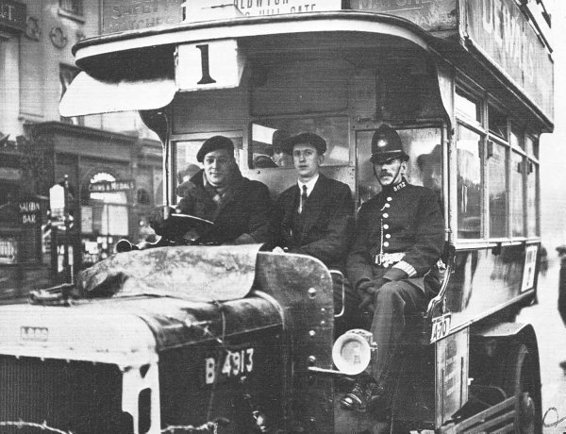
The General Strike, 1926: volunteers man the buses, with police protection.
The coal miners called for a general strike across the nation. Negotiations with the government sought to avoid this, but were suddenly broken off, after Baldwin’s Cabinet decided to adopt a tougher stance. Churchill has frequently been blamed for fomenting this U-turn, but the allegation is inaccurate. What can be more fairly said is that during the nine-day general strike which followed, Churchill had to be restrained from adopting inflammatory rhetoric and tactics. He was given the job of publishing an emergency government newspaper, called the British Gazette. The owners of the Morning Post made their facilities available for this purpose. Specifically, he was not given editorial control – and yet he attempted to exercise precisely that. During the strike, he also urged the use of large numbers of troops to escort a food convoy – a completely unnecessary provocation which was rejected by Baldwin. The strike fizzled out; but public opinion, especially on the left, regarded Churchill as the villain of the sad saga.
The economic policies of Churchill as Chancellor of the Exchequer are difficult to characterize as anything but failure. Yet his attitude to such issues is interesting. When wrestling with the Gold Standard question, he convened a special dinner, at which the proponents of both views were invited to thrash it out. Years later, he acknowledged his error, and was particularly scathing towards Montagu Norman, the Governor of the Bank of England. He remained friendly with Keynes, whose ideas would reshape the world economic order after the Second World War. In short, his mistakes can be seen as honest ones: he had endeavoured to bring an open mind to the issues.
Despite his economic focus, Churchill remained fully engaged with international affairs. This was a period in which he became critical of the USA, both on the question of war debt and over naval rivalry. His hostility towards Soviet Russia was also unstinting.
Defeat
At home, he enjoyed quiet family stability with Clementine and the four surviving children. He spent much of his spare time painting, and on various building projects. He had a close circle of friends, and he became a genial host. Brendan Bracken, a young newspaper entrepreneur and aspiring Conservative candidate, was one, as was Professor Frederick Lindemann from Oxford University. Lindemann, who was a physicist with bold ideas, would become a key Churchill adviser during the Second World War.
Stanley Baldwin went to the country again in May 1929. The economy was in a mess and the Conservatives unpopular. Although Churchill retained his Epping seat, it was the Labour Party which emerged as the strongest in a hung parliament. For a busy few days following the election, Churchill was involved behind the scenes, trying to put together a coalition between the Conservatives and Liberals. The task proved impossible. Ramsay MacDonald formed a minority Labour government with Liberal support. Since his return to the Conservatives in 1924, Churchill had managed to re-establish himself with many of his party colleagues. Yet he was now out of power. He would not be back in government until 1939.