
The decade which Churchill himself described as his ‘wilderness years’ was characterized by his close association with unpopular causes. This, coupled with a long spell of opposition for the Conservatives, kept him at the margins of power. At the margins, but not fully excluded. For he continued to cultivate contacts and to make contributions that would ensure he was never quite forgotten. It was a period which brought a stronger focus on activities beyond Parliament, with extensive travel and writing.
No sooner had the dust settled on the 1929 election than he was embarked upon an extensive lecture tour of the USA and Canada, with his brother Jack and son Randolph. They were entertained by luminaries such as Randolph Hearst and they enjoyed luxury train travel in a private railway coach, owned by the steel magnate Charles Schwab. Two years later he was in America again, with a series of lectures entitled ‘The Pathway of the English-Speaking Peoples’. For Anglo-American destiny had now become an important component of his thinking. Gone were his concerns about rivalry with the USA and its powerful navy. He now believed the English-speaking nations should work together for world order and culture.
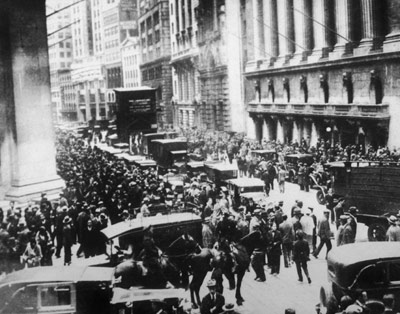
The Wall Street crash, October 1929. Churchill was in New York at the time and avowed that between them, Britain and the USA could resolve the crisis.
Intellectually, he developed this theme in his multi-volume History of the English-Speaking Peoples, a work which was not completed until 1958. He needed to write in order to restore his finances. His endless projects at Chartwell, together with extensive travel and entertaining, had led him into debt. In 1930, he had published a witty autobiography entitled My Early Life. From that year, too, he had begun work on a multi-volume biography of the Duke of Marlborough. These four volumes, published between 1933 and 1938, told of a Britain that built a military coalition to come to the aid of mainland Europe. The powerful echo with his own times and growing concerns was not lost on Churchill.
Nazi Germany
His views on Nazi Germany were rooted in clinical considerations of international power. Primarily, he was worried about an overly mighty Germany – whoever happened to rule it. This was not to say that he didn’t care about the Nazis. Even before Hitler seized power, Churchill had been revolted at their persecution of the Jews. In one of the period’s great ‘what ifs’, Hitler turned down the opportunity of dining with Churchill in 1932, because of remarks the latter had made about the Nazis and their anti-Semitism.
It was this early identification of the threat from Germany which would ultimately bring Churchill back to the centre of the political stage. Yet for most of the 1930s, his views were completely out of step with those of his colleagues and the British public. When Conservative Prime Minister Neville Chamberlain struck a deal with Hitler at Munich in September 1938, Churchill was angry and distraught. As the crisis over Czechoslovakia had built up, on three separate occasions Churchill had privately warned Chamberlain on the dangers of capitulation to Hitler. His public statements were equally unambiguous. While Chamberlain returned to widespread acclaim, Churchill stood in the House of Commons to denounce the deal and predict war. ‘I think you will find that in a period of time which may be measured by years, but may be measured only by months, Czechoslovakia will be engulfed in the Nazi regime,’ he told the House. It was a brave speech from a brave politician of conviction. For all his powerful oratory, Churchill was almost completely bereft of support from his own party. Most thought he was a warmonger. However, Clement Attlee’s Labour Party opposed the Munich deal, and there was at least some sympathy for Churchill in that quarter.
Indian independence
Churchill’s political ostracism on the brink of the Second World War was also the product of positions he had taken on other issues. Chief among these was Indian independence. A romantic love of empire coupled with more than a dash of racism, saw Churchill implacably opposed to the government’s cautious moves in this direction. When Gandhi and other leaders of the Indian independence movement were released from prison in January 1931, he resigned from the shadow Cabinet. The leadership of all three main political parties in Britain supported the policy. Churchill’s resignation represented a final break with Stanley Baldwin, the leader with whom he had such a difficult relationship.
In opposing the 1935 India Bill, Churchill found himself in the company of some of the most reactionary Conservative backbenchers. Of these, he was the only one with Cabinet experience – thus quickly emerging as their natural leader. But it should have told him something about the cause he had signed up to. Nor was there much of a constituency outside Parliament. He was beginning to look like yesterday’s man. The government’s proposal, drafted on the back of the Third Round Table Conference of 1932, was actually for dominion status for India, similar to Australia or Canada. In fact, the issue was swept aside by the Second World War, only to resurface immediately afterwards, as momentum built for unfettered independence. India became independent under Attlee’s Labour Government in 1947; but Churchill had been on the losing side of the argument all along.
The abdication crisis
His intervention in the abdication crisis of December 1936 appeared to be similarly out of step. The government (now a Conservative administration, again under Baldwin), the British establishment and most public opinion favoured abdication. The notion of the King marrying an American divorcee was extremely distasteful to most sections of society, however this might seem in these more liberal times. Churchill’s position was actually reasonable enough. He simply called for time to examine all options. He was fond of the King, and the monarchy. Those who accused him of conspiring to launch a ‘King’s party’ in Parliament were way off the mark. Yet once again, he was way off the spectrum of mainstream opinion.
Despite these very public arguments, Churchill had also been undertaking valuable work behind the scenes. Especially in the field of defence, his knowledge and enthusiasm were recognized by Baldwin. He kept up to speed by use of his contacts in the government and civil service, often receiving secret information to which he was not entitled. Baldwin appointed him to serve on the Air Defence Committee, but he did not confine his ideas to that sphere. Working closely with Professor Lindemann, Churchill put forward a barrage of suggestions and questions designed to help the country prepare for the worst. He was not always prescient: during this period he underrated the potential for the use of aircraft against naval vessels and declared the era of the submarine to be over. In overall terms, though, he injected energy and creativity into Britain’s rearmament and research programmes.
At home, the 1930s brought new tensions within the family. His son Randolph was something of an embarrassment, dabbling in politics to the detriment of Churchill’s party and securing a reputation as a drunk. His daughter Diana divorced in 1935, while Sarah married a man thought ‘unsuitable’ by the family. Through it all, Churchill clung to Clementine, who stood by him in this most difficult of periods. For by 1938, Churchill’s political career had hit the buffers. As Neville Chamberlain proudly proclaimed ‘peace in our time’, Churchill told the country what he felt it should hear; but it wasn’t listening. Had Chamberlain been right, the world may well have remembered Churchill primarily for his flamboyant writing. Hitler’s invasion of Poland was about to change all of that.