
From 1942 to 1945, Churchill would lead a resurgent Britain, with military success in Africa, Europe and, inevitably, Japan. Just before that last victory in August 1945, however, he would be out of office. He would stride the world stage, part of the triumvirate managing a truly global conflict, yet in doing so recognize that Britain, in her hour of triumph, was now in decline. So, perhaps, was he.
The military situation
When Japan attacked the USA in December 1941, Churchill did not have the early warning that he had received about Russia. Nonetheless he was privately thrilled, knowing that the three great powers had between them the capacity to defeat both Germany and Japan.
Not that the military situation was any less challenging. In June 1942 Tobruk fell, the great British fortress in North Africa. Rommel’s German-Italian army now threatened Cairo and the Suez Canal. In August, a largely Canadian invasion of Dieppe on the French coast ended in catastrophe. Worst was the Asian theatre, where Britain had suffered her greatest ever defeat at Singapore in February. Churchill blamed himself for this, harking back to the days when he had cut the funds necessary to build better defences. In fact, Japanese troops had proved far more skilful at jungle warfare than their British and Indian opponents. At sea, too, Japanese naval aviation had struck the Royal Navy as well as the Americans.

The tide turns: American troops land in North Africa, November 1942.
It was not until the spring of the following year that the military tide really turned. By then the Russians had destroyed a German army at Stalingrad, the Americans were beginning to advance back across the Pacific and Anglo-American forces had ejected the Axis from Africa.
Diplomatic and domestic challenges
These successful campaigns had been co-ordinated through exhausting shuttle diplomacy, in which Churchill played a central role. He immediately travelled to the USA and Canada following the Japanese attack in the Pacific, receiving standing ovations wherever he went. In terms of international influence, he was at his height. A ‘Europe First’ stance was agreed with Roosevelt; by the summer, the British and Americans had pooled their research into atomic weapons; and the basis for what became the United Nations was agreed. Importantly for Churchill, his emphasis on the Mediterranean was – for now – embraced by Roosevelt.
At home, meanwhile, he had faced both political and personal difficulties. He hardly had any time for family life. Clementine remained his rock, but was busy herself. She devoted a great deal of time to raising money for the war effort, especially to provide support for Russia. His three daughters also served as volunteers, Mary famously commanding an anti-aircraft battery. Randolph was in the special forces. Although as brave as his father, he continued to attract criticism for drunken and inappropriate behaviour. Sarah was by now divorced, but having an affair with a senior American diplomat. This was a potentially embarrassing issue of which Churchill was aware and could have done without.
Although he continued to enjoy broad popular support, rated at over 80 per cent by Gallop, he had his difficulties in Parliament. Noted left-winger Stafford Cripps had been to Russia and now called for a stronger alliance with Stalin. Churchill shrewdly neutralized Cripps by bringing him into the government. Beaverbrook resigned over the same issue, but fortunately for Churchill, did not enjoy widespread support. With the help of Attlee, who was steadfastly loyal, Churchill managed to retain a grip on the House. He comfortably won a vote of confidence by 464–1. In fact, Attlee, who as chairman of the Lord President’s Committee had strategic oversight of all domestic matters, competently ruled Britain while Churchill attended to the war. In doing so Attlee had more time to consider domestic policies for the future – something which was soon to assist him electorally.
As the war moved into its final phase, Churchill was to experience difficulties with both Stalin and Roosevelt. One of the flash-points was the question of a Second Front. Tensions first arose at his bi-lateral conference with Roosevelt in Quebec, in August 1943. Stalin’s view, that the Western allies should invade France that year, was well known. Roosevelt tended to agree. Churchill favoured the indirect approach to Germany through Italy, which he felt might be less costly. Mussolini had by now been toppled and Sicily was in Allied hands. For now, it was agreed to invade the Italian mainland and Churchill insisted on a British campaign in the Dodecanese. When they met Stalin in Tehran in November, Roosevelt sided with the Russians and plans for the invasion of France in the summer of 1944 were adopted. Churchill was wary – he believed such an obvious strategy would lead to attritional deadlock. Tehran taught him that Britain was no longer in the driving seat. Exhausted and chastened, within weeks he was struck down with pneumonia.
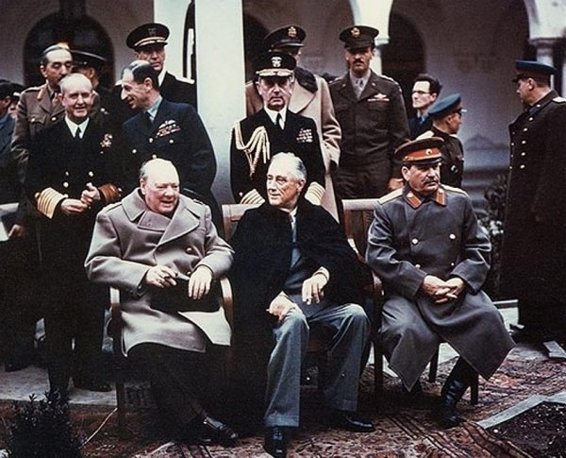
With Stalin and Roosevelt at the Yalta Conference, February 1945
The invasion of France proved successful, while Churchill’s Dodecanese campaign failed and the Italian war was mired in the mud and mountains. Meanwhile, the Red Army did most of the fighting – grinding inexorably towards Berlin.
The Russian threat
As the end in Europe became inevitable, Churchill’s mind increasingly turned to post-war geopolitics. In a deal (October 1944) that was to become notorious, he had divided up the continent in a private session with Stalin. This subdivision of countries into percentages of interest for Britain/America and Russia was never going to be practical. Roosevelt vetoed it as soon as he caught wind of it. Churchill persisted with it, taking solace from the fact that the Russians seemed to acquiesce in British suppression of the Greek Communist revolt, in December 1944. Genuine Russian intentions, however, had already been clearly signalled. Back in August, the Russians had allowed the destruction of the Free Polish Home Army by German forces. This was so that they could install a puppet government unchallenged – despite assurances over ‘shared influence’.
Poland was sensitive in Britain. This was the reason she had gone to war in the first place. Hundreds of thousands of Poles had fought in the RAF and alongside the British Army. It felt like betrayal – but there was little more that Churchill could have done. He was embarrassed in the Commons by comparisons to Munich, though he won the ensuing vote comfortably enough.
The spectre of an Eastern Europe totally controlled by Communist Russia haunted Churchill. He urged Roosevelt to accelerate the Anglo-American advance through Germany. He quietly ordered Britain’s General Montgomery to stockpile weapons with which to re-equip the German Army.
Whether war with Russia was feasible or not (and it most certainly was not), he understood that Germany was now beaten. It is in this context that Churchill’s about-turn on the question of strategic bombing is best viewed. In March 1945, following the firestorm bombing of Dresden, he began to challenge the RAF’s strategy. Professor Lindemann and others around Churchill had persuaded him that the unrestricted mass bombing of German civilians would win the war. Quite obviously, this had not been the case. The suffering and destruction wrought on Dresden caused Churchill to reconsider such a strategy against questions of morality. While Bomber Command (in the form of Air Chief Marshal Arthur Harris) and Lindemann felt betrayed, it is difficult to blame Churchill for such humanitarian considerations with the war all but won.
The 1945 general election
The public’s own opinion of Churchill was to be canvassed shortly. Although Clement Attlee favoured a continuation of the coalition government until the defeat of Japan, his own party would not wait that long. Churchill was forced to resign in May, following the defeat of Germany. A general election was called and he continued in office with a Conservative caretaker administration for the ensuing two months.
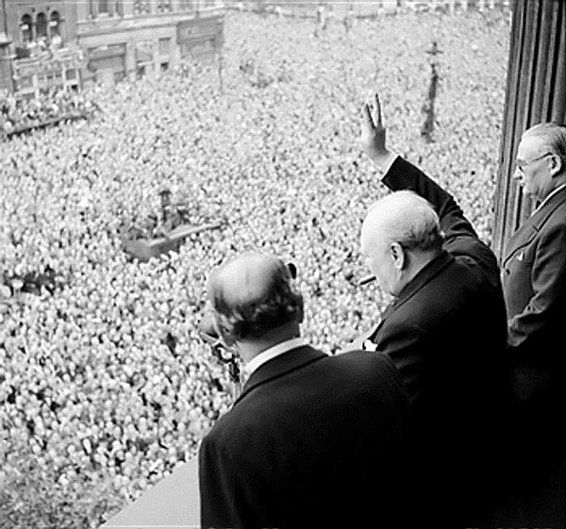
Victory in Europe: waving to the crowds, London, May 1945.
Fighting an election campaign while still fighting a war, Churchill had simply not given domestic politics sufficient thought. He made a fool of himself by warning that the Labour Party would introduce a ‘gestapo’; meanwhile, his own party had little to say about welfare reform, social justice or the structure of the economy. Attlee’s Labour Party, capturing the war-weary thirst for a better Britain, romped home with the first overall parliamentary majority in its history.
When the results came in, both Churchill and Attlee were at the Potsdam Conference. Churchill thus left the final negotiations to Attlee. The other new face at the table was that of US President Harry Truman, Roosevelt having died suddenly in April. Churchill, perhaps embittered by recent tensions, had not found the time to travel to the funeral.
Matters were, it seemed, coming to a close. On 2 September, Japan surrendered unconditionally to the Allies. One of Churchill’s last acts as Prime Minister had been to sign off the atomic attack which precipitated her final capitulation. But now he was gone, and the dust was settling over a world newly at peace. It was unclear what role, if any, he might have in this new order.