
The first eighteen months of the Second World War were to see Winston Churchill back in government, first in the Cabinet and then quickly propelled to the office of Prime Minister. The military backdrop he faced was bleak. As Britain fought for its very survival, Churchill proved to be a leader capable of galvanizing a stubborn defensive mindset. All the while, he had his own vision for turning the conflict round.
From the Admiralty to Downing Street: destiny
Hitler’s annexation of the whole of Czechoslovakia, only five months after his empty promises at Munich, worked as a tonic for Churchill’s political career. By May, the opinion pollsters Gallup were reporting that 56 per cent of the public wanted him back in government. The Daily Telegraph, normally loyal to the Conservative leadership, campaigned for his return. Prime Minister Neville Chamberlain had been proved wrong about Hitler. He was now under pressure to reinstate the very man who had most loudly predicted as much. When war was declared in September 1939, he had little choice but to appoint Churchill to the War Cabinet.
The famous ‘Winston is Back’ signal allegedly despatched to all Royal Navy ships may never have been sent; but the sentiment was certainly felt. He had been given the Admiralty again, perhaps in an attempt to keep him contained. Chamberlain, Halifax and others in the Cabinet mistrusted him and felt that his judgement was suspect. Given their own calculations over Munich, such views seem a little unfair. But back he was, and, as in 1914, he would have his hands all over Britain’s naval policy.
As in the First World War, the navy’s early record was mixed. Churchill escaped the blame for the embarrassing loss of the battleship Royal Oak in the middle of one of the navy’s largest bases, but did manage to secure kudos from the capture of the German ship Altmark. This bold seizure in Norwegian territorial waters had been at his personal intervention, in order to rescue the British prisoners held on board.
On 3 September, he had addressed the House during a debate on the war: ‘This is not a question of fighting for Danzig or fighting for Poland. We are fighting to save the whole world from the pestilence of Nazi tyranny and in defence of all that is most sacred to man.’ Full of confident patriotism and bombast, many MPs could not but help contrast his style with that of the quietly spoken Chamberlain. Here was a war leader in waiting.
Despite this, his elevation to the highest office came almost by accident, on the back of the Norwegian debate on 7–8 May 1940. Together with France and Poland, Britain had despatched troops on an ill-considered invasion of Norway a month earlier. By the time the Allied invasion force landed, German troops were already in control of most of the key ports. Churchill had been given the crucial chairmanship of the Cabinet’s Military Co-ordination Committee as the fleet sailed. Both in his role at the Admiralty and in his new chairmanship, Churchill’s fingerprints were evident in many of the flawed decisions which followed. Yet it was Chamberlain who would pay the price for Britain’s humiliating withdrawal from Norway.
For the debate in the House of Commons turned into an audit of Chamberlain’s war leadership. His majority collapsed from 213 to 81 – effectively, a vote of no confidence. Chamberlain had to go, and his last duty as Prime Minister was to advise the King as to whom to send for by way of a successor. On 10 May 1940, he drove to Buckingham Palace and advised the King to ask Winston Churchill to form a government.
The political reality had left little other option. Though Churchill still had plenty of critics, especially within his own party, there were few others that could command any support whatsoever with the Opposition. This was vital. The country faced an emergency and a government of national unity was required. Churchill’s elevation to Number 10 Downing Street had more to do with his popularity in the country and in the Labour Party than it did his own party. Yet for him, it was simple destiny, the hand of fate. He believed that this was the moment he had been born for.
The making of a war government
Churchill built a broadly based coalition government. His deputy was Clement Attlee, leader of the Labour Party. The Liberal Party leader also came into the Cabinet. As he extended his grip across government, Churchill brought others in from outside. There was his old friend Lord Beaverbrook, from the world of newspapers. He would take charge of aircraft production. Ernest Bevin, a prominent trade-union leader, came in as Minister for Labour. When Chamberlain retired due to ill health (he died later that year), Churchill sought and secured the Conservative Party leadership. He could now exercise authoritative control over his own troublesome backbenchers. Lord Halifax, the former Foreign Secretary, was sent to the USA as ambassador. This created space for the dashing Anthony Eden, a highly experienced Churchill ally, to take his place.
Behind the scenes, Churchill relied on a small team of those he trusted. Brendan Bracken became his Parliamentary Secretary. The most loyal of Churchill’s fellow Conservative MPs, Bracken would watch his back for him in Parliament. Professor Lindemann, who had already established a statistical team (more accurately a ‘think tank’ or ‘policy unit’ in modern terms) at the Admiralty, brought it across to Number 10. His would be a pivotal role in the ensuing months.
Departments were reshuffled and energized. Churchill himself took the position of Minister of Defence. The administrative changes he brought to government were at least as important as his public persona and international diplomacy. Churchill had reordered the machinery of government so that he had full personal control of an integrated military and foreign-policy system. For ill or good, the future conduct of the war would be in his hands. Meanwhile, similar domestic powers were vested in Attlee.
Britain alone
The military situation facing Britain appeared bleak. On the very day that Churchill took office, German armies had swept into Belgium and the Netherlands; France was next. Churchill travelled to Paris a number of times, and was in near daily contact with Gort, commander of the British Army in France. Against the advice of many, Churchill threw in some of the RAF’s last reserve fighter squadrons in a desperate attempt to save France. But the French Army had already collapsed.
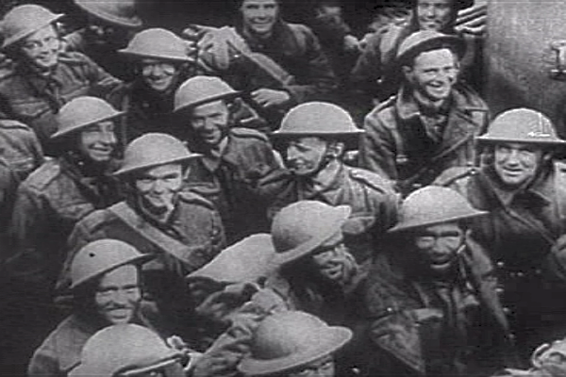
The British Army is evacuated from France, only three weeks after Churchill becomes Prime Minister. June 1940.
Britain managed to extricate most of her forces, minus their equipment, from the beach at Dunkirk. The nation now faced a triumphant Germany with its powerful air force based just across the Channel. Mussolini attempted to broker peace – Chamberlain (still in the Cabinet at this time)and others wavered. Churchill would have none of it, instead ordering the navy to destroy the French fleet at Mers el Kebir. For him, this was total war. He could not allow Hitler control of France’s battleships. Opportunistic, Mussolini’s Italy declared war on Britain on 10 June.
Hitler now turned his attention to the RAF, using the Luftwaffe in an attempt to neutralize it, prior to a possible invasion of Britain itself. Faulty German tactics, a properly integrated air-defence system and a handful of brave fighter pilots frustrated his efforts. It seemed more desperate than it perhaps was: but for Churchill, personifying Britain’s determination to fight on, this was ‘their finest hour’. It was certainly his.
He managed to capture the mood of the country perfectly. His rousing speeches galvanized British morale and convinced the public that they could hold on. His first speech as Prime Minister on 13 May promised ‘blood, toil, tears and sweat’. On 20 August, at the height of the Battle of Britain, he made his immortal remarks about the RAF: ‘Never in the field of human conflict was so much owed by so many to so few’. It might have been scripted beforehand, but that served merely to enhance Churchill’s brilliant delivery.

The Blitz: Churchill visits what remains of Coventry Cathedral.
There was some respite in Africa, where British forces beat back Italian offensives, ejecting Italy entirely from her East African holdings and pushing along the north coast into Libya. This was not to last, as in April 1941 Hitler struck in Yugoslavia and Greece. Churchill agreed to strip the army in North Africa for an expedition across the Mediterranean in support. Once again, a British Army had to be lifted off a beach by the Royal Navy. It got worse: Hitler reinforced the Italians in North Africa and the Axis army under Rommel reversed all of the gains in that theatre.
The personal stress that Churchill bore during this period is difficult to exaggerate. He led a punishing regime, reading and dictating from his bed in the mornings and chairing meetings until late at night. He drank too much, which was hardly surprising. His Cabinet colleagues had insisted on appointing a personal physician and Sir Charles Wilson was to accompany him for the rest of the war. In December 1941 he suffered a minor heart attack. Two years later, pneumonia was to keep him in bed for nearly a month. Not a fit man, and already in his mid-sixties, Churchill was also a heavy drinker and smoker.
Foresight: preparing for a grand alliance
As well as overseeing Britain’s military efforts, Churchill took the lead with much of the diplomacy. His well-known personal correspondence with US President Franklin D. Roosevelt had, in fact, begun during 1939, at Roosevelt’s own instigation. Now Churchill’s ideas for Anglo-American co-operation seemed less romantic, and became a pressing matter for global democracy. His central ambition was to secure American entry into the war. Without the USA, Britain might be able to cling on. With US support, they would beat Germany together. Inch by inch, Churchill and Roosevelt moved closer together, with Roosevelt having to manage the strong tradition of isolationism within American politics. The ‘Destroyers for Bases’ deal of September 1940 was important, but the real landmark came in the more prosaic Lend-Lease agreement made a few months later. Lend Lease gave Britain the credit to buy American supplies and weapons. It was the economic underpinning for her continuing struggle.
Churchill’s efforts to woo the Americans were critical. But he had been active, too, with the Russians. The fact that Britain had cracked German codes in 1940 meant that Churchill was well aware of Hitler’s intention to invade Russia. He warned Stalin repeatedly, notwithstanding which, the Russians were still caught by surprise. Although he loathed Communism, Churchill was always a pragmatist in the field of foreign affairs. Ultimately, he had supported the Russians during the Spanish Civil War, because he felt that Franco’s German-backed regime would be more dangerous for peace in Europe. When Hitler’s panzers struck east in June 1941, Churchill immediately announced aid for Russia. Still desperately fighting for survival, Britain sent two squadrons of frontline fighters to Russia that same August.
Churchill would take any good fortune that came his way. The only objective here was the defeat of Germany. By July 1941, he had buttressed Britain’s war effort by means of deals made with the Americans. The USA was now moving steadily towards war with the Axis. Hitler’s attack on Russia was a bonus. For all her travails and those to come, Churchill was convinced that Britain could now win the war against Germany. By the end of that year, he knew she would.