

As long as Fame’s imperious music rings
Will poets mock it with crowned words august;
And haggard men will clamber to be kings
As long as Glory weighs itself in dust.
ON 2 APRIL the Colonel arrived in Naples, and found that his celebrity in Africa was nothing compared to that awaiting him in Europe. Municipal, ecclesiastical, and military uniforms glowed and glittered. Evidently he was to be treated everywhere as if he were still2 a head of state. He fobbed off several dozen reporters with advance copies of his Sorbonne, Berlin, and Oxford speeches, to hold until delivery, and that night sought refuge at the opera. But his entry precipitated a ten-minute ovation. He saw less3 of Giordani’sAndrea Chénier than of constant visitors to his box, begging to be introduced.
Moving on4 to Rome the following day, Roosevelt managed to clear from his calendar any appointments with Catholic clerics. Cardinal Merry del Val, the Vatican secretary of state, would not back down on the see-no-Methodists condition of a papal audience, while Reverend Ezra Tipple, an American preacher given to calling Pius X “the whore of Babylon,” publicly boasted that the Colonel would at least see him. The comic-strip aspects of this squaring off of two clerics with bibulous names delighted Roosevelt, and gave him the chance to outmaneuver both. He acknowledged the Pope’s right to decline audiences “for any reason that seems good to him,” while claiming the same right for himself. And he canceled an embassy reception that Methodists would have attended, on the grounds of Tipple’s discourtesy toward the Holy Father.
His own tolerance—religious, social, and political—embraced, with humor and an easy response to all cultural challenges, the schedule of engagements that now crowded upon him. He rejoiced5 in the fact that both the mayor of Rome and the Prime Minister of Italy were Jews—“in the Eternal City, in the realm of the Popes, the home of the Ghetto …!”—and treated King Victor Emmanuel III as a fellow scholar, equally well informed on the Savoyard preference of Roman over Lombard law. Flattered, the king held a dinner for him in the Palazzo del Quirinale that had all the trappings of a state function. Roosevelt was unfazed6 at having to sit between Queen Helene, a Montenegrin, and her niece, the Princess Royal of Serbia. Conversing in rough but rapid French, he revealed his command of Balkan history and a lively interest in Slav literature, citing in particular some translations of Romanian folk songs by Carmen Sylva. They were enchanted, and teased him about having a daughter nicknamed “Princess Alice.”

BEFORE THE ROOSEVELTS PROCEEDED with their European tour, they snatched a brief family vacation at Porto Maurizio, on the Italian Riviera. Edith’s unmarried younger sister7, Emily Carow, lived there. She called her home Villa Magna Quies—“house of great quiet”—but its peace was disturbed on 11 April by the arrival of Gifford Pinchot.
Lanky, passionate8, and sad-eyed, the former chief forester had a litany of sins against progressive Republicanism to blame on President Taft. He specifically cited sixteen. In his monomaniacal hostility toward all who would not believe as he did, Pinchot was not unlike Reverend Tipple—except that for him, God was in nature, and man’s duty was to serve the Almighty with practical works: environmental, economic, and social. Physically hard and cold, he had spent his life trying to make himself more so, sleeping on the floor with a woodblock pillow—outdoors, if possible—and getting his valet to douse him every morning with buckets of ice water.
Roosevelt admired the hardness, if not the narrowness that came with it. Pinchot, born to Main Line wealth, had never had to live on equal terms with the “plain people” he invoked so patronizingly. Unmarried at forty-four, he had fathered no children, lost no electoral campaigns, faced no bullets in battle. Roosevelt, in contrast9, had—and in those respects alone was the bigger man. Which probably explained Pinchot’s increasing devotion, now that neither of them held power.
They spent most of that day and evening together. Pinchot got the attention he craved (“One of the best10 & most satisfactory talks with T.R. I ever had”), while Roosevelt pored over a sheaf of disturbing letters from other progressive Republicans. All warned11that some of his most cherished reforms were doomed, unless something was done soon to check the alliance developing between the administration and reactionaries in Congress.
He was more12 impressed by the letters than by their carrier. Perhaps Taft had been right to fire so uncompromising a person. “Gifford is a dear, but he is a fanatic.”
FOUR DAYS LATER13, Roosevelt and Kermit, traveling stag while Edith and Ethel proceeded independently to Paris, arrived in Vienna. A familiar, courtly figure14 awaited them at their hotel: Henry White, whom Taft had so brusquely removed as American ambassador to France. Roosevelt was overjoyed to see him. He had written ahead to ask if White, schooled in the nuances of Old World diplomacy, would consider being at his side in Berlin and London.
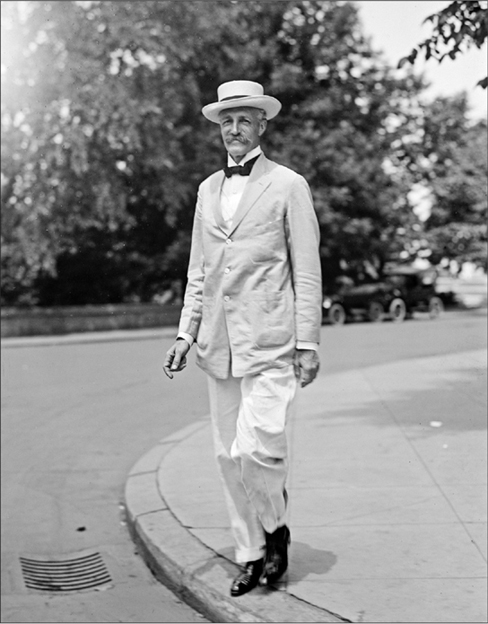
“ ‘GIFFORD IS A DEAR, BUT HE IS A FANATIC.’ ”
Gifford Pinchot, former chief forester of the United States. (photo credit i2.1)
Vienna was a plus. As somebody who had dealt personally with many of the monarchs he was to see during the next month and a half, White would be a useful adviser—particularly on how to handle Wilhelm II, that constant imponderable on the international scene. Roosevelt could look after himself in republican France. He wanted to avoid the danger of becoming an emissary between the four most truculent powers in Europe. No matter how often he protested that he was “merely a private citizen,” he could not ignore the consequences of his presidency, his Nobel Peace Prize, his international circle of acquaintance, and (perhaps most persuasive of all) the publicity glow he generated in motion, like that of the great comet15 currently approaching Venus.
After a reunion16 breakfast, the two men went over to the Hofburg palace at the invitation of Emperor Franz Joseph. White sat in an anteroom while Roosevelt had the disarming experience of being hailed as the embodiment of “the present and future” by an octogenarian who admitted to being “the last representative of the old system.”
Franz Joseph had held Austria and Hungary together, with difficulty, for sixty-one years. He spoke in French17, out of courtesy to the Colonel’s rusty German, and confessed that he was curious to see for himself how somebody so modern “felt and thought.” Roosevelt had detected18 a similar tempora mutantur wistfulness in the conversation of Victor Emmanuel, who seemed resigned to socialistic trends in Italy. Both rulers evidently felt that republicanism would soon be the doom of royalty, in Europe as well as Russia.
Aware that he was gazing for the first time into the eyes of a Habsburg, he was interested, but not awed. The best that could19 be said of the old monarch was that he was “a gentleman”—in Roosevelt’s mind, the highest of social categories. Not so the Emperor’s nephew and heir apparent. Archduke Franz Ferdinand struck him as “a furious reactionary in every way, political and ecclesiastical both.”
Meeting later20 with the Austrian Prime Minister, Richard von Bienerth, and Baron Alois von Aehrenthal, minister of foreign affairs, Roosevelt felt more at home. They were statesmen like himself, well-born Realpolitikers, executives of driving force. Yet he sensed a strategic insecurity in their conversation, not unlike that of condominium officials in Egypt. They clearly relied on Germany to hold their multicultural empire together. At the same time21, they were worried about German disapproval of Austria-Hungary’s recent annexation of Bosnia-Herzegovina (the hyphens alone betrayed the looseness of the overall structure), not to mention calls for revenge in Russia and Serbia, likely allies in any Balkan war. Germany’s fear of such an imbroglio was understandable: if Russia marched to Serbia’s aid, the Reich was treaty-bound to defend Austria-Hungary.
Roosevelt repeated22 to Bienerth a prophecy he had heard from the Duke of Abruzzi in Rome, that two great wars were certain: one between Great Britain and Germany, and another between the United States and Japan. He said he personally doubted the latter, as long as his government kept up a strong defense, and fortified Hawaii and the Panama Canal.
For the next thirty-six23 hours, he had to submit to the same quasi-royal honors that had at first amused, then exasperated him in Italy. Trumpets blared, swords and rifles clashed, and crowds blocked every street and square as he moved from the sixteenth-century Spanische Hofreitschule, through the Jockey Club to a medieval country castle, and finally to Schönbrunn Palace. He tried without success to make his hosts understand that he was no longer President of the United States. The non-republican mind, it seemed, could not conceive of sovereignty as finite.
Surrounded by flunkeys, guarded wherever he went, Roosevelt was screened off from the extraordinary changes occurring at lower levels of Viennese society—changes more radical than anywhere else in Europe, and coincident with Austria-Hungary’s thrust into the Balkans. He did not see24 the pornographic nudes of Klimt and Schiele, Kokoschka’s explosive studies of angst-filled burghers, the rectilinear architecture of the Secessionists. He was deaf to the atonality of Schönberg and the warnings of local poets and playwrights that an apocalypse was coming.
All he knew25, as he attended a dinner in his honor at Schönbrunn Palace, was that he had chosen the right country to be born in. Halfway through the banquet26, he watched aghast as Franz Joseph and fellow guests performed an ablution dating back to the days of Maria Theresia. Finger bowls were brought in, each with a small glass of water, and the flower of Habsburg aristocracy proceeded to swig, rinse, and spit.
These people, Roosevelt realized, were not merely old-fashioned, but “living in a world as remote from mine as if it had been France before the revolution.”
REMOTER STILL WAS that of the Magyar oligarchy in Hungary, where Serbs and Slovaks were suppressed with such discrimination that only one citizen in twenty could vote.
Roosevelt was met27 at the border by Count Albert Apponyi, an old patriot resentful of the “Dual Monarchy” linking royal Budapest to imperial Vienna. He noticed28, as he and Kermit rode to Apponyi’s castle for lunch, that each village they passed through had a separate ethnic identity: either Slav, or Magyar, or Teuton. It was Sunday morning, 22 April. Catholic and Protestant churches disgorged their separate congregations.
Multicultural himself29, he flabbergasted Apponyi with a long, almost verbatim quotation from a Magyar saga, which he said he had not thought of in twenty years. Proceeding after dark to Budapest, where thousands welcomed him in heavy rain, he scrupulously alluded to Franz Joseph as their “king,” not their emperor. Next morning, he made an extempore address30 to the mostly Magyar members of parliament. He pretended to be surprised when they reacted in ecstasy to his rapid-fire citations of Árpád, St. Stephen, Mátyás Corvin, the Golden Bull, the Battle of Mohács, the Bogomil heresy, and other episodes from Hungary’s history. He was, of course, showing off, in a way that would have made Edith Roosevelt cringe, had she been there. But his audience had never heard a foreign statesman express such understanding of them.
Twenty-four hours later, after a round of visits to ambassadors and state officials, Roosevelt was accorded the greatest popular demonstration seen in Budapest since the return of Franz Liszt in 1846. His carriage had to force31 its way through well-wishers along the esplanade. Cheers pursued him into his hotel until he reemerged to make a speech of thanks. It was translated line by line into Magyar. Cal O’Laughlin, standing by, reported: “With every expression there was a shout which rolled over the berg across the river and came back in a thundering echo. I have seen many demonstrations, but that one by the Danube has not been surpassed in my experience.”
BY THE TIME ROOSEVELT reached Paris on the twenty-first, it was apparent that he was the most famous man in the world32. In their respective sovereignties, the Kaiser, King Edward VII, and the Tsar of Russia might be better known, but none had his democratic appeal, nor his press appeal across three continents. “When he appears33, the windows shake for three miles around,” one overawed correspondent wrote. “He has the gift, nay the genius of being sensational.”
He knew enough of fame not to expect it to last. But with seven kingdoms still to visit, and reports of a massive homecoming being planned for him in New York, he had to brace himself for more and more adulation. “Like the elder34 Mr. Weller’s Thanksgiving turkey,” he joked to Robert Bacon, the American ambassador waiting to greet him at the Gare de Lyon, “I am old and tough and I will be all right for everything.”
Jules Jusserand, Bacon’s opposite number in Washington, was also on the platform. Roosevelt adored the spry little diplomat, a medieval scholar and veteran of his White House “Tennis Cabinet.” It had been Jusserand’s idea to have him address the Sorbonne. Both ambassadors35 had been working for some months to balance their desire to have him meet France’s political elite, and his preference for the society of intellectuals. As a result, his calendar for the next week juxtaposed the names of President Armand Fallières, Prime Minister Aristide Briand, Foreign Minister Stéphen Pichon, the Radical leader Georges Clemenceau, and other public men with those of Edith Wharton, Auguste Rodin, the historians Victor Bérard and Pierre de La Gorce, and a brace of literary barons, Paul d’Estournelles de Constant and Pierre de Coubertin.
En route to the Sorbonne on Saturday, 23 April, Roosevelt stopped off to thank officers of the Académie de Sciences Morales et Politiques for electing him an associate member. He did so in French, apologizing for his abuse of the language of Voltaire. “Quand on parle36 français, on manie l’instrument le plus précis et le plus éclair qui existe.”*
Shortly before three37 o’clock he entered the grand amphitheater of the university to a standing ovation. Jusserand had seen to it that he was flanked onstage by representatives of the French Institute’s five academies: Arts, Letters, Sciences, Belles Lettres, and finally the Académie Française itself, represented by eleven green-robed immortels. Elsewhere sat ministers in court dress, army and navy officers in full uniform, nine hundred students, and an audience of two thousand ticket holders. The vice-rector of the Sorbonne announced that the greatest voice of the New World was about to speak. Turning to Roosevelt, he said, “Vous unissez le moral à la politique et le droit à la force.”*
No thirteen words could have better proved the Colonel’s linguistic point, made just an hour earlier. He stuck to English, with the help of an interpreter, as he proceeded to read38 his long oration, entitled “Citizenship in a Republic.”
Acknowledging the right of the French to be proud of their old and sophisticated civilization, he made no apology for the relative rawness of his own. He boasted that the first Roosevelts in New Amsterdam had fought off hostile Indians and lived on equal terms with “traders, plowmen, woodchoppers, and fisherfolk.” This somewhat rusticated his family’s urban history. But he sought to emphasize that “primeval conditions must be met by primeval qualities” before a nation could think of becoming a republic. Even after it did, it was likely to exhibit “all the defects of an intense individualism” for a century or so. The “materialism” of contemporary industrial America was simply the pioneer spirit redux.
Politically, however, the United States and France were of mutual stature. Sister republics in a world of Empire, they represented “the most gigantic of all possible social experiments,” that of perfecting democratic rule. They were not dependent on the excellence, or incompetence, of hereditary monarchs; they must rely on the quality of the average citizen.
And on his fertility too. With a directness probably not heard at the Sorbonne in a century, except in lectures on anthropology, Roosevelt declared: “The chief of blessings for any nation is that it shall leave its seed to inherit the land.” France (he did not need to name her in this connection: her falling birthrate was well-known fact) had to fight “the curse of sterility.” She must breed soldiers to protect her and assert her rights.
This touched on39 France’s other neurosis: fear of conquest by a Germany expansive on land and at sea. War, he granted, was “a dreadful thing.” But shrinking from it when it loomed was worse. “The question must be, ‘Is right to prevail?’ … And the answer from a strong and virile people must be, ‘Yes,’ whatever the cost.”
Roosevelt bit off40 every word as was his habit, with snapping teeth and wreathing lips. Spectators in the farthest recesses of the hall could feel the force of his opinions even before the interpreter translated them. Their ears, attuned to the mercurial flow of French speech, had to adjust to his raspy, jerky delivery (accompanied by smacks of right fist into left palm) and the strange falsetto he used for extra emphasis. Nothing could be less mielleux. But his foreignness excused him, and won repeated applause.
The loudest came when he attacked skeptics “of lettered leisure” who, cloistered in academe, “sneered” at anyone trying to make the real world better.
It is not the critic41 who counts; not the man who points out how the strong man stumbles, or where the doer of deeds could have done them better. The credit belongs to the man who is actually in the arena, whose face is marred by dust and sweat and blood; who strives valiantly; who errs, and comes short again and again, because there is no effort without error and shortcoming; but who does actually strive to do the deeds; who knows the great enthusiasms, the great devotions; who spends himself in a worthy cause; who at the best knows in the end the triumph of high achievement, and who at the worst, if he fails, at least fails while daring greatly, so that his place shall never be with those cold and timid souls who know neither victory nor defeat.
IF ONLY BECAUSE ROOSEVELT clearly identified himself with the man in the arena, he had scored one of his greatest rhetorical triumphs42. The Journal des Débats printed the speech as a special Sunday supplement, declaring that nobody who heard it could help being “attracted, seduced, disoriented, and conquered.” Le Temps sent copies to every schoolteacher in France. Royalist as well as republican commentators praised it as a call for centralized authority over Marxist sedition. Military patriots rejoiced in the Colonel’s moralization of war.
Only two43 chauvinistic journals, L’Éclair and La Patrie, sneered at him for uttering American banalities. That did not stop Librairie Hachette from issuing a luxury reprint of his address on Japanese vellum. A popular pocket-book edition sold five thousand copies in five days. Translations appeared in many European cities, while the original text became known to British and American readers simply as “The Man in the Arena.” Roosevelt was surprised at its success, admitting to Henry Cabot Lodge that the reaction of the French was “a little difficult for me to understand.”
He wanted to44 spend 27 April, his last day in town, sightseeing with Edith. But Jusserand informed him that the German Emperor was planning “a big review” in his honor. France would “take it amiss” if he did not recognize her, too, as a great military power. Roosevelt saw that the ambassador was upset, and agreed to watch troops stage a mimic battle at Vincennes.
Command headquarters of the French army, the castle glittered with national pride—or what was left of pride, besmirched by the conspiracism and antisemitism of l’affaire Dreyfus. For two and a quarter hours45 that morning, Roosevelt sat on horseback as cannons boomed and blank bullets rattled. The action was fought at double-quick pace, to accommodate his schedule. He could have been viewing a Pathé newsreel, yet in color and with sound. Across the vast field beyond the garrison, relays of infantry charged. Cavalry forces engaged them in rearguard action. At the end of each rush, machine guns spat fire.
NEXT DAY, THE COLONEL and his entourage (now including Cal O’Laughlin as a press spokesman, and two aides46, Lawrence Abbott and Frank Harper, courtesy of The Outlook) reentered the world of monarchy. They traveled east47 via Brussels, where they were received by King Albert and Queen Elizabeth of Belgium. The huge, awkward young ruler endeared himself to Roosevelt with his “excellent manners and not a touch of pretension.” Queen Wilhelmina of Holland repelled him with exactly the opposite combination. He thought her “not only commonplace, but common … a real little Dutch middle-class frau.”
A sobering display48 of German naval might greeted him when he transferred to a Danish steamer at Kiel on the morning of 2 May. He was en route to Norway, and would not properly enter the Reich for another week. Even so, the dreadnoughts and battle cruisers cramming Kiel’s inner fjord presented their great guns, and rank upon rank of sailors saluted him as he cruised out of the harbor.
From where he stood on the steamer’s bridge, he could glimpse the entrance to Kaiser Wilhelm Canal, crossing the Jutland peninsula. A miniature of his own project in Panama, it showed signs of ominous enlargement49. Those dreadnoughts would soon have no problem moving between the Baltic and the North Sea.
Denmark opened out to port: flat, fertile, easily conquerable. King Frederick VIII50 was unavailable to greet the Roosevelts in Copenhagen, being out of the country on vacation. But by royal command, they were put up at the palace, and entertained by Crown Prince Christian. Roosevelt was informed that the last occupant of their suite had been the King of England, whom he might or might not be seeing later in the month.
According to news reports, Edward VII was not at all well.
They journeyed on to Christiania by night train, arriving there at noon on 4 May. Again they received a royal welcome. King Haakon VII and Queen Maud were on hand at the station, more palace accommodations provided, and the inevitable state banquet loomed.
Norway, despite its energetic attempt at pomp and circumstance, looked to Roosevelt “as funny a kingdom51 as was ever imagined outside of opéra bouffe.” Crowds lining the streets cheered with a peculiar barking sound. The royal family was palpably bourgeois: “It is much as if Vermont should offhand try the experiment of having a king.” However, given the inability of Europeans to think of continuity except in terms of heredity, he had to admire the way Norway had democratized its monarchy.
On the following day, he braced himself for a round of academic exercises in honor of his Nobel Peace Prize. He did so without enthusiasm, resentful of pressure from Andrew Carnegie to make a speech pleading for arms control, prior to lobbying the Kaiser. The pesky little millionaire52 (“Here is what I should say to His Imperial Majesty, were I in your place”), then expected to be invited to a follow-up disarmament conference in London—as a return, presumably, for financing Roosevelt’s safari.
Christiania was53 the obvious forum for a condemnation of the Anglo-German naval race, which vied with the Balkan situation as a likely cause of Europe’s next war. But what Roosevelt had seen of uneasy peace in North Africa, fractious peace in Austria-Hungary, and resentful peace in France had revived his old doubts about “the whole Hague idea of talking away conflicts that had to happen.”
In addition, he had developed a case of bronchitis. It was too late, though, for him to wheeze regrets. Christiania was bedecked with flags and evergreens. Long before he arrived at the National Theater, where the Nobel Committee awaited him, all 1,800 seats were taken by eager members of the public.
Roosevelt’s oration54 was understandably brief and hard to hear. It drew little applause. He thanked the Committee for honoring him, and said he had dedicated his prize money to a foundation, not yet active, that would help resolve major labor disputes. “For in our complex industrial civilization of today, the peace of righteousness and justice—the only kind of peace worth having—is at least as necessary in the industrial world as it is among nations.”
This was not the kind of peace Carnegie, or the Committee, hoped he would salute. When he did raise the subject of the naval arms race, he said only that “something should be done as soon as possible” to check it. He gave conditional55 support to the idea of arbitration treaties between powers “civilized” enough to hate war, and was prepared to believe that a Third Hague Conference might improve on the First and the Second. Finally he said something unequivocal. “It would be a master stroke if those great Powers honestly bent on peace would form a League of Peace, not only to keep the peace among themselves, but to prevent, by force if necessary, its being broken by others.”
The idea was arresting, if hardly new. It went back to Hugo Grotius’s “Society of States” linked by one law. Even the phrase “League of Peace” had been used before, by the British statesman Sir Henry Campbell-Bannerman. But Roosevelt gave it an original twist by warning that such a body would count for nothing if it did not have punitive, as well as judicial, authority. The impotence of the permanent court of arbitration at The Hague tribunal was a case in point. World peace, in his opinion, could be effected only by a concert of mature nations exercising “international police power.”56 He repeated the words police and power, as well as force and violence, three times each before sitting down.
Carnegie, disgusted, gave up all faith that the Colonel would serve as his personal peace envoy at Potsdam. “There’s a trace of the savage,”57 he wrote, “in that original compound.”
THE NEXT ROYAL PERSON to greet Roosevelt, at Stockholm’s Central Station early on the morning of 7 May, was Crown Prince William. He had news that threw into disarray all the future plans and protocol Lawrence Abbott had been working on. King Edward VII had died of pneumonia during the night.
Coughing and feverish58 himself, Roosevelt was relieved to have an excuse to shorten his stay in Sweden. Five weeks of being the most famous man in the world had been enough for him. He was happy to cede his title to a corpse, and did not care if he never stayed in another palace with European plumbing.
He sent a telegram59 to Berlin, asking if the Kaiser—King Edward’s nephew—might “in view of the circumstances” like to withdraw his gracious offer of accommodations in the Royal Castle. Word came back that the German court had gone into official mourning. His Majesty, however, looked forward to entertaining Colonel Roosevelt privately, and to riding with him at the military exercises in Döberitz Field. After that, Wilhelm would leave for Great Britain, to attend the royal funeral. So would almost every other head of state and government leader on the Continent. The exact date of the ceremony would not be announced for several days. Only then could Roosevelt decide what to do about his own British engagements.
Meanwhile, there hung in the sky over Europe, fading slightly in the light of dawn, the immense apparition of Halley’s Comet. It had shone60 with peculiar radiance in the small hours just after Edward died.
THE FIRST THING61 Roosevelt noticed, when his train reentered Germany on Monday, 9 May 1910, was the smallness of the crowds at every railway station. Some depots offered no welcome at all. Throughout every country he had traversed so far, he had been greeted “not as a king, but as something more than a king”—to quote one reporter in his entourage. Here, people who bothered to notice him at all were at best civil.
It was not dislike that showed on their faces, so much as lack of interest. They stolidly believed that Germany was the foremost nation62 in Europe, and would soon eclipse Britain as the world’s dominant power. To them, Theodore Roosevelt represented a republic of inferior culture, distant, disorganized, racially inchoate. Their press was free, their educational system unsurpassed, their economy explosive, their social security the envy of other states. They had the strongest army on earth, and the second strongest navy. How long could Britain—with aging, inefficient factories, acute class conflict, and twenty-one million fewer citizens—afford to keep ahead of the Kaiserreich in battleship construction?
Germany’s fields and forests63 were beautifully tended, its towns clean, its roads and rails smooth, its factories new and thrumming with energy. There were no equivalents of the peasant hovels of Hungary and Belgium, the slums of Italy, the trash heaps and hideous advertising that blighted the American scene. Neat shops and markets bulged with produce. The efficient movement of traffic in the streets, obedient to every police signal, bespoke a national desire for order and discipline. This was plainly a country where everything worked.
Except, to Roosevelt’s amusement, the timing and choice of terminus for his arrival in Berlin. There was a frenzied scurrying64 of imperial officials before he was apologetically received at Stettiner Bahnhof at 9:15 A.M. on Tuesday. They said that the Kaiser would have been present if protocol had not confined him to Potsdam. His Majesty expected the whole Roosevelt family there at noon.
Checking in first at the American Embassy, Roosevelt sprayed his bronchi and prepared to meet a ruler he felt he had gotten to know almost personally as president. The prospect was not intimidating. Wilhelm II in 191065 was no longer the most dangerous man on the international scene. Two years earlier66, he had come close to abdicating, after boasting too frankly about the German naval program to a British reporter. Since then, he had been further embarrassed by a homosexual scandal involving his circle of intimates. The hushed-up details were lurid enough for Wilhelm to remain in dread of the oligarchy of generals, admirals, and professors who held real power in Germany.
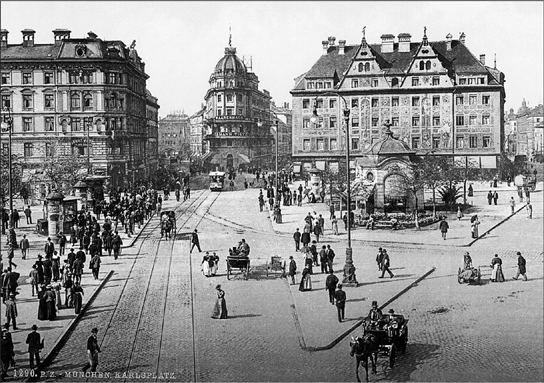
“THEY STOLIDLY BELIEVED THAT GERMANY WAS THE FOREMOST NATION IN EUROPE.”
The Reich around the time of Roosevelt’s visit. (photo credit i2.2)
Fortunately for him, those Prussians were archtraditionalists, devoted to Hohenzollern rule. They thought of him as their homeland king, more than they cared about him being emperor of the multipartite Reich, which had yet to celebrate its fortieth anniversary. And he ( a fantasist of Münchausian dimensions67) saw himself as Frederick the Great reincarnated, with his love of male society, his need for performance art, and his obsession with military display.
He received the Roosevelts outside Frederick’s Neue Palais, wearing the white-and-gold tunic of the Garde du Corps and a brass helmet, on which rode a silver spread eagle. Removed, the helmet revealed gray hair fast turning to white. At forty-nine the Kaiser was still, with his slate-blue eyes and erectile mustache, a transfixing figure—even if some of the fixity was provoked by his too-small left arm, cramped by forceps at birth.
Were it not68 for that deformity, and the laughable contrast between his finery and Roosevelt’s black frock coat and top hat, the two men were alike enough to be brothers. They were the same height at five feet nine, the same weight at two hundred–odd pounds, and both hyperenergetic, with punchy gestures and body-shaking laughs. Their diction was clipped (the Kaiser spoke flawless English) and their talk torrential. But whereas Roosevelt was a careful listener and responder, Wilhelm heard little. He deviated in all directions, not out of evasiveness, but instability.
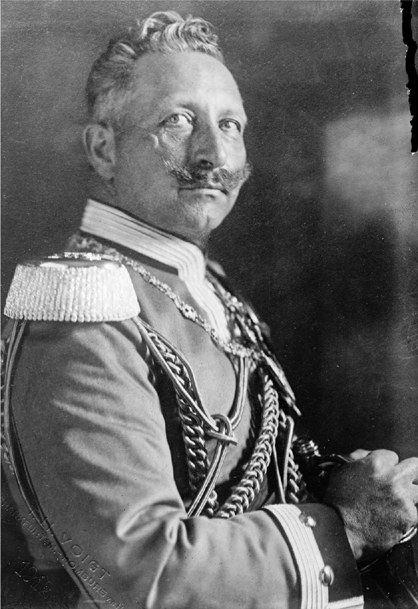
“HE … SINCERELY BELIEVED HIMSELF TO BE A DEMI-GOD.”
Wilhelm II, Emperor of Germany, ca. 1910. (photo credit i2.3)
They sat apart during lunch in the Jasper Room, doing duty with each other’s wives. Elsewhere around the six small tables, Kermit and Ethel followed suit with diplomats and government officials, including Chancellor Theobald von Bethmann-Hollweg. When the party adjourned to the Shell Room, Wilhelm and Roosevelt began a marathon conversation. They stood face-to-face69 under corals and iridescent coquilles, taking no notice when their aides consulted pocket watches.
Reporting afterward70 to the British historian Sir George Otto Trevelyan, Roosevelt wrote that he found the Kaiser affable and modest, and more humorous than most Prussians—although the humor turned to pomposity when Wilhelm was quizzed on subjects that he did not understand, “such as matters artistic and scientific.” Military, economic, and social affairs found them both on equal ground, as did the “fundamentals of domestic morality.” But Wilhelm would not go as far as Roosevelt in applying those fundamentals to foreign policy.
At least we agreed71 in a cordial dislike of shams and of pretense, and therefore in a cordial dislike of the kind of washy movement for international peace with which Carnegie’s name has become so closely associated.…
I said to the Emperor that it seemed to me that a war between England and Germany would be an unspeakable calamity. He answered eagerly that he quite agreed with me, that such a war he regarded as unthinkable; and he continued, “I was brought up in England, very largely; I feel myself partly an Englishman. Next to Germany I care more for England than for any other country.” Then with intense emphasis, “I ADORE ENGLAND!”
Roosevelt asked72 about the possibility of a moratorium in the Anglo-German arms race. Wilhelm at once stiffened, saying there was no point in discussing it. Germany “was bound to be powerful on the ocean.” However, with his immense army, he was happy to let the Royal Navy maintain a strategic edge at sea. But English politicians must stop demonizing Germans as people bent on war.
This sounded reasonable73 enough to Roosevelt, and confirmed his impression that neither the Kaiser nor Bethmann-Hollweg had designs across the Channel. Wilhelm seemed much more concerned about the “Yellow Peril” of Japanese expansionism. “This I was rather glad to see, because I have always felt that it would be a serious situation if Germany, the only white power as well organized as Japan, should strike hands with Japan. The thing that prevents it is Germany’s desire to stand well with Russia.”
BY THE TIME74 the Colonel got back to Berlin that night, his voice was completely gone. He was diagnosed with laryngitis on top of bronchitis, and begged off a dinner in his honor. But before he could retire, a cable from the White House removed all doubts about his future itinerary:
ROOSEVELT CARE AMERICAN EMBASSY BERLIN77
I SHOULD BE GLAD IF YOU WOULD ACT AS SPECIAL AMBASSADOR TO REPRESENT THE UNITED STATES AT THE FUNERAL OF KING EDWARD VII. I AM SURE THAT THE ENGLISH PEOPLE WILL BE HIGHLY GRATIFIED AT YOUR PRESENCE IN THIS CAPACITY AND THAT OUR PEOPLE WILL STRONGLY APPROVE IT. HAVE AS YET RECEIVED NO OFFICIAL NOTICE OF THE DATE OF FUNERAL BUT IT IS REPORTED THAT IT WILL TAKE PLACE ON THE 20TH OF THIS MONTH. PLEASE ANSWER.
WILLIAM H. TAFT
He cabled75 back, “Accept,” and went to bed.
MORE VOCAL WEAR76 and tear threatened in the morning, when a yellow imperial limousine came to transport him to Döberitz Field for the army exercises. The Kaiser awaited him, resplendent in blue and gold. Roosevelt’s slouch hat and khaki riding suit looked dingy in contrast. Henry White stood discreetly by, ready to mediate if needed.
“Roosevelt, mein Freund, I wish to welcome you in the presence of my guards,” Wilhelm said, as the three men climbed onto their horses. “I ask you to remember that you are the only private citizen who ever reviewed the troops of Germany.”
Roosevelt knew this78 was not true. General Leonard Wood, his old colleague from Cuba days, had been accorded the same courtesy in 1902, albeit as a senior officer of the U.S. Army. Perhaps Wilhelm was emphasizing the word private. But there was more to bother a foreign visitor, now, than semantics. The maneuvers he witnessed for the next five hours both amazed and depressed him. Five cavalry, six infantry, and four artillery regiments engaged in a clash of arms that made the charges at Vincennes look puny in comparison. Then the whole force split into two armies, each commanded by a Hohenzollern prince, and collided again. Battle conditions prevailed, with no hint of “game” playing, even when all three thousand troops marched past at the end, goose-stepping in salute to the Kaiser.
Lifting his hat79 every time Wilhelm touched his helmet, Roosevelt mantained a genial façade, but was aware only of the vast difference between himself and his host. It was not simply that the Kaiser held power, while he had none, nor the obvious fact that they were king and commoner. It was that he, self-made, had an integrated point of view, whereas Wilhelm personified the classic German neurosis of the Doppelgänger. Born to power, but also to disability, the Kaiser had “a sort of double-barreled perspective” on everything. One self—the imperial—surveyed the passing troops, exulting in supreme command. The other self—Wilhelm’s “mental ghost”—had ridden some way off, and was observing the whole scene with a quizzical detachment. Of the two, man and ghost, the former was the more disturbing to Roosevelt. “He was actually, as far as I could discover, one of the last of those curious creatures who sincerely believed himself to be a demi-god.”
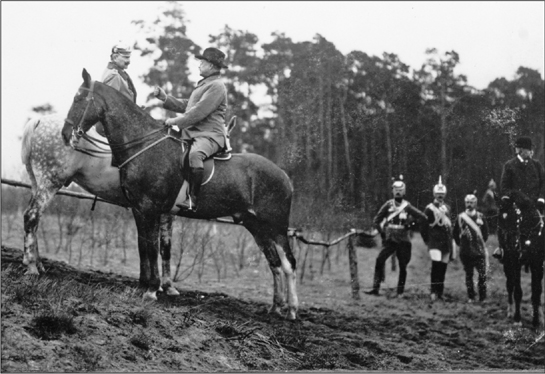
“THE COLONEL OF THE ROUGH RIDERS LECTURING THE CHIEF OF THE GERMAN ARMY.”
Wilhelm II’s caption to this photograph of himself and Roosevelt at Döberitz. (photo credit i2.4)
When Edith saw80 her husband alone, late in the day, she got the feeling that he had undergone an epiphany. “I’m absolutely certain now, that we’re all in for it,” he told her. “Facts and figures … aren’t half so convincing as the direct scrutiny of a thing—especially such a monstrous thing as this!”
HE RECOVERED81 HIS CHEERFULNESS overnight, along with much of his voice. This encouraged him to address the University of Berlin in person, dispensing with the offer of a substitute reader. The proceedings in the Aula auditorium amounted to a Germanic replay of those at the Sorbonne, only now, Roosevelt was made a Doktor of philosophy, and spoke with an emperor smiling and nodding at his feet.
Wilhelm had never82 visited the university before, so the atmosphere was stiff. Five jackbooted commanders of the student army corps stood immobile on the platform, swords drawn, throughout Roosevelt’s eight-thousand-word speech. He gave it in English, but in view of its length it was untranslated, and received in a heavy silence. Defining his theme as “The World Movement,” he began with a hoarse preamble on the rise and fall of civilizations. Germans, he said, had developed early as “castle-builders, city-founders, road-makers.” They had turned back waves of barbaric invaders from the East, and helped Christianize Danes and Magyars and Slavs. He made much of the day when “the great house of Hohenzollern83 rose, the house which has at last seen Germany spring into a commanding position in the very forefront of the nations of mankind.”
Roosevelt had learned as president that the Kaiser needed praise as much as oxygen, so he kept invoking imperial values as he went on. But when he remarked on the longevity of some cultures, as opposed to others that died, he used one of Wilhelm’s least favorite words, dropping it like acid into the balm of his previous flattery. “Those ideas and influences in our lives which we can consciously trace back at all are in the great majority of instances to be traced to the Jew, the Greek, and the Roman.”
Nor was he finished:
The case of the Jew84 was quite exceptional. His was a small nation, of little more consequence than the sister nations of Moab and Damascus … [yet] he survived, while all his fellows died. In the spiritual domain he contributed a religion which has been the most potent of all factors in its effect on the subsequent history of mankind; but none of his other contributions compare with the legacies left us by the Greek and the Roman.
The last statement, at least, was calculated to get the Kaiser’s head nodding again. Roosevelt swung into his main argument, which was that the spread of Greco-Roman culture across half the globe presaged the “world movement” now known as Western civilization. He listed the main85 features of European history since the invention of printing, in such primer-like fashion that scholars in the audience—many of whom had spent their careers studying the complexities of each—listened with expressions ranging from surprise to bemusement. Those who could understand English did not know whether they were being patronized, or merely disregarded by this species of genus Americanus egotisticus86. Roosevelt certainly seemed to care little for the Kaiser’s racial phobias:
Here and there, instances occur where … an alien people is profoundly and radically changed by the mere impact of Western civilization. The most extraordinary instance of this, of course, is Japan; for Japan’s growth and change during the last half-century has been in many ways the most striking phenomenon of all history. Intensely proud … intensely loyal to certain of her past traditions, she has yet with a single effort wrenched herself free from all hampering ancient ties, and with a bound has taken her place among the leading civilized nations of mankind.
So much for the Yellow Peril. Roosevelt went on to suggest that the best aspirations of all modern cultures were connected, as never before, by a web of global communications. “The bonds are sometimes those of hatred rather than love, but they are bonds nevertheless.”
As at the Sorbonne, he spoke too long, and equivocated too often. So the most cautionary part of his address, a reminder that the world’s new inter-connectedness could just as easily bring about its destruction, lulled more than it alarmed:
Forces for good and forces for evil are everywhere evident, each acting with a hundred- or a thousand-fold the intensity with which it acted in former ages. Over the whole earth the swing of the pendulum grows more and more rapid, the mainspring coils and spreads at a rate constantly quickening, the whole world movement is of constantly accelerating velocity.…
The machinery is so highly geared, the tension and strain are so great, the effort and the output have alike so increased, that there is cause to dread the ruin that would come from any great accident, from any breakdown, and also the ruin that may come from the mere wearing out of the machine itself.
But it was a warm afternoon87, and the auditorium was stuffy. Here and there, grayheaded professors slept.
ROOSEVELT’S BERLIN UNIVERSITY ADDRESS was even less of a success than his speech in Christiania. Local newspapers gave it scant attention88. Nevertheless, he enjoyed substantive interviews89 over the next two days with many eminent Berliners, from Bethmann-Hollweg and Admiral Alfred von Tirpitz to the aeronaut Count Zeppelin and the wildlife photographer C. G. Schillings. The German he had learned as a teenager in Dresden came back to him, and he had no difficulty making himself understood.
Back at the embassy, he was tickled to receive a set of photographs90 of himself and the Kaiser conversing at Döberitz. Each print was annotated on the back by Wilhelm, with heavy Prussian humor:
The Colonel of the Rough Riders lecturing the Chief of the German Army
A piece of good advice: “Carnegie is an old Peace bore”
The German and Anglo Saxon Races combined will keep the world in order!
Just before he left for London, an emissary came to ask if he would mind returning the pictures. Clearly, someone in the imperial suite dreaded that they might be published. But Roosevelt could already see them framed in glass, front and back, on display at his home in Oyster Bay.
“Oh, no,”91 he said. “His Majesty the Kaiser gave the photographs to me and I propose to retain them.”
* “When one speaks French, one handles the clearest and most precise instrument that exists.”
* “You unite morality with politics, and right with might.”