

The man Flammonde, from God knows where,
With firm address and foreign air,
With news of nations in his talk
And something royal in his walk,
With glint of iron in his eyes,
But never doubt, nor yet surprise,
Appeared, and stayed, and held his head
As one with kings accredited.
ROOSEVELT EMERGED2 FROM his train at London’s Victoria Station early on Monday, 16 May, with a band of black crape round his silk topper and another band around his left coat sleeve. A solemn and silver-bearded gentleman bade him welcome. It was Whitelaw Reid, whom five years before he had appointed American ambassador to the Court of St. James’s. Another familiar figure pushed forward, lean, long-faced, unmistakably English: his old friend Arthur Lee, M.P. Both men were wealthy, with stately homes in the country, and both were competing to introduce Roosevelt to the ne plus ultra of British society.
Reid had won3 the first round, since protocol demanded that the special ambassador stay in his official residence, Dorchester House. But Roosevelt planned to escape from that gilded prison as soon as the funeral obsequies were over. He preferred the self-effacing Lee to Reid, who, like so many former press barons, was inclined to be pompous.
For the next six or seven days, he had to behave with extreme formality. He was assigned a royal carriage, a military attaché, two British aides-de-camp, six grenadier guards, and even a bugler, to herald his comings and goings. Reid explained that he must make calls at all the noble houses and ranking embassies in London, and be at home when his calls were returned. He should be particularly solicitous toward the monarchs and ministers who had entertained him in Europe. On Thursday, he would take his place among the grandest of these grandees at a pre-funeral banquet in Buckingham Palace, and on Friday, join them in following Edward VII’s cortège to Windsor Castle.
Although his special status would lapse after that, Roosevelt found himself committed to a packed schedule of interviews, reunions, lunches, teas, and dinners that would fill his every waking hour for the next three weeks. In short, he would see little of Edith and even less of his children. In view of Kermit’s apparent resolve to mourn Edward in a panama hat, that was probably just as well.
First of all, homage had to be paid to the new king. Roosevelt breakfasted at the embassy, then proceeded with Reid to Marlborough House, where George V awaited them.
His Majesty turned4 out to be a fortyish retired naval officer, simple and unaffected in manner. He thanked Roosevelt for making a salutary speech at Cairo University, and wondered if “something of the kind, but stronger,” could be said in London. Roosevelt offered to do so at a reception planned for him in the Guildhall, at the end of the month. But it would be necessary to get the approval of Sir Edward Grey, the British foreign secretary. The King gratefully kept talking for almost an hour, and introduced him to Queen Mary and other members of the royal family.
Roosevelt’s laryngitis was still bad enough that he spoke with occasional gasps. For the first time in his life he obeyed a royal command, and went to Edward VII’s personal throat doctor5 for treatment. As a result, he was hard-pressed6 to make his appointments with other heads of state before lunch.
His “at home” sojourn that afternoon offered little respite. No sooner had he climbed Reid’s marble stairway to deal with his correspondence than a footman portentously announced, “The King of Norway is below, sir.”
Roosevelt threw down his pen in mock annoyance. “Confound these kings;7 will they never let me alone!”

HIS LAST VISITOR of the day was royalty of another sort. If Alice Roosevelt Longworth was no longer, at twenty-six, the scintillating “Princess Alice” she had been before her marriage, she had matured into a more complex, richly eccentric personality. Always exquisitely dressed, in rembrandt hats and fabrics that complemented her long-lashed, amethyst eyes, she now sported a cigarette holder, and knew just when to wave it, as she smokily discharged one of her patented sarcasms. In contrast to her sedate half sister, Alice was a born socialite, happiest under the chandeliers of the very rich. However, she also had a yen for rough, male political parlors—as her father had, in that never-mentioned period when he was married to the original Alice.
She floated into8 Dorchester House an hour before midnight, fresh from a transatlantic steamer, bringing a gale of Washington gossip with her. Alice’s chat amounted to primary information, for she was a favorite of President Taft, and the wife of one of his closest associates, Congressman Nicholas Longworth of Cincinnati. She clearly saw that her father’s return home was going to cause a crisis of leadership in the Republican Party. At all costs he must stay aloof from politics—unless in his heart he wanted to be president again. Alice certainly wanted that in her heart. She had buried what she called “a voodoo”9 in the White House garden.

“A BORN SOCIALITE, HAPPIEST UNDER THE CHANDELIERS OF THE VERY RICH.”
Alice Roosevelt Longworth, ca. 1910. (photo credit i3.1)
FOR THE REST OF THE WEEK Roosevelt went about his business, while hundreds of other envoys fulfilled similar obligations. Name after titled name crowded his calendar: the Princess Royal, the Duke and Duchess of Connaught, King George of Greece, Prince and Princess Christian, the Duke of Norfolk, Princess Henry of Battenberg, the Marquess of Londonderry, the Duchess of Argyll, Lords Lansdowne, Clarendon, and Cromer. More to his taste was an interview with Sir Edward Grey—“one of the finest fellows10 I ever met.”
Emerging one morning11 from Buckingham Palace with Henry White, he was pounced on by Wilhelm II. “My dear friend, I am so glad to have arrived in time to see you.… I have an hour to spare, and we can have a good talk.” Roosevelt glanced at his watch and said that, unfortunately, he was not quite as free. “I’ll give you twenty minutes.”
His bluntness was so unlike the reverence Wilhelm was used to that it beguiled rather than offended. The Kaiser settled for as long as he would stop, and was rewarded with inside information12 on what members of the House of Lords felt about Germany’s naval program. Roosevelt was uninhibited in saying what he thought of scaremongers like Lord Londonderry: “No more brains than those of a guinea-pig.” Wilhelm quoted this remark in a cable to Bethmann-Hollweg. It did not seem to cross his mind13 that the Colonel might be just as frank in talking about him to British leaders.
By late Thursday afternoon, as Roosevelt sat at tea in Dorchester House with a large company of English and American guests, he was beginning to show symptoms of explosive effervescence, as always in periods of intense activity. “I’m going to a Wake14 this evening,” he wheezed, chortling. Heads turned in shock as he repeated, “I’m going to a Wake at Buckingham Palace!”
“I HARDLY KNOW15 what else to call it,” he wrote afterward, in a private account of his service as a diplomat. At one protocol level, the “wake,” hosted by George V, was a gathering of some seventy special ambassadors, many of them royal; at another, it amounted to a dinner in honor of Wilhelm II, the senior monarch present.
In contrast to16 the star-studded uniforms on display, Roosevelt wore what the State Department considered appropriate for a representative of the New World: a swallow-tailed black suit with black studs in his boiled shirt-front. Minus the studs and plus a top hat, it would do him as well at the funeral. For all the severity of his appearance and carefully solemn expression, the satirist in him saw that the next twenty-four hours were going to be rich in comedy.
He was buttonholed at once by the self-styled “Tsar” of Bulgaria, who was a pariah at the party for having recently declared his country an empire. The bearded former prince was triumphant after denying Archduke Franz17 Ferdinand of Austria-Hungary transit rights through his wagon-lit on the train they had shared from Vienna to Calais. As a result, the archduke had been forced to alight at station stops whenever he got hungry, and march furiously down the platform to the dining car.
Wilhelm II did not find this as funny as Roosevelt did. Seeing him in conversation with the Tsar, he walked up and thrust himself between them. “Roosevelt, my friend, I want to introduce you to the King of Spain. He is worth talking to.”
That proved to be the case, although there was a chilly moment when Alfonso XIII said, “I have admired your career, and I have also admired your military career, though I am sorry that your honors should have been won at the expense of my countrymen.” Evidently, memories of the Spanish-American War still rankled south of the Pyrenees. The King went on to express gratification over the Vatican incident, saying that Catholicism in Spain had begun to encroach intolerably upon civilian life, and was causing an anarchist backlash, not unlike that in the Balkans. “I assure you that much though I object to the anarchists, I do not regard them as more dangerous to my country than are the ultraclericals. Of the two, I mind the extreme right even more than I mind the extreme left.”
Roosevelt had been saying the same thing, in almost identical words, for at least ten years, and was proportionately impressed.
His solemnity was further strained when Stéphen Pichon, the French minister of foreign affairs, approached him for a republican tête-à-tête.
He is a queer looking creature at best, but on this particular evening anger made him look like a gargoyle. His clothes were stiff with gold lace and he wore sashes and orders.… He got me aside and asked me in French, as he did not speak English, what colored coat my coachman had worn that evening. I told him that I did not know; whereupon he answered that his coachman had a black coat. I nodded and said Yes, I thought mine had a black coat also. He responded with much violence that this was an outrage, a slight upon the two great republics, as all the Royalties’ coachmen wore red coats, and that he would at once make a protest on behalf of us both. I told him to hold on, that he must not make any protests on my behalf, that I did not care what kind of coat my coachman wore, and would be perfectly willing to see him wear a green coat with yellow splashes—“un paletot vert avec des tauches jaunes” being my effort at idiomatic rendering of the idea, for I speak French, I am sorry to say, as if it were a non-Aryan tongue, without tense or gender, although with agglutinative vividness and fluency. My incautious incursion into levity in a foreign tongue met appropriate punishment, for I spent the next fifteen minutes in eradicating from Pichon’s mind the belief that I was demanding these colors as my livery.
The Kaiser swooped again when he saw Roosevelt being accosted by the henpecked Prince Consort of Holland. The King of Denmark introduced the King of Greece, whom he already knew. Monarch vied with monarch18 in getting him to tell stories of Africa, Cuba, and “the Wild West.”
As the all-male evening dragged on through dinner and cordials and cigars, Roosevelt was treated to royal confidences of embarrassing intimacy. Prince Ernest of Cumberland complained that “if it were not for him”—glowering across the table at Wilhelm II—“he would be the King of Hanover.” The King of Greece begged him to lend his voice to Greek claims on Crete, just as George V wanted him to do on behalf of British rule in Egypt. Even after he had said goodnight, three more kings19 pursued him to the palace door.
They knew20 that I was not coming back to Europe, that I would never see them again, or try in any way to keep up relations with them; and so they felt free to treat [me] with an intimacy, and on a footing of equality, which would have been impossible with a European.… In a way, although the comparison sounds odd, these sovereigns, in their relations among themselves and with others, reminded me of the officers and wives in one of our western army posts in the old days, when they were shut up together and away from the rest of the world, were sundered by an impassable gulf from the enlisted men and the few scouts, hunters and settlers round about, and were knit together into one social whole, and nevertheless were riven asunder by bitter jealousies, rivalries, and dislikes.
FRIDAY, 20 MAY 1910, was a day so beautiful that all London seemed to want to be outdoors and see the procession scheduled to depart from Buckingham Palace at 9:30 A.M. Hours before the first drumbeat sounded, a mass of humanity blocked every approach to the parade route along the Mall to Westminster Hall. There was little noise and less movement as the crowd waited under a cloudless sky. Green Park was at its greenest. The air, washed clean by rain overnight, was sweet and warm, alive with birdsong.
Roosevelt arrived early in the palace yard, where horses and coaches were lining up, and was again accosted by a furious Stéphen Pichon. The Duke of Norfolk had decreed that because of their lack of royal uniforms, they could not ride with the mounted mourners. Instead, they were to share a dress landau. Pichon noted, in a voice shaking with rage, that it would be eighth in a sequence of twelve, behind a carriage packed with Chinese imperials of uncertain gender. Not only that, it was a closed conveyance, whereas some royal ladies up front had been assigned “glass coaches.”21
The landau struck Roosevelt as luxurious all the same, and he admitted afterward, in describing the funeral, that he had never heard of glass coaches “excepting in connection with Cinderella.” But Pichon could not be calmed down:
He continued that “ces Chinois” were put ahead of us. To this I answered that any people dressed as gorgeously as “ces Chinois” ought to go ahead of us; but he responded that it was not a laughing matter. Then he added that “ce Perse” had been put in with us, pointing out a Persian prince of the blood royal, a deprecatory, inoffensive-looking Levantine of Parisian education, who was obviously ill at ease, but whom Pichon insisted upon regarding as somebody who wanted to be offensive. At this moment our coach drove up, and Pichon bounced into it. I suppose he had gotten in to take the right-hand rear seat, to which I was totally indifferent.… But Pichon was scrupulous in giving me precedence, although I have no idea whether I was entitled to it or not. He sat on the left rear seat himself, stretched his arm across the right seat and motioned me to get in so that “ce Perse” should not himself take the place of honor! Accordingly I got in, and the unfortunate Persian followed, looking about as unaggressive as a rabbit in a cage with two boa constrictors.
Band music blared22 as the gates of the palace opened and the Duke of Connaught rode out onto the Mall, escorting the two chief mourners, George V and Wilhelm II. Behind them came file upon file of mounted monarchs, princes, dukes, pashas, and sultans. The pace of the procession was so slow that people in the crowd were able, with the help of printed lists, to identify every strange or famous face. Eyes lingered longer on the Kaiser than on King George. He sat erect on a gray charger, helmet and jeweled orders flashing in the sun, his little left arm curving into the horse’s reins in a practiced trompe l’oeil.
When the last royal rider, Prince Bovaradej of Siam, had meekly trailed a posse of minor-state European dukes out the gates, the coaches and carriages started to roll. Edith Roosevelt stood with Kermit and Ethel on a private balcony overlooking the park, searching for her husband’s landau. They were among the few spectators to pay any attention to it when it passed. Roosevelt sat well back, with the strange reticence23 that sometimes overcame him on ceremonial occasions, avoiding eye contact with the crowd. There was no indicating that he was being subjected to a further Gallic tirade:
Pichon’s feelings overcame him24.… He pointed out the fact that we were following “toutes ces petites royautés,” even “le roi du Portugal.” I then spoke to him seriously, and said that in my judgment France and the United States were so important that it was of no earthly consequence whether their representatives went before or behind the representatives of utterly insignificant little nations like Portugal, and that I thought it was a great mistake to make a fuss about it, because it showed a lack of self-confidence. He shook his head, and said that in Europe they regarded these things as of real importance, and that if I would not join him in a protest he would make one on his own account. I answered that I very earnestly hoped that he would not make a row at a funeral (my French failed me at this point, and I tried alternately “funéraille” and “pompe funèbre”), that it would be sure to have a bad effect.
A Franco-American accord (Persia abstaining) was reached before the landau made its first stop in Parliament Square. Pichon agreed to wait and see where he was seated later in the day, at lunch in Windsor Castle, before making his placement a casus belli that might prevent France’s attendance at the future coronation of George V.
THE ENORMOUS PARADE, growing ever more brilliant as the sun climbed high, looked almost festive until King Edward’s coffin was brought out from Westminster Hall, to a single toll of Big Ben. Cannons boomed across the river. The casket was placed on a gun carriage, which led the way up Whitehall. By now, the procession was a mile long. Moving to the implacable rhythm of funeral marches by Handel, Beethoven, and Chopin, it took over an hour to get to Marble Arch. Roosevelt remained unobtrusive, but caught the eye of Sir Arthur Conan Doyle, reporting for the Daily Mail: “One remembers25 the strong profile of the great American, set like granite as he leans back in his carriage.”
Another profile, less strong but equally expressionless, was that of the heir to the thrones of Austria and Hungary. Franz Ferdinand, plumed and corseted, gave off waves of hauteur that disagreeably affected many observers. An American correspondent predicted that the archduke was “destined to make history26 in Southeastern Europe.”
Belgium’s enormous young king made a handsome figure, modestly dressed in a dark uniform that reproved the baroque costumes of the German dukes. They in turn failed to match the splendor of the Bulgarian Tsar, sweating under a white fur hat and carbuncled from groin to shoulder with decorations. The Tsar whom everybody27 would have preferred to see had stayed home in Russia, preoccupied with a pogrom against the Jews of Kiev. He was represented by his brother and mother.
Epaulettes pulsed like golden jellyfish and hundreds of medals swayed as the Earl Marshal, worrying about the approach of noon, tried to hurry his lead horses down the Edgware Road to Paddington. By 11:57 every dignitary expected at Windsor for the interment service was aboard the waiting royal train. It departed with no further ceremony, hauling a white-domed coffin car. Bystanders on the platform who had watched that equipage bearing away the Victorian Age, only nine years before, now saw it carry off the Edwardian.
M. PICHON’S MOOD began to improve when he was required to walk ahead of Roosevelt on the long march from Windsor Station to the castle. The midday heat28 was stifling, and only an occasional breeze darkened the buttercup fields stretching down to the Thames. Roosevelt suffered29 in his black clothes. For some reason, his aides-de-camp had made him carry an overcoat. He shifted it uncomfortably from arm to arm, making no attempt to keep step with his marching companions. It was plain that the special ambassador of the United States had had enough of pompe funèbre.
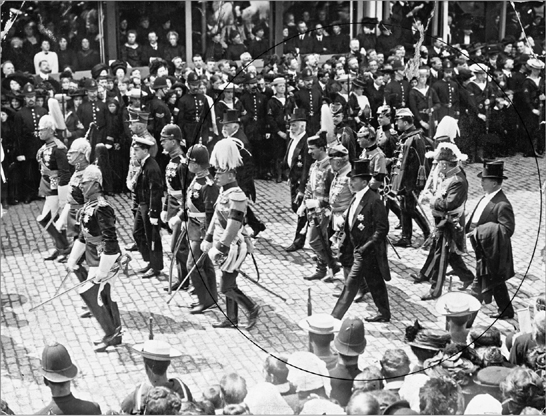
“EPAULETTES PULSED LIKE GOLDEN JELLYFISH.”
Roosevelt (far right) marches in the funeral procession of Edward VII, 20 May 1910. (photo credit i3.2)
But there was more to come. The cloister of St. George’s30 Chapel was heavy with the scent of stacked flowers. Members of His Majesty’s government sat waiting inside. To the delight of one socialistic reporter, there were no pews available for the royal mourners. They stood perspiring, awkwardly jockeying for position as the burial service got under way. Their swords and thigh boots made kneeling difficult, and getting up even more so. The liturgy was interminable, and the air in the room almost too close to breathe. Roosevelt began to look pale under what was left of his African tan.
Not until31 almost two o’clock did the coffin descend into the crypt. The mourners filed by to take a last look at it—Wilhelm II visibly distraught—then adjourned for lunch in the castle. Roosevelt sat at the King’s table. M. Pichon sat at Queen Mary’s, and seemed satisfied that the honor of France had been restored.
THAT EVENING ROOSEVELT and his best English friend, Sir Cecil Spring Rice, were entertained to dinner at Brooks’s Club by Lord Haldane, the Liberal minister of war.
“Dear old Springy”32 was now fifty-one, and a senior ambassador in the British diplomatic corps. He was deeply versed in the affairs of Germany, Belgium, Russia, and the United States, as well as those of Turkey, Persia, and Japan. From his current posting in Stockholm, he was able to keep a close watch on German naval aggrandizement in the Baltic, and quailed at it even more than Lord Londonderry.
Roosevelt enjoyed discussing grand strategy with Spring Rice, but the presence of another guest at Haldane’s table diverted his attention. David Lloyd George, the merry-faced chancellor of the exchequer, was the most revolutionary force to erupt in Parliament since the days of Reform, eighty years before. His “People’s Budget,” enacted just one week before King Edward’s death, had plunged Britain into a governmental crisis so acute that Conservatives—Arthur Lee agitatedly among them—were predicting the collapse of its historic class system into socialism, or worse. Lloyd George was no socialist, but for years, as the Liberal Party’s radical evangelist, he had looked for a means of destroying the power of the House of Lords. He had found his weapon in a budget that proposed a supertax on all unearned income and inherited estates. Prime Minister Asquith’s government was now threatening a general election, in order to force through a Parliament Bill that would abolish the notion of an unelected upper house. If that happened, nearly a thousand years of landed privilege were to be swept away by the little Welshman who now sat breaking bread at Brooks’s.
Fond as Roosevelt was of Tories like Lee, he found himself more drawn to Lloyd George, Haldane, and other Liberals who had come to power during his own, increasingly progressive, second term as president. (One exception was Winston Churchill, whom he considered33 to be a boor and a turncoat, and refused to see.) He admired the laws they had passed to benefit workers, pensioners, aspiring homeowners, and small traders. They seemed to be irresolute in formulating foreign policy, but he suspected that Sir Edward Grey supported the new king’s desire for a stronger imperial presence overseas.
Five days after the funeral, he breakfasted with Sir Edward and showed him a draft of his proposed Guildhall speech. It was as provocative toward “Little Englanders” as his Cairo address had been toward Egyptian Nationalists. The foreign secretary approved34every word, unconcerned that many members of the British establishment were bound to find it presumptuous.
BY THEN, ROOSEVELT35 had forsaken Whitelaw Reid’s luxurious hospitality (“Not exactly what I am used to at home”) and was staying with Edith and Alice in Arthur Lee’s town house on Chesterfield Street. Kermit and Ethel were off on a tour of Scotland. He could not escape so easily. Determined visitors kept ringing Lee’s doorbell: Conan Doyle, Rudyard Kipling, the hunter Frederick Courtney Selous, Kogoro Takahira, the former Japanese ambassador in Washington, even Seth Bullock, the sheriff of Deadwood County, South Dakota. They were more congenial to him than the royals he had endured for the past seven weeks. “I felt if I met another king I should bite him!”
On 26 May36 he went to Cambridge University to accept an honorary LL.D. and found, to his pleasure, that undergraduates seemed to be in control there. A Teddy bear greeted him, sitting with outstretched paws on the ancient cobbles. At the end of the ceremony in the Senate House, a second, monstrous Teddy was winched down from the gallery to hang over his head. He was informed that Charles Darwin had been similarly saluted with an ape, and Viscount Kitchener with an effigy of the Mahdi.
Coincidentally, he37 met Kitchener two days later at Chequers, Lee’s Elizabethan manor in Buckinghamshire. The hero of Omdurman repelled him as a large, squinting loudmouth, “everlastingly posing as a strong man.” Just back from seven years in command of the Indian Army, Kitchener was as overbearing as he was opinionated. He said that the United States had made “a great mistake” in not building a sea-level canal in Panama. Roosevelt cited the advice of engineers to the contrary.
“All I would do38 in such a case,” Kitchener declared, “would be to say, ‘I order that a sea-level canal be dug, and I wish to hear nothing more about it.’ ”
“If you say so. But I wonder if you remember the conversation between Glendower and Hotspur, when Glendower says, ‘I can call spirits from the vasty deep,’ and Hotspur answers, ‘So can I, and so can any man, but will they come?’ ”
Lee’s other guests that weekend were easier to take. The most distinguished of them39 was Arthur James Balfour, who had been prime minister during Roosevelt’s first term as president, and was now leader of the Opposition. Balfour, like Kitchener, was a bachelor, but in all other respects the viscount’s opposite: languid, cerebral, delicate as any aesthete drawn by Aubrey Beardsley. The delicacy was deceptive. For thirty-five years Balfour had trodden softly on the bodies of men who underestimated him.
He was now sixty-one, with a good chance of becoming prime minister again, if the Liberals failed in their assault on the House of Lords. At first, Roosevelt was not inclined to show him much respect. Balfour, he thought, was responsible for much of the war talk he had heard in Europe, having recently announced that there was an international consensus that Great Britain was “predestined to succumb40 in some great contest,” with a country that sounded very like Germany. Was the Tory41 leader just another doomsayer like Lord Londonderry, and had British Conservatism become a negative force, recoiling from the new dynamics of the twentieth century?
Arthur Lee wanted to counteract such doubts by getting them into a strategic conversation. The problem was, Balfour was shy and needed to be warmed, like a cold honeycomb, before any sweetness began to flow.
That happened sooner than Lee expected. Balfour, the author of several works of philosophy, had admired Roosevelt for years as a fellow scholar in politics. He had been overwhelmed in 1908 to receive a two-thousand-word letter from Roosevelt in praise of his book Decadence. In it, the President of the United States had swallowed whole his basic premise—that a civilization could not advance unless its elite was made to comprehend technological revolutions—but had extended it into the field of biology, comparing the disappearance of South America’s post-Tertiary fauna to just such a failure to adapt to what was new and strange.
“So it is42, of course, with nations,” Roosevelt had written.
In view of his own party’s failure to adapt to the rise of the Liberal species, Balfour had begun to wonder if the torch of Western leadership should not pass out of British hands into those of this prodigal American. Who was better qualified to become the first truly global statesman of the twentieth century, pulling together North America, Britain, and the whiter parts of the British Empire into one giant power bloc?
He had gone so far as to draft a proposal, entitled “The Possibility of an Anglo-Saxon Federation,” for Roosevelt and Edward VII to consider before they met. Perhaps the former president could be put at the head of such a superpower, balancing the Occident against the Orient, the Northern Hemisphere against the Southern, and, by virtue of overwhelming naval superiority, dictating universal peace.
“It would be a fitting43 conclusion to Roosevelt’s career,” Balfour wrote in a covering note to the King, “that he should go down in history as the prime author of the greatest confederation the world has ever seen.”
For some reason44, possibly relating to Edward’s death, he had abandoned his grand design. But Arthur Lee was delighted45 to see the former prime minister and former president hitting it off. Their minds, in his own expression, “fizzed chemically.”
The other guests at Chequers that weekend—Field Marshal Earl Roberts of Kandahar, Alfred Lyttelton M.P., and Cecil Spring Rice—shared a gloomy sense of Britain’s imperial decline. Roosevelt took advantage of their presence to discuss his forthcoming speech on Egypt.
“I never heard a man46 talk so continuously, or eloquently about himself,” Balfour’s secretary J. S. Sandars wrote afterward. “Amusing too after his fashion. He said that if we allowed Egypt to slip, as it was doing, out of our control, the first consequence would be seen in India.”
WHICH WAS MORE or less what Roosevelt said again at the Guildhall the following Tuesday, ignoring the stares of the Lord Mayor of London and his red-robed aldermen. They had just awarded him the freedom of the city, and had not expected a lecture in return. But he was no longer an ambassador, and felt it his duty47 to help King George and other defenders of the Empire.
He said he had just48 spent nearly a year in four British protectorates on the African continent. “You are so very busy at home that I am not sure whether you realize just how things are, in some places at least, abroad.”
This allusion to the crisis in Parliament got a few nervous laughs. In venturing some advice about handling native unrest along the Nile, he said, he wished only to pass on what he had learned himself, as President, during the Philippines insurrection. “You have given Egypt the best government it has had for at least two thousand years—probably a better government than it has ever had before; for never in history has the poor man in Egypt, the tiller of the soil, the ordinary laborer, been treated with as much justice and mercy.… Yet recent events, and especially what has happened in connection with and following on the assassination of Boutros Pasha three months ago, have shown that, in certain vital points, you have erred; and it is for you to make good your error.”
Sir Edward Grey, sitting on the dais with Balfour and Arthur Lee, whispered delightedly, “This will cause49 a devil of a row.” Some other distinguished guests, including Conan Doyle and John Singer Sargent, applauded more out of surprise than gratification. Were they being spoken to, or scolded?
Britain’s “error,” Roosevelt explained, lay in doing too much, rather than too little, to appease Egyptian feelings. “Uncivilized peoples” needed education and example. Fanatics in their midst throve on softhearted concessions. The willingness of Egyptian Nationalists to engage in sedition and murder had shown that they had no real understanding of democratic process. They would make “a noxious farce” of independence, if it was granted any time soon. “Of all broken reeds,” Roosevelt declared, “sentimentality is the most broken reed on which righteousness can lean.”
Scattered cheers were heard as he grew more peremptory:
Such are the conditions; and where the effort made by your officials to help the Egyptians toward self-government is taken advantage of by them … to try to bring murderous chaos upon the land, then it becomes the primary duty of whoever is responsible for the government in Egypt to establish order, and to take whatever measures are necessary to that end. [“Hear! Hear!”]
… Now, either you have the right to be in Egypt or you have not. Either it is or it is not your duty to establish and keep order. [“Hear! Hear!”] If you feel that you have not the right to be in Egypt, if you do not wish to establish and to keep order there, why, then, by all means get out of Egypt. [“Hear! Hear!”]
“I just love that man,”50 Balfour said afterward.
WHEN ROOSEVELT CAME DOWN to breakfast next morning, Lee greeted him with, “Well, the attitude51 of the English newspapers can best be expressed in the one word ‘gasp.’ ”
Liberal newspapers52 were infuriated that a foreigner, however distinguished, should instruct His Majesty’s government in condominium policy. “No summary can do justice to the vulgarity and ignorance of the oration which Mr. Roosevelt delivered at the Guildhall,” the National Review remarked. The Daily Chronicle felt he had “outraged every conventional canon of official and international propriety.” The Nation excoriated his “jackboot doctrine” of might over right, and obvious contempt for Islam. “Mr. Roosevelt talked as if the whole Egyptian people had adopted assassination as a political method,” commented the Manchester Guardian. “This is not robust or virile thinking; it is muddled, boyish thinking.”
Conservative reactions53 were more favorable, if stunned. The Pall Mall Gazette—Lee’s kind of paper—said that the former president had delivered “a great and memorable speech that will be read and pondered over throughout the world.” The Times reproved him for taking freedom of the city too far, but granted that his basic intent was “friendly.” The Daily Telegraph praised him for his candor, and asserted that Britain had “no intention of going,” either from Egypt or India. And the editor of The Spectator thanked him for “giving us so useful a reminder of our duty.”
After a few days, two of the most acerbic columnists in the country weighed in. George Bernard Shaw54 praised Roosevelt’s performance “in his new character of the Innocent Abroad,” and suggested that if Britain was indeed qualified to govern other peoples without their consent, it should re-colonize America. W. T. Stead, the editor of Review of Reviews, remarked apropos of the murder of Boutros Pasha, “We have caught the assassin, tried him, and sentenced him to death. What more did Mr. Roosevelt do when an assassin made him President of the United States?”
WHEN FURTHER COMPLAINTS were heard in Parliament about Roosevelt’s “insult” to the intelligence of the British people, Balfour rose in his defense. “I was an auditor55 of that speech,” he said, “and I hope I am not less sensitive than others.” No foreign observer could have delivered “a kindlier, more appreciative, and more sympathetic treatment of the problem with which we have long had to deal, and of which America is now feeling the pinch.”
Sir Edward Grey spoke next. “I should have thought56 that to everybody the friendly intention of that speech would be obvious.… It was, taken as a whole, the greatest compliment to the work of one country in the world ever paid by the citizen of another.”
So with hyperbole on both sides of the aisle, the Little Englanders were confounded. Roosevelt spent a few relaxed days in London, gallery-hopping with Edith and lunching with a grateful King57 George. “He has enjoyed himself58 hugely,” Spring Rice wrote to a friend, “and I must say, by the side of our statesmen, looks a little bit taller, bigger and stronger.”
The Colonel declined to be taken too seriously. When a report went around that he had murmured, “Ah! Tempora mutantur!” in front of one of Frith’s vast panoramas of Victorian life, he telegrammed a denial to the editor of Punch.
STATEMENT INCORRECT59. I NEVER USE ANY LANGUAGE SO MODERN AS LATIN WHILE LOOKING AT PICTURES. ON THE OCCASION IN QUESTION MY QUOTATIONS WERE FROM CUNEIFORM SCRIPT AND THE PARTICULAR SENTENCE TO WHICH YOU REFER WAS THE PRE-NUNEVITE PHRASE HULLY-GEE.
ONE LAST PUBLIC appearance60 was required of him before he left the Old World for the New: his Romanes Lecture at Oxford University on Tuesday, 7 June. For once, Roosevelt was61 not sure of himself. He wanted to strike the right donnish tone, which did not come as naturally to him as the hortatory. His subject, “Biological Analogies in History,” was one he had pondered since discovering, as a teenager, that he was equally drawn to science and the humanities. It seemed to him that these disciplines, rigorously separated in the nineteenth century, might draw closer again in the twentieth, as scientists looked for narrative explanations of the mysteries of nature, and scholars became more abstract and empirical in their weighing of evidence. Evolutionary science, in particular, had much to teach historians studying the rise and fall of civilizations.
At first, the proceedings in Oxford’s Sheldonian Theatre seemed appropriately formal. Lord Curzon of Kedleston, the university chancellor, introduced him in Latin as “Honorabilem Theodorum Roosevelt,” who by virtue of public achievements, merited a doctorate in civil law. As beadles escorted him onstage, Curzon’s prose turned to poetry:
Hic vir, hic est, tibi quem promitti saepius audis,
Cuius in adventum pavidi cessere cometae
Et septemgemini turbant trepida ostia Nili!
A translation of these lines was helpfully printed in the official program:
Behold, Vice-Chancellor62, the promised wight,
Before whose coming comets turned to flight,
And all the startled mouths of sevenfold Nile took fright!
Roosevelt took his place amid general laughter. It became evident that members of the Oxford faculty fancied themselves as classical wits. Perhaps they had heard about his telegram to Punch. Speakers compared him to Hercules in his battle against the trusts, and to Ulysses for his wanderings after a period in Africae solitudinibus. Henry Goudy, regius professor of civil law, archly noted that the Colonel had served two terms in the White House, and might yet extend that record to three—numero auspicatissimo, “most auspicious of numbers.”
Curzon, draping Roosevelt in scholarly silk, hailed him as Strenuissime, insignissime civium toto orbe terrae hodie agentum—“Most strenuous of men, most distinguished of citizens dominating today’s world scene.” In a final access of humor, the chancellor praised his friendliness toward all men—ne nigerrimum quidem—“even the blackest of the black.”
At least there was no giant Teddy bear to detract from Roosevelt’s dignity when he mounted the podium and began his lecture. He said that as an eighth-generation American visiting the heart of English academia, he felt less “alien” than one of his Dutch, French, Irish, or Scottish ancestors might have, in “the spacious days of great Elizabeth.” The phrase was a quotation from Tennyson. He left it unattributed, not wanting to condescend to his hosts, and swung into his main text with an eloquence that made their earlier joshing sound sophomoric:
More than ever63 before in the world’s history, we of today seek to penetrate the causes of the mysteries that surround not only mankind but all life, both in the present and the past. We search, we peer, we see things dimly; here and there we get a ray of clear vision, as we look before and after. We study the tremendous procession of the ages, from the immemorial past when in “cramp elf and saurian forms” the creative forces “swathed their too-much power,” down to the yesterday—a few score thousand years distant only—when the history of man became the overwhelming fact in the history of life on this planet. And studying, we see strange analogies in the phenomena of life and death, of birth, growth, and change, between those physical groups of animal life which we designate as species, forms, races, and the highly complex and composite entities which rise before our minds when we speak of nations and civilizations.
Only the continued use of blind quotations betrayed his uncertainty as an academic speaker. Echoing Balfour, he called for a scientific literature that went beyond jargon, so that tomorrow’s humanists could synthesize and explain what today seemed so confusing. He conceded that patterns in natural and human history did not duplicate one another. “Yet there is a certain parallelism. There are strange analogies; it may be that there are homologies.” He spoke for almost a quarter of an hour about the development of higher life-forms, from Eocene beginnings through the arrival of Homo erectus. Phylogenetically, he said, the word new denoted only a trend deviant enough to seem original. The same was often true of obsolescence: what looked like extinction might just be transformation. Thus, the small three-toed Neohipparion had variously become the horse, the donkey, and the zebra.
Clearly enjoying himself, Roosevelt ranged over some of the factors, environmental, pathological, and geomorphological, that determined which species should flourish or disappear. He applied them to the evolution of societies. All the modern countries of Western Europe had arisen from earlier Teutonic and Nordic ethnic overflows, mixing like cold rivers with the warm sea of Roman civilization. He defined two types of neonate states—those growing out of barbarism, and those mutating from previous cultures—and left unsaid the implication that the difference between them was that obtaining between Germanic or Slavic nations on the one hand, and Britannic or Japanese on the other. Evolution aside, there were differing types of “death” in human societies, such as those of the Greeks and Romans who once dominated all of Asia Minor and North Africa. For nearly a thousand years they had flourished, civilizing each community they absorbed. “Then they withered like dry grass before the flame of the Arab invasion.”
Roosevelt nudged his thesis into modern times by arguing, in words he would certainly not have risked at the University of Berlin, that anthropological science now clearly perceived “how artificial most great nationalities are.” At least, in the racial sense: “There is an element of unconscious and rather pathetic humor in the simplicity of half a century ago which spoke of the Aryan and the Teuton with reverential admiration, as if the words denoted, not merely something definite, but something ethnologically sacred.” Nationality was not myth, but a matter of common speech and purpose, of values shared between peoples whose origins might be various.
He acknowledged “that these great artificial societies acquire such unity that in each one all the parts feel a subtle sympathy, and move or cease to move, go forward or go back, all together, in response to some stir or throbbing, very powerful, and yet not to be discerned by our senses.” But whatever romance attached to nationalism had little to do with race.
Roosevelt was using64 the last word carefully, distinguishing it from ethnic, which he made clear had only cultural connotations for him, as ethnos had for the Ancient Greeks. Turning to a subject much more sensitive to his audience, he ventured some of the reasons why empires went into decline. One was when the sovereign authority devolved too much power to its provinces. In that case, “the centrifugal forces overcome the centripetal,” and the whole flew to pieces. He cited also greed, love of luxury, declining birth-rates, and loss of the “fighting edge.”
These drumskins, which he had been pounding for a quarter of a century, awoke the politician in him. The Romanes Lecture of 1910 degenerated into a stump speech, so prolonged it made his Sorbonne and Berlin orations seem epigrammatic in comparison. Toward the end—Roosevelt had been speaking for well over an hour—he did make one notable claim, that he considered himself “a very radical democrat,” opposed to any long-term domination of one group over another. But it was drowned out by the thunder of his exhortations.
“It would appear65 that the biological analogies in history are three,” a weary Oxonian remarked afterward. “Longitude, Latitude, Platitude.”
AFTER A FAREWELL dinner at Dorchester House, attended by the heads66 of the government, judiciary, and Anglican Church, Roosevelt left London for Southampton early on Thursday, 9 June. His ship was not due to sail until the following day, but he had an unusual assignation in Hampshire, en route to the port.
For years he had dreamed of roaming the English countryside “at the time of the singing67 of the birds.” Bird-listening was his primary delight as an ornithologist—almost his only delight in childhood, when he had been so myopic he had difficulty tracing the source of any song. Now, with his left eye blinded, he again wanted to hear, if not see, some of the British species he had studied as a boy.
Sir Edward Grey was happy to act as his guide through some melodious plot of beechen green. The foreign secretary was a passionate outdoorsman, extremely knowledgeable about avian life. He had suggested they tour the meadowlands around Highland Water, deep in the New Forest. There was a country inn nearby at Brockenhurst, where they could spend the night. Southampton lay only eight miles away. Roosevelt’s wife and children could travel there separately the following morning, and meet him at the docks.
With one of the longest days of the year to spare, the two men took a preliminary hike68 down the valley of the Itchen. Then they drove to Stoney Cross and fortified themselves with tea. At 4:30 P.M. they disappeared into the New Forest, and were not seen again until nine o’clock that evening.
The weather was overcast and the season late for a full chorale, but Grey was able to identify twenty-three different songs of forty-one observed species. Roosevelt listened and watched69 with a sense of literary familiarity. He had read Marryat’s Children of the New Forest as a boy, and many of the names his guide whispered to him—the nightingale, the skylark, the thrush, the blackbird—evoked poems he had by heart. But the beauty of their live music thrilled him. The cuckoo wrought its traditional spell, and the “ventriloqual lay” of the sedge warbler mocked him among the river reeds. If the “singing and soaring” of a skylark reminded him of Wordsworth, rather than Shelley, and its melody degenerated sometimes into chatter, he felt it deserved its place in the quotation books.
He heard nothing that quite equaled, to his ear, the chimes of the American wood thrush, the high, brilliant tessitura of the northern winter wren, or the unstoppable mockingbird70 that had once kept him awake one moonlit night in Tennessee. Nevertheless, “the woods and fields71 were still vocal with beautiful bird-music, the country was very lovely, the inn as comfortable as possible, and the bath and supper very enjoyable after our tramp; and altogether I passed no pleasanter twenty-four hours during my entire European trip.”
ROOSEVELT SAILED FROM Southampton the following afternoon on the Kaiserin Auguste Victoria. “Take care of him,”72 Rudyard Kipling wrote to a friend in New York. “He is scarce and valuable.”
The ship was crowded with a record number of American passengers, many of whom had shortened their vacations in order to accompany the Colonel home. Stateside, his voyage was already being called “the Return from Elba.” Similar imagery73 was employed in France. “Never since Napoleon dawned on Europe,” Le Temps remarked, “has such an impression been produced there as has been made by Theodore Roosevelt.” Some British commentators, still smarting over the Guildhall speech, would not have been sorry to see him head for St. Helena. “He is an amiable barbarian with a veneer of European civilization,” wrote S. Verdad, foreign correspondent for The New Age. “To give him credit for any diplomatic talent is a huge joke.” But the Westminster Reviewspoke for the majority in declaring, “Mr. Roosevelt is becoming more and more the commanding figure of the English-speaking world.”
All this attention—not to mention eight thousand letters74 received to date by his overworked secretaries—testified to a fact obvious to many, if denied by himself: that he was perceived as the once and future President of the United States. Those jokes at Oxford about him running for another term had been diplomatic. So, looking further back, had the state receptions, the military reviews, the royal confidences lavished on him since he stepped ashore in Khartoum. He would not have been mein Freund to the Kaiser, or George V’s chosen oracle of Empire, nor even Sir Edward Grey’s bird-watching buddy, if specialists in the Wilhelmstrasse and Whitehall really believed that he was headed for retirement. And the vehemence with which Muslims attacked him (a spokesman for75the Young Egypt Party regretted that he not been shot dead in Cairo) bespoke a new neurosis in international relations: fear that the United States, which he had personally shaped into the great Western power, would expand its influence eastward under a third Roosevelt administration. Maybe even a fourth: he was still only fifty-one.
There was, of course, the complicating factor of William Howard Taft. One of the longest letters in the Colonel’s prodigious stash of mail came from 1600 Pennsylvania Avenue. It was a litany of Taft’s personal and political troubles, beginning with, “I have had76 a hard time” and ending with an indirect appeal for help: “It would give me a great deal of pleasure if after you get settled at Oyster Bay, you could come over to Washington and spend a few days in the White House.”
HEADING FOR HOME, Roosevelt was a different person from the gregarious, Africa-bound adventurer of two springs before. He paced several hours a day on the first-class deck, a black hat shading his eyes. Fellow promenaders sensed his distraction and left him alone. He was willing to pose for the occasional “kodaker,” and made himself available for a general handshaking session. Otherwise, passengers saw little of him77. He spent most of his time with Edith and Alice in their respective staterooms, while Ethel roamed the ship with a little black dog, and Kermit played bridge in the smoking room. Invariably, the family ate together in the ship’s exclusive “Ritz Carlton” restaurant.
They had much to talk about, and more to ponder individually, with changes looming in all their lives. Edith wanted nothing more than to have her husband back at Oyster Bay for good. Her dream was to grow old with him in Sagamore Hill, their big house overlooking the sea, filling it with more books as it emptied of children. But she knew him well enough78 not to bet against some urge for action taking him away from her, sooner or later. She had seen him brood at Omdurman, noticed how he huddled with Pinchot in Porto Maurizio, heard him exalt the Man in the Arena in Paris, registered what he said the night he came back depressed and raspy-voiced from Döberitz. At Windsor, she had watched as he walked with kings, and—in Kipling’s cliché—kept his bearing. At none of these times had Theodore looked like a spent force.
Alice, attuned to every political overtone humming around Washington, saw trouble looming between the President, her father, herself, and her husband. Nick was in a difficult position, since he came from a family long associated with the Tafts. Alice’s dread was that, in the event of a Roosevelt-Taft split, Representative Longworth would resign from Congress and run for governor of Ohio. To ultra-sophisticated Alice, the prospect of life in Columbus was only slightly better than death.
Kermit had two more years of Harvard to brace for, with little enthusiasm. During his annus mirabilis with his father, he had discovered himself both as a man and a wanderer. Restless, nervous, intoxicated by danger, he had earned social respect on safari, only to discover, as he trailed Roosevelt through Europe, that people still took no notice of him. He was too grown-up now (and too fond of cards and liquor) to expect any sympathy from his mother. Ethel was his new soul mate.
And she—eighteen years old, the shyest, most studious member of the family—had been transformed too. Her first experience of the world outside America had filled her with a vast curiosity, which reading would no longer satisfy. For that reason alone, Ethel hoped that Roosevelt would not get back into politics. She was starved for his company, his warm physicality, and his universal knowledge. “I love Father79 so much that it frightens me at times.”
THE COLONEL PRESERVED his sphinx-like silence about domestic politics all the way across the Atlantic. He agreed to speak80 only at a Sunday service for first-class passengers, and preached a lay sermon on “scribes and Pharisees, publicans and sinners.” Afterward he said that he felt uncomfortable that similar worship was not provided for lower-class passengers. “Let’s see if we can’t carry this righteousness down to the steerage people and the stokers.”
Arrangements were made on the bottom deck, to vast excitement. When Roosevelt descended, escorted by the captain, he found more than a thousand Poles crowded around a makeshift altar draped with the German and American flags. The only light in the windowless space came from candles. He asked a Polish priest to say on his behalf “how earnestly he wished the adventure into the new land would be a turning-point in their lives; wished that they might find there all their dreams had painted for them; and how earnestly he, as a citizen of the great republic, welcomed them to it.” Many in the congregation began to weep as these words were translated. He stayed to hear them sing a litany and receive the priest’s benediction. As he made his way out, a girl seized his hand and kissed it. Others followed by the dozen, catching at the skirts of his coat and pressing it to their lips. He proceeded to another gathering on the third-class deck, where, speaking partly in German, he extended the same good wishes.
Later in the day81, musing, Roosevelt said to one of the journalists on board that he would like to see steerage done away with, so that all American immigrants “might, from the beginning of the voyage, feel that they were entering into a new life of self-respect, with privacy and cleanliness.”