
6.

JULIUS FROMM WAS FAR TOO PREOCCUPIED with his company to show much interest in politics. He usually voted for the Deutsche Volkspartei (German People’s Party), whose business-friendly agenda meshed with his own interests. Besides, he quite liked the fact that the head of the Deutsche Volkspartei, Gustav Stresemann, was married to the daughter of a Jewish industrialist.
When Hitler became Reichskanzler in 1933, Fromm’s two directors in the company were Berthold Viert and Karl Lewis. Viert had joined the National Socialist German Workers’ (Nazi) Party quite early, on October 1, 1930 (his membership number was 336158), and later served as the acting head of the local chapter in the Berlin suburb of Hirschgarten. Lewis joined the Nazi Party in 1933.
It appears that Fromm approved of, and even welcomed, the political activity of his two managers, hoping against hope that it might protect his company from outside pressures. In any case, a red swastika flag and a picture of the Führer were soon displayed in one of the two cafeterias. In early January 1933 (during the final weeks of the Weimar Republic), Fromm suddenly started emphasizing the German nature of his merchandise, calling his products “pure German quality products.” He soon began labeling his condoms “the bestselling German select brand.” In an evident attempt to ward off boycotts of his Jewish company, he announced that “the sale of our Fromms Act select brand is, as always, absolutely permitted!” This announcement was printed on March 25, 1933, on the title page of the drugstore journal Der Drogenhändler in an old-fashioned German penmanship style known as Sütterlin script. In the next advertisement, Fromm left off the foreign word “Act” in the company name. For a brief period, he was so plagued by uncertainty that he refrained from advertising his condoms altogether, and focused on another of his products—Fromms Rubber Pacifiers—to show consumers that his products were in line with the Nazi campaign to step up the birth rate.31
“When my father was faced with the question of whether to leave Germany after the Nazi takeover,” Edgar Fromm recalled, “his initial reaction was: ‘Hitlers come and go…’” Julius Fromm simply failed to grasp how deadly serious the National Socialists were about expelling and later annihilating the Jews. He insisted: “I cannot imagine this happening. After all, we are Germans!” Both of his directors, who had become Nazis, assured him repeatedly: “But Herr Fromm, we don’t mean you. You’re an exception.”
Although the Reich Economics Ministry generally gave Fromm’s company favorable treatment, since it made such a positive contribution to the German balance of trade, the company nonetheless became an ongoing target of harassment. As early as March and April 1933, an “in-depth” special audit of foreign currency regulations was conducted by the tax office. However, “no violations of any kind” could be detected. In addition, a “pure Aryan” competitor called Blausiegel, based in Erfurt, attempted to use the new anti-Semitic state doctrine to its own advantage. Fromm had made plans—later abandoned—to establish a branch in England, and these plans had been approved by the Reich Economics Ministry some time earlier. In 1934 Blausiegel protested this initiative, using a combination of vicious racism and a heavy emphasis on “German know-how”: “Up to now, the German production of condoms and pacifiers has had little real competition in most European nations; it would be dealt a serious blow if alien elements succeeded in establishing businesses of the same kind abroad by taking advantage of German know-how.”32
Julius Fromm was hoping not to have to emigrate, but he laid the groundwork just in case. The first step was to convert Fromms Act to a corporation in which he held 98 percent of the shares and his plant manager Alfred Hausding the remaining 2 percent. Fromm’s role in the company he had founded was henceforth restricted to the status of consultant. He drew an annual payment of 200,000 Reichsmarks plus 300,000 Reichsmarks from the firm’s net profits, and retained possession of the buildings and machines.
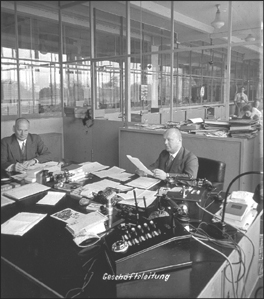
Directors Berthold Viert
(left) and Karl Lewis,
ca. 1935
The next order of business was to bring his two younger sons to safety. (Max had already fled to Paris in April 1933.) He sent Herbert, the designated successor to his company, to London in 1934, where he marketed condoms imported from Berlin, and in the same year he enrolled Edgar in a Swiss boarding school.

On December 20, 1933, the chief administrative officer in Potsdam filed an application with the Berlin police commissioner to review Fromm’s naturalization process, which had taken place back in 1920. The legal basis for this review was a law enacted on July 14, 1933, to the effect that citizenship awarded to “Eastern European Jews” between 1918 and 1933 would be revoked if the naturalization was deemed undesirable “with regard to racial and national principles.” This routine procedure was applied to some 15,000 Jews who had been granted citizenship during the years of the Weimar Republic.
The official questionnaire on file referred to Fromm by his birth name, Israel. The Berlin police commissioner reviewed the records on December 13, 1933, and noted in the margin:
There is no reason to continue granting Fr. German citizenship. He has fared well in Germany, he went about his business [during the war] and earned a good livelihood while other Germans did their duty and put their lives on the line for their country. When Fr. applied for German citizenship, he did not do so for the love of all things German and the German Reich, but simply in order to facilitate his business operations and to steer clear of the discomforts he would have had to accept as a foreigner in Germany, particularly during the war. It cannot serve the interests of the German people for these kinds of people to continue enjoying German citizenship… In view of the fact that Fr.’s petition for naturalization was rejected back in 1914 and he was thereby recognized as an international Jew, the law of July 14, 1933, should apply to him as well.
The overall assessment was less harsh: “He has not displayed behavior inimical to the welfare of the people and state in any civic, political, cultural, or economic context.”
A senior civil servant ordered that “Fromm be given the opportunity to make a statement.” Fromm responded immediately with a letter to the chief of police dated January 4, 1934, reaffirming his loyalty to the state:
I established my industrial company in Berlin, and I have built it up—in the beginning as its sole administrator and worker all in one—from the most modest beginnings to the importance it enjoys today. My German outlook and my German diligence have enabled me, conscientiously and honestly, to become one of the highest taxpayers in my residential district of Zehlendorf-Schlachtensee… Without a hint of arrogance, I can state that the company is well-known far beyond the borders of Berlin for its technical and architectural excellence and its steadfast pursuit of optimal facilities to promote good hygiene and working conditions; foreign customers and experts have quite often told me that it has become a sightseeing destination for Germany—and even for the world. That is my German life’s work!
He also pointed out that he had donated ten thousand Reichsmarks to the Winter Relief Fund, and that even back in the days of the Weimar Republic, he had advocated requiring community service in place of “unsatisfactory volunteerism.”
Fromm appended to the document an endorsement by Dr. Paul Stuermer, an avowed right-wing conservative and member of the Alldeutscher Verband (Pan-German League). Stuermer emphasized “the great popularity Fromm enjoys in the workforce and among experts” as well as his loyalty to the state, and the host of economic and personal consequences Fromm’s loss of German citizenship would entail: “In view of Fromm’s emotional rootedness in his wholly German family, denaturalization would do untold mental and physical harm not only to him personally, but to the German public interest, which would suffer significant material damage.”
On January 19 and 20, 1934, the District Factory Cells Division of the Berlin Nazi Party also sided categorically with Fromm “because of our interest in maintaining and creating new jobs.” The Nazi officials at this location feared for the future of the factory and drafted a detailed report about Fromm’s plan to set up a heavy-duty rubber factory producing tires with outstanding traction. The plant would employ two hundred workers on opening day. The report, dated January 19, 1934, states: “The company can be regarded as exemplary in both its technical and its social facilities. Director Fromm is the executive of the entire business. In the course of a single generation, he has brought this factory from very modest beginnings to its current prominence. Nearly all the machines and facilities in the plant were built to his own specifications, and most are patented… Stripping this man of his citizenship poses the risk that slowly, but surely, this factory will lose its standing, and if F. sets up factories abroad, the market for German exports will be lost there.”
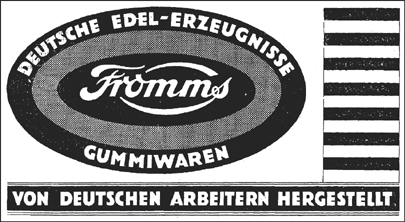
Advertisement in Der deutsche Drogist, 1934 (text reads: Fromms—
German quality products, manufactured by German workers)
The response by the Chamber of Industry and Commerce in Berlin was decidedly unreceptive to this argument. Motivated less by job concerns than by class envy of a successful Jewish businessman, and possibly by a prickle of anticipation about getting their hands on the booty themselves, the gentlemen disclosed their take on the issue “in strictest confidence”: “We are having particular difficulty seeing why denaturalization of Herr Fromm would represent any serious danger to the continued success of his business, let alone that it would make the company go under.”
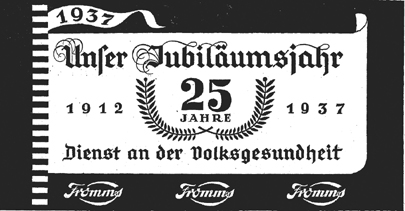
Advertisement in Der deutsche Drogist, 1937 (text reads: Celebrating our
anniversary—25 years of service to the health of our nation)
In the end, the chief administrative officer in Potsdam ruled in favor of Fromm. He emphasized Fromm’s “impeccably German way of thinking,” and voted “to uphold naturalization in this specific instance.” On April 21, 1934, the Prussian secretary of the interior decreed, in consultation with the Reich authorities, that “the plan to revoke Israel Fromm’s citizenship is being dropped.” Furthermore, it was found that strictly speaking, it was unlawful to force Fromm to resume using his first name Israel, and the Berlin police department initiated proceedings to rescind the “change in first name of the Jew Julius Fromm.” However, the matter was still pending when he emigrated in 1939.33
Apparently undaunted by all these dealings, Fromm kept at his business. Evidence of his calculated optimism was a major new marketing campaign with an array of advertisements he and his staff (whom he referred to as his “propaganda department”) designed for the pages of the Drogisten-Zeitung in 1933 and 1934. The sweeping curved lettering used in these ads proclaimed that this product was “Heat vulcanized / Storable for 3 years / Transparent.” The company sought to appeal to the journal’s rather conservative readers with slogans in old-fashioned German cursive script; these ran the gamut from jingles (“Fromms Rubber Products are the ones to get—because this brand’s the best one yet”) to lists of selling points (“Admired, Reliable, Popular!”). A 1934 advertisement declared with simple pride: “World-Famous Brand: Fromms Rubber Products.”
In 1935 Fromm marketed his sheer condoms as “The Winning Quality Brand!” During the Olympic Games in 1936, he distributed a mass transit map to foreign guests with the “authorization of the Propaganda Committee for the Olympic Games.” This map bore the title Nahverkehrsplan, a clever pun on the double meaning of the German word Verkehr (“transportation” and “sexual intercourse”), and thus a tie-in to his leading product.
Julius Fromm was busy around the clock, as a merchant, a boss, and an advertising agent on his own behalf. On top of that, he sought to advance the technology of his condoms. In view of the growing shortage of raw materials, Fromm—in collaboration with I.G. Farben in Leverkusen—conducted experiments to develop a suitable synthetic form of rubber.34 He improved the lubrication of “rubber products for rectal and vaginal use,” and filed a patent application to the Swiss Bureau for Intellectual Property in Bern on February 24, 1936. His new approach remedied several vexing problems that commonly occurred with older methods, which typically employed fine-grained materials such as Indian tragacanth or locust bean gum as lubricating substances. Although this treatment “smoothed the surface of the rubber products and improved the desired lubrication,” the rubbers would swell up prematurely in humid air, causing an “annoying stickiness” and making it “very difficult to impossible” to unroll them. Fromm therefore mixed the bulking agents “with finely powdered additives unaffected by humidity, such as talcum, mica, and other substances of that sort” and dusted the rubber products with these mixtures. This patent may well have been his most important one. It was registered in thirty countries.35
In the summer of 1936, the anti-Semitic newspaper Der Stürmer launched a smear campaign. Under the headline “Yet Again the Jew Company Fromms,” the paper used the form of ostensible or actual letters to the editor to inform its readers: “Dear Stürmer! I have before me edition no. 8 of the trade journal Der deutsche Friseur (The German Barber), dated April 16, 1936. This paper, I find a large advertisement for the Jewish company Fromms.” Another letter writer described the conduct of the Gubener Zeitung as “an outrage” and “the height of tastelessness” for having placed an advertisement by “the Jewish company Fromms Rubber Goods … right in the middle of the text of a speech” by Rudolf Hess. Furthermore, the streetcars in Hamburg were “still full of Fromms posters.” “Couldn’t you,” the alleged reader asked “dear Stürmer,” “at least drop a broad hint to the management of the Hamburg streetcars?”36
Julius Fromm was bound to have realized by this point “that he had to leave Germany,” his son Edgar recalled, “but he was so successful that he did not want to give up.” By the end of 1937, he knew it was time to go. He instructed his bank, the Reichs-Kredit-Gesellschaft, and his attorney, Sally Jaffa, to sell Fromms Act.37 The managers at the Reichs-Kredit-Gesellschaft agreed in principle to lend Fromm their support. Their initial plan was to grant him a credit in the amount of one million Reichsmarks so that he could emigrate as quickly as possible, and to take interim possession of the company on behalf of the bank. The company could then be Aryanized in good time. But in May 1938, the legal situation changed drastically. From then on, sales of companies that belonged to Jews were subject to the approval of the Reich Economics Ministry.
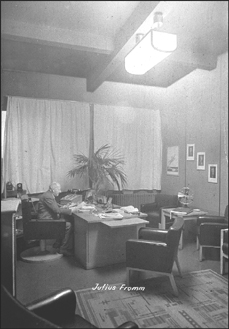
The boss in his office in
Köpenick, ca. 1935
Immediately thereafter, both the district economic adviser in Berlin, Professor Heinrich Hunke, and Hitler’s economic adviser, Wilhelm Keppler, began to show an interest in Fromms Act. However, Hunke (who went on to head the economics division of the finance ministry of Lower Saxony after the war, and remained in that position until 1967) was pushed aside to accommodate a far more influential prospective buyer, and he instead took possession of the Ebro Company (officially called the First Berlin Steam-Horsehair Spinning Factory, Inc.) in Berlin-Weissensee.38
On May 18, 1938, a Dr. Heuser, the assistant district economic adviser, came to the Reichs-Kredit-Gesellschaft to discuss the Fromm situation. According to notes on the conversation, he “pointed out that managing a factory with these notorious products would not be very pleasant for a bank, even if a trustee were appointed. Criticism of the bank might be leveled by a public authority or by some other agency.” He added the ominous remark, “Lending a million to the Jew Fromm could be somewhat risky.” After all, there was no guarantee that the collateral would ever be realized, even if it had been secured in line with standard bank procedures. From “the political standpoint,” this business was “fraught with extraordinary risk.”
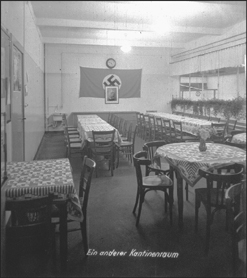
One of the cafeterias in Köpenick, with a
picture of Hitler over a swastika, ca. 1935
Heuser threatened the bank, which was prepared to conduct reasonably fair negotiations with its client, Julius Fromm, that he would put a stop to the allocation of natural rubber to Fromms Act. After all, he pointed out, raw materials were subject to foreign exchange and armaments regulations. This action would have bankrupted the company and rendered the bank collateral worthless. And Hermann Göring—the man in charge of foreign currency and raw materials used for armaments—already had his eye on the ultramodern factory. As a result, Heuser explained, he himself would look around for a “financially solvent candidate for Fromms.” The bank managers expressed their delight by underlining that part of the statement twice in their memo and adding three exclamation points in the margin.
The fact of the matter was that the prospective buyer had already been identified. This buyer and her associate were applying every conceivable kind of pressure to reduce the price of the business. Accordingly, the Reich Economics Ministry turned down a potential buyer whom Fromm had proposed. His name was Walter Koch, an Aryan German who lived in London. In the summer of 1938, Koch offered £50,000 for the business. The contract was even ready for signature.39
At the beginning of the sales negotiations in 1937, Fromm and the managers of the Reichs-Kredit-Gesellschaft had estimated a market value of five million Reichsmarks as a starting point, in view of the attractive Köpenick factory and the rising sales. In the course of the next six months, Fromm cut his initial asking price in half. Eventually the Reich Economics Ministry brought in a buyer named Elisabeth Epenstein, a woman who was offering to pay 200,000 Swiss francs to Julius Fromm from a bank in Zurich. According to the official German exchange rate, this sum was the equivalent of 116,000 Reichsmarks, but in reality the offer was worth several times that amount. After all, this was “precious western foreign currency,” as people said at the time. The Reichsmark was regarded as play money abroad—just as the East German mark would be many years later—and was traded far below the official exchange rate.
Fromm was also granted the right to convert 300,000 Reichsmarks of his personal assets into £30,000 over a period of time, and to have unrestricted use of this money from abroad. That was a significant concession in those days and conferred substantial privileges on Fromm in comparison with other Jews forced to emigrate. The rest of the deal, which was approved by the Reich Economics Ministry, provided for Fromm to receive a share of 10 percent on Fromms Act export sales to British Empire countries. This share of the export sales would count as part of his personal assets toward the £30,000. He would then reimburse the now-Aryanized Fromms Act for the official equivalent value of his share of the export sales from his personal assets left behind in Berlin, which he—like all others hounded out of the country—would not be permitted to take with him. It appears likely that there had been an additional provision legally entitling Julius Fromm to sell all Fromms rubber products throughout the British Empire.40 When the war broke out, this deal essentially became null and void.
The conditions of sale listed above for Fromms Act in July 1938 were dictated by a Dr. Siegert, an ambitious assessor in the Reich Economics Ministry. He summoned Fromm to the ministry by telephone, refused to make any concessions, and “demanded notarization the very same day.”
The compulsory contract was drawn up on July 21, 1938. On August 4, 1938, Dr. Carl vom Berg notarized the inequitable arrangement and had this to say in the preamble about the seller: “The person appearing before me is a Jew.” A few days later, the Berlin chief of police approved the sale, and it was again declared with notarial authorization “that the company is to be regarded as an Aryan company from this day forward.”41 The new owner of the company was Baroness Elisabeth Epenstein von Mauternburg, who was advised by her lover, a Viennese businessman named Otto Metz-Randa. She was the godmother of Hermann Göring, who had arranged for her to get the factory because it worked to his personal advantage.
As wretched and demeaning as Julius Fromm must have found the outcome, his compulsory sale turned out reasonably well in comparison to other Aryanizations at that time. After all, a relatively substantial amount of foreign exchange was made available, albeit less than Koch would have paid. On September 30, 1938, the Reich Economics Ministry formally granted the transfer of 200,000 Swiss francs to the Schweizerische Kreditanstalt in Zurich, with the request “to expedite the matter.” The document stated that “Herr Julius Fromm [is] free to dispose of the funds for the purpose of emigration.”42
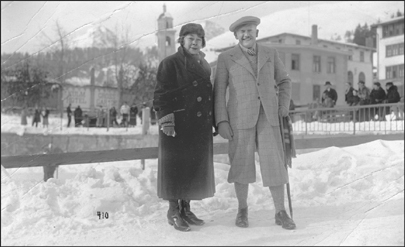
Julius and Selma Fromm in St. Moritz, 1937
Officials at the Reich Economics Ministry made a note in the Fromms’ passports permitting them to leave the German Reich at any time and without additional formalities. That note later proved problematic. According to Edgar Fromm’s report, the British asked: “Why were you able to leave without any difficulty when many other Jews were not?”
Julius Fromm had lost a great deal, but not everything. He was set to start a new life in England. However, Germany went to war and put a crimp in his plans.
In 1946 the Fromm family’s lawyer justifiably claimed: “The contract was signed under duress, and the payment was in striking disproportion to the value of the objects and shares acquired. Frau von Epenstein took advantage of her relationship with Göring, and at the Economics Ministry Herr Fromm was simply informed that the sale had to take place without delay under the set of conditions presented there.”43
Just how much more valuable Fromms Act was in reality is evident from a capital adjustment completed in the spring of 1942 for tax purposes. Instead of 200,000 Reichsmarks of common stock capital, the internal revenue service set the value at one million. According to the balance sheet of December 31, 1940, the working assets came to 2,174,000 Reichsmarks. When the business was later bequeathed to the purchaser’s lover, Otto Metz-Randa, the tax office set the inheritance tax at 939,000 Reichsmarks. The heir took this sum of money as a “credit” from the company’s cash holdings without any liquidity problems.44 The business flourished during the war as well, and the workforce was supplemented by 150 foreign forced laborers in 1942.45Between 1942 and 1944, three barracks were built to accommodate the new workers on the grounds of the Köpenick factory. The army needed finger cots for military hospitals and a supply of condoms in bulk. The regulations for army brothels in occupied France stipulated that each of the rooms had to display a sign that said “Sexual Intercourse Without Condom Protection Is Strictly Forbidden!” The sign had to be placed “in a highly visible location” and feature “letters that could be read easily from a distance of 20 feet.” The women were required to make condoms available, and the “price of the rubber prophylactics” had to appear on the inside of the door on the full list of set prices.46
Julius Fromm had always run his business with an iron fist, and had enforced a strict ban on smoking because of the fire hazards associated with the inflammable solvents used in the factory. To prevent employees from secretly enjoying a cigarette, matches and lighters had to be handed over when entering the factory premises. But within days of Fromm’s departure from the company he had founded, the German employees demanded that the ban on smoking be lifted, a demand that the ever-cautious Fromm had consistently refused to give in to. “Our members,” the new management wrote to the building inspection department in October 1938, “have repeatedly requested that one of the cafeteria rooms be reserved for smoking.” The “pure Aryan” management immediately agreed to satisfy the demand for this wholesome indulgence in cigarettes, and confirmed that “there would be no danger in making a cafeteria room available for smoking if the appropriate caution is exercised.” This matter was pressing, it turned out, because “a social gathering” was coming up.47