

KING STEPHEN BATHORY was a man with a methodical mind, calm, vigorous, and without illusions. They said he had studied at the University of Padua, but there was little of the scholar about him. They said, too, that he suffered from epilepsy and there was a strange unhealing wound on his leg, but these were perhaps legends invented to suggest that he was more vulnerable than he appeared to be. He was a short, thickset man, with high cheekbones, a long pointed nose, and a very low forehead. He did not look like a king; he looked like a Hungarian peasant. He had risen out of almost total obscurity to become the voyevoda of Transylvania, owing allegiance to the Sultan of the Ottoman Empire, and he had been elected King of Poland and Grand Prince of Lithuania because the Poles and Lithuanians saw in him a superb administrator. That a Hungarian commoner should become the ruler of vast territories in eastern Europe was surprising enough; what was even more surprising was that he made no effort to learn the languages of his subjects and yet was beloved by them. He was more than their king; he was their conscience.
From the beginning he had taken Ivan’s measure and knew how to deal with him. Ivan’s cruelties, his Byzantine pretensions, his vanity, his dependence upon his whims rather than any carefully thought-out plans were all proof of an inner weakness. Force, and force alone, would make him change his course. In 1579, the King had captured Polotsk and was now preparing to attack Russia itself. In the summer of 1580 he was forty-seven, three years younger than Ivan, and at the height of his powers.
During that summer Ivan was in a state of panic. He knew that a massive attack on Russia was being prepared, but he did not know where the blow would fall. He was striving for a truce on almost any terms. He invited the King to send ambassadors to Moscow, but the King refused, saying that Russian ambassadors must come to Vilno. He laid down conditions: the ambassadors must arrive in Vilno during the five weeks beginning June 14, 1580. Ivan replied that it would take five weeks for his ambassadors to reach the Lithuanian frontier and many more days for them to reach Vilno. The King answered that this was a matter of indifference to him. After five weeks he would be in the field in command of his army, and if they wanted to, and if they could find him, the ambassadors could reach him in his headquarters.
Knowing that war was imminent, Ivan ordered inspectors to comb the land for the nobles who had gone into hiding. Once found, they were to be beaten and then sent under guard and with guarantees of good behavior to Pskov or Novgorod, to serve in the army. To the envoys who were continually being sent to Poland and Lithuania he sent precise instructions: “If you want anything, you must ask your hosts for it courteously without swearing and without making threats. If you are granted permission to buy provisions, buy them; if permission is refused, you must endure. If the King does not enquire about the Tsar’s health and does not rise when you greet him in the Tsar’s name, do not complain.” Such mildness was not characteristic of Ivan. The King had sent him an ultimatum: there could be peace only if Russia surrendered all of Livonia and the cities of Pskov, Novgorod, and Veliki Luki.
In despair Ivan sent an urgent message to all the monasteries, urging the monks to pray to God, the Mother of God, and all the saints to preserve Russia from the invaders. Not knowing where the blow would fall, he scattered his troops in a dozen different places: at Pskov, Novgorod, Smolensk, on the Western Dvina River, in the few remaining strongholds in Livonia, especially in northern Livonia, where he feared an attack by the Swedes, and he was careful to maintain a large army on the Oka River far in the south in case the Tatars took it into their heads to attack at the same time as the Poles and Lithuanians. The King sent a column of 9,000 men against Smolensk. It was only a feint. The real attack was directed on Veliki Luki, which was reached by long circuitous roads through forests and marsh lands. Some 50,000 Polish, Lithuanian, German, and Hungarian troops stood outside the walls of a city defended by 6,000 Russians.
Russian ambassadors attended upon King Stephen Bathory in his camp outside Veliki Luki. The King sat on his throne and haughtily greeted the ambassadors, who begged him to call off the siege, promised to surrender twenty-four towns in Livonia if he would agree to a truce, and said they were agreeable to the surrender of Polotsk. This was strange, for Polotsk had been captured by the King the year before. The King repeated his demand for Pskov, Novgorod, and Smolensk, and the ambassadors left for Moscow for further instructions.
With its wooden outer wall and wooden watchtowers Veliki Luki was especially vulnerable to the flaming cannon balls used in the King’s army. The Russians had time to cover the walls with earth, but the King sent his men right up to the walls to remove the earth and then blew them up with charges of gunpowder. With the walls on fire, the King issued an ultimatum. If they laid down their arms and marched peacefully out of the city, their lives would be spared, otherwise they would all be massacred. The defenders accepted the ultimatum and were beginning to march out when the Hungarian troops, fearing to be deprived of their legitimate booty, broke into the burning city and slaughtered everyone in sight. On that day, September 7, 1580, Veliki Luki fell to the enemy. A month later the King, who was unwell, called off the campaign and returned to Vilno. The loss of Veliki Luki was, for the moment, a sufficient punishment for the Russians.
Battles and skirmishes continued through the winter. Staraya Rusa, an ancient city forty miles south of Novgorod, fell to the Lithuanians. The Swedes blockaded the fortress of Padis in northern Livonia for thirteen weeks, starving the Russians into surrender, and then slaughtered them. Russian ambassadors who went in search of the King were ill-treated, subjected to continual indignities, given neither food nor fodder for their horses, and some of their horses died of starvation while many of their servants were robbed and beaten. Ivan treated his enemies in this way; now the tables were turned. The Russian ambassadors and envoys, once so arrogant, found themselves at the mercy of Polish and Lithuanian officials who were even more arrogant. When they complained they were receiving no fodder for their horses, they were told: “Fodder! Fodder! You are always asking for fodder! You know we are at war and the money allotted for fodder is needed for other things!”
Ivan was forced to eat humble pie. When in the spring of 1581 he sent two new ambassadors, Ivan Pushkin and Fyodor Pissemsky, to the King’s court, they received instructions to behave with perfect humility. If abused or beaten, they were to accept punishment quietly; if insulted or provoked, they were to remain silent. If the Polish King objected to the word “Tsar” in the treaty, he was to be told that the Russian sovereign, to obtain peace among Christians, would not insist on being addressed by this title. As for Livonia, Ivan was prepared to surrender the entire country except for four cities including Dorpat and Narva.
King Stephen Bathory had long ago made up his mind that he would accept nothing less than all of Livonia, Smolensk, Novgorod, and Pskov. Realizing that Ivan was in serious difficulties he added for full measure an indemnity of 400,000 gold Hungarian ducats to pay for his military expenses. These escalating demands roused Ivan to a remarkable exhibition of self-pity. In a long letter to the King, dispatched on June 30, 1581, Ivan complained bitterly of the ill-treatment he was receiving at the hands of the King, who had violated the truce, permitted Russian traitors to enter his service, used treasure from the captured cities to pay for mercenaries, and burned down whole cities with firebombs—a dastardly weapon which no civilized ruler would use. Ivan explained patiently that he possessed one single overriding aim—to prevent the shedding of Christian blood. It was an odd claim from a man who had shed more Christian blood than any of his contemporaries. He declared that he had sent only small armies into Livonia; then why was the King sending vast armies against him? He was the hereditary ruler of a great nation fighting against a mere elected official who thirsted for blood, and he went on to remind the King that life-giving Crosses were protecting Russia and her Tsar. He wrote:
Then what kind of peace do you want? You stole our treasure, enriched yourself, impoverished us, hired soldiers with our money, captured Livonian territory, crammed it with your soldiers, and then with an even larger army than before, you marched your soldiers against us to take whatever was left. What is clear is that you want perpetual war, not peace.
What was equally clear was that Ivan’s letter provided a remarkable self-portrait of a man in a frenzy of self-pity, terrified by the approach of the King’s armies, capable of deluding himself about the real situation to an extent that was breathtaking, and incapable of intelligent argument. Sometimes in the letter he said things that were better left unsaid, for they invited crushing rejoinders. Ivan accused the King of allowing his soldiers to abuse the dead. The King replied:
You accuse me of abusing the dead. I did not abuse them. You, however, torture the living. Which is worse?
You condemn me for allegedly breaking the truce! You, the falsifier of treaties, changing them in secret and secretly adding new paragraphs to them in order to satisfy your insane lust for power! . . .
We have not set eyes on your face, nor on the flags embroidered with the Cross which you boast about. You do not frighten your enemies with your Crosses—you frighten only the poor Russians.
Why did you not come and meet us at the head of your army? Why did you not protect your subjects? Even the humble hen covers her chicks with her wings to protect them from the falcon and the eagle. But you, the double-headed eagle—for such is your insignia—you go into hiding!
You say you sorrow over the loss of Christian blood. Well then, choose a time and place and meet me on horseback and we shall fight one another! God will crown the better one with victory!
The King’s hard-hitting letter was not calculated to sweeten Ivan’s temper. Too many accusations hit their mark: Ivan was a notorious abuser of the dead, an equally notorious falsifier of treaties, and a physical coward who would not dare to engage in single combat. The King sent Ivan a present consisting of two books written in Latin and recently published in Germany concerning the state of Muscovy and its ruler with special reference to passages showing that Ivan was not descended from Augustus Caesar but from princelings who paid tribute to the Khan of the Crimea. “Read what they say about you in Europe,” the King wrote.
The King’s letter was dispatched by messenger and read aloud to the Tsar, who listened in silence. When the entire letter had been read out, he said quietly, “Send greetings to your sovereign from us.” Normally a royal messenger would be offered food from the Tsar’s table. Ivan thought it imprudent to feed someone who had brought so much bad news.
Implicit in the letter was the worst news that Ivan had heard for some time. War was imminent, huge forces would soon be advancing against Russia under command of a man who was fearless, ruthless, and completely sure of himself. Nothing would deter him, and unless a miracle happened he would carry everything before him.
One hope—a very slender hope—remained with Ivan. He had convinced himself that Pope Gregory XIII and the German Emperor Rudolph, the successor of Maximilian, were his natural allies and that both of them were alarmed by King Stephen Bathory’s close friendship with the Sultan of the Ottoman Empire. He wrote to both, urging an alliance against the King who “was shedding Christian blood in alliance with Moslem rulers.” Rudolph was not impressed with the argument; Gregory XIII saw the opportunity to begin a dialogue with Russia which might end with the conversion of the Russians to the Catholic faith. Istoma Shevrigin, Ivan’s ambassador at large, reached Rome on February 26, 1581, and was received like a long-lost child. The Jesuits were especially intrigued by the possibilities of mass conversion; the Pope was solicitous; a Jesuit, Antonio Possevino, who had worked in Poland, was given the task of mediating between King Stephen Bathory and the Tsar, who came to believe that the Pope was actively engaged in supporting his cause.
The Pope, of course, was engaged in supporting his own causes and Possevino was an intelligent papal agent. He reached Lithuania early in July 1581 and was almost immediately closeted with the King, who had just received Ivan’s strange letter accusing him of shedding Christian blood and abusing the dead. It was not the best time to discuss arbitration. Possevino had three audiences with the King, and then set out for Russia, meeting Ivan at Staritsa on August 20. Characteristically Possevino showed very little interest in discussing the war. What he wanted to discuss was the possibility of converting the Russians to Catholicism, a matter which Ivan regarded with distaste. He insisted that they should discuss peace negotiations. It was already too late. On August 25 the Russians in the watchtowers of the northern city of Pskov saw a huge cloud of dust moving across the sky. It was being blown towards them by a strong south wind—King Stephen Bathory was advancing on the city.
The cloud of dust was terrible enough; a few hours later the whole horizon was filled with the King’s troops.
Ivan had not guessed where the blow would fall, though he knew it was coming. The main Russian army, under the command of Simeon Bekbulatovich, was established at Staritsa. Some fifteen miles to the west stood the vanguard army under Prince Mikhailo Katyrev-Rostovsky. These two armies thus covered the approaches to Moscow, which was defended by a garrison force under Prince Ivan Mstislavsky. Another large army defended the Oka River against a simultaneous attack by the Tatars. The remaining Russian strongholds in Livonia were protected by garrison troops, and there was a powerful force at Novgorod under the command of Prince Ivan Golitsyn, the governor of the province. Prince Ivan Shuisky was placed in charge of the defense of Pskov, having sworn to defend the city to the death in an impressive ceremony in front of the Icon of the Virgin of Vladimir in the Uspensky Cathedral. The oath was repeated when he reached Pskov and assembled the entire populace, calling on them to swear before icons and crosses that they would die before surrendering the city.
King Stephen Bathory was a man who enjoyed solving difficult problems. Warned by a Russian traitor that Pskov was impregnable because of its stone walls and powerful defenses, and that he would be well advised to lay siege to Smolensk instead, he simply dismissed the advice as unworthy of a great general. No doubt the capture of Pskov presented difficulties, but if they were solved he could expect every other city to fall to his army at the first blow. The Krom, the castle of Dovmont, the fortress towers, the inner and outer walls—all were of stone. The King was certain that he could batter down the stone walls with his heavy guns, and then the infantry would pour through the debris of the walls and capture the whole city. It was a challenge which he found irresistible.
Prince Ivan Shuisky was a stern, capable, and devoted general whose chief characteristic was one he shared with his Russian soldiers—endurance. The fortifications were strengthened and the suburbs beyond the outer walls were fired to prevent the King’s forces from entering them and using them as a base for attacking the city. With its wide moats, twenty-eight towers, forty-foot-high walls, and its underground galleries reaching far beyond the outer walls, Pskov was, if not impregnable, at least better protected than any other city in Russia. In addition, it lay under the protection of the holy relics of St. Vsevolod which, at Prince Shuisky’s orders, were carried in procession round the walls followed by the entire population.
On the day when the King’s army was first seen, Prince Shuisky ordered a general attack. The gates swung open, the Russian soldiers poured out, engaged the enemy, took many prisoners and were themselves taken prisoner, and by nightfall they returned to the city, realizing that the sortie had resulted only in a few inconclusive skirmishes. Nothing had been gained and little had been lost.
Uncharacteristically the King was acting cautiously. He had an army of 100,000 Poles, Lithuanians, Germans, and Hungarians, and the defenders of Pskov probably amounted to no more than 40,000. His army was so well-trained and so well-equipped that the ambassador from the Sublime Porte, who visited him in his camp, observed: “If the Sultan and Bathory were to act together, they would conquer the world.” To breach the gates and walls the King ordered trenches dug; along these trenches gabions could be advanced to the city walls. The defenders took the precaution of building a second wall within the outer wall. For nearly two weeks, until sunrise on the morning of September 7, 1581, the King continued to make his preparations. Then, as the sun came over the horizon, twenty heavy cannon bombarded the city. On the following day, after further bombardment, the order was given for the attack. At several places the walls had crumbled under the bombardment and the King genuinely believed that by nightfall he would be the master of the city. Two of the great towers had been captured by the Germans and Hungarians, and the King’s flag flew over them. Poles and Lithuanians were fighting the Russians along the walls and pressing them back. “We shall dine tonight in the citadel of Pskov!” the generals said. It was learned that Prince Shuisky had been wounded and that the Russians were retreating. The King was congratulating himself that Pskov was about to fall into his hands after only two days of fighting.
Covered with blood and shouting at the top of his lungs, Prince Shuisky became the incarnate spirit of endurance and resistance, the embodiment of Russian courage. The holy icons and relics were brought to him; the enemy began to give way. One of the towers captured by the Germans and Hungarians suddenly crumbled into a heap of rubble; the Russians had blown it up with a heavy charge of gunpowder placed in one of the underground galleries. The fighting continued, but now it was outside the city walls.
Women and children hurried to bring water to quench the thirst of the soldiers; some came with ropes to drag away the cannon captured at the gates, and others armed themselves with pikes and joined the battle. By sunset the enemy was retreating to prepared positions and the Russians were streaming back to the city with captured standards, captured trumpets, and many prisoners. They had lost over 800 men and twice as many were wounded, but the King had lost more than five times as many. That night, in the candle-lit Cathedral of the Trinity, Prince Shuisky addressed his soldiers, saying:
Thus the first day has gone by, a day of labor, valor, tears and joy. Let us complete what we have begun! Our powerful enemies have fallen, while we, the weak, stand in our armor before the altar of God. The proud giant has been deprived of his bread, while we in our Christian humility have been fed with heavenly mercy!
On the following day, in a message shot by arrow into Pskov, King Stephen Bathory urged Prince Shuisky and his generals to surrender. He promised them extensive freedoms and privileges, the freedom to trade where they wished, the freedom to retain their ancient customs, their property, and their faith. Prince Shuisky shot back an answer, “We do not betray Christ nor the Tsar nor the Fatherland.” The King threatened to destroy the entire population of Pskov unless they surrendered, and Prince Shuisky replied, “We fear no threats. Come and fight. The victory is in God’s hands.”
With all the advantages of a powerful and well-trained army, heavy guns, vast stores of ammunition, and superb generalship, the King failed to take Pskov. Throughout September and October he made repeated assaults on the city, dug nine separate tunnels under the walls, hurled countless firebombs into the city, and massed his cannon in the hope of breaching the walls and destroying the towers. On November 2, 1581, after five days of continuous bombardment, he threw his entire army across the frozen Velikaya River in a last despairing effort to capture the city, and watched them straggling back over the ice. A month later he was still there, hoping to starve the city into surrender.
Although Pskov held out, Ivan deserved little credit. Once more he had been saved by his soldiers. At his headquarters in Staritsa he was protected by two huge armies. No effort was made to relieve Pskov or to supply food and ammunition to the beleaguered city. Ivan was sunk in the stupor of inertia.
The King’s raiding parties penetrated deep into Russia. One particularly daring raid, led by Christophor Radziwill, reached Rzhev, only fifteen miles from Staritsa, where Ivan had his headquarters. This raid by a small cavalry detachment reached Rzhev in early November 1581. Ivan panicked and hurried off to the safety of Alexandrova Sloboda.
He had scarcely reached Alexandrova Sloboda when a deputation of nobles came and presented him with a humble petition. They were brave men, for Ivan had his own way of dealing with petitioners. They knelt before him while one of them read out the words of the petition:
For three years our enemies have been invading the Fatherland, which it is our bounden duty to defend. We are ready to shed our blood, lay down our lives, and sacrifice our property for the sake of the Fatherland. Therefore, O Lord and Master, send your eldest son to the war!
Ivan entirely misunderstood the petitioners, flew into a rage, tore off his crown and the jeweled barmy around his shoulders and threw them to the ground, called them all traitors, and told them they had better choose another Tsar. Since the Tsarevich was present, he evidently thought they liked the Tsarevich more than they liked the Tsar. They answered that they were not traitors, they did not want the Tsar to abandon the throne, they only wanted the Tsarevich to lead them to victory. Apparently they left Ivan’s presence without being punished, for we hear nothing more about the petitioners.
Some hours later, still simmering with rage, Ivan ordered the Tsarevich into his presence and loudly berated him, saying: “You poor fool! How dare you seek to commit treason and sedition? How dare you defy me?” The Tsarevich stood his ground and denied that he had ever surrendered to a single treacherous thought; all he wanted was an army; his only aim was to defeat Stephen Bathory. His opinions about the calamitous three-year campaign against Stephen Bathory were well-known and it was unlikely that he was in any great danger. Then, as so often when he was troubled, the Tsar began to talk about the great collection of gold plate and jewels in his treasury. The Tsarevich, short-tempered like his father, answered that he cared nothing for all these jewels and regarded courage and valor as being worth infinitely more than the entire contents of the treasury. In this rebuke lay an explicit condemnation of Ivan’s cowardice and the futility of all his actions during the three-year war. Ivan was so enraged that he raised his heavy iron-pointed staff as though to strike his son. Boris Godunov, who was present, rushed forward and seized Ivan by the arm. This, too, was unpardonable, and Boris Godunov found himself reeling backward while Ivan jabbed at him with the sharp point of the staff, drawing blood. Then, so enraged that he scarcely knew what he was doing, the Tsar brought down the heavy end of the staff on his son’s skull, striking him in the temple and felling him to the ground. The blood was pouring out of the Tsarevich’s head, and Ivan thought he was dead.
There was a moment of stunned surprise and shock, and suddenly Ivan threw himself down beside his son, embraced and kissed him, and attempted to staunch the flow of blood, weeping uncontrollably, and calling out for a doctor to come immediately.
“I have killed my son!” he groaned, and it was observed that his face had turned deathly white.
He had committed many crimes, but it was beyond belief that he would crown all these crimes with the murder of his own son. Nevertheless it was so.
Ivan cried out for forgiveness and his prayer was answered. The Tsarevich could still talk, although the wound was fatal. He said, “I have always been loyal,” and as a sign of forgiveness he kissed his father’s hand. Then he was carried away and laid on a bed, while the Tsar remained in a trance of shock and grief, refusing to remove his clothes spattered with his son’s blood, now sitting by the bedside, now leaning helplessly against the wall. For three days Ivan went without sleep or food.
The doctors came, but they could do nothing. The Tsarevich lingered on for three days. He died three hours before sunrise in the early morning of Sunday, November 19, 1581. He was twenty-seven years old.
Although married three times, the Tsarevich left no children. His widow, the Tsarevna Elena, spent the remaining years of her life as a nun in the Novodevichy Monastery. She took the name of Leonida and was given the township of Lukh and a large estate to support her widowhood.
Three days after the Tsarevich’s death, the cortege set out from Alexandrova Sloboda for Moscow. The Tsar and all his entourage wore black; the Tsar walked beside his son’s coffin all the way. At the funeral service in the Cathedral of Michael the Archangel the Tsar threw himself against the coffin, uttering terrible cries. Before the coffin was sealed, a king’s ransom of jewels was poured into it, and every night twelve good citizens of Moscow kept watch on the tomb.
For many months Ivan remained grief-stricken. He slept fitfully, and tossed so violently that he sometimes fell off the bed to spend the rest of the night on the floor, shouting and moaning, growing silent only when he became exhausted. At such times attendants would spread a mattress on the floor and give him a pillow; and then, lying quietly, he would await fearfully the coming of the dawn.
During those months he was afraid to show himself to the people. One day he announced to his boyars that God had so cruelly punished him that there remained nothing for him but to leave the world and spend the remaining days of his life in a monastery. Since his son Fyodor was incapable of governing, they must choose a successor and immediately grant him the throne and the regalia. But the boyars were cautious. They knew his temper, his habit of suddenly announcing his abdication only in order to smoke out his enemies, and they also knew that any successor they might choose would be confronted with extraordinary difficulties and dangers, and when they met Ivan again they announced that they wanted no other Tsar but Ivan and his son Fyodor. Ivan pretended to accept their petition reluctantly and remained on the throne.
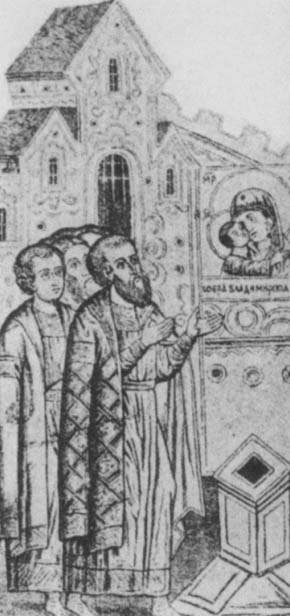
Ivan presenting the Icon of the Virgin to the Danilov Monastery in Moscow, circa 1564. The Tsarevich Ivan is standing behind him. This is the only contemporary portrait of the Tsarevich that has survived.
He was only a shadow of himself. The man who had once roared like thunder became strangely quiet. He no longer wore jeweled robes and no longer flourished the jeweled scepter; even his many crowns, which delighted him so much that he would sometimes wear two or three different crowns during the course of a single meal, were put away as a grown man puts away childish things. He wore black robes like a monk. Suddenly in the midst of the most ordinary conversation he would burst into a fit of weeping for no reason at all or because someone had said something that reminded him of the dead Tsarevich. For the rest of his life he was somber, morose, and given to sudden bouts of hysteria.
He had learned long ago that the donations to the monasteries and the prayers of the monks had the power to assuage grief and diminish the sense of guilt. So he scattered money widely and many monasteries and churches received gifts in commemoration of the dead Tsarevich. To the Troitsa-Sergeyevsky Monastery he sent the vast sum of 5,000 rubles for prayers to be said in perpetuity for the repose of his son’s soul, and a further 10,000 rubles were distributed among the Patriarchs of Constantinople, Antioch, Alexandria, and Jerusalem, and the abbots of the monasteries of Mount Athos and Sinai for the same purpose. On January 6, 1583, when visiting the Troitsa-Sergeyevsky Monastery for the Feast of the Epiphany, he threatened that unless prayers were spoken for the Tsarevich and special services were held for him “so long as the monastery remains standing and until the end of time” he would confront them all at the Last Judgment and curse them. At all costs the murdered Tsarevich must be saved. It was remembered that when he demanded that the monks should never forget to pray for his son, he knelt and bowed before them six times in succession, and all the time he was weeping.
About this time, or a little later, he began to compile those strange lists known as sinodiki in which he enumerated the people he had killed and urged that prayers should be said for their souls. The lists were long and comprehensive; armies of scribes were employed to write down the names of the victims and the circumstances of their executions; the Tsar’s private archives and those of his ministries were combed in order to discover the names of the dead; and in addition he consulted the death lists compiled for the use of the Oprichnina. Killing had been his passion, and now his passion was to be subjected to mathematical analysis, as though he wanted to learn the grand total of his sins. In the early months of 1583 these sinodiki began to arrive at monasteries all over Russia, together with handsome donations to be used for the support of the monks.
Very often it happened that the entire estates of people he had killed fell into his hands. Now, perhaps because he knew that death was approaching and he would soon be called to the Judgment Seat, he began to divest himself of those immense properties and stores of treasure which had accumulated over so many years. In addition to the names of the people he had executed, the dates, and the manner in which they died, it became necessary for the scribes to value and record the value of all the properties, culling them out of ancient estate records. Hundreds of secretaries were employed. The inventories were not always to be found in Moscow; appraisers were sent out to examine inventories all over Russia; complex and difficult problems had to be solved; an entire new industry was being created. Ivan was determined not to appear before God burdened by the vast wealth that had come to him by murder, and so to the mathematics of killing there was added the mathematics of estate accounting.
The dead were entering his life: at all costs their ghosts must be appeased. He proposed to divide their wealth among the two hundred monasteries of Russia, each monastery getting its proper share, and this too demanded many weeks of concentrated mental application. Since the matter ultimately affected the fate of his immortal soul, he took care that the work was done accurately and expeditiously. In fact the task was so arduous that it was not completed until after his death.
No single complete sinodik has survived, but ten fragmentary lists have been found in the monasteries, where the monks copied out the names of the victims and sometimes omitted to include the circumstances of the execution, although these, when known, were usually provided in the original sinodik. Fortunately for historians the monks sometimes included a few relevant details. Strangely the Tsar sometimes included the names of people who were not killed but merely disgraced and sent into exile. Sometimes, too, the Tsar simply abandoned a hopeless task, gave a rough count of the people killed, adding, “Thou Thyself, O Lord, know their names.”
The sinodik of the Monastery of St. Kirill enumerates 3,470 victims, but this is far from being the complete total. Among all the partial lists, supplementary lists, and special lists no estimate of the total is given. Ivan must have known how many people he killed, but the secret died with him.
A sinodik preserved in a monastery would begin in this way:
In 1583 the Tsar and Grand Prince Ivan Vasilievich of all Russia sent to the monastery this list of names to be prayed for, giving orders that they should be remembered during the litanies, liturgies and funeral services in God’s church daily.
Remember, O Lord, the souls of Thy departed servants, the princes and princesses and boyars and all Orthodox Christians, both male and female, who have been killed together with those whose names are not recorded.
Those who are not listed by name in the sinodik but in groups of ten, twenty or fifty, they are also to be prayed for. Thou Thyself, O Lord, know their names.
Often only the Christian names are given. Thus we read: “Nikita, Ivan Viskovaty, Vasily, his wife and two sons, Ivan, his wife and three daughters. . . .” By comparing different lists it is possible to identify many of these people, and so we learn that Nikita refers to Nikita Funikov, the treasurer, that Vasily is Vasily Stepanov, a secretary, and that Ivan is Ivan Bulgakov, also a secretary and that all of them were killed in Moscow in July 1570. Titles are sometimes recorded: “The pious appanage princess and nun Efrosinia, mother of Vladimir, was drowned in the Sheksna River, together with twelve people, including nuns.” There follows a list of the names of the people killed with her, the last being a fisherman named Korypan. Elsewhere the catalogue of death remains impenitently anonymous:
At Ivanovo Bolshoye seventeen people were killed, fourteen of whom met their deaths struck down by hand. At Ivanovo Menshoye thirteen people were killed, three of them struck down by hand. In Chermnev three people were killed, and two in Soslavl. At Bezhetsky Verkh sixty-five people were killed, twelve of them struck down by hand. Thou Thyself, O Lord, know their names.
Sometimes, too, we learn the names of the killers, and sometimes the killers themselves later appear among the dead. Sometimes there is a hint of drama: “Kazarin Dubrovsky with his two sons, and ten men who came to his help.” We would like to know more about the ten brave men who came to his help. A strange silence shrouds these lists, as stark and impersonal as a landscape covered with snow. Time has long ago obliterated the features of these people who died in so much terror and agony, but even today these lists can still haunt us, as they haunt the Russians who have never completely succeeded in erasing them from their memory.
The compilation of so many lists of people and so many ruined estates occupied many of the last months of Ivan’s life. He had become the chief registrar, the chief accountant. Dimly he appears to have realized the full measure of his criminality, the enormity of his evil deeds. In the past he had often beaten his breast and confessed to infamous murders and debaucheries, but there had always been an element of theatricality in these confessions. Now the theatrical gestures were abandoned—now there were only the lists, the names, the number of sons and daughters killed, the value of the estate, strange account books which recorded no profit, only a continual loss. These account books were almost abstractions of death, as Ivan himself was almost an abstraction of pure evil. In his dark robes he resembled a shadow melting into shadows. The lights were going out and soon he would be swallowed up in the darkness.
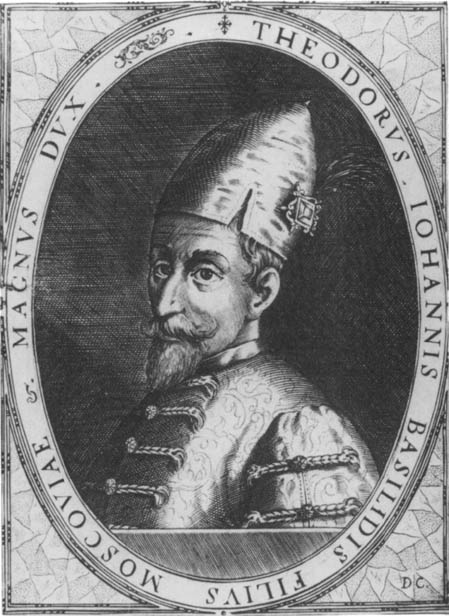
Tsar Fyodor, who succeeded Ivan on the throne.
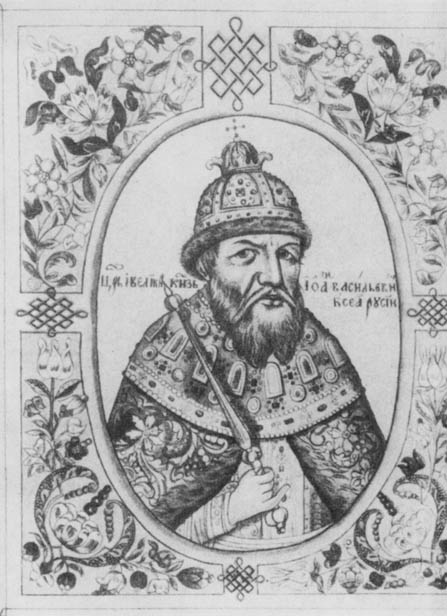
Seventeenth-century portrait of Ivan.