

ALTHOUGH HE HAD TAKEN NO PART in the fighting and was never in great danger, Ivan genuinely believed that Kazan had been conquered by him and that by his presence on the battlefield he had induced God to favor Russian arms. Divine energy had flowed through him, and from him it had flowed out among his soldiers. There would have been no victory without his prayers—those continual prayers which he uttered while moving from one tent church to the next. The sacred relics, the great banner portraying a stern Christ which fluttered above his head, and the many priests in his camp—all these had played a part in his victory.
He was therefore in a very solemn mood as he gazed at Kazan and decided how he would celebrate his triumph. His first act was to order that a church should be immediately built on the place where he had stood during the last stages of the attack. Since the church was made of wood and there was a good deal of lumber available, his master carpenters had no difficulty in building it in a single day. His second act was to send messengers to all his armies with orders that they should convey his gratitude and approbation, promising that he would himself congratulate them at the proper time. His third act was to make a ceremonial visit to the city. Some time elapsed before he could make the visit because the dead lay everywhere, and it was necessary to clear a passage for him.
The Tatars had captured many Russians in their raids, employing them as slaves. Now, as he rode through the city, they knelt beside the road, shouting in gratitude for their deliverance from bondage. Once, seeing some Tatar dead lying where they had fallen, women and children among them, Ivan said with tears in his eyes, “They are not Christians, but still they are people like us!” He rode up the winding road to the Khan’s palace on the acropolis, gazed across the plains, and then returned to his camp. Then he went to pray in the tent church of St. Sergius.
Later in the day he summoned his troops and addressed them, praising them for their courage, their steadfastness, their faith in God. He ordered the spoils to be divided among them. The most valuable of the spoils were the Tatar women and children, and these were accordingly distributed among the troops. “With my own eyes I saw vast numbers of prisoners being led away like herds of cattle,” wrote Angelov. Ivan’s share of the spoils consisted of Khan Yediger, his regalia, and heavy guns.
On October 4, when Kazan had been cleared of corpses, Ivan made his second triumphal entry accompanied by his court and a retinue of priests. His purpose was to select a site for the cathedral to be erected on the acropolis and to attend divine service for the first time on a spot where future generations of Christians would worship. Since the victory owed so much to the intercession of the Virgin, he decided that it should be called the Cathedral of the Annunciation. When the service was over, Ivan, still accompanied by his court and by a retinue of priests, made a processional journey around the walls, which the priests blessed with holy water. In this way Kazan became a Christian city.
Meanwhile there were other solemn ceremonies to attend, and many rituals. From all around Kazan there came tribesmen to swear allegiance to Ivan and to prostrate themselves at his feet. They brought presents, and received presents from the hands of the Tsar. Then there were the great banquets offered to his generals and boyars, and more banquets for the soldiers. It was necessary, too, to make decisions about the government of the city and about whether all the surrounding tribes should be subdued, and how many soldiers would be needed to occupy the khanate. Prince Gorbaty-Shuisky was made governor and Prince Vasily Serebriany vice-governor. In the belief that the conquest of Kazan had struck terror into the hearts of the Tatars, it was decided that only a small token force needed to be left behind. These troops amounted to about fifteen hundred cavalry, three thousand musketeers, and some detachments of Cossacks. Prince Kurbsky and others thought this policy completely mistaken and urged Ivan to remain with his army in Kazan until all the Tatars within the Kazan khanate had been conquered. Ivan refused. Had not God, the Virgin, and the saints fought by his side? Who would dare to raise his hand against the victorious Tsar?
There were, of course, many other reasons why the Tsar rejected this advice. He was eager to return to Moscow, he wanted to enjoy the fruits of victory in his own capital: the acclamations, the processions, the new majesty that accrued to him as the conqueror of Kazan. The nobles and boyars, who raised their own private armies and supported them, were anxious to disband them and return to their estates. Anastasia would soon be giving birth. She had already presented him with two daughters, and he was now hoping for a son, who would inherit the throne. He knew, too, that he was more powerful in Moscow, the mystical center of his empire, than when he was in the field. His task, as he saw it, was to return to Moscow as quickly as possible, to disband the greater part of the army, and to see that Kazan was well-governed. Kazan was one of the jewels of his crown, but there were many others.
There is no evidence that he gave much weight to Prince Kurbsky’s advice, which was remarkably sound and based on a wide knowledge of the Tatars. In fact, during the following years there were continual uprisings in the region of Kazan, and army after army had to be sent out to suppress them. Ivan had not struck terror into the hearts of the Tatars; he had merely wounded them.
The Cathedral of the Annunciation at Kazan was built in an astonishingly short space of time, for Ivan attended a thanksgiving service in it before leaving the city. Prayers were offered to Christ, the Virgin, and the saints to protect the city and its people, and then, while the people knelt in the streets, he made his ceremonial departure at the head of his army, which accompanied him to Sviazhsk, where he spent a night before making the long journey by boat to Nizhni-Novgorod. The cavalry rode along the banks of the Volga and the infantry traveled by boat. He was as well guarded on the boat as it was possible to be. Nevertheless in later years he convinced himself that during the journey from Sviazhsk to Nizhni-Novgorod he had been in terrible danger.
Ivan was not a man of great physical courage and he remembered in excruciating detail all the occasions when he felt himself to be in mortal danger. He especially remembered the times when he was abandoned by those whose duty was to protect him, when he would have perished if God had not saved him. Writing to Prince Kurbsky twelve years later in one of those strange and brilliantly written letters full of the fury of denunciation, he spoke of the ignominy and misery he suffered during the journey:
After God in His unfathomable mercy gave us victory over the Muslims and we were returning safe and sound with all the Orthodox Christian army—what shall I say about those “well-wishers,” whom thou callest martyrs? Let me say this: they placed me like a prisoner on the ship, and conveyed me with a very small escort through a godless and most unbelieving land. Had not the all powerful hand of the Almighty protected my humility, then I would certainly have lost my life. Such are the “well-wishers,” whom thou defendest, and thus do they lay down their lives for us by striving to deliver our soul into the hands of our enemies!
If Ivan in his hours of triumph could give way to irrational fears, then it could be expected that he would be even more irrational and fearful when triumph eluded him.
The journey to Moscow was one long triumphal progress. Everywhere he was acclaimed and worshipped. The peasants came down to the banks of the Volga to acclaim him, and the priests recited the litanies of thanksgiving only to have their words drowned by the shouts of the kneeling peasants, who called him their deliverer, the mighty one, the Tsar who had lifted the fear of the Tatars from their souls. Sometimes his ship anchored near the shore, and he presented himself to them, and there were more praises, more litanies. The news of the victory had long since reached Moscow, and from time to time he was met by messengers bearing letters from Anastasia, his brother Yury, or the Metropolitan Makary, all urging him to return quickly and offering congratulations for his victory.
The ceremonial mustering out of the army took place at Nizhni-Novgorod, where he formally thanked the soldiers for their services and gave them permission to return to their homes. Then he continued his journey to Moscow by way of Vladimir, the former capital of Russia.
On the road to Vladimir he was met by Vasily Trakhaniotov, Anastasia’s messenger, a boyar of Greek origin. He brought news that Anastasia had given birth to a son. Ivan was so overjoyed that he jumped off his horse, embraced Trakhaniotov, prayed, thanked heaven, wept, and ran about like a madman. To celebrate such an occasion he needed to give Anastasia’s messenger a present, but what present? Impulsively he threw off his mantle and pressed it on the messenger, and for good measure added his horse. Anastasia’s brother Nikita Zakharin was sent posthaste to Moscow to present the Tsar’s congratulations.
The birth of a son so quickly after the conquest of Kazan made Ivan delirious with joy. He already had two daughters, Anna and Maria—Anna died at the age of eleven months—but daughters counted for nothing compared with the birth of a son. God had once more shown him favor, for now the dynasty was secure.1
In Vladimir and Suzdal he paused only long enough to pray in the churches and to receive congratulations. He hurried on to Moscow, but first it was necessary to pray at the tomb of St. Sergius in the Troitsa-Sergeyevsky Monastery and to break bread with the monks. He spent the night on his estate at Taininskoye, where his brother Yury met him, and together they set out early the next morning for what would evidently be a tumultuous reception in Moscow.
Long before they reached Moscow, the people came out to welcome him. The crowds were so thick that he had difficulty making his way among them and was in danger of being cut off from his guards and retinue. He rode through the throng, bowing right and left, while the people kissed his hands and feet, and shouted, “Long live our God-fearing Tsar, conqueror of the barbarians, savior of the Christians!” At Sretinsky Monastery he was met by a procession headed by the Metropolitan Makary, the clergy carrying crosses, banners, and icons. Here he dismounted and kissed the Icon of Our Lady of Vladimir and many other icons. The old boyars, Prince Mihailo Bulgakov and Ivan Morozov, who had served his father and grandfather and who had ruled over Moscow in his absence, were also waiting for him. He embraced these and many other nobles, and then it was time for the Metropolitan to deliver a special blessing. Ivan, in return, explained the circumstances that led to the conquest of Kazan, his armies having gone forth in defense of Christ and the Church. He said:
Before I set forth on the campaign against Kazan, I took counsel with the Metropolitan Makary and the clergy about how the Khan of Kazan and his people were devastating the Russian land, the towns and villages, the churches and monasteries, and how countless Christians including priests and monks, boyars and princes, youths and children, men and women, had perished or had been taken prisoner and dispersed over the face of the earth. All this happened because of our sins and especially because of my sins.
Thus it was that on your advice we set out to make war against them. I urged you to pray to God, the Virgin and all the saints for our well-being and for the forgiveness of our many sins and for our deliverance from the barbarians. Thanks to God, the Virgin and the saints, and also thanks to your prayers and the watchful care and courage of Vladimir of Staritsa and of all our boyars and generals and our Christian army, which was ready to suffer great hardships for the true and holy Christian faith and for the holy churches and for our Orthodox Christian brethren, we reached Kazan safely and in good health. And God in His great mercy overlooked our sins and granted us victory. He gave into our hands the royal and populous city of Kazan, and he threw down the Muslim falsehood and established the Cross. And by the judgment of God, the Muslims who lived in that city perished without a trace and only Khan Yediger Makhmet remained alive in our hands.
Together with Prince Vladimir of Staritsa, I and all my army give thanks to thee, holy father, and to all the holy priesthood, for it was owing to your prayers that this miracle came to pass.
Ivan spoke as a conqueror who genuinely believed in the power of prayer, and he was not being in the least ironical or deceitful when he ascribed the victory to their prayers. Nor did he need any assistance in composing these speeches which read like sermons, for his mind had long since acquired an ecclesiastical coloring.
One phrase in the speech stands out: “All this happened because of our sins and especially because of my sins.” It is a phrase to remember, and we shall hear it again and again in the chronicle that follows. Sometimes he speaks the words very softly, in hushed expectation of punishment, but no punishment comes. Sometimes he speaks them boldly and defiantly, brazenly, with a sound like rolling thunder. To the end of his days he would speak publicly about his sins.
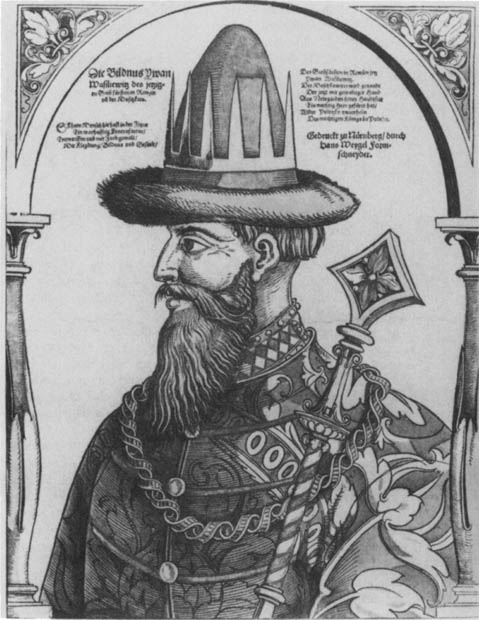
Seventeenth-century portrait of Ivan the Terrible. (Courtesy British Museum)
Now, in the Sretinsky Monastery just outside of Moscow, in the presence of the richly robed priests and the Metropolitan, he appeared as a figure of martial dignity and magnificence. He was wearing full armor: plumed helmet, brightly polished cuirass, greaves, gantlets, all the accoutrements of a warrior. Makary addressed him in a welcoming speech of inordinate length, with many quotations from many texts. He called upon God to witness the splendor of Ivan who had saved the Orthodox people and the Orthodox churches from the depredations of the Tatars. “The grace of God has been with you, as it was with all the ancient rulers who were favored by God,” he said, and went on to speak of Ivan’s ancestors, beginning with Constantine the Great and going on to Alexander Nevsky and Dmitry Donskoy. Then the Metropolitan and all the priests knelt before Ivan.
The time had now come for Ivan to change his role. He exchanged his shining armor for the robes of a Tsar. The jeweled fur-lined crown of Monomakh was placed on his head and the royal breastplate called the barmy, inset with jewels, hung from his shoulders. In addition he wore on his breast a jeweled cross that contained a small fragment of the True Cross. He entered Moscow in a blaze of jewels.
The solemn processions continued. In the Uspensky Cathedral he prayed before the icons and at the tombs of St. Peter and St. Iona, who were Metropolitans of Russia. In the Cathedral of Michael the Archangel he prayed at the tombs of his ancestors. One by one he visited all the churches in the Kremlin, for this was expected of him and he rejoiced in these liturgical processions. Only when he had performed all his religious duties did he permit himself the pleasure of seeing his wife and newborn son.
Anastasia lay in bed in the Kremlin Palace. He praised her for giving birth to his son and she praised him for conquering Kazan. This is all that the chroniclers tell us. We can therefore deduce that he closed the doors and permitted no one to observe him when he saw his wife for the first time in many weeks.
For a week he remained in seclusion, and then on November 8, 1552, he celebrated the victory with a banquet in the Granovitaya Palata attended by the Metropolitan Makary, all his generals, and all the great officers of state. The banquet lasted three days. He rewarded all who had helped to bring about the victory, and accordingly the first gifts went to the Metropolitan, the bishops, and the clergy, whose prayers had powerfully influenced the course of battle. An honor roll was drawn up, listing the names and titles of those who had fought most bravely, the great deeds they had accomplished and the wounds they had suffered. The names were read out and the soldiers were led up to the Tsar’s high table to be rewarded with gifts. These gifts took many forms. A soldier might receive a horse, another a suit of armor, another a velvet robe embroidered with gold and trimmed with sable. Many received jeweled Italian drinking cups and gold goblets, while others received estates and governorships. All together, in those three days, the Tsar gave away money, furs, robes, goblets, horses and armor worth 48,000 rubles. “No man had ever seen such splendor, so much celebration and merriment and generosity in the Kremlin Palace,” wrote the chronicler.
All Russia rejoiced, and all through the winter the battle of Kazan was the main topic of conversation. Ballads were written about it, legends accumulated round it, the story of the battle assumed the dimensions of an epic describing the forces of light overcoming the forces of darkness. More than Alexander Nevsky or Dmitry Donskoy, Ivan was exalted in the Russian imagination. A mere youth, almost single-handed, he had overcome the Asiatic hordes and cast off the Tatar yoke, which had pressed heavily on the Russians for two and a half centuries. If he had accomplished nothing else in his life, the Russians would have been profoundly grateful.
This was a moment of grave importance in Russian history. Soon the Russians would extend their power beyond Kazan and take possession of the Khanate of Astrakhan at the mouth of the Volga, and beyond the Volga lay Siberia. They would reach down to the Crimea and westward toward the Baltic, never content until they had pushed back their boundaries to the farthest possible limit. Russia would become an imperial power, ruling over many nations and countless tribes. Ivan was the true founder of this empire, which would always bear the imprint of his character, his violence, his rages, his towering ambitions, his pride and strange humility.
Now more than ever he was determined to rule as an autocrat, independent of the nobles and boyars. One day, shortly after the conquest of Kazan, he addressed them, saying, “God protected me from you! I could not torment you while Kazan stood on its own. I needed you for all manner of things, but now I am free to inflict upon you my torment and my wrath!”
Many of his councillors observed this new authoritarian manner with misgivings. Men like Adashev and Sylvester were deeply disturbed, and not only because their positions were threatened. Sylvester was still Ivan’s spiritual adviser. Ivan still relied heavily on Adashev’s counsel, but he was becoming increasingly reserved and remote. The poison of absolute power was working on him.
In December he journeyed again to the Troitsa-Sergeyevsky Monastery for the baptism of his son, who was given the name Dmitry. The christening took place at the tomb of St. Sergius, thus insuring a long, godly, and prosperous life for the boy, or so Ivan believed. He was accompanied by Anastasia, his brother Yury, and his cousin Vladimir of Staritsa.
There were more baptisms during the following months. The six-year-old Utemish Guirey, who had inherited the Khanate of Kazan only to be replaced by Khan Shigaley, was baptized by the Metropolitan Makary in the Chudov Monastery and given the name Alexander. After the ceremony the boy solemnly dined with the Metropolitan and was then taken to Ivan, who proclaimed that the boy should henceforth live within the Kremlin Palace. His policy was to keep a cautious eye on all claimants to the throne of Kazan, since he was himself the Tsar of Kazan.
During the same month Yediger Makhmet, the last Khan of Kazan, informed the Metropolitan that he would like to be baptized and to enter the Christian faith. To make sure that the Khan’s request was sincere, the Metropolitan arranged that he should be closely interrogated by priests for a number of days, but they found no evidence that he was embracing the faith because it was politically expedient. The Metropolitan reported the priests’ findings to Ivan, who received Yediger Makhmet and embraced him. On February 26, 1553, the convert to the faith, wearing only a white linen shroud, walked out of the Tainitskaya Gate in the deep snow, and in the presence of Ivan, Yury, Vladimir of Staritsa, and the Metropolitan Makary he was led across the frozen Moskva River to a place where the ice had been chopped away. He was asked whether he had changed his faith through compulsion and replied, “I desire sincerely and with love to worship Jesus. As for the false Mohammed and his evil book I curse them!” He then entered the icy water and was baptized under the name of Simeon. A large house within the Kremlin walls was set aside for him, and a retinue of servants was provided for him.
Thereafter Khan Simeon occupies only a minor place in the history of the Russian court. As a Khan, he was permitted to have his own courtiers and a boyar called Ivan Zabolotsky acted as his chief adviser and reported directly to the Tsar. He was treated like royalty, but had no power.
In this way the rebellious Tatar Khans were appeased, becoming as gentle as lapdogs. They were reduced to insignificance while retaining all the outward panoply of power. They were merely decorations at the Tsar’s court.
A few days later, perhaps because he caught a cold during the Khan’s baptism, Ivan took to his bed. The monkish chronicler wrote in March 1553: “Because of our ingratitude and our many sins the Orthodox Tsar was visited with a fiery sickness.”
This fiery sickness, probably a virulent form of pneumonia which brought him within an inch of death, was one of the most shattering events in Ivan’s life. It profoundly affected his attitude toward the many members of his court who refused for various reasons to swear allegiance to the Tsarevich Dmitry and it reduced him to helplessness at a time when he had hoped to exert the full powers of an autocrat. Terrible suspicions were awakened in his exhausted brain, as he fought with his illness. He had always been a suspicious man, who was inclined to see people in the worst possible light, and during his illness he grew even more suspicious, more resentful, and more cunning. His illness was a nightmare from which he emerged like a man clothed in the colors of a nightmare.
The chronicle known as the Tsarstvennaya Kniga contains the statement that Ivan suffered from a fiery sickness, and there are somewhat lengthy additions, which some scholars believe were written by Ivan in his own hand or at his dictation by his personal secretary Ivan Viskovaty, and these additions can be dated fairly accurately, being not earlier than the summer of 1566 and not later than the summer of 1570. From this document, from the letters of Ivan and Prince Kurbsky, from the deposition of Prince Simeon Rostovsky after his arrest, and from other sources it is possible to put together an account of what happened during the Tsar’s sickness.
Here are the words written into the Tsarstvennaya Kniga by the Tsar or his secretary:
After the baptism of Khan Simeon of Kazan on Wednesday March 1, 1553, the Tsar fell ill. The illness was very serious, and it was difficult for him to recognize people. He was so ill that many believed he would die. The Tsar’s secretary Ivan Mikhailovich Viskovaty took it upon himself to remind the Tsar about his will, which the sovereign always kept handy. The Tsar gave orders that the will should be completed, signed and dated.
When all this was done, Viskovaty reminded the Tsar about the oath of allegiance to the Tsarevich Dmitry which should be sworn by Prince Vladimir of Staritsa and the boyars. The same evening the following boyars gave their allegiance to the Tsarevich: Prince Ivan Fyodorovich Mstislavsky, Prince Vladimir Ivanovich Vorotynsky, Ivan Vasilievich Sheremetev, Mikhail Yakovlevich Morozov, Prince Dmitry Fyodorovich Paletsky, the secretary Ivan Viskovaty, and also the boyars Danilo Romanovich Zakharin, Vasily Mikhailovich Zakharin, and also the nobles who took part in the Council, Alexey Fyodorovich Adashev and Ignaty Veshniakov. . . .
These were all members of the Chosen Council. Mstislavsky and Vorotynsky were among Ivan’s commanders at Kazan, Paletsky was the father-in-law of Ivan’s brother Yury, and Danilo Zakharin was Anastasia’s elder brother. Later in the evening it transpired that two other members of the Chosen Council, Prince Dmitry Kurliatev and the treasurer Nikita Funikov, were both ill, or pretended to be ill, and therefore were unable to swear the oath of allegiance.
Many boyars and nobles were reluctant to take the oath. There were rumors that Prince Vladimir of Staritsa was being pushed forward by his mother, Princess Efrosinia, as a candidate for the throne and they were supporting him either because they genuinely admired him and wanted him to be Tsar after Ivan’s death or because—this was a more powerful argument—the death of Ivan and the elevation of the infant Dmitry to the throne would inevitably bring about the regency of Anastasia with all her relatives in positions of power. Prince Vladimir’s role is obscure. According to the chronicle, he frequently visited Ivan during his illness, but the boyars grew suspicious of him and finally kept him away from the bedroom “in order to safeguard the throne.” Sylvester thought he behaved quite normally and defended him. In his deposition written in 1554 Prince Simeon Rostovsky wrote:
At the time of the Tsar’s illness in March 1553, we were all discussing what we would do if the Tsar died. A messenger arrived at my house from Princess Efrosinia and Prince Vladimir of Staritsa,2 asking me to go and serve Vladimir of Staritsa and win over people to his side. I discussed the matter with many boyars and we thought that if we served the Tsarevich Dmitry, we would be ruled by the Zakharins, and rather than be ruled by the Zakharins, we would serve Prince Vladimir of Staritsa, and there were many boyars and princes who felt this way.
The names of the boyars who preferred to serve Vladimir of Staritsa are known. They were not self-seekers, but people who were distressed at the thought of having to live under another regency so soon after the regency which took power during Ivan’s minority. Some straddled the fence, offering to swear allegiance to the Tsarevich but not to the regency. Thus Fyodor Adashev, the father of Ivan’s close friend and adviser Alexey Adashev, said: “God knows, and so dost thou, O Tsar, that we kiss the Cross for thy sake and for the sake of thy son the Tsarevich Dmitry, but we shall not serve the Zakharins, Danilo and his brothers. Thy son, O Lord, is still in swaddling clothes, and therefore we shall be ruled by the Zakharins, Danilo and his brothers, and we have suffered enough from the boyars during thy minority.”
To the Tsar, suffering from a raging fever, so weak that he could not stand and could scarcely speak, such speeches smacked of treachery. All he had lived for, all he had fought for, was now in jeopardy. He believed he was dying among traitors. In his agony heheld fast to one thought: Dmitry must rule. Finally, summoning all his strength, Ivan addressed the refractory boyars. He said:
If you will not kiss the Cross in allegiance to my son Dmitry, it means you have already found another sovereign. But you kissed the Cross more than once to swear allegiance to me, thus promising that you would seek no other sovereign than me.
I hold the Cross to you, and I command you to serve my son Dmitry, not the Zakharins. I cannot speak much more. You have forgotten your oaths, because you do not want to serve me and my children. You no longer remember what you once swore to uphold. Those who refuse to serve a Tsar in swaddling clothes would not wish to serve him when he grows up. If you reject me, then let it be on your souls!
The Tsar was desperate for certainties, but there could be no common ground between “Dmitry must rule” and “the Zakharins will rule.” It occurred to him that Anastasia and Dmitry were in mortal danger, and so he turned to those who had sworn allegiance to him the previous evening, and said:
Yesterday you swore allegiance to me and my son Dmitry, but there are boyars who do not wish to see my son on the throne. If God wills that I should pass away, then remember your oath to me and to my son. Do not let the boyars use any means to destroy my son, but flee with him to a foreign land, which God will show you!
Finally in his distress the Tsar turned to the Zakharins, his brother-in-law Danilo and Vasily, who was Danilo’s first cousin, and pleaded with them to save the lives of Anastasia and his son:
And you, Zakharins, why are you so fearful? Do you imagine the boyars will spare you? No, you will be their first victims! You should sacrifice your lives for my son and for his mother, and you should not let my wife suffer indignities at the hands of the boyars!
These last words had the effect of silencing the quarreling boyars, for the Tsar’s rage was terrible to watch, and he had never before spoken so nakedly. One by one they left his bedside and made their way into the anteroom, where they kissed the Cross in allegiance to the Tsarevich Dmitry. Some days later, when the Tsar had recovered from his sickness, Vladimir of Staritsa and his mother also swore allegiance to the Tsarevich.
For Ivan those days of sickness were fraught with terror, and he remembered them vividly in years to come. He had seen treachery when he thought he was dying; he had imagined his wife and son dead; was the autocrat of all Russia so weak that he could not even safeguard his own son? The quarrel was over in a few days, for his sickness lasted little more than a week, but it left wounds that never healed. Henceforth he would distrust everyone, even those who were closest to him.
His relationship with Vladimir of Staritsa was severely strained, and though they sometimes appeared together at court functions the old easy companionship was now a thing of the past. In the autumn of 1577, nearly twenty-five years after his illness and eight years after he had ordered the execution of Vladimir, Ivan still remembered his old hurts. Writing to Prince Kurbsky, who had by this time become his sworn enemy although at the time of the illness he was one of those who professed their loyalty to the Tsarevich, he said:
Tell me why did you want to place Prince Vladimir on the throne and remove me and my children? Did I ascend the throne by robbery or by bloody feats of arms? I was born to rule by the grace of God, and I do not even remember my father bequeathing the Kingdom to me and blessing me. I grew up on the throne. Then why should Prince Vladimir be sovereign? He was born from the fourth appanage prince.3 What qualifications did he have for ruling? Where did he stand in the order of succession? His only claim was your treacherous support of him and his own stupidity. What was my guilt before him?
The Tsar’s guilt, real or imagined, and the guilt of others preoccupied him. The treachery and stupidity of others was also a subject of immense concern to him. In his own eyes he had never offended Prince Vladimir of Staritsa. Why, then, had the prince attempted to snatch the throne from him?
It was partly because he was so deeply aware of his own guilt that Ivan went constantly on pilgrimage to the holy places and fervently kissed the icons and relics. During his sickness he swore that if he recovered he would go on pilgrimage to the Kirillov Monastery at Beloozero, far in the north. (St. Kirill had been one of the disciples of St. Sergius.) To this monastery Ivan’s mother had traveled before he was born, to pray for the birth of a son. By making the same pilgrimage he was returning to the source of his own life, praying to be born again with new strength, his sins washed away through the intervention of the wonder-working saint. This pilgrimage would mark a new beginning of his life.
Nearly all his advisers attempted to dissuade him from making this long pilgrimage. They argued that it was unwise to undertake an arduous pilgrimage so soon after his illness, and the Tsarevich was too young to accompany him. Fighting had broken out near Kazan, with the Tatars gaining the upper hand. Kazan was in danger; the forest of Arsk was once more a refuge for a Tatar army who had built a new fortress deep in the interior. Sviazhsk, too, was under attack. These uprisings demanded his presence in Moscow. There were many other reasons why he should remain in Moscow, but Ivan rejected all of them. He had made up his mind. No one could dissuade him from undertaking a journey so close to his heart.
He took with him the people he liked and trusted most. Anastasia, his brother Yury, Danilo and Vasily Zakharin, Prince Ivan Mstislavsky, Prince Andrey Kurbsky, and Alexey Adashev were his companions on the journey. He also took with him his confessor, the Archpriest Andrey Protopopov, who had accompanied him to Kazan. Significantly, Vladimir of Staritsa did not accompany him.
The first stop was the Troitsa-Sergeyevsky Monastery, where Ivan visited the cell of Maxim the Greek, an old scholar who had been brought to Russia by the Grand Prince Vasily III to translate church books. Maxim was an ascetic, stern and uncompromising, and he had set his face against the monastic ownership of land. He had also corrected many errors in the Russian translations of Greek texts, to the confusion and consternation of Russian theologians, who found reasons for putting him on trial as a heretic. He was exiled and received the treatment reserved for heretics, being chained to the wall in a small cell and fed only when his jailers remembered him. Finally the Metropolitan Makary interceded for him, and Ivan gave orders that he should be permitted to stay at the Troitsa-Sergeyevsky Monastery.
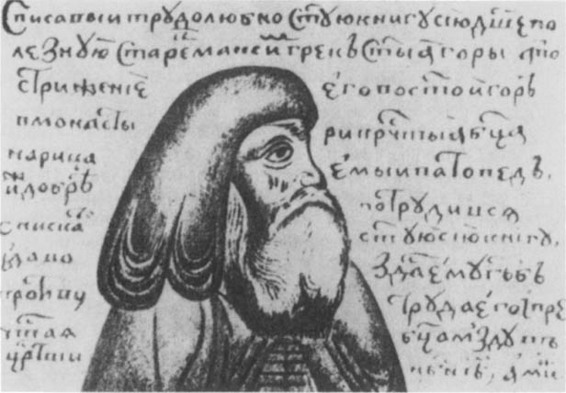
Maxim the Greek. (From a contemporary manuscript)
Maxim was a very old man by this time, and was believed to possess extraordinary spiritual powers. Ivan visited him to obtain his blessing, and instead received a rebuke. What particularly disturbed Maxim was that Ivan had promised faithfully to look after the widows and orphans of the soldiers killed at Kazan, and had done nothing at all. He was also disturbed because Ivan insisted on making a pilgrimage to the far north with his wife and seven-month-old child.
Prince Andrey Kurbsky, who had a high regard for Maxim and knew him well, has left an absorbing account of the meeting between the saintly Maxim and the formidable young Tsar. Here Maxim explains to Ivan that he is undertaking the pilgrimage for the wrong reasons:
You made a vow that you would pray to St. Kirill to intercede for you with God, but such vows are not in accordance with wisdom. For the following reason: When you were waging war against the proud and strong Muslim kingdom, many who fought strenuously for the Orthodox faith were slaughtered by the infidels, their wives were widowed, their children orphaned, their mothers left without sons, and they could only grieve and lament. You would be far better advised to reward these people and put their affairs in order, comfort them in their sorrows and troubles, and summon them to your capital instead of fulfilling vows that are contrary to reason.
Know that God is everywhere, He accomplishes all things, He sees all places with His sleepless eye, as the Prophet sayeth: He that keepeth Israel shall neither slumber nor sleep.4 And another Prophet sayeth: The eyes of the Lord are seven times brighter than the sun.5 Likewise not only does St. Kirill see in the spirit, but also all the spirits of our just forefathers, whose names are inscribed in the heavens and who now serve before the throne of the Lord, for they possess the clear-sighted eyes of the spirit, which see more from on high than the rich in Hell; and they pray to God for all men who dwell on earth, especially those who repent from their sins and willingly turn away from their transgressions to God.
Maxim was displeased because Ivan showed no intention of departing from the way of the transgressor. Why did he want to go to St. Kirill, when he could pray directly to God here at the Troitsa-Sergeyevsky Monastery, or in the Kremlin, or anywhere he pleased? An ostentatious pilgrimage would not bring him nearer to God, and abandoning widows and orphans would only remove him from God’s sight.
Suddenly the old priest became a figure out of the Old Testament uttering prophecies. Ivan had been saying, “I must go to St. Kirill, I must go to St. Kirill,” like a man obsessed. Maxim turned on him and said:
If you do not harken to me when I advise you according to God, if you forget the blood of the martyrs slaughtered by the infidels when fighting on behalf of Orthodoxy, if you overlook the tears of the widows and orphans, if you set forth stubbornly on your pilgrimage, then know that your son will die and will not return from thence alive. But if you harken to me, then both you and your son will enjoy health.
It was an age when many priests and saints uttered prophecies, and Ivan appears to have paid little heed to these dramatic words. According to Prince Kurbsky, Maxim was so convinced of the truth of his prophecy that he repeated it to four people intimate with the Tsar, begging them to remind the Tsar that the Tsarevich was in grave danger. The four people were the Archpriest Andrey Protopopov, Prince Ivan Mstislavsky, Alexey Adashev, and Prince Kurbsky himself. “But the Tsar paid no attention to these words, and went on his way.”
So the pilgrimage continued through the thickly wooded and marshy region north of Moscow, sometimes on horseback, sometimes by riverboat, sometimes on foot. Whenever possible, they spent the night in a monastery, and there was much kissing of relics and icons and usually there were special services to celebrate the Tsar’s arrival. One of the monasteries they visited was the Pesnoshsky Monastery near the city of Dmitrov. The monastery lay in a low swampy hollow near the river and Prince Kurbsky felt grave misgivings as they approached the place because it was the residence of Vassian Toporkov, formerly bishop of Kolomna, who had been deposed for acts of cunning and cruelty ten years earlier. At all costs Toporkov was determined to get into Ivan’s good graces.
According to Prince Kurbsky, everything happened exactly as though “the devil had aimed directly at the heart of the Tsar.” Ivan entered the monk’s cell and asked the question uppermost in his mind: “How may I rule in order to make my great and noble subjects obedient to me?” Toporkov answered: “If you wish to be an autocrat, do not let a single councillor wiser than yourself stand near you. Be firm, and you will hold all men in the hollow of your hands.” Ivan kissed the monk’s hand and said: “If my father were alive, even he would not have given me such sound advice.”
The prophecies of Maxim were forgotten in the happy contemplation of Toporkov’s celebration of absolute autocracy.
By way of Uglich, the upper reaches of the Volga and the Sheksna River, they came at last to the Kirillov Monastery. The monastery, which was built around the relics of St. Kirill, was immensely rich. It was a fortress, a trading post, almost a principality, possessing vast landed estates, warehouses, shops, and ships. Trade in fish and salt kept Beloozero alive, and much of this trade passed through the hands of the monks.
They arrived by ship outside the monastery walls and set up tents between the monastery and the river Sheksna. It was June, and pilgrims were coming from all over Russia to pray at the Saint’s shrine. There was a special service to honor the Tsar’s coming, and afterward Ivan distributed gifts to the monks. He visited the nearby Ferapontov Monastery, which was famous for the great swirling frescoes painted by Dionysius earlier in the century, and went on to visit other monasteries and hermitages. He stayed only a few days at Beloozero, and then gave the order to return to Moscow.
While they were boarding the ship which would take them down the Sheksna River on the first stage of the return journey, there took place an event so extraordinary and so unexpected that it seems to belong to legend rather than to history. A nurse carrying the Tsarevich Dmitry stumbled near the landing stage, and Dmitry fell out of her arms into the river. The child was quickly pulled out of the water, but was already dead.
The prophecy of Maxim the Greek was fulfilled at the very moment when they were leaving Beloozero. Lightning had struck out of a cloudless sky.
Slowly, sunk in hopeless grief over the death of the heir to the throne, Ivan returned to Moscow.
In a chastened mood, he continued to conduct affairs of state with the help of the Chosen Council. He was now disposed toward forgiveness, and the Chosen Council was disposed to practice moderation and compromise. There were no reprisals against those who failed to kiss the Cross and swear allegiance to the Tsarevich. The proud Ivan had given way to the humble and God-fearing Ivan, who realized obscurely that God had His own mysterious reasons for taking away his infant son.
In November 1553 Khan Simeon of Kazan, the former Yediger Makhmet, married Maria Kutuzova, who belonged to an ancient and noble Moscow family. At the wedding many nobles who had been reluctant to swear allegiance to the Tsarevich were present. Already, in June 1553, Fyodor Adashev, the father of Alexey Adashev, had been promoted to the rank of boyar in spite of his behavior at the time of Ivan’s illness. It was an unprecedented appointment, for the rank of boyar was the prerogative of the great nobility, while the Adashevs belonged to a good but modest noble family.
Sylvester remained a powerful influence at court, and there was a complete reconciliation with Prince Vladimir of Staritsa. The processes of reconciliation could scarcely have gone further. Another child was on the way, and Ivan’s grief was tempered by the knowledge that there might soon be another Tsarevich. On March 28, 1554, Anastasia gave birth to a son, who was given the name of Ivan. The baby was carefully measured and his exact measurements were marked on a board. Later, on this board, there was painted an icon depicting the boy’s saint. This was St. John Climacus, whose church stood within the bell tower of Ivan the Great in the Kremlin.
The birth of an heir to the throne was an occasion for rejoicing all over Russia. Messengers were sent in all directions to announce the glad tidings and well-wishers flocked to the palace to congratulate Anastasia, saying, “We are happy with you.” Monks and hermits came to bless the newborn child and were feasted at the royal table. The prisons were opened. Soon Ivan and Anastasia were journeying on foot to the holy shrines to render thanks to God and the saints for the favor they had received, bringing sumptuous gifts to the monasteries and dispensing alms to the poor.
Very little is known about the upbringing of the Tsarevich Ivan. One day, when he was about two years old, he was sitting on the lap of his nurse Frosinia when something very strange happened—the jar of holy water on the shelf behind her began to froth and bubble, making curious sounds. The nurse jumped up with the Tsarevich in her arms, lifted the lid of the jar, and watched the holy water pouring out. Obviously this was a miracle, perhaps directed toward the Tsarevich, and she poured the water over the boy, saying: “May this mercy shown by God bring long life and happiness to your noble parents and to you, my lord, and to all the kingdom.” News of the miracle reached Anastasia, who came hurrying to see the jar. Once more the holy water bubbled out, and she poured it over her face and body. Soon everyone in the palace heard about the miracle and came hurrying to wash themselves in the holy water.
A few weeks after the birth of his son Ivan received welcome news. He was staying with his family on the Kolomenskoye estate when a courier arrived with a letter from Prince Yury Shemiakin-Pronsky announcing the fall of Astrakhan at the mouth of the Volga. He learned that the Russian army had entered the city unopposed; the people had fled; the Khan of Astrakhan was in full flight. The Russians now commanded the full length of the Volga River and could sail across the Caspian at will. The Metropolitan was staying at Kolomenskoye and a solemn thanksgiving service was immediately held in the small and beautiful Church of the Ascension built by Ivan’s father to celebrate the birth of his son. Some weeks later Prince Shemiakin-Pronsky reached Moscow; he brought with him the captured wives of the Khan and was richly rewarded. At that moment it seemed that all of Tatary would inevitably fall to Russian arms.
In May of this year Ivan wrote his will, which was witnessed by Makary. The will proclaims that in the event of the Tsar’s death Prince Vladimir of Staritsa will become regent, and in the event of the death of the Tsarevich in childhood Prince Vladimir will become the lawful successor to the throne. Formerly Ivan was concerned to prevent the prince from ever ascending the throne. Now he saw that there might be no alternative. A curious clause in the will demanded that Prince Vladimir, if he should become regent, should not spare his own mother if she were to attempt some mischief against Anastasia and her son. Another clause demanded that the prince should keep no more than a hundred soldiers in his Moscow palace. He was to rule “without being vengeful and without partiality,” and at all times he must consult with the Metropolitan, the Boyar Council, and Anastasia.
In this way Ivan attempted to insure that after his death his wishes would prevail. While the will testified to a certain magnanimity, it also acknowledged a fact that had become especially apparent after the death of the Tsarevich Dmitry—the fact that he had very few options.
The goddess of Irony, who presides over Russian history, also presided over the will. As we shall see, Anastasia soon died, and Ivan murdered both his son and Prince Vladimir of Staritsa. The will therefore fell into abeyance and became one more of those documents which gather dust on the shelves of history and are remembered only because they illuminate the hopes and fears of a monarch confronted with the problem of the succession. From time to time we shall see him wrestling with the same problem, but with little success. It was as though he knew in his heart of hearts that the dynasty would die with him.
1 Anastasia and Ivan had six children in all: Anna, born August 10, 1549, died July 20, 1550; then Maria, born March 17, 1551, the exact date of her death being unknown; then Dmitry, born October 1552, died June 1553; then Ivan, born March 28, 1554, died November 19, 1582; then Evdokia, born May 11, 1556, died June 1558; then Fyodor, born May 11, 1557, died January 1598. Only the last of his six children survived him.
2 In Eisenstein’s film Ivan the Terrible Vladimir of Staritsa appears as a simpleminded youth without any talents, the victim of his mother’s ambitions. He was an intelligent, forthright man, not in the least simpleminded, and for a long time he had been Ivan’s inseparable companion.
3 Vladimir’s father, Andrey of Staritsa, was the fifth son of the Grand Prince Ivan III. The eldest son Vasily became Grand Prince and the father of Ivan the Terrible. Andrey of Staritsa was thus the fourth appanage prince, and his son Vladimir could claim only a very remote place in the order of succession.
4 Psalm, CXXI, 4.
5 Ecclesiasticus, XXIII, 19.