
Lenin had gained power with incredible ease. Without barricades, bloody encounters or intervention, state power had been transferred to the party that had promised to make the people happy by bringing them peace, land and liberty. According to the Marxist canon, everything was going to be simple: private property would be abolished, the bourgeois state smashed, the army replaced by an armed militia, the workers (‘even the cooks’) put in charge, secret treaties published, self-determination of the nations proclaimed, strict social control established, and the dictatorship of the majority confirmed. Everything, or so it seemed, had been foreseen by Lenin. All that remained was to build the socialist edifice according to the blueprint.
In reality, there was famine, factories went on strike, gangs held sway in many parts of the country, the peasants hid their grain, and the army disintegrated of its own accord. As far as the war was concerned, the Germans had moved in September to consolidate their position on the Baltic, and posed a certain threat to the Petrograd region, but since their strategy of removing Russia from the war in order to be able to concentrate on the western front looked like being successful, the war on the Russian front virtually came to a standstill at the time of the Bolshevik seizure of power. In any event, an armistice was quickly agreed, in December 1917, and the Germans' ambitions in the east could wait until they had settled accounts with the Allies in the west, or so they hoped. Meanwhile, Russia descended into chaos.
Lenin soon realized that ‘victory over the old world’ was impossible ‘without the dictatorship of the proletariat and an iron hand’.1 To this end, labour conscription was introduced, the bourgeoisie were subjected to repeated requisitioning, their apartments were packed out with new tenants, they were ‘purged’ from institutions and put under constant threat of new and worse punishments. A barracks mentality gradually took over in the endless commissariats, offices, Soviets and proletarian bodies.
Trotsky recalled that when Shteinberg, the Left SR Commissar of Justice, protested against the use of violence and repression as a means of settling social problems, Lenin exclaimed: ‘Surely you don't think we'll come out as the winners if we don't use the harshest revolutionary terror?’ Lenin took every opportunity to ram home the message that terror was inevitable. A dozen times a day he would fire off tirades against anyone suspected of pacifism: ‘If we can't shoot a White Guard saboteur, what sort of great revolution is it? Haven't you seen what the bourgeois garbage are writing about us in the press? What sort of dictatorship is this? All talk and no action.’2
With typical persistence, Lenin hammered home the need to toughen the dictatorship ‘to save the revolution’, until gradually his regulations for using the iron hand became standard Bolshevik practice. To be sure, he was often pushed into adopting harsh measures by the disasters which threatened, above all the famine, caused by the dislocation of Russia's supply system as a result of three years of war, together with reduced production. In effect, Lenin believed that terror would save the country from starvation. The food ‘must be taken from the rich’. Black marketeers must be shot. He also urged the masses to act independently, by which he meant they should carry out their own searches and confiscate food: ‘As long we do not use terror—i.e. shooting black marketeers on the spot—we'll get nowhere.’ Looters should be similarly dealt with, while ‘the better-off should be left without food for three days, as they have stocks’.3
There would seem to be three elements which explain why a man with Lenin's understanding of humanitarian principles could embrace violent methods. First, he simply lost his head when confronted by an avalanche of problems. Nothing more than an émigré intellectual a few months earlier, with no practical experience beyond controlling a Party faction, he had been cut off from the grim realities of life in Russia. As his first acts show, he had no idea how to deploy his time and responsibilities: personally authorizing an apartment for an old Bolshevik, or sending aid to a village outside Moscow, setting up the management of the Sovnarkom canteen and making endless propaganda speeches. The levers of the state machine, such as it was, were in harsh but inexperienced hands. Many of Lenin's telegrams portray his loss of control, even if only temporary. For instance, he cabled Antonov-Ovseenko and Dzerzhinsky in Kharkov: ‘For God's sake, take the most energetic and revolutionary measures to send grain, grain and grain!!! Otherwise [Petrograd] could expire. [Use] special trains and troops. Collect and load. Escort the trains. Inform us daily. For God's sake!’4 This was a cry of desperation, loss of control and panic, the partners of coercion.
The second element is that the Bolsheviks observed their own scale of moral values. Lack of pity, class hatred and Machiavellianism were to them the highest revolutionary virtues. Lenin even stooped to hostage-taking, decreeing that ‘in every grain-growing district, 25-30 rich hostages should be taken who will answer with their lives for the collection and loading of all surpluses’.5 The effect on the middle classes was utterly demoralizing.
The third element was that Lenin intended to use fear as a weapon. Terror would break the will to resist of millions. When V. Volodarsky, the People's Commissar for Press, Propaganda and Agitation, was assassinated by a Socialist Revolutionary in Petrograd in 1918, Lenin cabled Zinoviev: ‘This is im-poss-ible! The terrorists will think we're milksops. We have an extreme war situation. We must encourage energy and wide-scale terror against the counter-revolutionaries, especially in [Petrograd] as a decisiveexample.’6
Lenin cannot be accused of personal cruelty. His was more the social, philosophical cruelty of a leader. His main argument for the use of terror was that it was in the interests of the proletariat. In an article entitled ‘Plekhanov on Terror’, he wrote with seeming frankness about the difference between bourgeois and Bolshevik terror: The bourgeoisie ‘practised terror against the workers, soldiers and peasants in the interests of a small group of landowners and bankers, whereas the Soviet regime applies decisive measures against landowners, plunderers and their accomplices in the interests of the workers, soldiers and peasants’.7 Such an argument could be used to justify any crime perpetrated by the state. The leaders of the revolution had become priests of terror.
The Anatomy of Brest-Litovsk
To add to Russia's hunger, chaos and the rise of class terror, a new torture threatened: the possibility of a German advance, which could only be halted by signing the ‘indecent’ peace of Brest-Litovsk, a solution which in turn pushed Russia to the edge of a new time of troubles.
On 3 December 1917 the Bolsheviks established contact with the Germans, and by 22 December peace talks began. This was, after all, what the Germans had wanted when they helped Lenin. By early January the German side expressed its willingness to sign a peace treaty in exchange for major territorial concessions by Russia, namely the part of Poland held by the Russian empire until the war, the provinces comprising present-day Lithuania, and parts of what later became the Belorussian and Latvian republics, amounting to more than 150,000 square kilometres. The loss of territory in itself was bad enough, but it was the physical and human resources within that territory that more than anything else earned the treaty its title of ‘the indecent peace’. Soviet Russia gave up thirty-four per cent of her population, thirty-two per cent of her agricultural land, fifty-four per cent of all industrial plant and eighty-nine per cent of her coal mines.8 Lenin was in favour of signing such an accord, but at this point the Party became virtually split between the supporters of Lenin and the so-called Left Communists, led by Bukharin, who regarded the signing of this predatory treaty as a betrayal of the revolution.
Neither Lenin nor Bukharin was concerned by the loss of territory as such. Indeed, in the end Russia would be compelled to yield about one million square kilometres. In addition to the earlier demands, Russia would recognize the independence of Ukraine and cede three districts in the Caucasus to Turkey. Lenin's chief aim was to preserve his regime, or, in his words, the ‘gains of the revolution’. He would have been willing to give up Petrograd, and even Moscow itself, as long as his regime survived. ‘want to yield territory to the present victor to gain time. That's what it's all about, and only that … Signing a treaty in defeat is a way of gathering strength … If we were to wage a revolutionary war, as Bukharin wants, it would be the best way to get rid of us right now.’9 As for the Left Communists, they believed that by rejecting peace and calling for a revolutionary war, they could exploit the situation in Europe and provoke a continental conflagration. ‘The Russian revolution will either be saved by an international revolution, or it will perish under the blows of international capital,’ Bukharin said. He proposed ‘cancelling the peace treaty, as it gives us nothing, and then setting about proper preparations’ for a revolutionary war.10
The crisis was played out at the Seventh Party Congress in March 1918, at which Lenin was subjected to criticism as never before. Two reports were given, one by Lenin, the other by Bukharin. Lenin's speech contained little that he had not already said, with the same arguments about world revolution, the opinion that they might have to give up Petrograd and Moscow, that war with Germany was inevitable, and that the treaty was necessary to obtain a breathing-space of a day or two—even if it was going to cost a million square kilometres. It was above all the ‘breathing-space’ that was targeted by the Left Communists. Bukharin declared that it was not worth the candle, that the time would not suffice to discuss the sort of thing Lenin had in mind. ‘It won't be a breathing-space … but our own selfdestruction as the vanguard of the international socialist revolution. We should not pay such a price for a two-day breathing-space that will give us nothing.’11 Among Lenin's opponents, the Marxist theorist David Ryazanov remarked that Tolstoy had proposed making Russia into a peasant country of idiots, and now Lenin wanted to make it a peasant country of soldiers: ‘And we are tasting the fruits of that policy.’12
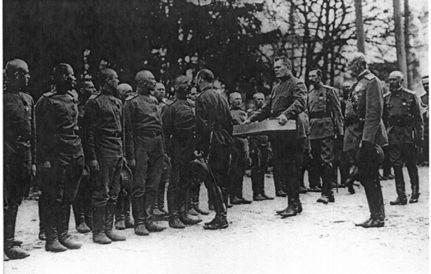
The Tsar awarding decorations, 11 April 1916.
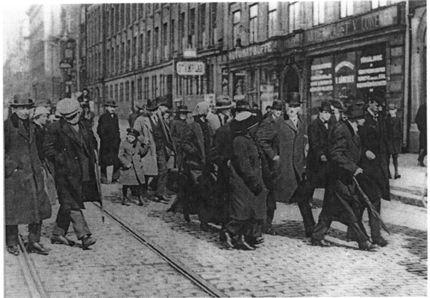
Lenin (with rolled umbrella) and the other political émigrés who travelled with him from Switzerland through Germany, in Stockholm before continuing their journey to Petrograd, April 1917. Zinoviev is seen holding his adopted son's hand (in Soviet publications this part of the picture was invariably deleted).
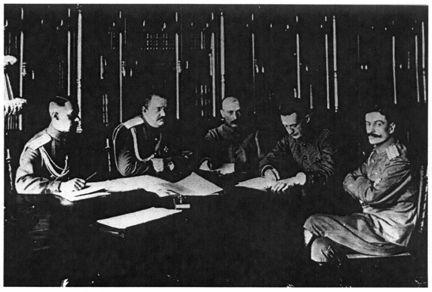
Above: Alexander Kerensky
(second from right)
presiding at a meeting in the
War Ministry, Petrograd,
21 August 1917.
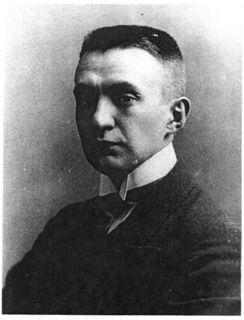
Right: Alexander Kerensky,
Minister of Justice, then
War Minister and Prime
Minister of the Provisional
Government between
February and October 1917.
He fled abroad after the
Bolshevik seizure of power,
and died in the USA in 1970.
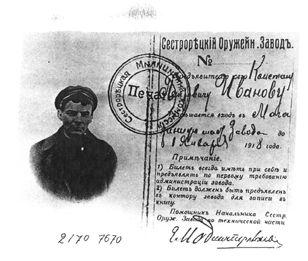
The false factory pass in the name of Konstantin Petrovich Ivanov, used by Lenin to cross the Finnish border in August 1917 to escape arrest by the Provisional Government.
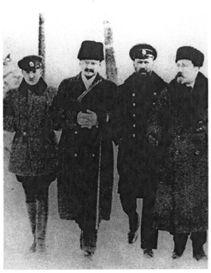
Trotsky with other members of the Soviet delegation during the peace negotiations at Brest-Litovsk in January-February 1918.
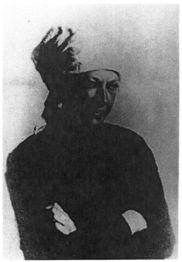
Nadezhda Krupskaya disguised as a female worker for her trip to see Lenin in hiding in Finland in the summer of 1917.
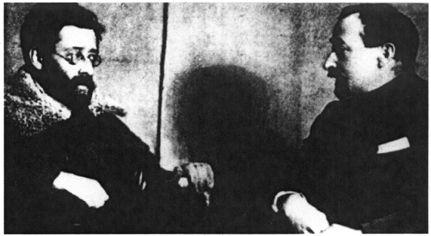
Two leaders of the Menshevik Party, Yuli Martov and Fedor Dan (his brother-in-law), in Petrograd in late 1917. Before the October revolution, they led different camps, Martov the internationalist, Dan the defencist, joining forces after the Bolshevik seizure of power.
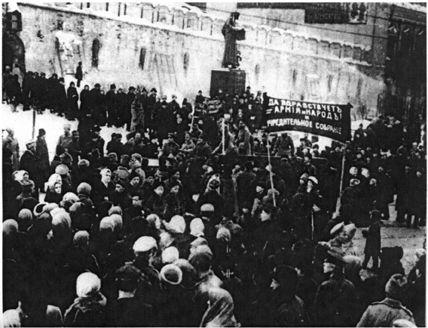
A demonstration in favour of the Constituent Assembly, Moscow, winter 1918. The Assembly had been elected by universal suffrage with a Bolshevik minority. It was dispersed by Bolshevik force at its first and only session in January 1918.
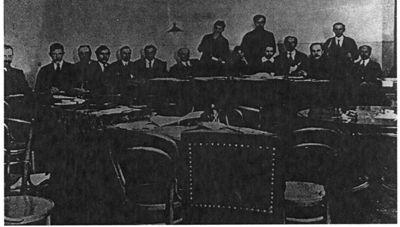
The first Soviet government, the Council of People's Commissars (Sovnarkom), in session in the Smolny Institute, Petrograd, 30 January 1918.
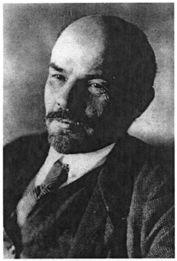
Above: Lenin in January 1918.
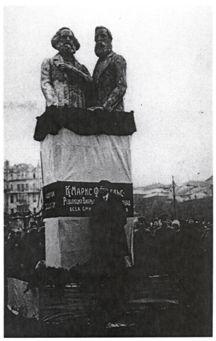
Right: Lenin making a speech at the
temporary monument to Marx
and Engels on Voskresensky Square
(renamed Revolution Square),
Moscow, 7 November 1918.
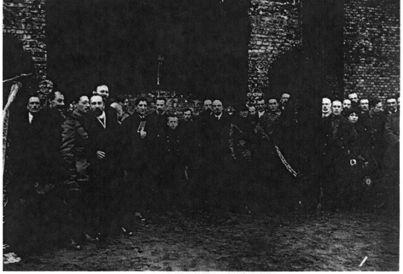
Above: At the Kremlin Wall,
7 November 1918. Lenin
is in the centre, Kamenev
is talking to Sverdlov
(in leather coat).
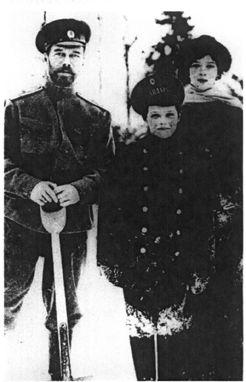
Right: The Tsar, his son
the Grand Duke Alexei,
and daughter the Grand
Duchess Tatiana in 1916.
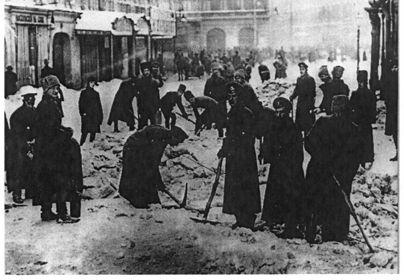
Former tsarist army officers perform compulsory labour service in Petrograd in 1918.
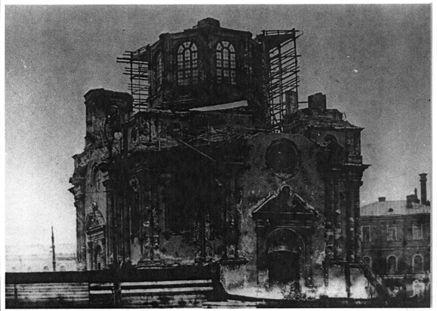
The destruction of Annunciation Cathedral, Petrograd, 1929, one of the many thousands of churches destroyed or converted to other uses.
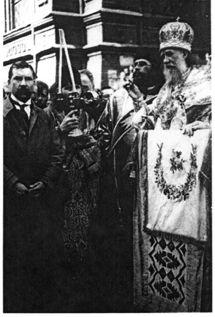
Above left: Patriarch Tikhon at
the Nikita Gate of the
Kremlin. Vasili Ivanovich
Belavin was appointed as
Patriarch by the Provisional
Government in 1917—the
first since the post was
abolished by Peter the
Great in 1721.
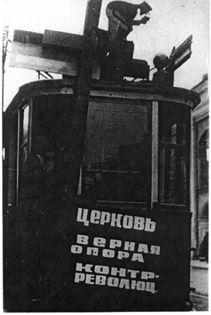
Above right: An ‘anti-Easter’
tram in Leningrad, 1932.
The poster reads, ‘The
church is the true support
of counter-revolution’.
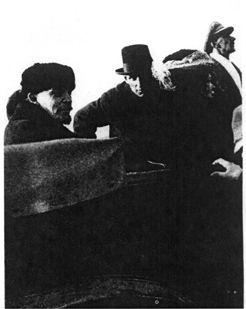
Right: Lenin with his
sister Maria in Moscow,
1 May 1918.
Lenin replied to his critics that ‘the treaty is not a capitulation’, but merely a manoeuvre, a tactical device to gain time and save the regime. In the end, he won the day by thirty votes to twelve. Had Trotsky, whose position was crucial, supported the Left Communists instead of remaining neutral, more of the delegates might well have swung behind the ‘revolutionary war’ platform. Undoubtedly, Lenin's personal authority played a great part. In any event, he added an important amendment which the Congress passed unanimously, namely that the Central Committee was empowered to annul the treaty should it see fit. He ensured that both the decisions of the Congress and all materials related to it be kept secret, and he even had all the delegates sign an undertaking not to talk openly about the debate in detail, apart from the single point that ‘Congress is in favour of the peace treaty’. He plainly did not want the criticisms of his position exposed, knowing that to the ordinary citizen it would appear unpatriotic, especially as only months earlier he had been labelled a German spy.
Lenin also proposed that the capital be transferred from Petrograd to Moscow, a clear sign of retreat before the threat of German occupation. Zinoviev added that the move was only temporary, ‘for the Berlin proletariat will help us move it back to Red Petrograd’. Prudently he added that, ‘of course, we cannot say when that will happen. Maybe we'll have to move the capital to the Volga or the Urals; it's a matter that will be determined by the state of the world revolution.’13 On Saturday 9 March 191814 all senior government officials received messages informing them that the departure for Moscow would take place the next day at 10 a.m. sharp from the Tsvetochnaya platform. Details for finding the point of departure were most precise: ‘Tsvetochnaya railway halt is located beyond the Moscow Gates. After one block past the Gates, turn left onto Zastavskaya Street, then at the canvas-covered fence turn right. Near this turning is the Tsvetochnaya platform, where the train will be waiting. Try as far as possible to bring your baggage to the station before departure, using telephone number 1-19 in good time in case of emergencies; use motor cars …’ The order was signed by the Sovnarkom Administrator of Affairs, Vladimir Bonch-Bruevich.15
Ignoring protests from the left and from some local workers, the government moved to Moscow on 10 and 11 March. This was in effect a signal to Germany that Russia would not defend her frontier.
While the Central Committee of the Communist Party, dominated by Lenin's Council of People's Commissars, or the Sovnarkom, was the real seat of power, in theory the country was being governed by Soviets (themselves dominated by Communists), and it was therefore the Extraordinary Congress of Soviets that ratified the decision to transfer the capital that had already been planned for 14 March. Lenin travelled by special train with his own security guards, while the government members went in another train. On their arrival, Lenin and Krupskaya moved into a two-room suite at the National Hotel. The writer Arthur Ransome, in Russia at the time as the correspondent for the London Daily News, recalled seeing Lenin sitting in the hotel lobby surrounded by trunks, bundles of bedding and clothes and parcels of books.16 A few days later, Lenin and Krupskaya moved across the road to a government apartment in the Kremlin, where they had three large rooms, a servants' room and kitchen. Lenin's study was in the building where the law court establishment used to be housed.
Lenin had barely arrived in the new capital before he decided to address the proletariat. His first speech, to the new municipal government in Moscow, the local Soviet, on 12 March, was confused and shapeless. He kept harking back to ‘the idiot Romanov’ and ‘the braggart Kerensky’, whom he blamed for ‘destroying the army’. From such routine accusations he then moved on to the gloomy prediction that ‘war is going to start, inevitably, even though our country is in ruins’. The silent audience could not fathom what their leader was driving at, until he at last came to the point: ‘We have no army, and the country that has no army has to accept an unprecedentedly shameful peace.’17 Only four months earlier Lenin had stated with conviction that the Bolsheviks' task, ‘which we will not lose sight of for a second, is the universal arming of the people and the dismantling of the standing army’.18 He now said nothing about mass demobilization.
Lenin could not but feel the ground trembling under his feet. He had to make a supreme mental effort to find arguments to justify the division of the great country, and he knew that if he faltered now, it was not only the regime and the revolution that would fall, but he, too. He returned home from the Moscow Soviet to work on the speech he must now make at the Congress of Soviets that would either ratify his treaty or see him off. But he found nothing to add to the ‘breathing-space’, ‘gaining time’, ‘gathering strength’, and more pointless attacks on Kerensky, Chernov and other members of the defunct Provisional Government. He even dredged up ‘the predator Napoleon’, ‘the predator Alexander I’, ‘the predatory English monarchy’ and ‘the Paris Commune’. On his feet for more than an hour and a half, he was unperturbed by the occasional shouts of ‘Lies!’ But when he declared that the newspapers were full of counter-revolutionary propaganda, and a delegate called out, ‘You've shut them all down,’ Lenin reacted fiercely, drawing applause from part of the audience: ‘Not all of them, yet, unfortunately, but we will.’19
He called on the delegates to ratify ‘this difficult and shameful treaty’, reminding them that ‘we are expecting the international socialist proletariat to come and help start the second socialist revolution on a world scale’.20 Without the customary ‘noisy applause’, he managed to get the ratification he came for: the Congress of Soviets voted 724 in favour, 276 against, with 118 abstentions.21 The treaty was duly signed on 3 March 1918 by the Soviet delegation, consisting of its chairman, Grigory Sokolnikov, Foreign Commissar Georgy Chicherin, Interior Commissar Grigory Petrovsky, and Deputy Foreign Commissar and secretary of the delegation Lev Karakhan.
The Bolsheviks had entered negotiations with the Germans at Brest-Litovsk with the intention of making peace ‘without annexations or reparations’—that is, having adopted the slogan of the Socialist International. Yet, by the time the treaty was signed, Soviet Russia had agreed to give up nearly one million square kilometres of her western territories, including Ukraine, whose independence she reluctantly recognized, but where the Germans expected to exercise their own authority. In addition, she was obliged to demobilize her army and navy, including the recently formed units of the Red Army, and to pay Germany 300 million gold roubles in reparations. As far as the Germans were concerned, all of these gains would prove illusory, but in the spring of 1918, with the German army in occupation of the territory under consideration, the Treaty of Brest-Litovsk looked like a major victory for them, and a humiliating defeat for the Bolsheviks who had done so much to facilitate the German strategy.
As for the opponents of the treaty, whatever their party or politics, for years they were called adventurist, destructive, and even mad. In one of the many letters Bukharin sent to Stalin while awaiting execution in 1938, he wrote: ‘I genuinely believed that Brest was the greatest misfortune’,22 and many thought as he did. Lenin was quite cynical about the treaty he had just agreed. When one of the delegates, from Yekaterinoslav, asked him sadly how she was going to tell the workers that their city was being given to the Germans, he played his last trump: ‘Revolution is inevitable in Germany. It will discard the Brest Treaty.’23
During this time, Lenin was having the apartment in the Kremlin refurbished. The work was dragging on, and the Ulyanovs meanwhile moved out into two rooms in the Cavalry building within the Kremlin precinct. A week later, Lenin wrote angrily to the Deputy People's Commissar of Public Property: ‘I should very much like to have the name and address of the person you entrusted to complete the work on the apartment … It's dragging on inordinately, and the person guilty of such unbelievable delays must be found.’24 The threat had its effect, and two days later the family, including Lenin's sister Maria, moved into the newly finished accommodation.25
Meanwhile, the German forces were pressing further and further into Russia, entering the central provinces, moving on Petrograd and Pskov and Sevastopol. Alarmed messages were pouring in. The Russian people could not understand how it was that the Kaiser's troops were arriving in passenger trains, like tourists, and occupying town after town without a fight. Lenin tried to pacify the population with another decree, stating that in view of the treaty ratified on 15 March 1918 by the Fourth Extraordinary Congress of Soviets, equivalent to unconditional surrender, there was to be no armed resistance offered to the Germans.26
In their semi-underground paper, the Mensheviks wrote, half in sarcasm, half in sorrow: ‘The Soviet regime has had to pay for the right to exist by carrying out all the orders and wishes of German imperialism. By all its latest measures, the Soviet regime has added its own stamp to Wilhelm's bondage of [Russia]. Soon we won't know whether we have a Soviet regime or a Mirbach* regime.’27
The Commissariat of Foreign Affairs was meanwhile sending cautious notes in an effort to stop the Germans from advancing beyond the agreed line. Foreign Commissar Chicherin cabled Berlin that the German army should not cross the Ukrainian border: ‘We repeat our proposal to the German government that it express itself more clearly as to where it places the frontier of the Ukrainian Republic.’28 Here was a once great state asking a foreign power to determine its own frontier.
Lenin, prepared to do anything to preserve his regime, accepted an exchange of ambassadors, Count Wilhelm Mirbach coming to Moscow, while Berlin received Adolf Abramovich Ioffe, a member of the VTsIK, candidate member of the Central Committee and personal friend of Trotsky. After his arrival, Ioffe cabled Moscow that he had failed to persuade the Germans to stop their advance towards the Caucasus. He reported that they were demanding the return of their naval ships in the Black Sea at Sevastopol before they would halt their advance: ‘I advise we accept their ultimatum and return the ships at Novorossiisk and Sevastopol … and declare that Russia accepts responsibility not to cross the indicated demarcation line … We must insist on preserving the frontiers of the Brest treaty.’29 Moscow, having long forgotten its ‘revolutionary determination’, again begged Germany not to infringe the understandings.
The Brest-Litovsk treaty had not been an inevitability; it was the price paid for the disintegration of the Russian Imperial Army and the Bolsheviks' acceptance of German help. Russia was now in a militarily hopeless condition. In 1917 the task had been a simple one: to hold fast against an enemy who was no less exhausted and maimed. It had been clear that America's entry into the war in April 1917 would soon bring dividends to the Allied side. When they came to power, however, the Bolsheviks had debts to repay, and this could only be done by way of national defeat. Lenin's decrees of land and peace in November 1917 had had the desired effect of disintegrating what remained of the Russian army, as the largely peasant soldiers departed from the front and the garrison towns to the villages to claim their share of land. When the Bolsheviks went to Brest-Litovsk, therefore, they had little if any bargaining power. Yet, only two or three months after the treaty was signed, Lenin's attitude was shifting. Ioffe was reporting growing difficulties in Germany, increased disorder in the army, and awareness that Germany could not beat the Western powers. Meanwhile the Bolsheviks were pouring money into making revolutionary propaganda in Germany. Just as the Germans with Bolshevik help had undermined Russia in 1916-17, so now the Bolsheviks, their secret allies, were replying in kind.
As early as the Fifth Congress of Soviets on 5 July 1918, Lenin, heckled and almost howled down by the SRs, began to sound a new note. His pathological fear that the state was about to perish had subsided, and he permitted himself to speak about Germany and the other ‘imperialist plunderers’, in a different way, admittedly without naming them: ‘The maimed beast has torn off a great chunk of our living organism … but it is [it] and not we who will perish, because the speed with which [its] resistance is failing will quickly take [it] to the abyss.’30 The main threat to Lenin's regime, however, was not the Germans, but domestic discontent with the Bolsheviks. Starvation was strangling the cities of European Russia, where the Bolsheviks' main support was located. Opposition was growing. After the euphoria of October, the realization emerged that slogans and appeals and decrees would not deal with the mountain of problems. A contemporary who knew Lenin recalled the words of a Soviet diplomat in Berlin: ‘We are doomed and must hang on till the last chance … Our endeavour will end in failure and severe punishment awaits us. We made this bed and we're going to have to lie in it.’31
The summer of 1918 saw a strange political metamorphosis: the Bolsheviks sensed the weakening of Germany, while the Germans were no less aware of the situation in Russia and the Bolshevik agony. The Germans had seen the Bolsheviks as their unofficial allies, and had helped them undermine the Provisional Government and get into power. The main German objective in removing Russia from the war, however, had been to release troops needed to crush the West. But by the summer of 1918, as the Russian civil war began to escalate, the Germans found themselves becoming increasingly drawn into the complexities of local political and military relations, especially in Ukraine. Their hopes for a rich supply of grain from ‘Russia's bread-basket’ foundered because the agrarian economy was disrupted, while their hopes for the transfer of large numbers of troops westwards were submerged in the quagmire of Ukrainian politics. As the historian of the Brest-Litovsk Treaty, John Wheeler-Bennett, wrote: ‘A million troops immobilized in the east was the price of German aggrandizement, and half that number might well have turned the scale … in the west. [Only] a few cavalry divisions were necessary in March and April 1918 to widen the gap between the French and British, thus severing the two armies. These were not available on the Western Front, but at that moment three cavalry divisions were propping up successive puppet governments in Kiev.’32
The Germans nevertheless sensed that the Bolsheviks were acting convulsively, that they were bending under the strain of the problems heaped on them. After visiting Lenin in the Kremlin for less than one hour on 16 May, the German Ambassador, Count Mirbach, was convinced that ‘Lenin firmly believes in his star’ and remains ‘inexhaustibly optimistic’.33 A month later, however, he reported that, in view of ‘the Bolsheviks' growing instability’, Germany should ‘prepare to regroup our forces’. He wrote that the monarchists and Constitutional Democrats ‘might form the nucleus of a future new order’, and suggested that, ‘with the proper precautionary measures and appropriately disguised, we might begin supplying these circles with the financial means they require … the Bolshevik system is in its death throes’. This notion was not supported in Berlin, where it was judged, realistically, that Russian monarchists and liberals were more likely than Lenin to be interested in reuniting their country, whereas it was in Germany's interest to prevent Russian consolidation.34 Mirbach's opinion at the end of June was more emphatic: ‘Today, after more than two months of careful observation, I can no longer give a favourable diagnosis of Bolshevism; we are undoubtedly standing at the bedside of a terminally sick patient; despite possible moments of apparent improvement, in the last analysis he is doomed.’35
Mirbach might have said the same of imperial Germany. By the late spring of 1918 the effect of the US entry into the war was being felt on the Western Front, and by late summer the German High Command privately recognized that victory was not possible. Austria-Hungary's war effort virtually ground to a halt at the same time, and on 3 October the Central Powers were ready to parley. In Germany itself the tide of revolution was also rising, demands for an end to the war grew more strident, and the governnment's will was flagging.
Thus, the summer of 1918 saw both unspoken allies suffering mutual frailty, and consequently reassessing their tactics. Lenin began taking the line set by Trotsky during the negotiations at Brest-Litovsk, ‘neither peace nor war’, when the intention had been to procrastinate by refusing the proffered terms of the treaty and threatening further military action, of which Soviet Russia was barely capable.
The Left SRs, especially in Ukraine, where armed clashes with the German forces and their local allies among the nationalists were a frequent occurrence, were openly campaigning to repudiate the Brest-Litovsk Treaty, to break off diplomatic relations with Germany and to resume the fight to free the country of its presence. Mirbach was depicted as Lenin's master, the Bolshevik regime as his pawn. On 6 July 1918, in an act characteristic of Socialist Revolutionary history, the Left SRs assassinated the representative of German militarism in Russia.
Two hours after Mirbach's assassination, Lenin and Sverdlov arrived at the German embassy on Denezhnaya Street to convey their condolences and their displeasure. Lenin cabled Ioffe to ‘call on the German foreign minister and express the Russian government's indignation’. Lenin was keen to show his loyalty to the treaty, and the assassins would be tried by a revolutionary tribunal.36 A week later, however, while resting at Kuntsevo, he was informed by Chicherin that Berlin was requesting the Sovnarkom's agreement to the transfer of a battalion of German troops to defend their embassy in Moscow. Lenin was adamant that this would not happen. Without convening the Sovnarkom, he told Chicherin to send back a note of refusal. He was now ready for the worst.
Speaking on 15 July at a session of the VTsIK in the Metropole Hotel in Moscow, Lenin was virtually ready to tear up the Brest-Litovsk agreement. To allow a German battalion to enter the city, he exclaimed, would be tantamount to ‘the beginning of the occupation of Russia by foreign forces’. Ignoring the obvious fact that the Germans had been in occupation of vast tracts of Russian territory since the first months of the war, he announced ‘there are limits’ beyond which the Republic would not go, and it would be ready ‘to a man to defend the country with arms’.37 Lenin was repeating what his opponents, the Left Communists and Left SRs, had been saying only four months earlier, and was revealing that he had plainly exaggerated the danger: Germany was in no better a position than Russia.
The refusal to allow German troops into Moscow did not provoke a harsh response from the Germans; they merely moved their embassy to Revel (Tallin), the capital of newly independent Estonia. Lenin was at last coming to realize that he was dealing with a changed, weaker Germany, and he soon altered his attitude towards Berlin, as was to be shown in his famous ‘Letter to the American workers’. Written on 20 August 1918, it makes it clear that he was no longer afraid of Germany, but was thinking instead of ‘the predatory beasts of Anglo-French and American imperialism’. He declared that in the event of an attack by ‘these sharks … I will not hesitate for a second to make a similar treaty with the predatory German imperialists.’38 In other words, he was ready to help Germany against the Entente. Russia's payments and her deliveries of grain and metals helped Germany resist the superior force of the Western powers. In return, Germany promised not to give help to the White movement.
The Treaty of Brest-Litovsk turned Russia into a second-rate power. Her incompetent leaders miscalculated the strength of Germany, and were willing to sacrifice almost everything to remain in power. The fate of the Black Sea Fleet illustrates the point. According to the terms of the treaty, Russia was obliged to bring her warships into port and disarm them forthwith.39 Commissars, committees, soviets and extraordinary commissions held endless meetings and countless votes, and sent telegrams to Moscow and Kiev for a decision on how to deal with the fleet. At the time the treaty was signed, the bulk of the warships were anchored at Sevastopol, and as a German naval force approached—albeit mostly small units with no heavy weaponry or logistical support—Lenin and Trotsky ordered the Soviet ships to move to Novorossiisk on the Black Sea. On 27 April 1918, Red Army commander F.F. Raskolnikov reported to Lenin that eight mine-layers, four transporters and five cruisers had left Sevastopol for Novorossiisk. Next day two battleships, the Volya and Svobodnaya Rossiya, together with the mine-layer Derzky, weighed anchor for the open sea. Meanwhile, Lenin took further, more drastic measures to evade the Brest terms on naval shipping. In a secret directive to the commander and chief commissar of the Black Sea Fleet, he wrote: ‘Upon representations by the Supreme army council, the Sovnarkom orders you on receipt of this to destroy all the ships of the Black Sea Fleet and commercial shipping at Novorossiisk.’40 As a few advanced German units approached Novorossiisk, Lenin's order to scuttle the fleet was carried out on 18 June 1918. Still awaiting the Germans in Sevastopol, however, were the crews of Soviet mine-layers and cruisers, as well as the entire submarine fleet, aircraft, battle equipment, stores, workshops and port facilities. Later, the Volya and six mine-layers returned to Sevastopol and were seized by the Germans. Raskolnikov accused Commissars Vakhromeev and Avilov-Glebov of treason.41
The whole affair took place because Lenin had misjudged the condition of an enemy who was himself being bled white. It took him three or four months to realize that Germany's position was no better than his own. Clearly, his attitude to the Brest-Litovsk treaty was more complex than might appear, and it was still evolving. The final part of this process Lenin expressed by concentrating all his political, diplomatic and ideological efforts into creating a revolutionary situation in Germany. Large sums of money were dedicated to the task.
In a letter which Lenin wrote while resting in Gorki in the late summer of 1918 and which Sverdlov read to the Central Committee, the Bolshevik leader claimed that ‘a political crisis has broken out in Germany, the government is wobbling, it has no support among the masses. It will end with the transfer of power to the proletariat. Bolshevik tactics have been justified. We will not break the Brest treaty now, but we will raise the question of giving help to the German workers in their difficult struggle with their own and English imperialism.’42 Lenin was thus arguing in favour of instigating revolution in Germany, but was against denouncing the Brest treaty for the moment. He was afraid of the West—Britain, France and America—but had again miscalculated, since they adopted a wholly passive position towards Russia's domestic concerns.
The results of Bolshevik influence in Germany and Austria were marked. German-language anti-war and anti-government propaganda, printed in Russia, was distributed by the Soviet envoy to all corners of Germany, and to the front.43 Ioffe reported that, through front-men, the Soviet legation had established a fund of ten million marks to supply German workers with arms and food. Berlin sent notes protesting against Bolshevik interference in Germany's domestic affairs, finally expelling Ioffe and the other Soviet representatives at the beginning of November 1918, and withdrawing their own from Russia. The game was up, however, and a year after the Bolshevik seizure of power, on 9 November 1918, Kaiser Wilhelm was overthrown, and on 11 November the Social Democrats Phillipp Scheidemann and Friedrich Ebert signed the Armistice with the Allies. The Bolsheviks could now announce that the Brest-Litovsk Treaty of 3 March 1918 was totally devoid of force and meaning. The Entente had saved Russia from its humiliating conditions, ending the dangerous game played by Lenin and the Germans.
The first partition of Russia had lasted a mere nine months. Lenin had shown himself to be a wily and resourceful tactician, but not a strategist. In the final analysis, it may be that history has justified his actions, since the ‘indecent peace’ was short-lived. This was not thanks to Lenin, however, but to the Allies who indirectly served his purpose. Strategically, Lenin had consistently overrated Germany's strength. Bewitched by the magic of power, he had been willing to accept the debasement of a great nation, and had lacked the vision to see that Germany's situation on the Western Front was hopeless.
White Raiments
In her Petersburg Diary, published in Munich in 1921, the poet Zinaïda Gippius wrote: ‘The whole population of Petersburg have been “put on the books” … Practically all the intellectuals who were left were working as Bolshevik clerks. They were paid just enough to die of hunger, but slowly. By the spring of 1919 nearly all our friends had become unrecognizable … People with swollen bellies were advised to eat their potatoes unpeeled, but by the spring potatoes themselves had vanished, as had our one delicacy, potato-skin flat-cakes.’ Gippius noted that among the intellectuals who had been ‘driven into service by hunger and the lash’, only a handful had become Bolsheviks, and these ‘worked zealously, made dirty deals with the commissars and waxed eloquent about the “people's wrath”’. Another group which adapted was from the lower-middle class, who worked as sweated labour and thought only of their next meal. ‘The overwhelming majority of the Russian intelligentsia, to their credit, are those who have “given in”, suffering greatly and gritting their teeth, and bearing life's cross of cast iron. Among them are almost allthe officers of the Red Army, the former officers of the Russian Army.’
Gippius recorded that at the mobilizations that were taking place almost monthly in 1918, former tsarist officers were being arrested, together with their families ‘and even their uncles and aunts’. The whole family would be kept in prison until the authorities were satisfied that the officer was a ‘compliant hero’, when they would be released, the officer into the army, the rest into constant surveillance. ‘And should an army commissar report adversely on this “military specialist”, his uncles and aunts, not to speak of his wife and children, will be sent somewhere to do forced labour, or back to prison.’44
On 2 December 1918 Trotsky, as People's Commissar for War and the chief organizer of the Red Army, cabled V.I. Mezhlauk, a Red Army commissar, urging greater discipline to halt the rate at which Red Army men were surrendering to the Whites: ‘The eleventh division has shown its total bankruptcy. Units are still surrendering without a fight. The root of the trouble is in the command staff. Evidently … attention has been paid to the combatant and technical side of the business, while forgetting about the political. I advise special attention be paid to the recruited officers, and that command duties only be given to former officers whose families are living within the borders of Soviet Russia, and they must be made to sign a personal undertaking that they will answer for the fate of their families.’45
Lenin's promise to turn the imperialist war into a civil war was succeeding monstrously. The bourgeoisie, now classed as ‘ex-people’, and having been deprived of a place in the sun because of their class origin, were simply condemned to resist. As early as May 1917, the Commander-in-Chief of the Imperial Army, General M.V. Alexeev, declared at an officers' congress at Mogilev: ‘We must all unite on the single great platform that Russia is in danger. As members of the Great Army, we must save her. Let that platform unite you … A united family must be formed from the body of Russian officers.’46 Alexeev was immediately relieved of his post by the Provisional Government, but it was plain that the Russian officer corps could become the backbone of military opposition to the revolution, should they begin to feel that things were going too far.
In rejecting the path of reform and the evolutionary development of the country, the Bolsheviks had predetermined that civil war must follow. In September 1916, Lenin had declared unequivocally that ‘whoever recognizes class war must recognize civil wars, which in any class society represent the natural and, in certain circumstances, inevitable continuation, development and sharpening of class war’.47 This ‘natural’ continuation began with the coup in October 1917, but in the summer of 1918 it acquired a terrible, destructive and utterly inhuman form. At its height in December 1919, Lenin tried to blame it on international capital, which he accused of dragging out the conflict.48 Certainly the imperialist powers did much to assist the counter-revolution, but their efforts were uncoordinated and unplanned, and were not the cause of the appalling Russian civil strife.
At the heart of Lenin's strategy was the aim of destroying the old order, the norms and ingrained customs of Russian life. He initiated a policy of violence against millions of people, and himself took a daily hand in applying the measures, giving advice and instructions on how the policy should be carried out. In one of his fundamental works of the revolutionary period, ‘How to Organize Competition’, printed later but immediately put into daily practice, he made it plain that communes and Party cells in town and village must devote themselves ‘to one general aim: the cleansing of the Russian land of any harmful insects, swindler-fleas, wealthy bugs and so on and so on. In one place, they should imprison a dozen wealthy people, a dozen crooks, half a dozen workers who shirk work … In another they should be put to work on cleaning [farming equipment]. In a third place they should be given yellow cards when they come out of lock-up, so that all the people can keep an eye on them as dangerous individuals until they have improved. In a fourth place, one out of every ten people guilty of parasitism should be executed on the spot. In a fifth …’49
Such were the measures that ignited the fires of the Russian civil war. Lenin cannot have imagined that his attack on the better-off peasantry—the kulaks—would not spark off civil strife. He was aware that of the fifteen million peasant households, only some two million were ‘kulaks’, or ‘wealthy’. These he called bloodsuckers, spiders, leeches and vampires, and it was against them in August 1918 that he hurled the war-cry: ‘Merciless war against these kulaks! Death to them!’50
When Stalin set about collectivizing agriculture five years after Lenin's death, he had no need for new slogans—they had already been prepared for him. The ‘cleansing’ or purging of the Russian land became one of the chief sources of social disorder, and it was bloody indeed. Lenin did not restrict himself to the methods he had proclaimed after the October coup, but improved them constantly. For example, in November 1922 he scribbled in pencil to Stalin:
On the matter of expelling the Mensheviks, Popular Socialists, Kadets and so on, I would like to ask some questions, since this operation, which was begun before my holiday, hasn't been completed yet. Has it been decided to ‘uproot’ all Popular Socialists? Peshekhonov, Myakotin, Gornfeld, Petrishchev and the others? I think they should all be expelled. The SRs are the most dangerous, because they're smarter. Also A.N. Potresov, Izgoev and all the people working on Ekonomist (Ozerov and many more). The Mensheviks Rozanov (a physician and smart), Vigdorchik (Migulo or somesuch), Lyubov Nikolaevna Radchenko and her younger daughter (I hear they're vicious enemies of Bolshevism); N.A. Rozhkov (he has to be expelled, he'll never come round); S.L. Frank (the author of Methodology). The Commission under Mantsev, Messing and the others, should compile lists and several hundred of such gentlemen must be expelled abroad without mercy. We will cleanse Russia for a long time to come. This has to be done at once. By the end of the SR trial, no later. Arrest several hundred even without giving any reasons: you may leave, gentlemen!51
Lenin did more than merely invent the notion of ‘cleansing Russia’. He also compiled lists, and kept a constant eye on the process. In 1922 he wrote to Unshlikht: ‘Please be so kind as to arrange to return to me all the attached papers with notes: who has been expelled, who is in prison, who (and why) has been exempted from expulsion. Make short notes on this page.’52
The Russian civil war developed into one of the bloodiest in history. As early as December 1917 Generals Alexeev and Kornilov began forming their Volunteer Army in the south. The Bolsheviks, realizing that either they must rapidly create a battle-worthy force or see their enterprise fail, soon forgot their promises to disband the army and create a people's militia. In giving Trotsky the task of creating the Red Army, Lenin showed good judgment. Despite lacking military knowledge or experience, Trotsky was a brilliant organizer, and as tough and unforgiving as any Bolshevik leader. In September 1918 he organized the Revolutionary War Council of the Republic, serving until 1925 as its chairman, responsible for operational and strategic planning, political control, revolutionary tribunals and inspection. The Council met rarely at first, since most of its members were engaged in the field, but after the summer of 1919 it functioned as the highest body for managing the defence of the country, under the ultimate sanction of the Party Central Committee.
A number of fronts formed as early as 1918, with numerous different armies. Their military councils were appointed by Trotsky himself, and charged with the task of keeping an eye on the former tsarist officers now serving as Red Army commanders, and of nipping in the bud any sign of panic as well as any hint of counter-revolution. Trotsky told his commissars ‘not to take their hands off their revolvers’. Lenin was concerned about possible betrayal. ‘We'll put each one under a commissar,’ Trotsky reassured him. ‘Maybe it would be better to put them under two who can use their fists,’ Lenin replied. ‘Surely we have some Communists who can use their fists.’53
Trotsky's orders were invariably blunt and to the point. He cabled Raskolnikov, the commander in Kazan: ‘In case of dubious commanders, put tough commissars over them with revolvers in hand. Give senior commanders the choice: victory or death. Don't take your eyes off unreliable commanders. In the event of desertion by a member of the command staff, the commissar pays with his head.’54 He cabled Lenin at the same time to report the disastrous situation in Kazan: ‘The absence of revolvers creates an impossible position at the front. It's impossible to maintain discipline without revolvers. I suggest Comrades Muralov and Pozern requisition revolvers from all persons who are not on combat duty. At the same time, Tula [where arms were manufactured] must be tightened up. We can't fight without revolvers.’55
The Bolshevik use of force in virtually all sectors of state policy was bound to provoke protest, open resistance and a widespread refusal to cooperate. In the army this manifested itself as mass desertion, the peak being reached in the second half of 1918 and early 1919. Men who had been forced to fight for the Bolsheviks against the White forces were declining the honour at an astronomical rate. In May 1919, when the government formed special units to deal with this problem, nearly 80,000 men were arrested, according to the Revolutionary War Council's own figures.56 After an amnesty was announced in June for those who returned to the ranks, and severe punishment for those who did not, 98,183 men presented themselves to the authorities, and in the course of the year 1,761,000 men were either detained or registered as voluntary returnees. If to this figure we add the 917,000 who evaded call-up in the second half of 1918 and early 1919, the scale of the boycott becomes apparent.57 Lenin's appeal of February 1918, entitled ‘The Socialist Fatherland is in Danger’ (written in fact by Trotsky), had been formulated as a Sovnarkom decree, and called on Soviets and revolutionary organizations to defend all positions to the last drop of blood.58 Clearly, if the proletariat and committed citizens were expected to go this far, then any bourgeois resisters, counter-revolutionary elements and deserters could only expect to be executed.
From Lenin's vast civil war correspondence, nothing connected with Trotsky was published except criticism or material showing him in a negative light. Such telegrams as that sent from Lenin to Trotsky in autumn 1918 were never made public: ‘Thank you, my convalescence is progressing well. I am sure that the crushing of the Czechs and White Guards at Kazan, and the kulak-bloodsuckers who support them, will be carried out in an exemplary, ruthless manner. With ardent greetings.’59
In the conduct of the civil war, Lenin was somewhat overshadowed by Trotsky. Lenin confined himself to instructions of a general political nature, and to making demands which often betrayed his anxiety. He cabled one front council in May 1919: ‘If we don't conquer the Urals by the winter, it'll be the end of the revolution, I'm sure.’ In another cable, this time to Zinoviev, demanding that more Communists be sent to the front, he warned, ‘Otherwise, we'll collapse.’ And to Rakovsky and Ioffe in Kiev: ‘The demise of the entire revolution is absolutely inevitable if there is no rapid victory in the Donbass.’60
Unlike other members of the government, Lenin showed no desire to go to the front, where he believed the fate of the revolution was being decided. At any rate, he never raised the question at the Central Committee or the Sovnarkom. In the strict sense, there were no fronts as such. Lenin was often shown maps on which he gazed at various ovals, arcs, arrows and dotted lines, but there never was an unbroken ‘ring of fire’ that corresponded to a front. Indeed, it was of the greatest strategic advantage to the Bolsheviks that the White forces of Admiral Kolchak in Siberia, General Denikin in the south and General Yudenich in the Baltic region, and the other anti-Bolshevik formations were so scattered. However hard they tried to unite and coordinate themselves, they never succeeded, despite the help of the Allied intervention.
Lenin, while rarely involving himself in strictly military issues, dealt with the political and social context in which such matters arose. The civil war was fought not only in strictly military theatres, but also in dozens of enclaves where peasant risings were constantly flaring up, occasionally in areas where intervention forces had appeared. It was necessary to stamp out these uprisings, and Lenin made it one of his special concerns. He mobilized local Party bodies, sent reinforcements and despatched orders on how to deal with the insurgents, speculators and saboteurs. On 29 August 1918 he cabled the Party authorities at Penza in southern Russia to express his ‘extreme indignation that absolutely nothing definite has been received from you about what serious measures have been taken to suppress the kulaks remorselessly and to confiscate their grain in the five districts run by you. Your inaction is criminal.’61
In the same month he advised the Party boss in Saratov ‘temporarily to appoint your own army commanders and shoot conspirators and waverers without asking anyone or any idiotic red tape’,62 and in December 1918 he told Shlyapnikov to ‘catch and shoot the Astrakhan speculators and bribe-takers. These swine have to be dealt so that everyone will remember it for years.’63 He cabled Sokolnikov on the southern front that delay in suppressing a Cossack uprising was ‘the height of disgrace … Whatever happens, this uprising has to be stamped out to the last … If you are not absolutely sure you have forces for a ferocious and relentless reprisal, cable us immediately and in detail.’64
Lenin's orders and exhortations streamed out of the Kremlin, all of their varied contents boiling down to one essential consideration: achieve your aim at any cost, regardless of losses. The Lenin who seemed externally so gentle and good-natured, who enjoyed a laugh, who loved animals and was prone to sentimental reminiscences, was transformed when class or political questions arose. He at once became savagely sharp, uncompromising, remorseless and vengeful. Even in such a state, however, he was capable of black humour. Trotsky recalled that when he heard the news of Mirbach's assassination, he called on Lenin: ‘“What a business!” I said, digesting the rather unusual news. “Still, we mustn't complain that life's monotonous.” “Yes, the routine knocking-off of a petty bourgeois,” he replied with a disquieting laugh. We had to go to the embassy to express our “condolences”. It was agreed that Lenin, Sverdlov and, I think, Chicherin would go … Lenin tried to recall the appropriate phrase in German. He nearly got it wrong … He almost started laughing under his breath, got into his coat and said firmly to Sverdlov, “Let's go.” His face changed to a stony grey.’65
Lenin's language was becoming that of the inquisitor, the prosecutor and the executioner. In the summer of 1918 he ordered the commander at Penza to ‘carry out relentless terror against the kulaks, the priests and White Guards, put any doubtfuls into a concentration camp outside the town’.66 He cabled Trotsky in August: ‘Shouldn't we tell [the commanders] that from now on we're applying the model of the French Revolution and putting on trial and even executing the army commander and] the senior commanders if they hold back and fail in their actions?’67To Trotsky again the following month he cabled that he was ‘surprised and alarmed by the delay in operations against Kazan. In my opinion, you shouldn't spare the city and delay any further, because what is needed is remorseless destruction.’68 To an unknown addressee he cabled on 3 June 1918: ‘You can tell Ter* that if there is an offensive, he must make all preparations to burn Baku down totally, and this should be announced in print in Baku.’69
During the civil war Lenin told his commanders to shoot miscreants for a widening range of offences: for taking part in a conspiracy, resisting arrest, concealing arms, disobedience, backwardness, carelessness and false reports. Despite the fact that he preferred to remain either in the Kremlin or in his comfortable villa outside Moscow, where he could not see the horrors of the war, by the orders and instructions he disseminated Lenin did much to exacerbate the cruelty. How he might have reacted had he seen the carnage in person cannot be guessed. It is true that in the many articles he published and the many public speeches he made during this period, he rarely called for the shooting of counter-revolutionaries or traitors. He preferred to issue his harsh instructions in coded telegrams, confidential notes or anonymous decrees in the name of the Sovnarkom. He cared about his reputation, and did not want to stain it with the notoriety of a hangman. In this he was moderately successful, as history has not on the whole judged him badly in this light.
In 1918 the greater part of the Russian population rejected the Bolshevik revolution, yet ultimately the Bolsheviks won the day. This was in part because their opponents had no clear or appealing ideas, and by responding to Red terror with White terror they alienated the simple peasant and ordinary citizen no less than did the Reds. In the summer of 1919 Kerensky, who was for neither the Reds nor the Whites, told foreign journalists: ‘there is no crime the [White] agents of Admiral Kolchak would not commit … Executions and torture have been committed in Siberia, and often the population of whole villages have been flogged, including the teachers and intellectuals.’70 White terror was just as repugnant as Red terror, but its chief difference was that it emerged spontaneously from below, and locally, while Red terror was applied as an instrument of state policy, and was therefore bound to be more effective.71
The Bolsheviks succeeded in defending the ‘gains of the revolution’ and, despite desertion of fantastic proportions, in creating an army of three million men. Using systematic terror, coercion, compulsion, hostages, a wide-ranging system of punitive measures and propaganda on a scale never before seen in Russia—or anywhere else—they forced the peasants and workers to fight for the Soviet regime in the hope that at least some of the generous inducements promised by the commissars might be realized. Lenin viewed Trotsky's line on ‘military specialists’ with mistrust at first, and when Trotsky told him in the middle of 1919 that there were already 30,000 former tsarist officers serving in the Red Army, he did not believe him. When he did become convinced, he had no illusions—he knew that only an insignificant number of former tsarist officers had joined the Reds out of conviction. The majority were hostages—or their families were. It would not be possible to beat the Whites with ‘closet’ Whites.
Trotsky also persuaded Lenin that they would get nowhere without compulsion: ‘If we wait for the peasant to understand what's happening it'll be too late.’ Lenin agreed, but was concerned that even committed units might lack steadfastness. ‘Russians are too kind, they lack the ability to apply determined methods of revolutionary terror.’72 With Lenin's approval, on 12 August 1919 Trotsky instructed military councils to create surveillance units: ‘Before we get the chance to create a kulak who will fight the enemy, we must at least have a mini-kulak who will tackle unruliness and shirkers among our own troops.’73
As well as unruliness and shirking, anti-semitism was also widespread in the Red Army. Among the consequences of the civil war in Ukraine in particular, where armies of bewildering political loyalties swept back and forth, was the near-destruction of Jewish village life. But anti-semitism in the Red Army as such was a separate issue. When Lenin was sent reports of ethnic vandalism by his own forces, he saw it as just another evil of civil war. In November 1920, Zilist, a Cheka official, reported on pogroms by the First Cavalry Army (immortalized in the ‘Red Cavalry’ stories of Isaac Babel):
A new wave of pogroms has swept through the district. The number of those killed cannot be established … As they retreated, units of the First Cavalry Army (and the 6th Division) destroyed, looted and killed the Jewish population. In Rogachev, more than thirty were killed, in Baranovichi—fourteen, in Romanov—unknown, in Chudnov—fourteen. These are new pages [in the history] of pogroms in Ukraine. All the villages named have been pillaged. The district of Berdichev has also been destroyed. Gorshki and Chernyakhov have been totally plundered.74
Lenin never demanded that the perpetrators of these atrocities be brought to account.
In July 1921 it was reported to Lenin that bandits were committing pogroms in the provinces of Minsk and Gomel on ‘a Ukrainian scale’, and that their activities were spreading with ‘catastrophic speed’. Examples were given of villages where those killed numbered between forty-six and 175, and where ‘the [provincial Party secretaries], military commissars and special units are doing nothing to fight against it’.75
The barbarities committed by both sides were tainted with anti-semitism. The propaganda pumped out by ultra-right-wing bodies, claiming that the Bolshevik revolution was a Jewish revolution and that the commissars were all Jews, found an echo among the masses. Lenin seemed to feel no need to pay special attention to this problem. The reports he received on the subject invariably bear his usual laconic scrawl: ‘For the archives’. On the other hand, when it was suggested he make sixteen three-minute gramophone records for propaganda purposes, he chose as one of his themes ‘On pogroms and the persecution of the Jews’. He naturally assessed the question from a class point of view. ‘It is not the Jews who are the labourers' enemies,’ he said, ‘it is the capitalists of all countries. Among the Jews, workers and labourers are the majority. They are our brothers being oppressed by the capitalists, our comrades in the struggle for socialism. The Jews have their kulaks, their exploiters and capitalists, just like the Russians, just like all nations.’76 According to Lenin, it was ‘capitalists who inflamed hatred against the Jews’, not individuals and organizations. While condemning anti-semitism in general, Lenin was unable to analyse, let alone eradicate, its prevalence in Soviet society.
The civil war enabled the Soviet regime to make its hallmark the severe limitation of the rights and freedoms that had been proclaimed after the October coup. Speaking in April 1919 at a plenary meeting of the Central Committee of Trade Unions, Lenin dispelled any illusions that might still linger among its members: ‘We never promised liberties right and left, on the contrary … [Clause 23 of the RSFSR Constitution] states plainly that we deny liberties to socialists if they used them to harm the socialist revolution.’77 Henceforth the Bolsheviks would imprison ‘several dozen or several hundred instigators, whether they are guilty or innocent, conscious or unwitting’, as long as the interests of the revolution were protected. At the First All-Russian Congress on Adult Education in May 1921, Lenin made a two-hour speech in which he stated, among other things, that ‘we do not recognize either freedom or equality or labour democracy, if they conflict with the interests of the emancipation of labour from the oppression of capital’.78 The civil war gave the Bolsheviks the excuse to realize the dictatorship of the Party in full, even though they called it the dictatorship of the proletariat.
It was therefore not surprising that the great mass of Russian army officers, entrepreneurs, intelligentsia, peasantry and ordinary citizens, realizing that they would never enjoy basic rights and liberties under this regime, would rise up against the Bolsheviks. Having been put virtually outside the law and condemned to perform only work which the commissars permitted them to do, these people had no choice. The Whites, though they did not make the most of their opportunities, lost chiefly because they lacked a compelling idea which might have united them. The democratic case that might have been made by such as Kerensky and his sympathizers was virtually commandeered by the Bolsheviks and their high-powered propaganda machine. Slogans in favour of restoring the throne made no impact. Simple anti-Bolshevism prompted the response, ‘Why are you any better?’ Replacing the Bolsheviks with a White dictatorship was unappealing, especially to the peasants.
The White movement also failed because it was led by military men and not by politicians. The White generals did not understand that the only possible unifying idea that was acceptable was one which advanced the development of Russia—namely, the idea that was born in February 1917 and culminated in the Constituent Assembly. They could not rise above a military and strategic understanding of the situation. Lenin outplayed and beat them above all politically, by able manoeuvring, altering his tactics and his slogans, by rabble-rousing when necessary and by using violence as a universal instrument of policy. Whatever doubts he might have had at the beginning of 1917, by now he was convinced that the future of Communism was assured in Russia. On May Day 1919, he declared to the assembled crowds on Red Square: ‘Most of you who are not yet thirty-thirty-five years old will see the flowering of Communism … the edifice of the socialist society which we have founded is not a Utopia.’79 Few realized at the time that this had been a Pyrrhic victory. But then, Lenin, despite his powerful intellect and mighty will, lacked historical perspective. He deeply and sincerely believed that the path he was blazing and cementing with violence would lead to the desired end.
The Whites did not want a barracks-style society, and though in a sense they were proved right historically, they lacked political and practical ability. Writing of the origins of their weakness and the defeat of their cause, Zinaida Gippius lamented: ‘We know why the White movement perished … The leaders miscalculated the strength of the enemy. Yes, some units harboured an ill-considered, blind affirmation of the old, a yearning for the past, a failure to realize that the past would not come back. But the main reason the Volunteer Army failed was that it was totally abandoned. Both internally and externally. It was abandoned not only by the Russians, but also by its perfidious allies of yesterday.’80
Be that as it may, long before the end of the civil war Lenin had good reason to feel he had won, and he set about reviving the dying fires of world revolution.
Regicide
On 18 July 1918 the Sovnarkom held an extraordinary session, attended by thirty-three members and chaired by Lenin. A special statement was read by the chairman of the All-Russian Central Executive Committee of Soviets (VTsIK), Yakov Sverdlov. Thin-faced, and sporting a goatee beard, moustache and pince-nez, Sverdlov read a note from the minutes of the VTsIK, which had already met, to the effect that Nicholas II had been executed in Yekaterinburg.
Adjusting his pince-nez, Sverdlov—who would himself die of Spanish 'flu within a year—read that, following the discovery by the Cheka of an extensive White Guard plot to abduct the former tsar and his family, on the night of 16 July the Yekaterinburg Soviet had ordered the execution of Nicholas Romanov. The rest of the family had been evacuated to a safe place. Sverdlov raised his head and surveyed his audience. There was no reaction, everyone remained calm. Chicherin was writing, Sklyansky was whispering something in Karakhan's ear. They accepted the information as a routine event on the revolutionary agenda. Sverdlov went on to say that in the name of the VTsIK he regarded the Yekaterinburg Soviet's action as correct. He and two others were then asked to compose a statement for the press.
Lenin paused from writing a note to Chicherin and asked in his guttural voice: ‘Any questions for Comrade Sverdlov?’ Someone might have mentioned that on 29 January 1918 they had decided to transfer Nicholas Romanov to Petrograd for trial,81 or that in early May Sverdlov himself had reported the transfer of the Romanovs not to Petrograd but to Yekaterinburg, and in this very month, July, the Party Central Committee had discussed what to do with the ex-tsar, and had determined that he must be put on trial. Now, however, only one quiet voice was raised to ask, ‘And the family was taken away?’ No reply was recorded.
Lenin asked, ‘What decision should we take?’ There could be only one, namely to approve what had been done by the Bolsheviks in Yekaterinburg. The brief minute reads that Sverdlov's report on the execution of Tsar Nicholas II had been received and noted.82Lenin then moved briskly on with his agenda of more than twenty items, which included a decree on the People's Commissariat for Health, the reorganization of the Red Cross and government statistics.83
Lenin knew that in fact the entire royal family had been executed. He, Sverdlov and Trotsky had discussed the issue several times. It had not been complicated: the Russian emperor must be liquidated. The Bolsheviks could not put the revolution at risk, with so many royalists raising their heads. But it had taken them a long time to decide to have him shot: they would have had a long list of charges with which to face him at a trial. But then the Cossacks had risen, as well as the old tsarist officer corps. How could there be a trial? According to the Bolsheviks, history had long ago given its remorseless verdict on the tsar.
Lenin's motives are not hard to understand. His elder brother, Alexander, had set out to assassinate a Romanov emperor and had been hanged for it. As has been seen, Lenin greatly admired Sergei Nechaev, the revolutionary who had ended up mad in prison. Bonch-Bruevich recalled Lenin telling him: ‘People have completely forgotten that Nechaev possessed a special talent as an organizer, an ability to establish particular skills in illegal work … It's enough to recall the precise reply he gave in one of his pamphlets to the question, “Who should be killed in the royal family?” It was, “The whole ektenia”* So, who should be killed? The entire House of Romanov, as any reader would understand. That was pure genius!’84
Furthermore, Lenin regarded the extermination of the monarch as natural not only because the French Revolution had set a precedent, but also because the Social Democrats took it as axiomatic. As early as 1903, when they debated the abolition of the death penalty at their Second Congress, some of the delegates had called out, perhaps mockingly, ‘And what about for Nicholas II?’ Even the Mensheviks in 1903 had not dared to oppose the death penalty for the tsar.85 And not long after Lenin's return from Switzerland, on 21 April 1917, the Central Committee passed a resolution written personally by Lenin: ‘We regard Wilhelm II as much of a crowned bandit, deserving of the death penalty, as Nicholas II.’86
From mid-1916 to mid-1919, Lenin mentioned the tsar more than a hundred times in his articles and speeches, digging deep into his treasury of abuse to describe him, but never once attempting a serious analysis of the man or his office. When the tsar was down, Lenin went on calling him a half-wit, weak-minded, an idiot-monster.87 Before the coup he had complained that ‘the Provisional Government, which arrested Nicholas II under pressure from the left parties, is keeping him in too privileged conditions’.88
The day on which the royal family was killed was a routine one for Lenin, except for a piece he was shown in National Tidende, a Copenhagen newspaper, asking how he would reply to rumours that the former tsar had been shot.89 It seemed that premonitions were afloat about the impending crime. Lenin scribbled that he did not comment on rumours, and that the story was bourgeois propaganda.
That evening the Sovnarkom met for a long session, after which, late at night, Lenin signed an instruction to form a Cheka on the eastern front.90 He and Sverdlov had already been shown a prepared statement that ‘White Guards are preparing to attack Ipatiev's house where Romanov, his family and company are being held under guard.’ The Sovnarkom's instruction was all the more urgent, since the tsar was in the eastern front zone.
Next day, Lenin received a letter describing the situation in Yekaterinburg.91 He was, however, already aware of it. Sverdlov had told him earlier that an order had been sent from Moscow via Perm to ‘close the question’. On this command, the Urals Regional Soviet would take the previously agreed step of ‘liquidating the Romanovs’. This account of events was confirmed in a conversation between Trotsky and Sverdlov after the capture of Yekaterinburg by the Red Army, which Trotsky recalled in 1935 and committed to his diary:
Talking to Sverdlov, I asked in passing: ‘Oh yes, and where is the Tsar?’ ‘It's all over,’ he answered, ‘he has been shot.’ ‘And where is the family?’ ‘And the family along with him.’ ‘All of them?’ I asked, apparently with a touch of surprise. ‘All of them!’ replied Sverdlov. ‘What about it?’ He was waiting to see my reaction. I made no reply. ‘And who made the decision?’ I asked. ‘We decided it here. Ilyich believed that we shouldn't leave the Whites a live banner to rally around, especially under the present difficult circumstances.’92
The murderers in Yekaterinburg were merely carrying out orders issued from Moscow.
17 July was another ordinary day for Lenin. He chaired meetings, dictated telegrams, wrote notes, received commissars and so on. He also read a report from Deputy People's Commissar for Education M.N. Pokrovsky calling for the erection of fifty monuments to outstanding revolutionaries and ‘progressive’ writers and artists. Hardly had they come to power than the Bolsheviks destroyed dozens of monuments to ‘persons of the exploiting classes’ in order to obliterate the memory of the past, while hastening to fill the empty pedestals with ‘proletarian heroes’. Within a few years thousands, indeed tens of thousands, of stone, bronze, iron and concrete idols would fill the squares, parks and palaces of the country.
This was not the first time Lenin had had power over the lives of members of the Romanov family. At the end of 1917 he had received an application from the tsar's brother Michael to adopt his wife's name and become plain ‘Mr Brasov’ and, he hoped, to go abroad. Lenin knew that Michael had been in favour of the February revolution, indeed had even worn a red ribbon in his buttonhole, and had in no way been involved in the fight against the Bolsheviks. Pushing the application away, Lenin snapped that he would not deal with the matter.93 Had he granted the petition, he might have saved Michael's life—for a time, at least. Rejecting it was tantamount to a sentence of death.
Michael was arrested and sent to Perm. On the night of 11 June 1918 a group of Bolsheviks under the command of V.A. Ivanchenko took Michael and his English secretary, Johnson, out of the town and shot them. There was of course no trial. A few years later, two members of the execution squad, A.V. Markov and I.G. Novoselov, started a dispute as to which of them could claim the glory for this act. Novoselov wrote a letter to the History Section of the Central Committee, in which he gave a detailed account of the execution, and of the way the executioners had stripped the dead men of their personal belongings.
A month after Michael's death came the tragedy of Yekaterinburg. Russia and the world were informed that ‘one Nicholas Romanov had been executed’ because ‘a major plot to effect the former tsar's escape had been uncovered. In the conditions of civil war this could mean a further danger for the proletarian revolution. The Romanov family have been moved to a safe place.’94
At the end of 1921 a miscellany entitled The Workers' Revolution in the Urals was published in Yekaterinburg. The entire edition of 10,000 copies was seized at once and removed from circulation as ‘class-harmful’. The collection included an article by P.M. Bykov called ‘The Last Days of the Last Tsar’, in which the author stated that ‘the question of executing Nicholas Romanov and all those who were with him had been decided in principle at the beginning of July. The leadership of the [Yekaterinburg] Soviet had been ordered to organize the executions and fix the date.’95 Bykov was writing with a relatively free hand, and following relatively fresh tracks. As to the initiative for organizing the execution and fixing its date, from the available evidence it appears that the local Soviet did not meet at all in July. The orders, therefore, could only have come from Moscow.
Much later, the deputy commandant of the ‘house of special purpose’, G.P. Nikulin, asked whether ‘Lenin, Sverdlov and other members of the ruling centre had been given prior notice of the execution of the royal family’, replied: ‘As Goloshchekin [military commissar of the Urals region] went to Moscow twice to discuss the fate of the Romanovs, it naturally follows that this is what they talked about.’96 Even if the formal decision to proceed with the execution was taken by the Yekaterinburg Soviet, it is inconceivable that the action could have been carried out without the sanction of the Central Committee, and of Lenin personally. The Bolsheviks paid particular attention to Party hierarchy, and the only thing that could have restrained Lenin from dealing with the tsar as he did was the wish to do so by means of a ‘proletarian trial’. As the civil war was moving towards Yekaterinburg, however, and given the shakiness of the Bolshevik regime, such considerations of even fake legality were cast aside. Lenin knew perfectly well what was in store for the Romanovs, and he approved it. Further proof can be found in the unfinished memoirs of Adolf Ioffe. In a section entitled ‘Lenin and our Foreign Policy’, Ioffe wrote:
I was in Berlin when the tsar and his family were executed. I was officially informed only of Nicholas II's execution; I knew nothing about his wife and children and I thought they were alive. When representatives of Wilhelm II and the brother of the former empress, the Duke of Hesse-Darmstadt, and other princes came to see me with various questions about the fate of [the empress] Alexandra Fedorovna (Princess Alix of Hesse) and her children, I always told them what I knew and believed. But finally I began to doubt the truth of my information, because I had been hearing various rumours. Despite all the queries I sent to Moscow, however, I could not get any sense out of them. Finally, when the late F. E. Dzerzhinsky was in Berlin incognito, en route to Switzerland, I made him tell me the whole truth, whereupon he told me that Vladimir Ilyich had categorically forbidden that I be told anything. According to Dzerzhinsky, Lenin had said: ‘Better if Ioffe knows nothing. It'll be easier for him to lie to them, there in Berlin.’97
Until very recently, almost everything that has been written about the end of the Romanovs was published outside Russia. The subject was taboo, like the Bolsheviks' links with the Germans, or Lenin's family origins, the truth about his illness, the Party's financial affairs, Lenin's personal involvement in the origins of the terror, and many others. Despite their mastery of propaganda, the Bolsheviks were here forced onto the defensive. All the documents relating to the extermination of the tsar and his family were kept in the most inaccessible, secret repositories.
The summer of 1918 in Russia was abundant in killings. The murder of the tsar, however, represented a landmark, for with it the Bolsheviks abandoned even the pretence of legality. Even if it were supposed that they might have had charges to bring against the tsar and the empress, what possible accusations could have been made against the thirteen-year-old Alexei, and his sisters, the four young princesses, Olga, Tatiana, Maria and Anastasia? Violence against children was not a rarity at the time. In November 1920 Dzerzhinsky reported to Moscow: ‘Today in Orel 403 Cossack men and women aged between fourteen and seventeen have arrived without any papers from Grozny for imprisonment in concentration camp for taking part in an uprising.’ Lenin merely marked the report ‘for the archives’.98 These were merely the anonymous children of Cossacks, unknown to anyone in London or Paris. In the case of the Romanovs, however, the Bolsheviks needed to present their action under the guise of ‘revolutionary initiative’ and ‘special circumstances’.
Indirect evidence shows that the order to execute the royal family was given verbally by Lenin and Sverdlov. The object of ‘exterminating the entire Romanov kin’ is confirmed by the almost simultaneous murders of Grand Duchess Yelizaveta Feodorovna, Grand Duke Sergei Mikhailovich, Prince Ivan Konstantinovich, Prince Konstantin Konstantinovich, Prince Igor Konstantinovich and Count Vladimir Paley (son of Grand Duke Paul Alexandrovich), all of them in Alapaevsk, a hundred miles from Yekaterinburg.
The Bolsheviks ascribed great importance to the extermination of the Romanov dynasty. Not only were they intent on removing the possibility of the monarchist banner reappearing on the scene and reviving the hopes of White survivors, they were also determined to force the population to become accustomed to the idea that there was not going to be any chance of a restoration. A trial, however obvious its outcome, would still have left the offspring alive and, even were they to remain in Bolshevik hands, they would have presented a threat. Thus—leaving aside the still contentious issue of whether one or more of the children survived—in one fell swoop the Bolsheviks destroyed the direct line of a dynasty that had come into being at the Ipatiev Monastery in Kostroma, when Michael Romanov ascended the throne of Muscovy in 1613, and ended by an ironic twist of fate in the house of the merchant Ipatiev in Yekaterinburg.
An investigative commission, established by the Whites when they entered Yekaterinburg in the summer of 1918 and headed by one Sokolov, ascertained that on the morning of 16 July the draft report on the execution of the former tsar had been sent by telegraph from Yekaterinburg to Sverdlov in Moscow for his approval before the execution was carried out. The perpetrators themselves confirmed that they received a ‘signal from above’. The fact that approval and confirmation of the execution was given by the VTsIK on the very next day speaks not only of coordination between Moscow and Yekaterinburg, but also of the planned nature of the crime. When the Central Committee discussed the question of Nicholas on 19 May 1918, Sverdlov proposed ‘that nothing be decided yet’. The leadership was divided over whether to try the tsar—but then what should be done with the children?—or whether to exterminate him without a trial, and yet preserve the regime's ‘good name’.99
It was agreed that for the moment no action should be taken, but that a solution should be found which would permit the extermination of the Romanov line of descent without the Bolsheviks' losing face. That solution was found in July in the form of the local ‘revolutionary initiative’ of the Yekaterinburg Bolsheviks. Moscow, meanwhile, was merely awaiting news of the executions, which it approved at once.
The recollections of the murderers lay for decades in the Kremlin's secret archives. They exemplify the machine of terror created by the Bolsheviks, and illustrate the way in which the psychology of violence became embedded in the social consciousness of the country. It rarely occurred to Soviet citizens to consider the fact that the seeds of the murderous collectivization, or the appalling purges of the 19305 and the end of the Second World War, and the post-war ‘punishment’ of entire nations, had been sewn by post-October Bolshevik practice. It is appalling to read the accounts by the perpetrators of the murders, the Yekaterinburg Bolsheviks Yurovsky, Medvedev (Kudrin), Radzikhovky, Nikulin, Yermakov and others, and to reflect that their action was for decades regarded as the highest revolutionary service, worthy of official commendation and reward. The deputy chief of the execution squad, Nikulin, complained in the 19405 that Yermakov was ‘improperly claiming all the credit for himself’. To the indignation of the others, who also claimed primacy, Yermakov had written in his memoirs that he had personally shot the tsar, the empress, the tsarevich Alexei, and one of the princesses, while ‘carrying out my duty to the people and the country’.
Yurovsky wrote in his 1912 memoirs that, as the newly appointed commandant of the House of Special Purpose, he established a harsher regime ‘until a definite decision came from the centre’ about the fate of the tsar.100 For example, the empress ‘used to take the liberty of glancing at the window often and going close to it. Once she took the liberty of going up to the window and was threatened by the guard with a blow of his rifle-butt.’101 He went on:
On 16 July 1918 at 2 p.m. Comrade ‘Filip’ arrived and informed me that the [local] Executive Committee had given the order to execute Nicholas. A comrade would arrive at night with the password ‘Chimney-sweep’ to whom we would have to hand over the corpses which he would then bury and finish the job … I called out the internal guards who had been deputed to shoot Nicholas and his family, and told each one of them whom he was to shoot. I gave them Nagan revolvers. When I was telling them their parts, the Latvians told me to leave them out of shooting the girls, as they wouldn't be able to go through with it. I thought it was best to leave them out of the shooting, as they would not be capable of fulfilling their revolutionary duty at the crucial moment … At 1.30 a.m. there was a knock at the door. It was ‘Chimney-sweep’. I entered the room, woke Dr Botkin [the family's physician], and told him they must all hurry and get dressed, as there was unrest in the town and I had to move them to a safe place.
At 2 a.m. I escorted the group down to the lower part of the house. I told them to arrange themselves in a particular order. I led the family down on my own. Nicholas was carrying Alexei in his arms. The rest, some of them carrying pillows, some with other things, made their way down into the cellar. Alexandra Fedorovna sat down. Alexei also sat down. I told everyone to stand. They all stood up, filling one whole wall and one of the side walls. It was a small room. I announced that the Executive Committee of the Soviet of Workers', Peasants' and Soldiers' Deputies had ordered their execution. Nicholas turned questioningly towards me. I repeated what I'd said, and then gave the order: ‘Fire!’
I fired the first shot and killed Nicholas outright. The shooting went on a very long time … It took me a long time to stop the shooting which had become disorderly. But when I tried to stop the shooting, I realized many of them were still alive. Dr Botkin for instance was lying propped up on his right elbow, as if he was relaxing. I finished him off with a shot from my revolver. Alexei, Tatiana, Anastasia and Olga were still alive. So was Demidova. Comrade Yermakov wanted to finish them all off by bayonet. But we couldn't. We discovered later the reason for this was that the daughters were wearing armoured bodices sewn with diamonds. I had to shoot each one in turn. To our great misfortune, the Red Army men had seen the things and decided they would have them.102
Another of the participants, Nikulin, also left an account:
Before the shooting started, Yurovsky said something like, ‘Your friends are advancing on Yekaterinburg and so you're sentenced to death.’ They didn't even know what was happening, you know, because Nicholas only said ‘Ah!’ and at that moment there was a volley, one, two, three. Some weren't quite dead. Well, I mean, some had to be finished off later … Anastasia and another one … We had to take the pillow off Davydova and shoot her. Yes, the boy was still alive, twisting and turning a long time, but then he was done for … In my opinion, we did the job humanely … I reckoned that if I was taken by the Whites and they dealt with me the same way, I'd be happy … I doubt if the Urals [Soviet] would've taken the responsibility themselves, you know, for the shooting, without an order from Lenin or Sverdlov or one of the other leaders, or at least their unspoken agreement.103
Radzikhovsky was another who took part:
I know all about it. The shooting was all over the place. I know that … Medvedev took aim at Nicholas. He just shot at Nicholas … Anyway, it was just another sentence that had to be carried out, we looked on it as just another chore* … Of course, you start to think about its historical importance … In fact, the whole thing was badly organized. Take Alexei, it took a lot of bullets before he died. He was a tough kid … We had a meeting after it. The townsfolk came … Goloshchekin who spoke suddenly said, ‘From Nicholas right down to the little one,’ which he shouldn't have said, of course. Anyway, the people didn't seem to understand. The factories took the news well. In the Red Army it gave them a big revolutionary lift.104
Finally, Medvedev, who wrote on the first page of his recollections, ‘For history. Not for publication. Party member since 1911’:
The Romanovs were completely calm, they suspected nothing … Yurovsky rushed in and stood next to me. The tsar looked at him inquiringly … the empress crossed herself. Yurovsky stepped a half-pace forward and addressed the tsar: ‘Nicholas Alexandrovich! The attempts of your supporters to save you have not been crowned with success. And so in this difficult year for our Soviet Republic … we have been charged with the mission of finishing off the House of Romanov!’ The women cried out, ‘My God! Ah! Oh!’ Nicholas muttered, ‘My God, my God! What's going on?’ ‘This is what's going on,’ Yurovsky said, taking his Mauser out of its holster. ‘Aren't you going to take us somewhere?’ Botkin asked in a thick voice. Yurovsky was about to reply, but I had already cocked my Browning and I fired the first bullet at the tsar. At the same moment, the Latvians fired off their first volley … Yurovsky and Yermakov were also firing into the tsar's chest at point blank. At my fifth shot Nicholas II fell onto his back, dead. The women were screaming and moaning; I saw Botkin fall, the butler had fallen by the wall and the cook was on his knees. A white pillow moved from the door to the right side of the room. A woman's figure rushed from the group of screaming women through the gunsmoke towards the closed door and fell, struck down by Yermakov's shots 8230 You could see nothing for the gunsmoke, the shooting was still going on at barely visible silhouettes of people falling.
We heard Yurovsky's voice: ‘Stop! Stop firing!’ It became quiet. There was ringing in my ears. Suddenly from the right-hand corner where the pillow was moving came the joyful cry of a woman: ‘Thank God! God has saved me!’ It was the maid, swaying as she got up. She'd been hiding behind the pillow and the bullets had been absorbed by the feathers. The Latvians had used up all their bullets, so two of them stabbed her with their bayonets. There was a moan from Alexei … Yurovsky went over to him and fired the last three bullets from his Mauser into him. He went quiet and slid down off the chair at his father's feet. We looked over the rest and found Olga and Anastasia still alive and finished them off with a Colt. Now they were all lifeless.105
That day or the next, Yurovsky and Nikulin left for Moscow to hand in their report to Lenin and Sverdlov. As well as a sack of diamonds and other precious stones, they took with them everything they had found in the Ipatiev house: diaries and correspondence, albums of the tsar's photographs showing the family in Tobolsk. Medvedev recalled that when the order to carry out the executions arrived from Moscow, ‘Alexander [Beloborodov] and I hugged each other’. He concluded: ‘So, the secret operation for ridding Russia of the Romanov dynasty was completed. It went off so well that up to now neither the secret of the Ipatiev house nor the burial site of the royal family have been revealed.’106
The perpetrators of this grisly action, who were not only proud of what they had done but even regarded the murders as a ‘humane act’, were possessed by a revolutionary drive that made them want to ‘turn the imperialist war into a civil war’. By comparison, the tsar's decision to abdicate in the name of the country's good and tranquillity says much. And his October 1905 Manifesto had spoken of basing ‘the unshakeable foundations of civil rights on the principles of the genuine inviolability of the person’. His prime minister of 1905, Count Witte, wrote long before the revolution: ‘pity the Tsar. I pity Russia. He is a poor and unhappy sovereign. What did he inherit and what will he leave? He is obviously a good and quite intelligent man, but he lacks willpower, and it is from that feature of his character that his state defects developed, that is, his defects as a ruler, especially as an autocratic and absolute ruler.’107
Perhaps Nicholas was not an outstanding personality, but he was at least noble and brave. He manoeuvred long and ably within the intricacies of Russia's contradictory system, but he could not imagine that he would meet the same terrible end as Louis XVI. But Louis's fate had been discussed by the Convention, and three votes had been taken. His request for three days' grace to prepare himself was denied, and he was given only twenty-four hours, but he did have the opportunity to bid his family farewell. The killing of any monarch is terrible, but the execution of the Romanovs was aggravated by the treacherous and arbitrary way in which it was carried out, without even a fictitious trial.
The extermination of the royal family symbolized the vast tragedy of a great nation which had yielded to class hatred and fratricide. The tragedy which took place in the Ipatiev house, ostensibly an episode in the deadly civil war, synthesized the hypocrisy of Bolshevik propaganda, the cruelty of the regime and the duplicity of its leaders. The murders in Yekaterinburg highlighted the inability of the Bolsheviks to handle problems without unrestrained violence or state terror. The authorities in Moscow could not admit to themselves that, even in defeat, they feared Nicholas as long he was alive. They did not believe that their revolution was irreversible, and Nicholas inspired in them a mystical fear as the symbol of the nation which might, when it had become disillusioned with the Bolsheviks, turn back to their monarch. The Bolsheviks were driven by the need to free themselves of this possibility.
There are several accounts of Lenin meeting Yurovsky and other participants in the murders. The deputy commandant of the Ipatiev house, Nikulin, was asked: ‘Do you remember if Yurovsky ever met Sverdlov or Vladimir Ilyich Lenin personally?’
‘Yes, he met Vladimir Ilyich Lenin,’ he replied.
‘Was that after the event?’
‘Yes, after.’
‘So he could have given him …’
‘Yes, he gave him something, and even wrote a note or something…’108
Lenin had also met some of the perpetrators before the event. In 1917 he received F.I. Goloshchekin,109 and spoke to him at the Seventh Party Congress in March 1918.110 According to A.V. Markov, one of the murderers of Grand Duke Michael, Lenin chatted with him in the Kremlin: ‘was on a mission to Moscow in 1918 and my work took me to Comrade Sverdlov, and he took me to see V.I. Lenin who asked me about the liquidation of Michael Romanov; I told him the job had been done cleanly, and he said, “Well, that's good, you did it properly.”’111
Nikulin later boasted, ‘If we'd had more people in the Party the likes of Yurovsky and his boys, it would have done us nothing but good, it would have been an achievement.’112 Men like Yurovsky and the rest would not have acted on their own, especially in view of the fact that Sverdlov had given them an order ‘to guard the tsar for an All-Russian trial’. Model Bolsheviks would not have disobeyed the authorities. They constituted important cogs in the system created by Lenin, and the dictatorship did not tolerate autonomous action; on the contrary, soon after the operation, the authorities gave it their formal approval.
After the events of July 1918, the regime imposed strict censorship on everything connected with them. The Party would not permit the Romanov affair to become a topic of historical interest, and was extremely zealous in this regard. On 26 July 1975, Yuri Andropov, as Chairman of the KGB, presented a paper at the Politburo, headed ‘Removal of the Ipatiev House’:
Anti-Soviet circles in the West periodically inspire propaganda campaigns of various kinds about the Romanov royal family, and in this connection the former house of the merchant Ipatiev in Sverdlovsk [as the city was then called] is mentioned.
The Ipatiev house still stands in the centre of the town. It now accommodates a study centre of the regional cultural administration … Foreign specialists have recently begun visiting Sverdlovsk. The number of foreigners may greatly increase in the future and the Ipatiev house could become an object of serious attention.
It therefore seems sensible to instruct the Sverdlovsk Regional Party Committee to deal with the question by demolishing the house as part of the planned reconstruction of the city.
The decision was not long in coming. The Central Committee approved Andropov's proposal and ordered Sverdlovsk to demolish the house ‘as part of the planned reconstruction of the city’.113 Boris Yeltsin, then the Regional Party Secretary, carried out the order with expedition.
Kerensky was far-sighted indeed when he wrote in 1920: ‘The Provisional Government would not yield one iota to the hate-ridden rabble-rousing demands of the left, because not to martyr the tsar was the best way to secure republican Russia from the rebirth of the monarchical legend.’114 The Bolsheviks, by contrast, made Nicholas II an eternal martyr and saint. Not all the bullets were to go in the same direction, however. Some were fired at the leader of the new regime, the chief organizer and ideologue of Bolshevism. But those who fired them were less successful than Yurovsky and his team of executioners.
Fanya Kaplan's Shot
The summer of 1918 was the low-point of the Bolshevik revolution, and Lenin was making one rallying speech after another. On 1 August, at a meeting of the Warsaw Revolutionary Regiment in Moscow, before their departure for the front, he told the Red Army men that they had the great honour of ‘defending sacred ideas’. The next day he addressed the Communists of the Butyrki district, spoke at a meeting of Red Army men at a club on Khodynsky Field, and finally, before an evening session of the Sovnarkom, he managed to fit in a speech to workers at the Michelson factory, in the old part of Moscow across the river.115 At all these occasions he spoke with conviction about the inevitability of world revolution, especially as ‘in Germany the same thing has started as happened with us, a defeatist movement’.116
The meeting at Michelson's on 2 August had gone well enough, and on 30 August Lenin returned to the factory to address a meeting on ‘Two Regimes’. He was warmly received by the workers, who were hoping he would make things better for them soon. But Lenin, who was preoccupied with events on a world scale, warned them of the dangers of democracy. ‘Wherever “democrats” rule you find plain, straightforward theft. We know the true nature of such democracies!’ He affirmed that ‘thanks to the abolition of the private ownership of land there is now a vital unification of the proletariat of town and country’. He then called on everyone to do their utmost to smash their enemies. ‘We have only one way out: victory or death!’117 He gave a hearty wave of the arm, and marched away towards the exit, pausing briefly outside the building to speak to a group of women.
Assistant Military Commissar Baturin of the 5th Moscow Soviet Infantry Division later testified when interrogated by the Cheka:
When Comrade Lenin was leaving the Michelson building, after the meeting on ‘The Dictatorship of the Bourgeoisie and the Dictatorship of the Proletariat’, I was at a distance of about twenty-forty paces from him. Everyone at the meeting was making for the exit and a bottleneck built up on the exit staircase, and I only managed to get outside with considerable effort. Proceeding towards Comrade Lenin's automobile, I heard three abrupt, dull sounds, which I did not take to be revolver shots, but rather as ordinary noises from the engine. After this, I saw the people who had been calmly standing by the car running in all directions, and there, lying motionless on the ground face-down next to the car, I saw Comrade Lenin. I realized an attempt had been made on his life. I did not see the person who had made the attempt. I did not lose my head, but shouted ‘Catch the killer of Comrade Lenin!’ and ran shouting into Serpukhovka, where people were running away singly or in groups and in all directions, scared by the shots and the general confusion.
I had reached [a certain point] on Serpukhovka, when I noticed behind me a woman standing by a tree and holding a briefcase and umbrella, and her strange appearance arrested my attention. She looked like someone who was escaping, frightened and hunted. I asked her what she was doing, and she replied ‘Why do you want to know?’ I then searched her pockets, took her briefcase and umbrella and asked her to come with me. On the way, sensing that she had shot Comrade Lenin, I asked her, ‘Why did you shoot Comrade Lenin?’ To which she answered: ‘What do you want to know for?’ And this finally convinced me that it was she who had shot at Comrade Lenin …
As I feared that sympathizers and supporters might try to get her away, or that she might be lynched, I asked armed militiamen and Red Army men in the crowd to accompany us … At the interrogation, which took place at the Military Commissariat of Zamoskvorechie District, the arrested woman identified herself as Kaplan and confessed to having made the attempt on Lenin's life.118
Lenin was lifted from the ground and put into his car. His driver, Gil, put his foot down and the car raced over the cobbles to the Kremlin. When they reached the entrance to Lenin's building, he refused help, put on his jacket and coat himself, and climbed the stairs to the third floor. His sister Maria opened the door in a great state of alarm, and a white-faced Lenin told her, with a tortured grin, ‘I've been slightly wounded, just in the arm.’ His physician, A.N. Vinokurov, was already there, waiting to give first aid.119The telephone in the lobby rang incessantly. Dr V.N. Rozanov recalled: ‘It was a small room … A typical picture that you would see anywhere when someone has had an accident: the confused, worried faces of relatives and close friends standing round the patient, other people, perhaps not family but just as concerned, standing a little way off whispering. Four doctors stood by the bed and others were soon called in.’120 Still more specialists were summoned later.
It was agreed that regular bulletins on Lenin's condition should be published. The bulletin of 30 August announced: ‘At 11 p.m. two bullet wounds were identified; one bullet entered the left shoulderblade, penetrated the chest cavity and damaged an upper section of the lung, causing haemorrhaging into the pleura and lodging in the right side of the neck, above the right clavicle. A second bullet entered the left shoulder, shattered the bone and lodged under the skin in the left shoulder region. There are signs of internal bleeding. The pulse is 104. The patient is fully conscious. The best specialists and surgeons have been brought in.’121
As the doctors descended on the Kremlin, Sverdlov and his comrades were preparing to make a general announcement.122 Lenin's life, however, was not in danger. The physician Obukh told the Moscow Soviet that the patient's heart function had returned to normal and that there was no risk of a relapse. In all, some thirty-five regular bulletins were to be published on Lenin's condition. Luck was on Lenin's side. As Rozanov wrote, ‘the bullet had taken an unusual and fortunate path, passing through the neck from left to right just in front of the larynx and behind the gullet and injuring no other vessels in the neck. Had the bullet deviated by one millimetre in either direction, Vladimir Ilyich would of course be dead.’123
This event suddenly brought home to the Party leadership just how much Lenin meant to them. His strong hand, his decisiveness and drive had not only made the October seizure of power possible, it had been responsible for creating the Bolshevik state. Lenin was the brain and the engine of the entire totalitarian system that was coming into being. Speaking at a meeting of the VTsIK on 2 September 1918, Trotsky declared that ‘in Lenin we have a person who was created for our era of blood and iron … Any fool can shoot through Lenin's skull, but to recreate that skull is a difficult task even for nature itself.’124
Trotsky was right: Lenin was made for the era of ‘blood and iron’. The concern aroused by the attempt on his life gave a powerful impulse to his glorification. The press published a mass of articles, appeals and addresses organized by Party committees expressing feelings of loyalty, gratitude and good wishes. This was perhaps the first perceptible wave of the cult without which a totalitarian society cannot exist. The leader and the masses were the two basic components of the structure erected by the Bolsheviks after 1917. To his credit, Lenin was too intelligent to bask in the rays of cult glory. Angelica Balabanova, the Secretary of Comintern, whose memoirs on Lenin do much to debunk him, nevertheless wrote: ‘[The] popularity and indisputable authority that he possessed perhaps irritated him. He avoided anything that might lead to his deification. He expressed this attitude so clearly that no one in his presence ever attempted to flatter him or display obsequiousness’.125 Now that he was injured, a veritable chorus of flattery welled up among Lenin's comrades-in-arms and commissars at all levels, and he told Bonch-Bruevich to order the newspapers and magazines to stop the campaign of adoration.126 Naturally, by refusing to be worshipped, he intensified the trend.
Lenin's assailant was taken to the Kremlin and incarcerated in a basement room below Sverdlov's apartment. She was interrogated by the top echelon of the Bolshevik legal and security systems, Commissar for Justice Dmitri Kursky and Cheka bosses Nikolai Skrypnik and Yakov Peters. She told them she had been born Fanya Yefimovna Roitman, the daughter of a Jewish schoolteacher in the province of Volhynia. She had four brothers and three sisters. In 1906, as an anarchist, she had attempted to commit a terrorist act with a bomb. She had been injured and sentenced to ‘eternal’ hard labour, i.e. an unspecified term. She first did time in Maltsev hard-labour prison near Orel in central Russia, and then in the notorious Akatua silver-mining camp near Chita in eastern Siberia, where she met Maria Spiridonova.* During her time in prison she broke with anarchism and became a Socialist Revolutionary. She was released after the February revolution. Her family had emigrated to America in 1911.128
Fanya (or Dora) Kaplan was made of the same stuff as Spiridonova, the same breed of recalcitrance, responding to violence with violence. Surrounded as an eighteen-year-old convict by SRs and terrorists, she emerged from penal servitude after February 1917 having lost none of her dedication. For such people, the gallows or the firing squad were the summit of their commitment, the final act of the fighter.
Kaplan was interrogated several times by the chairman of the Moscow revolutionary tribunal, A. Dyakonov, as well as People's Commissar for Justice Kursky and his two senior assistants from the Cheka, Skrypnik and Peters. Their chief concern was to discover what organization lay behind Kaplan, who had pushed her into making the assassination attempt and where they could be found.
Some of the interrogations were conducted in classic Bolshevik style, in the middle of the night. Trained long ago by the convicts in Akatua to outstare executioners and not to ‘break’, Kaplan sat on a stool in the middle of the room with her back bent, her gaze fixed on the Chekists in their leather jackets, with their Mausers.
Quietly, her voice full of conviction, she told them: ‘don't belong to any party.’
‘Why did you shoot at Comrade Lenin?’
‘I regard him as a traitor. The longer he lives, the further he'll push back the idea of socialism. For dozens of years.’
‘Who sent you to commit the crime?’
After a moment's pause, Kaplan replied: ‘committed the attempt on my own behalf.’
Peters and Kursky in particular tried to obtain evidence of her connections with the SRs and their militant groups. They asked her about particular individuals. They wanted to know if she knew Bitsenko, a former woman convict at Nerchinsk who became prominent in the SR leadership and had attended the Brest-Litovsk treaty talks as a member of the Soviet delegation.
‘Yes, I knew her during hard labour. I never asked her how to get at Lenin. I've only been in the Kremlin once … I saw Bitsenko for the last time about a month ago.’
‘How did you feel about the October revolution?’
‘I was in Kharkov, in hospital, when it took place. I didn't like it, I viewed it negatively. I was for the Constituent Assembly and I still am. As for my view of the SRs, I tend towards Chernov.’
‘So, why did you shoot at Lenin? Who sent you to do it?’
‘I made up my mind to shoot Lenin a long time ago. I was the one who shot him. I decided to take this step back in February. The idea matured in my mind in Simferopol [in the Crimea] and since that time I began preparing to do it.’129
These are the replies that appear in the minutes of the interrogation. Kaplan made no attempt to justify what she had done, to back away from it or to mitigate what she knew was in store. Her assertion, ‘I was the one who shot him,’ however, gives cause for serious doubt. Despite there being a large crowd present, not one witness testified to having seen Kaplan firing the revolver. Even the driver, Gil, who was alongside Lenin, said in evidence: ‘When Lenin was at a distance of three steps from the vehicle, I saw a woman's hand outstretched from behind a number of people and holding a Browning. Three shots were fired and I flung myself towards the place they came from. The woman who had fired the shots threw the gun down at my feet and fled into the crowd. The revolver was lying at my feet. No one picked it up while I was there. Correction: it was after the first shot that I saw the woman's hand with the Browning.’130
Eighteen witnesses questioned at the Zamoskvorechie district military commissariat said more or less the same thing. No one had actually seen Kaplan, as distinct from a woman's hand, fire at Lenin. Kaplan, moreover, had very poor eyesight; she could hardly see anything close up, and it is extremely doubtful that she would have been recruited by any militant group. D. Tarasova, who had been with her in Akatua and who was rearrested, stated that Kaplan was practically blind. ‘She was losing her sight over a long period and it has barely been restored.’131
The fact that Kaplan made no attempt to hide, and that she immediately affirmed at the first questioning that she had shot Lenin, gives even more ground for doubt. It seems likely that there was a plan in which Kaplan would accept the responsibility for the assassination attempt, as well as the consequences. In a personal communication to the author, Professor Litvin of Kazan University has asserted that the person who fired the shots at Lenin was in fact a certain Protopopov, who in July 1918 had been assistant to Popov, a Cheka unit leader. According to material collected by Litvin, Protopopov was arrested at the same time as Kaplan, and either that day or the next was executed. Kaplan did not know this and was playing out her tragic rôle to the end.
A statement Kaplan made when she was arrested, and studiedly repeated at her interrogations, deserves attention:
1918, 30 August, 11.30 p.m.
I am Fanya Efimovna Kaplan, the name under which I served in Akatua. I have borne this name since 1906. I shot at Lenin today. I shot at him out of my own conviction. I fired several times, I don't remember how many.
I won't say what revolver I used. I prefer not to give details. I was not acquainted with the women who were talking to Lenin. The idea of shooting Lenin had matured in my mind a long time ago. I didn't used to live in Moscow, I haven't lived in Petrograd …
I fired at Lenin because I regard him as a traitor to the revolution and his further existence will erode faith in socialism. What this erosion of the faith in socialism consists of I do not want to say.132
The ‘Kaplan attempt’ is another of the many mystifications of Bolshevik history. There are a number of puzzling circumstances. The Bolshevik A.V Kuznetsov, who according to his own testimony was a gun collector, did not give the Cheka the Browning that had been thrown to the ground after the shooting for a full three days. Yet a Browning was found in Kaplan's handbag when she was first searched. Whose revolver, then, was it that was handed in? The investigation declined to seek an answer to this question. Only after an interval of three days was Mikhail Yurovsky—the same Yurovsky who had organized the murder of the royal family, and who had been transferred to Moscow—ordered by Peters to search the scene of the crime, where the cases of four spent bullets from a Browning were found.133 Yet every witness testified that only three shots were fired.
One other person was a victim of the attempt. This was M.G. Popova, presumably one of the women noticed talking to Lenin. According to her, she approached Lenin and said: ‘“They've given permission to buy flour, but they're not lifting the roadblocks.” Lenin replied: “According to the new decree, they can't lift the roadblocks. We must struggle.” Then there was a shot and I fell.’134 The Cheka medical report on Popova shows that ‘a bullet entered the outer side of the elbow, passed right through the joint, exited through the inner side of the joint and scorched the left breast as it continued on its path’.
It has recently been ascertained that the bullet removed from Lenin's neck above the right sterno-clavicular joint on 23 April 1922 by the German physician Professor Borchardt was not fired from the Browning which Kuznetsov handed over to the Cheka. A further significant detail is that pages 11, 84, 87, 90 and 94 of the file relating to the shooting were missing when it was checked on 26 June 1963.
What are we to make of the evidence?
Oleg Vasiliev has suggested that there was no assassination attempt at all, merely a fake show: all the parts were prearranged, and the bullets were blanks.135 It is hard to accept this theory, daring though it is. It is sufficient to point out that no less than eight physicians attended Lenin on 31 August, and all of them claimed to have felt the bullet lodged in his neck. And there are also Popova's injuries.
It is more likely that it was not actually Kaplan who fired the gun. In the aftermath of the shooting, the authorities were not concerned to carry out a thorough investigation. There were only a few brief interrogations, and there was no trial. The ‘Kaplan attempt’ gave the Bolsheviks the excuse they wanted to launch massive, overwhelming state terror. It enabled them finally to deal with their recent allies, the Left SRs, whom they now felt to be a hindrance. Terror provided them with their last chance to make power the monopoly of one party. Therefore, no investigation or trial was needed in order to exterminate Kaplan, and therefore all the materials relating to the case were kept inaccessible for decades in the archives of the Cheka-KGB.
Kremlin Commandant Pavel Malkov wrote that on 3 September 1918 he was summoned to the Cheka, where senior officer Varlam Avanesov read him an order: ‘Kaplan is to be shot. The sentence is to be carried out by Kremlin Commandant Malkov.’ Forty years later, Malkov recalled: ‘The execution of a human being, especially a woman, was no easy thing. It was a heavy, very heavy responsibility. But I had never been ordered to carry out a more just sentence than this. I asked Avanesov: “When?” “Today. Immediately.” No one commuted the death sentence on Kaplan and it was duly carried out, and it was I who carried it out, a Communist, a sailor of the Baltic Fleet, Commandant of the Moscow Kremlin, Pavel Dmitrievich Malkov, written in his own hand.’136Before the execution, Malkov was given instructions personally by Sverdlov in the presence of Yurovsky. He was told to carry out the shooting in a garage, with a car engine running. Kaplan's remains were to be destroyed without trace. The execution was carried out at 4 a.m. on 4 September. Kaplan had demanded neither an open trial nor clemency. The ‘proletarian poet’ Demyan Bedny was invited to watch the execution, for the sake of ‘revolutionary inspiration’.
Lenin did not interfere in the course of Bolshevik ‘justice’. As Malkov himself wrote, ‘charming fable existed that he had asked that Kaplan's life be spared, and that she was seen in a camp on Solovki Island or Kolyma, in 1932 or even 1938. But these were nothing more than stories.’
Speaking of the affair to Angelica Balabanova at Gorki, where he was convalescing, Lenin said brusquely: ‘The Central Committee will decide what to do with this Kaplan,’137 as if he was not aware that the execution had already been carried out. Not only would colleagues who visited him on 6 September have told him that his would-be assassin had been dealt with, but on 14 September he received Malkov, the executioner himself.138 According to official published sources, they discussed the transfer of the Sovnarkom from the Justice building to the Great Kremlin Palace. The Sovnarkom did not in fact move, and it is unlikely that Lenin was not keen to know how Kaplan had comported herself in the last minutes before her execution. Lenin saw Balabanova at Gorki after 30 September, when she returned from Stockholm.139 By then he had taken part in a Central Committee session on 16 September and a meeting of the Sovnarkom next day,140 and was thus fully informed of Kaplan's fate.*
The entire episode illustrates that Lenin made a political error by remaining aloof from the ‘judicial process’. Had he intervened publicly to spare Kaplan's life, the legend of a ‘kind Lenin’ would have grown and endured. Lenin's speech to the Young Communists in 1919, cited above, is illuminating: ‘We do not believe in eternal morality, and we are exposing the deception of all the fairy-tales about morality.’144 Lenin's social ethics, by contrast, in the words of Dora Shturman, ‘were adapted to Hitler's fateful formula, “I liberate you from the chimera of conscience.”’145
In the torrent of violence unleashed by the revolution and its inevitable companion, civil war, it was natural that the enemies of the regime should identify Lenin as the author of their misfortunes. The SRs were conspicuous in this regard, and they were also accustomed to the use of terror as a means of settling political problems. Kaplan's attempt on Lenin's life was not the first. On 14 January 1918, in Petrograd, his car was fired on as he was driving to Bolshevik headquarters at the Smolny Institute with his sister Maria and the Swiss socialist Fritz Platten, having given a speech in the Mikhailovsky riding school to troops leaving for the front. ‘They had gone only a few hundred yards,’ an anniversary number of Pravda recalled, ‘when bullets started peppering the back of the car.’ Platten grabbed Lenin by the head and pushed him down. When the car was examined at the Smolny, it was found to have been holed in several places, a number of bullets having shattered the windscreen. Platten's hand was covered in blood, having been grazed by a bullet as he was shielding Lenin.146
A year later, Lenin had another close call, this time at the hands of gangsters. On the evening of 19 January 1919, Lenin, his sister and his bodyguard Chabanov were driving out of Moscow to a forest school at Sokolniki, where Krupskaya was living on her doctor's advice. As they approached a railway bridge, the car was stopped by three armed men. Lenin and his companions thought it was no more than a routine identity check, but, as Maria recorded, ‘we were amazed when the people who had stopped the car made us get out right away and, ignoring the pass he showed them, started going through Vladimir Ilyich's pockets, holding a revolver to his temple and taking his Browning and Kremlin pass’.
‘“What are you doing?” Maria cried. “This is Comrade Lenin! Who are you? Show us your permits!” “Criminals don't need permits.” And with this, they leapt into the car, keeping their revolvers pointed at us, and gave it full throttle in the direction of Sokolniki.’147
Lenin was obviously satisfied with the deal he had made with the gangsters, since he referred to it as the precedent for successful compromise. ‘Imagine,’ he wrote in an article entitled ‘Left-wing Communism, an Infantile Disease’, ‘that your car has been stopped by armed bandits. You give them your money, your identity papers, your revolver and the car itself. In exchange you are excused their pleasant company … Our compromise with the bandits of German imperialism was just such a compromise.’148 Brest-Litovsk, in other words, was a case of ‘your money or your life’.
The whole of Moscow was put on the alert after this incident. In effect, a state of martial law was declared in the capital. A week or two later, K.G. Rozental, chief of criminal investigation, reported to Lenin:
With the aim of investigating the bandit attack on you during your journey along the Sokolniki highway, and also in the interests of ending banditry, I ordered door-to-door investigation of all private furnished rooms and apartments which might be used as a hiding place for the criminal element of Moscow. All those suspected of being implicated in the assault have been arrested … We have succeeded in apprehending and arresting up to two hundred people, sixty-five of them wanted for many other crimes … Your attackers were the bandits Yashka Koshelkov, Zayats the Driver and Lenka the Bootmaker. A flat where the bandits had their meeting-place was discovered, and the landlord has since committed suicide.149
Bolshevik flair had been at work once again: two hundred arrested for the work of three.
Lenin's personal security was significantly increased after 7 April 1919, when Stalin sent a list of additional measures to be taken by the Kremlin commandant.150 They included a rule that when leaving the Kremlin Lenin must always be accompanied by two cars and five security men. His driver must be a ‘dedicated Party member’, and there must be an armed escort. Security guards from Lenin's apartment and office must be Party members of at least a year's standing. Sentries must be given a system of signals and a floor-button to use in case of assaults. Access to Lenin's apartment was to be solely by special ticket issued by Lenin. The clerks' office was to be moved downstairs, and Lenin's study was to be moved next to his apartment and the committee room. Finally, there was to be a thorough purge of all Sovnarkom staff.151
The search for enemies and terrorists permitted the acceptable use of necessary measures, but it also generated an atmosphere of suspicion, mistrust and spy-mania. ‘Awareness’ now became a favoured attribute among revolutionaries of all levels. The Saratov military commissar, Sokolov, for instance, wrote to Lenin at the end of April 1919 requesting permission ‘to report the secret military actions against the Soviet regime. Your enemies, all of whom are known to me, want to murder you and Comrade Trotsky. I pass this on to you at the persistent request of Red Army soldier Yakovenko of 12th Krasnokutsk Railway Regiment.’152
The Yakovenkos began to multiply, until it seemed they populated the entire country. Certainly Lenin was a target, but he was better protected after the attempts of 1918. He was also less vulnerable than other Bolshevik leaders because he ventured out of the safety of the Kremlin less often. He never visited the front, or the provinces, or toured the new republics created by the regime within the borders of the old empire, always preferring to rule by remote control from the Kremlin. He had intended to attend the Genoa Conference in April-May 1922 with Chicherin, and was only prevented from doing so by ill health.* On the other hand, Unshlikht had reported that ‘information has been received from a reliable source about the preparation of an attempt by Poles on the lives of Comrades Lenin and Chicherin. [This is being done] in case Lenin and Chicherin go to the conference in Genoa. They do not want it to happen on their own territory.’153
The attempts on Lenin's life gave rise to solidarity with the leader and unbridled admiration of his merits, his mind and his will. The eulogies that now blossomed bore a pseudo-populist character, and were permeated with ideological motives and expressed in empty, bland and often naive rhetoric. The inveterate Russian commitment to the idea of the ‘good tsar’ quickly found a new object of expression. As one of Lenin's most capable People's Commissars, Krasin, wrote: ‘The [Kaplan] attempt on Lenin's life made him far more popular than he had been before.’154The natural sympathy of ordinary people, pumped up by propaganda, gave rise to a persistent form of idolatry, which acquired ugly expression in the cult of Stalin while preserving the ‘deification’ of Lenin. The earthly god created by the Bolsheviks out of Lenin's image called forth an entire culture of worship, with rules, rituals and customs of its own.
The attempts on Lenin thus enabled the regime to engage in the exaggeration of the leader's rôle which it regarded as necessary for its own survival. Lenin's lack of personal vanity was no obstacle to the development of the idolatry.
The second consequence of the attempts on Lenin's life was that they allowed the regime to adopt unrestrained violence. Mass executions were carried out before the VTsIK decree on mass terror. Soon after Kaplan's attempt, the public execution took place of a number of former ministers of the Provisional Government: Shcheglovitov (Justice Minister), Khvostov and Protopopov (both Interior Ministers), Beletsky (Head of the Police Department), arch-priest Vostorgov and a dozen others. Beletsky tried to run at the last moment, but was shot down. When they had finished their work in Petrovsky Park, the firing squad picked the corpses clean.155
By the autumn of 1918 the Soviet regime was at its weakest. It seemed that one more push and the ‘first proletarian state’ would collapse like a house of cards. Paradoxical as it may seem, Fanya Kaplan's attempt on Lenin saved the system. According to Trotsky: ‘In those tragic days, the revolution experienced its inner crisis. Its “goodness” was moved to backstage. The Party sword was given its final tempering. Determination and when necessary remorselessness grew … There was movement, a strengthening, and remarkably the revolution was saved this time not by a breathing-space but, on the contrary, by a new danger.’156
Trotsky was right. Threatened by danger, the Bolsheviks resorted to the most repugnant means of saving their state, mass terror against their own people. They kept Lenin's promise to turn the imperialist war into a civil war. They were assisted by many in this venture, including those who fired the shots on the evening of 30 August 1918 at Michelson's factory on 3rd Shchipovsky Street.
The Guillotine of Terror
The attempt on Lenin's life became the point at which individual terror was supplanted by mass terror as an important component of state policy. Lenin had long strived for this. Trotsky recalled that when they were discussing the draft of Lenin's decree ‘The Socialist Fatherland is in Danger’, the Left SR Shteinberg argued resolutely against the idea of shooting on the spot anyone who gave assistance to the enemy. ‘On the contrary,’ Lenin exclaimed, ‘that's precisely wherein lies the real revolutionary pathos.’ He shifted the emphasis for ironic effect. ‘You surely don't think we're going to come out the victors if we don't use the harshest kind of revolutionary terror?’ Lenin never missed an opportunity, when discussing the revolution or the dictatorship, to remark: ‘What sort of dictatorship have we got, anyway? Show me! It's a bowl of mush, and not a dictatorship.’ Trotsky further recalled Lenin saying: ‘If we're not capable of shooting a White Guard saboteur, what sort of great revolution is it? Nothing but talk and a bowl of mush.’157 In his pamphlet ‘Routine Tasks of the Soviet Regime’, Lenin wrote with regret that ‘our regime is incredibly mild, more like milk pudding than iron in every particular’.158
Before the attempt at Michelson's, Cheka terror was already a phenomenon to strike a chill in the heart. Like the sound of a bolt being shot, the two syllables, Che-ka, would stop any conversation. The Cheka—or the Extra-ordinary Commission for Combating Counter-revolution and Sabotage, to give it its full name—was founded in December 1917, under the chairmanship of Felix Dzerzhinsky, ‘Iron Felix’, as the revolutionary inquisition, remorseless and implacable. The attempt on Lenin came at an opportune moment. Only by the use of terror could the regime make the soldiers fight or secure the grain supply. On 5 September 1918, a week after the attempt, at a meeting of the Sovnarkom which Sverdlov chaired in Lenin's absence, Dzerzhinsky and Sverdlov raised the question of mass terror, and Dzerzhinsky read a brief report. The bourgeoisie, he said, and their accomplices had raised their heads. The hydra's head must be cut off. Still shaken by the attempt and by the wave of demands from the workers to use force to put an end to these hostile acts, the People's Commissars were willing to pass any decree if it was fierce enough. The decree ‘On Red Terror’, which they passed, was entirely satisfactory to Lenin when he saw it, no doubt making a change from the usual ‘bowl of mush’. It deserves to be quoted in full:
The Council of People's Commissars, having heard the report of the Chairman of the All-Russian [Cheka], finds that in the present situation the security of the rear by means of terror is an absolute necessity; that to reinforce and to introduce a more systematic character into the activities of [the Cheka], it is essential that as many responsible Party comrades as possible be sent to work there; that it is essential to protect the Soviet Republic from class enemies by isolating them in concentration camps, that anyone involved in White Guard organizations, conspiracies and rebellions will be shot; that the names of all those executed should be published and also the grounds for applying this measure.159
In Lenin's absence, the decree was signed by People's Commissar for Justice Kursky, People's Commissar for the Interior Petrovsky and Administrator for Affairs Bonch-Bruevich. As the émigré historian Sergei Melgunov wrote: ‘The moral horror of the terror, its disintegrating effect on the human psyche, lay not so much in the individual murders, or even in their number, as in the system itself.’160 As during the French Revolution the knife of the guillotine ceaselessly reaped its doleful harvest, so now the Cheka gunned its way through the population.
The Bolshevik system set about ‘systematically’ creating a climate of fear and slavish obedience. In an interview in November 1918, Peters declared: ‘Until Uritsky [People's Interior Commissar for the Northern Region and Chairman of the Petersburg* Cheka] was murdered in Petersburg there were no executions, but after it there were too many, often indiscriminate, whereas in Moscow the regime responded to the attempt on Lenin with the execution of only a few tsarist ministers.’ In fact, as Peters knew well, hundreds had been shot. He used the interview to issue a warning that ‘Any attempt by the Russian bourgeoisie to raise its head again will be met by such a rebuff and such punishment that anyone who knows the meaning of Red Terror will grow pale.’161
The war against the Russian people was the Bolsheviks' greatest sin. It may be objected that terror was only used against those found guilty of crimes against the regime. Not so. A month before the decree on Red Terror was enacted, Lenin recommended a decree to A.D. Tsyurupa, the People's Commissar for Food Production, according to which ‘in every grain-producing district twenty-five—thirty hostages should be taken from among the rich who will answer with their lives for the collection and loading of all surpluses’. Tsyurupa was dismayed by the harshness of this measure, and in his reply evaded the subject of hostages. At the next meeting of the Sovnarkom, Lenin demanded to know why he had not replied on the issue of hostages. Tsyurupa tried to defend himself, as the very idea of hostage-taking appalled him, and he had no idea how to organize it. Energetically, was the answer. Lenin sent another note, to make his meaning clearer: ‘I am not suggesting that hostages be taken, but that they be appointed by name from each district. The object of appointing them is that, being rich, just as they are responsible for their contribution, so they are responsible with their lives for the immediate collection and loading of grain surpluses.’162
Those who like to think that such measures were prompted by circumstances, and that they applied only to particular cases, are simply wrong. The scale was massive, and the measures are typical of the way Lenin operated during the civil war. On 20 August 1918 he wrote to Nikolai Semashko, Commissar for Health and also a civil war leader, in Livny: ‘I congratulate you on your energetic suppression of the kulaks and White Guards in the district. We must strike while the iron's hot and not lose a minute, organize the poor of the district, confiscate all the grain and all the property of the rebellious kulaks, hang the kulak ringleaders, mobilize and arm the poor under reliable leaders out of our own unit, arrest hostages from among the wealthy and hold them.’163
The idea of the concentration camp system—the State Camp Administration, or GULAG—and the appalling purges of the 1930s are commonly associated with the name of Stalin, but the true father of the Bolshevik concentration camps, the executions, the mass terror and the ‘organs’ which stood above the state, was Lenin. Against the background of Lenin's terror, it becomes easier to understand the methods of Stalin's inquisition, which was capable of executing someone solely on the grounds of suspicion. Lenin did not merely inspire revolutionary terror, he was also the first to make it into a state institution. When M.M. Volodarsky, People's Commissar for the Press, Propaganda and Agitation, was assassinated in Petrograd in 1918, Lenin expected the local Bolshevik authorities to take strong measures. Instead, he found them slack and half-hearted, and sent off a stinging letter to Zinoviev: ‘Just today the Central Committee heard that the [Petrograd] workers wanted to respond to the murder of Volodarsky with mass terror and that you (not you personally, but the local [Party leaders]) held them back. I resolutely protest! We are compromising ourselves: even our resolutions threaten mass terror, but when it comes to action, we slow down the entirely justified revolutionary initiative of the masses. This is im-poss-ible! The terrorists will think we're milksops. We have an extreme war situation. We must encourage energy and widescale terror against the counterrevolutionaries, especially in [Petrograd] as a decisive example.’164
The decree on mass terror was the foundation upon which the system was built and developed by Lenin's successors and by those who followed Dzerzhinsky and Unshlikht. It is difficult to fathom how a man who loved Beethoven and Spinoza, who had read Kant and who liked to tell Gorky and Lunacharsky how much the Bolsheviks valued the intelligentsia, could reconcile himself to a system permeated with police rule. How could Lenin, who claimed to be the leader of a new world, personally write the orders to hang, to shoot, to take hostages, to imprison in concentration camps, knowing that these would not remain mere words?
When the Bolsheviks first used terror, they justified it by citing ‘revolutionary conscience’ and the hasty decrees of the Sovnarkom which encouraged it. When, however, terror became an everyday, common and at times mass occurrence, Lenin felt the need to give it a theoretical foundation. There are many articles in which he developed his explanations. In November 1920 the journal Kommunisticheskii Internatsional published ‘On the History of the Question of the Dictatorship’. Opening with his customary ‘Whoever does not understand the need for dictatorship of any revolutionary class to secure its victory, understands nothing of the history of revolution,’165 Lenin proceeded to list a number of propositions to justify and whitewash revolutionary terror. ‘The dictatorship means—take note of this once and for all—unrestrained power based on force and not on law.’166 Several times Lenin repeated Gorky's phrase, ‘the logic of the axe’, and he seemed to enjoy his own discovery that: ‘Unrestrained, lawless power, based on force in the simplest sense of the word, is precisely what the dictatorship is about.’167 He then produced a definition: ‘The dictatorship means nothing other than power totally unlimited by any laws, absolutely unrestrained by regulations and based directly on the use of force.’ The ‘revolutionary people creates its own court and punishment, applies force, creates new revolutionary law’.168 According to Lenin, violence meted out in the name of the dictatorship of the proletariat is ‘revolutionary justice’.
It is worth noting that before the revolution, on the whole Lenin did not stoop to ‘the logic of the axe’, the methods of the executioner. Having seized power, he shrugged off the cape of the Social Democrat and donned the cloak of the Jacobin. All his attitudes were now conditioned by one consideration: to cling to power at any cost. He did not, however, restrict himself to establishing the theoretical foundations of terror as state policy, but was also directly involved in its application. His correspondence with D.I. Kursky, People's Commissar for Justice, is both eloquent and illuminating. Naïvely, Lenin hoped that the organs of justice would help to cut through the monstrous bureaucracy that was coming into being. He suggested to Kursky that ‘absolutely by this autumn and winter of 1921-22, four to six cases of Moscow red tape must be brought to court, choosing “model” cases and making of each trial a political cause’.169 Hoping that the Commissariat of Justice might bring some ‘revolutionary order’ into the mired bureaucracy, he wrote: ‘Our state enterprises are in a shocking condition. And the worst culprits, the laziest idlers, are “well-meaning” Communists, who allow themselves to be led by the nose. The [Commissariat for Justice and the Revolutionary Tribunals] are primarily responsible for dealing fiercely with these idlers and the White Guards who are toying with them.’170 He added that there were plenty of intelligent people among the idlers and advised Kursky ‘to set up a political trial to shake up this “learned” swamp’.171
None of this distracted Lenin from the task of putting the repressive apparatus on a legal basis, even though his notion of what was legal bore little relation to justice. In 1922, Kursky set about formulating the Criminal Code of the RSFSR. With the formation of the USSR (Union of Soviet Socialist Republics) in 1922, each constituent republic composed its own criminal code, in theory independent but in practice in conformity with rules laid down by the Communist Party of the Soviet Union. Lenin took an active part in formulating the model criminal code, that of the Russian Soviet Federative Socialist Republic (RSFSR). He wrote to Kursky: ‘In my opinion, we should widen the use of execution (commuted to deportation abroad).’172 Two days later he wrote again: ‘The law should not abolish terror; to promise that would be self-delusion or deception; it should be substantiated and legalized in principle, clearly, without evasion or embellishment.’173 He could hardly have been more frank: terror must be legalized as a matter of principle, and its sphere of application be as broad as possible. Moreover, he added two possible variants showing how the ‘use of execution could be broadened’, only one of which we cite, since the differences between them are insignificant: ‘Propaganda, agitation or participation or collaboration with organizations helping that part of the international bourgeoisie which does not recognize the right of the Communist system of ownership to replace capitalism and attempts its overthrow by force, by intervention, blockade, espionage or financing the press and similar methods, shall be sentenced to [death], commuted in mitigating circumstances to deprivation of liberty or deportation abroad.’174 This became in all respects the basis of the notorious Article 58 of the Soviet Criminal Code,175 as was recognized in Volume 45 of Lenin's works, published in 1970: ‘Lenin's suggestions were taken into account in the Criminal Code … in the section on counter-revolutionary crimes.’176
It was to Lenin that Soviet society owed the credit for having established and created a special rôle for its ‘punitive organs’. In this he owed nothing to Marx and Engels, who had left no instructions about how such bodies should be created or how they were to function. Lenin himself was the patron saint of the Cheka. Established in December 1917, it was soon accorded extra-judicial status at Lenin's behest. The omnipotent Cheka had the power to arrest, investigate, pass sentences and carry them out. Tens of thousands of people were shot without trial in the cellars of the Cheka. As if this was not enough, on 14 May 1921 the Politburo, chaired by Lenin, passed a motion ‘broadening the rights of the [Cheka] in relation to the use of the [death penalty]’.177
Cheka terror was closely coordinated with Party decisions. In June 1918, three months before the decree on Red Terror was adopted, a Party conference of Chekists passed decrees ‘to remove from circulation prominent and active leaders of the Monarchist-Kadets, the Right Socialist-Revolutionaries and Mensheviks; to register and put under surveillance generals and officers, to maintain observation on the Red Army, its command staff …; to shoot prominent and plainly guilty counter-revolutionaries, speculators, robbers and bribe-takers’.178 Often, the Politburo preempted a decision of the courts. For example, it ordered the Central Asian Bureau ‘under no circumstances to let go of the Basmachi leaders and to bring them to trial by Revolutionary tribunal straight away, with a view to applying the death penalty’.179
Lenin's absorption in the affairs of the Cheka embraced the most basic technical detail: ‘custody and surveillance must be brought to perfection (special partitions, wooden partitions, cupboards or partitions for changing clothes), sudden searches; a system of double or triple sudden checks using all the rules of criminal-search art and so on’.180 These were the words of a professional in the security service rather than a head of government. He wrote to Dzerzhinsky suggesting that it would be ‘useful to carry out arrests at night’.181
Lenin was obsessed by the fear of ‘secrets’ being leaked, the discovery of Bolshevik plans and foreign intrigues. Even when Herbert Hoover, head of the US Food Administration, launched a relief programme in July 1921 to help distribute food and combat the famine in Russia, most of the workers being young American students, Lenin sensed danger. He wrote secretly to Molotov: ‘In view of the agreement with the American, Hoover, there is going to be an influx of a mass of Americans. We should think about surveillance and being kept informed. I propose the Politburo order that a commission be created with the task of preparing, working out and operating intensified surveillance and informaton on the foreigners, through the Cheka and other organs. The Commission should consist of Molotov, Unshlikht and Chicherin. They may be replaced only by members of the Party, and only very highly placed ones, with Molotov's approval.’182
For decades the Soviet people were brought up on the myth of Lenin's ‘goodness’, and countless books regurgitated the same stories of his concern for his fellow man. His ‘goodness’ was special, it was ‘revolutionary’. For example, when he was informed that in Tsaritsyn a certain Valentina Pershikova had been arrested by an alert Chekist for defacing a picture of Lenin, he wrote to the man: ‘There's no need to arrest someone for defacing a portrait. Release Valentina Pershikova immediately, but if she's a counter-revolutionary, keep an eye on her.’183
Lenin gave the Cheka his personal protection. After the revolution, control over the punitive organs was exercised by the Politburo alone, and later by the head of government and Party. If a conflict arose between the Cheka and any other state organ, Lenin invariably took the side of the Cheka. In December 1917, M. Kozlovsky, a senior official in the Commissariat of Justice, wrote to Lenin objecting to the Cheka's ‘unfounded executions’: ‘Several days have passed since I informed Stalin that I am at his service. But he is being slow. I attach eight cases which concern the protest I have made to the Cheka … I proposed a review of the executions of all the police officials, beginning with the village constable and the police officer … The decision “to shoot” is often taken without any investigation or foundation, ( … one of them just because he's a monarchist).’ Lenin wrote to Stalin that Dzerzhinsky had told him the Cheka was against his meeting Kozlovsky.184 And there the matter ended.
The Cheka quickly became virtually the chief element of the state, arousing fear not only among the mass of the population, but also among the Bolsheviks themselves. N.V. Krylenko wrote that the Cheka soon became a People's Commissariat, ‘terrifying in the remorselessness of its repression and the total impenetrability to anyone's gaze of what was going on in its depths’.185
Sensing the rise of muffled hostility to the Cheka, Dzerzhinsky, with Lenin's blessing, proposed to cease applying the death penalty in the provinces without ratification of the sentence in Moscow—by the Cheka. At the same time, he proposed that the death penalty be used more intensively against corrupt officials on the economic front.186
When an attempt was made to bring the repressive activities of the Cheka under the control of the Commissariat of Justice, Dzerzhinsky rebelled: ‘[It] will destroy our prestige, diminish our authority in the struggle with crime, and confirm all the White Guard slander about our “unlawful actions” … This is not an act of supervision, it is an act of discrediting the Cheka and its organs … The Cheka is under the supervision of the Party.’187 Dzerzhinsky was wrong: already the Party was not in control of the Cheka. It was subordinate to the first man in the Party only, and this became its sinister tradition. Steadily, but rapidly, the Cheka became a state within a state, with the power to sentence any citizen at its own discretion.
Alongside the Cheka were the Revolutionary Tribunals, so named by analogy with the French Revolution. Sergei Kobyakov, a defender in these tribunals, recalled: ‘There was no appeal against a sentence handed down by a tribunal. The sentence was not confirmed by anyone and had to be carried out within twenty-four hours.’188 The tribunals did not compare with the Cheka, either in their effect or in the scale of their operations, but nevertheless they disposed of thousands of people, often merely for belonging to the ‘exploiting’ class.
Global figures are not available, but particular incidents are revealing. In March 1921, while the Tenth Congress of the Bolshevik Party was in progress in Moscow, the soldiers and sailors on the fortress Baltic island of Kronstadt, twenty miles from Petrograd, revolted against Bolshevik rule and called for a government genuinely based on all-socialist Soviets. Lenin sent 50,000 Red Army troops to crush the insurgency. The exact number of those killed is unknown, but 167 sailors from the battleship Petropavloskalone were sentenced to death on 20 March, and similar trials went on throughout March and April.189
In 1921, with the civil war winding down fast, the military tribunals carried on as before, and although fewer army personnel were executed than in 1918 or 1919, the scale of revolutionary terror among the military is startling. N. Sorokin, deputy chief of the Military Collegium of the Supreme Tribunal, and M. Strogovich, director of the statistical branch of the Tribunal, reported to Trotsky that in 1921 4,337 Red Army troops and commanders were executed.190 This was in a year when the wind of victory was filling the Reds' sails and all their military defeats were behind them.
Occasionally, Lenin himself would advise on the conduct of a case. On 27 August 1921, at a small Politburo gathering consisting of Trotsky, Kamenev, Zinoviev, Molotov and Stalin, the question of the trial of the White general Baron von Ungern-Sternberg was discussed. Lenin made a proposal which was at once accepted: ‘We should aim for a solid accusation, and if there's plenty of evidence, about which there can be no doubt, we should organize a public trial, carry it out at maximum speed and shoot him.’191 The question here is not whether Ungern deserved a trial—his record as a civil war chieftain in eastern Siberia was bloody enough—but why the Politburo was involved. Lenin's proposal amounted to a political order to the court. He was acting as investigator, prosecutor and judge. No defence lawyer was needed.
The Cheka did not restrict its executions to the bourgeoisie, workers, peasants and the Red Army. It also shot its own people if they aroused suspicion. In March 1921 a group of Chekists at the Turkestan front wrote to the Central Committee, protesting that executions had increased in the Cheka: ‘[Chekists] are being shot for various crimes, and none of the Communists working in these proletarian punitive organs has any guarantee that he won't be shot tomorrow under some heading or other.’ The authors went on: ‘Once a Communist starts to work for the punitive organs he ceases to be a human being, but becomes an automaton … He cannot express his own views or give vent to his needs, as there is always the threat of execution.’ As a result of the work they did, and also the constant threat of punishment, the Chekists ‘develop bad tendencies, such as arrogance, vanity, harshness, callous egoism and so on, and they are gradually becoming a particular caste’.192
It was a ‘particular caste’ that absorbed Lenin's particular interest. For him, the Cheka must have one quality, namely loyalty: loyalty to him, to the Party and to the revolution. Bolsheviks sensed this, and they tried to assist by making suggestions. Ganetsky, for example, proposed to Lenin that there ought to be still greater unity between the Cheka and the Party: ‘It is important,’ he wrote, ‘to establish the closest possible ties between the Party organizations and the [Cheka] … All Party members in responsible posts must report to the Cheka all the information they receive, whether by private or official channels, that might be of interest in the struggle against counter-revolution.’ Lenin responded by enquiring if Ganetsky had discussed the matter with Dzerzhinsky and asking him to telephone. It was a proposal very much in harmony with Lenin's own thinking. He expressed his feelings about the Cheka in the memorable phrase: ‘A good Communist is also a good Chekist.’193
The Leninist school of terror took many forms: hostage-taking, deportation, deprivation of citizenship, execution for trivial causes, entrapment. In subsequent years, Menzhinsky, Yagoda, Yezhov and Beria would invent and refine yet new methods, based on proven Leninist experience. For instance, in April 1941 Deputy Interior Commissar I. Serov sanctioned the following recruiting ‘programme’. Under the code-name Operation Windmill, a false Soviet frontier with a false Japanese frontier-post was created in the Far East in the region of Khabarovsk. Soviet citizens were sent across the ‘frontier’ on special ‘missions’. There, they were arrested by Chekists dressed as Japanese guards, savagely interrogated, recruited as agents by the ‘Japanese’ and sent back across the border, where they would immediately fall into the hands of ‘real’ Chekists. When it was revealed that under ‘Japanese’ torture they had confessed to their NKVD links, they were condemned to death. Hundreds of unfortunates were dealt with in this way, and it was only the Soviet entry into the war in June that halted Operation Windmill.194
Despite the appalling economic hardship being suffered by the country, there is much documentary evidence that Lenin never denied the Cheka financial help. To cite only one example: as Chairman of the Council of Labour and Defence, in November 1921 he signed an order releasing a supplementary grant of 792,000 gold roubles to the Cheka for special needs.195 The Politburo ratified the decision on 24 November.196
The Cheka was under Lenin's constant gaze, and he made it plain that he regarded this body as one of the chief attributes of the system he had created. Speaking in 1922 at the Ninth Congress of Soviets, he said, ‘without such an institution the workers’ regime could not exist'.197 Yet only a few weeks before the October coup, in his State and Revolution, he had stated that when the proletariat seized power the state machine would be smashed and the state begin to wither away. Lenin lacked the vision to see the distant horizon of social development; his eyes were usually fixed at his feet, on everyday concerns and on the experiments that would turn the great country into the homeland of the GULAG.
The guillotine of the Russian revolution was the gun, and when it became clear that the civil war had been won, the firing squads' volleys were gradually replaced by the sporadic crack of revolver fire. But the fight against counter-revolutionaries, terrorists and saboteurs could not be managed with the Chekists' revolvers alone. As early as 1918 the Bolsheviks began organizing concentration camps, and those who were spared the bullet began filling them. On 20 April 1921 the Politburo under Lenin's chairmanship approved the building of a camp for ten to twenty thousand people in the region of Ukhta in the far north.198 A week later, Dzerzhinsky proposed that soldiers and sailors from Kronstadt—regarded in 1917 as the cream of Bolshevik support—who had rebelled against Soviet authority in March 1921, and held out against a mass Red Army assault for two weeks, should be ‘settled in the penal colony of Ukhta’.199 The Cheka then proposed building a new colony at Kholmogory, also in the north.200 And so it went on. Soon the entire secret map of the country would be pitted by the evil pock-marks of the camps, through which millions would pass in the seventy years of the Leninist regime.
The first deportations to the camps took place during the civil war. An especially large number of women and children were ‘resettled’ from the Don and the Kuban following the savage reprisals against the Cossacks. Thousands of them died, either in camp or on the way there. Trotsky anticipated Stalin's Siberian ‘marches’ when in August 1920 he reported to Moscow. ‘In the Kuban I propose to announce in the name of the government that families found guilty of collaborating with [the White general Baron] Wrangel will be deported beyond the Baikal to regions held by the Japanese, the Semenovites and others. I request to know if there are any objections.’201 There were no objections, but there was no transport.
The former Party archives and repositories of the KGB-NKVD contain piles of letters from the forlorn inmates of countless camps. The greater part would have been destroyed by the authorities, but some survived. They are especially numerous from the collectivization period of the early 19305 when Lenin's ‘cooperative plan’ was being realized. A random selection of such letters may give an impression of the mood of the time:
Request by the deportees of Severo-Dvinsk Region, Kotlass District, from the mass of people at Makarikha camp. We ask you to deal with our cases, [to tell us] what we did to deserve being tormented and mocked here? How is it we reaped much grain and helped the state and now we are worthless? If we are worthless, then please send us abroad, as here we are threatened with starvation and every day a revolver is held to our breast and they threaten to shoot us. One woman was stabbed by a bayonet and two men were shot, and in six weeks 1600 people perished.
The masses ask you to send a commission to inspect us and the conditions we are living in. A good farmer houses his cattle better, whereas we have water underfoot and sand falling into our eyes from above, we never take our clothes or shoes off, there's not enough bread, they give us three hundred grammes, there's no hot water at all, and if this goes on for another month there'll be hardly anything left.
Surely Russia isn't suffering because we planted a lot of grain? We think it's the opposite. We never had losses of grain, but now we lose everything and the way we're treated is not civil, it's simply idiotic. Can't you see what's happening? They took everything away and deported us. No one is better off, and Russia is in decline.
We ask the Central Executive Committee to see the state the kulaks of Makarikha are in: our huts are falling down, we live in great danger, the huts are heaped in excrement, the people are dying, we carry out thirty coffins a day. We have nothing: no firewood for the huts, no hot water, no rations, no bath to keep clean, and just three hundred grammes of bread, and that's it. With up to 250 people in a hut, we are getting ill just from the air we breathe, especially the babies, and this is how you torment innocent people.202
Those still at large tried to help the exiles, and some brave souls even travelled to the north to find them. Here is an anonymous letter, dating from early 1930, ‘to the authorities’:
We are writing to your honour and we ask you to believe our letter, which was groaned out in the northern tundra, not in bitter tears but black blood. We arrived in a place in the northern tundra of the Nandomsk region to find deported innocent souls … They have been thrown out not to somewhere else to live, but to a living misery like no other place made for man. When we were in the north, we were witness to the fact that up to ninety-two people are dying every day: we even had to bury children ourselves and burials are going on the whole time. This is only a brief letter, but to spend a week there, as we did, it would be better if the land fell into the sea and with it the entire universe, and if there were no more world and everything living on it.203
As Lenin had promised, the plough of the revolution ‘turned Russia over’. The writers of signed and anonymous letters, and even of poems, begged for relief in vain, as unnoticed by the regime as those who remained silent. In Lenin's words, they were the petty-bourgeoisie, the main enemies of the revolution. If they were not liquidated, they had to be re-educated, ‘taught socialism’,204 at whatever cost. The Bolsheviks believed this movement towards socialism could not take place without the guillotine: the end justifed the means. As Lenin wrote: ‘Let the lapdogs of bourgeois society … yelp and whine over every unwanted pup, while we cut down the big, old forest.’205
* Mirbach was the German envoy in Moscow.
* Saak Ter-Gabrielyan, the Commissar for Oil in the Caspian oil centre of Baku and head of the local Cheka.
* i.e. The entire list of Romanovs read out in part of the Orthodox service.
* This group had not long before executed Prince Dolgorukov, General Tatishchev, Countess Gendrikova and Yekaterina Schneider, who had been accompanying the Romanovs.
* Spiridonova became a member of the terrorist wing of the Socialist Revolutionary Party as a girl. In January 1906 the Tambov regional organization of the party carried out the assassination of a local official, and Spiridonova was sentenced to death, the sentence being commuted to an unspecified term of hard labour. In 1917, as leader of the Left SRs after the October coup, she was at large for a few months, under the constant gaze of the Cheka. Exiled to Central Asia in 1925, she worked as an economist in a local planning office until 1937, when she was arrested for the last time, and sentenced to twenty-five years on the usual absurd charges. In September 1941, together with a large group of convicts, she was shot without trial in Orel Prison. In her reminiscences, published in Moscow in 1926, at a time when a welter of literature about prison and exile under the tsarist system was appearing and even a ‘sworn enemy’ of the Soviet state could make her voice heard on such matters, Spiridonova wrote about hard labour in Siberia. She described how some of her comrades had committed suicide in protest against corporal punishment: ‘The comrade would lie on his bunk with one leg crossed over the other … He would have laid all his clothes under him to prevent the blood spilling below the bunk from the veins in his arms and behind his knees which he would have cut with a blunt knife. He would gradually feel faint. His life would gradually ebb away with his blood. How long, how long would liberation take? Then gradually alarm would invade his dormant mind, death was not coming, his young body was mobilizing its own means of survival, his wounds were filming over, his blood was drying into clots and he must begin all over again. He starts cutting with a piece of glass, digging into the wound with a sharp point, removing the clots.’127
* The Stalin era was not a healthy one for people bearing the name Kaplan. It was enough to be asked ‘Are you a relative of that Kaplan?’ to be in trouble. In ‘T’; Section of the Ministry of State Security, Kurbatov received a report: ‘A Fanya Lvovna Kaplan has been found with a husband called Vladimir Aronovich Kaplan and daughter, Marianna Vladimirovna Kaplan. Informer “Asya” and source Myshkin reported it. An order has been issued to obtain all possible information on these people.’141 And in 1949 Colonel Sharapov of the same ministry leaned from a certain Nikolaev that A.V. Kaplan was the brother of SR Fanya Kaplan. When asked how he knew this, he claimed he'd heard it from other tenants, but could not remember precisely who they were.142 A Vladimir Natanovich Kaplan was arrested in 1938 by the 11th Department of the Moscow Regional NKVD and died six months later in prison, while his sister Flora was sent to camp.143 There were many other unfortunate Kaplans.
* The Genoa Conference, in which twenty-nine European nations, including Germany and Soviet Russia, took part, was the first step towards recognition of Soviet Russia by the Western democracies. At a parallel conference in Rapallo, Germany and Russia came to their own agreement for economic and military cooperation.
* The name was adopted following the Bolshevik custom of calling the old capital Petersburg, eschewing the Slavic form, Petrograd.