
From the beginning of his revolutionary career, people were drawn to Lenin. They may have argued and quarrelled with him, but they could not ignore him. By the very force of his personality, he had an influence over people. But he had no bosom friends. In the early years he was close to Martov and N.E. Fedoseev—whom he met only twice—and AA. Vaneev, and he had warm comradely relations with Zinoviev and Kamenev on the eve of the revolution. Later, at various times he was warmly disposed towards Sverdlov, Dzerzhinsky, Podvoisky and Lunacharsky. But there were no lifelong friends. If Lenin showed concern that his close associates were eating properly or getting enough rest, he was doing no more than his Party duty. He might laugh and joke, but he never crossed the line into intimacy with anyone, except Inessa Armand. He was dedicated to The Idea, and such people may have followers and sympathizers, collaborators and disciples, but rarely personal friends.
Many of those who were included in the Politburo formed by Lenin on 10 (23) October 1917 to deal with the issue of the armed uprising went on to play important rôles in creating the system and influencing its development. The Politburo was not, however, a body that manifested itself either during the coup or immediately after it. Lenin had felt that the entire Central Committee could not be readily assembled to debate everyday matters, and that instead a small group of its members should meet on a regular basis to deal with current issues. At the Eighth Party Congress in March 1919 Zinoviev, presenting the report on the organizational question, declared that if the Central Committee were any bigger it would look like a ‘small [mass] meeting’.
The Communist leadership needed a Political Bureau, an Organizational Bureau and a Secretariat. No one imagined that the Political Bureau—Politburo—created at this congress would rapidly accumulate enormous authority and would in time become an organ of absolute power, concealed from the people by a cloak of secrecy and omnipotence.
The composition of the first permanently functioning Politburo, appointed on 25 March 1919, was Lenin, Kamenev, Krestinsky, Stalin and Trotsky, while candidate members were Bukharin, Zinoviev and Kalinin. All of these men, apart from Krestinsky, who remained in the Politburo only until 1921, and Kalinin, who was little more than a decoration, were Lenin's chief assistants. Krestinsky, who was both a ‘Left Communist’ and a ‘Trotskyist’, and who occupied a number of posts in the Central Committee, Sovnarkom and VTsIK, ended his life as a victim of Stalin's purges. A thick volume in the special collection of the Ministry of State Security Archives includes documents on ‘the trial of Bukharin, Rykov, Yagoda, Krestinsky’, with a half-page attached noting that the sentence on Krestinsky was carried out on 15 March 1938.1
Kalinin was more fortunate. Appointed Chairman of the VTsIK by Lenin on Sverdlov's death in March 1919, until his natural death in 1946 he played the part of a dummy head of state, and had no influence whatever on the fate of the country.
The first meeting of the Politburo, on 16 April 1919, attended by Lenin, Kamenev, Krestinsky and Kalinin only, made it plain that this was to be more of a state than a Party organ. The Politburo determined its own membership. It examined the economic position of the workers, restricted the teaching of religion to outside school hours, brought the People's Commissar for Land into the Politburo, agreed a trip by Kalinin on the agit-train ‘October Revolution’, ordered trials of anti-Soviet groups, and so on.
Lenin's evaluation of his entourage is best expressed and most concentrated in the famous ‘Letter to Congress’ that he dictated over several days between December 1922 and January 1923. On 24 and 25 December he described the political, moral and intellectual qualities of Trotsky, Stalin, Zinoviev, Kamenev, Bukharin and Pyatakov. On 24 December and 4 January he dictated a damning postscript on Stalin.2 These notes give both a view of Lenin's appreciation of the situation in the country as a whole, and an insight into his personal attitudes to his retinue.
Lenin's inclusion of Pyatakov in his list of potential successors is somewhat surprising. He described him as a man of ‘undoubtedly oustanding will and outstanding abilities’,3 and certainly Pyatakov occupied a number of important posts which could be described as ministerial, but he was never influential in the Party, as far as its strategic goals were concerned, and it is difficult to find anything in his biography that would put him on the same plane as, say, Bukharin, or indeed any of the others in Lenin's list. Perhaps it was simply Lenin's intuition that Pyatakov had great potential. None of this, however, saved him from a sad end. After expulsion from the Party, arrests and exile, he was finally put on trial in 1937. His ‘Outstanding will’ failed him after the prolonged torture and beatings he received at the hands of Yezhov's henchmen. A secret meeting with Trotsky in Oslo in December 1935 was invented by his interrogators, as were Pyatakov's ravings in a thirty-five-page letter that he wrote to Yezhov in December 1936. In it, he cites Trotsky as telling him, ‘You must understand that, without a whole series of terrorist acts, which should be carried out as soon as possible, it will be impossible to bring down the Stalinist government. I am talking about a coup d'état … The most acute methods have to be used in preparing this coup, above all terror, wrecking and sabotage.’4
There was a second rank of Bolsheviks who were in close contact with Lenin, and who included such figures as Sverdlov, Dzerzhinsky, Ordzhonikidze, Uritsky, Lunacharsky and a number of others, but their rôle was rather as executors of the leader's will, his interpreters and representatives. It was the members of the Politburo who facilitated the armed uprising, carried through the economic policy of War Communism and the Red Terror, mobilized every resource for the civil war, managed the transformation to the New Economic Policy, and instigated the programme of world revolution. They, and the second-level Bolsheviks, while preserving their own personalities and peculiarities, were the bearers of Lenin's will, his inspiration and his bitter mistakes. They were the channels of the Leninist course.
The entourage was not monolithic, and many of its members were hostile to each other, especially Trotsky and Stalin, whose enmity had tragic consequences for the country and the Party. Bukharin tried to remain on good terms with everyone, often at the expense of his principles—so much so that as early as 1928 Trotsky dubbed him ‘Kolechka Balabolkin’ (a Russian Vicar of Bray or political weathervane).5 Zinoviev, who always found it hard to maintain his loyalties, described Trotsky—with some justification—as a ‘phrase-monger’ who had merely repeated whatever Parvus was thinking. In 1925 Zinoviev stated baldly that Trotsky ‘did not know (and still doesn't know) the path to victory in the Russian revolution or the international revolution’.6 The only stable partnership in the group was that formed by Zinoviev and Kamenev, who, apart from a serious lapse in October 1917, gave Lenin no trouble.
With rare exceptions, Lenin's entourage followed him unhesitatingly, supporting him, fighting among themselves and competing for a higher place on the pyramid of power. As a group, they also serve to some extent as human reflectors of their leader's image.
The Most Capable Man in the Central Committee
On 24 December 1922 Lenin described Trotsky as ‘the most capable man in the present Central Committee’ and ‘the outstanding leader of the present Central Committee’.7 Shortly before his death, Lenin had remarked on Trotsky's superior intellect, but had also noted his weaknesses, his self-assurance and his inclination towards the ‘administrative side of the cause’. Lenin's assessment had been preceded by years of cooperation, as well as by fierce and at times unseemly confrontation, by careful study of each other and renewed collaboration. Their relationship went through several phases.
At the turn of the century it was Lenin who gave the young revolutionary help at a critical moment. In October 1902, Trotsky knocked on the door of Lenin's boarding house in London, having been given the address by Pavel Axelrod in Zurich, on whom he had called after escaping from exile in Siberia.
Lenin introduced Trotsky to the leading lights of the movement: Plekhanov, Potresov, Dan, Zasulich and Martov, and involved him in the work of their newspaper, Iskra. For his part, the twenty-year-old, who seemed to have aroused in Lenin a protective instinct, and who saw himself as a hero on the run, drank in the heady revolutionary wine fermented by the Russian émigrés. At first Lenin was keen to patronize the young man and to make him an assistant. Quickly, however, he sensed Trotsky's obstinacy, his capriciousness and his vanity. Their paths diverged at the Second Congress in 1903, when the Party split into Bolsheviks and Mensheviks, and Martov, Axelrod, Dan and Zasulich appeared to Trotsky immeasurably more appealing than Lenin.
After the 1905 revolution Lenin and Trotsky were irreconcilable political and ideological enemies. Lenin attacked Trotsky for trying to hold a centrist position, while perhaps also envying him his brilliant talent as a writer—not to be compared with Lenin's heavy-going style. Lenin heaped abuse on Trotsky and labelled him with the insulting nickname ‘Judas’. In one of his letters to Inessa Armand, he wrote, ‘That's Trotsky for you! Always the same, evasive, cheating, posing as a leftist but helping the right while he can.’8 Trotsky, however, could give as good as he got. In the articles he wrote between 1905 and October 1917, he appropriated Lenin's rôle as a theorist, and changed his baton into a wooden club. It appeared the two must remain hostile forever. In March 1913 Trotsky wrote to the Menshevik Nikolai Chkheidze: ‘The rotten squabble, systematically inflamed by that master of such affairs, Lenin, that professional exploiter of any backwardness in the Russian labour movement … The entire Leninist edifice is presently built on lies and falsification and carries within it the poisonous source of its own disintegration.’9
Right up to February 1917, Lenin regarded Trotsky as a proWestern Social Democrat, a dreadful sin in his eyes. In July 1916 he dubbed Trotsky a hypocrite, a Kautskyite and an eclectic. (‘Kautskyite’ was one of Lenin's favoured insults, and he used it on Trotsky in several of his articles. Kautsky's centrism was for Lenin the very embodiment of opportunism and treachery; centrism was the betrayal of the working class. In an open letter to Boris Suvarin, Lenin explained that he reproached Trotsky ‘because too often he represented the policy of the “centre” in Russia’.10) But, the closer the revolution approached, the less harsh Lenin became in his attitude to Trotsky, although he would still occasionally accuse him of sophistry and similar anti-Marxist crimes.
Once he was back in Russia, Lenin ceased to criticize Trotsky, now calling him ‘the well-known internationalist and opponent of the war’.11 The revolution, it seemed, was bringing them together despite themselves. If, before Trotsky returned to Russia in May, Lenin could still describe him, without reproach, as ambiguous in his attitude to the defencists,12 on the whole after February 1917 Trotsky's position seemed clear to Lenin, and all anger ceased. In April 1917, during a speech to troops of an armoured division, Lenin castigated the British for arresting ‘Our Comrade Trotsky, the former chairman of the Soviet … in 1905’, while he was returning from the USA to Russia.13 Finally, Lenin found a place in his heart for Trotsky when the Petrograd centrist organization known as the Inter-District Committee was admitted to the Party at the Sixth Congress in August 1917 (in the absence, be it said, of both Lenin and Trotsky). By this move, Trotsky brought Lenin the additional strength of 4000 socialists, as well as a powerful influx of intellectuals including Ioffe, Lunacharsky, Manuilsky, Karakhan, Uritsky and Yurenev.
It was not, however, personal considerations that brought the two men closer, but the need for radical solutions to the situation. They were both Jacobins by inclination, and were above all set on staging the uprising, establishing the dictatorship and, if necessary, using terror.
Trotsky, responding to Kautsky in the summer of 1920, wrote: ‘The revolution demands of the revolutionary class that it reach its goal by all the means at its disposal: if necessary by armed uprising, if necessary by terrorism. Terror can be very effective against a reactionary class that does not want to leave the scene. Fear can be a powerful resource in both domestic and foreign policy. War, like revolution, is based on fear. A victorious war usually destroys only an insignificant part of the defeated army and breaks the will of the rest by fear.’14 Trotsky knew that, soon after the revolution, Lenin had proposed that the Bolsheviks organize terror, and indeed echoes of Lenin's views can be plainly heard in Trotsky's article.
Lenin knew that in Trotsky he had found an outstanding organizer, able to function in any sphere of activity, who compensated for his own reluctance to stir from ‘headquarters’. It suited Lenin that Trotsky had almost at once accepted second place, that he was not a rival, even if at times his popularity exceeded Lenin's own. Later, in exile, Trotsky wrote:
Had I not been present in 1917 in Petersburg, the October Revolution would still have taken place—on the condition that Lenin was present and in command. If neither Lenin nor I had been present in Petersburg, there would have been no October Revolution: the leadership of the Bolshevik Party would have prevented it from occurring—of this I have not the slightest doubt! … The same could by and large be said of the Civil War, although in its first period, especially at the time of the fall of Simbirsk and Kazan, Lenin wavered and was beset by doubts. But this was undoubtedly a passing mood which he probably never even admitted to anyone but me.15
Trotsky's description of Lenin's (and his own) part in the revolution and civil war is accurate. The two high-profile leaders personified the Bolshevik dictatorship in the public mind. In November 1917 Nikolai Sukhanov wrote: ‘Who cannot see that what we have is nothing like a “Soviet” regime, but is instead a dictatorship of Lenin and Trotsky, and that their dictatorship relies on the bayonets of the soldiers and armed workers whom they have deceived and to whom they have doled out worthless tattered banknotes, instead of fabulous riches that are nowhere to be found in nature.’16 As Dora Shturman writes, Trotsky was fitted ‘by his personal psychological qualities to be the number-two man, the supreme executor rather than the initiator and generator of the ideas, manoeuvres and moods’.17
Trotsky was more than an outstanding organizer, orator and writer; he also possessed a remarkable talent for psychological observation, and his recollections about Lenin, some of them published in his book on him, are of greater interest than many in the vast library of writings on the subject. He recalled that ‘during sessions, when speeches were being made, Lenin would save time by sending notes with an enquiry or to sound an opinion. Sometimes it sounded like a pistol shot next to one's ear… The art in his notes was in the way he would go to the root of the question.’18 Elsewhere Trotsky noted that‘Lenin's way of dealing personally with many things cost a great expenditure of energy. Often he would write the letters himself, address the envelopes and then stick them down.’19 Trotsky also recalled the way Lenin would ‘watch every speaker from under his hand, as if he were feeling him out and weighing every word; it was a special look of interrogation’.20
Occasionally Trotsky depicted Lenin in broader strokes. In his article ‘The National in Lenin’, published in Pravda in April 1920, on the occasion of Lenin's fiftieth birthday, he wrote:
Marx's very style, rich and beautiful, a blend of strength and flexibility, anger and irony, the severe and the refined, bears within it the literary and aesthetic trends of all preceding social and political German literature, beginning with the Reformation and earlier. Lenin's literary and oratorical style is terribly simple, utilitarian, ascetic, like everything about him. And there is not a trace of moralizing in his powerful asceticism. It is not the result of a principle or a contrived system, nor of course of posturing—it is simply the outer expression of an inner concentration of force for action. It is prudent, peasant efficiency, but on a grandiose scale.21
The comparison may not have been valid, since Marx was never the head of a government and Lenin never attempted to write the equal of Capital, but Trotsky was right to draw attention to the simplicity that concealed a powerful, cunning and often duplicitous mind. He was also right to see Lenin as a man of action, which was a characteristic in which Trotsky himself, as Stalin observed, was relatively lacking. While Trotsky was a major leader at critical moments, such as the coup, the German offensive and the civil war, when his energy was inexhaustible, as soon as the conflagration had died down he quickly reverted to what he had always been, namely a talented and original political writer.
By the end of 1920 Trotsky began to spend more time writing, hunting and resting in Party sanatoria than at committee meetings, which he had always found tedious. While he was still enjoying the glory of having built the Red Army, and writing his multi-volume Works, Stalin was busy assembling his own staff of loyal placemen and gathering power. Trotsky's lack of concern and his vanity let him down at the crucial moments, when Lenin retired from active work and when he died. Once there was no ‘number one’, there was no need for a ‘number two’. Trotsky was only needed while Lenin was alive.
The relations between Lenin and Trotsky are revealed in their correspondence. It is certain that many letters in which Lenin expressed a favourable attitude towards Trotsky were destroyed. His ‘Complete Works’ and the ‘Lenin Miscellany’ (Leninskii sbornik) contain every negative statement Lenin ever made about Trotsky, and not one positive one. When Lenin died, Stalin brought to light the old polemic his rival, Trotsky, had conducted with the late leader, in which he found a great deal of verbal ammunition to fire at the now isolated Trotsky. Stalin examined literally every one of Lenin's writings in search of criticism of Trotsky, and he found it in such epithets as ‘sordid careerist’, ‘scoundrel’, ‘rascal’ and ‘swine’.22
Lenin's heirs managed to overlook his favourable remarks about Trotsky, and they remained unpublished until the 1960s. For example, in connection with the elections to the Constituent Assembly, Lenin wrote: ‘nobody would dispute Trotsky's candidature, as, first of all, Trotsky as soon as he returned [to Russia] took up an internationalist position; secondly, he struggled among the Interdistrict members for fusion [with us]; thirdly, during the difficult July days, he was on top of the situation’.23 When at a November 1917 meeting of the Central Committee Zinoviev proposed bringing Right SRs and Mensheviks into the government, Trotsky objected, and Lenin was highly appreciative: ‘Trotsky said a long time ago that unification was impossible. Trotsky understood, and since then there has never been a better Bolshevik.’24
One more example of Lenin's high opinion of Trotsky is worth citing. In 1919 the Politburo was debating Trotsky's order to shoot a commander and commissar at the front for withdrawing their regiment and preparing to retreat. Lenin took Trotsky's side. The debate acquired a condemnatory undertone, and Trotsky recalled a similar incident in 1918 and retorted angrily that if it had not been for his ruthless measures at Sviyazhsk, ‘we wouldn't be sitting here in the Politburo!’ ‘Absolutely right!’ Lenin exclaimed, and wrote a note in red ink on a blank sheet that bore the seal of the Sovnarkom. He then handed Trotsky the note, which read: ‘Comrades: Knowing the strict character of Comrade Trotsky's orders, I am so convinced, so absolutely convinced, of the correctness, expediency and necessity for the success of the cause of the order given by Comrade Trotsky, that I unreservedly endorse this order.’ He added, ‘I will give you as many blanks like this as you want.’25 Clearly, Lenin invested the highest trust in Trotsky's ability to carry out the functions of the dictatorship. Trotsky was his ‘iron commissar’, and Lenin applauded his ruthlessness.
Trotsky, however, had absorbed more of the traditions of European Social Democracy than Lenin, and he was the first to sense the fatal danger of the rapidly growing bureaucracy, which ominously signalled the birth of totalitarianism. Lenin only saw it when he had neither the strength nor the time to fight against it. Later, in exile, Trotsky described the specific form of Soviet society as the ‘Stalinist bureaucracy’. For Stalinist theorists, he wrote, this social stratum did not exist. They spoke only of ‘Leninism’, an incorporeal leadership, an ideological tradition, the spirit of Bolshevism, an imponderable general line, ‘but about the fact that there is a clerk, alive and made of flesh and bones, who twists this general line the way a fireman twists his hose, you won't hear a word … And there are millions of these clerks, more than there were workers at the time of the October revolution. A mighty bureaucratic machine has been erected, towering above the masses and commanding them.’26
Trotsky was one of the few to discern the source of the cult of Lenin and Leninism. Writing in 1927, he warned: ‘The real danger begins when the bureaucracy makes attitudes towards Lenin and his teaching the subject of automatic reverence.’27 He was of course right, but lamentably he failed to apply his insight, and he was moreover also guilty of helping to create the climate of idolatry around Lenin during the latter's lifetime. At a session of the VTsIK on 2 September 1918, Trotsky declared: ‘we have a figure who was created for our epoch of blood and iron … This figure is Lenin, the greatest man of our revolutionary epoch.’28 Trotsky's admiration, however genuine, brought him a moral gain: history would reserve a special place for the man who was second only to the ‘greatest’.
Lenin realized that Trotsky was playing a rôle beyond those he held formally as People's Commissar for the Army and Navy and Chairman of the Military Revolutionary Council, indeed, that his volcanic energy and extraordinary organizational skills made him the regime's trouble-shooter. Whenever there was another crisis, be it at the front, in the transport or food sectors, Lenin turned to Trotsky, confident that he would effect a solution. Trotsky, who was overloaded with all manner of responsibilites and commissions, often refused. In July 1921, for instance, the Politburo wanted to add to his jobs the post of People's Commissar for Food Supply. Trotsky refused and convinced Lenin, and within a few days the Politbuo also, that he was right to do so.29
Lenin was well aware of the hostility between Trotsky and Stalin, and tried repeatedly to normalize their relations. Although he occasionally took one side or the other, on the whole he tried to remain above the fray, and at times he criticized them both publicly. At the Tenth Congress, for instance, he expressed his disagreement with Trotsky over the trade unions, though in so courtly a manner that one can barely recognize the Leninist style: ‘Comrade Trotsky today debated with me especially politely and rebuked me or called me arch-cautious. I must thank him for the compliment and express my regret that I am unable to return it. On the contrary I am constrained to speak of my incautious friend.’30
After the October coup, Lenin and Trotsky had the relationship of equals, but when Lenin became ill in 1922, his relations with other leaders strengthened at Trotsky's expense. Trotsky visited him less than, say, Stalin or Bukharin. On the other hand, Trotsky, who talked to Lenin's physicians, seems to have realized sooner than many that Lenin was not going to be able to return to his full functions as Chairman of the Sovnarkom. And he was convinced in his heart that Lenin could pass the leader's baton to no one but him. He was psychologically prepared to replace the leader, but he was seriously mistaken. He had earned the unspoken dislike of his colleagues by his blatant show of intellectual superiority.
Believing that Lenin was finished, Trotsky was extremely sceptical about the sick Lenin's efforts to address the Party through the press. When on 5 March 1923 Lenin asked him to ‘take on the defence of the Georgian affair at the Central Committee’, since he could not rely on the impartiality of Stalin and Dzerzhinsky,31 Trotsky refused on the grounds of ill health. Perhaps he wanted to avoid worsening his relations with Stalin, or already regarded Lenin's wishes as whims. In either case, he would not carry out the last wish of his leader.
Despite the good relations he enjoyed with Lenin, at times Trotsky felt that his past was not entirely forgotten, and that at any moment it might be used against him. Indeed, in his ‘Testament’ Lenin chose to remind the Party of Trotsky's non-Bolshevik past, even though his tone was not accusatory. There may have been political intimacy between them, but not close friendship. Trotsky's wife, Natalya Sedova, did not visit Krupskaya, and Trotsky, unlike Kamenev, Zinoviev, Bukharin and Stalin, did not visit Lenin at home. Nor was he drawn to his sick leader's bedside, where the others were frequently to be found.
It is possible that Lenin retained, consciously or unconsciously, a degree of distrust towards Trotsky, as a number of hitherto unpublished documents suggest. On several occasions he wrote personal—if enigmatic—notes to Kamenev, Zinoviev and Stalin, suggesting they should exert pressure on Trotsky to change his views on some issue or other. On 14 March 1921 Lenin wrote to Kamenev suggesting that at the Tenth Congress, ‘You should say (I forgot to) that Trotsky's approach is entirely wrong, and that practical experience will show Trotsky his mistake (say you're in favour and that it'll go through on another point).’32 Lenin was clearly reluctant to point out Trotsky's ‘mistake’ in public, but was encouraging Kamenev to do so. Similarly, during a discussion on another item at the Politburo, he wrote to Kamenev: ‘Take no notice of Kalinin, leave him to me. You deal solely with Trotsky.’33 It is plain here that Lenin was using Kamenev to influence Trotsky in a way he was himself not prepared to do.
When Trotsky heard that, despite the considerable administrative load he was already bearing, the Politburo wanted to put him in charge of the state treasury under the Finance Commissariat, he refused, sending a written explanation. Lenin reacted with a note to the Politburo: ‘Trotsky's letter is unclear. If he is refusing, a decision of the Politburo is required. I am for not accepting his resignation.’34 Once again, Lenin avoided open confrontation with Trotsky, preferring to leave it to other members of the leadership to reason with him. On 18 July 1922, while convalescing at Gorki, Lenin wrote to Stalin asking for his and Kamenev's opinion of Trotsky.35 It appears that a line was being worked out by Lenin, Stalin and Kamenev either against Trotsky or about him. The initiative for these discussions may have come from Stalin, encouraged by other members of the Politburo who feared an increase in Trotsky's power, and it is likely that the question of relieving him of a post or two was discussed, as a letter from Lenin to Kamenev suggests:
I think we'll manage to avoid exaggerations. You write, ‘(The Central Committee) is casting or is about to cast a healthy cannon overboard’. Surely that's a gross exaggeration? To cast Trotsky overboard—which is what you're hinting at, there's no other interpretation—would be the height of absurdity. If you don't think of me as having become stupid to the point of uselessness, then how can you think of such a thing???? Blooded children before the eyes* …36
Lenin evidently felt the opposition to Trotsky was going too far, and here he was defending him.
In general, Lenin used his authority to prevent the enmities within the leadership from splitting the Party, even if he was not always entirely open with Trotsky. He often expressed sincere amazement and admiration for Trotsky's military audacity. Trotsky sent Lenin and Sverdlov copies of most of his operational instructions, and many of them bear a note of Lenin's approval. In a cable of 26 November 1918 to the Revolutionary War Council at Balashov, Trotsky wrote: ‘You must use an iron fist to force the divisional and regimental commanders to go over to the attack at whatever cost. If the situation does not change in the course of this week, I shall be compelled to apply stern repression against the command staff of Ninth Army. On 1 December I demand from Ninth Army Revolutionary War Council an accurate list of all units which have not fulfilled their battle orders.’37
At times Lenin interpreted Trotsky's cables to him as categorical demands which, knowing the critical position, even he would try to fulfil as quickly as possible. In a cable to Lenin of 28 December 1918, Trotsky declared: ‘I draw the Defence Council's attention to the excessive exemption from military service of so-called irreplaceable officials … The difficult position on the railways is chiefly explained by the absence of good workers who are being replaced by frightened and hysterical people who cannot do anything.’38 The phrase ‘I draw the Defence Council's attention’ smacks of an order from a boss to an inferior body. Lenin, however, was not offended, knowing full well that Trotsky was the key to success or failure in the civil war. Transport was a particularly troubled area, and Lenin fully supported the harsh proposals Trotsky made to relieve it. For instance, in February 1920 Lenin instructed the Defence Council: ‘The individual bread ration is to be reduced for those not working in transport and increased for those who are. Let thousands more die, the country will be saved.’39
Trotsky was in his element during the revolution and civil war. He was not afraid to take upon himself the responsibility for measures and actions which could have far-reaching consequences. On the last day of the negotiations at Brest-Litovsk, for example, he went beyond the framework of Lenin's instructions and took what he saw as the only proper decision, thus putting Berlin and Petrograd at loggerheads for the first rime. His cable to Lenin read: ‘The talks are concluded. Today after final clarification of the unacceptability of the Austro-German conditions, our delegation declared that we are leaving the imperialist war, demobilizing our army and refusing to sign the annexationist treaty. In accordance with this declaration, [you may] issue the order immediately to cease the war with Germany, Austria-Hungary, Turkey and Bulgaria and to demobilize on all fronts.’40
Lenin was impressed by Trotsky's unflinching conviction of the inevitability of the world proletarian revolution. After two years of civil war, Lenin himself was less sanguine, and both of them accepted that it had not been possible to ignite the flames of an international conflagration immediately: it would have to be done gradually. This gradual approach was expressed in the formation of Communist parties throughout the world by the Soviet Communist Party; by organizing illegal agencies in capitalist countries, promoting labour movements and national-liberation risings. Tactics shifted from storm to siege—a siege which was to last for seventy years.
Very few people in history have had influence of a global order: a few conquerors, some great philosophers and religious figures. Among them, undoubtedly, Lenin and Trotsky have a place.
Six months before his assassination in 1940, Trotsky wrote in his will: ‘Whatever the circumstances of my death, I will die with unshakeable faith in a Communist future.’41 He never lost his belief in the Communist utopia of world revolution. As if aware that he did not have long to live, in the last year of his life Trotsky conducted a frantic propaganda war against Stalin. In his manifesto letter to the Soviet workers, entitled ‘They are Deceiving You!’, he wrote: ‘The goal of the Fourth International is to spread the October revolution throughout the world and also to regenerate the USSR, purging it of its parasitical bureaucracy. This can only be achieved through an uprising of the workers, peasants, Red Army men and Red Navy men against the new caste of oppressors and parasites.’42
However different they were from each other in many ways, Lenin and Trotsky found common cause in the arena of revolution. Both believed that only force and determination could save the revolution. They each knew the other's strengths and weaknesses, and were able to work together during the revolution and civil war, setting aside their previous differences. But they were both wrong on the main point: they believed that the dictatorship they had created was capable of bringing happiness to the people. Lenin saw a danger for the regime in the weakening of the proletarian principle; Trotsky saw it in Stalin and in what he personified. Neither of them, however, understood that the danger—to the regime, to themselves, and to the future—was the system itself, the system they had designed.
A passage in Trotsky's Diary illustrates the bond that existed betwen him and Lenin:
When I was getting ready to go to the front for the first time, between the fall of Simbirsk and that of Kazan, Lenin was in a gloomy mood. ‘Russians are too kind,’ ‘Russians are lazybones, softies,’ ‘It's a bowl of mush we have, and not a dictatorship.’ I told him: ‘As the foundation for your military units we should use hard revolutionary nuclei, which will support iron discipline from within; create reliable security detachments which will act from outside in concert with the inner revolutionary nucleus of the detachment, and which will not hesitate to shoot deserters; we should guarantee competent leadership by putting a commissar with a revolver over every [tsarist officer]; we should set up military-revolutionary tribunals and create decorations for individual bravery in battle.’ Lenin answered something like this: ‘That is all true, absolutely true, but there is not enough time; if we act drastically (which is absolutely necessary) our own Party will interfere: they will whine, set every telephone ringing, tug at our coat-tails—in short, interfere. Of course, revolution hardens one, but there is too little time …’ When Lenin became convinced in our talks that I believed in our success, he supported my trip wholeheartedely, helped with the arrangements, showed great concern, kept asking about ten times a day over the telephone how the preparations were going, whether we should not take an airplane along on the train, etc …
When Trotsky returned from his success at Kazan and went to Gorki to tell Lenin about the first victories at the front, Lenin ‘listened eagerly … and kept sighing with satisfaction, almost blissfully. “The game is won,” he said … “If we have succeeded in establishing order in the army, it means we will establish it everywhere else. And the revolution—with order—will be unconquerable.” ’43
Lenin and Trotsky were not ‘lazybones’ and ‘softies’. They were as one in believing that only terror and unrestrained violence would save the Bolshevik regime. Speaking on 12 January 1920 at a meeting of the Communist trade union faction, in a speech which mentioned terror frequently and that does not appear in his ‘Complete’ works, Lenin said: ‘Trotsky has introduced the death penalty, and we shall approve it’.44 Boundless faith in revolutionary violence made of these two very different men pragmatic allies, but even as the second in the hierarchy, Trotsky's position was unstable. He was alone.
The Man with Unlimited Power
Of the three Bolshevik leaders—Lenin, Trotsky and Stalin—it pleased history that, after Lenin, it was to be Stalin who would play the most sinister part in the events of the twentieth century. Each of these three leaders had his own part to play: Lenin was the inspirer, Trotsky the agitator, and Stalin the executor, and it was Stalin who carried to its conclusion Lenin's scheme for a dictatorship of the proletariat in the land which was ‘building socialism’. Trotsky, the outcast, meanwhile dreamed of spreading the scheme throughout the world in an improved form.
All three leaders assembled a phenomenal quantity of documentary material, access to which (apart from the large amount Trotsky managed to take abroad with him) was until recently strictly controlled. The countless thousands of books, monographs, memoirs, research and every kind of miscellany written either by the leaders themselves or by others, were read by astonishingly few people in the USSR. Apart from a required minimum for examinations, most of Lenin's works were of interest only to propaganda specialists. Since all other philosophies were banned, the system used Lenin's writings to give a basic political education to the people.
Lenin did not publish his works himself. This was done by his disciples. It never seems to have occurred to those condemned to read them how much trivia they included: insignificant notes, marginal scribblings, outlines of plans. For instance, Lenin's instructions on ‘Sanitary rules for inhabitants of the Kremlin’: ‘All those arriving (by train) shall before entering their accommodation take a bath and hand their dirty clothes to the disinfector (at the baths)… Anyone refusing to obey the sanitary regulations will be expelled from the Kremlin at once and tried for causing social harm.’45 There are hundreds of such examples, interesting perhaps for the historian, but essentially more in keeping with the output of a low—grade supervisor than a great revolutionary leader.
Lenin dead was even more important to Stalin than Lenin alive, for the entire Leninist heritage could then be used to work for the system. Whatever did not ‘work’ was kept hidden in super-secret archives. In 1933, in a letter to Stalin, one of the collectors and curators of Lenin's materials, Viktor Tikhomirnov, reported that ‘the secrecy of their storage is completely guaranteed’.46 Lenin documents were searched for and collected over decades, large sums in gold were paid abroad, masterpieces of art were given in exchange for single letters, or books with his markings, or for everyday personal notes. Entire expeditions were sent abroad to find Leniniana. The Director of the Institute of Marxism-Leninism, V. Adoratsky, wrote in triumph to Stalin in 1936: ‘Comrade Ganetsky managed after several efforts to get about forty books with Lenin's markings and eighty-five books from his Cracow library (with his stamp but without markings).’47
Stalin replied to one request from those in charge of the archives: ‘Allocations may be made. But we must know what we're getting under the guise of archives. We don't want to buy a pig in a poke. Let them give us a list of the documents in the archive with a short description of the contents, and then you can spend 50,000 roubles.’48 A team consisting of Bukharin, Adoratsky, Arosev and Tikhomirnov reported to Stalin from Paris in April 1936, where a certain ‘Roland’ had offered them Lenin manuscripts for a large sum: ‘Roland himself wants 3,000,000 French francs (about 240,000 gold roubles). We think it would be wiser, if the deal goes through, to set his cut at about 100,000 gold roubles, i.e. about 1,250,000 French francs. Roland has been of service apart from the purchase of the archives and could be useful in the future.’49
While in Paris, Tikhomirnov also had direct talks about some Lenin documents with G. Alexinsky, a former Bolshevik who had been involved in bringing the question of Lenin's German money to light in 1917. Under a ‘Top Secret’ stamp, Tikhomirnov reported to Stalin: ‘At our first meeting Alexinsky very cautiously showed me what appeared to be letters written by Lenin. The handwriting, as far as I could judge—Alexinsky wouldn't let me read them properly—was absolutely like Lenin's. Alexinsky says Lenin wrote these letters to a [woman] writer who was on very close terms with him, but who was not a member of the Party. This person does not want to give the letters to us as long as Nadezhda Konstantinovna [Krupskaya] is alive. This woman is completely well provided for, as she has been receiving funds from us in Moscow and they have been passing either through Menzhinsky or Dzerzhinsky, and now she regularly receives an appropriate sum from a bank deposit.’50
The leadership spared no expense to retrieve Leniniana, and everything that fitted the scheme of Leninist and Stalinist ideology was published—with the appropriate commentary. Everything that did not was incarcerated sine die in the Party archives.
Stalin's archives are no less voluminous than Lenin's, and they include everything from the manuscript drafts of his first articles to Beria's reports of having carried out the orders of his ‘infallible leader’. There are, for instance, the Politburo minutes of 5 March 1940, concerning the making of a new sarcophagus for Lenin's embalmed corpse, while the same meeting agreed the order—signed by Stalin and a number of other members, as was his custom—to exterminate over 20,000 Polish officers, soldiers, priests and civilians who had been interned when Poland was divided in September 1939.51
It is clear from the documents that relations between the leaders were not trouble-free, a fact that became especially evident when Lenin fell ill in 1922. By the following year, most of the leadership sensed that Lenin was doomed. Many of his wishes were simply ignored, while others were not handled impartially. Lenin dictated a memorandum to Kamenev about the principles of federative state organization, with the request that he acquaint the rest of the Politburo with it. Stalin read the memorandum and replied to Kamenev: ‘Comrade Lenin has in my view “been too hasty” in demanding the fusion of the People's Commissariats into federal commissariats … Haste will only give food to the “independentists” … I think Lenin's amendment to Clause 5 is unnecessary…’52 And so he went on, rejecting Lenin's proposals on nearly every item.
In public, Stalin continued to show loyalty right up to Lenin's death, but inwardly it seems he had buried him long before, as had Trotsky. During this time, however, Stalin used the close intimacy he had with the dying leader to strengthen his own position. He would return from Gorki—where he was the most frequent visitor—to Politburo meetings, which were being chaired by Kamenev in Lenin's absence, and convey ‘greetings from Ilyich’. He would talk about Lenin's instructions and his point of view, all the while gradually, imperceptibly creating the image of himself as Lenin's particularly trusted agent. Some of Lenin's notes, written or dictated to him, he chose to convey to the others. Thus, on 19 May 1922 he read out: ‘Comrade Stalin: Apropos. Isn't it time to establish one or two model sanatoria not nearer than 450 miles from Moscow? We should spend gold for this; we're spending money and we will go on spending money for a long time to go on necessary trips to Germany. But model sanatoria means only those where it is shown we have physicians and administrators who stick to the letter, and not our usual Soviet slipshod bunglers.’ Having thus shown his concern for the Party leadership—only they were to benefit—in a way that would become traditional, Lenin then added a postscript, headed ‘Secret’: ‘In Zubalovo, where you have built dachas for yourself, Kamenev and Dzerzhinsky, and where they are building one for me for the autumn, we should try to have the branch railway repaired by autumn and a fully regular rail-trolley in service. Then we can have a rapid and secret and cheap service all year round. Write and check up on this. Also the neighbouring farm should be put on its feet.’53
Lenin seemed very much concerned for the health and welfare of his comrades-in-arms. Also in 1922 he wrote: ‘Comrade Stalin: I don't like the look of you. I suggest the Politburo issue instructions: Stalin must be made to spend from Thursday night to Tuesday morning at Zubalovo…’54 All this served to reinforce the impression Stalin wanted to create among the members of the Politburo, namely that Lenin and his ‘wonderful Georgian’55 had a very special relationship, suggesting the possibility of succession by Stalin. For his part, after a session Stalin would often send Lenin a note, asking, for instance, when he might have twenty minutes of his time to bring him up to date on what was going on ‘in the centre’—‘I) either today (hardly: I'm already tired), 2) tomorrow, if there's a meeting, or will you be coming in? 3) on Saturday?’ As if to underline his total loyalty, he might add, ‘It's all the same to me when; you just consider your own convenience and only your own (I can come out, if you say so and when you say).’56
Lenin came to value Stalin's ardour, and relied on him increasingly. On 10 March 1922 Stalin wrote to report that a check carried out by Yelizaveta Rozmirovich on the finances of the People's Commissariat of the Interior had revealed major omissions and that Lev Karakhan, Deputy Foreign Commissar, and Nikolai Gorbunov, chief administrator of the Sovnarkom, might be subject to criminal proceedings. ‘Your opinion?’ Stalin asked. Lenin replied at once: ‘As long as you are convinced and there is a formal order by the investigator, then we must put them on trial. We cannot let it go.’57
In time the impression grew that Lenin's favoured method of managing state affairs was by sending notes. He wrote countless notes to a host of people on every subject, trivial or important, urgent or not. To Kamenev he wrote about three hundred letters and notes, to Trotsky more than one hundred, to Zinoviev about three hundred, and to Stalin more than two hundred. Many of these notes show Lenin to have been the forefather of the future Party bosses, who identified themselves with the absolutist regime and who regarded state property as their own. For instance, he wrote to the Secretary of the VTsIK, A.S. Yenukidze, asking him to make arrangements ‘about speeding up the supply of firewood for A.I. Yelizarova’ (Lenin's elder sister).58
During these early years Stalin became accustomed to carrying out personal favours for Lenin. In April 1922, for example, Lenin received a letter from G.L. Shklovsky, an old Bolshevik living in Germany, asking for a comfortable job. During the war Shklovsky had served as Lenin's special agent for many varied purposes: he had handled Lenin's correspondence and the transmission of documents, his publications, and on a number of occasions he had put his apartment at Lenin's disposal for business meetings, but chiefly he had been involved in the financial operations of both Lenin and the Party. During the prolonged tug-of-war over the ‘Schmidt inheritance’, Shklovsky had handled the lawyers, passing on Lenin's instructions on the preparation of arguments, and acted as his factotum. When Lenin was getting ready to leave Switzerland, it was Shklovsky he asked to recover the 100 francs he had given the Zurich police as a deposit on his residence permit.
Among the many tasks Shklovsky had carried out for Lenin were propaganda among Russian prisoners of war, ensuring that ‘they come back to Russia as Bolshevik supporters’, and organizing medical treatment for F.I. Samoilov, a Bolshevik deputy in the Fourth Duma. Now, after the revolution, when Shklovsky asked Lenin to set him up comfortably, Lenin deputed Stalin to deal with it: ‘Shklovsky is an old Party man … he's worried; he's afraid of being “left out” and so on. (He has a family, with children; it's not easy for him to get used to cold, hungry Russia).’ Lenin asked Stalin to find out Shklovsky's needs, and ended his letter: ‘We mustn't “fritter” people away, we must deal with them attentively.’59
Stalin wrote to Shklovsky: ‘Your letter to Comrade Lenin has been passed to me with a request to write to you to enquire where and what sort of work you would like. You may rest assured that the Party will not refuse to satisfy your desires.’60 Shklovsky's desires turned out to be extremely practical and concrete. He wanted his family to remain abroad and to receive his present salary, while he himself was prepared to remain in Russia to do ‘purely Party work’, or ‘to work in the administration of vocational education, or in the Land Commissariat, or Comintern, or the Foreign Commissariat’. He concluded: ‘The happiest outcome for myself, however, would be to go as envoy to Switzerland.’Stalin informed Lenin that Shklovsky ‘is asking to go to Switzerland … We have no trade representation in Switzerland, there's only the Red Cross, but I don't know if Shklovsky would want to work in the Red Cross, not being a medic. I must clarify this.’61
Shklovsky's wish was granted. He was engaged in diplomatic work until 1925, when he returned to become a Party functionary. However, he soon found himself labelled a Trotskyist, and in 1937, all his ‘special commissions’ for Lenin notwithstanding, he was shot.
Lenin wrote countless ‘little notes’ with requests to give assistance or support to people who had done him favours. In subsequent years the practice of appointing people to senior Party or state posts continued to depend on the will and the desire of the Party leader. To Stalin it was no more than ‘hierarchical justice’ to seek out a cosy place for someone who had been useful to Lenin.
By his actions Lenin taught Stalin his ruthlessness, his implacability, his cunning, his purposefulness and his ability to ‘work with the cadres’. Stalin turned out to be an excellent pupil. He realized early on that Lenin was terminally ill, and also that Lenin would be more useful to him dead, but canonized, than alive. As early as 1920, on Lenin's fiftieth birthday, Stalin wrote that ‘with the advance of the revolutionary epoch, when practical, revolutionary slogans are demanded of the leaders, the theorists leave the scene, giving way to new people’.62 The examples he gave of departing theorists were Plekhanov and Kautsky, unaware as yet that among the ‘new people’ the little-noticed Stalin would soon emerge as a new leader. Stalin also wrote, while Lenin was still alive, that ‘only those who combine theoretical power with practical, organizational experience, can hold the post of leader of the proletarian revolution and the proletarian Party’.63
Close association with Lenin may have taught Stalin a foul-mouthed intolerance of inadequate officials. He could hardly have forgotten a note to himself and Kamenev, dated February 1922, in which Lenin railed against the financial experts they had taken on. Lenin had written: ‘We'll always be able to find shit-awful experts: let's start with some sensible ones … you've got to straighten out these useless swine who can't present accounts … Teach these arseholes some responsibility about producing complete and accurate figures…’64
Although Stalin had met Lenin for the first time in 1905, at the Tammerfors Party Conference in Finland, they were not on close terms before 1917. Indeed, in 1915 Lenin could not even recall the name of the future leader. In July he asked Zinoviev what it was, and again in November he wrote to Karpinsky: ‘a big favour: find out (from Stepko [N.D. Kiknadze] or Mikha [M.G. Tskhakaya] the name of “Koba” (is it Iosif Dzh …? we've forgotten). It's very important!!!’65
After they met again, when Stalin waited with other Bolsheviks for Lenin to arrive at Beloostrov on 3 (16) April 1917, and especially after the October coup, Stalin became extremely close to the leader. On the personal level, however, Kamenev and Zinoviev were closer.
During the coup itself Stalin somehow faded into the background. None of the documents of the period—apart from the falsifications of the Stalin era—say anything about his rôle in those dramatic days. It was only when on 26 October (8 November) Lenin proposed that he enter the new government as People's Commissar for Nationalities, that Stalin floated to the surface again. During the Brest-Litovsk negotiations, Stalin would not commit himself to either side of the debate. On 23 February 1918, when the German ultimatum was being discussed by the Central Committee, he attempted to take up an ‘interim’ position, suggesting the talks be continued, ‘but we need not sign the treaty’. Lenin's response to this is well known: ‘Stalin is wrong when he says we don't have to sign the treaty … If you don't sign, then you are signing the death warrant of the Soviet regime within three weeks.’66 Stalin was careful not to make such an error again, and henceforth he would ensure he was always on the leader's side.
After showing himself to be a diligent executor of Lenin's orders during the civil war, Stalin was appointed, on Lenin's suggestion, to the Politburo (Political Bureau) and Orgburo (Organization Bureau). These two bodies were created by Lenin in March 1919, in effect to bypass the much larger and less manageable Party Central Committee. Their functions were described in simple terms by Lenin: ‘The Orgburo allocates forces, the Politburo decides policy.’67 Plainly favouring Stalin, Lenin personally ensured that he was given an apartment in the Kremlin, checked to make sure he was getting the proper ( ‘Kremlin’ ) food rations, and on 15 October 1920 issued a second permit, the first having gone to Trotsky, allowing Stalin the use of a special train.68 Lenin also appointed Stalin People's Commissar of Workers' and Peasants' Inspection, followed by other posts, culminating on 3 April 1922 in the General Secretaryship of the Central Committee. Although this appointment was proposed by Kamenev at a plenary session of the Central Committee, there can be no doubt that Stalin's candidacy had already been agreed with Lenin. The two Commissariats were largely nominal, for Stalin was too preoccupied at the front to function in them. In a letter to Ioffe, indeed, Lenin remarked that ‘fate had not allowed [Stalin] even once in three and a half years to be either People's Commissar of Workers' and Peasants' Inspection or of Nationalities. That's a fact.’69
As General Secretary, Stalin was obliged to maintain even closer contact with Lenin, visiting him frequently to inform him about the situation among the leadership, and also to control access to him by other state and Party officials. Occasionally Lenin regulated the flow himself. In August 1922, for instance, he asked Stalin to arrange ‘a half-hour meeting, either at noon or five, with Krasin, Rykov, Kamenev, [Miron] Vladimirov and [Ivan] Smilga, in any order they care to fix’, and that the doctors should be informed about each meeting through Abel Yenukidze.70
Until the end of 1922, Stalin's relations with Lenin were extremely close. From the end of May until the beginning of October in that year, Stalin visited Lenin at Gorki twelve times, more often than any other person. As Lenin's sister Maria wrote to the Presidium of the Combined Plenum of the Central Committee and Central Control Commission of 26 July 1926:
V.I. Lenin valued Stalin very highly … V.I. used to call him out and would give him the most intimate instructions, instructions of the sort one can only give to someone one particularly trusts, someone one knows as a sincere revolutionary, as a close comrade … In fact, during the entire time of his illness, as long as he had the possibility of seeing his comrades, he most frequently invited Comrade Stalin, and during the most difficult moments of his illness Stalin was the only member of the Central Committee he invited.71
This letter was written to bolster Stalin in the savage internecine struggle going on in the leadership, but it nevertheless reflects the reality.
Even when he was seriously ill, Lenin never lost sight of his obsession with ‘cleansing Russia for a long time’, and he continued to give Stalin instructions to carry out his punitive orders through the Cheka.72 Stalin was still following Lenin's advice in the 1930s, although in his own original way, sending not hundreds, but millions, and not abroad, but to concentration camps at the far ends of the huge country. He had learned much from Lenin. From the moment in May 1918 when Lenin had signed the order appointing Stalin to control food production in the south of Russia, and had vested him with ‘extraordinary powers’,73 Stalin became accustomed to making decisions without regard to justice, to morals, elementary human feelings or mercy.
It was, however, not Lenin but Stalin who pioneered the new political device of assassination abroad. Stalin would bitterly regret having allowed Trotsky to leave the Soviet Union in 1929, and he set the NKVD—successor of the Cheka and OGPU—the task of eliminating his sworn enemy almost as soon as Trotsky was outside Soviet jurisdiction.74 Stalin's assassination team pursued Trotsky, but for many years failed to hit the fatal mark.
As late as June 1937, Trotsky was still hoping for a reconciliation. From Mexico he telegrammed Moscow: ‘Stalin's policy is leading to ultimate defeat, both internally and externally. The only salvation is a radical turn towards Soviet democracy, starting with the latest trials. I offer my complete support for such a course.’ The comment Stalin wrote on this telegram leaves no doubt about his intentions: ‘A spy's mask! He's an insolent spy for Hitler!’ Molotov, Kliment Voroshilov, Anastas Mikoyan and Andrei Zhdanov obsequiously appended their signatures below.75 That same day, Stalin gave orders to intensify the operation to liquidate Trotsky, but the mission would not be accomplished until August 1940. The day after the event, Stalin was shown the draft of an article for Pravda entitled ‘The Death of an International Spy’. He gave it his approval, but made a number of amendments in pencil which, though few, suggest much. He described Trotsky as ‘an organizer of murders’ and said that he ‘taught people how to murder behind one's back’ and ‘organized the villainous murders of Sergei Kirov, Valerian Kuybyshev and Gorky … he has the stamp of an international spy and murderer on his brow’.76
While ordering the murders of millions, Stalin repeatedly called Trotsky a murderer. The obsession with murder was becoming characteristic. It was not a trait he was born with, but was acquired in the process of bloody Bolshevik practice. While Lenin was alive, Stalin was forging the character of the absolute ruler within himself. Lenin was by education and training a lawyer and advocate, but he behaved more like a prosecutor. The accusatory mode of thinking was developed in Stalin under the manifest influence of Lenin, and the actions he took later, as absolute dictator, bore the marks of that influence—if in simplified form.
Stalin's ‘Journal of Incoming and Outgoing Documents’ eloquently illustrates his style of leadership. In December 1937, concerning the chairmanship of the Kalmyk Executive Committee, Stalin wrote to the local NKVD: ‘If Khomutinkov is a candidate for the Supreme Soviet, there's no point in arresting him now, (you can deal with him after the election). If he is a candidate, arrest him in two weeks.’ In the same month, having read Yezhov's report on the interrogation of a certain Comrade Land, he wrote to officials in the Political Section of the Red Army: ‘Take note of Land's evidence. Evidently all the people he mentions (with the exception of Meretskov) are scoundrels.’ In December 1938, replying to a note about shortcomings and distortions in the work of the NKVD in Belorussia, he wrote ‘personally to Molotov and Beria. We have to cleanse the dirt from the Belorussian organs of the NKVD; there's a lot of this dirt in all the other republics and regions.’ At the same time he wrote to Beria about the ‘Rokhlin spy ring’: ‘I've known Rokhlin was a swine for a long time. I told Bagirov a year ago that Rokhlin has to be got rid of. It's strange they've taken so long to arrest him.’77
Lenin kept no similar journal, but the laconic decisions, remarks and cabled orders he sent out bore a very close resemblance to those of his pupil. It is enough to recall his orders ‘not to take hostages, but to appoint them by name’, and that ‘a ruthless military campaign is needed against the rural bourgeoisie’; or his message that ‘the plan for a mass collection of grain using machine-guns is a brilliant one’; or ‘we have to encourage energetic and massive terror’; or ‘Draw up district lists of the wealthiest peasants who will answer with their lives for all grain surpluses’; ‘hang the kulak ringleaders’; ‘shoot the conspirators and waverers without asking anyone’; ‘lock up the doubtful ones in a concentration camp’;78 or his note to Stalin and Unshlikht to make an example of thieves by ‘catching some and shooting them’.79
Stalin personally ordered the execution on 27 August 1939 of Nikolai Sukhanov, the Menshevik chronicler of the revolution who had languished in Siberian exile since 1920.80 A ‘true Leninist’ and a confirmed anti-Semite, it was also Stalin who initiated the ‘case’ against Solomon Lozovsky, an old Bolshevik and former chief of the Communist Trade Union International, and twelve other Jews on charges of espionage, and who ordered their execution (with one exception) on 12 August 1952.81
Lenin and Stalin were alike in their self-confidence, their belief in their infallibility, their absolute faith in the universality of the dictatorship of the proletariat, their ability in handling the masses, their caution and craftiness, their ruthlessness. But, while Lenin was Stalin's spiritual father, they were very different people in their personal behaviour. Lenin did not like to have his photograph taken, while for Stalin it was almost a necessity; Lenin had a weakness for foreignlanguage dictionaries and would leaf through one before going to sleep; Stalin's bedtime reading was more likely to be manuscripts of textbooks and scripts requiring his approval. The archives contain many such texts bearing his peremptory judgments. Lenin was reserved where hard drink was concerned, though he liked good beer. Stalin preferred vodka and brandy, but towards the end of his life he drank only Georgian wine. Neither had close friends when they were in power, although that is not surprising: the moral bonds of friendship cannot withstand hierarchical restraint. Bukharin, for example, tried to save himself in endless letters to Stalin, addressing him as ‘dear Koba’ and signing himself in the familiar form. It was a one-sided correspondence: Bukharin pleaded, debased himself, extolled ‘Koba’, but it did not save him.
Lenin was cruel ideologically, politically, philosophically, and callous in the way he dealt with his political enemies, but in his personal relations he was not a cruel person. Towards Stalin he showed concern for his health, his food, his apartment and his rest. He wrote to Yenukidze, ‘Isn't it possible to free the apartment allocated to Stalin more quickly? I ask you please to do this and to telephone me.’82 When Stalin had to undergo some minor surgery in January 1921, Lenin wrote to his surgeon, V.A. Obukh: ‘Would you please send Stalin four bottles of good port. We have to give him strength for the operation.’83
Holidays had been an important feature of Lenin's life abroad, but after 1917 he took time off mainly for reasons of ill health. When Stalin came to power, he took his holidays in Russia's southern resorts in the late summer or early autumn. After the Second World War, in which he felt that ‘history had confirmed his judgment’, he increased the number of his vacations, but even in the 1930s he would spend two to three months a year at special rest homes at Sochi, Gagry, Mukhalatka and other resorts, running the country during breaks from gazing at the sea, promenading in the parks and indulging in solitary philosophical contemplation on the terraces of ancient palaces. Between 1949 and 1952 Stalin spent up to four and a half uninterrupted months every year on holiday, from August until his birthday on 21 December.84
In 1922 Zinoviev wrote an article called ‘Comrade Lenin on Holiday. Notes’, in which he described how Lenin had enjoyed spending time before the revolution in Paris, Berne, Zurich, Cracow, Kuokkola and other places. Skating, cycling, hiking, swimming and hunting were all favourite recreations, but his preferred pastime was ‘to be alone, one to one, with nature’. When they were in the Tatra mountains, Zinoviev recalled, ‘he would think nothing of making us travel from our little Galician village over sixty miles into Hungary to come back with the trophy, a bottle of Hungarian wine’.85 This article was not published. At the same time, Pravda asked Stalin to write a similar article, indeed with the same title.* His piece had a rather different tone: ‘I met many old soldiers at the front who, after several days in constant battle without sleep or a break, came back looking like ghosts and would collapse in a heap, and then after a rest would get up and go back, refreshed, to fight again … Comrade Lenin made just such an impression on me.’ Stalin wrote that Lenin was interested in everything, from the harvest to the price of the rouble, the budget, the Entente, the rôle of America, the SRs, the Mensheviks.
In December 1922 Lenin's nervous system underwent a sharp deterioration. A Central Committee plenum passed a special resolution making Stalin responsible for Lenin's regimen, and for helping the doctors to create the most favourable conditions for his recovery. Despite repeated strokes beginning around 20 December, Lenin asked to dictate letters and instructions. He felt he might die at any moment, and it was at this time that he dictated, among other things, his ‘Letter to the Congress’ and the famous ‘Postscript’ describing Stalin as ‘crude’, and stating that ‘this failing, which is tolerable in our milieu and in dealings between us Communists, becomes intolerable in a General Secretary. I therefore suggest that the comrades think of a way of moving Stalin from this post and replacing him with someone who in every other way differs from Comrade Stalin in his superiority, that is, is more patient, more loyal, more respectful and more attentive to his comrades, less capricious and so on.’87
When Stalin heard that Lenin had been allowed by his doctors to go on dictating, he thundered down the telephone at Krupskaya. After listening in tears to this tirade, she at once sat down and wrote a letter to Kamenev: ‘Because of a short letter which I wrote under Vladimir Ilyich's dictation, and with the doctors' agreement, Stalin yesterday attacked me in the crudest way.’88 She did not tell Lenin of the incident until 5 March 1923, when he seemed to be improving. He was furious, and the following day he dictated the last letter of his life, upbraiding Stalin for his behaviour towards his wife and insisting that he either apologize or break off relations with him.89*
Two days later, on the night of 8 March 1923, Lenin's condition worsened suddenly. He probably never saw Stalin's somewhat impertinent reply to his letter, dated 7 March. On three pages, torn out of a notepad stamped with his name and office, Stalin virtually denied what Krupskaya had reported, and concluded disrespectfully: ‘if you think that to maintain “relations” I should take my words back, then I can take them back, though I refuse to understand what the problem was, where my fault lay and what it is people want of me.’ It was signed simply ‘I. Stalin’.90
Soon after Lenin died a year later, Stalin had the Marx-Engels Institute renamed the Marx-Engels-Lenin Institute. He ensured, by means of a special Central Committee decision, that all materials, documents and letters, including those of a personal nature, would be deposited in this new centre for the ‘research of Lenin's heritage’. A Lenin archive of 4500 documents was created, as Tikhomirnov informed Stalin in early 1933. It would soon grow to 26,000. On Stalin's orders all Lenin material that had belonged to Bukharin, Zinoviev, Kamenev and other leading figures was transferred to it,91 and expeditions by Ganetsky, Adoratsky and Tikhomirnov scoured Vienna, Warsaw, Cracow, Zurich, Brussels and Paris in search of more Leniniana.92 In March 1946, for instance, Deputy Foreign Commissar A. Lozovsky wrote to Stalin that he had learned that ‘in the archives of the recently deceased “Orthodox” [Lyubov Isakovna Axelrod] there are two of Lenin's letters and many from Plekhanov. I think the Marx-Engels-Lenin Institute should be instructed to obtain these letters from her heirs for some kind of compensation, [e.g.] letting them keep her apartment or a monetary payment.’93
Few people understood the hidden reason for the tireless search for Leniniana, especially as many of the documents vanished into the bowels of Stalin's repository the moment they were discovered. Stalin simply took control of Lenin's materials, and in this way was able at one and the same time to protect himself, to obtain an instrument of blackmail and intimidation, and to remove thousands of original documents from academic study. As has already been mentioned, in 1991 the special repositories contained 3724 unpublished Lenin documents, and about a further 3000 official Sovnarkom papers bearing his signature. The greatest secret of Stalin's invulnerability, his diabolical strength, was his monopoly on Lenin, his monopoly on the interpretation and ‘defence’ of Lenin's heritage. Here was one of the roots of the stability of the totalitarian system created by Lenin, and of its inability to reform itself. Stalin ensured that it was not only Lenin's body that was embalmed, but also his ideas.
The Bolshevik Tandem
It was 24 August 1936. The courtroom was hot and stuffy, and the summer heat seemed to solidify the atmosphere. All the windows were shut. The Chairman of the Military Collegium of the Supreme Court of the USSR, the military lawyer V.V. Ulrikh, read out the verdict in a loud voice: ‘The guilt is established of I. Zinoviev, G.Y., 2. Kamenev, L.B….’ and so on, until all sixteen names had been read out.
Ulrikh wiped his brow with a handkerchief and continued firing his words into the sticky, echoing silence: ‘… for having a) organized a united Trotskyite—Zinovievite terrorist centre to carry out the murder of leaders of the Soviet government and [Communist Party]; b) prepared and on 1 December 1934 through the Leningrad underground terrorist group carried out the heinous murder of Comrade S.M. Kirov; c) organized a number of terrorist groups which have been preparing to murder Comrades Stalin, Voroshilov, Zhdanov, Kaganovich, Ordzhonikidze, Kosior and Postyshev, i.e. crimes under Articles 58-8 and 58-11 of the Criminal Code of the RSFSR … On the basis of the foregoing … the Military Collegium … sentences 1. Zinoviev, Grigory Yevseevich, 2. Kamenev, Lev Borisovich’—and so on down to the sixteenth name—‘to death by shooting, all their personal property to be confiscated.’94
The condemned men were led from the court, Kamenev supporting Zinoviev, who kept muttering incoherently, ‘He promised, he promised … Stalin promised. We must let Stalin know … he promised…’ Grigory Yevdokimov, Ivan Bakaev, Vagarshak Ter-Vaganyan, Alexander Smirnov and the others, their heads lowered, were escorted out. The officials dispersed, talking to each other in whispers. Both Kamenev and Zinoviev still cherished some hope; Stalin had indeed promised to spare their lives if they would make a full ‘confession’ and repent. They had not realized that everything had been predetermined.
All of the sixteen condemned men, except one, wrote begging for mercy. The exception was Eduard Solomonovich Goltsman, eleventh on the list, who wrote a note declaring that he would positively not ask for mercy.95 Perhaps it was clear to him that nothing could alter the grisly drama they were acting out. The rest were still hoping, especially Zinoviev and Kamenev. After all, they had been summoned from prison to an audience with Stalin, who had personally promised to spare their lives. Also hoping was Natan Lazarevich Lurie, who wrote in his appeal that he had ‘repeatedly prepared terroristic acts against Voroshilov, Ordzhonikidze and Zhdanov, and had been armed for the purpose’. What could such a ‘terrorist’ expect, as he repeated under dictation the lies he had already told in court?96
None of the sixteen knew that in the folder containing the charge sheet lay a government order, signed by Unshlikht, to the effect that any ‘petition for mercy must be rejected’. Ulrikh had only to enter the date. He signed one more document, addressed to the Commandant of the Military Collegium, Captain I.G. Ignatiev, and requiring him to carry out the sentence of death on Zinoviev and Kamenev immediately, and to inform Ulrikh that it had been carried out.97 At 2 a.m. on 25 August, a few hours after the conclusion of the trial, in the presence of Ulrikh himself, Deputy Interior Commissar Agranov, Chief Prosecutor Vyshinsky and Ignatiev, the condemned men were duly executed in the cellar of the building in which their trial had been held.98
Thus ended the lives of Zinoviev and Kamenev, two inseparable comrades, who on the personal level had been closer to Lenin than anyone else. To be sure, Lenin had not forgotten their ‘treachery’ when they refused to support his plan for an armed uprising in October 1917. In his letter to the Bolsheviks of 18 (31) October 1917, he had raged and stormed that ‘this is a thousand times more base and a million times more harmful than all of Plekhanov's speeches in the non-Party press in 1906-07 … I would be ashamed if, out of our former friendship, I wavered in my condemnation of them. I say outright that I no longer regard them as comrades.’99 It was this episode that Lenin recalled in his ‘Letter to the Congress’ of December 1922 when he wrote: ‘I will only recall that the October episode with Zinoviev and Kamenev was not, of course, accidental, but also that they are no more to blame for it personally than Trotsky is for his non-Bolshevism.’100
The lives of this ‘Bolshevik tandem’ had been cut off by Lenin's successor, whom Zinoviev and Kamenev privately called ‘the Asiatic’. They fell between the grinding stones of the mill they had themselves helped to build. Having been at the very peak of the Bolshevik hierachy during Lenin's life, after he died they remained there only for as long as they were useful to Stalin in his contest with Trotsky, and then for another decade they struggled desperately to get back into the top rank of the leadership.
Grigory Yevseevich Zinoviev and Lev Borisovich Kamenev were born in the same year, 1883. Zinoviev (his real name Radomyslsky) was the son of a Jewish dairy-farmer near Yelizavetgrad—renamed Zinovievsk, then (and still in 1994) Kirovograd—in Ukraine. Kamenev (his real name Rozenfeld), was born in Moscow into the family of a skilled Jewish worker. Both became Marxists early. They never associated with any of the Jewish revolutionary organizations that existed at the time, but despite their adoption of Russian aliases, there is no evidence of ethnic alienation. Like so many Russian Jewish intellectuals of their generation, they were highly secularized, and saw in the Russian revolutionary movement the broadest and most compelling arena. Like Lenin, neither of them ever did a day's paid work, dedicating themselves instead to being ‘professional revolutionaries’. They both, but especially Zinoviev, had the reputation of being Marxist theorists: in an article called ‘On Bolshevism’, Lenin listed them among the ‘chief Bolshevik writers’—a list which naturally also included himself.101 Zinoviev's output was far greater than that of Kamenev, especially after the revolution. His collected works—in sixteen volumes, with his head embossed on the binding—were published almost simultaneously with Trotsky's. Compared to Trotsky, however, Zinoviev's writing was undistinguished, though it does possess a certain flair. The work most interesting to the historian is his memoirs, written shortly after Lenin's death but kept in the archives until 1989, in which Zinoviev describes the Prague Conference of 1912, the clashes associated with the attempts to unmask the Bolshevik double agent Roman Malinovsky, and reflects on his meetings with Lenin.102
Between 1918 and 1925 Zinoviev spoke countless times at the Sovnarkom, at factories, Comintern, the Central Committee and various conferences. Every word was carefully recorded by his staff and prepared for publication. The special archives contain two volumes of his notes at the Politburo. With the help of ghost-writers, he wrote bland apologetics on Lenin, V. Ulyanov (Lenin) in two volumes, On the History of Bolshevism in two volumes, and A Year of Revolution: February 1917-1918, as well as other books. His writings are a good example of the way in which the Party was becoming rapidly bureaucratized. For decades to come, the speeches and books of the Party bosses would be compiled by faceless assistants and speechwriters, and left unread on the shelves. At least, during Lenin's time, Zinoviev and his like did a great deal of work on their own texts. Later leaders, from Khrushchev to Gorbachev, generally did little more than adjust the tone of a speech, or sign their collected works. Intellectual prostitution was to become the norm.
Of the ‘Bolshevik twins’, Kamenev was undoubtedly the more appealing. He was certainly the more courageous. He opposed Lenin by publishing his protest against the planned coup in October 1917 in Gorky's newspaper Novaya zhizn', and he made an attempt to oppose Stalin. At the Fourteenth Congress in December 1925—on Stalin's birthday, as it happened—he declared:
We are against creating a ‘leader’ theory, we're against making a ‘leader’. We are against the Secretariat standing above the political organ, by combining both policy and organization in practice. We are for our summit being internally organized in such a way that full power should reside precisely in the Politburo, uniting all the politicians of our Party, and so that the Secretariat should be subordinate to the Politburo and carry out its orders on the technical level … Personally, I suggest that our General Secretary is not someone who is capable of unifying the old Bolshevik headquarters around himself … Precisely because I have spoken on numerous occasions with Comrade Stalin, precisely because I have spoken on numerous occasion with a group of Leninist comrades, I say here at the Congress: I have come to the conclusion that Comrade Stalin cannot perform the function of unifying the Bolshevik headquarters … I began this part of my speech by saying we are against a theory of one-man leadership, we are against creating a leader!103
With the benefit of hindsight, one could say that the attempt Kamenev, supported by Zinoviev, made in October 1917 to avoid the violent accession to power by the Bolsheviks was prophetically cautious, and the speech he made in 1925 was a similar warning which went equally unheeded.
Kamenev was a less fluent writer than Zinoviev, and the articles he wrote at the beginning of his Bolshevik career, like those he wrote on the inner-Party struggle, make hard reading. In August 1909 Lenin wrote to Zinoviev of the difficulty he had in editing Kamenev's work: ‘the last two-thirds of the article are altogether bad and can hardly be reworked. I've done the first third … but I don't feel like correcting the rest, as I can see that it's not so much a question of correcting as of rewriting the whole thing all over again.’104 Perhaps Kamenev did not write well, but what he did leave does not confirm Lenin's remarks. His short book on Chernyshevsky, in the series ‘The Lives of Remarkable People’, reveals him to have matured as a writer, and to have been second only to Trotsky in that group.
Zinoviev and Kamenev felt a deep personal affection for each other. In moral, political, literary and some other respects, Kamenev was Zinoviev's superior, more solid and less corrupt. Zinoviev was tainted as an exponent of Bolshevik terror, while Kamenev was personally uninvolved and unblemished in this respect. Yet of the two, Zinoviev was the dominant figure, and Kamenev would follow dutifully behind.
When they were abroad before the revolution, Zinoviev was especially close to Lenin, and at one time Zinoviev's wife, Zlata Ionovna Lilina, had been close to Krupskaya, who in her memoirs recalls the couple frequently. Zinoviev distinguished himself as one of Lenin's most active and trusted agents, and it was his devotion that no doubt appealed most to Lenin: his doubts following October notwithstanding, they remained on good terms. All of Lenin's letters to Zinoviev before 1917, however, begin ‘Dear friend’, or ‘Dear Grigory’, while those written after October open with the more formal ‘Comrade Zinoviev’.105
Notwithstanding his high profile, Zinoviev remains a somewhat enigmatic figure. Described by the Mensheviks as ‘Lenin's arms-bearer’, after Lenin died he went quickly into decline. Stocky and short-winded, this seemingly phlegmatic man would be transformed whenever he took the platform, speaking with tremendous animation. His strong, compelling voice could dominate a hall, and in the open air he seemed to have been made for great meetings. In Lunacharsky's words: ‘Naturally Zinoviev's speeches are not as rich or as full of new ideas as the real leader of the revolution, Lenin, and he cannot compete in graphic powers with Trotsky, but with the exception of these two orators, Zinoviev has no equal.’106 He was equally effective in German, when addressing a Comintern congress or a German Party congress, but while he wrote much and said a great deal, he cannot be described as a profound writer or commentator.
Despite their lack of colour, Zinoviev's books—or rather the materials that he published for books on Lenin—contain much of interest. In his memoirs, written in the 1920s and held in the Party archives until the late 1980s, he wrote that, even at the age of twenty-five, Lenin ‘felt responsible for the whole of mankind, and plainly felt himself to be a leader (in the best sense of the word) of the working class and the Party’. He added that he felt Lenin had a genuine vocation for the rôle he had chosen for himself: ‘Yes, he had it! Without it he wouldn't have become Lenin.’107 Zinoviev's memoirs were written after he had passed the peak of his career, when Stalin was rapidly gaining strength. Marx finally died, Zinoviev wrote, when his successor, Engels, died. ‘But it was different with Lenin. There was no Engels to succeed him, but he too did not die altogether … Yet in many ways at the same time things turned out worse than with Marx.’ Then he let the cat out of the bag: there was the ‘mistake’ of the testament: ‘he had a mistaken perception of how things would look without him’.108
In quite uncharacteristic style, Zinoviev was here saying that Stalin was no Engels, and that things had turned out badly. It seems that Zinoviev, like Kamenev, Trotsky and no doubt Bukharin and a few others, could not forgive himself for allowing the helm of the giant ship of state to have been seized by a pirate who, having made himself in effect Lenin's ideological successor, quickly became an absolute dictator. Zinoviev could not forget that in 1917 and later he had treated Stalin with condescension, virtually as the representative of the national minorities. Stalin, biding his time, had rarely responded to Zinoviev's patronizing remarks. When there was a discussion among the leadership about which of them should be put forward as chairman of Comintern, Zinoviev remarked: ‘We want someone with European culture, a knowledge of languages’. And he it was who became the first chairman. He was a passionate advocate of the export of revolution, especially to Germany, a strategy Lenin agreed with. In January 1920 he declared in a speech: ‘The Crimea must be liberated as soon as possible, as we will need our hands free, because the civil war could compel us to move to the west to help the Communists there.’109
While the Second Comintern Congress was in session in the summer of 1920, Lenin launched a military campaign to take Warsaw. Russia had been at war with the newly independent Poland since April 1920, when the Poles had launched a campaign to recover territory in Ukraine, which they regarded as traditionally Polish. Zinoviev had arranged for a vast political map of the world to be hung on the stage of the Bolshoi Theatre, where ‘the world party of the socialist revolution’ was in session. Every morning the delegates watched as little red flags were moved to show the progress of the Reds, while Zinoviev gave an excited commentary, promising that their next Congress would take place in Berlin, then in Paris, then London … His words were drowned in a storm of applause.
Small details or anecdotes in Zinoviev's memoirs of Lenin are occasionally interesting and unexpected. He recalled that ‘we heard a very funny joke of Plekhanov's: “They say Lenin is a first-class philosopher in the sense that in philosophy he's still in the first class.”’ Or: ‘Lenin loved to frighten us: if we made mistakes, he'd say “We'll flee”’ Or: ‘In Paris once we were drinking to the success of his new book and we sat in the café till the small hours (though, to be honest, I couldn't imagine who would read the book, apart from a handful of Social Democrats).’110
Unfortunately, Zinoviev's occasional mots were lost in the welter of such assertions as ‘Lenin was born a genius’,111 ‘Lenin has the intuition of a genius’, ‘Lenin is the genius of world revolution’, and even ‘Lenin is the genius of Leninism’.112 There were a few rare occasions after the revolution when Zinoviev allowed some criticism of Lenin into his speeches. On 27 November 1923, at an educationists' congress, when Lenin was already incapacitated, Zinoviev touched on the theme of the mistake Marx and Engels had made in estimating the time when the socialist revolution would arrive, and added, ‘I have to say that V.I. Lenin made the same mistake.’113 On the whole, though, glorifying Lenin became not merely an obligation for Zinoviev, but the mark of Party loyalty.
After 1926, when he was removed from the Politburo, Zinoviev divided his time between trying to oppose Stalin, expressing repentance, and doing the second-rank jobs Stalin gave him. In 1930, despite having no higher education, he was made the Rector of Kazan University, and in December 1931 Deputy Chairman of the State Scientific Council. But he kept alive the memory of his earlier closeness to Lenin, and always believed that sooner or later he would return to the pinnacle of power.
Kamenev had not lived with Lenin, or gone into hiding and shared a fisherman's hut with him, nor did he return to Russia in the famous ‘sealed train’. Yet there are grounds for believing that Lenin's feelings for Kamenev were deeper than for Zinoviev. Not because Kamenev was his deputy on the Sovnarkom and the Council of Labour and Defence, but perhaps rather because Kamenev was endowed with more moral decency. Kamenev was a true Bolshevik, but in common with Pyatakov, Lunacharsky and Rykov, he lacked that indispensable harshness or cruelty which was the hallmark of Bolshevism. He was capable of raising his voice against arbitrary rule and of heeding the call of human suffering with un-Bolshevik sensitivity. When the authorities made it difficult for Kropotkin's widow to leave the country after the old Anarchist died in 1921, it was Kamenev who persuaded Lenin to grant her permission.
Lenin's meetings with Kamenev in 1921 and 1922 were numerous and extended,114 and it is reasonable to believe that, as one of Lenin's closest associates, Kamenev's moderation, reserve and composure must have had an influence on his leader, who lacked precisely those qualities. Lunacharsky observed that Kamenev ‘was regarded as a comparatively gentle person, in view of his remarkably good nature. This was praise rather than a rebuke, but perhaps it is also true that, compared to such people as Lenin, Trotsky or Sverdlov and the like, he was too much of an intellectual, responding to different influences, and was apt to waver.’115
Kamenev had become better known to Lenin when he was handling the negotiations with the ‘trustees’ of the Party funds. Despite the fact that he was married to Trotsky's sister, he became a close companion of Lenin and Krupskaya. In April 1913 Lenin wrote to him: ‘So, we'll see each other this summer. Please come. We've taken a villa near Zakopane (4-6 hours from Cracow, Poronin station) from 1 May to 1 October; there's a room for you. The Zinovievs are not far away…’116
It seems that Lenin was very fond of Kamenev, for he had no difficulty after their clash in October 1917 in supporting the proposal that he be made Chairman of the new government, the VTsIK. Lenin frequently gave Kamenev difficult tasks, for example sending him, at Trotsky's suggestion, on a secret mission to England and France in February 1918, while negotations at Brest-Litovsk were in progress, to ask the Allies to help the Bolsheviks resist the Germans. The trip ended in failure. Kamenev's agreed diplomatic immunity was ignored by the British, who sequestered his diplomatic bag and a cheque for £5000 and sent him packing. The French refused him permission even to set foot in France.117 His tasks often went well beyond the limits of Party and state concerns, embracing everyday domestic chores. Lenin wrote to him in the winter of 1920: ‘Gorky arrives on the 12th or 13th. Can you make sure he has firewood?’118 This was followed by: ‘Evidently your orders for Gorky's firewood haven't been carried out. We're feeding people on promises. Comrade Guilbeau is complaining. The temperature in his apartment is 0 degrees. The person guilty of not carrying out your orders should be put on trial.’119 And it was Kamenev whom Lenin asked to provide funds to help Inessa Armand's children to maintain their mother's grave,120 among many other such small commissions.
The biggest service Kamenev rendered, however, was as publisher and editor of Lenin's works. As early as 1907 he undertook to publish a three-volume collection of Lenin's writings since 1895 entitled ‘In Twelve Years’. He signed an agreement with the Social Democrats' publishers, Zerno, in St Petersburg, but the venture failed for various reasons, chief of which was that nobody bought the first volume when it came out. In 1920 Lenin's Collected Works in twenty volumes began to appear in Moscow, the last volume being published posthumously in 1926. Kamenev was in charge of the editing and consultations with the author as the work proceeded. The civil war was still in progress, the country languishing in darkness and chaos, but Lenin, Trotsky and Zinoviev could not wait to publish their multivolume works.
After he was removed from the Politburo in 1926, Kamenev was posted by Stalin to various outposts of ‘socialist construction’ : People's Commissar for Trade, envoy to Japan, then to Italy, and then member of the board of the Lenin Institute. He was the first person to see Lenin's personal archive, which formed the nucleus of the Lenin Institute's collection, and his appointment as director was a sensible one. As editor of the first edition of Lenin's works, he had already ‘weeded’ a good deal of material that did not accord with the canon of Leninism, in effect establishing the Bolshevik tradition of showing only what portrayed Lenin in a positive light. In 1934 he was appointed director of the Institute of Literature, where it seemed he might finally be able to accomplish something. It appears from indirect evidence that he wished to embark on reminiscences of Lenin, since he was more familiar than anyone else with the late leader's literary heritage.
Kamenev himself left no ‘works’, although there was sufficient material for five or six volumes. The speeches he made in Lenin's memory, his prefaces to Lenin's writings, his reflections on Martov, material virtually constituting a chronicle of the inner-Party differences, and his correspondence with Stalin, are all worthy of attention. While his political articles may have lacked originality, his literary essays are of much higher quality. Apart from the book on Chernyshevsky, he wrote an article on Goethe, a preface to one of Turgenev's novels, and review articles on a number of others.121
In the internecine conflict that flared when Lenin died, both Kamenev and Zinoviev made poor political judgements. At first they helped Stalin to isolate Trotsky, and then themselves fell under the wheels of Stalin's chariot. The destruction of the Bolshevik ‘old guard’ cannot be explained solely in terms of different policies, the contest of ‘deviations’ or platforms. Lenin had created a system which could tolerate only one leader at its summit. In the beginning, however, there was a host of claimants. When Stalin came out on top, they served to remind him that Lenin had tried to avoid having favourites, and had kept all his entourage in roughly the same position. Nor could Stalin come to terms with the fact that in many respects Zinoviev Kamenev and the other ‘October leaders’ had had closer relations with Lenin than he. He saw them as potential rivals, and this decided their fate. The absurd invention of conspiracies and secret centres was merely the outward form of a process that finally confirmed Stalin's monopoly on Lenin and his heritage.
At first, the ‘twins’, especially Zinoviev, believed they would return to favour. When on 6 November 1929 the Communist cell of the Central Union of Consumers' Societies was interviewing Zinoviev for membership, he declared: ‘I think that in time (and I hope it will not be far off), the Central Committee will give me the opportunity to apply my efforts in a wider arena.’122 He had obviously failed to study the methods of Lenin's best pupil. Stalin could not overlook the fact that Zinoviev had been praised far more than he during Lenin's life. In September 1918 Trotsky had concluded a speech at the Petrograd Soviet: ‘We are pupils of Lenin, we strive, however minimally, to be like this flaming tribune of international Communism, like the greatest prophet and apostle of the socialist revolution.’ He sat down to ‘stormy applause’. But then the chairman of the meeting, a certain Zorin, exclaimed: ‘Long live the best pupil of Comrade Lenin, Comrade Zinoviev!’, and the minutes show that the meeting erupted into a ‘stormy ovation’.123 Not even Trotsky could praise Lenin as Zinoviev could. When the leader died, Zinoviev declared: ‘Lenin is Lenin. As mighty as the ocean; as stern and inaccessible as Mont Blanc; as tender as the southern sun; as great as the world; as humane as a child.’124 It was intolerable to Stalin that others should try to commandeer the dead Lenin and his ‘Leninism’.
As Zinoviev felt Stalin's grip tightening, he ceased to fantasize about regaining his former glory, concentrating instead on finding ways merely to survive. His (and Kamenev's) requests for an audience with Stalin were ignored, and he felt he had little choice but to join in the chorus of adoration for the new leader, a rôle for which he had proven talent. On the tenth anniversary of Lenin's death, in January 1934, Zinoviev wrote an article on the subject which he could not get published. He had cited Lenin and added: ‘Comrade Stalin, the continuer of Lenin's cause, could in early 1933 reinforce this quotation with the facts of the victoriously completed First Five-year Plan.’ He had then inserted the word ‘great’ before ‘continuer’.125 When Stalin's book Marxism and the National-Colonial Question was published, Zinoviev at once wrote an article entitled, ‘From the Gold Reserve of Marxism-Leninism’. It began on a high note: ‘There are in the treasury of Marxism-Leninism a number of books which no Marxist can do without, and which constitute the gold reserve of World Communism. Such books are few in number. Indeed, quantity is here unimportant. Few though they may be, these books represent the most valuable possession of the world labour movement. Among this “mighty pile” one of Comrade Stalin's works has for long—and rightly so—occupied a leading place. We are of course referring to The Foundations of Leninism. Now a new book will with equal merit take its place among the most outstanding works of Marxism-Leninism…’126 This piece also failed to find a publisher.
After the assassination of Leningrad Party chief, Sergei Kirov, on 1 December 1934, both Zinoviev and Kamenev were arrested. Kamenev tried to dissociate himself from Zinoviev, hoping in this way to mitigate his lot. When he was asked by the investigator, Rutkovsky, about his friendship with Zinoviev, he replied: ‘There has been a distinct cooling in my relations with Zinoviev. However, a number of domestic circumstances (a shared villa) has made it impossible for me to break with him entirely. I think it necessary to mention that living in one villa in the summer of 1934 we led completely separate lives and met rarely. We were visited by different people and we spent the time separately. Yevdokimov and possibly Kuklin, who visited him, were his guests, not mine. Finding this situation nevertheless unacceptable, at the first opportunity I started building myself a villa on another railway line. At the time of the inner-Party struggle, I never regarded Zinoviev as fit to run the Party; the recent years have confirmed my conviction that he possesses no leadership qualities.’127
Zinoviev meanwhile tearfully begged for mercy in letters to Stalin, Yagoda and Agranov. In one letter to Stalin, he wrote: ‘I have no illusions. Already at the beginning of January 1935 in the Leningrad holding prison, Central Committee Secretary Yezhov, who was present during one of my interrogations, said to me, “Politically you've already been executed.”…I beg you to believe this: I did not know, I absolutely did not know anything, nor did I hear anything, nor could I have heard anything about the existence of any anti-Party group or organization in Leningrad.’ He declined to say anything about Kamenev.128 Whether or not this last fact affected the court's decision, on 16 January 1935 Ulrikh read out the verdict: ‘As a result of the counter-revolutionary activity of the “Moscow Centre” in various branches of the Zinovievite counter-revolutionary underground, purely fascist methods of struggle have made their appearance, and a terroristic mood aimed against the Party leadership and the government has grown stronger, leading to the murder of Comrade S.M. Kirov.’
As ‘chief organizer and most active leader of the “Moscow Centre”’—a fiction created to add flesh to the invented plot—Zinoviev was given ten years' imprisonment. Kamenev, described as ‘one of the leading members of the “Moscow Centre”, but in recent years not having taken an active part in it’, was given five years.129
Ten days later Zinoviev was sent to Verkhne-Uralsk camp, and Kamenev to Chelyabinsk. This, however, was not the end of their odyssey, and they were soon to be brought back for the next phase of their torment. Stalin was determined that there should be no witnesses to the movements of Lenin's former comrades, and as a result various instructions were cabled to their keepers. The Moscow NKVD chief, Molchanov, ordered the prison chief at Verkhne-Uralsk to ‘send Zinoviev to me in Moscow in a separate railcar and under reinforced escort under the command of your deputy. Two days later, with you personally accompanying and following the same procedure, send me Kamenev. It is your personal responsibility to ensure that the dispatch of Zinoviev and Kamenev is kept totally secret, both from the other prisoners as well as prison staff, and to maintain careful observation on the journey. Cable me the time of departure and the train and railcar numbers.’130
At their second trial in August 1936, the ‘Bolshevik twins’ were more compliant. In exchange for Stalin's promise to spare their lives, they had agreed to confess to all the fantastic charges. They were both brought to the Kremlin at the start of the investigation, but the content of their conversation with Stalin can only be surmised. There was speculation in the West that at the first trial they may have scared Stalin into thinking that, if they were condemned, ‘their friends abroad would publish compromising documents about him’.131 Either Stalin was not afraid of this, or there were no such documents: in any event, the drama was acted out according to his scenario.
Under interrogation on 28 July 1936, Zinoviev was asked: ‘It has been established by investigation of your case that the organization's centre carefully worked out a plan of the conspiracy. What evidence can you give us about this?’ He replied: ‘The political aim of the plot was to overthrow the Central Committee and the Soviet government and to create our own central committee and our own government, which would have consisted of Trotskyites, Zinovievites and Rightists. In concrete terms the plan for the coup was the following: we calculated that the murder of Stalin (and other Party and governmental leaders) would cause confusion in the Party leadership. We intended that Kamenev, Zinoviev, I.N. Smirnov, Rykov, Sokolnikov, Tomsky, Yevdokimov, Smilga, Mrachkovsky and others would in these circumstances return to leading Party and governmental posts…According to the plan, Trotsky, I and Kamenev were to have concentrated in our hands the entire leadership of the Party and state…’132, and so on in the same vein.
In his letters to Stalin from prison, Zinoviev sank to the lowest depths of humiliation: ‘I am at the point where I sit for long periods and stare at your portrait in the newspapers and those of other members of the Politburo thinking: my dear ones, look into my heart and surely you will see that I'm no longer your enemy, that I am yours, body and soul …’ He signed his letters, ‘With all my soul, I am now yours, G. Zinoviev.’
Leninist was eating Leninist, the system was remorselessly consuming its creators. Who would be left to be told in June 1988 of the decision to ‘set the case aside in the absence of corpus delicti’? While no trace of Zinoviev's relatives has been discovered, a grandson of Kamenev and also his younger son have been found to have survived.
The Party's Favourite
Lenin's assessment of Nikolai Ivanovich Bukharin is odd, despite the obvious fact that he valued him highly. He dictated it to M.A. Volodicheva, one of his four stenographers, on the grey wintry evening of 24 December 1922. Far from clarifying the situation, his opinion only muddied it:
Of the younger members of the Central Committee, I would like to say a few words about Bukharin and Pyatakov. They are in my view the most outstanding forces (of the very youngest forces) and the following should be borne in mind regarding them: Bukharin is not only the most highly valued and important Party theoretician, he is also legitimately regarded as the favourite of the entire Party, but it is very doubtful if his theoretical outlook can be considered as fully Marxist, as there is something scholastic about him (he has never studied dialectics and never quite understood it, I think).134
How can one reconcile the view that Bukharin was the Party's ‘most highly valued and important theoretician’ with the qualification that he had neither studied nor understood dialectics? How could one of the Party's ‘most outstanding forces’ at the same time be suspected of not being ‘fully Marxist’? How could the ‘scholastic’ Bukharin also be the ‘favourite of the entire Party’? The statement tells us more about Lenin than Bukharin. Lenin's own political ‘dialectics’ gave him the license to turn the dictatorship of a class into the dictatorship of a party, and then the dictatorship of one man. Bukharin's failure to understand dialectics boiled down to nothing more than the fact that he was probably the gentlest of the Bolshevik leaders, and gentleness had no place in Lenin's philosophy. As for his being the Party's favourite, it is doubtful if most rank-and-file members even knew of his existence: his lively mind, his energy as a political writer, his dedication to Communist ideals, and above all his loyalty to Lenin were enough to earn him Lenin's accolade.
Bukharin was born in Moscow in 1888 to highly cultivated parents, who were both schoolteachers. He became politically active during the 1905 revolution, and in the following year joined the Bolsheviks, attracted by their militancy and the fact that were more active in Moscow than their rivals, the Mensheviks. From 1907 to 1910 he studied law at Moscow University, but was frequently arrested, and finally exiled to the far north in 1911, whence he escaped, eventually reaching Germany. During his years in exile abroad, he spent time in Germany, Austria, Denmark, Sweden, Norway and the USA.
He first met Lenin in 1912, when the latter was living in Cracow, in Austrian Poland. Their relations were on the whole harmonious, although they differed on the national question, which Lenin raised in 1915. In New York when the February revolution occurred, Bukharin found his way back to Russia in May 1917, and his militant left-Bolshevik views soon put him in the front rank of the Party hierarchy, where he was to remain until the end of the 1920s, when his espousal of ideas condemned as a ‘right-wing deviation’ brought isolation and ultimately, in 1938, execution.
In the early years after the 1917 coup, Bukharin was an exponent of Left Communism, which laid emphasis on world revolution and the boundless effectiveness of the dictatorship of the proletariat. A decade later he was the leader of the Right Communists, stressing gradualism, compromise and moderation. The switch between these two poles could not come overnight. What were his views in the intervening years? A convenient answer is to be found in his little-known work of 1924, ‘On the World Revolution, Our Country, Culture and so on’.135 It is in the form of replies to Academician Ivan Pavlov, who was developing his theory of conditioned reflexes in the early 1920s, and its sixty pages convey Bukharin's theoretical views.
Pavlov, with the courage of the genuine scientist, had stated in his introductory university lecture that ‘Marxism and Communism are not the absolute truth, they may be partly true and partly untrue’. He doubted the chances for world revolution and saw nothing positive in the revolution in general, warning that the regime was heading into blind alleys that would lead to the degradation of culture. He opposed civil war as a means of achieving a political goal.
Bukharin set out to demolish Pavlov's position, itemizing what Pavlov had called the Bolshevik ‘blind alleys’. Doubt about world revolution was Pavlov's ‘blind alley number one’. Bukharin argued:
It is perfectly obvious that the world revolution is a fact. Its present phase of development, when the proletariat has seized only one sixth of the world's surface, and not six sixths, is, however, also a fact.
A profound reflection by ‘the Party's outstanding theoretician’, indeed.
Pavlov's ‘second blind alley’, namely, that the Russian revolution lacked positive content, Bukharin dismissed by pointing out that
the Bolshevik revolution saved the country from defeat and from being turned into a colony…Merely the exit from the war and non-payment of [tsarist] debts were two factors which defined the country's life.
In other words, the positive content of the revolution was too obvious to require proof, and the non-payment of the country's debts was supposed to convince Pavlov that the revolution had brought a benefit. Here Bolshevik bandit logic was speaking through Bukharin.
Pavlov had asked whether the civil war was not appalling. Bukharin replied to this ‘third blind alley’:
Without the destruction of the power of capital we shall perish—that is what must be burned into every thinking mind. And for the sake of the salvation of mankind we must make the sacrifices demanded by the revolution.
This was simply Lenin's argument in favour of revolutionary violence ‘for the sake of mankind’, but Bukharin could not know that between 1929 and 1953 Soviet Russia would create 21.5 million ‘sacrifices’, i.e. political victims, or that he would be one of them.
Was the revolution, as Pavlov asserted in his ‘fourth and last blind alley’, taking the culture nowhere? Bukharin was especially annoyed by some of the examples Pavlov cited, for instance, that Soviet Russia was giving ‘vast sums to foment revolution in Japan, while our laboratory gets three gold roubles a month’. ‘How,’ Bukharin asked, ‘does Academician Pavlov know about these “vast sums for Japan”?’ In fact hundreds of millions of roubles were being dispersed with Bukharin's knowledge to dozens of countries, besides Japan, for the purpose Pavlov had identified. Bukharin lectured the academician: ‘If a positive outcome of the struggle is a necessary precondition for everything else, then there is no choice: we have to sacrifice everything.’ Everything, in other words, must be sacrificed for the sake of clinging to power. It is unclear how culture made its appearance in this fourth blind alley. The argument was about sacrifices, all of them justified, according to Bukharin. Pavlov was made despondent, for instance, about the class basis of admission to higher learning, but here, too, Bukharin gave a nimble explanation: if not, we would slide ‘towards the goals of the liberal bourgeoisie’, and that would be nothing other than ‘degeneration’.
Bukharin called the questions and doubts of the academicians and professors ‘the ideology of the stone age’.136 His replies to Pavlov were quintessentially those of Bukharin the theoretician, views he defended in 1918 and still held in 1929. His attractive personality, his wit and lively intelligence, coupled with the dignity with which he faced the court in 1938, have made some believe that his theoretical views were of a similar, liberally-inclined nature. But this was to misjudge him. We may now well ask whether it was Pavlov who was in a blind alley, or Bukharin.
Arrested in March 1937 for espionage and wrecking, for three months Bukharin refused to provide the evidence needed to prove the existence of a conspiracy. Finally, in June, he was forced to make the following statement:
After prolonged hesitation I have come to the conclusion that I must fully confess my guilt before the Party, the working class and the country and finish once and for all with my counter-revolutionary past. I confess that until recently I took part in an organization of Rights and was, with Rykov and Tomsky, a member of the organization's centre, that this organization aimed at the violent overthrow of the Soviet regime (by coup d'état, uprising, terror), and that it was part of a bloc with the Trotskyite-Zinovievite organization. I will give details about this.137
He began with theoretical confessions, which ought to have shown him that his fate, like that of millions, was not an accident, but was profoundly systematic, and prompted by Marxism-Leninism, which grounded his crimes in theory. Bukharin's ‘personal evidence’ makes astonishing reading as a human document. He was prepared to confess to anything under the interrogation of State Security Captain Kogan. As the Chekists were themselves incapable of penetrating Bukharin's theoretical ‘errors’, they told him to write them down himself. He did so in the form of a philosophical treatise: ‘1. My general theoretical anti-Leninist views; 2. The theory of the state and the theory of the dictatorship; 3. the theory of class struggle in conditions of the proletarian dictatorship; 4. the theory of organized capitalism…’ Only at the end of this ‘treatise’, composed in an NKVD prison, did he speak of political issues: his struggle against the Party, the origins of his ‘school’ with its counter-revolutionary aims and so on.
Bukharin's voluminous ‘theoretical evidence’, is perhaps unique as an occasion when an accused man assisted his interrogators by writing in his own hand a deposition that sought to trace the sins of his own theoretical views. ‘As is known,’ he began, ‘Lenin's “testament” indicates that I did not understand dialectics and had never studied it seriously. This was entirely true … [My] abstract schematism strove to keep up with the “latest generalizations”, detaching them from multiform, rapidly moving life, and in this moribund approach to the processes of history and historical life lies the root of my huge political mistakes, becoming under certain circumstances political crimes.’ Bukharin confessed to being not merely ‘scholastic’, but also anti-Leninist. ‘As is known, V.I. Lenin accused me of concentrating all my attention on the destruction of the bourgeois state, on the one hand, and on the classless society, on the other…It was precisely here that lay one of the roots of the recent ideology of the Rights… The might of the state apparatus of the nascent and strengthening dictatorship of the proletariat was underrated.’138
It is true that Bukharin had underestimated the monstrous power of the terroristic dictatorship. The system was now operating according to the laws of totalitarian society. Now that his clever head was under the knife of Stalin's guillotine, he could better understand the satanic force of the ‘state apparatus’. Nevertheless, he could still parrot Lenin's utterances on the withering away of the state: ‘My fundamental error was to argue that, after the destruction of the landowners and capitalists, would come a phase of “balance” between the proletariat and the peasants in which the class struggle would die away. Hence, instead of [calling for] the destruction of the kulaks came its peaceful conversion into the slogan: “enrich yourselves”.’139
Of course, what Bukharin wrote in prison was not what he believed. The system had no need of theory; it wanted a sectarian religion and inquisitors who would guard its purity. If only Lenin could have seen and heard the State Security captains ordering their prisoner to ‘coordinate your theory with your political crimes’! It must be said that Bukharin made his ‘confessions’ most professionally. The several dozen pages of his ‘personal deposition’ are more important than many of Lenin's works, for they reveal the collapse and the tragedy of the entire Bolshevik enterprise. They show a highly intelligent man dedicating himself to the service of a utopian idea. And there were millions of such people.
Perhaps the most honest period of Bukharin's life was the time of the Brest-Litovsk treaty. He and his supporters, the Left Communists, no doubt trembled when Lenin repeated in March 1918 that General Hoffmann might not take Petrograd or Moscow ‘this minute’: ‘But it is quite possible that he could do it tomorrow…We are facing an epoch of severe defeats, it is here and we must take account of it, we must be ready for stubborn work in illegal conditions, in conditions of certain slavery under the Germans.’140Lying on his prison bunk, Bukharin might have recalled how he had cried out at the Seventh Party Congress: ‘It is not a price to pay for a two-day breathing space that will do nothing for us. That's why we say, comrades, that the prospect offered by Comrade Lenin is unacceptable to us.’141 He had been true to himself then, as he wrote to Stalin from prison on 15 April 1937: ‘I sincerely thought that Brest [would cause] the greatest harm. I sincerely thought that your policy of '28-'29 was dangerous in the extreme. I proceeded from the policy to the person, not the other way round. But what did I do wrong, what let me down? Anti-dialectical thinking, schematism, striving for literary effect, abstraction, bookishness.’142
Lenin had said he was at odds with the dialectic, and now Bukharin repeatedly repented of his ‘anti-dialecticism’ before his prison guards, before the failed priest Stalin and before the cretin Yezhov at his interrogation. It was not only the circumstances that broke the man, it was the naive belief that by repenting of non-existent sins he might obtain a pardon. Lenin after all had loved him. He had written less to him than to the other members of his entourage only because he had preferred talking to him. Often he had displayed simple paternal concern for the younger man.
The Bolsheviks had hardly settled in Moscow, and had barely realized that they would stay in power, than they began to start looking after their own health. By 1920 the leaders were making regular trips to Germany for medical treatment, summoning German specialists or ordering expensive medicines from abroad. They were also already taking leave of two to three months at a time. Among those who were especially fond of long breaks were Trotsky, Zinoviev, Bukharin and Ioffe. Lenin would write to the Soviet envoys with instructions to keep an eye on the treatment and rest being given to Party leaders and to keep him informed. Bukharin and his wife took a trip to Germany in the spring of 1922, and on 26 April Lenin wrote to Nikolai Krestinsky, Soviet ambassador to Germany, in a letter marked ‘top secret, copy to Stalin’:
Thank you very much for the medicine you sent. I'd like to say something about Bukharchik. Smilga tells me he's behaving disgracefully. He's not taking his treatment sensibly. Rumours about attempts (being prepared) on his life have driven him crazy and so on. An attempt is a distinct possibility and the enemy has plenty of opportunity. I therefore suggest the following:
Bukharin should be summoned here. In a month (or six weeks) we'll send him back, to his wife.
During that time we should:
1. Transfer his wife to a different sanatorium where there are fewer Whites and more German Communist workers in the neighbourhood. No doubt such a place can be found in Saxony.
2. Prepare two or three German Communist workers, not blabbermouths, and settle them without Bukharin's knowledge near his sanatorium as security. This is hard to do because they are blabbermouths, windbags and braggarts, one and all. But it must be done.
3. Bukharin's wife must revert to her maiden name. She has the right to do so under our laws.
I ask you earnestly to manage all this sensibly and seriously.143
Lenin was planning this whole operation solely to ensure that Bukharin and his wife should have a good rest in a German sanatorium, and this while Russia was still in smoking ruins from the civil war.
In his way, Bukharin was a Party aristocrat. He had prepared himself well, possessed broad knowledge, knew the Marxist ‘classics’, and could not but feel himself to be the intellectual superior of the Voroshilovs, Molotovs and Kaganoviches around him. Early post-revolutionary Bukharin had, like Lenin, been ‘orthodox’. In his Theory of the Proletarian Dictatorship, written in 1919, he had also been sweepingly uncompromising: the members of the Second International were ‘vacantly chattering dead corpses’; Kautsky, who was one of them, was a ‘general's bootlicker’; the League of Nations was ‘rubbish’; ‘the proletariat not only gives no freedoms to the bourgeoisie, it exercises the severest repression against them, closes their newspapers, their unions, and smashes their sabotage by force’.144 Like Lenin, Bukharin extolled the principle of class war, the one-party monopoly, the illusory nature of the bourgeoisie. He was in favour of a strictly centralized, planned economy. In no way did he depart from Lenin.
The more mature Bukharin of the late 1920s introduced a new, near-liberal element into his social and economic views, thus further aggravating his political position and diminishing his prestige in the Party hierarchy. While defending and developing Leninism in a speech on Lenin's political testament, delivered on 21 January 1929, he added that the industrialization of the country should not be carried out ‘by overtaxing the peasantry’, but ‘the peasantry should be engaged through their self-interest’, their ‘own benefit’ must be taken into account.145 It is not surprising that Bukharin never managed to throw off the accusation that he ‘defended the kulak’, ‘inflamed personal property interest’ and advocated a policy of ‘personal enrichment’.
Bukharin was neither a heretic nor an opportunist. He merely saw the absurdity of repudiating, as Marxism did, the engine of economic progress, namely self-interest. He wanted to make ‘some slight adjustments’ to the traditional views but, more than that, he then wanted the Party line to follow suit. He thus quickly became a ‘deviationist’ and, according to the logic of Bolshevik thinking, ‘went over from theoretical to political and then to terroristic struggle’. He tried in every way to break out of his difficult position, defending not merely his gradualist heretical views but himself as well. His defence was also traditionally Bolshevik: he attacked Trotsky, taking as his target Trotsky's July 1928 declaration about the ‘danger of the Right’, which he described as ‘unprecedentedly slanderous and hysterical’.147 Struggling to stay afloat, he ruthlessly kicked Trotsky when he was down and about to be deported.
For his own part, Trotsky was condescending towards Bukharin, although he also mocked him in insulting and sarcastic terms. ‘Bukharin's struggle with the opposition,’ he wrote in autumn 1927, ‘reminds one dreadfully of the way a soldier fires his rifle when he's frightened to death: he screws up his eyes, waves his rifle above his head, fires off rounds at a crazy rate and hits precisely nothing. The same furious chatter at first deafens and may even frighten the target, who does not know that the one doing the firing…is Bukharin, who is himself frightened to death.’147 Later, in exile, Trotsky wrote an interesting comment on Bukharin, observing him through the prism of Lenin's attitude to him.
‘There was something childish in Bukharin's character,’ Trotsky wrote, ‘and it was this which made him, in Lenin's words, the favourite of the Party. He had frequently and very passionately polemicized against Lenin, who replied severely but benevolently. The sharpness of their arguments never breached their friendly relations.’ Trotsky then recalled an incident at the Politburo.
When England suddenly changed her attitude towards the Soviets, going from intervention to proposing a trade agreement…everyone, as I remember, was seized by one thought: this is a serious turning point…Suddenly up piped Bukharin: ‘What a thing! Events are standing on their heads!’ He looked at me. ‘Stand, then,’ I retorted. Whereupon Bukharin got up, dashed over to a leather sofa and stood on his head. After a minute or two, he returned to the table in triumph, we all laughed and Lenin resumed the meeting. That was Bukharin, in theory and in politics. Frequently, with all his exceptional abilities, he stood with his legs in the air.148
Like so many of Lenin's comrades-in-arms, Bukharin's was a sad fate. Perhaps it was this, together with his moderate image, that led many to think that his ideas were progressive. Closer attention to what he wrote, however, and a less frenzied approach to the discoveries of the past, reveals that Bukharin's ideas hardly differed from the official line, except perhaps over tactics and pace. As the editor of Izvestiya, he intuitively sensed that a policy of rapid industrialization and forced collectivization was disastrous, but he could only hint at this with extreme obscurity.
For some years after the ‘Rights’ had been smashed, Stalin allowed Bukharin to remain, if not the ‘Party's favourite’, then at least someone who was useful to it. In the 1930s until his arrest, and of course after it, he tried to return to Stalin's favour, sometimes sinking far below his dignity, even writing a poem to the leader. Invariably addressing Stalin as ‘Koba’ almost to the end of his life, hoping by familiarity to restore their good relations, Bukharin occasionally saw a glimmer of hope, as Stalin relaxed his grip. Then sinister omens portending persecution and arrest followed. Bukharin again wrote a long (undated) letter of explanation, expressing his sincere good feelings towards the leader:
Dear Koba,
…Among other things you said that I hardly appear in the editorial office. In fact I'm there every day. Recently I've been leaving after working all night…I haven't been in Moscow in fact for the last two days. I was commissioned to write a pamphlet on Kalinin*in three days…I enclose the pamphlet I've just finished as concrete proof. It seems you're being informed by some of my friends with a special interest. Don't be angry that I'm writing to you frankly and openly. If you think I'm being ‘over-familiar’, and that I am not behaving properly towards you, please tell me.149
Bukharin wanted to bring back the old days of Lenin, when the leaders addressed each other in the familiar form, intrigued against each other only politically, and had yet to learn Stalin's methods of entrapment. Bukharin's one-sided correspondence with Stalin is remarkable both for its sheer volume and also for the passion Bukharin showed in begging for forgiveness. He wrote not only to Stalin, but also to his other former comrades-in-arms. On 1 September 1936, after the trial of Zinoviev and Kamenev, he wrote to Voroshilov:
You [familiar form] no doubt received my letter to the members of the Politburo and Vyshinsky: I wrote it tonight in Comrade Stalin's secretariat with the request that it be circulated: it contains everything of substance connected with Kamenev's monstrously base accusations…I'm terribly glad the dogs were shot…If I'm still alive when the war breaks out, I'm going to ask to be sent to the fight…and you're going to have to do me a last favour and fix me up in the army, even as a private. Excuse this confused letter: a thousand thoughts are galloping like wild horses, and I have no strong reins. I embrace you, because I'm clean.150
Bukharin lay on his prison bunk for long nights, staring at the ceiling of his cell; Lenin had trusted him, Stalin had not. The whole struggle slowly flickered through his confused, fevered mind. Before his arrest, he had written: ‘Yet again and again I declare, 1) that neither by word, nor act nor thought have I ever had nor do I now have anything to do with any terrorists of whatever stripe. I regard even a hint at such a thing as monstrous… 2) Under all and any circumstances I will protest my full and absolute innocence, however many slanderers give their slanderous evidence against me.’151
Following this letter, the criticism seemed to die down. Bukharin hardly dared hope: perhaps Koba had taken notice. He would never know that Stalin had sent his letter to L.Z. Mekhlis, the chief editor of Pravda, having scrawled on it: ‘The matter of the former Rights (Rykov, Bukharin) has been postponed until the next Central Committee plenum. Therefore the abuse of Bukharin (and Rykov) should cease until the matter has been resolved. It doesn't take much intelligence to understand this elementary point.’152 Nor did he know that Stalin was operating according to a programme. When, in February 1937, on the eve of the Central Committee plenum, a new wave of attacks struck him, Bukharin fell to pieces. He could not understand that it had been precisely he, with Lenin, Trotsky, Stalin and those who were now preparing to judge him, who had built this unfeeling system. It was ritual slaughter; there had to be enemies, spies and terrorists, preferably among the highest ranks of the regime. The system, in order to exist as a besieged fortress, must be engaged in permanent struggle, it must seek out and destroy all who would undermine its walls and its towers. And Bukharin had helped to build this fortress.
He recalled that on 20 February 1937 he had gathered all his strength and written once more to the Politburo, addressing them as ‘Dear Comrades’: ‘I sent the Central Committee a “declaration” of nearly 100 pages in reply to the heap of slander contained in the depositions…As a result of everything my nerves are utterly shattered. The death of Sergo [Ordzhonikidze], whom I loved passionately like a brother, drained my last strength…I swear to you once more with the last breath of Ilyich, who died in my arms…’ This last phrase was underlined in thick blue pencil by Stalin, with a marginal note, ‘He's lying’.
What was the truth about this? In the last months of Lenin's life, very few of the leaders visited him. Deprived as he was of the power of speech, it was almost impossible to conduct a conversation with him, and moreover he was reluctant to receive visitors. In Krupskaya's ‘top secret’ memoirs, which remained inaccessible for decades in the Party's secret archives, she recalled: ‘When he was asked if he wanted to see Bukharin, who had earlier been a more frequent visitor than others, or than any of the comrades connected with our work, he shook his head in refusal, knowing that it would be unbearably hard.’153
But, as the press reports of January 1924 showed, Bukharin did indeed visit Lenin at Gorki on 21 January 1924. That afternoon, Professors O. Foerster and V.P. Osipov had attended Lenin. They examined him carefully, and found no worrying symptoms,154although Lenin in fact had less than two hours to live. When he started having convulsions, it was decided to allow Bukharin into the room.
Bukharin referred to this episode in his letter in the hope that the memory of the dead leader would protect and save him at this critical moment. He went on: ‘All that is left for me is to be rehabilitated or leave the scene. In these highly extraordinary circumstances from tomorrow I am going onto a full starvation diet, until the accusations of treason, sabotage and terrorism have been lifted…if I have to go to the end of this doleful way, then let me die and let me die here, don't drag me away anywhere else, and forbid them to pester me. Farewell. Be victorious.’155
Of course, he would not be permitted to go the way he had chosen. Perhaps he now remembered September 1919, when the Politburo discussed the question of arresting the Kadets and the bourgeois intelligentsia. Appeals had been pouring in, and Lenin had deputed Bukharin, Dzerzhinsky and Kamenev to deal with them. As Lenin's letter to Gorky of 15 September 1919 witnesses, however, he still regarded his tough policy as appropriate: ‘We have decided to appoint Kamenev and Bukharin to check the arrests of bourgeois intellectuals of the near-Kadet type and to release anyone they can. For it's clear to us that some mistakes were made. It's also clear that in general the arrest of the Kadet (and near-Kadet) people was both necessary and correct.’156
Six weeks after his arrest, during the night of 15 April 1937, Bukharin wrote yet again to Stalin, this time a letter of twenty-two pages, marked ‘Personal’. He began with a request that the letter be sent to Stalin ‘without any preliminary reading by anyone else’. He wrote:
At the plenum I felt like an innocent man nailed to the pillar of shame. In desperation I swore by Ilyich's hour of death. After all, you well know that I loved him boundlessly, heart and soul. I appealed to his memory. But they said I was taking advantage of his name, even that I had lied about being there when he died, and they even produced a ‘document’ (an article of Zinoviev's), but the fact is that after Ilyich had died I left Gorki for Moscow and then returned with everyone else, as the article says. I will not hide the fact that I dreamed of great intimacy with the leadership and with you. I missed important people, I missed broader work. Is that a sin? Is it a crime? I learned not just to respect you personally again, but to love you earnestly (again, let anyone who doesn't believe me giggle all they like, it is true). I was delirious for you to trust me. All this happened, and it's all come to dust, and I wriggle like a worm on my prison bunk.
…The time we lay together on a divan at your place, was I supposed to be plotting against you? Rubbish. I'll tell you what was really going on as we approached 1928. I genuinely believed that you were acting in a Leninist way; I cited many references to Ilyich. So, what was going on? The fact is I took Ilyich's testament (not about personalities but its line) literally and formally …A special situation had been created by 1928, which had not entered Ilyich's field of vision…But, like a schoolboy, I grasped only the letter, ignoring the spirit. In 1928-29 I saw in you the embodiment of anti-Leninist tactics. It was foolish, but that's how it was.
Bukharin was saying that Lenin had not been able to give advice for the future, and thus he acknowledged that Stalin, in ‘developing’ Lenin, had been right. He capitulated on every front. When he referred to Lenin and his own mistakes, Bukharin inevitably returned to Stalin: ‘It was often extraordinarily nice when I managed to be with you. I really began to feel towards you as I had felt towards Ilyich, a feeling of family intimacy, a great love, boundless trust, as for a man one can say everything to, write everything to, share everything with, and complain to about everything.’
Bukharin mentions the book he was finishing and wanted to dedicate to Stalin, for now he felt that he was ‘your pupil’. He asserts once more that ‘nothing will make me commit shameful slander against myself’, and ends on a tormented note: ‘the cells are dark and the electric light is on night and day. I scrub floors, I clear up, I slop out and so on—it's all familiar. But it breaks my heart that this is in a Soviet prison, and my grief and my yearning are boundless…Be healthy and happy.’157
Stalin circulated Bukharin's letter to the other members of the Politburo. Each one signed it and added their own comments: Molotov: ‘I've read it. In my opinion a crook wrote it.’ Kaganovich: ‘The same old underhand refrain: Who, sir? Me, sir? No, sir!’ Mikoyan: ‘Bukharin is still doing his provincial stage-act and his hypocritical sharp practice.’ Andreyev: ‘Typical Bukharin-style lying.’ And so on.
Though he was crushed, Bukharin had one more letter to write to Stalin. This time he did not mention Lenin. Lenin was now in the dim and distant past. He wanted so much to live, and perhaps, having surrendered, he saw a glimmer of hope. Now, both ‘Koba’ and the familiar form of address had gone, and were replaced by ‘Greetings, Iosif Vissarionovich’:
I have been hallucinating (I've had such periods) that I was talking to you for hours on end—you were sitting on my bunk, you gave me your hand. Unfortunately, it was just an illusion…
I wanted to tell you that I'd like to clear everything up with you for the last time in my life, but only with you. I know it's unprecedented. I cherish not the slightest hope that it will happen. But at least you know that that was what I was waiting for, like the Israelites waiting for manna from heaven. I will take nothing back, I don't want to make any complaints about anyone.
I'm not writing this because…I'm trying to bargain something for myself. I look at myself as someone who is politically dead. I've written (apart from a scholarly book) a big book of poems (250-300 pages long). My first pieces seem childish to me now (but I'm going to go over them) with the exception of ‘A Poem about Stalin’, which I sent you before I was arrested. I can say that as far as content is concerned, nothing like it has been attempted in our literature.
He then returns to The Transformation of the World, the book he has been writing in prison (which has not yet surfaced in the archives). Chapters on ‘The Epoch of Great Works’ and ‘The Future (Communism)’ occupy a special place: ‘I wrote it mainly at night and literally with the blood of my heart’Iosif Vissarionovich, you are such a specialist on style and you love literature so much, please don't let this book perish…My words may seem monstrous to you, but it's a fact that I love you with all my soul!'158
The finale of the Bukharin drama was his letter, dated 13 March 1938 and addressed to the Presidium of the Supreme Soviet, from ‘N. Bukharin, sentenced to death’. It was a plea for clemency:
I regard the sentence of the court as just retribution for the heavy crimes I have committed against the Socialist motherland, her people, Party and government. There is not a single word of protest in my soul. I should be shot ten times over for my crimes…I am firmly convinced that in the years to come great historical boundaries will be crossed under Stalin's leadership, and you will not regret the act of charity and mercy I request: I will strive with all my might to prove to you that this gesture of proletarian magnanimity was vindicated.159
Bukharin's fate had, however, already been decided. The appeal was turned down, and on 15 March he was executed.160
To his credit, long before his death, Bukharin had foreseen where unrestrained state violence could lead. In December 1924 he had written to Dzerzhinsky—‘Iron Felix’—hoping to correct a view of his attitude to the GPU which had been presented at the Central Committee in his absence:
I believe we must more quickly go over to a more ‘liberal’ form of Soviet power: fewer arrests, more legality, more discussion, more self-government (under Party leadership, naturally) and so on. This line is theoretically argued in my article in Bolshevik, which you approved. Therefore I sometimes speak against widening the powers of the GPU and so on. You must understand, dear Felix Edm[undovich]—you know how much I like you—that you have no grounds for suspecting me of any bad feeling towards you personally or the GPU as an institution. It is a question of principle, that's what it's about.161
To write a letter like this to Dzerzhinsky, the personification of state violence, took some courage, as well as insight. Dzerzhinsky, however, forwarded it to Menzhinsky, his sinister deputy, with a personal note—‘No copy’—asking for Bukharin's letter ‘to be returned to me after reading’, then addressed the principle raised:
We must necessarily take account and give thought to such moods in leadership circles of the Central Committee. It would be the greatest political error if, on a question of principle like the GPU, the Party gave, or might give, a ‘springtime’ to the philistines, either as the line, the policy, or in a declaration. It would mean giving in to the Nepmen, to the philistines who tend towards denying Bolshevism. It would mean victory for the Trotskyites and the surrender of our positions.162
Dzerzhinsky was not called ‘Iron Felix’ for nothing. It is nevertheless likely that the majority of the Central Committee shared his views, rather than those of Bukharin. Such, however, had often been his fate. In early 1921, for instance, when a powerful peasant uprising erupted in Tambov Province, Lenin gave Bukharin the job of analysing the circumstances and reporting to the Politburo on the measures needed to put it down. In his report on 2 February 1921 Bukharin tried, and to some extent succeeded in getting, at least as an expression of intent, a reduction in the confiscation of produce in order to relieve the peasants. The Politburo approved this measure, but Lenin also proposed sending out Antonov-Ovseenko to ensure that alongside the economic measures, there should be military back-up.163
The rising nevertheless spread. Bukharin's ‘moderate’ measures did not work. As Lenin and the others in the Politburo had expected, economic measures accomplished nothing, and only punitive steps would do. The next time the Politburo met, on 27 April, it was without Bukharin. It decided to appoint Mikhail Tukhachevsky—who was to rise to the rank of Marshal in 1935, only to be executed as a spy in 1937—as commander of the forces in the Tambov district, responsible for both the military and political spheres, with the task of wiping out resistance within one month, and ‘not to allow interference in his work’.164 The uprising was crushed in a sea of blood.
Bukharin was simply not cut out for such actions, but when the regime abandoned the policy of war communism, his influence grew. His views were aired again at the Fourteenth Party Congress, where he said ‘we shall build socialism even on our impoverished base, we shall drag ourselves along at snail's pace, but we shall build socialism’.165 He suggested that the New Economic Policy in the countryside was a widening of the base of the well-off peasantry, that it was a transition from civil war to civil peace, that it was gradualism and consistency.
He put his views even more plainly at the Moscow regional Party conference on 17 April 1925: ‘Our policy in the countryside must develop in such a way that the limitations holding back the growth of the well-off and kulak economy fall away and are partly destroyed. We have to say to the peasants, all the peasants: enrich yourselves, develop your economy and don't be afraid that pressure will be put on you.’ How often would these ‘heretical’ words be thrown in his face, and how many times would he have to justify his ‘bourgeois degeneration’? In 1925, however, his views were shared by many, including Stalin. On 9 May, speaking at a meeting of Moscow Party members, the General Secretary stated unequivocally: ‘Some comrades, seeing the differentiation in the countryside, have come to the conclusion that the Party's main task is to ignite class war in the village. That, comrades, is wrong. It is empty chatter.’
For a short time, then, Bukharin's interpretation of the New Economic Policy was in the ascendant, but soon enough the Politburo reverted to a policy of harsh class war in the countryside, squeezing the kulak and finally going over to outright collectivization. Now, with Trotsky out of the way, in effect Stalin took over his radical concept of building socialism in town and country. Bukharin was prepared to support the disastrous Stalinist course, but Stalin, seeing him as a hindrance, removed him from the Politburo in 1929.
Bukharin took this very badly, and was desperate to restore his former relations with Stalin by repudiating his own earlier views on the economy and by seeking audiences—but it was too late. In this respect, Lenin's judgment of him was not far off the mark: ‘He is an engaging economist, and we always supported him in this, but as a politician he is diabolically unstable.’166 Bukharin, in fact, was typical of the kind of weak man who does not even want to look strong. His exceptional mind was compromised by his weakness of will. In the system Lenin had created, Stalin could only have people around him who were capable of agreeing with him and of approving his ‘wise decisions’. Senior members of the Communist Party vied with each other to find new and more unctuous ways to praise him, but members of the Politburo were required to make a special effort; they, after all, were fortunate enough to be part of the ‘Leninist HQ’.
The Leninist Politburo
For decades the Politburo personified a mysterious, secretive, mighty and at times sinister body. When a Central Committee plenum took place, the population waited anxiously to hear the names of the new members, as if it was going to make a noticeable difference to their lives. When the long black limousine of a member passed by, the militia would stop all traffic a long way ahead and would stand eagerly to attention until it had gone. The country villas of these top officials, behind their tall green fences and electrically operated gates, were like princely estates, with security guards, staff, swimming pools, tennis courts, and even the occasional indoor cinema. The legends abounded among the half-destitute population about the food consumed in these establishments. And yet it all began so simply.
At a meeting of the Central Committee in Petrograd on the evening of 10 (23) October 1917, it was agreed to form a ‘political bureau… to consist of seven members: Len., Zin., Kam., Tr., Sok., St., Bubn’ (Lenin, Zinoviev, Kamenev, Trotsky, Sokolnikov, Stalin, Andrei Bubnov).167 The meeting took place at 32/1 Karpovka Embankment, apartment 31, a site soon made into a museum. It was here that Lenin made his first appearance after going into hiding. But neither in the rising itself, nor in the aftermath, did this body make its mark, and indeed it might have faded from memory had Lenin not felt that the Central Committee was too unwieldy as an instrument of leadership. He decided it needed a nucleus which would function on a permanent basis.
At the Eighth Congress in March 1919, Zinoviev proposed that the Central Committee be enlarged to nineteen members, a number, he suggested, that would make it possible to form a political bureau, an organizational bureau, a secretariat and group of roving representatives. There were no objections, and on 25 March the new bodies were duly instituted.168
The Politburo, in the form in which it was to become known, first met on 16 April 1919. Several resolutions were passed about the bureau's creation and its system of operation, but there was never a debate about its powers. It was always taken for granted that they were unlimited. It was Krestinsky's idea that its meetings should be regular, and it was agreed that they would take place on Thursdays. Despite attempts to change the time to Wednesdays at 11 a.m., Thursday meetings remained the ‘Leninist tradition’.169
This small group of people, none of whom had any governmental experience, and dealing as they were with a vast range of issues—social, economic, political, Comintern, Cheka, military, diplomatic, financial, food production and cultural—many of which they could not understand, were determining the fate of millions and millions of people. Trotsky made an attempt to regulate the number of questions tabled by the Politburo every week, but in general he preferred to avoid office work and took off more time than the others for public speaking, rest and writing.
Despite a decision of 20 January 1922 that the Politburo would only consider issues from high-level bodies if they were themselves incapable of dealing with them,170 it in fact became the decision-making body on every question, and it acquired from the very beginning the status of the highest state organ, while inner-Party questions (which ought to have been its main preoccupation) always took up an extremely small part of its agenda. On 3 April 1922 a Central Committee plenum resolved to establish the post of General Secretary and two Secretaries, appointing Stalin General Secretary and Molotov and Kuybyshev Secretaries, and from that moment the regulation of the Politburo's work was strengthened: ‘Accepting Comrade Lenin's proposal, the Central Committee orders the Secretariat to fix and keep strict control of the hours of official audiences … Comrade Stalin is instructed to find deputies and assistants for himself immediately, thus releasing him from work in government institutions (apart from policy control).’171
It was not yet obvious that the new proletarian state would draw its main strength from a bureaucracy as impenetrable as reinforced concrete, from the Politburo's monopoly of power and the orthodoxy of the Party members. State power had been handed over to a so-called Party organ which was in fact the main instrument of the Bolshevik dictatorship. The General Secretary quickly passed new working arrangements through the Politburo, fixing ‘obligatory meetings of the Politburo on Mondays and Thursdays at 11 a.m. and meetings of the Politburo troika, consisting of Comrades Kamenev, Stalin and Molotov, on Wednesdays at 12 noon.’172 Lenin altered this at the end of 1922 to Thursdays only for the Politburo ‘from 11 a.m. and no later than 2 p.m.’. He proposed that the agenda be circulated no later than noon on Wednesdays, and that supplementary questions should be introduced on the day of a session only in case of absolute urgency, especially on diplomatic issues, ‘as long as no objection is raised by even one member’.173 It was unanimously agreed that the Central Committee would have no other permanent staff than its secretaries and that its chairman would be chosen at each session.174 Kamenev was often chairman during the early years, especially when Lenin was absent.
In February 1923, when Lenin was too ill to carry out his duties, Zinoviev proposed a division of labour among Politburo members to manage the work of ‘the major branches’, such as the Presidium of the VTsIK, the Revolutionary Military Council of the Republic, Comintern, the Trade Union Council, the Foreign Commissariat, the Foreign Trade Commissariat, the cooperatives, and the National Economic Council.175 As a Party body which had already assumed the rôle of state control, the Politburo extended its tentacles into every sphere of public life. In order to give the work of the Politburo a planned structure, Zinoviev proposed that over the next three months they should review the Finance and Food Commissariats, the export of grain, foreign trade as a whole, the Red Army, the National Economic Council, the Transport and the Education Commissariats. He proposed that the work of these main branches be made the special responsibility of individual members of the Politburo.176
On 14 June 1923 the Politburo adopted a three-month plan, signed by Stalin, for establishing the division of labour among its members, which resulted in a restructuring of their responsibilities. Zinoviev was given the job of preparing foreign policy materials; Trotsky would do the same for foreign trade and the commission for concessions, as well as matters relating to the struggle with the Mensheviks and SRs; all general economic issues would be prepared by Kamenev and Rykov; Stalin would prepare all materials relating to the nationalities question and education; Bukharin would be responsible for youth, press and state publishing matters; Rudzutak the cooperative movement; Molotov internal Party questions; Kalinin would keep an eye on general developments in the countryside and the peasants' mood; and Tomsky would do the same for the workers.177
The Politburo was often called ‘Leninist’, especially from the 1930s onwards. It met with exemplary regularity, even if only three members were present. On 28 May 1919, for instance, Lenin, Kamenev and Krestinsky, in consultation with Pyatakov and Bubnov, alone decided on ‘universal mobilization in Ukraine’, and also declined Dzerzhinsky's surprising request to release the Left SR and former Justice Commissar Shternberg, who had been arrested. It then went on to deal with a dozen other issues with equal expedition.178 Sometimes, especially during the civil war, its decisions were those rather of a revolutionary tribunal than a political party, as for instance on 24 June 1919, when it ordered that anyone who failed to surrender a weapon within the specified time would be subject to severe punishment, including execution.179 Or on 14 May 1921, when it drafted a law for the Sovnarkom to approve widening the powers of the Cheka to allow the death penalty for theft from state warehouses and factories.180 On occasion the Politburo authorized such measures to be taken on a local level: on 2 February 1922 Kamenev, Molotov and Stalin instructed the Samara Cheka that it could apply the death penalty without asking the All-Union Cheka.181 This approach greatly ‘simplified’ matters, and ‘revolutionary repression’ thus became a local institution. Within a month came the order permitting the GPU to pass sentences without trial, to ‘isolate foreigners in camps’ and to deal on the spot with anyone arrested in possession of a weapon.182
On 27 March 1922, at the Eleventh Party Congress, speaking of a planned, temporary retreat by the Party under the New Economic Policy, Lenin drew a military analogy: ‘When a real army makes such a retreat, they mount machine-guns, and when the orderly retreat turns into a rout, they give the order to fire, and rightly so.’183 With Lenin's approval, Trotsky had indeed applied the use of blocking units at the front to prevent troops from retreating without permission. Lenin believed that the Politburo must set the tone in the harsh suppression of everyone who ‘did not agree’ with the revolution. On 6 July 1922, it advised the Turkestan front ‘to compel the Central Asian Bureau of the Central Committee under no circumstances to let go of the Basmachi chieftains and to hand them over for trial by the revolutionary tribunal immediately, with the death penalty in view’.184
Increasingly, one of the dominant functions of the Politburo was that of a personnel board. Appointments from district Party instructor to deputy minister, regional military commander to manager of a large factory, would come to the Politburo for approval. The Bolsheviks had soon learned that personnel selection was of the utmost importance. The list of appointments made on 19 April 1921, for example, gives an impression of the range of detailed control exercised by the Politburo: the board of the Moscow Higher Technical School, the Council for General Financial Questions, the appointment of O.Yu. Shmidt to the board of the Finance Commissariat, Smirnov's appointment to the board of the Justice Commissariat, Lutovinov's to the Foreign Commissariat, Kryuchkov's, Skvortsov's and Freiman's to Social Security, and so on.185 Such was a typical agenda for the Politburo. In time, every professional, specialist and bureaucrat in the country came to learn that the political, Party and ideological principle was the decisive factor in personnel selection. Loyalty to the Party was more important than ability, and this, with the active assistance of the lower Party committees, became the Soviet norm.
In 1925 the Politburo passed two special resolutions introducing ‘Nomenklatura No. 1’ and ‘Nomenklatura No. 2’. ‘Nomenclature’ in this context means a list of important posts to which suitable names have to be matched.
Posts in the first category were predominantly appointed by the Politburo and ratified by the Central Committee. These included first secretaries of republic central committees, regional committees, district committees, People's Commissars, military district commanders, and ambassadors to important countries.186 Candidates for these posts were interviewed by senior state and Party figures. Stalin thought it particularly important to look prospective district Party secretaries in the eye, as well as regional Party secretaries, army commanders and People's Commissars, and ask them one or two questions such as: ‘How are you personally struggling against Trotskyism?’, ‘Is it possible for your commissariat to fulfil the Five-Year Plan in four?’, ‘How do the former [tsarist] military experts function in your army?’ The nomenklatura table, with extremely rare exceptions, excluded former members of other parties.
Posts in the second Nomenklatura included managers of various trusts, industrial bosses and Deputy People's Commissars. These were appointed not by the Politburo, but by the various Central Committee departments.
The Politburo was especially harsh in its attitude towards the Mensheviks. In his speech at the Eleventh Congress, Lenin, who spoke calmly enough about the pros and cons of the NEP, the union with the peasantry and competition in production, changed his tone when he came to the Mensheviks. ‘When a Menshevik says: “You're now retreating, and I was always for retreating, I agree with you, I'm on your side, let's retreat together,” we have to reply: “Our revolutionary courts have to shoot you for admitting publicly that you're a Menshevik, otherwise they're not our courts, but God knows what.”’187
Lenin's hatred of the Mensheviks is striking. In several decisions which did not relate directly to them, he nevertheless chose them for special targeting. In November 1921 the Cheka received information that an uprising was in preparation in Moscow and Petrograd. Lenin at once reacted by ordering that Mensheviks in custody be kept there, and that arrests be stepped up.188 In March 1923, when Lenin was seriously ill, the Politburo developed his ‘programme’ for dealing with Mensheviks in the USSR on a state-wide basis. All Mensheviks were to be expelled from state institutions and enterprises, and Menshevik status would include even those who had left the Party after October 1917. Menshevik students were to be excluded from higher learning. Menshevik adults were to be sent to camps in the Narym region near Tomsk in western Siberia, while their children would be despatched to Pechera, north of Archangel in the Arctic.189 The Russian Social Democratic Workers' Party was being systematically liquidated. The Menshevik desire to impart a democratic character to socialism was as serious a sin in Bolshevik eyes as membership of the bourgeoisie, the capitalists or the royal family. One might have thought the campaign was being fought against terrorists and plotters or state criminals, rather than people who had once belonged to the same party. Had Lenin been told a few years earlier that he would be putting these people in prison or sending them into exile and handing them over to the tender mercies of the Cheka, he would have dismissed the charge as slanderous. And yet he and his ‘Leninist’ Politburo soon trampled on many of the principles of social democracy which they had sworn to uphold.
Lenin rarely produced a report for the Politburo. If anything, he devoted more care to the Sovnarkom than the Party body, though he left no doubt that he regarded the latter as the supreme organ of the Bolshevik regime. Frequently during meetings he would seem to be preoccupied, writing his little notes to other members, but he would come to life the moment someone seemed about to drop their ‘class’ guard. More than once he took Lunacharsky to task for his ‘democratic licence’. For instance, he took great exception to Lunacharsky's request that the world-famous singer Fedor Chaliapine (to use the French transliteration which he himself adopted) be allowed to go abroad on a tour, dismissing it as ‘frivolous’. In the end a compromise was reached: ‘Chaliapine may go abroad if the Cheka can guarantee that he will return. If the Cheka objects, the matter will be reviewed.’190 The Cheka apparently did object, but nevertheless on 31 March 1922, three weeks after the first debate on the subject, the great singer was let out of the Bolshevik cage. He was never to return, except to be reburied in Moscow in 1983.
Throughout the short time he spent at the head of Soviet government, Lenin conducted a running battle against bureaucracy and corrupt bureaucratic practice. When he was informed that a commission had confirmed allegations of corruption in the housing section of the Moscow City Council, and that the Moscow Party Committee had given protection to the culprits, Lenin was outraged, and wrote to the Politburo: ‘This is not the first time the Moscow Committee … has indulged criminal Communists who should be hanged. They say it's a “mistake”, but it's a gigantic “mistake”. I propose … that the Moscow Committee be severely rebuked for indulging Communists.’191 Lenin seems not to have understood that the essence of the system he had created was expressed in bureaucratic totalitarianism. He was merely battling with some of the external features of bureaucratism, while the trouble lay deep within the society he was bringing into being. His notes and instructions simply brought about a more refined version of the social defect.
Since one of the primary purposes of the regime was to promote and facilitate revolution elsewhere in the world, the affairs of Comintern and the Foreign Commissariat were a special interest of the Politburo. On such matters every member was a specialist, and debates tended to be lively. Among the most eloquent illustrations of Bolshevik Realpolitik, as well as its historical consequences, was the Politburo's unanimous agreement to a request from Germany to establish German officer-training courses in Soviet Russia, in order to evade the terms of the Versailles treaty. Trotsky and Dzerzhinsky were deputed to find suitable locations outside Moscow.192
Comintern affairs were treated by the Politburo as an adjunct of foreign policy, and an area in which there was barely any attempt to observe even a pretence of democratic methods. As an example of the way Comintern was involved with foreign affairs, on 27 July 1922, when discussing diplomatic talks with Japan, it was decided that as Japan was ‘living through a revolutionary period’, the Communists ‘must try to use the talks for agitational purposes’.193 In an action which typified the Politburo's cavalier attitude towards the international bodies, it simply asserted, without any pretence at form, that ‘Comrade Rudzutak be appointed General Secretary of Profintern’, the Communist Trade Union International,194 and even fixed the day and the hour (Wednesdays at 11 a.m.) of its meetings.195
Typical of the triviality of many of the issues dealt with by the Politburo are the following: should Deborin, Lyubov Axelrod and Bazarov be allowed to give lectures on Marxist philosophy? The former, yes, the latter two, no;196 a request from Krasin to ‘publish abroad the letters and diary of the former empress, Alexandra’;197 ‘developing Soviet diplomatic etiquette, entirely excluding lunches, breakfasts, suppers, teas and so on’.198 The Politburo also dealt with matters of leave and rest, trips abroad for its members and for the entire top echelon.
In effect, as soon as it began to meet regularly, Lenin's Politburo became a super-government. Party affairs took second place. Many of the features of Lenin's style of work became a tradition to be scrupulously observed by all future General Secretaries. First and foremost, this meant that the decisions of the Politburo were supreme, higher than the law or the Constitution, which for this body were mere auxiliary instruments. For the citizens of the great state, the Politburo itself embodied the law. It also acquired from Lenin the rule of total secrecy. Who, for instance, knew that the Politburo planned the massacre at Katyn, or the creation of domestic and foreign terror units, how it dealt with the Berlin crisis, the Cuban adventure, the invasion of Hungary, Czechoslovakia or Afghanistan, or that it prepared to invade Poland in 1981? Much has become known since the dramatic changes that have taken place in recent years, but far from everything.

Lenin, with Sverdlov to his left, in Moscow, 7 November 1918.
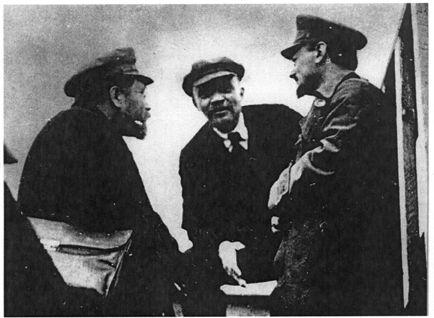
Lenin with Kamenev, left, and Trotsky, circa 1918.
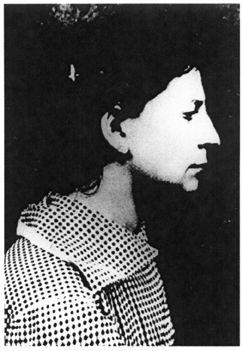
Left: Fanya Kaplan,
arrested and executed for
the attempt on Lenin's life
in August 1918. This
photograph was taken by
the Kiev Provincial Prison
Inspectorate in 1907 after
her arrest for a terrorist act.
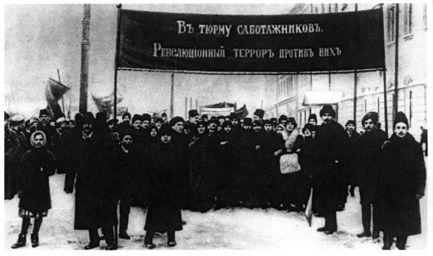
Below: A procession in
support of Red Terror,
Moscow, winter 1918.
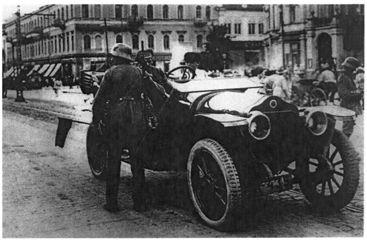
A German army patrol in Kiev in 1918. Kiev was captured by numerous sides during the civil war, enduring
perhaps as many as eighteen different occupations.
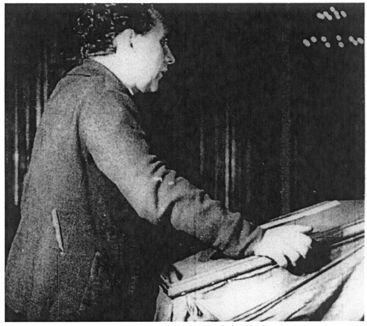
Zinoviev making a speech, possibly at a meeting of the Communist International
Comintern, no date.
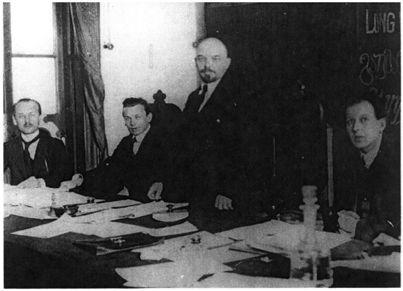
Lenin at the First Congress of the Comintern, March 1919.
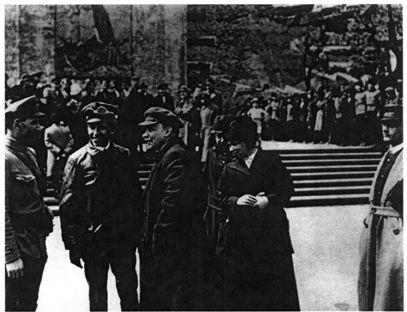
Lenin with Krupskaya and his sister Maria outside the Kremlin, 25 May 1919.
Lenin at a military parade on Red Square, 25 May 1919. The speaker is Tibor Szamuely, the refugee
leader of the failed Hungarian Communist revolution.
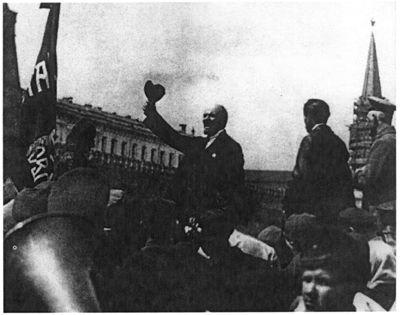
Lenin on the same occasion.
Above left: Lenin talking to
Yelena Stasova between
sessions of the Second
Comintern Congress,
Moscow, August 1920.
Stasova, nicknamed
‘Comrade Absolute’, was
a Central Committee
Secretary and an important
Party organizer.
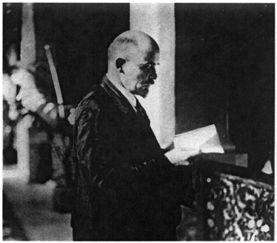
Above right: Lenin during
an interval at the Second
Comintern Congress.
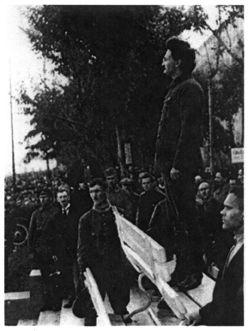
Right: Trotsky speaking.
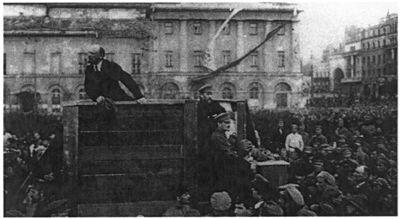
Lenin speaking in Moscow on 5 May 1920, with Kamenev and Trotsky standing on the steps of
the podium to his left. After Trotsky's deportation from the USSR in 1929, his figure was erased from
the photograph.
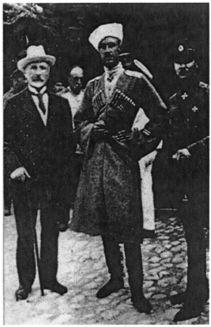
Above: Nikolai Bukharin speaking at the funeral
of the American journalist John
Reed in Moscow, 1920.
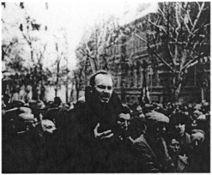
Left: Baron Peter Wrangel, chief of the
White forces in southern Russia, with his chief
adviser, Alexander Krivoshein, on his right, and
his chief of staff, Pavel Shatilov,
on his left, Crimea, August 1920. Wrangel's
forces, and several tens of thousands of
civilian refugees, were evacuated to
Constantinople by French and British
naval ships later that year.
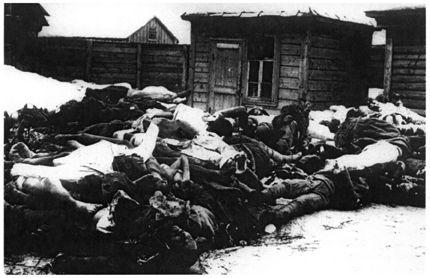
Corpses of some of Admiral Kolchak's White forces shot by Reds at Omsk in Siberia, 1919.
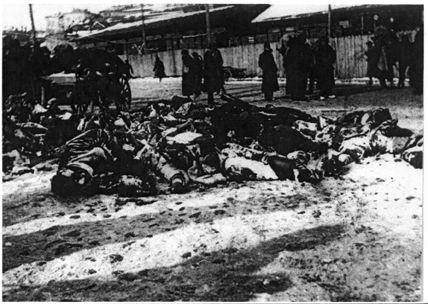
Red victims of the Japanese intervention at Vladivostok, November 1920. British, French, American
and Japanese forces landed at Vladivostok in August 1918 and were engaged to various degrees in
armed conflict with Red troops in the Far East. The Japanese were the last foreign forces to leave the
territory, in October 1922.
As we have seen, even in Lenin's time the Politburo had already become a super-government, and over the years this status was only intensified. By a special resolution of 8 February 1947 (by which time the People's Commissars had been renamed Ministers), ‘Questions relating to the Foreign Ministry, the Foreign Trade Ministry, the State Security Ministry, the circulation of money, hard currency, and also important issues relating to the Armed Forces Ministry, will be concentrated in the Politburo’.199 Since then, following decisions by Brezhnev, Andropov, Chernenko and Gorbachev, the spheres of Politburo members' activities were successively defined and redefined, in terms of ‘the preliminary examination, preparation and supervision of a specific number of issues’.
The Politburo functioned in different ways at different times. Under Stalin it was an obedient, ‘consultative’ body of yes-men whose job was to sanctify the actions of the leader. To the outside world, it was still the revolutionary inner sanctum, but for Stalin it was nothing more than a convenient assembly which gave legal force to his will. Acting on the age-old precept of dictators, he had liquidated all his old comrades who had known his weaknesses and his failings, and in their place he had put new ‘comrades-in-arms’ who owed their promotion to him, all of them zealous executives. Lenin had transformed the dictatorship of the proletariat into the dictatorship of the Party, and Stalin went further by making the dictatorship of the Party into that of one man. The Politburo meanwhile remained the chief instrument for maintaining in the public mind some semblance of collective, or collegial, leadership, while in reality it was utterly subservient, its members vying with each other to invent some new epithet with which to praise The Leader.
This situation came about as a direct result of Lenin's having concentrated all power in the hands of the Party. Stalin finished building Lenin's totalitarian pyramid, and under him the Politburo came to resemble a court of the Inquisition. On 3 December 1934 it agreed that the security authorities be empowered to speed up their work in connection with ‘terrorists’, and that the courts be told ‘not to allow petitions for mercy to delay the carrying out of death sentences, since … it is not thought possible to examine such petitions’.200 This decision echoed Lenin's order to ‘shoot plotters and waverers without asking anyone and without any idiotic red tape’.201 Lenin, however, had resorted to such summary measures in wartime, while Stalin was prepared to do so in time of peace. His ‘Leninist’ Politburo went even further: on 5 July 1937 it decided ‘henceforth to establish a procedure whereby all the wives of unmasked Right-Trotskyite spy traitors should be sent to camps for not less than 5-8 years’.202 But this was in effect merely the continuation of a practice established in the civil war, as when Trotsky demanded that commands be given only to those former tsarist officers whose families had remained within the limits of Soviet Russia, and that they be told that they bore responsibility for their families' lives.203 Lenin had no objection to this measure, since he himself had introduced hostage-taking—again, however, in a war situation, while Stalin had no such excuse. Stalin was indeed, as the slogan had it, ‘the Lenin of today’.
Shortly after Hitler's invasion of the Soviet Union in June 1941, the Politburo was ready to conclude a second Brest-Litovsk treaty with Germany. Stalin was willing to repeat his master's example. He ordered Beria to contact the Bulgarian ambassador, Stamenov, who was a NKVD agent, and through him to establish contact with Berlin and to propose to Hitler that the USSR would on the cessation of military action ‘cede Ukraine, Belorussia, the Baltic States, the Karelian Isthmus, Bessarabia and the Bukovina’. Beria deputed his agent Sudoplatov to negotiate with Stamenov.204 The Politburo was proposing to throw tens of millions of people into slavery under the Nazis.
No measure was too extreme, no method too dirty for the Politburo to contemplate. It is enough to recall that when it felt most threatened by the Nazis, it appealed for support to the Russian Church which it had all but destroyed, to scholars and designers whom it had cast into the oblivion of the camps, and to the Jewish population which had suffered the full measure of Soviet anti-semitism. Yet, after Hitler had been defeated, the Politburo felt that too many concessions had been made during the war, especially to the Jews. While publicly showing sympathy for Jewish causes, including the foundation of the state of Israel, behind the scenes the Politburo was rewriting its script. As early as September 1946, the dictator of Soviet culture, Andrei Zhdanov, instigated an assault on Jewish theatre critics, and thereafter anti-semitic policy ranged through attacks on Zionist sympathizers, arrests, executions, street murder and the closing down of Jewish institutions.205
To be sure, Stalin's power was so immense and unrestrained that often he did not even trouble to camouflage his actions with the fig-leaf of the Politburo. Astonishingly, apart from Stalin, only Molotov was privy to the negotiations with Ribbentrop on 23 and 28 August and 28 September 1939, that culminated in the cynical carve-up of several countries. Frequently, during night-long carousals at his dinner-table, Stalin would have ideas and make plans which he would share with his fellow-drinkers. Next morning it would only remain for Malenkov to formulate the ‘wise decision’ as an order of the Politburo.
Among the countless crimes committed by Stalin's Politburo, one stands out for its cruelty and utter cynicism—the massacre at Katyn.* On 5 March 1940 the Politburo instructed the NKVD: ‘the cases of 14,700 former Polish officers, civil servants, landowners, police, intelligence officers, gendarmes, settlers [i.e. Polish farmers from Western Ukraine and Belorussia], and prison guards; and the cases of 11,000 members of various counter-revolutionary espionage and sabotage organizations, former landowners, factory-owners, civil servants and deserters, now being held in prisons in the western provinces of Ukraine and Belorussia, should be reviewed in a particular order and the death penalty by shooting be applied.’ It further ordered that: ‘Cases should be handled without summoning those being held under arrest and without prior notice of the charges, or an order to end the investigation or formulate the charges.’206 The men to whom this was applied were not prisoners of war, nor had they committed any known offences against the Soviet Union. Like so many others, they were simply perceived as a potentially anti-Soviet force that must be eliminated.
No Politburo minutes of the discussion of this issue appear to exist. Moreover, despite their repeated denials that there were any documents which proved the Politburo's involvement, all of the subsequent leaders were familiar with them. Khrushchev examined them in March 1959, Andropov in April 1981, and Gorbachev's assistant V.I. Boldin in April 1989, presumably with the intention of informing the General Secretary of their contents. There are about a dozen different instructions, emanating from the Politburo and starting in 1971, to cover up or camouflage the crime. They involved Brezhnev, Andropov, Chernenko and Gromyko, as well as other Party leaders who are still alive today.207
It was Khrushchev who brought back into fashion the term ‘true Leninist’, as an antidote to ‘true Stalinist’. After the debunking of Stalin at the Twentieth Party Congress in 1956, a silent struggle was going on in the top echelon of the Party between the supporters of classic Stalinism and those who wanted to preserve it in a more liberal form. It all ended at a plenum in June 1957 which condemned the so-called anti-Party group, consisting of Malenkov, Molotov, Kaganovich, Bulganin, Pervukhin, Shepilov and others. The minutes of this meeting, extending to 344 pages, represent a unique document, anatomizing both the morale of the Communists and the morality of the Central Committee.208 Accusing Molotov and Kaganovich of taking part in the repressions of 1937-38, Marshal Zhukov read out a document according to which they, together with Stalin, had sanctioned the execution of 38,679 senior officials, cultural figures and army leaders. They had marked on the lists where the death penalty was to be applied, and it was left to the Military Collegium merely to carry out its duty. Zhukov cited as an example one day, 12 November 1938, when Stalin and Molotov ordered the execution of 3167 senior figures.209 Another Central Committee member, Dudorov, described how many Party secretaries, summoned by Malenkov, were arrested as they entered his office, and as many were arrested following audiences with him.210 The Party ‘HQ’ was not only organizing terror against the people, it was itself an organ of the political police.
Yet, even having heard the chilling facts of Stalin's regime, there were those who could still say, as did Kaganovich: ‘I loved Stalin, and he was something worth loving—he was a great Marxist … We should be proud of him, every Communist should be proud of him … We have uncrowned Stalin and without realizing it we have uncrowned thirty years of our own work.’211 Leninism in its Stalinist form had become a part of the Soviet character, a deeply fanatical outlook, a way of thinking and acting. This could be seen to some degree in the huge flourishing of dogmatism in the country at large. And the path of dogmatism is the shortest way to dictatorship.
After the dramatic Twentieth Congress, when Khrushchev courageously stripped the cloak of secrecy off the crimes of the special services, there came a new era in the life of the ‘Leninist’ Politburo. Its tactics changed: only Stalin, Beria and the NKVD had been guilty of ‘violating revolutionary legality’, while the Party, and still more the Politburo, were blameless. Any attempt to examine the origins of the terroristic regime was severely curtailed.
Khrushchev himself felt the effects. When he was removed from power in a palace coup in 1964, he was, perhaps without realizing it, a beneficiary of his courage in 1956, for he was not arrested, shot or exiled, but was left to live out his days in peaceful retirement. But once the former First Secretary of the Central Committee—the post of General Secretary was renamed in 1953 and revived again in 1966—had drawn a bracing breath of freedom, he abandoned any intention he may have had of fading out gracefully. Like many old men who have led a stormy life, he decided to write his memoirs. With little schooling or culture, but much native wit and no little courage, he set about dictating his reminiscences.
This soon became known to the Politburo, of course. On 25 March 1970, KGB Chairman Yuri Andropov reported to the Central Committee in a top secret note:
N.S. Khrushchev has recently started work on memoirs of the period of his life when he occupied senior Party and state posts. These dictated memoirs contain detailed information constituting exclusive Party and state secrets on such specific questions as the defence capability of the Soviet state, the development of industry, agriculture, the economy in general, scientific and technical achievements, the security organs, foreign policy, relations between the CPSU and the fraternal parties of socialist and capitalist countries, and so on. He reveals discussions at closed meetings of the Politburo … Under these circumstances, it is imperative that urgent operational measures be taken to permit the monitoring of Khrushchev's work on his memoirs, and to prevent the entirely likely leak of Party and state secrets abroad. With this aim in view, it seems sensible to establish operational secret surveillance of Khrushchev and his son, Sergei … We also think it would be desirable to summon N.S. Khrushchev to the Central Committee again and to warn him of his responsibility for the publication and leak of Party and state secrets and to demand that he draw the necessary conclusions.212
The Politburo was worried. Khrushchev had presented them with an unprecedented situation. On 27 March I.V. Kapitonov and Andropov were deputed to inform Khrushchev about the ‘exchange of opinions at the Politburo’.213 This had little effect, except to make Khrushchev and his son Sergei act with greater caution. Nevertheless, the KGB managed to get hold of more than 2000 pages of transcribed dictation. It was, however, only a copy, the original having been spirited out to the West by Sergei and another relation, without even Khrushchev himself realizing it. When it became clear that it was going to be impossible to prevent publication, it was decided to put pressure on the old ‘Leninist’ publicly to denounce the material as a forgery.
This time the Chairman of the Party Control Commission, A.Y. Pelshe, and two other members, S.O. Postovalov and R.E. Melnikov, confronted their recalcitrant ex-comrade. The hour-long conversation, scrupulously taken down by two stenographers, reads like a film script, and although it is far too long to reproduce in full here, it is worth quoting extensively as evidence of Communist morality, the climate of political investigation cultivated by the Politburo, and Khrushchev's independent and bold behaviour.
PELSHE: According to Ambassador Comrade Dobrynin, on 6 November [1970] representatives of the American Time publishing house officially announced that they were in possession of the ‘memoirs of N.S. Khrushchev’. Perhaps you would tell us straight to whom this material was handed over for publication abroad.
KHRUSHCHEV: I protest, Comrade Pelshe. I have my human dignity and I protest. I gave material to no one. I am no less a Communist than you.
PELSHE: I have to tell you that the material is there.
KHRUSHCHEV: You tell me how it got there. I don't think it has. I think it's a provocation.
PELSHE: You are in a Party building …
KHRUSHCHEV: I have never given any memoirs to anyone and would never have permitted it. As for what I dictated, I regard it as the right of every citizen and Party member.
PELSHE: We already said in a conversation with you that this method, this writing of memoirs which a wide circle of people are attracted to do, is not appropriate …
KHRUSHCHEV: Go ahead, arrest me, shoot me. I'm fed up with life. When people ask me, I say that I'm not happy to be alive. I heard today on the radio that de Gaulle died. I envy him …
PELSHE: Tell us how we can get out of the situation.
KHRUSHCHEV: I don't know. It's your fault, not yours personally, but the whole leadership's … I know that before I was summoned, they despatched agents …
PELSHE: A lot of people in Moscow know you're dictating.
KHRUSHCHEV: I'm seventy-seven. I still think clearly and I answer for all my words and actions …
PELSHE: How are we going to get out of this?
KHRUSHCHEV: I don't know. I'm totally isolated, virtually under house arrest. Both gates are watched. It's very shaming. I'm fed up. Relieve my suffering.
PELSHE: No one is trying to hurt you.
KHRUSHCHEV: Moral torture is the worst kind.
PELSHE: You said when you had finished you'd hand it over to the Central Committee.
KHRUSHCHEV: I didn't say that. Comrade Kirilenko suggested I stop writing. I said I couldn't do that, it was my right.
PELSHE: We don't want you to die.
KHRUSHCHEV: I want death.
MELNIKOV: Maybe someone has let you down?
KHRUSHCHEV: Dear comrade, I answer for my words and I'm not mad.I gave no one any material, nor could I have.
MELNIKOV: Your son wasn't the only one to handle the material, there was also the typist, whom you don't know, and the writer, who isn't a Party member, and whom you also don't know, and others.
KHRUSHCHEV: These are all Soviet people, trusted people.
MELNIKOV: No need to stamp and shout. You're in the CPC [Party Control Commission] now and you should behave accordingly…
KHRUSHCHEV: It's my nerves, I'm not shouting. I'm in a different situation and a different age.
PELSHE: Never mind about age and nerves, every Party member has to answer for his actions.
KHRUSHCHEV: You're absolutely right, Comrade Pelshe, and I do. I'm ready to take my punishment, even the death sentence.
PELSHE: The CPC doesn't sentence to death.
KHRUSHCHEV: It used to be the practice. How many thousands of people perished? How many were shot? And now they're putting up monuments to ‘enemies of the people’…
PELSHE: On 23 November, that's in thirteen days, [the memoirs] will be published, they're with the printer now …
KHRUSHCHEV: I'm willing to declare that I have given no memoirs either to any Soviet or Western publisher and have no such intention. Please write that down.
POSTOVALOV: We have to think, and you above all, of what kind of announcement you should make, and to make them …
KHRUSHCHEV: I will say only one thing, and that is that everything I dictated is the truth. Nothing made-up, nothing amplified, if anything the opposite, it's rather toned down. I expected to be asked to write. They published Zhukov's memoirs, after all. His wife rang me and said: ‘[Zhukov] is ill and can't talk to you himself, but he wants to know your opinion of his book …’ I told her I hadn't read it, but people had told me about it. I said what he had written about Stalin was disgusting and I wouldn't read it. Zhukov is an honest man, a military man, but he's a hothead …
POSTOVALOV: But you said you hadn't read his book.
KHRUSHCHEV: People told me about it.
POSTOVALOV: We're not talking about Zhukov.
KHRUSHCHEV: Comrade Pelshe didn't let me finish what I was saying It's Stalinist style to interrupt.
PELSHE: That's your habit.
KHRUSHCHEV: I was also infected by Stalin, but I liberated myself, whereas you …
MELNIKOV: Comrade Khrushchev, you may make a protest if you're offended.
KHRUSHCHEV: I'm telling you, don't push me into lying in my old age.
PELSHE: We heard today that the American Time publishing house has the memoirs of Khrushchev which will be published there. That's a fact. We would like you to define your attitude to this affair, without talking about the substance of the memoirs, by saying you're indignant and that you gave nothing to anyone …
KHRUSHCHEV: Let the stenographer take down my statement. From reports in the foreign press, chiefly in the United States of America and other bourgeois countries, it has become known that the memoirs or reminiscences of Khrushchev are to be published. I am indignant at this fabrication because I have given no memoirs to anyone, neither Time nor any other publisher, not even Soviet publishers. Therefore I regard this as lies, a forgery which the bourgeois press is capable of publishing…214
To his credit, Khrushchev would only admit, despite the arm-twisting, that he had not given his memoirs to anyone. He did not disavow the contents of the memoirs. The long dialogue between the disgraced ‘Leninist’ and the Party inquisitors highlights the way Party morality had been intensively cultivated by the Politburo. Since the time of Lenin, falsehood had become one of the Party's chief political assets. Khrushchev's words, ‘don't push me into lying in my old age’, reflect on the individual level the rule of untruth, falsification and lying that were the Communist Party's stock-in-trade. It has to be said, however, that the vast majority of the people believed the lies, and helped to spread them.
Thus, after the Twentieth Congress the Politburo lost none of its power, but merely altered the form of its influence. Instead of openly using physical terror, it now resorted to mental terror, the manipulation of public opinion and the ‘perfecting’ of the totalitarian bureau-cratization of society. It still remained the super-government, the supreme organ, which decided everything.
The Politburo relied on the vast apparatus of the Central Committee. While the Central Committee itself had in the order of three hundred members, and half as many candidate-members, its many thousands of officials stood above the government, the ministries, universities, industry, culture, sport, diplomacy, the army, the secret police and intelligence services. And this was true in every region and district. The Central Committee organization had over twenty sections and as many sub-sections, further subdivided into 180-190 sectors.215 There were sectors for Ukraine and Belorussia and the other republics, an international department to handle relations with other socialist countries, newspapers, Party cards, philosophy, work among foreign students, the cinema, general and specialized defence engineering, defence electronics, collective farms, state security, Soviet institutions in capitalist countries, and so on and so forth. By the end, the Party apparatus—that is its working organization, as distinct from Party members—numbered as many as 100,000 to 150,000 people. This pyramidal structure, from the smallest cell at grassroots level up to the Politburo itself, stood like a scaffold around the nominal governmental, or Soviet, administrative structure, controlling, energizing, directing and manipulating it, through the Party members who everywhere saturated the Soviets, to ensure that the Politburo's policies were carried out.
Lenin's invention of the one-party system in effect led to the liquidation of the party in the usual sense of the word. It became an order of privilege which observed hierarchy more strictly than an army, and at its peak was the Politburo, a clan of inviolable, unanswerable individuals. But just as they could rise, so they could be lowered rung by rung down the ladder of authority to the very bottom—sometimes with a bang—by the General Secretary, invariably with the unanimous support of the rest. This was put succinctly in an exchange on 17 June 1971: Politburo member Gennadi Voronov proposed that regional Party secretaries and chairmen of soviets should be confirmed in office by the Council of Ministers, ‘or at least that it give its agreement’. Stalin had changed People's Commissars into Ministers in 1943, and the Council of Ministers ostensibly occupied the same place as the Sovnarkom had done (this is not to say that it had the same authority—far from it, since Stalin needed none of these bodies in order to rule, preferring his own personal Secretariat and the security organs). Voronov's colleague Andrei Kirilenko at once spoke up: ‘I would like to help Voronov and tell him that in Russia we have the Central Committee of the CPSU and it decides all such questions, including personnel questions. It was never otherwise, so why rearrange things now so that such questions should go through the Council of Ministers?’ Podgorny added: ‘Why put these things through any other organs?’216
On 7 January 1974, during a two-hour discussion on the dissident writer Alexander Solzhenitsyn, Brezhnev declared: ‘According to our overseas representatives and the foreign press, a new work by Solzhenitsyn, called The Gulag Archipelago, is being published in France and the USA. No one has read it yet, but its contents are already well known. It is a crude anti-Soviet libel. We must now discuss what to do about it. Our laws permit us to put Solzhenitsyn in prison right away, for he has encroached on the holiest of holies, on Lenin, on our Soviet system, on the Soviet regime.’ After speeches by Kosygin, Andropov, Kirilenko and Suslov, the Politburo confronted the dilemma of whether to try Solzhenitsyn or to put him out of the country. They chose the latter course.217 For them, an intellectual danger was no less threatening than a nuclear one.
Even when faced with a humanitarian problem, they were incapable of rising above their Bolshevik prejudices. On 31 August 1983 Soviet aircraft shot down a South Korean passenger airliner that had violated Soviet air space in the Far East. The Politburo session of 2 September was a long one, as member after member exclaimed: ‘This was a crude anti-Soviet provocation’, ‘Our pilots acted in strict accordance with the regulations’, ‘We must show resolve and presence of mind’, ‘We must stick to the version announced in the press’, and so on. All their thoughts were bent towards concealing the truth of the matter. Only Solomentsev and Gromyko said, inter alia, ‘Perhaps we could say we sympathize with the families of the victims?’ Gorbachev took the view that ‘We cannot say nothing, we have to take an offensive position.’218
What is so striking about this exchange is that, while the whole world was shaken by the deaths of the 269 innocent victims, and by the senselessness and savagery of the action, the only concern shown by members of the Politburo was to find a way to save face, to justify themselves, and to take up an unassailable ‘offensive position’.
Even during the period of perestroika, when it seemed that everyone had at last recognized the urgent need for fundamental reform, the Politburo's main objective was to find a way to renew the system cosmetically, to change its façade while preserving its essence. It never occurred to them that the totalitarian system, created by Lenin, was not amenable to reform. With this in mind, Gorbachev's historic rôle appears in a different light. It was not so much that he destroyed the totalitarian system, but rather that he did not prevent its self-destruction. The three-hour Politburo session of 15 October 1987 concerned itself entirely with a discussion on the question of the draft report to be given at a ceremonial session of the Central Committee on the seventieth anniversary of the October revolution, a significant date in the Communist calendar in any year, but especially so now, with change in the air.
RYZHKOV: I think the report gives a correct rebuke to a certain group of people who are trying to exploit democracy to harm our Party and the general interests of the state.
GORBACHEV: We don't need any kind of bourgeois pluralism. We have socialist pluralism, for we take account of people's different interests and different points of view.
RYZHKOV: That should go into the report … After all, every word is going to be used as ammunition: ‘Aha, pluralism! Let's have a second party, a third party,’ and so on.
LIGACHEV: I would like once more to stress: it is very important that precisely now a correct, principled Marxist-Leninist evaluation be given of the Party's ideological struggle with Trotskyism …
GROMYKO: There can be no argument about how things would have been if we hadn't had collective, socialist agriculture. How would the country have looked during the war and what state would it have been in at the end of it? … We should say that without Lenin the Party faced a very difficult problem of gaining victory over the dark forces which wanted to destroy the Party…
GORBACHEV: … here Lenin's genius was revealed, in that all his comrades-in-arms were of an order beneath him. I can say here in this circle that, until Lenin's return to Petrograd, Stalin and all the rest who were in Russia were getting themselves ready and thinking that things were fine now, there will be a legal opposition. And they would be in the opposition. They were already preparing themselves to be a legal opposition party. That was the view of rather senior figures in the Party. And then Lenin appeared and, without pausing, said: ‘Long live the socialist revolution!’
SHEVARDNADZE: I'm a bit worried about one phrase, although it's correct in principle. It says in the report: ‘The policy of liquidating the kulaks as a class was the correct one …’ Maybe we could drop ‘liquidating’ and find some other word …
CHEBRIKOV: A group has emerged, they don't reflect the mood of the people, of course, but they're distributing leaflets about the need for a new constitution. Here's one of them. It says our Constitution doesn't correspond to perestroika, that it's the constitution of a totalitarian regime, more like army regulations, and that the country is like a barracks. They also attack Article 6, on the leading rôle of the Party.
The rest of the members spoke in similar vein. The population was freeing itself slowly enough from Bolshevism, from socialism which levelled downwards, from hostility to those who thought differently, but the Politburo was even more backward. In this respect the Politburo was keeping the Leninist tradition alive.
Similarly, it was keeping alive the tradition of looking after itself.A special session of 28 july 1966 decided that politburo ‘members and candidate members, Central Committee Secretaries and Deputy Chairmen of the Council of Ministers would start work at 9 a.m. and finish at 5 p.m., with an obligatory break for lunch’, and that they would have a six-week summer holiday and a four-weeks winter break.219 On 24 March 1983 the additional privilege of starting work at 10 a.m. was agreed for members and candidates over the age of sixty-five—at that time virtually all of them qualified.220 Three years later, members' pensions were reviewed and set at eight hundred roubles a month (a skilled worker earned about two hundred), plus the dacha and staff of five, the Chaika and Volga limousines, and so on.221 All this information was kept in ‘special files’ which could be opened ‘only with the permission of the General Secretary of the CPSU’.222
All power is vicious, but Bolshevik power was especially so. A glimpse into the doings of the Politburo confirms that. They represented the apocalypse of the regime in the twilight of the revolution.
* A quotation from Pushkin' Boris Godunov.
* The object of the article was to dispel rumours that were circulating in the West and among émigrés about Lenin's death. Comrade Lenin, Stalin wrote, smiled and remarked: ‘Let them lie if it gives them comfort, one must not deny the dying their final consolation.’86
* A fuller account of this incident is given in Chapter 7.
* The city, now known again by its original name of Tver.
* The author was a member of the four-man commission which sought and found the complete proof of this.