
SEVEN

THE STARTLING news evidently came to Morse through his brothers. On April 15, 1837, their Observer reprinted an item that had run a few days earlier in the Baltimore Patriot. It reported that two Frenchmen, named Gonon and Serval, were in the United States demonstrating a revolutionary system of long-distance communication. They claimed that their telegraph was capable of operating as fast as a person could write or even speak. Fast and far. A hundred-word dispatch might be sent from New York to New Orleans in half an hour.
The claims were amazing. The world measured communication-time in terms of transportation time, by how long it would take anything or anyone to get from here to there. Except by smoke signal, semaphore, and the like, sending words was the same as sending a package. Earlier in the century this meant that a letter went out no faster than ponies could gallop or sails could waft a schooner—or, by mid-century, no faster than coal-fed boilers could push steamships and railroad cars. The identity of communication with transportation had existed for millennia. News of Andrew Jackson’s victory in the Battle of New Orleans in 1815 took as long to reach Washington as news of Alexander the Great’s victory at the Battle of Arbela took to reach his capital in 331 B.C. But Gonon and Serval redefined the possible. As the newspaper item exclaimed, “The imagination is overpowered in contemplating the consequences of such an achievement of human ingenuity.”
Morse felt overpowered, too, but for a different reason. He had in his rooms at New York University, he believed, the same system the Frenchmen were promoting in America. As far as he knew, no one but himself had even dreamed of such a device. Not only that. He had been quietly developing it for five years. He had allowed a few people at the University to see preliminary stages of his invention, and had sent a few correspondents a few oblique hints about it. But he seems to have kept only his brothers fully informed. As far as the world knew, since returning from Europe he had spent his time painting, teaching, or fighting immigration and Catholicism.
Through experiment Morse had often changed the design of his telegraph. The apparatus that existed around 1837 remained so crude that he was reluctant to have it seen, and perhaps ridiculed. It consisted of two main elements: a transmission device that he called the port-rule and a receiver called the register. The port-rule was activated by a printer’s composing stick (M)—about three feet long, made of wood, and grooved. Flat metal blanks could be set into the groove, each having from one to nine V-shaped notches. (An unnotched blank represented a space.) When the crank (L) was turned, the composing stick glided beneath the balanced lever overhead (O-O). A projecting tooth dropped into the valleys or rose to the peaks on the notched metal blanks. At the same time, the two-pointed copper prong at the other end of the lever dipped in and out of two thimble-size cups of mercury (J, K), which were connected to a battery (I). As the composing stick passed underneath, the seesawing lever opened and closed an electrical circuit, in a rhythm dictated by the notched blanks.
This circuit activated Morse’s register. He built the device into a wooden frame otherwise used for stretching canvas (X). A clockwork mechanism (D) slowly fed out a ribbon of paper over a drum (B). From the top of the frame, suspended above the paper, hung a pyramid-shaped pendulum (F) with a pencil at the lower end (g). Its movement was governed by a device set in the middle of the frame: an iron armature, and a bar of soft iron coiled in wire that led back to the port-rule (h). As the copper prongs dipped into the cups of mercury they closed the circuit, sending an electrical current into the wire, which magnetized the bar, which attracted the armature, which caused the pendulum to swing, which made the pencil zigzag along the moving paper. When the circuit opened, the armature, mounted on a spring, moved away from the magnet.
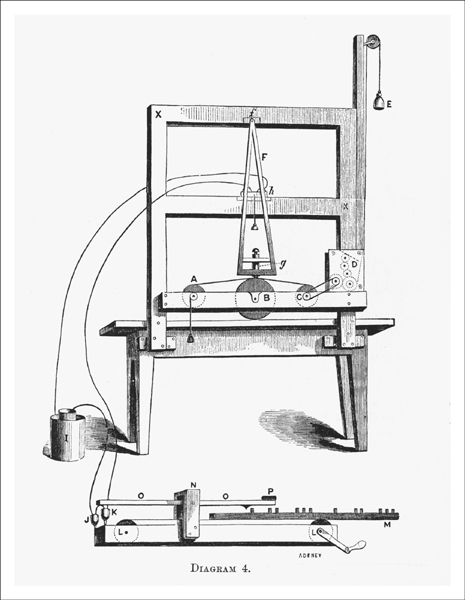
Morse’s original telegraph apparatus (ca. 1836) (Samuel I. Prime, The Life of Samuel F. B. Morse, LL.D. [1875])
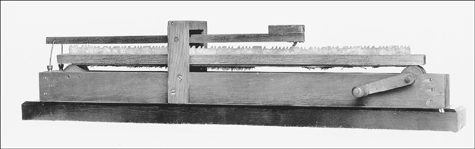
Reproduction of Morse’s original port-rule (Smithsonian Institution)
In operation, then, as the composing stick passed beneath the seesawing lever, opening and closing the circuit, the register reproduced in pencil on its paper ribbon the pattern of the V-shaped notches cut into the metal blanks. The Vs signified numbers: VVVVVV represented 6, for example, VV VVV 23. To decode the message the recipient looked up the word numbered 6 and the word numbered 23 in a dictionary expressly compiled for the purpose.
However crude, Morse’s telegraph was accurate and, once the type was set, fast. That it might not be unique, however, had never occurred to him. To counter the boasts of Gonon and Serval, he and Sidney immediately made his five-year-long effort known to the public. In reprinting the Baltimore article about the French invention, Sidney informed readers of the Observer that rapid communication over long distances was stale news. The feat had been suggested to him “several years since,” he said, using an electrical battery and fine wires. Surely to avoid any hint of Morse family self-interest, he identified the inventor only as “a gentleman of our acquaintance.” Instead, he had his brother’s identity revealed in a companion article in the Journal of Commerce: “The Gentleman alluded to by the editor of the New York Observer, as the inventor of the Electric Telegraph, is Professor Samuel F. B. Morse, the President of the National Academy of Design.”
Whatever dismay Morse felt in learning about Gonon and Serval was in one sense excessive and in another not enough. The system of the two self-styled “Professors of Graphy” was not an electrical telegraph at all, but an alleged improvement on the optical telegraph, a semaphore. France had a working system of such semaphores, windmill-like towers of adjustable arms and flaps, built about six miles apart. Signal operators used ropes and pulleys to position the arms according to a code. Messages were read by telescope from station to station and passed on. The system spanned all of France, extending into Holland, Germany, Italy, and Spain. It was to this complex visual semaphore that, in 1794, the word “telegraph” was first applied.
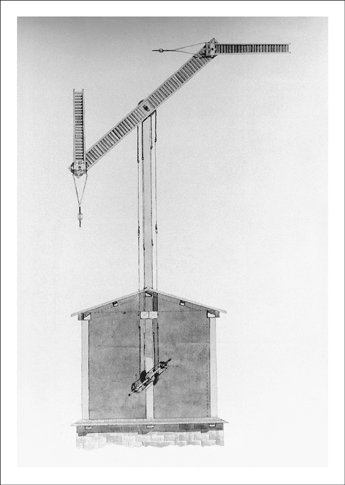
Chappe semaphore (Musée de la Poste, Paris)
Morse soon learned, however, that although he had supposed himself to be the first person who ever put the words “electric” and “telegraph” together, scientists of several countries had been experimenting with electrical signaling systems for about twenty years. And in the fall of 1837 the American press began reporting a sudden surge in the production of such devices abroad, and of interest in them. “Scarcely a journal arrives from Europe which does not contain some notice of the Electric Telegraph,” the Journal of Commerce said, “which now seems to have excited the attention of the scientific world as the wonder of the age.”
Morse clipped and preserved articles depressingly headed “ELECTRIC WIRE TELEGRAPHS,” “NEW AND BEAUTIFUL INVENTION.” He read that in Scotland a William Alexander proposed laying insulated copper wires, one for each letter of the alphabet, under the turnpike from London to Edinburgh. In Munich a Professor Steinheil was stringing iron wires between the cathedral and the observatory of Bogenhausen; he conjectured that Lisbon could communicate to St. Petersburg in two seconds. In London an “eminent scientific gentleman” was perfecting a device to send an electric current through five wires that activate needles, whose positions on a dial denote letters of the alphabet: “the discovery will perhaps be the grandest in the annals of the world.”
Such reports described methods and devices akin to what Morse had produced himself. He received the news with not only pained disbelief but also suspicion. “There is not a thought in any of the foreign journals relative to the Telegraph,” he said, “which I had not expressed nearly 5 years ago.” Knowing well enough how Europe and England feared America’s example and wished to curb its growing power, he worried that before he could perfect his own apparatus the innovations it embodied would be stolen from him, “that other nations will take the hint and rob me both of the credit and the profit.”
Morse set to work establishing himself as the inventor of the electric telegraph. First he tried to verify the date of his discovery. When and how had news of his invention leaked out? Word of mouth travels fast: “a hint flies from mind to mind and is soon past all tracing back to the original suggester.” He traced the progress of his own hints back to his return voyage from France in October 1832, aboard the ship Sully. It was then and there that the idea of an electric telegraph first occurred to him, and he had divulged it. “It is certainly by no means improbable,” he thought, “that the excitement on the subject in England has its origin from my giving the details of the plan of my telegraph to some of the Englishmen or other fellow passengers on board the ship.”
To confirm his suspicions and establish his originality, Morse prepared a circular letter addressed to the captain of the Sully and four passengers:
There is to be a contest, it seems, for priority of invention of this Electric Telegraph between England, France, Germany and this country. I claim for myself and consequently for America priority over all other countries in the invention of a mode of communicating intelligence by electricity.
His object in writing, he said, was to ask whether his shipmates recalled his speaking about an electric telegraph during the voyage five years ago. If so, he asked them to fully state what they recalled. He also asked the captain, William Pell, to answer a more specific question: had Pell mentioned the telegraph to others after the voyage? The ship had carried twenty-six passengers, mostly Americans, plus seven or eight French farmers in steerage, presumably immigrants. In addition to Captain Pell, Morse addressed his letter collectively to fellow-passengers Francis J. Fisher, a Philadelphia lawyer; William Rives, the American minister to France; Charles C. Palmer; and the Boston physician-geologist Dr. Charles Jackson.
Morse may not have sent Jackson a copy of the letter—for reasons to be explained—and Palmer seems to have left the United States. But his other hoped-for defenders replied quickly, and their accounts of the voyage bore out his most significant assertion. “I have a distinct remembrance,” Captain Pell wrote, “of your suggesting as a thought newly occurred to you, the possibility of a telegraphic communication being effected by electric wires.” The passengers agreed, with slight variation. “You spoke of a single wire,” Fisher wrote, “and letters or signs were to be indicated by a quick succession of strokes or shocks.”
Morse’s respondents also agreed that his telegraph generated discussion, among other things of how to protect the wire conductor when strung across rivers. Morse had solved the problems proposed to him, Rives recalled, with “great promptitude & confidence.” Captain Pell believed that the give-and-take helped Morse refine his vague original idea, so by the end of the trip he had conceived a workable instrument. “I sincerely trust,” Pell added, “that circumstances may not deprive you of the reward due to the invention, which, whatever may be its source in Europe, is with you I am convinced original.” He mentioned, however, that since the voyage he had indeed spread the word and told others of Morse’s telegraph.
Morse’s own recollections of his discoveries aboard the Sully were minutely particular. He clearly remembered, he said, “the manner, the place, and the moment when the thought of making an electric wire the means of communicating intelligence first came into my mind and was uttered.” He and Dr. Charles Jackson had just dined and were sitting across a table from each other. “We were conversing,” he said, “on the recent scientific discoveries in electro magnetism and the experiments of Ampere.” Another passenger asked whether a lengthy wire did not retard the passage of an electric current. Jackson replied No, that Benjamin Franklin had demonstrated long ago in London that electricity travels at once through any known length of wire. This, Morse said, triggered his crucial realization: “I then remarked … if the presence of electricity can be made visible in any desired part of the circuit I see no reason why intelligence might not be transmitted instantaneously by electricity.”
By Morse’s account, the possibly world-changing idea took possession of his mind and kept him from sleeping. He tried to work out methods of regulating the current, drawing in his sketchbook what became the notched blanks of his port-rule. He pondered ways of using electricity to inscribe: the current might be made to puncture some paper by a spark or mark it by chemical decomposition. Regarding the second notion he consulted Jackson, who suggested that the current would leave a brown mark on paper stained with turmeric and treated with sulfate of soda. They agreed to experiment with the idea after reaching home.
Some at least of Morse’s account is confirmed by the pocket-size sketchbook he kept aboard the Sully. What survives is only a certified copy of a certified copy of the original. But it has an authentic look and feel of Morse’s return from his three years abroad, containing sketches of Havre and notes for his Capitol rotunda painting of Columbus. Quite as Morse maintained, he evidently was preoccupied while at sea with thoughts of a telegraph system. He sketched some of its main elements: a tube for burying conducting wires under the earth and tall poles for stringing them above ground; an electromagnet actuating an armature to move a stylus against a roll of paper. He also composed a newsworthy dispatch to be sent by number-word code, perhaps his first conception of what a telegraph message might be like: “War. Holland. Belgium. Alliance. France. England. against. Russia. Prussia. Austria.”
Of Morse’s work on the telegraph between his first inklings on the Sully in 1832 and the port-rule/register of 1837, only glimpses remain. Twenty years after the voyage, his brothers testified that they met him when the ship docked. As soon as they greeted him he announced that he had discovered a means of communicating intelligence by electricity. Moving in for several weeks with his brother Richard, he made a mold and used the parlor fireplace to cast blanks for the port-rule. In the process he spilled molten lead on a chair and rug, severely burning a finger.
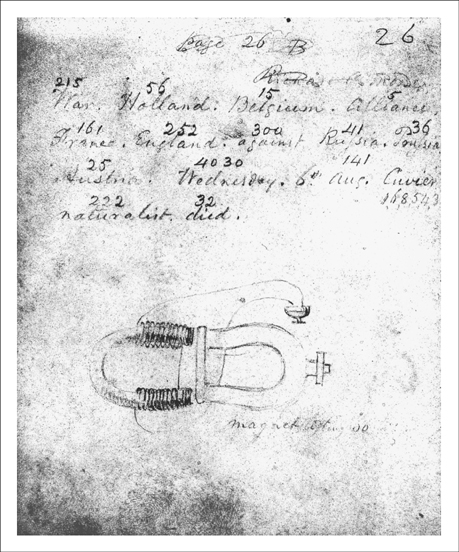
Page from Morse’s Sully sketchbook (Smithsonian Institution)
Some of Morse’s colleagues and painting students at New York University later recalled seeing telegraph apparatus in his rooms in 1835–36, months after he moved into the tower. They remembered galvanic batteries, wire lying about the floor or suspended on the walls, the clockwork paper dispenser feeding out a white ribbon that became covered with Vs. “We grieved to see the sketch upon the canvas untouched,” one student added. “We longed to see him again calling into life events in our country’s history.”
To further secure his title to the invention, Morse began publicizing his telegraph through the press. Articles about his ongoing work soon appeared, headed “Morse’s Telegraph” and “Morse’s Magnetic Telegraph.” The Journal of Commerce commented that while American newspapers had been copying from papers abroad ecstatic notices of telegraphs in Europe, they seemed unaware that “the honor of the first discovery” belonged to America. “Prof. MORSE … some five years ago, on his passage home from France, conceived the idea of communicating intelligence by electricity, and matured his plan.” In published letters to the editor of several newspapers, Morse pointed out that Europeans asserted only what their devices “may” do; he asked for proof that they had actually sent intelligible communications. Meanwhile the Journal reproduced an example of what his port-rule had provably transmitted—a ribbon of Vs representing the numerically coded message “Successful experiment with telegraph.”
Suspecting that foreigners had stolen his ideas, Morse was astounded when his new publicity aroused charges of theft against himself—from an American. The accuser was Dr. Charles Jackson, his fellow passenger on the Sully. At the time of the voyage Jackson had been a twenty-eight-year-old physician with a Harvard M.D., returning from study of medicine and geology in Europe. Now he operated a private chemistry lab in Boston and served as state geologist of Maine. He wrote to Morse saying he rejoiced in the success of “our Electric Telegraph.” He had read notices of the device in the press, but he missed seeing himself mentioned: “I suppose that the reason why my name was not attached to the invention of the Electric Telegraph is simply that the editors did not know that the invention was our mutual discovery.”
The intensity of Morse’s reaction to this can be measured by the dozens of furious pages he wrote in reply. Going over in detail what seems every moment of his acquaintance with Jackson, he adopted a tone of gentlemanly respect for Jackson’s honor and fairness—broken, however, by poisonous accusations of delusional thinking, faulty memory, bad faith, and theft of intellectual property.
“I lose no time in endeavoring to disabuse your mind,” Morse began, “of an error into which it has fallen.” Rehearsing all their encounters aboard the Sully, he reminded Jackson of the after-dinner conversation that had inspired his crucial realization. Jackson had spoken of Franklin’s demonstration that electricity passes at once through any length of wire. This had been the moment of Morse’s epiphany: “I see no reason,” he had told the company, “why intelligence might not be transmitted instantaneously by electricity.” Jackson considered himself a partner in the telegraph, it seemed, simply because they had agreed to experiment together with marking turmeric paper by electricity. In fact, Jackson had no conception of the port-rule and register Morse had devised. “All the machinery has been elaborated without a hint from you of any kind in the remotest degree. I am the sole inventor.”
“I have always entertained the highest opinion of your honour & fairness,” Jackson came back, “… should be very sorry to have any reason to change my opinion of your character.” He challenged point by point Morse’s version of what was becoming The SullyStory. The all-important suggestion for communicating intelligence by electricity had come not from Morse, he said, but from himself. During the after-dinner conversation he mentioned having seen a demonstration at the Sorbonne in which an electric spark traveled instantaneously around the lecture room four hundred times, an experiment anticipated by Franklin. Then one of the passengers, either Rives or Fisher, said “it would be well if we could send news in the same rapid manner.” At this, Morse asked, “ Why can’t we?” Jackson then explained how it could be done, using the spark to perforate ordinary paper or mark chemically treated paper—an experiment he had made himself. “I do claim to be the principal in the whole invention made on board the Sully,” Jackson concluded. “It arose wholly from my materials & was put together at your request by me.”
Too enraged to bother seeming polite, Morse replied with a threat of legal action. Certain that Jackson, an American, meant to steal his work, he again appealed to his acquaintances from the Sully, whose testimony he had sought against thieving Europeans. “I little thought when I made this request in order to prepare myself against foreign claimants,” he wrote, “that I should be under the necessity of again troubling you for evidence to defend myself against an attack at home.”
Morse asked Rives and Fisher whether either of them had remarked, as Jackson alleged, that “It would be well if we could send news in the same rapid manner.” He also asked Captain Pell, “Was there on board ship any other person than myself the inventor of the Telegraph?” Their responses were heartening. Rives and Fisher both disowned the remark: “such a conception had never entered my mind,” Rives said; “it was a complete novelty to me when first presented to my contemplation by your conversations.” Pell admitted that he could not remember every conversation about the telegraph during the voyage, but one impression stayed with him forcefully: “you only on board of that ship was the originator … your mind alone seemed interested in it with any seriousness of purpose, even after its first suggestion by you.”
In sum, Morse denied that he was indebted to Jackson in any way—“for any single hint of any kind whatever which I have used in my invention.” He did however owe to Jackson some of his thinking about telegraphs, how much is uncertain. Jackson was one of the few Americans acquainted with current European research in electricity and magnetism, of which Morse knew nothing. Jackson’s assertion that he made rough drawings of electrical apparatus for Morse is substantiated by Morse’s sketches of an electromagnet, an electrical generator, and similar devices in the Sully sketchbook. Such unacknowledged influence may explain another suspicious matter. As noted earlier, Jackson’s name appears in the heading of Morse’s first circular letter, asking fellow passengers to confirm that he had thought up an electric telegraph in 1832, years before the outburst of comparable European inventions. Jackson later contended, correctly it seems, that Morse never sent him the circular, as if aware that his reply would be damaging.
On the other hand, whatever Morse may have learned from Jackson, the design of the cumbrous but effective port-rule and register was his own, evolved over five years. And the co-creator of “Morse’s Patent Metallic Double-Headed OCEAN-DRINKER and DELUGE-SPOUTER VALVE Pump-Boxes” was not exactly a stranger to technology. Some of the bitterness between the two men arose from their shared conception of the Lone Inventor, creating ex nihilo from his lofty imagination, an ideal in Morse’s case reinforced by his imperious conception of The Painter, independent of all ties to patrons. This dubious notion—to look ahead—would bedevil Morse the rest of his life, burdening him with neverending disputes that many times multiplied the entire days he must have spent trying to refute Jackson. And the brilliant Jackson’s account of what he told Morse would become ever more suspect as his craving for celebrity led him to appropriate other inventions and discoveries.
If nothing else, Morse’s set-to with Jackson was instructive. “The condition of an inventor,” he had found out, “is, indeed, not enviable.” To protect his rights and the further development of his work, he applied in October 1837 to the Commissioner of Patents in Washington, Henry L. Ellsworth, a friend and Yale classmate. He said he wished to have a caveat. This document granted statutory protection to an inventor’s claim of priority, even before his work was matured enough to be patented. If the inventor did not file a patent within a year, he forfeited the protection. Morse’s application described in detail what was now his invention-in-progress—port-rule, register, numbered dictionary, the elements of “a new method of transmitting and recording intelligence by means of Electro-magnetism.”
The application and Morse’s $20 fee secured him a caveat for the improbable-looking composing stick and canvas stretcher he chose to call the “American Electro Magnetic Telegraph.”
Engrossed now in his invention, Morse set out to substantially improve the apparatus and demonstrate it to the public. He sought the advice of a scientific colleague at New York University, Professor Leonard D. Gale, author of Elements of Chemistry (1835). Morse’s device worked perfectly, Gale found, but through a wire circuit of only forty feet. For the telegraph to become practicable, the distance obviously had to be greatly extended.
Gale knew how to do that. He saw that Morse’s telegraph used a one-cup galvanic battery—that is, a pair of zinc and copper plates immersed in a cup of acid. Such a battery generated low voltage, incapable of producing a current over a long distance, which demanded a battery of many cups. Gale had one, a so-called intensity battery of forty cups that he substituted for Morse’s single cup. Gale also saw that Morse had wound the electromagnet loosely, with a few turns of wire. Gale had read a scientific paper published in 1831 by Professor Joseph Henry of Princeton, the pre-eminent American physicist, describing how the power of an electromagnet could be greatly increased by winding it tightly in hundreds of turns of wire. No physicist himself, Morse expressed “great surprise” at the idea, Gale said. But on Gale’s advice he rewound the magnet, girdling it a hundred times or more.
With the powerful new battery and magnet, Morse soon had his telegraph operating not through 40 feet but through 200 and shortly after through 1000. On September 2, 1837, he gave his first public exhibition of the apparatus, at New York University. He set up a circuit of 1700 feet, one-third of a mile. The wire stretched many times back and forth across a long room that served as Gale’s lecture hall and housed the University’s mineralogy collection. The spectators included a Fellow of the Royal Society, Charles Daubeny, Professor of Chemistry at Oxford. Morse reported the success of his presentation in the Journal of Commerce, remarking that it showed the practicability of his telegraph, and its superior simplicity “over any of those proposed by the Professors in Europe.”
Increasingly confident and ambitious, Morse wrote three weeks later to the Secretary of the Treasury, Levi Woodbury. At the direction of Congress, Woodbury had issued a government request for information and advice about the possibility of erecting a telegraph in the United States—that is, a network of semaphore towers such as existed in France. Morse’s response to Woodbury reconceived the whole project. Optical telegraphs, he said, were inaccurate, slow, and useless at night or in fog. Instead, he had invented a new mode of telegraphic communication that was precise, nearly instantaneous, and operable day or night in any kind of weather.
Morse described in detail his port-rule-register-dictionary. But he emphasized that the interest of Congress in a nationwide telegraph system inspired him to now think beyond it. He suggested that miles of wire might be interred in iron tubes or strung above ground on stout spars, thirty feet high, fifteen to the mile. He told Woodbury that he was now experimenting with very long distances, along with Professor Gale, “a gentleman of great science, and to whose assistance … I am greatly indebted.” He promised to send their results to the Secretary, and demonstrate his invention in Washington before the new year. If the government wished to use it he was ready to make any sacrifice of time and energy to help create a national system, “which may justly be called the American telegraph.”
Morse’s unusual response impressed Woodbury. The Secretary submitted to Congress seventeen of the replies he received. All but one, he explained, concerned semaphores, the single, striking novelty being Morse’s. Woodbury soon passed along to the House the progress reports Morse had promised. By late November they contained news that Morse and Gale had transmitted a message through a circuit of ten miles—“and we have now no doubt of … effecting a similar result at any distance.” At this point Morse told Woodbury that he wished to delay his appearance in Washington in order to refine his crude hardware and present for the government’s evaluation “as perfect an instrument as possible.”
Morse knew no more of toolmaking, however, than of electrical science. Having turned to Gale for help with the batteries and magnet, he now enlisted an experienced machinist—one of his former pupils at the University, a recent graduate named Alfred Vail (1807–1859). Thirty years old, considerably older than most of the other students, Vail had previously studied at a seminary. Morse knew him fairly well. They had lived for a while in the same boarding house, and they attended the same Presbyterian church, on Mercer Street. More important, Vail’s family owned a foundry and machine shop, the Speedwell Iron Works. Vail had worked there, cutting screws and handling a drill press.
Vail had been present on September 2 for the public debut of Morse’s telegraph at the University. By one account he was greatly impressed, and then and there offered Morse his assistance. By another, he returned a few days later to discuss the invention, skeptical that it could work over long-enough distances to be commercially useful. Morse was aware of the problem, and had already talked it over with Gale, who believed that a current could not be produced strong enough to mark characters on paper at a hundred miles. The problem did not affect Morse’s upcoming demonstration before Congress. But against the distant prospect of developing a system that might have to reach hundreds and thousands of miles, he had invented a new device. “It matters not how delicate the movement may be,” his thinking went, “if I can obtain it at all, it is all I want.” However weakened at, say, twenty miles, the current might at least be strong enough to close and open another circuit, sending the signal on with a fresh impulse for another twenty miles. The signal could be repeated from one twenty-mile circuit to another for the required distance—even around the globe.
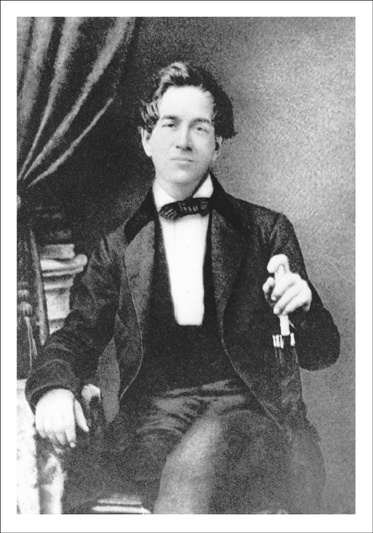
Alfred Vail (New York University Archives)
This so-called relay was an elegantly simple device that used an electromagnet to close and open an independent circuit having its own battery. It marked a huge, essential advance in the utility of Morse’s telegraph, and had many other possible applications. Given his little knowledge of mechanics and electrical science, the relay seems miraculously ingenious. One historian of technology has called it “a creative engineering achievement of the first order.”
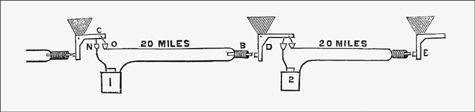
Morse’s 1837 relay plan (Samuel I. Prime, The Life of Samuel F. B. Morse, LL.D. [1875])
Morse’s description of his relay convinced Vail. He agreed to take on the job of refining Morse’s machinery, in exchange for a share of the profits. The partnership had other mutual benefits. Seeking his place in the world, Vail had thought of entering the Episcopal ministry or opening a religious bookstore—or working at the Philadelphia mint. In the telegraph he believed he had found his future. “I disided [sic] in my own mind,” he said, “to sink or swim with it.” On his side, Morse valued not only Vail’s mechanical skill but also his financial assistance, for Vail offered to ask his father and brother to pay for building the apparatus to be shown to Congress. The offer came as a deliverance. A hike in rent at the University had forced Morse to give up four rooms that he rented to his pupils. Even more than usually strapped for funds, he accepted money from Sidney and Richard to support his work on the telegraph. And the year, 1837, had brought one of the worst economic depressions of the nineteenth century, bankrupting hundreds of businesses and throwing thousands of people out of work.
Morse and Vail signed formal articles of agreement. By its terms, Vail would construct a perfected telegraph for exhibition before Congress “at his own proper costs and expense”—the money coming, in reality, from his family. He/they would also defray all incidental expenses, including the costs of obtaining a patent. In exchange, Morse granted Vail a one-fourth financial interest in the apparatus in the United States, and one-half interest in the foreign rights—provided Vail also paid the costs of taking out patents abroad.
Beyond his know-how and family resources, Vail was a young man to Morse’s taste—artistic, literary, and pious. He played the violin and had led the school’s literary society, the Eucleian. He was preoccupied with Sabbath-keeping, self-examination, and other means of becoming a “perfect Christian.” As was true for Morse also, his religious, aesthetic, and political views flowed together. In his commencement oration he depicted God as the origin of beauty in the universe and of the human impulse to improve nature—of both the fine and the useful arts. Nor could Morse have disapproved Vail’s statement, in an undergraduate essay, “If America is free, she must obey the laws of God.”
With the agreement signed, and the Vail family sending checks, Morse and his team got to work in earnest overhauling the telegraph for demonstration in Washington. He and Gale stayed at the University, Vail returned to the Speedwell Iron Works, in Morristown, New Jersey. The surviving documents provide only sketchy information about the time and exact nature of their various improvements. But now and over the following months Vail streamlined the register. He got rid of the canvas stretcher and pendulum, and reinstalled the recording apparatus on and within a flat box. The register became a horizontal, not a vertical, device, no longer standing up but lying down. At the same time he simplified the operation of the electromagnet and of the clockwork that moved the paper.
Meanwhile Morse and Gale prepared the conducting wire, no easy task. Plans called for showing Congress an instrument that could operate over ten miles—commonly the distance between the stations of optical telegraphs. Frustratingly, the wire arrived slowly in batches from its Connecticut manufacturer and proved to be made of inferior copper. The brittleness made it difficult for Morse and Gale to solder the segments together. Their efforts were further delayed in awaiting the arrival of heavy storage reels from Speedwell. And the entire ten miles of wire had to be wound in cotton for insulation. By November, Gale had a strong current working through the whole length—a triumph—but the current burned the mercury in the small cups. A so-called Cruikshank’s battery had to be built to overcome the problem: a tar-coated mahogany trough filled with acid, holding sixty pairs of large zinc-copper plates.
At the same time, Morse labored over the giant dictionary, “a most tedious, never ending work,” he said. “I am up early & late, yet its progress is slow.” He had in mind a compendium of 30,000 handwritten words, but whether he achieved this length is uncertain. He completed two copies late in October, on oversize pages about two feet square. To judge from his later dictionaries, he divided each page into five columns, fifty words per column, in alphabetical order and several grammatical forms. The number 36, for example, meant “abash,” 37 “abashed,” 38 “abashing,” 39 “abate,” and so on. However grueling the effort, Morse glowed over the result. Operators could now transmit, by numbers alone, “any intelligence whatever in the fullest manner.”
Over the first three months of the new year, Morse unveiled his refurbished telegraph in a series of public exhibitions, climaxed by his presentation to Congress. Vail or someone in his family suggested that he first try out the apparatus at Speedwell, about thirty-five miles from New York City. Morse and Gale stripped from one of the reels, and sent on to New Jersey, two miles of wire—a length sufficient to prove the efficiency of the remodeled telegraph over substantial distances.
Set in rolling hills along the Whippany River, the Vails’ foundry and machine shop converted iron bars into screws for ships and crankshafts for railroad cars, its clanging forge room a world of burning cedar and white-hot fagots. In addition to Vail and his brother George, the place was worked by several slaves and indentured servants, sometimes personally whipped by a stout old gentleman in Quaker garb—Alfred’s father, Stephen Vail, a skilled mechanic who was also a lay judge of the Court of Common Pleas.
Morse had visited the ironworks once before to test an earlier model. But he fell ill and became bedridden for ten days, with “one of my bilious attacks.” A young assistant at the place later recalled that he seemed glum over his painting career, and had a “facility of becoming ‘ill’ ” when problems arose: “if we were meeting with difficulties, he succumbed to the blues and left us to work our way out as best we might.” Ill or not, Morse managed during the trip to paint portraits of Vail’s parents, for a fee.
Returned to Speedwell, Morse conducted a private trial on January 6, using the vacant second floor of a barnlike factory building. Through the two miles of wire coiled around the room he sent a message suggested by Judge Vail: “A patient waiter is no loser.” Morse repeated the demonstration four days later, this time for hundreds of local people and some who had come from Newark for the event. He transmitted a quite full letter, which was deciphered with but a single minor error. “The success is complete,” he cheered, “the talk of all the people round.”
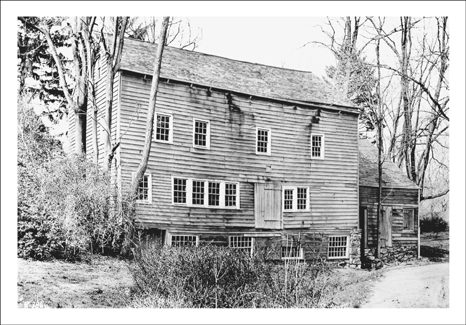
Speedwell factory building (Smithsonian Institution)
Two weeks later, accompanied by Vail, Morse tried some further experiments at New York University. For each performance he sent out engraved invitations requesting the presence of a select audience “to witness the operation of his ELECTRO MAGNETIC TELEGRAPH … previous to its leaving the City for Washington.” For the first time in public he attempted a transmission through the entire ten miles of wire. Disastrously, in three days of public tryouts the system repeatedly failed. As reportedly had happened at Speedwell when he faced difficulty, Morse fell ill (or “ill”). He recovered when still another attempted transmission worked. Better than that, he succeeded in the related test of using his markings to represent not numbers but letters. Surviving accounts do not make clear his means of doing so, beyond mentioning that he cast some sort of new type for the port-rule. But he learned that in this way he could transmit ten words per minute, twice as many as before. Among the messages he sent, one began, appropriately: “ATTENTION, THE UNIVERSE!”
Morse and Vail went on to Philadelphia, where Morse exhibited his ten-mile circuit before the Franklin Institute. Founded a decade earlier as the nation’s first organization “for the promotion of the mechanic arts,” the Institute sponsored lectures, published a distinguished journal, and looked into new inventions.
Morse demonstrated both his numerical method of marking, and his just-introduced method of marking letters that came to be known as Morse code. What seems to be the first mention in print of this famous dotdash alphabet appears in the Institute’s lengthy report on the demonstration:
Two systems of signals were exhibited, one representing numbers, the other letters. The numbers consist of nothing more than dots made on the paper with suitable spaces intervening. Thus … … …. would represent 325, and may either indicate this number itself, or a word in a dictionary prepared for the purpose to which this number is attached. The alphabetical signals are made up of combinations of dots and of lines of different lengths.
The still-controversial code has sometimes been attributed to Alfred Vail. On the contrary, Vail at this time told his father, significantly: “Professor Morse has invented a new plan of an alphabet, and has thrown aside the Dictionaries.” He also had reservations about Morse’s “new plan.” When improved it would outperform the numerical dictionary method, he thought. But the alphabetical signals required that the port-rule be cranked by machine, Morse’s hand being too unsteady. And Morse’s freshly cast type seemed to him imperfect. Even Vail’s criticisms, it deserves emphasis, indicate that the contriver of Morse code was Morse.
Following the Philadelphia exhibition, Vail boxed up the telegraph and forwarded it to Washington by railroad—a technology less than a decade old in the United States, and just beginning to flourish. Meanwhile the Franklin Institute sent a copy of its report to the Secretary of the Treasury. The report warmly endorsed Morse’s apparatus, calling it practicable, pointing out its superiority to European semaphoric and electromagnetic systems, and declaring it “worthy of the patronage of the Government.”
Arriving at the capital early in February, Morse and Vail put up at Gadsby’s Hotel for $17.50 a week. Vail had grown used to shelling out family money for Morse’s expenses—$35 to $75 here and there—but the steep rate dictated a move to some less expensive boarding house. Vail found such lodging for $10 a week, but Morse decided to stay at Gadbsy’s—for the sake of having servants to cater to him, Vail believed. He did not mind the separation, for he had become miffed at Morse. Morse had printed up invitations to the Philadelphia performance—without asking the Vails, but at their expense, and in his own name. And now in Washington, Vail discovered, when invited to meet with President Van Buren or other distinguished people, Morse was inclined to go alone, “unwilling that I should accompany him to see any of the Great Folks.”
A week at Gadsby’s taught Morse that despite its enormous prices the hotel offered poor service. But his move to Fuller’s, a $9-a-week boarding house, made Vail no less disgruntled. It galled him that, although they had signed articles of agreement, Morse called him an “Assistant.” When he protested the title Morse apologized and explained, not convincingly, that he “supposed it synonymous with Partner, Colleague.” Many inventors of the period, imbued with the ideal of the Creative Genius, failed to credit the mere craftsmen and mechanics who were essential to their work. Vail nevertheless felt used, resentful at being handed such menial chores as packing and shipping: “Professor Morse is indisposed when there is anything to do.” And his brother George griped that Morse failed to keep the family posted and granted them no recognition. Vail did not turn away, certain that he had embarked on a great and noble adventure. But he was beginning to see his former teacher as imperious, exploitative, and vain, a hierarch who gave him the dirty work, let his family pay the bills, and took the glory for himself.
Morse’s Washington demonstrations apparently began around February 15 and lasted several days. He used the numerical code rather than trust his alphabetic method. The city was cold, the ground covered with a half inch of ice, boys and men skating over the streets. Morse and Vail performed in the carpeted room of the Committee on Commerce, warmed by a hickory wood fire, the wire circuit spooled on two five-mile reels. Despite the stormy weather, members of Congress crowded into the room, some bringing back other witnesses, who came again and again. John C. Calhoun alone sent down a dozen other senators. Morse gave a special showing, upon request, for President Van Buren and members of his cabinet, including the Secretaries of State, Treasury, War, and the Navy. He had the President convey a message to him silently, which he then set up on the port-rule, in numbers, for Vail to decipher. Van Buren sent “The enemy near.”
But to Morse’s delight, there were no enemies, only dumbstruck admirers of his telegraph. “Members of Congress who, when told of its operation, scouted it as impossible and visionary, come and are for a while mute and then go away with exclamations of wonder.” To Vail the events seemed unreal, “as though some strange thing had happened.” He recorded some of the amazed comments he heard: “what would Jefferson think, could he arise up … where will improvements and discoveries stop … it is the most wonderful discovery ever made … it must belong to the government.” Patent Commissioner Henry Ellsworth, from whom Morse had obtained a caveat, reportedly said that “nothing has ever been in Washington that has produced such a noise.”
The Committee on Commerce asked Morse to draw up a full report on his invention. They planned to recommend that Congress appropriate funds to test the device over a much longer distance. Morse believed that if the experiment succeeded, the government would buy his telegraph and amply reward him. He submitted two reports, a week apart. Trying the telegraph over fifty miles, he said, would show whether it could operate over a thousand or ten thousand. He estimated that the circuit and instruments could be built in three months, at a cost of $26,000.
Looking further ahead, Morse addressed the sensitive question of ownership. Given its immense power, the telegraph would become a tool for good or for evil, as properly or improperly used. If some speculators monopolized it, for instance, the device might enrich them but bankrupt thousands. He therefore suggested that the government retain sole right to use of the telegraph, granting individuals or companies the right to build lines between two points. By making the telegraph a joint public-private venture the government could both reap a vast revenue for itself and nourish the “enterprising character of our countrymen.”
The Committee on Commerce gave Morse more than he asked. They recommended that Congress appropriate $30,000 for a fifty-mile test—the extra $4000 to be used for meeting unforeseen expenses. The committee chairman, Francis O. J. Smith, submitted an ecstatically zealous report to the House. Morse’s telegraph, it said, could transform the nation’s commercial, political, and social condition, bringing about “a revolution unsurpassed in moral grandeur by any discovery that has been made in the arts and sciences.” Among its other benefits, the telegraph could enable people all over the widely extended country to communicate with each other instantaneously. In a manner that inspired religious reverence it could endow the American citizen with a power approaching the “HIGH ATTRIBUTE OF UBIQUITY.”
F. O. J. Smith (1806–1876) was himself so keen on the telegraph’s possibilities that he asked Morse to take him in as a partner. He suggested that they go to Europe together and apply for foreign patents while waiting for the appropriation bill to pass Congress. Morse hesitated: such an alliance with a public official might be misunderstood, giving rise to charges of improper influence. At the same time he recognized how valuable Smith could be to the suddenly flowering enterprise, not only by his connections in Washington but also as a lawyer. He explained his misgivings to Smith, who replied that, as the session of Congress was ending, he would take a leave of absence. A thrice-elected congressman from Maine, he would also send a letter to his constituents declining to stand for reelection. On these terms Morse agreed to a partnership.
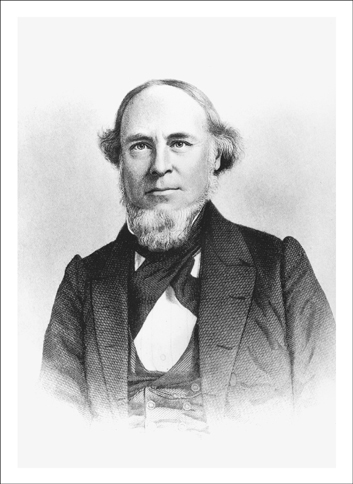
Francis O. J. Smith (Maine Historical Society)
Commissioner Ellsworth reportedly discouraged Morse from making the trip abroad. The time had passed for obtaining foreign patents, he said; telegraphs were already well known in Europe. He had reason to think so, for stories about European devices continued to appear in the American press. But by now Morse dismissed them as kowtowing, signs of “a slavish dependence on foreign opinion, not yet eradicated from American hearts, the old colonial feeling of inferiority.” Ellsworth advised him instead, while in Washington, to approach the foreign ministers of various countries and try to interest their governments in purchasing his device. Morse did speak with the minister of Turkey, and with Gail Hunt of the then-independent Republic of Texas. But he decided to head for Europe anyway, together with Smith.
In March, Morse drew up new articles of agreement embracing himself, Smith, Alfred Vail, and Leonard Gale. Smith would seek patents for the telegraph in Great Britain, France, and other countries; negotiate with foreign governments and private persons the right to use the invention, and act as legal counselor and attorney for the other partners. Morse agreed to accompany him abroad for three months, to aid in demonstrating the telegraph, his expenses to be paid by Smith and refunded from the proceeds of sales. Smith would acquire a one-quarter interest in the American patent and a five-sixteenth interest in any foreign patent. Vail agreed to a two-sixteenth interest in both patents, Gale to a one-sixteenth. Morse retained the major stake, but not by much: a nine-sixteenth interest in America and half interest abroad. All the parties bound themselves to another, essential principle: no partner could sell rights to the invention without consulting the others and having their consent.
Before leaving for Europe in mid-May, Morse got ready several complete telegraphs to take along—transmitters, receivers, dictionaries, batteries. Given the difficulty of moving it all aboard ship and between countries, he decided to take a setup capable of working through only two miles. The apparatus included a once-again-improved port-rule and register, created by Vail after much thoughtful experiment.
Morse also gathered up letters of introduction and recommendation from well-placed politicians and other notables to their counterparts in Europe, including Russia. He impressed on them that in going abroad he hoped not only to profit from his telegraph, but also “to claim for my country the honor of the Invention.” At the same time he prepared a U.S. patent application, working together with F. O. J. Smith but making the elaborate drawings himself, a “most arduous and tedious process.” Foreign governments would not patent his telegraph if he had already patented it in America. So he asked the Patent Office to delay issuing the document until he returned from abroad—a request that would bring him grief.
While developing his telegraph, Morse had stayed in touch with his artist friends and painting pupils. As President of the National Academy of Design, too, he had continued to deliver the annual address and look after the awarding of premiums. On the eve of his departure the members once again elected him president, commissioning him to make purchases for the Academy while abroad. Before setting off he also attended to The Gem of the Republic, his giant history painting of the signing of the Mayflower Compact. After his wounding elimination from the Capitol rotunda project, a group of artists had raised subscriptions to commission the work, hoping to rally him. Getting started, he had visited Boston and Plymouth to search for remains of the Mayflower and of the furniture of the Pilgrims.
Morse sent the subscribers a printed letter, admitting that he was in a “state of suspense.” He hoped while in Europe to pursue “some studies connected with the Picture,” he said. But his commitment to the telegraph might make it a duty, “to myself and to my country,” to put off the painting for a while, perhaps eventually to give it up. For the moment he asked his sponsors to collect no more money until he returned, when he would more certainly know what to do. What he wanted to do was clear, he concluded: “If possible I wish as soon as practicable to relieve myself of the cares of the Telegraph, that I may have my time to devote more strenuously than ever to the execution of my picture.” In fact, however, his lifelong and once-consuming ambition to paint was dying.
Morse’s brother Richard decided to accompany him and Smith, not to transact business, but for the healthful effects of an overseas voyage. Sometimes vomiting after meals, he had been experiencing again the emotional pain that had darkened his adolescence and young manhood, what he described as “depression of mind, irritability of nerves & irresoluteness.”
As he embarked for Liverpool, Morse himself felt anxious. “I am risking all my professional business by this act,” he told Vail, “and if it should turn out nothing, I shall be in a bad situation.” His artistic career had taught him much about hopes that turned out nothing, or worse. Although pleased by the rousing and unanimous approval of his telegraph in Washington, he recalled his last stay in the city thirteen years before: while painting Lafayette he had received the news of Lucrece’s death. He must stay guarded, he thought, even though the prospect before him now was of fame and wealth, “the tide of prosperity at its full flow.” Human affairs were inconstant, and just ahead on such tides often lay defeat: “in this world a continued course of prosperity is not a rational expectation.”