
7
In the aftermath of Edward II’s withdrawal from Berwick, two powerful themes begin to dominate the narrative: the raiding of England, and the capture of Scottish towns and castles. The two are more closely connected than they might first appear. The raiding of England and the extraction of tribute from her terrified and defenceless northern communities provided Robert with the funds to pay his soldiery to undertake prolonged sieges of castles and walled towns. Scottish subjects were custom-bound to serve their king unpaid for only forty days; for anything beyond that the king had to pay. Lucrative raiding opportunities must also have provided a carrot, enticing Scottish aristocrats to adhere to the Bruce cause; the stick keeping them in line was the destruction of not just enemy-held castles but virtually all castles, privately held or royal. As we have seen, it was a matter of policy for Robert to deprive Scottish nobles of the luxury of independence and choice between masters which private castle walls provided. Thus Robert’s civil war against the ‘Anglo-Scottish’ nobles was intimately connected with his patriotic war against the English.
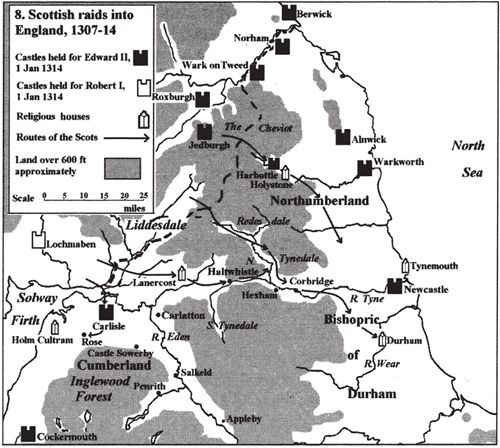
On the departure of the English court from Berwick, Robert seized the initiative and mounted two devastating raids on the north of England. The first, which lasted from 12 to 20 August 1311 is narrated by the English Lanercost chronicler: ‘having collected a great army, he [Robert] entered England at Solway on the Thursday before the feast of the Assumption; and he burned all the land of Gilsland and the vill of Haltwhistle and a great part of Tynedale, and after eight days he returned to Scotland, taking with him a great booty of animals; nevertheless he had killed few men apart from those who wished to defend themselves by resistance.’ The following month, Robert again invaded England:
About the feast of the Nativity of the Blessed Virgin [8 September], Robert returned with an army into England, directing his march towards Northumberland, and passing by Harbottle and Holystone and Redesdale, he burnt the district around Corbridge, destroying everything; also he caused more men to be killed than on the former occasion. And so he turned into the valleys of the North and South Tyne, laying waste those parts which he had previously spared, and returned into Scotland after fifteen days; nor could the wardens whom the king of England had stationed on the marches oppose so great a force of Scots as he brought with him.
These expeditions were of a different order to the cross-border cattle raids that Douglas and others had inflicted on the western march since 1307. Robert was apparently leading large infantry forces and systematically laying waste enemy territory, as he had done at the herschip of Buchan. For his followers the plundering was a useful reward that increased loyalty, but the troops could not keep everything they captured. Traditionally one third of the plunder and any prisoners taken had to be handed over to the lord. Extraction of money seems to have been Robert’s main objective at this stage, for he showed himself quite willing to be bought off. Following these raids the Northumbrians sent envoys to negotiate a truce, and they agreed to pay £2,000 until 2 February 1312. The men of the earldom of Dunbar, still of the king of England’s peace, also paid a heavy fine for a truce to that same date.
The money was needed to prosecute sieges of the east-coast towns of Perth and Dundee, and for increasing military pressure on Berwick. Barbour treats the recovery of castles and walled towns in a special way. As has been pointed out, chronicles were written for entertainment, and some of the most entertaining passages in Barbour are those relating to the capture of the castles of Scotland from ‘English’ garrisons. More than any other aspect of the narrative they demonstrate how the Scots overcame the vast material wealth and superiority in numbers of their adversaries by deploying slight, that is, native wit and cunning. Robert could rarely resort to long sieges, which were expensive and would leave his forces stationary and vulnerable to attack; nor did he have in sufficient number the catapults, battering rams or other machinery that would facilitate taking by storm. Trickery was the Scots’ only resource. The pattern was already well established: as early as Christmas Night 1308 the castle of Forfar was captured by stealth. ‘Philip the Forester’ and some others used ladders to scale the wall while the guards slept, and they killed everyone within and handed over the castle to Robert. He then demolished the castle wall and poisoned the well. At Douglas Castle in April 1308, as we have seen, they tempted the garrison out with the prospect of robbing a line of packhorses; at Linlithgow in August 1313 they hid in a hay wain which they lodged in the gates of the peel to prevent their closing, springing out to surprise the guards and capture the castle. Frequently the episode is set on a feast day – Christmas Night, Palm Sunday and Shrove Tuesday are all mentioned – when the sentries were lax or distracted or drunk. Usually Barbour gives a key role to a named folk hero: Tom Dickson planned the ambush of the Douglas garrison in St Bride’s Kirk, William Bunnock drove the hay wain in the capture of the Peel of Linlithgow, and Syme of Ledhouse made the ingenious rope ladders for scaling the walls of Roxburgh in February 1314. A rivalry emerges between Robert’s lieutenants Douglas and Thomas Randolph – who was created earl of Moray in 1312 – as to who could gain most glory in the taking of castles.
In December 1312 Robert made his first attempt to capture Berwick: the first of many. Berwick was at once the largest and richest town in Scotland; the administrative and military centre of the English occupation; the locale of the English supply operation; and the key strategic position that controlled access to the rich Northumberland coastal plain. Bruce’s night-time attempt to scale the walls by way of rope ladders was, however, foiled by a barking dog ‘just as old geese saved Rome by their gaggle’. Robert was forced to turn to lesser targets, but in the meantime the depredations of the enemy garrisons of Lothian were doing his work for him. Neglected by Edward II, low on morale and desperate for provisions, they raided the surrounding countryside mercilessly, causing Anglo-Scottish lords such as Adam Gordon to protest to Edward II that the sympathies of country people were being alienated by rampaging garrisons.
Robert had Dundee under siege from February 1312. Edward II was anxious to keep the town at all costs, and he forbade an agreement which the commander, William de Montefichet, had reached with Robert, that Dundee should be surrendered in exchange for return of English prisoners. Instead, ships and barges along the east coast were collected to ferry heavily armoured infantry to Dundee, but at last, in April, Montefichet was forced to surrender, and his garrison was permitted to leave for Perth. Robert’s possession of Dundee, however, made the supply of Perth by sea all the more difficult for the Anglo-Scots and English.
The chronicles agree that Robert invaded England next in mid August:
Having assembled a great army, he invaded England about the feast of the Assumption of the Blessed Virgin [15 August 1312] and burned the towns of Hexham and Corbridge and the western parts, and took booty and much spoil and prisoners, nor was there anyone who dared to resist. While he halted in peace and safety near Corbridge, he sent a part of his army as far as Durham, which, arriving there suddenly on market day, carried off all that was found in the town, and gave a great part of it to the flames, cruelly killing all who opposed them.
The next day ‘despairing of help from the king of England’, the men of the bishopric of Durham and those of Northumberland each agreed to pay the Scots £2,000 for peace until Midsummer 1313. The deal with the men of Durham was struck at Hexham on 16 August. The communities of Westmorland, Copeland and Cumberland ‘redeemed themselves in a similar way’ and, though they did not have the cash to give straightaway, they surrendered the sons of the chief lords as hostages. In the English counties the normal machinery of regular taxation seems to have been employed to collect these blackmail payments, but the rate at which Robert exacted this tribute from England was ruinous. The £2,000 which Northumberland paid to Robert in 1311 was double the amount it had yielded to the king of England in 1296, and Northumberland was made to pay the same amount the very next year.
Coffers replenished, Robert redoubled his efforts to capture Perth. This was a difficult task, for Perth was protected on the landward side by the River Tay and by a ditch. The defenders were led by Sir William Oliphant, Montefichet, and the earl of Strathearn. Oliphant was the same man who had valiantly defended Stirling Castle to the last in 1304; this is at once an indication that Robert was up against experienced veterans of siege warfare, and a salutary reminder that many patriotic Scots did not approve of the Bruce regime. The siege also illustrates that aristocratic families were often divided in their allegiances: while Strathearn was defending the town, his son and heir was at Robert’s side attacking it. Barbour describes how Robert tested the bed of the ditch with a long pole to find out where it was shallowest, and at last found a place where men could wade across, though the water was shoulder high. At the end of December he had his men pack up their equipment and feign retirement from the siege, but eight days later they crept back in dead of night with a small force carrying ladders. It was the night of 7/8 January. They listened carefully, but heard no noise from sentries. Then ‘to show an example to his men’, the king shouldered his ladder and slipped into the icy water, and, using his spear to prod the bed of the moat, waded across the ditch. In admiration, Barbour puts the following words into the mouth of a French knight witnessing Robert’s actions:
Ah, Lord, what shall we say
Of our French lords,
Always stuffing their bellies with good food,
Willing only to eat and drink and dance,
When such a knight, so noble
As this one, by his chivalry
Has put himself in such danger
To win a wretched hamlet.
The king, Barbour says, was the second man to scale the town wall. The French knight may be a device, employed by Barbour to reflect upon the king’s bravery, but Robert’s energetic participation in the attack on Perth is borne out by other sources. Taken entirely by surprise, the townsfolk put up no fight, and, though there was widespread spoliation, few were slain as a result. The walls and towers of the town’s defences were then destroyed. Strathearn, arrested by his own son and heir, was taken into the peace of King Robert, another earldom brought onside.
In the summer of 1313 Robert had only to make threatening noises for northern England to pay up. In the run-up to midsummer, when the truce would lapse, the Northumbrians wrote to Edward II pleading for aid. Their king replied characteristically by ordering the men of Northumberland to do their best to defend the county against the Scots. In June it was reported that the Scots were ready to attack in three places on the March, and on 5 August the bishop of Durham excused himself from parliament saying that Robert Bruce ‘has of late caused a great host to be assembled’. To stave off disaster, the northern English counties negotiated for a third year, and Northumberland, Westmorland, Cumberland ‘and other borderers’ offered large sums for a truce, to last until 29 September 1314. We know that on this occasion Cumberland was forced to pay 2,000 marks (£1,466), because Edward II subsequently ordered that collection of the money should be audited. From this audit we see how the burden was allocated to the different wards and lordships of that county; the generous sums allowed for maintenance of the hostages – sons of local knights; the hefty expenses claimed by the collectors, who were local gentry; and the sweeteners paid. These last included twenty measures of oaten flour to King Robert and £12 in cash, a salmon and two measures of wine to Brother Robert de Morton, King Robert’s attorney.
To us it is remarkable that, as an alternative to providing protection, Edward II was prepared to countenance the buying of private or local agreements with his enemy. ‘No deals with terrorists’ is a dictum to which all modern states subscribe. Edward II may similarly have considered that his royal dignity was being compromised by agreements between local communities loyal to him and hostile Scots. Yet he tolerated and even encouraged them for two reasons. Firstly, since the local commanders or local communities paid for them, they were cheaper than campaigning, and secondly, they saved him from having to compromise on domestic issues in return for parliamentary taxation which he needed to mount a campaign. But, as Edward discovered, this method of staving off enemy attack undermined perception of him as king: it sapped faith and confidence in his lordship, and ultimately encouraged local communities to accept the alternative of Robert’s lordship. In 1315 the people of North Tynedale ‘gave themselves up completely to the King of Scotland’. As one historian has remarked, by the late 1310s a fifth of Edward’s kingdom was paying tribute to Robert. Short-sighted and temporising Edward II’s policy may have been, but he might have recovered all his compromised lordship with a single victory on the battlefield.
Robert did not confine his raids to England. In February 1313, Robert assisted his brother, the new Lord of Galloway, in inflicting further punishment upon the Gallovidians. The castles of Buittle, Dalswinton and Dumfries were all taken and destroyed. On 17 May 1313 Robert landed at Ramsey on the Isle of Man ‘with a multitude of ships’ and besieged the castle of Rushen for five weeks. The enemy commander at Rushen was the Gallovidian Dungal MacDowall. In unleashing this attack, Robert seems to be pursuing a blood feud, typical of a Gaelic warlord. As we have seen, Dungal had captured and handed over for execution Robert’s brothers Thomas and Alexander in 1307; he had survived Edward Bruce’s assault on Galloway in 1308; in February 1313 he had been driven out of Dumfries Castle and fled to Man; and now, as castellan at Rushen, he seems to have attracted the enmity of Bruces once again. The five-week siege required a widespread search for foodstuffs, and Robert sent galleys to Ulster on the last day of May. ‘The Ulstermen resisted them and manfully drove them off. It was said, nevertheless, that Robert landed by licence of the earl [of Ulster] who had taken a truce.’ While the earl’s position as father-in-law to Robert seems often to have given rise to such suspicions, it is likely that no love was lost between the two men. Robert may have wished to use the opportunity to repay his father-in-law for his troublemaking visit to Argyll in 1309. Rushen fell to the Scots on 12 June, and Robert had it demolished. Dungal seems to have fled to join other Scottish émigrés in Ireland, to which place the vengeance of the Bruces would pursue him yet.
In the North Sea theatre of war, the Scottish privateers continued their co-operation with Flemish and Eastlander merchants against English vessels. As Robert captured further east-coast ports – Dundee in 1312, Perth in 1313 and Edinburgh in 1314 – the English blockade became progressively unenforceable. English ships began to sail in convoys for safety. Tension between the English government and Robert, Count of Flanders, mounted as the English demanded sterner measures against the privateers, and the count protested his inability to hinder legitimate trade. In 1311 the English seized three Flemish-owned vessels near Aberdeen in Scotland for supplying the Scots. In reprisal, English merchants in Flanders were arrested. English vessels supplying Scottish castles also fell prey to the privateers. From 1311 protracted talks between the two governments tried to repair relations, but these were abandoned in 1313. Incidents continued to occur: in the estuary of the Schelde three Flemish-owned ships sailing from Hull to Flanders were attacked, with English merchants claiming to have lost £4,000 in wool, cash, and other commodities in the shipment. Five English merchants travelling with the convoy were taken as captives to Aberdeen and sold to the Scots. In return for stolen wool, the Scots acquired arms and foodstuffs. On 1 May 1313 Edward II wrote to Count Robert complaining of the activities of the now notorious John Crabbe, and alleging that a convoy of thirteen Flemish ships laden with arms and foodstuffs had lately departed for Scotland from the port of Zwyn. Edward II then played a trump card: he denied the Flemish towns direct access to English wool, by establishing a staple, or exclusive trading post, at St Omer in Artois, outside Flanders and in the French sphere of influence. English wool would henceforth be taken heavily guarded and in convoy to this staple port, and Flemish merchants would have to pay a higher price for their raw material. Even so, privateering on the North Sea continued: at Michaelmas 1314 another English ship was captured, and a wool merchant of Beverley and his son were abducted.
In 1312 Robert repaired diplomatic relations between Scotland and Norway. Influential in the North Sea and more especially in the Western Isles, Norway remained important to Scotland’s wider interests. Robert’s sister Isabel had married King Eric II. Eric had died in 1299, but Isabel continued to live there as dowager queen until 1358. By an agreement sealed at Inverness in October 1312 Robert undertook responsibility for payment of the annual 100-mark tribute due to Norway. In 1266 Alexander III had promised to pay this sum annually in return for Norway’s ceding of the Western Isles to the kingdom of Scotland. With money extracted from northern England, Robert could afford to square up to this foreign commitment, proving to North Sea traders that Scotland was a safe and reliable country with which to do business.
Commercial and diplomatic relations were only one of a number of problems distracting Edward II from the task of shoring up his deteriorating military position in Scotland. A new development however sent Scotland to the top of his priorities. At an assembly at Dundee on 21–24 October 1313 Robert issued an ultimatum to those Scots who still refused to acknowledge his kingship. Although hostilities would continue, those who submitted to him within one year might be allowed to retain their lands and titles. Having taken Linlithgow, and severed communications between Stirling and Edinburgh, he was now in a powerful position to threaten Lothian, and considered that by this well-advertised ultimatum he might tear the heart out of the Scottish resistance. This decree – so tempting to the remaining Anglo-Scottish lords – ensured that the king of England would at last bestir himself and lead an army into Scotland, and in November the English administration set the wheels in motion for a full-scale invasion of Scotland the following summer.
As 1314 opened, the enemy remained in control of their four main garrisons – Edinburgh, Roxburgh, Stirling and Berwick – and still had possession of several lesser strengths. Early in 1314 the earl of Moray set about besieging Edinburgh Castle. Barbour relates that the castle was well provisioned, but that the garrison commander, Sir Piers Lubaud, came under suspicion of wanting to betray the castle. His men clapped him in irons and imprisoned him, and appointed an English constable to take charge. The siege wore on until March and still Moray had made no progress, as the garrison did not want for food. Hearing of Douglas’s success at Roxburgh however, he offered a reward to any of his men who might be able to scale the cliff and the castle wall, and one man came forward. This folk hero was William Francis, who in his youth had been in the castle and had learned to climb down the rock at night to visit a girlfriend in the town. Accordingly, on the night of 14 March, Moray and thirty of his men set off to follow William Francis’ ascent of the rock:
The night was dark, as I heard tell,
And soon they came to the foot of the rock
Which was high and sheer.
Then before them William Francis
Climbed in the clefts
Always the first among them
And they followed him at the back;
With great difficulty, sometimes to, sometimes fro
They climbed in the clefts
Thus until they had climbed half the crag.
At the foot of the wall they used a ladder, and gained the parapet. After a bloody battle the assailants took possession of the castle. They discovered Piers Lubaud in the dungeon. Piers did homage to Robert and became his liegeman. True to form, Edinburgh Castle too was demolished to deny it to the English occupation, ‘lest the English ever afterwards might lord it over the land by holding castles’.
Moray’s capture of Edinburgh had been inspired by Douglas’s success in taking Roxburgh. Barbour states that Douglas had rope ladders, similar to those used at Berwick two years previously, made specially for the task. These ladders were ‘of wonderful construction’, and much admired by the English chronicler who inspected them in person and at close quarters at Berwick. On Shrove Tuesday – 19 February 1314 – Douglas and his company crawled up to the wall and used a lance to place a grappling crook in the embrasure. The clatter was heard by the sentry, but too late, for the Scots had mounted the wall. They surprised the large garrison, who were making merry in the hall, and killed until it was clear that they had the upper hand. A small party led by the warden, Guillemin de Fiennes, retreated to a tower where they continued resistance. But the next day Fiennes was wounded fending off an assault, and, in return for life and limb for the defenders, he surrendered the tower. Edward Bruce was sent especially to destroy the castle; he and his men ‘knocked to the ground the whole of that beautiful castle, just as they did other castles’.
In March Robert began putting pressure on Stirling to surrender, and in mid May Edward Bruce made an arrangement with the commander of Stirling: unless the English army came within three leagues the castle, within eight days of 24 June, Sir Philip Mowbray would surrender it.34 Edward Bruce’s prominence at this time, indeed the prominence of all three of Robert’s lieutenants – Edward, Douglas and Moray – might suggest that Robert was once more temporarily ill.
Only the threat of a complete collapse of the English position in Scotland had stirred the English king into action, and some of his nobles into grudging co-operation. Two of the four key Scottish castles had already fallen that spring: Roxburgh in February 1314, Edinburgh in March. For the coming campaign Edward II called up 10,000 infantry – including 3,000 Welsh – with additional writs of array demanding masons, carpenters and smiths. Clearly he was expecting to besiege and retake castles that had fallen to Robert. A further 10,000 troops were ordered up, chiefly from northern England, which had been laid waste and taxed to ruin by the Scots. Though Edward knew well that 20,000 men would not turn out, this doubling of the call-out is indicative of his determination to overwhelm the Scots. Full wardrobe books survive for many of Edward I’s Scottish campaigns, but one could not be compiled for the Bannockburn campaign since the records were lost in the rout. We are therefore forced to estimate. For the main thrust of attack along the Eastern March perhaps 10,000 infantry mustered for battle. The army lacked the full quota of cavalry as the earls of Lancaster and Warwick and their allies again refused to serve in person and sent only knights to perform the strict terms of their service. But the royal household provided the kernel of the heavy cavalry force, and, in addition, the ‘royalist’ earls of Gloucester, Hereford and Pembroke brought their contingents of knights and men-at-arms. Other powerful magnates present included Robert Clifford, Henry Beaumont, Pain Typtoft and John Segrave. Scots who rode with Edward included Robert Umfraville, Earl of Angus; John Comyn, son and heir of the murdered John Comyn; Sir Edmund Comyn of Kilbride; and Sir Ingram de Umfraville. An English chronicler states that Edward had 2,000 horse; allowing for the chronicler’s exaggeration 1,000 seems reasonable. Sensible provision was made for the presence of a large English army. A Genoese merchant banker was employed to ensure that enough grain was stored at the twin provision depots of Berwick and Carlisle. As in 1311 there was to be a simultaneous campaign on the western approaches to Scotland: the earl of Ulster was to lead 27 Anglo-Irish lords, 25 Gaelic Irish chiefs and 4,000 foot. John of Argyll – who must have savoured the prospect – was to lead the fleet. While it is not at all clear how this arm of the campaign proceeded, the earl of Ulster at least linked up with the royal army.
What could Robert pit against this formidable array? The Scottish cavalry were led by the hereditary marischal, Sir Robert Keith. They were vastly inferior in numbers and quality. At a stretch there might have been 500 Scottish horse, but, while the English knights rode large specially bred chargers called destriers, many of the Scots were probably mounted on light ‘hackneys’ or ‘hobbies’. It is estimated that Robert mustered 5,000–6,000 infantry. He was at least contemplating the possibility of a pitched battle.
The relief of Stirling became urgent as the English royal army approached Scotland. At Newminster in Northumberland on 27 May, Edward II stated that the Scots could be expected to assemble ‘in strongholds and morasses between us and our castle of Stirling’. An English chronicle relates that the host proceeded by forced marches: ‘Brief were the halts for sleep, briefer still for food; hence horses, horsemen and infantry were worn out with toil and hunger.’ Entering Scotland, resplendent with heraldric banners and trappings, the English vanguard, led by the earls of Gloucester and Hereford, was a colourful and awe-inspiring sight:
The sun was shining bright and clear
And arms that were newly polished
Flashed in the sun’s rays
In such a way that the whole land was aflame with
Banners fluttering right freshly
And pennants waving in the wind.
The great host proceeded to Edinburgh, and occupied the town. The slighted castle afforded little comfort, but the harbour at Leith was useful for unloading provisions. The following day the vanguard set out towards Falkirk and Stirling.
Despite the lack of an English royal wardrobe book, the sources for Bannockburn are plentiful by comparison with other major battles. That blessing creates the difficulty of reconciling what are often conflicting accounts, as the various eyewitnesses recorded different aspects and episodes of the battle. We have three good chronicle accounts from the English, at least two of which were based upon eyewitness accounts. However, in the topography described there are two forests – Torwood and New Park – two approach roads – the road running north towards Stirling from Denny, which corresponds to the modern A80, and the road from Falkirk and Larbert, corresponding to the modern A9 – and two churches – the church of St Ninian, a mile south of Stirling Castle, and the chapel at Larbert, two miles north of Falkirk; deciding upon the precise meaning of references to places is thus fraught with difficulty. We have a good idea of the general whereabouts of the battle: Barrow and Duncan share a very similar idea as to the exact whereabouts of the main engagement on 24 June. Artefacts from the period, possibly connected with the battle, have been discovered in that vicinity; recently, during the course of a BBC archaeology programme, two pieces of stirrup were discovered, and in 2004 a ‘bodkin’, or armour-piercing arrowhead was unearthed. The archaeologists have done well: the field was picked clean immediately after the battle by the Scottish camp followers.
In the Barbour narrative the course of the battle is central, representing the key vindication of the hero-king’s struggle, and Barbour has not resisted embroidering the narrative with anecdotes and material to entertain a courtly audience. Consequently his account of the battle occupies three books of The Bruce. Robert assembled his host at the Torwood, which was a forest stretching either side of the road to Stirling, between the Tor Burn and the River Carron. Understandably, Robert appears to have been racked by indecision: to fight or flee? And if to fight, where and how? At first he decided to make a stand on the Tor Burn. He divided his army into three: Moray was to lead the vanguard; Edward Bruce the second division and he himself the third, which included the men of Carrick, Argyll, Kintyre and the Isles. Barbour records a fourth division led by Walter the Steward and Douglas, but since the English chronicles all record three it seems that Barbour invented a fourth to give roles to all his heroes. Robert positioned all his forces in or near woods to keep them safe from cavalry attack. His own division he took to the woods of the New Park, while Moray was ordered to stay in the Torwood, with instructions to ‘keep the road beside the kirk’. Duncan takes this to mean the chapel at Larbert. For the present, Moray was to block the main approach road, the A9 route. Robert had selected a battlefield, probably the area spanning the A80 just north of the Tor Burn, where he ordered his men to dig a trap for the English cavalry: a honeycomb of shallow holes, ‘a foot in diameter and as deep as a man’s knee’, each concealed with twigs and grass. This device has been likened to a minefield; it would certainly have disrupted a cavalry charge.
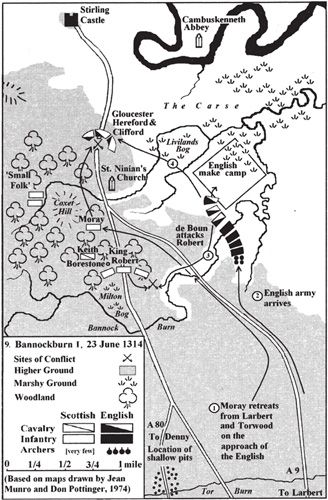
The English spent the night at Falkirk, and on the Sunday 23 June ‘after dinner’ they came within sight of the Torwood. They were anxious to reach Stirling Castle either that day or the next, before Mowbray delivered it up for lost, so there was a tendency for leading groups to press ahead. There were two encounters that evening, which took place as the main body of the English army was still arriving. In the first incident, a group of young aristocratic hotheads, spying some Scots ‘straggling under the trees as if in flight’, galloped off around the Torwood to cut off their retreat. What they had seen was Moray, retiring from his position at the chapel of Larbert to join King Robert in the New Park. Probably he had seen the English host from afar and decided upon withdrawal. The English must have seen further activity around the New Park, for they rode off in that direction, confident that the Scots were in full retreat before them. Great was their surprise then, when the Scottish king himself galloped out towards them, at the head of a force of cavalry:
He rode upon a little palfrey,
Low and bonny, and directing
His company with an axe in his hand
And on his bascinet he wore
A hat of boiled leather
And on top of that
As a sign that he was king,
A high crown.
At the head of the English aristocrats rode Sir Henry de Boun, a knight of Hereford’s retinue and possibly a relative of that earl. Levelling his lance, he rode full tilt at the king, but missed, and as he passed Robert stood up in his stirrups and brought his axe down on de Boun’s head. With the force of the blow, Barbour tells us, the axe-shaft broke in two, and Barbour has the king complain nonchalantly that he had ruined a bloody good axe. The English knights fled. Robert’s victory in this one-to-one combat is attested by two English chronicles, and such a personal feat of arms at the very commencement of battle sent Scottish morale soaring. It was a vindication in itself of Robert’s right as king. Enormously encouraging, news of the encounter will have spread rapidly throughout the Scottish ranks.
Shortly before or after this, Robert Clifford, who also saw Scots close by the woods, led a contingent of cavalry to skirt around the woodland and cut off the Scots’ retreat. Clifford was accompanied by the earl of Gloucester, Henry Beaumont and, among others, to our good fortune, by Sir Thomas Gray, whose son included his father’s eyewitness account in his narrative, Scalachronica, written in 1355–57. These knights galloped around the wood until out of the sight of the main body of the English army, and took up a position to block a retreat towards Stirling. Suddenly, out of the woods, came a rush of Scottish infantry, bunched closely together in a tight schiltrom formation, and carrying pikes. Moray had seen that the English contingent was isolated. The English cavalry had halted too close to the trees to form up and charge, expecting the retreating Scots to come from another direction. The horses were the main targets of the Scottish pikemen, and, maddened by their wounds, the chargers reared up and threw their riders. Sir William Deyncourt was killed. Sir Thomas Gray was taken prisoner. Gloucester was unhorsed – an omen of what would happen on the morrow. Robert Clifford was routed, and he led the remainder of the contingent back to rejoin the main army. Thus a second and stronger group of cavalry rejoined the main body of the troops with wounds, excuses and tales of the valour of the Scots.
Both actions took place in the evening, and the light was now fading. The English, tired when they had arrived, were now thoroughly demoralised; the Scots were buoyant. The summer night was heavy with expectations, full of possibilities and riddled with politics. Robert should never have fought the Battle of Bannockburn: in the face of such a host he should have prudently retired to the hill country to keep his forces intact and wait for the English to starve. Yet these incidents meant that, psychologically, the battle was already won. He had decided against pushing his luck, however, and Sir Thomas Gray tells us that he was preparing to withdraw under cover of night to the high country of Lennox when he received a defector from Edward’s camp. This was Sir Alexander de Seton, who had supported Bruce in 1308, but had returned to the faith of Edward II after 1310. He brought news of the demoralised state of the English camp, and Robert changed his mind once more, determining to gamble everything on the outcome of the morrow’s battle. Seton was not the only defector: David de Strathbogie, Earl of Atholl, Edward Bruce’s brother-in-law, had been alienated from the Bruce camp by the knowledge that Edward had scorned his sister to whom Edward was affianced, or possibly even married, by deserting her for Isabel of Ross. Atholl defected to the English, further diminishing the Scottish cavalry and carrying off Robert’s stores from Cambuskenneth Abbey.
The exact text of Robert’s crucial eve-of-battle speech to his lords does not survive, but echoes of it have come down to us in several versions. Barbour gives the king a speech of 150 lines, in which he commences by asking his men whether they should fight or flee. They opt enthusiastically for the former. Then Robert reassures them that in three ways they have the edge. ‘The first is that right is on our side and God will always fight for the right.’ Secondly, the arrival of the enemy host affords a tremendous opportunity for the Scots to plunder. Thirdly, the enemy fight only to destroy them, but the Scots fight for survival itself:
And for our children and our wives
And for our freedom and our land
We are bound to stand in battle.
Later Robert puts before his lords the stark choice that lies before them:
You bear honour, reputation and riches
Freedom wealth and happiness,
If you carry yourselves like men;
And exactly the opposite
Will befall you if you let cowardice
And wickedness take over your hearts.
In one part of the Barbour text the king acknowledges the personal loyalty and profound trust that his men are demonstrating by their presence:
You could have lived in serfdom,
But, because you have yearned to have freedom,
You are gathered here with me.
There is also practical advice: to charge with speed towards the enemy and not to be too quick to plunder or take prisoners until the day is indisputably won. In another version – quite possibly the ‘official’ version, penned after the event by the Scottish chancery, especially for inclusion in chronicles – these ringing words are put into the mouth of the king:
We have lost brothers and friends and kinsmen.
Your relatives and friends are captives,
And now prelates are shut up in prison with other clergy
And no order of Mother Church remains safe;
The nobles of the land have passed away in the bloodshed of war …
They [the English] glory in their wagons and horses; for us
The Name of the Lord and victory in war is our hope.
Happy is this day! Saint John the Baptist was born on it;
And Saint Andrew and Thomas who shed his blood
Along with the saints of the Scottish fatherland will fight today
For the honour of the people, with Christ the Lord in the vanguard!
The mood in the English camp contrasts deeply with that in the Scottish. For the tired English troops there was a lot of work to be done in the dark. The infantry bivouacked in the carse – the marshland near the river – and stayed under arms the whole night, expecting Scottish attack. The horses, however, had to be moved onto firm ground across the Bannock Burn, and makeshift bridges were constructed from the thatch, doors and shutters of nearby dwellings.
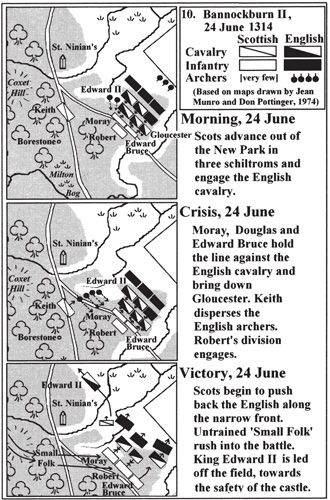
At daybreak each army heard mass for the feast day, and the troops confessed to priests and then breakfasted. It was the custom that men were knighted on the morning of battle, and Robert used the occasion to confer that honour upon Walter Steward and James Douglas. Then the Scottish troops arrayed in their three divisions with banners displayed, and emerged from the forest of New Park. An English chronicle describes them in these terms: ‘Not one of them was on horseback, but each was furnished with light armour not easily penetrable by a sword. They had axes at their sides, and carried lances in their hands. They advanced like a thick-set hedge and in a phalanx such as cannot easily be broken.’ Chronicles from either side agree that at some distance the Scots knelt to pray a Pater Noster before advancing. ‘Yon folk are kneeling to ask mercy’ remarks Edward II in the Barbour narrative, and by his side the Anglo–Scot Sir Ingram de Umfraville replies, ‘They ask mercy, but not from you. They ask God for mercy for their sins. I will tell you something for a fact; yon men will win all, or die; none will flee for fear of death.’ Meanwhile Abbot Bernard of Arbroath, the chancellor of Scotland, was moving among the troops, bearing around his neck the Breccbennach, the little silver reliquary, smaller than a man’s hand, which contained a bone relic of St Colmcille and was believed to transmit potency in battle.
By contrast with the Scots, the English infantry remained in a single body. The English too had their talismans: one English monk bore the banner of St Cuthbert, the patron of the bishopric of Durham; another that of St John of Beverley. The battlefield put them at a significant disadvantage. Cavalry needed space to manoeuvre, but the available space was confined by the Bannock Burn and marshes to the south-east and trees to the north-west. Moreover, the Scots had the advantage of attacking downhill.
Formalities over, the conflict began with archers exchanging volleys. Archery had not yet reached its heyday in England; nevertheless, had the English been able to mass their archers in sufficient numbers they would swiftly have thinned out the ranks of the Scottish schiltroms. But the narrowness of the field, coupled with the size of the host made it impossible to group them effectively. Nevertheless the archers had some impact; an English chronicle states that ‘the King of England’s archers quickly put the others to flight’. Then the Scottish infantry advanced, two schiltroms abreast of one another, and a third, the king’s, behind. Gloucester led the English, stung into action, the Vita Edwardi Secundi reports, by an accusation of treachery levelled at him by Edward II the previous night, and his cavalry smashed into the phalanx led by Edward Bruce and in which Douglas served: ‘When both armies engaged and the great horses of the English charged the pikes of the Scots, as it were into a dense forest, there arose a great and terrible crash of spears broken and of destriers wounded to the death; and so they remained without movement for a while.’ Many of the destriers refused to charge into the forest of pikeheads and threw their riders. The Scottish spearmen targeted the horses of the enemy, and Gloucester’s horse was killed under him. At all events the earl rolled to the ground where ‘borne down by the weight of his body armour he could not easily rise’. His death was a pivotal event in the battle. There was no need for it to have been decisive, but such was the critical role of great magnates that this event took all the steam out of the English attack. Other magnates too were knocked or dragged from their horses: Robert Clifford, Edmund de Mauley, Pain Typtoft, and William Marshall. In the mêlée a new effort was made to mass the English archers, but, realising this, Robert directed the small Scottish force of cavalry under Sir Robert Keith to ride them down. This Keith accomplished by riding into the flanks of the archer battery. The English chronicles are consistent in reporting that the great mass of English infantry never engaged the Scots, so narrow was the front. Meeting their own men wounded and fleeing, the English infantry themselves began to flee.
Even now, the battle was not necessarily lost for the English, but for a chance intervention. ‘Yeomen and boys and men on foot’, carters and labourers of the Scottish army, who had been guarding the baggage train heard the din and, witnessing confusion in the English ranks, and believing the battle won, swept onto the field. They were anxious to secure a share of the pickings; yet these poveraille, or ‘small folk’, were mistaken for a Scottish reinforcement. It was this perception that secured victory for the Scots. Among the English the rout became general, and horsemen and infantry stumbled into the Bannock Burn and were drowned. Edward II had appointed the earl of Pembroke and Giles d’Argentan on either side ‘to the king’s reins’, that is, to lead him out of trouble. Giles d’Argentan refused to desert the field and rode off to an honourable death in battle. Illustrating the heraldic practice of maintaining rankings of knightly reputations, Barbour reports that d’Argentan was the ‘third best knight’ of his time. It was left to Aymer de Valence, now Earl of Pembroke, to lead Edward to safety, though the English king left much against his will. The English chronicles agree that Edward showed no lack of personal courage or keenness for the fight, and this is to be remarked upon, for they are seldom generous to him. One chronicle has Scottish knights on foot tugging at the covering of Edward’s horse to prevent his escape, while the English king, vigorously wielding his mace, knocked them to the ground.
Robert gave the signal that prisoners might be taken for ransom, and the Scots fell upon a bonanza of plunder: horses, armour and weapons thrown away by fleeing knights, harness – ‘two hundred pairs of red spurs were taken from dead knights’ – tents and pavilions, rich apparel and all the costly trappings of the English royal and three comital households were all for the taking. An English chronicle remarks that had the Scots been less greedy for plunder they might have had many more prisoners. But the value of prisoners’ ransoms was never underestimated by the Scots. King Robert claimed all the leading prisoners, as was his prerogative, and in the bag were the earl of Hereford, the earl of Angus, Ingram de Umfraville, Maurice Berkley, John Giffard, Antony Lucy – a powerful knight of the English West March – John Segrave and many others. One chronicle lists seventy-five names of captured gentry, and even that will be a partial listing. All would be forced to pay ransom according to rank.
Edward II, meanwhile, led by Pembroke, arrived at Stirling Castle and sought admittance. However, his garrison commander, Sir Philip Mowbray, refused to lower the drawbridge. Aware that the castle would now have to be surrendered, he honourably saved his king from captivity, and honourably delivered the castle to Robert in accordance with the agreement he had reached with Edward Bruce. It is to be lamented however that Mowbray did not dishonourably bring about the end of the war at a stroke by admitting Edward, making him prisoner and gifting to Robert the only thing that the English might trade for peace: their king. Such was the course taken by the constable of Bothwell castle, Walter fitz Gilbert, who after the battle admitted the earl of Hereford and retinue, made Hereford his prisoner and then, changing sides, delivered both earl and castle to Robert. Mowbray’s decision not to deliver Edward into captivity enabled war to drag on year after year, neither side able to inflict decisive defeat on the other. For the present, then, Edward II fled through the King’s Park to Linlithgow, to Patrick, Earl of March, at Dunbar, Douglas pursuing him doggedly with a force of sixty horse. Finally, Edward took ship for Berwick and safety. Pembroke, his rescuer, also succeeded in bringing his Welsh retainers through ninety miles of hostile countryside to safety in Carlisle.
It was a magnificent victory, to which Robert responded with magnanimity towards many of his opponents. The bodies of Gloucester and Clifford were restored with honour to their families. Perhaps we should not be surprised that Raoul de Monthermer, Gloucester’s step-father, was allowed to go home without paying ransom, for the house of Gloucester had been loosely associated with the Bruces for many years. Robert was reportedly saddened by the death of the earl. His body was brought from the battlefield and placed in a kirk under guard before being handed back. Marmaduke de Thweng, veteran of many Scottish campaigns, was also released free of ransom. Robert ensured that the widow of Edmund Comyn of Kilbride, who had fought against him, was provided for ‘until she could recover her rightful dower according to the assize of the land’. These of course were all adversaries of high rank, and Robert probably took no such interest in the fates of lesser captives. Such were the conventions of the age. The repercussions of Bannockburn were seismic. In terms of British military history it was revolutionary: for the first time an infantry army had overcome an army led by heavy cavalry, and English chroniclers were not slow to draw parallels with the battle of Courtrai in 1302, when the Flemish townsfolk had put to flight the flower of French chivalry. The English government collapsed. The royalist administration headed by Pembroke was utterly discredited and the dour leader of the baronial opposition, Thomas of Lancaster, five times an earl, took control of the government in the king’s name – to the king’s undisguised distaste. In Scotland only the garrisons of Berwick and little, isolated Jedburgh remained faithful to Edward, and though his government of Scotland continued to exist it was reduced to managing these garrisons and the immediate vicinity of Berwick.
The Scots enjoyed their windfall of riches, estimated at £200,000 by the Vita Edwardi Secundi, a figure that must be dismissed as a wild exaggeration. They also sustained losses: Barbour notes that the Scottish knights William Vipont and Walter Ross died in the battle. But, at a stroke, three major castles tumbled into Robert’s lap: Stirling, Bothwell and also Dunbar, which Earl Patrick of March surrendered on the departure of Edward II. Prisoners’ ransoms brought huge sums of money to individual Scottish lords. Robert, however, had relatives to redeem, and the following year he was able to exchange the earl of Hereford for four prisoners whom the English had held since 1306: Elisabeth his queen, his sister Mary, his daughter the lady Marjorie, and his old mentor, Robert Wishart, Bishop of Glasgow, now blind with age. Money poured into the royal coffers from the ransoms of other prisoners: the earl of Angus, John Seagrave, Maurice de Berkley and Antony Lucy were all redeemed by ransom.
Yet, a great deal remained unchanged by Bannockburn. Robert’s victory did not dissolve Edward II’s claim to be rightful king of Scotland, nor did it bring him any nearer to a negotiating table. The English remained the stronger side by far, and had no reason to give in on account of one defeat. The very next year, and every year thereafter, if they so chose, they could march a powerful army to Stirling or beyond. Nor did it vanquish the Scottish opposition to Robert. In Argyll and Ireland, the irredentist John of Argyll continued to make trouble for the Bruces, and since 1313 he had been joined in the Irish Sea theatre of war by the Gallovidian knight, Dungal MacDowell. It would take more than a single victory, however momentous, to reconcile these diehard warriors to a Bruce regime.