
6
With the death of ‘le roy coveytous’ in July 1307, and with Robert’s decision the following September to move beyond the heartland of Bruce dynastic influence, the war and Robert’s life entered a new phase. Gone were the days of struggling frantically for survival in the wake of the catastrophies of Methven and the Galloway landing. Robert and his allies were seizing the initiative and carrying war to the enemy. The period witnessed the devastation of three centres of resistance to his power: Buchan, Galloway and Argyll; a fourth centre, Lothian, Robert was not yet strong enough to reduce. In the Barbour text two principal themes emerge. The first is how the Bruce faction managed to overcome the overwhelming material advantages of their enemies by cunning and guile. This is illustrated by the capture and destruction of many castles garrisoned by their enemies. The second theme is the increasing recognition in Scotland of Robert as king. Barbour portrays the period in terms of an inexorable Risorgimento, as the Scottish people come to their senses and recognise the hero-king, but we know different. Civil wars are always more savage and bitter than foreign wars, and even in the Barbour narrative the scale of bloodletting is apparent as Robert Bruce recovers his kingdom with ruthless perseverance.
This escalation of the struggle was made possible by the long-anticipated demise of Edward I and the accession to the English throne of his son. Edward of Caernarfon, Edward II as he now was, was neither the colossus of statesmanship nor the genius of imperial expansionism that his father had been. A contemporary described his character in these terms:
This Edward was fair of body and great of strength, and unsteadfast in manners, if men shall believe what is commonly told. For he forsook the company of lords and sought out the company of harlots, singers, jesters, carters, delvers, ditchers, rowers, shipmen and bootmen, and other craftsmen; he also gave himself up to much drinking. He would lightly share confidences and hit men who were about him for the merest offence, and he did more by the advice of other men than by his own. He was generous and solemn in feast making, loquacious and inconstant, irritated by his enemies and cruel to his own. He loved strongly one of his favourites and did him great reverence, worshipped him and made him extremely rich. From this came hatred to the lover, evil speech and backbiting to the loved, slander to the people and harm and damage to the realm.
Thomas of Castleford is more pithy: ‘this Edward was wise in word, and fool in deed.’ Edward II was considered by the English nobility of the day to be an undignified character. He was homosexual, and the favourite referred to above was a Gascon knight called Piers Gaveston, whom, to the disgust of the magnates, Edward elevated to the earldom of Cornwall. Like his father, Edward II was anxious to maintain and increase the power of the English monarchy, and that included holding onto Scotland by every conceivable means, but he lacked his father’s single-mindedness, his powerful influence over the English feudal nobility and his overbearing personality. Soon Edward II developed a deep-seated hatred of the most powerful of all the English nobles, Thomas of Lancaster. Altogether, the second Edward was an opponent of lesser stature than Edward I had been, and Robert was fortunate that Edward I’s successor was incompetent and under-mighty. One English annalist records a possible saying of Robert: that ‘he feared the bones of the dead king more than he did the live one, and that it was a greater feat of war to wrest six inches of territory from Edward I than to gain a whole kingdom from his son’.
The character of the English king directly affected the nature of the war Robert was engaged in. Edward II had left Scotland on 1 September 1307 without confronting Robert and his guerrilla band, and he did not return until 1310, allowing Robert three years in which to establish a secure power base. In retrospect we can see the magnitude of this error; 1307–10 were the ‘locust years’ of English occupation, when what was dearly won by the strenuous efforts of the previous reign was recklessly frittered away. Military and financial support for garrisons and Scottish communities that accepted Edward II’s kingship were sorely neglected; another catastrophic error which Robert did not fail to punish. To Edward’s supporters in Scotland, dependent upon a distant and distracted government, the offer of suffraunce de guerre or purchased truce always seemed attractive. Naïvely they trusted that time was on their side, that the English king would sooner or later come to help them; whereas Robert offered truces only to neutralise the strong while picking off the frightened and vulnerable. In time it became clear that the faraway English king promised much and delivered little, while Robert presented an immediate and pressing threat to increasingly isolated lords and communities.
Barbour tells us that Robert set out northwards in September 1307 with his brother Edward, Gilbert Hay, Sir Robert Boyd and others. His small army marched swiftly, but grew significantly along the way. There are no details of the ninety-mile journey to the north-west; his force marched down the Clyde, north along Loch Lomond and over the mountains to the head of Loch Linnhe. Moving with great speed, he will have been very careful to avoid any encounter with John of Argyll. Malcolm, Earl of Lennox, appears to have rejoined the king, and Robert received naval support on the western flank from MacRuaridh and MacDonald galleys. In the rear, James Douglas remained in Selkirk Forest, the haven that had sheltered Wallace and Simon Fraser before him, and Douglas’s following became sufficiently threatening to necessitate the garrisoning of Carlisle Castle from 16 April 1308 to Michaelmas following (29 September).
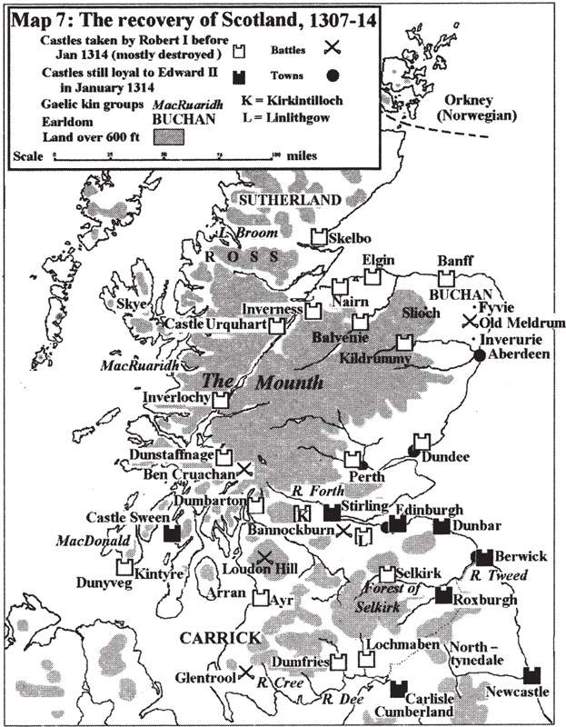
Robert moved quickly to besiege the Comyn stronghold of Inverlochy Castle, arriving on 25 November 1307. Inverlochy was the key to the Great Glen, the obvious corridor to the north. The Comyns were surprised; evidently they had not provisioned the castle adequately and it was handed over to Robert ‘by the deceit and treason of the men of the castle’. Robert probably slighted Inverlochy, as he destroyed all the castles that fell into his hands at this stage. He then moved rapidly north-east along the glen, destroying Castle Urquhart on Loch Ness along the way, and at the far end he captured and destroyed Inverness. Probably the galleys were hauled or carried overland between the lochs of the Great Glen, allowing Robert to move rapidly and amphibiously. To the north and west lay the hostile territories of Caithness, Sutherland and Ross. In a letter to Edward II William, Earl of Ross, offered explanations as to why he was forced to come to terms with Bruce:
we heard of the coming of Sir Robert Bruce towards the parts of Ross with a great power, so that we had no power against him, but nevertheless we caused our men to be called out and we were stationed for a fortnight with three thousand men at our own expense, on the borders of our earldom and in two other earldoms, Sutherland and Caithness and [Bruce] would have destroyed them utterly if we had not made a truce with him, at the entreaty of good men, both clergy and others, until Whitsun next [2 June 1308]. May help come from you, our lord, if it please you, for in you Sir is all our hope and trust. And know, dear lord, that we would on no account have made a truce with him if the warden of Moray [Reginald de Cheyne] had not been absent from the country …
Ross’s blaming of his neighbour for failing to support him is typical of the reaction of the Anglo–Scottish lords, who lacked leadership above all. Robert established a pattern: by forced marches and surprise attacks he outmanoeuvred and caught his enemies unawares, dividing them and forcing them singly into temporary subjection. Robert is most unlikely to have faced down an army of 3,000 men. The earl has greatly exaggerated the size of Robert’s army to justify his failure to resist. In fact, at this point in the narrative Barbour estimates Robert’s strength at a realistic 700 men. Ross probably paid heavily in tribute in order to secure this truce.
It was now late November, and Robert with confidence turned his back on Ross. He marched eastwards to destroy Inverness and Nairn castles. At this point however, his attack lost momentum. He was unable to reduce Elgin but made a truce with the defenders. He was now in deeply hostile territory, held by the Comyns for generations, and, winter though it was, the Comyns organised the Anglo–Scottish lords of the north for a counter-attack. The combined strengths of John Comyn, Earl of Buchan; David of Strathbogie, Earl of Atholl, the son and heir of Earl John; Duncan of Frendraught; and John Mowbray closed in.
One can scarcely imagine a worse time for Robert to fall ill, which occurred as he was advancing on Banff Castle. Of the nature of the illness we know nothing; he was unable to ride his horse and had to be carried in a litter. His men could find no effective medicine. The sickness was probably the result of campaigning into the winter, and if so, many of his men will have been affected. Barbour has a good word for Edward Bruce’s attempts to rally the troops, but Edward made no attempt to take his brother’s place by leading the men into battle. They stayed at Duncan of Frendraught’s manor of Concarn for two nights; then, burning the manor and all the corn, they moved on towards Slioch, near Huntly. The galley fleets of the Gaelic lords did not operate on the eastern seaboard. Desertion was endemic in medieval armies, and many following Robert would have seen this as a good time to run away. On Christmas Day the enemy sighted Bruce’s force, safe from cavalry attack in ‘a certain wooded marsh’ near Slioch. Buchan’s army retired to collect a sufficient infantry force to flush out the Bruces, and having done so they returned to the spot on 31 December 1307. But there was no engagement that day, and during the night the Bruces withdrew towards the south. Instead of closing in for the kill, the Anglo–Scottish leaders then fell out with one another. Some loss of nerve or lack of leadership seems to have overcome them at this crucial time; Buchan was to die in 1308, and he may have been ill already. They approached the earl of Ross and tried to persuade him to join with them in the attack, but Ross was too terrified of reprisals to abandon his truce. As a result of pressure from Robert to the south and east, and from the MacRuaridhs to the west, his power had collapsed. The MacRuaridhs now refused to pay the earl revenues from Skye and other Hebridean islands hitherto subject to the earldom. Robert’s policy of dividing the opposition appears to have tided him over the dire emergency of Christmas 1307.
The following spring Edward II’s faithful liegemen in northern Scotland wrote to him, appealing for help. Edward responded on 20 May in typical fashion, thanking them for their good service and ordering them to stay in their commands. In early March 1308 John Mowbray was next to be forced to accept a truce from the Bruces; they were then free to waste the castle and lands of Sir Reginald Cheyne at Balvenie – known then as Mortlach – and of Sir Alexander Comyn at Tarradale. Robert dispatched William Wiseman to the rear to capture the castle of Skelbo on Palm Sunday, 7 April, and to renew his siege of Elgin Castle, held by Duncan of Frendraught. Wiseman was not able to capture Elgin, however, for John Mowbray arrived to relieve it in apparent violation of his recent agreement with the Bruces.
In May of 1308 Robert, not yet fully recovered from his illness, decided to confront John Comyn, Earl of Buchan, and John Mowbray. He must have received an accession of strength during the spring, but from where? It seems that, despite the power of the Comyns, not all northern gentry and freeholders opposed Robert. Earlier in the year John Mowbray had had to punish ‘freeholders and others whom he knew to be of ill-repute’, apparently for their support of the Bruces. The growth of Robert’s force in this unfavourable territory lends support to Duncan’s assertion that Robert possessed ‘the capacity to by-pass the reluctant traditional leaders of the community and to appeal to and command other social ranks’.
Robert advanced from Inverurie towards Old Meldrum. There, in an action known as the Battle of Inverurie, his vanguard was attacked and worsted by the enemy. When the main enemy force came in sight Fordun reports that ‘he ordered his men to arm him and set him on horseback. When this was done, he too, with cheerful countenance, hastened with his host against the enemy to the battle-ground, although by reason of his great weakness he could not go upright, except with the help of two men to prop him up.’ Comyn and Mowbray were put to flight and their army scattered and ‘pursued as far as Fyvie twelve leagues away’. In the wake of this victory Robert set about a systematic destruction of the earldom of Buchan, known to history in Barbour’s phrase as ‘the herschip of Buchan’ and designed to weaken permanently the Comyn power base:
Now let us go to the king again
Who was well pleased with his victory
And had his men burn all Buchan
From end to end and sparing none.
He harried them in such a way
That a good fifty years afterwards
People bemoaned ‘the herschip of Buchan.’
From detailed accounts of the destruction that4 befell the north of England in the following decade, we can picture the destruction of Buchan: the burning of barns and mills, the burning and trampling of standing crops, the killing and driving off of the tenantry and the burning of their villages. The prominent symbols of Comyn lordship in the area would all have been targeted and destroyed: Dundarg and Slains castles, as well as Deer Abbey would all have been severely damaged. After this Robert is said to have ‘taken into his peace’ the people north of the Mounth: that is to say, he accepted a sum of money to spare them from further destruction and take them under his protection.
The campaigning season proper began, and for the first time Robert set his sights on Aberdeen, the northernmost significant port. This would bring him the additional revenues of tolls on commerce and lucrative customs on wool and hides. It would also enable him to open communications with other North Sea towns and kingdoms. Accordingly Robert besieged Aberdeen late in June and around 1 August it fell to him. Commercial relations with towns and cities across the North Sea were now possible; it will be remembered that on the taking of Berwick, Wallace had wasted no time in inviting traders to visit liberated Scotland. Markets had to be found for the produce of Robert’s territories – wool, hides and timber – and Robert’s forces were in sore need of weaponry and armour. His nobles too would have been clamouring for those luxury goods that differentiated them from their followers: high-quality clothing, furs and wine. More important in the long-term was the diplomatic window on the wider world that Aberdeen provided. Robert wasted no time in opening diplomatic relations with King Philip the Fair of France. Within a year of the capture of Aberdeen Philip had abandoned recognition of John Balliol and had written to Edward II describing Robert as King of Scots.
Possession of this first port enabled the Scots to forge crucial alliances with seagoing peoples. Robert received only diplomatic support from France, but the towns of the North Sea could supply him with war materials in return for Scottish wool. German merchants from the Hanseatic cities of eastern Germany, known as Eastlanders, and Flemish traders had resented the interruptions war had brought to the Scottish trade, and they were keen for it to resume. Since 1303 France and England had been at peace, which had left each of these large kingdoms free to attack its smaller neighbours. While England attacked Scotland, France was free to pressurise the Flemish towns, particularly Ghent and Bruges, which were centres of the European cloth-making industry. On the seas, the Scots and Flemings made common cause, co-operating in attacks on English vessels, and running the blockade of Scottish ports. Through Aberdeen, the territories under Robert’s sway traded wool for arms and foodstuffs supplied by the Flemings and Germans. The North Sea trade between independent Scotland and the continent had already been an irritant to Edward I; to Edward II, it was to become a constant irritation.
As early as April 1305 Edward I had suspected the Flemings of sustaining Scottish revolt. However, privateering on the North Sea by the Scots, Flemings and Eastlanders began in earnest from about 1308, just before the capture of Aberdeen. In that year the English tried to impose a blockade on independent Scotland, but given the distances involved this was almost impossible for them to enforce. In October 1309 Edward II complained to the count of Flanders and the city of Bruges that Flemish merchants had been trading with the Scots and their partners, the Eastlanders. Robert issued formal ‘letters of marque’, authorising Scottish crews to attack English vessels. Typically the privateers would commandeer or rob an English ship of its cargo of wool, and take the wool to Aberdeen. There they would remove the seal of the English customs known as the cocket, the proof that duty had been paid, and replace it with either the Scottish cocket or with the seal of a Flemish trader operating in England. This then enabled the privateers to sell the stolen English wool legitimately on the continent. Early in 1311 the notorious Flemish privateer John Crabbe robbed two ships leaving Newcastle with eighty-nine sacks of wool, and disposed of them in exactly this fashion.
After the capture of Aberdeen, Robert turned south-west to confront Argyll in August 1308. With Buchan dead, John of Argyll was certainly the most virulent in resistance to the Bruces, but he had been confined to bed with illness for months. He will have striven to build a coalition against Bruce, but most lords, himself included, were parochial in outlook and sought first and foremost the security of their own lands and incomes. On the approach of Bruce, John assembled a significant force of men and galleys and prepared an ambush on the slopes of Ben Cruachan. The exact site of the battle is in dispute,29 but John’s force waited high on the slopes of the mountain to attack Robert’s army as it passed between the mountain and either Loch Awe or the sea at Loch Etive. Robert however, had anticipated the ambush and secretly sent Douglas higher up the slopes still with a force of archers.30 John directed the Argyll men from a galley on the sea loch, but when his men attacked by rolling boulders down the hill as Robert’s main force passed below, they found themselves caught between Robert’s and Douglas’s forces. They were forced to take flight and they scrambled downhill for the bridge over the River Awe, intending to break it down once across. But Robert’s men were hot on their heels and caught up with and slaughtered the enemy and drove off their cattle. Barbour, Fordun and other chroniclers state that Dunstaffnage Castle was then captured, but it is now considered that this occurred the following year; instead Robert extracted tribute from Argyll in return for a truce, to last until the English king came to their aid. Afraid that his acceptance of Robert’s terms would be interpreted as desertion, John wrote afterwards to Edward II explaining the impossibility of his position in face of Robert’s strength, assuring him of his loyalty and urging him to lead an army into Scotland. Unsurprisingly John makes no mention of his defeat, and he wildly exaggerates Robert’s strength, the better to explain his actions:
Robert Bruce approached these parts by land and sea with 10,000 men they say, or 15,000. I have no more than 800 men, 500 in my own pay whom I keep continually with me to guard the borders of my territory. The barons of Argyll give me no aid. Yet Bruce asked for a truce, which I granted him for a short space, and I have got a similar truce until you send me help.
I have heard, my lord, that when Bruce came he was boasting and claiming that I had come to his peace, in order to inflate his own reputation so that others would rise more readily in support of him. God forbid it. I certainly do not wish it, and if you hear this from others you are not to believe it; for I shall always be ready to carry out your orders with all my power, wherever and whenever you wish. I have three castles to keep as well as a loch twenty-four miles long, on which I keep and build galleys with trusty men to each galley. I am not sure of my neighbours in any direction.
As soon as you or your army come, then, if my health permits I shall not be found wanting where lands, ships or anything else is concerned, but will come to your service.
In far away Westminster, preoccupied and infatuated, Edward II failed to take the hint, and that Christmas, Edward lost yet another stronghold, Forfar, to Robert.
In other theatres of combat Robert’s lieutenants had been active, both on his behalf and in their own interests. When Robert had marched northwards in September 1307 James Douglas had begun to establish himself deep in the Forest of Selkirk. From there he made further efforts to regain his patrimony. With relish Barbour describes how the wily Douglas planned another assault on Douglas Castle. Disguised as a thresher, secretly armed and accompanied by only a few men, he attended the Palm Sunday service at St Bride’s Kirk, the chancel of which still stands; the mention of Palm Sunday dates the episode to 7 April 1308. The whole of the garrison except a cook and a porter were present in church ‘to carry their palms’. Prematurely one of his men gave out the traditional battle cry ‘Douglas!’, but Douglas drew his sword and laid into the men of the garrison. In a short time two-thirds of the garrison lay dead or dying. Thirty prisoners surrendered, and Douglas took the castle easily. He entered to find the table laid for the feast. His men ate their fill and then ransacked the building for weapons, armour, treasure and clothing. Before leaving, he beheaded his prisoners and threw their bodies into the cellar. Into the cellar too he emptied all the food he could not carry off:
He made a foul concoction there,
For meal and malt and blood and wine
All ran together into a mush
That was disgusting to see.
Afterwards he polluted the well with salt and the bodies of dead horses. Finally, he set fire to everything that would burn, abiding by Bruce’s policy of denying shelter to the enemy. He split his men into several groups, and they disappeared into the forest by diverse routes. To our minds an appalling atrocity, the ‘Douglas Larder’ as it became known served the purpose of warning the local population against serving with the enemy.
Douglas was among those who joined Edward Bruce for an equally savage attack on Galloway in the summer of 1308: ‘Meanwhile, taking advantage of the quarrels between the king of England and the barons, Edward Bruce, brother of the oft-mentioned Robert and Alexander Lindsay, Robert Boyd and James Douglas knights, with their following which they had from the outer isles of Scotland, attacked the people of Galloway, disregarding the tribute which they took from them, and in one day slew many of the gentry of Galloway and made nearly all that region subject to them. Those Gallovidians who could escape came to England to find refuge.’ Hebridean troops were used for this harrying of Galloway, said to be led by ‘Donald of Islay’.31 It seems that one, or possibly two, bitter battles were fought. The first took place on the banks of the River Dee, at which the Gallovidians put up stout resistance. They were led by the Gallovidian chief Dungal MacCann. MacCann was forced to flee to his fortress of Threave, an island in the River Dee. There he was captured and handed over to Edward Bruce, presumably for execution. The second battle seems to have been fought far to the west on the River Cree, when English reinforcements led by Ingram de Umfraville and Aymer de St John set out to counter-attack. Edward Bruce defeated them too, and they fled to Buittle Castle on the Urr Water. Edward then besieged Buittle but failed to take it. In fact, successful as the campaign was in terms of devastating the countryside and exacting vengeance for the deaths of Thomas and Alexander Bruce, Edward failed to capture any major castle in the south-west. Lochmaben, Tibbers, Loch Doon, Dumfries and many more English garrisons still survived for another three to five years. No doubt Edward, who bore the titles Lord of Galloway from 1309 and Earl of Carrick from 1313, took all these castles, but Barbour’s statement that he won thirteen castles by force must refer to the whole period 1308–13. Strangely there is no mention of Dungal MacDowall in resisting this attack; we might expect him to have taken a leading role in defending Galloway, and he may well have done despite the chronicles’ silence, for in April 1309 he received a grant of a Cumberland manor for his good service, ‘whereby he has become hated by the enemy’.
The subjugation of northern Scotland was assured when on 31 October 1308 Ross surrendered utterly to Robert, and in return was permitted to retain his lands and titles. Obviously this sort of arrangement necessitated a mechanism for keeping track of the king’s grants and commitments, and it is around this time that evidence emerges that Robert’s entourage included a royal bureaucracy. A mandate dated 14 October 1308 is witnessed by ‘Sir Bernard the king’s chancellor’. This cleric was the head of the king’s writing office and part of his job was to keep a record of royal orders and grants of land issued. Bernard the Chancellor probably had long experience of royal diplomatic form, correct forms of protocols and address, methods of sealing and so on. He would certainly have been familiar with the texts and arguments put into the mouth of Boniface VIII by Scottish diplomats in the past, and he may previously have served in the chanceries of King John Balliol and the guardians. Robert subsequently endowed Bernard with the abbacy of Arbroath in 1311.
Bernard’s assistance was therefore invaluable when in January 1309 there arrived from the king of England the earl of Gloucester ‘and two other earls’ to negotiate a truce. It was a high-powered delegation, and well chosen. The house of Gloucester had been the English family most closely associated with the Bruce affinity and Gloucester and his companions were accompanied by papal and French envoys. Such a delegation may even have been intended to negotiate a lasting peace. This however eluded them, probably because Robert was not prepared to concede sovereignty of Scotland. Terms for a truce, however, were brokered by the emissaries of King Philip of France – who had recently become Edward II’s father-in-law. These were as follows: both sides were to return to the positions they occupied at the feast of St James the Apostle – 25 July 1308 – and there would be a cessation of hostilities until All Saints’ Day – 1 November 1309. It was just the sort of arrangement that played right into Robert’s hand. The English might as well have conceded truce to Midsummer 1310, for they could do nothing until the weather and food supplies permitted campaigning.
Robert however could do plenty. There is no evidence that he blatantly violated the agreement, but the truce did not have a neutral effect. In the localities, perceptions, understandings and loyalties were shifting in Robert’s favour. Edward II’s supporters were leaderless, bickering, increasingly demoralised and isolated. Robert restored nothing to the enemy, and continued to intimidate and bully vulnerable garrisons and communities loyal to Edward. Time and distance ensured that he was not brought to account. Increasingly the English administration was paralysed by magnate rivalry and the king’s preoccupation with keeping his favourite, Piers Gaveston, safe from the hands of the magnates.
On 16 and 17 March 1309 Robert held a parliament at St Andrews. Such a gathering of the higher nobility – common people would not have been represented – was a powerful claim to sovereignty, and a clear statement that an alternative government had been established and demanded obedience. The pretext for summoning such an assembly was to consider a reply to a letter from Philip, requesting that Robert contribute forces to the crusade he was planning; Robert was thus advertising that he had received a letter from the king of France, who had previously sponsored the Balliol cause. The careful crafting of such a reply was, of course, far too important to be left to a large assembly. Bernard the Chancellor would take care of the drafting, but the pretext kept up the fiction that the nobles participated in matters of state. The real purpose of parliaments at that time was to project the majesty of monarchy and thus enhance its legitimacy. Parliament was the fullest expression of kingship, solemn and dignified, the occasion of many grants and mandates. Robert could only have held this assembly in time of truce, for, as a mark of their loyalty, lords were expected to leave their estates and attend. Heading the list of those in attendance were the great magnates, the earls of Ross, Lennox and also Sutherland. James, the Steward of Scotland, was there, and Robert had appointed other great officers of state for the occasion: Gilbert Hay, Constable of Scotland, and Robert Keith, Marischal. Robert’s chief lieutenants were there: Edward Bruce, now bearing the title ‘Lord of Galloway’; James Douglas; and ‘Donald of Islay’, probably Angus Óg. Lesser stalwarts were there too: Lindsay, Boyd, Gillespie MacLachlan of the MacRuaridhs and three representatives of the Campbells. Sullen and disaffected, old Alexander MacDougall too had been compelled to attend, but before the year was out he would rejoin his son in the service of Edward II. Present too were a number of prominent ‘newcomers’ to Robert’s camp: James the Steward with son and nephew, traditional adherents of the Bruce affinity who had lost their lands twice in the past for resistance to the English king, and who had decided once more to risk everything by throwing in their lot with the Bruces. Robert’s nephew, the young Thomas Randolph, Lord of Nithsdale, was also present.32Earlier he had sounded off to the king about unchivalrous methods of warfare; evidently he had atoned for his contempt. Another noteworthy recent addition was John Stewart of Menteith, to whom Edward I had granted the earldom of Lennox; this title he had surrendered to Robert in return for lands in Knapdale – awarded at the expense of the MacSweens – and Arran. Many of the hierarchy would have attended the parliament, including bishops of Dunblane and Dunkeld, and possibly those of Ross, Moray and Brechin. A senior bishop of the Scottish kirk, Robert Wishart of Glasgow, was then a prisoner, yet his seal was appended to the document as though a representative of his were present; William Lamberton of St Andrews may have attended in person, even though Edward II still considered him loyal.
Robert might have used the occasion of the parliament to demand a grant of taxation of these worthies, but it is unlikely that he would have tried to impose such a burden while acutely dependent upon their support. Money might have been forthcoming from the Scottish Church, however. Some £7,000 of clerical subsidies was outstanding from Scotland and had never been paid to collectors, and Robert may have been formally granted this by a council of the clergy that met at the same time as the parliament.33Opportunity was taken at this assembly to publish a proclamation by a general council of the Scottish clergy in fulsome support of Robert’s kingship. This document may have been intended for an international audience, at the general council of the Church which had been summoned for Vienne in 1311. It contained arguments for the independence of Scotland, produced in 1299 and 1301, and authors of these earlier statements of Scottish independence may well have been present at the council.
Rehearsing the events of the Great Cause, the Declaration of the Clergy states a myth which Robert was desperate to foster and perpetuate, that ‘When there arose a subject of dispute between John Balliol, lately installed as king of Scotland … by the king of England, and the late Robert Bruce of honourable memory, the grandfather of Robert who is now the king, concerning which of them had the better title by right of birth, to inherit rule over the people of Scotland, the faithful people have always believed without hesitation, as they had understood from their ancestors and elders, and held to be the truth, that Robert the grandfather was the true heir, and was to be preferred to all others.’ Of course ‘the faithful people’ represented at the parliament and church council had no such memory; nevertheless they had found a leader who, they believed, might deliver them from foreign occupation and safeguard their Church from subjection to the Archbishop of York, and so they were willing to accept this rewriting of history. The whole point of the declaration, and of the 1309 parliament, was that Robert sought acknowledgement as the ‘natural’, or divinely appointed, ruler.
A second embassy may have been received during this truce. In August 1309, Richard de Burgh, the Red Earl of Ulster, was sent to western Scotland to reason with his son-in-law. He was paid to set out on the instructions of Piers Gaveston, who was then lord lieutenant of Ireland, and with an impressive following of Irish magnates, men-at-arms, hobelars (troopers mounted on a ‘hobin’: a pony or hackney) and foot. His mission was perhaps to intimidate as much as to persuade. Presumably Robert received the earl, but there is no record of such a meeting. It is possible however that a show of force by an Anglo-Irish magnate in the west of Scotland moved Alexander MacDougall to a last act of defiance. That same month Bruce was in the far north at Loch Broom, where he can only have been collecting men and ships from his MacRuaridh allies for another assault on Argyll. A charter dated 20 October shows that he was again at Dunstaffnage. On this occasion he had indeed captured the castle. Alexander MacDougall, now evicted from his ancestral pile, fled to England and eventually joined his son John of Argyll in Ireland.
The truce with Edward II was now drawing to a close. Cumberland gentry were ordered to go to their border demesnes, either in preparation for the resumption of hostilities, or to protect them against raiding that was already taking place. On expiry of the truce in November 1309, Robert increased the pressure on garrisons and communities loyal to Edward II, but, as was his wont, he was prepared to be bought off. In December 1309 Edward advised his commanders at Ayr, Perth, Dundee and Banff, probably in response to increasingly desperate pleas for assistance, to do likewise by taking what truce they could until Whitsun, 7 June 1310. That was the earliest conceivable date by which an English army would appear in Scotland. These castles could at least be provisioned by sea, but others inland were more vulnerable to siege, and to the pleas of their garrisons Edward’s government turned a deaf ear. Even commanders at Berwick and Carlisle agreed a truce until 14 January 1310, and money was paid to Robert as part of these deals. Edward’s commanders succeeded in getting a general truce, intended to tide them to the campaigning season, but it was practically worthless. Early that summer a delegation of loyal Scottish magnates wrote to Edward II and advised him that unless he set out for the north in person all would be lost in Scotland. In July orders were at last issued for a general muster of the English host: ‘Since the king’s enemies the Scots, to whom he had granted a truce, contrary to the form of that truce, daily take from him castles, towns and lands, as he understands from men in his service in these parts, he has resolved to be at Berwick in person at the Nativity of Our Lady next [8 September] with horses and arms as powerfully as he can.’ But it was not the pleas of the loyal Scots that had forced Edward to attend to his duty, rather it was outrage at royal misrule in England.
Edward had made lavish grants to his hated favourites. He had over-exploited the royal prerogative of ‘prise’, which allowed the king arbitrarily to seize goods as the itinerant court needed them and to defer payment for them. Heavy taxation had been levied on the pretext of Scottish war, with nothing yet achieved. It was scarcely surprising that a committee of the baronage, known as the Lords Ordainer, had been appointed to take government out of the king’s hand for the time being and to regulate his household. Edward deeply resented what he saw as usurpation of his rights. He intended his Scottish campaign of 1310–11 to take the wind out of opposition sails, and to undermine reform at home. The campaign also had the virtue that he could keep his beloved Piers Gaveston by his side and safe from the hands of magnates.
Since the campaign suited all these domestic purposes, Edward at last showed a resolve to confront Robert. All did not go well, however, and elaborate plans for a landing in Argyll had to be called off on account of unseasonal weather. As a result of Gaveston’s presence, many of the English magnates boycotted the campaign, and Edward rode north with only three earls at his side: Gloucester, Warrene and Gaveston himself as earl of Cornwall. At the end of September 3,000 infantry mustered at Berwick, most of whom were Welsh. The cavalry comprised the royal household of 50 knights and 200 squires or men-at-arms, plus the contingents of the earls – who traditionally did not accept royal wages and therefore do not figure in the accounts.
In the face of such odds Robert kept well to the north. On 4 September he was rumoured to be at Perth, where he had made a truce until Michaelmas with the beleagured garrison. Douglas remained in the Forest of Selkirk, probably seeking a confrontation. On 1 September Edward advanced from Wark into the valley of the Tweed, in businesslike fashion. It being late in the year, he was able only to consolidate his grip on accessible parts of southern Scotland, replenishing and reorganising the garrisons of southern Scotland. He visited Roxburgh and the Peel of Selkirk, vital for checking Scottish activity in the forest. From the main army, raiding parties sallied its thick cover. The author of the Vita Edwardi Secundi recounts what happened to one such party:
One day, when some English and Welsh, always ready for plunder, had gone out on a raid, accompanied for protection by many horsemen from the army, Robert Bruce’s men, who had been concealed in caves and in the woodlands, made a serious attack on our men. Our horsemen, seeing that they could not help the infantry, returned to the main force with a frightful uproar; all immediately leapt to arms and hastened with one accord to help those who had been left amongst the enemy; but assistance came too late to prevent the slaughter of our men … Before our knights arrived up to three hundred Welsh and English had been slaughtered, and the enemy returned to their caves. From such ambushes our men often suffered heavy losses.
Edward’s army then proceeded by way of Biggar to Linlithgow – the vital staging-post between Edinburgh and Stirling – and across Lothian to Renfrew. Then Edward retired to Linlithgow and Edinburgh, and thence by sea to Berwick by the beginning of November. Such were the difficulties of finding forage for animals in the winter that further campaigning was not possible. The infantry returned home, their forty days’ service completed, and the royal court settled down into winter quarters at Berwick. At this point Robert’s forces returned to harass the garrisons.
Remaining over the winter on Scottish soil was not so much a statement of Edward’s determination to reduce Scotland to his obedience, as an admission of his fears associated with returning to England: fears of facing further sanctions imposed by the magnates or parliament, or of banishment of his favourite, Gaveston. The English expedition had been hamstrung by the refusal of the English earls to participate fully in the war. Even Gloucester and Warrene made the political point of wintering just across the border, on English soil and so not technically on the king’s service. Edward’s new and vociferous opponent, Thomas of Lancaster, arrived to do homage for two of the five earldoms which he had inherited, but refused to cross the Tweed – that is, to leave the kingdom – to perform the service. The king of England was humiliated into making the crossing himself.
Against this background, the English chronicles are surely correct to take the view that Edward was considering making a deal with Robert which would allow him to face down this domestic opposition. He did initiate contact with Robert at this time; from a letter written the following February it seems that two royalist nobles, Robert Clifford and Robert fitz Payne had their king’s permission to meet with Robert at Selkirk on 17 December 1310. We do not know whether the meeting took place. Subsequently, Gloucester and Gaveston were to have met Robert near Melrose Abbey, but Robert was warned of treachery and did not show up. Either of those arrangements might have been for straightforward parley with the enemy. But a third suggests that Edward II was trying to reach a private arrangement with Robert behind the backs of his baronage. In February a high-ranking clerk of the English chancery, John Walwayn, was arrested and thrown in prison ‘because he suddenly went towards those parts to speak with Robert Bruce’. That same month Edward sent Gaveston with 200 men to strengthen the Perth garrison, which, together with Dundee, now marked the farthest limit of the English occupation. Gloucester and Warenne meanwhile penetrated the Forest of Selkirk, where Douglas found it easy to avoid confrontation.
Robert did not confront the powerful English earls, but instead punished the weaker and more vulnerable of his adversaries in the west. That December, rumour at the English court had it that he had assembled a galley fleet in the Western Isles and intended to attack Man. In February he was said to be marching towards Galloway. As winter turned to spring Edward became desperate to raise an army, but in the teeth of stout opposition from the English magnates this was virtually impossible. John of Argyll had visited the court over the winter, and appears to have persuaded Edward, now clinging to any straw to avoid a humiliating return to England, that he could raise a large army in Ireland. Accordingly orders for the raising of improbably large forces in Ireland were issued, with John at their head, and a fleet of sixty-two English and Irish ships were to ferry this army to Ayr. Edward put great store by this plan, calling it ‘one of the greatest movements of the Scottish war’. The ports, however, refused to supply the ships, and the plan was largely abandoned.
John of Argyll did succeed in mustering some sort of force however. A Gaelic praise-poem, a rare survivor, affords a glimpse of part of this attack on Scotland’s western approaches. The poem celebrates the expedition of John MacSween from the north-west of Ireland to reclaim Castle Sween, in Knapdale. The MacSweens had expanded westwards from Scotland and settled in the Fanad Peninsula in Donegal in the 1260s, and then had been gradually ousted from Knapdale by the Stewarts of Mentieth in the early fourteenth century. By 1310 the MacSweens undoubtedly formed a part of the MacDougall coalition. In that year Edward II granted Knapdale to John MacSween, on condition that he recapture it from Robert’s ally, John of Menteith, and the poem describes the voyage of MacSween’s mailed galloglasses. Here is a taste of it:
Who is this by whom the fleet is sailed against the Castle of Sweeny of Slieve Truim?
A sinewy man who could not avoid arrows, one of the two piercing lances of the region of Conn.
It is John MacSween who is the commander of their fleet on the surface of the sea, a hardy leader;
The masts of his ships are exceedingly precipitous in height, the wave will test them in an ocean of summits.
John has made a happy landfall in the bosom of Knapdale, at the end of an ocean voyage;
The thick-cropped, fortress-possessing, handsome eyebrow, with many masts and heroes, a vigorous man with a warrior’s moon.
The poem reveals that MacSween was welcomed by the inhabitants of Knapdale, and that the castle was taken without violence. This illustrates how enormously difficult was Robert’s task of dislodging the MacDougalls and their allies from their ancestral lands. It is hard to believe that MacDougall influence was fully extirpated from Argyll during Robert’s reign, even though by 1318 the king of Argyll is reported to be a MacDonald. The poem, a narrow window on the Gaelic west, is also instructive in that it reminds us that this whole western dimension of Robert’s long war goes virtually unrecorded in the English royal records upon which we are so heavily dependent.
Edward II, then, obtained some service in the west in 1311; from England, however, he obtained virtually none. He tried to raise troops through a totally novel and unparliamentary levy of one foot-soldier from every village in England, but to little effect. With no troops and no money there was nothing he could do at the end of July 1311 but summon the English parliament and leave Berwick with a bad grace. In August 1311 Edward was forced to accept the diktat of the Lords Ordainer, known as ‘the Ordinances’, which imposed upon his household a series of unpalatable reforms and restrictions. Edward II’s worst fears were realised as Gaveston was seized and executed by the English magnates on 19 June 1312. Thus the English baronial opposition had played into Robert’s hands. It would be interesting to know whether Robert had any contact with them, but at this date that seems unlikely. He had, rather, judged wisely and allowed events to take their course. In seeing off Edward, Robert had not merely survived the great test of English invasion, he had triumphed in all but name. The Anglo-Scottish lords had longed for Edward to lead an army into Scotland; when that army had come and gone, many would have read the writing on the wall.