
3
Edward’s conquest of Scotland in 1296 had been a pushover, and, as Scots were well aware, he had just finished prosecuting the last of three bitter wars to subdue Wales. The kingship of Britain was beckoning, as Peter Langtoft, Canon of Bridlington, acknowledged:
Now are the islanders all joined together,
And Albany reunited to the regalities
Of which King Edward is proclaimed lord.
Cornwall and Wales are in his power
And Ireland the great at his will.
There is neither king nor prince of all the countries
Except King Edward, who has thus united them.
A man grounded in hard political realities, Edward himself can hardly have been under the illusion that his subjection of Scotland was complete, but for now he had to switch his attention to France, a far more powerful enemy.
Scots also knew that the humiliation of their homeland was going down rather well in England. An intensely conservative people, they had just witnessed astounding change in the accepted order of things. Most will have been profoundly shocked at the degradation of Scottish kingship, the humiliating defeat of their lairds in battle and the sacrilegious removal of the sacred relics of the kingdom. They regarded the terms of the Treaty of Birgham as the standard for an acceptable union with England, but Edward I had ignored those terms, trampled all over Scottish sensibilities and made every effort to destroy Scotland’s separate identity.
Had the English presence been limited to the imposition of a few disciplined castle garrisons, it is possible that the Scots might have tolerated it for a time. Had the change of regime had little practical effect on the great mass of the people, it might have lasted. In fact the new order presented three serious threats to the well-being of the people: security of landed property was jeopardised; financial exactions impoverished every social class, and the horrendous prospect of enforced military service overseas loomed. To these elements, which are the principal causes of the uprising of 1297, the widespread sense of outrage at English triumphalism and loss of freedom must surely be added.
Any threat to security of landed tenure was sure to provoke a violent reaction from the propertied noble classes, and an atmosphere of uncertainty prevailed early in the autumn and early winter. Edward had imprisoned many of the Scottish leaders, and they remained in prison well into 1297. It remained to be seen whether they would be restored to their lands. Already, in the summer of 1296, Edward’s officials had traversed the country, extracting an oath of fealty to Edward from every substantial freeholder in the land and taking evidence of it. These written and sealed testimonials, over 1,500 of them, were recorded on a document known as the Ragman Roll. The very approach to collection of these fealties, methodical and legalistic as it was, will have generated fear of dispossession. For why should Edward want these proofs of sworn loyalty if it were not to extract military or other services? The Bruces, now back in possession of Annandale, acquired a new neighbour, as the former Balliol lordship of Galloway was awarded to the Englishman Henry Percy. Robert Bruce VI, Lord of Annandale, and his son Robert Bruce VII, Earl of Carrick and future king, were sworn and appear on the roll along with all the others. But not everyone of note was represented on the Ragman Roll. Malcolm and William Wallace, vassals of the Steward, are not recorded as having sworn. Lower down the social scale, they will have been more easily omitted, and the absence of their names is not proof of principled opposition.
Financial exactions certainly increased as a result of the change of regime. Edward had installed Hugh Cressingham as treasurer of Scotland, and his task was to raise money for Edward’s war with King Philip the Fair of France. Cressingham’s exactions were such that by May 1297 he was able to send the huge sum of £5,188 to the English exchequer. It was customary for a king to obtain parliamentary sanction for the collection of taxes, but this sum was raised by gathering in the king’s debts, and the profits of justice, fines, wardships and marriages. In England a general ‘prise’ or seizure of wool was conducted as part of royal policy. This also applied in Scotland and must have been hugely unpopular with great religious houses that produced the wool, and the merchants of the east-coast ports who exported it. It was probably Edward’s long-term intention to pay for this wool, just as, technically, the casual seizures of goods and transport by the king’s ministers – also known as ‘prises’ – were all supposed to be paid for in the long run. But these financial expedients thoroughly alienated the merchants of the east-coast towns and country people living in proximity to castle garrisons. Cressingham, a fat and unpleasant man, was personally loathed by the Scots.
It was, however, the prospect of having to serve overseas that appears to have caused most alarm. The widespread belief was that Edward intended to ‘seize all the middle people of Scotland to send them overseas in his war, to their great damage and destruction’. Early in June 1297 Edward began to release the captured Scottish nobles from prison in return for promises to serve in his planned campaign against France in Flanders. Those released included many of the governing Comyn–Balliol faction: the two John Comyns of Badenoch – the elder and the younger – John Comyn, Earl of Buchan, Alexander de Balliol and Alexander, Earl of Menteith. Accordingly, the magnates who governed large swathes of the country returned to their estates, and leadership was restored to a defeated people. Edward expected them to begin enlisting their tenantry in preparation for service overseas.
In the west, Gaelic clans realigned themselves in accordance with the new order. Under the Comyn-dominated governments of Alexander III and King John, MacDougall had been in the ascendant and MacDonald excluded from royal patronage. But on the defeat of the Scots this situation was reversed: the MacDonalds had sided with the English – and the Bruces – against their traditional enemies, and reaped the benefits of having backed the winner. Alexander MacDonald of Islay and his younger brother Angus Óg became Edward’s chief agents in the region, leaving the MacDougalls excluded from patronage, but far from powerless.12 On release from imprisonment at Berwick in May 1297, Alexander of Argyll and his son John went on the rampage, attacking MacDonald, Campbell and MacSween territories. This son, John of Argyll, known as John Bachach (‘the Lame’) was later to emerge as one of Robert Bruce’s most inveterate foes. To counter this threat, Edward’s government appointed Alexander MacDonald of Islay as baillie of Kintyre, formerly an office held by James the Steward, and baillie in the sheriffdoms of Lorn, Ross and the Isles, privileged positions formerly held by Alexander MacDougall of Argyll. Thus in the summer of 1297 the MacDonalds were struggling, on Edward of England’s behalf, to restrain this widespread MacDougall rebellion.
The violence in the west had probably never ceased since 1296 and can largely be explained by traditional animosities, but clear centres of revolt specifically against Edwardian government crystallised in the south-west, in the Forest of Selkirk and in the north of Scotland. While the lord of Annandale himself, Robert Bruce VI, remained aloof, still clinging perhaps to the remote possibility that Edward I would install him as sub-king, the revolt in the south-west was nourished by the traditional allies of the Bruces, the former cronies of Robert the Noble, James the Steward and Bishop Wishart of Glasgow. Both are accused by English chronicles of stirring up this revolt, which began in May 1297 in parts of Galloway. Further north, in Lanark, William Wallace – who was one of the Steward’s tenants – attacked and killed William Hesilrig, the English sheriff, and the rising became widespread. In the far north meanwhile Andrew Moray led entirely separate attacks on the English garrison at Castle Urquhart that same month. Finally, in Aberdeenshire, remarkably the English sheriff defected to the side of the rebels. These originally unconnected revolts, mobilised, naturally, by aristocratic leaders, enjoyed widespread support from all classes.
The myth that Wallace was a commoner who led a popular uprising has scant foundation in history. Wallace himself was the son of a knight, and he was soon joined by Sir William Douglas (known as ‘le Hardi’, ‘the Hardy’), the Steward’s brother-in-law and another ally of the Bruces. Together they mounted a daring raid on the court of the English justiciar William Ormsby while it was in session at Scone. Though Ormsby escaped, the rebels captured valuables and horses. After this they made for the cover of Selkirk Forest, ‘the cradle of insurrection’ which provided virtually impenetrable shelter for malcontents. These outlaws attracted a large following, which they began to fashion into an army.
James the Steward abandoned his covert support for the rebels for open participation and joined Wallace and Douglas in July, leading into rebellion a further group of disaffected Scottish nobles, including not only Robert Wishart, Bishop of Glasgow and former guardian, but also MacDuff, the son of the ninth earl of Fife, Alexander Lindsay and the young Robert Bruce VII, the Earl of Carrick. The future king was now twenty-two and in joining the rebels he seems to have been acting independently or perhaps even in the face of his father’s disapproval. The lord of Annandale was careful to have nothing to do with rebellion, and seems to have abandoned his patrimony once more for the safety of Carlisle. Young Bruce’s involvement in rebellion was not in the family interest. What possessed him to risk life, limb and inheritance by joining the rebels is unknown; it looks as though he had fallen under the influence of his grandfather’s friends Wishart and the Steward, and, if we may trust his Bruce’s reported words, they had inspired him to patriotic resistance.
When first suspected of sympathy with the rebellion, the young earl was obliged by the bishop and citizens of Carlisle to swear an oath of loyalty to the king on the sacred host and on a relic called the sword of St Thomas in Carlisle Castle. Having done so, Robert left the city, and, to allay suspicion further, he feigned an attack on the lands of Sir William Douglas and burnt a part of them. He carried off Douglas’s wife and children, but took them, not to the king’s custody in Carlisle, but to safety in Annandale. It may be at this point that he first met the young James Douglas, heir to Sir William, who was to become his faithful lieutenant and close friend. In Annandale, Robert called together the knights of his ancestral patrimony and addressed them. These words are put into his mouth by the hostile chronicler Walter of Guisborough:
My dearest friends, you know and it is true that recently at Carlisle I swore an oath as you know and have heard, but it is null and void since it was extorted by force. I did this thing from fear for the body, but not of my own free will. For this I am contrite and deeply penitent. I hope nevertheless that the benefit of absolution will follow shortly. No man holds his own flesh and blood in hatred and I am no exception. I must join my own people and the nation in which I was born. I ask that you please come with me and you will be my councillors and close comrades.
Young Bruce was then believed to have acted out of patriotism, and he may well have done so. The lord of Annandale, Robert Bruce VI, however, was having nothing to do with the revolt at this time, and because of this the men of Annandale refused to follow his heir. They told young Bruce that they would give him a response on the morrow, but most slipped away under cover of night to avoid refusing him.
The chronicler adds the not improbable observation that ‘even at that time it was noised abroad that Carrick aspired to the kingship’. However that might be, the sources show that Bruce was in the forefront of fomenting rebellion. A letter to King Edward from Cressingham of 23 July reports the opinion that ‘if you had the earl of Carrick, the Steward of Scotland and his brother … you would think your business done’. Little was achieved in any case by the Steward, Wishart and Bruce: by June they found themselves hemmed in by superior forces led by English magnates Henry Percy and Robert Clifford, who were both to become hardened veterans of the Scottish wars. Yet the Scots did not surrender but instead quibbled over surrender terms, and in this way they pinned down Percy and Clifford’s army for almost a month. They bought time, while William Wallace in the Forest of Selkirk and Andrew Moray in the far north spread rebellion. By 24 July Percy and Clifford had captured Sir Alexander Lindsay and Sir William Douglas, who was kept in irons in Berwick Castle ‘still very savage and abusive’, having failed to produce hostages for his release. Soon afterwards Sir William was sent to the Tower of London, where he died, leaving his son James to avenge him.
Wishart, the Steward and Bruce were expected to surrender at Irvine on 8 August, and Cressingham had high hopes that their expected surrender in the south-west would mean the end of the rebellion. On 4 August he wrote to the king, ‘Sire, across the Scottish Sea [the Firth of Forth] your peace is still disturbed, so it is said, as a result of the deeds of the earls who are there. But at all events, we hope that if the business with the bishop of Glasgow and the others on the feast of St Laurence [8 August] goes well, we will have the people on the far side of the Scottish Sea at our mercy, by God’s grace.’ Percy and Clifford came away from the capitulation at Irvine with the impression that they had pacified the whole of southern Scotland, and that rebellion south of the Forth was over. They even convinced Cressingham, who had raised a large infantry force in Northumberland and was preparing to enter Scotland, that there was no need for a further expedition. Bishop Wishart was in prison by July.13 The Steward was released, doubtless on sureties and delivery of hostages. One of the terms suggested for Bruce’s release had been the handover of his baby daughter Marjorie as a hostage, but it is not at all certain that this was agreed. Indeed there is no record of Bruce surrendering; he may have escaped somehow. If he did surrender at Irvine, it can only have been briefly and without commitment because it is quite clear in the aftermath of the Battle of Falkirk that his standing was high with the patriots. Elsewhere rebellions continued to spread and began to coalesce. Wallace, operating out of the vast Forest of Selkirk, was amassing and training large numbers of foot-soldiers and gathered sufficient strength to besiege Dundee castle. In the north-east Andrew Moray had taken the castles of Inverness, Banff and Elgin. By a remarkable miscalculation on Edward’s part, the Comyns – John, Earl of Buchan, and his brother Alexander and John of Badenoch III – instead of being sent to Flanders, were dispatched to keep in check the northern revolt. Edward must have believed that by the taking of sureties and hostages they had been reduced to complete dependence on him. At first they were ineffectual in Edward’s service; then Buchan openly changed sides and joined the rebels. Only the fact that he was serving in Flanders kept John Comyn of Badenoch the elder loyal to Edward. The return of the Comyns was especially significant. North of the Mounth they had tremendous prestige, and throughout Scotland they will have been looked to for leadership. If this presented a problem for those elements of the revolt associated with the Bruce faction, there is no reflection of it in the sources. Letters to Edward from Hugh Cressingham reveal the disintegration of the occupation administration: ‘[24 July 1297] Sire, let it not displease you, by far the greater part of your counties of the realm of Scotland are still unprovided for with keepers, as well by death, sieges or imprisonment; and some have given up their bailiwicks, and others neither will nor dare return; and in some counties the Scots have established and placed bailiffs and ministers, so that no county is in proper order excepting Berwick and Roxburgh and this only lately.’
The reference to the Scots appointing bailies and officials of their own reveals the degree of organisation behind the revolt, and such organisation can only have come from the aristocratic governing element. With much of the pre-1296 government restored to the country, the rebellion acquired further legitimacy and vigour. The earls of Buchan, Strathearn, and Carrick too, if, as we suspect, Bruce was still with the rebels, will have contributed levies of men from their estates, and there may have been other elements of compulsory military service at work. With the authority of at least two earls behind them, Wallace and Moray began to issue writs in the name of King John, and they continued to have Dundee under siege.
Edward’s lieutenant in Scotland, John, Earl of Warrene, never actually resided in Scotland: he found that the climate was not conducive to his health. But, though the king himself was absent in Gascony, Cressingham’s letters eventually had effect in Westminster, and in September Warenne at last felt obliged to bestir himself. He marched with a substantial force from Berwick to Stirling. On the slopes north of the River Forth Andrew Moray and Wallace’s forces had combined and lay in wait for Warenne’s army to cross Stirling Bridge. Twice on the morning of 11 September 1297 the English army crossed the bridge, but each time it was summoned back to await Warenne’s command. He had slept in. On the third occasion, the Scots waited until half of the force had crossed the bridge, then they charged down the slopes at the English, cutting their army in two. The half of the English army which was on the bridge or waiting to cross could only watch as the other half was butchered. Warenne was on the south side, with those waiting to cross, but the hated treasurer found himself on the wrong side of the bridge.
Hugh de Cressingham, not accustomed to the saddle,
From his steed in its course fell under foot.
His body was cut to pieces by the ribalds of Scotland,
And his skin taken off in small thongs
As an insult to the king, whose clerk he was …
The battle of Stirling Bridge was a landmark victory that restored Scottish confidence and pride, erasing the memory of the debacle at Dunbar. There was only one significant loss on the Scottish side: Andrew Moray appears to have been mortally wounded in the battle. There is a report that he was killed, but letters were written in his name at some time after the battle, indicating that he did not die straightaway. He lingered at least until 7 November, the date of a document in which Wallace and Moray are described as ‘Leaders of the Army of Scotland’. An immediate consequence of this outstanding victory was that Wallace’s prestige soared, and on Moray’s death he became sole guardian. The Scottish Church rallied behind Wallace, and in Rome it was able to achieve the consecration of the patriot William Lamberton as bishop of St Andrews. This extra-ordinarily able ecclesiastic then brought the plight of the Scots to the notice of the French and papal courts.
After the battle Wallace resumed prosecution of the siege of Dundee, and having captured also the town (though not the castle) of Berwick, he announced to merchants of Lübeck and Hamburgh that liberated Scotland was open for business. His principal achievement, however, was his protracted invasion of the East and West Marches of England. A contemporary chronicler, Walter of Guisborough, describes the panic in Northumberland after the battle of Stirling Bridge, where there was no doubt what was in store: ‘The Northumbrians were petrified with fear and they evacuated from the countryside their wives and children and all their household goods, sending them with their animals to Newcastle and various other places. At that time the praise of God ceased in all the monasteries and churches of the whole province from Newcastle to Carlisle. All the monks, canons regular and the rest of the priests and ministers of the Lord, together with almost the whole of the people fled from the face of the Scot.’ Another chronicle, theChronicle of Lanercost, summarises the Wallace invasion of northern England: ‘After this … the Scots gathered together and invaded, devastating the whole country, causing burnings, depredations and murders, and they came almost up to the town of Newcastle; but turned away from it and invaded the county of Carlisle; there they did as in Northumberland, destroying everything; and afterwards they returned to Northumberland, to devastate more fully anything they had overlooked previously; and on the feast of St Cecilia, virgin and martyr [22 November 1297], they returned to Scotland.’ We know that this is a broadly accurate summary for it corresponds with information gleaned from financial accounts of manors destroyed. After sporadic raids led by others, Wallace led an army apparently composed of infantry spearmen south from Berwick towards Newcastle, but then shied away from that formidably large – though as yet unwalled – town and moved westwards into Tynedale, burning Bywell and Corbridge. At Newminster and Hexham he extracted a ransom for sparing the monasteries. Hexham was still recovering from the Scots’ last visitation in 1296. Then Wallace advanced upon Carlisle. That city began to prepare for assault, and Robert Bruce VI was replaced as garrison commander by John Halton, Bishop of Carlisle, probably because he was a Scot; nowhere is it alleged that he was disloyal, or that members of his family were fighting alongside Wallace. The city was already menaced by Gallovidians, and ten Gallovidian hostages were delivered to the city in an effort to gain it further protection. Wallace and the ‘Army of Scotland’ arrived outside the city at Martinmas (11 November), and a clerk was sent into the city to demand its surrender to ‘William the Conqueror’. Wallace was impressed by the defences, however. The citizens had prepared engines to resist a siege, whereas he himself had no siege train. He did not attack, but left a force to keep the city garrison in check while he devastated Cumberland as far as Inglewood Forest and beyond. Then around 18 November Wallace and the Gallovidians marched eastwards, re-entering Tynedale. Again he visited Hexham Priory. Scottish troops – Gallovidians, perhaps – stole even the sacred vessels from the altar. The hostile chronicler Walter of Guisborough says that Wallace apologised to the canons for the behaviour of a ‘rough and uncivilised people who had no shame’. He issued a protection to the priory, no doubt in return for a hefty ransom.
After two days Wallace left the priory and marched on in the snow towards Newcastle. The town had not yet been fully encircled by defences and the citizens prepared for the worst. They organised watches, the castle was garrisoned and three war-engines rehabilitated. It was now about 23 November. Wallace, however, failed to attack: ‘The courageous men who were in charge of Newcastle braced themselves and went out of the city a little way, despite the fact that they were very few against many. Seeing this, the Scots veered away from the city, divided among themselves the spoils, and handing over to the Gallovidians their share, they departed to their own regions.’ The English reports of the invasion reveal that Wallace was unable to capitalise fully on the signal victory of Stirling. He seems to have presided over, rather than led, a five-week rampage through northern England, a large infantry force, boldly challenging Carlisle and Newcastle, but ill-equipped to assault either. Wallace was embarrassed by the behaviour of his men at Hexham, suggesting that discipline was poor in the Army of Scotland. Perhaps Wallace had intended an assault on Newcastle, but his men were unwilling to risk losing their spoils. We may indeed wonder how far the raid was an expression of Wallace’s strategic ambitions and how far it was motivated by popular feelings of vengeance and euphoria in the wake of the victory at Stirling.
Wallace’s fascination with major strategic points – Berwick, Newcastle and Carlisle – is reminiscent of earlier invasions of England by David I and William the Lion. Yet Wallace appears to have been indecisive, attracted by the great strategic prizes of Newcastle and Carlisle but aware that his army was poorly equipped to capture either. It is true that he captured the towns of Berwick and Dundee, but the only castle he took was the comparatively unimportant one of Jedburgh. A decade later Robert Bruce had learned from Wallace’s experience in northern England: his first raids on the same territories threw all strategy to the wind, making the organised collection of ransoms and booty their priority. His were cavalry raids, which avoided battle, rather than invasions by massed bodies of slow-moving infantry. Memories of the Wallace invasion however will no doubt have contributed to the decisions by the northern English counties to pay the extortionate ransoms demanded by Robert Bruce when he became king, rather than risk repetition of thehorrors of 1297. Only when he had reduced the surrounding countryside to his obedience did Bruce apply pressure on the strategic towns of Berwick and Carlisle.
In the absence of her king, England was reeling from the shock of defeat and invasion. As a knee-jerk reaction to defeat at Stirling Bridge, writs of array were issued for the assembly of an improbably large 33,400-strong infantry, mostly from the English shires and the remainder from Wales. Horrified by the impudence of the Wallace invasion, all the resources of the English governmental machine were brought to bear and actually produced a force of 18,500 men, an army of unmanageable proportions, which gathered at Berwick in early 1298. On its approach Wallace evacuated the town, aware that he was unable to hold it. This vast force was impossible to feed, and to the enormous relief of Edward’s Scottish administration, instructions arrived from the English king in February that nothing was to be attempted until his return. The levies were disbanded. A winter invasion of Scotland was impossible for any army, and such a vast army would simply have starved. Some retaliation had already taken place, for around Christmas Warenne and Robert Clifford had raided Annandale and destroyed ten villages.
The English still held the major castles of Scotland: Berwick, Edinburgh, Roxburgh and Stirling, but Wallace increased the pressure on them all, keeping their garrisons busy. Wallace was well aware that he would soon have to face Edward in battle, and he probably spent the spring and summer of 1298 training levies. He was knighted by one of the earls who supported him, to make acceptable to the aristocrats his election as sole guardian of Scotland and in recognition of his achievement at Stirling Bridge.
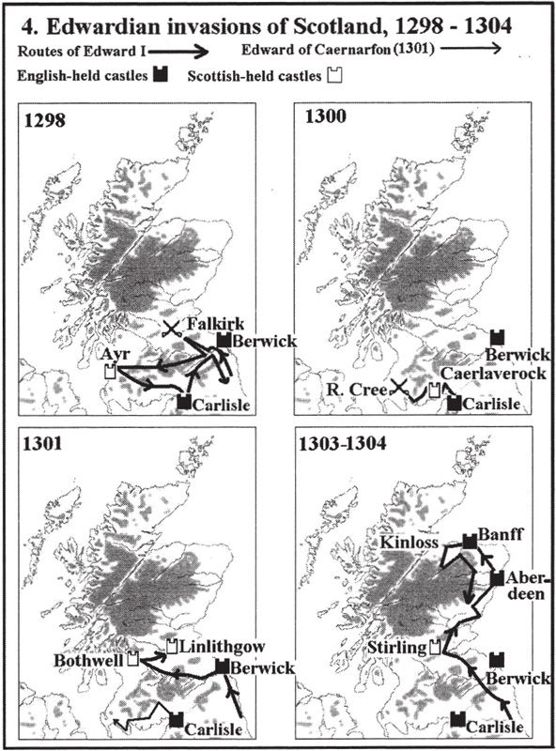
On his return from Flanders in February, Edward began gearing up for a decisive campaign in Scotland. That summer, the Scots scored a significant diplomatic victory. Bishop-elect Lamberton had been able to evade the English blockade and make the voyage to Rome for consecration there on 1 June 1298. Then he travelled to Paris, to join a small group of Scottish émigrés at the French court. They were able to persuade both King Philip and Pope Boniface VIII to write to Edward demanding the release of King John Balliol and a cessation of Edward’s attacks on the Scots. It was a significant step in the escalation of diplomatic pressure against England, but it would be a year before the English king would be forced to make any concession, and for now nothing would stop his invasion of Scotland. With a united English aristocracy at his back, Edward mustered a force of 25,000 foot – 11,000 of whom were Welsh – and 3,000 cavalry. The logistical preparations for such a force were, however, inadequate. Edinburgh and Carlisle were the only locations to which some grain was sent in advance, and ships intended to provision the army were delayed by contrary winds. The Welsh foot-soldiers turned out to be unreliable, but Edward may have been forced to use them because so many of the English had already served their forty days outside the kingdom of England at their own expense in the previous winter. As this force advanced into Scotland it became clear that Wallace had very thoroughly removed from their path all possible means of sustenance, ‘a scorched earth’ tactic that threatened to weaken the English severely before battle was joined. This too would be later emulated by Bruce. In an effort to cheer up his starving troops, Edward’s Welsh foot-soldiers were given wine, and violence broke out between the Welsh and the English knights. The Welsh withdrew from the army, and threatened to take no further part in the war. As the English passed through the town of Linlithgow they saw the massed spears of the Scottish army on a mountain in the distance.
Wallace had clearly realised the sense in postponing battle as long as possible, to make the most of dissension in the enemy ranks and draw them deep into hostile territory. However the earls upon whom Wallace depended may not have countenanced anything but conventional warfare, and Wallace’s own position would have been profoundly weakened had he allowed the English to reoccupy Scotland. Open battle was therefore inevitable, although the folly of taking on a superior force had already been demonstrated at Dunbar in 1296. A little beyond the town of Falkirk the Scottish force prepared to give battle, and on the feast of St Mary Magdalene, 22 July, they faced the mighty English host.
Unlike Edward’s army, which was largely paid and for which accounts survive, nothing exists to reveal the size of Wallace’s force. The challenge before Wallace was to withstand the might of Edward’s armoured cavalry with an army substantially composed of foot-soldiers. He drew up his army of spearmen in three densely packed ‘schiltroms’ or blocks radiating iron spearheads. A small marsh and loch between the armies provided some natural shelter for the Scottish centre from the charge of the English heavy cavalry. So that they would not give way before the impact of the charge, Wallace had each schiltrom ‘anchored’ to its chosen position by means of ropes tied to wooden stakes driven into the ground, which formed makeshift circular palisades. These then were the rings he referred to in his famous remark to the foot-soldiers before the battle, ‘I have brought you into the ring, now see if you can dance.’ In the gaps between the schiltroms he placed such archers as he had, and in the rear he kept the small numbers of cavalry that Scottish nobles – James the Steward, the earls of Buchan, Strathearn, Lennox, possibly Carrick, Atholl and Menteith too – had committed. Should the worst come to the worst, Callendar Wood lay to the rear of Scots, which might provide cover for fleeing infantry.
It was perhaps the best possible arrangement that could be devised for such an unequal battle, but it was not good enough. The aristocratic Scottish horsemen fled the field early without making any contact with the English. Those with most to lose, they had weighed up the odds and made the rational, if ignoble, last-minute decision to avoid personal commitment, leaving their tenants to face the enemy. English cavalry rode down the Scottish archers positioned between the schiltroms, then turned their attention to the now isolated formations of spearmen, who had to withstand the impact of repeated charges. Periodically each schiltrom was subjected to the hail of crossbow bolts and arrows from the Welsh bowmen and eventually – as they ran out of manufactured missiles – of stones. The schiltroms were stationary targets for missiles and cavalry charges, and eventually, despite the palisades of ropes and stakes, they could not hold together. Battle turned to slaughter. In fleeing to the woods behind them, great numbers of Scottish spearmen were killed; others drowned in the loch; still others were ridden down by the pursuing English cavalry. The English lost 110 horses and 2,000 infantry were killed. That figure takes account only of the paid element of the English force. There is no estimating Scottish losses, but they must have been far in excess of those sustained by the victors.
We are unsure of whether Robert Bruce VII, Earl of Carrick, was at the battle of Falkirk. Some chroniclers record that a Robert Bruce was present at the battle and active on the side of Edward I, but, if true, this is likely to have been Robert’s father, the lord of Annandale.14 In view of young Robert’s high standing with Scots in the wake of defeat – when he was elected joint-guardian – it seems most unlikely that he fought with the English. Bruce may have fought on the patriot side, fleeing ignominiously with most of the Scottish aristocratic cavalry. In the aftermath of Falkirk, his lands were not seized as forfeit to Edward I, but the region dominated by the Bruce faction became the focus of Edward’s attention.
After the battle the victorious English advanced into Fife. They occupied St Andrews, but one report says that Edward, out of respect for the local saint, ordered that the town should not be sacked. Perth, however, was destroyed. Edward then turned westwards through Forest of Selkirk and marched towards the earldom of Carrick. One of the English chronicles carries a report that the Scots were regrouping in Galloway, and it seems that Edward was anxious to confront them. It is very likely that the Comyns and the earl of Carrick – who emerged as the leaders of resistance in the aftermath of the battle – had retreated to family estates in the south-west. Bruce indeed may have previously arranged that the Bruces’ Irish allies should contribute forces to the west of Scotland. For in what may have been an echo of the Turnberry Band, Antrim magnate Thomas Bisset arrived with his followers on the island of Arran in order, according to Walter of Guisborough, ‘to assist the Scots, as was commonly said’. Once he learned of the outcome of the battle, however, Bisset changed his stance and claimed that he had come to help the English and actually received a grant of the Isle of Arran from Edward. The Guisborough’s chronicle records that ‘hearing of the approach of the king, Robert Bruce the son fled from his face and he burnt that castle [Ayr] which he held’. It is the first concrete report of Bruce’s activities since the surrender at Irvine. It is also significant that the young earl is associated with the burning of castles to deny them to the enemy. This tactic he subsequently developed into a hallmark of his style of warfare.
At Ayr Edward waited for a fortnight for ships carrying provisions to appear while his army starved a second time, and then he retreated, first to Dumfries, thence to Lochmaben. In Annandale the Bruces’ retainers held the ancestral castle at Lochmaben, but, probably in the aftermath of Stirling, they had at last declared for the patriots. Now, they had no choice but to surrender, and Edward spared their lives. He destroyed the stone castle of Robert the Noble of Lochmaben, and re-using the stone, built afresh on a site nearby. Adjacent to this new castle, be built a wooden palisade covered in mud to render it fireproof. Such structures were known as peels, and they enlarged the accommodation and hence the protective capacity of castles. They could be speedily erected, and at no great expense; in time peels were attached to many castles in English-held Scotland including Dumfries, Linlithgow and – significantly – at Selkirk, always a focal point of resistance. Edward then made arrangements for the garrisoning and provisioning of castles throughout Scotland, and reorganised the occupation. Garrisons at Berwick, Edinburgh, Stirling, Roxburgh and Jedburgh were all carefully provisioned, and captaincies were established over wide areas: Eskdale, Edinburgh, Nithsdale, with Patrick, Earl of March, appointed as guardian of Scotland South of the Forth. Lack of provisions however meant Edward could no longer stay in Scotland, and he led the bulk of his army across the Solway, reaching Carlisle in September.
For the Scots, the saving grace of the year 1298 was that Edward was unable properly to follow up his victory. The remains of the Army of Scotland and many of the nobles – Buchan and Lamberton the most prominent – regrouped in the shelter of Selkirk Forest. There, in the weeks following the rout, the internal politics of the patriots were played out to a remarkable conclusion. It was decided that after such a defeat Wallace could no longer remain as sole guardian. Wallace may have been moving towards the conclusion that the Scots could never achieve victory by their own efforts, for a year later he left for Paris to lobby the French king for support. In his stead Robert Bruce, Earl of Carrick and John Comyn of Badenoch the younger were elected joint guardians of Scotland. The heirs of both hostile noble factions had evidently decided to bury differences for the time being and co-operate to resist the occupation. How this was achieved or what the heads of the two families thought we do not know; Bruce may have co-operated because he was given a position of honour and influence equal to that of the Comyns, but he will not have compromised on his family’s claim to the throne.
The patriot government of northern Scotland was resilient enough to withstand defeat at Falkirk, and it still functioned in the name of King John. It was probably based upon the Comyn lordships of the north-east, still largely unscathed by warfare. In the north the court of the justiciar of Scotia – which office was filled by John Comyn, Earl of Buchan – still held pleas, and sheriffs still collected revenues for the government of the guardians, and not just for north of the Forth, During the joint guardianship of Bruce and Comyn, their official documents commenced in the following words: ‘Robert Bruce, earl of Carrick, and John Comyn the son, Guardians of the kingdom of Scotland in the name of the famous prince the illustrious King John, together with the bishops, abbots, priors, earls, barons and other magnates and the whole community of the realm …’ Bruce of course would much have preferred there to be no mention of King John, but he was prepared to acquiesce as long as John remained at a safe distance.
Edward fully intended to return to Scotland in the following season, 1299, and before the summer of 1298 was out he had issued writs for the next season’s campaign and laid plans for the supply of his garrisons. His hand had been immeasurably strengthened by the Anglo-French peace of 1298, negotiated through the arbitration of Boniface VIII.15 This was a cynical agreement by which England and France reined in their mutual antagonism in order that each might concentrate on suppressing its smaller northern neighbours. Thus the English abandoned their erstwhile allies, the Flemings, to the tender mercies of Philip IV. The French did rather better by their allies, the Scots. Before distancing themselves from the Scottish alliance they wrung a highly significant concession from the English, namely the release of King John from English into papal custody. A number of political difficulties however rendered it impossible for Edward to contemplate campaigning in Scotland in the summer of 1299. One was his impending marriage to Margaret, the sister of Philip the Fair, a major state occasion which, given the political importance of the marriage, called for the utmost delicacy in planning and protocol. Another was the truculent attitude of the English baronage. Edward seized as forfeit all the lands of many Scottish nobles who had fought against him. These he granted out to English magnates, in order to give them a stake in the conquest of Scotland: the earl of Lincoln, for example, was awarded the office and lands of James the Steward; Robert Clifford was given the Maxwell castle of Caerlaverock; and, later, Henry Percy was granted the lands of Ingram Balliol. It was the first major redistribution of forfeited estates. The grantees, however, were left to gain possession and extract revenue from Scottish estates, and the king’s apparent generosity cut little ice with his magnates. The Falkirk campaign had been possible because king and magnates had acted from shared outrage at the Wallace invasion, but these circumstances were not to be repeated. Already the earls of Norfolk and Hereford had fallen out with Edward over his grant of Arran to Bisset – which had been made without their advice. They were now demanding that the king abide by concessions he had made, and which he was now unwilling to stand by.
An exchange of prisoners was achieved in April 1299, and it is interesting to note that the Scots had captured some middle-ranking English lords: William fitz Warren, Marmaduke de Thweng16 and William de Ros. Resistance against the occupation mainly took the form of slow exertion of pressure on English garrison castles by encirclement, cutting off supplies and ambush. But it was also a war of mounted raids, known as chevauchées, designed to impoverish and terrorise populations adhering to the enemy, another tactic subsequently developed by Robert Bruce. Patriot nobles mustered at Peebles for a raid from the cover of Selkirk Forest. A council was held there on 19 August 1299. The report of a spy who witnessed the council provides a remarkable insight into the tensions prevalent within the patriot camp:
At the council Sir David Graham demanded the lands and goods of Sir William Wallace because he was leaving the kingdom [for Paris] without the leave or the approval of the Guardians. And Sir Malcolm, Sir William’s brother, answered that neither his lands nor his goods should be given away, for they were protected by the peace in which Wallace had left the kingdom, since he was leaving to work for the good of the kingdom. At this, the two knights gave the lie to each other and drew their daggers.
The next sentence reveals that Bruce and Comyn factions were quite literally at each others’ throats:
And since Sir David was of Sir John Comyn’s following and Sir Malcolm Wallace of the earl of Carrick’s following, it was reported to the earl of Buchan and John Comyn that a fight had broken out without their knowing it; and John Comyn leaped at the earl of Carrick and seized him by the throat, and the earl of Buchan turned on the bishop of St. Andrew’s, declaring that treason and lese-majesté [an offence against the dignity of a sovereign power] were being plotted. Eventually the Steward and others came between them and quietened them.
The meeting ended with Bishop Lamberton being admitted as a third guardian in an effort to maintain some semblance of unity. Edward’s allies and garrisons in Scotland paid the price for his failure to campaign in 1299. That summer the patriot commander Herbert Morham was able to cut lines of supply to the ninety-strong English garrison at Stirling, and they began to starve. Bruce continually tried through the autumn to force the English garrison out of Lochmaben. He had no success. But in November the long siege of Stirling ended in the surrender of the English garrison. For the Scots this was a major strategic prize that promised to enlarge significantly the area under the sway of the patriots. In the west too, Edward’s agents the MacDonalds sustained a serious defeat as the MacDougall revolt continued unabated. The Annals of Ulster record that in that year ‘Alexander MacDonald, the person who was the best for hospitality and excellence that was in Ireland and in Scotland, was killed, together with a countless number of his own people, who were slaughtered around him, by Alexander MacDougall.’
On Alexander’s death, leadership of the MacDonalds passed to Angus Óg, who then adopted the title ‘Lord of Islay’, the style used by the head of the kindred, and he later became a staunch ally of Robert I. For the present, Angus Óg co-operated with Hugh Bisset – who had become Edward’s naval commander in the west – and John MacSween against the MacDougalls on the seas around Bute and Kintyre. Horrified at the collapse of the key fortress of Stirling above all, Edward made a rash attempt to mount a winter campaign, summoning 16,000 men to appear at Berwick in the middle of December, but for this he did not have the support of his earls. Only 2,500 men turned up, and these stayed only a few days before deserting. Despite this, there was no doubt that the English would field a formidable army in the summer of 1300.
By May 1300, however, Robert Bruce had ceased any co-operation with Comyn, and at a patriot parliament held at Rutherglen in that month he no longer appears as a guardian. Clearly great personal animosity had developed between himself and John Comyn of Badenoch III. Bruce’s decision to leave – or his removal from – the guardianship seems to have been related to Edward I’s agreement in July 1299 to surrender King John Balliol into papal custody in France. One of the factors that made this possible was an oath King John had taken on 1 April 1298 never to set foot in Scotland or have anything to do with Scots. Balliol and Comyn elements among the Scots were delighted at the release of their king and at once began working towards a restoration of King John to Scotland. This, Bruce could not stomach, and he ceased his involvement in the patriotic resistance. His place in the guardian triumvirate was taken by Ingram de Umfraville, a magnate firmly aligned with the Comyns.
The purpose of the Rutherglen parliament had been to concert resistance to the expected English invasion of 1300. Edward had decided this time to enter Scotland by the Western March, presumably to try to break the hold of the patriots on the south-west, where lay the Bruce territories of Annandale and Carrick, the Balliol lordship of Galloway, the Steward’s lands and the bishopric of Glasgow. Tenants of these lords had all been strongly supportive of the patriot cause. The English army was to proceed along the Solway coast accompanied by a provisioning fleet. The main action of the campaign was the siege of Caerlaverock Castle, lately recaptured by the Scots and a threat to the English garrisons at Lochmaben and Dumfries, and to the security of the Cumberland littoral. The siege, which commenced in July, involved battering rams and trebuchets, and was an awe-inspiring demonstration of the power of Edward’s siege train. As they advanced westwards, the English met with resistance on the banks of the River Cree, where there was a brief engagement between the English and the main Scottish cavalry force, led by the Comyns. The Scottish cavalry soon took flight, as they had done at Falkirk, but Edward was unable to pursue the Scots further. He stayed in south-west Scotland, supervising the garrisons and organising the occupation until, in October, he could stay no longer. He met Scottish envoys at Dumfries, and in a recorded exchange with their envoys we see that what rankled with Edward, what above all he could not tolerate, was the Scots’ perceived breach of faith with him: ‘Every one of you has done homage to me as chief lord of Scotland. Now you set aside your allegiance and make a fool of me as though I were a weakling!’ Nevertheless he granted the Scots a truce until the following summer. Of Bruce there is no mention, and it seems he took no part in the 1300 campaign. In Professor Duncan’s opinion he was sulking. Excluded from the guardianship, he took nothing to do with the patriotic resistance, and the prospect of fighting for King John was anathema to the Bruces.
The Scottish diplomatic effort at the papal and French courts, headed by Bishop Lamberton, had borne further success in June 1299 when Boniface VIII sealed the papal letter to Edward I known as ‘Scimus Fili’, a text clearly inspired by the strong Scottish lobby at the curia. However it arrived only in the autumn of 1300. This papal broadside was an outright denunciation of the Edwardian occupation. It claimed that ‘from ancient times the realm of Scotland belonged rightfully, and is known still to belong, to the Roman church’. It reminded Edward of his undertaking in the Treaty of Birgham that ‘the realm should remain for ever entirely free and subject or submitted to nobody’. It accused Edward of taking advantage ‘at a time when the realm of Scotland lacked the protection of a ruler’, and concludes that ‘no-one who considers [these things] can doubt that the realm of Scotland belongs to the Roman church, and that it was not, and is not lawful for you to dominate it by force and to subjugate it to your rule.’ No wonder that Edward could not bear to listen to this as it was read to him by an archbishop, but exploded with wrath. ‘By God’s blood! For Zion’s sake I will not be silent and for Jerusalem’s sake I will not be at rest, but with all my strength I will defend my right that is known to all the world!’ Boniface urged Edward to present his case to rule Scotland before the papal court. The Scots had effectively captured the weapon of papal favour. Since the papal letter advanced no arguments specifically in favour of King John’s rights, the Bruce faction may have had the upper hand in lobbying at the papal court.
Two responses were prepared by the English. One was a letter from Edward I, dispatched in May 1301, rehearsing the historical evidences supporting the English claim, accusing the Scots of terrible atrocities and explaining that Edward could not accept papal mediation in this matter. Another was a letter, ostensibly from the barons of England – though no doubt written by royal clerks – protesting their king’s claims in equally strong terms. In Rome meanwhile the Scottish delegation, ably led by Master Baldred Bisset, argued powerfully that the Anglo-Scottish dispute should be submitted to the papal court. Any homage done by Scottish kings was only for lands they held in England. In a much-admired processus, carefully designed to appeal to papal interests, Bisset advanced five proofs – from papal privilege, common law, prescription, past history and documentary evidence – to demonstrate that Scotland owed Edward I no allegiance.
However, the focus of the Scottish diplomatic effort was switching to France, whither King John had now been transferred, out of papal custody and into that of the French king. Philip the Fair saw in Balliol a very useful pawn in his attempts to undermine Edward I. The prospect of a Balliol restoration was growing, and from exile King John was now free to influence events in Scotland. By the campaigning season of 1301 there had been further changes in the guardianship. Bishop Lamberton and his colleagues Comyn and Umfraville resigned and were replaced by Sir John Soules acting as sole guardian; one chronicler reports that Soules had been elevated to the guardianship on the prompting of King John. Changes in the wording and seals of documents emanating from the patriot government also suggest a more prominent role for the exiled king: where previously the names of the guardians had appeared at the head of such deeds, they were now replaced by the name of King John, with Soules, the guardian, appearing only as a witness.
The English invasion of 1301 materialised as a two-pronged attack, much more complex and formidable than that of the previous year. Edward himself led an army from Berwick up the River Tweed to Selkirk and Peebles, and then into the valley of the Clyde to besiege Bothwell Castle in August; his son Edward of Caernarvon, Prince of Wales, led a force along the Solway coast all the way to Loch Ryan. With the help of a force from Ireland, the prince’s vanguard was able to capture Turnberry in September. As earl of Carrick, Robert Bruce VII could not afford to stand aloof from resistance to this invasion, for Turnberry was the principal castle of his earldom. Presumably it was Bruce’s garrison that held out against the prince of Wales until September 1301, and it was the militia of his earldom that menaced the English garrison thereafter. Yet Bruce was involved in resistance only in so far as invasion threatened his own lands, and he left it to the Comyn earl of Buchan to lead the patriot efforts against king and prince, and to Soules and Umfraville to attack the English occupying Lochmaben on 7 and 8 September.
Increasingly distancing himself from the patriots, Bruce decided early in 1302 to return to allegiance to Edward I. The prospect of a Balliol restoration presided over by the Comyns was something he could not tolerate since it would remove completely all possibility that he would succeed to the throne. Moreover, in the peace concluded between the English and French at Asnières in January, provision was made for lands of Scots who had not submitted to be handed over to French administrators. Such an arrangement would deprive Robert of the revenues of his earldom for an indefinite period, and quite possibly place him at the mercy of the Comyns who could expect to receive favourable treatment from the French.
However, probably the main reason why Robert changed sides at this point was that he had managed to negotiate generous terms from Edward. The text of the agreement has survived. Robert and his men were guaranteed life and limb, lands and tenements and freedom from imprisonment. Edward would compensate him should the terms of a treaty or a papal ordinance affect the tenure of the Bruce estates, so that Robert would not suffer from French administration of his estates. Robert was granted the wardship and marriage of a son of the earl of Mar. The child, Donald of Mar, was Robert’s nephew. Mention is made of Robert’s ‘claim’ in a further clause. This might just refer to his claim to lands or titles, but it seems to have a wider meaning, and it could encompass his claim to the throne of Scotland. There was of course no question of Edward permitting an independent monarchy of Scotland; the kingship of Scotland envisaged at this time can only have been as a vassal or sub-king to Edward I. If we interpret this document correctly, it seems that Edward not only allowed Robert to persist in his claim to the throne, but intimated that under certain conditions he might even facilitate it:
Because [either ‘the king’ or ‘Robert’] fears that the kingdom of Scotland may be removed from out of the king’s hands (which God forbid), and handed over to Sir John Balliol or to his son, or that claim may be brought into disrepute, or reversed and contradicted in a fresh judgement, the king grants to Robert that he may pursue his claim and that the king will hear him fairly and hold him to justice in the king’s court. If by any chance it should happen that the claim must be adjudicated elsewhere than in the king’s court [for example, in the papal court], then in this case the king promises Robert assistance and counsel as before, as well as he is able to give it.
Why should Edward have given Robert Bruce a chance to air his claim to the Scottish throne? It seems that even Edward I, whose armies were marching into Scotland virtually on an annual basis, was now prepared to concede the possibility of a Balliol restoration. It might suit his diplomacy towards France and the papacy to tolerate it. The above passage seems also to admit of the possibility of a re-run of the Great Cause in the papal court. Edward may have permitted Robert to persist in his claim to the Scottish throne since, in the event of a Balliol restoration, he could use Robert to destabilise the Scottish monarchy.17 Edward would work hard to ensure that there would be no Balliol restoration in Scotland, but, if it came to it, he had in Robert Bruce a willing and pliant rival for the sub-kingship.
Robert had gained security for his lands and titles, without, apparently, compromising his claim to the throne. His father was probably delighted at his change of sides. It brought additional benefits to the family: Edward Bruce appears in the service of the Prince of Wales in April 1304, and Alexander Bruce, the clergyman, received the living of Kirkinner near Wigtown for his maintenance. Robert was able to travel into England to attend parliament, as he did in October 1302, probably following an instruction to make a public gesture of obedience and loyalty. On this journey he may well have visited his father or family properties in England. We know he stayed in England over the winter and visited Cambridge in the spring of 1303 to give a feast there, as was traditional, on the occasion of Alexander Bruce’s becoming Master of Arts. Another benefit that came Robert’s way as a result of his return to Edward’s allegiance was a second marriage. The fate of Robert’s first wife, Isabel of Mar, is uncertain; most probably she had died. This second marriage was to Elisabeth de Burgh, daughter of Richard de Burgh, Earl of Ulster. It was a most desirable match, and Edward might have dangled the possibility of it before Robert to persuade him to defect. The ‘Red Earl’ was the most powerful magnate in Ireland, and a traditional ally of the Bruces, as the Turnberry Band of 1286 testifies. The Red Earl’s sister Egidia – also known as Gelis – had married James the Steward, so Bruce’s marriage strengthened the long-standing alliance of these three families. Altogether we have no reason to believe that Robert’s change of sides was an anguished decision, or that defection cost him anything in terms of esteem among his peers in Scotland. No one at the time levelled the charge of treachery at him so far as we know. Contemporaries probably acknowledged that Robert was merely pursuing family interest and his claim to the throne of Scotland by other means, and acting in a predictable and understandable way.
Professor Barrow draws attention to an interesting letter written by Bruce in March 1302, just after he had changed sides. It is a promise to the Abbey of Melrose that, though in the past he had often drafted the abbey’s tenants of Maybole into the army of the earldom of Carrick, conscience now troubled him and henceforth he would never compel the tenants to military service unless there was a summons of the common army of the realm. While Bruce’s piety and his particular devotion to Melrose Abbey is unquestioned, the timing of the promise suggests that the earl of Carrick was not overly concerned to provide troops for his new master.
The truce between Edward I and the patriots ensured that there was no campaign in 1302, yet a dramatic turn of events in Scotland was effected by a battle in faraway Flanders. At Courtrai on 11 July the haughty aristocrats of the French heavy cavalry suffered a comprehensive humiliation at the hands of the Flemish foot-soldiers, weavers and townsfolk who opposed Philip the Fair’s efforts to control them. It was a landmark battle: the first significant occasion in the Middle Ages when infantry defeated cavalry. In the long term of course this development boded well for the Scots, and in that sense Courtrai prefigured the victory of the Scottish foot at Bannockburn. But in 1302 it spelt disaster for the Scottish cause. In the words of Barrow, it ‘did more to make Scotland an English province than any other single event of these years’. For the result of the French king’s defeat was that he was forced to abandon all support for the Scottish patriots and for restoration of the Balliol monarchy. In the autumn of 1302 the guardian, John de Soules, led a delegation of Scottish aristocrats to Paris to try to persuade the French king to continue his support, but it was to no avail.
While Soules in France struggled to ward off disaster, John Comyn of Badenoch took over the role of acting guardian at home and enjoyed considerable success. Together with Simon Fraser, Comyn scored a remarkable victory on 24 February 1303, sallying out from the shelter of Selkirk Forest to ambush Edward’s lieutenant in Scotland, Sir John Segrave, and the clerk of the royal wardrobe, Ralph Manton, at Roslin near Edinburgh. Manton, a central figure in the bureaucracy of occupied Scotland, was killed, and many knights, including Segrave, were taken prisoner. The Peel of Selkirk, designed to project the English occupation into the very depths of the forest, was captured by the Scots.
Though it represented a considerable achievement, this victory was set in context by the inevitable summer invasion. The Edwardian invasion of 1303 was larger, more penetrating and, consequently for the Scots, more demoralising than any that had gone before, and there was no mistaking the English king’s sense of purpose. On 20 May 1303 Edward concluded a further peace with Philip of France, and, thus secured on his southern flank, he concentrated his undivided ferocity upon the Scots. All the resources of England and her satellite territories were marshalled as never before and devoted to crushing Scottish resistance. In July a large Irish contingent led by the earl of Ulster landed in the west to reduce the castles of Bute and Inverkip. Robert Bruce, Earl of Carrick, was also active in Edward’s service. He was ordered to call up 1,000 foot from his sheriffdom of Ayr, and, in co-operation with two Galloway chiefs, Gibbon MacCann and Dungal MacDowall, a further 1,000 from Carrick and Galloway. Bruce himself seems to have remained on the Western March with John Botetourt during the campaign. Three prefabricated pontoon bridges, designed to project the English army across the Firth of Forth, were floated up the North Sea coast. Sir William Oliphant, commanding the Scottish garrison at Stirling, held grimly on while the great host passed by, but in August the English attacked and overcame the Scottish garrison at Brechin. Edward continued his march along the east coast, through Aberdeen, to Banff and as far as Kinloss Abbey. There he halted in mid September, and during October he returned by a more inland route, by way of Kildrummy, Brechin and Scone. Early in November Edward settled into winter quarters in Dunfermline Abbey, where he was joined by his queen.
During February 1304 Edward dispatched an expedition deep into Selkirk Forest to locate Fraser and Wallace. In this Bruce was ordered to participate, and he joined John Segrave, Robert Clifford and William Latimer. They routed the patriots, but both Fraser and Wallace escaped. No clue survives as to how Bruce might have felt at participating in this action. To pursue the former leader of Scottish resistance, his comrade-in-arms, perhaps his former commander, must have been deeply uncomfortable for him – to say the least. Stories that Bruce captured Wallace but released him unbeknown to Clifford must be dismissed as a later fabrication by Robert’s hagiographers. It had been four years since, during the row in the patriot camp in Peebles, the Wallaces had last shown themselves supporters of the Bruce faction, and this episode illustrates how the Edwardian conquest of Scotland had changed the face of politics beyond all recognition.
Wallace was now an isolated figure. Most other Scottish commanders, including the guardian, John Comyn, decided that resistance could no longer be maintained. That same February the great majority of Scottish patriots sued for peace. This was partly an acknowledgement that they had been overwhelmed by the military might of England, partly exasperation at the failure of King John to throw in his lot with his beleagured subjects. The patriots no longer enjoyed the support of the King of France or of the pope, and now they resigned themselves to a general surrender while there was still a little room for negotiation with Edward I. Comyn sought that Edward would rule Scotland according to the laws and customs in the time of Alexander III; that any departure from them should be sanctioned by the assent of the good people of Scotland; that nothing should be enacted to the prejudice of the Scots; and that no hostages be taken. Edward, on the other hand, was unwilling to accept all the Scottish leaders into his peace until Wallace had been captured. A series of compromise agreements were reached, whereby certain of the patriot leaders were to be exiled for varying periods of time, depending upon the extent of their involvement with the resistance. Scottish nobles whose estates had been granted to Englishmen were to be given the opportunity to buy them back. Edward could have insisted upon much tougher terms. Simon Fraser also surrendered, though it is clear that Edward detested him. As it was, he was saving the fullness of his vengeance for the Scottish garrison of Stirling, and for William Wallace.
In the spring of 1304, Edward besieged or ‘invested’ Stirling Castle and unleashed upon it all the refinements of medieval siege technology, including primitive explosives. Engines of war – battering rams and catapuls – were collected from Brechin, Aberdeen and Berwick. Robert Bruce contributed siege machines of his own. Lead was stripped from the roofs of nearby churches to provide counterweighs for catapults, and cotton thread, sulphur and saltpetre – the ingredients of Greek fire – were assembled, presumably to make bombs. The siege of Stirling was a showcase for contemporary warfare; in fact Edward ensured that the whole prospect – ingenious contraptions at work, fires, explosions, heraldic banners and shields, feats of arms – could be viewed at a safe distance by the ladies of the English court from a specially constructed oriel window. Within the castle, the heroic garrison, led by Sir William Oliphant, sheltered from the explosions in caves deep within the bedrock, but emerged to rain crossbow bolts and stones on the attackers. Oliphant may have felt deserted by his king, who had not arrived to lead the resistance; he claimed to hold the castle, not of the guardian, Sir John Soules, nor yet of King John, but, in reference to the Scottish royal standard, ‘of the Lion’. Thus Oliphant considered that he held the castle in trust for the monarchy or kingdom of Scotland. Gazing across at the enemy ranks, however, the defenders discerned the heraldic devices of their erstwhile comrades John Comyn, Alexander Lindsay, David Graham and Simon Fraser and became aware that these hitherto staunch patriots had already made terms with Edward. On 20 July Oliphant decided he could hold out no longer and offered surrender. Edward showed no magnanimity whatsoever and refused to give the defenders peace until he had tried out his new and terrible siege engine, the Warwolf. At last, on 24 July, he allowed them to surrender, and Oliphant’s brave men emerged, barefoot and faces besmirched with ashes, symbolising abject contrition, to throw themselves on his mercy. The king made it plain that they were lucky to be granted life and limb, and he hanged the man responsible for betraying the castle to the Scots four years earlier.
Victorious, Edward returned to England that summer with Scotland all but subdued. Only William Wallace remained at large. On the day after the siege of Stirling had ended, Edward had dispatched Comyn, Lindsay, Graham and Fraser to capture Wallace by 13 January 1305, if they wanted easier surrender terms. In August 1305 the greatest patriot of the age was captured as he lay with his mistress – according to Peter Langtoft’s chronicle – by John of Menteith’s men. Wallace was taken to London where a show trial rehearsed the accusations against him: he had spared none who used the English tongue, he had slaughtered children, widows and nuns, and he had rebelled against his feudal lord. No account was taken of the facts that Wallace had never sworn fealty to Edward, and did not acknowledge Edward as his lord. No opportunity was given for him to answer the charges. By the standards of the age this was all to be expected: Wallace was not of high birth and he had waged war without particular regard to chivalry. As Edward’s biographer points out, ‘there was no reason why Edward should have treated him with compassion or respect’. But the barbarism of the execution is inexcusable by any standards. Wallace was dragged by horses for four miles from Westminster to Smithfield, hanged, cut down while still alive, disembowelled and beheaded. His head was placed on London Bridge, and the body quartered, with parts dispatched to Newcastle, Berwick, Stirling and Perth. Wallace had been unloved by the Comyn faction, and though hailing from within the Bruce camp we must assume that Robert Bruce had made every effort to hunt him down in 1304. Even so, Edward’s treatment of a former guardian may have generated considerable outrage. It is likely that the Bruce coup of 1306 owes something of its popular support to Wallace’s brutal execution.
In September 1305 Edward addressed the problem of the future government of England’s latest satellite territory. Ten Scots met with twenty of the king’s counsellors to draft the Ordinance for the Government of Scotland. In the text, Scotland is referred to not as a realm or kingdom, but merely as a ‘land’; its status is thus relegated to that of Ireland. A royal lieutenant – John of Brittany – was appointed to serve as guardian, with a council of twenty-two Scottish aristocrats. Other offices included a chancellor, a chamberlain, and four pairs of justices, each pair consisting of an Englishman and a Scotsman. The sheriffs and castellans appointed were mostly Scots, but the more important castles and the sheriffdoms of the south-east were given to Englishmen. The council of twenty-two was to embark upon a comprehensive review of Scottish law. In this document none of the attention to detail manifest in his settlements of other lands is shown, and one gains the impression that, at the age of sixty-four, Edward I was enormously relieved to have finally settled the Scottish question. Bruce, who had recently entertained hopes of being vassal king, was to have but a minor role in the settlement. He was among those nominated to sit on the guardian’s council, and, as he held the young heir to the earldom of Mar in wardship, he was to install a constable in Kildrummy Castle, the principal seat of that earldom.
In 1305 Edward I appeared to have completed his exhausting undertaking of reducing Scotland to obedience. Indeed he had hammered the Scots into submission, but it is also true that he had been obliged to reach accommodation with the powerful aristocratic Comyn faction, and, having finally secured their co-operation, he could now govern through their resources of lordship, patronage and castles. Edward could have done so much earlier, had he been in a position to devote to Scotland his undivided attention. The costs, even in terms of hard cash, were staggering. His biographer estimates that the campaign of 1300 cost £40,000–50,000, and that of 1303–04 may have cost £80,000. For Edward’s earlier conquest of Wales there had been a higher proportion of his income available; he had conquered Scotland at a time when there were many other calls on his resources. True, there were distant highlands and islands where Edward’s writ did not yet run, but, as he had control of all the centres of authority he could be confident that his peace had been widely imposed. True again, he was unloved, had no purchase on the hearts and minds of the Scots and must have been resented by virtually all, yet he was now in a position to divide and rule, to administer vast resources of patronage and coercion. As was the case for any medieval monarch, he had little need of consent from the population at large so long as magnates could be relied upon to co-operate, however begrudgingly. Given a competent heir to cement his achievements, continued co-operation from Scottish magnates and the absence of any alternative to his rule, Edward’s conquest might have lasted indefinitely. In 1305 Scotland’s fate had been sealed; the Edwardian super-kingdom had arrived.