
4
Murder, revolution and enthronement
The reconstruction of the events of 10 February 1306 with which this book opens is based upon the narrative of the chronicler Walter of Guisborough who, though hostile to Bruce, is the best near-contemporary source for these events. John Comyn had ridden from Dalswinton, accompanied by his uncle Sir Robert Comyn. Bruce was accompanied by Christopher Seton; the others with him were possibly Seton’s two brothers. The principals greeted one another with a kiss – though, the Guisborough chronicle points out, it was not the ‘kiss of peace’. Between the two men a deal or agreement for mutual assistance may already have existed, and in all likelihood Bruce will have canvassed Comyn’s support for an attempt on the throne. To this Comyn would not consent. Walter of Guisborough describes what happened:
They were speaking together with words which seemed peaceful; suddenly, in a reversal, and with different words, [Bruce] began to accuse him of betrayal, in that he had accused him to the king of England, and had worsened his position to his harm. When [Comyn] spoke peaceably and excused himself, [Bruce] did not wish to hear his speech, but as he had conspired, he struck him with foot and sword and went away out. But [Bruce’s] men followed [Comyn] and cast him down on the paving before the altar, leaving him for dead … Robert Comyn his uncle ran to bring him help, but Christopher Seton, who had married Robert’s sister met him, struck his head with a sword and he died … Comyn still lived, for the friars had carried him down to the altar vestry to treat him and for him to confess his sins. When he confessed and was repentant, by the tyrant’s [that is, Bruce’s] order he was dragged out of the vestry and killed on the steps of the high altar.
Discussion had turned to argument and argument to accusation, insult and jealous rage. It is impossible to believe that murder was intended in a sacrosanct church of all places; Bruce would not have handed such a weapon to his enemies. But John Comyn had not died outright before Bruce left the church. Bruce subsequently ordered him to be dragged out of the vestry and finished off by the altar. Later writers relate that Roger Kirkpatrick of Closeburn and James Lindsay finished off the dying Comyn on Bruce’s behalf, but it is unlikely that he had any evidence for this. Bruce had surely intended to assume leadership of a united Scotland, not to plunge the country into years of bitter civil war. He had blundered across his Rubicon, and he will have realised immediately that the die was cast. Perhaps he proclaimed his intention to seize the throne there and then; at any rate his men hurried off to seize Dumfries Castle. Robert’s coup d’état had not got off to the smoothest of starts.
Robert Bruce’s actions ensured that Edward I died angry, bitterly disappointed that a coveted prize, the conquest of Scotland, had slipped exasperatingly from his grasp. By any standards the dark deed of that February evening was a defining episode in Scottish history, and in the history of these islands. Robert Bruce VI had taken no action that we know of since 1296 to promote the family’s claim to the throne, and, if he took any interest in Scottish affairs, it was only to appear on the field at Falkirk to assist in the defeat of the patriot cause. Had his son, Robert Bruce VII, lived a trouble-free life in the service of Edward I, Scottish identity and the very concept of Scotland might today have been totally different: a quaint medieval survival, a distant half-forgotten memory, or possibly lost altogether.
There has been endless speculation as to what drove Robert Bruce VII to take such drastic action. Firstly, we might say, three preconditions had been met: three factors that made it possible for him to attempt a realisation of his family’s claim to the throne. The first of these was the sudden impossibility of a Balliol restoration, caused by defeat on the field of Courtrai of Philip the Fair’s power, upon which the whole idea had depended. This left the Bruce claim to the Scottish throne the sole remaining plausible option for a revival of the monarchy. The second was the death of Robert Bruce VI on 21 April 1304. On the collapse of Scottish resistance to Edward I early in 1304, Robert Bruce VI had died while returning to Annandale, and he was buried at Holm Cultram Abbey in Cumberland. This meant that Robert Bruce VII acquired a considerable increase in prestige and resources as he became lord of Annandale, head of the family and claimant to the throne of Scotland. Accordingly he did homage to Edward I and came into his inheritance on 14 June. The third factor permitting of a Bruce bid for the throne was the looming prospect of Edward I’s death. At sixty-five Edward was very old by medieval standards, and every courtier fawning upon the domineering old man anticipated that a Pandora’s Box of possibilities would spring open on his demise. Cultivating the heir to the throne, covert alliances and plotting are the order of the day when a king’s death is not far off. In 1305, on his capture, the patriot leader Wallace was found to be carrying documents implicating certain of the Scottish magnates in a conspiracy; tantalisingly, we know nothing of their contents. We may be certain however that Robert Bruce had never abandoned his designs on the throne, and was preparing for Edward’s death as the moment when he would act. Such were the preconditions for any attempt to realise the Bruce claim, but one further occurrence also facilitated or even encouraged it. This was the appointment on 26 October 1305 of Bishop William Lamberton as one of four guardians to hold office until John of Brittany, nominated as lord lieutenant in the ordinance of 1305, could take up his duties. The bishop had a long history of supporting the patriot cause when political circumstances had allowed, and the appointment rates as a significant miscalculation on the part of Edward. Indeed, it was almost as huge an error as Edward’s underestimation of Robert Bruce himself.
The question however remains of what impelled Robert to risk everything – estates, family honour, life and limb – by leaving Edward I’s fealty. Was he pulled by patriotism to act against his own interests, or pushed by declining fortunes? There are conflicting assessments of Bruce’s position at this juncture. Professor Barrow, the leading authority, takes the view that Robert, as earl of Carrick and lord of Annandale, married to a daughter of the most powerful magnate in Ireland, holding Ayr and Kildrummy castles, and with three royal forests in his keeping, had everything to lose. ‘Potentially, he had never been richer or more favoured.’ He implies then that patriotism motivated him to act contrary to his own immediate interests. Professor Prestwich however stresses that Robert had grounds for discontent with royal service which drove him to act as he did. Like all Edward I’s magnates, Bruce faced great difficulty in recovering expenses. He was owed money on account of expenditure incurred as sheriff of Ayrshire and Lanarkshire, and there was trouble over certain rights he claimed in Annandale. Prestwich’s judgement is that Bruce’s expectations of royal service had not been realised, and that ‘with more careful handling by Edward, it is very likely that Bruce would have remained a valuable ally of the English’. Probably, like his father, Bruce still harboured fond expectation of eventually being asked to take on the role of vassal-king of Scotland, and was disappointed at Edward’s continued refusal to employ him in this capacity.
Other factors less quantifiable and more difficult to assess, were also making for a violent reaction against the sullen Pax Edwardiana. Surely outrage seethed among the Scottish nobility at Edward’s trampling on every Scottish sensibility, at the foreign occupation, disinheritances, the looting of precious relics, arbitrary seizures and exactions of oaths and hostages. This outrage fed upon the provocative execution of William Wallace, whom Edward I had humiliated, tortured and killed. Wallace was a former guardian of the realm and a military leader who had probably commanded considerable popular respect in Scotland. This outrage Bruce must have shared and probably hoped to harness to his own ends. Furthermore, as the old king neared his end the climate of expectation must have been brewing, a sense of imminent catastrophe dimly reflected in the rumours and forebodings inspired by the prophecies of Merlin and Thomas of Erceldoune obscurely referred to in Barbour’s The Bruce and in a letter of 15 May 1307 discussed in the following chapter.
Disappointed – perhaps bitterly so – with the rewards of royal service, Bruce also suffered a perceptible downturn in fortunes and favour at court. In March 1305 he was prominent at the Westminster parliament. He sought and received the lands of Sir Ingram de Umfraville in Carrick; he was consulted as to how Scotland should be represented at the subsequent parliament; and the following April he was among those charged with supervising election of those representatives, and with the defence of Scotland. Yet when that subsequent parliament met in September 1305 Bruce was not present;18 he was relegated by the ordinance to a minor role in the government of Scotland; and the lands in Carrick were restored to Umfraville. Furthermore Edward attempted to collect from Bruce debts allegedly owed by his father.
It may be that by February 1306 Bruce feared a sudden and catastrophic fall from grace, and was driven to desperate measures to escape awful consequences. Had he been planning a revolt as we suspect, he may have dreaded revelation of his preparations. Pacts with other magnates may have been preparations for revolt, or capable of interpretation as such. One such pact he made on 11 June 1304 with William Lamberton, Bishop of St Andrews, while watching the showpiece reduction of Stirling Castle, the last patriotic stronghold in Scotland. Each promised to aid the other in the event of future perils, ‘to be of one another’s counsel in all their business and affairs at all times and against whichever individuals’. It is an innocent enough agreement and not remarkable of itself, except that it lacks the normal clause ‘exempting fealty to our lord the king’. This leaves open the possibility that these confederates may have been prepared to assist one another in activities which Edward would consider treasonable. Lamberton may not have been the only magnate with whom Bruce allied. It seems likely that some similar arrangement had been entered into with John Comyn of Badenoch III, head of the senior line of the family, the victor of Roslin and the man Bruce was to kill at Dumfries. Comyn was also at the siege of Stirling. Versions of such a deal between the two men are recorded in both pro- and anti-Bruce chronicle traditions, relating either that Comyn revealed Robert’s intentions to Edward, or that Bruce was incensed by a report that Comyn had done so. The Barbour narrative poem The Bruce, which commences with this episode, includes the latter version. Either way, almost every early source alleges that Bruce was plotting a coup d’état to which Comyn would not assent. Finally, judging by his swift and enthusiastic reaction to the dramatic events of spring 1306, it is most likely that Bishop Wishart of Glasgow was also party to whatever plot Bruce may have been hatching.
It is worthwhile pausing to consider the figure of John Comyn III of Badenoch, known to history as ‘the Red Comyn’, though that name properly pertains to each successive head of that branch of the Comyn family. He belonged to the aristocratic faction that had been in the ascendant in Scotland for the thirty years prior to 1296. During that time the Comyns had used royal power and office to extend and establish their influence, develop extensive landed interests and an unrivalled network of patronage, especially in the north of Scotland. Comyn had been sole guardian from the autumn of 1302 to the ‘general submission’ of February 1304. His wife was Joan de Valence, sister of Aymer de Valence, a rising star at the court of Edward I and a magnate already, with considerable military experience in Scotland, soon to become earl of Pembroke. As already mentioned, Comyn was also the victor of Roslin, a patriotic victory of such moment that the Scottish ambassadors in Paris wrote to him, ‘It would gladden your hearts if you knew how much your honour has increased in every part of the world as a result of your recent battle with the English.’ Comyn thus had considerable military prestige as well as all the kudos that lineage, extensive lands and patronage could bestow. Equally with Robert Bruce, John Comyn was leadership material; his only disadvantage in that respect was that he had no claim on the throne. Any movement Comyn led would have had to be in the name of King John.
When the heads of both families met in the Greyfriars Church at Dumfries on 10 February 1306 there will have been considerable tension. Bruce may well have seen Comyn as a rival for power, though unlike himself Comyn had no pretensions to the throne of Scotland. As we have seen there had always been deep suspicion and animosity between the Bruce and Comyn factions, and these same men had actually come to blows at the council meeting in Peebles in 1299. But, besides tension, there will also have been feelings common to both that, one way or another, things were coming to a head. In Professor Barrow’s phrase, ‘it was the moment for action’. We know that Bruce had been carefully provisioning his castles, and was therefore prepared if the need arose to take drastic steps.
After the murder, Robert Bruce rode back to Lochmaben to raise the tenantry of Annandale, this time with much greater authority than he had done in 1297. A letter survives, written by an unknown author in the English garrison at Berwick in March 1306, which gives detailed information on Bruce’s movements in the weeks after the death of John Comyn. The author explains that he himself is engaged in reinforcing the peel at Berwick, and that he is none too sure of the support of local people and soldiers. He then lists the fortifications held by Robert, and the provisions available to them:
Sir, the news in these parts is that the earl of Carrick holds the king’s castles of Dumfries and Ayr, and the castle of Dalswinton which belonged to John Comyn, and the castle of Tibbers which belongs to Richard Siward, and he holds this Richard, and William Balliol, in prison as he did before; and of the stores which were in the castle of Ayr, there are in the town in the hands of merchants, a good hundred casks of wine and other stores in great plenty. He has had his castle of Dunaverty in Kintyre provisioned for a long period.
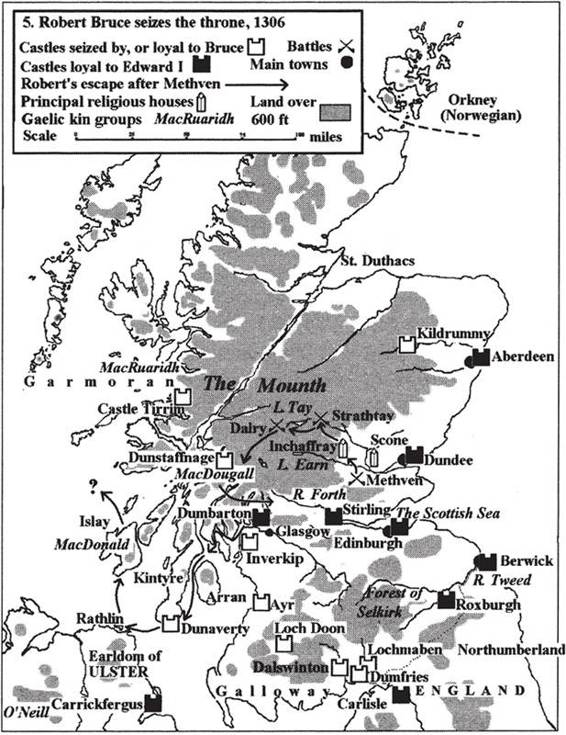
Robert Boyd, a prominent member of Bruce’s retinue, had taken Rothesay by trickery, and was besieging Inverkip. The writer describes Robert’s efforts to raise an army:
The earl of Carrick has made war in Galloway to cause the people to rebel with him, but they have answered in accord that they will never rebel against the king for any man living … Sir, the earl of Carrick has been at Glasgow and Rutherglen and in those districts, and has received the fealty of the people where he has come, and has charged them to be ready to go with him with rations for nine days when they receive a day and night’s notice … The evil bishop remains at Glasgow as his chief advisor, and the earl comes often, and they take … their counsel together, and they are mustering all the support that they can find from every quarter …
Bruce then was in open rebellion. It is no wonder that the people of the ‘otherwise-minded’ province of Galloway, ever hopeful of further autonomy from Scotland, refused Bruce their support. Nevertheless he had taken care to ensure that his castles were well provisioned. The distribution of the castles seized (along the Solway and Carrick shoreline) suggests an expectation of help from the Western Isles or Ireland; Bruce was falling back on the same plan that his grandfather had entertained both at the Turnberry Band and in his rebellion of 1286–87. While Edward and Neil Bruce stayed with Robert in 1306, there is no mention in narratives of the other brothers, Thomas and Alexander Bruce, who may already have been dispatched to the Western Isles to muster galloglasses. The Berwick correspondent also reports that Bruce intended to garrison and hold his own castles against the king’s forces, but that he would destroy other castles. From other sources we learn that the rebellion was spreading in the Bruce heartland of the south-west. Christopher Seton and his brothers held for him Tibbers and Loch Doon castles. The young Thomas Randolph – later to become Robert’s most trusted lieutenant and earl of Moray – adhered to Bruce, in spite of his father’s loyalty to the Balliols.
Bruce then left Lochmaben to consult with ‘the evil bishop’, Robert Wishart, at Glasgow. On the way there, at Arickstone, Barbour says that he met for the first time the young James Douglas, son and heir of Sir William Douglas le Hardi who had died in the Tower of London in 1298. Douglas threw in his lot with Bruce in the hope of recovering his patrimony, which Edward I had granted to Robert Clifford. According to Barbour they became firm friends instantly:
That’s how they made each other’s acquaintance
Men who never afterwards disagreed for any reason
As long as they lived
Their friendship increased more and more all the time
Because Douglas always served loyally
And Bruce who was worthy brave and wise
With a good will rewarded him well for his service.19
Bruce spent some time in conference with Bishop Wishart who absolved him of the sin of killing of Comyn and administered an oath that, as king, Bruce would abide by the direction of the clergy of Scotland. The oath was probably a traditional one, expected of any candidate for kingship, but the Scottish clergy was from this time onwards supportive of the Bruce monarchy. According to the Scalachronica of Thomas Gray, the bishop gave him ‘robes and the attire with which Bruce had himself vested and attired on the day’ and ‘a banner of the royal arms which he had long hidden in his treasury’. This is all borne out by subsequent charges against the bishop sent by Edward I to the pope. The bishop will also have advised on a suitable date for enthronement. If the revival of the kingship were to be credible, all traditional forms would have to be observed as far as possible. Enthronement in the penitential season of Lent would not do. Easter, with its connotations of resurrection and rebirth, would have been ideal, but nine days before Easter, on 25 March, came the feast of the Annunciation, which was not reckoned as Lent. Since time was of the essence, they settled for the earlier date. They dined, and then the bishop bade him ‘go to secure his heritage by all the means that he could’. Leaving Glasgow, Bruce advanced against John of Menteith, the sheriff and constable of Dumbarton. John refused to surrender the castle of Dumbarton to Bruce’s supporters, Alexander Lindsay and Walter Logan.
Bruce did not assault Dumbarton, but took his growing entourage across the River Forth, as the Berwick correspondent explained: ‘On the day that this letter was written John of Menteith informed me that the earl of Carrick had crossed the sea with 60 men-at-arms. And sir, if the people on the other side are trustworthy, which I do not misdoubt, he will have but a short stay with them.’ Although Walter Logan of Hartside had extensive Irish connections, the context of the letter shows that the crossing was of the River Forth, commonly referred to as ‘the Scottish Sea’, not the North Channel between Scotland and Ulster, yet it is likely that Bruce had sent others to the Western Isles or Ireland to raise support. The letter continues:
Sir, however you are given to understand of the earl of Carrick, he is nevertheless attempting to seize the realm of Scotland and to be king …
The king’s council ordered him to deliver up the king’s officers, and the king’s castles in his hands, and the towns which belonged to John Comyn, and should belong to the king on the death of John (on whom God have mercy), but to this, Sir, he has made no answer.
Sir, the chamberlain commanded him to do the same thing … and he replied that he would take castles, towns and people as fast as he could, until the king had notified his will concerning his demand, and, if he would not grant it to him, he would defend himself with the longest stick that he had.
Edward’s council of Scotland and chamberlain had therefore called on Bruce to desist and surrender, but Bruce had aggressively demanded something of the king and expected a response. His demand might have been for a comprehensive royal pardon or for Edward to bestow upon him the vassal kingship, but since neither was likely to be forthcoming, he was proceeding regardless with his seizure of the kingship. Apart from anything else, it was only as king, with a king’s power to raise armies, that Bruce could withstand the vengeance of the Comyns. The outraged Comyns and their allies – Sir John Mowbray, Ingram de Umfraville, the earls of Buchan and Atholl, Alexander Abernethy and others – were mustering their forces at Liddesdale and preparing to take vengeance on Bruce. Atholl was feigning, however, and subsequently joined Bruce.
Revival of the kingship was not proceeding quite as Bruce had planned, and he was improvising frantically. No doubt he had envisaged leading a united Scottish reaction to English occupation, but there is no disguising that the ‘community of the realm’ was divided, and that the greater part supported the more legitimate Balliol claim and preferred the Edwardian settlement to the usurpation of a murderer. However, Bruce’s support among the higher clergy probably reflects the Scottish Church’s historic insistence upon independence from the archiepiscopal authority of York. Bishop Wishart, who had recently been granted timber for the steeple of Glasgow Cathedral, used it instead to make siege engines to attack Kirkintilloch Castle. Bruce also enjoyed disproportionate support among the higher nobility, many of whom were already closely linked to the Bruce aristocratic faction. Everywhere but in Galloway Edward’s intrusion upon the rights and liberties of the kingdom, the humiliation of the Scottish king and the execution of William Wallace had been deeply resented. Bruce was borne to the throne upon that groundswell of emotion. As he advanced from Dumbarton on Scone his retinue will have been daily increased by fresh adherents of every class, delighted at the revival of the kingship, but whose commitment remained to be tested. In those heady spring days as Lent neared its end, it may have seemed that, along with monarchy, the very nation was being reborn. News spread, and expectant crowds gathered for a cherished spectacle they had despaired of ever again witnessing. All was not optimism, of course. In April, May and June lands and titles of the chief rebels were declared forfeit and parcelled out to followers of Edward. Annandale was granted to Humphery de Bohun, the Earl of Hereford; Robert’s earldom of Carrick to Henry Percy; the earldom of Lennox to John Menteith and that of Menteith to John Hastings.
The feast of the Annunciation fell upon a Friday. Walter of Guisborough, the most reliable of the chroniclers, records that four bishops and five earls were present at the ceremony. We know of three bishops at most. Robert Wishart and David Murray, Bishop of Moray, were there on the Friday, and, when he had heard the news of Comyn’s murder, Bishop William Lamberton, as chief of Edward’s council of Scotland, delayed and obfuscated the council’s reaction to the Bruce coup, then fled from Berwick across the Firth of Forth, arriving at Scone to celebrate mass for the new king on the Sunday following, Palm Sunday. He may even have been present earlier, at the enthronement, since he was later accused of showing Bruce ‘honour on the day of coronation’. The identity of the fourth bishop we do not know, but the abbots of both Scone and Inchaffray were both in attendance. We know of four earls present, besides Bruce himself: the young Donald, heir of Mar, who was Robert’s ward, Malcolm of Lennox, Alan of Menteith and John, Earl of Atholl, a recent adherent. It was a creditable turnout of the great and good, sufficient to be convincing. Crucially, however, the earl of Fife was absent, the heir being sixteen-year-old Duncan, soon to become the fourth earl, who was currently in the wardship of Edward I and therefore unavailable. The earl of Fife’s traditional role of leading the king-elect to the throne was central to proceedings. But for the enthronement of John Balliol in 1292, when the earl was a child, a substitute had had to be found, and on this occasion too a substitute became available. This was Isabella of Fife, the young heir’s aunt, who was also countess of Buchan, being married to John Comyn, Earl of Buchan. Atholl had escorted her to Scone from her house, emptying the stables of Buchan’s horses as he did so, to thwart pursuit. Isabella is reported in English chronicles as Robert’s mistress. However this may be, she must have had strong motivation for such flagrant defiance of her husband.
On the appointed day, Lady Day, all the essential ceremonies were observed. The new king was acclaimed by clergy, nobles and people in the abbey church, and then led out to the churchyard where the time-honoured ceremony took place under the gaze of a crowd of onlookers. The clergy girded Robert with a sword, administered the oath and placed a robe on his shoulders. Much of the regalia were missing, having been looted by Edward I. The rose-sceptre and the Stone of Destiny now lay at St Edward’s shrine in Westminster Abbey; Professor Duncan observes of this ceremony, ‘The place, Scone, and the inaugurator, a representative of the earl of Fife, were important, but the Stone was quietly forgotten.’ The high point of proceedings was when Isabella of Fife led Robert Bruce to whatever throne or ornamental chair was provided. To underline the significance of the moment, she then placed a coronet on his head, though this was not recognised as part of the ancient rite.20 A Highland poet or seanachaidh read aloud the new king’s genealogy reaching back to Kenneth MacAlpin, and beyond to Fergus son of Erc, the mythical ancestral ruler of Dal Riata, the ancient Irish kingdom and homeland of the Scots. The day ended with a feast.
On the Sunday following, high mass was said by Bishop Lamberton, and this was followed by the taking of homages and fealties. Among those who adhered to the new king, adding significantly to his legitimacy, was Alexander Scrymgeour, the King of Scots’ hereditary royal standard-bearer, who had served all the guardians in turn. Furthermore, Scrymgeour bore the very banner of Alexander III. The significance of regalia and ceremony was allegedly wasted upon Robert’s wife, Elisabeth de Burgh, who reportedly berated her husband for ‘playing at kings and queens’. Whatever her views were, from this point in the narrative onwards it behoves us to refer to Robert Bruce as Robert I of Scotland.
Enthronement was necessary pageantry. It was vital that Robert Bruce should undergo the sacramental change from mere mortal to Robert I, King of Scots and representative of divine order in the world. But it did not alter the harsh facts that the new king had perhaps only a quarter of Scotland under his sway, and that powerful enemies were bearing down on him. Preparations for a campaign had been set in train by the English government on 1 March. In England too a pageant was held, in May 1306. Following the knighting of Edward of Caernarfon, the prince of Wales, all the newly made knights were invited to a ‘feast of the Swans’, where they each pledged an oath of chivalric symbolism, ‘to the Swan’, to avenge the death of John Comyn; then they set off to join the campaign. In the streets, meanwhile, popular satirists jeered at Bruce’s makeshift ceremony. They scoffed at ‘King Hobbe’ or ‘Mad King Robin’ and they gleefully predicted that the new king’s reign would not last for long: ‘I think you may be King of Summer,/King of Winter you will not be.’
For the new King of Scots the period after the enthronement was one of frantic activity to strengthen his power-base by capturing castles, making friends and promises – ‘friends and friendship purchasing’ as Barbour puts it – and twisting arms. He travelled north, where David Murray, Bishop of Moray, was rousing the people to a patriotic crusade. Edward I subsequently complained to the pope that ‘The flock of the Bishop of Moray, who assembled to the help of the said Robert, and still hold themselves with him, have done this owing to the incitement, preaching and exhorting of the said bishop, because he told them that they who rebelled with Sir Robert to help him against the king of England and took the part of the said Sir Robert, were not less deserving of merit than if they should fight in the Holy Land against pagans and Saracens.’ Robert captured and destroyed Forfar Castle on his way north. He visited Banff, and extorted cash from the merchant communities of Aberdeen, Dundee and Perth by taking hostages. At Aberdeen, Bruce spent a week or so, establishing his queen and his daughter Marjorie in the care of a band of faithful knights: his brother Neil, Alexander Lindsay and Robert Boyd. At Perth, the bailiffs were thrown in prison and threatened with death until they paid £54, which Robert then took as rents that were due to him as king. He may have attacked and damaged the fortifications of all three towns, for Edward I had them all repaired the following year. When Malise, Earl of Strathearn, refused to provide military support for the new king, Robert, accompanied by Atholl, advanced against him. He marched to Fowlis, one of Strathearn’s castles, and held two meetings with Strathearn to demand his support; gave him a few days to think it over; then in exasperation had him seized and held on the Isle of Inchmahome, where at last the earl submitted. Strathearn had good reason to be cagey: not only was he not a natural ally, being married to a Comyn, but Edward I held hostage his only remaining son.
The ‘Anglo-Scots’ ‘21 reaction to the Bruce coup was initially swift, but then months were wasted waiting for the English to arrive in strength. The letter from the Berwick correspondent shows that, though taken utterly by surprise, the Anglo-Scots were nevertheless in a strong position. All the main castles of Lothian and the east were provisioned, the Peel of Selkirk was in safe hands, and already a hundred Northumberland foot were on their way to Berwick. As early as 22 February – a mere twelve days after the murder of John Comyn – Tibbers castle had been recaptured; on 3 March Dumfries fell to forces hostile to Bruce. These actions were probably taken by garrisons already in Scotland; it was summer before the English entered Scotland in strength. On 5 April Edward appointed Aymer de Valence, the brother-in-law of the murdered Comyn, as his lieutenant in Scotland. Henry Percy and Robert Clifford, leading a force of 100 cavalry, closed in on the Bruce heartland of south-west Scotland. Robert, having taken more castles than he could garrison, left the castle at Ayr slighted and abandoned. At last, in June, Aymer de Valence advanced from Berwick towards Perth and Dundee with 300 cavalry and a large force of infantry; Barbour tells us he was accompanied by the Scottish magnates Philip Mowbray and Ingram de Umfraville. At Cupar in Fife, Valence arrested the elderly and defiant Bishop Wishart; at Scotlandwell near Kinross, Lamberton also surrendered, though he first dispatched his ward Andrew, son and heir of James the Steward, into Robert’s care. Valence then occupied Perth.
Buoyed up by the widespread support at his enthronement, Robert knew that if he could confront and defeat Valence there was every chance that vindication of his right on the battlefield would cause support for his kingship to snowball further. Strathearn had proven unreliable in providing levies, but Robert had nevertheless managed to gather a considerable army and besieged Strathearn in his manor house at Kenmore in Perthshire. Robert laid waste his estates and had him arrested for a time. Strathearn – whose sons were hostages with the English king – played for time and only just managed to avoid commiting himself until Robert was at last distracted by the advance of Aymer de Valence on Perth.22 With Robert were the earls of Lennox and Atholl, his brother Edward Bruce, Thomas Randolph, Hugh Hay, Sir David Barclay and Sir Simon Fraser, once again in revolt. It was scarcely a sign of confidence, however, that many of Robert’s knights wore white shirts over their surcoats, masking their heraldic devices so that, in the event of defeat, they would not be identified and suffer loss of lands or a traitor’s death.
On 26 June Robert challenged Valence to come out of the town and fight in the open, but Valence declined, responding that he preferred to wait until the morrow. Robert’s men broke up to make camp at Methven and forage for firewood, but, just then, in the twilight, Valence attacked with devastating effect. A cavalry charge put to flight the infantry and surprised Robert’s knights. The chronicles report that Robert was almost captured. Barbour describes how Philip Mowbray seized the reins of Robert’s horse and cried, ‘Help! Help! I have the new-made king!’ Christopher Seton, however, attacked Mowbray, causing the bridle to slip from his hand.23 Barbour puts as brave a face as he can on the defeat, but Robert’s forces were clearly routed, and they were pursued from the field by knights of Valence’s company. Malcolm, Earl of Lennox, slipped away quietly to his estates. Thomas Randolph was one of those captured, and he was fortunate to have his life spared. But sixteen prisoners were tried and executed at Newcastle in August, and a further eleven were taken to York. Simon Fraser, whom Edward I hated deeply, was also captured and, like Wallace, taken to London where he suffered a gruesome execution for the gratification of the mob.
Pursuit was hot, for there were great rewards in ransoms and royal favour to be had for those who captured significant personages. Robert and the remnants of his cavalry fled west-wards along Strathearn, into the territory of St Fillan, whose relics were reverently maintained by the Abbey of Inchaffray, a recipient of the king’s generosity in later years. During his flight Robert perhaps considered himself protected by the saint or may have been sheltered by the abbot. He was still accompanied by Edward Bruce, the Northumberland knight Walter Burradon, Gilbert Hay, Neil Campbell and a few others, and with them he crossed over the mountains into Strathtay. There, however, the pursuers, led by the Gascon knight Giles d’Argentan, caught up with them. The Bruce party suffered a further defeat, but they must have acquitted themselves well, since they caused horses to be lost by the pursuers. Great was the delight of English songsters at Robert’s discomforture: ‘Now King Hobbe to the moors has gone/To come to town he has no desire.’
Certainly there was nothing left to Robert now but further flight into the wilderness. It is impossible to imagine that he could avoid despair on taking to the heather after Methven and Strathtay. He had gambled, and lost heavily. Whether he cursed his ambition for bringing ruin on his family and friends, he surely regretted deeply whatever had transpired in the church at Dumfries, for it had set in motion a chain of events that could now – it seemed – only end in death and disgrace. Working from the benefit of hindsight, commentators have tended to exaggerate such faint glimmers of hope as remained to him. Recovery from this desperate position was by no means inevitable, however; it was, rather, miraculous.