
5
Defeat and exile
In the dark moment that followed his defeats at Methven and Strathtay, Robert Bruce must have drawn upon wells of self-belief, fortitude and confidence that few possess. For about a fortnight he and his men kept to the high glens and hillsides. Fortunately it was summer, and one pictures the erstwhile grandees sheltering in the ‘sheilings’, or temporary dwellings of herdsmen in the high pastures, binding wounds and struggling to find grazing sufficient for the horses. The Scottish chronicles describe the outlaw life of Robert’s band of loyal followers in the Mounth. For this episode, the nadir of the hero-king’s career, Fordun sets the desolation of his hopes and the ruin of his fortunes against the indifferent sea and sky:
the aforesaid king was cut off from his men and underwent endless woes, and was tossed in dangers untold, being attended at times by three followers, at times by two; and more often he was left utterly alone without help. Now passing a whole fortnight without food of any kind to live upon but raw herbs and water; now walking barefoot, when his shoes became old and worn out; now left alone in the islands; now alone fleeing before his enemies; now slighted by his servants, he abode in utter loneliness.
The solitude described here is, however, a literary device demonstrating despair. In Barbour’s The Bruce the king does not want for company, but lives nonetheless a miserable existence:
They spent many days as outlaws
Suffering hardship in the Mounth
Eating flesh and drinking water …
Thus in the hills lived he
Till the most part of his menie [retinue]
Was tattered and torn. They had no shoes
Save those they could make of hide.
The new king’s tribulations were only just beginning. The MacDougalls were advancing on him from the west. In the Gaidhealtachd, news of the murder of John Comyn and the inauguration of a Bruce king had had profound repercussions. Until this time Alexander MacDougall had been in continual revolt against the authority of Edward I’s chief lieutenant in the area, Angus Óg MacDonald. In accordance with the general surrender of 1304, the MacDougalls had entered the peace of Edward I. But such was the strength of the bond between the Comyns, Balliols and MacDougalls, and such the fear of a Bruce kingship, that the news of Comyn’s death and Bruce’s enthronement swept the MacDougalls into the camp of Edward I to avenge the murder and terminate the Bruce coup. The MacDonalds, by the same token, suddenly found their firm allies, the Bruces, to be anathema to Edward’s government, and their inveterate foes, the MacDougalls, on Edward’s side. Thus a complete about-turn in the politics of the region had occurred: the former rebel MacDougalls now siding with Edward I, and Edward’s erstwhile agents in the region, the MacDonalds, siding with the Bruces against him.
At this juncture there comes to prominence John of Argyll, or John Bachach – ‘the Lame’ – MacDougall, who was to remain a thorn in Robert’s side for many years. Known to Barbour as ‘John of Lorn’, this was the son of Alexander MacDougall of Argyll and a daughter of John Comyn of Badenoch I24 and therefore he was a full cousin of that John Comyn whom Bruce had murdered. Though his father was still active, John took over the leadership of the powerful MacDougall affinity. Such was the bitterness which John harboured against the Bruces that Barbour was moved to write:
This John of Lorn hated the king
For the sake of his uncle Sir John Comyn.
Were he able to slay or capture him,
He would not value his life at a straw,
Provided that he could take vengeance on him.
Accordingly John sought out the remnants of Robert’s forces where they skulked in the mountains following their defeat. In July, near the head of Strathtay at Dalry, he found them. In Barbour’s account Robert’s party was attacked but saw off a thousand axe-wielding Argyllsmen, who nevertheless slew and injured many of his horses. Barbour makes a rare admission that Robert withdrew from the battlefield, and he also discloses that James Douglas and Gilbert Hay were wounded. Probably Barbour has turned defeat into victory; John of Argyll seems to have been victorious yet unable to destroy the Bruce force entirely. Here, in later life, Robert I established a priory of Strathfillan, at Glendochart, as though in gratitude for a great mercy at this place.
Now thrice defeated, Robert dispatched John, Earl of Atholl, with all the party’s horses, to join the queen at Kildrummy Castle. This relieved him of the difficulty of finding grazing for the warhorses. Atholl had instructions to take the ladies of the Bruce party from Kildrummy to a seaport in order that they might escape to Norwegian territory in the Orkney Islands, or to Norway itself. In Norway, Isabel, Robert’s sister, lived as widowed queen, and there his dependants would find asylum. However, Neil Bruce remained at Kildrummy after the ladies had departed, and there he prepared to resist a siege, a decision that suggests tremendous but misplaced faith in his eldest brother. According to the Barbour narrative the royal ladies were accompanied by the young James Douglas. The Bruce includes vignettes of Douglas finding food for the ladies, bringing them now venison, now eels, now salmon and trout caught by hand. But Aymer de Valence, enormously strengthened by the arrival in Scotland of a large expedition under Edward of Caernarfon, was closing in on the Bruces. By 3 August he was at Aberdeen. Soon afterwards the English besieged Kildrummy. The castle fell to them in September, betrayed by one of the garrison, who set fire to the stocks of grain. Neil Bruce was delivered into the hands of the prince of Wales as a prisoner. Atholl, Queen Elisabeth and Robert’s daughter Marjorie were captured at St Duthus or Duthac’s sanctuary near Tain by William, Earl of Ross. In early September Duncan, the boy earl of Mar, was taken either at Kildrummy or at Tain. Violation of sanctuary was a serious taboo, and, although Ross later defected to the Bruces, King Robert subsequently bound the earls of Ross to pay £20 annually for six chaplains at St Duthaus’s sanctuary at Tain to say masses for the souls of earlier kings and for that of John, Earl of Atholl.
Aged, and embittered at the sudden renewal of resistance in Scotland, Edward I exacted a terrible vengeance on Robert’s adherents. On account of his rank Atholl was taken to London for a show trial, and then, for that same reason, hanged from a gallows thirty feet higher than anyone else, cut down, beheaded and burned. The English knight Christopher Seton, Robert’s brother-in-law and his castellan at Loch Doon, suffered hanging in Dumfries. Seton’s wife, Christina Bruce, later founded a chapel for him at Dumfries, and Robert provided an income to pay for masses for his soul. Christopher’s two brothers were also executed. Mention has already been made of the sixteen prominent supporters of Bruce hanged at Newcastle in August. When they surrendered on or around 10 September the garrison of Kildrummy Castle was also hanged; and in October Neil Bruce was tried before Edward of Caernarfon, drawn by horses through the streets of Berwick, then hanged and beheaded, along with Sir Alan Durward and several others. Edward I’s treatment of the female prisoners was more discriminating, which may suggest that some of the Scottish ladies showed a spirited defiance of the English king, while others did not. The punishment meted out to Mary Bruce and Isabel of Fife, the countess of Buchan, was most inhumane, even by the harsh standards of the time. To make an example of them they were confined, each in a separate cage open to public gaze, one at Roxburgh, the other at Berwick. The cage of the countess was constructed in the shape of a crown, recalling her role in Robert’s enthronement, and is described as ‘a little wooden chamber in a tower of the castle of Berwick with latticed sides, so that all might look in from curiosity’. Each cage was to be equipped with a privy, and the ladies were to be attended by Englishwomen. At first the twelve-year-old Marjorie, Robert’s daughter, was sentenced to be similarly imprisoned, but Edward relented and she and Christina were entrusted to the custody of Henry Percy. The countess was not released from her cage until June 1310, when she was sent to a convent in Berwick; we do not know how long Mary Bruce had to endure this degrading punishment. This spiteful treatment of the ladies of the Bruce court is indicative of the depth of Edward’s rage at those who ruined his settlement of Scotland. Robert’s de Burgh queen, who may perhaps have disapproved of his coup and then sought leniency from Edward on this account, received the lightest punishment. She was detained at the royal manor of Burstwick in Lincolnshire, and given two elderly companions whose demeanour was to be ‘not at all gay’ – sometimes taken to mean that they were not allowed to smile.
Yet Edward I was a complex character, and even in the midst of all this cruelty and bloodletting he found reasons for clemency towards some. Three knights, Alexander Seton, Robert Boyd and Alexander Lindsay, were apparently released. Young Thomas Randolph, who had also been captured, was released and he reverted to the peace of the English king. The boy Donald, heir of Mar, was retained and brought up at the court of Edward of Caernarfon, to whom he became so attached that he refused to leave in 1315 when prisoners were exchanged.
Mercifully ignorant of the bloodletting that was to befall his followers, Robert and his ragged company, which Barbour puts realistically at 200, proceeded on foot across the Mounth late that August. Options were closing all around him. The enmity of the MacDougalls seems to have deterred him from approaching the western coast. Over eighty miles of hostile territory lay between the fugitives and the Forest of Selkirk, the established locale for outlaws and dissidents. Bruce family territories of the south-west were now subdued and enemy garrisons were installed in them. Remaining options cannot have seemed attractive. Some of his supporters, such as David, Bishop of Moray, had made it to safety in Orkney. There was always Ireland, where local kings could defy the will of the English king with impunity, though Robert had perhaps already appealed to his father-in-law, the Red Earl of Ulster, and been spurned. Only in the highlands and islands of western Scotland could he expect shelter, but he had to keep on the move. Barbour suggests plausibly that Robert’s immediate goal was Kintyre; from there he would be able to flee to any of these further destinations.
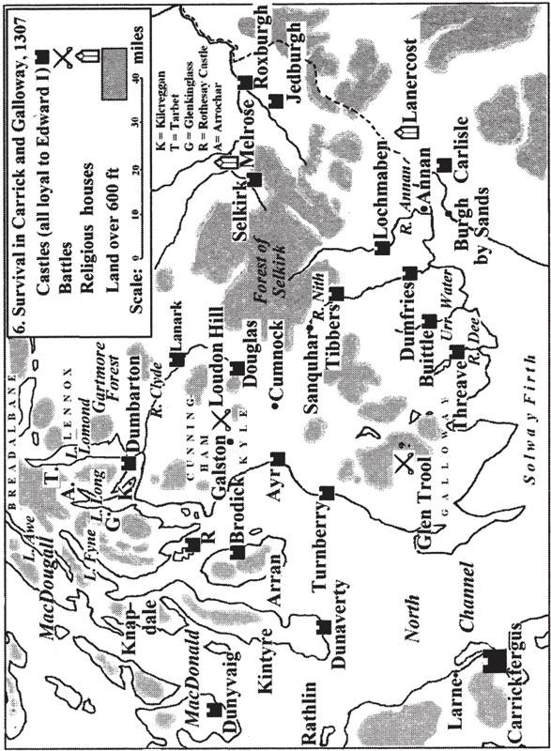
The Barbour narrative is vague at this point. He describes how Neil Campbell departed to collect ships, while the king set off for Loch Lomond, reached it on the third day, spent a day and a night getting his men across the loch in the only boat available, and thence into Lennox. Duncan, however, has reconstructed a more probable itinerary. Robert must have led his men by foot through Breadalbane and then south to the coast at Loch Fyne – at which point Neil Campbell left the main band to gather boats – and thence to Glenkinglass, Arrochar and Tarbet, where Loch Lomond was crossed in an easterly direction, and so on to Lennox.25 Barbour’s account of the day and night spent crossing Loch Lomond, and hunting venison in the earl of Lennox’s forests in the vicinity of Gartmore fits more easily into this sequence. Hearing the king’s hunting horn, Malcolm, Earl of Lennox rode to meet Robert and greeted him joyfully, for he had believed that Robert had died on the field at Methven. Lennox provided a feast for the hungry fugitives. After this Neil Campbell rejoined the main party, Duncan suggests, in the vicinity of Kilcreggan on Loch Long. Campbell had provided ships with sails and oars and they all set off down the Clyde Estuary for Bute en route to the open sea. Malcolm, however,delayed and was last to set out. His ship was hotly pursued by enemy vessels, perhaps from Dumbarton, where John of Menteith, to whom Edward I had recently awarded Malcolm’s title and earldom, was in command. Barbour relates how, to slow down the enemy, Malcolm cast overboard various pieces of harness and gear, which the enemy took time to take on board, and in this way the earl escaped to rejoin the fugitive king.
From Bute, Robert and his men sailed to Kintyre, where they were warmly received, probably not by Angus Óg MacDonald of Islay as Barbour has it, but by Malcolm MacQuillan, the lord of Kintyre and owner of Dunaverty.26 It is evident from the Berwick correspondent that in February MacQuillan had placed Dunaverty at Robert’s disposal for the coup. Perched on a rocky headland at the tip of the Kintyre peninsula, Dunaverty must have ideally suited Robert’s needs. Barbour claims that it was Robert’s intention to winter in Dunaverty, yet at this point in the narrative Robert feared treachery:
Nonetheless in many ways
He dreaded treason
And therefore, as I heard men say
He trusted completely in no-one
Until he knew him truly.
This is hardly surprising, since Robert had potentially such a price on his head. Barbour states that Robert stayed in Dunaverty only three days on account of his fear, but the real cause of his abrupt departure appears to have been the arrival in Kintyre of a substantial force to attack the fugitive king in his lair. Early in September the English lord John Botetourt, accompanied by John of Menteith, arrived to besiege Dunaverty. Clearly they understood that Robert was within the walls, and they transported two siege engines from Carlisle to smash their way in. At the end of September the castle fell, but to their dismay the besiegers’ quarry had already fled.
Around 20 September the Bruce party embarked. Barbour describes an unhurried departure from Dunaverty in several ships borne by a strong but favourable wind, bearing Robert and his followers to Rathlin Island off the coast of Antrim. He was accompanied by his brother Edward, Malcolm of Lennox and Neil Campbell, who were with him in Kintyre; Malcolm MacQuillan, Lord of Dunaverty, was probably also of the party. Barbour’s description of the crossing, which owes much to Virgil, is memorable:
They raised sail and set forth,
Soon passing by the Mull
And entered soon into the race
Where the current was so strong
That strong waves, which were breakers,
Rose like hills here and there.
The ships glided over the waves,
For they had a wind blowing fair.
Nonetheless, anyone who had been there
Would have seen a great shifting
Of ships. For sometimes some would be
Atop the waves, as if on a hill-top
And some would slide from top to bottom,
As if bound for hell,
Then rise up suddenly on the wave,
And other ships nearby sank into the trough.
This voyage of Robert Bruce to Rathlin, like that of Bonnie Prince Charlie ‘over the sea to Skye’, is often invested with a special, almost mystic, significance. In both instances the fate of the Scottish nation personified in royalty is entrusted to the waves: nature intervening to save the embodiment of Scotland from the clutches of the enemy. However, Robert himself would have seen the voyage as no significant departure. The whole western coast from the Hebrides to Ulster and further west was a cultural unity, linked by seasonal travel along shipping lanes and easily traversed. Rathlin he may have considered a Scottish island, rather than part of Ireland.
Far from fleeing his homeland, Robert was taking to a highway that for generations had borne MacDonald, MacDougall, MacRuaridh and MacSween galloglasses, not just between Erin and Alba, but to all the far-flung islands of the Gaidhealtachd. Undoubtedly Robert was now intent upon recruiting such mercenaries from two principal sources. The first source was Angus Óg MacDonald, based at Dunyvaig on Islay; the second the ‘Lady of Garmoran’, Christina MacRuaridh, or as she is known ‘Christina of the Isles’, doubly related to the Bruces through the family of Mar. Her late husband, Duncan of Mar, had been both Robert’s brother-in-law by reason of his first marriage to Isabel of Mar, and also his brother-in-law by reason of his sister’s marriage to Garnait, Earl of Mar. To persuade these Gaelic magnates that it was in their interest to support him, to weld together their scant resources by skilful diplomacy and conjure armies will have taken a supreme effort. Unfortunately we know very little about how this remarkable achievement was accomplished, and these autumn and winter months of 1306–07 are crucial missing pieces from the jigsaw of Robert’s life.
It is hard to believe that Rathlin was Robert’s intended destination; either the Irish mainland or Islay would have been more attractive. Barbour, who specifies Rathlin, records that the people of the island fled with their cattle to a ‘right stalwart castle’ and that Robert negotiated with them. No such castle existed on Rathlin, and Barbour might be describing action on any of larger Western Isles. The men of the island did homage and fealty, and while Robert stayed they undertook to send him every day provisions for 300 men. The size of Robert’s requirement increases the probability that the ‘Rathlin’ scene belongs to an arrival on a much larger island, more able to sustain the Bruce court, or that it may have been repeated on various landings on others of the Western Isles.
During the autumn and winter, Robert and his envoys journeyed to and fro among the Western Isles, calling in debts, twisting arms and promising the world in return for military service and ship service. Against all the odds, a letter of King Robert which seems to belong to this period has survived. It is addressed ‘to all the kings of Ireland, to the prelates and clergy and the inhabitants of Ireland’, and is a letter of credence, borne by Robert’s envoys to Irish Gaelic kings. It appeals to the supposed common racial origin of the Irish and Scots:
Whereas we and you, and our people and your people, free since ancient times, share the same national ancestry and are urged to come together more eagerly and joyfully in friendship by a common language and by common custom, we have sent over to you our beloved kinsmen, the bearers of this letter to negotiate with you in our name about permanently strengthening and maintaining inviolate the special friendship between us and you, so that with God’s will our nation may recover her ancient liberty. Whatever our envoys or one of them may on our behalf conclude with you in this matter, we shall ratify and uphold in the future.
Our nation may recover its ancient liberty? To modern ears it sounds as though Robert conceived of a single Gaelic nation, and that he offered an alliance of Gaelic peoples against the dominance of England. Such sentiments are not uncommon in Gaelic poetry of the period, but only rarely were they expressed politically. It is best not to take this sort of language at face value. The letter demonstrates only that the Bruces knew how to introduce themselves to a Gaelic audience; it does not mean that they were prepared to lead the Gaelic world into conflict with the Anglo–Norman. The flowery appeal to common language and custom would cut ice only if accompanied by the threat of force, or by silver, and lots of it. The Bruces consistently pedalled this ‘pan-Celtic’ verbiage in their dealings with Ireland – and Wales – when it suited them, and the Irish and Welsh understood it for the posturing it was. Probably the king’s brothers Thomas and Alexander were the plenipotentiary envoys empowered by this document.27 Indeed, conspicuously absent from events in Scotland, they may have been whipping up support in the Gaidhealtachd since February 1306. Later in 1306 they are described as ‘leading a piratical existence’, which may suggest that they moved among the Western Isles gathering a force of ships.
During the winter of 1306–07 Robert pieced together his coalition. Traditional loyalties to the Bruces were no doubt cited and played upon to maximum effect. Christina MacRuaridh duly acknowledged Robert as king, and placed at his disposal the lordship of Garmoran, a sprawling collection of lands and islands that stretched from the Outer Hebrides to the shores of Loch Linnhe. She was also rumoured to be Robert’s lover during these months. Then, at Martinmas, Robert sent ‘many Irishmen and Scots’ across to his earldom of Carrick to collect the rents then due, and this would have given him cash with which to bribe those West Highland chiefs and Irish kings who could not be otherwise be persuaded to support him.
As Robert and his brothers laboured to raise an army of galloglasses, the king of England was not unaware of their activities. Hugh Bisset, the lord of Rathlin and a vassal of the Red Earl, commanded a squadron in the North Channel. In January he was ordered to equip his ships and join John of Menteith among the isles off the coast of Scotland, cutting off Robert Bruce’s retreat. Edward I added that he ‘held this business greatly at heart’. Four lords were paid for expenses in inquiring as to the whereabouts of ‘enemies, rebels and felons of Scotland, who had come to Ireland and been received, with religious persons and others, within the liberty of Ulster, and in seizing those enemies and their harbourers and conveying them to the castle of Dublin.’ This reference to ‘religious persons’ could include Alexander Bruce. Simon Montacute, a Somerset baron who had designs on the Isle of Man, was put in command against rebels ‘lurking in Scotland and the isles between Scotland and Ireland’. The Red Earl of Ulster, like his daughter, Robert’s queen, clearly wanted nothing to do with Robert’s ambitions and made no difficulties for royal agents involved in the pursuit. The sheriff of Cumberland was ordered to commandeer vessels and sent them to Ayr, which became a naval base for Montacute, Bisset and another commander, William le Jettour, all of whom were engaged in the hunt for Bruce. By February they had at their disposal 15 vessels and 200 sailors, and they patrolled the waters around Arran and Bute. Also at Ayr was the victor of Methven, Aymer de Valence, with significant land forces. Evidently the Bruces were expected to attempt a landing on the Scottish mainland. Edward’s correspondence betrays deep anxiety for news about the whereabouts of the Bruces and the progress of the hunt. Occasionally he received reports from spies. Montacute was one of those paid for information about Scots received in Ulster. Robert’s agents had been busy seeking military support from the Red Earl’s restless Gaelic vassals, and that Edward’s spies were monitoring their activities. On 6 February 1307 Edward considered that Aymer de Valence had been too cautious, and he instructed his treasurer, Walter Langton, to write to Valence and the others at Ayr, telling them that the king understood from elsewhere that they had made such a hash of the pursuit that they dared not tell him. Five days later he wrote directly to Valence in the same terms. Edward had heard nothing of the sort, but, lying in his sickbed in Lanercost Priory, he was consumed by anxiety for news, anxiety which probably hastened his demise.
The Bruces could not wait for Edward’s death, however, for the good weather would allow Montacute’s squadrons to penetrate even to the outer isles. They prepared to land on the Scottish mainland in two stages. Towards the end of January 1307, Robert arrived in Kintyre, and remained thereabouts for a month or so, evading Montacute’s patrols. At around the same time James Douglas and Robert Boyd – neither of whom had accompanied the king on his voyages – mounted an attack on Brodick castle on the Isle of Arran from the mainland. They failed to capture it, but managed to link up with Robert nevertheless. Then on 9 February 1307 a second force, of eighteen galleys, led by Thomas and Alexander Bruce, made a landing in Galloway. This force included Sir Reginald Crawford, a former sheriff of Ayr; Malcolm MacQuillan; and ‘a certain Irish kinglet’, and the landing was interpreted as a revenge attack on the people of Galloway for their failure to support Robert’s kingship. Dungal MacDowall attacked it upon landing, and onlytwo galleys escaped. The following payment, made in the wardrobe of the prince of Wales on 19 February, explains the fate of the leaders: ‘To Dungal MacDowall, captain of the army of Galloway, coming to the court of the Prince at Wetheral and leading in his company Sir Thomas Bruce and Alexander his brother and Sir Reginald Crawford, traitors of the king, having captured them in battle, together with the heads of certain other traitors of Ireland and Kintyre, cut off by the said Dungal and his army … 1 mark.’ From this it appears that Malcolm MacQuillan and the Irish chieftain had been killed in battle by the Gallovidians. Alexander ought to have been spared on account of his status as dean of Glasgow; nevertheless all three prisoners were taken to Carlisle for execution. Thomas was drawn at the tails of horses through the streets, hanged and beheaded on 17 February; the other two were hanged and beheaded. For his good service MacDowall received a further £40 and was knighted at Easter, but he earned the lasting enmity of the remaining Bruce brothers.
Robert, lurking on Arran or elsewhere in the Clyde Estuary, sent a spy by the name of Cuthbert to Carrick, who found that, through fear of the English, the men of the earldom could no longer be relied upon. Cuthbert decided therefore against setting alight a beacon, the signal for Robert to cross; nevertheless a fire was lit which Robert and his men mistook for the signal, and they crossed into Carrick around 10 February. The earldom had been subdued the previous summer, and it was occupied by enemy troops, both in castle garrisons and billeted in villages. It comes across quite strongly from Barbour that, far from welcoming home their exiled earl, the people of Carrick displayed little residual loyalty to the Bruces and an abiding fear of the English:
Both high and low the land was then
Occupied by Englishmen
Who scorned above all else
Robert Bruce the doughty king.
Carrick was then given entirely
To Sir Henry the lord Percy
Who in Turnberry castle then
Was with almost three hundred men
And he so dominated all the land
So that everyone was obedient to him.
This Cuthbert saw their wickedness
And saw the folk wholeheartedly
Become so wholly English, both rich and poor
That to none dared he disclose himself.
A little further on in the narrative Barbour returns to this theme:
When the king and his folk were
Arrived, as I told you earlier
He stayed a while in Carrick
To see who would be friend and who foe.
But he found little support
And, although the people sided with him in part,
Englishmen so harshly
Governed them with threats and power
That they did not dare show him any friendship.
Robert’s own earldom was utterly hostile to him. The common people, whatever their true sympathies, had no confidence that he would triumph in the long run, and therefore no guarantee of protection from the vengeance of the English.
Edward I, at Carlisle, was as well informed about Robert’s landing as he had been about that of Thomas and Alexander. Fifteen knights and some forty other cavalry were immediately dispatched against Robert, led by John Botetourt, and four hundred and sixty foot-soldiers were sent to reinforce Aymer de Valence. Henry Percy, to whom Robert’s earldom of Carrick had been granted, also mobilised to capture him. Robert seems to have not only successfully evaded these forces, but after a time to have inflicted humiliation on Percy. His band surprised Percy’s baggage train, and captured horses and silver plate. Percy scuttled into the safety of Turnberry Castle, and did not stir until a force of Northumberland infantry arrived to enable his evacuation. The English and their allies searched for Robert for the remainder of the spring.
Unable to rely on his former tenants and confronted with an enemy superior numerically and with every other conceivable advantage, Robert remained in the hills and moors. Moorland, marshland and hill country, impenetrable to heavy cavalry, became his ‘favourable territory’, where he was safe, and the enemy ill at ease. He relied on ambush and surprise to make the best use of his small force. Choosing his ground carefully, he would suddenly emerge to win a minor skirmish and then retreat once more into the wilderness. He preferred small engagements, thus minimising his losses and capitalising upon the snowball effect of a series of small victories. He never engaged the enemy unless sure of victory. He terrorised unsympathetic villages and local communities, forcing them to pay large fines, to provide supplies or military service. Thus he created a local ‘climate of insecurity’, where lords could not guarantee protection to their vassals, and where the writ of the king of the England could not run. Immensely negative and destructive in the short term, these tactics eventually permitted Robert to broaden the basis of his own lordship, to create, in effect, ‘liberated areas’.
This is all instantly recognisable to the modern mind as guerrilla warfare, ‘the war of the flea’, where all strategy is tossed to the wind in favour of tactical advantage. Faced with a stark choice between ignominious survival and a traitor’s death and the end of his dynasty, Robert stooped to modes of combat that were plainly beneath his royal and lordly dignity. Having lost three brothers, a wife and child and many loyal friends to this brutalising war with Edward I, he was perhaps driven to the conclusion that victory could not be won through chivalric feats of arms; but that victory, however squalid, must be won at all costs. Guerrilla warfare did not come easily to haughty feudal lords to whom honour and chivalry were everything, who considered themselves born to lead the cavalry charge with heraldic banners flying proudly, and whose very breeding revolted at ‘churlish’ modes of combat. In medieval Christendom the conduct of knights was often barbaric – especially when fighting non-Christians or social inferiors – yet it was uncommon for knights fighting their peers to adopt systematically tactics of ambush, surprise and terrorism to offset numerical disadvantage. Later Robert received a dressing down for his ‘unchivalrous’ methods from his nephew, Thomas Randolph, who, after he had rejoined the king, criticised him thus:
You rebuke me,
But rather you should be rebuked.
For since you made war on the king of England,
You should strive to prove your right by open fighting,
And not by cowardice or cunning.
For that insolence Randoph was held in confinement, but the criticisms he reportedly voiced may have been widely shared.
Following his raid on Percy’s baggage train, Robert’s next successful action was indeed the stuff of guerrilla warfare: a ruthless massacre. Barbour describes how, in a village near Turnberry, Bruce and his men descended upon English troops billeted therein, and dispatched many of them in their sleep.28 Even Barbour seems a little shame-faced about the episode, and he puts these unconvincing words of justification into Robert’s mouth:
And even if we killed them all when sleeping,
No man could reproach us for it
For a warrior should not bother
Whether he can overcome his enemy by might or guile,
So long as good faith is always maintained.
At night the screams of the surprised troopers were heard by Percy’s garrison inside Turnberry Castle, but none dared venture out. Only when a force of Northumberland infantry arrived did Percy leave the safety of the castle. Robert did not however take possession of it, which would have offered the enemy a target, but slighted the castle to ensure that it could afford the enemy no further protection. For the present he preferred to remain on the run. Destruction of castles became another central plank in Robert’s strategy. He systematically destroyed fortifications to rob lords of the security that these afforded. In doing so, he forced them to commit to his cause.
After this Robert’s guerrilla band received some adherence from the local gentry. Barbour describes how a lady of that country, ‘who was closely related to him’ – though nameless in the poem – was ‘greatly cheered at his arrival’. She contributed forty men to his force, and gave Robert the grim news of the fates that had befallen the ladies of his household, his brother Neil, the earl of Atholl and Christopher Seton. It is speculated that this lady too was Robert’s mistress. She is often identified as Christina of Carrick, whom Robert decreed many years later should be paid an annual allowance of forty shillings.
Many times she comforted the king,
Both with silver and with food
Such as she could get in the land.
In the middle of March, John Botetourt was searching for Robert in Nithsdale, with a large force of cavalry. Evidently he found him, for compensation was paid to Botetourt for horses lost on 12 March. Perhaps as a result of Botetourt’s losses the English government ordered levies of northern English foot-soldiers to assemble at Carlisle on 15 April ‘to pursue Robert Bruce and his accomplices who are lurking in the moors and marshes of Scotland’. In April they must have had news that he was in Glen Trool, for on 17 April a force of thirty horse rode out from Carlisle to seek out Robert in that vicinity. There is no record that they encountered Robert’s band.
Barbour stresses that Robert at this time was vulnerable to betrayal. He recounts that Sir Ingram Umfraville had offered £40-worth of land in return for Robert’s murder, and includes two versions of an episode where three men set out to kill him. A one-eyed Carrick man, of sturdy build, and his two sons lay in wait for Robert one morning as he rose to answer a call of nature. Robert was accompanied only by a page carrying a crossbow, but he was accustomed to wear his sword at all times. With these weapons Robert dispatched all three would-be assassins. In a similar episode, the king and his foster-brother spent the night in an abandoned farmstead in the company of three traitors. Although the king triumphed – as always – his foster-brother was killed, and ‘the king went forth, sad and angry, grieving tenderly over his man’.
In one of the most famous of these episodes from Barbour, men from Galloway attacked Robert’s camp one evening, and used a bloodhound to follow the king’s trail. Robert’s entourage was pursued into rugged terrain, where the king became separated from his followers and, at a narrow ford, single-handedly held off the 200-strong enemy. Later in the text, it is John of Argyll who hunts the king with hound and horn, ‘as if he were a wolf, a thief, or a thief’s accomplice’. These episodes, some representing different versions of the same tale, others several episodes rolled together, and others no doubt borrowings from classical or Celtic myth, all represent facets of an important development: that myths of Robert’s strength, courage and worthiness grew as events unfolded. It can also be inferred from the Barbour text that changes were gradually occurring. The size of Bruce’s force was increasing. There is mention of a royal banner which signified Robert’s presence and kingship: it is perhaps the banner of Alexander III. Whole districts began to declare for Robert: ‘he made the land of Kyle obedient to himself’, and ‘the greater part of Cunningham held to his lordship’.
Barbour does not neglect the activities of his other hero, James Douglas. All the returned exiles were anxious to recover possession of their own lands and rents, and Douglas and his men set out to recover his patrimony. In the first of many tales of ingenious tricks played by the Scots to dupe castle garrisons, Barbour describes how Douglas disguised his men as a convoy of peasants leading pack animals laden with grain to the Whitsun fair at Lanark. This episode may then be dated to May 1307. The convoy wound its way close by the castle at Douglas in Lanarkshire, tempting the garrison to sally out and capture the grain. As the garrison approached, Douglas’s men threw the sacks, filled only with grass, off the saddles and, mounting the horses, attacked the sortie and raced towards the undefended castle. Douglas gained access and paid the remaining soldiers to clear off; then he knocked down the wall of the castle and destroyed its houses so that it was useless to the enemy. That was only a temporary success however. Robert Clifford, to whom the castle had been granted, was subsequently given £100 and twenty-one masons to make good the damage, and the castle was repaired and garrisoned that summer.
Around 10 May there took place the encounter between the Bruce band and Aymer de Valence at Loudon Hill. Walter Langton, Bishop of Lichfield, the royal treasurer, was touring the garrisons of the south-west, making payments to ensure their loyalty. For security, he was accompanied by Valence. Robert was clearly interested in capturing the chests of silver coin that travelled with the treasurer, and he prepared to ambush him first at Galston, then at Loudon, where a good firm road ran through marsh on both sides. Robert prepared the ground by digging three ditches to fortify his position on the road, and his men, used to running, hiding and guerrilla fighting for a year now, prepared with apprehension to face the approaching cavalry:
Their bascinetts were all burnished bright
Gleaming in the sun’s light;
Their spears, their pennons and their shields
Lit up all the fields with light
Their best bright-embroidered banners,
Horse of many hues
Coats of armour of diverse colours
And hauberks which were as white as flour
Made them glitter, as though they were like to
Angels from the kingdom of heaven.
Valence’s impressively armoured cavalry was routed by Robert’s force of entrenched spearmen, who, Barbour suggests, numbered about six hundred, and Valence was forced to flee to Bothwell. Robert did not get his hands on the treasure, however, nor did his men get the chance to plunder the enemy, as Valence’s force seems to have retired largely intact. But a letter from the English court shows that the defeat put Valence once more in bad odour at court: ‘The king had been much enraged because the Guardian of Scotland [Valence] and the other folk had retreated before King Hobbe without doing any exploit.’ This letter also reveals that prior to the battle, Douglas – whom we are used to considering as Robert’s faithful friend – had been thinking about defecting to the English. That revelation, more than any other, demonstrates just how precarious Robert’s position was in the spring of 1307.
Even so, while Robert himself was contained in the south-west of Scotland, there is evidence that in distant parts the Bruces’ frantic diplomacy in the Gaidhealtachd over the previous winter was beginning to take effect. In Forfar, a hundred miles from Glen Trool and across the Scottish Sea, a letter of 15 May suggests that events in the south-west were being closely watched and exaggerated to suggest the imminence of Bruce’s ultimate triumph: ‘I hear that Bruce never had the good will of his own followers or of the people generally so much with him as now. It appears that God is with him, for he has destroyed King Edward’s power both among English and Scots.’ Robert of course had done nothing of the sort as yet. But the Forfar correspondent identifies the propagandists who had so demolished the morale of the Anglo-Scots:
The people believe that Bruce will carry all before him, exhorted by false preachers from Bruce’s army men who have previously been charged before the justices for advocating war and have been released on bail, but now are behaving worse than ever. I fully believe, as I have heard from Reginald Cheyne, Duncan of Frendraught and Gilbert of Glencarnie who keep the peace beyond the Mounth and on this side, that if Bruce can get away in this direction or towards the parts of Ross he will find the people all ready at his will more entirely than ever, unless King Edward can send more troops, for there are many people living loyally in his peace so long as the English are in power.
May it please God to prolong King Edward’s life, for men say openly that when he is gone the victory will go to Bruce. For these preachers have told the people that they have found a prophecy of Merlin, that after the death of ‘le Roy Coveytous’ the people of Scotland and the Welsh shall band together and have full lordship and live in peace together to the end of the world.
This hugely significant letter raises a number of points. Firstly, it illustrates the power of millenarian preaching in the medieval world, and use of prophecy to magnify rumour and create real opportunity from remote possibility. This is not the first time in the life of Bruce that we have encountered political prophecy, the ‘media spin’ of its day. Robert, or his allies among the clergy, had dispatched such preachers far and near, formenting a sense of foreboding and imminent change. Secondly, the letter serves to remind us that the Scottish clergy – not just its lower orders, but at least four bishops – were largely supportive of the Bruce claim to the throne; we have already encountered Bishop David Murray preaching holy war on Robert’s behalf. Thirdly, it points up the serious gap in our knowledge: the unknown agreements forged during Bruce’s sojourn in the Western Isles. That northern districts should be in such expectation of Robert’s ultimate victory, while he himself was merely living the life of a successful bandit in the south-west, takes some accounting for. Support for the Bruce cause in Ross can only have been the result of MacRuaridh influence, coupled with the distance and terrain that preserved the north-west from English reprisal. One is tempted to suggest explanations for which there is no evidence: was there perhaps a growth in the population, and hence in the military significance, of the north-west? Professor Barrow found that Bruce consistently recruited his armies from north of the Forth, and there is evidence that northern Scots accompanied Robert on his later raids into England.
The contrast between the expectations expressed in the Forfar letter and Bruce’s precarious though improving position in the south-west is remarkable. Following his creditable display in the open field at Loudon Hill, Robert considered it prudent to retreat to the mountains once more. Barbour portrays him hunting and relaxing in the safety of a deep glen, behaving with rather more nonchalance than his position would warrant. He relates that the English, ‘riding by night, keeping to cover by day’ arrived secretly within a mile of Robert’s location, and that they sent a beggar-woman to spy on him. The beggar, however, aroused Robert’s suspicions; he had her seized, and she confessed that Valence and his men were already closing in on him through the woods. Quickly Robert donned armour and prepared to fend off the attack, and the English fled in such disarray, Barbour recounts, that their leaders fell out with one another. The records of payment by the English wardrobe however, testify to a different sort of action, but one no less successful for the Bruces. A horse-list reveals that, around the middle of June, twenty-three men-at-arms were killed while chasing Robert Bruce between Glen Trool and ‘Glenheur’. If Professor Duncan is correct in interpreting ‘Glenheur’ as the valley of the Urr Water, then Valence pursued Robert for twenty-five miles, through the rugged grandeur of what is today Galloway Forest Park.
A fortnight later there came the news that the Forfar correspondent had dreaded. On 3 July Edward of England had ridden out of Carlisle, aware that only his presence would restore the situation in south-west Scotland. Heading for Dumfries, he spent the night of 6 July at Burgh by Sands, but he was found dead by his servants the following morning. His officials, well aware of the effect that news of his death would have in Scotland, at first attempted to suppress it. There was no let up in the search for Robert Bruce. That month John of Argyll was at Ayr with a force of 800 men – a figure which we can tell from administrative sources that Barbour gives correctly – and he was accompanied by Robert’s nephew, Thomas Randolph, still loyal to Edward I. In the Barbour narrative John set out with a tracker dog to find Robert, then in the vicinity of Cumnock. Although Robert’s band split up, the tracker dog always stayed in hot pursuit of the king’s group. John sent an advance party of five men, fleet of foot, to head off Robert. The hero-king dispatched four of these enemies, and his foster-brother the fifth.
On the news of his father’s death, Edward of Caernarfon travelled from London to take charge of the campaign, and he was in Scotland on 31 July. He advanced to Dumfries, where he divided his army into three columns and set out in pursuit of the rebel earl of Carrick. He moved through Tibbers and Sanquhar before reaching Cumnock, where he stayed ten days. During this time Robert did not dare to put his head above the parapet and avoided action. But Edward retired to Carlisle on 1 September. His campaign was perfunctory, for he was required to return to England for the obsequies of his great father, to hold a parliament and to attend to arrangements for his own marriage and coronation. Requiring Aymer de Valence for other services, he relieved him of the Scottish command and appointed instead the less able John of Brittany. When Edward departed, Robert celebrated with a vengeful attack on the hated Gallovidians – the first of many. In this way the remaining Bruce brothers, Robert and Edward, exacted revenge from those who six months previously had captured Thomas and Alexander and handed them over for execution. By 25 September Gallovidian refugees were pouring across the border, seeking safety and grazing for their herds of cattle in Inglewood Forest. Dungal MacDowall and Dungal MacCann wrote to the king of England appealing for help, complaining that the Bruces were forcing the men of those parts to perform military service. The Bruces pursued the refugees mercilessly, carrying war into England for the first time. On the English West March keepers of the peace had to be appointed ‘for the preservation of those parts from incursions of the king’s enemies and to punish rebels’, and the Cumberland knight Thomas de Multon was ordered to assist the keepers ‘owing to the thieving incursions of Robert Bruce’.
Towards the end of September Robert steeled himself for a tremendous gamble and moved decisively northwards. It was a bold step, but necessary, for his position was still far from secure in the south-west, the area where Bruce dynastic influence might have been expected to predominate. Clearly, Robert too had heard those rumours of growing support for his cause in the north which the Forfar correspondent had reported. To seek allies and to broaden the basis of his kingship he had to move northwards. His great adversary Edward I having gone to his reward, Robert was anxious to capitalise upon any faltering in the English war effort. His most dangerous foes however were Scottish, and Robert now turned northwards to face his bitterest enemies: the magnate faction that had governed Scotland for fifty years, the Comyns, and the implacable MacDougall lords of Argyll.