
THREE
[T]he loss of Lombardy... is a loss of his rail roads and his dividends on his loan!
THE EARL OF SHAFTESBURY, 1859
On the evening of Thursday January 14, 1858, the Austrian ambassador in Paris was dining at Alphonse de Rothschild’s house in the rue Saint-Florentin when a clerk from the Rothschild office arrived with an urgent message. James, who was also present, left the room and returned almost at once—“quite pale,” according to Hübner—to inform the assembled company that Italian terrorists had made an attempt on the lives of Napoleon III and the Empress Eugénie. Did James discern that this would be the catalyst for yet another French intervention in Italian affairs, this time decisively on the side of “the revolution” and against Austria? It seems unlikely; it would have been more logical to expect the unscathed Emperor to react against the Italian nationalist movement—and that was the course he initially appeared to take.
Yet even as he acquiesced in the execution of his own would-be assassin, Felice Orsini, Napoleon chose to use him as the channel for a strange communication of sympathy with the nationalist cause: two letters, supposedly by Orsini, were made public before his execution, the first of which declared that “until Italy regains her independence, there can be no certainty of peace for Your Majesty or for Europe.” If he himself did not draft this call to arms, Napoleon undoubtedly intended to answer it. Almost immediately he made overtures to the Piedmontese government; and on July 20 met Cavour at Plombières to discuss nothing less than a redrawing of the map of Italy: in return for Savoy, Cavour suggested, Napoleon should help Piedmont to create a Kingdom of Upper Italy “from the Alps to the Adriatic,” which would then form an Italian federation with the Papal states, the Two Sicilies and the remaining states of central Italy. It was not, in fact, until January 1859 that France and Piedmont reached a formal agreement along these lines, symbolised by the marriage of Victor Emmanuel’s daughter Clotilde to Napoleon’s disreputable cousin Prince Jérôme (Nice was also sacrificed to France for the greater good). But the diplomatic manoeuvres of the intervening months, accompanied as they were by repeated attacks on Austria in the French press, gave James increasing cause for concern—or so it appeared.
On December 5, James went to see Napoleon to complain about the effect on financial confidence of an article in the previous day’s Moniteur which, unbeknown to him, had been inspired by Jérôme. Napoleon, after an uncomfortable silence, assured him that he had “no intention of making changes in Italy”; despite his objections to Austrian policy, he “protested his pacific intentions.” A month later, however, the most Napoleon would say to Hübner was “that if relations [between France and Austria] were not as good as he desired, that would not affect in the slightest his sentiments towards his sovereign”; this did nothing to reassure James, who visited the ambassador the next day with the English ambassador Cowley in a state of “great alarm.” There was, Hübner reported, panic at the Paris bourse. So James went to see the Emperor once again, who now assured him that he had not intended to offend Hübner. James “returned quite satisfied, and caused the funds to rise on the bourse.” Yet just three days later the market slumped back on the announcement of the marriage between Jérôme and Clotilde; Napoleon himself admitted that, though France was behind him, he did not have the bourse on his side. When James went hunting with the Emperor on January 23, the latter pointedly complained about Austrian military reinforcements in Italy and warned that Austria “might attack Piedmont.” And so the guessing game continued: the following weekend, James asked whether he should undertake a loan to Austria. Napoleon did not object; but James assured Hübner in February that de Rothschild Frères had “refused decidedly to give money to the Piedmontese until all danger of war had disappeared,” despite a direct request from Jérôme. On March 10 there was another panic at the bourse amid rumours that an English attempt at mediation had failed; once again Hübner detected James’s alarm. But when Cavour himself came to Paris two weeks later, following Russian proposals for a congress and an Austrian demand for Piedmontese disarmament, it appeared that the crisis was once again abating. “So, M. le baron,” he was heard to ask James, “is it true that the bourse would rise by two francs the day I resign as Prime Minister?” “Oh, monsieur le comte,” replied James, “you underestimate yourself!” It was at around this time that James delivered himself of another bon mot, a barbed allusion to Napoleon’s famous speech at Bordeaux seven years before:
The Emperor does not know France. Twenty years ago a war might have been proclaimed without causing any great perturbation. Hardly anybody but the bankers held stock exchange or commercial securities, but today everybody has his railway coupons or his three per cents. The Emperor was right when he said “The Empire meant peace,” but what he does not know is that the Empire is done for if we have a war.
“Entente fous,” he concluded darkly, à la Nucingen, “bas de baix, bas d‘embire.”
It was the same in London, where Disraeli—who owed his ministerial office to Palmerston’s resignation over the Orsini affair—was kept closely informed of developments by Lionel. On January 14, he wrote to Derby, relaying information which doubtless came from New Court:
The alarm in the City is very great: “the whole of the Mediterranean trade is stopped.” The reduced value of securities is not less than 60 millions sterling, the greater part in France. Another such week will break the Paris bourse. “And all because one man chooses to disturb everything.” Only one feeling in the City—that the Government will have nothing to do with the affair. “Though the thing were settled in a few days, months will pass before confidence is again restored, and we were on the eve of immense prosperity.”
Lionel himself called in his election address on April 16 for “a strong government,” whether Liberal or Tory, capable of responding to the “critical” events on the continent. This could be interpreted as an endorsement of the Palmerstonian line of strong support for Piedmont against Austria; but there were some Liberals who suspected Lionel of studied ambiguity, to conceal his own pro-Austrian sympathies. It was the first of many hints that, in the realm of international relations, the Rothschilds still had more in common with the Tories than with the Liberals. Shaftesbury (an opponent of emancipation, and therefore hardly unbiased) described Lionel on the eve of the battle of Magenta as “almost frantic, the loss of Lombardy to [that is, by] Austria is a loss of his rail roads and his dividends on his loan! ... Strange, fearful, humiliating, but so it is, the destinies of this nation are the sport of an infidel Jew!”
The Finances of “Unification”
Between 1859 and 1871 a succession of military conflicts in Europe and in the Americas confronted the Rothschilds with new and apparently insoluble dilemmas. Each was presented by one side as a war of unification—the unification of Italy, of the United States, of Germany—and so historians tend to regard their outcomes as in some sense predestined, if only by the “law” of political economies of scale. In reality, they were wars between multiple states, the outcomes of which were far from easy to foresee. Nationalism was not the decisive factor: the “unification” of Poland failed in 1863; the “unification” of Denmark failed the following year; the “unification” of the slave states the year after that; and the “unification” of Mexico in 1867. Nor was it unitary nation states which the politicians intended to create, but federations: Cavour originally planned a North Italian federation; in America, the war was a war about federalism; and in Germany Bismarck resolved in 1866 “to stick more to the confederation of states [model], while in practice giving it [the North German Bund and later the German Reich] the character of a federal state with elastic, inconspicuous but far-reaching forms of words.” Moreover, all the conflicts could have turned out differently if there had been intervention by one or both of the world’s two superpowers, Britain and Russia. As it happened, both elected to stay on the sidelines provided events in Europe had no implications for events in the Near East, to which they attached more significance; but this non-intervention was never wholly certain.
The choices faced by the Rothschilds were indeed far from easy. When Piedmont went to war with French support against Austria, which side should the Rothschilds support, given their financial involvement with all three states? When the states of the Union and the states of the Confederacy went to war in America, whom should the Rothschilds support? Imports of Southern cotton and tobacco were as much a part of their transatlantic business as investment in the Northern states and railways. When Prussia and Austria fought Denmark, it was perhaps less problematic, though the ties between the British and Danish crowns at times discomfited the London Rothschilds. But when Prussia fought Austria and other members of the German Confederation, yet more conflicts of interest arose; as they did again when war broke out between Prussia and France in 1870.
The traditional inference drawn from all this is that the wars of the 1860s must have cost the Rothschilds dear. To be sure, the diplomats’ diaries from the period are full of references to anxious Rothschilds blanching at this or that piece of bad news: the descriptions quoted above of their responses to the Italian war of 1859 are typical. James himself famously reiterated his family’s traditional aversion to war when he told Bleichröder in 1862 “that it is the principle of our house not to lend money for war; while it is not in our power to prevent the war, we at least want to retain the conviction that we have not contributed to it.” And it seems at first sight logical to infer from the repeated convulsions of the international financial markets that when war did come, it was damaging to the Rothschild balance sheets. Even more persuasive, the unifications of first Italy and then Germany seem to have sounded the death knell for two of the five Rothschild houses. The Naples house was wound up in 1863, just three years after Garibaldi’s redshirts took Sicily from the Bourbons, paving the way for the annexation of their ancient kingdom by the House of Savoy. The firm of M. A. von Rothschild & Söhne limped on for three decades after the Prussian annexation of Frankfurt; but its decline (at least in relative terms) seems to date from 1866, the moment at which Berlin forcibly staked its claim to be the new financial centre of Germany.
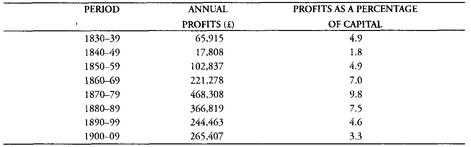
There is, however, a defect in this argument, namely that it is substantially contradicted by the available evidence of the Rothschild banks’ economic performance in this period. As table 3a shows, the 1860s and 1870s were two of the London house’s three most profitable decades for the entire period before 1914 (the 1880s was the other).
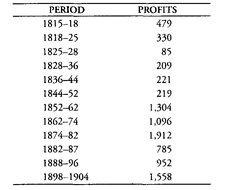
Taking all five houses together, their average annual profits rose to unprecedented levels in the years 1852 to 1874 (see table 3b). The later periods 1874-1882 and 1898-1904 were more profitable, but compared with what had gone before, the “unification years” were golden ones.
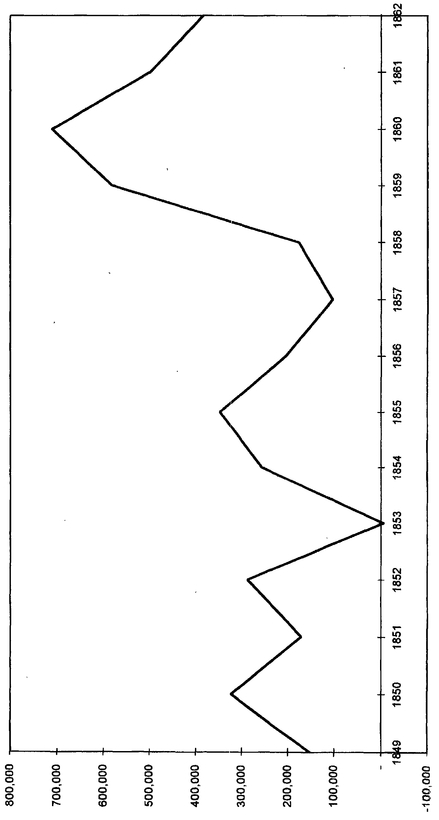
Of course, such averages may be misleading, as they lump together periods of war and peace. But even when annual figures are analysed more closely, the results are unexpected. Illustration 3.i shows that the years 18 5 9-6 1 -the years of the wars of Italian unification—were in fact the most profitable years in the history of the Naples house.
Table 3a: Profits at N. M. Rothschild & Sons, 1830-1909 (decennial averages).
Source: RAL, RFamFD/13F.
Table 3b: Average annual profits of the combined Rothschild houses, 1815-1905 (£ thousand).
Source: Appendix 2, table d.
Admittedly, the figures for the London house lend more support to the theory that the wars of the period were detrimental to the Rothschilds. In order to make a comparison, illustration 3.ii compares annual profits at New Court with those of two leading City rivals, Barings and Schröders, in each case calculating profits as a percentage of capital at the end of the previous accounting year. This indicates quite strongly that the years 1863—7—the years of the wars of German unification—were bad years for the London house; its most profitable years were years of peace: 1858, 1862 and 1873. It was Barings (and to a lesser extent Schröders) who seemed to thrive in the war-torn mid-1860s—though for Barings these high profits probably had more to do with the return of peace in America than with war in Europe. Nevertheless, it would be absurd to argue that there was no connection between the overall profitability of the period as a whole for the Rothschilds and the recurrence of military conflict. For, as we shall see, it was primarily by financing the European states’ preparations for war and the international transfers which tended to follow the wars of the period that the Rothschilds were able to boost their profits in the years of peace. Far from damaging their position as the world’s leading multinational bank, the wars of the mid-nineteenth century generated unprecedented business for the Rothschilds, just as fifty years before it had been war which had set them on their way to fortune and notoriety.
The wars of the 1850s and 1860s were fought by states which were, by and large, strapped for cash; this more than anything else explains the importance of the role played by bankers in the period—and the substantial profits they could make. Tax bases remained narrow. Indeed, it might be argued that they were especially restricted in this period, as more and more states followed the British example of trade liberalisation—Austria cutting tariffs and signing a trade agreement with the Prussian-led Zollverein in 1853, France signing a free trade treaty with Britain in 1860—for in the short term the effect of tariff reductions was to reduce revenue until increased trade volumes filled the gap. The Austrian state had the greatest difficulty in rationalising the tax system of its disparate territories and, despite heroic efforts by Bruck in the 1850s, at no point in the period was the budget balanced. The Prussian state, by contrast, had a relatively efficient system of raising revenue, with profitable state enterprises filling its coffers; but the political conflict between the Liberal-dominated parliament and an increasingly conservative monarch made finance almost as problematic. The question of who should determine the military budget—Landtag or crown?—was one of the two fundamental questions Bismarck was appointed to resolve. In addressing the other—who should rule Germany?—Bismarck had to increase the size of that budget substantially. The financial expedients he adopted to circumvent the Prussian parliament were as crucial to the achievement of German unification as the battles of Sadowa and Sedan.
Even more than in the previous decade, politicians seeking to raise money by means other than taxation had the advantage of a rapidly growing and diversifying international banking system. If the 1850s had been the decade of the Credit Mobilier and similar investment banks, the 1860s saw the proliferation of more enduring institutions, joint-stock deposit banks. In Britain this had relatively limited significance for the Rothschilds, because the majority of deposit banks concentrated almost exclusively on the kind of domestic financial business which the London Rothschilds had always eschewed. Nevertheless, in the wake of the liberalisation of English company law in 1856 and 1862 there were a number of efforts to establish joint-stock banks with foreign ambitions, of which the Anglo-Austrian Bank—set up in January 1864 by George Grenfell Glyn—posed perhaps the most serious challenge to Rothschild interests. These were the kind of newcomers who, in the words of Lionel’s eldest son Natty, did “a great amount of rash business, so much so that Uncle Muffy [Mayer] would do very little or hardly anything with them.”
In France James had to contend with four important new competitors established in this period: the Credit industriel et commercial (founded in 1859), the Société de depots et comptes courants (1863), the Société Générale (1864) and the Credit Lyonnais (which opened its Paris branch in 1865). In fact, not all of these were strictly speaking rivals. The Société Générale, for example, was established by a group including Talabot, Bartholony and Delahante, who were already linked to the Rothschilds through various railway ventures, and the new bank often acted in concert with the Rothschilds. Relations with the Credit Lyonnais were also cordial. If anything, the new banks posed a more serious threat to the Credit Mobilier, which was itself increasingly acting more like a deposit bank after the limited success of its ambitious investment schemes in the 1850s.1 Even so, their existence served to broaden the bases of French finance, and this could only imply a relative diminution of Rothschild power in Paris. James chose not to involve himself directly in the Société Générale, though he was explicitly invited to “put himself at its head”; plainly, his own desire to establish a joint-stock bank in Paris had waned since the days of the Réunion Financière. In Austria too there were new joint-stock establishments to rival the Rothschilds’ Creditanstalt. The idea of establishing an Austrian version of the Credit Foncier in Vienna was more or less dismissed by James and Anselm when it was first suggested in 1863. However, this left the field open to the Belgian financier Langrand-Dumonceau, who aimed to create an international network of mortgage banks and other institutions, and sought to cast himself as the Catholic alternative to the Jewish Rothschilds.
All this gave the warring states more choice than had been the case in the past: if the Rothschilds refused to provide them with funds, they could turn to others. There was therefore no longer any real possibility of a Rothschild veto over bellicose policies (if such a thing had ever really existed). Governments might finally lose wars for want of funds, but that did not prevent them from starting them. If there are economic explanations for the defeats of Austria, the Confederacy and France, one is that they were less able to exploit the new sources of finance than Piedmont, the Union and Prussia; or rather that the financial markets were less willing to lend to them. For this was an era in which the increasing integration of the international monetary system gave bankers as a group an unprecedented power, even if no single bank could claim to be as powerful as the Rothschilds had been in the decades before 1848. The combination of free trade and the development of bimetallism as an international monetary system tended to reduce the politicians’ freedom of manoeuvre; small miscalculations—diplomatic as much as fiscal—could lead to swift punishment from investors, the most obvious manifestations of which were, of course, a fall in the price of a government’s bonds or a run on its currency, testing the monetary authority’s commitment to currency convertibility. Table 3c illustrates the financial gravity of the 1858-9 crisis for Austrian bonds by comparing their performance with those of Britain and France. The fact that the bonds of one of the great powers could lose more than half their value as a direct result of a military defeat speaks for itself.
3.i: The pfofits of the Naples house, 1849-1862 (ducats).
3.ii: Pronfits as a percentage of capital at N.M. Rothschild & Sons, Barings and Schröders, 1850-1880.
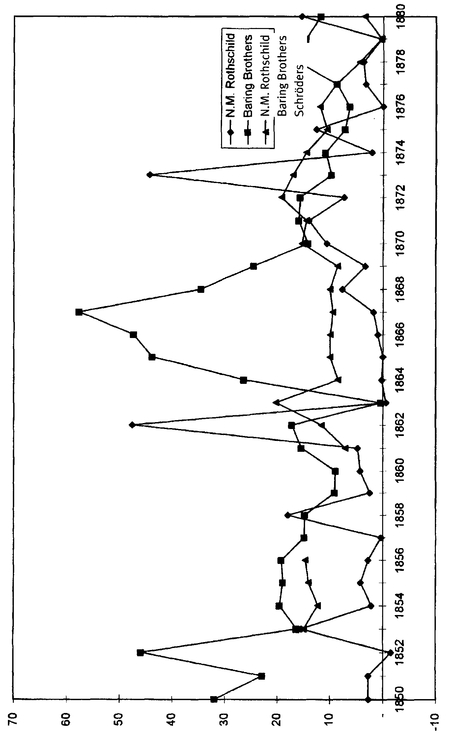
Table 3c: The financial impact of Italian unification.
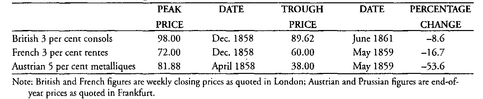
Sources: Spectator; Heyn, “Private banking and industrialisation,” pp. 358-72.
From Turin to Zaragoza
To the diplomats and politicians, the Rothschilds looked worried in 1859. In reality, they were calculating carefully to ensure that both sides in the conflict paid them for their financial services—a point which historians relying primarily on the diplomats’ letters and diaries have naturally overlooked. Thus, while he urged Napoleon to preserve peace, James had no hesitation in subscribing to the French 500 million franc loan of 1858, which was widely regarded as a “war loan.” At the same time, the London house took the lead in organising a £6 million loan to Austria in January 1859, designed to consolidate the fiscal and monetary stabilisation achieved by Bruck since his appointment as Finance Minister in 1855.2 Piedmont was more problematic. In the summer of 1858, after protracted negotiations, James had helped to organise a 45.4 million lire (nominal) Piedmontese loan for Cavour (sharing the bonds between the Paris house and the Turin National Bank) after the government had realised that a public subscription on the domestic market stood little chance of success.
When Cavour sought to raise a further 30-35 million on the French capital market the following December, however, the situation had changed. He now tried to mend his broken bridges to the Pereires, threatening to deny James that “monopoly over our rentes which he has sought for so many years.” “If, having divorced Rothschild, we marry Messieurs Pereire,” mused Cavour, “I believe we shall make a happy couple together.” But this time the strategy of playing the two rivals off against one another failed: neither party was willing to accept the terms Cavour envisaged, and he was forced to retreat to a limited public subscription, issuing 1.5 million francs of rentes at a substantially lower price than he had proposed to sell them to the banks (79 compared with 86). This outcome reflected not so much a Rothschild refusal to finance war as a general reluctance, which was shared by the Credit Mobilier, to attempt any large scale bond issues in the wake of the poor performance of the Austrian loan. Yet it should be noted that, despite what James said to Hübner, the Rothschilds did participate in Cavour’s last pre-war bond issue, taking 1 million lire when he sold a further 4 million.
Thus when war finally broke out at the end of April 1859—following a rash ultimatum issued by Austria in the mistaken belief that Russia and Prussia would take her side—the Rothschilds had played at least some role in the financial preparations of all three combatants. To say simply that they sought to prevent the war—to assume that its outbreak was therefore a blow to them—is to make the same mistake which Hübner and others made at the time: to judge James by his words rather than his deeds. He could not stop the war and he knew it; his aim was to minimise his losses on business already undertaken, and to seek to maximise his profits on whatever new business the war might generate. The classic illustration of this is the telegram sent from the London to the Paris house on April 30, 1859—the day Austrian troops crossed the border into Sardinia—which reads: “hostilities have commenced Austria wants a loan of 200,000,000 florins.”
The war, in any case, stopped of its own accord. No sooner had Austria suffered what looked like a fatal blow at Solferino (June 24) than Napoleon hastily made terms, fearful—and understandably so—of what might follow Prussia’s mobilisation in the Rhineland. At Villafranca (July 12), he struck a compromise with Franz Joseph which seemed to leave Cavour high and dry: Austria retained Venetia and the fortresses of Lombardy, and secured a vague commitment that the other Italian rulers—now menaced by nationalist insurrection—would be restored. Only when it was evident that this was enough to avert a crisis on the Rhine could the conspiracy to unite Italy resume. By the end of December 1859 Napoleon seemed ready to ditch the Pope (whom French troops still notionally defended); by January 1860 Cavour was back in office; and on March 23 the two men updated the Plombières project. In return for Savoy and Nice, France would support a succession of plebiscites in the Italian states, the outcome of which was a foregone conclusion. Now two questions arose. Could Cavour control the revolution he had begun? Only when Garibaldi’s thousand had run out of steam in Naples and Cavour’s army had swept through the Papal states was it clear that he had succeeded, and that the new Italy would be a monarchy in the image of Piedmont. The other question was whether the great powers would intervene once again to preserve the Metternichian order, as they had done repeatedly in Italy. But Prussia would rescue Austria only in return for hegemony in Germany, which Austria refused; while Russia would break with France only in return for the revision of the 1856 Black Sea clauses, which Britain refused.
It is not easy to say what the Rothschilds collectively thought of the new Kingdom of Italy, formally proclaimed in 1861. James had on two occasions hinted to Cavour that he favoured unification; while some younger members of the family in England were evidently caught up in the prevailing mood of Italophile enthusiasm: Anthony’s teenage daughters Constance and Annie “translated in one short half hour Garibaldi’s hymn of liberty into English poetry” in 1860. On the other hand, James was perturbed by the role played by Garibaldi. This was not to be wondered at, as his invasion of Naples in September 1860 put the Rothschild house there in an acutely difficult position. Adolph opted to flee with the Bourbon King Francis II to Gaeta, north of Naples, but it soon became obvious that neither James nor Anselm was prepared to grant the exiled monarch the loans (of 1.5 and 2 million francs respectively) which he requested. Adolph’s embarrassment may partly explain his sister Charlotte’s animus against Garibaldi, the “Italian rebel” whose “senseless reception” by the Whig elite when he visited England in 1864 she so deplored. Like her later denunciations of Bismarck in 1866, these comments also reveal how far the woman who had enthusiastically hailed the revolutions of 1848 had come to share her uncle James’s attitudes in the intervening years.
James’s concept was authentically supranational; he was more or less deaf to the rhetoric of nationalism, which he saw as part of a regrettable tendency to democra tise international relations—hence his suspicion of Garibaldi, whose every move seemed to weaken the bourse. In his eyes, it was a sign of Napoleon III’s weakness that he had to take account of popular feeling within France in making his foreign policy; just as later it was a sign of Bismarck’s unreliability that he was prepared to exploit German nationalist sentiment for Prussian ends. There was too much of 1848 in the events of 1860 and 1866 for his taste. On the other hand, James was no inflexible reactionary, wedded to the treaties of 1815. He preferred to think of states as businesses—not such an unreasonable elision considering how many Italian politicians (Cavour and Bastogi, for example) had banking backgrounds. Thus, where historians (following contemporary intellectuals) have seen nation-building, James saw mergers and demergers, and this illuminates his response to Austria’s predicament after 1859. Piedmont’s hostile takeover of Italy made sense and had succeeded; Austria was as financially weak in the wake of defeat as before; therefore she should sell her rights over Venetia or Holstein to the powers which could afford them—Italy and Prussia. It faintly puzzled him that the Austrian Emperor preferred to suffer further military defeats rather than to commercialise Habsburg decline in this fashion. After all, it made no difference to James whether Venetia was governed from Vienna or Turin or Florence; he continued to think of the map of Europe in terms of railways rather than borders. Indeed, as Shaftesbury quite rightly divined, the most important consequence of the Italian war for the Rothschilds was that it transferred a substantial part of the territory over which their Imperial Lombardo Venetian and Central Italian railway line ran from Austria to the new Kingdom of Italy. The crucial clauses of the Treaty of Zurich (November 1859) confirmed the validity of the existing concessions granted by Austria in Lombardy, substituting the new Italian state in the contracts where appropriate, and the same principle was applied to concessions granted by the old Italian states in July 1860. Formally, separate companies administered the tracks on either side of the Italian—Austrian border; in practice, the same shareholders still met in Paris to discuss the affairs of the whole north Italian network under James’s chairmanship.
It is in this light that we should understand the Rothschild response to Italian unification. James’s initial reaction was to offer his services to vanquished and victors alike. As early as August 1859, the Austrian government was surprised to see the Paris house issuing bonds for Tuscany, though this was in fact the balance of an earlier transaction. In March the following year, James intimated through Anselm that he would be glad to help the Austrian Treasury too as it struggled to finance its deficit. Typically, he took advantage of Habsburg weakness to spell out the first of many conditions. He would subscribe up to 25 million of the planned 200 million gulden loan, provided no other foreign bank were involved. “The Minister has always wanted to avoid entrusting this operation to our houses,” he wrote menacingly, “and he has no idea how much he damages his own credit and jeopardises the success of the undertaking. The public has now grown accustomed to our houses patronising all Austrian [loans?], one way or another.” If the operation were not entrusted exclusively to the Rothschilds, the public would assume “that we are withdrawing and have lost our confidence in Austria’s finances, which will make a very bad impression.”
In August he sent a similar signal to Turin, where a new loan of 150 million lire was issued in August 1860. Although he took some 17.5 million lire of the new 4.5 per cent rentes (at a price of 80.5), James felt that he should have been given more. It was, he declared, “a land where there is money to be made and they have work for us”:
I am far from saying that we should propose a new business or say that we would be willing to make their rentes rise. No, for if Garibaldi carries on, I will certainly not be for a rise, and if he remains quiet, I will still feel like selling a bit... If we now .. , have to sell 1 million rentes in order to show our strength, I have nothing against that.
As we shall see, the Rothschilds were able to use the aftermath of the Italian war to reassert their influence in France too, though such veiled threats proved unnecessary there.
James even sought to resuscitate his long-standing relationship with the Papacy, the interest on whose bonds he had rather hastily ceased to advance in December 1860. If this was done on the assumption that Cavour and Garibaldi would soon be establishing a new Italian capital in Rome, James soon realised his mistake: despite Napoleon’s willingness to leave the Papal states to Cavour, it proved politically impossible for him to withdraw French troops from Rome itself. On this question, the Emperor remained the prisoner of his own Ultramontane supporters. When the chronically insolvent Vatican was forced to turn back to the rue Laffitte in 1863, the Rothschilds were therefore ready to oblige, albeit on a small scale. From its very inception in the 1830s, this relationship had always seemed implausible. Given the aggressively reactionary stance of Pius IX in this period, it now seemed quite bizarre, and it is no wonder the Papal nuncio in Paris was mocked: “The thesis is to burn M. de Rothschild: the hypothesis is to dine with him.” But the reality was that those like Langrand-Dumonceau who dreamt of replacing “Juda” with “a Catholic financial power” did not have the Rothschilds’ financial strength; and that strength was sorely needed as the Vatican’s credit steadily sank during the 1860s. Moreover, at least some members of the family were notably respectful of Catholic sensibilities. Charlotte, as we have seen, was favourably impressed by the forms of worship and charitable institutions of the English Catholics; while in 1867 James showed himself sensitive to Catholic sentiment when he refused to ratify a major Italian loan which was to be secured on the temporal possessions of the clergy.
The decision to withdraw from the 1867 loan also needs to be seen in the context of growing Rothschild disenchantment with the financial policy of the new Italian state. As early as December 1861, James began to have doubts about the stability of the new state’s finances. The Finance Minister, he complained, seemed intent on “ruining” his own credit, attaching more importance to new military expenditures (in the anticipation of further battles to complete the unification process) than to the government’s existing liabilities. Throughout the 1860s, James never wholly abandoned his earlier optimism about the new state’s long-term economic prospects: Italy, as he put it, was “our hobby horse.” The problem was that, as long as the new government aspired to get its hands on Rome and Venetia, its military expenditures were likely to be inflated. The fact that there was serious resistance in southern Italy to the imposition of what was essentially Piedmontese rule further widened the gap between the new state’s expenditure and its revenue. Between 1859 and 1865 the new government borrowed no less than 1,875 million lire: current revenues from tax and other sources covered only half its expenditures. Inevitably, this had an impact on both Italian bonds and the new currency. The Italian rente, which James predicted in 1862 would rise to “75 ... if not 80,” declined to a nadir of 54.08 in 1866—below the price of Roman bonds. On May 1, 1866, a year after joining the bimetallic Latin Monetary Union with France, Belgium and Switzerland, and on the eve of renewed war with Austria, Italy had to suspend the convertibility of the lira.
The new Italian state was thus something of a financial disappointment. The Rothschild letters of the 1860s abound with abuse of the new Kingdom: the Italians were “rabble,” successive ministers were “asses” and “imbeciles,” Italy itself was no more than a “would-be great power.” In September 1864 Alphonse struck his cousin (and mother-in-law) Charlotte as “preoccupied because the house is overburdened with Italian stock. He says that the Kingdom of Italy cannot last”; he also anticipated growing “hatred between Naples, Sicily, Tuscany and Piedmont.” James had confidently anticipated something like a greater Piedmont; instead, as Alphonse commented sourly in 1866, Italy’s credit was approaching that of Spain or Mexico. “These Italians really are rogues,” he wrote angrily on hearing of a new tax on foreign capital, “and I at least can give myself the credit for having always considered them as such despite the lyricism of the discourses in their favour pronounced in England and France.”
On the other hand, a weak government could still be a source of good business. Despite James’s grumblings, the Rothschilds had helped to replenish the National Bank’s dwindling reserves of precious metal on a number of occasions beginning in September 1862. Six months later the London and Paris houses arranged a major rente issue worth some 500 million francs (nominal).3 It was not long before more was needed, however, and 1864 saw prolonged wrangling between the government and its bankers over the price at which it was prepared to sell its treasury bills. Having more or less committed themselves to a further issue of 150 million rentes, the Rothschilds were dismayed to see the Italian government selling short-term paper at prices which could only weaken the market for its bonds. Only in order to prevent a further slide did James and Lionel agree to an advance of 17-18 million lire in gold.
Although the inability of the Italian government to balance its budget and the resulting decline in the price of its bonds was somewhat embarrassing to its principal foreign bankers, all these transactions were far from unprofitable. Yet James and Lionel were not content with the resulting commissions. In addition, they sought to use the government’s recurrent cash-flow difficulties to force it to make concessions to their railway company. True, their hopes of a “fusion” of the Lombard line and all the incomplete lines south to Livorno, Rome and Naples were frustrated by political opposition in the new Italian parliament to foreign control of the national railway network; the deputies were naturally keen that Italy should have her own railways as well as her own state. But by 1865 the government’s financial needs overrode such economic nationalism: for 200 million lire it was agreed to sell the existing state-owned lines to the Lombard company. This put the company’s own finances under considerable pressure, necessitating short-term advances from both the Rothschilds and Talabot’s Société Générale while it sought to raise the necessary funds by issuing new bonds. However, in conjunction with similar acquisitions in Austria and Switzerland, it represented a strategic investment.
The year 1865 also saw renewed debate about the construction of railway lines through the Alps. While others debated the relative political merits of the Fréjus (France), Lukmanier/St Gotthard (Switzerland) and Brenner (Austria) passes, James could look on with equanimity, as he had almost all the options covered. For, while others unified nations, the Rothschilds were quietly unifying Europe. As James put it to Landau in December: “All these questions are connected.” “It is effectively beyond doubt,” he enthused in a letter to the banker d‘Eichthal, “that the Brenner line... will be the premier route through the Alps, at the very centre of Europe, and that it will divert to its profit the greater part of the general traffic of the Orient, the Mediterranean and the Adriatic towards the West of Europe ...” This was James’s map of Europe: a railway map.
The parallel Alphonse drew with Spain is a useful one, for there was indeed a superficial similarity between the Rothschilds’ dealings with Spain in this period and their dealings with Italy. Here too railways were the key, with the Zaragoza line playing the same role in James’s Spanish calculations as the Lombard line in Italy. Like the Italian government, the government in Madrid continued to run budget deficits—as it had done more or less without interruption since the 1820s. In both cases, Rothschild financial assistance tended to be made conditional on railway concessions. There were three differences between Spain and Italy, however. First, political instability was worse in the former: a military coup against the absolutist pretensions of the crown in 1854 had been followed by a full-blown revolution, but the old differences between Moderados and Progresistas—each with their own general—had led to a constitutional crisis in 1856. The Moderado regime of General Leopoldo O‘Donnell was overthrown in 1863 by another royal coup. Three years later there was an abortive pronunciamento by yet another general. Sometimes, this political chaos could be made light of. As James put it in December 1864: “Nothing new here. Just a change of government in Spain.” But by February 1867 he was pre sciently warning his sons to expect “a 1792” in Spain. ”In general,“ reflected Alphonse later the same year, ”Spain marches in the opposite direction to other countries. Spain is calm when the rest of the world is in trouble, and makes revolutions when the rest of the world is in repose.“ Spain was ”the country of surprises, where one cannot even count on tomorrow coming.“
The second difference between Spain and Italy was, as Nat never ceased to remind his brothers, that Spain had a much longer history of insolvency: each time the Spanish government approached the bond market, it encountered the disgruntled holders of old “passive” debts on which previous governments had defaulted. The acute deflationary crisis which gripped Spain in the mid-1860s hardly helped to increase Spanish creditworthiness. Finally, the Spanish railways were much less profitable than those of Italy. By the mid-1860s, when government subsidies dried up, the Zaragoza line had debts to the Paris house of as much as 40 million francs and was running an annual deficit of 1.5 million. The letters of the Paris house are full of laments about this financial “nightmare.”
All this helps to explain the relatively cautious attitude of James and his nephews when approached by successive Spanish governments for loans in the 1860s. A small advance was agreed in 1861-2; but a larger operation foundered in 1864, prompting attempts by rivals like the Pereires and Barings to step into the breach. Two years later James was prepared to countenance a new advance of 8 million francs only in return for tax breaks or subsidies for his railway company (an objective which temporarily seemed to bring Rothschild and Pereire interests into harmony). However, a rival group of French banks led by Fould and Hottinguer stole a march by offering the Madrid government a new bond-issue worth some 79 million francs. This was followed in 1867 by a further loan arranged by the Société Générale (with Barings in a supporting role) which was intended to convert the so-called “passive” debt on which interest payments had been suspended. Although the competition annoyed James, history was merely repeating itself: the English Rothschilds were as reluctant as ever to encumber themselves with new Spanish bonds, preferring to continue the system of modest advances against the output of the Almadén mines. Other forms of guarantee offered—the salt monopoly, the tobacco monopoly or colonial revenues from Cuba—did not have the appeal of mercury: the English Rothschilds always preferred metals, and the more precious the better.
The French Rothschilds, by contrast, were mainly concerned to secure concessions for the ailing Zaragoza line, and were willing to flirt with the possibility of further advances and even a new loan to this end: as Anthony rightly said, “railroads are always at the bottom of the Baron’s business.” The tortuous negotiations of 1867 revolved around the ban on Spanish bonds at the French bourse which had been imposed in 1861 in an attempt to combat capital export. The French premier Eugène Rouher intimated that he was willing to end this suspension—thus allowing a new Spanish loan to go ahead—provided the Spanish government set its financial house in order. The question was whether this reordering would include the kind of perks for the Zaragoza line sought by James; though quite why the Spanish government should borrow between 10 and 100 million francs purely in order to hand it over to French-controlled railway companies was never entirely clear. The negotiations, which were initiated on behalf of the Narváez government by the banker Salamanca, were still dragging on inconclusively when the revolution broke out—by which time Narváez was dead and Salamanca bankrupt. “A little security and stability in the political system,” grumbled Alphonse, “would be more efficacious than any subsidy.” It was not to be: in September a coalition of generals led by Juan Prim launched a successful revolution which overthrew Queen Isabella. Indeed, one reason for the failure of the various loan negotiations prior to this was probably the various bankers’ sense of impending upheaval. As Alphonse acknowledged, Weisweiller had “long anticipated the Catastrophe.”
Napoleon at Ferrières
That Alphonse was able to count on strong support from the French government in his negotiations with Spain is in itself noteworthy. For perhaps the most unexpected consequence of the Italian war was its impact on relations between the Rothschilds and Bonapartist France. Superficially, the French role in Italian unification was one of the high points of Napoleon III’s reign, and the Second Empire never looked more outwardly impressive than it did in the early 1860s. When Lionel visited Paris in April 1861, he was dazzled by the transformation of the city being wrought by Georges Haussmann. “I must say,” he commented half-seriously on seeing some of the wide, new boulevards which had replaced the cluttered alleys of the old town, “I wish we had a man like the Emperor for three months just to make a few alterations in old London.” Yet behind this veneer the Empire was developing serious weaknesses. In part, these were diplomatic. Nothing did more to alienate English Liberal opinion than Napoleon’s acquisition of Savoy and Nice in March 1860; this intimation of “vast conceptions” akin to those of his uncle undid all the diplomatic good done by the Anglo-French trade treaty signed in the same month. To James, Anglo-French antagonism could only imply trouble for France; that had been the lesson, as he saw it, of Louis Philippe’s demise. “The most revolutionary developments of French internal policy,” he told the new Austrian ambassador, Richard Metternich in October 1859, “would not affect the financial world here as profoundly as a breach with England.” “It is a great pity,” remarked Mayer Carl in March the following year, “that the favorable impression of the treaty should suffer by all these unfortunate speeches [about Italy] which lead to nothing good [and] are at liberty to spoil the good understanding which ought to exist between England and France for the general security of Europe.” “The great financiers of Paris and especially the Rothschilds” were, according to one diplomatic observer the following month, “engineering a panic and are shrieking from the housetops that war between the two great sea powers is inevitable.”
This diplomatic estrangement had an economic dimension too. The approach of civil war in America led to a drain of gold from Europe across the Atlantic, beginning in 1860. This affected both London and Paris; but, while the Bank of England relied principally on increases in Bank rate to defend its reserves, the Banque de France was not quite converted to strict imitation of Threadneedle Street practice. Partly in order to avoid further increases in its discount rate—which some of the regents opposed—the Governor of the Banque therefore authorised purchases of gold in London in November 1860. Unfortunately, his agent made the mistake of withdrawing over £300,000 directly from the Bank of England itself, a confrontational step which Alphonse deplored. An agreement to swap 50 million francs of Bank of England gold for the equivalent in Banque de France silver provided only a temporary respite for the Banque, which was coming under additional pressure from the abnormally large French trade deficit and the financing needs of the government.
These difficulties forced the government to turn to the Rothschilds. In October 1861 an elaborate transaction was agreed whereby de Rothschild Frères and five other Paris banks (Hottinguer, Fould, Pillet-Will, Mallet and Durand) drew three-month bills on the London house and on Barings to the value of £2 million, with the aim of reducing the premium on sterling bills and halting the gold flow across the Channel. At the same time, the Banque sold rentes (though it appears to have partly negated the deflationary effect of these open market operations by issuing 50 million francs’ worth of small denomination notes). None of these devices really resolved the Banque’s difficulties, however, which continued into 1862-4 as gold and silver were diverted to Egypt and India, the principal suppliers of cotton to the European textile industry in the absence of the blockaded American South.
For the Paris Rothschilds, tight money meant a revival of influence; or rather, it meant a decline in the influence of a number of rivals. In 1861 Jules Mirès was arrested for fraud, a downfall James relished: “Rothschild is triumphant,” observed Mérimée, “and says that he is the sole baron of industry.” The early 1860s also saw the first intimations of the Credit Mobilier’s mortality. Having invested heavily in real estate through their subsidiary the Compagnie Immobilière, by 1864 the Pereires found themselves struggling to balance their books. As these stars of the 1850s waned, Alphonse waxed as the voice of economic orthodoxy at the Banque de France. The Credit Mobilier, argued Alphonse in October 1864, was the “principal author” of the monetary crisis and the “sole remedy lay in the energetic resistance of the Banque.” “The suspension of convertibility,” he feared, was the Pereires’ last hope of survival. “This situation is really quite critical, for it is a struggle to the death between the old system and the new system of business, between the Credit Mob. and the banks of state.” The testimony he and his father gave to the monetary Enquête of 1865 was therefore an advance obituary for the earlier ambitions of the Pereires to supplant the Banque with a more expansionist system of credit. “You wish to establish a dozen banks?” James asked the commission, alluding to Pereires’ requests for monetary relaxation:
You wish to give them the right to issue notes? Where will the confidence be then? Suppose I am at the head of a small bank which has a little money, but needs a lot. I would not take precautions, I would say: Let come what may! Some other bank is going to have to come to the rescue. That is what all the little banks will do which will be established and which will look towards the Banque de France, as if towards a mother bank which is obliged to pay for the follies of others.
Monetary policy, he and Alphonse argued, could be a matter for the Banque alone; confidence would evaporate if the convertibility of its notes were threatened; its conduct should resemble as far as possible that of the Bank of England, with the important exception that silver should continue to enjoy equal status with gold in the Banque’s reserve. The Pereires sought to strike back, blaming their difficulties on the Banque’s high discount rate and the drain of French capital abroad orchestrated by the Rothschilds. As Emile Pereire put it in November 1865:
There are people at the Banque who wish me ill ... [But] it was not me who financed the Zaragoza and Alicante railways; it was not me who financed the Lombard lines; it was not me who was responsible for the 1,500 million of Italian loans, Belgian loans, Austrians, Romans, Spanish; and yet the signature which these operations all bear is among those which accuse us of having impoverished the national wealth for the benefit of foreigners!
But the Rothschilds could follow the death throes of the “Mob.” with detached Schudenfreude. James even indulged in a casual speculation in Credit Mobilier shares, though he was probably not responsible (as some contemporaries believed) for their last great rise and fall in 1864. The “old” bank had become the new; the “new” bank had become the old.
In fact, the monetary difficulties of the early 1860s were not solely due to uncontrollable global economic forces; they were partly a consequence of the government’s fiscal policy. The Italian war had necessitated an increase in public borrowing: in 1859, for example, the Banque had to lend the Treasury 100 million francs against rentes and also discounted treasury bills worth 25 million. These sums, however, were just a small fraction of the regime’s total borrowings throughout the 1850s, which—even without the costs of the Crimean and Italian campaigns—had totalled approximately 2 billion francs. The decision of the former Minister of State Achille Fould to set himself up as the leading critic of this policy paved the way for an unlikely political realignment which would have been unthinkable a decade earlier.
It was a rapprochement of erstwhile foes visible at first only in the countryside. As early as November 1860 it was reported that the Emperor was “hunting at St Germain with Messrs Fould and Rothschild”; the following October rumour had it that “Messrs Fould, de Germiny [the Banque Governor] and Alphonse Rothschild have held long conferences on the financial situation with the Emperor at Compiègne.” A month later, however, came the announcement in Paris of Fould’s return to office as Finance Minister—an announcement conspicuously welcomed by the Rothschilds and the bourse as a whole. “I am glad to note that... your good friend ... Fould has followed your wise counsel not to reduce the Banque’s discount rate,” wrote James in a letter to Alphonse just a few weeks later. Alphonse should “go to Fould and quite openly and freely chat with him a bit” and intimate that “we would very much like to work hand in hand with him.”
Substantial proof of this new harmony between Rothschild, Fould and Bonaparte came in January 1862 with the conversion of the (relatively few) 4.5 per cent rentes into 3 per cents. Although James, who was wintering in Nice, had some minor reservations about the transaction, in the end Fould was able to count on complete Rothschild support, not only at the Banque de France but at the rue Laffitte itself. In the first phase, the Paris house lent the government 30 million francs (for four months at 5 per cent interest) to push up the price of 3 per cents. In addition, Alphonse agreed to purchase 85.9 million francs of thirty-year government debentures, which were also to be gradually converted by the government into 3 per cent rentes. The conversion was a success for the government; for his part, James was delighted to have reasserted the Rothschilds’ traditional predominance in French public finance.
The famous visit of the Emperor to hunt at Ferrières on December 16, 1862, needs to be seen in this context. Historians have often represented this as symbolising the reconciliation of Bonaparte with (if not his surrender to) the old Orléanist haute finance; and so it seemed. Accompanied by Fould, his Minister of State (and cousin) the comte de Walewski, the English ambassador Earl Cowley and Generals Fleury and Ney, Napoleon travelled by rail to Ozouer-la-Ferrières, where he was met by James’s four sons at 10.15 a.m. Having walked across the green velvet carpet embroidered with golden bees which had been rolled out across the station platform, the Emperor and his party were then transported to the chateau itself in five carriages decked out in the Rothschild colours of blue and yellow. On his arrival, imperial flags were flown from all four towers. The rest of the family (including Anthony, Natty and his sister Evelina) were then introduced in the main hall, and the Emperor paused to admire the pictures by Van Dyck, Velasquez and Rubens hanging there. He then stepped outside to plant a commemorative cedar tree in the gardens, after which he was served a lavish breakfast. “The service of silver plate made from models which were immediately destroyed to preserve it unique,” reported The Times in reverent tones, “was accompanied by the celebrated service of Sèvres porcelain, every plate of which bears an authentic picture by Boucher.” The hunting itself was also pronounced a success: some 1,231 head of game were reported killed. The afternoon concluded with a buffet in the hall, accompanied from the gallery by the senescent Rossini’s specially composed “Chorus of Democratic Hunters” (sic), a piece of nonsense scored for tenors, baritones and basses, accompanied by two drums and a tam-tam. At 6 p.m., the imperial party returned to the station, their way illuminated by “keepers, huntsmen and other persons employed on the domain, holding torches.”
Yet the extent to which this most ostentatious of all displays of Rothschild hospitality represented a genuine reconciliation with Napoleon is doubtful. Although quite favourably impressed by the Emperor himself, Natty captured something of the uncomfortable reality of the day in his account to his parents:
I must say it was one of the most disagreeable rides I ever had as the road [from the station] was like a pane of glass... If it had been in England the populace would have been much more enthusiastic; as it was the cries of Vive l‘Emperor were for the greater part uttered by paid agents ... After breakfast, which lasted some time and would have been excellent if it had only been warm, the sportsmen adjourned to the Park. There was an enormous show of game, but as most of the shots had drunk 10 or 12 different kinds of wine they shot very badly. Altogether some 800 pheasants were murdered; they ought to have killed 1500.
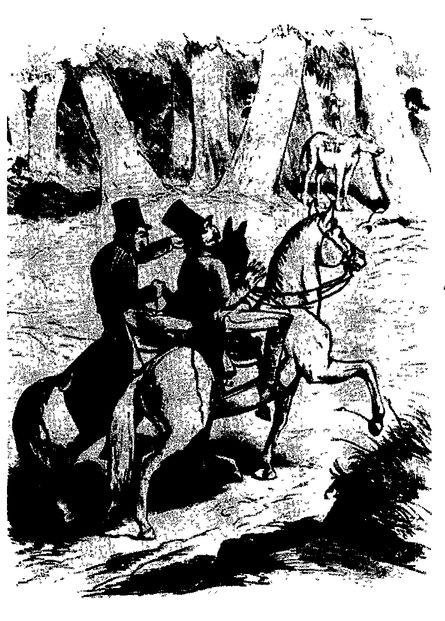
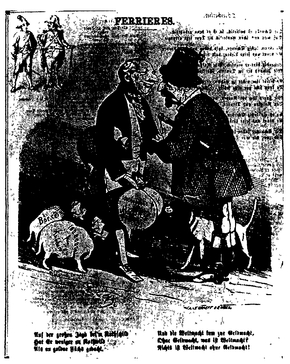
Moreover, according to one account, James could not resist a barbed parting shot as he bade the Emperor farewell. “Sire,” he supposedly said, “mes enfants et moi, nous n‘oublierons jamais cette journée. Le memoire nous en sera cher”: with the masculine article, “mémoire” means “bill,” suggesting a pun at the Emperor’s expense (in both senses). Like the Goncourt brothers, for whom Napoleon was just the latest French sovereign “to pay a state visit to money,” the contemporary German cartoonists who portrayed Napoleon as hunting the golden calf or fat “bags” of money were wide of the mark (see illustrations 3.iii and 3.iv); but they all sensed the essentially bogus nature of the occasion. The Ferrières reception was nothing if not a bid for Anglo-French reconciliation—hence the presence of Cowley and no fewer than four English Rothschilds. Yet no such reconciliation ever came. On the contrary, each diplomatic crisis seemed to drive France and England further apart.
Publicly, the Bonapartes and Rothschilds were now on friendly terms, and James and his relatives were regularly invited to court social functions. In January 1863, for example, he was spotted by the Goncourts at a soiree given by the Emperor’s cousin Princess Mathilde. A few months later, Alphonse went to Compiègne once again to discuss monetary policy with the Emperor, noting with satisfaction that “HM appears to understand the necessity to take rigorous measures.” He and his wife returned there just four months later for an evening of charades—a favourite imperial pastime-in which Leonora appeared as “Judith with the head of Holofernes,” complete with “three or four millions in diamonds on her head and neck.” The following year, Fould specifically asked James to discuss the monetary situation with the Emperor, fearing that the Pereires might yet persuade Napoleon to abandon convertibility. Instead, James sent Alphonse, whose only complaint was that the Empress was rather garrulous and “wanted to know too much about the Jews.” In November 1865 Leonora was again asked to join the amateur theatricals at Compiègne. She and her husband, along with Gustave and his wife Cecile were also present at the Emperor’s celebrated fancy-dress ball in February 1866, at which the Empress somewhat ominously appeared as Marie-Antoinette.
Yet contemporaries could not help noticing the ambivalence of the relationship. Compared with James, Napoleon was still young: he was fifty-four when he visited Ferrières, James seventy. Yet the Emperor’s health was indifferent, depriving him of energy at critical moments, whereas James—though his eyes were deteriorating and his hands increasingly arthritic—had lost little of his prodigious vigour. When Charlotte called to see her uncle in the rue Laffitte in 1864, she “found him at luncheon, eating first beefsteak with potatoes and then an enormous helping of lobster. One must be well or nearly so to venture upon such heavy diet.” She was equally impressed by his “excessively exhausting” lifestyle, “perpetually oscillating between Paris and Ferrières,” not to mention Boulogne, Nice, Wildbad and Homburg. He remained the dominant force in the Paris house until the last year of his life, indefatigably corresponding and rushing from one meeting to the next, driven by a work ethic his younger relatives could not hope to match. In August 1867 Anthony gave a pained account of a visit by James to London:
This morning I needed to go to the Ex[change]—at 9.00 comes the Baron[,] I must go with him to-the P[rince] of W[ales]—to the Duke of Cambridge & then the V[ice]roy of E[gypt] then the Sultan so that one is as confused & then if one is not at the office [one is] blown up [told off] so it is quite impossible to write as one ought.
Nevertheless, James still found time to build up an unrivalled collection of wild-fowl at Ferrières and to conduct a protracted flirtation with the comtesse Walewska, the minister’s wife. Nor should the long periods he spent each year at such spas be taken as a sign of failing strength: for it was precisely when he went to take the waters that he seemed “more juvenile, more frisky than ever,” “din[ing] at the public table, and speak[ing] with every lady, provided she is pretty and young.“ When the French press carried exaggerated reports that his sight had failed altogether in 1866, James was:
irate and most impatiently anxious to give the flattest contradiction to all the penny-a-liners, who had lamented his supposed blindness. So he made a point of going the round of the theatres with his sons, of sending countless glances to all the actresses, as many to the fair occupants of stalls and boxes, and of ending his day by playing whist and winning at the clubs, and giving a faithful account of all the partridges, pheasants and chevreuils [deer] brought down by his own unerring gun.
3.iii: Das goldene Kalb (1862).
Supremely self-confident, and perhaps now a little reckless in his old age, James felt free to give vent to that sardonic humour which in the past he had tended to suppress. Some of his jokes were the stuff of stock exchange lore: “At the bourse, there comes a time when, if you want to succeed, you have to speak Hebrew”; “You ask, do I know what causes the bourse to rise and to fall? If I knew that I would be a rich man!” Asked by an eager young broker if he thought installing a turnstile and charging admission to the bourse would affect the price of rentes, James, deadpan, responded: “My fiew is that it vill cost me tventy sous a day.” But his most famous jokes—like the pun on “mémoire” at Ferrières—subtly mocked the Emperor. “L‘Empire, c’est la baisse” defies translation: literally “the Empire means a falling market,” this pun on Napoleon’s famous claim that the Empire meant “la paix” was to prove a damning epitaph for Napoleon’s regime.
3.iv: Ferrières: Auf der großen Jagd bei’m Rothschild (1862).
Small wonder, then, that contemporaries reverted to the old Orléanist joke that he and his family were the real rulers of France. Those most malicious of contemporary diarists, the Goncourt brothers, pictured a gathering of seventy-four Rothschilds at Gustave’s wedding:
I imagine them on one of those days Rembrandt invented for synagogues and mysterious temples, lit by a sun like the golden calf. I see all those male heads, green with the sheen of millions, white and dull like the paper of a banknote. A fete in a bank cavern... Pariah kings of the world, today they covet everything and control everything, the newspapers, the arts, the writers and the thrones, disposing over the music hall and world peace, controlling states and empires, discounting their railways as the usurer controls a young man, discounting his dreams... Thus they rule in all walks of human life, including the Opera itself... It isn’t the captivity of Babylon, but the captivity of Jerusalem.
To the Goncourts, James was “a monstrous figure... the most base, [with] the most terrifying frog-like face, his eyes bloodshot, eyelids like shells, a mouth like a purse and drooling, a sort of golden satyr.” But those, like Feydeau, who saw James in his “natural element”—his office—could not help but be impressed by the sheer life force he exuded:
He had the singular and precious ability to concentrate his thoughts, to become inwardly absorbed, even in the midst of the most infernal brouhaha. Often, when about to conclude the most important transactions, he would close his door and receive no one; often too, he used effortlessly to conduct the most important and the most trivial operations at one and the same time, charging one of his sons, usually the eldest, to receive in his main office the clerks from the bourse, while he, huddled in a corner of the same room with some minister or ambassador, happily discussed the conditions of an operation involving hundreds of millions ... He sometimes broke off in the middle of discussing the terms of a loan which stood to earn him several dozen millions, to exact from some hapless courtier, who could not but agree, a concession which can only have been worth about fifty francs on some miserable little deal... This financial genius had the redoubtable ability to see everything and do everything himself ... This Titan ... read all the letters, received all the despatches, and found time in the evening to perform his social duties despite devoting himself to business from five in the morning. And you had to see how everything in his immense banking house ran like clockwork! What marvellous order throughout! What obedient employees...!
Thus, even as Napoleon began to loosen his own grip on political power, James became more and more the absolute monarch of Parisian finance. Before this “holi est of holies of money,” as the Goncourts put it, “all men were equal, as absolutely as before Death itself!”
The question remains: how far did Rothschild power actually undermine the Bonapartist regime, as some contemporaries believed it did? If James seemed at least ambivalent towards the imperial regime in public, in private he and his family remained downright hostile. His French relatives, Natty felt, were “more ridiculously Orleanist than ever, finding fault with every thing and every body connected with the emperor,” a view echoed by Benjamin Davidson after an encounter with Betty.4 James at first gave the shift towards a more parliamentary constitution a cautious welcome, but half expected Napoleon to resort to another coup d‘état. When Alphonse resolved to follow his uncle Lionel’s example and stand for election it was as an opposition candidate—though James had reservations about making Rothschild opposition so “overt.”
But why were the Rothschilds opposed to a regime which, by the 1860s, was scarcely unfavourable to their business? More important than lingering Orléanist sentiment, James and his sons saw a fundamental contradiction between the supposed new era of sound finance under Fould and the Emperor’s foreign policy, which remained as adventurous—and in their eyes dangerous—as ever. The early 1860s saw a succession of international crises in which Napoleon seemed tempted to “make mischief”; and each time he showed signs of doing so, the expectation of increased military expenditure and yet more government deficits tended to depress the price of rentes. As early as July 1863, there was talk of a new French loan, for example; the recurrent monetary difficulties of the Banque could also easily be attributed to the effects of imperial foreign policy on financial confidence. Even before the Italian war, as we have seen, James had formulated his theory of Bonapartist politics: “No peace, no Empire.” The events of the subsequent years only made him the more sure of this, and his letters abound with references to the connection between financial weakness and diplomatic room for manoeuvre. “There won’t be no war [sic],” he assured his‘nephews in October 1863. “As I said, the Emperor should speak terribly peacefully. He has to if he wants to get money [and] if indeed a loan is to be made.” “I believe,” he wrote in April 1865, “that the weak bourse will help to keep the Emperor in a more peaceful frame of mind.” And again in March 1866: “We will maintain the peace for some time, as the great man [Napoleon] cannot [afford to] make war.” His recurrent anxiety was that internal political weakness might nevertheless tempt Napoleon to gamble on foreign adventure. The more Napoleon confirmed this fear, the more James foresaw financial trouble: that was what he meant when he said that the Empire had come to mean “la baisse” rather than “la paix.”
The Roots of British Neutrality
Distrust of Napoleon provides one of the keys to understanding the Rothschild response to the events of the 1860s. There is, however, a point of equal importance to be made about the political and diplomatic role of the British Rothschilds in the same period, namely their acceptance of what amounted to a policy of non-intervention in the conflicts not only of the European continent but also of the American.
It is not at all easy to plot the course of the British Rothschilds’ political engagement in the 1860s. Having secured admission into the House of Commons, Lionel never addressed his fellow MPs, but it is an error to suppose that he was politically inactive. He attended the House frequently—even being carried into a debate on one occasion when immobilised by arthritis—and saw senior political figures and journalists so frequently at New Court and Piccadilly that his wife could write in 1866: “Politics interest your father to the exclusion of all other topics.” Naturally enough, Lionel remained a Liberal, having for so long enjoyed the majority of that party’s support in his campaign for admission to parliament, as did his bucolic younger brother Mayer. He was a Liberal on economic policy too, as much a convinced free trader as his friends Charles Villiers, the brother of the Liberal Foreign Secretary Clarendon, and the future Liberal Chancellor, Robert Lowe. But ties of friendship inclined him in the direction of Disraeli, if not Disraeli’s party; he and Charlotte were also friendly with other Tories, including General Jonathan Peel (Sir Robert’s brother, though not a Peelite) and Lord Henry Lennox, MP for Chichester. It was typical of Lionel that in 1865 he asked Delane to tone down his attacks on Russell’s government in The Times, while at the same time welcoming the government’s most effective critic—Disraeli—to New Court. In April 1866, in the thick of the debate over Russell’s Reform Bill, the Rothschilds had “the two great rivals at dinner—the whig [Gladstone] on Saturday, the tory [Disraeli] on Sunday. Natty says that the two entertainments represent Scylla and Charybdis—and that we are sure to have crossness and ill-humour on one of the two days, if not on both.”
Natty—Lionel’s eldest son, and of all the British Rothschilds the most politically engaged—also steered something of a zig-zag course. His earliest recorded political remarks indicate an enthusiastic Liberalism, combining hero-worship of Gladstone, cynicism about Disraeli and a Cobdenite enthusiasm for free trade. But he was also warm in his praise for Palmerston, and never seems to have regarded trade treaties as a substitute for military readiness (a view doubtless reinforced by his own military training and service with the Buckinghamshire Yeomanry). When he first visited the Commons (to hear the Reform Bill debates in 1866) “he found the great Mr. Gladstone’s oratory heavy and pompous, while he thought that Mr. Disraeli sparkled delightfully.” Lowe’s arguments against Reform appear to have swayed him; yet Bright—its most passionate proponent—remained a hero.
It says much about the ambiguity of Rothschild politics that when pro-Reform demonstrations were held in London in July 1866, Evelina locked away her Sèvres vases and refused to venture outside; yet when “some conservative gentleman said to Natty, who was defending the foolish reformers, that he was sorry all our windows had not been smashed ... your brother replied we were perfectly safe, as the people knew us to be their friends; they cheered the house, and Natty and Alfy in the crowd.” When Lady Alice Peel told Lionel “that the soldiers ought to have shot twenty or thirty of the rabble, which would very soon have put an end to the riot,” he gave a characteristically oblique reply: “You may say anything to me, Lady Alice, but I advise you not to go about London with such suggestions.” Charlotte blamed the Tory Home Secretary Spencer Walpole for provoking the violence by excluding the demonstrators from Hyde Park; but she nevertheless accepted that “if a Tory government can but be induced to bring in liberal measures, there is no earthly reason why it should not prove as useful as the Whig administration.” Lionel “wished every success to Mr Dis.” in government—but this was partly because he had no desire to fight yet another general election if the Tory ministry foundered. He can hardly have been reassured when Disraeli told him in February 1867, on the eve of the new parliamentary session, that “when we meet again, I shall be either a man or a mouse, but we shall not resign, depend upon it, without making an appeal to the country.” Throughout the long process of amendment and passage of Disraeli’s Reform Bill, the Rothschild door remained open to politicians of all hues: Charlotte eagerly read John Stuart Mill (who went so far as to advocate female suffrage), gave tea to the Gladstones and dined with the Disraelis. Lionel dutifully attended the debates and voted on amendments, conferring often with “our friend” Disraeli, but marvelling ironically “to see the same members in such high spirits in passing a measure which last year they opposed in the most violent manner.”
The basis of the British Rothschilds’ increasingly bipartisan approach to politics remained, as in the past, foreign policy. Furnished with impeccable political intelligence from the Paris house, they were able to command the attention of any government, Liberal or Tory. Sharing James’s objective—to restrain Napoleon III from aggression which might lead to a general war—they generally sought to shape British policy accordingly (by contrast, it is remarkable how little the British members of the family worried about Prussia). Yet there is no missing a slight loss of interest in continental affairs in this period. Anselm no doubt exaggerated, but his analysis of March 1866 says much about the letters he had been receiving from New Court:
Do not have any illusions; the political influence of England in continental affairs can be considered as nil; it is not by constantly keeping one’s sword in its sheath, or one’s armoured vessels in the peaceful waters of ports that one makes the most of oneself, that one makes oneself feared. Anyway, it is clear that Reform Bill and the bovine epidemic are dearer to the heart of John Bull than the duchies [of Schleswig and Holstein].
The shaft was well aimed: there is no doubt that Mayer spent more time in 1866 worrying about the effect of the rinderpest sweeping his herds at Mentmore than about the unification of Germany Dramatic events—the failure of Overend, Gurney (May 10), the fall of the Russell government (June 26), the Reform riots in London (July 23)—distracted British attention from events on the continent at a crucial moment. Whatever qualms Lionel may have had about Bismarck, he had no strong desire for British intervention on the continent; and even if he had, it is unlikely that he could have done much to overcome the isolationism of successive Foreign Secretaries. As long as Gladstonian principles of fiscal rectitude prevailed, British budgets were balanced so that even when defence expenditures were increased, they were financed by taxation not borrowing: in only four years between 1858 and 1874 did the government run a deficit, and in each case it was tiny. The long-run trend was for the national debt to be paid off, not increased: between 1858 and 1900 it fell from £809 million to £569 million (perhaps Gladstone’s most tangible achievement). A government that did not borrow money was a government the Rothschilds could advise, but not pressurise.
The American Wars
The habit of British non-intervention may be said to have begun with Russell’s emotive welcome to Italian unification, which more or less negated his and Palmerston’s suspicions of French policy. The outbreak of the American Civil War, by diverting British attention to the security of Canada, established the pattern which was to persist for more than a decade. Rothschild attitudes towards the American conflict have often been misunderstood; in fact they illustrate the essentially passive role played by Lionel in foreign affairs in this period. Because Belmont (as the Democrats’ national chairman) was a leading supporter of Stephen A. Douglas, Lincoln’s opponent in the presidential election of 1860, he—and in turn the Rothschilds—incurred opprobrium from both sides in the war which broke out the following year. Northern Republicans reviled “the Douglas National Chairman” as a trimmer on the issue of slavery; so did Southern Democrats, but from the opposing point of view.
According to one of his biographers, Belmont struggled throughout the conflict to bolster Rothschild support for the Union: his nightmare was that his “masters” in Europe would lend financial support to the South. But he and the Rothschilds were still repeatedly accused of Confederate sympathies, especially in the wake of General George McClellan’s nomination as Democrat candidate in 1864, because he favoured a negotiated peace with the South rather than what Belmont called Lincoln’s “fatal policy of confiscation and forcible emancipation.” “Will we have a dishonourable peace, in order to enrich Belmont, the Rothschilds, and the whole tribe of Jews, who have been buying up Confederate bonds,” thundered the Chicago Tribune in 1864, “or an honourable peace won by Grant and Sherman at the cannon’s mouth?” “Let us look at a few undeniable facts,” wrote the New York Times that October. “The notorious undenied leader of the Democratic Party at [the] Chicago [convention] was the agent of the Rothschilds. Yes, the great Democratic party has fallen so low that it has to seek a leader in the agent of foreign Jew bankers.” It was an argument developed in lurid terms by a Pennsylvanian supporter of Lincoln at a rally the following month:
The agent of the Rothschilds is the chief manager of the Democratic Party! (Cries of “that’s so” and cheers) ... What a first rate Secretary of the treasury he would make, if Mr McClellan happened to be elected! (Laughter) There is not a people or government in Christendom in which the paws, or fangs, or claws of the Rothschilds are not plunged to the very heart of the treasury... and they would like to do the same here... We did not want to borrow and the Jews have got mad, and have been mad ever since (Cheers). But they and Jeff Davis and the devil are not going to conquer us (Prolonged applause).
Was there any truth in the allegation of support for the South? There was evidently some sympathy for the Southern cause in the rue Laffitte, if not at New Court. This owed at least something to the reports from James’s third son Salomon, who had been sent across the Atlantic in 1859 (rather as Alphonse had been in 1848) as part of his business education, and remained there until the outbreak of war in April 1861. Although appalled in a Dickensian way by most aspects of American political life, Salomon was inclined to sympathise with the South, and argued in his last despatch to Paris that Europe should recognise the Confederacy in order to halt the war. Quite apart from the argument that the South should be allowed to determine its own laws—which swayed such unlikely supporters of the slave states as Gladstone—the disruption to the European economy caused by the Northern blockade of Southern cotton exports provided a persuasive argument in favour of a swift peace, if not a Southern victory. At least one of the London house’s American correspondents—the house of Chieves & Osborne in Petersburg, Virginia—repeatedly urged “that England should at once recognise the Southern Confederacy upon the score of interest and humanity [sic].” And Belmont himself (contrary to Katz’s account) explicitly told Lionel when he visited London in 1863 that “soon the North would be conquered.” However, much as they deplored the outbreak of war, the Rothschilds adopted a posture of neutrality in the early stages of the war, arguing against intervention by either Britain or France. In 1863, the American consul-general in Frankfurt informed Harper’s Weekly after a conversation with Mayer Carl that
here the firm of M. A. Rothschild a[nd] Son are opposed to slavery and in favor of the Union. A converted Jew, Erlanger, has taken the rebel loan of £3,000,000 and lives in this city; and Baron Rothschild informed me that all Germany condemned this act of lending money to establish a slaveholding government, and that so great was public opinion against it that Erlanger a. Co. dare not offer it on the Frankfort bourse. I further know that the Jews rejoice to think that none of their sect would be guilty of loaning money for the purpose above named; but it was left, they say, for apostate Jews to do it.
It was indeed Erlanger, in conjunction with the American James Slidell, who issued the first “cotton guaranteed” Confederate loan in March 1864; and the only London bank which would consent to become involved was not N. M. Rothschild but J. Henry Schröder & Co., which had never previously issued a government loan. The London house informed Belmont that “the Confederate Loan was of so speculative a nature that it was very likely to attract all wild speculators... It was brought out by foreigners, and we do not hear of any respectable people having anything to do with it... We ourselves have been quite neutral and have had nothing to do with it.”5 By 1864 at the latest, James was involved in financing Northern imports from Europe, criticising Belmont for his reluctance to assist the Lincoln government and urging his sceptical nephew Nat that Northern bonds represented a good investment. 6 When the charge of having financed the South was repeated in 1874, Belmont was able to state with only slight exaggeration that “some nine years ago, the late Baron James de Rothschild, in Paris, showed... by his books, in my presence, that he was one of the earliest and largest investors in our security during the war.” The idea that the Rothschilds backed the South was mere legend, like the later allegations against Belmont that he sought to delay the payment of American aid to the Fenians.
What is undeniable is that compared with rivals like Barings and the London-based Americans George Peabody and Junius Spencer Morgan, Rothschild interest in American finance—Northern and Southern—was limited and continued to be so for the rest of the century. While newcomers like the Seligmans could operate with a family member in New York, the Rothschilds remained at one remove from the American market, the more so as Belmont devoted increasing amounts of his time and energy to politics (accumulating powerful enemies in the process).7 Moreover, the Civil War had done much to disillusion even James about the United States. Although he had been optimistic about increasing transatlantic business after the conclusion of peace in 1865, he was haunted by the fear of a resumption of political “disturbances.” In 1867, his last word on the subject was to sell American funds because “I have the deep conviction that although America is a country beyond all calculation, one should not have any illusions that the battle which is being rejoined is not only directed against the President but against the South.”
Although James’s sons continued to take an interest in the cotton market, Alphonse expressly told his cousins in January 1868 that “we do not wish to speculate on some Negro revolt in the South or anything of that sort.” He was equally lukewarm about American railways. There was a similar though milder reaction in London. When the American financier Jay Cooke visited London in 1870 in the hope of finding takers for $5 million of Northern Pacific Railroad bonds, he got short shrift from Lionel. Rothschild involvement in the US economy increasingly was confined to bond issues for states or the federal government. Even this proved problematic: the resumption of post-war business got off to a bad start when the London house invested in $500,000 of Pennsylvania state bonds. Within a year, it was apparent that the state intended to pay off its creditors with depreciated dollars; but when Belmont protested, he elicited a crudely anti-Semitic response from the state’s Treasurer, William H. Kemble: “We are willing to give you the pound of flesh, but not one drop of Christian blood.” A New York state loan in 1870, issued by the Paris, London and Frankfurt houses in partnership with Adolph Hansemann, was more successful and led to another successful issue in 1871. However, the Rothschilds always preferred to deal with the central government, and from 1869 onwards they lobbied President Ulysses S. Grant for the chance to assist him in the task of stabilising federal finances. The London house was among the five issuing houses for the 1871 refunding loan, a process repeated two years later and again in 1878. To be sure, the Rothschilds continued to be denounced by Belmont’s opponents as the “European Shylocks,” whose sole purpose was to revalue the bonds of the various American states by putting the United States on to the gold standard. But the reality was that the Civil War had led not only to a temporary decline in British continental influence, but to a permanent decline in the Rothschilds’ transatlantic influence.
The best argument of all against meddling in other people’s civil wars was provided by events south of the Rio Grande. Although Napoleon III failed in his attempts to influence the outcome of the American Civil War, he did manage to intervene in the affairs of the American continent in another way. The French invasion of Mexico was one of the least successful ventures in imperialism of the entire nineteenth century. In part, it sprang from Napoleon’s belief that Mexico must be preserved from complete American annexation. In part, it was a way of giving the former Austrian Governor of Lombardy a new job, though the Archduke Maximilian accepted the Mexican throne only under pressure from his ambitious Saxe-Coburg wife Charlotte and against the advice of his brother, the Emperor Franz Joseph. Only superficially was the invasion about money. The initial French, British and Spanish expeditions to Mexico in 1861 were prompted by the new Progressive government’s refusal to maintain interest payments on the country’s foreign debt; and throughout the succeeding years the interests of the bondholders were frequently cited to justify what was being done. But in reality most of the bondholders were British, and the French had to inflate their own claims or (as Morny did) acquire other people’s. The decision of Britain and Spain to pull out in April 1862 and the subsequent despatch of 30,000 more French troops swiftly turned the Mexican affair into a costly fiasco. It was possible to occupy the country and install Maximilian, but the French Treasury could not sustain an open-ended commitment: hence the Convention of Miramar stipulated that the new Mexican regime owed France 270 million francs—40 million for the bondholders and other private interests, the rest for the costs of the invasion. This in turn could be paid only by raising a new Mexican loan in Europe; and this required the new regime to be secure. But as soon as the American Civil War ended and the US signalled that she did not regard Maximilian as the legitimate ruler of the country, the occupation became untenable. In 1866 Napoleon was obliged ignominiously to withdraw his troops, leaving the hapless Maximilian to face a firing squad the following year.
It has been suggested that the Rothschilds were opposed to the Mexican adventure. The reverse is true. The Rothschilds had interests in Mexico, as we have seen. Indeed, Nathaniel Davidson was concerned that he stood to lose at least $10,000 as a result of the Juarez government’s refusal to recognise legal agreements made by its conservative predecessor, particularly with regard to Church lands, on the security of which Davidson had lent some $700,000. The San Rafael ironworks he had acquired were also under threat. Davidson therefore welcomed the arrival of European forces at Vera Cruz, and only regretted that they did not move more swiftly to overthrow Juarez. He hastened to assist the French expedition’s paymaster by discounting bills and providing him with several million dollars of gold from California. There was an indirect interest in Maximilian too: his wife was the daughter of King Leopold of the Belgians, a long-standing Rothschild friend who had entrusted her legacy to the Paris house as long ago as 1848. As soon as the French government brought up the question of a Mexican loan, the Rothschilds therefore made no secret of their interest.
To be sure, James was always sceptical about the likely success of such a loan. “I don’t quite understand,” he mused in August 1863, “how an Austrian Prince can go under the title of Emperor with French troops, and if they don’t stay, who can guarantee that taxes will continue to be collected and [interest paid on] the loan.” He correctly foresaw too that the ending of the American Civil War would weaken the French position. Even if the loan were taken in commission, James had no desire to be associated with bonds which might easily be rendered worthless if the whole adventure ended in a débâcle. But these doubts should not be taken to mean that he was against the loan; it merely explains his uncharacteristic eagerness to act in tandem with Barings, thus spreading the risk, and the pains he and Alphonse took to secure the agreement of the London bondholders to their terms. Ultimately, he was sorry to lose the Mexican loan to rivals like the Credit Mobilier and Glyn’s and made an energetic effort to hang on to it. He regarded the idea of a new Mexican bank as potentially “a golden deal” and was disappointed when that too had to be abandoned. Even without the loan, the Rothschilds found themselves exposed, thanks to Davidson’s over-enthusiastic discounting of bills not only for the French army but for Maximilian himself. When the French withdrawal was announced—to Davidson’s horror—they were left with bills on Maximilian’s doomed regime worth some 6 million francs.
There had therefore been legitimate, if ultimately disappointed, commercial reasons for supporting the Mexican adventure. However, there was a more subtle and perhaps more important subsidiary argument in favour: squandering money and men in distant Mexico distracted France from Central Europe. The private correspondence makes this manifest: as James put it bluntly in June 1863, sending money and troops to Mexico was “not good for the Treasury, but it avoids war over Poland” (see next chapter). The ramifications of this weakening of France, however, would prove far greater than he would ever know. Alphonse’s assessment, following the news of Maximilian’s death was not overdone:
One should not deceive oneself: the tragic death of poor Maximilian is an event which could have very serious consequences. In the country [France] there reigns a general discontent stemming from the frivolity with which questions of internal as well as external policy are treated. From this there comes a general malaise, an uncertainty about the future which influences all transactions.
This malaise was the “baisse” against which James had all along warned.