
THREE
On the Magnetic Compass
It was [Chinese pilots who were] the first to employ the magnetic compass at sea. This great revolution in the sailors’ art, which ushered in the era of quantitative navigation, is solidly attested for Chinese ships by AD 1090, just about a century before its initial appearance in the West…. The exact date at which the magnetic compass first became the mariner’s compass, after a long career ashore with the geomancers, is not known, but some time in the 9th or 10th century would be a very probable guess. Before the end of the 13th century (Marco Polo’s time) we have compass bearings recorded in print, and in the following century, before the end of the Yuan dynasty, compilations of these began to be produced. In all probability from the beginnings of its use at sea, the Chinese compass was a magnetised needle floating on water in a small cup.
—JOSEPH NEEDHAM
From Science and Civilisation in China, Volume IV, Part 3
Joseph Needham swiftly realized that to accomplish all he had in mind in China he should now move very fast. He was certain that the British government would regard his mission as fully accomplished once the Japanese had been defeated and the war was over—and that might not be far in the future. Nearly all of the embassy’s military advisers, and those on the staff of the American embassy in Chongqing, too, doubted that Japan could hold on in China for more than a couple of years. And so from almost the moment his plane touched down, and well aware that on Churchill’s whim his duties could be brought to a sudden close, Joseph Needham began to whirl around China like a dervish.
He led no fewer than eleven full-fledged expeditions around some of the wildest and loneliest places in the country, in the process logging somewhere around 30,000 miles. He probably covered more territory than the most doughty explorers who had gone before him. He would later make the bantering remark that he certainly saw more of China than his Chinese Communist friends saw on their famous Long March. They did a mere 8,000 miles—although Needham readily conceded that his mileage was done primarily in a series of wheeled vehicles whereas theirs was accomplished almost invariably on foot.
Each of his expeditions had a threefold official purpose. First, he was to bring simple good cheer to the men and women working in China’s more remote scientific outposts. By now he knew only too well of their poverty and their improvisations, of their cheerful attitude of recycle and repair. He had heard countless tales—of tuning forks made from the spars of Japanese planes that had been shot down; of weights for chemical balances made by melting down coins of former dynasties; of vaccines stored in caves and kept cool with blocks of ice sawed from the surface of the Yellow River. Needham wanted to help these people, and he was fast developing a missionary zeal for helping.
Second, to boost their morale—and to keep their vitally important scientific work going—he was to hand-deliver any equipment they needed. In performing this task he saw himself as something of a latter-day Father Christmas, delivering sacks of goodies to well-behaved, faraway recipients. Much later he recalled his pleasure in
delivering large tubes of rare gases to the Chinghua University Radio Research Institute; or driving to the Peiping Academy’s retreat near the famous Taoist temple of Heilongtang with several substantial cases of optical glass, to help them in their courageous programme of manufacturing microscopes in the Chinese hinterland. A cathode-ray oscilloscope gladdened the hearts of the excellent physicists in Kunming, and a few grams of colchicines made all the difference to life at the Sichuan Provincial Agricultural Experiment Station. A consignment of rubber tubing arrived at a university in Fujian just at the moment when all research was coming to a stop because of the perishing of their previous stock. Electric motors in crates jolted over the road from Chongqing to Chengdu to help the excellent work going on in the Chinese Air Force Experiment Station there. A first-rate binocular dissecting microscope kept a first-rate embryologist full at work. These things are good to look back upon.
Third, there was the nakedly diplomatic motive: he was to travel around China waving the flag for Britain. Few of his colleagues in the embassy had been granted as much freedom—and as generous a budget—to wander. It was felt that Needham—by traveling to unvisited nooks, places where the legendary Chinese suspicion of foreigners was still evident, and where few outsiders were ever seen or made welcome—might, if he acted judiciously, add a certain warmth to the rather cool official relationship between Britain and China. And if that happened, and once the Japanese were defeated and compelled to leave, London would be in a far better position to expand its influence, both in China (at whatever city the government might settle in) and then farther, across the region.
A fourth possible official purpose is seldom mentioned. During those war years Britain, like all interested western powers, was eager to get to know all it could about the Chinese Communists. Joseph Needham was halfway to being a committed communist himself, and his contacts with the party leaders in Chongqing, and especially his burgeoning friendship with Zhou Enlai, could be of considerable use to the intelligence services. There is no evidence that Needham was ever in any sense a spy: prudence and scientific neutrality were his watchwords; he was always careful to retain the trust of the Chinese Communists as well as that of the Nationalist government to which he was formally accredited. But he had unique access, and the insights he gained from his visits to Zhou’s headquarters were uniquely valuable. His subsequent dinner conversations at the embassy, and his occasional discussions with military attachés from other embassies—especially with the “China hands” at Clarence Gauss’s American mission—were thus invariably listened to with great care, just in case Needham let some morsel of information drop.
His expeditions also had an unofficial purpose. He traveled—and his superiors knew and recognized his pressing need to do so—to further his own personal academic investigations into the nature of China. His appetite for inquiry intensified the longer he remained in the country, and the embassy staff could not help noticing the huge number of books and pamphlets he was sending back to Cambridge, as well as the ever-increasing number of notepads and diaries he was filling. It was never entirely clear what he might do with the fast accumulating store of information, but that he was on his way to being the embassy’s premier China expert was becoming abundantly clear to all.
Of his eleven expeditions, seven were short trips that took him only a few hundred miles out of Chongqing. The four others were anything but short—they were epics that took weeks, sometimes months, and were often risky, dangerous, and in at least one case, downright foolhardy. One journey took him through the jungles of southwestern China close to the frontier with Burma. Another went east and north, to Xi’an, the old capital city now known for its immense buried army of terra-cotta soldiers.19 A third went southeast, close to the Japanese front line—a somewhat mobile and intangible frontier which shifted with the fortunes of war, with the result that Needham and his small party were almost captured and made prisoners of war.
The first expedition he undertook, beginning in August 1943, was the gem. This was by far the most complex and the most difficult—and, as it turned out, the most instructive and rewarding. Though many setbacks and minor disasters caused it to run months beyond schedule, it took him to the farthest northwestern reaches of China, far beyond the western terminus of the Great Wall and out into the hot and sandy deserts of what now is called either Sinkiang or Xinjiang but during the war was called, much more romantically, Chinese Turkestan.
On this journey he headed to one specific spot in the Turkestan desert where there was a very small cave. Western scholars have given it a number, 17, and it is one of the 400 man-made Mogao Grottoes that line a cliff outside an oasis beside the far western desert town of Dunhuang, which is otherwise known as a rest stop on the Silk Road, with restaurants that offer steaks cut from local donkeys.
For Needham, the importance of Cave 17 had nothing to do with his official duties. This cavern, whose doorway is so low that one must stoop to enter it, was the place where, thirty-six years earlier, in 1907, an immense and ancient Chinese library had been discovered, including a printed scroll that was now recognized as the oldest dated printed book in history. It is known as the Diamond Sutra, and it had been printed in AD 868.
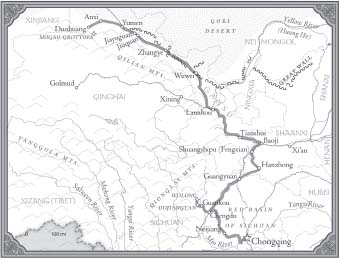
Map of Needham’s Northern Expedition, Chonqing–Dunhuang
That this book was made by a Chinese man demonstrated conclusively that printers had been at work in China six centuries before either Gutenberg or Caxton set their own first books in type in Europe. If any one thing in all creation gave the lie to the western notion that China was a backward country, this was it. The fragile document that had been plucked from the sands of Cave 17 showed that China was, quite incontrovertibly, a nation at the forefront of human civilization. From the moment Needham first read the story of the Diamond Sutra, he felt an irresistible pull: he had to get from Chongqing to the caves at Dunhuang, no matter what.
He decided early on that his expeditions—certainly this first one, which he knew from the maps would be long and would cover difficult terrain—should be made in a rugged, reliable, go-anywhere kind of vehicle. After spending some days kicking tires, he chose a sludge-brown two-and-a-half-ton Chevrolet truck, a converted canvas-covered American ambulance that had been lent somewhat grudgingly by the Royal Air Force truck pool. He then hired to go with it a Cantonese driver, Guang Wei, whom he liked, and who agreed to double as a mechanic.
On Needham’s instructions—given in English, since this was to be the common tongue among the participants, who came from London, Guangzhou, and Malacca, and so had three different linguistic origins—Guang painted “Sino-British Science Cooperation Office” in large white letters, as well as in Chinese calligraphy, on both of the truck’s cab doors and on both sides of its body. In addition he mounted two small flagpoles beside the headlights: one flying the Union Jack of Britain, the other the blue-quartered red flag, a white sun in its quarter, of Nationalist China. (Despite his friendship with the Chinese Communists in Chongqing, Needham felt it would be imprudent to fly any hammers, sickles, or red stars. This was an official British diplomatic adventure, and as a diplomat he was officially accredited to Chiang Kai-shek’s Nationalist government.) The flags would alleviate any possible doubt by friend or foe as to exactly who was traveling—and since stray parties of Japanese soldiers or strafing fighter planes had the habit of turning up in the most unexpected places, foes might well be encountered. Being able to demonstrate the mission’s innocently scientific purpose could, Needham thought, turn out to be a matter of life or death.
The team then packed the truck, first with the goods they were to deliver, and then with their own supplies—forty-gallon drums of fuel,20 all the imaginable tools and spare parts they might need, camp beds, Primus stoves, the apparently purposeless lengths of string and oilcloth and sheets of tin without which no self-respecting Englishman would travel anywhere remote, and a very great deal of canned food—meats by Hormel and Fray Bentos, biscuits by Huntley & Palmer, mustard by Colman’s or Keen’s, as well as bottles of the undrinkable Paterson’s Camp coffee, the rather better Fry’s cocoa, and Cadbury’s chocolate bars, seemingly by the ton.
They needed only to acquire the necessary permits: authorization notes had to be obtained from nine different organizations—the Foreign Office, the Transport Bureau, the army garrison headquarters, and other arms of China’s bureaucracy. Also, dozens of photographs had to be signed and countersigned in police stations and visa offices—a process that took the exasperated Needham several days. But eventually, at the end of the first week of August—armed with a bundle of chop-covered, seal-emblazoned, signed and sworn and notarized and diplomatically rendered official documents—they were ready to go.
They left Chongqing in what initially would be a two-truck convoy. Needham was in his own vehicle, with H. T. Huang and three other passengers: an American geologist, Ed Beltz, who was cadging a ride; the writer and teacher Robert Payne, who also needed a short lift to see a dying friend in Chengdu; and a young Chinese woman, Liao Hongying, a chemist educated at Oxford’s Somerville College, who would act as Needham’s amanuensis and provide him—though almost certainly platonically—with the female company he craved. She was extremely beautiful, as well as intellectually accomplished, and there had been much nudging and winking within the mission when the roguish counsellor had first selected her. (Considering what eventually befell Miss Liao, as we shall see, the whisperings at the embassy turned out to be most ironically misdirected.)
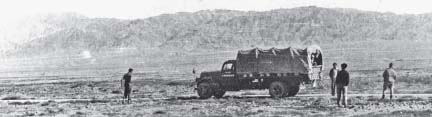
The converted Chevrolet ambulance in which Needham traveled to northwest China, pictured during a repair stop on the Silk Road.
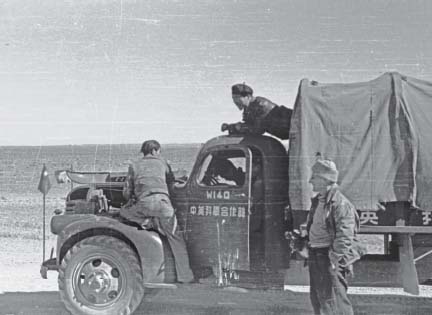
In another embassy Chevrolet truck would be Sir Eric Teichman, who was being driven to a northern Chinese border city so that he could head west on another epic overland journey toward India, from where he would eventually fly home to Britain. The departure date for the two vehicles was set for August 7, a Saturday. It was expected that on this, their first Chinese adventure, the party would be staying away from base for eight weeks or so, little more.
For the duration of their expedition the Dunhuang caves were at the front of their minds: reaching them was the ultimate goal, no matter what the hardships. But there were other things to see on the way—other Chinese marvels. The first of these, which Needham managed to visit just a week after he left Chongqing, involved a subject that has captivated China since the beginnings of its history: water.
China is, basically, a gigantic plateau. tilted gently from west to east. The biggest of the Chinese rivers, the catchment of nearly all others, flow almost entirely in that general direction, from their sources in the Himalayas in the west to their estuaries on the eastern ocean. The rivers swell each springtime as a result of the melting snows and soon afterward become swollen again with rains during the southern monsoon. As a result, questions related to flooding and water control became, almost from the nation’s beginnings, a matter of overarching importance.
And this was not just local importance. The Chinese had long ago realized that, so far as flooding was concerned, local interests had to be subordinated to a wider national need. Swollen rivers did their damage or brought their benefits to huge tracts of land and to large numbers of people who, if they were prudent, and whatever their local loyalties, ought to come together to bring each river under control. So the creation of what one might call a supra-local national water authority, and a large bureaucracy to populate it, became of great importance early on in China’s history.
As it happened, the immense power that such a body eventually acquired in early China helped to strengthen the fledgling imperial system as a whole—and it quickly became evident that whoever controlled the empire’s rivers simultaneously wielded enormous power over the empire. Some sinologists go farther: the historically despotic nature of Chinese imperial rulers derived from one abiding reality—that the keepers of China’s hydraulics had the wherewithal to do with China much as they pleased.
Water engineers were given formidable powers, and when they were successful, they earned formidable reputations. One of these engineers, in the Qin dynasty, was Li Bing, who created a monster irrigation project on the Min River 2,300 years ago: astonishingly, it still stands. Part of Needham’s plan when he set out that August was to inspect this structure: it was to be his introduction to the fact that ancient China could not only do small things very well—such as grafting plums and inventing the abacus and the magnetic compass—but also make achievements on a gargantuan scale.
Getting to the dam site turned out to be agonizingly slow. The men and Miss Liao traveled through the heat and dust of the Red Basin as slowly as sloths. Within the first moments of leaving Chongqing, they had been presented with a sight that unsettled their Chinese drivers. A funeral cortege passed directly in front of Sir Eric Teichman’s truck. It turned out that the chairman of the Chinese Republic, Lin Sen, had died the previous week, and while climbing a hill on the way out of town the little convoy was forced to stop and wait for an hour as the white-robed mourners edged by. Teichman’s driver complained that this was an omen: so somber a delay must mean that his journey—maybe everyone’s journey—was ill-fated.
The village of Yongqiang, which now is just a ten-minute drive west of Chongqing, took Needham and his trucks took more than eight hours to reach. By the time the sun was setting on Saturday evening his little convoy had bumped and strained over only sixty miles, reaching the town of Neijiang. They stayed that night at the China Travel Service inn, which
in contrast to the old-fashioned Chinese inns is very clean (and there is no insect life to be found in their comfortable modern beds). In the old inns the beds consist of a just a few bare planks and the traveller is expected to bring his own bedding. Modern sanitation has of course never been heard of. In the old northern regions the beds, called kang in Chinese, are platforms made of clay which stand about two feet from the floor. A fire is supposed to burn underneath all night but invariably expires about three or four a.m. leaving one to freeze until dawn. The primitive central heating device can be temperamental in other ways; I have known it catch fire on occasion, and destroy the clothes of one of my Chinese colleagues.
Whether his own clothes caught fire or his truck broke down—it was already leaking oil, and the radiator was dripping—we do not know, but Needham made no progress on Sunday. He opted instead to meet and have dinner with a Chinese cavalry colonel whose card he had been given, who turned out to have been educated at Saumur, and who spoke impeccable French. On Monday morning Needham went on a side trip to buy fuel—ninety gallons of power alcohol and an additional ten gallons of absolute alcohol, which he planned to cut with some low-octane gasoline he had bought in Chongqing. He irritatedly described the road toward the distant blue mountains as “rough going,”21 though he was charmed to find someone selling sugar plums. He also bought apples and a basket of tomatoes, then managed to avoid the normally compulsory police check on the main northbound road, arriving in Chengdu just before suppertime, just in time to allow his mechanic to rush the flagging truck to a repair shop.
Then finally the blue range of mountains stood ahead, rising abruptly before them, with the Min River coursing out of a chasm with terrific speed. Needham knew the most important statistics—that the Min fell 12,000 feet from its headwaters in only 400 miles, so that it flowed down an average gradient of thirty feet every mile, which in riverine terms is a formula for exceptional danger. He knew also that in 250 BC the redoubtable Li Bing had worked to tame and harness the Min, creating the structure that stood before him now, which visitors before and since have felt should be listed as one of the wonders of the world.
The site is called Dujiangyan. As an irrigation project, it may not seem to deserve being ranked alongside the Pyramids or the Taj Mahal, but it is actually one of mankind’s more extraordinary achievements. Needham liked to quote, approvingly, the ancient Roman engineer Sextus Julius Frontinus, who wrote famously in the first century after Christ that his aqueducts were indispensable, and would be remembered long after “the idle pyramids, or the useless, though famous, works of the Greeks.”
Needham liked this quotation not simply because Frontinus was right about the Egyptians and the Greeks but also because his achievements in Rome had been made three full centuries after those of Li Bing in China. Moreover, unlike the highfalutin monuments beside the Nile and the Yamuna, Dujiangyan had been made purely for the common good, and it still works today just as it was designed to work, whereas many Roman aqueducts lie in ruins. The fact that Dujiangyan was still working excited Needham most.
In 250 BC Li Bing had been appointed governor of the province of Shu—modern-day Sichuan—under the kingdom of Qin, during the unstable period of the so-called Warring States, and shortly before the formation of the unified Qin dynasty, from which the name China is derived. Like everyone, he was only too well aware of the Min’s deadly caprices. It was a river that either ran half-dry in the summer, leaving the paddy farmers of the plains starved for water, or else, more commonly, flooded uncontrollably and caused a swath of destruction and death all the way to Chengdu and beyond. The river needed to be brought to heel. Li Bing, after winning permission from the king of Qin, undertook what would in time be described as “the largest and most carefully planned public works project yet seen anywhere in the eastern half of the Eurasian continent.”
To control the river, he decided to cut a new spillway and channel any excess water through it with a specially designed, adjustable diversion dam. It took him seven years to break through the mountain: he managed this by having workers burn piles of hay on the surface of rocks to make them hot, and then pour cold water to cool them down rapidly, letting the nearly instant contraction crack them open. This cutting eventually led to an opening seventy feet wide, and the Min River waters, which were shifted toward it by Li Bing’s clever fish-shaped dam, began to course through it the moment the final wall was broken open. The anniversary is still celebrated each year: a ceremony called the “breaking of the waters” is held every summer, commemorating an eastern engineering feat that was undertaken more than 2,000 years ago, when westerners (though not Plato, Aristotle, the Egyptians, or the Mesopotamians) still coated themselves with woad and did little more than grunt.
Needham was fascinated by what he found at Dujiangyan. The engineering achievement was astonishing, its design was aesthetically pleasing, and its long endurance was remarkable. He also loved the architecture of the temples that had been built on the hillsides centuries ago to commemorate Li Bing’s work. He spent several pleasant hours gazing down at the river from a cool vantage point high on one of the pagodas in the forest.
Then he met the modern director of the irrigation scheme, who was technically Li Bing’s successor. He encountered him walking around in the wet mist beside the main spillway, checking monitoring devices and reading water meters. He had a slide rule sticking out of his pocket and turned out to have been trained in Manchester. Needham said how impressed he was by the system—the spillway, the dams, the endless torrents of water—and all of it created so long ago. No wonder, he said, that they had erected a temple to Li Bing. “To us,” replied the director, smiling, “he was like a god. He surely deserved a temple.”
Needham now turned north. His plan was to cross an outlier of the mountain range and head northwest to join the Silk Road—a route that could take him, in theory, all the way to Baghdad and to the Mediterranean at Antioch. Even this fairly modest leg of the journey turned out to be wretchedly difficult. His diary pages for the second and third weeks of August are filled with references to breakdowns, interminable waits, and unexpected disasters—interspersed, however, with a jocular perspicacity, as if despite the frustration he finds it all rather amusing and instructive:
At 2.30 p.m. the alcohol gave out…changed the carburetor tops…took off feed pump, put grease between the leaves of the diaphragm…. Found 40 trucks waiting for the ferry so we put up in a little inn, open air. There was a storm alarm, and also a lunar rainbow…. Sir Eric in trouble with the gendarmerie for photographing a bridge. We are informed that the road is blocked and that we must wait. The hotel at Hanzhong was full, so off we went to the China Inland Mission22 and all of us were put up. Had an enjoyable visit to Bishop Civelli and his merry men.
Needham’s enjoyment stemmed from his discovery that the bishop was Roman Catholic and conducted high mass each Sunday, in Latin. Needham and H. T. went along, Needham finding himself open-mouthed with delight—at seeing the entirely Chinese congregation lip-synching the Latin recitatives, and most of all at listening to sacred music he had last heard in his little church in Thaxted. He said he felt transported, back to medieval Europe, and back to Essex in the 1930s.
But Needham’s greatest annoyance was the growing frequency of not being transported. At times his litany of woes—as when he tried to cross the Bao River, ten days out from Chongqing—would become a full-blown chorus:
Arrived at [the ferry stop in] Wuguanhe at 10 a.m. Awful big washout. Lines of trucks and endless mulecarts there all day. Hopeless organisation. An incident officer should have been appointed with full charges for as far as the traffic jam extends on each side. Here again, like the rotten bridges on the Sichuan side [they had crossed into the province of Shaanxi, notorious for its inefficiency], surely far more men, money and effort ought to be spent on this great national northwest artery.
Eggs and potatoes for supper. H. T. paid. Slept fairly well in and around the truck. During the night 100 more mulecarts came by and were only stopped at 3 a.m. by a driver behind us who drove his truck across the road.
Had a lovely bathe about 5 a.m. in the river and a good breakfast. At about 8.30 a.m. an awful air force officer forced passage with four southbound trucks—had an awful job stopping southbound traffic: Ed was stationed at the top of the road and H. T. at the bottom while we brought our truck down, breaking a support on the way. We were ready to cross when miles and miles of army supplies on foot came through, cutting us short and making everyone wait. Finally got across at 12:10, a 26 hour delay.
After several more days like this, Needham decided to call a halt. They stopped at the small town of Shuangshipu, nestling in a hollow in the hills eighty miles away from the Silk Road. He chose it for his caravanserai in part for simple convenience, and to get repairs for his truck’s newly broken spring. But he also stopped at Shuangshipu in the hope of seeing one of China’s more celebrated foreign residents—a man with the unusual name of Rewi Alley, who thanks to this brief stop would soon become a privileged member of Needham’s inner circle. “No better friend,” said Needham much later, of this formidable and controversial character, “and no more reliable colleague.”
Rewi Alley could lay claim to many things—one of his biographical entries lists him as “writer, educator, social reformer, potter and Member of the Communist Party of China”—and is also undeniably the most famous New Zealander ever to have lived in China. He lived there for sixty years, becoming a mythic figure in his own lifetime, an intimate of the Chinese Communist leaders, a man regarded by his admirers as almost godlike and by his enemies as a charlatan, a traitorous propagandist, a libertine, and a pederast.
He was remarkable-looking—short, stocky, sunburned, with legs like tree trunks. He had been named for a Maori chief and was the son of a schoolteacher and of a mother who was an early suffragist. He was a fanatic about keeping fit, an eager nudist, and—an admission made much of by his detractors—an unabashed homosexual.
Alley first came to China in 1927, impelled at least in part by his eager interest in young Chinese men (he had been sexually initiated by a soldier from Shandong whom he had encountered in France when both were serving in the final months of the Great War). He lived in Shanghai, a city that offered him a wide array of erotic amusements, and worked there first as a fireman, then as a factory inspector. During his ten years in the city he learned Chinese well-nigh perfectly, wrote volumes of homoerotic poetry, volunteered for famine- and flood-relief projects and other humanitarian causes in the countryside, and demonstrated a passion for social work and improving the lot of the ordinary Chinese. He left a distinct impression on all who met him—including, in the mid-1930s, W. H. Auden and Christopher Isherwood.
But in 1937, when the Japanese bombers struck targets in Shanghai and their troops overran the city, he fled. He went west, settling initially in the city of Hankou on the Yangzi. Here, the following year, in the company of Edgar Snow and his wife, Helen Foster (who was also known as Peg Snow and by her nom de plume, Nym Wales), and the secretary to the British ambassador (the ambassador in those days was the colorful Sir Archibald Clark-Kerr, who wrote all his diplomatic dispatches with a quill), Rewi Alley sat down to help create a revolutionary new industry.
The guiding principle was simple. Since by now the Japanese either controlled or had destroyed almost all of China’s major manufacturing capability, and since the Chinese military response to the mighty invading army was based on guerrilla tactics of harassment and surprise, why not organize guerrilla industry too? Why not build hundreds of factories which were light, flexible, and perhaps even mobile; which could operate in the far beyond of inland China; and which could simultaneously provide low-paid work for the locals and low-cost output for the national good? The idea—no one is entirely sure who at the meeting came up with the concept, but supporters of Rewi Alley like to say he did—was immediately and widely accepted as entirely brilliant. The Chinese government chipped in some money; international appeals were launched to ask for more; and an organization known as Indusco, or the Chinese Industrial Cooperative (CIC), was formally set up.
By happenstance the first two characters of this new organization’s Chinese name were gung ho—and though there was no linguistic connection, the two words were very soon afterward adopted as a motto by a friend of Alley’s in the U.S. Marines. They became the battle cry of this marine unit, and such were the unit’s successes on the battlefield that the phrase—much like “Up and at ’em!” or “Banzai!”—slipped into the American English lexicon. In short order gung ho acquired a new meaning—a little different from its start as a battle cry and a lot different from its Chinese industrial origins. It now signified unquenchable and almost careless enthusiasm. But since ironists might say that both spirits, old and new, also underlay the cooperative’s efforts in China, there may be a certain symmetry to it all. (The fact that the phrase was first coined at a meeting of four foreign left-wing sympathizers in an office of the Yokohama Specie Bank in Hankou in early 1938 has, on the other hand, no symmetry to it at all.)
Once the supporters’ money was received, messengers and organizers fanned out into the hinterland and tiny factories sprang up in remote towns all over China. They were factories that generally employed just twenty or thirty workers—seven was the usual minimum, and rarely did a CIC factory ever have more than 100 in its workforce. The factories produced a bewildering variety of goods that war-torn China needed. They made candles and lightbulbs; they printed pamphlets and mined bauxite; they tanned leather, spun cloth, and hammered out boilers, tin roofs, small boats, and spare parts for railway engines—everything which was needed and which was not being made in the bombed-out factories in places such as Shanghai, Fuzhou, Tianjin, and Wuhan was being made in the countryside, by an energized, optimistic, and newly purposeful Chinese rural workforce.
Rewi Alley was invariably out in the field at the sharp edge of the process, while the Snows and the other theorists of the movement (which would be much admired by E. F. Schumacher and the adherents of his “Small is beautiful” movement in the 1970s) remained behind in the capital. Alley bicycled, walked, and hitchhiked for thousands of miles across China in the early 1940s, lecturing on the CIC’s ideas, attracting volunteers, setting up plants, and then moving on. He was seen as a golden-hearted gypsy of a man, and by April 1940 Time magazine reported, clearly approvingly, that his wanderings had helped to bring into existence some 2,000 CIC factories, which employed 50,000 workers and produced goods valued at $6 million each month, well beyond the reach or interest of the Japanese bombers.
Rewi Alley was often compared to Lawrence of Arabia—Edgar Snow, for one, wrote that “where Lawrence brought to the Arabs the destructive technique of guerrilla war, Alley was to bring the constructive technique of guerrilla industry…. It may yet rank as one of the great human adventures of our time.” There was a sustained effort by Snow and other left-wing journalists and writers to advance Alley—with his formidable looks, his romantic past, and his swaggering, devil-may-care attitude—as the public face of the “Gung Ho” movement; and millions of dollars were indeed raised on the back of his story.
But he was a figure of much controversy, too. Later, when he was elderly and had moved to Beijing to live out his retirement as an official “foreign friend of the Chinese people” in a house donated by the government, he described the occasional precariousness of his position during the 1940s:
I had many enemies, who stuck at nothing in the way of stories to pull me down. I was a British Agent, trying to get hold of Chinese industry; a diabolically clever engineer trying to find out about Chinese resources for foreign interests; a sentimental religious adventurer out to make a name for himself at the expense of the Chinese people; a sex maniac with a wife in every big city in the countryside; how I took an actress to sleep with me on long journeys; a Japanese agent, spying for the Japanese. A Communist sympathizer. An agent of the Russians. An agent of the Third International, a fool who knows nothing of industry, a gangster who was piling away a fortune in banks in India.
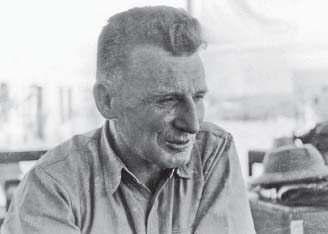
Rewi Alley, the most famous New Zealander ever to live in China, and who would become one of Needham’s most enduring friends. He gave the world the phrase gung ho.
By the time he got to Shuangshipu, his enemies had seemingly triumphed. In 1942 he had been summarily fired when it was alleged that some of his Gung Ho factories had been forging guns and weaving blankets specially for the Chinese Communist armies. The Nationalists were infuriated, not least because Chiang Kai-shek had personally seen to it that about $2 million in government funds had gone to help Gung Ho establish itself.
So Alley was removed as field secretary, and demoted. He remained on the payroll of the cooperative, but his duties were downgraded to those of a teacher in the schools that trained the Gung Ho apprentices. These were known as Baillie Schools, after the American missionary Joseph Baillie, who had first recognized the need for technical training. Since the students were invariably young and male, Alley took his demotion in high spirits, and by the time Needham came to meet him in the summer of 1943, he was contented and philosophical in his new incarnation as a master in a school for young boys.
The damage to the truck was far worse than Needham expected, and he would have to spend some time in town while the necessary repairs were made. So he set out to look for Alley, going first to the Baillie School behind the town gasworks, and then to Alley’s famous cave house—but the great man was bathing. A servant was sent to fetch Alley; and while he waited, Needham looked in on a cotton-spinning cooperative that was just being built, and traipsed through a machine shop that had been set up some months before.
Finally Rewi Alley arrived. The men shook hands; took off for the curious cottage-cum-cave where the New Zealander had lived for the past year; and had high tea—corn on the cob, honey, the large flatbread known as da bing, eggs, tomatoes, and coffee. (Needham developed a peculiar liking for bread and honey from that moment on, and for the rest of his life. On his eightieth birthday Gwei-djen reminded him of how, “when one is hungry in China, and when one feels like a sweet taste, schooled by Rewi Alley, one goes to the drug-shop and buys a jar of honey to eat with the cartwheel Gansu bread.”
The men next went to the school, where by now the boys, an irrepressible group numbering about sixty, most in their mid-teens, had been primed to line up and perform for their distinguished diplomatic visitor. They sang folk songs from the Chinese northwest, and both Needham and H. T. reported being deeply moved by one haunting melody—it was twilight, and as the boys sang the flag was lowered for the evening.
Then Needham took the stage and sang a medley of English folk songs, his thin, high voice clear in the evening air. He sang “Lilli Bulero” and “The Saucy Spanish Boy,” and after concluding from the applause that it all had gone well, he decided to forget how foolish he might look in front of the children, ripped off his army jacket, rolled up his sleeves, picked up a heavy stick—and for fifteen breathless minutes performed a series of particularly wild and whirling old English morris dances, singing lustily all the while. To all who saw his performance that August evening the image of morris dancing in China remained profoundly haunting. It left the schoolboys open-mouthed with astonishment and, Needham later assumed immodestly, delight.
He said later that he felt that while he was no Fred Astaire, what he lacked in elegance he made up for with historical accuracy and gymnastic enthusiasm. One of his colleagues agreed, writing: “Dr. Joseph Needham/ Dances with philosophic freedom./You’d better watch your toes if/You dance with Joseph.”
The friendship with Rewi Alley was sealed. Needham did not care one whit if homosexuality kept Alley in China, or specifically in this remote corner of China. In later years Needham, though an ardent heterosexual himself, would champion the cause of gay men and women—and in all likelihood he did so in part because of his deep admiration for Alley, whose sexual habits were unashamed and flamboyantly expressed.23
His headmaster in Shuangshipu, a young, aristocratic Englishman named George Hogg, was later to write of life in Alley’s peculiar house:
The main distinctive feature of Rewi’s cave in Shuangshipu is exactly the same as that of his former house in Shanghai—that at any time out of school hours it is filled with boys. Boys looking at picture magazines and asking millions of questions. Boys playing the gramophone and singing out of tune. Boys doing gymnastics off Rewi’s shoulders or being held upside down…. Boys pulling the hairs on Rewi’s legs, or fingering the generous portions of the foreigner’s nose. “Boys are just the same anywhere,” says Rewi. “Wouldn’t these kids have a swell time in New Zealand?”
North of Fengxian the scenery changes almost in an instant. The mountains, which up to this point on the journey had been of unforgiving granite clothed with stands of bamboo, give way at the summits above town to soft rolling hills, all terraced and gorse-hedged and with small flat expanses for wheat, corn, or paddy, and with the soil, most significantly, a warm shade of yellow.
This yellow soil gave its name to the Yellow River, into the wide valley of which Needham’s trucks were now beginning to make their long, slow descent. The Yellow River, the Huang He, is yellow because it tears away from its banks a huge amount of this rich soil—1.5 billion tons each year—and carries it unstoppably down to the sea. This is the muddiest river in the world, thirty-four times as muddy as the eau de Nil–colored Nile. The mud, say many Chinese, is China. The Huang He has long been known as “China’s sorrow” because the river is tearing out China’s heart and pouring it into the ocean.
The soil—fine, friable, and easily plowed—is known as loess and was so named in Germany, where geologists first noticed it. The common belief is that it is the windblown relic soil of the last great Ice Age. It is thick and extensive—loess deposits are found all over central Europe and central Asia, in vast tracts of northern China, and in the central plains states of America. It is much loved by farmers, being defined by one Victorian as “a loose light soil of prodigious fertility, and the joy of the agriculturist.”
But it was not much loved by Joseph Needham, who discovered just outside Huixian that the Yellow River’s tributaries are as loaded with silt and yellow loess as the great river itself. “We reached a difficult crossing—a sea of mud, the mountains dissolving like dilute brown cream. Rewi paddled and checked it.”24 Three trucks—Needham’s two and one other, a stranger—were stuck for many hours in the torrents of mud. Needham, patiently waiting it out, contented himself with photographing the peculiar waveforms in the river.
Needham noticed one other change in the landscape. The first evidence of the presence of Islam appeared just beyond the town of Huixian. “Visited the mosque…very beautiful,” he wrote in his diary. “Must be the most easterly mosque in Central Asia.” He made a drawing of it and wrote a caption with an additional description:
Mosque hall, garden, terrace with three old men sitting on it, ablution courtyard, road spirit wall; towers of three stories ([with a] muezzin) in Chinese style with Arabic as well as Chinese inscriptions. This included arch in lower storey. Mullah’s house with his own ablution pavilion. Bamboo-shaped bricks in the arches. Brick panels of rhomboid-shaped bricks. Trees very pretty. The whole well-painted and kept up. Everybody very friendly and obviously proud to be Muslims.
As it wore on, the journey became worse and worse, with the trucks behaving impossibly. Each day the party was held up because of broken head gaskets, oil leaks, transmission problems, flat tires. So accustomed were the travelers to mechanical upsets that a fractured piston or two seemed a mere bagatelle, and Needham met each episode with equanimity and good spirits. “Bought marvellous peaches,” he would write. “Sun came out. Had nice breakfast.” “Lovely rugs. Pots of flowers everywhere.” In one village he found that the people were less than fetching, being “very poor and smelly,” but he was thrilled to find that their daughters had bound feet. The village woman still wrapped young girls’ feet in long cloths—having broken their toes, sliced into their soles, and pulled out their nails to speed the process of creating the “lotus feet” that men seemingly craved. Needham exulted over the discovery of a custom which, however barbaric, had not been completely eradicated. The republic had banned the practice from 1911 on and had ordered all women to unbind their feet—but the unbinding was as painful and crippling as the binding had been in the first place. Needham, while revolted, found it all fascinating.25
He kept discovering treasures that he knew would be useful for his book. “Found Song dynasty pottery shards in a fort above the village,” he recorded at one enforced halt—and then whiled away the time waiting for the mechanics to repair a water pump, or some such, by ruminating on the methods of early Chinese ceramicists, and of how their techniques of throwing, glazing, and firing had been much more advanced in China in Song times—the tenth and eleventh centuries after Christ—than they had been in Europe. Lord Macartney’s China trade expedition of 1792 had brought newly created pottery from Josiah Wedgwood’s factory in Etruria as a gift for the Chinese emperor: small wonder, Needham noted, that the emperor huffily refused to accept the pieces—English ceramics must have seemed primitive to him in comparison with the Chinese porcelain of the day. (Some scholars offer an alternative explanation for the emperor’s refusal. By deigning to accept the gift of Wedgwood he would have been tacitly admitting that the English ware perhaps actually was of a quality equal to that made by his homegrown craftsmen. Such an admission would have resulted in a loss of face for every ceramicist in the empire.)
But then, as the problems with the trucks worsened, the mood turned more bleak. The head gasket blew again, and this time they had no more spares because—to Needham’s intense chagrin—Eric Teichman’s driver had taken them all. “Triple damn old Tai,” the diary notes—the only profanity seen so far. There would be more.
That night they had to sleep in a room with a pig, which didn’t improve Needham’s temper. The next morning they tried to fashion a new gasket, first by hammering flat Rewi Alley’s aluminum shaving-soap dish and covering it with cork. This blew out at the precise moment the truck was trying to cross a shallow stream. They were stuck in the middle when, alarmingly, another truck went by with the passengers all shouting “Flood! Flood!”—and sure enough within moments the stranded flagship of the Sino-British Science Cooperation Office expedition was under eight feet of water, and what had been merely immobile was now inundated, to boot.
The next day they hauled the damp, damnable Chevrolet out of the mire and made another new gasket, this time out of an old canvas bag. It lasted for just five minutes. “NBG,” wrote Needham: “No bloody good.” Needham and H. T. then left the truck altogether and hitchhiked, riding first, and very uncomfortably for about sixty miles, on top of an unstable clutch of gasoline drums in the back of an army transport: it rained and was intensely cold and the pair huddled miserably under a tarpaulin—Needham wishing, no doubt, for a cozy fire and tea and crumpets in his rooms at Caius. The truck driver eventually dropped them off at a junction; they took a rickshaw to a village called Lizhishi; found an Indian-made gasket for sale; hitchhiked back again: and were at their own truck by nightfall. The mechanic installed the gasket, and the truck worked perfectly. But then Needham developed a crippling toothache, which put him out of action for two more days.
Eventually they crossed into Gansu province, and after another day reached its biggest city, Lanzhou, a dire place best known today as the most polluted city in the world. In Needham’s time it was known for another reason: it was one of the few places where a bridge crossed the Yellow River, and this bridge might be sturdy enough to take the convoy of trucks. If Needham crossed the river and turned left, then he would be on the old Silk Road, and well on the way to Dunhuang and the caves.
On Early Suspension Bridges
In this region (Chang-ku, now Tan-pa, on the Sichuan-Xizang border) there are three suspension bridges. Hundreds upon hundreds of stakes and piles are driven in on the two banks of the river, and stones heaped over them. Long bamboo cables are suspended between them, with wooden boards laid down, and large ropes at the sides to help the traveller to support himself. Passengers walking over these bridges feel their feet declining and sinking as if they were on soft mud. But such bridges can be built where no stone structure is possible.
—From Chin Chuan So Chi, by Li Xinheng, seventeenth century
There is the site of a cable suspension bridge market just at the point where the line of the Great Wall crosses the Yellow River southwest of Ningxia and turns northwest to cross the Gobi Desert and protect the Old Silk Road.
—Joseph Needham
From Science and Civilisation, Volume IV, Part 3
By the time they wheezed gingerly across the half-broken bridge into Lanzhou, everyone in the party was tired and dejected. Being mostly British and therefore generally phlegmatic, they elected to stay put awhile, so that full repairs could be carried out on their vehicles. They would replace all the doubtful-looking gaskets, springs, oil pumps, and piston connecting rods that had plagued them since Chengdu; and to do the work they hired a man named Liu who, it was claimed, was the finest mechanic in the Chinese northwest. Needham, his tooth recovered, promptly took off to explore.
For the two weeks of his enforced stay in Lanzhou he buried himself in as much book-related science and technology as he could find. He talked to biologists at the Epidemic Prevention Bureau, to a man who made windmills and was trying to detect water underground with a technique more sophisticated than dowsing, to experts on potato viruses and horse illnesses and to vets who knew all about the strange problems that afflict sheep in the Gobi Desert. Needham looked around a machine works, a dry battery factory, a flour mill, a power station, and a hospital so modern that the lights in its operating room had mirrors incorporated inside them, the better to illuminate the patient. He took a raft across the Yellow River to see some people called Bairnsfather, found others with unusual names—a bishop named Buddenbrook, an American named Lowdermilk—and noted with pleasure that at the local technical school a man from Java was teaching two boys from the Tibetan frontier about engineering drawings, while a Chinese-Tibetan girl was doing the accounts.
He also did a series of routine, quotidian, and generally pleasant things—he had a haircut, bought himself a sheepskin coat and a set of wonderfully warm Gung Ho blankets, and stumbled across a German mission library where he luxuriated in being able to read year-old newspapers from Berlin. He found cartons of cheap but tasty Russian cigarettes and locally made, less tasty fat cigars. He also had soapstone seals carved with his Chinese name and various honorifics.26 He ate moon cakes (during the Chinese autumn festival, which took place while he was marooned), and bought wool and darned his own socks. Finally, he had a tailor run up some khaki cotton trousers, and wearing these and his freshly polished Sam Browne belt, took the local American consul out to dinner in a Muslim restaurant.
But Needham was also rather frightened, by a number of unsettling experiences and by a torrent of highly unsettling dreams.
Lanzhou was a city poised uneasily between battlefields, where conflicts of one kind or another were invariably in full flood—fights between Japanese and Chinese, between Nationalists and Communists, between untamed warlords, between frontier tribal rivals, between Russian invaders and frontier protection authorities. All of these left sad, struggling human detritus in their wake. Needham reported seeing, for example, large numbers of captured rebel soldiers “tied like hogs” and being led off to be shot. He saw “a tall country girl” trying to offer one of these wretches a bundle, before being struck full in the face by a guard’s rifle and told to be off. He saw what he referred to as a “trachoma squad” of bewildered soldiers from Sichuan, who appeared to have no idea where they were and behaved like “the blind leading the blind.” He came across groups of malnourished, waiflike children, military camp followers who, he noted with distress, kept dying overnight. Eighty-eight of them died during one particularly ghastly stop, according to Rewi Alley.
After days of distressing sights like these, it was perhaps not entirely surprising that Needham’s sleep suffered, and that his nights were interrupted with bizarre imaginings. As it happens, though, his nightmares had no obvious connection to the miseries of China, but were in fact all related to anxieties over his life in Cambridge. One of them was quite simple—he dreamed he had lost his readership in biochemistry, that he was arguing with the people at his laboratory, and that he thought he might not be allowed to come back to England once his stint in China was done. This was perhaps due to his anxiety over air travel, which he hated and had to steel himself to undertake.
Another dream he found less obviously explicable. He had been standing on a railway platform with his wife, Dophi—the notation in his China diary relating to her is in Greek, as was his custom—when an express train flashed past, collided with a vehicle, and threw out a woman’s body, “which splashed.” Seven other women then rose up, one from between the railway lines, and, terrified, they all rushed away. Then soldiers came, and Needham tried in vain to find the stationmaster to tell him what had taken place. “It was all very vivid and startling,” he notes. “Was it a premonition of danger?”
If nothing else these dreams—and there would be others, especially when the nighttime weather in China was dramatically bad—reminded Needham that, however irritating the daily difficulties of travel, his life in China provided him with a great escape. The professional and domestic trials of his everyday academic and domestic life were far away and out of sight—and if his subconscious chose once in a while to nudge his elbow and force him to think of Cambridge, of biochemistry, of his religious convictions, of his mother (who by now was near death), of his wife and his mistress, and perhaps of the consequences of his normally careless liking for sexual adventure—then perhaps it was a small price to pay. A few bad nights in exchange for a life of such license as he now enjoyed seemed a bargain, he later wrote, that most would be willing to accept.
They left Lanzhou, their truck supposedly mended, in the middle of September. The team’s makeup had changed somewhat. Ed Beltz, the American geologist whom Needham had very much liked—he was “49, an excellent chap, and tough”—had left to work at an oilfield in Gansu province. Liao Hongying, the beautiful chemist from Somerville, had opted to stay behind in Lanzhou, ostensibly to help in a local school. And Sir Eric Teichman had gone off, too, bound for the far frontier. Needham was sorry to see him go, for although his high-handedness (particularly in the matter of requisitioning trucks and drivers) had caused some inconvenience, his intelligence and courage were of the first water.
As it happened, Needham was never to see Eric Teichman again, and for the most melancholy of reasons. After Teichman left Lanzhou he traveled along the outer Silk Road and across the deserts of the Tarim basin; crossed the Chinese frontier, as planned, for the Pamir Mountains; and finally arrived in India, his months of wandering passing without unanticipated incident. He was then flown home from New Delhi. But a few days after he had returned to his country home at Honingham Hall in Norfolk, he disturbed an American serviceman who was poaching on his land, and he was shot dead. He was just sixty years old.
Needham later described Teichman as a great mentor, and his death as a terrible loss. Perhaps the passing of the funeral cortege in front of Teichman’s truck in Chongqing had been an augury, after all.
Rewi Alley alone would continue with Needham to look for a site to build a replacement school—and so the party heading up north now comprised merely Alley, H. T., and Needham, who wrote as they set off, “I simply had no idea, before I took this North-Western trip, of the sort of thing it would be. Great mountain passes, overwhelming scenery, unpredictable roads, bridges broken down, roads washed away…strange places to sleep in night after night.”
Beyond Lanzhou the road divides—to the left a main branch heads toward Tibet; and then to the right at a further junction, a small road heads off in the direction of the Tarim basin and the notoriously hostile Taklamakan Desert. Needham took neither of these, but opted instead for the first main branch to the right, along the narrow, 600-mile defile known as the Hexi corridor, the sole passageway for traders from the outer west into China, and for most of the country’s history also the only way out.
His trucks bumped along what was then little more than an execrably surfaced track. They shook themselves free of the loess hills and the choking yellow dust and muddy rivers that had caused them so much motor trouble, and headed north toward the dry grit and cold of the Gobi Desert. For several hundred miles they marked their progress by following roadside markers and the path of the western extension of the Great Wall.
On the left rose a snow-dusted mountain chain, the Nan Shan, which in Needham’s time was known as the Richthofen Range, having been named for its discoverer, the Red Baron’s explorer-geologist uncle, Ferdinand Richthofen. On the right ran what looked like a low line of adobe, twenty feet high, with dozens of caves hollowed out at its base. This rather sorry affair, crumbling and inhabited—for people lived in the caverns, and large mastiff-like dogs would rush out and bark violently on being approached—was the relic of the original Great Wall, formed of rammed earth, stones, sticks, and (it is said, surely apocryphally) the bones of its builders.
There was almost none of the brick-faced reconstruction which went on during the Ming dynasty of 600 years ago, and which gives the Great Wall elsewhere its look of impregnability and permanence. In the far west it is a rather pathetic affair, crumbled, weather-beaten, and—since it ends in a Ming fort at the village of Jiayuguan 200 miles from where it runs alongside the Silk Road—all too easy to skirt. Almost any Mongols and other marauders would have found it a comprehensively ineffective barrier, no better than an Oriental version of the Maginot Line.
It does, however, mark a frontier—topographical, geological, anthropological, linguistic—and so is a reminder of why it was first built. Within its supposedly secure confines lies China. Without is the barbarian beyond, and the names of the towns and villages that lie on the far side of the Great Wall in the west—Ehen Hudag, Amatatunuo’er, Ar Mod, Qagan Tungg—are clearly those of an alien people, unconnected with the Chinese, other than being their neighbors and, in Needham’s time, their vassals.
The high grasslands here, vivid green and speckled with grazing sheep, reminded Needham of the South Island of New Zealand, or the machair of western Scotland; and when he first saw the Great Wall there was a spectacle in the making, with a thunderstorm boiling over the southern mountain ranges, and little naked shepherd boys in fur cloaks running into the caves for shelter.
He loved the fact that the more distant hills rising out of the Gobi were called the Cinnabar Mountains, and he thought the whole conjunction—of names, weather, and great antiquity—was vastly impressive. He thought this even more when he crossed a cwm called Black Crow Sand Pass, raced down the slope on the far side to the nondescript village of Anyuan, lunched at a nearby mission, and discovered that its abbot was from England and, moreover, an Old Etonian. Only later that night, when the truck broke down yet again and he had to spend the night in a truckers’ rest stop, did his equanimity falter: his night, he said “was like sleeping in a public lavatory with cocks crowing under the bed.”
Northwestward the scenery became harsher, more desertlike. Soon there were camels. At first most of them were solitary, but later Needham saw some harnessed together, in baggage trains. These were Bactrians, with two humps and a great deal of hair; and though they appeared to be numerous enough in Needham’s day, an innkeeper in the oasis of Shandan27 recently reported that they have become very rare, and are currently endangered. There are maybe 500 Chinese Bactrians in the world, the innkeeper said, most of them living and working in this lonely part of Gansu province.
Beyond Shandan was Jiayuguan, the rather ramshackle fort of turrets and angular baileys that the first Ming emperor threw up at the western end of the Great Wall in 1372. This, sited in what is known as the “First Pass under Heaven,” was the place where exiles used to be sent, to be dispatched to the dismal lands of the great beyond, far away from the civilizing delights of the Chinese empire. Jiayuguan was also the site of the first imperial customs post. All who came here from the great beyond—all the camel trains that trekked in from Arabia, and came up and over the Pamirs and the deserts of Central Asia—could pay their first taxes and fealties to the representatives of the Beijing court, no matter that they still had 2,000 miles of trekking before reaching the capital. And even when the capital was at Chang’an, today’s Xi’an, it was still 1,000 difficult miles away.
The westernmost entrance of the fort, the most distant from the Chinese center, is known as the Gate of Sorrows, and through it were sent all those doomed to be exiled. For those dispatched through it by imperial edict, it was a gate of no return, and it was popularly known simply as “China’s mouth.” To be within, to be “inside the mouth,” was to be safe, whole, content, one of the Yellow Emperor’s beloved children. To be beyond it, however, beyond the reach of the Celestial Empire, was to suffer a dreadful and unimaginable fate in a land of monsters who had red hair, drank milk, had eyes in their ribs, and wailed in perpetual pain.
In the final days before he reached his goal, Needham spent many nights at lonely hostels in the Gobi Desert. These were run by the New Life Movement, one of Chiang Kai-shek’s half-baked schemes for reviving Confucian ideals. Needham liked the inns, noting that in one the spoons came from Leningrad and that another had been built into a sandstone fort resembling one he remembered in Dubai, in southern Arabia. The shops he found were stocked with Russian goods; the smuggled Japanese canned foods that could be found elsewhere had clearly not penetrated this far.
And then, at the end of September, almost two months after leaving Chongqing, and 300 miles farther on, he was finally at his destination, Dunhuang. Out of the sand suddenly rose the green trees of the oasis—and somewhere nearby were the caves.
At first it seemed as if this might be a bit of a letdown. Needham’s diary suggests that he was somewhat underwhelmed. One has to imagine that after getting bogged down more times than he cared to relate in the fine white sand that surrounds the town, he was now simply dog-tired. His remarks relate to comfort far more than to culture: Dunhuang, he noted, was very clean, and the nectarines, the pears, the crabapples that looked like large cherries, and the Hami melons from the great Turfan depression some miles ahead were “most delicious.”
The following day he did drive out, as planned, to see the town’s famous caves, the hundreds of hidden cliff-grottoes which housed innumerable paintings and carvings of the Buddha—and where the Diamond Sutra had been found. But his notations are still perfunctory—“worked on caves all day” is about his only written remark, and seemingly written without very much enthusiasm.
But this would all change, thanks to what, in view of the earlier experiences of his epic journey, he might well have anticipated. The truck broke down once again—this time so catastrophically (its main bearings sheared) that Needham and his party would be stranded—not for the next six hours or six days, but for the next six weeks.
The Dunhuang oasis, where palm trees and melon vines suddenly rise out of the endless sands of Turkestan, exists thanks to a river called the Daquan, and to a small body of crystal-clear water called Crescent Moon Lake, which, despite being surrounded by fantastically high dunes, is by some hydrological mystery never filled in. The view from the highest range of these dunes, the Hills of the Singing Sands, is unforgettable. Dawn is the best time to climb: the sky (like the lake) is invariably crystal-clear, the robin’s-egg blue of early morning. The lower dunes rise and fall and glitter, immense sharp-sculptured waves of pale yellow crystal, as far as it is possible to see. The sun rises fast over a white-hot horizon. To the west, toward the trackless wastes of the Taklamakan and Lop deserts, all is still dark, but cloudless, and the summits of the distant dunes are tricked out with gold as the sun catches their edges.
And then, rising from between the closer dunes, their vertical spires contrasting dramatically with the desert realm of the horizontal, are green trees by the thousands. There is water, somewhere nearby. This truly is an oasis, a place of refuge and settlement—and among the trees there are buildings that glint as the sun catches them, scores of structures, the upswept eaves of a nest of pagodas, the minarets of a mosque or two, a cluster of hotels.
Dunhuang is the most important junction of this section of the Silk Road, a place where the merchants and pilgrims of centuries ago had to decide whether to pass to the north or to the south. If they were heading toward India and Arabia, the southern route was the better; if bound for Antioch and the Mediterranean, they would strike out to the north. Dunhuang was where travelers on the outbound journey would rest and decide which route to take; and on the way home it was where they would rest and give thanks for having survived.
Of the hundreds who passed by way of the Dunhuang junction, the Buddhists in particular offered the most profuse gratitude. They did this in three specific sites near the town, in gorges made by the river where the eroded cliffs stood tall enough and wide enough to allow the creation of what Indian Buddhists had long ago shown a liking for—scores on scores of intricately decorated caves, designed specifically for their mendicants and meditations.
Of the three cave sites, by far the largest and most important was a cliff, one and a half miles long, at Mogao. Wandering monks began incising caverns into the soft sandstone cliffs of Mogao and in neighboring valleys during the fourth century, and by the time the last cave was dug in the fourteenth century, more than 700 had been created—some as small as coffins, and made for sleep and shelter; others many stories high, containing gigantic statues of the Buddha, and used for worship and salutation.
One of the twentieth century’s memorable explorers of Asia, the Hungarian-born British citizen and archaeologist Marc Aurel Stein, reached this set of caves in the spring of 1907—with consequences that were to have a considerable bearing on Joseph Needham’s later work.
Stein, who was born beside the Danube in the city of Pest in 1862, took degrees in Sanskrit, Old Persian, and the new science of philology at the universities of Vienna, Leipzig, and Tübingen. By the time of his discoveries in Chinese Turkestan he was in early middle age and revered for being doughty, implacable, imperturbable, and case-hardened to any trials that might befall him on the road. Since the beginning of the century, when he had completed a two-volume translation of a twelfth-century Sanskrit work, the Rajatarangini, he became obsessed with a single fascinating story: how Buddhism was carried from its birthplace in the high Himalayas of India, across the ranges and into the vast and protectively xenophobic empire of China.
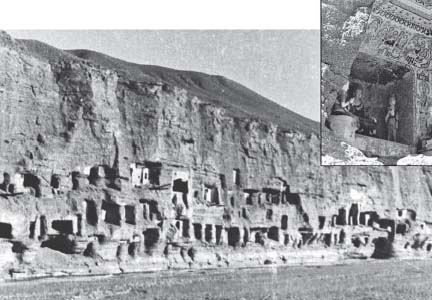
An early photograph of the Buddhist caves carved into the Mogao cliffs near Dunhuang. The world’s oldest printed book, the Diamond Sutra, was found in an annex to a lavishly illustrated cave like that pictured.
There was no doubt that it had migrated there: the White Horse Temple in the eastern Chinese city of Luoyang had been built in the first century after Christ and was an unequivocal celebration of Buddhism. But how had something so very Indian become, in short order, transported, transformed, and transmuted into something so very naturally Chinese? Stein, plodding patiently through the deserts just north of the mountain ranges, was determined to discover the answer.
His research, and that of other scholars in France and Germany, showed that it was all the work of a number of determined and very peripatetic monks. Some of these monks were Indian, some were Chinese, and in the first decades of the first millennium they had managed, through grim determination and no doubt some memorable heroics, to carry the message of the Buddha—usually by word of mouth—across the dangerous high-altitude passes between the two great empires. They brought their stories down to the main trade route between central Asia and China that would in time become known as the Silk Road—the same road Needham had been so patiently traveling for the last eight weeks.
Once on the road, the Buddha’s word soon reached the Chinese court. As soon as the senior mandarins at Chang’an, or Xi’an, had been shown images of great golden statues of his calming presence, and told the finer details of his teaching, they officially declared themselves impressed. Over time the religion took firm hold in establishment China. When it was fairly well settled, Chinese pilgrims began to make the long, dangerous journey to its source, to see for themselves the fountainhead of their new faith. Groups of translator monks also began to journey and to forage for the details of Buddhism, and in the process began the collection, translation, and dissemination among the Chinese of the great Buddhist texts, the sutras.
One of these wandering monks is remembered today in particular, and with reverence. He was Xuan Zang, a scholar’s son from the east of China. Tales of his adventures along the Silk Road in the seventh century, and of his expeditions to Nepal and India and to present-day Pakistan and Afghanistan, became well-known in Chang’an and beyond. His stories, all based on diaries written with priestly precision, are full of such fantastic happenings that they have survived into modern times—they find their way even today into the comic-book world of Japanese manga.
The equally romantic explorer Marco Polo had once been to this same desert, and had also left voluminous writings that Stein studied. But it was Xuan Zang’s adventuring that particularly inspired him. The memory and the accounts of this tough old monk led him, eventually and inevitably, to strike out for Dunhuang himself, to find the caves, and to uncover the astonishing treasure trove of Buddhist documents that would make him world-famous. This find would provide even more of an epiphany for Joseph Needham when he himself arrived in Dunhuang, dog-weary, highway-stained, and stranded, thirty-six years later.