
CHAPTER THIRTEEN
I
January 2, 1899—inauguration day—was bitter cold in Albany. A layer of snow coated the streets, and the temperature hovered around zero. Along the Hudson River the bucking wind had brought all vessels, even the icebreakers, to a halt. As governor-elect, Roosevelt headed to the state capitol as part of a parade, the trombones following him “froze in silence,” with only the drums keeping up a Sousa-like beat.1 Even the photographers refused to take pictures, for fear of damaging their expensive equipment. That afternoon, following swearing of the oath of office at the capitol, Roosevelt moved his family into the state executive mansion on Eagle Street. Typically, he refused to allow the inclement weather to extinguish his euphoria at becoming governor. Come spring, the entire front yard would be blooming with a variety of roses known as New Yorkers, plus hundreds of other indigenous plants from every county in the state. But now, as the seasonal cycle went, the lawn offered only bare elms and some evergreen shrubbery caked in frost.2
Becoming governor of New York was quite a historic achievement for Roosevelt. He was following in the larger-than-life footsteps of John Jay, Martin Van Buren, and Grover Cleveland. Back in 1891 Roosevelt had published History of New York City, for some quick money, anatomizing past governorships for anecdotal well-springs of raw courage.3 Indeed, Roosevelt understood that he was part of a very special club—the governorship of New York—whose antecedents ran from the Revolutionary War to the Spanish-American War. Seventeen years previously, he had come to Albany as an assemblyman: now he was running the state with the largest population in America. Roosevelt was no longer simply moving through history. He was poised to make it.4
That first evening in Albany, Roosevelt left Edith and his children in the executive mansion with a night watchman on duty and ventured outside into the vicious sleet. It wasn’t family-friendly weather. Dinner was being served at a friend’s house for society types of his own rank, a five-course meal worthy of Delmonico’s in Manhattan. He didn’t want to be late. Upon his arrival cocktails were handed out on specially engraved silver trays. At the dinner table the talk centered on current events. In an adjacent room a violinist played movingly, but Roosevelt talked over the mellifluous music. All the hale-looking gentlemen, most with stylish mustaches, sat riveted as he held court over buttery foods. At eleven o’clock the governor-elect said good night to his hosts and was driven back to the executive mansion. Dismissing the carriage prematurely, Roosevelt walked across the veranda to the front door; it was locked. Three or four times he rang the bell, feeling slightly like a Cossack trying to get into the czar’s palace. Nobody came to his rescue—not Edith or the night watchman or an awakened child. Losing patience, worried he was going to turn as blue as a winter corpse, an east wind cutting through his topcoat, Roosevelt clutched his key ring as if it were brass knuckles and smashed his fist through the plate-glass window. Reaching through the hole, he flipped the catch and gained entrance for his first night’s sleep as governor. The following day the New York Times ran a whimsical headline: “Gov. Roosevelt Shut Out.”5
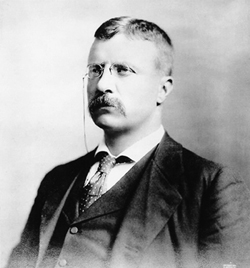
Theodore Roosevelt was governor of New York from 1899 to 1900.
Roosevelt as governor. (Courtesy of the Library of Congress)
That was the only time in Theodore Roosevelt’s two-year term as New York’s governor that the words “shut out” would appear next to his name. Starting with his first annual address, presented shortly after the inauguration, Roosevelt launched an activist reformist agenda. Sandwiched in between discussion of roads and the economy was a section Roosevelt called “The Forests of the State.” The governor declared he would work against both the “depredations of man” and “forest fires” to keep parts of New York forever wild. He wanted to realign state government on behalf of conservation and natural resource management, demanding scientific answers to statewide environmental problems. (If Roosevelt had an overriding conceit in early 1899, it was that he thought in terms of geological time and in biological imperatives, whereas lesser politicians in Albany were part of the pettiness and crudeness of campaign cycles). The first annual message also declared that fish and game laws would be “more rigidly enforced.” The Adirondack Park, under Roosevelt’s watchful stewardship, truly would become a monument to “the wisdom of its founders.”6
What infuriated Governor Roosevelt about conservation and wildlife protection in his home state was its politicization, which led to inveterate inefficiency and callous disregard of nature. The state Fisheries, Game, and Forest Commission, for example, was packed with self-serving politicians who didn’t know flickers from juncos, who had never read Darwin’s A Naturalist’s Voyage or marveled at John James Audubon’s drawings of elegant egrets. Their uninformed anti-forestry views had spread like dermatitis over the state, he believed, negatively affecting the Catskills and Adirondacks. Whether he was taxing corporations, improving the Erie Canal, revamping mental hospitals, issuing new labor laws, or crusading on behalf of forestry, Roosevelt was well aware that his reformist policies would influence other states. Owing to his leadership of the Rough Riders, his national popularity was sky high. Reporters from Maine to California, understood that he made terrific copy. Widespread fame had brought him all its perks and degredations. “Everything he did,” the historian G. Wallace Chessman reflected in Governor Theodore Roosevelt, “would go into the record, to be used for or against him in the future.” 7
From day one as governor, Roosevelt championed the hiring of biologists and scientific experts for the New York Fisheries, Game, and Forest Commission, preferably experts trained in the Ivy League, to replace the politicians—who were like bloodsucking ticks on the state’s resources. Too often they used their positions of power to promote sweetheart deals. An investigation of the commission, Governor Roosevelt threatened, was under way. Warily, Roosevelt sought to fire the politicians on the statewide game commission and replace them with independent-minded biologists, zoologists, entomologists, foresters, sportsman hunters, algae specialists, trail guides, botanists, and activists for clean rivers. In Germany this phenomenon was being calledDarwinismus. “The state of New York is fortunate at present in having a Governor who is not only deeply interested in all matters of game, fish and forest preservation,” George Bird Grinnell noted in Forest and Stream in May 1899, “but also has so clear an acquaintance with these subjects that he can always be depended upon to act on them for the public good.”8
Grinnell believed that for all his Rough Rider’s machismo, in private Governor Roosevelt wasn’t a know-it-all. Constantly, as his own correspondence bears out, Roosevelt would seek advice from acclaimed zoologists and foresters. Which herpetologist was the expert on snapping turtles? Which forester knew about a new strain of invasive fungi? Shouldn’t George Perkins Marsh’s The Earth as Modified by Human Action be carefully studied before the state allowed a paper company access to Bear Mountain? Basically, Governor Roosevelt wanted the state bureaucracy reduced and cronyism purged from natural resource management. One good silviculturist or pisiculturist, he believed, was worth more than any number of politicians looking to have their palms greased. Governor Roosevelt, in fact, advocated changing the commission altogether: from having five members to having only one scientific forestry leader—an idea also enthusiastically promoted by Gifford Pinchot.9
Pinchot was only thirty-four years old in 1899 but had established himself as an independent progressive of some note. Although he had been born in Connecticut, he was uncommonly proud of his French ancestry.10 His father, James Wallace Pinchot, a broad-ranging intellectual, had been an intimate friend of the elder Theodore Roosevelt.11 A graduate of Yale University (class of 1889, summa cum laude), Pinchot played on its football team as a reserve and was a member of the campus-based YMCA and a regular volunteer at the Y’s Grand Street Mission in New Haven.12 Strong, handsome, and notable for his porcelain-blue eyes, Pinchot was in such fine pulmonary shape that he could read from The Compleat Angler while doing a one-armed push-up. After college Pinchot spent more than a year at the École Nationale Forestière in Nancy, France, studying forest conservation. As part of his education he toured the most ably managed ancient woodlands of France and Germany. Meteorology, botany, and even astronomy came easily to Pinchot; he took up anything that could help him decode the mysterious forests of the world. Pinchot’s father had been a mainstay of the American Forestry Association, strongly advocating conservation management. Inspired by his father, Pinchot decided in his early twenties to dedicate his life to forest conservation. As proof of his pro-forestry convictions, he helped transform the family estate, Grey Towers in Milford, Pennsylvania, into a tree nursery, “the first forest experiment station in the nation to encourage the reforestation of denuded lands.”13
At the time Pinchot began foresting at Grey Towers, the United States had no university or college forestry program. He wanted to change that unfortunate situation. In 1892 he began the first serious systematic forestry work in American history at the timberlands of George Vanderbilt’s mansion, Biltmore, outside of Asheville, North Carolina.14 At the start nobody knew whether it was an advanced pilot program against catastrophism or a hillbilly boondoggle. Before long, however, this wasn’t a question: Pinchot’s forestry methods helped Biltmore prosper. In 1892 he opened an office in New York City, marketing himself as a forestry consultant. Pinchot wanted Americans to avoid the kind of horrific deforestation that had taken place in Europe ever since the industrial revolution oversaw the reckless wholesale destruction of the continent’s natural resources. Pinchot was a devotee of George Perkins Marsh, the pioneering Vermont conservationist who wrote Man and Nature, and he took seriously Marsh’s concern that parts of Asia Minor, North Africa, Greece, and Alpine Europe had been deforested to the die-off point of being as barren as a moonscape. “The earth is fast becoming an unfit home for its noblest inhabitant, and another era of equal human crime and human improvidence, and of like duration with that through which traces of that crime and that improvidence extend, would reduce it to such a condition of impoverished productiveness,” Marsh had written, “of shattered surface, of climatic excess, as to threaten the depravation, barbarism, and perhaps even extinction of the species.”15
The label applied to Pinchot time and again, borrowed from the Scottish philosopher John Stuart Mill, was “utilitarian.” In conservationist terms, this meant a believer in wise use of natural resources. But the label also unfairly minimized (and at times maligned) Pinchot’s lifetime effort to preserve and expand many of America’s most magnificent forestlands. He was a tireless crusader for both utilitarian forest preserves and wildlife protection. “The eyes do not look as if they read books,” Owen Wister wrote of Pinchot, “but as if they gazed upon a Cause.”16
Pinchot first came to Governor Roosevelt’s serious attention in 1896, when President Cleveland appointed the Yalie chief forester; however, they had dined together once, in May 1894. (Roosevelt, in fact, wrote Pinchot a quick note following the meal: “I did not begin to ask you all the questions I wanted to.”) 17 By 1897, Roosevelt thought enough of Pinchot to nominate him for the Boone and Crockett Club.18 And in 1898, when Pinchot became President McKinley’s head of the Division of Forestry (renamed in 1905 the United States Forest Service), Roosevelt roared his approval. Independently wealthy, using the family fortune to help promote western reserves, almost British in demeanor, Pinchot saw himself as the Exeter-and Yale-trained advocate, press agent, and spokesperson of a new forestry movement. His nickname was: “the Chief” (or “G.P.”) and his forestry associates were “Little G.P.s.” In his 1936 book Just Fishing Talk, Pinchot said that when he was a teenager, the Adirondacks had been his touchstone place, the woodlands where he learned to catch brook trout and painted turtles. As with Roosevelt, the Adirondacks had given Pinchot, a world-class fly-fisherman, “a new and lasting conception of the wilderness.”19
In early February 1899 Pinchot finally spent significant time with his idol and family friend. The governor had invited him to spend an evening in the Eagle Street mansion. Roosevelt had become something of a roadside attraction in Albany since inauguration day, with everybody wanting a moment of his time. Cognizant of Roosevelt’s new Rough Riders fame, Pinchot was grateful to have been included in Roosevelt’s frenetically full calendar. Accompanying Pinchot to the meeting was the architect Grant La Farge, the son of the famous painter and draftsman John La Farge (whose closest friend was Henry Adams).20 Roosevelt not only liked Grant La Farge—a fellow member of the Boone and Crockett Club whose face had a scrubbed Bostonian intellectual look—but named him the New York state architect during his first year as governor. The firm of Heins and La Farge, in fact, was commissioned by Roosevelt to build the Bronx Zoo. At Roosevelt’s recommendation La Farge also received the contract to design the first buildings at the State University of New York–Albany.21
As Pinchot and La Farge waited to be called into the governor’s office, they grew slightly nervous. Understanding that the wildly popular Governor Roosevelt was the most celebrated outdoorsman alive, they hoped to form a united front with him on the pressing forestry issues of the era. Pinchot’s principal concern was that every hour, the United States had fewer trees than an hour before. Deforestation in such places as the Olympics, the Cascades, and the Front Range of the Rockies was now widespread in land tracts not protected by the Cleveland Reserves. (And it was taking place even in some acreage that was supposedly protected.) Too many unscrupulous deals for U.S. government leases were being made in and around the western reserves. Pretty soon all the raw land west of Denver might look defiled like in Haiti, China, and Italy. The dire warnings in Man and Nature had to be heeded. The lack of water for irrigation was also a serious problem in places such as California and Nevada. Pinchot essentially promoted two remedies: creating more forest reserves and allowing some regulated timbering within their boundaries. Pinchot’s scheme was to enlist Governor Roosevelt in the great cause. Roosevelt—a politician who refused to sit on the dais while the band played—was his best hope for developing a new, widespread public awareness of the perpetual benefits of the forest realm. America had to remain a land with luxuriant woods and verdant valleys. “We arrived just as the Executive Mansion was under ferocious attack from a band of invisible Indians,” Pinchot recalled in his autobiography Breaking New Ground, “and the Governor of the Empire State was helping a houseful of children to escape by lowering them out of a second-story window on a rope.”22
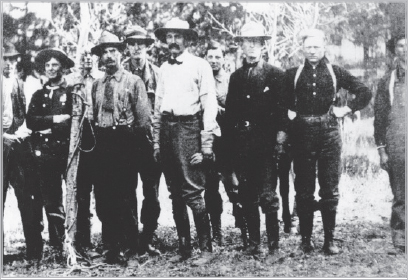
Gifford Pinchot and his forestry team.
Gifford Pinchot and forestry team. (Courtesy of Gray Towers National Historic Site, Milford, Pennsylvania)
What a grand time Pinchot and La Farge ended up having in Albany with the famous Rough Rider! They cut up like misbehaving kids and acted as if they were trail mates; and Governor Roosevelt told numerous stories about adventures off the beaten path. All three shared a gratifying intellectual curiosity about the natural world. Roosevelt, in fact, acted not as a governor with authority and power, but as a fellow wilderness enthusiast, a fraternity brother from the world of the Boone and Crockett Club. He was excited by the talk of the Pacific Northwest and the Front Range, and his facial muscles flexed as he spoke, while his knees bounced with boyish enthusiasm, as if he were overcaffeinated. Any moment, it seemed, he would climb out the window on a rope himself then break another plate-glass to get back inside the mansion. Keenly observant, Pinchot noted that when the Adirondacks were mentioned Governor Roosevelt perked up like a border collie eyeing sheep. Lake Tear-of-the-Clouds, Algonquin Peak, Upper Ausable Lake, Lake George—such natural wonders had magical connotations for Roosevelt, as they would later for the painters O’Keeffe and Hartley.
Capitalizing on the governor’s love of this natural setting, Pinchot hoped to form an alliance with Roosevelt that afternoon and evening, for preserving the deciduous hardwoods of the Adirondacks—especially the sugar maple, American beech, and yellow birch. What was supposed to be a short chat with the governor on their way to examine forested acreage owned by the Adirondack League Club (renamed the Tawahus Club in 1897), turned into hours of rollicking storytelling about the outdoors. Clearly, Roosevelt was fascinated to hear about the old-growth forests of the Olympics and Cascades, which Pinchot had recently toured (and photographed) as President McKinley’s “confidential forest agent.” But Roosevelt’s immediate concern as governor was the deterioration of the Laurentian mixed forests from Nova Scotia to the bogs of Lake of the Woods in Minnesota, especially in the Adirondacks and Catskills.
That first evening together, after hopscotching from one topic to the next like red-bellied nuthatches scouring for insects at one decayed stump after another, Roosevelt and Pinchot—in an act of primordial male bonding—put on gloves and boxed. Weaving and jabbing, throwing right and left jabs, ducking punches, Roosevelt was able to size Pinchot up as an honest man with a killer instinct. “Pinchot truly believes that in case of certain conditions I am perfectly capable of killing either himself or me,” an amused Roosevelt wrote. “If conditions were such that only one could live he knows that I should possibly kill him as the weaker of the two, and he, therefore, worships this in me.”23
But that evening it was the six foot and two inches tall Pinchot who seemed the stronger—at least at first. “I had the honor,” Pinchot wrote in his autobiography, “of knocking the future President of the United States off of his very solid pins.” Fellow Boone and Crocketters had been saying that the patrician Pinchot was, surprisingly, a “man’s man,” who could “outride and outshoot” anybody. Roosevelt put the Yalie’s reputation to the test and came out with a favorable impression.24
Roosevelt, not to be defeated, shrugging off the boxing loss, immediately challenged Pinchot to a wrestling match, anxious to show off some pinning techniques. This time Roosevelt easily won the match. The score was now even at 1 = 1. Shrewdly Pinchot decided that it was best to safeguard the tie; a split decision, he reckoned, was the best outcome in dealing with a family friend with such a large ego and such a competitive disposition. Sometime during the punches and take-downs, Roosevelt decided to trust Pinchot; he liked the Old Boy’s gameness, the way he didn’t refuse a challenge, his aristocratic mien, and his abiding sense of noblesse oblige. And, more important, Pinchot wholeheartedly shared Roosevelt’s ideals regarding scientific forestry. Pinchot was also impetuous, and the governor liked impetuousness in a man. Patience, Roosevelt believed, was a bent card that the dim and selfish played. Grinnell remained Roosevelt’s muse on wildlife protection issues, but the irrepressible Pinchot, Roosevelt’s junior by seven years, now was effectively anointed his guru on forest policy. Roosevelt and Pinchot formed an alliance that would have a profound effect on the modern conservation movement. Together, they would promote America’s forests with firm confidence and zeal.
Ironically, even though Pinchot advocated forest conservation, he was seen as a sellout by thoroughgoing preservationist friends of Roosevelt, such as John Muir and William Temple Hornaday. The fact that Pinchot wanted to allow regulated tree harvesting in the Western Reserves was nearly anathema to them. Governor Roosevelt knew about this, but he thought the put-downs unfair. After all, Pinchot’s family was about to donate $150,000 for Yale University to start a forestry school and was starting a forestry camp at Grey Towers to teach a new generation wise use policy.25 “Gifford Pinchot is the man to whom the nation owes most for what has been accomplished as regards the preservation of the natural resources of our country,” Roosevelt later said. “He led, and indeed during its most vital period embodied, the fight for the preservation through use of our forests.”26
Pinchot embraced Governor Roosevelt’s notion that New York should have one superintendant who could replace the five-man Fisheries, Game, and Forest Commission.* Roosevelt would promote this concept, saying that a “system of forestry” needed to develop “along scientific principles.”27 Roosevelt also implored the chief of the U.S. Forestry Division to help him preserve the Adirondacks as completely as Yellowstone and Yosemite. The east coast population centers, he believed, needed wilderness parks to help revive city dwellers’ spent spirits. As Pinchot and La Farge headed to the Adirondacks to help establish a land management plan, setting up camp at Lake Colden, located midway up the mountain, they had the governor on their side. Roosevelt, in fact, gave them carte blanche to use his name as expedient. Roosevelt was starting to understand that Pinchot wasn’t merely a forester but a revelation.
What really sealed the deal between Roosevelt and Pinchot was their shared admiration of 5,344-foot Mount Marcy, the tallest peak in New York. More than thirty years after Roosevelt first saw its summit, Mount Marcy (named in 1837 after Governor William Learned Marcy) still had magnetic appeal to him. (Sometimes Mount Marcy was called Tahawus, Cloudsplitter, or High Peak of Essex by locals.28) Compared with four larger eastern summits—Mount Mitchell, Mount Washington, Clingman Dome, and Mount Rogers—Marcy was a “bump” yet its slopes were still covered by primeval forest.29 Now, in freezing February temperatures, Pinchot and La Farge were planning on snowshoeing to the top of Mount Marcy with the help of two Indian guides; theirs would be only the second ascent ever attempted in winter. Upon hearing about their planned adventure, Roosevelt lit up like a Christmas tree. Bully! If he hadn’t just started his job as governor, he would have joined the Ivy League explorers on the historic climb. Reacting as if they were about to go to the North Pole or Antarctica, Roosevelt demanded that Pinchot and La Farge report to him in Albany after the ascent. Hungrily, like a city editor, he wanted details of the twenty-foot snow drifts and ice squalls. The trip to Mount Marcy, Pinchot recalled, was “exactly in his line.”
Yes, yes, both Pinchot and La Farge vowed to Roosevelt, they would visit Albany with firsthand reports of the summit immediately following their ascent. They had suddenly become Roosevelt’s pro tem wilderness correspondents. True to their word, Pinchot and La Farge braved the mountain, but because of a blizzard it was rougher than they expected. Even Governor Roosevelt would have deemed them demented for challenging Old Man Winter so brazenly. As in tundra country, all the evergreens were, as Pinchot put it, “a monument of snow.” Pecking out footholds wherever possible, Pinchot and La Farge pressed forward, half a step at a time, constantly shivering. Underdressed for the arctic temperatures, they nevertheless progressed incrementally in the squall. Both guides quit: one claimed that his snowshoes were too long, and the other had developed numbness in a leg. Normally, the pragmatic Pinchot would have retreated, recognizing that mountaineering in such brutal weather was like Russian roulette: one Canadian cold front could bring death faster than sleep. But he didn’t want to tell Governor Roosevelt he had failed. So Pinchot and La Farge, minus the guides, pressed on.
Grant La Farge later wrote about the climb for Outing, saying that the gale-force wind was like a “battery of charging razors.”30 Also, visibility was no better than what might be seen through a sheet. About three-quarters up Mount Marcy, they were reduced to crawling on hands and knees to reach the summit. Pinchot said that he held his “head down in the squalls” and stopped “every minute or two to rub my face against freezing.” 31 Even their mustaches and eyelashes froze. Eventually, through sheer willpower, they arrived at the summit’s signal pole, but they saw nothing but snow and ice. “Got to the top,” Pinchot wrote in his diary. “Foolish.”32
Worried about contracting grippe or whooping cough, Pinchot and La Farge snapped photographs of each other and then crawled back down Mount Marcy as quickly as possible—dizzy, terrified, suffering from frostbite.33 The three-day ordeal was the most dangerous of their lives. Once they were warm by a lodge fire, Pinchot and La Farge, to their horror, learned that they had been climbing in the blizzard of 1899—called the “Storm King” by the press. Unprecedented arctic temperatures had socked and crippled the entire Northeast. Water pipes, it was said, had burst throughout every county in New York. The weight of snow had caused house roofs to cave in. They were lucky—very lucky—to be alive. Both men later retold the story of ascending Mount Marcy as if they were characters in a knockabout comedy.
Their harrowing climb, however, produced one positive result. Returning to the executive mansion in Albany as promised, Pinchot and La Farge had wild stories to regale Governor Roosevelt with. Feeling left out, Roosevelt announced that he too would conquer the Adirondacks’ tallest summit come August or September when the weather got better. Full of “dee-light,” pleased to hear about their mountaineering antics, Governor Roosevelt had come to embrace Gifford Pinchot as a new member of his extended outdoors family. Given how close their fathers had been, they fell into an easy camaraderie as if they were long-lost blood brothers. (La Farge, an early member of Boone and Crockett Club, had long ago received T.R.’s stamp of lifetime approval.) 34
II
One New York leader Governor Roosevelt was constantly trying to outfox was Thomas “Boss Platt. Ever since he served as a New York assemblyman from 1882 to 1884, Roosevelt refused to join Platt’s Republican rubber stamps. He was unimpressed by Platt and distrusted him—Platt had flunked out of Yale and had worked as a pharmaceutical salesman and, in Michigan, as a lumber operator. Roosevelt, however, was deferential to Platt—his elder by twenty-five years—merely because political expediency demanded it. He didn’t want to spar unnecessarily with a slugger. As past president of the Tennessee Coal and Iron Company, Platt knew at least one thing about geology: that the land had glorious treasures which could be extracted. He considered nature sightseeing a fey enterprise. He had been elected to the U.S. Senate from New York in 1896, and when his photograph appeared in the New York Tribune on January 21, 1897, it was the first halftone reproduction ever published in a daily newspaper. As of 1899, only Governor Roosevelt was a more recognizable New York personality than the fit, trim, bushy-sideburned Platt. In his dogged, confident, shrewd, relentless way, Platt was a formidable counterpart to Roosevelt; their values, however, were at the opposite ends of the Republican Party’s spectrum. Nevertheless, after only a month in office, Roosevelt wrote to John Hay that, to his surprise, he was “getting on well” with Platt.35
Almost monthly Governor Roosevelt and Senator Platt engaged in parlor debates at roundtables on topics such as corporate taxes, improved schools, and funding state infrastructure. Sometimes Roosevelt and Platt found themselves in general agreement on foreign policy issues including the annexation of Cuba and the building of an interoceanic canal. But when it came to conservation issues they were like positive and negative jumper cables; when their ideas touched, sparks flew in all directions. Quite simply, Roosevelt refused to water down his conservationist beliefs to curry favor with Senator Platt. They differed on scientific forestry, the Palisades, antipollution laws, and the need for watersheds.36 Wisely, Boss Platt—who was never bored in Roosevelt’s “impulsive” presence—let him have the parklands, preferring to have him champion birds’ rights than meddle in antimonopoly fights on Wall Street, where huge sums of Republican money were at stake. Platt was careful not to denounce Roosevelt publicly; instead, he paid Roosevelt a backhanded compliment by saying that at least the Colonel wasn’t a slacker. “Politicians found [Roosevelt] a hard customer,” John Burroughs recalled of his stormy relationship with men like Boss Platt. “His reproof and refusal came quick and sharp. His mannerism was authoritative and stern…. His political enemies in Albany, early in his career, laid traps for him, in hopes of tarnishing his reputation but he was too keen for them.”37
As of April 1899, Governor Roosevelt’s ideas about pushing oneself to the limits were only implied, or only written in letters to friends. Certainly, reading about the virtues of the pioneers in The Winning of the West or about military fortitude in The Rough Riders made it clear that Roosevelt believed overcoming hardship built character; oddly, he always seemed happiest with no accoutrements except a horse and rifle. There are even wisps of evidence that he was a devotee of recapitulation theory: a belief, propounded by a professor of pedagogy and psychology, G. Stanley Hall, founder of Clark University in Worcester, Massachusetts, that “overcivilization was endangering American manhood.” According to Hall, American boys were becoming effeminate and needed to return to primitivism instead of wallowing in Victorian-era “ideologies of self-restrained manliness.” Too many American men, Hall argued, were having neurasthenic breakdowns. Among Hall’s many prescriptions for this decline of American manliness were the promotion of the “savage” in boys, the introduction of nature into their workweek, the creation of physical fitness regimens, and the rejection of the bureaucratic-corporate economy. Hall “believed that by applying Darwinism to the study of human development,” the historian Gail Bederman says, “he could do for psychology what Darwin had done for biology.”38
Addressing the Hamilton Club in Chicago on April 10, the thirty-fourth anniversary of Lee’s surrender at Appomattox Court House, Roosevelt pulled together all his “up from asthma” thoughts and presented them to the American public preparing to enter the twentieth century as the doctrine of the “strenuous life.” He was introduced by William “Buffalo Bill” Cody. “In speaking to you, men of the greatest city of the West, men of the State which gave to the country Lincoln and Grant,” Roosevelt began, “men who pre-eminently and distinctly embody all that is most American in the American character, I wish to preach, not the doctrine of ignoble ease, but the doctrine of the strenuous life, the life of toil and effort, of labor and strife; to preach that highest form of success which comes, not to the man who desires mere easy peace, but to the man who does not shrink from danger, from hardship, or from bitter toil, and who out of these wins the splendid ultimate triumph.”39
What immediately strikes one upon reading about Roosevelt’s promotion of the “strenuous life”—besides its overtones of recapitulation theory—was that he was preaching a philosophy of survival of the fittest that echoed Herbert Spencer. Roosevelt had larded his “strenuous life” doctrine with sociobiology, the misguided belief that Darwin’s evolutionary principles could best be expressed by humans through imperial expansionism, military hyperpreparedness, free-enterprise economics, and eugenics. Damning the “life of ease” and the hesitating manner, Roosevelt wanted Americans to engage in strenuous endeavors of every kind. Tiredness, he said, wasn’t fitting in a country of such natural vitality. Nation building, he believed, was undertaken by a population that shunned soft hands and conquered weakness and was engaged to the fullest in the consciousness of its times. Every healthy American man, if he was lucky enough to have leisure time, Roosevelt believed, should hike, camp, hunt, and fish. Men could find exhilaration in the wild. Rules were already available; just follow the sportsman’s code: “Let us, therefore, boldly face the life of strife, resolute to do our duty well and manfully; resolute to uphold righteousness by deed and by word, resolute to be both honest and brave, to serve high ideals, yet to use practical methods.”40
The mere fact that Governor Roosevelt delivered this inspirational speech in Chicago instead of New York made his words newsworthy. New York’s governor was telling Americans in Illinois to go hard into whatever they believed in, whether it was farming, football, forestry, or factory work. Interestingly, Roosevelt never mentioned God in “The Strenuous Life” in many ways, in fact, the doctrine defied most Christian traditions by putting the obligation of personal power on the individual rather than in the otherworldly, mystical, or communal. Roosevelt’s doctrine not only smacked of Spencer—and Hall—but also had a heavy dose of Nietzsche’s superman. The saving grace of Roosevelt’s philosophy—which liberates him from what was later called fascism—was that he was democratic in spirit, believing anybody could rise to greatness in America. And there wasn’t an iota of cynicism in his doctrine: it was pure free-range optimism.
The following year, Roosevelt’s speech in Chicago had become so popular throughout America that it was published as a chapter in the appropriately titled book The Strenuous Life. Remembering how he had wisely disregarded the advice of a Massachusetts heart doctor in 1880 who had told him to never climb mountains, Roosevelt now touted exertion and physical education as national imperatives. As governor he wrestled, boxed, practiced jujitsu, and swam in the Hudson River just for the bracing sensation. Citizens didn’t have to be frail. Lean into your ailment, he believed, and defeat it. Urbanization had caused an unnatural deficiency in young people, and the schools needed to reverse this unhealthy trend by teaching Emersonian self-reliance. Implying that imperialism could be justified as part of the “strenuous life,” Roosevelt was really applying the basic tenets of Darwinism to a program for Homo sapiens, in the spirit of Horatio Alger’s fictional stories about self-made men. If Darwin was correct in saying that humans had evolved from apes and were therefore animals, then it made sense, Roosevelt believed, for the strongest and swiftest among the species to rule the human kingdom. That meant, in his mind, the Americans. As Bederman aptly put it, “Roosevelt believed that bitter evolutionary conflict allowed the fittest species and races to survive, ultimately moving evolution forward toward its ultimate, civilized perfection.”41
Besides sharing the “strenuous life” of boxing and mountain climbing, Roosevelt and Pinchot believed that vast forestlands were necessary so that men could develop survivalist qualities not known in the overly civilized cities. It was as if once the forests disappeared, manhood would also vanish. Roosevelt, as governor of New York, was now in a position to act. In 1899 alone, Roosevelt had the state purchase 69,380 acres for forest reserves in the Catskills and Adirondacks. He wanted the iron-ore companies regulated. He began the ultimately successful process of turning Watkins Glen—a Finger Lakes scenic spot—into a state park. On November 28, 1899, echoing his first annual message, he wrote a scathing letter to the Fisheries, Game, and Forest Commission, claiming that New York’s wardens were woefully ignorant of proper forest and wildlife management techniques.42 He demanded a full report from the five commissioners on each warden in the state, and he intended to replace most of them with scientific experts and woodsmen. Furthermore, Roosevelt wanted the Adirondacks protected as if the region were a national park, “both from the standpoint of forestry and from the less important but still very important standpoint of game and fish protection.”43
III
You didn’t have to be an investigative reporter or an intellectual to realize that Governor Roosevelt was crazy about birds. Regularly, he invited ornithologists to visit the executive mansion to discuss bird protection issues. His son Theodore “Ted” Roosevelt Jr., at age twelve, would go nest-gathering with his father each week, amassing a fine collection.44 (As a matter of ethics, however, they refused to collect the eggs of wild birds.) Using his political clout to promote the Audubon Society (New York), he wrote to Frank M. Chapman, associate curator of the American Museum of Natural History, on February 16, 1899, delineating how to dramatically increase the avian presence in the state. “The loon ought to be, and under wise legislation, could be a feature of every Adirondack lake,” Roosevelt said. “Ospreys, as everyone knows, can be the tamest of the tame; and terns should be a plentiful along our shores as swallows around our barns. A tanager or a cardinal makes a point of glowing beauty in the green woods, and the cardinal among the white snows. When the bluebirds were so nearly destroyed by the severe winter a few seasons ago, the loss was like the loss of an old friend, or at least like the burning down of a familiar and dearly loved house. How immensely it would add to our forests if only the great logcock were still found among them!”45
What disturbed Roosevelt most was that many bird species, because of human recklessness, were becoming either rare or extinct. As a boy he had shot at passenger pigeons for his Roosevelt Museum and was proud of having done so. But he no longer saw it as an achievement. The lessons of John Burroughs had taught him better. “The destruction of the wild pigeon and the Carolina parakeet has meant a loss as severe as if the Catskills or the Palisades were taken away,” Roosevelt wrote to Chapman. “When I hear of the destruction of a species I feel just as if all the works of some great writer had perished; as if we had lost all instead of only part of Polybius or Livy.”46
And Roosevelt considered the Palisades Park between New York and New Jersey a landscape masterpiece. Getting Andrew H. Green (his go-to guy at the Bronx Zoo) to help him establish a 700-acre refuge from Fort Lee (New Jersey) to Piedmont (New York), in order to preserve the sill cliffs (commonly called “Palisades sill”) on the west bank of the Hudson River, had become a priority for Roosevelt. He sought to halt the unsightly mining that was ravaging the local scenery of the world’s greatest city. As Roosevelt envisioned it, a thirteen-mile stretch of the preserved Palisades along the Hudson River would become a forerunner of other interstate parks nationwide. To damage the cliffs was sacrilegious. Every month Roosevelt grew more and more disquieted, knowing that New Jersey’s quarry operations were destroying the scenic backdrop to the city.47 The view from Riverside Drive, for example, would be forever ruined if the Jersey side of the Hudson was marred with only factories, storefronts, and houses.
Besides getting the right men onto the New York State Fisheries, Game, and Forest Commission (which today is the New York State Department of Environmental Conservation) and establishing Palisades Park, Roosevelt wanted to find ways to educate New York citizens about nature. On May 2, 1899, when he had been governor for only four months, Roosevelt signed into law an educational initiative very dear to his heart. After looking into the curricula of the public schools, Roosevelt was horrified to learn that natural history and geography weren’t being taught. Immediately, he sought appropriation funds so that classes presenting men like Audubon, Darwin, Burroughs, and Marsh could be offered in every county.48 Young citizens, he believed, needed to understand the evolutionary process and learn why dumping sewage and refuse into the Great Lakes and Hudson River was unacceptable. In a sense, promoting Earth Day seventy years ahead of time, Roosevelt believed that humans couldn’t afford to recklessly poison their own environment without incurring a heavy toll in ill health, environmental ugliness, and corrosion of the spirit.
A quick look at Governor Roosevelt’s time line for 1899 clearly shows that he wasn’t a stationary executive. Even mundane talks about tax law became moments for impassioned theater. Although forestry and wild-life issues didn’t monopolize his engagements, these topics were a high priority for him on the speaking trail. Refusing to weaken the conservationist plank in his first annual message, Roosevelt overcame a drubbing from the timber industry for extending state forest reserves in Delaware, Green, Sullivan, and Ulster counties. In May he hiked around the Adirondacks, preaching Pinchot’s gospel of forestry science to people living around the McIntyre Iron Works. Seizing the initiative from Robert B. Roosevelt, T.R. got the New York legislature to pass Amendment (Ch 729) to the Fisheries Law, which forbade the pollution of any rivers, lakes, or streams used by the state fish hatcheries.
At one juncture Roosevelt went to inspect Niagara Falls to see if it could become a national park. The Transcendentalist philosopher Margaret Fuller had once stated that the great falls were “the one object in the world that would not disappoint.”49Roosevelt disagreed. Doing a good amount of fast walking, he spent days surveying the cataract, exploring the cliffs of Goat Island, refusing to ride the new electric streetcar, and upset that a suspension bridge promoted by Boss Platt was going to mar the natural view of the thundering falls. (Wasn’t the steamer Maid of the Mist enough?) The saga of Niagara Falls had begun 600 million years ago, Roosevelt lamented, and now a group of transportation hotshots, after dollars, wanted to demote the natural wonder into a tourist trap. The garishness of their plans sickened him. In the spirit of Ripley’s Believe It or Not, there were already five-legged calves and two-headed goats on display near the falls. Almost nothing irritated Roosevelt more than the use of deformed animals in freak shows. As Governor Roosevelt envisioned the situation, Niagara Falls needed to become an intercountry national park administered by both Washington, D.C., and Ottawa. But Roosevelt dropped the issue—the concessionaires had already seized Niagara Falls, and there was no turning back. Instead, Governor Roosevelt headed southward to camp out for a few days in the Peekskill woods (better known as John Burroughs Country).50
Not all of Roosevelt’s travels were within New York. In June 1899 he headed by train to Las Vegas, New Mexico, for the first annual Rough Rider’s reunion. Las Vegas was situated along a stop on the Santa Fe Trail in New Mexico Territory, and Roosevelt had wanted to see the town for years, particularly the Spanish colonial-style plaza where Stephen W. Kearny once delivered a cracker-jack speech on manifest destiny during the Mexican War.* Western figures like Wyatt Earp, Doc Holliday, and Mysterious Dave Mather had spent so much time in the decorative adobes of Las Vegas that Roosevelt found every block intriguing. Billy the Kid had even once called the town home. By coming to the Rough Riders’ reunion, Governor Roosevelt was weaving himself into southwestern lore. (In 1940, Las Vegas, New Mexico, was chosen as the Rough Riders’ official reunion headquarters, with a museum dedicated to them.)
Besides making terrific press, Governor Roosevelt was able to see for himself the beauty of the rugged Sangre de Cristo Mountains he had heard about so frequently in Cuba from the Rough Riders. This was where the western edge of the Great Plains met with the southern edge of the Rockies. Las Vegas was in the heart of the Central Flyway, one of the four major migration routes in North America—this flyway followed the Great Plains and extended from Central Canada to the Gulf of Mexico. Tall ponderosa pines rose along the canyon rims, and some of the finest piñon, pine-juniper, and groves of gambel oak could be easily enjoyed. Over 270 bird species spent time in this ecosystem.51 Just seeing Swainson’s hawks—which often congregated in the short-grass prairie that later became the Las Vegas National Wildlife Refuge—was enough of an attraction to induce Roosevelt to travel more than 2,000 miles.52
Upon returning home from Las Vegas, as Roosevelt’s train went though Kansas, huge crowds greeted him at depots. “I cannot tell you how much impressed I was by the rugged look of power in Kansas men whom I met along the line of the railroad,” Roosevelt wrote to William Allen White about the famed journalist’s home state. “What a splendid type it is! I can see their faces now. Our country is pretty good after all!” 53
Only a portion of Governor Roosevelt’s energy was given to forestry, birds’ rights, and wildlife protection in 1899. For one thing, starting in January, Scribner’s magazine began serializing Roosevelt’s The Rough Riders, about his exploits in the Spanish-American War; in May it was published as a book and became a runaway best seller. With a vengeance, Roosevelt also wanted to start taxing corporations in New York to help finance conservation programs. Many disgruntled Republicans, including Boss Platt, insinuated that he was a traitor to his class. Such insults were music to Roosevelt’s ears. In May 1899, for example, he addressed the City Club of New York and didn’t mince words. “A corporation is simply a collection of men, who may do well or who may do ill,” he said. “The thing to do is to make them understand that if they do well you are with them, but if they do ill you are ever and always against them.”54
Such anticorporation speeches angered some Republican bigwigs, who worried that Roosevelt might paralyze the party. But such rhetoric put independent voters strongly on the side of Roosevelt’s “sock it to the rich” spiels. Throughout the summer of 1899, while Roosevelt worked hard on writing a biography of Oliver Cromwell (Lord Protector of England from 1653 to 1658), newspaper editorials began to pop up, suggesting that he should become President McKinley’s vice presidential nominee in the coming election of 1900. The word was that Vice President Garret Augustus “Gus” Hobart—who had been raised in luxury in Long Branch, New Jersey—was seriously ill and that Roosevelt would be a logical replacement. Henry Cabot Lodge, always Roosevelt’s sponsor, began promoting the nomination wherever he went. Others thought Roosevelt should become secretary of war or of the interior. Ironically, Boss Platt and the corporate financiers wanted Roosevelt out of Albany, and hope was that they could elevate him to Washington, D.C., to get him out of their hair.55
On November 21, 1899, Vice President Hobart died. His heart had given out. “No one outside of this home,” President McKinley said in Paterson, New Jersey, “feels this loss more deeply than I do.”56 Expectations ran high during the holiday season that Roosevelt would be McKinley’s replacement, at least for the reelection ticket in 1900. (Mark Hanna would serve as an interim number two in the chain of command.) The other names bandied about—for example, John D. Long and Timothy Woodruff—by contrast to Roosevelt, seemed stale. Disregarding all this speculation, Roosevelt unambiguously said forget it; he had no interest in the number two spot. Even though President McKinley had treated Hobart almost as a copresident, bringing the vice presidency up from its low estate, Roosevelt really wanted nothing to do with any kind of candidacy.57 Santa Claus was preparing to visit Oyster Bay, the nineteenth century was coming to a close, and he didn’t have time for guessing games or parlor politics. Much of what Roosevelt had to be grateful for—his colonelcy, his status as a war hero, his governorship—had come his way within the past two years. His strenuous life was on the upswing. He was considered an icon. Only Buffalo Bill took the oxygen out of a room as easily as Governor Roosevelt. While Roosevelt’s restless urge to make a mark on American politics persisted, he didn’t think riding on President McKinley’s coattails was the proper way for advancement.
Instead of corresponding about Vice President Hobart’s death on November 21, Roosevelt preferred to write about the newest addition to the household menagerie: a baby opossum, which he had requested from his friend Bradley Tyler Johnson. “The opossum arrived all right and Archie received it with such loving admiration that I gave it to him, a little to the jealousy of Ted and Kermit,” the governor wrote. “In spite of your assurance that it is tame, Archie does not venture to pet it, and its only intimate acquaintance with him is when I take it up by the nape of the neck, and on such occasions it always opens its jaws like an alligator. Archie still regards it with unqualified respect. It has utterly unsettled the nerves of the terrier who sits in front of its cage for hours, showing the most eager, but I fear unfriendly desire to get in.”58 About ten to fourteen days later Roosevelt, worried that Ted’s feelings were hurt because the opossum wasn’t his, got Ted a guinea pig to even the score.59
Roosevelt was always a fine correspondent, and that December the letters poured out of him. In many he expressed thanks to his close friends, such as George Bird Grinnell and Henry Cabot Lodge, for always being at his side. In others he reflected on how parochial Albany was compared with Washington, D.C. Already Pinchot was soliciting Roosevelt to side with him in a campaign to transfer the forest reserves from the Department of the Interior to the Department of Agriculture.60 But mainly they were a form of cheerleading; he was trying to unite his allies in his reform crusade through graciousness. “Oh Lord!” Roosevelt wrote Elihu Root, “I wish there were more of you. I think I have made a pretty good Governor, but I am quite honest in saying that I think you would have made a better one; for in just such matters as trusts and the like you have the ideas to work out whereas I have to try to work out what I get from you and men like you.”61
IV
Governor Roosevelt’s second annual message to the New York state legislature on January 3, 1900, was the most important speech about conservation ever delivered by a serious American politician up until that time. Everything from illegal hunting to forest fire protection and watersheds was covered. The governor tried hard to persuade the legislators that forest preservation was of “the utmost importance to the State.” Disposing of land abusers as parasites, Roosevelt stated—insisted, really—that the “Adirondacks and Catskills should be great parks kept in perpetuity for the benefit and enjoyment of our people.”62 His speech led to what Conservation Biology later called a “revival of democracy” through the nature movement.63 Like a sentry standing watch, Roosevelt was going to protect New York’s wilderness from despoilers of every stripe. “As railroads tend to encroach on the wilderness,” Roosevelt warned, “the temptation to illegal hunting becomes greater, and the danger of forest fires increases.”64
Although Governor Roosevelt gave a small compliment to the Fisheries, Game, and Forest Commission for the propagation of hatcheries producing valuable food, his address was essentially a litany of woes he wanted corrected. Lumbering in state forests, Roosevelt declared, had to be placed “on strictly scientific principles no less than upon principles of the strictest honesty toward the state.” Both lakes and rivers, he said, needed to be protected from the indiscriminate effects of hyper-industrialization. Game wardens, he claimed, weren’t doing their jobs correctly. He wanted “woodsmen” with a background in science to take over these posts. State forests had to be consistently treated with the utmost respect by lumber companies. “The subject of forest preservation,” he said, “is of the utmost importance to the State.” And then he took up specific issues of birds’ rights:
The State should not permit within its limits factories to make bird skins or bird feathers into articles of ornament or wearing apparel. Ordinary birds, and especially song birds, should be rigidly protected. Game birds should never be shot to a greater extent than will offset the natural rate of increase. All Spring shooting should be prohibited and efforts made by correspondence with the neighboring States to secure its prohibition within their borders. Care should be taken not to encourage the use of cold storage or other market systems which are a benefit to no one but the wealthy epicure who can afford to pay a heavy price for luxuries. These systems tend to the destruction of the game: which would bear most severely upon the very men whose rapacity has been appealed to in order to secure its extermination.
The open season for the different species of game and fish should be made uniform throughout the entire State, save that it should be shorter on Long Island for certain species which are not plentiful, and which are pursued by a greater number of people than in other game portions of the State.65
Never before in U.S. history had a governor championed forest preservation and bird rights with such forthrightness.66 As Roosevelt wrote to Grant La Farge, he had done this without a “particle of popular backing of the effective kind.”67 Pinchot, who had been somewhere out West at the time the speech was delivered, would later memorize passages as if it were the Gettysburg Address. Overnight, the ornithologists praised Roosevelt’s second annual message to the skies; it was a fulfillment of a dream. Frank M. Chapman of the American Museum of Natural History, for example, considered January 3 one of the greatest days of his life—Roosevelt’s hard-hitting, visionary defense of birds in his second annual message was, Chapman believed, the tipping point for the Audubon Movement, the wave which crashed down on an entire new generation anxious for preservation to triumph over annihilation. A governor of New York, for the first time, took on both the lumber and the cold storage lobbies.
Not that Chapman was surprised. Starting in early 1900, Governor Roosevelt began promoting the virtues of “citizen bird” with a new zeal. Public awareness, the governor and his followers believed, was always the first step in winning a political battle in the United States. The previous year, the magazine Audubon had come into existence; its editor, Frank M. Chapman, was hoping to lead an effort to create bird reservations throughout the United States (particularly in New York and Florida). There was a movement afoot, encouraging individual participation in field research projects, surveys, censuses, and polls. The central idea was that every American community could have its own bird sanctuary. People were encouraged to have binoculars or field glasses ready at home. For the first time backyard bird feeders and ceramic birdbaths were erected by everyday citizens hoping to attract crossbills and grosbeaks. Sunflower seed feeders, for example, attracted jays, finches, and chickadees. One company started manufacturing nectar feeders—tubes filled with sugar water—to attract hummingbirds. Vacations were planned around simply spying on a new bird with alert eyes. Hard-core enthusiasts, those rich enough to travel, could be found looking for the greater prairie chicken in the sand hills of Nebraska or sighting the Chihuahuan raven in the borderlands of Texas.68
It is hard for some people to understand what made Roosevelt love birds so deeply when other influential contemporaries paid them so little mind. Its safe to say, for example, that Roosevelt was the only serious bird-watcher to ever become president of the United States. In the final analysis, virtually all ornithologists—Burroughs, Chapman, and Grinnell included—were people who just started counting the birds they saw and got carried away. Blessed with some sixth sense, birders like Roosevelt believed avians could be key to the biblical drama of Genesis. And the pastime of bird-watching wasn’t exclusively for the rich. Those actively predisposed to birding—27 million strong in the United States by 2009, making this the nation’s single most popular hobby 100 years after Roosevelt’s presidency ended—take joy in seeing the sudden movement of a warbler or in hearing a veery pierce the afternoon silence with its song.69 Despite some differences in temperament, Roosevelt, Burroughs, and other leading naturalists shared a desire to personally witness as many as possible of the nearly 700 species that spent time east of the 100th meridian.
Besides Sagamore Hill, one of Roosevelt’s favorite places to go birding in 1900 was the woodlands in and around the Bronx Zoo. Throughout his life Roosevelt would traverse bogs, prairie potholes, and wetlands just to see a particularly rare bird. He knew that the best birding occurred in transition areas where two or three habitats met—what modern ecologists call ecotones. Just wandering around the Bronx grounds reconfirmed his belief that, as Pinchot held, forests were a necessary precondition for species survival. Waterfowl—with the exception of the African pygmy goose—always nested in high places, usually trees. Roosevelt fretted that New York’s migratory birds faced triple jeopardy: the fragmentations of northern breeding grounds; the disappearance of nesting and feeding areas along migratory routes; and deforestation of the Adirondacks and wintering grounds in Florida, Cuba, Puerto Rico, and Mexico. He didn’t worry about some adaptable species, such as the northern cardinal (Cardinalis cardinalis), whose year-roundpurty-purty-purty was a soothing antidote to the industrial noise of the nearby Bronx. Mourning doves and blue jays were also easily found in backyards. But other species he encountered using the zoo as a refuge—for example, the black-capped chickadee (Poecile atricapilla) and northern mockingbird (Mimus polyglottos)—might need human rehabilitation efforts to help them survive the impact of industrialization. Too much of the New York City habitat had been cut into pieces for roads and buildings, but Roosevelt’s zoo would be a thickly forested oasis for some bird flocks being decimated by modern conditions.
Just eight months before the second annual message, at the urging of Chapman, Roosevelt had signed the Hallock Bird Protection Bill. As of May 2, 1900, it was illegal to kill and sell nongame birds for commercial purposes in New York. For the first time a state government was earnestly in the business of birds’ rights.70 The bill—named after the naturalist author Charles Hallock, a former Yalie who had founded Forest and Stream, and sponsored by the Audubon Society—regulated the hunting of birds in New York.71 Hallock was a hero to both Roosevelt and Grinnell and had a catholicity of interests to equal Thomas Jefferson’s. Besides founding Forest and Stream he was the leading expert on sunflowers (using the seeds to make clean fuel), established a game reserve in Minnesota, and originated the uniform code of game laws in America. His Camp Life in Florida had a huge impact on Roosevelt’s eco-sensibility. Hallock wrote fine books about angling, including The Salmon Fisher (1890). It was Hallock’s Vacation Rambles in Michigan (1877), in fact, that taught Roosevelt much of what he knew about the Great Lakes. Hallock maintained that America had four main flyways—Atlantic, Mississippi, Central and Pacific—and his bill would make sure they stayed as they were. Roosevelt was upbeat that America’s recklessness toward migratory birds could be rolled back.
Chapman, at the governor’s request, toured millinary factories after the law was enacted, threatening state-sanctioned shutdowns if any illegal plumage was found. Roosevelt let the Millinary Merchants Protective Association—an organization he despised—know that undercover “Audubonists” would be inspecting facilities at his request. His threat was unambiguous: the Hallock Bill had to be adhered to, and lawbreakers would be arrested.72 As John Burroughs noted, when “unholding laws like the Hallock Bill,” Roosevelt was “scrupulous in morals,” and “unflinching in what he thought to be his duty.” 73
After signing the Hallock Bill, Roosevelt wrote Frank M. Chapman a note, praising the Audubon Society for its mission. “It would be hard to overestimate the importance of its educational effects,” Roosevelt said. “Half, and more than half the beauty of the woods and fields is gone when they lose the harmless wild things, while if we could only ever get our people to the point of taking a universal and thoroughly intelligent interest in the preservation of game birds and fish, the result would be an important addition to our food supply. Ultimately people are sure to realize that to kill off all game birds and net out all fish streams is not much more sensible than it would be to kill off all the milch cows and brood mares. As for the birds that are the special object of the preservation of your Society we should keep them just as we keep trees. They add immeasurably to the wholesome beauty of life.”74
Keep in mind, however, that Governor Roosevelt wasn’t working in a vacuum when he signed the Hallock Bird Proection Bill. By the time he had been sworn in as governor in January 1899, studying the typology of birds had become a popular movement in America, in large part because of the success of the Audubon Society’s first national promotion of bird-watching. When Roosevelt said that birds mattered, millions of people listened because they were already predisposed to the Audubon movement and admired its new celebrity spokesperson. Not that Roosevelt was opposed to killing birds for science—far from it. Only by collecting specimens could a naturalist like himself properly study eye lines for su-perciliary stripes, eye rings, spectacles, mustache marks, malar marks, and ear patches.75 What infuriated Roosevelt and aroused his righteous indignation, were the market hunters who were harming not just New York but the entire Florida ecosystem. When he invited ornithologists to the executive mansion in Albany, Roosevelt would hold court, floating various ideas on how to derail the millinary industry.
Governor Roosevelt used his new political authority and his status as a war hero to lash out at what John Burroughs (in Signs and Seasons) called “bird highwaymen.” After the Hallock Bill, these millinary plunderers’ destruction, both naturalists believed, had to end in criminal suits. (Unfortunately for Roosevelt and the conservation movement, the modern-day concept of class-action suits against despoilers of the environment did not come to fruition until the Federal Rule of Civil Procedure 23 in 1938.) As far back as 1886, with venom pouring from his pen, Burroughs had gone after the “bird highwaymen” and even science-minded men who overcollected. “The professional nest-robber and skin-collector should be put down,” Burroughs wrote, using the kind of fierce language Roosevelt admired, “either by legislation or with dogs and shotguns.”76
Burroughs was first and foremost a bird lover. He knew how to tread quietly in a woods or marsh so as not to scare the birds away. Like Roosevelt, he used his ears as much as his eyes. He looked for particularly rare species at dawn and dusk, when they were most active. Seldom did he disturb birds that were courting or nesting. He trained himself to detect small movements in the woods, usually by looking out of the corner of his eyes. Sometimes Burroughs would make a squeaking or pishing noise to attract curious songbirds. This seemed to work like a charm with chickadees and kinglets. Burroughs marveled that there were 5 billion wild birds in North America. But extinctions of species like the Labrador duck and the great auk were far too frequent. Every town, Burroughs believed, needed an Audubon Society so that birdsong could seep into people’s consciousness.
V
Among all these birds’ rights activists who gravitated around Burroughs, Grinnell, and Roosevelt, none were as politically effective at reducing market hunting as William Dutcher of New York. Dutcher—who had a grayish beard like Andrew Carnegie’s, wore rimless spectacles, and kept his hair neatly parted—dedicated thirty years of his life to the “citizen bird” movement. At first glance, Dutcher’s face suggested a buttoned-down “old chap,” a man dutiful about fulfilling obligations and the handshake agreements like those made in the days before the telegraph. Born in New Jersey during the Mexican War, Dutcher was raised to become an apprentice Wall Street banker. But, for whatever reasons, his health faltered in the city. Coughing fits, headaches, bronchitis, sinusitis, although not seriously debilitating, flared up chronically, making him miserable. Repairing to a farm near Springfield, Massachusetts, filling his lungs with fresh air, and hiking through the unfenced woods along the Connecticut River revived Dutcher, and he had an inspiration. Nature, he came to believe, had curative powers more potent than the homeopathic nostrums being peddled in his local pharmacy.
Returning to New York to earn a living, and to make something of himself, Dutcher joined the Brooklyn Life Insurance Company, where he worked his way up from cashier to secretary to top agent. Not unhandsome or overly sophisticated, Dutcher was what the sociologist William H. Whyte, in the 1950s, would call an “organization man,” dressed for success and unflaggingly loyal to his boss. Living in Manhattan, however, once again took a toll on his precarious health. All the nagging symptoms he had experienced as a teenager came back, causing him to feel like a voodoo doll being pinpricked by every allergen known to mankind. Relief came only when he escaped for weekend trips to hunt snipes, ducks, and geese. One afternoon at Shinnecock Bay on Long Island he shot a beautiful Wilson’s plover. Intrigued by this shorebird’s white forehead and distinctive eye stripe, he decided to have the taxidermist John Bell—Audubon’s student, who had taught Theodore Roosevelt as a boy—mount it. Bell’s museum-quality product, he figured, would bring some much-needed flair to his rather drab office at the insurance company.
From that single Wilson’s plover grew one of the best bird collections in New York. Dutcher learned that this plover was named after the pioneering ornithologist Alexander Wilson, who shot a specimen in Cape May, New Jersey in 1813. Dutcher may perhaps have thought that someday a bird would be named after him. Certainly he could have imagined few greater honors. If he opened up new windows in ornithology he was sure others would follow him. With the zeal of a smitten hobbyist, Dutcher became infatuated with all the birds of Long Island. That was his niche as a collector. Every weekend, even in winter, he could be found shooting double-crested cormorants, American golden plovers, and harlequin ducks with his .410-gauge along the North Shore and even at the far-off tip of the island.77 With great steadiness, he would carefully skin his birds by first making an incision in the breast and belly. Then he would peel the skin off the carcass and remove the meat, replacing it with cotton. An arsenic paste was then rubbed all over the feathers to deter insects while the specimen was drying. Writing out insurance policies by day, and reading John Burroughs by night, and applying the arsenic on weekends, Dutcher, the taxidermist-ornithologist, stepped out of the corporate shadows to become the world’s authority on Long Island birds, with his only real rival being Theodore Roosevelt of Oyster Bay.
In September 1883, after a summer of collecting specimens on Long Island, Dutcher was elected an associate member of the American Ornithologists’ Union (AOU), the new nonprofit organization promoting avian rights. (He would also participate in the first Audubon movement in 1886.) From his cluttered office at 51 Liberty Street—when he wasn’t wrestling with insurance claims—Dutcher carefully crafted position papers for the AOU to disseminate and squeezed annual dues from new members. Refusing to let the AOU become ineffectual, he was fervent about stopping the slaughter of birds. He was no martyr, but it didn’t take his colleagues at AOU long to realize that he was a workhorse.
Undoubtedly the most tireless member of AOU’s Protection of North American Birds Committee, Dutcher evolved into a strong conservationist, determined to win the battle, never concealing his emotions, drafting model laws to protect nongame birds, and coordinating activities between the various state Audubon societies that were springing up along the Atlantic coast. Determined to thwart the plumers, Dutcher, with the financial assistance of Abbot H. Thayer, created a fund to protect colonies of U.S. seabirds from Maine to Florida. The Thayer Fund, as it was called, had the distinction of being the first conservation effort solely dedicated to saving herons, egrets, pelicans, and hundreds of other sea-birds from extinction. A simple philanthropic rule of thumb for William Dutcher was, “If John James Audubon painted it, the Thayer Fund would protect it.”
What made Dutcher an effective lobbyist was his single-minded devotion to his winged clients. Like a determined town crier, he was impossible to silence. He saw setbacks not as defeats, but only as retrenchments. Always, at any hour or minute, when it came to birds’ rights he had skin in the game. (In other words, he was a fanatic.) As much as he admired Burroughs’s poetic musing about hermit thrushes and the common sparrow, birds’ rights, he believed, would be won through the legislative process. Laws were elastic, and he planned to take full advantage of that fact. If the Boone and Crockett Club could lobby successfully for timberland reserves and for the protection of Yellowstone Park, then there was no reason he couldn’t achieve model bird laws. Cordial, determined, and always armed with data, Dutcher headed to Albany in an effort to convince the New York legislature that the gulls and terns of the Empire State deserved protection. With Governor Roosevelt and John Burroughs cheering him on, Dutcher persuaded the legislators to approve the assigning of a few wardens all around Long Island to safeguard seabirds’ breeding grounds. If Albany agreed to this conservation plan, the AOU, through the Thayer Fund, would foot the employment costs. Dutcher won, and immediately the fund paid for the new wardens to keep what he called “brutalists” in check.
The AOU’s victory in New York was just the beginning. The indefatigable Dutcher (a devout Episcopalian) traveled up and down the Atlantic Coast like an itinerant preacher offering revival meetings on behalf of birds. Promoting the gospel of birds, actively selling what he called the AOU model law (or Audubon law), Dutcher scored legislative victories in Boston, Trenton, Hartford, and Augusta, Maine. But those were all Yankee capitals, the home turf of legislators who were apt to accept the conservationist arguments of the day. As Governor Roosevelt understood, with characteristic realism, his real challenge would be in Florida, part of the old Confederacy, where the avian slaughter had become big business. What good would it do to protect birds in New York, only to have them slaughtered when they migrated to Florida? To truly protect the sheer diversity of shorebirds, he would have to lobby successfully in Tallahassee.
On March 2, 1900, at the L. F. Dommerich estate in Maitland, Florida—an elegant resort town where presidents Grover Cleveland and Chester Arthur had both wintered—an inaugural meeting of the Florida Audubon Society (FAS) was held. The participants were largely central Floridians, but the new governor of New York—Theodore Roosevelt—was asked be an officer. (This meeting took place two months before the Hallock Bird Protection Bill was passed in New York.) Concerned about “citizen bird,” and eager to save Florida’s wildlife from human predators, Roosevelt gladly accepted. Most of the other founders, by contrast, lived in Florida, including Governor W. D. Bloxham and G. M. Ward, the president of Rollins College. Recognizing that Governor Roosevelt was the single most popular advocate for birds’ rights in the nation, a friend of pelicans (both brown and white), Dutcher embraced him, you might say, as a parvenu embraces an heiress. Even though the relationship was initially based on Roosevelt’s providing political muscle for Dutcher’s cause, an abiding affection developed between these two bird lovers.78
That afternoon in Maitland, when the FAS joined the existing twenty-four state chapters of the Audubon Society, was the day of salvation for Florida’s wildlife. The creation of FAS meant that bird lovers no longer felt discouraged or inept. In unity there was power. And with the popular Governor Roosevelt on board, it was harder for the opposition to dismiss the protectors of pelicans and terns as cranks holding conch shells to their ears to hear plumers’ distant gunfire. Unfortunately, Clara Dommerich, a fan of T.R.’s who was known for her bullish stubbornness and was the real driving force of FAS, became ill and died just eight months later. Her funeral, however, was the occasion of a rallying cry for birds. Women in Florida not only started boycotting plumers but created Audubon clubs in town after town to keep Dommerich’s and Roosevelt’s message alive. Of FAS’s founders, ten were women and five were men. Katherine Tippetts, for example, opened a branch office in Saint Petersburg and ran it for thirty-three years, going on to serve as statewide president from 1920 to 1924. During the progressive era she became known in conservation circles as the “Florida bird woman.”79 (Her lobbying led to the creation of the entire state park system.)
Besides the FAS and Governor Roosevelt, Dutcher now had the U.S. government on his side. And once again, the “velvet hammer” of the U.S. conservation movement, John F. Lacey, congressman from Iowa’s Sixth District, entered the drama. Lacey was committed to the fate of avian species in his home state, such as blue-gray gnatcatchers and Henslow’s sparrows. The Lacey Act of 1900—which he sponsored six years after the Yellowstone Protection Act—made it illegal to transport protected birds across state lines. It was the first federal law protecting game.80 According to the Federal Wildlife Laws Handbook, the Lacey Act authorized the secretary of the interior to “adopt measures to aid in restoring game and other birds in parts of the U.S. where they have become scarce or extinct and to regulate the introduction of birds and animals in areas where they had not existed.”81
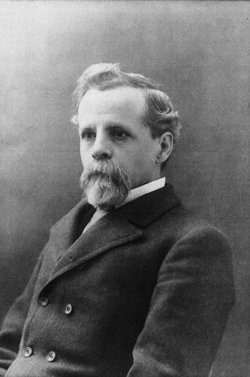
Congressman John F. Lacey of Iowa’s Sixth District did more to protect migratory birds than any other politician in American history besides Theodore Roosevelt.
Congressman John F. Lacey. (Courtesy of the University of Iowa Special Collections)
Under consideration since 1897, the Lacey Act finally passed the House on April 18, 1900, and then, three weeks later, on May 25, passed the Senate. President McKinley signed the Lacey Act into law with no regrets.82 A new conservationism had arrived in America. No longer could you kill a snowy white heron along the Indian River, for example, and sell the feathers to Macy’s department store in New York. As Governor Roosevelt saw it, as a consequence of this federal legislation (plus the Hallock Bird Protection law), Dutcher could now make a citizen’s arrest if he saw somebody illegally shoot a bird.83 The landmark legislation, however, didn’t accomplish its immediate goal, for the financially stingy President McKinley initially employed very few game wardens. Worse yet, the state game laws weren’t really enforced. Still, the law of the land was now on the side of the conservation movement.84 It would be up to the Audubon societies and AOU to figure out how to raise funds for wardens.
High-minded speeches like Roosevelt’s second annual message and legislation like the Hallock Bill and the Lacey Act were, of course, only the first steps in this reformist movement. Enforcing change—in this case, closing up the millenary industry’s loopholes and confronting market hunters and fishermen bent on exterminating pelicans—proved to be difficult. Suddenly, the heavily armed plume hunters in Florida were pitted against newly organized conservationist groups like the FAS and AOU in a what were known as the “feather wars.” This protracted feud flared up and became deadly between 1900 and 1920. Under the Lacey Act, however, a poacher could no longer bribe or intimidate a local judge to turn a blind eye toward the slaughtering of birds. Now, for the first time, accused poachers operating in Florida would have to go before a federal judge, who would be fully cognizant that the federal government wanted the act vigorously enforced.
Refusing to capitulate, and antagonistic toward what they perceived as Yankee hunting restrictions, the plumers in Florida stood their ground and defied the law. It was reminiscent the blowback in response to the Washington’s Birthday Reserves or Cleveland Reserves. Abetted by the millinary industry, many intransigent Florida market hunters simply refused to pay the new laws any mind. They believed in their God-given right to exterminate species; Washington, D.C., could shove its bird laws as far as they were concerned: the Second Amendment gave them the right to shoot whatever they damn well pleased. Roosevelt—the “born bird-lover” 85—scoffed at such backward, neo-Confederate thinking. Some plumers, however, decided that it was legally safer to hunt in the North, in the “prairie potholes” of Canada and the upper Midwest, rather than in the southern states, which encompassed the cross-continental bird migration route known as the Mississippi Flyway; in Minnesota and Wisconsin, unlike Florida, wardens weren’t patrolling the “Father of Waters.”
Nevertheless, a huge pro-Audubon Society change had occurred. And to the consternation of the millinary industry, its worst enemy—Theodore Roosevelt—seemed to be a short-fused time bomb. Within four months after the legislation in Tallahassee, he would be president of the United States.