
CHAPTER FOURTEEN
I
By the time the Lacey Act had passed in 1900 Governor Theodore Roosevelt and John Burroughs had solidified the friendship that began at their first meeting at the Fellowcraft Club. Burroughs now had a face full of hard-earned wrinkles, and he had grown a long, bushy beard as white as beach flax; he resembled Charles Darwin as an old man (the British naturalist had died in 1882), or Father Time. There was about him an outdoors aura of a solitary holy man or troglodyte. From 1889 to 1900 Roosevelt and Burroughs had regularly met for lunch, discussed bird laws, and swapped books. The two men shared the admirable traits of enjoying a well-turned phrase and never keeping the inkhorn dry. During his tenure as governor Roosevelt and Burroughs each managed to publish three books. Together they were proud Audubonists. “I send you a copy of my Big Game Hunting,” Roosevelt wrote to Burroughs on May Day 1900. “It is really a combination of two volumes. In the second part, I wish you would look on p. 65 and before and after, where I speak about some birds. Again and again as I have listened to those plains birds I have longed to have you hear them, and I have longed even more to have you hear the bull elk and the great wolves.”1
In 1899 James Bryce deemed Roosevelt “the hope of American politics” Burroughs, however, saw the Colonel as the great public naturalist of the future.2 An alliance of great importance to the wildlife protection movement was forged between Roosevelt and Burroughs. Burroughs, in fact, invited Roosevelt’s twelve-year-old son, Ted—who had straight jet-black hair and a face full of freckles—to spend a long weekend with him, hiking around the clear streams near his rustic cabin, Slabsides (built in 1895 on a bog that was once a celery swamp).*3 According to Roosevelt, little Ted “grinned with delight” when he heard of Burroughs’s offer of hospitality. “How I wish I could be with you!”, Roosevelt wrote to Burroughs. “As I have written you, when out on the Ranch in the old days I cannot say how many times I longed to have you there. It was only while I was in the West and on my ranch that I ever had much opportunity of really hearing bird songs. Of course I know our common birds of the East—the thrushes, bobolinks, etc., but it was only while I was on my ranch that I ever lived out of doors.”4
Having Burroughs provide a guided tour around the Hudson River Valley was akin to having Thoreau describe the salient features of Walden Pond in a walk-around. Burroughs, Roosevelt believed, was the top-drawer nature writer of all time. His voice and memory were those of a master. Burroughs’s book of nature essays, Far and Near, included “Babes in the Woods,” about his fine time with Ted exploring Black Creek.5 Eastern bluebirds—nesting in dead tree stumps—became the species du jour on their fine tramp. Burroughs explained to Ted the difference between the plaintive female note and the more ardent note of the male. The red, white, and blue eastern bluebird had become signature birds to Burroughs.6 “Never in your life have you given more happiness than to the small boy who spent last Saturday and Sunday with you,” Governor Roosevelt wrote to Burroughs on May 21. “I thank you most sincerely for your kindness to him. Ted is a good little fellow and he appreciated every moment of his stay. He has really been very interesting over of his experiences, notably the conduct of the two parent bluebirds after you by accident broke down the stump containing their nest and then put it up again.” 7
With Burroughs as his primary muse, Governor Roosevelt had entered the “citizen bird” movement full-throttle. Along with Frank M. Chapman, William Dutcher, and a few others, Roosevelt truly thought of himself as part of the guild of professional naturalists. And Burroughs was their éminence grise. Just as Theodore Roosevelt Sr. had gotten immersed in the humane movement, his son now believed in the moral impact of Darwin’s theory: that benevolence toward other species was compulsory, that society had a sacred obligation to take care of lower species like birds.8 This “moral” Darwinian impulse had first started fomenting when T.R. had read Wake-Robin at Harvard University. (In 1859, when Roosevelt was one year old, Burroughs had written in his Notebookthe evolutionary sentiment that “from a single atom, by infinite modification, Nature builds the universe”). To Burroughs, The Descent of Man was a miraculous “model of patient, timeless, sincere inquiry; such candor, such love of truth, such keen insight into the methods of Nature, such singleness of purpose and such nobility of mind, could not be easily matched.”9
Roosevelt’s heartfelt appreciation of Whitman, Emerson, and Darwin grew as he read more and more of Burroughs’s books. If Captain Reid was too juvenile and Charles Darwin too scientific, Burroughs fell into the middle zone; he wrote in a way Roosevelt could emulate. Burroughs, you might say, further stoked the key ingredient to Roosevelt’s penchant for faunal naturalism: compassion for all wild creatures, especially birds. Once Burroughs became the first vice president of the New York Audubon Society, in fact, Roosevelt would do whatever he could to help the organization (of which he was also a member) flourish. “I know your Society will frown upon the milliner’s use of bird skins,” Burroughs wrote in 1897, accepting the vice presidency. “I hope it will also discourage the senseless collecting of eggs and nests which so many young people take up as a mere fad, and which results in the destruction of so many of our rarer birds.”10
To Burroughs, On the Origin of Species was a “true wonderbook”—the exact sentiment Roosevelt had toward it. The debt both naturalists felt they owed Darwin could never be repaid. Both men learned to scoff at Darwin’s critics as dimwits who couldn’t comprehend basic scientific laws of nature. Only Shakespeare and Emerson, they believed, had a comparable grip on the universal condition. Darwin “is the father of a new generation of naturalists,” Burroughs enthused in his journal. “He is the first to open the door into Nature’s secret senate chambers. His theory confronts and even demands the incalculable geological ages. It is as ample as the earth, and as deep as time. It mates with and matches, and is as grand as, the nebular hypothesis, and is the same line of creative energy.”11
What about the role of God in all this orthodox Darwinian celebration? Both Roosevelt’s and Burroughs’s views can be summed up in a single, often quoted line: natural selection may “account for the survival of the fittest, but not for the arrival of the fittest.”12God was the one who created Darwin’s world order. Independently, Roosevelt and Burroughs both understood that Darwin believed natural selection was a process, not a cause.13 “The influence of Darwinian thought on Roosevelt’s generation,” the historian John Morton Blum noted in The Republican Roosevelt, “was profound.”14
Realizing that calling Burroughs “John” was too pedestrian (and “Mr. Burroughs” too formal) Roosevelt settled on “Oom John”—oom being Dutch for uncle. Obviously, this was meant not in the sense of a “Dutch uncle” but as a salutation expressing deep and abiding love and kinship for time immemorial. Even though Burroughs continued to call Roosevelt “Mr.” or “Governor” or “Mr. President”—old-school propriety to the maximum degree—to T.R. he was Oom John, the wisest mentor of them all. Oom John, in fact, approved of the Boone and Crockett Club books and thought his politically powerful young friend’s book The Wilderness Hunter, in particular, excellent. There was, Burroughs recognized about Roosevelt, a fine naturalist buried under the yarns about twelve-point antler trophies and the Rough Rider’s braggadocio. Not that Burroughs minded hunting per se. Like Roosevelt, Grinnell, and the others in the Boone and Crockett Club, Burroughs believed seasonal hunting was an imperative for thinning out herds and game-bird flocks. Roosevelt was in awe of Oom John’s ability to notice field marks on birds—color, feather pattern, eye-catching markings, gender, and shape. But Burroughs preferred Roosevelt’s more poetic side, admiring the way he wrote about nighthawks flying over a canyon or the coloration of Old World chats. To Roosevelt there was no higher compliment than Oom John’s writing to him to say that he admired Roosevelt’s hunting books because they were infused with such “good sound naturalist writing.”15
II
Coinciding with his second annual address as governor of New York was Roosevelt’s publication of The Strenuous Life, his essays expounding his view of the hardy American character being replenished by the outdoors life. Overcrowded and unsanitary big cities, where the air was foul and pestilence was bred, where whole blocks were nothing more than slums, were incompatible with health. In speeches in New York City that month—one given at the Boone and Crockett Club’s annual banquet—Roosevelt stated that the time had arrived for wildlife preservation, clean rivers, antipollution laws, and wise use of forests. There was an intensity to Roosevelt during those opening months of 1900 that was almost electric. Writing to Henry L. Sprague, for example, Roosevelt mentioned for the first time that he was fond of the West African proverb “Speak softly and carry a big stick; you will go far.”16 To historians this proverb has become emblematic of Roosevelt’s imperialistic belief that the United States should maintain a robust army and navy while using diplomatic channels in foreign affairs, dangling the threat of war over adversaries’ heads. “Roosevelt loads his gun too heavy,” Burroughs wrote in his diary. “The recoil hurts him more than the shot does his enemy. He is bound to make a big noise but the kick of the gun is so much power taken from the force of the bullet. People react vigorously against him as they always do to his surplus verbal energy.”17
Like in foreign afairs, there was little soft speaking from Governor Roosevelt regarding forestry and wildlife protection; there was only the big stick. Such intimidation tactics on behalf of wildlife protection, particularly against the millinary industry, often worked. On February 10, for example, a few weeks after his second annual message, the state legislature revised Chapter 31 of the General Laws and approved Act (Ch 20) for the protection of forests, fish, and game. New York state now had the most progressive conservation protection laws in the United States (with the possible exception of Vermont). As the historian G. Wallace Chessman noted, Roosevelt squared off against the powerful Utica Electric Light Company when it tried to purchase private lands in the Adirondack Park; protecting birds, he said, came first.18 By March 1900 Roosevelt had also won approval for the land, funds, and management for Palisades Park, which he had deeply wanted. Largely because of Roosevelt’s opposition to quarrying, the ruination of the cliffs had stopped overnight. That success spurred Roosevelt onward. If New York and New Jersey could create a joint park at the Palisades, he didn’t see why Wisconsin and Michigan—to give just one example—couldn’t do the same with the islets surrounding Beaver Island in Lake Michigan. Meanwhile, Roosevelt began promoting Gifford Pinchot as “the best authority on forestry in the country.” When some people raised the objection that Pinchot was “too political” in his work at the Forest Division of the U.S. Department of Agriculture, Roosevelt squawked. Blithe irresponsibility had guided America’s forest policy for far too long; Pinchot was the intellectual antidote. “Pinchot has no more to do with politics than the astronomers of the Harvard observatory have,” Roosevelt said in Pinchot’s defense. “All he is interested in is his forestry work.”19
As for the oyster beds of New York, Roosevelt was searching for their protector. Uncle Rob had been conducting all sorts of experiments in oyster farming at Lotus Lake, and his nephew was probably intrigued. Basically, Roosevelt wanted to recruit someone like Seth Green to come work as the “oyster protector” at the Fisheries, Game, and Forest Commission. Writing to the conservationist George McAneny, Roosevelt said, “The man appointed to this position should of course have some literary knowledge, some scholarly attainment, but he must know practically about oysters and be able to row and sail and handle himself on mud flats.”20 Connected to Roosevelt’s concern about oyster beds were his hyperactive efforts to promote scientific water resource management and to stop reckless water pollution by the timber companies.21
Obviously, as New York’s governor Roosevelt engaged in other reformist measures not connected to forestry or oyster conservation. He established a state hospital to care for crippled and deformed children, promoted consistent pharmaceutical standards, fought to end racial segregation in public schools, and demanded antiracism efforts in schools. Compulsory seating areas for employees in factories, he declared, were mandatory. Disapprovingly, he toured sweatshops with Jacob Riis, furious that such sickening squalor existed in America, stopping just long enough to ask the most pertinent questions about city services in the down-and-out neighborhoods. And his interest in integrating Native Americans into the main fabric of national life continued. For example, he pushed for compulsory education on the Alleghany and Cattaraugus reservations in New York. The time was long overdue, Roosevelt believed, for Native Americans to be given a fair shake. Long before the term “affirmative action” was in use, Roosevelt was promoting the concept on behalf of Indians. And he started corresponding with three African-American intellectuals whom he deeply admired: Booker T. Washington, William Henry Lewis, and Paul Laurence Dunbar.22
By June 1900 Governor Roosevelt was described by the New York Sun as the greatest reformer in American politics. That month, as testimony to his meteoric rise, the Republican National Convention in Philadelphia nominated him to run as President William McKinley’s vice president, despite Mark Hanna’s fervent objections. (Hanna actually had a heart attack shortly after T.R.’s nomination, but lived.) Wearing a huge black top hat, Roosevelt had stood out at the convention amid a sea of straw boaters like, as Edmund Morris put it, “a tent in a wheat-field.”23 He remained coy, however, about whether he wanted the official vice presidential nomination in the first place. Boss Platt understood that in any case Roosevelt would get the nod. Famously, he quipped, “Roosevelt might just as well stand under Niagara Falls and try to spit water back as to stop his nomination by the convention.” 24
Amid the political theater of June 1900, Roosevelt nevertheless found time to read books by fellow naturalists. Back in 1882, he had read Camps in the Rockies by the British sportsman William Adolph Baillie-Grohman and was floored by its accurate description of elks. Now, while the Republican convention was going on, Roosevelt read Baillie-Grohman’s newest effort, Sport in the Alps, and was again pleased. “Ever since I read your Camps in the Rockies I have felt tantalized because you had nothing about bear and bison hunting,” Roosevelt wrote to him. “I know you look down on the latter, but after all it was something peculiar which has passed away forever and I do wish you had written about it. I shall always feel defrauded until you write a couple of chapters on Wapiti and Big Horn in your Camps in the Rockies. By the way, your Sport in the Alps was exactly the book which I had long been hoping to see written. Again here I wish you could have extended your researches to take in the records of bison and aurochs shooting in Lithuania and Poland in former centuries.” Realizing, perhaps, that he was being too critical of a writer he admired, Roosevelt invited Baillie-Grohman to Sagamore Hill to see his favorite black-tailed buck head, an award-winning Boone and Crockett Club trophy.25
Once Roosevelt became the vice presidential nominee in June, he traveled throughout New York, speaking to huge crowds in Minneola, Brooklyn, Newburgh, Auburn, Syracuse, and Niagara Falls, plus numerous hamlets in between. A radiant atmosphere seemed to accompany his every step. “I am as strong as a bull-moose,” he told Hanna, who was running McKinley’s reelection campaign, “and you can use me to the limit.”26 Once again Roosevelt went to Chicago, on September 3, this time to discuss the “labor question” instead of the “strenuous life.” Hordes of frenzied citizens followed his train on horses shouting, “We Want Teddy!” Wherever he went in the West, a great fuss occurred. As Roosevelt prepared to deliver a stem-winder in Kansas, the showman William “Buffalo Bill” Cody hopped onto the bandwagon, endorsing him by saying, “A cyclone from the West had come, no wonder the rats hunted their cellars!”27 Both Cody and Roosevelt believed that the three great U.S. presidents—Washington, Jackson, and Lincoln—were all outdoorsmen in their youth. They both exuded the Wild West mythology in demeanor, and Americans loved them for it.28
Hundreds of veterans of the Rough Riders followed Roosevelt through the Rocky Mountain states, acting as both bodyguards and essential eyewitnesses of his valor in Cuba. Buffalo Bill had signed up sixteen of the veterans to reenact the Battle of San Juan Hill in Cody’s Wild West extravaganza.29 When one populist editor mocked Roosevelt in Cripple Creek, Colorado, a well-armed Rough Rider shot the critic with a revolver; Roosevelt wouldn’t denounce this act, perpetrated in defense of his besmirched character. The fact that the Democrats had nominated the pro-silver ticket of William Jennings Bryan and Adlai E. Stevenson (the grandfather of the Democratic presidential nominee of 1952 and 1956) egged on Roosevelt’s quarrelsome nature. These were repugnant types, he believed, afraid of Darwinism, the strenuous life, fierce expansionism, vehement nationalism, modern science, and old-fashioned hard work. His opinion of Bryan, in fact, was very low—and the Scopes trial was still twenty years in the future.
The most memorable moment of the American West tour occurred when Roosevelt visited Medora. Suddenly there was a proud luster to his gait. The Badlands lay before him, the essence of eternity found in the fossils of ancient fish and odd-shaped buttes. He wanted nothing more than to disappear over the horizon with a fine horse, saddle, and bridle. “The romance of my life,” Roosevelt said, “began here.”30 That simple phrase was soon adopted by North Dakotans as something akin to the state motto. Having traveled more than 1,000 miles by rail, delivered more than 1,000 speeches, and met 3 million folks, he found the absolute stillness of the badlands mighty impressive. His day in Medora was his only moment of sustained reflection that fall. “Tis Teddy alone that’s runnin’,” Mr. Dooley reported, “an’ he ain’t a-runnin, he’s gallopin’.”31
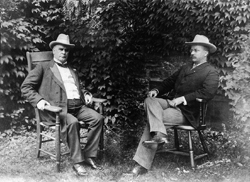
President William McKinley and Governor Theodore Roosevelt ran together as a ticket in the 1900 presidential election. Because they never were together, this photo was purposely doctored to give the appearance of a policy pow-wow.
McKinley and T.R. (Courtesy of the Theodore Roosevelt Association)
For the first time in his storied Democratic career, Robert B. Roosevelt broke from his party to vote for his nephew. Blood was thicker than politics. Spending time at Lotus Lake oyster farming, continuing to perfect fish hatching techniques and breed eels, R.B.R. had retired his bicycle in favor of an automobile (the first Roosevelt to do so). Indeed, he was now fancying himself as a race car driver. Although he also maintained a stable of the best horses in Long Island. Old Charlie Hallock, founder of Field and Forest, fresh from his success in obtaining birds’ rights, wrote to R.B.R., curious about how he planned on voting in the 1900 election, as a Democrat with a nephew on the Republican ticket. “I’m glad…that you are still fishing and shooting,” R.B.R. wrote back. “I have been a Democrat the last year [but] the wild extravagances of Bryan and his populist associates forced me to McKinley. I can go there easier now for Bryan is just as crazy about 16 to 1 as ever. Besides Theodore is half a Democrat and will keep the administration right. The tail will wag the dog.” 32
On November 6, 1900, McKinley and Roosevelt won in an electoral landslide. Boss Platt was perhaps the happiest man in America, having foisted Roosevelt on Washington, D.C., and gotten him out of New York. On the other hand, Mark Hanna openly wept, shaking his head in dismay and mumbling, “That crazy cowboy.”33 The Rough Rider was now vice president (or would be as of his swearing in on March 4 on the U.S. Capitol steps). Roosevelt’s Democratic critics immediately scoffed that being vice president was a boot-polisher’s job (anticipating John Nance Gardner’s remark that it wasn’t worth “a bucket of warm spit”). The unconventional Roosevelt, who had made bold reformist improvements in New York, they said, fearlessly standing up to Boss Platt on conservation issues, among others, had been relegated to a lifeless position. Poor Teddy Roosevelt had become the “fifth wheel of the executive coach.”34 Typically, Roosevelt would have none of such talk. “If I have been put on the shelf,” he said, “my enemies will find that I can make it a cheerful place of abode.”35 This quip was, of course, touche defensiveness and smart public relations.
Days after McKinley’s reelection, Roosevelt, showing how easily he could shift from being governor of New York to being a national office holder, wrote a long open letter to the National Irrigation Congress about the “vital necessity” of “storing the floods and preserving the forests.” No longer was he pontificating just about the Catskills and Adirondacks. Wanting to bring western life to the national forefront, he had arid places like the Great Basin and the San Joaquin Valley in mind. Refusing to mince words he laid out a blueprint that the federal government would soon adopt. Dams and reservoirs would be constructed to help irrigate even the “vast stretches of so-called desert in the West.” Herein lay the seeds for what would soon become Roosevelt’s reclamation of the American West as U.S. president. Not pausing to think if it was smart to build cities in the Mojave or Sonoran deserts, Roosevelt’s open letter made some fine points about how deforestation of the arid West must be prevented. Certainly, Roosevelt had his heart in the right place—even if he wasn’t foresighted enough regarding the potential menace of dams.36
Besides writing to the National Irrigation Commission, Roosevelt took time that December to settle scores with politicians who had mocked, obfuscated, or taken advantage of loopholes in New York’s game and fish laws. Reports from wardens that one of his commissioners was abusive toward them, scoffing at fish hatcheries, really set him off. Roosevelt’s ire toward one of his five Fisheries, Game, and Forests commissioners in particular—Percy S. Lansdowne, former secretary of the Erie County Fish and Game Association, nominated by Roosevelt that March—was triggered by the illegal loan of a state wildlife boat as a donor’s perk. To Roosevelt this was simply stealing from the state. Furthermore, Lansdowne had been known to mock Roosevelt’s idea that the ticky-tacky tourism around Niagara Falls wasn’t good for nature. Now, as governor, preparing to be vice president, Roosevelt lit into Landsdowne in a letter, calling him an untrustworthy, lying, thieving scoundrel and part of the “patronage machine.”37
That December Roosevelt also took stock of his own duty and destiny. As of New Year’s Day his tenure as governor would be finished. After delivering the most speeches ever in a U.S. presidential campaign, he felt as if he had jumped off a twenty-story ledge, had landed in a fire department net, and was now strolling around Oyster Bay with his hands in his pockets, glowing and in a “what next” trance. He worried about falling into an inward desolation of spirit. The open letter on western irrigation was for public consumption, but Roosevelt also wrote beautiful, serene letters to fellow naturalists about the disappearance of wildlife and forests in the American West. He lamented that the “great mountain forests” he encountered in 1891 in Idaho and Montana and Wyoming were “growing bare of life.”38 A meditation poured out of his pen on how wilderness had cured him of asthma.39
There was, however, a strange melancholy in Roosevelt’s voice, perhaps indicating delayed depression after finally leaving the adrenaline-fueled campaign. All he could think about that December were the Colorado Rockies. He needed them as a fix for his declining spirits. He decided to head to Colorado come January and hunt cougars for the Biological Survey of Dr. Merriam. Instead of debating at the Cosmos Club how many types of cougars existed in the West, he would collect specimens to help in the inventorying. “Now I am hard at work endeavoring to assume the vice-president poise,” he wrote Elihu Root. “Incidentally I may mention that I am getting altogether too much of it as regards habit of body, and have become so fat and stiff that after the first of January when I’m a private citizen, I shall take two months’ holiday in Colorado and hunt mountain lions, if the fates are willing.”40
Ironically, being elected vice president brought a jolt of jitters to Roosevelt. Had his political career hit an impasse? Had he really become just a “dignified nonentity”? Instead of satisfying his ambition, the vice presidency became distressing. Intoxication could be found, he believed, in the Colorado Rockies. Blocking out six weeks of his calendar in January–February 1901, Roosevelt put himself on assignment for the U.S. Biological Survey. He would collect cougar specimens and then write about his hunts for a magazine. That was, from his perspective, honest work. He wouldn’t have to be in Washington, D.C., until the inaugural ceremony on March 4. “How I wish I could wait and make the hunt in March and April, so as to get after bear,” Roosevelt wrote to Philip Stewart, “but, of course, I have to be back in time for the Inauguration.”41
III
Ever since Roosevelt read Winthrop Chanler’s essay on forest-clad northeastern Colorado in American Big-Game Hunting he had been hankering to hike and hunt in the White River region. Right after New Year’s Day 1901, he headed to Colorado Springs—nicknamed “Little London” because so many English tourists came to see the Rockies by train—for a combination holiday and cougar hunt. At long last Roosevelt would get to see snow-tipped Pikes Peak, the parts not desecrated by logging, even though the awful January weather made the summit impossible to ascend. From a Colorado outfitter Roosevelt acquired a large leather coat, sweaters, a corduroy jacket, a buckskin shirt, and loads of other appropriate winter wardrobe accessories. With his clothing secure he would travel by train to Colorado Springs to connect with friends and then head north to Meeker.
Roosevelt’s host was Philip B. Stewart of Vermont, Yale class of 1886, a former football captain, now a utility executive. He lived off and on in the resort town. (Stewart’s Republican father had served as governor of and congressman from Vermont.) Gladly, Stewart pointed out such landmarks as the Antlers Hotel and Garden of the Gods upon Roosevelt’s arrival. And there were others involved in the hunt. A surgeon in the Rough Riders, Dr. Frank Donaldson, chief of the throat and chest clinic at the University of Maryland, lived part-time in Manitou Springs, Colorado, where he ran the Red Crags wellness clinic and lodge (advertised as “the Saratoga of the Rockies”), was also there to greet Roosevelt.42 As the nurse Clara Barton noted in her memoir The Red Cross, Donaldson had been able to find the best medical supplies in Cuba for his Rough Riders because he demanded them.43 Overflowing with excitement, however, Roosevelt could do nothing but talk to Stewart and Donaldson about the beauty of Pikes Peak—which he climbed a quarter of the way up in a failed attempt to find bighorn sheep.44 Donaldson, who believed that thin mountain air was healing for asthmatics, enjoyed hearing Roosevelt talk about his personal medical history and how nature helped him breathe. Two other Rough Riders from Colorado Springs—Walter Cash and Ben Daniels—were also on hand for Roosevelt’s visit.
The primary purpose of this trip was to collect cougars (and to a lesser extent lynx) from the White River area for Merriam. His job, in fact, was to shoot as many of the predators as possible for the Biological Survey to analyze. This was the new arrangement between Roosevelt and Merriam. Somehow, perhaps as a payback for Roosevelt’s Cosmos Club challenge, Merriam now had Roosevelt collecting specimens for him in the Rocky Mountains, a pretty nifty trick. For six weeks Roosevelt hunted north of the White River on horseback—mainly between Coyote Basin and Col-orow Mountain—enjoying the high, dry country with the cutting air full of shimmering frost particles. These pearly peaks were a fine diversion from politics. The heavily wooded slopes were wilder than he had imagined, untouched by axes. Meeker, named after a U.S. government Indian agent who had been killed by a band of Utes in 1878, had become a regional center for hunting. The White River Plateau Timberland Reserve (the precursor of what became White River National Forest) had been the favorite hunting grounds of many members of the Boone and Crockett Club.
Roosevelt had written (with some nostalgia for his days in the Badlands around 1886), that he had “no more hesitation in sleeping out in a woods where there were cougars, or walking through it after nightfall, than I should have if the cougars were tomcats.”*45Nevertheless, he spent most nights sleeping in a forest hut or a rancher’s house chosen at random, or at the Hotel Meeker across from the local courthouse. (It was hypothermia he was worried about, not cougars.) As at every hotel in the American West where Roosevelt ever slept—that is, among those surviving the wrecking ball—a bronze plaque would soon be erected at the Meeker Hotel on Main Street bragging that he had once stayed there. Over the years Roosevelt would tell people that the Meeker Hotel was better than any lodge in the Swiss Alps. The rock-hewn splendor of Colorado, he’d say, was by his estimate a world-class attraction. The tourist board of Colorado loved him for that, even though the timber barons and mining companies wanted him buried in an avalanche of snow. “The sage-brush grows everywhere upon the flats and hillsides,” he wrote in what would become a chapter in Outdoor Pastimes of an American Hunter. “Large open groves of pinyon and cedar are scattered over the peaks, ridges and tablelands. Tall spruces cluster in the cold ravines.”46
Having adopted Josephine the cougar as the mascot of the Rough Riders, feeding her milk from a bottle and watching her grow, Roosevelt had become extremely interested in mountain lions (or cougars, as he preferred to call the species). Only Merriam and Winthrop Chanler, he believed, had written proficiently about cougars. (And he even doubted a few of their scientific claims.) False reports about how cougars seized prey and about their size variation annoyed him no end. Some zoologists actually believed bobcats were small cougars, a proposition that T.R. knew was hokum. Even though Roosevelt was a fan of the famous hunter Richard Irving Dodge’s The Plains of the Great West, he believed that Dodge had misidentified cougars as two separate species. Roosevelt—sounding a bit like Merriam—believed there were also five subspecies such as the Florida panther. “No American beast has been the subject of so much loose writing or of such wild fables as the cougar,” Roosevelt complained. “Even its name is unsettled.”*
While tramping about the Maroon Bells, a gorgeous group of Paleozoic sandstone and mudstone peaks near Aspen, Roosevelt recognized the wisdom of the Harrison administration in having protected this piece of the Colorado wilderness for all time. On every scientific “relief map” of the continental states that Roosevelt had ever seen, those which reproduced nature exactly, showing the peaks and valleys and other geographic details on a small scale, Colorado was the most intriguing, with its hilly ribs and mountain ranges. This was an ancestral elk range, a place where the Ute once hunted the great herds, a wild evergreen country which, thanks to federal intervention, would stay wild.47 The elemental and the fundamental were honored in the Rockies. Far away from the thunder of applause and prodigious fame, Roosevelt, advocate of the strenuous life, found peace shaving stubble from his face in a nearly frozen stream. In Colorado he dreamed. He plotted. He slept and breathed well. He found his scattered wits by cupping his hands, then shouting Hello, and not getting a reply. “Some thirty miles to the east and north the mountains rise higher, the evergreen forest becomes continuous, the snow lies deep all through the winter, and such Northern animals as the wolverene, lucivee, and snow-shoe rabbit are found,” Roosevelt wrote. “This high country is the summer home of the Colorado elk, now woefully diminished in numbers, and of the Colorado blacktail deer, which are still very plentiful, but which, unless better protected, will follow the elk in the next few decades.”48
Not that he didn’t work hard throughout the six weeks. Daily he visited Colorado homesteads to record reports of cougar sightings, as if he were collecting census data for the federal government. Replaying his days collecting grizzly bear stories in Montana in 1889, he now performed the same oral history task in the winter loneliness of Colorado. What could be better than dusk on horseback in the Rockies looking for cougars and hearing lore from old-timers in the snow? Or watching every night as a crescent moon hung over the mountain peaks. Black-tailed deer abounded, but Roosevelt conscientiously refused to shoot one. He took his Biological Survey job too seriously for that. After all, deer weren’t predators. Also, Stewart—who took photographs of the Colorado wilderness with his new Kodak camera—didn’t want to take down a deer.49 “The bucks had not lost their antlers, and were generally, but not always, found in small troops by themselves,” Roosevelt wrote, “the does, yearlings, and fawns—now almost yearlings themselves—went in bands. They seemed tame, and we often passed close to them before they took alarm. Of course at that season it was against the law to kill them; and even had this not been so none of our party would have dreamed of molesting them.”50
In Roosevelt’s “With the Cougar Hounds”—which appeared in his 1905 book Outdoor Pastimes of an American Hunter—Roosevelt mentions Merriam by name three or four times, with interesting elaborations.51 Clearly, Roosevelt was determined to make readers understand that his hunt wasn’t just for sport; it was a scientific expedition. Fourteen cougars both male and female were shot between January 19 and February 14, and Roosevelt recorded detailed data about each one. The largest was eight feet long, and the shortest was under five feet. Zoological tables were compiled by Roosevelt to help Merriam and others at the survey understand the precise circumstances in which the cougars were killed. His field reports from Colorado were the work of a professional, recording whether the cougars’ coats were tawny golden or gray-brown. “The fourteen cougar we killed showed the widest variation not only in size but in color, as shown by the following table,” Roosevelt wrote. “Some were as slaty-gray as deer when in the so-called ‘blue’ others, rufous, almost as bright as deer in the ‘red.’ I use these two terms to describe the color phases; though in some instances the tint was very undecided. The color phase evidently has nothing to do with age, sex, season, or locality.”52
Roosevelt’s relationship with cougars was complex. In The Wilderness Hunter, as a western rancher, he portrayed them as “bloodthirsty” killers attacking cattle with vicious abandon.53 There was even an overdramatized illustration by J. Carter Beard of a rabid-looking cougar Roosevelt had shot in September 1889. But Roosevelt’s respect for the cougar had grown over the years. He liked the fact that a male cougar would defend between 50 and 400 square miles on its own. But he worried that the cougars’ prey were elk and deer. Cougars were obligate carnivores that depended on deer and elk as part of their primary diet. If the cougars weren’t controlled in the Rockies, then the big game couldn’t come back. So Roosevelt saw himself on a four-pronged mission in Colorado: helping the Biological Survey better understand Puma concolor; working to eradicate the cougar from the White River region to enhance the elk and deer populations; claiming his place as the North American authority on these big cats; and selling a couple of articles (illustrated with Stewart’s photographs) for the October and November issues for the Scribner’s Magazine. For a sportsman, cougars, blessed with diurnal and nocturnal vision, were extremely difficult to hunt. In the days before radio telemetry devices it took a truly gifted outdoorsman to track them at all.
Accompanying Roosevelt, Stewart, and Webb on the hunt was John B. Goff, considered the finest tracker of the “ghost cats” in Colorado. This was always Roosevelt’s secret as an outdoorsman; he had a genius (and the money) for finding the best hunt guides available for every expedition. Roosevelt’s deft writing about the hunt—when published in 1905—contained the most anatomically correct descriptions of Colorado cougars, from their white muzzles to their huge paws, ever written up until that time. Carefully crating his kills in Denver, Roosevelt had shipped his cougars’ heads, paws, and skins directly to C. G. Gunther’s Sons on Fifth Avenue in New York City for preparing.
The trip to Colorado whetted Roosevelt’s appetite for more cougar collecting. Word from Yellowstone National Park was that cougars were wreaking havoc on the elk herds. Encouraged by Merriam, Roosevelt planned on heading up to the park within the year to find more specimens for the Biological Survey and help out the bands of elk. “Many conservationists of the day, including Roosevelt, believed limiting predation would increase ungulate populations,” the historian Jeremy M. Johnston explained inYellowstone Science, “allowing them to recover from the results of the intensive market hunting that occurred in the park before the ban on hunting.”54
IV
Roosevelt returned to Washington tremendously improved in appearance. In Colorado, he had written a dozen letters detailing his hunt for the cougar (and lynx). What he seemed to admire most about cougars was that they ate meat only fresh and clean—and, of course, the way they mastered topography; they were able to live in isolated cliffs or remote alpine valleys far removed from civilization. Armed with all his detailed measurements and field notes regarding cougars and lynx, Roosevelt denounced William Henry Hudson, best known in history as the author of Green Mansions, for his “preposterous fables” about cougars in his recent book The Naturalist on the Plateau.55 Roosevelt kept score on those whom he considered “nature fakers,” preparing for a frontal assault in the near future. Unlike bears—which were omnivores with meal alternatives like berries, roots, shoots, and pine nuts—cougars were able to eat only meat; Roosevelt believed this was the reason they were overdramatized as bloodthirsty killers.
Famously, Mark Hanna once quipped that Roosevelt was a “damn cowboy,” now only “one heart beat away from the presidency.” But the word “cowboy” would imply that Roosevelt was a rubber stamp for the stockmen’s associations of the Rocky Mountains, which he clearly wasn’t. The reality, in fact, was far worse than Hanna contemplated. Roosevelt was a pro-forest, pro-buffalo, cougar-infatuated, socialistic land conservationist who had been trained at Harvard as a Darwinian-Huxleyite zoologist and now believed that the moral implications of On the Origin of Species needed to be embraced by public policy. The GOP was in trouble.
While Roosevelt had been in Colorado a great oil boom was under way. It was big enough to have befuddled John D. Rockefeller himself. Roosevelt didn’t know whether it was a cause for celebration or woe. Near Beaumont, Texas, at a place known as Spindletop, black gold spouted 200 feet in the air. The western plains of Texas and Oklahoma, he knew, would never be the same now that oil had been found. Somehow or other Roosevelt found a way to be at war with the Standard Oil Company for his entire life. Meanwhile, on the eve of Roosevelt’s inauguration as vice president J. P. Morgan and Company announced the formation of a humongous corporation, U.S. Steel, with a capitalization of $1.4 billion. That development didn’t much impress Roosevelt’s usually outsized curiosity. Talk of automobiles replacing horses—which R.B.R. envisioned as the wave of the future—irritated him further. The mere thought of Duryeas in Yellowstone or Wintons in Yosemite was anathema to Roosevelt. Society didn’t let Studebakers drive into cathedrals or art museums, did it? A “stern moral code” dictated all aspects of his life, causing him to reject what the Blum called in The Republican Roosevelt “the amorality of business.”56
For all of his cutting-edge talk of science, Roosevelt was really an old-fashioned camper type, a rustic, enamored with the very notion of log cabins or hunters’ and naturalists’ shacks. As he took his oath of office his primary concern wasn’t Spindletop or J. P. Morgan; it was conservation. As for foreign policy, Roosevelt promised he would backstop President McKinley’s policies. When it came to building a new great naval fleet and administering the Philippines, Roosevelt believed, President McKinley, to his credit, was an expansionist. Roosevelt’s only real complaint (and it was a big one) was that McKinley was a slow-moving, incremental expansionist. As an admirer of Mahan, Roosevelt wanted the United States to make permanent naval bases in Cuba, Panama, Guam, and Puerto Rico. In February 1900 he had written a sharp protest letter to Secretary of State John Hay over the Hay-Pauncefote Treaty; he felt U.S. rights to build an isthmus canal across Panama or Nicaragua hadn’t been properly protected under the terms.57
The challenge for Vice President Roosevelt—particularly when it came to conservation—was to be a team player in the McKinley administration. The Senate session Roosevelt presided over lasted for only five days—March 4 to 8—and then adjourned until the late fall. Roosevelt’s big accomplishment as vice president was, as the historian H. W. Brands succinctly put it, having “gaveled the session open and closed.”58 Roosevelt was forced to console himself by considering that his real work took place during the campaign, so it didn’t now matter whether he fell into a life of “unwarrantable idleness.”59
Fame has an ugly dark side in America: the sniping by the tabloid press. Because Roosevelt was the vice president–elect while he was in Colorado, hunting cougars, he was a particularly tempting target for irresponsible journalism. A story was propagated by Senator Thomas MacDonald Patterson of Colorado—the Democratic, free-silver populist editor of the Rocky Mountain News—that Roosevelt had been drunk on a train with Senator Henry Cabot Lodge and a few others. It was pure rubbish. The Associated Press also went after Roosevelt for “grossly dissipated conduct.” In defense, Roosevelt claimed that the wire service was “controlled” by Bryan, who wanted him bruised.60 A barrage of belittling stories appeared in the Colorado press about Roosevelt’s White River hunts, alleging that he was afraid of bears and that he shot treed cougars chased down by other men. For the first time ever, Roosevelt had journalists turn on him in packs. “To go mountain lion hunting sounds much more ferocious, but it really is not,” Roosevelt wrote to Winthrop Chanler of the Boone and Crockett Club. “The only danger I run is from the infuriated yellow press, and this is moral, not physical. It is very exasperating to have humiliating adventures which never occurred attributed to me in connection with bears and wolves (neither of which animals did I so much as see) and then to have the very same papers that have invented the lies state that they were sent out by my press agent with a view to my own glorification. However, I suppose it is all in a day’s work of a public man in our free and enlightened country.”61
That March Vice President Roosevelt—after reading a draft of “The Merriam Report” from the Harriman expedition—had become obsessed with protecting Alaskan wildlife. A member of the Boone and Crockett Club, Casper Whitney, had been quoted inOuting as suggesting that Alaska adopt a single commissioner for forests, fish, and game—an idea that Roosevelt had promoted in New York. Roosevelt agreed that this was the “ideal” solution to stop the slaughter of caribou, elks, and seals. What Alaska needed, Roosevelt believed, was one first-rate advocate of protecting wildlife and forests (like the Boone and Crockett Club’s president, W. A. Wadsworth), who would be in charge of managing the territory’s natural resources. Any time three, four, or five men were on a playing board, Roosevelt told Whitney, game laws tended to be watered down. “I wish to Heaven it were possible to get Congress to act about Alaska,” Roosevelt wrote. “As far as I know they simply provide for free rum, by voting to prohibit the sale of liquor there, and I do not know that they know anything about the game laws. Well, things are a little discouraging at times.”62
Being back at Oyster Bay gave Roosevelt time to read. Two of his favorite new titles were Thomas Huxley’s Autobiography and Graham Balfour’s The Life of Robert Louis Stevenson.63 The novelist Hamlin Garland had sent Roosevelt his recent collection of outdoors stories, Her Mountain Lover, and found a truly receptive audience in the vice president. “Your account of the Alaskan trail appealed to me very strongly,” Roosevelt wrote to Garland on April 4. “I suppose I am utterly illogical, but it always gives me a pang to think of the fate that befalls the pack horses under such conditions. I am very glad you brought your pony home and rode it. I find it just as you say—that is, about three days restores me to my case in the saddle; though I am sorry to say I have grown both fat and stiff so I should now hate most bitterly to try to manage what we used to call on the range a ‘mean horse.’”
Then, changing the subject Roosevelt told Garland about his recent hunt for cougars, noting that he hadn’t shot deer or elk. His tone was that of a hunting addict, pleased that he had found a cure, able to restrain from shooting even when big game was smack in front of him. As a fellow writer Roosevelt knew that Garland had singular gifts, and considered his novel A Son of the Middle Border a masterpiece. “As I grow older I find myself uncomfortable in killing things without a complete justification,” Roosevelt continued to Garland, “and it was a real relief this year to kill only ‘varmits,’ and to be able to enjoy myself in looking at the deer, of which I saw scores of hundreds every day and never molested them.”64
There was also a loose end to take care of—getting Merriam the cougar and lynx skulls and skins, which were still being prepared at C. G. Gunther’s Sons; an impatient Roosevelt resented their taking so much time. He also compiled with great exactitude the relevant naturalist data collected in Colorado. Unfortunately, Roosevelt got a blast of bad publicity because the owners of C. G. Gunther’s Sons invited the press into their Manhattan shop to see Roosevelt’s kills. Jokes were already widespread about Roosevelt disappearing into the wilds of Colorado before his inauguration as vice president, and being more interested in cougars than foreign policy. “Gentlemen,” Roosevelt began his curt note to C. G. Gunther’s Sons. “I am exceedingly sorry you have written to the press asking them to visit the collection. I had no objection to anyone seeing it who wanted to; but the one thing I was especially anxious to avoid was advertising, or seeming to advertise, it in any shape or way. It is most annoying to have had papers like Life, the Journal etc. notified. Will you please send on the skulls at once to Dr. Hart Merriam, together with the two largest lynx skins? & begin to make up the other skins; and show them to no one from this time on, unless he had my written authority.” 65
When Merriam received the specimens, from C. G. Gunther’s Sons, he sent a congratulatory message to Roosevelt, saying that “your series of skulls from Colorado is incomparably the largest, most complete, and most valuable series ever brought together from any single locality, and will be of inestimable value in determining the amount of individual variation.”66 Two cougars, however, stayed with Roosevelt, serving as rugs for his Sagamore Hill library.
Because Roosevelt kept the cougar heads on these rugs, visitors to Sagamore Hill could be forgiven for thinking that he was showing off his hunting skills. Roosevelt even acquired two Alexander Proctor sculptures of cougars, which he used as props to stimulate conversation about his Colorado hunts. Essentially, he had fallen into the same trap as all persona manipulators. For years he promoted himself as a big game hunter extraordinaire—for example, having photographs taken of himself in buckskin holding a rifle. Although he clearly was the leading light of the wildlife protection movement, many average Americans knew him merely as a hunter. After the bad publicity Roosevelt received over the Colorado hunt, in the future he had naturalist-inclined friends at his side to offer testimonials that he was a scientifically-minded hunter, not a bloodthirsty rogue. Confusion over this issue caused Roosevelt deep anguish throughout his years as vice president, president, and ex-president. The sad reality was that most newspaper readers preferred hearing the details of Roosevelt’s hunts, not the biological minutiae about the variation of rings on a lynx’s tail. Roosevelt could be a grave, serious man when it came to studying wildlife genera, but hardly anybody knew it.
V
Shortly after Roosevelt became vice president, he began casting a wide net in hopes of bringing first-class men into the Forest Service and the Biological and Geological Survey. Writing to Gifford Pinchot, for example, Roosevelt tried to get Jacob Riis’s eighteen-year-old son Edward attached to an “outdoor government trip.”67 He also lobbied to get his old friend from Maine, Bill Sewall, a job as postmaster of Island Falls. “He is a true American type of the best sort,” Roosevelt wrote in his letter of recommendation, “as strong as a bull moose, fearless, shrewd, honest and kindly.”68 Worried that animals weren’t being properly represented with biological facts in various popular books—especially the short stories of Ernest Seton Thompson—Roosevelt started promoting true animal experts like William Temple Hornaday, not literary imposters.69 As for hunting, Roosevelt wrote a series of letters touting the use of knives rather than guns; a knife at least improved the odds for the animal being pursued. Roosevelt and William Wells of Forest and Stream believed they could, once and for all, get cougars written about in a truthful, detailed, zoological fashion. “That cougar of yours which measured eight feet four inches is the longest of which I have any authentic record,” Roosevelt wrote to Wells. “My biggest one measured eight feet and weighed two hundred and twenty-seven pounds. I sent its skull on to Dr. Hart Merriam, the naturalist, at Washington and he writes me that it is the biggest skull that he has ever seen. From this it is easy to see what perfect nonsense is written by those who speak of ten and eleven-foot cougars.”70
That June the executive committee of the Boone and Crockett Club appointed a special committee to propose ideas for establishing big game refuges throughout America. All of Roosevelt’s closest conservationist allies were on the committee, including Caspar Whitney, Gifford Pinchot, George Bird Grinnell, Archibald Rogers, and D. M. Baringer. In 1896 the Supreme Court, in the case of Geer v. Connecticut, held that the state owned the wildlife even in a national forest—a verdict Boone and Crockett didn’t like. The club found a convenient way around the impasse in United States v. Blassingame, in which the court ruled that forest reserves were the private property of the federal government and that it could protect acreage from trespassers in the same manner as any private landowner. The ruling made it legal to create refuges in the national forests—the objective of the club.71 Alden Sampson served as chairman of the committee and issued the following mission statement. “The general idea of the proposed plan for the creation of Game refuges is that the President shall be empowered to designate certain tracts wherein there shall be no hunting at all, to be set aside as refuges and breeding grounds, and the Biological Survey is accumulating information to be a service in selecting such areas, when the time for creating them shall arrive.” 72
Furthermore, that June Roosevelt started grappling with the whole Darwinian concept of man as descended from apes in a serious way. With the enthusiasm of a cheerleader, he hoped Arthur Erwin Brown, vice president and curator of the Academy of National Sciences of Philadelphia, would put all his anthropological articles and pamphlets on the subject of human evolution into a book. What could be more exciting work, Roosevelt thought, than tracing the real origins of man? Not for a minute, however, did he suggest that natural selection determined human advancement. He leaned toward eugenics but never accepted it. The species with the greatest fecundity—such as rats and mice—had hardly advanced up the biological pecking order. “It has always seemed to me that we should ultimately have to put the branching off of man’s direct ancestors from the mass of the other primates to a remote tertiary period,” Roosevelt wrote to Brown, “and I am interested in your view that the parent stem branched off directly from the early lemuroid forms, instead of from some monkeylike form after the latter had itself branched off. As I understand it, the belief now is that the existing species even of the sharply defined and small rhinoceros family represent three stems which have remained wholly distinct since eocene times.” 73
Besides birds and books at Sagamore Hill there were, of course, trips to be taken. Determined to get road dust on his shoes, he escorted Edith that May to the Pan-American Exposition in Buffalo and went back to Colorado on his own to deliver a speech and gather more information about cougars for Merriam. There was also a side trip to give a lecture in Minnesota, where he sneaked some Mississippi River bird-watching into the itinerary. Basically, Roosevelt was trying to stay out of President McKinley’s way, avoiding the front page, presenting himself as a loyal lieutenant, not a usurper. He was cognizant that he might be able to run for president in 1904, and it was extremely important that he didn’t appear hungry for power. Roosevelt’s muse throughout these months was the always blunt Henry Cabot Lodge, who wanted him to cool down the cougar-hunting heroics; they had the deleterious potential of making President McKinley think he was grandstanding in the Rockies for future western votes.
Roosevelt spent some of the summer writing essays on deer, cougar, and other North American big game. And then, time permitting, there would even be a Minnesota-Wisconsin series on wood animals like wolverines or badgers with sharp claws and flesh-eaters’ teeth that were difficult to tame. Having time on his hands, Roosevelt made arrangements to study law after the Senate reconvened in the fall, and he started collecting walking sticks as a hobby. “I have very ugly feelings now and then,” Roosevelt wrote to William Howard Taft that April, with a straight face, “that I am leading a life of unwarrantable idleness.”74
That summer Roosevelt also started boning up on Vermont’s enlightened conservationist laws. Although President McKinley was only moderately interested in conservation, Roosevelt—with the loyal Secretary Bliss at his side—believed he could increase America’s forest reserve acreage at the rate of something like three Delawares a year. Reserves aside, Roosevelt also wanted America to have the same strict game laws as Vermont. In early September, just when the apple orchards were bearing fruit, Roosevelt went up to the Green Mountains of Vermont on a fact-finding trip. He had never before visited Vermont in an official capacity. Basically he wanted to get places like Alaska, Colorado, Montana, and Wyoming to adopt Vermont’s admirable standards of natural resource management. Ostensibly speaking for his dinners, Roosevelt was also on a fact-finding mission.
Much of Roosevelt’s first day in Vermont was consumed with making speeches on topics ranging from the Civil War to naval policy. On September 6, however, Roosevelt attended a big-tent luncheon of the Vermont Fish and Game League on Isle LaMotte in Lake Champlain.75 The league had been highly successful in reintroducing Adirondack white-tailed deer to the state, issuing fishing licenses (as a kind of taxation), and opening game reserves.76 Pleased that as governor of New York Roosevelt had adopted various of Vermont’s conservation ideas for his own state, the conservation league had elected him an honorary member.77 His primary host in Vermont was Frank Lester Greene, an ardent champion of forestry science who had served valiantly in the Spanish-American War. Harvard may have been America’s Darwinian laboratory and Yale the institution where forestry science took hold, but Vermont, owing to George Perkins Marsh’s legacy, was the birthplace of early conservationist thinking. There was a down-to-earth pragmatism about the way Vermonters like Greene were wise stewards of the lands. Dairy farmers and town merchants in Vermont understood that mangling woodlands was injurious to every aspect of good living. Roosevelt wanted to learn how Vermonters applied conservation and then implement it on a large scale.
From the second Roosevelt was deposited on the lakefront dock from Seward Webb’s yacht Elfrida, he explored Isle LaMotte like a tourist. At his side was ex-Rough Rider Guy Murchie. A book had informed Roosevelt that the world’s oldest coral reefs existed around Isle LaMotte. The Chazy Reef was buried under the southernmost part of the island; its limestone was more than 450 million years old.78 Roosevelt couldn’t help marveling that Vermont—of all places—had once been under a tropical sea. There were other geological facts that probably intrigued Roosevelt and appealed to his insatiable curiosity about the island. Somehow, the few hundred residents of Isle LaMotte were able to quarry black marble limestone from the reefs without polluting the harbor. Some of the finest marble blocks ever discovered, in fact, came from Lake Champlain and were used as construction materials for the U.S. Capitol and Radio City music hall. There were other attractions on the island including a fish culture station said to be spawning more than 1 million eggs a week, incubated in a series of tanks, but he never got around to inspecting them, owing to a tragedy.79
That evening of September 6, much of Roosevelt’s talk to his fellow conservationists centered on his recent cougar hunt in Colorado. Sitting in the audience was Philip Stewart, his hunting protégé and photographer, who gave him somebody to bounce his anecdotes off in a slightly humorous way. “Stewart took the hunt a shade less seriously than I did,” Roosevelt joked. “I wanted to shoot the lions but he wanted to Kodak them. He had a large and Catholic taste and wanted to Kodak everything. When the dogs treed the first lion I was riding ahead and had got within fifty yards of the tree and could see the animal in the tree snarling and spitting. I was immensely interested. Suddenly Stewart halted me in a tone almost agonizing in its earnestness, as though a pack of mountain lions was upon us when he proceeded with the air of a villain in melodrama to take a picture of a rabbit on a stump.”80
After the speech Roosevelt repaired to the grand estate of Lieutenant Governor Nelson Fisk, next door to where the Fish and Game League’s banquet had been held. He was going to talk off the record to various conservationists in a little while. Back in 1897 President McKinley had stayed at the mansion, where he claimed a cane chair as his own. Now Roosevelt, as a courtesy, was given the same chair. Roosevelt had anticipated having a delightful evening because the novelist Winston Churchill (the author ofRichard Carvel) was on hand, along with Senator Redfield Proctor of Vermont. Together they were sure to provide lively debates on politics and literature. At five-thirty that evening Roosevelt was called away from the veranda to the telephone, one of the few on the island. He was informed that President McKinley had been shot twice at point-blank range while visiting the Pan American Exposition in Buffalo. Burying his head in his hands, Roosevelt was heard to gasp “My God!”
To think that a wretched little anarchist, Leon Czolgosz, had tried to snuff out America’s twenty-fifth president set Roosevelt’s teeth on edge. Securing the only telephone line on the island for hours, Roosevelt was able to get a message to the hospital in Buffalo. Word of McKinley’s dire plight spread throughout the Fish and Game League crowd and everybody was aghast. Senator Redfield Proctor made a formal announcement which had the effect of nauseating the shocked conservationists even more. “Friends,” he said, “a cloud has fallen over this happy event.”81 A short while later another call arrived, telling Roosevelt that the president was “resting quietly” and that recovery was likely. “Good!” Roosevelt exclaimed, his face relaxing.82
Announcing the positive news to the guests at the banquet, who listened with bated breath to Roosevelt’s every word, the vice president asked to be excused from the event. Roosevelt’s friend Dr. Webb, who owned the Elfrida, was going to take him to Arrow Point on the mainland near Burlington, where he could take a special train (Engine 108), which pulled the private car of the president of Rutland Railroad to Buffalo. When Roosevelt was asked by a local reporter about the attempted assassination, his face became impassive. Staring straight ahead, with utter stillness as if he were a statue, he said, “I am so inexpressively grieved, shocked, and horrified that I can say nothing.”83
Nobody knew what Roosevelt thought as his night train traveled across New York state. There are no accounts to describing him as serene or anxious or melancholy. Oddly, this is one of the few historic moments in his life that he himself never recounted. Probably his heart had sunk into his boots, and his mind was reeling like the discord of untuned fiddles, for a collective ominousness held sway over America that evening. Had yet another president been killed in his prime? Not since a bullet struck President Garfield twenty years earlier had the nation’s nervous system been given such a jolt. President McKinley’s wound was quite serious; the bullets had penetrated his abdomen, damaging his stomach and pancreas. McKinley had been rushed to Exposition Hospital for immediate surgery. He was then moved to the home of John G. Milburn on Delaware Avenue to rest.
Arriving in Buffalo in the hush of dawn, catching a morning chill, Roosevelt hurried to McKinley’s bedside where, more or less, he stayed for the next three days. By September 10, President McKinley’s health had vastly improved. The situation didn’t look fatal; it seemed that the president was going to pull through. A very relieved Roosevelt didn’t want to hang around Buffalo any longer (like one of those Cuban land crabs or vultures circling the dead) so he said good-bye and headed for Oyster Bay and then the Adirondacks to reconvene with Edith. Everybody deals with tragedy differently, and Roosevelt now felt the urge to climb Mount Marcy. (Probably the ascent had already been planned and he was getting his itinerary back on track.) Roosevelt knew life was short and he didn’t want to miss his home state’s glorious peak, which had tugged at him since those long-ago campfire readings of Last of the Mohicans. To Roosevelt it was wrong for a governor of New York not to have climbed the great summit. Even though Burroughs had written extensively about his 1863 trek to Mount Marcy, the “sage of Slabsides” had never made it to the top; Roosevelt would do it for him.
For the first time since Yellowstone Edith agreed to climb a mountain with her husband, exited to see the virgin groves of birch, pine, spruce, and fir. Two of Roosevelt’s eager children—Kermit and Ethel—were also going to make the climb and go swimming in Lake Tear-of-the-Clouds, the source of the Hudson River. (Alice and Quentin were ill and couldn’t join the family outing.) Roosevelt’s conservationist friend James McNaughton had a hunt club near Mount Marcy in the hamlet of Tahawus which was going to serve as the Roosevelts’ base camp. His family was waiting for Roosevelt at the Tahawus Club when he arrived wet from the rain; the forest was cast in a blue gloom. Clearly, the hike wasn’t going to be a picnic. “The Adirondacks,” Edith complained, “is probably the wettest place in the world.”84
Two ranger guides had volunteered to lead the Roosevelt family from the Tahawus Club up to the summit dome, where there was a spectacular view of the divide between the Hudson and Saint Lawrence rivers. Also accompanying the Roosevelt party were McNaughton, a governess, and two law students from Harvard. Their first day on the Calamity Brook trail started out golden but turned to slate-gray as they boarded canoes and paddled toward Lake Colden at an elevation of 3,500 feet. There, at lakeside, they lodged in two cabins with, as Edith put it, “miserable little cots.” The next morning, September 13, a pall of fog hung in the air so thick that it was hard to see five yards ahead. The ledges were getting slippery. At this juncture Edith and the children bailed out of the expedition. Theodore had a ranger take them back down to the Tahawus Club. With his family out of harm’s way, Roosevelt, clutching a walking stick, waving the other men forward, grew more determined than ever to reach the summit. If Pinchot could pull it off in a blizzard, surely he could make it in a damp September rain.
As his correspondence bears out, Roosevelt was in a deeply reflective mood during those grim days since the attempted assassination of President McKinley. Like a falling barometer or a dropping temperature, Roosevelt’s mood had sunk low in Buffalo. He had written Jacob Riis a cryptic letter about losing his youth, saying that at age forty-two he felt a “shadow” coming over him like a dark shroud. Perhaps reaching the summit of Mount Marcy with his companions would help renew his optimistic spirit. After all, how could he not feel uplifted by the sight of wild New York unfurled beneath him, a blanket of green forestlands and long valleys and a pattern of blue lakes for as far as the eye could see. At that high an elevation, where only balsam fir and a few stunted spruce thrived, he could think in an unmuddled way.
The mountain climber Jon Krakauer, in Into Thin Air, wrote about the out-of-body sensation encountered when one is rubbing up against the “enigma of mortality,” finally reaching a summit after days of difficult climbing. Krakauer’s reward was a glimpse across the “forbidden frontier” of death.85 Somehow 360-degree views from mountaintops, staring at the horizon in a cyclorama, remained the closest humans could get to comprehending the afterlife before the advent of modern aviation. Some climbers have called it a “rush.” To others it’s a “little taste of heaven.” To Roosevelt it was another moment of perfect clarity like the one he had on Mount Katahdin as a young man. For hours he basked in his own romantic profile; he was the explorer hero, at one with the backwoodsman on the trail in a Leatherstocking story at one with Audubon and Thoreau, Boone and Crockett, breathing fast, wondering what had happened to McKinley in Buffalo. He made a personal pact to become a habitué of Mount Marcy—the summit was that inspiring. “Beautiful country!” Roosevelt kept repeating, while standing on a great gray rock at the edge of an anorthosite cliff. “Beautiful country!”
Once the spell lifted, Roosevelt, his head cleared, started making his way down the mountain with the others. Unbeknownst to him, meanwhile, President McKinley had taken a sharp turn for the worse. Quite suddenly the vice president was desperately needed in Buffalo; the odds were high that he’d be sworn in as the next American president. The only problem was that nobody knew how to find Roosevelt. The press reported that the vice president was “lost” in nature. The New York Times, for example, headlined its story that day “Hunt over Mountains for Mr. Roosevelt.”86 Only the park ranger who had escorted Edith and the children down the mountain had a true idea of his whereabouts. At one-twenty-five on Friday, September 13, Roosevelt—eating a sandwich while sitting at Tear-of-the-Clouds—was met by a hyperventilating Harrison Hall. He appeared to be waving urgent dispatches from Buffalo. Roosevelt intuited what the message said.87
Racing down the mountain to rendezvous with his family, his combustible spirit restored, Roosevelt packed his belongings and then headed to the North Creek station. His drafts were now open and his chimney was drawing new air. Like a young giant he had sneaked Mount Marcy in just under the wire.88 Although McKinley had eminent physicians at his bedside, they had failed to detect a gangrenous infection. “For more than twelve suspenseful hours, the nation had no President,” the historian Margaret Leech noted in In the Days of McKinley. “Theodore Roosevelt was speeding on Saturday morning across the breadth of New York State.”89
At every railroad depot—Albany, Amsterdam, Utica, Rome, and Syracuse—reporters mobbed Roosevelt’s train in search of a quote. He stayed mum. Roosevelt was soon going to be the new president. He arrived in Buffalo at one-thirty PM on September 13, lodging at his friend Ansley Wilcox’s colonial mansion on Delaware Avenue. Every labored last minute had been an hour of agony for poor William McKinley. Roosevelt’s usual good nature and high spirits weren’t on display. He had a distracted look on his face and seemed self-contained. At two-fourteen AM on the morning of September 14, eight days after being shot, McKinley died. For the third time in thirty-six years an American president had been assassinated. A solemn Roosevelt, dressed in a frock coat, a thin gold watch chain hanging out of a pocket, was immediately sworn in as America’s twenty-sixth president; the time was three-thirty PM.
At only forty-two years old Roosevelt had become the youngest president in American history. Oddly, when taking the oath, Roosevelt didn’t swear on a Bible; owing to the constitutional separation of church and state, nobody thought it was necessary. Perhaps his recent moments on top of Mount Marcy had brought him as close to God as he was going to get. And he waved off the military escort, claiming that a couple of mounted policemen were quite enough. An American president, he insisted, didn’t cower when something dreadful happened. Roosevelt, however, understood that the public needed to be reassured that the government was in stable and experienced hands. Immediately, he announced that all of McKinley’s cabinet officers—John Hay, Lynam Gage, Elihu Root, Philander Knox, and Ethan Hitchcock among them—would be retained. The old McKinley administration would continue to provide all the springs to the government. “I wish to say,” Roosevelt told the press, “that it shall be my aim to continue, absolutely unbroken, the policy laid down by President McKinley for the peace, the prosperity, and the honor of our beloved country.”90