
CHAPTER FIFTEEN
I
Roosevelt’s wide, toothy smile took on a glint of extra assurance in the last days of September 1901 after he was sworn in as America’s twenty-sixth president. Indeed, the forces of destiny seemed to have had a governing hand in his triumphant storybook career. All over Washington, the phrase being bandied about was “Roosevelt luck.” Nobody, it seemed, enjoyed being president more than T.R., even though he had reached the mountaintop of American politics because of an assassin’s gun. In a conversation with the diplomat William vanden Heuvel during the 1970s, Alice Longsworth, Roosevelt’s daughter, was asked about the circumstances of her father’s suddenly learning, in the desolate Adirondacks, about President McKinley’s imminent death. “That must have been a terrible moment of sadness,” vanden Heuvel said. Alice, knowing her father all too well, answered, “Are you kidding?”1
Overnight, from the relative obscurity of the vice presidency, Roosevelt was now in a governmental position where his every action could be a thunderbolt. The subtle hazards and perils of being president never dawned on him. He was all forward motion, ready to rule by righteousness and a bit of the belt. A friend once famously quipped that Roosevelt was “the meteor of the age,”2 imbued with unshakable self-confidence in his own ideas. In power of mind and disposition Roosevelt was an old-school military disciplinarian type always shouting “Charge!” and galloping up policy hills with flamboyant bravado. There was nothing fussy about him. Largely disdainful of automobiles and the telephone, Roosevelt remained a twentieth century saddle-horse man who favored written correspondence as his primary mode of communication.3 Untiring at his desk, vigorous and direct in his opinions, he was a virtual writing machine. It’s been estimated that he wrote more than 150,000 letters in his lifetime. (Harvard University Press published eight thick volumes of them between 1951 and 1954; these are, in effect, an epistolary biography of Roosevelt.) These letters were like chess moves to Roosevelt, helping keep his hyperactive mind fresh and his fighting instinct well honed. “Now talking with Roosevelt often does no good because he does all the talking,” William Allen White noted in December 1901. “But when you write him and he can’t talk back you get a chance to put in more.”4
After only a few days in office Roosevelt started bombarding western friends with exhortations to gear up for a fight to protect America’s heritage. According to the Forest Management Act of 1897, timber and water were the only natural resources that the U.S. government was officially sanctioned to protect inside forest reserves. Therefore, this stop-gap act had opened forest reserves to mining claims. And it ignored foraging because allowing livestock to graze in the reserves was still being hotly debated in Congress. Within a few weeks Roosevelt made it clear that his administration would keep voracious sheep—those goddamn hoofed locusts—out of the forest reserves. “Intellectually a sheep is about on the lowest level of the brute creation,” Roosevelt had written; “why the early Christians admired it, whether young or old is…always a profound mystery.”5 Roosevelt made it clear that sheepherders, or borregueros in the west, would be arrested if they trespassed on federal property. Instead, Roosevelt wanted to promote big game in its old, pre-Columbian range. Roosevelt insisted that white-tailed deer rather than livestock of any sort should populate places like the northern Arizona plateau. Eventually, after seven and a half years as president, he won that specific debate. There are literally hundreds of instances in which Rooseveltian wildlife protection trumped grazing. For example, when Roosevelt became president the Kaibab Forest of Arizona had only about 2,000 deer. Owing to Rooseveltian game management principles, this number swelled to 100,000 within a decade.6 And not a single sheep’s bleat could be heard in the Kaibab Forest.
Furthermore, Roosevelt built on postulations promoted by Charles D. Walcott (director of the U.S. Geological Survey), who insisted that there were “sentimental” reasons to save forests; they had recreational as well as commercial value. But before Roosevelt’s “new conservationism” could soar, the obligations of continuity and stability were met as protocol dictated. Roosevelt retained stalwarts from the McKinley administration—notably Secretary of State John Hay and Secretary of War Elihu Root—to reassure the nation regarding foreign affairs. The American government would not abandon Hawaii, Guam, Puerto Rico, or the Philippines on his imperialistic watch. There was only one clear deviation in foreign policy. A more energetic push for an isthmus canal would be prioritized; it was a pet issue for Roosevelt. And, of course, Roosevelt would continue to oversee the building of a first-rate U.S. Navy fleet, as dictated by Mahan’s security ideas.
On the domestic front, however, immediately deviating from McKinley’s policies, Roosevelt began professionalizing forestry and wildlife protection in both Interior and Agriculture. A battle royal for the future of the West had erupted, and he didn’t plan on letting his pro-conservationist side lose. “This immense idea (of conservation) Roosevelt, with high statesmanship, dinned into the ears of the Nation,” Robert La Follette of Wisconsin recalled of the months following McKinley’s assassination, “until the Nation heeded.” 7
Influenced by Pinchot, Roosevelt believed that the United States was in the Dark Ages when it came to proper scientific management of the reserves. In late 1901 showdowns between preservationists and developers over forest reserves had become common in the West. For example, a spur track had been laid from Williams, Arizona, to the South Rim of the Grand Canyon, a distance of sixty miles, slashing its way through forest. Besides increased tourism, eastern fortune seekers were pouring into the Grand Canyon region seeking minerals and timber rights. Other companies wanted to construct buildings at scenic sites. Plans were under way by the Atchison, Topeka, and Santa Fe railway to erect the luxurious El Tovar Hotel on the canyon brink. Was the Grand Canyon going to be ruined? Roosevelt determined that forest rangers and wildlife protectors should be hired as a police force around the Grand Canyon to deal with the increased tourist, timber, and mining development. Not that Roosevelt was opposed to limitedwisedevelopment.8
In actuality, Roosevelt wanted more Americans to spend holidays in the West rather than waste time in Europe. What concerned him was that the U.S. government didn’t have enough army troops protecting, for example, California’s sequoias or Yellowstone’s petrified wood. Roosevelt hoped old-breed mountain men, husbandry experts, and Rough Rider-types could be employed in national parks and forest reserves as rangers. In the Sequoia National Park’s Superintendent’s Annual Report of 1901 the term “park ranger” was used for the first time by the U.S. Army. Roosevelt liked the ring of it. According to the historian Charles R. Farabee Jr., in 1902 Roosevelt’s Interior Department created three classifications of rangers: Class A1 (deeply familiar with forestlands and able to survey and inventory) and Classes 2 and 3 (no complex requirements, “but they must be able-bodied, sober, and industrious men fully capable of comprehending and following instructions”).9 Class A1 was paid ninety dollars per month; Class 2 got seventy-five dollars; Class 3 got sixty dollars.10
Like a diligent ROTC recruiter, Roosevelt now went after one of the ablest Class A1 westerners he knew—David E. Warford of Arizona, from the Troop B Rough Riders, who had taken two Spanish bullets in his thighs near Santiago—to watch over white-tailed deer and forestlands in the Kaibab Forest north of the Grand Canyon. To Roosevelt, Warford—who had returned to Arizona a war hero—was a “new prototype” of the forest ranger conservationist. Warford would protect the yellow pine groves of central-eastern Arizona in what is today the Apache, Coronado, and Tonto national forests. Because the nearly 4.15 million acres* of noncontiguous reserve lands had irregular boundaries—on a map the land looked like jigsaw pieces—it needed somebody who knew every swath of the entire Great Colorado Plateau like the back of his hand to protect the forests from exploitation. Such a vast territory needed a “ranger”—a term first popularized in America during the French and Indian War but appropriated by the Confederate Army during the Civil War. “You have been appointed a Forest Ranger,” Roosevelt wrote to Warford. “Now, I want to write to you very seriously to impress upon you that you have got to do your duty well, not only for your own sake, but for the sake of the honor of the regiment. I recommended you because under me you showed yourself gallant, efficient and obedient. You must continue to show these qualities in the government service exactly as you did in the regiment. You must let no consideration of any kind interfere with the performance of your duty. You are to protect the government’s property and the forests and to uphold the interests of the department in every way. Now, remember that I expect you to show yourself an official of far above the average type; and you are to stand or fall strictly on your merits.”
It was signed, “Your old Colonel.”11
Bureaucratic confusion reigned supreme in late 1901 regarding the protection of national parks and western forest reserves. From 1886 to 1918, for example, Yellowstone, General Grant, Sequoia, and a couple of other national parks remained protected by the U.S. Army. Hence when Roosevelt became president the acting superintendent of Yellowstone was Major John Pitcher of the Sixth Cavalry, known for his antipoaching zeal and hyperefficiency. Selected in 1902 as superintendent, a job he held for five years, Pitcher made great improvements in Yellowstone, establishing a fish hatchery, buffalo alfalfa fields, and trout bag limits in Yellowstone Lake. But owing to the Federal Reserve Act of 1891, the supervision of forest reserves adjacent to the park became the responsibility of the Department of the Interior (not the army). Within Interior the reserves fell under the jurisdiction first of the General Land Office (GLO) from 1891 to 1901 and then, during Roosevelt’s administration, the Forestry Division. But—and herein lies one of the many confusions—the Department of Agriculture (USDA) also had a Bureau of Forestry. Interior and Agriculture divided the responsibilities of managing reserves. So in 1901 Yellowstone National Park, for example, was run by the U.S. Army, while the abutting Yellowstone Park Timber Land Reserve was overseen by the Secretary of the Interior. The United States desperately needed a streamlining of its natural resource policy. As President Roosevelt saw it, forest management and national greatness were one and the same.
What President Roosevelt recognized in the fall of 1901 was that, ironically, the key to making forest science work depended on Class A1 district rangers—men like Warford whom locals would respect as federal law enforcement officers. It was nearly worthless, Roosevelt believed, to appoint out-of-state Ivy Leaguers as rangers. Communities needed to respect the local ranger, who ideally would have a “shared heritage” with them. The new federal forestry rules and regulations had to be explained, because citizens in the West were accustomed to taking timber and foraging livestock at will. Limits had to be taught. The threatening “No Trespassing” needed to come from the mouth of a homeboy. One of the things Roosevelt liked about Warford, for example, was that he spoke Spanish, which allowed him to communicate with many locals in New Mexico and Arizona. Once this pillar of police ruggedness was in place, then the food scientists and biologists could come in as backup. Another innovation of Roosevelt’s was having student assistants—that is, Yale- or Biltmore-trained scientific forestry experts—spend time working side by side with the western-born rangers.* Roosevelt wanted to give the local men the “undivided responsibility” to oversee their respective forest reserve site.
Besides the Arizona reserves, Roosevelt turned to the Black Hills in South Dakota, where his old friend Seth Bullock, sheriff extraordinaire, had been employed as forest supervisor to protect the federal reserve as a result of Roosevelt’s lobbying as vice president. “As soon as I was appointed,” recalled Bullock, “Washington commenced to send a lot of Dudes out here as Forest Rangers. I didn’t want them. I wanted Forest Rangers who could sleep out in the open with or without a blanket and put out a fire and catch a horse thief. I wrote the Colonel [Roosevelt] about it.”12
Upon receiving Bullock’s letter, President Roosevelt instructed Secretary of the Interior Ethan Allen Hitchcock to give Bullock a “free hand” in administering the 1,211,680-acre South Dakota reserve. The sixty-six-year-old Hitchcock wasn’t used to having a president run roughshod over him in such a brazen, unremitting fashion. An old-style southern diplomat from Mobile, Alabama, Hitchcock had been McKinley’s minister to Russia before accepting the secretaryship. He was a lineal descendant of the Revolutionary War hero Ethan Allen.13 A snappy dresser and a calm presence, Hitchcock epitomized Mark Twain’s belief that truly civilized men never rushed. Hitchcock dealt with everybody in formal niceties, allergic to conflict, gracious to the point of caricature. A low-grade conservationist himself, Hitchcock was deeply concerned that some of America’s richest timberlands had been recklessly destroyed and others were on the verge of destruction. Certainly Hitchcock understood that the combination of intensive industrial production, the application of science and technology to manufacturing, and the encouragement of land developers and urban growth was destroying natural habitats forever. Yet the optimistic Hitchcock knew that even burned-out forests could be reborn, eventually producing new yields. Nature could heal itself. For the most part Roosevelt and Hitchcock were in sync. Yet between 1901 and 1907 they feuded like obdurate brothers. Hitchcock resented the bullish way the president was going about things, acting like Cassandra, exaggerating the long-term societal dangers because America was consuming forests three times faster than they were being reproduced. Roosevelt and Hitchcock’s goals and vision concerning conservation had nearly identical implications for policy—where they differed was in the matter of pace. It was zoom versus incrementalism.
Roosevelt, apparently sensing that Hitchcock was only three-quarters on board, never fully trusted this cabinet officer. Concerned that pro-development senators from Wyoming and South Dakota wouldn’t like the conservationist-cowboy Bullock being given carte blanche in the Black Hills, President Roosevelt disseminated Bullock’s letter to every legislator on Capitol Hill. No consultation was going on; Roosevelt was informing the legislators that the legendary lawman Bullock was in charge of South Dakota’s rimland management. Hitchcock, contemplating resignation, decided instead to buckle up and join Roosevelt’s progressive crusade, even if it meant absorbing all the president’s doomsday histrionics. Balding, with a huge gray mustache, Hitchcock acted around Roosevelt and Pinchot like a wise butler tolerating abhorrent behavior from youngsters because he had no other choice. What Bullock tried to communicate to Hitchcock was that the Black Hills could survive only if timber and water were conserved. “If both are destroyed,” Bullock warned, “the richest 100 miles square will become a desert.”14
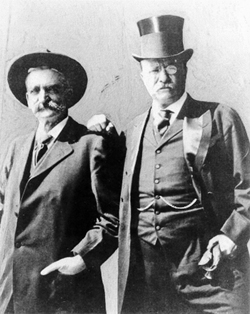
Seth Bullock and Teddy Roosevelt. This photo was taken early in the twentieth century. Roosevelt first met Bullock on a cattle range in 1884, and they became very good friends. Soon after assuming the presidency, Roosevelt appointed Bullock U.S. marshal for South Dakota and Black Hills forest ranger. Bullock had an open invitation to stay overnight at the White House whenever he pleased.
T.R. with Seth Bullock. (Courtesy of David Dary)
Having the vital Bullock—a forerunner of Shane—on his side was a great relief to Roosevelt. Everybody needs a few bad-weather friends. “I hope to see you in Washington this winter,” Roosevelt wrote to Bullock on September 24. “I want to have you at dinner at the White House, and we will talk over past events. I have been peculiarly pleased to have a man of your type to execute the forest laws, for I know you will see to it that they are enforced absolutely without regard to anything but the law itself. Above all I hope you will see that any Government official who is guilty of laxity or inefficiency is held to a strict account.”15
What President Roosevelt was trying to accomplish by circulating his correspondence with Seth Bullock to congressional offices was to demonstrate the kind of top-drawer fellow needed to protect the western reserves. Roosevelt’s vision of law enforcement was hundreds of Bullocks reined up like an Interior Department cavalry on parade, ready to protect the forestlands as a backup for the U.S. Army. Since 1872 Bullock had been perhaps the most vociferous promoter of Yellowstone living in the West. After all, it had been Bullock, as a renegade member of the territorial legislature, who introduced the bill to preserve northwest Wyoming as a “great national park.” Nobody in the West loathed poachers—and arrested them—with the earnest fervor of Bullock. As sheriff in Deadwood, Bullock—who entered the pop culture kingdom in 2004 as the leading character in the HBO television series Deadwood—relished protecting the Black Hills from rogue mining outfits operating without proper claims and from rank outlaws illegally prospecting for gold on federal land. And he expressed a sweeping damnation of all lawbreakers. A veteran of Grisby’s Cowboy Regiment in the Spanish-American War and a fierce ally of the Rooseveltian conservation movement, Bullock wanted the upside-down county around Deadwood—specially Devils Tower toward the west and Wind Cave to the east—preserved as national parks.
President Roosevelt modeled his administration’s conservation policy after his own governorship in New York—where he had tried to whittle down the Fish, Game, and Forest Commission to one nonpolitical appointee. Thus a new era in forest conservation and wildlife management policy was under way. As governor of New York from 1899 to 1900 Roosevelt had led an effort to measure every stream and brook in the state. He now wanted to apply that idea nationally.16 With an air of reasonableness, he warned Secretary Hitchcock that at all costs nobody should be employed in Interior solely for political reasons. Instead, Roosevelt wanted “good plainsmen and mountain men, able to walk and ride and lie out at night, as any first-class men must be able to do.” He wanted wilderness warriors who understood forest reserves to lead to overall social betterment in America. His exhibits A and B were Warford and Bullock: outdoorsmen without an ounce of haughtiness or of susceptibility to greed. Remembering how Yellowstone had been hampered by a lack of law enforcement before the protection act of 1894, Roosevelt basically wanted the western territories of Arizona, New Mexico, Indian, and Oklahoma protected by Rough Riders. “In other words,” Roosevelt instructed Secretary Hitchcock, “they are to be rangers in fact and not in name, and no excuse will be tolerated for inability to perform the vigorous bodily work of the position any more than lack of courage and honesty would be excused.”17
II
President Roosevelt, now living in the White House, became extremely controversial on a number of fronts besides recruiting rangers and running roughshod over Interior in the late fall of 1901. Roosevelt couldn’t help showing his thornier side and his streak of independence, scoffing at both the GOP party line and concerns over states’ rights. Roosevelt had planned to head to Alabama that fall to meet with the “negro leader” Booker T. Washington at Tuskegee Institute. However, suddenly thrust into the presidency, Roosevelt had to cancel this trip. “I write you at once to say that to my deep regret my visit south must now be given up,” Roosevelt informed Washington. “When are you coming North? I must see you as soon as possible. I want to talk over the question of possible appointments in the South exactly on the lines of our last conversation together. I hope that my visit to Tuskegee is merely deferred for a short season.”18
Everything about Booker T. Washington impressed Roosevelt. Born a slave in Virginia, too poor to attend school, the self-taught Washington nevertheless founded, in 1881, the Tuskegee Institute, a technical school for African-Americans. A believer in Washington’s “accommodationist” view toward whites, Roosevelt declared Washington “the most useful, as well as the most distinguished, member of his race in the world.” In office only a month, Roosevelt invited Washington to the White House as a courtesy on October 4 to discuss a federal judgeship in Alabama. A productive dialogue on race relations ensued; the two leaders stood four-square on many important national issues. Washington was invited back to the White House in mid-October to brainstorm about ways to enhance educational possibilities for African-Americans in the South. Eventually, Washington and Roosevelt, enjoying each other’s breathless enthusiasm, broke for dinner. Joining them were the first lady, Edith Roosevelt (she hadn’t gotten used to being called that), and a professional friend, Philip B. Stewart of Colorado, cougar hunting fame. Everybody had a most enjoyable time.
Holy hell broke out in the South the next day, however, when an AP wire story simply stated that Roosevelt had dined with Washington in the White House. The ground rumbled and the southern press went berserk. A segregationist code had been shattered. Headlines like “Our Coon-Flavored President” and “Roosevelt Dines a Darkie” appeared throughout the former Confederacy. The New Orleans Statesman grumbled that the meal was “little less than a studied insult to the South.”19 The Memphis Scimitarran an editorial stating, “It is only very recently that President Roosevelt boasted that his mother was a Southern woman, and that he is half Southern by reason of fact. But inviting a nigger to his table he pays his mother small duty. No Southern woman with a proper self-respect would now accept an invitation to the White House, nor would President Roosevelt be welcomed today in Southern homes. He has not inflamed the anger of the Southern people; he has excited their disgust.”20
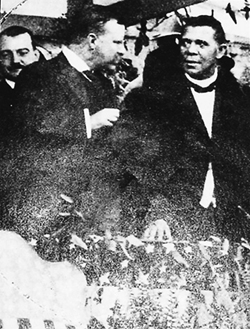
Theodore Roosevelt and Booker T. Washington became great friends. Besides inviting Washington to dine at the White House in 1901, Roosevelt also visited Tuskegee Institute in 1904.
T.R. with Booker T. Washington. (Courtesy of the Theodore Roosevelt Association)
Southern segregationists ripped into Roosevelt with a fusillade of cruel, bigoted, ugly language. James K. Vardaman—publisher of the Greenwood Commonwealth, who was a veteran of the Spanish-American War and a Mississippi Democrat and would become governor and then a U.S. senator—surmised that the “White House was so saturated with the odor of the nigger that the rats have taken refuge in the stable.” Roosevelt became nauseated by these insults—such hatred in America was cancerous. The southerners, Roosevelt lamented, had indicted him for trying to encourage literacy and help fight poverty among African-Americans. The Richmond (Virginia) Times was aghast at Roosevelt’s tolerating the idea that “negroes shall mingle freely with whites in the social circle—that white women may receive attentions from negro men.”21 Never one to cower in the face of threats, Roosevelt decided to go hunting in Mississippi sometime in 1902—to go into the belly of the beast, almost as an act of defiance. Not for a split second was he going to let ex-Confederates—of all people—assault his character. In coming months he would continue consulting with his friend Booker T. Washington; only he back-pedaled away from dinners in favor of meetings at ten o’clock in the morning. Roosevelt, however, did live up to his pledge to tour Tuskegee, though not until after the 1904 presidential election when being photographed with a “negro” wouldn’t cost him votes.22
On December 3, Roosevelt was to deliver his First Annual Message to Congress, so he surveyed various friends (including Chapman, Grinnell, and Merriam) about what he might say regarding conservation and wildlife protection. A key to President Roosevelt’s vision of the American West was a vast increase in forest reserves and western irrigation. These tenets would be a fundamental part of his annual message. At the time of McKinley’s death in September 1901 the number of U.S. forest reserves had increased from twenty-eight to forty: a total of more than 50 million acres. Not bad. Building on that adequate legacy, President Roosevelt strategized about how to triple McKinley’s effort. He succeeded in increasing the number of national forests from forty to 159, with a total of more than 150 million new acres.23 Put another way, the U.S. forest reserves went from about 43 million acres in 1901 to 194 million acres in 1909 under Roosevelt’s leadership. As the historian John Allen Gable computed in the Theodore Roosevelt Association Journal, Roosevelt’s new forestlands constituted an area larger than France, Belgium, and the Netherlands combined.24
Forest reserves aside, President Roosevelt looked back in bafflement over why McKinley had rejected stringent wildlife protection laws. Didn’t McKinley want elk and antelope to populate the Great Plains? Was he really opposed to a moose reserve for Maine? The fact of the matter was that McKinley simply hadn’t wanted to squander political capital with powerful western senators over what he considered fringe issues, such as protecting ungulates. That indifference immediately changed with Roosevelt in power. From the get-go Pinchot, in fact, at Roosevelt’s behest, had brought into the forefront of U.S. conservation policy initiatives which the Boone and Crockett Club had formulated: mainly, having game reserves inside national forests. Anxious for his administration to make these bold leaps toward wildlife protection, Roosevelt asked Gifford Pinchot to push the ideas about game reserves through Congress. It didn’t prove easy going for Pinchot. Western development interests didn’t give a damn about buffalo, deer, and elk. Working with the Boone and Crockett Club and the New York Zoological Society, Roosevelt, with the essential help of Congressman Lacey, nevertheless soon made historic strides in getting wildlife protection legislation.
Deciding unilaterally to change the name of the Executive Mansion to the White House that October, Roosevelt asked Pinchot to head the Division of Forestry in Interior. He promised him “an absolutely free hand”—free, that is, from the gaze of Ethan Allen Hitchcock. Roosevelt claimed his White House desperately needed Pinchot’s help on selecting ideal sites for forest preserves and on intelligent habitat management (including selective timber thinning and brush control). As a lure or incentive Roosevelt told Pinchot that his recommendations for forestry would become—in essence—the de facto administration policy. Pinchot, not Hitchcock, would be the ultimate arbiter at Interior. And while ostensibly Pinchot was merely head of a division, in reality he would have more power than Secretary Hitchcock or the GLO commissioner, Binger Hermann (a former Republican congressman who was an attorney in Oregon). Hitchcock would be a useful figurehead—and an ally of sorts—kept only to placate the McKinley’s old guard. As for Hermann, he smelled to Roosevelt like an enemy, an Oregonian more interested in pork for river and harbor appropriations than in protecting places like Crater Lake, Three Arch Rocks, or the Cascades. Point-blank reality was that Pinchot (as division head) would be making federal forestry policy.25 (Later, in 1905, Pinchot would become the first chief of the new forestry service).
Gladly, Pinchot accepted the president’s gracious offer. In the coming years their vigorous friendship continued to blossom. Roosevelt found Pinchot to be a bundle of invaluable insights. Together they would often hike in Rock Creek Park, swim in the Potomac River, play tennis, watch birds, and chop firewood near National Cathedral School. While Pinchot wasn’t given to lyrical outpourings like Burroughs or Grinnell, he was a far better conservationist tactician than anybody else orbiting around Roosevelt. In Roosevelt’s so-called “tennis cabinet” (“kitchen cabinet” sounded too sissified for Roosevelt), Pinchot was probably his most trusted colleague. Pinchot, in fact, became something of a “faithful bodyguard,” always willing to defend Roosevelt from attacks.26Seldom did Roosevelt and Pinchot see things through different lenses. (There, however, was one big difference between them: Roosevelt was first and foremost a bird preservationist whereas Pinchot was not). And they both enjoyed night work and end-of-the-day confidences. “They were appalled by the human destruction of nature everywhere visible in early twentieth-century America,” the historian Char Miller has noted. “The solution, they believed, lay in Federal regulation of the public lands and, where appropriate, scientific management of these land’s natural resources; only this approach, guided by appropriate experts, would ensure the land’s survival. So parallel ran their thoughts that Roosevelt reportedly assured Robert Underwood Johnson, editor ofCentury Magazine, that on questions of conservation the chief forester was in truth the keeper of conscience.”27
Not only did Pinchot agree to run the Division of Forestry in Interior, but over Thanksgiving he inserted paragraphs about conservation into the December 3 annual message. To many western senators these insertions were out-and-out heresy. The intensity and boldness of Roosevelt’s address, read by a clerk (as was traditional), encouraged conservation enthusiasts on many levels, though the speech was somewhat short on details. And it wasn’t just a cranky outburst. It was hard-core Rooseveltian conservationist philosophy, presented on the nation’s center stage. For those familiar with Roosevelt’s allegiance to the Boone and Crockett Club and various Audubon societies, it wasn’t very shocking—but the sheer breadth of the wildlife protection plank wasunexpected. Even though most New Yorkers had accustomed themselves to the proposition that the sportsman Roosevelt, when it came to wildlife protection or forestry policy, was never content to be a spectator, Congressmen on both sides of the aisle were surprised by the piercing vigor of his conservationist agenda.
Nobody has recalled President Roosevelt’s First Annual Message with such elegance and insight as historian Edmund Morris in Theodore Rex. Combining actual passages of Roosevelt’s address with vivid descriptions of individual legislators and the atmosphere, Morris wrote about that frigid December day as if he had been sitting in the visitors’ gallery witnessing history.28 Regardless of its overall eloquence, the annual message consisted of important reports and helpful comments that the White House had received from various departments (in other words, it was cobbled together).29 For starters Roosevelt, in strong language, condemned filthy anarchists; he was seething because three presidents in his lifetime had been struck down in their prime by lunatics. Thunderous applause arose from Congress as the clerk, reading Roosevelt’s bracing prose, exclaimed with pent-up frustration that the American people, usually “slow to wrath,” when “kindled” (by an anarchistic abomination like the murder of McKinley) ignited like a “consuming flame.”30 As president he planned on ridding the nation of anarchists, sending them scurrying like mice across the floorboards of national life.
Although Roosevelt offered some uplifting chamber of commerce-like pronouncements about improved business confidence, his address was notable for its stinging language about corporate trust-busting. Industrialists interpreted the address as a sneer from the pulpit. Clearly, Roosevelt planned on restraining the business class, and even openly challenging it over stock market manipulations and monopolist attitudes. Throughout the Gilded Age huge corporations worked overtime to abuse the public welfare, affecting millions of Americans; such abuses were going to be curtailed with Roosevelt in the White House. He promoted immediate federal intervention in regulating corporations. And—like a boot stuck in mud suddenly coming free—he said that workers were no longer going to be treated as industrial wage slaves. Demanding improved labor laws, Roosevelt lambasted, as Morris puts it, politicians that were “fattened at the public trough.”31 Many of those seated—particularly senators from the Deep South still furious over the Booker T. Washington affair—were leaning forward with fingers clasped and heads shaking: no, this traitor to his class and race can’t be real. “In the interest of the public, the government should have the right to inspect and examine the workings of great corporations,” Roosevelt stated. “The nation should, without interfering with the power of the States in the matter itself, also assume power of supervision and regulation over all corporations doing interstate business.”32 No company was above the law or deserved special treatment from the U.S. government. He outright rejected corporations that wanted rebates and rate fixing. “Great corporations,” Roosevelt proclaimed, “exist only because they are created and safeguarded by our institutions; and it is therefore our right and duty to see that they work in harmony with these institutions.”33
Following these cautionary swipes at corporations President Roosevelt launched into his conservation plank, based on the philosophy of Pinchot and Grinnell. Nothing would palsy his resolution regarding wilderness protection. The West had 6 million inhabitants in 1901; by the time Roosevelt left office there were over 10 million citizens and the population was still growing. Much of Roosevelt’s conservationist thinking in the annual message was directed toward this region. With the West so much in the forefront, he was, as Morris noted in Theodore Rex, “striking a note altogether new in presidential utterances.”34 Nothing about Roosevelt’s conservationist rhetoric could have been misconstrued as give-and-take. He was telling Congress the new lay of the land. Disgusted that the United States had cut down almost 50 percent of its timber, and that valuable topsoil had been washed away, Roosevelt was sending a wake-up call.35 He wanted Congress to save pristine American land while it still existed. Whether they were coniferous forests in the Pacific Northwest or strands of Douglas fir far older than the republic in the Front Range of the Rockies, forests had to be saved. His far-reaching conclusion, after much consideration, was that he wanted the western reserves vastly increased. Decades of study had taught him the symbiotic relationship between timber, soil, and water conservation. “The preservation of our forests is an imperative business necessity,” the address stated. “We have come to see clearly that whatever destroys the forests, except to make way for agriculture, threatens our own well being.”36
And the conservationist creed—albeit carefully modulated—didn’t stop there. It would be up to the federal government—not big business—to lease lands for logging or mining, and not just near the famous destinations like Yellowstone and Yosemite. Throughout the West, the prettiest scenery not deforested or contaminated would be on the table for consideration as national parks or forest reserves. Not on his watch would such lovely Pacific Northwest ranges as the Cascades and Olympics be turned into heaping mounds of slag as in Appalachia. No western state would go unaffected. Praising the U.S. Department of Agriculture, Roosevelt promised to sponsor even more science-based studies pertaining to trees, plants, and grasses through its Biological Survey division run by Dr. Merriam. Roosevelt’s address was pure radical Americanism—especially the ten paragraphs dealing directly with conservation. That November, just a few weeks before the First Annual Message, John Muir had published the essay collectionOur National Parks, which included his classic Atlantic Monthly articles “The American Forests” and “The Wild Parks and Forest Reservations of the West.”37 Roosevelt had found them highly stimulating and persuasive. Roosevelt did not mention Muir in his annual message but nevertheless sided with Muir’s ecologically sensible crusade to save the great forests of the Pacific Slope. Roosevelt, in fact, liked to quote Muir, who wrote in 1897: “The forests of America, however slighted by man, must have been a great delight to God; for they were the best he ever planted.”38
Roosevelt was the new Delphic oracle of conservation, the political authority of the forestry movement, best-selling author, wilderness trooper, birder, hunter, and moral advocate for nature. For most presidents, give-and-take with Congress was important. Roosevelt, however, believed in only one solution: his own. But, by and large, Congress wasn’t persuaded by Roosevelt’s far-reaching promotion of forestry in the First Annual Message. Roosevelt, for example, recommended consolidating forest workunder the Bureau of Forestry. “This recommendation was repeated in other messages,” Roosevelt carped in An Autobiography, “but Congress did not give effect to it until three years later. In the meantime, by thorough study of the Western public timberlands, the groundwork was laid for the responsibilities which were to fall upon the Bureau of Forestry when the care of the National Forests came to be transferred to it.”39
Besides forest reserves Roosevelt spoke out in the First Annual Message on behalf of wildlife protection as formulated by the Boone and Crockett Club, implying that many federal preserves would eventually be created to protect elk, pronghorns, mule deer, and mountain goats. Even though wildlife didn’t have the economic importance of timber or water, it was the most endangered resource of twentieth-century America. To Roosevelt the forest reserves, in consequence, should “afford perpetual protection to the native fauna, and flora, safe havens of refuge to our rapidly diminishing wild animals of the larger kind.”40 Eventually Roosevelt would sell suspicious western developers on the need for wild-life protection by offering a quid pro quo. Predator control would serve as an inducement. Once established, federal game reserves would thin out wolves and coyotes in a region, keeping these predators away from domestic livestock in the government lands. This, in turn, would also mean far less predators in communities near forest reserves. Roosevelt had Merriam at the Biological Survey begin printing pamphlets on how best to poison coyotes and wolves.41
Diligently, Roosevelt had tweaked drafts of the first annual message, searching for exactly the right phrases. This wake-up speech wasn’t a pedestrian tract on the virtues of utilitarian forestry. It was meant for the ages, meant to be bound in gilt-stamped leather. The embryonic wildlife protection movement (best epitomized by the Boone and Crockett Club and the Audubon societies) had now come to fruition on a large scale at the federal level. The U.S. government was headed into the business of saving elk, deer, and buffalo. Even though the address was read by the clerk, listeners could envision the president jabbing his finger at disputants, determined to topple their built-in predispositions. “Roosevelt respected expert opinion and made use of it to a degree which was unmatched among the public, men who were his contemporaries,” Pinchot explained. “Men of small caliber in public office find scorn of expert knowledge a convenient screen for hiding their own mental barrenness. So true is this that one of the best measures of his own breadth and depth of mind is the degree to which a public man acknowledges the value of expert knowledge and judgment in fields with which he himself, in the nature of things, cannot be familiar. By this standard Roosevelt stood at the very top.” 42
At about the time of the First Annual Message, Roosevelt encouraged Merriam to increase the hiring of so-called “camp men” who could help the Biological Survey’s field reporters inventory native plants and animals. For a salary of about twenty-five dollars a month, these camp men (usually hunt guides from the area) would assist the trained scientists working for the Biological Survey. Together the egghead and the rough-and-ready would set traps, prepare skins, and ship species back to Washington, D.C., where they could be carefully studied in laboratories. Roosevelt wanted thorough field notes with biotic summaries accompanying every shipment. One of Roosevelt’s favorites among Merriam’s “field agents” was J. Alden Loring (who upon his recommendation in 1899 became assistant curator of mammals at the New York Zoological Park). Always encouraging Loring to become a public figure, to stop concealing his genius, Roosevelt tapped him as a talent scout taps a promising athlete. Proud of the way Loring was following in Merriam’s estimable footsteps, Roosevelt later had the young naturalist collect for the U.S. National Museum in Europe. Loring also helped reintroduce buffalo back to South Dakota and accompanied former president Roosevelt on his 1909 African safari.43
What impressed Merriam about Roosevelt was that even while living the “strenuous life,” he never stopped being a faunal naturalist. The microscope had turned a new generation of biologists to studying minute organisms, but Roosevelt stayed focused on what Merriam called the more “obvious forms of life.” Starting in November 1901 and continuing until he left office in March 1909, Roosevelt would telephone Merriam quite regularly, particularly during the spring migration, making sure that the warblers in the White House elms were blackpolls or that the flocks of rusty blackbirds along the Potomac basin hadn’t decreased in numbers from the previous year. Not long after becoming president, in fact, Roosevelt had asked Merriam to take a twilight bicycle trip with him from the White House to Rock Creek Park to watch a beaver build a lodge. “He was ‘delighted’ to see the beaver cut a willow and swim with it to a floating log,” Dr. Merriam recalled in Science, “where he sat up and ate the bark.”44
Regularly Roosevelt would walk from the White House to Merriam’s home to study his world-class collection of mammal bones and skins.45 He was like a child wandering into F.A.O. Schwartz on Christmas Eve. Merriam’s huge library was the“zoological salon” of the District of Columbia. “Few people are aware of Roosevelt’s knowledge of mammals and their skulls,” Merriam recalled. “One evening at my house (Where I then had in the neighborhood of five thousand skulls of North American mammals) he astonished every one—including several eminent naturalists—by picking up skull after skull and mentioning the scientific name of the genus to which each belonged.”46
Besides rattling off the genus of skulls, Roosevelt was proud that some of the Biological Survey’s best cougars were courtesy of his prodigious hunting efforts. Two weeks after Roosevelt delivered his Annual Message he wrote to Yellowstone’s acting superintendent, Major John Pitcher of the Sixth Cavalry, about shooting cougars to control predation. The president wanted to arrive in Yellowstone that June and hunt “varmints” that were “not protected.” A backwoodsman, John B. Goff, would serve as a guide, using his pack of hounds to chase the big cats. If Roosevelt collected ten or twelve cougars from Wyoming he could ship them to Merriam to be compared with the ones from Colorado. Being president shouldn’t mean relinquishing his reputation as the world’s leading expert on cougars. From Major Pitcher’s perspective this was an insane request. The president of the United States, busy with international crises, wanted to summer in the wilds of Yellowstone to “thin out” the cougars? But Major Pitcher—particularly asacting superintendent—wasn’t going to tell his boss no. He started making arrangements.
The rumor that Roosevelt was coming to Yellowstone had C. J. “Buffalo” Jones whooping with excitement. Sidestepping Major Pitcher, Jones started to make plans for a hunt in Yellowstone. He was especially anxious for the president to see some of the buffalo he’d raised like cattle. Most Americans in 1901 could see bison only in Buffalo Bill’s Wild West Show, or at Bronx Zoo or the Goodnight Ranch in Texas. Jones was determined to change that sad fact. An old buffalo runner, he had reformed and was among the best bison breeders in the American West. Sickened that his own slaughtering of buffalo had almost brought about their extinction, Jones wanted to show his hero, President Roosevelt, how he had made a 180-degree turn. Roosevelt was greatly interested in Buffalo Jones’s claim to have successfully crossbred bison with cattle (producing “catalo”) and even reportedly broken a few of the offspring to harness. Unfortunately, one of Jones’s captive Yellowstone buffalo—named “Lucky Knight”—had trampled a Wyoming resident to death. Refusing to let Lucky Knight be butchered, Buffalo Jones instead trained it to pull his buckboard. He bragged that he had the only killer buffalo in the West.47 Unfortunately, Roosevelt’s 1902 trip to Yellowstone was postponed for a year owing to an unexpectedly heavy workload. The anthracite coal strike, heightened Russo-Japanese tension, and other serious presidential concerns forced Roosevelt to postpone seeing Buffalo Jones’s bison herd until April 1903.
That Christmas season President Roosevelt grew intrigued by the creation of the new American Scenic and History Preservation Society in New York (it was an outgrowth of Andrew H. Green’s Trustees of Scenic and History Places and Objects, which had helped Roosevelt save Palisades Park back in 1900). Just as Roosevelt wanted the Biological Survey to inventory all of America’s plants, birds, fish, insects, and wildlife, this new nonprofit organization, modeled after Britain’s National Trust, was going to protect both historic sites and scenic places. Roosevelt believed—thanks to Congressman Lacey’s inspection tour—that, for example, the Anasazi cliff dwellings in Colorado and the Pueblo Chaco Canyon in New Mexico needed protection. The new trust was going to start doing that and more. Among the places the trust saved were Stony Point Battlefield (thirty-five acres on the shore of the Hudson River near West Point), Lake George Battlefield (thirty-five acres on Lake George), and Fort Brewerton (in Hastings at the foot of Oneida Lake). Wishing he could have founded the trust, Roosevelt began scheming to find new ways for the federal government to interface with it. And Roosevelt started lobbying the trust to save Chalmette Battlefield in New Orleans, the site along the Mississippi River where Andrew Jackson gave the British their comeuppance; he sent Green the appropriate chapter of his Naval War of 1812, which documented the historical significance of the battle.* Contained in the trust fund were the seeds of what would become Roosevelt’s grand preservationist accomplishment—the Antiquities Act of 1906.
Congressman Lacey had truly gotten President Roosevelt to start thinking in earnest about preserving Chacoan heritage sites in Colorado, Utah, New Mexico, and Arizona. The cultural blossoming of the Chacoan people had begun in the mid-800s (after Christ), long before Saint Augustine was born and of course even longer before the supposed “oldest city” in North America was named after him in Florida. The Chacoans built a network of fairly sophisticated villages throughout the Southwest. The huge Four Corners high-desert valley was once a hub of Anasazi life. Tribesmen farmed lowlands and constructed elaborate cliff dwellings. The Chaco Anasazi were extraordinary masons, and their towns were monuments to creative architecture. A burning question in archaeological and ethnological circles in 1901 was: what happened to the Anasazi? The answer seemed to be that a great drought had killed them off. The message to Roosevelt was clear: aridity was the death card in the Southwest. To be sustainable, communities had to develop water reservoirs. In 1901 Europeans considered Aztec and Maya ruins in Mexico and South America grand antiquities. The nationalistic Roosevelt scoffed at such boosterism by the European art world on behalf of Mexico. The United States, he said (thumping his chest, as it were), had just as fine ancient rubble in its own Southwest as existed in Peru or Bolivia. The cliff dwellings at Mesa Verde, Colorado, were our Machu Picchu.
Since his days at Harvard, in fact, Roosevelt had been interested in the mysteries pertaining to the vanished Chacoans. The photographer W. H. Jackson of the U.S. Geological Survey had written extensively about how Chacoan stairways were carved into cliffs at Mesa Verde. Unfortunately, the plates of photography he took weren’t properly developed, so he brought back to New York only diary notes. But in 1888 the Bureau of American Ethnology spent six weeks in the Four Corners region photographing Chacoan sites for a huge project on Pueblo architecture. It also reported that vandals were looting the antiquities. When Roosevelt was the U.S. civil service commissioner he denounced Chacoan “pot hunters” as being as swinish as the poachers at Yellowstone.
Between 1896 and 1900 the great archaeologist and trail guide Richard Wetherill began excavating the Mesa Verde cliff dwellings. At the same time the American Museum of Natural History in New York began analyzing Pueblo Bonito. When Roosevelt was governor he inspected crates of artifacts from the Southwest when they arrived at the American Museum of Natural History and were eventually put on permanent display. Therefore, by the time Roosevelt became president in September 1901 the fact that the GLO was promoting the idea of a Chacoan national park was old news to Roosevelt. Meanwhile, in Santa Fe, New Mexico, the committed archaeologist Edgar Lee Hewett—a quiet, unassuming intellectual enamored of the Chacoan past—was mapping various sites at Four Corners in preparation for preservation, as head of the School of American Research. Hewett made it a personal crusade to save these amazing archaeological sites. There were dozens of legal hurdles to clear (not the least being Wetherill’s claim to the land around Chaco Canyon), but Roosevelt told Congressman Lacey they’d find a way to preserve Chacoan sites. In 1902 Lacey—hiring Hewett as coconspirator—began working on sensible legislation. It would evolve into the Antiquities Act of 1906.
III
So Roosevelt had started to put the wheels in motion for preservation early in his administration. Polishing up his credentials as a naturalist and one of the four or five popular authorities on North American mammals, Roosevelt also published, on May 7, 1902, a book titled The Deer Family. Written while he was vice president, The Deer Family was issued as the first volume of the American Sportsman’s Library (edited by Casper Whitney of the Boone and Crockett Club).48 The book was done in collaboration with his fellow naturalists T. S. Van Dyke (on Pacific Coast elk and Columbia black-tailed deer), Daniel G. Elliot (on caribou), and A. J. Stone (on moose), and Roosevelt wrote the first four chapters himself. The publisher of The Deer Family—the Macmillan Company—made much of the fact that it constituted, as the Washington Times noted, “the first time in the history of the country a book has appeared bearing the name of the President of the United States as that of the author.”49
Collaboration between authors was fairly commonplace in the academic world of 1902, and scientists usually presented scholarly papers at conferences with three or four names attached to their joint research. But Theodore Roosevelt was president: whom he decided to share his title page with was automatically news. And he didn’t mind working with Darwinian eccentrics. The three men Roosevelt chose to be associated with in publishing this historic book were among the very best naturalists in America. All of them held a Darwinian belief in the importance of fossil records and the interconnectedness of environment and life. One of Roosevelt’s major motivations for writing his essays in The Deer Family, in fact, was to swing a lantern over the names of these naturalists, big game hunters, and explorers, in gratitude for their decades of largely unsung work. And the Boone and Crockett Club, in a congenial way, was circulating petitions in the Great Plains to promote the notion of big game preserves; The Deer Familywas an important tool in this wildlife repopulation effort.
President Roosevelt had been in awe of Professor Elliot ever since age nineteen, when Theodore Sr. had introduced them in Italy. Honored all over the world for his bravery and his zoological discoveries, and known especially for his astounding papers on birds, Elliot had been vaguely associated with the American Museum of Natural History since its founding. He was also active in the American Ornithological Union. Darwin had detailed the courtship rituals of the Australian bowerbird; Elliot did the same for shorebirds. No fewer than ten nations had decorated Elliot for his first-rate empirical work in the natural sciences. Throughout the 1890s he interacted with Roosevelt socially in New York, swapping stories of bird sightings like a couple of old fuddy-duddies from the British Museum. Playing the eager student, Roosevelt had read Elliot’s monographs, all saturated with facts, including Family of the Pheasants and Birds of Paradise. With his large walrus mustache, which stood out more vibrantly than his pointed beard, Elliot was easily distinguishable in a crowd. When the naturalist Dr. Albert Bickmore heard that Elliot had been chosen by the Field Museum of Chicago to be its zoology curator in late 1894, he lamented that New York had lost “one of America’s first scientists.” In 1898, while Roosevelt was in Cuba with the Rough Riders, Elliot was the first serious naturalist to systematically study the Olympic Mountains in the Washington Territory (home range to Roosevelt’s elk). Elliot had initiated a movement to save the state of Washington’s Mount Olympus from the timber conglomerates.
Then there was T. S. Van Dyke, whose book The Still Hunter was considered a classic in the sporting genre. Van Dyke was less scientific than Elliot and was blessed with the ability to spin a good yarn about cougars; Roosevelt admired the way he brought wild creatures into the lives of everyday Americans without scientific pretension. He had a tremendous knack for powerful, accurate generalization. Nobody in the United States wrote prose as similar to the president’s as Van Dyke. There was a tradition that was passed down from Reid to Van Dyke to Roosevelt. The president was enthralled by a popular article of Van Dyke’s, “The Hills of San Bernardino,” and recommended it to everyone. “We have left far behind us the mellow flute of the valley quail,” Van Dyke wrote, “but his double-plumed and gay cousin of the mountain well supplies his place. From the lowest valley to the loftiest point where vegetation grows, you often see his mottled waistcoat of white and cinnamon, his bluish coat, and long nodding plumes; may hear the gentle patter of his little feet on the pine-needles as he steals softly away, and hear his ordinary quit-quit-quit-quit queeah changed into a dismally-anxious queeeee-awwk, as he leads the little brood from danger.”50 Just as Elliot was making his mark studying the Olympics, Van Dyke became the preeminent mountain climber-naturalist of California’s Palomar mountain range. Fancying himself as the Joaquin Miller of any California landscape south of Big Sur, Van Dyke also wrote The City and County of San Diego, published by a small local press.51 Unlike that of the other authors in The Deer Family, however, some of Van Dyke’s work was clearly mediocre. And at times, as when he claimed to have shot four wildcats with one shotgun blast, he defied believability.52
Rounding out The Deer Family’s quartet was A. J. Stone, the naturalist wunderkind of the moment. As a corresponding member of the Zoological and Ethnological Museum of Natural History and the New York Zoological Society he spent the years 1897 to 1899 living around the Arctic Circle with only his kayak and sled dogs as companions.53 Taking off from Fort McPherson, the Hudson Bay Company’s northernmost outpost, he trudged up through sea ice to forlorn Herschel Island. During one five-month stint Stone hiked 3,000 miles above the Artic Circle, shattering all previous land travel records. With the bitter wind assaulting him, and temperatures often falling to minus seventy or eighty degrees Fahrenheit, he nevertheless traversed snowdrifts as tall as the White House. Polar bears, northern fur seals, and arctic foxes were all vividly described in his field notes. When the harpooner hero returned to America the New York Times saluted his circumnavigation as finishing “one of the most remarkable trips in the history of the North American continent.”54
The selection of Elliot, Van Dyke, and Stone as coauthors of The Deer Family represented three distinct sides of Roosevelt’s conservationist persona, though perhaps the president did not realize this. There was the intrepid Elliot, the man of letters, naturalist, and globe-trotter, known for the precision of his scientific work in ornithology and mammalogy (but also heartily equipped to endure leeches and snakebites). The dominant strain of the big game hunter–naturalist was represented more than adequately by the indomitable Van Dyke, who was roaming the West Coast in search of bears, as he had done in Montana. Like Roosevelt’s, Van Dyke’s prose was action packed, yet careful about wildlife observations. Being a naturalist explorer was an occupation that the president coveted more than any other. Recognizing that the Artic Circle was one of the last frontiers, Roosevelt, from temperate Washington, D.C., chose Stone, who had exhibited the grit, individualism, and adventurousness in the wild taiga and tundra at the top of the world, tethered to a dogsled. They shared a fundamental attitude of no retreat. Clearly Stone, like the president himself, had learned to overcome wind chill, distance, and isolation while still managing to read Tolstoy on a inflatable mattress by quiet candlelight in a makeshift outpost shack.
Bookstores throughout the United States set up displays of The Deer Family, complete with handsome illustrations of sixty-seven-inch Alaskan moose antlers and Wyoming antelope grazing on the open range. And although Van Dyke, Elliot, and Stone were coauthors, the dark green cloth cover read only: “The Deer Family by Theodore Roosevelt and Others.” In fact, President Roosevelt had written only one-third of the book, but his lively chapters were far and away the most popular. Upon opening The Deer Family the reader immediately encountered a brief “Foreword” by Theodore Roosevelt—written in June 1901, when he was vice president. “This volume is meant for the lover of the wild, free, lonely life of the wilderness,” he wrote, “and of the hardy pastimes known to the sojourners therein.”55
Roosevelt’s chapters in The Deer Family are beautifully written, combining a nearly childlike rapture for hunting with an adult conservationist philosophy.56 Not only did the president offer compelling scientific details of the exact bifurcations of a mule deer’s main prongs or the pugnacity of elk herds; he made his field observations discernible to the average American. When writing about these mammals the president insisted on biological precision, seamlessly weaving into his narrative a steady succession of scientific facts, big-bored .505 Gibbs flashbacks, and earthy descriptions of Western scenery. In The Deer Family were echoes of the naturalist prose that Roosevelt had first showed off in The Wilderness Hunter, to the hearty approval of John Burroughs. For example, here is Roosevelt on the North Dakota prairie in The Deer Family:
It was beautiful to see the red dawn quicken from the first glimmering gray in the east, and then to watch the crimson bars glint on the tops of the fantastically shaped barren hills when the sun flamed, burning and splendid, above the horizon. In the early morning the level beams brought out into sharp relief the strangely carved and channeled cliff walls of the buttes. There was rarely a cloud to dim the serene blue of the sky.57
Nostalgic passages like these, in which the writer is hungering for open spaces, made The Deer Family a minor best-seller for three or four weeks. Literally every review the book received was respectful. From the perspective of time, 100 years after it was written, The Deer Family—even more than The Wilderness Hunter—may be the most important of all Roosevelt’s books for our understanding of his evolved views on conservation. No longer does Roosevelt regale readers with his derring-do across the immensity of the continent. Nor does he champion mountain men in nativistic, white-man’s-burden fashion. In The Deer Family, Roosevelt—speaking as a U.S. president—became an environmental crusader and scold. Derision toward unsportsmanlike hunters was more amplified than in his previous outdoor books and essays. “The big game hunter should be a field naturalist,” Roosevelt wrote. “If possible, he should be an adept with the camera; and hunting with the camera will tax his skill far more than hunting with the rifle, while the results in the long run give much greater satisfaction. Wherever possible he should keep a note-book, and should carefully study and record the habits of the wild creatures, especially when in some remote regions to which trained scientific observers but rarely have access. If we could only produce a hunter who would do for American big game what John Burroughs has done for the smaller wild life of hedgerow and orchard, farm and garden and grove, we should indeed be fortunate.”58
He urged all sportsmen to immediately become naturalists, keeping detailed notes about wildflowers, prairie grasses, and swamp fronds. Even if the would-be hunter didn’t “possess the literary faculty and powers of trained observation necessary for such a task,” Roosevelt instructed, he could nevertheless “do his part toward adding to our information by keeping careful notes of all important facts which he comes across.” Attempting to create North American field guides from the ground up—something akin to the later regional WPA guides—Roosevelt wanted everyday citizens to partake in inventorying the nation’s natural resources. “Such note-books would show the changed habits of game with the changed seasons, their abundance at different times and different places, the melancholy data of their disappearance, the pleasanter facts as to their change of habits which enable them to continue to exist in the land, and, in short, all their traits,” he wrote. “A real and lasting service would thereby be rendered, not only to naturalists, but to all who care for nature.”59
Unbeknownst to Roosevelt’s opponents in spring 1902, his desk at 1600 Pennsylvania Avenue had already become a rubber-stamp center for any serious-minded conservationist or natural resources specialist with an honest agenda. Already he was thinking of how best, with a modicum of good sense, to repopulate a federal forest reserve with his Bronx Zoo bison. Regularly, he was staying in touch with William T. Hornaday. Together they also had high hopes of someday creating a national elk reserve near Yellowstone. “Surely all men who care for nature, no less than all men who care for big game hunting, should combine to try to see that not merely the states but the Federal authorities make every effort, and are given every power, to prevent the extermination of this stately and beautiful animal,” he wrote of elk. “The lordliest of the deer kind in the entire world.”60
Although this is a chicken-or-egg situation, the Bronx Zoo had made a special effort to advertise its elk, mule deer, caribou, and moose as all being part of what it called “The Deer Family.” Unfortunately, despite the enthusiasm of Hornaday and Roosevelt, the zoo was failing in its efforts to breed moose and caribou in captivity. The sultriness of New York City in summer was, as Hornaday later noted, “decidedly inimical” to the project. “This densely humid and extremely saline atmosphere is about as deadly to the black-tail, caribou and moose as it is to the Eskimos,” Hornaday wrote, “and thus far we have found it an absolute impossibility to maintain satisfactory herds of those species in the ranges available for them.”61 It wasn’t enough to breed buffalo or elk in captivity. Big game refuges were needed in their western habitats. Worried about a band of dwarf elks in Kern County, California, Roosevelt had the Biological Survey move them to Sequoia National Park, where the Department of the Interior assumed the responsibility for their case.
Furthermore, on January 7, 1902, the executive committee of the Boone and Crockett Club issued its final report on how to create wildlife refuges. Washington insiders called it the Roosevelt Report (knowing full well that the president would adopt the club’s recommendations). At the core of the final report was the belief that U.S. game reserves should be established inside national forests. For example, President McKinley had established Oklahoma’s Wichita Mountains Forest Reserve in 1901 to protect natural resources. The Boone and Crockett Club’s report suggested that part of this forest could become a buffalo or deer preserve. Because the U.S. government already owned the Wichitas, it had the authority to fence off thousands of acres to save vanishing wildlife. The report also recommended that the economic needs of locals always be factored in when policy recommendation were made.62
Prudence, of course, was the tenor of President Roosevelt’s directives regarding forest preservation and wildlife protection. As an accidental president, coming into power because of McKinley’s death, Roosevelt wanted to avoid unnecessarily kicking over a hornets’ nest. Senators from Idaho, Oregon, Montana, Utah, and Colorado already had their long knives out for him. He had to move with caution concerning the regulation of game animals and birds in any new forest reserve he created, to avoid an outcry of states’ rights sentiment. His strategy was to start slowly with just one or two forest reserves, where the political opposition would be next to nil. Then, if he was elected in his own right in 1904, depending on the magnitude of his electoral mandate, he would act more boldly and decisively, taking head-on what he called in An Autobiography the “great special interests” of the Far West that were destroying nature “at the expense of the public interest.”63 As of 1902 the United States had approximately 43 million acres of forest reserves at its disposal. Roosevelt, with Pinchot at his side, wanted the Forestry Bureau to quickly double or triple that amount. From a long-term planning perspective Pinchot hoped to persuade Roosevelt to transfer the Division of Forestry from the Interior Department to the Department of Agriculture (he accomplished this goal with the Transfer Act of 1905).
IV
Throughout the first six months of 1902 the president fought for the federal government’s “conquest” of the arid lands of the West. Increasingly this involved irrigation. He believed instinctively that the huge undertaking of constructing large dams and reservoirs was an obligation of the federal government because its scope was beyond the capacity of private enterprise.64 Wanting to build on John Wesley Powell’s recommendations for the Geographical Survey, Roosevelt fought tooth and nail for land reclamation through hydrological advancements such as dams, reservoirs, and aqueducts as if he himself were the editor of Irrigation Age. (Ironically, Powell actually believed in decentralized irrigation, not huge, federally run Rooseveltian dams.) Rivers could be redirected, Roosevelt believed, so as to build sustainable western communities in Utah, Arizona, Nevada, California, Texas, and New Mexico. Although he had promoted saving bird habitats, Roosevelt seemed totally ignorant of the potential downside of advanced hydraulic drilling on the desert ecosystem. Filled with good intentions, the shortsighted Roosevelt was, sadly, unable to envision how potentially harmful the dams were to the western environment he so loved.65 Yet the goal of turning arid land to fields of green was, from a human development perspective, ennobling.
Of course, Roosevelt wasn’t working in a vacuum. Many western politicians approved of selling public lands in sixteen western states to fund ambitious irrigation projects. Every politician west of Kansas City or Bismarck, it seemed, was floating a how-to-do-it irrigation bill. The idea was that once settlers prospered on the irrigated western lands, they would help repay the cost of the hydraulic projects by contributing to a revolving fund (something like the later Social Security system). Roosevelt and his followers believed these large-scale irrigation projects would dramatically transform the western economy, landscape, and farming. The days of decaying lumber would be over. As Roosevelt had stated in his First Annual Message, the federal government needed to create “great storage works” for water. Wise irrigation laws should be adopted in the West—laws that issued clear titles for water rights.66
Doing all this reclamation legwork for Roosevelt were Pinchot and the young hydraulic specialist Frederick H. Newell, who in June 1902 became chief engineer under Charles D. Walcott, then director of the U.S. Geological Survey. “Pinchot and Newell actually did the job,” the president joked, “that I and the others talked about.”67 (Later, in 1907, when Walcott left the Reclamation Service to head the Smithsonian Institution, Roosevelt had Newell serve as director of a new Department of Interior Reclamation bureau.) In his unpublished memoir, written in 1927, Newell explained his commitment to Rooseveltian conservation, inspired, in part, by growing up in the lumber town of Bradford, Pennsylvania. With an aptitude for geology, Newell attended MIT, graduating in 1885 with a degree in mining engineering.
In 1888 he started working for John Wesley Powell and became Powell’s right-hand man. A regular at the Cosmos Club, Newell was invited, along with Pinchot, to become a member of the “Great Basin Lunch Mess,” where intense discussions were held on western rivers, forestlands, geographical surveying, and soil conservation. As an author Newell was almost as prolific as Roosevelt—only there was no romance of nature in Newell’s utilitarian volumes, such as Oil Well Drillers (1888), Agriculture by Irrigation(1894), Hydrography of the Arid Regions (1891), and The Public Lands of the United States (1895). When modern-day environmental activists attack Pinchot, they often attack his sidekick Newell as well. Whereas Pinchot enjoyed hiking, Newell found pleasure in dynamiting. Unlike others in Roosevelt’s inner circle, Newell never wrote about the inherent beauty of nature. There was the kind of vacancy in Newell’s eyes, that a novelist such as Melville might have described as soullessness. As an entrepreneurial engineer he solely wanted to make money off the land. He had an inability to say no to western politicians. Newell initiated canals and dam projects, at such a rapid pace, that many failed owing to untested soils and unfeasible transportation. Only on his deathbed did he realize that federal reclamation—to which he had devoted his entire life—was unnecessary and even seriously damaging to much of the arid West.68
On June 17, 1902, the Fifty-Seventh Congress created the Reclamation Service (later the Bureau of Reclamation) by approving the Newlands Act (named for Francis Newlands, a Democratic representative from Nevada). Immediately the act was hailed as a triumph for the Roosevelt administration. “I regard the irrigation business as one of the great features of my administration and take a keen personal pride in having been instrumental in bringing it about,” Roosevelt wrote to Hitchcock that very day. “I want it conducted, so far as in our power to conduct it, on the highest plane not only of purpose but efficiency. I desire it to be kept under the control of the Geological Survey of which Mr. [Charles Doolittle] Walcott is the Director and Mr. [Frederick Haynes] Newell the Hydrographer.” 69
The Newlands Act was a revolution for the American West. An overenthusiastic Roosevelt wanted to start with a few large dam projects divided among a few states. Overnight, however, Congressman Newlands was getting great press and Roosevelt grew envious. Why was everybody giving that Democratic fool Newlands all the credit? Roosevelt wanted the western Republicans—for example, William Morris Stewart of Nevada and Francis Emroy Warren of Wyoming—to have the credit for the historic irrigation act. Fuming to Secretary of Agriculture Wilson, Roosevelt threatened to attack Newlands’s reputation through back channels.70 To Roosevelt, Newlands was a shameless grandstander who didn’t deserve to have an important act named after him. Truth be told, as the historian Donald Worster points out in Rivers of Empire, neither Roosevelt nor Newlands was very instrumental in the federalization of western water issues; they were both, in essence, latecomers. Stubbornly, Roosevelt nevertheless insisted in both writings and public speeches that the landmark western irrigation measures should be called the Reclamation Act, not the Newlands Act. (However, at Pinchot’s insistence he does toss Newlands a bone in An Autobiography.71)
Why did President Roosevelt throw himself wholeheartedly into the drama of the Newlands Act? Certainly, Roosevelt saw himself as a man of the American West. Even though his views on protecting forests had made him vehement enemies in the region, he was (to his mind) the first western president in American history. (This didn’t mean, however, that he abandoned the establishment privileges provided by his aristocratic New York upbringing.) Owing to the dispiriting brouhaha over Booker T. Washington, Roosevelt’s name had become a dirty word in the Deep South. With his astute political antennae, Roosevelt knew he needed western support to succeed in national politics. During 1902, with reclamation being debated by the House Committee on Irrigation of the Arid Lands, Roosevelt didn’t want to be sidelined.
To Roosevelt, the West was the best hope for America. He rightly foresaw California, Oregon, and Washington as new Edens. Nobody believed more strongly than Roosevelt that the West had to be won; it offered landscapes of incalculable value. If the western citizens didn’t have water, he worried, they would perish, and their cities would become ghost towns. But dams and reservoirs (built cautiously, without pork-barrel waste) would allow the West to be settled by tens of millions of people. The American cities of tomorrow were Los Angeles, Albuquerque, and Sacramento. The federal reclamation of the West, to Roosevelt, was the next natural step toward conquest. If reservoirs were created, the West Coast from San Diego to Seattle would be humming with jobs. With western populations swelling, Americans, he believed, would turn to the fabled China trade, using Hawaii and the Philippines as stepping-stones. And, finally, as Roosevelt envisioned it, with a proper reservoir system places like the Willamette Valley in Oregon and the San Joaquin Valley in California could become the most productive agricultural lands in the world; of course, he wasn’t wrong about this. “The forest and water problems,” Roosevelt insisted, “are perhaps the most vital internal questions of the United States.”72
By 1904 six reclamation projects were up and running. Even critics of the Newlands Act had to admit that Roosevelt had a genius for cutting red tape. Every year exciting projects were launched. For example, the linking of Colorado’s wild Gunnison River to the Uncompahgre Valley—a Herculean feat that required constructing a channel ten feet high, ten feet wide, and five miles long by blasting through mountain rock. In Arizona the Salt River was impounded by the 360-foot-high Roosevelt Dam, to create one of the world’s largest artificial bodies of water. Such reclamation projects led to agricultural booms in fruits, dates, sugar beets, alfalfa, on and on. More than 3 million acres of the West were cultivated under Roosevelt’s reclamation programs. Culverts, bridges, and canals were all engineered, at great expense. “The Roosevelt-Pinchot-Newell vision of millions of desert acres in bloom,” the historian Paul Russell Cutright wrote, “was well on its way to reality.”73
Serious books have been written on the Newlands Act—and this is not the place to do them all justice. It’s safe to say, however, that unlike the western agricultural boom, the studies with an eye on the environment don’t have a happy ending. The grand irrigation projects—Panama Canals on a reduced scale—destroyed many natural wonders. On the other hand, the engineering done by the Reclamation Service was impressive in both scope and innovation, overcoming mind-boggling obstacles. While Roosevelt had sympathy for western farmers and ranchers worried about drought and rural poverty, one suspects an additional motivation behind his cheerleading for the Newlands Act: it smacked of American triumphalism. To Roosevelt the West—particularly the dry mountain air of the Rockies and the warm climate of California and the Southwest—was a cure for America’s industrial ills. Health-seekers by the trainload were moving to Los Angeles, Santa Barbara, San Bernardino, and San Diego, and he knew why.74
Roosevelt correctly surmised that someday the population of the West would equal that east of the Mississippi River. But only through efficacious forestry and irrigation, he believed, could the West live up to its limitless potential. Undoubtedly, Roosevelt wanted western greenbelts and scenic wonders saved to enhance the quality of life. This didn’t mean, however, that he didn’t also want to see large increases in the number of human settlers in the West. And, to repeat, without water, “Go West, young man!” would be foolhardy advice. Therein lay the rub of his advocacy of the Newlands Act. He believed the act would transform the social aspect of the West by substituting “actual homemakers, who have settled on the land with their families, for huge, migratory bands of sheep herded by the hired shepherds of absent owners.”75 (Somehow, the issue always got back to Roosevelt’s hatred of sheep.) Writing to Speaker of the House Joseph Cannon on June 13, 1902, Roosevelt explained his support of western reclamation and irrigation: “This is something of which I have made careful study…from my acquaintance with the Far West…. I believe in it with all my heart.”76
V
That August Roosevelt headed to New England for a busy tour, in his private Pullman train compartment, known as the Mayflower. Roosevelt had never been very popular in New England, so he considered this trip something of a goodwill tour.77 Yet he overbooked himself. He always seemed to be saying hellos and good-byes simultaneously. More than fifty reporters and newspapermen followed him, hoping to engage in conversational bouts. It was his first visit to Vermont since McKinley’s assassination. For the most part his stump speeches were about the ironclad Monroe Doctrine, trust-busting, and citizenship. For Labor Day weekend in early September, Roosevelt headed to Massachusetts to be with Senator Henry Cabot Lodge and William Moody, son of the famous evangelist Dwight L. Moody. In Springfield more than 70,000 people came to hear the president lecture about not retreating from the Philippines. According to Roosevelt, the United States had a sacred obligation to establish a democracy there. Always trying to sneak beautiful scenery into his itinerary, Roosevelt yielded to an impulse and spent a few days in the Berkshires, traveling in a landau drawn by four gray horses, leaving the Mayflower Pullman on the tracks in Stockbridge.
Throughout the New England trip Roosevelt had the Secret Service agent William Craig constantly at his side. Since McKinley’s assassination the presidential Secret Service had greatly increased. (In June, though, an armed lunatic had wandered into the White House, waving a pistol about like a drunkard until he was apprehended by the police.) Now, at Pittsfield, Craig ended up giving his life for the president. A runaway trolley, car 29, had run into Roosevelt’s carriage at the Howard’s Hill intersection, toppling it on its side like a sinking ship. The damage was extensive. Upon impact, Craig, known as “Secret Service Man Extraordinaire, and Plenipotentiary to the President,” had risen from his seat and thrown himself directly into the trolley so that Roosevelt wouldn’t take the direct hit. Craig was crushed and almost decapitated. Roosevelt was deeply shaken, his face bruised and bleeding. A fist-sized lump swelled on Roosevelt’s right cheek, and a coal-black bruise emerged under his right eye. Immediately, Roosevelt, a bit dazed, raced over to Craig, who was dead—the first U.S. Secret Service agent killed in the line of duty. Craig’s body was almost unrecognizable.
Once Roosevelt regained full consciousness, he grew angry at the trolley driver, who was arrested but later released on bail. An atmosphere of chaos prevailed, with onlookers screaming in horror and running in all directions. “I am all right,” Roosevelt kept saying. “I am unhurt.” When people saw that he had survived the crash, they began shouting enthusiastically. “Don’t cheer,” Roosevelt scolded them. “Don’t. One of our party lies dead inside.” Sipping brandy to steady his nerves at a physician’s office, deeply distraught over the death of his trusted friend, the president nevertheless continued his tour of Massachusetts, but he refused to speak to crowds, opting to instead praise William Craig’s courage. The novelist Edith Wharton heard Roosevelt speak in Lenox and noted that what he said was an appropriate response for the grim episode. Roosevelt had developed abscesses on his left leg, turning his ankle a weird purple-green. “This is a dreadful thing,” Roosevelt kept saying over and over again, “dreadful.”78 The New York Timesran a story with the subhead “Soft Earth Saves President” (he had fallen into a wash from the hill).79
Refusing to let the crash at Pittsfield preclude his visit to the Biltmore estate to study its forestry program firsthand, Roosevelt arrived as scheduled on September 9, 1902, following tours of the Civil War battlefields of Chickamauga and Chattanooga. ThePittsburgh Times suggested that the president needed to stop traveling so much, that the “strenuous life is sometimes overdone.” But onward he went. Local dignitaries in North Carolina poured onto Roosevelt’s railway car, eager to shake hands with the president, who, with artificial geniality, kept saying “dee-lighted.” His face was still battered and bruised from the accident, so polite people tried not to stare. Heading for Battery Park Hotel, built on the highest point in Asheville, Roosevelt peered out, mesmerized by the Great Smoky Mountains foothills. “Oh, this is magnificent!” he said. “This is indeed a most magnificent country—the grandest east of the Rockies!”80
After delivering a patriotic speech Roosevelt headed in his carriage to the Biltmore estate, in a bone-chilling wind. Full of questions, Roosevelt toured the mansion, inspected the lotus ponds, and talked with the levelheaded young foresters who had gathered to pay their respects. Ever since Pinchot had promoted the Biltmore at the Columbian Exposition in 1893, the effects of its forestry program (including how best to plant the seedlings of yellow poplar, black cherry, black walnut, and other species) had increased.Garden and Forest magazine, for instance, was raving about the experimental station. Under the guidance of Carl A. Schenck, Biltmore’s forestry school was setting a standard for scientific professionalism. To Roosevelt the Biltmore was the “cradle of forestry in America” (in 1968 President Lyndon Johnson commemorated it as such by a congressional act).81 Yet Roosevelt was piqued because Schenck wasn’t an American citizen (he kept his German citizenship), so their conversation didn’t go well. Although Roosevelt was at the Biltmore for only a few hours, he returned to Washington full of talk about timber physics, dendrology, and wood utilization. And he left all of Asheville abuzz, warmed by his scientific enthusiasm for forestry. “The president came and went yesterday,” the Biltmore reported to George W. Vanderbilt, who was in Bar Harbor, Maine. “It had been raining before he came and rained immediately after he left but it was clear while he was here.”82
Later that month Roosevelt headed to the Midwest. After speaking in Indianapolis he fell ill; his leg looked gangrenous. With the first flash of pain he tried to conceal a cold panic. Listlessness fell over him. He was placed under local anesthesia at Saint Vincent’s Hospital, and doctors removed two ounces of serum from a sac in the anterior tibial region. Roosevelt slowly recovered from the makeshift operation, but he was never the same afterward. “I have never gotten over the effects of the trolley car accident six years ago,” he wrote to Kermit in September 1908. “The shock permanently damaged the bone.”83 Physicians now believe that the accident in Pittsfield also led to phlebitis and thrombosis, conditions that would eventually become factors in his death.
Refusing to be nursed, Roosevelt threw himself back into the fray. Besides running the White House, he had six children to raise. His eldest, Alice, was sixteen years old; the youngest, Quentin, was four. Promoting the strenuous life for his own brood, the president oversaw pillow fights, wrestling matches, roller-skating, and leapfrog throughout the White House. Furniture and china were regularly broken. All sorts of native plants were ordered, to give certain rooms a more natural feel. Because the White House was under renovation, however, the Roosevelt family had to live at 22 Jackson Place—across from the White House—for several weeks. Whenever T.R. traveled away from Washington, D.C., he wrote his children letters. In the coming years they would receive missives from Yellowstone, the Grand Canyon, the lower Mississippi River, Yosemite, the Painted Desert, and dozens of other extraordinary American outdoor places he was determined to pass on to his progeny as a legacy.84
“Will you tell me how things are in the Yellowstone Park as regards game protection?,” Roosevelt wrote John Pitcher at Yellowstone on October 24, 1902. “I know the buffalo are almost gone, and I know how difficult it is to protect the beaver. How are the elk being protected? Is there much slaughter of them in the forest preserves outside of the Park, and is there much poaching of them in the Park itself? How are they holding their own? I should be very much obliged if you would give me any information about the game in the Park. What force of rangers have you?”85
Undergirding Roosevelt’s promotion of the American wilderness from 1901 to 1909 was Darwinism—a word uttered reverently by the president. In Nature’s Economy (1977) the historian Donald Worster writes, convincingly, that ecology after Darwinism became a “dismal science” in America. Roosevelt, it seems, was an exception to this rule. When Darwin, for example, traveled to South America he encountered the “violence of nature,” including huge vultures, stalking jaguars, vampire bats, and poisonous snakes. It was a frightful land of volcanoes, earthquakes, and insect swarms. Everywhere Darwin looked in the jungles of South America there were “the universal signs of violence.” Ironically, Roosevelt was thrilled by nature’s violent side. He wasn’t like John Muir studying ferns or John Burroughs praising bluebirds. The blood-and-guts aspect of Darwin’s account appealed to Roosevelt. The president, in fact, felt part of the bond of violence. Tumult, cataclysm, horror, and brutality in nature taught Roosevelt to immerse himself in defiance and struggle. On hunting excursions he was engaged in the dark pageant of earth, where death was always looming.86
Forget Progressivism or Republicanism. From late 1901 onward President Roosevelt behaved like a Darwinian ideologue, disseminating the great naturalist’s ideas as if they were providential. It’s impossible to understand anything Roosevelt did or said without taking Darwin, Huxley, and Spencer into consideration. There was never a time when Roosevelt, the politician as inquiring scientist, didn’t want to know everything about the organic makeup of a forest reserve or a seabird or a moose antler. Besides being a utilitarian conservationist, Roosevelt felt he had a duty to inventory and catalog every type of beetle, lizard, mouse, pine cone, seedling, and wildflower in America. Like a modern-day Thomas Jefferson he wanted all of the American West cataloged as thoroughly as Darwin had cataloged the Galápagos. His handpicked Lewises and Clarks, in this regard, were employees of the Biological Survey, forestry experts like Pinchot, Audubonists of every stripe, and Bullock and Warford outdoors types. It was Roosevelt’s obsession with the truths of Darwinism and pragmatism of Pinchot that made his conservation policies so much more ambitious than those of Cleveland and McKinley. A good equation for understanding our twenty-sixth president is the following: Grinnell (hunting) + Darwin (evolution) + Pinchot (utilitarianism) + Burroughs (tender naturalist) = President Roosevelt.87