
CHAPTER TWO
I
Cruelty to animals infuriated Theodore Roosevelt even when he was a child. The mere sight of a horse being flogged or dog kicked made him sick at heart. Overcrowded poultry cages and bounties for shooting cats, for no clear-cut scientific reason bothered him. After the Civil War, companion animals like dogs and cats were seen by society at large as a quirk of sophisticates. Working-class people, worried about rabies and flea infestation, thought of such animals mainly as disease vectors.1 (Roosevelt himself, as a college student, shot a mad dog that was menacing his horse on Long Island.2) To the Roosevelt family, however, a domesticated dog or cat was part of the family. During the Victorian era one’s obligation to a pet included making sure it didn’t suffer undue pain. No less a person than Darwin decided not to be a physician (even though his father and grandfather were physicians) because he couldn’t stomach watching hideous premodern surgical procedures (such as amputations) performed without anesthetics. Morphine and ether would not come into medical practice until the 1850s. “When the concern about pain was combined with the changing understanding of similarities between humans and animals, it became obvious that animals were also capable of suffering and feeling pain,” the historian Stephen Zawistowski has explained in Companion Animals in Society. “Thinking on this had come full circle from the Cartesian assertion that animals were automations incapable of feeling pain.”3
The Darwinian naturalists—including young Roosevelt—believed all animals and birds could feel pain; therefore, its deliberate infliction had to be stopped. Wild turkeys, lizards in pet shops, passenger pigeons, overworked donkeys—all needed to be treated fairly, in a humane, pain-free way. Roosevelt even believed some animals had thought processes and emotional lives similar to those of humans. During his presidency, he wrote to Mark Sullivan, the editor of Collier’s, “I believe that the higher mammals and birds have reasoning powers, which differ in degree rather than kind from the lower reasoning powers of, for instance, the lower savages.”4
As for hunters, Roosevelt, like his father, insisted that they follow an ethical code that would protect “wild creatures” from “destruction” by “greed and wantonness.”5 True gentleman sportsmen, Roosevelt learned as a child, needed to seize the initiative in protecting both domestic and wild animals from abusive treatment. For example, gravely wounded animals, in all circumstances, had to be immediately put out of their misery by hunters. For his entire life Roosevelt disdained steel-jaw traps. Animal shelters and horse ambulance fleets, the Roosevelt family believed, needed to be established in major cities. A form of sterilization (spaying) was needed to stop dogs and cats from overbreeding. Drawing on British notions that cockfighting and bullbaiting were intolerable, the Roosevelt clan insisted that mercy be extended to all of God’s creatures.6
As young T.R. saw it, Darwin’s Descent of Man and The Expression of the Emotions in Man and Animals broke down the egocentric notion that humans were godlike and all other creatures—even chimpanzees, baboons, orangutans, and gorillas—were inconsequential vermin or a food source. In 1641 the French philosopher Réne Descartes had actually promoted the notion that animals had no feelings and were essentially machines; that same year, however, the Massachusetts Bay Colony passed the first legal code to protect domestic animals in North America.7 Influenced by his grandfather Cornelius V. Roosevelt and his father, Theodore Roosevelt Sr., throughout his life T.R. held that animal protection groups needed to be established and maintained. (At first he had domestic animals in mind; later in life, he included wild animals.) As he put it, “harmless life” deserved to be treated with respect, not as “waste products without feelings.”8
Certainly, Roosevelt wasn’t a vegetarian or what would later be called a vegan. Although he was only five-foot-eight, he ate enough beef and wild game for a football squad. Nobody of his generation promoted hunting—and eating game—more assiduously than Roosevelt. As Darwin’s idea of survival of the fittest implied, the natural world was violent. Deer, elk, rabbits—and many other species—usually died violently, torn to pieces by predators. Hunting, if done correctly, was the least violent way for an animal to die. A principle with universal application, according to Roosevelt, was that living creatures, even cattle or lambs on their way to slaughter, needed to be handled with dignity. (Roosevelt was prescient in this regard. In 1958 the federal Humane Methods of Slaughter Act mandated that a cow had to be knocked out as painlessly as possible before an incision was made.) 9
II
One of the Roosevelt family’s friends, in fact, was Henry Bergh, a founder of the modern animal protection movement. The son of a wealthy shipbuilder, Bergh had grown up in New York City and then drifted through his early adulthood, spending the Civil War years traveling around Europe. After a brief stint during the Lincoln Administration as a secretary to the American legation in Russia, where he had befriended the czar, Bergh and his wife, Matilda, settled down in London. There, he had a religious epiphany, a humane vision pertaining to animals.10 Since childhood, Bergh had always been concerned about their well-being. In London he met Lord Harrowby of the Royal Society for the Prevention of Cruelty to Animals to explore how he could take the group’s anticruelty creed to the United States and create a similar organization in New York City. An incensed Bergh explained to Lord Harrowby how sickened he had been watching Russian and Caucasian peasants whip donkeys with sticks until their legs buckled and their backsides were full of festering welts. Such mistreatment, he believed, needed to be stopped. A prohibition movement had to be launched at once.11 His new motto for his life emanated from the pages of Thomas Paine’s The Age of Reason: “Everything of persecution and revenge between man and man, and everything of cruelty to animals is a violation of moral duty.”12
Bergh’s father had died, leaving Henry and his brother and sister an enormous inheritance. Once Bergh returned to Manhattan from abroad, immediately claiming his money, he embarked on changing the way Americans looked on animals, pushing for numerous new anticruelty laws. Many of his early supporters had become active in both the abolition of slavery and public health advocacy.13 Whether it was designing ambulances for horses or sponsoring “clay pigeons” for shootists, Bergh and his followers were on a tub-thumping mission to reverse barbaric behavior. Stray dogs in the city pound, for example, were being captured and crammed into large iron cages, and then lowered into the Hudson and East rivers and drowned. Aghast at such rank cruelty, Bergh wanted to find more humane ways to euthanize dogs. His efforts in this regard were successful, as a progression of more ethical killing techniques—for example, administering gas into decompression chambers and sodium pentobarbital injections—soon prevailed.14
An omnivorous pamphleteer, Bergh printed a circular trumpeting a society that would prohibit “thoughtless and inhuman persons” from hurting “dumb animals.” He mailed this broadside throughout the state, but his search for people to sign a petition encountered a lot of resistance. The pervading sentiment in New York was that an owner of an animal could treat it however he or she wanted. To start legislating whether a farmer should slaughter a billy goat or whether a barkeeper could shoot a garbage-eating tabby was tantamount, most people thought, to interfering with constitutional rights of ownership. “Without animals you would have no meat, no milk, no eggs,” Bergh snapped at his critics in a public statement. “There would be fewer vegetables and little grain, because the farmer would have to pull his own plow. You would have to walk everywhere you go instead of riding. Your shoes, your coat, that beaver hat, your gloves, the silk scarf you were wearing—all of these things and many more you have only because of the world’s dumb creatures. Since we are so dependent on them, I consider it morally wrong to be needlessly cruel to them.”15
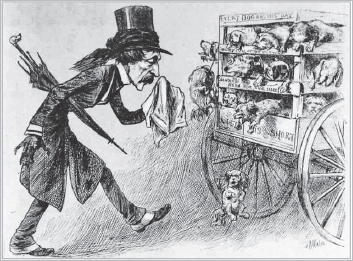
Puck showed Henry Bergh as “The Only Mourner” to follow the dog cart to the New York City pound.
Henry Bergh cartoon in Puck. (Courtesy of the ASPCA)
While some other New Yorkers scoffed at Bergh’s plea for the humane treatment of animals, the Roosevelt family embraced his animal rights program (as did the legendary editor Horace Greeley of the New York Tribune and former president Millard Fillmore). A massive lobbying effort began in 1865, with Bergh heading the grassroots effort in Albany. A constant force at his side was Cornelius V. S. Roosevelt, who insisted that the humane treatment of animals had to become law. On April 10, 1866, the American Society for the Prevention of Cruelty to Animals (ASPCA) was officially incorporated in New York state and laws were passed prohibiting abuse of animals.16 A man who beat a mule or horse could now be charged with a misdemeanor. When the ASPCA was officially incorporated at a public meeting at Clinton Hall in Manhattan later in April—with Mayor John T. Hoffman in attendance—Bergh was unanimously elected president. Today the ASPCA’s first annual report (1867) is on display at the organization’s facility on Ninety-Second Street in Manhattan. Both Cornelius V. S. Roosevelt and John J. Roosevelt (T.R.’s granduncle, who was twice elected to the New York state legislature) had chartered the new organization.17
Knowing that Cornelius V. S. Roosevelt, John J. Roosevelt, Theodore Roosevelt, Sr., and other powerful New York philanthropists were on his side, an empowered Bergh now began patrolling downtown like a cop twirling a billy club, looking for animal abusers to arrest.* For cruel attitudes and practices to end, a few animal abusers would have to be handcuffed and carted off to jail. Or maybe—as the extreme believers in animal rights advocated—these abusers could be put in the stocks or dunked in a barrel. Somehow,an example had to be made of the animal abusers if the laws were to have an impact. It didn’t take Bergh long to act. Just outside the ASPCA’s tiny office at the corner of Broadway and Twelfth Street, he spied a butcher with a cart full of hog-tied calves, crammed so tightly together that they were bleeding from hoof lacerations and bellowing loudly in agony. Bergh, who was on horseback, chased the butcher’s cart, and finally caught up with it at the Williamsburg Ferry slip. Hopping off his horse, Bergh implored the butcher to release the calves or else go to jail. “Yah,” the butcher yelled, as if being accosted by a lunatic. “You’re crazy.”18
Tempers flared and a shouting match ensued. The police were called in to settle the rancorous dispute. The result was a lawsuit filed by the ASPCA against the butcher. It was the first of many suits Bergh would file in the coming years. Sounding as impassioned as the captured John Brown after his Harper’s Ferry raid, Bergh resorted to courtroom theatrics, hoping to persuade the magistrate to side with the humane movement. His passionate pleas, however, fell on deaf ears. Half of New York’s farmers and hay hands would be imprisoned, the judge reasoned, if cattle mistreatment were prosecuted to the letter of the new law. So the judge imposed only a minuscule fine on the relieved butcher and asked the ASPCA not to bring such frivolous cases before his court anymore. “Ridicule was regularly cast on the efforts of the society to enforce the law,” the historian Roswell McCrea recalled in The Humane Movement, “and many of its supporters became discouraged.”19
The determined Bergh, however, continued pushing his ASPCA agenda forward. The rumor soon spread that he was a fanatic, an unhinged fool who thought feral cats, kitchen pigs, and leopard frogs had rights. Bergh, for example, challenged the poultry industry, insisting it was inhumane to drop live chickens into a scalding bath. Old horses, he also insisted, should never be turned out in the streets to die. The great impresario P. T. Barnum, livid because Bergh had the temerity to claim he treated his prize circus animals in an “abominable” fashion, fired back a volley, denouncing Bergh as a “despot.”20 Quite simply, Bergh became a citywide laughingstock, accused of caring more about hens than about battered women. Lies circulated that he had pet dragonflies and caterpillars. “It hurt him when people were amused at a picture of him with donkey ears, surrounded by animals laughing at him,” his biographer Mildred Mastin Pace said, “or a caricature of him wearing a horse blanket instead of a coat.”21
A repetitive cycle soon developed that stymied the ASPCA. Every time Bergh succeeded in arresting an abuser, the judge would throw the case out, usually ridiculing it. Even his friends said he had a crusader complex. Recognizing that for the ASPCA to become effective he would have to forgo street rumbles and win a landmark legal decision, Bergh tempered his impetuous patrols. Matter-of-factly, he now started searching for a litmus test, a case he could win. It was hard to make above-the-fold news in theNew York Times or Herald-Examiner in cases about whipping mules. There wasn’t much inherent drama in a stubborn mule that wouldn’t budge; it boiled down to a semantic argument over what constituted a heavy hand. To succeed, Bergh needed a ruse that would grab everybody by the lapels and say, “Wake up! New laws have been passed!” Seeking controversy, Bergh made a strange but inspired tactical leap. In 1866 he decided to bet the ASPCA franchise on defending green sea turtles that were being systematically tortured on the East River wharves without so much as a murmur of public protest.22
For starters, Bergh felt pity for the sea turtles, which had been shipped to New York from the Mosquito Lagoon area in Florida (and various Caribbean islands) to be sold for soup and stews. They were valued for their meat and calipee (the cartilaginous part of the shell), and their eggs were also being collected from beaches to be used in cooking and as curatives. The East River fishermen had pierced the huge fins of their captured greens with a screw-like device and then tied them up with straitjacket thongs, giving them no food or water. The 400-pound turtles lay on the dock, writhing in pain, piled up like cordwood, one on top of another. Often they were left upside down, struggling to right themselves. Marching up to Captain Nehemiah Calhoun, the fisherman responsible for the turtles’ mistreatment, Bergh informed him that he was under arrest for cruelty to animals. As Bergh and Calhoun argued back and forth a mob of spectators arrived hoping for a pistol duel or a fistfight. Before violence ensued, the police intervened and Captain Calhoun was escorted to the nearby police precinct. Waving a copy of the anticruelty bill, Bergh had the police arrest the captain. After Calhoun endured fingerprinting, a court date was set for later in the week.
Bergh was defeated in the courtroom, but this loss turned out to be a boon for the ASPCA. After the hearing, a counter-sentiment in Bergh’s favor started to swell. The courtroom loss jacked up ASPCA’s fund-raising a hundredfold or more. Thousands started writing contribution checks or offering their pocket money to the ASPCA. Others just sent in coins as if dropping them into a collection basket. Donations arrived in amounts ranging from one cent to $1,000. Meanwhile, owing to the media attention, Bergh had become an A-list celebrity in New York, appearing at Broadway openings so frequently that he was mistaken for a stagehand, imploring autograph seekers to demonstrate moral elasticity when it came to animal rights. Everybody had now heard of the ASPCA and the ubiquitous “turtle man.” That was a good thing. Daily, Bergh’s office was besieged with reports of starving horses, mauled dogs, cats set on fire, and illegal cockfights. Determined to win in the long run, full of resilience, refusing to let the humane movement be ghettoized or demoted into the kooky slipstream of the time, Bergh started hiring investigators to look into complaints of abuse, paying them ten to sixteen dollars a week.
Getting hard-earned traction for the ASPCA—laws against abuse of animals were starting to be seriously enforced—in 1873 Bergh once again upped the ante. With the legendary attorney Elbridge T. Gerry—a great-grandson of a signer of the Declaration of Independence—at his side, Bergh rescued a young girl named Mary Ellen Wilson from an abusive home. Owing to a series of family deaths, the ten-year-old Mary Ellen had ended up in a deplorable tenement house, and her body was bruised and scarred when a social-worker type discovered her.23 The Bergh-Gerry team successfully used an innovative interpretation of the writ of habeas corpus as their legal weapon. Acting as a private citizen, feeding his friends at the New York Times details of Mary Ellen’s plight, Bergh took the child’s abusers to court. Deeply saddened by the way children were regularly mistreated, Bergh, with Theodore Roosevelt Sr., as a principal ally, formed the Society for the Prevention of Cruelty to Children; the modern-day humane movement for child protection was born.24
III
Young Roosevelt admired his family for embracing the humane movement of the late 1860s and 1870s in all its forms. Constantly throughout his life, he would place both his grandfather Cornelius and Theodore Sr. on pedestals, pleased by their association with high-minded men like Henry Bergh. But he was also ashamed of his father for having avoided service in the Union army during the Civil War. Family obligations, Theodore Sr. said, prevented him from fighting. When Fort Sumter was attacked, Theodore Sr. was supporting, at the Twentieth Street house, his wife, Mittie; her mother, Martha; her sister Annie; and his and Mittie’s own three children (and they had a fourth coming). These were ample reasons for not volunteering in the Union Army. Instead of marching off to war, Theodore Sr., as rich men were apt to do, hired a surrogate soldier. Although it is true that Theodore Sr. helped create an Allotment Commission, which eased the financial burdens for Union soldiers fighting at places like Shiloh and Antietam, he himself nevertheless had avoided combat. (The commission saved for the New York families of 80,000 soldiers more than $5 million dollars of their wages.25) Some 620,000 men had died in the war. American women endured losing sons, husbands, and fathers over high-minded principles like abolition. Theodore Sr., however, never even smelled gunpowder from the time of Bull Run to Appomattox. Mortified by this, T.R. spent his entire life waging policy and battlefield wars, anxious to prove that cowardice didn’t run in the family’s bloodline.26
Theodore Sr. routinely supported nonprofit activists like Bickmore and Bergh, not to mention grappling with family financial matters, and he was nothing if not intrepid. As Emerson had been fond of saying—and Theodore Sr. believed wholeheartedly—there was only truth in transit. Having squired his children around Europe, the elder Roosevelt decided that having his brood see the Holy Land and Egypt was an essential component of their education. A few days before T.R.’s thirteenth birthday, the family set sail from New York on the S.S. Russia, bound for Liverpool. As was to be expected, en route T.R. kept a diary and drew images of animals he saw, many of them resembling cave paintings but others looking like thoughtless doodles. Even with the tumultuous Atlantic affecting his stomach, he dutifully reported seeing gulls, terns, and kittiwakes. While the ship was in the Irish Sea, he grew excited because a snow bunting was on board and was captured by the crew.27
But T.R. had something more in mind than sketchbook drawings on this journey to the Nile. Recently he had taken taxidermy lessons from John Bell, a wizard at the art who had trekked with John James Audubon up the Missouri River in 1843. According to theOrnithological Dictionary of the United States, the sage sparrow (Amphispiza belli), in fact, was named after Bell by the great Audubon himself.28 Decades later, Roosevelt would recall the lanky, white-haired Bell fondly as being “straight as an Indian,” with a “smooth-shaven clean-cut face” and a “dignified figure always in a black frock.”29 It was at Bell’s crammed shop at the corner of Broadway and Worth that T.R. eagerly learned the “art of preparing” wild-life. The high odor of microminerals, in fact, became almost a perfume to Roosevelt. In particular, he was attracted to cleaning skulls and other bones with the larvae of dermestid beetles. To Roosevelt, Bell’s office was straight from Mr. Venus’s shop in Charles Dickens’s Our Mutual Friend. In his “Notebook on Natural History,” he recorded a story Bell had told him about a death match between a rooster and a field mouse. “The field mouse fought long and valiantly,” Roosevelt recounted, “but at last was overcome, although not until after a protracted battle.”30
So now, when the Russia dropped anchor, T.R., coughing unmercifully, his stomach weak from seasickness, he went wandering through the shopping district of Liverpool looking for arsenic, an odorless ingredient used by ornithologists for skinning and cotton-stuffing birds. “In the streets I was much annoyed by the street boys who immediately knew me for a Yankee and pestered me fearfully,” he wrote on October 26, 1872. “Requiring to buy a pound of Arsenic (for skinning purposes) I was informed that I must bring a witness to prove I was not going to commit murder, suicide or any such dreadful thing, before I could have it!”31
By the 1860s, taxidermy—a craft practically as old as Egypt itself—had become a high art, with specialists the world over vying to be the very best mounters. The etymology of the word derived from the Greek taxis (arrangement) and derma (skin). Taxidermy took a steady surgeon’s hands adept at making incisions carefully and treating skins delicately. Always the loyalist, young Theodore bragged that his prized teacher, John Bell, one of Audubon’s right-hand men, was the top taxidermist, the world champion.32 But critics instead preferred Jules Verreaux, whose innovative exhibit “Arab Courier Attacked by Lions” at the Paris Exposition of 1867 was novel in that the skinned and mounted animals were displayed in a harrowing, gruesome diorama. The innovative Verreaux actually had a Barbary lion (now an extinct subspecies) ripping a helpless camel. Authentic skulls and teeth were used in the diorama, and a human figure wrapped in plaster of paris was added for increased dramatic effect. In 1869 the American Museum of Natural History acquired this pioneering work of taxidermy, which initiated a new way of displaying wildlife worldwide. Young Theodore was enthralled with Verreaux, because he opened up new possibilities for how naturalists and taxidermists could expand science and art.33 But his loyalty was with Bell for one overriding reason: Bell had the great Audubon on his résumé.
After procuring the arsenic, T.R. raced to see Liverpool’s natural history museum. He didn’t like its displays, concluding that Americans did taxidermy better. Perhaps because he was being teased by working-class European boys, a pronounced nationalism and family chauvinism began seeping into T.R.’s diaries. “The specimens,” he wrote in his diary, “are neither so well mounted or so rare as those in our own American Museum of Natural History in New York.”34
To practice his taxidermy in England, Roosevelt would purchase snipe and partridges at marketplace stands. Meanwhile, John James Audubon had entered Roosevelt’s life in a profound way. Studiously, Roosevelt pored over leatherbound volumes of Audubon in a succession of hotel suites and railway compartments, clutching an aunt’s copy of Birds of America like a fumbled but recovered football. And he also started to become enamored with Audubon’s three-volume study The Viviparous Quadrupeds of North America. While he was studying Audubon’s works, species extinction and animal abuse started to worry Roosevelt. In Turin, for example, he lamented the “miserable” treatment of horses. And his Berghian sentiments about how European carriage horses were treated in paddocks was once again noted in his diary. “The cabhorses are worse [off] than those of New York,” he complained at one juncture, “and the animals in general are treated much more badly.” 35
Young Theodore was happy to be done with Europe when the Roosevelts finally arrived in Egypt a few days after Thanksgiving 1872. The very sight of the ancient city of Alexandria was like a tonic to him. “How I gazed on it!” Roosevelt wrote. “It was Egypt, the land of my dreams; Egypt the most ancient of all countries! A land that was old when Rome was bright, was old when Babylon was in its glory, was old when Troy was taken! It was a sight to awaken a thousand thoughts, and it did.”36
No sooner did Roosevelt arrive at the dock than he started filling his diaries with descriptions of braying donkeys, foxlike yellow dogs with perked ears, leashed baboons doing circus tricks on a street corner, and camels smaller than he expected. He hurried to a fowl stand and purchased a quail—after haggling with the Arab vendor over the price—for taxidermy. As the family continued on to Cairo by train, T.R. was enthusiastic about the wildlife he saw from his compartment window. “We passed through the Delta of the Nile and on all sides numerous birds of various spieces areose, while heards of buffaloes and zebus grazed quietly in the marshy fields,” he wrote. “Among the birds were snipe, plover, quail, hawks, and great black vultures.”37
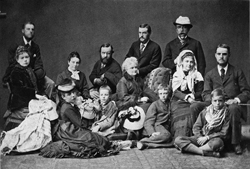
A group photo of the Roosevelt family, taken in Egypt in 1872. Theodore Roosevelt, Sr., is at center back row, seated; Mrs. Theodore Roosevelt is at his left. Seated on floor: Anna, Corinne, Theodore Roosevelt, and Elliott.
Roosevelt family group shot. (Courtesy of Theodore Roosevelt Collection, Harvard College Library)
The historian David McCullough has written that young Theodore had a deep aversion to attending church. He reached this conclusion by reading the boyhood diaries. He even ventured to claim that T.R.’s asthma attacks were often precipitated by not wanting to go to Sunday services. However, McCullough only hints at something that becomes abundantly clear in the diary entries of 1872; T.R. wrote religiously about the animals he saw before and after services. As a “natural theologist” of sorts, Roosevelt had an image of God that wasn’t a gray-bearded patriarch hurling thunderbolts down to earth but an omnipotent guardian who devised the exquisite intricacies of all living things. Here is a sample entry from Egypt on December 1:
We went to the English Church at the New Hotel. The sermon was quite good. Afterwards we visited the gardens where we wandered about till lunch time. There were many beautiful trees and at one place an artificial cave with brooks, and cascades, and winding passages and stone cut stairs, and so cool and refreshing! The ground moreover was covered with a creeping sort of vine, which looked like grass, and on this tame ravens and crows hopped about, while warblers sang in the bushes. It was altogether very beautiful and we passed a very happay time there. Coming home we were followed by a man who showed off a funny little longeared hedgshog and wanted us to let him charm a cobra which he had in his shirt.
In the evening Father and Mother dined at Mr. and Mrs. Blodged. I went to the gardens before dinner and wandered about for some time. The birds had all gone to their nests but innumerable bats were flitting over the surface of the water.38
Once the Roosevelt family left Cairo for a houseboat journey up the Nile,* the amount of writing T.R. produced about birds was staggering. He later stated that his “first real collecting as a student of natural history” began on this Egyptian holiday.39 Yet he never collected a truly rare bird of scientific value.40 The journals from this trip have titles like “Remarks on Birds,” “Ornithological Observations,” “Ornithological Record,” “Catalogue of Birds,” and “Zoological Record.” Now that they were in the Middle East, T.R.’s father gave him a French pin-fire double-barreled shotgun to use. That changed everything. Everywhere he went, his gun was close at hand. “The mechanism of the pin-fire gun was without springs and therefore could not get out of order,” Roosevelt recalled, “an important point, as my mechanical ability was nil.” 41
Although the Pyramid of Cheops enthralled him, he got a bigger thrill shooting for specimens along the riverbanks. When it came to identifying Egyptian wildlife, he put Darwin aside and instead listened carefully to the observations of local guides. Hunting with his father on December 13, T.R. shot his first bird—a warbler-like species. It was the first of thousands of birds he would kill in the name of taxidermy, science, survival and sport in the coming decades. Never before in his young life had he felt as vigorous and vital as in Egypt with shotgun in hand. Perhaps the dry desert climate, so rehabilitating for asthmatics, helped. Every day, it seemed his spirits kept lifting. “In the morning, we passed a large flock of about sixty Egyptian geese,” Roosevelt wrote on December 29. “They were wading in the shallows, but swam out into deep water, where they arranged themselves in an irregular long line and as we approached, divided themselves into several squads and flew off in various directions. At about 12 oclock we stopped and took a walk, during which I observed no less than seven species of hawks crows, stercho finches, and small waders in easy shot.”*42
Even though young Theodore flourished in the desert climate, his American chauvinism didn’t dissipate as the family moved on to the Holy Land. Everything was bigger and better back home. When he arrived in Jerusalem, his first instinct was to declare it “remarkably small.”43 Bathing in the Jordan River produced the lament that it was only “what we should call a small creek in America.”44 To the manger of Bethlehem in Palestine, where Jesus Christ was born, T.R.’s irreverent reaction was to shoot two “very pretty little finches” for his collection.45 Upon arriving in Damascus, the sacred ground where Paul became a disciple of Christ, Roosevelt went jackal hunting. “On we went over hills, and through gul-leys, where none but a Syrian horse could go,” Roosevelt wrote. “I gained rapidly on him and was within a few yards of him when [he] leaped over a cliff some fifteen feet high, and while I made a detour around he got in among some rocky hills where I could not get at him. I killed a large vulture afterwards.”46
The historian Edmund Morris pointed out the jackal hunt was the future president’s first attempt to hunt wildlife for “sport, rather than science.”47 Nothing has baffled Roosevelt scholars over the decades more than how Theodore, who vehemently opposed cruelty to animals, could nevertheless kill wildlife with such ease. Although T.R. often hunted for science (in the Middle East he was collecting for his Roosevelt Museum), one can’t escape the conclusion that he relished the thrill of the chase as a sport. Basically Roosevelt took his cues from Captain Reid in The Boy Hunters. The chapter “About Alligators” defended old-time naturalists like Alexander Wilson and John James Audubon against the overclassification of the laboratory school. By hunting their own specimens down, Audubon and Wilson had truly learned to understand color variations (and the eating and breeding habits) of species better than stationary bio-lab technicians in Cambridge or New Haven. According to Captain Reid, a real naturalist lived outdoors while the “old mummy-hunters of museums” sat around like shriveled prunes making divisions and subdivisions of Crocodilida ad nauseam.48
So hunting, to young Roosevelt, was a prerequisite for being a real faunal naturalist of the old Audubon school. But mistreating beasts of burden, who often suffered and died in streets, had nothing to do with hunting. All persons with a moral compass—as the ASPCA claimed—knew that. Also, the slaughterhouses of the world, Roosevelt complained, weren’t regulated in any way, shape, or form. Rancid meat and salmonella were commonplace. As a budding sportsman and an advocate of the humane movement, Roosevelt simply wanted hunting and the treatment of domestic animals regulated. Species extinction, torture of animals, overhunting, lack of seasonal bag limits, cock and bull fighting—such activities were anathema to his gentlemanly outlook on life. Killing game like cougars or bears with a knife was fine—but tormenting or teasing the animal was deemed unforgivable. Like his father and paternal grandfather, Theodore believed that animals had feelings and perhaps even communicated with one another in ways undecipherable by humans, and that they needed to be treated mercifully. By shooting finches in Egypt, for example, carefully studying their eye bands and plumage, taking careful notes of their demeanor, and lovingly stuffing them so as not to damage their plumage, Roosevelt believed he was honoring the species. Most other men would simply shoot birds. Roosevelt, by contrast, shot and collected them for scientific scrutiny. Only by learning everything about a species could you eventually save it from the maw of industrial man. If Roosevelt’s views pertaining to animals seem contradictory, consider this: they are essentially the hunting and animal rights codes American society abides by in the twenty-first century.
IV
When Roosevelt boarded a ship for Greece, leaving the Middle East, his asthma flared up again—perhaps returning to “civilization” made him ill. Wherever Theodore went in Europe he pouted and wheezed, believing that Greek ruins and Turkish mosques were a waste of time for an ornithologist like himself. Arriving in Vienna on April 19, 1873, he bemoaned the fact that his father needed to spend months in Austria on business. Young Theodore’s letters from Vienna attested to his depression: “I bought a black cock and used up all my arsenic on him.” “The last few weeks have been spent in the most dreary monotony.”49 “If I stayed here much longer I should spend all my money on books and birds pour passer le temps.” 50
While Theodore Sr. stayed in Vienna, he sent three of his children—Theodore, Corinne, and Elliott—to Dresden (known then as the Florence of the Elbe) to live with a German family. His cousins John and Maud Elliott were also there. The idea was for the American youngsters to become fully immersed in German culture. What interested the young Roosevelt most about Germany, however, were the romantic painters who had studied in Düsseldorf during the 1860s—Albert Bierstadt and George Caleb Bingham among them—and had them turned toward the American West for inspiration. And there was also his utter fascination with the white storks of Dresden, which nested in chimneys and could be found around the nearby pond. Instead of immersing himself in German history or language, he continued to play Audubon, studying the storks for variations in color and size. “My scientific pursuits cause the family a good deal of consternation,” he wrote to an aunt from Dresden. “My arsenic was confiscated and my mice thrown (with the tongs) out of the window.”51
But something else had occurred on this Old World trip. For the first time Roosevelt had carefully read On the Origin of Species himself instead of being spoon-fed Darwin’s theories by an uncle, a cousin, or a adult friend. (Darwin at this time was said to betalked about more than read.) Somewhat pretentiously, catching the rising wind, Theodore now began imitating the great evolutionary theorist, talking in Darwinspeak about animal variation and natural selection, one of the basic mechanisms of evolution along with genetic drift, migration, and mutation. What was exciting about Darwin was that he was a scientist and an explorer; he thereby met Captain Reid’s criterion for greatness while epitomizing modernity in science. Next, Theodore read The Descent of Man, in which he learned that Homo sapiens had evolved from apes, shrews, and birds. The effect of reading these books was that Roosevelt began to sound like the character in Henry James’s The Madonna of the Future who breathlessly said, “Cats and monkeys—monkeys and cats—all human life is there!”52 Roosevelt, in fact, held to Darwin’s belief that men were biological relatives of apes until his dying day.53
More than anything else, Darwin offered the young Roosevelt the philosophy of biology. Darwin was part of the first generation ever to revolt against Aristotle’s concept of scala naturae, the story of a man’s march to perfection.54 What Roosevelt grew to appreciate about Darwin was that he described geological events and natural selection in historical terms. Evolutionists also embraced the notion that nothing was predetermined; everything was adaptive. In one swoop Darwin erased determinism from the blackboard of human collective experience. Roosevelt was not very good at physics but had a fine grasp of history. He took comfort in mathematical facts, not supernaturalism. Basically, he saw Darwin as explaining the history of the world in an orchard, a finch, a tortoise, or a desert. Darwin even offered possible answers for the extinction of the dinosaurs at the end of the Cretaceous.
Writing to Oliver Wendell Holmes just before the 1904 presidential election (which he won), Roosevelt explained why Darwin was the force in the “tremendous intellectual revolution” of their time. Beaming himself thousands of years into the future, Roosevelt predicted that Darwin’s work would have an unparalleled “position in history” and that it would have been “superseded by the work of the very men to whom it pointed out the way.”55
Roosevelt in 1873—nearly thirty years before becoming president—had already decided to become a foot soldier in the Darwinian “revolution of natural history.” Darwin had looked “with confidence to the future, to young and rising naturalists” who could understand creation from an evolutionary perspective—and he found a willing volunteer in Roosevelt. As Roosevelt later wrote, Darwin had “originality” going for him, unlike those “well meaning little creatures at universities” who were “only fit for microscopic work in the laboratory.”56 The time had come, Darwin had said, for modern biology to lead the way toward enlightenment. “When we no longer look at an organic being as a savage looks at a ship, as something wholly beyond his comprehension,” Darwin wrote, “when we regard every production of nature as one which has had a long history; when we contemplate every complex structure and instinct as the summing up of many contrivances, each useful to the possessor, in the same way as any great mechanical invention is the summing up of the labour, the experience, the reason, and even the blunders of numerous workmen; when we thus view each organic being, how far more interesting—I speak from experience—does the study of natural history become!”57
Careful to avoid taxonomic errors, Roosevelt began tagging the yellow wagtails and pelicans he shot. He tried to record each bird’s most minute distinguishing traits. He was particularly proud of an Egyptian plover he collected and mounted.58Whenever he struggled to identify and classify the birds he killed, the Reverend Alfred Charles Smith’s The Attractions of the Nile and Its Banks, a Journal of Travel in Egypt and Nubia would help. In fact, young Theodore’s Middle East diary marks the professionalization of his youthful enthusiasm for wildlife and domestic animals.59 No longer was it enough to record seeing “snipes” homologies were now equally important to him. The variations between the great snipe (Gallinago media) and the common snipe(G. gallinago), for example, made all the difference in the world. The time had arrived, Roosevelt believed, for him to understand the biological reasons that some birds had nonfunctioning wings whereas hummingbirds couldn’t stop flapping theirs. “We behold the faces of nature bright with greatness,” Darwin had written, but “we forget the birds which are idly singing around us mostly live on insects or seeds, and are thus constantly destroying life; or we forget how largely these songsters, or their eggs, or their nestlings, are destroyed by birds and beasts of prey.”60
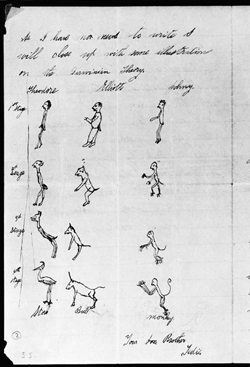
Theodore Roosevelt drew Darwinian evolutionary ideas using his family as natural selection case studies. This illustration—one of a series—was done on September 21, 1873, while he was in Dresden, Germany. He was fourteen years old.
T.R.’s Darwin evolution drawings. (Courtesy of Theodore Roosevelt Collection, Harvard College Library)
In On the Origin of Species, unlike Missionary Travels, there were no lavish illustrations, no photographs of great zebra herds or wallowing hippopotamuses. Just carefully reading the text, however, became something of a personal benediction to Roosevelt. Enhancing Darwin’s allure were profiles of the British explorer-naturalist that appeared in popular boys’ magazines. It was also exciting that Charles Darwin and Abraham Lincoln—young Roosevelt’s two idols—had both been born on February 22, 1803; this is the kind of coincidence children love. Like young Theodore studying under John Bell, Darwin once had a taxidermy apprenticeship with John Edmonston, an escaped West Indian slave who moved to Scotland. And, just as Theodore Roosevelt, Sr., had helped create the American Museum of Natural History, Darwin’s paternal grandfather had written Zoonomia (1794–1796), which dealt with transmutation. It was as if zoology was in the bloodlines of both Roosevelt and Darwin. An admonition Darwin’s father had once shouted at young Charles could very well have been blurted out in the Roosevelt household: “You care for nothing but shooting, dogs, and rat catching, and you will be a disgrace to yourself and all your family.”61 Maybe someday, Roosevelt hoped, he too would be lucky enough to catch rats on a ship around the world like the Beagle, all in the name of natural history.*
Taxidermist, illustrator, diarist, voracious reader, hunter, ornithologist, mammalogist, animal rights advocate, naturalist, and now Darwinian evolutionist, Roosevelt—all of fourteen years old—was über-precocious. Taken together, all these sides indicated a deep appreciation of wild-life, and an understanding of how little biologists understood about the living world. “When I was young I fell into the usual fashion of those days and collected ‘specimens’ industriously, thereby committing an entirely needless butchery of our ordinary birds,” Roosevelt wrote to his hunting friend Philip Stewart as vice president of the United States in 1901. “I am happy to say that there has been a great change for the better since then in our ways of looking at these things.”62
When we go through the ruck of evidence about Roosevelt’s childhood, in fact, one document stands out. In whimsical letters written from Dresden to his mother and sister Bamie, T.R. drew charts showing Darwin’s evolutionary theory in terms of the Roosevelt family’s genealogy. Done in a young person’s hand, the illustration resembled what today would be called “outsider art” or a doodle on the back of an envelope. It was presented to mother as “Some illustrations on the Darwinian theory,” broken down into four stages. T.R. demonstrated how, as a close reader of Darwin’s work, he personally could have actually evolved from a Dresden stork—the kind that the Danish author Hans Christian Andersen popularized in a fairy tale. Theodore, in fact, was so enamored of these long-legged birds living in the chimneys of Dresden that he imagined his own descent from them. Elliott, on the other hand, came from a bull. And his cousin Johnny—Darwin would have undoubtedly approved of this—had evolved from a monkey.63
Indeed, Roosevelt’s illustration most assuredly was modeled after the frontpiece of the eminent naturalist Thomas Huxley’s 1863 Evidence of Man’s Place in Nature, which showed, in sequence, a gibbon slowly evolving into man. Huxley had worked tirelessly to help decipher the 500-page On the Origin of Species for a mass audience, distilling complicated scientific facts for the comprehension of the general public.64
Humorous aspects of the drawing aside, as of 1873 Roosevelt was dead serious about spending his life as a faunal naturalist (or biological explorer). After all, there were naturalist mysteries to be solved on this little-known planet earth. Religious leaders had long argued over the origin and development of life. Now Darwin and Huxley had provided an answer. Bursting with the enthusiasm of a convert, Roosevelt swallowed natural selection hook, line, and sinker. For the rest of his life, in fact, he used evolutionary theory as his guiding light; it illuminated his views on everything from politics to geography to fatherhood.65