
CHAPTER TWENTY-TWO
I
Staring out the White House window one mild spring morning in 1906, President Roosevelt watched his sons Archie and Quentin sculpture little mud monuments in a sandbox. “What a heavenly place a sandbox is for two little boys,” Roosevelt wrote to Kermit about his brothers. “Archie and Quentin play industriously in it during most of their spare moments when out in the grounds. I often look out of the office windows when I have a score of Senators and Congressmen with me and see them both hard at work arranging caverns or mountains, with runways for their marbles.”1 With such a crowded indoor schedule, the president lamented that he couldn’t join the lads outside to play like a prairie dog. Deadlines and commitments were getting the best of him. Much like his sons, only on a vastly larger scale, Roosevelt was preoccupied with reconfiguring landscapes (by Executive Order, that is) for the United States. Arranging for the designation of wonders, in fact, was an apt description of the Roosevelt administration’s conservation policy in 1906. No longer was Roosevelt inventorying possible western landscapes to preserve; he was actually preserving them.
Accordingly, some of Roosevelt’s indoor bureaucratic chores of 1906 were of the inspiring outdoors type. For example, paperwork was being drafted at the General Land Office to save Devils Tower in southeastern Wyoming—perhaps the strangest molten rock configuration in North America. This isolated Devil’s Tower outcropping soared over the Missouri Buttes—five dome-shaped rock formations four miles away from it—in the northwest corridor of the Black Hills. Looming over the Wyoming Valley at 1,267 feet above the river, Devils Tower looked like a huge stone tablet on which the Ten Commandments were said to have been set.
Devils Tower had no cultural features like the prehistoric dwellings in the Four Corners region that Congressman John F. Lacey and Edgar Lee Hewett wanted saved. It was a perpendicular columnar laccolith, a gray horn formed during the Triassic Period about 250 million years ago, when the dinosaurs roamed. Surrounding the main stumplike rock formation of Devils Tower were pine forests, woodlands, and grasslands—in short, an unspoiled sanctuary for teeming wildlife. Devils Tower was a sacred site to more than twenty Plains tribes, including the Arapaho, Crow, Lakota, Cheyenne, Kiowa, and Shoshone. They used it like an altar, a place for prayer offerings, vision quests, marriage ceremonies, and funerals.2 There was an enduring Indian legend that long ago a huge bear had clawed the tower’s side, leaving deep scratches or grooves there. This seemingly otherworldly tower served, appropriately, as a setting in the director Stephen Spielberg’s 1977 sci-fi movie Close Encounters of the Third Kind. To geologists, Devils Tower was an important site: an amazing formation at 5,112 feet above sea level, composed of red sandstone and maroon siltstone, with the oxidation of iron mineral causing the outer surface to look almost rust-colored. It was more difficult to climb than the Tetons (near Yellowstone) or El Capitan (in Yosemite). “There are things in nature that engender an awful quiet in the heart of man,” N. Scott Momaday wrote in The Way to Rainy Mountain. “Devils Tower is one of them.”3
In early 1906 Roosevelt considered how Devils Tower could be saved for posterity. Because it was only a mile wide, it didn’t seem to be large enough for a national park (although the much smaller Platt and Hot Springs were national parks). And Roosevelt didn’t want Devils Tower declared part of a national forest, because it was a “wonder,” not a utilitarian natural resource for the Forest Service to manage. Roosevelt, who was familiar with the history of the U.S. Geological Survey, knew that Colonel Richard I. Dodge had named Devils Tower in his 1876 book The Black Hills. To Dodge, it was “one of the most remarkable peaks in this or any other country.”4 Bully for Dodge! And the geologist Henry Newton had written that it was an “unfailing object of wonder.”5Bully for Newton, too!
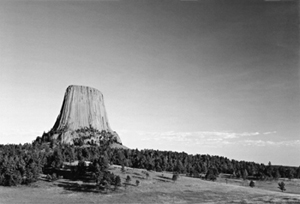
Devils Tower in Wyoming became Roosevelt’s first national monument, created in 1906.
Devils Tower National Monument. (Courtesy of the National Park Service)
A scholarly debate has continued for decades about whether Roosevelt actually climbed or even visited Devils Tower. Some bogus literature propagated by the tower’s boosters claims that he did. At best, that is a half-truth. During his trips to the Black Hills and Bighorns in the 1880s and 1890s he did see it (geologists say it looked about the same then as it had 10,000 years prior).6 After all, the Little Missouri River flowed within twenty or so miles of it. But Roosevelt probably never stood any nearer to its base. On his Great Loop tour in 1903, his train had made stops in the Wyoming towns of Gillette, Moorcroft, and Sundance, so he probably saw Devils Tower from a distance. And he had visited the South Dakota communities of Edgemont and Ardmore on that trip—both within sight of the tower. But touch it: no. Nevertheless, as with Mount Olympus in Washington state, Roosevelt revered Devils Tower as a Wyoming site of great value. And strangely, the “Tree Rock,” as the Kiowa called it, was part of Roosevelt’s life as a rancher because its lore was persuasive throughout the Dakota Badlands.
Roosevelt wasn’t alone in his admiration for Devils Tower. It had its share of cheerleaders during the progressive era. In 1891 Senator Francis E. Warren of Wyoming, a pleasant-looking man in his mid-forties, tried to establish “Devils Tower National Park,” introducing Bill S.3364. It was shot down by Congress. Every few years Warren would reintroduce the legislation, only to have it repeatedly rejected.7 However, Senator Warren was able to have Devils Tower classified as part of a federal timber reserve. This at least bought him some time for negotiation. Roosevelt, who was struggling to get the Grand Canyon officially declared a national park, didn’t want to have Devils Tower fail again owing to congressional indifference. But even though he had Warren on his side, politicians in Wyoming were anti–federal government. Since the 1890s, when the Boone and Crockett Club had roared against the segregation of Yellowstone National Park by the railroad company, Roosevelt had been disliked by a substantial number of Wyomingites.
What Roosevelt wanted was an executive order to save places like Devils Tower, the Grand Canyon, Mount Olympus, and the Petrified Forest. And he wanted it without confronting dimwitted legislators whose insatiable craving for profit blinded them to the inspirational value of geological landmarks. Congressman Lacey—as head of the House Committee on Public Lands—ballyhooed Devils Tower’s weirdness as an asset for tourism. The nation became intrigued about the tower. By what process had Devils Tower been formed? Was it created by volcanic material, or was it an immense mass of igneous rock? Had it once been part of the bottom of an old sea? Who could solve this geological mystery? Roosevelt, collaborating with Lacey, inquired whether there wasn’t a clever way to save Devils Tower in the name of archaeology or paleontology. A concerted legal effort commenced in conservationist circles to devise a new presidential prerogative for preserving extraordinary wonders like Devils Tower from commercial destruction. Congressman Lacey, with his extensive knowledge of land law in the developing West, was a strong advocate of placing this “volcanic plug” in the public domain as a contribution to science.8 Decode the mysteries of Devils Tower, the thinking went, and geologists would finally understand how the Black Hills came into being.
Part of Roosevelt and Lacey’s concern in early 1906 was that “big oil” was an octopus with tentacles that harmed consumers and landscapes alike. That January, in fact, Missouri’s attorney general, Herbert Hadley, had initiated court hearings against Standard Oil Company of Indiana, Republic Oil Company, and Waters-Pierce Oil Company for “monopolistic conspiracy.” With Roosevelt cheering, John D. Rockefeller, the founder of Standard Oil, was hit with thirty-four subpoenas. For a while, Rockefeller hid from the law. By June 1906 the attorney general of Ohio got into the act, anxious to prosecute Standard Oil of New Jersey for violating Ohio’s antitrust laws. Recognizing that oil companies never were good stewards of the land, and worried that natural gas hunters would despoil the Dakotas and Wyoming, Roosevelt encouraged the U.S. attorney general, Charles J. Bonaparte, to prosecute Standard Oil of New Jersey under the Sherman Antitrust Act.
Roosevelt actually wanted Standard Oil of New Jersey (a holding company, which controlled more than sixty other companies) dissolved. He felt virtuously outraged by Rockefeller and others who always had a price and were never concerned about the dignity of land. So while Roosevelt was on the offensive to save places like Devils Tower and the Petrified Forest of Arizona in 1906, he was also on the warpath against the “swine,” corporate types like Rockefeller who were interested only in personal enrichment. By contrast, Roosevelt himself was concerned for public enrichment, and his trust-busting was making him wildly popular. Building on the damning evidence amassed by Ida Tarbell in her two-volume History of the Standard Oil Company (1904), Roosevelt had his Bureau of Corporations further investigate the oil industries; a report was due in the summer of 1907. This was part of Roosevelt’s “campaign against privilege,” which was “fundamentally an ethical movement.”9
II
Saving Devils Tower and the Petrified Forest was on Roosevelt’s mind during early January 1906, when he learned that his trusted hunting guide in Colorado, John Goff, had been mauled by a cornered cougar. Roosevelt seemed more grimly interested in how the cougar had attacked Goff than in how many stitches Goff needed. Did the cougar lunge? Was it rabid? Or had it been protecting cubs? How deep were the incisions? “Do let me know about it,” President Roosevelt anxiously wrote to Yellowstone Park’s superintendent, John Pitcher. “I am interested for Johnny’s sake, and besides, I have a zoological interest and am anxious to know how the job was done.”10
Roosevelt was highly attuned to western affairs that January. Even though he was fighting for appropriations to build the Panama Canal, passing legislation concerning railway rates, and calculating a tariff for the Philippines, he vigorously championed statehood for the three western territories of Oklahoma, New Mexico, and Arizona. In addition, the process for creating Sevier National Forest in south central Utah began that January (eventually, more than 375,000 acres were set aside by the U.S. Forest Service). Utah’s Great Basin—known for spectacular canyon scenery—was becoming a federally protected wonderland. In Utah, communities like Ogden, Salt Lake City, or Provo seemed like run-of-the-mill settlements compared with the magnificence of the canyonlands.
There were also hard fought battles going on in Colorado, pitting railroads against coal companies over land. Roosevelt jumped right into the controversy with shirtsleeves rolled up, like a negotiator for labor and management. In Idaho and Montana, angry miners were starting to organize behind radical groups, including the Industrial Workers of the World (IWW, or Wobblies), which had been founded in June 1905. Roosevelt insisted that the so-called Wobbly syndicalists (Big Bill Haywood, Daniel DeLeon, Eugene V. Debs, Mother Jones, and other industrial unionists) must be law-abiding and operate without violence. To Roosevelt the danger of industrial unionism was that its proponents saw it as superior to Americanism. The IWW had been created, in part, because the American Federation of Labor (AFL) had organized only 5 percent of the nation’s workers. Roosevelt didn’t care for the IWW, for two specific reasons: it was trying to monopolize labor, and it was a threat to free-market capitalism. And Roosevelt, refusing to be intimidated, sent federal troops into Goldfield, Nevada, to crush a miners’ strike. He deemed the protest harmful to the nation. “I wish labor people absolutely to understand that I set my face like flint against violence and lawlessness of any kind on their part,” Roosevelt wrote a friend, “just as much as against arrogant greed by the rich.”11
It would take a good psychiatrist to understand why Roosevelt hated anarchy in any guise. If there wasn’t order, he couldn’t function properly. But still he surrounded himself with birds and animals that scurried all around in his homes—macaws squawking, dogs barking, cats jumping on papers, turtles wandering about. His tolerance of animal behavior and his intolerance of human behavior were like night and day. There may have been an inner struggle between his childlike obsession with disappearing into the freedom of the wild—responsibility be damned—and his compulsion to be biologically precise about every songbird, tree, grass blade, and insect antenna. The masculine side of his nature wanted to hunt big mammals while his feminine side wanted to nurture small songbirds. He believed that studying all wildlife had helped sharpen and attune his senses. “Roosevelt loved animals, both wild and domestic,” the historian Edward Wagenknecht observed. “Even on the hunting field they were individuals to him. He always hated to shoot a cow, always took care not to frighten a doe away from her babies.”12
Among the early-twentieth-century conservationists, only John Muir had the temerity to stand up to Roosevelt—at Yosemite in 1903, Muir had challenged Roosevelt to reform his boyish hunting ways. And how was Muir rewarded for his candor? At first, well: Mount Shasta, Mariposa Grove, and Yosemite Valley were all saved by the federal government. But over time Roosevelt repaid Muir’s casual insult by saying that Muir didn’t know birds and then by siding with Pinchot on turning Hetch Hetchy into a man-made reservoir. There were consequences for challenging Roosevelt—and these might involve policy. The sycophant got farther with Roosevelt than the challenger. Nevertheless, Roosevelt continued to admire Muir for rallying to nature’s defense. In this regard Muir was embraced by the president as a “radical” in the best sense of the word. Here was the difference, in Roosevelt’s mind: the strikers in Goldfield, Nevada, wanted more for themselves whereas groups like the Sierra Club of California were fighting fornational betterment. And there was in Muir’s carriage, Roosevelt thought, the radiance of Yosemite itself, which the president truly honored.
That spring, just as Roosevelt was ready to expand the boundaries of Yosemite National Park, a disaster rocked California: at daybreak on April 18, an earthquake destroyed San Francisco. Within a few minutes the streets around Union Square and Chinatown filled with mounds of debris. Three hundred thousand people were left homeless. Gas mains had snapped, and storefronts went up in flames. Boats capsized at Fishermen’s Wharf. Broken glass from apartment windows rained down like hail. Beautiful hotels like the Winchester and the St. Francis were wrecked. Merchants shouted in disbelief. People walked about dazed, with fretful eyes, scared that at any minute the entire city would sink into the Pacific Ocean. A human flow out of the Bay Area commenced, under the U.S. Army’s leadership. The Chinese had considered 1906 the year of the Fire Horse—a time of mass confusion—and this proved to be prophetic. “The entire event which was to destroy an American City and leave an indelible imprint on the mind of the entire nation,” the historian Simon Winchester wrote in A Crack in the Edge of the World, “had lasted for just over two and a half minutes.”13
Reports of the earthquake aroused Roosevelt’s martial temperament. This was no middle-size quake like the one in 1868. Unfortunately, he was 2,500 miles away in New York and was unable to order naval action. Shaking an impotent fist at the ground was all he could at first do. Reports of buckling aftershocks came over the telegraph directly into his office in downtown Oyster Bay. Then the telegraph shut off. At best, communication with northern California was hit-and-miss. Telephones weren’t working at all in the Bay Area—everything was broken in the stricken city. More than 3,400 people died throughout northern California. 14 Roosevelt issued a national condolence: “I share with all our people the horror felt at the catastrophe that has befallen San Francisco, and the most earnest sympathy with your citizens. If there is anything that the Federal Government can do to aid you it will be done.”15
Many San Franciscans were in a condition of panic. Social dislocation and even mayhem took over. The San Andreas Fault from northwest of San Juan Bautista to the “triple junction” at Cape Mendocino had ruptured the ground, cracking it open like an eggshell. From above, it looked like a zigzagging chain down the spine of California in the cracked earth. Towns anywhere near the fault line suffered severe damage. Geologists were confounded by the violent power of the vibrating earth. Survivors said that that the experience was like walking on a trampoline or falling into a tar pit. Although the event is known to history as the San Francisco earthquake, virtually all towns in northern California suffered extensive damage, and the outlook for a quick recovery was bleak.
Americans had known that California was an earthquake zone but the state’s residents had long played ostrich, pretending that their homes weren’t actually built along a fault line. Now, terrorized shouts of “Fire! Fire! Fire!” were heard along the same streets where Roosevelt had paraded on his Great Loop tour of 1903. Then, Roosevelt had proclaimed San Francisco the shining white Acropolis of the glorious west coast, the juggernaut of manifest destiny. Now everything was covered with smoke clouds, and the air was poisonous. People contended for jugs of water, worried about dehydration. Soot-blinded horses frantically neighed and frothed in front of brownstones that had toppled into heaps of rubble. Triage stations were set up in fields. After a while, however, an eerie calm blanketed the city, a collective numbness, as people grew weary of trying to put the fires out. The New York Times said that the exact scope of the disaster in terms of terror and damage “will never be known.”16
Statistics came pouring into the White House about the devastation in California. The quake was felt for about 375,000 square miles from Coos Bay, Oregon, to Los Angeles and well into Nevada’s Great Basin. More than 28,000 buildings had been destroyed. Following Roosevelt’s direct order, the army and navy quelled public unrest and effectively evacuated residents to safety. The armed forces also provided food and shelter for the homeless. The USS Preble was anchored offshore from San Francisco to provide humanitarian relief. At the request of Mayor Eugene Schmitz, martial law was imposed, with orders to shoot looters. The USS Chicago evacuated 20,000 people by sea (numerically a world record until Dunkirk during World War II).
On April 22, Roosevelt announced that relief efforts were to be overseen by the Red Cross. Congress had appropriated $2.5 million in aid. Determined to show the world that the United States could handle its own problems, Roosevelt declined foreign aid of any kind (relief money nevertheless trickled in from abroad). When the San Francisco mint was raided by looters, federal troops unloaded their guns, killing more than thirty people. But mostly the recovery efforts went well. More than 1,500 tons of provisions were expertly delivered daily to fifty-two food distribution centers. Exuding optimism, Roosevelt claimed that within the decade San Francisco would be rebuilt. And so it was.
III
Besides grappling with this situation, Roosevelt devoted a lot of energy to Niagara Falls. Since 1904 the State Department had been negotiating with Canada, by means of an International Waterways Commission, to protect the integrity of the falls. With Great Britain brokering the bilateral negotiation, a regulated equitable division of water power between the two countries was obtained. But Roosevelt wanted Canada to agree to protecting the “aesthetic value of the falls.”17 Roosevelt became obsessive about creating an international park between Canada and New York. Not to do so, he said, was sacrilegious. Eventually, in June 1906, a bill passed Congress authorizing the secretary of war to supervise the preservation of the falls. Although there are no documents to prove it, Roosevelt seemed to be threatening Canada, by implying that if the Canadians didn’t cooperate properly with the War Department, the United States would seize control of Niagara Falls and run it as an American national park.
That spring, Roosevelt also resumed regular contact with the prolific artist Frederic Remington, who had illustrated Roosevelt’s Ranch Life and the Hunting-Trail. Remington’s sketchbooks of heavy-duty paper had themselves become American heirlooms. A few of Remington’s illustrations from Ranch Life—“An Agency Policeman,” “Making a Tenderfoot Dance” and “Cowboy Fun”—had grown in popularity since the 1890s.
And in October 1902 Remington published a novel that the president adored: John Ermine of Yellowstone (about a Caucasian boy who is raised by Crow Indians and becomes a scout in the U.S. Army). The New York Times said that this novel was reminiscent of Wister’s The Virginian. Remington’s characters included Sitting Bull, Crooked Bear, and the White Weasel. What stood out for Roosevelt was Remington’s brilliant description of life among the Crow as they roamed in the western prairies. Remington also did a fine job of illustrating John Ermine of Yellowstone, thirty drawings in all.18 In one drawing, the well-cut John Ermine looks a lot like the blond, blue-eyed George Armstrong Custer before the Battle of Little Bighorn. Conceived as an epic western, John Ermine of Yellowstone was an oddly complex tale of an intermixing of European American and Native American strains. The lead character, Ermine, is torn between both cultures, incapable of fully assimilating into either. The novel got solid reviews; one reviewer said that Remington had captured the imperishable quiet of Wyoming’s forestlands.
“My dear Remington,” Roosevelt wrote to Remington on February 20, 1906. “It may be true that no white man ever understood an Indian, but at any rate you convey the impression of understanding him! I have done what I very rarely do—that is read a serial story—and I have followed every installment of The Way of an Indian as it came out.”19 Flattered by Roosevelt’s praise of him in the parlors of Washington, D.C., as the Karl Bodner or George Catlin of their generation, Remington made Roosevelt a small wax bronze titled Paleolithic Man as an appreciation. It depicted, Remington wrote, a Darwinian representation of a “human figure bordering on an ape, squatting and holding a clam in right hand and a club in left.” Remington had created the sculpture at a makeshift studio on Cedar Island in the Chippewa Bay archipelago in the Thousand Islands area, along a scenic stretch of the Saint Lawrence River in New York. Suffering from health problems caused by overeating, Remington, who had become a quirky odd duck, was hiding from the world. Jokingly, Remington added in his note that the bronze was modeled after “the original inhabitant of the original Oyster Bay—whenever that was—.”20
Oh, boy! Did Roosevelt ever fancy that piece of Remingtonia! Hurrah for Darwinian art! Whatever tension and mistrust had developed between Roosevelt and Remington in the 1890s had vanished. Although Roosevelt never purchased a Remington, he had amassed a fine collection of items, which had been bestowed on him as gifts. Even though fanciful artists like Maxfield Parrish were now the rage, Roosevelt stood steadfastly by Remington, whose struggle with obesity had taken on tragic dimensions. (At over 350 pounds he weighed more than Secretary of War William Howard Taft, and his weight was obviously affecting the functioning of his vital organs.) The Paleolithic Man statue thrilled Roosevelt. “We hail the coming of the original native oyster,” he wrote to Remington. “Mrs. Roosevelt is as much pleased as I am with it. I think it is very appropriate, for undoubtedly Paleolithic man feasted on oysters long before he got to the point of hunting the mammoth and the woolly rhinoceros.”21
Throughout the spring of 1906 Roosevelt corresponded with John Burroughs, sharing the excitement of spying all the springtime birds around the White House. Oom John was busy raising a few vegetables while writing essays about rural neighbors, salt breezes, and maple syrup. All the features of farm life in the Catskills (and the universe at large) were Burroughs’s bailiwick. Of course, the two naturalists chatted about birds. “That warbler I wrote you about yesterday was the Cape May warbler,” Roosevelt told Oom John. “As soon as I got hold of an ornithological book I identified it. I do not think I ever saw one before, for it is rather a rare bird—at least on Long Island, where most of my bird knowledge was picked up. It was a male, in the brilliant spring plumage; and the orange-brown cheeks, the brilliant yellow sides of the neck just behind the cheeks, and the brilliant yellow under parts with thick blade streaks on the breast, made the bird unmistakable. It was in a little pine, and I examined it very closely with the glasses but could not see much of its back. Have you found it a common bird?”22
There was a warmth and kindness to Roosevelt in spring 1906 that had been missing since the hurly-burly of becoming president. He seemed proud that talented outdoorsmen like Burroughs, Wister, Remington, Chapman, and Merriam were his realfriends—not those New York money changers deformed by “swinish greed” and by “vulgarity and vice and vacuity and extravagance”23; or, for that matter, those Chicago meatpackers whose astonishing workplace uncleanliness Roosevelt called “revolting.”24Writing to the editor of the Saturday Evening Post, Roosevelt, as if taking stock of his friends, boasted that his “intimate” fellows were “men I met in the mountains and backwoods and on ranches and the plains.” He meant Bat Masterson, Will Sewall, Joe and Sylvane Ferris, Seth Bullock, John Willis, Jack Abernathy. If you had a biographical history in the West—the old West—Roosevelt was sympathetic.
Echoing Grinnell, Roosevelt insisted that Native American tribes had to be treated fairly under his administration. Sometimes Roosevelt acted as if America had been better off before Wounded Knee, when the Indians still rode freely in the Great Plains. There was something in the president of John Ermine of Yellowstone. Roosevelt worked with Inspector James McLaughlin of the U.S. Indian Service to negotiate more than forty tribal agreements on behalf of his administration. Native Americans were opposed to land allotments, but the federal government was allotting land anyway. Roosevelt worked to keep fraud out of the system.* And, almost miraculously, the planned reintroduction of buffalo at Wichita Forest and Game Preserve in southwestern Oklahoma scheduled for 1907 was welcomed by both cowboys and Indians.
Roosevelt also continued to encourage his naturalist friends to write big popular zoology. For example, he sent Henry Bryant Bigelow, a junior staff member at the Harvard Museum of Comparative Zoology (who had written about caribou and wolves), a glowing note of endorsement, urging him to try composing gorgeous zoological prose like On the Origin of Species or Birds of America. “We need that the greatest scientific book shall be one which scientific laymen can read, understand, and appreciate,” Roosevelt wrote. “The greatest scientific book will be a part of literature; as Darwin and Lucetius are.”25
All this natural history and yearning for the high country awakened Roosevelt to new possibilities for preservationism. By June 1906, as Congress adjourned for the summer, Roosevelt grew anxious about the fate of United States’ western sites, particularly the Grand Canyon, the Petrified Forest, Devils Tower, and Mesa Verde. With regard to these, getting commitments out of legislators was like tearing tin. Arrogantly, Congress was also stalling on whether to accept from the state of California two magnificent gifts: Yosemite Valley and Mariposa Big Tree Grove. What in hell were the stingy western senators thinking? That’s what Roosevelt wanted to know. Piqued at Congress’s hesitation over further preservation of Yosemite, Roosevelt wrote to Senator George Clement Perkins of California, a Republican who was an embarrassment to the Republican Party, a sharp letter demanding that Congress, without delay, seize these old-growth redwoods, spectacular waterfalls, and unparalleled scenic wonders for the enrichment of the public domain. With San Francisco three-quarters destroyed by the earthquake, and people living in tent cities on the outskirts of town, the federal government needed to do something special for California.
“It seems to me that it would be a real misfortune if this Congress adjourned without accepting the magnificent gift of California of the Yosemite Park,” Roosevelt wrote. “What is the status of the matter? Is it not possible to have it put through? I earnestly hope you will look it up and let me know. It would be too bad if, either from indifference or because of paying heed to selfish interests, the United States Government fails to act as in my judgement it is morally obligatory upon it to act in view of the generous action of California.”26
IV
On June 6, 1906, President Roosevelt signed into law “An Act for the Preservation of American Antiquities.” It allowed for a president to designate “historical landmarks, historic preservation structures, and other objects of scientific interest” as national monuments. Drafted by the team of Lacey and Hewett, the act was stunning in its exclusion of Congress. It was an unparalleled tool for a president to use.27 The preservationists involved (who included W. H. Holmes of the Smithsonian Institution and the Reverend Henry Mason-Baum, known for excavations in the Holy Land had so carefully crafted the language of the legislation that it sounded inoffensive and whisked through the Senate (on May 24) and the House (on June 5) practically unaltered. It gave the president the unencumbered power to unilaterally declare the protection of landscapes of archaeological, scientific, and environmental value federal land.28 As the historian Robert W. Righter has said in the Western Historical Quarterly, now Roosevelt could seek “rapid presidential action” instead of a “dillydally” with a “tortoise-paced Congress.”29 At last Roosevelt had a legal way to circumvent Congress in these matters.30
More than any other policy Roosevelt adopted as president, the signing of the Antiquities Act has earned him praise from modern environmentalists; it represented the self-proclaimed “wilderness hunter” as a high-minded naturalist statesman. Roosevelt had confounded pro-development interests in the West with a preservationist program for both now and tomorrow. There was no longer a need to negotiate with the timber and mining lobbies over such sites as Devils Tower or the Petrified Forest. The resourceful Roosevelt had given America a way station for these places on the road to national park status. The genius of Lacey and Hewett’s effort was that the Antiquities Act didn’t limit the acreage a president could designate as national monument lands on behalf of science. Basically, the acreage was entirely up to a president’s discretion. In wiggle words, the act stated simply that the monuments were to be “confined to the smallest area compatible with the proper care and management of the objects to be protected.” But Roosevelt’s idea of “small was bigger than anybody else’s in official Washington.
Until, June 1906, Congress saw Lacey as the bulwark against Roosevelt’s overreach. Colleagues knew that Lacey was eager to save abandoned ruins of prehistoric peoples in the Southwest, but he was also a man of compromise. Lacey, imbued with the European social ideal of a strong central state, had pounded on doors on Capitol Hill asking for assistance in saving El Morro (Inscription Rock), Montezuma Castle, and Chaco Canyon. He was always soft-spoken and modest in demeanor. As chair of the House Committee on Public Lands he was, however, a formidable power broker, particularly with the delegations from the Middle West and West. So it was understandable that congressmen and senators from Montana, Wyoming, Washington, Oregon, Idaho, and other western states agreed to Lacey’s antiquities project. Why not? Their reaction was as old as politics. They’d scratch Lacey’s back and, as a quid pro quo, he would ease up on issues such as timber leasing, mining contracts, and grazing laws in the national forests. These western legislators surely must have worried. But about Roosevelt’s overdoing the designation of national monuments, the worst case scenario was no worse than the bird refuges of 1903 to 1905: nothing more than a few hundred acres of prehistoric ruins and natural oddities scattered about the American landscape. That would be a tolerable progressive indulgence compared with the grabs of forest reserves.
Congress, in effect, had been tricked by the otherwise ethical Lacey. The Antiquities Act was a dangerous precedent to set with Roosevelt in the White House. The legislation had placed a new conservationist weapon—the national monument—at T.R.’s disposable. To think that Roosevelt wouldn’t stretch his new powers to the extreme was naive. Certainly Roosevelt was honest about the prehistoric ruins in New Mexico and Arizona: these resources were preserved for the sake of science. No longer would southwestern pot hunters or tourist vandals have free rein to desecrate these ancient sites. Where Roosevelt grew mischievous, however, was in exploiting the loose language of the Antiquities Act, which stipulated that national monuments were ipso facto ofscientific value. To Roosevelt a marsh, an arroyo, and a limestone cliff were all of scientific interest. What wasn’t a biological or geological birthright to him? And now, as of 1906, the federal government would become the caretaker of historically significant ruins.
At first, the Antiquities Act would permanently protect part of the Four Corners region in the West. Lacey had traveled earlier that spring from Santa Fe to Durango, Colorado, and had been aghast to see thieves taking artifacts from Mesa Verde. He knew that Roosevelt wanted to make life miserable for such heirloom robbers. Lacey began pushing harder for the Anasazi cliff dwellings near Durango, Colorado, to become a national park. Along with Hewett, he also championed preserving the ruins of the Pajarito Plateau in New Mexico near Los Alamos. A grassroots effort was forming to create a “national cultural reservation” on the Pajarito Plateau. When Lacey first visited the region in August 1902, he had been mesmerized by the deserted caves, communal ruins, and adobe villages where Indians still lived. And he knew that the trail guide at Four Corners, John Wetherill, was Roosevelt’s idea of a great American. Wetherill was a real-life John Ermine in the Navajo-Apache-Hopi lands.*
Old photographs show Wetherill with deep-set eyes and a pronounced nose, looking looking like a weathered, desert version of Seth Bullock. He wore a turquoise stone to ornament his favorite belt buckle, and his hair was cut bare on the sides; this midwesterner had clearly adopted the Southwest as his home. The novelist Zane Grey wrote about Wetherill, idealistically but simply, in his essay collection Tales of Lonely Travels. Once the Antiquities Act was passed, Wetherill made recommendations in the Southwest as requested by Forest Order 19, which asked national forest supervisors to report on prehistoric structures and other artifacts and sites of scientific interest located on the western reserves.
Born in Kansas in 1866, “Hosteen John,” as he was called, had moved to Mancos, Colorado in 1880. Although ranching was the family business, Hosteen John became obsessed with the cliff dwellings of Mesa Verde in southwestern Colorado. By 1900 Wetherill, with his wife, Louisa Wade, moved to the Navajo lands of New Mexico. Tired of dealing with droughts and rustlers, he decided to own trading posts at Ojo Alamo, Chavez, and Chaco Canyon. Besides selling trinkets and provisions he became the best-known trail guide for the entire, vast Four Corners region. It was Hosteen John who had taken Hewett and Lacey to see the astounding prehistoric ruins there.31
In retrospect, Lacey, Hewett, and Wetherill were together the ideal advocates for southwestern antiquities: a congressman, an archaeologist, and a knowledgeable guide. After gathering information from both Hewett and Wetherill, Lacey felt certain he could get Congress and the Senate to approve of Mesa Verde. He was more worried about the Petrified Forest of Arizona (soon to become a favorite spot of John Muir and John Burroughs). Thousands of people there were stealing Pliocene fossils, pottery shards, and petrified logs. These thieves would just leave with whatever they wanted. When the Pueblo people had lived in the Painted Desert–Petrified Forest area, they had used fossilized wood for tools; in 1906, travelers en route to California collected chunks for souvenirs, sometimes by the wagonful. “This remarkable deposit has been subject to much vandalism already, and unless permanently reserved and protected, is sure of ultimate destruction,” Lacey wrote about the Petrified Forest for Shield’s Magazine. “The land is useless for agriculture, as it is in the heart of a desert. An attempt was made some years ago to work these trees up into table tops, but the prevalence of small holes in the body of the finest of the logs prevented the success of this commercial enterprise. Otherwise this great national curiosity would have long since become a matter of history only.”32
Consumed with impatience, Lacey started learning every geological fact about Arizona’s Petrified Forest as if he were on assignment from the American Museum of Natural History. To draw attention to the great petrified logs, he wrote reports, delivered speeches, and lobbied the Santa Fe Railway about their value as a stopover attraction for tourists on the way to the Grand Canyon. Lacey also wrote a slogan for the railroad to use: “Come see the Grand Canyon (the greatest scenic wonder in the world) and the Petrified Forest of Arizona (the greatest natural curiosity).” When congressmen from California, Washington, Oregon, and Wyoming told Lacey that their states had petrified forests, too, Lacey grew exasperated. The fools didn’t understand. Of course, there were other petrified forests. But his was “The Petrified Forest of the World,” in a class by itself. “Yellow, red, blue, white, black, brown, rose, purple, green, gray, in fact, all the colors of the rainbow, are found in these trees,” Lacey said. “Many of them are five feet in diameter and 140 feet in length, and lie just as they were originally deposited, imbedded a few inches in the desert sand.”33
Since the early 1890s Roosevelt and Lacey had made a lot of conservation deals together. They had become alter egos. But Roosevelt had never seen Lacey so stirred up as he was over the Petrified Forest. Lacey even quoted the poet Samuel Taylor Coleridge, who had said that the great arches of Gothic cathedrals were a “petrified religion.” And the Arizona Territory—God bless the United States—had the most holy petrified valley in the western hemisphere. Lacey admitted that he wasn’t schooled in the principles of stratigraphy, but he nevertheless knew that the geologic history of the Petrified Forest was worth preserving. Whether they were using petrified wood for tabletops or chopping down old-growth redwoods for decks, Lacey was annoyed by the disrespect that business enterprises and commercial vandals were showing toward the western heritage. “As hard almost as the diamond, as brilliant in colors as the flowers of the field, this ancient forest, which was transformed into stone perhaps before man appeared on the planet, is still to be seen under the sunshine of Arizona,” Lacey wrote. “It should by all means be preserved for the admiration and wonder of generations yet to come.”34
According to Professor Rebecca Conrad, author of Places of Quiet Beauty, Congressman Lacey inserted the words “scenic and scientific” into the Antiquities Act as a clever way to preserve places like the Petrified Forest of Arizona. Here wood had been turned to solid silica, rock, and quartz. Lacey also wrote an account of his 1902 trip to Arizona with Wetherill as his guide, and of how his idea for the Antiquities Act came into focus. The archaeological district known as Newspaper Rock Petroglyphs hadPueblo dwellings actually made out of petrified wood. It was all astounding! Borrowing a page from Merriam, Lacey cleverly chose the Roosevelt elk (T.R.’s beloved species) and the Petrified Forest as his original impetus for the Antiquities Act. “It was this trip which led to the introduction and passage of my bill for the preservation of aboriginal ruins and places of scenic and scientific interest upon the public domain,” Lacey wrote, “under which the Petrified Forest, the Olympic Range Elk Reserve and about two hundred places of ethnological interest have been designated as ‘monuments’ and preserved to the public.” 35
What a pity that Congressman Lacey has been left out of most environmental history textbooks covering the Roosevelt era! With the exception of Char Miller, Hal Rothman, Rebecca Conrad, and Patricia Nelson Limerick, few western historians have taken the time to realize all that Lacey did to save prehistoric ruins, desert ecosystems, bird sanctuaries, petrified forests, plug-dome volcanoes, wildlife-rich areas, and national wonders. But Roosevelt, at least, understood that Congressman Lacey was the man, the shrewdest pro-conservationist legislator of his time. Lacey’s secret had four aspects: he was a committed outdoorsman, amateur ornithologist, and Indian scholar, and he wasn’t a credit monger. He championed places like Mesa Verde, the Petrified Forest, Chaco Canyon, and El Morro, even though he earned no votes in Iowa’s Sixth District for doing so—Lacey was, therefore, a true American patriot. The Pajarito region of New Mexico, in particular, captivated him with its ancient rock drawings of the sun, snakes, and deer. All the caves and ruins of the Zuni, Taos, and Acoma, he believed, needed to be saved. As for the Petrified Forest, the trees had hardened into a complete and priceless landscape. “Let these trees be protected from vandalism and they will endure forever,” Lacey pleaded with the Senate. “It is to be hoped that the public sentiment which has urged and warmly approved of the action of the House of Representatives in thrice passing the bill to set aside this land as a public national park will in the near future bring about favorable action in the Senate. That lover of nature, the President, will be glad to sign such a bill.”36
Just three days after Roosevelt signed the Antiquities Act of 1906, there was a strange event in Iowa. At the Republican county convention in Fairfield, a prankster let loose an elephant—wearing a banner that read “G.O.P.”—to rampage through the crowded hall. Mayhem ensued in the hall as the frightened elephant trumpeted madly about. Republican delegates fled through the windows and doors. According to the New York Times, one terrified politician broke an arm in the panic. When the elephant was finally calmed down and the shock of the event had subsided, there was a police inquiry. As it turned out, a group from the pro-Roosevelt and pro-Lacey wing of Iowa’s Republican Party had hired the elephant from Robinson’s Circus for the prank. “The elephant’s name is ‘Teddy Roosevelt,’” the Times reported, “and the convention was afraid of it.”37
At Lotus Lake in Long Island that June, Robert B. Roosevelt’s health was breaking down: he was seventy-nine and had many ailments.38 Reports circulated that he wouldn’t live long.39 Nevertheless, R.B.R. led a high-profile campaign on Long Island to replant white pine trees wherever any had previously been chopped down. Even on his deathbed, R.B.R. was engaged in life. Having already planted white pines at his own estate, he implored all his neighbors from Montauk to Brooklyn to do the same. Long before Franklin Roosevelt created the Civilian Conservation Corps in 1933, R.B.R. had started a regional forerunner on Long Island. It was a crusade for him, just as stopping the indiscriminate killing of birds and fish had been following the Civil War.40
President Roosevelt was at Oyster Bay on June 14 when Uncle Rob died. Coincidentally, the president had just had a species of trout named after him in California. The obituary in the New York Times noted that R.B.R. had been the famous author ofThe Game Fish of North America, The Game Birds of the North, Superior Fishing, Fish Hatching and Fish Catching, and Florida and Game Water Birds—all notable conservationist accomplishments. A funeral was scheduled, and the president came to say a proper good-bye. An era had ended, but all of R.B.R.’s conservationist aspirations—everything he had stood for, except his bohemian lifestyle and his philandering—lived on in his nephew in the White House.
Following the funeral, in July 1906, President Roosevelt started planning to save both Devils Tower and Petrified Forest in the fall. The paperwork was now in order. He dashed off a note of gratitude to Congressman Lacey for championing more knolls, buttes, spurs, ruins, and ravines than anybody else in America. It was Lacey who taught Roosevelt to look at petrified logs as gems or precious stones—they were that valuable. Believing that Lacey’s methodical approach to saving antiquities was good for the republic, Roosevelt told Lacey that “certain gentlemen” were filled with a “deep sense of obligation” for all his work. This rather dull and stern Iowan, a Civil War veteran of the Mississippi River campaign, who always wore a standard-issue gray suit, had done more for America’s environmental and cultural heritage during the progressive era than anybody else. He was a giant like Gifford Pinchot, Jane Addams, or John Muir. Roosevelt suggested that these “gentlemen” wanted to name a park, a monument, or a memorial in his honor for engineering the Antiquities Act of 1906: they wanted to honor him with a mountain, forest, or canyon. The modest Lacey was amused, and he demurred. Nevertheless, Roosevelt signed “An Act to Protect Birds and Their Eggs in Game and Bird Preserves” into law that June as a tribute to Lacey.41
Encouraged now that Mesa Verde had become a national park, Lacey urged Roosevelt to use the Antiquities Act to declare the Petrified Forest a national monument. Time was short. Couldn’t the Roosevelt administration somehow circumvent the slow, tedious process of obtaining congressional approval for a national park? The miles of petrified logs, the multihued badlands, the Painted Desert, the historic buildings, and the archaeological ruins would, if preserved, be Lacey’s legacy. Roosevelt had the Department of the Interior look into it at once. Meanwhile, as the logistics were worked out, Roosevelt wanted trespassers arrested for stealing prehistoric pottery fragments or for setting off a rock slide from a hill in the Petrified Forest. Wetherill was keeping Lacey informed about any syndicates stealing wagons of petrified wood—but the small-time thief was nearly impossible to apprehend.
V
After the success of the Antiquities Act, Roosevelt’s intensity in the West increased. On June 19 he signed a joint congressional resolution enlarging Yosemite National Park by 41.67 square miles (nearly 27,000 acres)—no small clump of trees. Suddenly two of California’s crown jewels, which Roosevelt had seen on his 1903 western trek with John Muir at his side—Yosemite Valley and Mariposa Big Tree Grove—were acquired by the Department of the Interior. But instead of being elated, Roosevelt grew concerned. Lacey was right. If Congress was so slow to act on behalf of an already established national park like Yosemite, what would it do when he introduced the Grand Canyon, Petrified Forest, and Mount Olympus for consideration as national parks? Would the extractors be able to prevail over the protectors during the congressional process? For a national park designation, Roosevelt needed Congress; but designation as a national monument required only determination.
An ardent believer in statehood for the Territories, Roosevelt now indicated that admittance into the Union entailed a quid pro quo—turning over natural and archaeological wonders like the Grand Canyon, the Canyon de Chelly, and the Petrified Forest to the Department of the Interior to become national monuments). This horse-trading wasn’t put in writing—he wasn’t that foolish—but the precondition was implied. In territories like New Mexico, Arizona, and Oklahoma the president had the advantage (just as he did in establishing the Luquillo National Forest in Puerto Rico). Consultation wasn’t essential for action in de facto colonies. “The Territories are filled with men and women of the stamp of which I grew to feel so hearty a regard and respect during the years that I myself lived and worked on the Great Plains and in the Rocky Mountains,” Roosevelt wrote to Mark A. Rodgers, secretary of the Arizona Statehood Association. “It was from these four Territories that I raised the regiment with which I took part in the Cuban campaign. Assuredly I would under no circumstances advise the people of these Territories to do anything that I considered to be against either their moral or their material well-being.” 42
Unquestionably, Roosevelt took a paternalistic attitude toward Arizona. He regarded Arizona’s mining, timber, and real estate interests with amused disdain, and with steadily increasing distrust. To most people on the Atlantic seaboard, Arizona seemed far, far away; but Roosevelt considered it his backyard. The Geological Survey had reported, gravely, that Arizona’s mineral deposits (except for coal) would be largely extracted by the end of the twentieth century as a result of overmining. This prediction caught Roosevelt’s full attention. The insatiable mining outfits would destroy wild Arizona if the federal government didn’t intervene.
Congressman Lacey was likewise disgusted by overindustrialization, but he took it as a given in the modern world. As Roosevelt saw it, the true enemies in the West were aridity, adroit political malfeasance, poaching of relics, and thieving of timber. Roosevelt failed to understand that his reclamation projects—especially hydroelectric dams—were aimed at dominating nature on behalf of settlers; they, too, ruined landscapes and made some regions dependent on federal funding. Lacey believed that the solution to western problems was more federal responsibility and preservationist morality, achieved by congressional authorization. But Congress seemed uninterested in the Four Corners region. Action was required. Roosevelt, the “preacher militant,” as of the summer of 1906, refused to accept a feather-duster approach to the Southwest. Roosevelt’s warrior side wanted to crush his enemies into the dust, not outfox them with legalities. To Roosevelt hate could be a creative impulse for the common good. It’s hard to escape the feeling that Roosevelt enjoyed creating national forests and national monuments in part because it was rubbing his opponents’ faces in his wilderness philosophy of living.
Still, underlying Roosevelt’s hostility toward despoilers was his fear of America without a wilderness. Conservation was a way for Roosevelt to grapple with this anxiety. By saving heritage sites and forests, Roosevelt was providing a way for the body politic to stay healthy. By reclaiming the prehistoric past, Indian relics, volcanic mounds, hidden lakes, fish-filled streams, stands of trees, weird-looking buttes, desertscapes, and petrified wood, Roosevelt believed he could preserve the old pioneer spirit that had made American civilization so special. To Roosevelt, industrialization was a corrosive problem in that it led to urbanization, which in turn stripped citizens of their attachment to the land. A whole generation of youngsters were suffering from what we might now call a nature-deficiency disorder. It was the wilderness, Roosevelt insisted, with reverence, that made American special. The novelist Frank Norris had an octopus to war against—the huge agricultural concerns. Similarly, Roosevelt had the trust titans to rally against, because their concept of laissez-faire economics was unpatriotic. They valued money more than Old Faithful or the Great Smoky Mountains. “If we do not go to church so much as did our fathers,” Burroughs commented about the naturalists around Roosevelt in 1905 “we go to woods much more, and are much more inclined to make a temple of them than they were.”43
VI
It wasn’t just the Far West that Roosevelt was worried about. An ugly international incident had occurred in the Alaska Territory, involving Japanese seal hunters wielding clubs, knives, and guns in the Pribilof Islands. On July 16 a small fleet of Japanese vessels attacked the Alaskan seal rookery at Saint Paul Island. Unbeknownst to the Japanese, the Roosevelt administration maintained a small naval–biological research facility on this island, which is in the Bering Sea. The American sailors there were fond of the seals, which had originally been saved by President Grant and were celebrated by Rudyard Kipling in The Jungle Book, first published in 1894. A few of the sailors intervened to stop the Japanese poaching raid, and a melee occurred. Sickened because the Japanese had clubbed baby seals and then skinned them alive, the Americans killed five of the raiders, wounded two others, and apprehended another twelve. An international brouhaha erupted over the Japanese butchery and the American’s heavy-handedness. TheJapanese Times, for example, said that although seal poaching was a misdemeanor, the U.S. Navy had responded with murder. In contrast, the San Francisco press published gruesome details of the hunt, supported the U.S. Navy, and said that the merciless slashing and beating of American seals in American waters was outrageous.44
One side effect of the San Francisco earthquake was a thoughtless increase in anti-Japanese prejudice on the Pacific coast. When people are under duress, they may look for a scapegoat: in San Francisco the recent Japanese immigrants provided one. The Russo-Japanese War had left the United States and Japan as the preeminent powers in the Pacific basin. The negotiated Portsmouth Treaty also bestowed on Japan strategic, political, and economic interests in Manchuria, and these threatened to undermine America’s open-door policy as formulated by Hay. Roosevelt greatly respected Japan but feared its rise to power. With nativist emotions running high in San Francisco, an anti-Japanese backlash occurred, manifested in school segregation, riots, and a spate of anti-Japanese legislation in Sacramento. In San Francisco between May 6 and November 5, 1906, for example, there were more than 290 cases of assault, most perpetrated against Japanese immigrants. Two eminent seismologists from Tokyo were stoned for investigating the San Andreas Fault; some San Franciscans didn’t want foreigners to tell them not to live on a fault. These racist attacks and stonings angered the Japanese government, particularly because it had given $246,000 to San Francisco for relief after the earthquake. Therefore, a deep distrust already existed between Tokyo and Washington, D.C. when the “Alaskan seal incident” occurred.
The U.S. Department of Commerce and Labor quickly submitted a report confirming that many of the seals had indeed been skinned alive. Aleuts who lived on the island were unbiased eyewitnesses. Even more disturbing were the photographs taken of seals half-skinned, hobbling about maimed and apparently bleating in pain. Many bigots in California used the incident as a pretext for sweeping condemnations of the Japanese character. Roosevelt’s own reaction was beyond words. Poaching always set him off like a bomb, and the poaching in this case made him apoplectic. Realizing that the Aleutian Islands were the remotest land in North America, and that policing the 1,200-mile archipelago was an impossible task, Roosevelt nevertheless was proud of the U.S. Navy for attacking these and other raiders. Tokyo wanted the Roosevelt administration to try the sailors for the murder of the five Japanese men. Japanese lawyers, as noted above, argued that according to the Alaskan criminal code, seal poaching was not a felony but a misdemeanor, and that committing murder to stop a misdemeanor was not justifiable in a republic based on democratic principles.
Determined to flummox Roosevelt, the bitter Japanese government developed a legal argument and recommended punitive measures. But Roosevelt was unbending with regard to seal or bird rookeries. Instead of court-martialing the sailors, he congratulated them for being outstanding watchdogs for Alaska’s priceless seal herds. However, not wanting to go to war with Japan over this incident, he told Secretary of the Navy Charles J. Bonaparte to remove all U.S. ships from Asian waters. The international incident should be settled by diplomats, not battleships. With tension so high on both sides, Roosevelt privately feared an international incident, even while publicly expressing militaristic bravado.
Realizing that the United States was holding a weak hand, the State Department had Assistant Solicitor William C. Dennis draft a memorandum reflecting Roosevelt’s views on the imbroglio; it was submitted on September 10, 1907. “The circumstances of a pelagic seal raid in a wild country like Alaska, carried on by armed raiders and accompanied by a brutal and cruel slaughter of the seal herd, put a severe strain on the common-law doctrine defining the rights of misdemeanants,” Dennis wrote. “It has not been so long since Kipling could say ‘There is never a law of God or man runs north of Fifty-three,’ and it may well be that the methods of those heroic days are still sometimes morally justifiable irrespective of the provisions of the penal code.” 45
Tokyo was furious over Dennis’s memorandum. It had about as much legal validity as the hanging of a horse thief in The Virginian. Did Roosevelt really think that Japan would accept Kipling as a defense? Dennis was unable to explain convincingly that the president loved seals and that Roosevelt had found the butchering of an Alaskan herd worthy of vigilante action. Worried that the incident might escalate to war, Secretary of State Elihu Root wisely stepped into the fray. The best strategy was to cool down temperatures on both sides. Root, working closely with the Department of the Navy, came up with a different defense of American sailors to present to Ambassador Baron Kogoro Takahira: the poachers were “burglars” and burglary was a felony under Alaskan law. If this premise was accepted by Tokyo, then the killing of the five Japanese during their commission of a crime was justifiable. Wasn’t it? Reluctantly, in May 1908, the Japanese government accepted this argument, and the diplomatic crisis ended.
As a conservationist Roosevelt had prided himself on his stewardship of the whole land. This included Alaska’s Aleutian Islands. With his literary imagination Roosevelt could hear the waters slapping against ancestral rocks—the sound seemed to travel all the way from the Bering Sea to the corridors of power in Washington, D.C.. He could imagine the baby seals Kipling had written about in The Jungle Book, the Aleuts killing only what they would eat, and the Japanese poachers believing they could ignore international boundaries. Growing up in Manhattan after the Civil War, T.R. had enriched his naturalist studies by acquiring a seal skull. Now, as president, he had threatened to send battleships to preserve these friendly mammals’ Alaskan rookeries.
VII
There was great joy in preservationist circles on June 29, 1906, when President Roosevelt signed Mesa Verde National Park into existence. Credit for the park should probably have gone to the skilled ancestral Pueblo masons who had built the cliff dwellings 700 to 1,600 years earlier. But Roosevelt instead lavished praise on Congressman John F. Lacey, Edgar Lee Hewett, John Wetherill, and others. The motto for saving these enchanting cliff dwellings—rock villages in protected alcoves of the southwestern Colorado canyon walls—was “leaving the past in place.” Once the Pueblo tribes of Mesa Verde had migrated south to the Rio Grande region in 1300, the Ute tried to live in the Mesa Verde (Spanish for “green table”) cliffs. Much as the Comanche helped bring the buffalo back to Oklahoma, the Ute played a crucial role in protecting the cliff dwellings from pillagers over the decades. From the hundreds of dwellings of Mesa Verde that survived erosion and human defacement, archaeologists in 1906 had saved a hugely important chapter in the saga of prehistoric America.46
When Roosevelt created Mesa Verde National Park, it contained 52,073 acres, all rising high above the surrounding mesa. There were more than 4,000 deserted dwellings for archaeologists like Hewett and novices like the Wetherills to analyze now in an appropriate way. Two women—Virginia Donaghe McClurg and Lucy Peabody—had led the successful crusade to preserve these ruins. McClurg was a New Yorker who had moved to Colorado in 1879 to teach. Intrigued by the mysteries of Mesa Verde, she wrote a series of preservationist stories for the Review of Reviews, Cosmopolitan, and Century Magazine. Her partner in championing Mesa Verde—Lucy Peabody—came from Cincinnati. For a while Peabody worked as a secretarial assistant at the Bureau of American Ethnology, where she advocated saving the ruins in the Four Corners area. When she married a major in the U.S. Army, she moved to Denver, where her interest in Mesa Verde’s cliff dwellings grew.
Both McClurg and Peabody were devoted Roosevelt Republicans in 1906—i.e., progressives. They saw in Roosevelt the best chance for preserving Mesa Verde from speculators. Influenced by Uncle Tom’s Cabin, the Chautauqua movement, and Susan B. Anthony, they became a bulwark against silver mining around Durango, Colorado. At that time, Europeans were offering money for ancient relics found around the Mesa Verde excavation site. A recession had developed, and pot hunting became profitable for poor Coloradan farmers and for transients. In 1891 twenty-three year old Nils Otto Gustaf Nordenskiöld, of the Academy of Sciences, collected more than 600 items for Sweden from Mesa Verde. (Today they’re in a museum in Helsinki and should be returned to the United States at once.) In 1893 Nordenskiöld—whose uncle was a famous Arctic explorer—published a heavily illustrated book, The Cliff Dwellings of Mesa Verde. Archaeologists from all over the world now wanted to visit Colorado. “Nordenskiöld’s expedition and the loss of a large and valuable collection aroused both admiration and deep resentment among American archeologists,” historian Char Miller writes, “and provided strong arguments in Congress for protective legislation.”47 Roosevelt felt that Nordenskiöld had looted American property. Wasn’t there any law to stop foreign raiders from stealing U.S. antiquities?
When Roosevelt became president in 1901, the answer to his question was still no. Yet, with Lacey working on the legislative angles (and the activists in Santa Fe who gravitated around Edgar Lee Hewett receiving attention from the press), a federal strategy was incrementally being put in place for the Pajarito Plateau and Mesa Verde. Using the power of the pen, McClurg and Peabody initiated a grassroots progressive movement in Colorado to protect Mesa Verde. Women in Colorado had won the vote in 1893 (they were among the first in America to do so), and these suffragists now made Mesa Verde their cause. They tried to persuade the Ute to cede Mesa Verde to the federal government. They formed a women’s association to police the cliff dwellings and protect the site from vandals. With the help of John Wetherill, “No Trespassing” signs were posted—so many, in fact, that they looked frightening. The women also enlisted Hewett to argue the archaeological case in Congress. “These are unquestionably the greatest prehistoric monuments within the limits of the United States,” Hewett said. “Aside from their great historic and scientific value they would be of more general interest to the public.” A visibly upset Hewett claimed that “irresponsible damage” was being done at Mesa Verde and that the “deterioration progresses very rapidly.”48
From 1901 to 1903, during the Fifty-Seventh Congress, two bills had been introduced in the House of Representatives to establish a national park at Mesa Verde—both died. Congress did authorize the Department of the Interior to negotiate with the Ute in the hope that they would relinquish the ancient cliff dwellings. But that was a minor issue to Coloradans anxious to save Mesa Verde. With Roosevelt urging Lacey, Hewett, Wetherill, McClurg, and Peabody to stay the course, two bills were introduced in the Fifty-Eighth Congress for a “Colorado Cliff Dwellings National Park.” These also failed. It had become clear to Lacey that getting a sweeping act passed to save the southwestern antiquities than would be easier fighting for each ruin separately. So in the late spring of 1906 it was a happy turn of events when the Antiquities Act of June 8 passed and was soon followed by the creation of Mesa Verde National Park.
Roosevelt wasn’t passive about his new national park, the first in Colorado. Working closely with the Smithsonian Institution, the Department of the Interior began excavating and repairing the Anasazi sites. Jesse Walter Fewkes of the Smithsonian, for example, had crumbling walls quickly stabilized. Proper roads were soon constructed so that visitors could enjoy the ruins. Cliff dwellings in the park, such as Long House, Mug House, and Step House, were popularized in periodicals including Harper’s andNational Geographic. Any vandals who dared touch the ruins would be fined $1,000. The “mothers of Mesa Verde”—McClurg and Peabody—had prevailed.49
VIII
That June the Roosevelt administration was on an upswing regarding the preservation of southwestern prehistoric ruins and cliff dwellings: the Antiquities Act and Mesa Verde were steps forward for the progressive movement. However, the Bronx Zoo took a leap backward. It is true that the New York Zoological Society was running the most amazing endangered species program in the world. As Roosevelt had envisioned it in 1895, Charles Darwin had a living memorial in the Bronx. Two Colorado black bears—Teddy B and Teddy G—had been donated to the zoo that spring by an admirer of the president.50 They were advertised as “teddy bears,” and the city’s schoolchildren flocked to the zoo as if P. T. Barnum’s circus elephants were in town. The rambunctious bear cubs were adorable, with jolly faces and a little white around their muzzles. Every five or ten minutes the cubs, lacking their mother’s discipline, tumbled and rolled in a playful wrestling match as crowds gathered around to ooh and aah. Also, British East Africa—particularly the grasslands of Kenya and Uganda—tugged at Roosevelt’s mind and he had requested that the New York Zoological Society purchase a baby rhinoceros for $5,000. The board complied. The rhino, only five or six years old and weighing 250 to 300 pounds, was an immediate star attraction at the zoo. And there was another baby star as well: a buffalo calf was born in captivity that June. Hornaday had now successfully raised two generations of calves since the founding of the zoo.51
But unfortunately, the New York Zoological Society’s success in showcasing small animals led Hornaday to make a fatal error in judgment. At the Saint Louis World’s Fair in 1904 Hornaday had been fascinated by a Congolese pygmy, Ota Benga, who was put on public display in an ethnological exhibit called the University of Man. The backstory here is essential. An eccentric missionary and anthropologist, Samuel Phillips Verner, had been hunting for specimens in the Belgian Congo when he stumbled on Ota Benga in a cage. According to Verner, a cannibalistic tribe planned to eat the pygmy. What a find! Immediately, Verner had an idea for a human rights gesture. Why not put the pygmy on display in Saint Louis as an example of The Descent of Man? From shrew to spider monkey to chimpanzee to baboon to gorilla to pygmy—the display would be all the rage at the fair. So Verner purchased Benga, thereby, in his own mind, saving him from the boiling pot. Before long Benga found himself in Saint Louis. At the University of Man’s display of aboriginals, the “representatives” included Hottentots, Zulus, Eskimos, Filipinos, and Geronimo in the flesh. All the displays included proper species classifications on informative plaques, on the assumption that these would present Darwinian theory in a more visually interesting way and help schoolchildren better understand it. Benga quickly learned to ham it up for coins, dancing and basket weaving like the popular image of a bushman.
Hornaday was taken in by this racist hullabaloo. After seeing Ota Benga in Saint Louis he negotiated to have the pygmy—who had meanwhile been brought back to Africa—delivered to the Bronx Zoo for public display. At first Benga was startled by the diverse animals at the zoo. Being from the Congo had hardly prepared Benga for, say, the huge pythons that hung out of crooked tree limbs and were fed live rats. New Yorkers cheered the new acquisition, which enhanced their civic pride. In the tradition of the Bronx Zoo’s educational outreach, Hornaday dutifully wrote an article on Ota Benga for the October 1906 edition of the Zoological Society Bulletin; it was called “African Pygmy” and was positioned right before one called “The Collection of Lizards.”52
Reading that issue of the Bulletin is a frightening journey into the perils of Darwinism as applied to human beings. For all of his sophistication in husbandry Hornaday had a deplorable attraction to eugenics. So did Madison Grant, who had approved the Bronx Zoo’s abominable display. Hornaday—who was doubtlessly a better man than this ugly episode suggests—called Benga part of the “smallest racial division of the human genus and probably the lowest in cultural development.”53 Kept in a cage next to an orangutan named Dohong, who pedaled around on a tricycle, Benga was provided with straw and rope to weave. No monkey could do that! The pygmy had evolved! “He has much manual skill,” the article in the Bulletin noted, “and is quite expert in the making of hammocks and nets.” Sometimes Benga was encouraged to sleep with the chimpanzees for mutually beneficial socializing. To attract visitors, and hoping to build on the success of Teddy B and Teddy G, Hornaday advertised that something “New Under the Sun” in zookeeping had occurred at the Monkey House. It was as if the Bronx Zoo were trying to explain Mendel’s theories of heredity with regard to the trait of smallness versus largeness—using Benga as exhibit A. And the tourists did come in droves.
On September 8, opening day, a huge crowd gathered to see Hornaday’s prize exhibit. Expectations were high. And Benga, his teeth filed into arrowheads to add the allure of menace, didn’t disappoint the spectators. But the New York Times seemed appalled: “Bushman Shares a Cage with Bronx Park Apes.” To be fair to Hornaday, Benga had already become a Darwinian specimen at Saint Louis, where headlines such as “Pygmies Demand a Monkey Diet” and “Pygmy Dance Starts Panic in Fair Plaza” appeared. However, in New York the Times article of early September 1906 helped raise a public accusation of racism at the Bronx Zoo. The whole spectacle, which included white children laughing and taunting Benga in his cage, turned the “serious minded grave.” TheTimes questioned the morality of putting an African on public display in such a pseudoscientific way.
Likewise, African-American ministers in New York protested against putting a human being in a cage with a monkey. The Reverend Dr. R. S. MacArthur of Cavalry Baptist Church announced a coordinated “agitation” aimed at freeing Ota Benga. Reports of the whole affair were getting more and more sordid. “It is too bad,” MacArthur said, “that there is not some society like [the New York Society] for the Prevention of the Cruelty to Children.” MacArthur went so far as to say that Benga was a slave. “We send our missionaries to Africa to Christianize the people,” he remarked “and then we bring one here to brutalize him.” He also went directly after Hornaday, saying that “the person responsible for this exhibition degrades himself as much as does the African.”54
In accordance with the Bronx Zoo’s educational mission, an informational plaque was placed outside Ota Benga’s cage. It read:
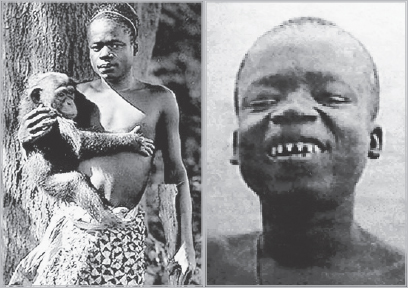
Ota Benga was degraded by being put in a cage as a supposedly Darwinian exhibit at the Bronx Zoo. Benga was often made to pose with monkeys and had his teeth sharpened to look like a cannibal.
Ota Benga. (Courtesy of the American Museum of Natural History)
The African Pygmy, “Ota Benga.” Age 23 years. Height, 4 feet 11 inches. Weight, 103 pounds. Brought from the Kasai River, Congo Free State, South Central Africa by Dr. Samuel P. Verner. Exhibited each afternoon during September.
That September the tabloids ran stories about Ota Benga—some sympathetic, others mocking. Facts came out: the Bronx Zoo hadn’t purchased the pygmy; he was on loan, so the charge of slavery was a guffaw. The New York Evening Newscondescendingly noted that while Benga was black, he wasn’t coal-black—he wasn’t actually on the bottom rung of the descent of man. That rung was occupied by more dark-skinned blacks. A spirited debate also ensued about whether Benga was a real pygmy or a dwarf or midget. There was great interest also in his sharply filed teeth, which led speculations about cannibalism. Schoolchildren visiting the zoo goaded Benga to rip at raw meat hurled at him by keepers. Benga’s nickname was “Bi,” and kids taunted him with it until he waved at them. One afternoon Benga, refusing to wear strange clothes, broke away from his keeper. When he was eventually apprehended he was brandishing a knife; quickly, the zookeepers disarmed him.55 “We are taking excellent care of the little fellow,” Hornaday said in the Bronx Zoo’s defense. “He has one of the best rooms in the primate house.”56
A few courageous Baptist ministers kept coming to the zoo to protest the incarceration of Ota Benga. Although there is no record of President Roosevelt’s getting involved in the controversy, Hornaday nevertheless started feeling pressure to reverse course. Charges of zoological quackery were starting to arise. “I do not wish to offend my colored brothers’ feelings or the feelings of any one for that matter,” Hornaday said. “I am giving the exhibitions purely as an ethnological exhibit. It is my duty to interest visitors to the park, and what I have done in exhibiting Benga is in pursuance of this. I am a believer in the Darwinian theory.” However, he insisted that Darwinism wasn’t the main reason for displaying the pygmy. Hornaday was a Nebraskan, raised on the frontier, and Ota was his counterpart to Geronimo in the Wild West show. After all, Buffalo Bill had received accolades for parading Apache performers around dusty fairgrounds. Why should Hornaday get pummeled in the press over a Congolese pygmy? Such criticism was selective and hypocritical. Exasperated, and tired of fierce criticism from newspapers and ministers, Hornaday went on to explain that Benga slept in the primate house because it was the most obvious and most “comfortable” place for him to bed down at the zoo.57 What was Hornaday supposed to do? Have him sleep with the zebras?
On Sunday, September 16, more than 40,000 visitors came to the zoo and went to the monkey house to see Ota Benga. As a special attraction, Bi had been let out of the cage and was free to wander around the zoological park, though with a keeper at his side. “They chased him about the grounds all day, howling, jeering and yelling,” the New York Times reported of the spectators. “Some of them poked him in the ribs, others tripped him up, all laughed at him.” Fearing for the pygmy’s life, the keeper put Benga back in his cage. “Me no like America,” Benga said. “Me like St. Louis.”58
Eventually, unable to shake off the criticism, Hornaday cracked. Arriving at work on Monday, with a pack of newsmen firing questions at him, Hornaday threw in the towel. “Enough!” he said. “Enough! I have had enough of Ota Benga, the African pigmy. Ring up the Brooklyn Howard Colored Orphan Asylum. Tell them that they can get busy tinkering with his intellect. I’m through with him here.”59
Benga was shunted off to the orphan asylum, supposedly as a free man. But he really wasn’t free. In 1900, Governor Roosevelt had signed into law an act banning discrimination in public schools; yet, oddly, it wasn’t applicable in orphanages.60Dressed in a white suit, Benga was kept as a sort of mascot at Howard. He remained something of a celebrity, and he was taught math and a few hundred English words and was introduced (forcibly it seems) to the New Testament. But because there were children at the asylum, Benga was segregated from the mainstream of the institution. The cooks fed him scraps in the kitchen, away from the children’s view. Because he became a chain-smoker, he was deemed a bad influence on young people. The relocation to the orphan asylum was becoming a failure for all involved, so another Plan B was tried. In 1910 Benga was shunted off to Lynchburg, Virginia, where he worked on a tobacco farm in the Tidewater region. Deeply disturbed by his experience as a zoo exhibit, and longing for his African homeland, Benga committed suicide in 1916: a pistol shot to the heart. When Hornaday heard about the suicide he was very unsympathetic. “Evidently,” Hornaday wrote, “he felt that he would rather die than work for a living.” 61
The small world that is history ridicules Hornaday over the Benga episode. But his views about the University of Man were once taken seriously and given credence throughout America in the early twentieth century. All over the nation, government-run eugenics offices had opened. In 1910, in fact, there was a Eugenics Record Office, created and founded by rich industrialists. An effort was made by the strong to weed out the weak in the “American race.” This misguided movement was an outgrowth of a theory called social Darwinism and is often seen as a step toward Nazism. From 1900 to 1935, thirty-two states adopted laws that allowed sterilization of “defective humans.” Only half-jokingly, H. L. Mencken said that all the southern sharecroppers needed to be sterilized. As Karl W. Gibson points out in Saving Darwin, more than 60,000 Americans were sterilized in the early twentieth century because they had epilepsy or stuttered or were mentally challenged. Ota Benga was, in a sense, a victim of the eugenics movement.62
IX
On September 24, 1906, a few days after Ota Benga was transferred from the Bronx Zoo to Brooklyn Howard Colored Orphan Asylum, Roosevelt at last set aside Devils Tower on two square miles of Wyoming wilderness, as a national monument (A clerical error omitted the apostrophe in Devil’s Tower, and it has never been reinstated.) Once the Antiquities Act passed in June, Frank W. Mondell, representative at-large from Wyoming, began pushing for Devils Tower to become the first national monument. Although he was vehemently opposed to national forests, Mondell, a resident of nearby Newcastle, Wyoming, correctly surmised that Devils Tower could, if properly promoted, become a first-rate tourist attraction, bringing tourist dollars to Newcastle, Gillette, and Sundance. Although Devils Tower was out of the way, there was a possibility that tourists visiting the Black Hills would make a day’s outing to see the bear claw marks.*63 (Mondell wanted to build an iron stairway from bottom to top: evidently he didn’t think it would be obtrusive, possibly because he had no idea what “obtrusive” meant.) As a member of the House Committee on Public Lands, which Lacey chaired, Mondell worked with the GLO all summer to get the size of the site over 1,000 acres so that the tower could be properly cared for and managed.
Depending on where a visitor was standing and what the angle of sunlight was, Devils Tower produced various impressions. At the top reaches the colors were grays; the bottom had soft reds, pastel rust, and yellow-olive combinations. There were almost no roads to the tower in 1906; travelers coming from the east had to ford the swollen Belle Fourche River seven or eight times. From a distance the Tower seemed, deceptively, to be always within grasp.
A cursory look at the Wyoming newspapers of September 25 shows zero interest in the new federal designation. After all, to locals the site was still just forlorn Devils Tower. Unfortunately, the Roosevelt administration had no ranger to assign to the tower. The commissioner of the GLO, Fred Dennett, did provide a “special agent” based in Laramie, Wyoming, whose job included halting commercial vandalism and homesteading on the new national monument property. On the Fourth of July locals were allowed to attempt climbs to the top. What made national monuments so confusing was that, depending on what was expedient on a case-by-case basis, they were under the jurisdiction of one of three departments: Interior, Agriculture, or War. (Eventually, in 1916, they were all brought into the Department of the Interior.) 64
Because the special agent didn’t live at Devils Tower, locals started chipping off hunks of the rock formation for souvenirs. Eventually “No Trespassing” signs were posted all around Devils Tower as a deterrent; these worked, to a limited degree. However, not until the 1930s, when roads were built, did Roosevelt’s first national monument finally become a major tourist attraction, with full-time federal protection services provided.
If all Roosevelt had been doing from June to September 1906 was creating Devils Tower National Monument and Mesa Verde National Park, the academic debate over whether he was a preservationist or a conservationist would not arise. Clearly, his actions on behalf of these western sites, no matter how prosaic the language of the Antiquities Act, made him a thoroughgoing preservationist. Yet throughout the summer of 1906 Roosevelt was also deeply involved with the building of dams, bridges, and reservoirs in the frontier landscape of the West, under the Reclamation Act. Emblematic of the progressive era, his Reclamation Service now had more than 400 engineers and other experts working in Arizona, New Mexico, and Oklahoma. More than 1 million acres of arid land was being irrigated (and this irrigation entailed digging 800 miles of canals, tunnels, and ditches). The Roosevelt administration was giving the American West a concrete and steel reconstruction for the sake of water. This activity by the Reclamation Service caused newspapers in the West to rejoice. Reclaimed land west of the Mississippi River, in fact, could soon sustain 100 million people, owing to wise water policy.65 “The crowded conditions of the eastern communities will be automatically relieved,” theEllensburg (Washington) Dawn predicted, “a happy and contented, home-loving and home-owning people will occupy the present arid regime of the west.” 66
Just as the Panama Canal was a triumph of engineering, so too was the hauling of 16 million cubic yards of American earth under the Reclamation Service’s guidance. Roosevelt had hired more than 10,000 men and 5,000 horses to reclaim the arid west. The days of general surveys and land examinations were over—the time had come for housing communities to be built in places like Los Angeles, Phoenix, Albuquerque, and Oklahoma City. “We may well congratulate ourselves upon the rapid progress already made, and rejoice that the infancy of the work has been safely passed,” Roosevelt wrote to Gifford Pinchot. “But we must not forget that there are dangers and difficulties still ahead, and that only unbroken vigilance, efficiency, integrity, and good sense will suffice to prevent disaster…. There remains the critical question of how best to utilize the reclaimed lands by putting them into the hands of actual cultivators and homemakers, who will return the original outlay in annual installments paid back into the reclamation fund; the question of seeing that the lands are used for homes, and not for purposes of speculation or for the building up of large fortunes.”67
Because 1906 was a midterm election year, Roosevelt tried to push his conservation policy into the slipstream. He boasted about how smart he was to have Pinchot running the Forest Service out of Agriculture (not Interior). To Roosevelt, Pinchot remained a golden boy who could do no wrong. Roosevelt believed that under Pinchot’s stewardship the U.S. Forest Service was intensely engaged in making sure all western reserves resources contributed mightily to the “permanent prosperity of the people who depend upon them.” Western entrepreneurs lambasted Roosevelt and Pinchot’s forest reserve policies as socialism, but the president believed his administration’s foresight guaranteed future jobs to stockmen, miners, lumbermen, railroad employees, and small ranches. And it was helping to end rural water shortages. If the western forests were destroyed, there would be no water, and cities would become ghost towns.
Furthermore, Roosevelt believed that Pinchot was doing a superb job of finding innovative ways to put out wildfires, both man-made and natural, which swept over the West in the summertime. He deserved an ovation. Wildfires were most common in zones where the terrain was moist for nine months of the year but then became extremely dry from July through September, creating a tinderbox. When scrub, leaves, twigs, or branches dried out, they became highly flammable. Entire national forests could be transformed almost instantly into smoldering mulch. Sometimes farmers would use fire (circumscribed burning) to clear land. This was often necessary, but it was dangerous. If a light wind picked up the flames and sparks jumped, they could cause an uncontrollable wildfire. Lightning fires were another problem for the dense forests and wind-beaten sagebrush of the West. An entire forest reserve could disappear in a few days. The chaparral in southern California and the lower-elevation deserts in the Southwest were particularly vulnerable to wildfires. Then, of course, there was human carelessness, as well as arson.68
What Roosevelt had on his hands in 1906, however, was a feud between forest rangers and stockmen in the western wildlands. To reduce tension Roosevelt formed Forest Service advisory committees aimed at enlightening ranchers on why a steady stream flow and reservoirs were directly correlated with more grass for grazing. Forest rangers were their friends, not the enemy. Meanwhile, the USDA’s Biological Survey increased its predator control, teaching ranchers that poisoning coyotes was smart but shooting insect-eating songbirds was a mistake.
“There is therefore no longer an excuse for saying that the reserves retard the legitimate settlement and development of the country,” Roosevelt wrote to Pinchot in a letter intended for public distribution. “The forest policy of the Government in the West has now become what the West desired it to be. It is a national policy, wider than the boundaries of any State, and larger than the interests of any single industry. Of course it cannot give any set of men exactly what they would choose. Undoubtedly the irrigator would often like to have less stock on his watersheds, while the stockman wants more. The lumberman would like to cut more timber, the settler and the miner would often like him to cut less. The county authorities want to see more money coming in for schools and roads, while the lumberman and stockman object to the rise in the value of timber and grass. But the interests of the people as a whole are, I repeat, safe in the hands of the Forest Service. By keeping the public forests in the public hands our forest policy substitutes the good of the whole people for the profits of the privileged few. With that result none will quarrel except the men who are losing the chance of personal profit at the public expense.”69
What made Roosevelt so powerful when working to save western ranchlands was that he was speaking from firsthand knowledge. Insofar that landscapes were left to cowboys, places like Texas would be vulcanized into barren zones of burnt grass, as if vast acreage had been shaved by a giant razor. In 1905 Roosevelt had his Public Land Commission issue an alarming report based on data collected by a team of experts. “The general lack of control in the use of public grazing lands has resulted, naturally and inevitably, in overgrazing and the ruin of millions of acres of otherwise valuable grazing territory,” the report said. “Lands useful for grazing are losing their only capacity for productiveness, as, of course, they must when no legal control is exercised.”70 But as the historian Deanne Stillman noted in Mustang, this dire report was ignored by western Congressmen as taste-curdling U.S. federal government babble and “the range got worse.” 71
X
The fall of 1906 was the first occasion when Roosevelt was able to spend much time at Pine Knot that year. The timing of his visit to Virginia was simple: November 1 was the opening of the wild turkey hunting season in Virginia. Arriving on Halloween, Theodore and Edith stayed for the better part of five days at Pine Knot. The woodsy retreat made Roosevelt immediately content. Being in the Blue Ridge Mountains, where the leaves were turning to dazzling fall colors, was sheer joy to the president. He had been consumed with the Cuban revolt, trust-busting, labor disputes, the Panama Canal, Indian matters, and a congressional election, and the thought of bagging a wild turkey for supper was a great relief from these pressures. The hunt was hosted by his friend Dick McDaniel, and the word around Charlottesville-Keene was that the wild turkeys were plentiful. A few well-intentioned local farmers tried to secretly stock plump turkeys on Roosevelt’s Pine Knot property to make the president’s hunt a guaranteed success. But word leaked out, and the scheme was aborted. Traipsing about the woods at Pine Knot, a local physician showed the president to a fine covey of quail in a clearing. Roosevelt waved him off. “I want,” he said imperiously, “bigger game than that!”
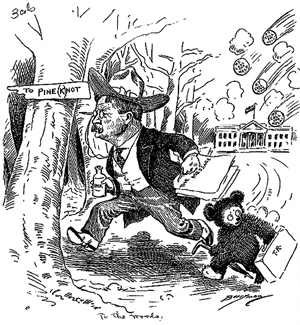
Whenever possible Roosevelt fled the White House to spend time at his rustic cabin, Pine Knot, near Charlottesville-Keene, Virginia.
T.R. races off to Pine Knot. (Courtesy of the Edith and Theodore Roosevelt Pine Knot Foundation)
On November 4 Roosevelt got his bird. The Washington Post and the New York Times had articles about the wild turkey’s weight and colors.72
Never before had Roosevelt eaten a turkey that tasted as fine as this one. Free from the White House’s tedious schedule, he enjoyed the simple nearby things at Pine Knot. Relieved of encumbrances, he wrote enthusiastic letters about the game bird to both his son Kermit and old Bill Sewall in Maine.73 In 1907, Roosevelt wrote an essay about the wild turkey hunt, “Small Country Neighbors,” for Scribner’s Magazine. As a literary effort the piece stylistically recalled “Sou’-Sou’-Southerly,” written twenty-seven years earlier, or something in a publication of the Boone and Crockett Club. “Small Country Neighbors” was a celebration of the American simple life: a turkey hunt, fresh vegetables, a small cabin or hut in the woods, a tent on the shore. Roosevelt wrote: “Each morning I left the house between three and five o’clock, under a cold, brilliant moon. The frost was heavy; and my horse shuffled over the frozen ruts…. It was interesting and attractive in spite of the cold. In the night we heard the quavering screech owls…. At dawn we listened to the lusty hammering of the big logcocks, or to the curious coughing or croaking sound of a hawk before it left its roost.”74
The exaltation of hunting wild turkeys—and killing one—in the crisp air got Roosevelt thinking again about the Appalachians. He very much wanted to create an eastern forest reserve in the Blue Ridge Mountains to match the vast western reserves in the Rockies. But this idea was akin to heresy in West Virginia, Virginia, North Carolina, and Georgia. In 1901, in his First Annual Message, Roosevelt had proposed such an eastern forest reserve to Congress. He wanted it to include vast parts of the Shenandoah Mountains of Virginia, the White Mountains of New Hampshire, and the Great Smoky Mountains of Tennessee–North Carolina. Congress, however, had refused. By late 1902 Roosevelt had grown extremely frustrated that both Democratic and Republican politicians were hindering his plan for an eastern reserve. He wanted to strangle them. The nonauthoritarian part of being president—i.e., working with Congress—annoyed him no end. With regard to natural resource management before the Antiquities Act, Roosevelt’s authoritarianism was often foiled in the legislative process. “I should like to see the Government purchase and control the proposed great South Appalachian preserve,” he wrote to a friend, “but there are very grave practical difficulties in the way.” 75
From his correspondence during the fall of 1906, it is clear that Roosevelt was deeply worried about the survival of the Blue Ridge Mountains if unregulated timbering persisted. Too many farmers in Virginia were wasting soil, water resources, and forestlands along the James River. Human greed never ceased to amaze Roosevelt. Studying the Round Rock depot outside Charlottesville one afternoon, taking a casual inspection stroll as he’d done as New York’s police commissioner, surrounded by green walls of trees, Roosevelt saw that once-pristine forests were girdled, and chopped-up trunks were piled high in lumberyards along the tracks. How utterly unnecessary and regrettable the scene was. To Roosevelt, cutting trees in the Blue Ridge to make room for the plow was a good thing. But massacring mile upon mile of land just for lumber was criminal, as was companies’ refusal to replant. “American consumption of lumber was greater than ever before,” the historian Roy M. Robbins writes in Our Landed Heritage. “It was estimated in 1905, that to supply the Portland [Oregon] mills alone, 80 acres of timber had to be cut every twenty-four hours.”76 The situation was just as bad—if not worse—in Virginia.
XI
While Roosevelt was hunting wild turkey in Virginia, the 1906 congressional elections were held. Generally speaking, it was a good day for Republicans (progressive) in the North and Democrats (progressive) in the South. But in what was interpreted by political pundits, in part, as displeasure with Roosevelt’s intense conservationism, twenty-eight Republican seats were lost in the U.S. House of Representatives. This meant that the Republican majority was lessened by fifty-six seats (it was now 222 to 164). One casualty of the election was John F. Lacey of Iowa’s Sixth District. Apparently the voters didn’t care that Lacey was America’s authority on petrified logs in the Arizona desert; they wanted solutions to the economic downturn of 1906 (which would turn into the Panic of 1907). Iowans living in towns like Oskaloosa, Pella, and Eddyville had real problems and spared little thought for Anasazi cliff dwellings, Zuni cave drawings, and the mating habits of little green herons. Congressmen were supposed to bring back pork to the home district not establish federal parks, forests, and bird reservations in other states and territories.
Nothing seized Roosevelt’s attention quite like an electoral debacle. Losing Lacey in Congress, for instance, was a blow, because Lacey had so ably aided the conservationist movement in the congressional Committee on the Public Lands. But Roosevelt realized, stoically, that every politician had his day and Lacey’s had lasted for thirty-seven years. With his congressional career now terminated, Roosevelt inquired whether Lacey wanted a cabinet appointment or an ambassadorship. Lacey’s answer was no. He preferred to practice law in Oskaloosa. What an unsung American hero this Iowan was! Without Lacey, there might have been no model bird laws in Florida, no reintroduction of bison in Oklahoma, and no preservation of cliff dwellings in the Southwest. Mesa Verde might have been destroyed without his intervention. William Hornaday correctly said of Lacey that “he was never elsewhere than on the firing line.” A movement was under way in November 1906 to create a “monument as lofty as his own purposes and as imperishable as his fame.”77 The accomplishments of Lacey’s governmental career were never forgotten by Roosevelt, who, on returning from Panama, planned to designate as national monuments three southwestern prehistoric sites favored by Lacey.
From Pine Knot the president headed to Norfolk, setting sail for Panama on November 9, 1906, to see “how the ditch is getting along.” There had been no cases of yellow fever in Panama City since November 11, 1905; the amazing Dr. William Gorgas had eradicated this scourge from the isthmus. So Roosevelt, with a group of military personnel at his side, was ready for an inspection tour. The first days passed peacefully at sea. Much of his correspondence while he was aboard the USS Louisiana dealt with Cuba and America’s naval power. Yet he also kept colorful naturalist notes. “All the forenoon we had Cuba on our right and most of the forenoon and part of the afternoon Haiti on our left,” Roosevelt wrote to his son Kermit, “and in each case green, jungly shores and bold mountains—two great, beautiful, venomous tropic islands.” Among meditations on voodoo, cannibalism, Dutch sea dogs, Vasco Nuñez de Balboa, and the Chagres River flood, Roosevelt wrote about the tropics, proud to think that he had saved wild parts of Puerto Rico, Florida, and Louisiana from destruction. “The deluge of rain meant that many of the villages were knee-deep in water, while the flooded rivers tore through the tropic forests,” he wrote of Panama. “It is a real tropic forest, palms and bananas, breadfruit trees, bamboos, lofty ceibas, and gorgeous butterflies and brilliant colored birds fluttering among the orchids. There are beautiful flowers, too. All my old enthusiasm for natural history seemed to revive, and I would have given a good deal to have stayed and tried to collect specimens.”78
Halfheartedly reporting on the engineering feats associated with the Panama Canal, Roosevelt was proud of his achievement but seemed to prefer being a naturalist. He saw himself as an advance scout for the American Museum of Natural History, which didn’t acquire specimens from Panama until 1914.79 When the Louisiana anchored in Puerto Rico, Roosevelt rushed out to inspect the Luquillo National Forest area he had created in 1902. After reading Biological Survey reports about the rain forest and parrots, he now examined them on his own. Returning to his childhood habit of drawing animals, Roosevelt once again doodled parrots and turtles. “The scenery was beautiful,” he wrote to Kermit. “It was as thoroly [sic] tropical as Panama but much more livable. There were palms, tree-ferns, bananas, mangoes, bamboos, and many other trees and multitudes of brilliant flowers. There was one vine called the dream vine with flowers as big as great white water lilies, which close up tight in the daytime and bloom at night. There were vines with masses of brilliant purple and pink flowers, and others with masses of little white flowers, which at night smell deliciously.”80
Kermit, now sixteen years old, was full of gratitude that his father sent him such marvelous notes from Panama, from Puerto Rico, and at sea. But he seems to have thought somewhat differently in early December. News came that his father—President Theodore Roosevelt—had won the Nobel Peace Prize for negotiating a settlement in the Russo-Japanese War. Not surprisingly, as the first American ever to win this honor, Roosevelt was pleased. But he was also concerned about the $40,000 check that accompanied the prize. After all, he had spent much of his public career huffing and puffing against bribery and corruption. He had made peace between Japan and Russia because it was his job as president. Ethically, the $40,000 didn’t belong to him.
To Kermit, his father was just being unduly foolish. The money could properly be used to build a new wing on Sagamore Hill, to travel around the world, or to earn interest in an inheritance fund for him and his brothers and sisters. Shouldn’t the Roosevelt family enjoy this gift? His father, that December, deplored such self-indulgent notions. “Now,” the president wrote to Kermit, “I hate to do anything foolish or quixotic and above all I hate to do anything that means the refusal of money which would ultimately come to you children. But mother and I talked it over and came to the conclusion that while I was President at any rate, and perhaps anyhow, I could not accept money given to me for making peace between two nations, especially when I was able to make peace simply because I was President. To receive money for making peace would in any event be a little too much like being given money for rescuing a man from drowning, or for performing a daring feat in war.”81 A prisoner of old ethics, Roosevelt received the check that December. He used it to create a committee in Washington, D.C., for industrial peace.
On December 8, Roosevelt had signed quietistic declarations establishing Montezuma Castle (Arizona), El Morro (New Mexico), and the Petrified Forest (Arizona) as national monuments under the Antiquities Act of 1906. The three monuments were a tribute to Lacey’s trademark persistence on their behalf. If Lacey hadn’t been a teetotaler, he might have uncorked a bottle of Dom Perignon when told of this order. In Arizona, Wetherill excitedly anticipated more tourists than he could shepherd to see the ancient sites. Roosevelt had created all three monuments as a federal measure to deter artifact thieves and promote scientific study. He understood that these southwestern ruins and petroglyphs were windows to understanding the prehistoric cliff dwellings, pueblo ruins, and early missions discovered by army officers, ethnologists, cowboys, and explorers on the vast public lands in the territories. The story of ancient peoples could be analyzed better in these three monuments than anywhere else in North America; the ruins were that intact. Thanks to the Antiquities Act, nobody was allowed to excavate or appropriate anything from Montezuma Castle, El Morro, or the Petrified Forest without permission from the relevant department (War, Agriculture, or Interior). As Charles F. Lummis wrote inSt. Nicholas, an illustrated magazine for young adults, these monuments were in a part of the United States which “Americans know [as] little as they do Central Africa.”82 The historian Josh Protas has noted, in A Past Preserved in Stone, that the “diversity” of Southwestern monuments “set a precedent for the types of monuments that would later be established.”83
Take, for example, El Morro, on the Colorado Plateau. More than 2,000 inscriptions and petroglyphs were carved into the soft sandstone by explorers, pioneers, and native tribes. Much of western history may have been lost when pioneers headed down the Santa Fe Trail, but at El Morro some clues were left behind. Located five miles from Trinidad, New Mexico, this ancestral Pueblo ruin is at an elevation of 7,219 feet. Probably fewer than 1,000 easterners had seen it by 1906. Apparently, the ancients had used El Morro as a reliable water hole and campsite. At the time T.R. declared El Morro a national monument, the walls carved with signatures looked like a gigantic hotel register. Once again, thanks to Roosevelt, El Morro was now a treasured place, saved for future generations to study and enjoy.
Montezuma Castle National Monument of Arizona featured amazing cliff dwellings that had been molded and lived in by the pre-Columbian Sinagua around AD 1400. The Sinagua had once prospered, developing a sophisticated culture, but then inexplicably vanished. To many people, the Arizona cliff dwellings they left behind were among the wonders of the world. Nobody really knew what to make of them. The Verde Valley area overlooking Beaver Creek had been named by Europeans for the Aztec emperor of Mexico—Montezuma II—in the mistaken belief that he had once lived there, and the misnomer stuck. An early advocate of protecting Montezuma Castle was T.R.’s old Rough Rider friend William “Buckey” O’Neill, who besides being a mayor of Prescott, Arizona, was the editor of Hoof and Horn. To O’Neill, the Montezuma Castle cliff dwellings, much like Mesa Verde, raised more questions than they answered. Why did the Sinagua leave? Archaeologists offered conflicting answers to such questions, though warfare and drought seemed the most logical reasons. Now, professional anthropologists and archaeologists could study Montezuma Castle’s axes, tools, shells, paints, bone implements, and other artifacts with federal protection.
Because the Roosevelt administration didn’t have cash to spare, the Arizona Antiquities Association started repairing Montezuma Castle and put up a protective metal roof. Tourists at Phoenix and Prescott now became enthusiastic about day outings to Montezuma Castle. As a promotional gimmick, it was said that Kit Carson had favored the ruins; he had once camped in the area. There were murmurs in the Tucson newspaper that Montezuma Castle should become a national park. All of Arizona was proud of Montezuma Castle. “We were (and perhaps still are) attracted to the ruins, no matter what their size or age,” John B. Jackson wrote in A Sense of Place, A Sense of Time. “Their shabbiness served to bring something like a time scale to a landscape, which for all its solemn beauty failed to register the passage of time.”84
But it was Petrified Forest National Monument that created a flash of satori in preservationist circles. If a swath of Arizona’s Painted Desert strewn with petrified coniferous trees could be saved, so could Florida’s swamps, Louisiana’s brackish marshes, and Alaska’s tundra. Lacey, who had crisscrossed the country in his effort to save the Petrified Forest—which he considered one of America’s five most striking wonders, along with Yellowstone, Crater Lake, Yosemite, and Wind Cave—celebrated at his home in Oskaloosa. Nobody in public life could speak about the Petrified Forest quite like Lacey, even though he came from Iowa. He believed that many of the petrified logs had grown exactly where they now lay. Every log impregnated with silica, stained by iron oxide and other minerals, was a rainbow of colors. “Ages ago, so long that it makes one dizzy to think of it, these trees were alive and growing in the Southwest,” Lacey said. “They were coniferous, as shown by microscopic examination of their texture. The species is extinct, and the nearest resembling species now found exists in Asia Minor. The geological history of this forest is easy to read. The trees fell and floated around in some old arm of the sea until the roots and limbs were worn and rounded just as we see like examples on the sandbars of the Mississippi. The trees became heavy and waterlogged and settled to the sea bottom.”85
Thanks to the guardian spirit of Theodore Roosevelt and John F. Lacey, this ancient sea bottom filled with petrified logs in eastern Arizona was an American treasure for future generations to study and enjoy. And Wetherill was ready to enforce federal protection even in treeless vales where the grass blades had perished due to the pounding sun.