
CHAPTER TWENTY-THREE
I
Even with the administration’s designation of Petrified Forest, Montezuma Castle, and El Morro as national monuments in December 1906, President Roosevelt wasn’t content. Because John F. Lacey was no longer in Congress, Roosevelt had less clout with the House Committee on Public Land. Furthermore, the relationship between Interior and the USDA’s Forest Service was not congenial. By January 1907, Roosevelt had grown increasingly suspicious that his secretary of the interior, Ethan Allen Hitchcock, was too soft on the extraction industries in the West. Hitchcock was like a well-trained bullfighter who made his best passes when there was no bull present (or, as Roosevelt saw it, receded into the shadows when a real goring was possible). Easing Hitchcock, a McKinley man at heart, out of the post, became a priority for Roosevelt in early 1907. Finesse was needed because Roosevelt didn’t want to cut the life-line while Hitchcock was still making policy. Another consideration was allowing Hitchcock to reenter the private sector with honor, and this too became a priority for the administration over the holiday season. The situation was especially sensitive because Hitchcock, who was then sixty-one, was feeble (he died in 1909).
As of January 15—the day of the Senate’s official confirmation—Roosevelt’s new secretary of the interior was James R. Garfield of Ohio. Everybody in Washington knew Garfield as one of Roosevelt’s staunchest foot soldiers. As the saying went, he was an old head on young shoulders. Yet he was always something of a messenger boy. And it didn’t hurt that Garfield’s wife, the former Helen Newell of Cleveland, Ohio, was a prominent Washington hostess (part of the first lady’s elegant clique). “Garfield is earnest,” the Saturday Evening Post wrote. “The President likes earnest persons. Garfield is ambitious. The President likes ambitious persons. Garfield is conscientious, and the President lays much stock by that. In short, Garfield is a clean young man, with a mind that grapples with great problems, no matter what the windup of the encounter may be.”1
Roosevelt wanted somebody to go after the perpetrators of land fraud in the West, a fellow Republican progressive unafraid of controversy. Garfield was his beau ideal. The handsome forty-two-year-old Garfield had served in the Ohio state senate from 1896 to 1899. He was rara avis because of his old-fashioned sense of bedrock loyalty, always a character trait in short supply. As a silver-star bonus, Garfield was the son of James A. Garfield, the twentieth president of the United States, and had been weaned on national politics. For all their differences, Roosevelt knew that the elder Garfield had been a man of biting intelligence. Young James was a student at St. Paul’s School in Concord, New Hampshire, when his father was assassinated and he had witnessed the ghastly shooting, which happened at the Baltimore and Potomac railroad station in Washington, D.C., during his summer break. Somehow he had absorbed the assassination faster than much of the country did, and he refused to let the tragedy derail his ambition. In 1881 he enrolled at Williams College, where he earned straight A grades. Following college Garfield earned a J.D. degree from Columbia University, developing a formidable, Rooseveltian prosecutorial bent. Garfield wasn’t afraid to rouse lions from their lairs in the name of good government.
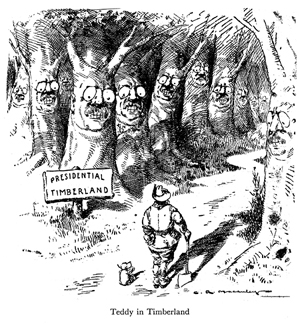
“Teddy in Timberland” was a popular cartoon that ran in syndication.
“Presidential Timberland.” (Courtesy of the Theodore Roosevelt Association)
From 1902 to 1903 Garfield was Roosevelt’s eyes and ears at the U.S. Civil Service Commission. His professional attitude was characterized by following orders and saying “Yes sir.” Bosses, including Roosevelt, naturally admired that sort of man; and in addition, Garfield was competent. He was promoted to commissioner of corporations at the Department of Commerce and Labor. With the zeal of Lincoln Steffens he lashed out against the corrupt industries of the era: oil, steel, railroads, and meatpacking. Perhaps Garfield was only following orders, but he seemed to relish what we might now describe as being Roosevelt’s pit bull. At the very least Garfield understood that the fight for national forestry would be prolonged and intense. Now, in early 1907, Roosevelt wanted to sic Garfield on the timber thieves and land hustlers. As Roosevelt, Pinchot, and Garfield saw it, forestry was a science based on truth—not a political game in which you tried to score points in order to be reelected. “He has a man’s job before him now,” the Washington Post wrote of Garfield that spring. “The Department of the Interior controls the public domain, the forests, the Indians, the patents, the pensions, the Bureau of Education, the Geological Survey, and the Reclamation Service. All the land grafters, all the Indian grafters, all the sharks who are trying to get the timber and the oil and the coal for nothing must come to him and pass under his eye.”2
The unflappable Garfield immediately was in full stride, walking directly into the line of fire. When the Republican Party lost House seats, pro-business newspapers started attacking Roosevelt for his antagonistic attitude toward Wall Street, big timber, and Standard Oil. For example, Edward Payson Ripley, president of the Atchison, Topeka, and Santa Fe, said that Roosevelt didn’t have the public interest at heart in creating forest reserves and national monuments. To Ripley, Roosevelt was simply obsessed with the wilderness. The railroad tycoon E. H. Harriman—who had sponsored the Alaska expedition that included Dr. C. Hart Merriam and John Burroughs, had a similar opinion—deeming Roosevelt a self-promoter and a traitor to his class. Roosevelt, for his part, started instructing Garfield to defend Native Americans from corporate land grabs in Oklahoma, Wyoming, and Montana. George Bird Grinnell was starting to write ethnographic books on Indians—he was doing research for a study that would be published asBy Cheyenne Campfires. His work was starting to rub off on Roosevelt.3 In a court order, Roosevelt defined Garfield’s job as protecting the “rapidly disappearing timber” for future generations to enjoy. America’s forests, Roosevelt believed, belonged to the homeland, but the homeland was under siege by underregulated industrialization (in other words, big business run amok). “Oil and gas,” Roosevelt wrote to Garfield on February 1, 1907—“I most emphatically believe that we should not permit the lands containing oil and gas to be alienated under conditions which would in effect mean the building up of a great monopoly in oil.” 4
With the success of the Antiquities Act in 1906, Roosevelt had become even more dangerous to western developers, railroad companies, and oil companies. He usually donned a Stetson hat and often wore a bandanna around his neck, and his public rhetoric was full of western toponyms, cowboyisms, and Indian words not often heard in the East. From the White House, he was playing a Rocky Mountain man to help sell his radical conservationism. The oilmen, land developers, and trust titans wanted to see Roosevelt relegated to the sidelines of public life, like John F. Lacey. Instead, they had to confront not only Roosevelt but also Garfield. The timber industry believed that T.R.’s excessive conservationist initiatives were symptoms of his having gone berserk. But such hostility only encouraged Roosevelt to thrust himself forward as the true guardian of America’s natural resources. Figuratively, conservationism was simply the wise, righteous preservation of the American way, the prerequisite to Roosevelt’s building a republic like none other. “The grazing states, especially Colorado, Wyoming, and Montana, protested vigorously against the new policies,” the historian Roy M. Robbins noted in Our Landed Heritage. “The stockmen of these states were compelled to use the meadows in the reserves inasmuch as the lower plains gave out during hot weather. The sheepmen were especially anxious, for fear that government regulation would curtail their operations in favor of cattle interests. Both those groups looked with suspicion upon policy which seemed to favor the homesteader.”5
Working closely with Pinchot, Roosevelt began scheming for innovative ways to create dozens of new national forests before Congress reconvened on March 3. These forests would humanize the soul—if not, the Dark Ages would come to America (or so Roosevelt supposed). On February 23, 1907, in fact, a disgusted senator—Charles Fulton of Oregon, a fellow Republican—introduced the following amendment to an agricultural appropriations bill: “hereafter no forest reserve shall be created, nor shall any addition be made to one heretofore created, within the limits of the State of Oregon, Washington, Idaho, Montana, Colorado, or Wyoming except by act of Congress.”6
Fulton believed the whole Antiquities Act was nonsense and had to be curtailed. He was sick and tired of arrogant executive orders that gave petrified logs and spotted owls priority over business profits. Also, Fulton said, the lowly settler and the poor farmer were being denied the same rich timberlands by the Roosevelt administration. This was a grim consequence of the government’s irresponsible hoarding of resources.
Roosevelt’s answer to Fulton was dramatic. On March 2, 1907—four days before the amendment was slated for a vote—Roosevelt released a document to Congress as a presidential fait accompli. Thirty-two new forest reserves had been created, seemingly overnight. Behind each forest listed were snatches of complicated conversations his representatives had conducted with state legislators and land managers about soil erosion, runoff, and deforestation. Numerous papers, passes, exemptions, validations, dues, expansions, and limitations had been issued. Roosevelt’s refusal to let Congress inhibit him caused a firestorm against him on Capitol Hill. By contrast, in sleepy Oskaloosa, where he had resumed his law practice on Main Street, Lacey deemed it a great day in the annals of forestry. Roosevelt had delivered a punishing blow to the advocates of states’ rights. He had caught Congress flat-footed. And the lumberman’s axes had been stilled in certain heavily forested regions, particularly in the Pacific Northwest.
The conservationist pronouncement of March 2 was a fine example of Roosevelt’s unappeasable conservationism. Roosevelt issued a long “Memorandum” listing forest reserves either created or enlarged:
Toiyabe Forest Reserve, Nevada
Wenaha Forest Reserve, Oregon and Washington
Las Animas Forest Reserve, Colorado and New Mexico
Colville Forest Reserve, Washington
Siskiyou Forest Reserve, Oregon
Bear Lodge Forest Reserve, Wyoming
Holy Cross Forest Reserve, Colorado
Uncompahgre Forest Reserve, Colorado
Park Range Forest Reserve, Colorado
Imnaha Forest Reserve, Oregon
Big Belt Forest Reserve, Montana
Big Hole Forest Reserve, Idaho and Montana
Otter Forest Reserve, Montana
Lewis and Clark Forest Reserve, Montana
Montezuma Forest Reserve, Colorado
Olympic Forest Reserve, Washington
Little Rockies Forest Reserve, Montana
San Juan Forest Reserve, Colorado
Medicine Bow Forest Reserve, Wyoming, Colorado
Yellowstone Forest Reserve, Idaho, Montana and Wyoming
Port Neuf Forest Reserve, Idaho
Palouse Forest Reserve, Idaho
Weiser Forest Reserve, Idaho
Priest River Forest Reserve, Idaho and Washington
Cabinet Forest Reserve, Montana and Idaho
Rainier Forest Reserve, Washington
Washington Forest Reserve, Washington
Ashland Forest Reserve, Oregon
Coquille Forest Reserve, Oregon
Cascade Forest Reserve, Oregon
Umpqua Forest Reserve, Oregon
Blue Mountain Forest Reserve, Oregon 7
When Fulton heard that huge tracts of Oregon forestlands had been pickpocketed by the federal government before the agriculture bill could be voted on, he was furious. No serious American, he believed, could have designated so many western forest reserves in such a cavalier fashion. It was a gray, grim day, Fulton lamented, for Willamette valley’s businessmen. According to Fulton’s tirade, Roosevelt and Pinchot’s team had sneakily withdrawn 16 million acres, ostensibly to prevent overlogging. And eight of the forest reserves were in Oregon: Wenaha, Siskiyou, Imnaha, Ashland, Coquille, Cascade, Umpqua, and Blue Mountain.8 The whole damn state, Fulton fumed, was becoming a park. The lumber warehouses and industrial storage sheds in his state would be empty if this type of land grab was tolerated. A torrent of accusations followed: Why didn’t Roosevelt burn the Constitution while he was at it? Why didn’t he just declare Oregon a colony and get it over with? Why didn’t he ban sawmills from operating in the West?
Not for a second did Fulton believe that the autocratic Roosevelt was preserving millions of acres for homesteaders or for posterity. The new forest reserves were, to his mind, something the aristocrats of the Boone and Crockett Club and the Audubon Society wanted to have as trophies, at the expense of hardworking, taxpaying citizens. And in general, western interests claimed that this was foul play. Roosevelt, they believed, had acted dishonorably by setting aside the 16 million acres of forest reserves without proper congressional consultation.9
As a result of the land withdrawal of March 2, the executive branch was sued. The plaintiffs’ lawyers said Roosevelt was acting like a tribal chieftain unaccountable to constitutional law. The defense attorneys said the lawsuits were small-minded. At issue was whether the Roosevelt administration had abused executive powers. Eventually, in 1910, the dispute was brought before the courts, first in U.S. v. Grimaud (220 U.S. 506) and then in Light v. U.S. (200 U.S. 523). In both cases the U.S. Supreme Court ruled in T.R.’s favor. Big timber had been stymied. The threat of these court cases served only to impel Roosevelt forward with his far-reaching conservationist agenda.10
Convinced that the future of America was imperiled, Fulton kept up his dogged pursuit of Roosevelt. That spring Roosevelt had told Everybody’s Magazine that westerners who didn’t understand subspecies of deer and elks weren’t good stewards. The president’s attitude was plain as day: timber companies were bandits, and westerners incapable of biologically identifying moles were nature fakers. What rubbish! To Fulton, the president was as crazy as a loon—and dangerous. But Roosevelt later patted himself on the back for being a political fox. “When the friends of the special interests in the Senate got their amendment through and woke up, they discovered that sixteen million acres of timberland had been saved for the people by putting them in the National Forests before the land grabbers could get at them,” Roosevelt bragged in An Autobiography. “The opponents of the Forest Service turned handsprings in their wrath; and dire were their threats against the Executive; but the threats could not be carried out, and were really only a tribute to the efficiency of our action.”11
The combination of the Antiquities Act, the new natural forests, and the debate over nature fakers put Roosevelt in a mood for sparring. He was now forty-nine, and there was about him the cockiness of a gambler who has been winning and is itching for more action. Unleashing Garfield on the corporations was his latest sport. Another favored sport was lambasting faux naturalists untutored in Darwinian biology. “You will be pleased to know that I finally proved unable to contain myself, and gave an interview or statement, to a very good fellow, in which I sailed into Long and Jack London and one or two others of the more preposterous writers of ‘unnatural’ history,” Roosevelt wrote to Burroughs. “I know that as President I ought not to do this; but I was having an awful time toward the end of the session and I felt I simply had to permit myself some diversion.”12
The seemingly arbitrary forest reserve designations of March 1907 stung the Western politicians the most. As the Congressional Record noted, even as late as World War I the mention of what Roosevelt had done “still brought forth the wrath from certain quarters.”13 In 1907 the Walla Walla Weekly accused Roosevelt of putting the small logging operations out of business in Washington state with his mania for national forests. As this argument went, rich corporations like the Weyerhaeuser Timber Company already owned millions of acres. They weren’t adversely affected by T.R.’s conservationism; the little guys were. The Seattle Post-Intelligencer sarcastically wondered why T.R. didn’t just declare the entire state a national forest. Some people in Seattle and Tacoma argued that Roosevelt’s obsession with land fraud made him believe, mistakenly, that national forests were a “panacea.” Governor Albert Mead of Washington declared that “Gifford Pinchot, the United States forester, has done more to retard the growth and development of the Northwest than any other man.”
Roosevelt scoffed at such criticism as juvenile. There was more to the Pacific Northwest and northern California than fresh-cut boards. The Pacific slope was more wonderful than any place in Europe. The mere thought of Mount Shasta and Mount Olympus made Roosevelt ache, and intensified his love of the United States. America’s three West Coast states taken together were larger than any European country. California alone was bigger than Great Britain or Italy. American mammal life also far exceeded that in spent-out Europe. In Oregon, for example, the bears ate both clams and berries and slept in primeval forests and on rock-strewn beaches. Roosevelt called the soil of the San Joaquin Valley the prerequisite for its becoming a God-ordained garden. And the forestlands of these three states, he was convinced, were the finest in the world. “There is nothing quite like the Coast, either in America or anywhere else,” Roosevelt would write. “Nature is different from what it is elsewhere. The giant sequoias and redwoods, the wonderfully beautiful isolated mountain peaks and great mountain ranges, the giant chasms like the Yosemite, the forests, the flower meadows, the soft, sunny, luxurious beauty of Southern California, the colder but equable wet climate of the Northwest coast proper, the marvels of Puget Sound, the Valley of the Columbia and of the rivers running into it—all these things, taken separately, may be matched elsewhere, but not when taken together.”14
One of Roosevelt’s strongest conservationist statements was a long letter he wrote on June 7, 1907, to Secretary of the Agriculture James Wilson. Obviously composed with posterity in mind, Roosevelt abandoned his usual cheerleading on behalf of “America the beautiful” in favor of a sober-minded analysis of the importance of protected forests for national security. “If the people of the states of the Great Plains, of the mountains, and of the Pacific slope wish for their states a great permanent growth in posterity they will stand for the policy of the administration,” Roosevelt wrote, disgusted that a Public Lands Convention was being organized in Colorado to overturn his policies. “If they stand for the policy of the makers of this program, they should clearly realize that it is a policy of skinning the land, chiefly in the temporary interest of a few huge corporations of great wealth, and to the utter impairment of its resources so far as the future is concerned. It is absolutely necessary to ascertain in practiced fashion the best methods of reforestation, and only the National Government can do this successfully.”15
II
Criticism of Roosevelt’s national forests of March 2 wasn’t confined to California, Washington, and Oregon. Newspapers in the grazing states of Colorado, Wyoming, and Montana also slammed into Roosevelt. Many editors considered the large-scale withdrawal of timber and coal lands completely unacceptable. Inequity was involved because the federal government had grabbed western forestlands while leaving eastern forests in private hands. Demands were made for nullification. An editor of Denver Field and Farm fumed that one-fourth of Colorado was now a national forest: soon, decent Coloradans wouldn’t even have land left to bury the dead. The Centennial (Wyoming) Post of March 30 suggested that after March 2, an old cowboy song needed a new verse:
Bury me not on the range
Where the taxed cattle are roaming
And the mangy coyotes yelp and bark
And the wind in the pines is moaning
On the reserve please bury me not
For I never would then be free;
A forest ranger would dig me up
In order to collect his fee!16
Roosevelt’s forest conservationism brought him a lot of hate mail during the spring of 1907. Everybody west of the 100th meridian—which drops from the Manitoba–North Dakota border through Greater Bismarck and straight down to the streets of Laredo—seemed to have a quarrel with him. The White House mailroom grew leery of any letter postmarked Colorado, Wyoming, Montana, Washington, Idaho, Oregon, or California. The hugeness of what Roosevelt was doing seemed to be the principal concern. Roosevelt claimed that he was only stopping shifty businessmen, trust titans, and oil hogs from despoiling the national landscape, and that he was surprised when Wall Street called him a “wild-eyed revolutionist.” This was disingenuous on his part. Various captains of industry had pleaded with him to ease up on his apparent rancor toward railroads and oil. But Roosevelt refused to capitulate. With muckrakers cheering him on, Roosevelt enjoyed being a wilderness warrior. In his letters, he expressed a somewhat overstated preference for hiking Rock Creek Park to study fauna rather than dealing with unscrupulous robber barons. “The grounds are now putting on their dress of spring,” Roosevelt wrote to Kermit about the White House lawns. “The blossom trees are in bloom; perhaps the most beautiful spot at the moment is round the north fountain with the White Magnolia, the pink of the flowering peach, and the yellow of the forsythia.”17
In the West, cowboys played a game called “chapping,” slapping one another with leather chaps to see who would cry uncle first. During the spring of 1907 Roosevelt was engaged in chapping with big timber, in particular. Circumventing Congress, he began appealing directly to the general public in his addresses about conservation. In a sadistic way that no historian, no journalist, and no political commentator can overstate, Roosevelt enjoyed making the timber companies suffer. What infuriated his opponents was how he appealed directly to the public, with prosecutorial zeal. It unnerved them. The press always allowed Roosevelt to cloak his conservationism in patriotism and morality—and the newspapers’ readers in the nonwestern and southern states fell for it hook, line, and sinker.
No president ever manipulated the press with the consummate skill of Roosevelt. Part of his cunning was treating even minor journalists as if they mattered. Reporters, as a rule full of self-importance, used the fact that Roosevelt was a man of letters, a member of their tribe, to justify their puffery. A voracious bibliophile, inspired by the Saint Augustine admonition to (“Take up, read!”), Roosevelt never missed a major article in any contemporary periodical, even an obscure academic journal. As Roosevelt liked to joke, he was at heart a “literary feller.” The novelist Ellen Glasow tried to explain why, against her better instincts, she regularly surrendered to Roosevelt’s bravado. She believed that Roosevelt had “dubious literary insight,” but she confessed that he also had a strange “human magnetism.”18
Another factor also aided Roosevelt’s career. As the historian Ron Chernow has pointed out indirectly in Titan, Roosevelt was a direct beneficiary of “a newly assertive press.” Thanks to two technological developments—linotype and photoengraving—the number of glossy magazines proliferated during the Roosevelt era. Too often, Chernow believes, historians have focused on the “strident tabloids” and “yellow journalism” of the period.19 The circulation battles between Joseph Pulitzer and William Randolph Hearst, for example, were an impetus for sensational copy.20 But this was also a serious era, when investigative reporting was significant. Periodicals like McClure’s, Outlook, and Scribner’s Magazine loved Roosevelt for two primary reasons: he wrote for them and he applauded their exposés of corporate corruption. Add into the mix the sheer electricity that Roosevelt produced in his public appearances, the way he sucked the air out of any room, and the trust titans didn’t have a chance. Roosevelt didn’t lull reporters’ sense of right and wrong; he challenged them to write the right thing by flattery and by making good copy.
A case in point occurred on April 14, when Roosevelt delivered a major policy address on Arbor Day, promoting trees. His message was direct: posterity would weave no garland for farmers who overharvested trees and didn’t plant new ones. Roosevelt was sure of that. Arbor Day, to Roosevelt, was a holiday to equal the Fourth of July. It had started in 1872, when Nebraska had very few trees: the state board of agriculture had sensibly distributed elms, oaks, and pine seeds for citizens to plant. Arbor Day evolved into a competition in which cash prizes were awarded to whoever planted the most trees. According to the Omaha World-Herald, more than 1 million trees were planted on the first Arbor Day. What began as a state holiday in Nebraska soon became a national effort.21Many states held annual spring Arbor Day events. Now Roosevelt—with western senators and Rockefeller’s supporters clamoring for his head—transformed Arbor Day 1907 into a rallying cry for his visionary conservationist policies. To an audience made up of children from the Washington, D.C. area, Roosevelt preached the wonders of national forests. “It is well that you should celebrate your Arbor Day thoughtfully, for within your lifetime the nation’s need of trees will become serious,” he said. “We of an older generation can get along with what we have, though with growing hardship: but in your full manhood and womanhood you will want what nature once so bountifully supplied and man so thoughtlessly destroyed, and because of this want you will reproach us not for what we have used, but for what we have wasted.”22
The eastern press loved this lecture. The Washington Post covered it on the front page under the headline “President for Trees.” 23 But Senator Fulton considered it a sickening spectacle of Roosevelt manipulating the press. “A people without children would face a hopeless future: a country without trees is almost as hopeless,” Roosevelt had said. “Forests which are so used that they cannot renew themselves would soon vanish, and with them all their benefits. A true forest is not merely a storehouse full of wood, but, as it were, a factory of wood, and at the same time a reservoir of water. When you help to preserve our forests or to plant new ones, you are acting the part of good citizens. The value of forestry deserves, therefore, is to be taught in the schools.” 24
Roosevelt kept saying that the “shortsightedness” of deforestation would be solved only by planting trees and reducing lumbering. However, with regard to forest reserves—unlike national monuments—after March 1907 Roosevelt was still forced to work with an irritated Congress on bills aimed at purchasing for the federal government great forest reserves in the White Mountains and Southern Appalachians. Many congressmen felt bruised by Roosevelt’s obvious contempt for them. They were hardly in the mood to squander political capital for the sake of his eccentricities. “The only agreement of the bills,” Roosevelt lamented to Secretary of Agriculture Wilson, “is that of their great expense.” Roosevelt had calculated which states were doing a good job of preserving forests (New York and Pennsylvania) and which states weren’t (Michigan and Wisconsin). What brought him great pride was that the western states were far more fortunate than “their eastern sisters” because his administration had shoved “requisite foresight” down their throats.25 Not on his watch would America become a lumber exporter to the world.
III
That same spring Roosevelt had received the report by the Bureau of Corporations on the unlawful activities of Standard Oil of New Jersey. It infuriated Roosevelt no end: Standard Oil had engaged in price-cutting practices, collusive deals, public misinformation, and so on. How to deal with such abuses? First, Roosevelt increased his calls for much stronger regulation of corporations. This infuriated conservative Republicans, but Roosevelt knew that it was good politics. The banking system and the stock market were going through a severe downturn. Why not make the petroleum industry the scapegoat? The Roosevelt administration issued seven lawsuits against Standard Oil and its subsidiaries (these lawsuits were coupled with numerous antitrust cases that state attorneys general issued). Part of Roosevelt’s motivation was trust-busting as nation-building. Criticism was hurled at Roosevelt by Wall Street financiers who claimed that he was stifling the stock market with his gloomy pronouncements. By dismembering Rockefeller’s Standard Oil and Harriman’s Santa Fe Railroad, Roosevelt was trying to show that the United States was run by the federal government, not by self-interested capitalists with huge bank accounts and no scruples. To Roosevelt, men like Rockefeller and Harriman were “the most dangerous members of the criminal class—the criminals of great wealth.”26
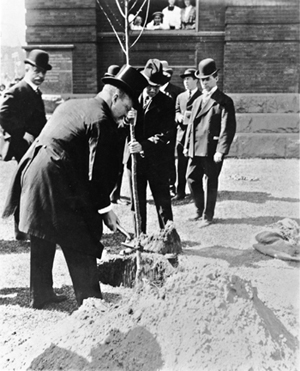
Roosevelt loved Arbor Day because it gave American citizens a chance to do something productive. Every April new trees would be planted across America.
T.R. at Arbor Day tree planting. (Courtesy of Theodore Roosevelt Collection, Harvard College Library)
Even though gasoline automobiles had infiltrated Washington, D.C., in 1907, Roosevelt insisted on either speed-walking or horseback riding around town. Cars didn’t appeal to him—the idea of placing gasoline on top of a hot engine seemed perverse and worrisome, and the rumble of engines scared away the birds. This was the last year before the Model T transformed the American landscape forever—an event which simply bored Roosevelt. Still, he cheered Michigan and Indiana for building better automobiles than anywhere else in the world. As an unapologetic nationalist he liked America to have the automotive edge—or any edge.
Unable to stay idle, Roosevelt began drafting an ornithological report for AOU on how sparrows were different in Long Island and Virginia owing to climate variations. And he was perplexed by some avian mysteries. Why did wood thrushes flourish at Sagamore Hill whereas they were scarce at Pine Knot? He kept detailed bird lists for Virginia about species he encountered: Baltimore and orchard orioles, flickers, redheaded woodpeckers, purple grackles, bluebirds, all nesting “within a stone’s throw of the rambling attractive house, with its numerous outbuildings, old garden, orchard, and venerable locusts and catalpas.”27
For an Audubonist, this was a real feast. But Roosevelt had an eerie experience that May, which he would talk about for years to come. Keenly observant, he saw a flock of passenger pigeons near Charlottesville. Because Darwin, whose name Roosevelt still uttered with reverence, had begun On the Origin of Species with a report about experiments conducted on backyard pigeons from around the world, Roosevelt was interested in their evolutionary characteristics. Darwin had successfully bred pigeons, concluding that they were all descendants of Columba livia (the rock dove). He had speculated that if the varied pigeon species mated in the wild, the offspring would eventually lose their unique traits and resemble the rock dove: this was due to a process that Darwin called reversion.28
What Roosevelt also knew that May 18 about the passenger pigeons (a species on the edge of extinction) was that no flock had been sighted in the wild by an ornithologist for more than twenty-five years. In the era before DNA records containing gene analysis and ancestral chromosome fusions, knowledge about birds’s genetic makeup came from detailed field reports in many towns. Roosevelt was thus fulfilling his public duty by reporting on what he saw near Pine Knot. “There were about a dozen, unmistakable with their pointed tails and brown-red breasts, flying in characteristically tight formation to and fro before alighting on a tall, dead pine,” the historian Edmund Morris writes in Theodore Rex. “He compared them to some mourning doves in the field beyond; and there was no question of the difference between the two species.”29
Because pigeons were delicious, many species were being driven into extinction by market hunters. For example, in 1904 the Choiseul crested pigeon (Microgoura meeki) had vanished; the last one was sighted in the Solomon Islands near New Guinea. In early 1907 two American birds had gone extinct in Hawaii: the Molokai’O’o (Moho bishopi) and black mano (Oreganis funera). This led Roosevelt to create, in 1909, a huge federal bird reservation in the westernmost Hawaiian islands. But the Molokai’O’o and black mano were rare birds, easily shot by hunters. By contrast, the destruction of the passenger pigeon affected all of North America, where it was known to be the most abundant bird of all time. Before the Europeans arrived in the New World, nearly half of all the birds there were passenger pigeons. To pioneers, they were an unlimited food supply.
Robert B. Roosevelt had tried to stop this slaughter of passenger pigeons in the 1880s, introducing skeet shooting to sportsmen as an alternative, but to little avail. The last recorded passenger pigeon was shot around 1900—nobody had gotten within sight of a flock since then. William T. Hornaday had already shown passenger pigeons in a tombstone cartoon as being extinct (though he added a hopeful question mark). But now Roosevelt had seen a flock at Pine Knot in 1907. Excitedly, Roosevelt hurried back to the cabin and wrote Oom John an effusive letter, insisting that they were “no doubt” passenger pigeons. Burroughs quickly wrote back an encouraging note, saying that the previous year a flock was said to have been seen around Boston, Massachusetts, although the report was unconfirmed. A few weeks later Burroughs said that a flock was seen in Sullivan County, New York.30 There was no need for Roosevelt to feel diffident: he wasn’t the only observer. Perhaps the passenger pigeon could be saved, like the buffalo.
Realizing that passenger pigeons were on Hornaday’s endangered species list, and being exceedingly sportsmanlike about this matter, Roosevelt refused to shoot one. But he knew visually that this was the passenger pigeon, as described in Audubon’sBirds of America (page 25 of Volume 5). All of Albemarle County was abuzz over Roosevelt’s sighting which, if true, was the last official report before extinction. That same year W. B. Mershon had published, as a farewell, The Passenger Pigeon—a book of memories of the great flocks that constituted an impressive ornithological eulogy.31 There was also public concern about the impending extinction. As it happened, the last passenger pigeon on earth—named Martha—died in captivity on September 1, 1914, at the Cincinnati Zoo. Thereafter, coffee shops and bars would freakishly boast about having a stuffed passenger pigeon on display.
Roosevelt took pride in the fact that Burroughs’s eminence had habituated since their first meeting at the Fellowcraft Club. Likewise he was proud that his illustrator of Ranch Life, Frederic Remington, had become famous. Somewhat surprisingly, Remington was perhaps the one western artist willing to denounce the staged rescues in Buffalo Bill’s Wild West shows, and Owen Wister’s hero in The Virginian. Remington called Indians the “aboriginal” Americans, and he was praised by a Crow chief for having white skin but the heart of an Absaroke.32 In articles, short stories, and two novels Remington had treated Native American warriors as outdoorsmen superior to the “great white hunters” of modernity with their scoped rifles and waterproof sleeping bags. As theIndependent noted, Remington had been a pioneer in moving away from “mere sentimentality” about Indians to serious ethnography. This intellectual advance in Indian scholarship impressed Roosevelt greatly.33
Over the summer of 1907 Roosevelt composed a series of open letters on the White House stationary, honoring Remington’s artistic achievements. Roosevlt saluted Remington’s painting for the inherent westernness of his broken peaks and purple mountains. Roosevelt was a habitual doodler, but he couldn’t draw his beloved West the way Remington could. However, he had the political power to save natural sites in the rutted wag-ontrail territories. Every Remington rough trapper and graceful Indian radiated a humanity worthy of Rembrandt. “I regard Frederic Remington as one of the Americans who has done real work for this country, and we all owe him a debt of gratitude,” Roosevelt declared on July 17. “He has been granted the very unusual gift of excelling in two entirely distinct types of artistic work; for his bronzes are as noteworthy as his pictures. He is, of course, one of the most typical American artists we have ever had, and he has portrayed a most characteristic and yet vanishing type of American life. The soldier, the cowboy and rancher, the Indian, the horses and the cattle of the plains, will live in his pictures and bronzes, I verily believe, for all time.”34
To Roosevelt, the very talented Remington had made a “permanent record of certain of the most interesting features of our national life.” He ranked Remington as high as George Catlin for accurately combining Indian ethnography and western landscapes. By 1904 Remington’s bronzes such as The Bronco Buster, The Buffalo Signal, and Coming Through the Rough were themselves virtually national monuments, cycleproof, as recognizable as Leutze’s painting George Washington Crossing the Delawareor Bingham’sFur Traders Descending the Missouri. Remington’s bronzes—twenty-one in all, cast at the Henry-Bonnard Company (using the sand-cast method) and the Roman Bronze Work Company (using the latest wax casting method)—were like the Liberty Bell or the Golden Spike of the Transcontinental Railroad: in a word, heirlooms. Lacey had been the legislative genius of the Antiquities Act. Edgar Lee Hewett and other grassroots activists had stirred up preservationist action in the Four Corners region. But it was the spirit of Remington that brought places like Petrified Forest and El Morro out of the bureaucracy at the GLO or the Department of the Interior and animated it with a whiff of the Wild West for people worldwide. And he did so without succumbing to romanticism—though his work had been treasured as such.
Others were starting to see Roosevelt’s saving of wonders as his gift to America. Praising the Antiquities Act of 1906, the New York Times, for example, noted that the national monument movement had created America’s “conservationist consciousness.” The United States stood at the center of a revolution in natural resource management, and Roosevelt was responsible for this positive shift. That was a high compliment to Roosevelt. If the Times was correct, then 1907 became the year when Roosevelt’s doctrine of conservationism cohered. The four national monuments Roosevelt had founded in 1906—Devils Tower, Petrified Forest, Montezuma Castle, and El Morro—could have just been a flash in the pan to please Hewett and Wetherill. But in 1907, inspired by Remington, Roosevelt kicked up a dust storm, declaring antiquities sites with impressive regularity. Following Hewett’s recommendation, Chaco Canyon—which had been a major urban center of the ancestral Pueblo culture—became a national monument through a presidential executive order of March 11. Ruins and hieroglyphics were now folded into the national forestry movement on a permanent basis. As Stanford University’s president David Starr Jordan later wrote in the journal Natural History, Roosevelt’s genius was that “he did not care a straw for precedent.”35
In 2009 the National Park Service published a detailed time line of Chaco Canyon’s history from AD 850 to 1902. In vivid detail it recalled when Hewett first stumbled upon ancient stairways carved into cliffs. But when Roosevelt declared Chaco Canyon a national monument in 1907, very little was known about this prehistoric Four Corners site. Regularly, as Hewett reported, the Hopi and Pueblo of New Mexico made pilgrimages to the ruins as if to a temple. Likewise, Richard Wetherill (the brother of “Hosteen John” Wetherill) had homesteaded in the Chaco Canyon area west of Santa Fe, studying Pueblo Bonito, Pueblo Del Arroyo, and Chet’o Ketl. For the Roosevelt administration to actually acquire the complex of ruins at Chaco Canyon, the GLO had to ask Wetherill to relinquish the valuable land; he enthusiastically did. In an act of high-minded philanthropy, the great southwestern trail guide and Indian trader Richard Wetherill simply handed Chaco Canyon over. Roosevelt later repaid John Wetherill with a personal visit in 1913 to the Betatakin ruins of a “big village of cliff-dwellers” in what is now Navajo National Monument.36
Then, on May 6, Roosevelt struck again, in northern California. The Antiquities Act was starting to take effect. Following the San Francisco earthquake, geologists came to California from all over the world to study the San Andreas Fault and the Lassen Peak volcano (the southernmost one in the Cascade range). What fascinated geologists about Lassen Peak was that it was not a typical mountaintop; it had a cluster of craters on its summit. Situated on the edge of the so-called Pacific plate, Lassen Peak was one of more than 300 active volcanoes that constituted a ring of fire in that part of the world. These volcanoes included Mount Rainier, Mount St. Helens, Alaska’s Katmai, Japan’s Fuji, and Indonesia’s Krakatoa. To Californian poets, Lassen Peak was just a weird and gorgeous mountain in Shasta County. But to concerned geologists, it was a mighty volcano about to blow. Recognizing that this volcano was both a scientific and a natural wonder, Roosevelt granted it national monument status. And it wasn’t just the peak that was saved: all the surrounding steaming springs, hissing fumaroles, and gurgling mud pots were saved as well. Roosevelt wanted the entire thermal alley preserved as a monument.
Deeming the Lassen Peak volcano area the Yellowstone of California, Roosevelt also created another national monument on the new park’s northeastern border, called Cinder Cone, that same May 6. From above, Cinder Cone looked like a 700-foot-high pottery wheel with a dent on top. According to the U.S. National Park Service, the volcanic cone has been “controversial” since the 1870s “when many people thought it was only a few decades old.”37 They were wrong. Created from volcanic cinders and loose scoria, Cinder Cone was the product of a succession of dramatic eruptions that took place about AD 1700 (or during a 300-year period). “The series of eruptions that produced the volcanic deposits at Cinder Cone were complex,” the U.S. Geological Survey reported in 2004, “and are by no means completely understood.”38
Cinder Cone was particularly striking for its complexity of color. At least five lava flows had occurred at the site, giving the cone a multihued, unweathered surface. Whereas Lassen Peak offered the exquisite beauty of Mount Shasta, Cinder Cone seemed unassuming but was a menacing geological freak. Cross-country skiers were easily fooled: under the silent snow of winter, Cinder Cone was a fiery inferno of red-hot lava—a fact best not forgotten. At night over Cinder Cone, the stars shone with a brightness that pierced through the dark clouds which often hung overhead. But at any given moment, pillars of fire could shoot like a dragon’s breath high into the sky from this volcanic hazard, washing away the dwarfish evergreen forests in a cataclysmic sweep of lava—nature at its most brutal. Someday, scientists would have to more fully analyze the paleomagnetic reason for this.
On May 22, 1915, such an event happened at Lassen Peak National Monument, the crossroads of three biological provinces: the Cascades, Sierras, and Great Basin desert.39 After 27,000 years of dormancy, the volcano erupted, spewing rivers of lava and blowing dark ash all the way to Reno. An avalanche turned trees into debris. The dramatic scene became known as the “Great Explosion.” The only other U.S. volcano to erupt in the twentieth century was Mount Saint Helens, on May 18, 1980; this eruption was triggered by a 5.1 earthquake. A thousand years may pass before Lassen Peak or Mount Saint Helens erupts again—or it could happen next year, or tomorrow. That’s part of the mysterious appeal of such sites. As for Lassen Peak and Cinder Cone, they were upgraded to national park status in 1916 as a single unit under the Department of the Interior. Lassen Volcanic National Park is considered by many the hidden gem of the California eco-system.
IV
That June 10, 1907, President Roosevelt, with the Antiquities Act a success, delivered a major address on conservation before the National Editorial Association in Jamestown, Virginia. Roosevelt was appealing to the newspaper world’s better nature. The core of the grim problem, the president explained, was that America lacked “foresight” in managing natural resources. Factories polluted the air. Rivers had been turned into cesspools. Lakes were fished out. Crops weren’t being rotated. Deforestation without even a slight thought for the future was occurring in county after county. What a dump America could become! In a combination of defiance, humility, schoolmarmish lecturing, and guilt, Roosevelt pleaded with his hundreds of listeners to start a conservation revolution befitting the twentieth century. Journalists had a serious responsibility to the nation to shed light on the problem. By not covering his agenda for national forests they were in effect entering a suicide pact.
There was genuine passion in Roosevelt’s remarks. Moreover, he had chosen an ideal venue for this address. At Jamestown, where in 1607 settlers had established the first permanent English colony in the New World, Roosevelt could present himself as an advocate of conservation for the long term. A group known as the Association for the Preservation of Virginia Antiquities was trying to save 22½ acres of the historic sites made famous by Captain John Smith and Pocahontas—some of these places had a real connection to Smith and Pocahontas; others were imagined to have such a connection. The group hoped to generate future tourism. But there was a problem in Jamestown: insidious erosion by the James River was eating away at the historic village. By visiting Jamestown, where red and white mulberry trees had been planted by the first settlers, Roosevelt was sending a strong conservationist message, which included both preservation of antiquities and national forestry. “We have tended to live with an eye single to present, and have permitted the reckless waste and destruction of much of our National wealth,” he said. “The conservation of our natural resources and their proper use constitute the fundamental problem which underlies almost every other problem in our National life.”40
But at this time Roosevelt also continued to push forward his reclamation projects. That same spring of 1907, Roosevelt appointed an Inland Waterways Commission to analyze America’s river systems, the development of water power, flood control, and land reclamation. To Roosevelt national monuments were his left punch and reclamation was his right punch. Together they formed the “Roosevelt Doctrine” of conservation. What they had in common was his fervent belief that the federal government, not individuals or corporations, was the best steward of the land. And what both sides of the debate admitted was that water was king. Therefore, everybody thought Roosevelt’s Inland Waterways Commission made perfect sense. It was perhaps the one thing Roosevelt did in 1907 that wasn’t contentious.
That September, shortly before Roosevelt left to take a journey for the Inland Waterways Commission down the Mississippi River, little Skip died in his sleep at Sagamore Hill. He had been a poem of a dog. The president had owned many pets, but none were as special as Skip. Nights at Sagamore Hill had often found Roosevelt reading history and novels with a snoring Skip in his lap or at his side. They had constituted a harmonious blending of two spirits into one. “We mourn dear little Skip,” Roosevelt wrote to Archie, “although perhaps it was as well the little doggie should pass painlessly away, after his happy little life.” 41
At the end of September, President Roosevelt headed to Iowa for a journey on the Mississippi River. His wife had traveled down the Mississippi in the yacht Mayflower from Vicksburg to New Orleans earlier that year. It was now his turn. Fulfilling an old dream, getting to play at being a riverboat captain, the president lived on a steamboat for four days (October 1–4). His enthusiasm for the trip was inexhaustible. Boarding the boat in Keokuk, Iowa, he was joined by the former congressman John Lacey, Gifford Pinchot, and other friends. It was the finest company imaginable, and piquant and witty remarks were the main fare. But no matter how interesting the conversation was, Roosevelt reserved the presidential prerogative of abruptly turning his head (like a lizard following the course of a fly) whenever an usual bird or a driftwood log appeared. The Mississippi was both the spiritual heart and the economic backbone of America. Roosevelt knew that a tree branch thrown into the Mississippi in Minnesota would float away toward Davenport, Cairo, Greenville, and Natchez; would reach the Gulf of Mexico and go past his bird rookeries and then around the Florida Keys; and might eventually be found by a fisherman in Senegal or Ghana.
Officially, this was an inspection trip on behalf of Roosevelt’s Inland Waterways Commission. Incredibly to Roosevelt, who liked infrastructure improvements to be made quickly, the Mississippi River levees, which had ruptured and collapsed in the flood of 1882, still weren’t properly fixed. The U.S. Army Corps of Engineers was trying to control the wild waterway, but with only limited success. There was some repair activity: wing dams were being erected to deflect the strong current, and dikes were being built. But, as Twain had prophesied in Life of the Mississippi, the riverfront communities would “get left” to ruins the next time the spring rains were heavy.42 (That is precisely what happened in 1912, 1913, 1927, and beyond.) Nevertheless, sounding like James B. Eads, Roosevelt promoted river engineering over wild, scenic nature for the sake of enhanced commerce on the Mississippi River. Commerce ruled the river. Barges were the gods. The entire Mississippi watershed, Roosevelt believed, needed to be treated as a single unit from sources to stream mouths. Full coordination between the Army Corps of Engineers, Reclamation Service, Forestry Bureau, Division of Soils, Geodetic Survey, and Mississippi River Commission had to commence at once if there was to be even a remote chance of containing the Mississippi.43
The river floods were terrible, but Roosevelt liked to brag that the Mississippi Delta had the richest soil in the world. He believed that wherever a Mississippi levee system was built properly, and fears of flooding were removed, the delta would become densely populated, and Memphis and Baton Rouge would become huge transportation hubs. But if the levees weren’t secure, if the Mississippi was allowed to rampage, then settlements like Cape Girardeau or Helena would become shells of their former selves. “At present the possibility of such flood is a terrible deterrent to settlement,” Roosevelt lamented, “for when the Father of Waters breaks his boundaries he turns the country for a breadth of eighty miles into one broad river, the plantations throughout all this vast extent being from five to twenty feet under water.”44
Meanwhile, there was plenty of horseplay and suspender snapping aboard the steamer. Every dinner of catfish, hush puppies, and wine was accompanied by bursts of laughter. Churning down the Mississippi, paddle wheel grinding on and on, naturally caused the men to think of Fink, Shreve, Grant, Pike, and all the rest associated with the river called the “Father of Waters.” It was fun to watch Pinchot plucking his thick mustache as he told comical anecdotes about his trips to the west coast conifer forests. And each town they passed was of historical interest: Hannibal, Quincy, Saint Louis, Sainte Genevieve, Osceola. All the way to Memphis, Tennessee, the USS Mississippi churned, past old Native American mounds, modern locks, and earthen levees built in ancient times.
Formally attired, wearing his top hat on the deck, sitting in a rocking chair and reading Inland Waterways Commission reports until the aperitif hour, Roosevelt prepared for his big address to the Great Lakes–to–Gulf Deep Waterway Association in Memphis. Basically, Roosevelt’s speech in Memphis on October 5 was a rehash of his conservationist address at Jamestown earlier that year. That October, in fact, marked Roosevelt’s last reclamation project, in Oakland, California. Pinchot had cleverly suggested that in May 1908 Roosevelt hold a White House Governors’ Conference to tackle all of America’s serious natural resources issues. Without hesitation Roosevelt agreed. “It ought to be among the most important gatherings in our history,” Roosevelt said, “for none have had a more vital question to consider.” Staying in Memphis for only an evening, Roosevelt left the Peabody Hotel, a mid-South institution, for a stroll to the house where Ulysses S. Grant lived before the siege of Vicksburg.
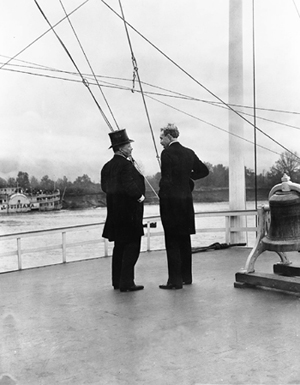
President Roosevelt and Gifford Pinchot conferring about conservation while traveling down the Mississippi River in October 1907.
T.R. and Pinchot. (Courtesy of Theodore Roosevelt Collection, Harvard College Library)
Roosevelt liked the feel of Memphis and how the Chickasaw bluffs rose dramatically several hundred feet along the eastern bank of the Mississippi River. The bluffs afforded protection from floods and access to river commerce. When the Civil War began in 1861 about 1,000 steamboats had plied the river. Now, owing to the advent of railroad traffic, there were far fewer river vessels. But Roosevelt didn’t pine for the steamboat era, per se. His romanticism was always tilted more toward horseback riding on the prairie. With his type A personality, he didn’t like being confined on a boat. It made him feel antsy, and also helpless—the very thought of boiler explosions, snags, and sandbars made him restless. He was proud that his great-great uncle Nicholas Roosevelt, a gifted associate of the inventor Robert Fulton, had been the first to steamboat down the Ohio and Mississippi rivers in the New Orleans, traversing thousands of miles before the vessel reached its namesake city and anchored across from The Cabildo (where the Louisiana Purchase was signed in 1803, doubling the size of America).45
Following his speech in Memphis, Roosevelt headed by train to Stamboul, a hamlet in East Carroll Parish, Louisiana. Stamboul was known for its cypress timber, for its pecan trees, and—henceforth—for President Roosevelt’s having set foot there.46As usual, Dr. Alexander Lambert was at Roosevelt’s side, this time along with two other physicians. Originally Roosevelt was hoping to meet Reverend Herbert K. Job to inspect the Breton Island Federal Bird Reservation, and then to visit Avery Island, which had become a privately managed nursery for the preservation of egrets.47 But time constraints forced him to settle for a hunt for black bears in northern Louisiana, a short way from the Mississippi River, with John M. Parker and John McIlhenny as his hosts in the canebrakes. Concerned about bad publicity (which he had received in Mississippi five years earlier), Roosevelt banned reporters and gawkers, and even the Secret Service men did not know where his camp was. When reporters followed Roosevelt around on such hunting trips, he saw them as mice looking for sensational copy so as to become rats.48
The ever-obliging John Parker took a chance in hiring the uncouth fifty-three-year-old pot hunter Ben Lilly as Roosevelt’s guide through the Tensas bayou wilderness in search of black bear. Lilly knew the extensive bottomlands of this part of the alluvial Mississippi Valley better than anyone else. By all accounts Lilly seldom washed; was scraggly, grizzled, and unkempt; and refused to sleep indoors—he preferred hollowed-out logs and switch cane. He had a full beard and intense, wild blue eyes, and was deemed a “goofy old coot” by Roosevelt because of his obsessive muttering. Roosevelt’s first impression of Lilly, when the guide arrived in camp dressed like a blacksmith, was a “religious fanatic.”49 As night began to lower, Roosevelt nevertheless strategized with Lilly about their best tracking options come morning. It was as if the president were testing uncertain ice. An early autumn cold had crept into camp, and the men were already getting sniffles and coughs. Roosevelt and Lilly stayed up late and talked about Louisiana black bear and water moccasins, enjoying each other’s openness of manner. “I never met any other man,” Roosevelt wrote, “so indifferent to fatigue and hardship.”50
Roosevelt, however, never fully warmed to Lilly. A wise man once said that a person (like Lilly) unable to live in society was either a beast or a god—and Lilly, raised a hunter, was clearly of the first type. But Roosevelt found the whole concept of a wild man anthropologically fascinating. Lilly was called the “most skilled hunter who ever followed a hound,” and he was hired throughout the Mississippi Delta to hunt (for a bounty) menacing bears or cougars who had destroyed livestock.51 Because the canebrakes grew ten to twelve feet high, it was difficult for hunters to see in front of themselves; hence the brakes were a fine cover for bears. Comparing Lilly to James Fenimore Cooper’s Deerslayer in “woodcraft, in handihood, in simplicity—and also in loquacity,” Roosevelt began sketching Lilly’s character traits in rather psychologically complex prose for Scribner’s Magazine. It was unusual for Roosevelt to write in this way about people, but Lilly was so like an animal—the kind of man who knew how to die standing up—that he couldn’t resist. “The morning he joined us in camp, he had come on foot through the thick woods, followed by his two dogs, and had neither eaten nor drunk for twenty-four hours; for he did not like to drink the swamp water,” Roosevelt wrote. “It had rained hard throughout the night and he had no shelter, no rubber coat, nothing but the clothes he was wearing, and the ground was too wet for him to lie on; so he perched in a crooked tree in the beating rain, much as if he had been a wild turkey.”52
Rain fell all over the Delta that October. It was pouring on every stretch of the soggy plains, on the cottonfields, on Poverty Point all the way eastward across the Mississippi River to Port Gibson, and on the dark, sinuous Mississippi riptide. It was falling, too, on the federal cemetery on the bluff in Vicksburg, where Union and Confederate soldiers lay under marble slabs. It rained heavily on every interesting wildlife-rich area along the Tensas River bottomland hardwoods, open water pools, and old runs as Roosevelt’s party set up a tent camp near Bear Lake, everything turning into a dull mud.
The Roosevelt party was in the thickest patch of this hardwood habitat. Bottomland forests were rapidly being clear-cut for conversion into agricultural areas. So there was a sense that this was the “last” hunt. Garfish were caught. An alligator slid into the water, and a couple of crows pecked for food in a field. Black squirrels made a commotion in the trees, living in easy community with wood rats. The swamp rabbits were amphibious, behaving like muskrats. Bats bawked. Roosevelt described the snapping turtles he encountered as “fearsome brutes of the slime, as heavy as man, and with huge horny beaks that with a single snap could take off a man’s hand or foot.”53
The Louisiana Canebreak was a place where a man could die and not even be noticed. The fleas had disappeared, and even though winter was approaching, the oak trees weren’t bare. “Palmettos grow thickly in places,” Roosevelt wrote. “The canebrakes stretch along the slight rises of ground, often extending for miles, forming one of the most striking and interesting features of the country. They choke out other growths, the feathery, graceful canes standing in ranks, tall, slender, serried, each but a few inches from his brother, and springing to a height of fifteen or twenty feet. They look like bamboos; they are well-nigh impenetrable to a man on horseback; even on foot they make difficult walking unless free use is made of the heavy bush-knife.”54
Clearly this fourteen-day hunt wasn’t a dignified sport like shooting quail in the sedge. Roosevelt grew perturbed when he was told that there were only four or five bears left in the Louisiana canebrakes (although bears were reported regularly in the more western parishes of Ouachita and Lincoln). As the world’s leading advocate of wildlife protection, Roosevelt could have called it quits and headed back to Memphis and the silk bedsheets of the Peabody Hotel. Instead he started insisting that the Mississippi tracker Holt Collier was needed lickety-split. Collier could definitely find a Louisiana black bear (Ursus americanus luteolus) in high water. It seemed that Roosevelt had entered the realm of fantasy, barking orders like a colonel while also imagining that he was the type of old-fashioned bayou character Mayne Reid had written about in The Boy Hunters. To understand Roosevelt’s hunt in the canebrakes, it is necessary to realize that he wasn’t after just any bear. He wanted a Louisiana black bear, distinguished by having a longer, narrower snout than most bears, and one of the sixteen recognized subspecies of black bears in America. Long ago this subspecies had been widespread from Mexico to Canada, but now it was dwindling under the pressure of human encroachment. Roosevelt wanted to shoot one to use for a museum display.
Soaked and disgruntled, Roosevelt remained determined. There was no way he was going be denied this trophy, as he had been in 1902. He wasn’t going to leave the Tenasas River area without killing a bear. Eventually Collier showed up with two planters from Greenville, Mississippi—Clive and Harley Metcalfe—accompanied by a wagon full of bloodhounds. Collier now took charge of the hunt. He instructed Clive and Harvey Metcalfe in a low voice to “take the Cunnel and bum around with him in the woods like you an’ me always does, and don’t put him on no more stand. He ain’t no baby. He kin go anywhere you kin go; jes’ keep him as near to the dogs as you kin. Mr. Harley and me’ll follow the hounds; when we strike a trail you and the Cunnel come a-runnin.”55
It’s thought that the Roosevelt party pitched their tents at the Bear Lake Hunting Club near Tallulah, Louisiana (the club had been incorporated in 1899 by delta planters). The gentlemen of Louisiana and Mississippi still preferred to hunt from the stand, staying dry from and keeping out of the pneumonia-inducing weather. Roosevelt headed toward the cane thicket and the bogs around Bear Lake. He tracked for hours, but the bear proved elusive. At one juncture a wild boar attacked the hunt dogs, killing two of them.
Spending time with Collier was worth the struggle with briar patches and boars. Much as he had done with Catch ’Em Alive Abernathy, Roosevelt had used Collier as a source of anecdotes to entertain listeners in Georgetown and on Capitol Hill. As Roosevelt told it, Collier was a flawless hunter who wasn’t afraid to bloody his knuckles, a black man who had befriended Frank James, killed more bears than Davy Crockett, fought at the battle of Shiloh, traveled with springtime fairs to chase skirts, and gambled in high-stakes poker games on the Mississippi River. Blacks outnumbered whites four to one in the delta, but Collier was the kind of man who transcended racial categorization. Everybody, regardless of color, took a shine to him. “When ten years old Holt had been taken on the horse behind his young master, the Hinds of that day, on a bear hunt, when he killed his first bear,” Roosevelt wrote. “In the Civil War he had not only followed his master to battle as his body-servant, but had acted under him as sharpshooter against the Union soldiers. After the war he continued to stay with his master until the latter died, and had then been adopted by the Metcalfs; and he felt that he had brought them up, and treated them with that mixture of affection and grumbling respect which an old nurse shows toward the lad who has ceased being a child.”56
Frustrated by the thought that he was going to leave the Louisiana canebrakes without a bear trophy, Roosevelt pulled Collier aside, out of earshot from the white planters. “Holt,” Roosevelt said. “I haven’t got but one or two more days. What am I going to do? I haven’t killed a bear.” Collier whispered back, “Cunnel, ef you let me manage the hunt you’ll sho’ kill one to-morrow. One of ’em got away to-day that you ought to have killed.” “Whatever you say goes, Holt,” was Roosevelt’s reply. Collier answered, “All right, Cunnel.”
The next day Collier showed the right stuff. The streaming rain had stopped, replaced by mild, clear weather. Collier’s dogs got a scent and started following it in the direction of Roosevelt, who was crouched in the hardwood forest waiting for his golden moment. To Roosevelt, this was America’s “great forest” of red gums and white oaks, which he called the “Northeast Louisiana Bottoms.” “In stature, in towering majesty, they are unsurpassed by any trees of our eastern forests,” Roosevelt wrote, “lordlier kings of the green-leaved world are not to be found until we reach the sequoias and redwoods of the Sierras.” The greenest mosses of the Tensas River were now surrounding Roosevelt. Worried about encounters with rough thickets, Roosevelt had sensibly worn thornproof gear, which served him well during the hours of pursuit.
Roosevelt would look into hollowed or downed logs for bears. He wasn’t worried about other so-called predators. Back in the days when Louisiana was owned by France, there were lots of red wolves and Florida panthers in the primeval Tensas River forest, but they had been wiped out in the effort to control predators. Only the Louisiana black bears—a threatened species in 2009—remained in the thick tangle of creepers and vines. In the adrenaline rush of the hunt, Roosevelt’s banged-up knees weren’t aching. Eventually the dogs found a she-bear. Leaping up in front of the bear, which was twenty yards away, Roosevelt took aim with his rifle as the animal ran toward him. The shot caught the bear clean in the chest. She moaned as if in surrender or defiance. According to Roosevelt the bear “turned almost broadside” and started walking “forward very stiff-legged, almost as if on tiptoe, now and then looking back at the nearest dogs.” She toppled over “stark dead,” as Roosevelt put it, “slain in the canebreak in true hunter fashion.”57
Dancing a jig, Roosevelt dropped his rifle, pulled Harley Metcalfe off his horse, and gave him a hug. What ecstasy Roosevelt felt at killing a five-foot fully mature she-bear with his 45–70 rifle.58 He had also absorbed the recoil without a bruised shoulder, so the hunt was deemed a complete victory. He talked about it for weeks. Today a lone historical marker commemorating the hunt can be found in the hamlet of Sondheim, Louisiana.
Now the kennel wagon was loaded up. Holt Collier had earned his pay, and he was toasted by the president as an Olympian of the Tensas River. Dr. Lambert apparently took a series of photographs of Roosevelt and Collier on the hunt, but these have never been found. Others have surfaced, however, courtesy of the Parker estate (one shows the men looking like borderland desperados). The press exaggerated the size of the bear, saying that Roosevelt had shot a 375-pound giant; the president said no, it was only 202 pounds. That evening the hunters ate bear steak, with Roosevelt rattling on about his quarry. The president kept an inventory of what his party had shot: the final count was three bears, six deer, and twelve squirrels, and one each of wild turkey, possum, and duck.
And the birding had proved first-class. Long ago John James Audubon had learned what an avian paradise the Louisiana wetlands could be. Audubon had lived in Saint Francisville for on and off twenty-three months from 1821 until 1830, painting eighty of his exquisite folios there. Using Oakley Plantation as his base, Audubon would regularly live among flocks of egrets and herons. In Louisiana, he drew such fine works as Carolina Parrot and Mocking Birds Attacked by Rattlesnakes. Roosevelt had expected to see mockingbirds and half a dozen sparrows perking about in the thick woods and sloughs, but nothing had prepared him for the variety of woodpeckers he observed in the groves of giant cypress. Quite famously in the annals of bird-watching, he recorded seeing three great ivory-billed woodpeckers. And dozens of barred owls “hooted at intervals for several minutes at mid-day”—turning their heads sharply when footsteps were heard. To Roosevelt these owls took on a special mystery at night, their cries seemed “strange and unearthly” like the long hoot of the Southern Pacific headed across the flatlands.59
Roosevelt spent October 20 at the home of a Delta planter. All in all, despite the deprivations, it had been a fine week of hunting and bird-watching. Fully rested, with a bearskin as a memento for a museum, he headed east to Vicksburg, once called the Gibraltar of the Confederacy. Largely owing to the president’s lobbying, the Vicksburg battlefield was being preserved as a 1,800-acre national military park. There was a triumphant procession in the town for the first time since the Civil War, and Roosevelt was given a grand welcome. A new monument was being erected, and the townspeople were excited. Everybody, it seemed, asked Roosevelt about the Louisiana bear hunt—such light conversation helped ease the tension between Democrats and a Republican president. Governor Vardaman of Mississippi, still furious over Roosevelt’s dinner with Booker T. Washington, tried to spoil the special event, which was intended to honor the gallantry of both Union and Confederate soldiers during the Civil War. But although Vardaman injected some invective into the gala, Roosevelt was equal to the situation. Because he was in Vicksburg officially, to dedicate a war memorial to Union and Confederate soldiers, he made a concession for the sake of national unity by praising Jefferson Davis for the first and only time in his life. Surrounded by proud soldiers, he basked in every expression of American pride. Vicksburg—the site of a famous Union siege during the Civil War.
Vicksburg—where from 1899 to 1902 the Corps of Engineers diverted the Yazoo River to flow into the old riverbed so that today the Yazoo, not the Mississippi, flows past the town. Vicksburg—the very word had been part of his life since his boyhood. Vicksburg—to Roosevelt it was a sacred site of both the Union’s glory and America’s eventual healing.
Following an obligatory speech in Leland, Mississippi, Roosevelt made his way back to Memphis and then headed by train to Washington, D.C. The combination of the Mississippi River steamboat trip followed by stalking bears in the Louisiana canebrakes had made him long for the vitality of his youth. How simple the outdoors life, rich with bird life, was: the search for wood, meat in the pot, the sound of painted finches singing in the dawn. Everything required to feel alive with God was available by walking through a meadow, the woods, or a bayou with an eye out for warblers and vireos. An idea started to percolate in Roosevelt. Perhaps he would lead specimen collecting expeditions to the three A’s: the Arctic, Africa, and the Amazon. There were still wild places left where an explorer could make his mark.
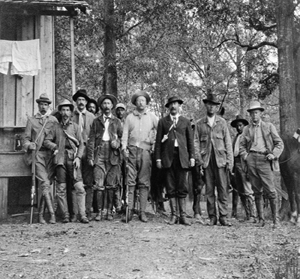
President Roosevelt in the Louisiana canebrakes with his hunting partners.
T.R. at the Louisiana canebrakes hunt. (Courtesy of Theodore Roosevelt Collection, Harvard College Library)
As a token of appreciation to Harley and Clive Metcalfe and Holt Collier, Roosevelt had three 45–70-caliber model 1886 Winchester rifles shipped to Mississippi as “treasured keepsakes.” On each weapon the hunter’s full name was engraved, with “1907” underneath.60
V
Reports of Roosevelt’s bear hunt sickened Mark Twain. He saw Roosevelt as a hypocrite: a purported conservationist but also an obsessive hunter. To Twain, the spectacle of the president, who was getting rounder by the day, trudging through swamplands in a downpour to kill one of the last black bears in East Carroll Parish was pathetic. Also, why was a busy president disappearing for days to beat the bushes for bears? Twain personally liked Roosevelt, who had once helped him with a tricky customs issue in Europe. He even enjoyed Roosevelt’s conversation from time to time. But the hunt in Louisiana was the tipping point. As America’s foremost humorist, Twain attacked Roosevelt by writing burlesque versions of the hunt. The gist of the ridicule was that Roosevelt had a rogue hormone, which caused him to light out after animals with deadly intent. A bear or cougar would be better off taking an anesthetic than having to encounter an inglorious death at the hands of a maniac shouting bully before pulling the trigger. Yet Twain was dealing with only one side of Roosevelt’s multidimensional self. As many others have noted, T.R. had thousands of sides, including bird-watching and forest preservation. But Twain, of course, wasn’t looking for balance.
And Twain, as he was apt to do, hit his mark. He had a legitimate ax to grind in this regard. A longtime animal rights advocate who had written A Horse’s Tale and A Dog’s Tale and condemned bullfighting, Twain now insisted that killing a bear with a pack of yapping hounds and mastiffs was the equivalent of shooting a cow in a pasture. In the Adventures of Huckleberry Finn, he described two loafers in the town of Bricksville who enjoyed pouring kerosene on stray dogs and torching them.61 Turning to Roosevelt, he now imagined the unfortunate cow looking at the president and saying, “Have pity, sir, and spare me. I am alone, you are many…. Have pity, sir—there is no heroism in killing an exhausted cow.” But Roosevelt—who Twain said was “still only fourteen years old after living a half century”—coldly refused. Sarcastically, Twain claimed that Roosevelt had shot the Louisiana black bear in an “extremely sportsmanlike manner” and then triumphantly hugged his planter guides as if he just scored the winning touchdown in the Harvard-Yale game. Then Twain essentially severed his friendship with Roosevelt by declaring that Roosevelt was “the most formidable disaster that has befallen the country since the Civil War.”62
Much as H. L. Mencken or (in our own time) Maureen Dowd cleverly attacked politicians, Twain started eviscerating Roosevelt, deriding the president as one of the most “impulsive men in existence.” Twain was baffled as to why the president was so widely admired as an embodiment of America malehood. Solve that mystery, and you would know the soul of the American people in all their cruelty and glory. Typically, Twain provided his own answer, saying that Roosevelt would “slap the Devil on his back and shoulder and say ‘Why Satan, how do you do? I am so glad to meet you. I’ve read all your books and enjoyed every one of them.’ Who wouldn’t be popular with an act like that?”
Twain’s feud with Roosevelt dated back to 1898, when they had opposing views of the Spanish-American War. Twain was twenty-three years older than Roosevelt, and the generational gap was a factor in his antagonism. Believing that his own hard-earned wisdom was much richer than Roosevelt’s impetuous vitality, Twain differed with Roosevelt on issues such as England against the Boers in South Africa and the revolution in Panama. But something more than foreign policy or disagreements over imperialism erected a barricade between these two colorful figures. Roosevelt’s idea of great literature tended to lean toward swashbuckling epics and romantic sagas. He disdained cynicism, irreverence, and irony in books; but all three attributes were Twain’s trademarks. Roosevelt did, however, consider Twain a “real genius” and thought that The Adventures of Huckleberry Finn, Tom Sawyer, and Life on the Mississippi were three all-time American “classics.” But he disliked A Connecticut Yankee in King Arthur’s Courtbecause it mocked the noblemen of the Round Table.63
What Twain was chastising Roosevelt about in 1907 was the Boone and Crockett Club’s “hunting ethos.” As Twain saw it, Roosevelt and other elite hunters would always stalk the largest male big game, the animals with the biggest antlers, tusks, heads, or necks. These hunters, then, were obsessed with bigness. Some modern scientists now believe that Twain was on to something—that, perversely, such selective hunting causes the decline of the very species that elite outdoorsmen want saved. If Charles Darwin was correct in saying that “a law” was the “ascertained sequence of events,” then the shrinking of antler and horn sizes by the twenty-first century was probably an unintended result of hunters’ aiming particularly at game with large antlers and horns. In a landmark report in the January 2009 issue of Proceedings of National Academy of Science, Professor Chris Darimont of the University of California-Santa Cruz offered startling data about the fate of Canadian bighorn sheep’s shrinking curved horns. According to Darimont, modern-day hunters, by aiming for the “mightiest” and “lordliest” big game, had left surviving generations with a noticeably slimmer, less sturdy gene pool. “Human-harvested organisms,” Darimont told National Geographic, regarding his findings, “are the fastest-changing organisms yet observed in the wild.”64
What the National Academy of Science was claiming in 2009 turned the Rooseveltian sportsman’s ethos on its head while proving Darwin’s theory of natural selection once again prescient. Natural selection occurred quickly in the hypertechnological twenty-first century. Trophy hunting and pound-fishing for the biggest quarry were injuring species’ long-term chances for survival.65 “Hunting, commercial fishing, and some conservation regulations like minimum size limits on fish,” Cornelia Dean of the New York Times wrote, summarizing the report, “may all work against species health.”66 In a process called “micro-evolution,” species were apparently getting smaller, in part because hunters and fishermen were always zeroing in on the biggest game and catches. Not only was natural selection real, but Americans like Roosevelt, culturally obsessed with bigness, as typified by the Boone and Crockett Club, by fishing derbies, and by game management protocols that thinned out the largest species first, were completely wrong. TheProceedings of National Academy of Science report didn’t mince words: harvesting the largest organisms in the wild (whether these were Colorado bighorn sheep or Oregon salmon) was wrongheaded. Human predators—using guns and nets combined with technology—were causing species to shrink in size. “Our preference for largeness in vertebrates is culturally strong because now we can find the largest fish or the biggest brown bears with new gadgetry,” Professor Darimont explained in an interview. “It’s the worst thing a hunter or fisherman can do to aim for the biggest game or catch.”67
Meanwhile, in Alberta, Canada, for example, hunters targeting the largest specimens of Theodore Roosevelt’s beloved bighorn sheep had caused horn length and body mass to decrease by about 20 percent from 1979 to 2009. By the time Barack Obama became president, trophy hunting was also pushing polar bears and grizzly bears into the category of endangered species. What a strange twist of fate for hunters inspired by Roosevelt and Grinnell to contemplate! Killing the trophy game, taking out the alpha males, was adversely affecting the species they loved. At least, however, the Boone and Crockett Club had gotten some things right during Roosevelt’s presidency: it had fought for huge wildlife refuges, promoted seasonal hunting, insisted on licenses in every state, issued bag limits, and banned the killing of females during the breeding season and of young animals at any time.
Obviously, along the Tensas River in 1907, Roosevelt couldn’t have known about “micro-evolution.” Given how seriously Roosevelt took evolution, he might have reformed his hunting practices if he had read Proceedings of National Academy of Science. But such speculation is moot. All that history recorded of Roosevelt’s hunt was his need for a Louisiana black bear to donate to America’s growing natural history collection (and to satisfy his own desires). And the average American continued to cheer the president onward for his wilderness exploits. Roosevelt appealed to an almost mystical attachment that people had toward bears. The public both adored and feared them. Whether dead or alive, in zoos or as toys, bears were popular. The toy teddy bear remained the rage in 1907. And Roosevelt himself sometimes emitted bearlike grumbles when he was in the outdoors and pretended to be standing on haunches, mainly for comical effect. But now Twain was irritated that Roosevelt could so easily sell his bear act to the American people. It wasn’t Roosevelt’s charisma that Twain minded, but the way Roosevelt marketed himself as the “great bear hunter.” In face-to-face encounters, Twain continued to like Roosevelt. But he was nevertheless nauseated by the carnival atmosphere at the White House—a spotted pony in the elevator, a wolf-catcher at the dinner table, and a pet badger biting the ankles of visitors. Such ridiculous stunts were signs of arrested development—as was shooting a bear for no reason.
“Mr. Roosevelt is the Tom Sawyer of the political world of the twentieth century,” Twain wrote, “always showing off; always hunting a chance to show off; in his frenzied imagination the Great Republic is a vast Barnum circus with him for a clown and the whole world for audience; he would go to Halifax for half a chance to show off, and he would go to hell for a whole one.”68
Twain had a point. But he was blind to all the good work Roosevelt was doing for the wildlife protection movement. Twain simply never mentioned that work in his interviews, articles, or books. No matter what Twain thought of him, Roosevelt didn’t have to run to Canada or Louisiana to show off his preservationist side in the fall of 1907. He did that with strokes of the presidential pen—and Twain never even noticed.
On November 16, for example, Roosevelt declared the Gila Cliff Dwellings a national monument. Located in New Mexico’s Gila National Forest, the monument had only 553 acres, yet it contained the cave dwellings of the Mogollan people between AD 1257 and 1300. When visitors leaned against the stone there and soaked up the warm sun, they were transported back in time. Reality seemed like an illusion. Pottery pieces…knives…a cracked crib…a doll…rattles…a slingshot…cooking utensils—you could see where babies had been born and elders laid to rest. You didn’t need to read Adolph F. Bardelier’s Ancient Society to be intrigued by the Gila Cliff Dwellings. The Gila wilderness was a place of both concealment and abandonment. And every inch for miles needed to be card-cataloged by the Bureau of American Ethnology. Roosevelt wanted to save not only the cliff houses but also Gila Hot Springs. By 1910 Harper’s Weekly was promoting the Gila Cliff Dwelling National Monument as a tourist site on a par with the Grand Canyon. Roosevelt had applied his promotional magic once again.69
Besides the ruins, the national forest along the Gila River was spectacular in its diversity. Wildlife was—and remains—thick around the Gila Cliff Dwellings, which are constructed at an elevation of about 5,700 to 6,000 feet. Even in 1907 the Mexican gray wolf (Canis lupus bailey) was associated with this national monument. According to U.S. Fish and Wild-life, it was the most genetically distinct subspecies of the gray wolf. In 1911, disappointed that the Tensas River game had vanished, Ben Lilly moved to the Gila mountains, where for twenty years he lived in the wild, as indigenous as a mule deer.70 And it was near Gila Cliff Dwellings National Monument that the conservationist Aldo Leopold had an epiphany about wolves, dramatically rendered in A Sand County Almanac. “We reached the old wolf in time to watch a fierce green fire dying in her eyes,” Leopold wrote. “I realized then, and have known ever since, that there was something new to me in those eyes. Something known only to her and to the mountain. I was young then, and full of trigger-itch; I thought that because fewer wolves meant more deer that no wolves would mean hunters’ paradise. But after seeing the green fire die, I sensed that neither the wolf nor the mountain argued with such a view.”71
And on December 19, as if giving America a Christmas gift, Roosevelt created Tonto National Monument to preserve both cliff dwellings and more than 160 species of birds. No more rifling of antiquities would be permitted at Tonto. A land of sandstone formations and rugged wilderness, the Tonto region was carved by wind, sand, and humans. Hidden about the site were caves pocketed into the red rock. Lacey considered the Tonto—situated at the northeastern boundary of the Sonoran desert—the most rugged terrain in Arizona. Unintentionally, saguaro cactus were now saved by the federal government for the first time, for the sake of Hohokam and ancestral Pueblo ruins. (An intermixing of the tribes had probably occurred between the late thirteenth century and the middle part of the fifteenth century when, as the National Park Service put it, the Tonto Basin was depopulated.)
Mark Twain—unlike the archaeologists—never appreciated Tonto National Monument. But the archaeologists knew that Roosevelt’s monuments in New Mexico and Arizona were important. The late prehistoric pottery found in the upper and lower cliff dwellings of Tonto, in fact, was named “Roosevelt red ware” by archaeologists trained at Harvard and Yale. It was their way of saluting Roosevelt’s foresight in the Southwest. Roosevelt red ware was part of a Salado ceramic tradition begun in AD 1280 to 1450 and based on use of red, white, and black paint in geometrically interesting configurations. Most of the gorgeous pottery bowls were found around Roosevelt Lake at Tonto National Monument. These exquisite bowls, now on display at museums in the Southwest, had both interior and exterior decorations. Petrographic analysis of the Salado pottery continues. Each year newfound fragments yield fresh anthropological revelations. Pottery, along with bones, remains our best clue to our ancient past.
Tonto National Monument became part of the U.S. National Park Service in 1933. And the name of Theodore Roosevelt—attached to both the lake and the pottery—remained a major part of the monument’s appeal.