
CHAPTER TWENTY-FOUR
I
When Roosevelt received an advance copy of Reverend Herbert K. Job’s Wild Wings from Houghton Mifflin in 1905, illustrated with winsome photographs, it immediately served as an Auduboner-action impetus. Everything always seemed conditional on offshore bird rookeries but Job’s black-and-white photos of wild Florida—now housed at Trinity College in Hartford, Connecticut—had the permanence of fine art.1 To Roosevelt, Job’s photograph of man-o-wars wheeling through the air was worthy of the Louvre. With admirable precision, Job captured the biological traits of feisty terns and turbulent skimmers in all sorts of intriguing positions (both on the wing and at rest). Although Job was an amateur photographer, his birds nevertheless seemed alive with joy, and some almost seemed to have human traits. Because the young birds Job spied at Cape Sable and the Florida Keys were vulnerable to predators, he clicked and then scrammed to avoid disturbing their nest incubators.2
But photography was not Job’s only talent. Accompanying the pictures in Wild Wings was painstakingly accurate ornithological prose. (The excellent chapters “Following Audubon among the Florida Keys” and “The Great Cuthbert Rookery” had been previously published in Outing Magazine.) All of Job’s ornithological observations—whether written or presented as photographs—also offered topographical detail about pathless jungles of red and black mangrove; sea rocks teeming with chattering birds; and sandy white beaches with nesting burrows. This, of course, endeared Job to Roosevelt, who found him the real thing. Job wasn’t a fraud like the Reverend John Long, who claimed that egrets built casts for their broken legs and that robins chirped in Morse Code. Furthermore, in Wild Wings, Job promoted a sensible idea: “Every American Should Be a Game Warden” (a worthwhile precept for the “Citizen Bird” movement to follow). To Job, birds were windows into the soul of God; killing them for women’s hats was akin to blasphemy. Small birds, in particular, Job said, needed protection and love—people should feed them suet and seeds in winter to help survive zero weather.
Job was born in Boston during the Civil War. As a boy he used to take a skiff along Cape Cod, Block Island, and the Connecticut coast to study seabird colonies. The spots where they congregated mesmerized him. Before long he became a dedicated wildlife photographer. After earning an A.B. degree at Harvard in 1888, Job trained at the illustrious Hartford Theological Seminary to become a Congregationalist minister.3 His first pulpit was in North Middleboro, Massachusetts, before he relocated to Kent, Connecticut. Job was married and had a daughter. He shared with his family an unshakable enthusiasm for birds. Slowly but surely, he started bringing birds into his sermons. To him, birds’ nests were sacred incubators (“castles”) that needed to be designated “a safe refuge.”4 According to Job, citizens had a “holy obligation” to protect God’s little flight machines. Starting in the 1890s, armed with his trusty camera, Job photographed flocks along the Gulf of Saint Lawrence, on the headlands of Nova Scotia, on the wet prairies of North Dakota, and along the banks of the Saskatchewan. Taking a factual approach to ornithology, he promoted the creation of federal bird reservations. He was something of an ornithological writing machine, and no bird was beneath his scrutiny;Outing Magazine called him America’s “humane sportsman” and a “gentle naturalist” in Burroughs’s tradition. “You are one of the Americans I feel particularly proud of as an American,” Roosevelt wrote to Job, “because of the excellent work you have done.”5
By the time Roosevelt was president, Job had established himself as a popular ornithologist of note. This would prove propitious for both men. Job’s stock in trade—combining wildlife photographs with outdoorsman-like prose—was indebted to the sportsman style Roosevelt promoted in the Dakota trilogy. Not only had Job written a few poignant articles for Outing Magazine but he was an energizing force for the Connecticut Audubon Society. Still, as a writer, Job was only slightly above average: say, seven on a scale of one to ten. So when Wild Wings was published, naturalists rubbed their eyes in disbelief. Job had written a minor classic; wherever egrets, herons, and laughing gulls covered every inch of ground, he was in his element. As he wrote in Wild Wings, he would set up a pup tent and live with birds on islets for weeks on end. There were, for example, ten amazing shots of Florida pelicans—those Roosevelt favorites—in their black and red mangrove habitat, many taken at close range. For sheer exaltation, Job outdid even Frank M. Chapman. Some of the photos in Chapter 1 (“Cities of the Brown Pelicans”) actually came directly from the Pelican Island Federal Bird Reservation. Because Florida was bleached by sunlight, these photos had an impressive clarity. To Roosevelt, Chapters 2 and 3—“Following Audubon among the Florida Keys” and “In the Cape Sable Wilderness” were revelatory. Even Job’s photo of guano-whitened branches of mangrove interested him.
Cleverly, Job argued that saving the Florida Keys would be the most fitting memorial to the life and legacy of John James Audubon. Here Job found “rare and beautiful water-birds in amazing numbers, tropical islets with their dark mangroves, waving palms, and coral shores, waters prolific in fish and huge sea-turtles, with the soft southern zephyrs playing all over.” Job was as slender as a whip. He usually had field glasses at the ready. He wore a cropped mustache. His connection to the great Audubon wasn’t accidental. As a hook for Wild Wings, he had retraced Audubon’s Florida excursion of 1832 and provided a highly accurate bioregional update. The central difference was that Audubon had used a gun (and painted eighteen birds in Key West) whereas Job (with a camera) shot hundreds of photos. Audubon’s paintings are enduring classics. Many of Job’s photographs were only memorable: spoonbills wary of intruders, snowy egret just hatched, a young ibis nesting, and cormorants leaving a rookery. But Job pulled out all the stops in Wild Wings, even excerpting poetry verse from Byron, Bryant, Lanier, and Longfellow to further enhance the reader’s emotions. There were also meditations on the secrets of owls, instructions for the new sport of “hawking,” and descriptions of shore-patrolling against plumers killing golden plovers. And he championed government protection of rookeries. Like the AOU and the Audubon Society, Job pleaded with fashionable women to stop being induced by vendors to purchase hat and bonnet feathers.
“Here I felt I had reached the high-watermark of spectacular sights in the bird-world,” Job wrote after documenting Key West with his camera. “Wherever I may penetrate in future wanderings, I never hope to see anything to surpass, or perhaps to equal, that upon which I then grazed. Years ago such sights could be found all over Florida and other Southern States. This is the last pitiful remnant of hosts of innocent, exquisite creatures slaughtered for a brutal, senseless, yes criminal, millinery folly, decreed by Parisian butterflies, which many supposed free Americans slavishly follow. Florida has awakened to her loss, and imposes a very heavy fine for every one of these birds killed. Sincerely do I wish that every one who slaughters, or causes to be slaughtered these animated bits of winged poetry, may feel the full weight of penalty of the statute and of conscience.”6
To Roosevelt, Wild Wings was filled with fascinating bird lore. It was irresistible to read what an authentic bird-watcher and bird saver—not the faker Long—had presented. But Job could never have been a member of the Boone and Crockett Club. The systematic brutality of hunting—all that bubbling blood—never appealed to his Christian sensibility. Leaving his shotgun at home in Connecticut, Job had gone to Florida with a camera which registered in one-thousandth of a second (it had a long-focused four-by-five-inch plate).7 He was an Auduboner on a mission, and his church, according to the Congregationalist and Christian World newsletter, actually paid for his trips to Florida. They were a fine investment. 8 He was going to prove that Floridians were terribly shortsighted for allowing vandals, eggers, developers, and plumers to massacre herons, egrets, pelicans, and other birds. As a leader in Connecticut’s Audubon movement, he had an obligation to lead this crusade.
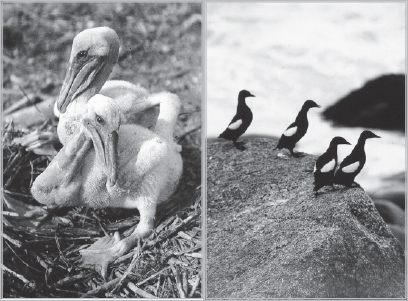
Roosevelt was enthralled by the ornithologist Herbert K. Job’s Wild Wings. Job’s photographs—like these of baby pelicans and handsome cormorants on sea rocks—were used by Roosevelt to promote the “citizen bird” movement. Roosevelt declared that to kill one of these Florida birds indiscriminately was akin to murder.
Herbert K. Job photos. (Courtesy of Trinity College, Hartford, Connecticut)
Roosevelt sent Job a heartfelt congratulatory letter on White House stationery. He had admired Job’s earlier book Among the Water-Fowl (1902) and now thanked his “fellow Harvard Man” for the “exceedingly interesting” book. Not only was Roosevelt inspired to save more of subtropical Florida by creating federal bird reservations, but he also admitted the folly of using guns rather than cameras when engaging in outdoor adventures. “I have been delighted with it,” Roosevelt wrote to Job about Among the Water-Fowl, “and I desire to express to you my sense of the good which comes from such books as yours and from the substitution of the camera for the gun. The older I grow the less I care to shoot anything except ‘varmints.’ I do not think it at all advisable that the gun should be given up, nor does it seem to me that shooting wild game under proper restrictions can be legitimately opposed by any who are willing that domestic animals shall be kept for food; but there is altogether too much shooting, and if we can only get the camera in place of the gun and have the sportsman sunk somewhat in the naturalist and lover of wild things, the next generation will see an immense change for the better in the life of our woods and waters.” In a handwritten postscript Roosevelt confessed that he was “still something of a hunter, although a lover of wild nature first!”9
An ecstatic Job persuaded his publisher, Houghton Mifflin, to print Roosevelt’s letter about Among the Water-Fowl as the introduction to Wild Wings. The first-edition book cover was an elegant green-turquoise with golden seabirds in flight embossed on the front, back, and spine; its now a presidential collector’s item.
The influence of Among the Water-Fowl and Wild Wings went far beyond the ornithological community. With the Antiquities Act of 1906 and the National Forest Decree of 1907 as the newest weapons in the his preservationist-conservationist arsenal, Roosevelt once again turned hard to wildlife protection by means of federal bird reservations. Spurred on by the Job books, Roosevelt vowed to stop the precipitous decline in avian species such as man-o-wars, albatrosses, and loons. It didn’t hurt to have a noted clergyman cheering his efforts on from the sidelines. “The lack of power to take joy in outdoor nature is as real a misfortune,” Roosevelt said in Outlook, “as the lack of power to take joy in books.”10
From August 8, 1907, to October 26, 1908, in fact, there were eighteen new “I So Declare It” federal bird sanctuaries. There were no stentorian speeches about these reserves from the president, or from Dr. Merriam or Secretary of Agriculture James Wilson. There was only direct action. In the last five months of 1907 the president—concerned about the Central Flyway from Canada to the Gulf of Mexico—created no fewer than three federal bird reservations in the semitropical waters of Louisiana alone: Tern Islands, mud flats east of the Mississippi River mouth; Shell Keys, seventy-eight unsurveyed acres of low-lying sand-and-shell islets in the Gulf of Mexico south of historic New Iberia; and East Timbalier Island, small marshy islets and sandbars due south of the mainland. All the new reservations were east of the mouths of the Mississippi. If you included windswept Breton Island (established in 1904), Roosevelt had saved much of the biologically diverse Louisiana–Mississippi Gulf Coast island chains from stumpage and slashing.
The remoteness of these Gulf locations greatly intrigued Roosevelt. When there was free time on his calendar, he hoped to inspect the totality of the small Gulf islands and sandy keys thickly covered with seabirds’ nests. Roosevelt particularly liked black skimmers (called razorbills in the south Gulf) and wanted to visit these outer islands in June when the great flocks deposited eggs. The heavy surf and heavy onshore wind sounded like a pick-me-up to him. The woolly clouds in the Gulf moved, at dusk, with a galvanic speed that drove up rain. He hoped that Job would soon accompany him on the south Gulf excursion. Roosevelt joked that the only thing better than a clergyman in your corner, covering your action, was a physician. Bird-watching in the Gulf of Mexico with Warden William Sprinkle of Biloxi, Mississippi, and Reverend Herbert K. Job of Kent, Connecticut, as his guides on the outer islands of Louisiana was his latest idea of a splendid open-air holiday on the edge.
Job began doing advance work for this possible trip. Traveling southward, he gathered data for Roosevelt about tarpon and other game fish, the migration of bay birds, and the egg-laying of sea turtles. This scouting also afforded Job the opportunity to befriend Warden Sprinkle, whom he affectionately called “protector of the Gulf birds.” As an assignment for Outing Magazine in 1907, Job wrote “Curiosities of Louisiana Sea Islands,” an article that Roosevelt loved. Job was announcing to the world that his beloved Theodore Roosevelt—the ornithologist president—was heroically protecting America’s flyways from unwelcome human encroachment.11
According to the Biological Survey’s Annual Report of 1908, Roosevelt didn’t create Tern Island, Shell Keys, and East Timbalier Island at random. He was concerned about effluence from the mouth of the Mississippi River. Besides birds, marine life filled Tern Island, Shell Keys, and East Timbalier. Single-cell animals, jellyfish, and copepods were omnipresent. Billions of types of plankton—many still not identified by scientists—kept the food chain thriving. As a bonus, a perceptive beachcomber on these Louisiana islands could discover amazing rocks, fossils, shells, coral, and bones. A botanist could marvel at bayberry or wax myrtle. The currents and undertows around these outer islands, however, made them treacherous for the seafaring novice. With just the slightest change in weather a breaker, like a small waterfall, could rush up on the unsuspecting novice’s vessel and swamp it. In June 1915, as ex-president, Roosevelt visited these isolated barrier islands with both Job and Sprinkle as companions.
II
From the Louisiana islands Roosevelt, for the first time, moved west of the Mississippi River with his idea of federal bird reservations. Under the instructive guidance of Job, Chapman, and Dutcher, Roosevelt matter-of-factly developed a bold Oregon-Washington strategy for the Biological Survey to implement with environmental interconnectedness in mind. And there was one inflexible rule: once the Roosevelt administration created a federal reservation, it didn’t tolerate plumers, seal hunters, or human menaces of any other kind. The refuges were official U.S. government property policed by wardens paid by the Audubon Societies and AOU (with money from the Thayer Fund). Recognizing that America’s coastal areas were under siege from the millinery, fishing, and oil lobbies (and anxious to continue to add new rookeries to his conservationist program), Roosevelt established three more federal bird reservations along the Pacific coast in Washington state on October 23, 1907—Flattery Rocks, just off the coast from the town of Ozette; Copalis Rock, an island cluster of bluish sandy clay; and Quillayute Needles, known for its natural sandstone pillars and barking seals. The wildlife was so noisy at these Pacific sites that even the rocks seemed to talk. John Muir had been right in Steep Trails. Washington state was, to put it mildly, “strikingly varied in natural features.”12
When considering these Pacific Northwest refuges, it’s important the reader keep in mind that their preservation received little attention from the general public or the press in 1907. It’s probably safe to say that 95 percent of Americans had never heard of the Biological Survey, and 99.9 percent had never read a word about Job’s bird rookeries. But the Biological Survey and Job were on the front line of the bird protection movement. And from 1885 to 1905 the Biological Survey issued twenty-three separate monographs on North American fauna—though how many were read was another question.13
Modernity, in general, didn’t work in harmony with the Biological Survey’s concern for saving bird flocks and faunal habitats. Forests were being destroyed by logging, depriving birds of essential habitats. An ugly ramification of the telegraph and telephone lines crisscrossing North America was that birds died en masse by flying directly into them. Ernest Harold Baynes—a popular figure in buffalo preservation circles since the successful creation of Oklahoma’s Wichita Mountains reserve—wrote in Wild Bird Guests that the new Statue of Liberty in New York harbor was a bird trap, killing 1,400 on a single morning.14 Skyscrapers, in general, were deplored by the Audubon Society. This fear of overindustrialization, long articulated by Burroughs, convinced Roosevelt that he should establish a coordinated system of bird refuges from the Pacific Northwest to the prairie in North Dakota, and from the upper reaches of Lake Huron to the coral reefs of the Florida Keys. Starting in 1903 (with Pelican Island), every year the USDA’s Biological Survey issued an annual report, in which bird reservations established for aesthetic reasons were given noticeably more space than animal control. Wildlife protection had taken hold in the Biological Survey in a way that would have been unthinkable before Theodore Roosevelt’s presidency.15 According to Aldo Leopold, in Game Management, because of the “Roosevelt Doctrine” of conservation, the “game hog” and the “market hunter” were “duly pilloried in the press and banquet hall, and to some extent in field and wood, but the game supply continued to wane.”16
Besides poachers, plumers, and eggers the first federal bird reservations along coastal areas—bird cities—had to confront the hazard of bad weather. Even a warden with a shiny USDA badge was no deterrent to winds of 130 or 140 miles per hour. The Biological Survey’s annual report for 1907, for example, told of nonhuman difficulties the USDA had at Breton Island in Louisiana. “The islands composing this reservation were visited and somewhat damaged by a severe tropical hurricane which swept the Gulf of Mexico in 1906,” the report noted glumly. “Breton Island, six miles in length, was split into three parts, and although normally standing twelve feet above water was flooded throughout its whole extent. Many thousands of pelicans were destroyed by being dashed to the ground by the wind. A beneficial feature of the storm, however, was the extermination of the raccoons and muskrats, which had infested the island and which annually wrought considerable havoc among the nesting birds.”17
Roosevelt’s passionate interest in saving the birds of coastal Washington and Oregon grew out of his trip to Portland, Oregon, and Puget Sound, Washington, in 1903. Not only did plumers want to kill birds, but oil companies wanted to kill seals for heating fuel oil. William Finley began using the model law established by the Lacey Act as a means to prevent the killing of both birds and seals on offshore rocks. Confident, committed, and filled with an enormous sense of purpose, Finley organized the Oregon Audubon Society (today’s Portland Audubon Society) using the slogan “Woods, Water, and Wildlife,” at around the time of Roosevelt’s “great loop” tour of 1903. All Finley talked about with T.R. was Three Arch Rocks, off the Oregon shore: how the tides slapped and receded with eternal ferocity (just as Job had described a New Brunswick rookery in Wild Wings). Marine life, Finley told Roosevelt, occupied every niche and crevice of these rock mounds. At night, with waves crashing, small ghost crabs wandered about, looking like aliens from outer space. And murres congregated there as nowhere else in America. These unsurveyed Pacific mounds—located only 350 yards from the southern trip of a cape18—also teemed with tufted puffins and seals. The mounds ranged in height from 275 to 304 feet. These offshore rookeries were being patrolled, though only haphazardly, by “citizen bird” activists in the state.19
The activists in Oregon needed the White House to get involved and establish permanent federal protection. Feeling the burden of responsibility on his shoulders, Finley became a lobbyist. “Finley’s contribution to environmental awareness can be equated to that of only one other naturalist who was on the scene in the west during those early years,” Roger Tory Peterson wrote—“John Muir.”20 After the 1904 presidential election, Finley began sending Roosevelt private photos of the carnage among wildlife in his state. As the most noted Pacific coast wildlife photographer, Finley took seriously all living creatures that colonized the shore and outer rocks. He was, for the west coast, like Herbert K. Job and Frank M. Chapman combined—with constant help from his wife, Eileen, and Hermann Bohlman. Roosevelt was enraptured by Finley’s images. Whenever possible he talked about the Finleys and Bohlman.
Unfortunately for American environmental history, there are only superficial, potted biographies of Finley available. But we know that Finley took up Roosevelt’s invitation to visit the White House. The pictures Finley showed Roosevelt as an inducement for preservation were taken with a 5 by 7 plate camera and are stunning in their high artistic quality. Roosevelt was particularly riveted by the tufted puffins and seals (both favorites with the general public) at Three Arch Rocks. Wisely, Finley had left trunks full of more blurry images back in Oregon. Lobbying Roosevelt, Finley complained furiously that plumers were being allowed to operate along the bird-rich Pacific Coast. The Oregon Audubon Society was making headway in policing the area, but Three Arch Rocks needed federal protection—soon. Finley spread the photos on a wooden table and explained each one in detail; Roosevelt was nearly jumping with excitement. “Bully, bully,” he kept saying, “we’ll make a sanctuary out of Three Arch Rocks.”21
Its reasonable to assume that Finley left Washington, D.C. energized. Roosevelt had told him that the Biological Survey—when all the legal underbrush was cleared—would declare Three Arch Rocks a federal preserve. While it’s true that Finley grew impatient as months and then years went by, he nevertheless trusted Roosevelt to do the right thing. Three Arch Rocks was going to be just one piece in the Biological Survey’s coordinated preservationist strategy for the west coast. The reason for the delay regarding Three Arch Rocks was that the Roosevelt administration wanted to first pass anti-trespassing laws in Congress. Finley also had to tolerate a lot of ridicule from congressmen opposed to the idea of a federal bird reservation in Oregon—particularly oceanic bird rocks—a reservation that nobody except a few ornithologists would ever be allowed to visit. But Congressman Lacey, his hair now iron-gray, calmed Finley down. “All in due time,” Lacey would say. “All in due time.” Disappointment and anxiety occasionally got the best of Finley, but he never forgot his mission. When he had to listen patiently to arguments against birds, Finley, refusing to be baited, remained serene. (For example, Senator Charles Fulton of Oregon once said that birds were like lice. “I really want to know why there should be any sympathy or sentiment about a long-legged, long-necked bird that lives in swamps and eats tadpoles and fish and crawfish and things of that kind,” Fulton asked. “Why we should worry ourselves into a frenzy because some lady adorns her hat with one of its feathers, which appears to be the only use it has.” 22)
The outcome was well worth the wait. On June 28, 1906, Congress had enacted the Game and Bird Preserves Protection Act (Refuge Trespass Act) to provide “regulatory authority” to managed uses on reservations administered by the Biological Survey. The act made it a misdemeanor to disrupt birds or their eggs on federal wildlife reservations.23 The syndicates were being shut down.
The naturalist Dallas Lore Sharp, in a marvelous manifesto advocating wildlife refuges—Sanctuary! Sanctuary!—wrote about Finley and Bohlman rowing out to the fifteen-acre Three Arch Rocks to study the strange birdlife there. Sharp also brought Roosevelt into the narrative, explaining how the combination of these three bird lovers saved Three Arch Rocks for posterity:
Swinging their dory they were practiced now from her rocky davits, they launched her empty on a topping wave, loaded in their precious freight, and, pulling safely off, headed for shore, making a solemn promise to old bull sea-lion, and to the flippered herds sprawling along the ledges, and to the flying flocks that filled the air. But none of the multitude heard it above their own raucous screaming, and none of them knew. They did not know how that vow took one of the boys across the States to the other ocean shore. They did not see the pictures of their rainy, sea-washed home spread in high excitement over a table in the White House, nor watch an eager man, all teeth and eyes and pounding fists, whanging about and bellowing: “Bully! Bully!” just like an old bull sea-lion. But Finley did. They did not see him study the pictures and vow, “We’ll make a sanctuary out of Three-Arch Rocks.” But Finley did.24
Besides Three Arch Rocks, Finley also fought to save the diversity of wildlife along the Washington state coastline. At Flattery Rocks alone—more than 800 islands, seal rocks, and reefs—special interests were wreaking environmental havoc. The feather and egg mongers were destroying the fourteen species of seabirds that bred along the Flattery Rocks, including fork-tailed storm petrels, double-crested cormorants, black oystercatchers, pigeon guillemots, Cassin’s auklets, and tufted puffins. With the Game and Bird Preserves Protection Act on the books, Roosevelt wanted to do something spectacular to save the Washington state rookeries.25 In 1853 Berthold Seemann—“Naturalist of the Expedition” on board the British explorer Captain Henry Kellett’s ship—had written admiringly about Flattery Rocks in Narrative of the Voyage of H.M.S. Herald; Roosevelt had made this classic volume a treasured part of his home library.26 Now, Finley offered visuals to match that exploration text.
Enthralled by Finley’s wildlife photographs, Roosevelt worried that before long oil derricks would deface Washington’s rugged coastline. And recognizing that the Flattery Rocks system—as well as Copalis Rock and the Quillayute Needles—had been created as a by-product of the Olympic Mountains, he asked Dr. Merriam at the Biological Survey to find a way to preserve these wonders before the population of Tacoma and Seattle and commercial extractors swarmed the coast. Purple starfish, lumpish seals, thrashing whales, crowds of murres, crags, caverns—Roosevelt wanted the biological integrity of these Washington islands preserved unmarred in its entirety. Few oceanic islands in North America, save for those in Alaska, had such steep sides with uncounted colonies of nesting seabirds. If need be, Washington state’s cute tufted puffins, which bred on the rock piles (sometimes even underneath boulders), could be used as an appealing symbol. Coastal Washington was their favorite North American congregation point outside Alaska.
After careful consideration the Biological Survey recommended that Flattery Rocks quickly be declared a federal bird reservation; Roosevelt agreed. On October 23, 1907, he signed an Executive Order to that effect. And the Roosevelt administration took its environmental responsibility even farther. On the same day, Roosevelt declared Quillayute Needles (consisting of Hand Rock, Carroll Islets, Bald Island, Jagged Islet, Cake Rock, James Island, Hunting Rock, Quillayute Needles, Rounded Islet, Alexander Island, Perkins Reef, North Rock, Middle Rock, Abbey Island, and South Rock) a federal bird reservation. Then he did the same on behalf of Copalis Rock, unsurveyed rock islands with seabirds, hauling seals, and sea otters. The pelt hunters, fishing organizations, plumers, pot hunters, weekend poachers, oil drillers, and corporate despoilers had been shut down by the federal government along the coast from Seattle to Portland at environmentally sensitive locales. More than any other president, Roosevelt used executive orders without consulting Congress. There was no reason for Washington state to be immune from them. “Roosevelt had the sense to keep wild places in Washington wild,” Kevin Ryan of the state’s Maritime National Wildlife Refuge Complex has noted. “The shear rocks are too hard for people to climb, so all three Roosevelt reserves have become species indicator zones.”27
Roosevelt had grabbed land for the Biological Survey and saved the most enchanting part of Washington state coast for future generations. He said that his own great-grandchildren would someday get to smell Washington’s salty breeze, see the surf-carved ocean rocks, feel the riptide at the roiled straits, and marvel at God’s creation without the stink of gasoline. In Washington state they would be able to see mountains at the ocean’s edge with primeval coniferous forests untouched by axes. They would hear the long-drawn call of loons or watch kittiwakes build nests. By boat, they could encounter pristine islands along the international boundary with Canada. They would be able to imagine what Flattery Rocks, Quillayute Needles, and Copalis Rock had been like during the long-gone days when Captain James Cook stumbled on them and Indians built stockade villages at the foot of the towering ocean rocks and searched for lobsters, oysters, crabs, and fish. Over half of America’s Pacific coast bird species used these Washington state offshore island rocks, and so the Roosevelt administration shut them off from human encroachment.
Today all three of these national wildlife refuges—Copalis, Flattery Rocks, and Quillayute Needles—work together as the Washington Maritime NWR Complex. Under Roosevelt’s executive orders, these islands remain closed to the public—they belong to the seabirds and seals. As Roy Crandall, director of publicity for the Pan American Exposition, wrote in a 1909 edition of Technical World Magazine, President Roosevelt (and the Audubon societies)* single-handedly saved “the coasts of Washington, Oregon and California in the Pacific.” Owing to Roosevelt’s foresight “thousands of protected birds now swarm and multiply in safety and in confidence for they are becoming so tame that bird wardens walk among them and brush them from their paths.”28
III
Once Finley had persuaded the Roosevelt administration to save bird rookeries in Oregon and Washington, he turned his lobbying efforts to wetlands known for their waterfowl: the marshes of Klamath, Tule, and Malheur (which means “misfortune” in French; the name was given after Peter Skene Ogden of the Hudson Bay Company was robbed of his furs there in 1826).29 Finley and Bohlman camped for over a month in the marshes of Lower Klamath Lake on the border of Oregon and California during the summer of 1905 and photographed the abundant waterfowl for the National Association of Audubon Societies. Their photographs, as well as their report detailing the tremendous numbers of birds being slaughtered ($30,000 worth of grebes by feather hunters in 1903 and over 120 tons of waterfowl by market hunters in 1904), led to the Klamath becoming the first major waterfowl refuge established and the first refuge associated with the reclamation project.30
Writing years later in Nature Magazine about the federal bird reservation movement in the Pacific Northwest during the Roosevelt era, Finley offered a succinct rationale for west coast bird refuges in wetlands (not just on oceanic rocks). “A very large number of lakes and ponds have been drained and many swamps have been dried up under the guise of making agricultural land,” Finley wrote. “With the gradual spread of population, each year the migratory flocks return to former nesting sites, only to find them destroyed, and their natural food supply diminished. The vital point today in wild fowl preservation is that a goodly number of the remaining lakes, ponds, and swamps must be preserved. No matter how many game laws we have or how rigidly these are enforced birds, like people, cannot live without homes and many species are sure to be pushed to the point of final disappearance.”31
Because Washington and Oregon weren’t overly populated (after all, they got about 140 inches of rain annually) and the extraction operations were just beginning along the Pacific Northwest coast, Roosevelt had been able to make a preemptive strike on behalf of wildlife in 1907 with Three Arch Rocks, followed by the three Washington state bird rock archipelagos and the waterfowl marshes of Oregon. On the same numerologist’s dream of a day (08/08/08) that Klamath Lake was established, so too was Key West. Florida, in 1908, proved far more difficult. Nevertheless, Roosevelt was ready to methodically finish the job he had started at Pelican Island, Passage Key, and Indian Key. Outfoxing his opponents every step of the way, confusing them with his embrace of both hunting and preservationist polarities, Roosevelt issued one executive order after another from February to October 1908 to save sites in Florida such as Mosquito Inlet, Dry Tortugas, Key West, Pine Island, Palma Sola, Matlacha Pass, and Island Bay.32
Just as Upton Sinclair’s book The Jungle spurred Roosevelt to issue laws regulating meatpacking, Wild Wings saved birdlife in Florida. Understanding that in the tropics residents sometimes resorted to slash-and-burn practices, the president moved quickly to protect “Florida’s wildlife heritage.” No salt prairie, coral reef, mangrove thicket, or bird rock was precluded from the Biological Survey’s consideration. And Roosevelt had the congressional ruling of June 28, 1906, about not disturbing or trespassing on federal bird Reservations, to work with as a legal deterrent in Florida. Not that it was foolproof—the congressional order was frequently defied. A deranged Floridian, for example, shot four of Roosevelt’s pelicans on Mosquito Inlet, claiming that the refuges were illegal. The courts ruled in favor of the Roosevelt administration.33 The assailant pleaded guilty and paid a steep fine.
This was a time of profound, positive change in the Florida wildlife protection movement. Numerous islands along Florida’s Gulf of Mexico and every bird rookery along the Atlantic Ocean now had aesthetic value to Roosevelt. He would have to save them from the persistent ignorance of the ex-Confederate yokels and from railroad executives like Henry Flagler. In An Autobiography, Roosevelt listed his most notable wildlife protection achievements in Chapter II, “The Natural Resources of the Nation.” Among them, Florida ranked high. In particular, he saved the West Indian manatees (Trichechus manatus latirostris) at Mosquito Inlet in Volusia County, about eighty miles from Orlando. Roosevelt hoped to create “safe havens” throughout Florida where these manatees could live unmolested, as President Ulysses S. Grant had done for the northern fur seals of Alaska. The manatee—whose name is Haitian, meaning “big beaver”—was almost as special to Roosevelt as the buffalo.34 Although he did not create an American Manatee Association, he did fight for the species’ survival. “Wild beasts and birds are by right not the property merely of the people alive to-day,” he said with regard to protecting Florida’s manatees and seabirds, “but the property of the unborn generations, whose belongings we have no right to squander.” 35
Exactly when President Roosevelt brought manatees into his wild-life protection program remains unclear. (Burroughs, we are told by the ornithologist Charles William Beebe, astonishingly didn’t know what a manatee was before visiting Florida in 1903.36) Perhaps as a boy Roosevelt encountered manatees or sea cows; they are part of the mermaid myth and had become popular characters in children’s books. Maybe he read one of the landmark manatee studies by Outram Bangs or Alfred Henry Garrod.37Known for barrel-rolling and playful chases, manatees were hard to dislike. They continually grabbed and kissed each other, and lolled for hours in the warm waters of Florida, evidently with no worries or woes. They were herbivores and socialized with one another by nuzzling playfully. Children’s books of the mid-nineteenth century often portrayed the manatee fondly, much as they portrayed the friendly panda. (Fishermen, by contrast, often denounced manatees as homely and shot them on sight.) During the Great Depression they were poached for meat.
Perhaps Robert B. Roosevelt’s Florida and the Game Water-Birds had affected Roosevelt. In that book, Uncle Rob had briefly diverged from his loosely structured autobiographical narrative to talk about the manatee herds he encountered throughout Florida. He noted how tourists near Mosquito Inlet couldn’t believe that “cows feed under water,” until they saw a stubby-snouted manatee munching on and sheltering under freshwater plants. “The animals and birds are as queer and unnatural as the herbage,” R.B.R. wrote of aquatic Florida. “Or as a climate which furnishes strawberries, green peas, shad, and roses at Christmas.”38
A close relative of the manatee—Stellar’s sea cow—had been hunted into extinction in 1768, and Roosevelt worried that the same fate awaited the West Indian species. Indeed, in 1885, an observer in Florida noted that “ten years ago the meat (of a manatee) could be bought at fifty cents a pound. The animals are becoming far too scarce to admit of it being sold at all. There is no doubt that the manatee is fast becoming an extinct animal.” And another factor in the manatees’ uncertain prospect was that they reproduced slowly. Male manatees didn’t breed until they were nine years old, and females didn’t reach sexual maturity until they were five. A lone calf was then born every three to six years. Mothers insisted on nursing their babies for up to two years.
Given these facts, Roosevelt was concerned about whether manatees had a future in Florida. Even though his Mosquito Inlet Reservation was ostensibly to protect native birds on small mangrove and salt grass islets, shoals, sandbars, and sand spits in Mosquito Inlet and the mouths of the Halifax and Hillsboro Rivers, manatees, he knew, also would receive needed protection in the warden-patrolled waters, especially during calving season. Part of his reason for setting aside Mosquito Inlet (near Daytona Beach), as a federal bird reservation—by means of an executive order issued on February 24, 1908—was to protect the manatees’ northernmost range. The purpose of saving Mosquito Inlet, a primordial Darwinian laboratory, was to keep the manatees there free from human molestation; they were the most essential large mammal in the Florida ecosystem. This was the same rationale he used for declaring Three Arch Rocks a federal bird reservation—doing so had the additional benefit of saving seals. If Floridians couldn’t rally to protect manatees, then the probable fate of such lesser creatures as Suwannee bass, striped mud turtle, red-cockaded woodpecker, and southeastern beach mice was dismal indeed. Also, selfishly, Roosevelt wanted manatees saved so that he could enjoy them when he went spearfishing after his tenure at the White House was over.39
Sea turtles played a significant role in another of Roosevelt’s federal bird reservations. The president liked the fact that sea turtles came from “a different world.” Long before the biologist Marston Bates published The Forest and the Sea in 1960, Roosevelt understood that the “sea margin”—where marine and terrestrial environments mixed—meant everywhere in Florida. Whether it was on tidal flats, sandy beaches, or flyspeck islets, marine species often used land and sea interchangeably.40 Certainly this was true of sea turtles. The Atlantic coast of Florida, especially from Melbourne Beach to Palm Beach was the world’s most crucial habitat for sea turtles—loggerheads, greens, and leatherbacks.41 Keeping up on sea turtle biology Roosevelt wanted to protect egg clutches from predators ranging in menace from raccoons to Miami restaurateurs. Roosevelt didn’t mind if fishermen caught these turtles to eat (he personally thought turtle fritters were dee-licious) but ravaging their breeding grounds indiscriminately needed correction.
On April 6, 1908, Roosevelt declared the Tortugas Keys (now Dry Tortugas National Park) a federal bird reservation. (The Tortugas group, located ninety miles west of Key West, Florida, and 470 miles southeast of New Orleans, consisted of eight little islands: Loggerhead Key, Bird Key, Garden Key, Long Key, Bush Key, Sand Key, Middle Key, and East Key.) Roosevelt boldly protected both sea turtles’ egg-laying and the boobies that congregated by the thousands in the buttonwood trees. When the Spanish explorer Juan Ponce de Leon first visited these coral reefs in 1513, he marveled at the colonies of sea turtles he encountered. His crew recorded catching 160 of them. Ponce de Leon considered them a good omen, and they were also perfect for soup and stew; he was the one who named the remote island group Tortugas (“turtles”). John James Audubon had spent days in Tortugas Key mainly to observe the sooty terns that annually nested here, raised chicks, and then migrated back to the Yucatán peninsula.42 In Caribbean pirate lore, the chain had a bad reputation as a site of shipwrecks; Caribbean captains, in fact, called the reefs an “underwater graveyard.”43 Before long, the word “Dry” was added to nautical charts to warn mariners that there was no fresh water on the island chain.
Although one can’t be certain, Roosevelt probably first seriously encountered the Dry Tortugas when writing his two-volume history The Naval War of 1812, published in 1882. Fort Jefferson—America’s largest coastal fort in the mid-1800s, built with more than 16 million bricks—was constructed on Garden Key in that chain (following the battle of New Orleans) to provide a future defense line for Florida, Alabama, and Mississippi. At times the Dry Tortugas were used to quarantine people with yellow fever. After being convicted as a co-conspirator in Abraham Lincoln’s assassination, Dr. Samuel Mudd was incarcerated at this remote prison fortress in the Gulf of Mexico, helping to care for these patients. By the time Roosevelt became president in 1901, lighthouses were operating in Tortugas Key warning sloops and schooners of the low-lying staghorn coral, patch reefs, sand flats, and sea grass beds. In Florida and the Game Water-Birds, Uncle Rob had declared the Tortugas Keys the center of the greatest fish population in the entire United States. He was indubitably right. Although the Tortugas were difficult to get to, sports fishermen, including the novelist Zane Grey, used to hunt in the warm waters for 300-pound blue marlins and 100-pound wahoos.
The biologist Rachel Carson of the U.S. Fish and Service Wildlife wrote in The Edge of the Sea about the fascinating creatures Roosevelt had saved with his federal bird reservations—particularly the Tortugas group. Describing how loggerhead, green, and hawksbill turtles must return to land every year for spawning, Carson noted the majestic seasonal ceremony in the Tortugas group when the turtles “emerge from the ocean and lumber over the sand like prehistoric beasts to dig their nests and bury their eggs.”44Roosevelt was dead when Carson published The Sea Around Us in 1951, but his daughter Alice Roosevelt Longworth wrote a fan letter to Carson, saying that her father would have welcomed this noble literary work with open arms.45
The Dry Tortugas were so remote in 1908 that most ornithologists in New York hadn’t even visited them. Invariably, visitors to Key West erroneously believed they were at the end of America, not realizing that the Dry Tortugas were seventy miles farther out. The best-informed ornithological studies that had seized Roosevelt’s attention were a research paper by Dr. John B. Watson of John Hopkins University (it had been funded by the Carnegie Institution, and brevity was its virtue) and, of course, Job’s Wild Wings(which included photographs of sooty tern swarms estimated at 6,000 or 8,000 strong).46 Complementing Watson and Job was the Florida Audubon Society, which undertook a bird count on the island chain. The yearly return of the sooty and noddy terns was being touted by some ornithologists as the east coast’s equivalent of the swallows returning to Capistrano mission in southern California. “In other words,” the ornithologist Alexander Sprunt, Jr., would write in The Auk about the Dry Tortugas, “if not held as a miracle, at least the conviction is extant that the birds arrive and depart on exactly the same day each year and, if it varies at all, it is held to be due to certain phases of the moon!”47
Four months after the preservation of the Tortugas group, Roosevelt set his sights on the unpopulated islands of the Key West chain. Developers were eyeing the island chain and hoping to build tourist hotels, so Roosevelt refused to delay. Key West might not seem much different from the other Florida mangrove islands he had established as federal bird reservations, yet it was unique. For one thing, it was a turtle nesting area free of raccoons. This meant that the offshore beaches and sand dunes were an ideal nesting habitat for loggerhead and green turtles (unlike Breton Island in Louisiana, which did have raccoons). Every spring, hard-shelled marine turtles would leave the ocean to bury their round eggs in the coarse-grained sand dunes at Key West. Because there were no raccoons or other egg thieves, the successful hatching rate on Woman Key and Boca Grande Key (both part of T.R.’s Key West Federal Bird Reservation) was extraordinarily high. The turtles’ real enemy was fishing nets, and tough laws would have to be enacted to prevent the demise of greens and loggerheads. Later, as a former president, Roosevelt inspected sea turtle eggs in Breton Island; he foolishly dug some up to eat—a sin in the eyes of modern marine biologists. For all his acumen as a naturalist, Roosevelt—like most of his generation—simply didn’t know how endangered they were. It would be another forty years before the plight of sea turtles was discovered and eloquently articulated by Dr. Archie Carr.
Even though the Key West and Dry Tortugas Reservations only protected small islands and keys, their protection helped keep the surrounding waters clean and clear. Crater Lake blue, with shades of emerald and dabs of purple, these exquisite waters seemed to roll into infinity. Colonies of soft coral were a pale plum color, and little starfish with tube feet clung to the sides. When Key West islets were saved by Roosevelt by means of an executive order (August 8, 1908), these unparalleled coral reefs were already celebrated among oceanographers all over the world. Most scientists agreed that only the Great Barrier Reef of Australia, which was ten times larger than Key West, was more magnificent. To Roosevelt, Florida’s coral reefs—made of living colonies of tube-like animals called polyps—were a world unto themselves. The more than 6,000 shallow coral reefs—from Key Biscayne to Key West to the Dry Tortugas—were breathtaking in their biodiversity. Anybody who has owned tropical fish knows how amazing the Day-Glo colors of the bicolor damselfish, neon goby, clownfish, and foureye butterflyfish can be when viewed in an aquarium tank. Many first-timers in Key West, however, come to experience such wondrous and underwater wildlife in its natural setting. The diver in Key West quickly realizes that an ever-soothing, symbiotic world without human footprints exists in the coral reefs, that the harmonious balance of the ecosystem is awe-inspiring.
If Roosevelt had traveled (as modern visitors do) in a glass-bottom boat a mile off of Key West—over a vast tract of ominous shoals—a coral kingdom would suddenly have appeared before his eyes. As Herbert K. Job understood, this was an important zone for obtaining data on schools of luminous tetra. On closer inspection, Roosevelt would have seen a brown film, or membrane, which blanketed the entire ecosystem together as if a connecting tunic. Polyps with flower-bud mouths, towering barrel sponges, giant octopuses, jellyfish waving their tentacles, porcupine fish ballooning themselves up, angelfish with broad bands of shiny black sailing into and out of coral thickets, all lived in this Key West reef. Their lives were fragile. Roosevelt’s nature writings are nearly encyclopedic, but he never wrote about this ecosystem. He surely knew the difference between a lumpfish and a surgeonfish but when it came to differentiating coral species, he was probably clueless. What he did know, however, was that these Florida reefs needed protection, that scientists had still not discovered all the species and plants living on the vegetation-rich bottom of the ocean. The Florida Keys, as Wild Wings indicated, was an heirloom as valuable as Yellowstone or the Grand Canyon.
Roosevelt, moreover, considered these reefs national treasures not just because shimmering fish, rays, jellyfish, anemones, big sponges, lobsters, and bull sharks were scientifically fascinating. Roosevelt probably also understood the reefs protected American coasts by reducing “wave energy” from hurricanes and tropical storms. And Key West was the habitat of more than 250 bird species. The national imperative was, therefore, clear. To disregard scientific opinion, aesthetic value, and natural security in favor of fast dollars was, to his mind, reprehensible. When the Key West reservation celebrated its centennial in 2008, only about half of Florida’s coral reefs had even been mapped.48 This didn’t, however, mean that the reefs were secure from environmental degradation. A coalition of marine scientists feared that rising carbon emissions might kill off the reefs by 2050 or 2060. “Burning coal, oil and gas adds carbon dioxide—a heat-absorbing greenhouse gas—to the atmosphere,” Elizabeth Weise wrote in USA Today. “That interferes with the ability of coral, living organisms, to calcify their skeletons, and the coral begins to die.”49
IV
Each Florida wildlife refuge Roosevelt saved in 1908 had a fascinating story of its own. The last remaining rookeries along the lower Gulf Coast of Florida were documented by the National Association of Audubon Societies Secretary T. Gilbert Pearson in April of 1906, during a trip he made to visit two Tampa Bay bird reservations already established by Roosevelt—Indian Key and Passage Key—and to help the widow of murdered warden Guy Bradley buy a home in Key West. Pearson found a colony of brown pelicans and cormorants at Palma Sola, eight miles south of Tampa Bay and two large colonies of brown pelicans a few miles north of the Caloosahatchee River, presumably in Matlacha Pass, and Pine Island Sound. He also discovered two large colonies of Louisiana (tricolored) herons in Gasparilla Sound (Island Bay). He learned that the bird laws of Florida were hardly enforced. Only Guy Bradley kept the professional hunters at bay before his murder. Pelican colonies were constantly raided by locals for the eggs. Plume hunting caused the egrets to be so scarce that Pearson only saw a dozen in six weeks of observations. A local bird-skin collector was caught in 1904 selling many different kinds of birds including the now-extinct Carolina parakeet and the extirpated (and possibly extinct) ivory-billed woodpecker. Pearson’s reports made their way to Roosevelt’s desk and found an attentive audience in the President. The message was clear, these Gulf Coast Florida colonies (Palma Sola, Pine Island, Matlacha Pass, and Island Bay) also needed protection.50
First by one bureaucratic trick, then by another, Roosevelt accomplished his overarching goal of protecting birds’ habitats. His cleverest tactic was to preserve a group of islets under a single name (for instance, Quillayute Needles in Washington state). Florida’s fishermen and its millinery industry accused Roosevelt of grabbing land. The many islands he saved were like a rash, they believed, breaking out wherever an honest land or water bounty might be had. Take Pine Island, for example—the refuge Roosevelt created on the southwest coast of Florida (north of Sanibel Island in Pine Island Sound) in the autumn of 1908. This federal bird reservation was actually three isolated islands inhabited by thousands of brown pelicans.51
Roosevelt could have declared a number of refuges around Pine Island, but he didn’t. With the agility of a professional politician, and understanding the mental laziness of many uninvolved citizens, he was able to disarm his opponents (whose greed, he felt, was pitted against his own sense of public good). By not establishing multiple refuges, Roosevelt made the preservation seem slighter. His detractors now had to object to Pine Island as a single entity. If he had instead issued three separate executive orders, cries against such a “land grab” would surely have been heard throughout Congress instead of merely in the hamlets of Lee County, Florida. A single entity was also convenient. It took only one executive order—Number 939—to save Pine Island as a priceless marine ecosystem where wildlife could flourish. Only a decision by the Supreme Court could have reversed his order, which he issued on September 15. And Roosevelt had powerful allies in the Gulf Coast to make sure this didn’t happen.
At Island Bay the Audubon Society’s game warden was Columbus B. McLeod—short, bad-tempered, and something of a hermit. His salary of thirty-five dollars a month was paid for by the National Association of Audubon Societies’ Thayer Fund. With his motorboat regularly plying the waters of Charlotte Harbor, McLeod also served as the deputy sheriff of Desoto County (present-day Desoto, Charlotte, Hardee, Glades, and Highlands counties), applying warrants and arresting poachers.52 McLeod—Paul Kroegel’s counterpart on the Florida Gulf coast—was almost sixty, unmarried, and an outdoorsman. He was a friend of the manatees but his primary purpose in life was to protect egrets and roseate spoonbills from extraction. Florida was a bird paradise, he believed,but if the plumer gangs weren’t broken up, even the white pelicans would vanish. Warden McLeod would fearlessly motor up to bands of illegal hunters and threaten to have them busted, drowned, run down, hanged, and marched off in shackles—all at once if need be—if they didn’t leave the Roosevelt administration’s rookeries alone. Some of his rows with these hunters should probably have been covered in the Tampa Tribune, but fisticuffs were part of daily life along the Gulf shore. “I protected the Sunset Island Colony for three years in my feeble way without a cent of compensation except the love I had for the wild, free birds and the pleasure it gave me to save the lives of every single bird that I could,” McLeod wrote in the fall of 1908, in a report to the Audubon Society. “Since that time you have engaged me as a warden for the Audubon Societies, with a salary and nice little boats, which allowed me to look after their [the birds’] interests more and give them better protection.”53
McLeod received his mail on the island hamlet of Placida, but he actually lived on Cayo Pelau Island (116 acres of wetland mangrove and ten acres of uplands). With three sandy beaches and rare tropical hardwood hammocks to call his own, he was living the fleabitten life of an outback type. He was poor, but not as poor as the Seminoles. Sometimes he would take a canoe on the lower Peace River, in perfect harmony with his environment. Although biographical information about McLeod’s daily activities remains sketchy (he didn’t keep a diary as Kroegel sometimes did), he patrolled the Charlotte Harbor rookeries around Gasparilla Sound, chasing away poachers with his boat, badge, and gun. McLeod wrote an emergency report for The Auk in 1907, on protecting roseate spoonbills. As a wildlife warden, he worried that enforcement of the Lacey Act was too lax, that the good old boys of Florida simply spat at federal laws. At times, their arrogance made him weep in frustration and dismay. “No Trespassing” signs, he understood, didn’t mean much in the matted thickets of southwest Florida. But McLeod had the tough soul of an outdoorsman and lit out after hunters in both boat and prose. “Five years ago there was a fine flock of roseate spoonbills or ‘Pink Curlews’ that used and did their feeding in the northeast end of Turtle Bay,” he said; “only 18 are left now of the flock, and they have for the past two seasons done their feeding on my home island in the fall, and winter months. Hunters and tourists killed them, and there are but few left on the Gulf Coast of Florida.”54
McLeod spoke in a short, curt, unflamboyant way. There was no philosophical complexity about him, and this simplicity added to his credibility. As an environmental activist, McLeod worked with the National Association of Audubon Societies and the Roosevelt administration to go after the illegal hunters in Charlotte Harbor. He was livid because the cold-blooded murderers of Warden Guy Bradley, using expensive lawyers, were never indicted. He complained about this often, calling it an abortion of justice. Herbert K. Job said the same. Regardless of the Lacey Act and the law of June 28, 1906, plumers, he said, were still killing birds for “wings, feathers, and mountings.”55
Eventually, McLeod himself, while protecting the rookeries in northern Charlotte Harbor and the lower Peace River, became a victim of the “Feather Wars.” Shortly after Roosevelt’s executive order 939 regarding the west coast of Florida, he was murdered by local fishermen and plumers who were furious over federal island grabs. McLeod’s patrol boat No. 5 was discovered on November 30, 1908, sunk with sandbags. Blood was splattered all around, as if a can of red paint had exploded. Detectives, believing that McLeod had been hacked to death with an ax, recovered his blood-soaked hat, which had two gashes in the crown. Clumps of hair were also found. A struggle had obviously occurred before McLeod had died. Speculation was that his body had been tossed into the Gulf of Mexico, where sharks and other flesh-eating fish had devoured it. Presumably, this was meant as a message to the Florida Audubon Society that individuals who tried to interfere with the milliners would face dire consequences. The person or persons who killed McLeod were never found.* Once again, as in the murder of Guy Bradley, Job seethed with rage. Notices seeking information about the murder were posted on bulletin boards in fishermen’s hotels around the Charlotte Harbor region. The De Soto County Sheriff, however, claimed they couldn’t find proof: there were no fingerprints, no witnesses, and no confessions.
McLeod’s death strengthened Roosevelt’s determination to further safeguard the rookeries and wildlife preserves in Florida. Roosevelt vowed to visit the federal bird reservations that McLeod had protected soon; he eventually did go to Pine Island Sound after his presidency, in 1914. And the National Association of Audubon Societies, undaunted, pleaded with citizens of Florida to “awake” and establish a game commission in order to see that the bird laws were enforced.56 In Bird-Lore, an illustrated bimonthly, the editor, Frank M. Chapman, credited McLeod with saving the white pelican colonies in Charlotte Harbor and lamented that the warden “had his head chopped open and his body sunk in the harbor by persons who did not approve of his zeal.”57McLeod, at the time of his murder, had dutifully kept a bird count the way President Roosevelt had instructed field naturalists to do: he had tallied 1,000 white ibises, 500 pelicans, 250 cormorants, and 150 cranes.58
The story of Audubon patrol boat No. 5 sent chills down the spines of those in the “citizen bird” movement. Two Audubon wardens—Bradley and McLeod, both approved by Roosevelt—had been murdered while on duty protecting seabirds. The week McLeod was murdered, conservationists had been lobbying the state legislature in Tallahassee to amend the Lacey Act by hiring state game wardens. Now the Audubon Society in Florida was demoralized. Misdemeanors be damned! Anybody who anchored at a bird rookery should be slapped with a felony charge! If tougher conservationist laws weren’t enacted soon, Florida would be deforested, like Palestine or Spain, and bereft of birdlife!
Many Floridians, however, simply didn’t want tax revenues used for birds.59 They’d rather let the landscape become barren than pay a single cent to preserve it. On the other hand, many newspapers proudly promoted avian protection in their editorials. “To proclaim a bird reservation without providing for its protection is a waste of words,” the St. Augustine Record pointed out. “The Audubon Society asks that citizens of Florida tax themselves by voluntary contributions to maintain wardens on these rookeries during the breeding season. If this be necessary, it is a confession of failure on the part of the State that should be resented. It is an invasion by the citizens of the domain of the State that shall be rebuked. To leave this matter in the hands of a society is to invite murder and will bring the name of Florida into disrepute.”60 And the magazine Outlook asked the key question: “Will the people of Florida sleep until it is too late?”61
Columbus McLeod didn’t die in vain. In 1910, the New York State Assembly outlawed the commercialization of feathers with the passage and signing of the Shea-White Plumage Bill. In 1911, New York State Senator Franklin Delano Roosevelt defeated attempts to weaken the law, thus essentially ending the domestic market for plumes.
V
A zoology book that Roosevelt read one evening in the White House was responsible for his keen interest in the gopher tortoises of Florida, Georgia, and Alabama. In 1907, after poring over the herpetologist Raymond Ditmars’s The Reptile Book—a beautifully written encyclopedia complete with dozens of vivid and affecting photographs—T.R. grew excited about sea turtles and tortoises of all kinds.62 “Impatient with the use of scientific language obscure in meaning to all but specialists, [Ditmars] wanted to tell about snakes in an understandable style that would awake the sympathy of the general public,” the biographer L. N. Wood remarks in Raymond L. Ditmars: His Exciting Career with Reptiles, Animals, and Insects. “It was part of his lifelong campaign to break down the widespread prejudice against reptiles.”63
Mixing science with popular writing, The Reptile Book offered pages of anatomical detail about these slow-moving, solitary tortoises who seemed to be ambassadors from a prehistoric time. To President Roosevelt, this was thrilling Darwinian material, a biological extravaganza between handsome covers. What Pinchot was to trees, Grinnell to big-game, Hornaday to bison, and Chapman, Job, or Finley to birds, Ditmars was to reptiles. Legend has it that Ditmars’s office was crammed with more jars full of pickled snakes than anywhere else in the world. When the president fastened on a naturalist or a member of the animal kingdom, he didn’t just skim; he read and devoured every biological vagary and nuance. Taking a break from world affairs to ponder reptiles, Roosevelt relished learning about the differences between a tortoise carapace and plastron; about clutches; about terrestrial predilections; and about how “rolling beetles” or tumblebugs lived on their excreta. Roosevelt learned that gopher tortoises had an insatiable appetite for plants, feeding on 400 to 500 different kinds on Florida’s islands like Sanibel Island, Captiva Island, and Pine Island. And this figure didn’t include mosses or fungi. Clearly, the tortoises needed a lot of habitat to survive.
Characteristically, Roosevelt wrote an exuberant note to Ditmars—a former reporter for the New York Times who served as curator of reptiles at the New York Zoological Park from 1899 to 1920 under the direct supervision of William Temple Hornaday. As with Hornaday, Grinnell, Burroughs, Muir, and others, Roosevelt marveled at how Ditmars—a meticulous man of science—“made the present and past life history of this planet accessible in vivid and striking forms to our people generally.” 64 Ditmars was clearly part of Roosevelt’s tribe. Calling The Reptile Book “genuinely refreshing,” even though at times a slog to read straight through, Roosevelt invited Ditmars to visit the White House or Sagamore Hill, saying it would be “a great pleasure if I could see you some time.” 65 The president wanted to discuss the fate of reptiles in North America with Ditmars, whom he considered the greatest herpetologist alive. “I have a very strong belief,” Roosevelt wrote, “in having books which shall be understood by the multitude, and which shall yet be true—in other words, scientific books written for laymen who have some appreciation for science—so that the books will be of value to all men who are interested in the subject. It seems to me that your volume exactly fulfills these requirements. Personally, I have long wanted to have in my library some good books on reptiles.”66
After his presidency, Roosevelt spent a couple of fine afternoons studying gopher tortoises living on islets around Punta Gorda, Florida. “The burrow was shallow and we speedily dug out the occupant,” he reported for the American Museum Journal. “It was a fairly large specimen, weighing 11½ pounds, with a shell 13½ inches long, 9 inches wide, and 5¼ inches deep. (Later we secured a small specimen on Captiva Island, which weighed 4¾ pounds, was 8½ inches long, 6 inches wide, and 3½ inches deep). How this big tortoise got to the island is something of a mystery, as the species is entirely terrestrial; it must have been drifted out by some accident of flood or storm.”67
A reptile Roosevelt did nothing to protect after reading Ditmars, however, was the alligator (Alligator mississippiensis). Alligators populated the swamps of Florida, Georgia, Alabama, Mississippi, and Louisiana, 68 and Roosevelt encountered alligators when he journeyed to the South in 1907, but he never took one for a trophy at Sagamore Hill. An article by John Mortimer Murphy in Outing Magazine titled “Alligator Shooting in Florida,” didn’t endear the species to Roosevelt.69 Murphy compared baby alligators eating prey to a terrier shaking a rat, and Roosevelt’s southern notebooks recounted incidents of humans being bitten by alligators along sandbanks and in mudflats. “In the lakes and larger bayous we saw alligators,” Roosevelt wrote in Outdoor Pastimes of an American Hunter. “One of the planters with us had lost part of his hand by the bite of an alligator.”70 When he traveled to Panama aboard USS Louisiana in November 1906—becoming the first U.S. president to visit a foreign country during his term of office—he wrote to Kermit about what he thought was a cunning gator with a carnivorous mouth. “There are alligators in the rivers,” he reported. “One of the trained nurses from a hospital went to bathe in a pool last August and an alligator grabbed him by the legs and was making off with him, but was fortunately scared away, leaving the man badly injured.”71
Here is a very rare example of Roosevelt misidentifying a species. Alligators weren’t found in Panama. Instead, the nurse was probably attacked by the common caiman (Caiman crocodilus). There is no good explanation why Roosevelt was so sloppy with this field observation. Later, when he was traveling in both Africa and Brazil, Roosevelt’s disdain for crocodilians of any kind and his utter revulsion regarding their biological traits became obvious. Traveling down dark rivers he would contemptuously shoot at these creatures as if they were rats on a garbage heap. What disgusted Roosevelt most about crocodilians was their insatiable appetite and bizarre digestive system. Abandoning any pretense of objective Darwinian analysis, Roosevelt deemed them evil monsters that destroyed ecosystems (crocodilians, especially alligators, actually protected egrets by feeding on their predators, such as raccoons and snakes). Knifing open a shot Nile crocodile in Africa, for example, Roosevelt was nauseated by the varied contents of its stomach. “The ugly, formidable brute had in its belly sticks, stones, the claws of a cheetah, the hoofs of an impalla, and the big bones of an eland, together with the shell plates of one of the large river-turtles.” 72
That Roosevelt had little use for swamps in general becomes clear from his response to a ridiculous scheme for draining the Everglades as part of a program by the U.S. Reclamation Service. Despite all his good work for “citizen bird” in the southern latitudes, Roosevelt almost made a serious blunder in the Everglades: he directed the Reclamation Service to investigate the possibility of draining them. “Turn-of-the-century conservationists stopped the annihilation of the birds of the Everglades,” the reporter Michael Grunwald of Time wrote in The Swamp: The Everglades, Florida, and the Politics of Paradise. “But they had no problem whatsoever with the drainage of the Everglades.” 73 Just as Roosevelt allowed Hetch Hetchy in Yosemite to be flooded for the sake of San Francisco’s water supply, he wanted the Everglades drained so Miami could grow southward into affordable housing villages—a forerunner of suburbia.
The initiator of the Everglades scheme was Dr. John Gifford of Coconut Grove, the first American to earn a doctorate in forestry. As editor of the magazine Conservation, Gifford vigorously promoted the wise use of natural resources. Gifford insisted that conservationism meant “reclamation of swamplands and the irrigation of deserts.” In 1901 he wrote the important Practical Forestry, which made it clear that swamps tangled with palmetto didn’t impress Gifford like birch, oak, and elm. Yet, ironically, Florida—as Gifford’s narratives The Everglades of Florida (1911) and Billy Bowlegs and the Seminole War (1925) attest—was his lifelong passion as a conservationist.74 As the chief promoter of saving Puerto Rico’s Luquillo National Forest, Gifford was all for preserving vast patches of jungles for eco-tourists to use. He was also an advocate for “citizen bird.” Eventually, he became a professor of tropical forestry at the University of Miami, where he promoted various uses for the cypress, maple, and pine. Gifford’s articles regularly appeared in the magazine Tropics. Unlike Henry Flagler, who was involved in railroads, hotels, and real estate in Florida, Gifford considered that some of wild Florida had to remain. But the Everglades? A 200-square-mile alligator swamp? To Gifford, the Everglades were a putrid wasteland. So he concocted plan after plan to drain the great swamp. After all, Washington, D.C. had been a straggling village until its swampland was drained; now it had theaters and museums and was the finest capital in the western hemisphere.75 Gifford’s most improbable scheme entailed importing sacks full of cajeput (melaleuca) seeds from Australia. He hoped that these water-absorbing trees would thrive and dry up the Everglades.76
Roosevelt himself never became engaged in these drainage schemes, but his Forest Service under Gifford Pinchot did. Pinchot considered draining the Everglades by planting Australian melaleuca trees a noble idea. When John Gifford quitConservation, his replacement, Thomas Will, was even more of an advocate for drainage. As a former president of Kansas State Agricultural College, Will envisioned citrus groves and housing developments instead of little blue herons and alligators. With the apparent approval of Roosevelt’s Forestry Service, Will offered his visions to the Florida Everglades Homebuilders Association, the Everglades Farming Association, and the South Florida Development League. Aiding Will’s boosterism was a legendary promoter of development in Florida: Napoleon Broward. A huge fan of Roosevelt’s, Broward was opposed to railroads, corporations, and Flagler’s populism. He claimed to be a Rooseveltian conservationist, but he favored only reclamation. And although he was a dedicated outdoorsman, he nevertheless led the campaign to drain the Everglades with considerable audacity. His conservationist rationale was that the wildlife could live around the newly drained Everglades communities. Broward thought of himself as standing up for the “little folks.” He believed that Flagler and other rich railroad men were “draining the people” from Florida, “instead of the swamp.” Roosevelt’s fingerprints aren’t found on any of the documents in this episode, but he clearly sided with Broward in the hope that south Florida could be made “fit for cultivation.”
A generation of Florida environmentalists never forgave Roosevelt for embracing the Gifford, Will, and Broward’s drainage scheme. They pointed out that Florida had plenty of land available for settlement without destroying the Everglades ecosystem. In The Swamp, Grunwald inventoried anti-drainage comments that became widespread in Florida: “a wildcat scheme,” “a sinful waste,” “nonsensical,” and so on. Roosevelt ignored such complaints, unconcerned that a big project (on the scale of the Panama Canal) in the Everglades might bankrupt the state, and that its effect on nature would be devastating. Because Broward was an ambitious reformer—opposed to child labor, opposed to the millinery industry, in favor of road expansion, and a committed educational activist—the Roosevelt administration approved of Florida’s building four canals in the Everglades. In 1908, the same year Roosevelt saved Mosquito Inlet, Tortugas Keys, Key West, Pine Island, Matlacha Pass, Palma Sola, and Island Bay Federal Bird Reservations in Florida, he named Napoleon Broward president of the National Drainage Congress.
Perhaps President Roosevelt supported the idea of draining the Everglades simply for reasons of political expediency. After all, Broward was a Rooseveltian reformer. The president had enough problems in the South without squaring off against Broward. And keep this in mind: even though Roosevelt approved twenty-four federal irrigation-drainage projects as president, not one was in Florida. After the Newlands Act of 1902, all his projects were in the West.77
Roosevelt, however, never approved a major project for draining the Everglades, and the plan never got off the ground. What’s curious about his implicit support of the idea, however, is that he simultaneously embraced the opposite logic with regard to the Panhandle and central Florida. There, Roosevelt created large national forests instead of approving drainage projects. Federal bird reservations were usually not more than five to 100 acres in area (there were exceptions, though) because they were confined to isolated islands and swamps. But the national forests sprawled over whole counties. On November 24, 1908, Roosevelt created the Ocala National Forest in central Florida. Pelican Island was only 55 acres; Ocala covered 607 square miles. It ran nearly from the Atlantic to the Gulf. According to Frank M. Chapman, who knew the area inside-out, the name “Ocala” came from the Timucuan Indians and meant “big hammock.” This region was where Chapman had cut his teeth as an ornithologist in the 1870s. The Ocala ecosystem was like a recharge battery for the entire Floridan aquifer. The new national forest contained more than 600 natural lakes and ponds. The management of Ocala National Forest was similar to that of the forests of the west, 78 but Roosevelt wanted the waterways to remain pristine, with no urban pollution.
Today Florida treasures the Ocala National Forest. Situated between Marineland on the Atlantic and Silver Springs in the interior, it attracts tourists because of its renowned mirrorlike waters and their cypress trees, bending ferns, and water lilies. It’s the premier home of the Florida black bear (Ursus americanus floridanus). For Americans seeking “wild Florida,” camping at Ocala in places such as Doe Lake and Big Bass Lake has become a must. Ocala is about as close to the wild Florida of the days of Ponce de Leon as one can comfortably get without heading into the deepest recesses of the Everglades.
Three days after the Ocala National Forest was created, Roosevelt created another national forest, in the Panhandle. Established on November 27, 1908, the Choctawhatchee National Forest was a flatland full of longleaf and pine trees. It looked almost like a tree nursery or an arboretum. Turpentine workers and small-time fisherfolk lived in the Choctawhatchee—the Roosevelt administration didn’t mind them. Cattlemen were another story. They were burning down the pinelands to create grazing areas—a practice T.R. deemed reprehensible. American and European tourists were heading to Miami and Palm Beach in droves, and many people thought the Panhandle worthless. But Florida was a big state with over 1,200 miles of tidal shoreline.79 Just going from Key West to Pensacola—near where the Choctawhatchee National Forest was formed—was a 1,000-mile journey. If Ditmars had spent a day there, he’d have given up counting reptiles; the number of lizards and tree frogs were in the millions. While south Florida was becoming a center for land-promotion schemes and nightclubs, the Panhandle, still fairly rural in 1908, was considered Florida’s best-kept secret. An outdoorsman could collect specimens in the Panhandle waterways and pinelands without many distractions.
Because the South was anti–federal government, the mere fact that the Roosevelt administration had created the Choctawhatchee National Forest there was notable. The forest reserve had about 467,000 acres and was situated on the extreme western arm of Florida and Choctawhatchee Bay, Santa Rosa Sound, and East Bay. It went from the Gulf of Mexico to about twenty miles into the Panhandle’s interior. The longleaf and pines and the dense undergrowth of blackjack and turkey oak made the forest tract commercially valuable. The Choctawhatchee National Forest was President Roosevelt’s last great conservation initiative in Florida. It wasn’t far from where John Quincy Adams had preserved his tree farm for the U.S. Navy in 1828.
VI
Just eleven days after Pine Island, Roosevelt issued Executive Order 943 (September 26, 1908), creating the Matlacha Pass Federal Bird Reservation. Originally, he protected three teardrop-shaped Matlacha Pass islands overflowing with mangrove vegetation—red, black, and white. Later, when he visited the area, he commented on the Florida figs and pawpaws.80 There was also a lot of buttonwood. Sea grape grew wild on the Matlacha Pass islands, as did strangler fig and gumbo-limbo. So many unusual plants grew at Matlacha Pass, in fact, that a pharmaceutical company dispatched botanists to Florida looking for possible cures. On any given day a visitor to Matlacha Pass circa 1908 could see birds nesting, eastern indigo snakes hunting for mice, and American crocodiles sunning in mudflats. There were numerous hummingbirds—a species whose metabolism and oxygen consumption always fascinated Roosevelt. (Hummers have been clocked at 200 wing-beats a second.81) But it was the West Indian manatee of Matlacha Pass that impelled Roosevelt toward bold preservation measures.82 On the same day Matlacha Pass was saved, he created yet another federal bird reservation for seabirds near Sarasota. This was Palma Sola, an island on an isolated lake where plants sprang up and grew at an astonishing rate.
Not far from T.R.’s federal bird reservations at Pine Island, Matlacha Pass, and Palma Sola was Island Bay, an intricate complex of mangrove keys including some that were unnamed. When T.R. signed Executive Order 958 on October 23, 1908, creating Island Bay (including the refuge islands Gallagher Key and Bull Key) as a “preserve and breeding ground for native birds,” he considered it his last one in Florida, the pièce de résistance there.83 Surrounded by brackish waters, the bottom around Island Bay offered fine examples of such rich Florida marine vegetation as widgeon grass and shoal grass. Besides the more commonplace shorebirds, gulls, and terns, the rare little blue herons often congregated on Island Bay. For centuries the Calusa Indians lived on these islets, and for good reason: an abundance of shellfish was available. West Indian manatees also congregated in the warm waters around Island Bay where vegetation was plentiful.84 Fittingly, Roosevelt’s last bird reservation in Florida had the additional value of protecting manatees from human encroachment.
During this period Roosevelt, hoping to guide public opinion, supported William Dutcher’s request to the AOU and—following the lead of Pennsylvania and Delaware—appointed state ornithologists in Florida. A concerted effort was also under way for state Audubon societies to affiliate with the SPCA and other humane organizations. Some states, as a result of Dutcher’s lobbying, outlawed the shooting of birds on Sundays. The AOU chastised Arizona, Hawaii, Oregon, Michigan, and other states with a high concentration of birds for not adopting this prohibition, which gave “absolute rest to bird life for the one day per week.”85
With Roosevelt’s support, Dutcher also wrote to the U.S. Navy, asking it to protect the rookeries of the Philippines, and of the Midway atolls, which were owned by the United States and were a station of the Pacific Cable Company. Roosevelt had already sent U.S. Marines to Midway to protect the albatross, and he was ready to do the same for terns in the Dry Tortugas. “I am informed that the Japanese people have been in the habit of visiting these islands for the purpose of killing birds for their plumage,” Dutcher wrote to T.R.’s secretary of the navy, William Moody, about Midway. “It is known that during the past few years enormous numbers of seabirds have been killed by the Japanese and have been shipped to the Paris, London, and New York markets for millinery ornaments; among these birds were great numbers of a very beautiful form of the tern family known as Gygis alba. Our Society is under many obligations to your Department for your hearty cooperation in our work for the preservation of sea-birds, the latest and one of the most notable instances being your order of April 24 [1903] in re the birds on the Dry Tortugas, Florida.”86
Once the Dry Tortugas became a federal bird reservation in 1908, Roosevelt personally asked the Secretary of the Navy to make sure that the Tortugas group, including every key and shoal, would never be disturbed. No traps, torpedoes, maneuvers, or mock invasions would be allowed to turn this paradise into an ash heap. Roosevelt wanted the Tortugas group astir with birds flying along the ocean’s edge. A special warden, W. R. Burton, was assigned to Bird Key by AOU. Burton’s job was to report to Dutcher anybody encroaching on the Tortugas bird sanctuaries. Dutcher in turn would report the matter to Roosevelt, who would inform the secretary of the navy. If any U.S. sailors dared touch a sooty tern’s egg or nest, they would be severely punished. Herbert Job went to the naval station at Key West and spoke personally with the coolheaded Commander George Bicknell. Bicknell understood what the president wanted and expressed to AOU the Navy Department’s deep regret that some shortsighted Florida residents seemed “determined to make of their beautiful state a lifelong, treeless desert as fast as they possibly can.”87
Roosevelt scoffed at the notion, expressed by people in Florida’s chambers of commerce, that the White House’s approval of AOU-Audubon wardens in Florida smacked of socialism. Collective action on behalf of “citizen bird” was a good thing, he said. “Every civilized government which contains the least possibility of progress, or in which life would be supportable, is administered on a system of mixed individualism and collectivism and whether we increase or decrease the power of the state, and limit or enlarge the scope of individual activity, is a matter not for theory at all, but for decision upon grounds of mere practical expediency,” Roosevelt argued. “A paid police department or paid fire department is in itself a manifestation of state socialism. The fact that such departments are absolutely necessary is sufficient to show that we need not be frightened from further experiments by any fear of the danger of collectivism in the abstract.”88
VII
Creating seven federal bird reservations in Florida from February to October 1908 brought Roosevelt unexpected accolades from an up-and-coming political cartoonist: Jay Norwood (“Ding”) Darling. A short résumé of Darling’s life will help us to better understand how Roosevelt influenced a new generation of bird protectionists.
Although Darling was born in Michigan, he grew up in Sioux City, Iowa. As a teenager he often explored the flatlands of Nebraska and South Dakota like a cowlicked Tom Sawyer. He was employed as a cattle herder but had ambitions to earn a college degree. When he went to Yankton College in South Dakota, however, his smart-aleck side got the best of him, and he was kicked out in 1894 after taking the school president Henry Kimball Warren’s horse and buggy on an unauthorized ride. Rebounding, however, was part of Darling’s nature. He developed a fascination for Darwinian biology—an outgrowth of his infatuation with the ecosystems of the Missouri River and the Big Sioux River—and the prowling habits of cougars intrigued him (he and Roosevelt were kindred spirits to Roosevelt in this regard). He learned the Latin taxonomy of the Great Plains creatures, and he enrolled in Beloit College (Wisconsin), where he became the art editor of the yearbook. But he remained mischievous and an incurable class clown, and it didn’t take him long to get suspended for ridiculing faculty members in a series of cartoon strips.89
Darling eventually graduated and was hired as a political cartoonist at the Sioux City Journal. He deeply admired Roosevelt’s Dakota trilogy on hunting, and he rallied to the president’s side in 1900 owing to their shared affinity for preservationism-conservationism. To some people, Darling’s allegiance to Roosevelt was nearly insufferable. His inaugural political cartoon in the Journal, in fact, showed McKinley and T.R. on an elephant, lording it over a broken-down donkey carrying an imbecilic-looking William Jennings Bryan.90 But Darling’s satire was popular, and he was soon snagged by the Des Moines Register and Leader and given creative license. With doglike devotion to all things Rooseveltian, Darling used his carte blanche to promote all aspects of the conservation movement in his cartoon strips.91
When Darling spoofed the developers of his day, he always knew that Roosevelt was cheering him on. In particular, Darling took a deep, personal interest in Roosevelt’s attempts to stop the wanton destruction of bird habitats around America, appreciating that the president seldom hesitated to exercise executive power on behalf of wildlife. To Darling the federal bird reservations were a masterstroke against ignorance and greed. Few Americans even noticed their establishment, but Pine Island, Dry Tortugas, Stump Lake, and Three Arch Rocks became magical places to Darling. A great friendship developed between T.R. and Darling, with conservation as the link.92 Darling relished the fact that it took Congress many decades to fully understand the permanency of Roosevelt’s “I So Declare It” executive orders: and by then it was too late to reverse. Darling also claimed the avian photographs of William L. Finley—particularly his iconic Californian shot images of golden eagles, condors, and great blue heron—as galvanizing influences on his wildlife protection crusade.93
Darling believed that the federal bird reservations, even more than the national parks or national forests, were the enlightened, sensible way to save aviaries. Claiming that President Roosevelt was his mentor, Darling, a Republican, became an important warrior in Florida’s land issues. By 1917 Darling’s pro-conservation cartoons were syndicated in some 150 dailies by the New York Herald Tribune. When T.R. died two years later, Darling was shattered—losing Roosevelt was like losing a father. But he didn’t mope for too long. He quickly moved to fill the void left by the great man—especially in Florida. Preservationist leadership always meant a lifetime of knife fights with rich companies and their soulless lawyers.
Wisely, President Franklin D. Roosevelt recruited Darling in 1934 to serve on the President’s Committee for Wildlife along with Aldo Leopold and Thomas Beck. A year later he hired Darling to lead the Bureau of Biological Survey into a productive period after Merriam’s era. In this capacity, Darling struck on an interesting conservation awareness scheme. He designed (and Franklin Roosevelt approved) a “duck stamp” that generated extra income for the U.S. wildlife refuges.94 Growing ever more fervent about protecting T.R.’s achievements in wild Florida, Darling founded the National Wildlife Federation, largely keeping the “wildlife protection legacy” of T.R. alive for decades to come. Just as Theodore Roosevelt saved bison and elks on preserves, Darling led efforts to rescue Nevada’s dwindling antelope herds. And during World War II, while other cartoonists focused on the war, Darling worked around the clock to save various islands near Fort Myers from overzealous developers.95
Owing to Ding Darling’s intense lobbying, in December 1945 President Harry Truman approved a lease with the State of Florida creating the Sanibel National Wildlife Refuge, adjacent to the sites T.R. had saved in 1908. Besides birds, Darling had sought protection from the Truman administration for all estuarine habitats including sea grass beds and mud-flats. 96 Keeping field notes and making sketches, as Theodore Roosevelt would have wanted, Darling recorded dark shadowy terns whose colors were indiscernible, black skimmers clouding the sky like dimly seen bats, and reddish egrets wading in flats looking for small fish. There were no flamingos to record, however, for these magnificent Phoenicopteridans had been killed off in Florida by plumers, who later bragged about it at night in taprooms. Darling’s cartoons also highlighted his efforts to create a refuge for the “toy” deer of the Keys from marauding hunters. His efforts helped to create the National Key Deer Refuge in 1957. His life was testimony against the destructive lunacy of Floridians.
When Darling died in 1962, at eighty-six, his foundation proposed renaming Sanibel National Wildlife Refuge after him. In 1967, with the approval of President Lyndon Johnson, the J. N. “Ding” Darling National Wildlife Refuge was officially created as part of a larger, more easily administered complex that encompassed three of Roosevelt’s refuges of 1908—Pine Island, Matlacha Pass, and Island Bay. Even though this new refuge wasn’t declared until more than sixty years after T.R.’s death, its existence can be seen as his crowning achievement for wildlife protection in Florida. Nowadays it is populated by great egrets, snowy egrets, wood storks, roseate spoonbills, great and little blue herons, white and brown pelicans, tri-color herons, yellow-crowned night herons, short- and long-billed dowitchers, lesser and greater yellowlegs, anhingas, cormorants, blue-winged teal, ospreys, and bald eagles. Today, also, Ding Darling National Wildlife Refuge is one of the top ten birding spots in America.97 “Ding idolized Roosevelt,” Darling’s grandson, Christopher Koss, recalled. “They both shared an interest in ecology and refused to waver when it came to protecting birds. Roosevelt inspired not just Darling but an entire generation to fight for conservation. With Roosevelt as leader there became a meeting of the young minds.”98
Theodore Roosevelt’s “wild Florida” strategy of 1908 might have failed if it hadn’t been for the support of people like McLeod, Bradley, Dutcher, Chapman, and Darling. Recognizing that for victory in Florida, pro-wild life troops were necessary, Roosevelt had recruited them. When he approved the appointment of wardens in the tradition of Kroegel and Bradley, he felt the same unswerving conviction he once exhibited as a Rough Rider in Cuba. Prototypes of future on-site employees of the U.S. Fish and Wildlife Service, these biologically informed wardens enlisted eagerly in Roosevelt’s cause. Roosevelt encouraged his disciples on how to win through a combination of public education, grassroots work, alliance-building, and scathing ridicule. The key factor was bringing poachers and plumers to account. Some of these Rooseveltians later became Bull Moosers, paying T.R. homage well into the 1940s, when World War II caused the progressive movement to taper off.
What’s most impressive about Roosevelt’s bird reservations is how coordinated the system became. Signing executive orders on behalf of birds became a habit for Roosevelt during his last eighteen months in office. The Biological Survey’s sanctuaries were like latticework, linked by regional offices. What Roosevelt asked Floridians to do between 1901 and 1909 was think about the future. The industrial growth of Jacksonville, Tampa, and Miami was a good thing. The Reclamation Service might consider draining the Everglades and building canals throughout south Florida. People had to live and improve. Yet, Floridians also needed to develop “the right kind of a civilization.”99
Typically, Roosevelt envisioned Florida’s big cities surrounded by big greenbelts. He knew that Florida was a fragile, hurricane-lashed eco-system and that it needed perennial care. Florida couldn’t be stripped of its greenness. Manatees, roseate spoonbills, greens and leatherbacks, marlins, sooties, and mangrove forests—all were a heritage to be passed down to future generations. Did Floridians not want their children to see colonies of interesting waterbirds? And coral-beds? Outsiders would always try to swoop into Florida and extract natural resources for profit, leaving behind environmental degradation. Shouldn’t real Floridians protect their state’s biological bounty of tropical forests, pristine beaches, and coral reefs from corporate molestation?
VIII
The Kentucky poet Wendell Berry once wrote, “When despair for the world grows in me and I wake in the night at the least sound, in fear of what my life and my children’s lives may be, I go and lie down where the wood drake rests in his beauty on the water, and the great heron feeds.” 100 Berry might almost have been communicating with William L. Finley’s spirit. For Finley, as Oregon’s pioneering wildlife photographer, waded in scum ponds and slept soaking wet in ocean-rock crevices in order to document the habits of migratory birds. His stolid ornithological concentration had already become legendary in rural Oregon. The establishment of Three Arch Rocks on October 14, 1907, inspired Finley to preserve yet another waterfowl concentration site in Oregon: the Klamath basin, a series of lakes and marshes that were a stopover for approximately three-quarters of the Pacific Flyway waterfowl.101 These extensive wetlands attracted more than 6 million waterfowl, including the American white pelican, the double-crested cormorant, and numerous heron species (including the kind that brought Wendell Berry such comfort).102 Roosevelt didn’t write an introduction to Finley’s first book, American Birds, as he had done for Herbert Job’s Wild Wings, but he nevertheless marveled at Finley’s ornithological accuracy.103 The two simultaneous events—Three Arch Rocks becoming a federal reserve and American Birds being published—were not accidental.
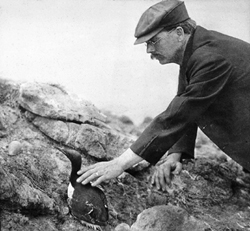
Nobody did more to save the birds of Oregon and Washington than William L. Finley, pictured here patting a cormorant. Finley, a brilliant wildlife photographer, led the West Coast Audubon Society movement.
William L. Finley. (Courtesy of U.S. Fish and Wildlife Service)
In 1905 Finley and Bohlman—fresh from studying golden eagles in California—started spending a lot of time in the lower Klamath basin, on instructions from William Dutcher, now head of the National Association of Audubon Societies. Nowhere in North America were there so many jungles of floating tules (pronounced too-lees) as in the Klamath basin. Tules are a huge species of sedge, part of the family Cyperaceae. Little clusters of sprouting tules—a plump, rounded green stem with grass-like leaves often clustered around beige flowers—were once so common around Tulelane Lake that in the California-Oregon wetlands there was a popular expression, “out in the tules,” meaning “beyond way-away.” Along the shorelines of the California-Oregon lakes the tule marshes served as a buffer against water surges and high winds. Even the haze that beset the state borderline area, particularly along the Pacific coast, was known as tule fog. Walking on a tule was akin to hiking in snowdrifts—you never knew when you’d plunge downward. Treading carefully in the tules, Finley and Bohlman once again delivered photographic gems. Their straight-on black-and-white portrait of a canvasback in tule was as artful as an Audubon print. Some of the photographs, such as four Caspian terns screaming at each other, were comical. Others, like some tiny spotted sandpipers dancing around a spring flower, were aimed at winning children over to the Audubon Society’s cause.104
Worried that President Roosevelt—his chief ally—was consumed by the ceaseless distractions of Washington, D.C., Finley focused his activism on counterbalancing the San Francisco plume hunters who were killing off birdlife in the Klamath basin. Keeping detailed notes about the plumers he encountered, Finley recorded that the going rates per dozen birds were: teal ($3), mallard ($5), pintail ($7), and canvasback ($9). Bales of skins were being shipped out, like hay. Camping on marsh tules, which made a fine mattress, Finley started writing up his field notes as articles for The Condor magazine in 1907; these articles included “Among the Pelicans,” “The Grebes of Southern Oregon” and “Among the Gulls on Klamath Lake.”105 As Roosevelt had intuited, Finley was a naturalist writer almost as good as Muir and Burroughs. And what made Finley sui generis among wildlife photographers of the early twentieth century was that he also took motion pictures of the lower Klamath. He had footage of great migratory waterfowl swarms and close-ups of pelicans nesting. (Roosevelt liked that, too: after all, he had filmed Jack “Catch ’Em Alive” Abernathy wolf-coursing in Oklahoma.) Today, Finley’s grainy black-and-white films are prized possessions in the archives of the U.S. Fish and Wildlife Service in Shepherdstown, West Virginia.
Much like Paul Kroegel at Pelican Island, Finley at the lower Klamath and Lake Tule was a master of walking softly among the birds. The western grebe rookeries he studied were like none other in the world. He would sit quietly for hours in the low reeds, camouflaged, spying as grebes dived and swam underwater with chicks on their backs. Even when the wind ruffled the surface of the tule and sheets of rain blew eastward horizontally, Finley didn’t abandon his blind. Once he got lucky and photographed western grebes hatching from eggs amid dry tules. “We watched as one of the little Western Grebes cut his way out of the shell and liberated himself,” Finley wrote in The Condor. “The wall of his prison is quite thick for a chick to penetrate, but after he gets his bill through in one place, he goes at the task like clock work and it only takes him about half an hour after he has smelled the fresh air to liberate himself. After the first hole, he turns himself a little and begins hammering in a new place and he keeps this up till he has made a complete revolution in his shell, and the end or cap of the egg, cut clear around, drops off, and the youngster soon kicks himself into the sunshine.”106
On behalf of the Oregon Audubon Society, Finley, armed with field notes, photography, and a home movie, journeyed back to Washington, D.C. in 1906 to personally show off the Oregon lake region to Roosevelt at the White House. Roosevelt congratulated Finley on Oregon’s Model Law for birds. Finley inquired about Three Arch Rocks. The conversation went back and forth like that for an entire evening. The two naturalists discussed how to preserve lower Klamath Lake as a breeding ground for native birds. The Klamath basin was a large area of land, which dwarfed Crater Lake. In Florida, Roosevelt was creating federal bird reservations of forty to 200 acres. If Klamath was declared a reservation, it would be something like 80,000 acres. Further complicating the situation was the fact that the Reclamation Service was draining the wetlands for large-scale agricultural farming. Finley told Roosevelt that his Klamath irrigation project—while obviously a well-intended offshoot of the Newlands Act—was turning wetlands into mudflats. “We move to conserve or develop one resource,” Finley complained, “while at the same time, we are destroying another.”107
Roosevelt thought Finley had the right stuff. He was a well-spoken, accomplished young man, rather overly serious, but otherwise with no discernible flaw. He had a wonderful scientifically inclined mind, which appreciated that even maggots had an important role in nature, feeding grackles and nighthawks. Also, Finley could make even a magpie nest sound as interesting as the Taj Mahal. Like Chapman, he was doing a fine job of popularizing birding. Sunset magazine—aimed at middle-class families—had published a few of his well-written ornithological pieces. Perhaps knowing that Roosevelt had a soft spot for the American white pelican (Roosevelt had, in fact, saved both Stump Lake and Chase Lake in North Dakota largely for their benefit), and much like Pinchot and La Farge in 1900 regaling Roosevelt with stories about Mount Marcy, Finley told of rowing in puffs of wind, making treacherous landings, putting up rough campsites, setting up a blind near Rattlesnake Island, and seeing half-grown pelicans and hearing their cries. Combined with the home movies, all this was quite a pitch. What image could have appealed to Roosevelt more than Finley’s colorful remark that these pelicans looked “like a squadron of white war-ships”?108
Bravo! Bully! Wow! Roosevelt loved the whole presentation. Perhaps he had discovered a new American original like the young Audubon. Clearly, Finley wasn’t a fringe ornithologist but a main voice. Once again T.R.’s famous exuberance was called forth by the incredible photographs of young burrowing owls perched on Bohlman’s lap and Finley hand-feeding double-crested cormorants at Tule Lake. There was nothing bland about Finley’s photos. Having already saved, for John Muir, the 14,162-foot Mount Shasta, which was prominent on the horizon in much of the Klamath basin area, Roosevelt wanted to solve the political problems associated with creating a huge federal bird reservation in the middle of his Reclamation Service project. This was seen by Auduboners as Pinchot’s public revenge. Finley, however, took the compromise with a certain grace, as though, having toiled so long to bring attention to the Klamath basin, he felt a distinct relief in having gotten Roosevelt to establish something big for birds.
As if in a great wave of protectionism, Roosevelt rescued more than 37 million waterbirds in Oregon. On August 8, 1908, by means of an “I So Declare It” executive order he created the Klamath Lake Reservation, consisting of 81,619 acres of lakes and marshes. (This would be only the first of six national wildlife refuges set aside in the Klamath basin.*) He wanted the habitat preserved—particularly the ten- to fifteen-foot-high tule—for the pelicans and grebes. But a serious error had also been made. The entire Klamath basin should have been declared a national park, like Crater Lake or Mesa Verde, and the Reclamation Service should have been booted out of southern Oregon once and for all. However, this didn’t happen. Spurred on by the Klamath Waters Association, the raping, dredging, and draining of the wetlands ecosystem continued. At best, the reclamation project was a product of its time. Although Auduboners were (and still are) grateful that Roosevelt had helped rescue the white pelicans, cormorants, grebes, and great blue herons, his conservation policy mainly failed in the Klamath basin. It was the worst example of Roosevelt’s trying to reconcile agricultural utilitarianism and waterfowl preservation. But since then, rehabilitation efforts have succeeded.109“I hope the marsh,” Finley wrote, “will defy civilization to the end.”110
Also, Finley succeeded in getting 81,619 acres of the Klamath basin preserved inside the Bureau of Reclamation’s reservoir. Eventually Roosevelt created many of these “overlay” refuges in the West—seventeen were established on February 25, 1909, alone, by Executive Order 1032. Some environmental historians think that these “overlay” bird reservations within reservoirs were largely a waste of time. Finley, they claim, was hoodwinked by Pinchot and those around Pinchot.
When in 1911 Governor Oswald West of Oregon, a Democrat, selected Finley to become the state’s first Fish and Game Commissioner, Roosevelt celebrated. It was a victory for “citizen bird.” But besides women’s suffrage and prison reform, wildlife protection was one of the issues dearest to West’s heart. With unflinching determination, he insisted on public access to Oregon’s beaches.111 “In Governor West of Oregon, I found a man more intelligently alive to the beauty of nature and of harmless wild life, more eagerly desirous to avoid the wanton and brutal defacement and destruction of wild nature, and more keenly appreciative of how much this natural beauty should mean to civilized mankind, than almost any other man I have ever met holding high political position,” Roosevelt wrote in Outlook. “He had put at the head of the commission created to express these feelings in action, a naturalist of note, Mr. Finley.”112
Praise from a former president is always a good thing for a writer. But Finley felt especially blessed when Roosevelt commended West’s environmentalist ethos in rhapsodic terms: “He desired to preserve for all time our natural resources, the woods, the water, the soil, which a selfish and shortsighted greed seeks to exploit in such fashion as to ruin them and thereby to leave our children and our children’s children heirs only to an exhausted and impoverished inheritance; he desired also to preserve, for sheer love of their beauty and interest, the wild creatures of woodland and mountain, of marsh and lake and seacoast.”113
In the years after Roosevelt and Finley’s initial collaboration of 1903 to 1909, the U.S. Fish and Wildlife Service decided to pay tribute to these conservationists. In 1964, 5,325 acres of the Willamette Valley were saved as the William L. Finley National Wildlife Refuge. Here was one of the best spots to see Canada geese, mallards, northern pintails, and great blue herons. A botanist could study broad-leafed pondweed, water plantain, American slough grass, and Engelmann’s spike rush in the refuge. Anybody who wants to experience the Willamette valley ecosystem before Portland’s sprawl reaches it can today wander around the white oak savanna in all its primordial splendor. And in the the refuge (which is near Corvallis, Oregon), among bottomland ash forest and native prairie, is a herd of Roosevelt elk—a truly fitting tribute to the two naturalists’ work together.
And who had the idea for this refuge? Ding Darling. He was intent on having the Willamette Valley refuge, deep in the foothills of the coast range, named for Finley and populated with Roosevelt elk. The story of Finley and Roosevelt’s collaboration now lives on in the Oregon landscape, thanks to Darling’s foresight. As for Governor Oswald West, there is a spectacular Oregon state park—situated on the Pacific Ocean between Hug Point and Nehalem Bay—named to honor his crusade for public access to beaches and for bird sanctuaries.
The Malheur National Refuge—spanning a forty-mile area in the southeastern corner of Oregon—celebrated its centennial on April 4, 2008, by brewing a micro beer manufactured by Rogue and called Great Egret Pale Ale.114 U.S. Fish and Wildlife had good reason to celebrate. After decades of setbacks in the Klamath, rehabilitation was succeeding. Now tens of thousands of visitors come to the northern Great Basin to watch migratory birds feed in the high desert.
Three Arch Rocks became—even more than Crater Lake—a symbol of Oregon’s pristine beauty. The largest of the surf-pounded mounds was officially named Finley Rock and is home to the largest colony of tufted puffins in the state. Tourists come to view the puffins with binoculars from Oceanside Beach and Cape Meares on the mainland. But no trespassing is allowed at the sanctuary. And from May 1 to September 15 no boats are allowed within 500 feet of the mounds.115
Early on, some critics of Roosevelt’s reservations at Klamath basin said that only a lunatic would have the audacity to declare Oregon’s tule land a breeding grounds for birds. As their argument went, this wasn’t Mount Rainier or Crater Lake but a swamp splotched with bird excrement! Other critics said that Roosevelt’s penchant for bird-watching was warped, occultism. Scoffing at such thinking, Roosevelt said that preserving the Pacific coast’s wildlife was democratic in spirit. There was nothing warped about protecting canvasback and white pelicans. In fact, he wanted to protect endangered birds all over American territory, from the eskimo curlews in Alaska to the whooping cranes in Michigan to parrots in Puerto Rico. That some fellow Americans couldn’t understand the inherent morality of species survival was troubling to Roosevelt. But so what? Before leaving the White House he planned to create even more than the twenty-five bird sanctuaries of 1903 to 1908. It was as if he had found in wildlife protection his autumnal passion. And he had Grover Cleveland’s famous “midnight reserves” to use as a presidential precedent.