
CHAPTER THREE
I
No photographic images exist of the fifteen-year-old Theodore Roosevelt with his trunkful of bird booty, on board the S.S. Russia and anxious to arrive at New York Harbor. Shortly before sailing home, however, he described in a letter to his mother (who had returned early) how the combination of asthma and mumps had made his face as puffy as “an antiquated woodchuck with his cheeks filled with nuts.”1 Besides homesickness for his Roosevelt Museum and his friends, there was another reason the sickly Theodore was eager to return to New York. While the Roosevelts were in the Middle East and Europe, a new family mansion had been constructed at 6 West Fifty-Seventh Street—near Central Park and much closer to the American Museum of Natural History. Young Theodore couldn’t wait to see the new house and unpack his bee-eaters, wagtails, bullfinches, and other specimens in the space especially assigned to his Roosevelt Museum. To Roosevelt the new home meant bigger and better display space for his painstakingly acquired wildlife specimens. His Roosevelt Museum was now three or four times larger than before. Each new bird added was assigned an inventory tag, including its Latin binomial.2 “My first knowledge of Latin,” Roosevelt later recalled of his childhood, “was obtained by learning the scientific names of the birds and mammals which I collected.”3
Roosevelt studied Carolus Linnaeus’s Species Plantarum and Systemae Naturae to help himself learn the binomial system. Naturalists revered Linnaeus as their patron saint because in the mid-eighteenth century he had created this simple, universal two-part Latin nomenclature, which revolutionized taxonomy. Thanks to Linnaeus, botanists and zoologists everywhere could use the same language when discussing species. Rejecting previous assumptions about the “subjective value of perfection of animals,” Linnaeus based his sytem on “objective, observed similarities in anatomical structure.”4 His system of biological classification—still used—was developed with a sense of cataloging God’s creatures. Honoring all life-forms with both a genus and a species name, Linnaeus also placed humans in his binomial system, as Homo sapiens (the term for man beginning in the Pleistocene epoch 1.8 million years ago). By the time Theodore Roosevelt was growing up, scientists and explorers seeking glory ranged far and wide in the remote wilderness, racing to discover organisms that could be named after themselves. “The Linnaean system eliminated the confusion of having, for example, a butterfly called the mourning cloak in the United States, the yellow edge in Canada, and the Camberwell beauty in Britain,” Nancy Pick explains in The Rarest of the Rare. “People all over the world, whatever their language, can understand Nymphalis antiopa.”5
In considering the Roosevelt Museum it’s important to remember that Theodore was always trying to emulate both Linnaeus and his father. Just as Theodore Sr. had planning meetings, fund-raising drives, and specimen hunts, so too did his son. Ecstatic about the Fifty-Seventh Street house, particularly because it had more room for his collectibles and curiosities—not to mention a modern gymnasium on the top floor with free weights and parallel bars—Theodore decided to hold a spontaneous Roosevelt Museum “directors’ meeting” on December 26, 1873. Playing the adult, he met with his cousins James West Roosevelt and William Emlen Roosevelt behind closed doors. Big issues needed to be decided, now that he had acquired all these strange Old World birds to add to the New World collection. A professionalization process—imitating the Museum of Comparative Zoology at Harvard University—was under way. The document that T.R. drafted illustrates just how businesslike he had become about being a naturalist and scientist:
There has been no meeting for two years owing to the absence of a majority of the members in foreign countries collecting specimens.
Whereas the size of the Museum requires entire reorganization it is resolved that a new constitution be adopted.
Said new constitution having been read and signed by directors. It is also resolved that Mrs. James K. Gracie, Miss Elizabeth Lewis, Mr. Elliott Roosevelt and Mr. John Elliott be constituted members.
It is also resolved that in consideration of the great services rendered by Messrs. Elliott Roosevelt and John Roosevelt that they be not obliged to pay any initiation fee.
It is also resolved that any of the directors be authorized to sell or exchange duplicate specimens of the Museum the proceeds to be given to the Museum.
It is also resolved that Mr. Theodore Roosevelt, Jr. President of the Roosevelt Library present at the next meeting written proposition for the incorporation of the Library and Museum.
Present at the meeting:
T. ROOSEVELT, JR.
J. W. [JAMES WEST] ROOSEVELT
W. E. [WILLIAM EMLEN] ROOSEVELT.6
Clearly there was a lot of faux erudition going on here. Although Theodore did keep minutes of the Christmastime meeting, the so-called board didn’t convene again for five months, and then met only to agree on letting Theodore spend $8.50 to purchase new ornithological specimens.7 That modest financial request is the last surviving document pertaining to the Roosevelt Museum. West Roosevelt eventually became chief resident physician at Roosevelt Hospital in New York City and Emlen Roosevelt became the senior partner of the Wall Street firm Roosevelt and Son. But Theodore stepped up his naturalist pursuits through a private tutor instead of a board of directors. According to biographer Edmund Morris, acceptance at Harvard “floated ever nearer” and if the “grail eluded his reach, he might not have the strength to grasp it again.”8
Theodore Sr. was elated with his son’s advances toward maturity and with young Theodore’s steady attempt to streamline his naturalist hobby into a serious scientific pursuit. In An Autobiography, in fact, Roosevelt reflected on his father’s sage advice that “if I wished to become a scientific man I could do so,” but as a corollary he had to be dead certain “that I really intensely desired to do scientific work.”9 As of the early 1870s biological studies such as botany and zoology had become truly scientific disciplines. The German scientist Alexander von Humboldt, the founder of modern geography—who died when Roosevelt was one year old—had pioneered in studying the interchange between organisms, habitat, and geography.10 Then, in the early 1880s, the microscope had been invented to study germs. Theodore enjoyed On the Origin of Species, but Theodore Sr. worried that his boy wasn’t going to buckle down in chemistry and physics classes; his son liked bear variations, not cell theory. “I am a belated member of the generation that regarded Audubon with veneration, that accepted [Charles] Waterton—Audubon’s violent critic—as the ideal of the wandering naturalist,” T.R. later reflected, “and that looked upon [Nikolaus] Brahm as a delightful but rather awesomely erudite example of advanced scientific thought.”11* Clearly, Roosevelt was the kind of natural history student who would travel great distances to shoot specimens in forests. But would he sit still and do the semi-stifled indoor laboratory work that came after great hunts? His father had doubts.
Because as an adult T.R. preached the strenuous life, recording his rugged outdoor adventures and battlefield prowess with such dramatic flair, it’s often forgotten that his aptitude for professions other than naturalist or author was minimal. His abysmal health ruled out an appointment to West Point or Annapolis. He had no predilection for the world of commerce. Managing the family’s fortune didn’t interest him—in fact, he brushed off the chance to become a partner in Roosevelt and Sons. He felt antipathy toward bankers, accountants, and financiers. And every time Theodore gazed at a law book, his eyes glazed over in boredom. Even though his uncle Robert B. Roosevelt tried to nudge him toward the law, even a squad of top-notch defense or prosecuting attorneys could never have convinced him that habeas corpus was a more interesting concept than the migratory habits of Ectopistes migratorius—the passenger pigeon.
Therefore, Theodore’s career path seemed as plain as day: to become a Harvard-trained biologist or naturalist.12 Someday his specimens could become part of the Harvard Museum of Comparative Zoology Collection, Roosevelt hoped, displayed beside the natural history artifacts donated by George Washington, Meriwether Lewis, Charles Darwin, Henry David Thoreau, and John James Audubon.13 For most of his life, Theodore had been homeschooled. He was never enrolled in public school, and he attended a private school in Manhattan for only a brief time. Theodore Sr. hired a highly regarded tutor, Arthur Cutler, to help Theodore brush up for Harvard’s notoriously difficult entrance exam. Years later Cutler was asked to recall his former student’s inherent strengths and weaknesses. “[Theodore] never seemed to know what idleness was,” he said. “Every leisure moment would find the last novel, some English classic, or some abstruse book on Natural History in his hand.”14
In 1874, continuing the family tradition of fleeing Manhattan every summer, Theodore Sr. decided to rent a house in Oyster Bay. A jutting curve of land on the North Shore of Long Island, less than an hour by train from midtown Manhattan, Oyster Bay had been founded in 1653. By the time of the American Revolution, it was a bustling seaport. Although it later boasted that “George Washington slept here,”15 Oyster Bay had actually been a hotbed of loyalist sentiment once the port was occupied by British troops after the Battle of Long Island. By the time the Roosevelts started summering in Oyster Bay, wealthy New Yorkers, attracted by the breezes coming off Long Island Sound, had built blocks of Victorian and colonial homes. Just after the Civil War, Oyster Bay had grown into a popular summertime getaway location for New Yorkers desperate to escape the clamor and congestion of urban life. Appropriately, the town seal of Oyster Bay eventually became a seagull in flight.16
Theodore’s mother, Mittie, named the waterfront estate her husband leased “Tranquility.” With its columns, attractive veranda, and huge parlor, it was like something out of the antebellum South. The name, however, was a misnomer, for the house constantly sang with activity. As the old adage goes, life begins at the water’s edge. And Oyster Bay was no exception. On the North Shore the quaint meadows, low hills, and dense woodlands were a bird lover’s paradise. Just rocking on Tranquility’s veranda allowed Theodore to see surf scoters, old squaws, herring gulls, red-throated loons, catbirds, and chickadees. The soliloquy of the open bay was conveyed by these preening birds, and all young Theodore had to do when the four o’clock shadows arrived was sit back and watch and listen with pure elation.
By 1874 the bard of Long Island was Walt Whitman, who wrote poetically about the clouds drifting over sand dunes and eagles dallying in the sky. In his old age Whitman, in fact, would claim that he had “incorporated” Long Island into himself.17Now, at every chance possible, Roosevelt would tramp around rural Glen Cove and Lloyd Neck as if he were Whitman on the prowl, jotting down wildlife sightings with scientific exactitude. His ear was always cocked to catch a vireo’s robinlike warble or a pesky gull’s squawk. His notebooks were no longer travel diaries: the two he kept in Oyster Bay between 1874 and 1876 were labeled “Journal of Natural History” and “Remarks on the Zoology of Oyster Bay.”18 Inside, amid long lists of birds he observed in Oyster Bay, were symbols used to identify the avians as male or female. Struggling to be a professional, he jotted down sightings of prairie warblers perched in cedars and yellowthroats eating caterpillars. “My contributions to original research were of minimum worth,” Roosevelt recalled of his fieldwork; “they were limited to occasional records of such birds as the dominica warbler at Oyster Bay, or to seeing a duck hawk work havoc in a loose gang of night herons, or to noting the bloodthirsty conduct of a captive mole shrew.”19
Although Oyster Bay appealed to Roosevelt’s fancy for birds, the forested environment of the Adirondacks tugged at him in a more primordial way. Long Island had woods. The Adirondacks had wilderness. What exactly did or didn’t constitute wilderness has long been debated, with no definitive verdict. Certainly, just hearing somebody utter the word “wilderness” conjures up remote landscapes—that is, sparsely populated or untraveled areas undisturbed by too many footprints or other obtrusions of human beings. One imagines wild—not domestic—animals in a wilderness area. Yet, just when you start homing in on a definition, you have to contend with the hard reality that both outer space and oceans are often referred to as wilderness. To many people, in fact, wilderness is nothing more or less than a state of mind. Basically, wilderness is a subjective concept, as the historian Roderick Frazier Nash noted in his landmark study Wilderness and the American Mind, first published in 1967. Trying to arrive at a “universally acceptable definition of wilderness,” Nash wrote, is nothing short of impossible. “One man’s wilderness may be another man’s roadside picnic ground,” he believed. “The Yukon trapper would consider a trip to northern Minnesota a return to civilization while for the vacationer from Chicago it is a wilderness adventure indeed.”20
Given the fact that Roosevelt was a Manhattanite, it’s easy to assume that the Adirondacks, where he headed next, were his idea of a genuine wilderness. The Adirondacks embodied what the ecologist and philosopher Aldo Leopold would define as “wilderness” in 1921: the ability of a certain geographical terrain to “absorb a two weeks’ pack trip” away from human-centered activities.21 The historian Patricia Nelson Limerick in Something in the Soil described the western wilderness as a place where “mass society’s regimentation and standardization” find a “restorative alternative.” 22 (The Wilderness Act of 1964 officially defined wilderness as being “untrammeled by man and where man himself is a visitor who does not remain.”23)
So when young Theodore arrived in the Adirondacks in August 1874, he wasn’t looking for the silken comfort of Paul Smith’s hotel, perched on a bank of the Lower Saint Regis Lake. Only by “roughing it” in the backcountry could he encounter bears, deer, and raccoons up close in a wilderness setting. Rhapsodically and steadfastly, he began keeping a diary called “Journal of a Trip to the Adirondacks” about the millions of acres west of Lake Champlain and north of the Mohawk River. Hiring a rugged Canadian backwoods guide, Mose Sawyer (from Keese’s Mill, New York), as his hiking companion, Roosevelt intended to hike the highest mountains—Algonquin, Marcy, and Whiteface. (Even with Sawyer, he only got about halfway up them.) These were summits his parents had previously prohibited him from climbing, worried about his health and well-being. Roosevelt and Sawyer set up a camp along the south branch of the Saint Regis River near McDonald’s Pond. Occasionally visitors from New York City would accompany them on day outings in the wooded ranges.
Sawyer claimed that Roosevelt—who preferred venison to brook trout for dinner—had no interest in hunting deer or fishing. It was all birds, birds, birds. Once, in fact, Theodore quietly glided past fifty grazing deer, not lifting his rifle. Arm in arm through the beech woods, Sawyer and Roosevelt traveled; a lifelong bond was forged. As partial payment for taking him into the remote hardwood and softwood forests of the Adirondacks, Roosevelt presented Sawyer with four of the birds he had mounted in Oyster Bay (unfortunately, Sawyer’s cat ate them and died of arsenic poisoning). “He was a queer looker,” Sawyer recalled of Roosevelt in a newspaper, The Adirondack Experience, decades later, “but smart.” According to Sawyer, the oddest aspect of Roosevelt was that he didn’t “smoke, drink or swear.” Sawyer testified that Roosevelt had a puritanical streak lurking in everything he did and said. For example, two prominent New York City doctors—Dr. Wright and Dr. Loomis—spent an evening with Roosevelt and Sawyer at Blue Mountain Lake. After listening to the budding ornithologist pontificate, one of them concluded that Roosevelt was “the smartest idiot I ever saw.”24
What jumps out from “Journal of a Trip to the Adirondacks” is the way Roosevelt was now injecting the botanical history of trees and fauna into his wildlife narrative. No longer was it enough to record seeing a purple finch or a barn swallow from his canoe; now he also described the geographical surroundings in which he observed a blue jay or common sparrow, specifying whether the tree it was perched in was a white pine, balsam fir, or red spruce. Roosevelt enjoyed having the sweat shine on his face as he hiked the alpine terrain to see hapland, rosebay, diaspen-sia, mountain sandwort, and other vegetation native to the Adirondacks. His hope, as he took topographical notes about Saint Regis Lake that August and on follow-up visits in 1875 and 1877, was to write a booklet about the birds of the Adirondacks.25 But since Dr. C. Hart Merriam and other top-notch naturalists had written seriously on Adirondacks wild-life, Roosevelt pragmatically realized that it was hard to add much to “the sum of human knowledge.” 26
On each of these trips Roosevelt’s irreplaceable guide was Sawyer: a real outdoorsman, what loggers called a seven-sided son of a bitch, who knew every bit of the Adirondacks’ mid-mountain and cloud forests like the back of his hand. “The region more particularly dealt with is at an elevation of over 2000 feet, is strongly hilly, or one might almost say mountainous, and is thickly studded with small lakes and ponds whose outlets are narrow and very crooked streams,” Roosevelt recorded in his diary. “It is densely wooded; the few open places being the clearing around houses and the ‘slashes’ where the woods have been burned. The forests are chiefly evergreen (largely intermixed with birches, beeches, and maples, however); the bulk being composed of pines, balsams and spruces, with numbers of hemlocks on the ridges. In the low level lands there are frequently extensive tamarack swamps…. The characteristic features of the fauna of the region are, among mammals, the presence in small numbers of the larger carnivora and furbearing spieces; among birds the abundance of woodpeckers, the breeding of numerous warblers, and the presence of a number of northern species, as Picoides arctus [black-backed woodpecker], Parus hudsonicus [boreal chickadee],Perisoreus canadensis [gray jay], Contopus borealis [olive-sided flycatcher] and Falcipen-nis canadensis [spruce grouse].”27
Unable to find a black bear and uninterested in shooting white-tailed deer (which had been almost wiped out in upstate New York), Roosevelt instead ended up hunting muskrats and squirrels. Each specimen he bagged was studied for coloration and markings back at what Sawyer called the “Great Camp” Darwin would have approved of the young man’s detailed approach to his wildlife studies. Minor revelations about mammalogy were plentiful for Roosevelt. For the first time he understood why farmers considered chipmunks such a menace; he pulled eighteen wild peas out of a single pouch of one he shot. A highlight that first summer was Roosevelt’s hearing the far-off howl of an eastern timber wolf. (According to a study by the University of Toronto, wolves howl more frequently in August than any other month; Roosevelt was the beneficiary of this zoological fact 28). After hearing the wolf’s lonesome contact and reunion call, Roosevelt kept a special eye on underground burrows and rock caves where he knew Canis lupuspacks lived in dens. He wanted to see one of the lupines with his own eyes—a feat he never accomplished.
But that was about it. Roosevelt’s most detailed, lively, and interesting passages from the Adirondacks journals were his bird entries. Noting that there was a plethora of woodpeckers, Roosevelt successfully collected five species for his Roosevelt Museum. To Roosevelt, woodpeckers were an evolutionary link to a prehistoric era when giganotosauruses and stegosauruses roamed the prairies of North America. Each hammer of their beaks was interconnected to the world of trees and insects, and to time immemorial. The Adirondacks without an echo of a woodpecker sharpening its beak, he reasoned, would be deafening in their silence. “There is a grandeur in this view of life,” Darwin had written to end On the Origin of Species, “that, whilst this planet had gone cycling on according to the fixed law of gravity, from so simple a beginning endless forms most beautiful and most wonderful have been, and are being evolved.” 29
Many of the birds Roosevelt collected and observed in the Adirondacks later became much less common and were placed on the National Audubon Society’s “Watch List.”30 There was, for example, the rare Bicknell’s thrush, a shy, buff-breasted, long-distance migrant whose call—“vee-ah”—Roosevelt enjoyed immensely. Even the wood thrush, common in the 1870s, found itself on the watch lists by late 2008, a casualty of the disappearance of extensive deciduous tracts of woodlands in upstate New York. To Roosevelt the wood thrush’s song at twilight—a rising and falling “ee-o-lee, ee-o-lay” as heard in the Adirondacks—was more beautiful than any other sound on earth.31
The world of the Adirondacks as presented by Sawyer and as heard with his own finely tuned ears caused Roosevelt to dream about heading out to Hawk’s Ridge in Duluth, to see great flocks of raptors in their autumnal glory. Like Audubon and Darwin, he would refuse to become an indoor naturalist. From Minnesota he could bundle up in fur and sheepskin like Zebulon Pike and go southward to rendezvous with the headwaters of the Arkansas and Red rivers. The West was tugging on Roosevelt’s imagination like a mighty altar. “A naturalist can find employment any where—can gather both instruction and amusement where others would die of ennui and idleness,” Captain Mayne Reid had said in The Boy Hunters. “Remember! There are ‘sermons in stones, and books in running brooks.’”32
II
When young Theodore was growing up, the interior American West was still a raw wilderness of snow-choked mountains, pristine forest, black lava rock, unknown canyons, and a buffalo-trodden prairie larger than Europe. Because Roosevelt had never traveled west of the Erie Canal, his understanding of the American West in the 1870s derived primarily from newspaper accounts and photographs (with the invention of the portable wet-plate camera, images of Pikes Peak, Old Faithful, and the Three Sisters of the Tetons were now regularly appearing). Although the westward expansion of the 1870s had no artist to equal Mathew Brady during the Civil War, the photographer W. H. Jackson beautifully documented Yellowstone. Also, Timothy O’Sullivan did a fantastic job of capturing the raw natural essence of Utah’s Wasatch Mountains. Snow squalls, scorching desert sun, hailstorms, dense fog, and steep cliffs were among the many natural obstacles these photographers faced. Emulating the landscape paintings of Albert Bierstadt and Thomas Moran with his camera, Jackson took sweeping panoramic portraits of the cliff dwellings of Mesa Verde, Colorado; O’Sullivan did the same with ancient ruins at Canyon de Chelly, Arizona. Both places were later saved as national sites by President Theodore Roosevelt.33
But something else exciting was occurring in western photography that elated the young Roosevelt. Photographs started to appear in periodicals celebrating the explorers of the late 1860s and 1870s. There was Lieutenant Colonel George Armstrong Custer standing over his first hunted grizzly bear (taken by Wild Illingworth), and Major John Wesley Powell on horseback talking to an Apache guide (courtesy of Jack Hillers). Like many other teenage boys, Roosevelt swooned over these photographic images of the frontier, as he had over Audubon’s birds and Catlin’s Indians. The Cascades and the Bitterroots had now been opened up to him as stunning visual experiences. Certainly many of these post–Civil War explorers—Custer and Powell leap first to mind—used photography as self-advertisements for their loftiest exploits. Young Theodore, however, saw them through rose-tinted glasses, in a blur of romance, as explorers braver than brave.
At the end of the Civil War new geographical revelations were appearing almost daily in the public press, along with pictures, because the U.S. Congress was eager to inventory the mineral wealth west of the Mississippi River.34 The U.S. government held title to more than 1.2 billion acres—mostly west of Kansas City—but had surveyed only about one-sixth of this land. In March 1867 Congress approved sweeping geological studies of the western lands by the General Land Office and Corps of Engineers. Suddenly, engineers educated at West Point were the new trailblazers in the Rocky Mountains and beyond. Every square yard of foothills, badlands, thin forests, or drainage ditches would be mapped. On March 3, 1879, Congress created the U.S. Geological Survey to inventory the national domain acreage that President Jefferson had acquired from the Louisiana Purchase, and much more.35
With so much mineral-rich land open for the taking, speculators were scheming to grab stakes, mine gold, discover oil, dig coal, control wheat markets, fish out rivers, and clear-cut virgin forests. This entrepreneurial fever also provided a commercial opening for trained civil engineers, geologists, and biologists (to a limited degree). Railroad workers and miners were greatly in demand, as were cartographers and surveyors. Clarence King, first director of the U.S. Geological Survey, noted that 1867 marked a pivotal point when “science ceased to be dragged in the dust of rapid exploration and took a commanding position in the professional work of the country.”36
The historian William H. Goetzmann, in his Pulitzer Prize–winning Exploration and Empire, broke down the nineteenth-century exploration of the American West into three distinct phases: (1) the Lewis and Clark era (1803 to 1840), when the desire was to gather practical information and discover likely trade routes; (2) the manifest destiny years (1840 to 1865), when families (and railroad companies) headed west looking for fertile land, natural resources, and big bonanzas; and (3) the post–Civil War “frontier laboratory” phase (1860 to 1900), when botanists, paleontologists, ethnographers, and engineers sought scientific information. This third period was the time of the “Great Surveys,” when a wave of scientists headed west for reconnaissance and inventories. “It was also a time for sober second thoughts as to the proper nature, purpose, and future directions of Western Settlement,” Goetzmann wrote. “Incipient conservation and planning in the national interest became in vogue, signifying the way that the West had come of age and its future had become securely wedded to the fortunes of the nation.”37 But it wasn’t until March 3, 1885 that a Biological Survey—a U.S. Department of Agriculture unit within the Division of Entomology that Roosevelt championed like a fight promoter—was established.*
When Roosevelt was growing up, the federal government did show tiny signs of a burgeoning new awareness that protecting wildlife and animals mattered. On June 30, 1864, for example, when Roosevelt was only five years old, in what is widely considered the initial federal intervention on behalf of wildlife resources, Congress transferred the Yosemite Valley from the public domain to the state of California. Even though Sacramento would eventually return the Yosemite Valley to the U.S. government, in 1906, an important precedent was established, for in the transfer agreement California agreed to “provide against the wanton destruction of fish and game found within said park, and against their capture or destruction for the purposes of merchandise or profit.”38
A timeless hero to Roosevelt was President Ulysses S. Grant, particularly for his strategic skill in securing a Union victory in the Civil War. Just as T.R. turned fourteen in 1872, and was taking an interest in the American West, President Grant signed the bill creating, at least on paper, Yellowstone National Park. Enthralled by stories of grizzly bears, time-clock geysers, petrified logs, and massive elk herds—all of which appeared in his favorite boys’ magazine Our Young Folks—Roosevelt vowed to visit the new national park someday. Two great interests—General Grant and American wildlife—had come together in the Yellowstone story. Unfortunately, President Grant didn’t fully comprehend the thuggishness of western poachers. The 2.2-million-acre park had no uniformed police force (wardens) to enforce the law, and wildlife was killed there indiscriminately until 1894, when the Yellowstone Park Protection Act clamped down on the criminals.39
Accounts of Alaska’s brute beauty were also extremely popular as Roosevelt was coming of age. Virtually no important biologists had inventoried this American acquisition. Back in 1867, Secretary of State William Seward had acquired more than 650,000 square miles of Alaska from Russia for a song—$7.2 million (less than 2 cents an acre).40 Antiexpansionists called the purchase “Seward’s Folly” and considered it a frozen wasteland not worth a trillionth of a dollar, but other Americans cheered it. Determined to prevent both the Russians and the Japanese from killing what were now American seals in the Bering Sea rookeries, President Grant set aside the Pribilof Islands to protect them in 1869; this measure was approved by Congress the following year.
Living on the five tiny Pribilof Islands—only two of which, Saint Paul and Saint George, were habitable by humans—were the finest seal herds in the world, tens of thousands of bulls with harems swimming in the frigid fogbound waters and coming onto rocky beaches. The Pribilof Islands were, in essence, cities of seals. But Russian, American, and Japanese vessels were slaughtering these mammals in the Bering Sea at a rapid rate. To these hunters and harpooners, the Pribilofs were a killing ground. Rudyard Kipling included in his second Jungle Book the short story “The White Seal,” about fierce battles between nations over seal fur from the Bering Sea. Now that the United States owned these islands—considered the most lucrative rookeries of fur mammals anywhere—President Grant wanted to make sure he could protect the hundreds of thousands of fur seals.41
Like Grant, President Benjamin Harrison also cast an eye on Alaska. By means of an Executive Order on March 30, 1891, he created the Afognak Island Forest and Fish Culture Reserve to protect another part of Alaska’s “bays and rocks and territorial waters, including among others the sea lion and sea otter islands.”42 (The island is today part of Katmai National Monument, the second-largest area in the National Park System.43) A side effect of Harrison’s executive action on behalf of Alaskan wildlife was that the thick-billed murres and red-legged kittiwakes were saved from extinction. Flocks of auklets were able to flourish, and the blue-gray arctic fox could continue devouring their eggs. The food chain had been preserved.44
Neither Grant nor Harrison has been properly credited for small steps in protecting Alaskan wildlife from harpooners and market hunters. As Roosevelt later noted, the foresight of his two fellow Republican presidents regarding Alaskan wildlife had mattered. It proved that the federal government could, when necessary, intervene effectively to help mammals survive as species. Also, it showed that the government would protect the intricate tapestry of nature if the reason for doing so was economically compelling—in the case of Yellowstone, wildlife was being protected for tourism; in Alaska, the motivation was the long-term benefit of the seal-hunting industry.
This economic conservationism was a postulation that T.R.’s uncle Robert Barnwell Roosevelt—who lived in a brownstone adjacent to T.R.’s birthplace on Twentieth Street in New York City—put to the test regarding the fished-out streams and lakes of North America.
III
As a boy Theodore Roosevelt always had a soft spot for Robert Barnwell Roosevelt, his vaguely bohemian “Uncle Rob.” A creative contrarian and lover of animals, birds, and especially fish, Uncle Rob was always caught up in the maelstrom of his times. He simply never sat upright in his carriage. With a bristle-cropped beard, receding hairline, bad eyesight, and frameless spectacles, R.B.R. (as the family called him) would be easy to mistake for any of the bewhiskered American presidents elected between Grant and McKinley. Imbued with an outlandish catholicity of interests, the conspicuous Robert B. Roosevelt epitomized the many-sided Victorian-era bon vivant. For decades the Roosevelt family—owing to his philandering with chorus girls and trollops—treated him as a black sheep. Somehow he just couldn’t control his streak of lechery. Embarrassed by his wayward morals and intellectual incongruities the family, to some extent, banished R.B.R. from the fold. Nevertheless, his shiftiness aside, he was greatly admired in his day by the public at large.45
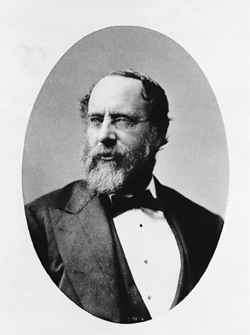
Robert B. Roosevelt was considered the great U.S. conservationist during the years from the Civil War to the Spanish-American War. “Uncle Rob,” as his nephew Theodore Roosevelt called him, was a many-sided Victorian reformer. In recent years the New York Historical Society (manuscript Department) has opened R.B.R.’s personal scrapbooks for scholarly viewing.
Robert B. Roosevelt. (Courtesy of the Theodore Roosevelt Association)
While not quite a bigamist, Robert B. Roosevelt came awfully close to being one. The simple fact was that he led a double life, married to Elizabeth Ellis Roosevelt (T.R.’s Aunt Lizzie) while having a long-standing affair with a neighbor, Minnie O’Shea (Mrs. Robert F. Fortescue), whom he hired at the New York Citizen.46 Secretly R.B.R. fathered four children with this mistress. Later, after Elizabeth died, he married Minnie.47 Unfortunately, this affair was so widely frowned upon that Robert B. Roosevelt has not been fully appreciated by recent environmental historians. His diaries and papers were largely hidden by the Roosevelt family for 100 years. Usually R.B.R. sported a porkpie hat and a gray jacket as he squired women around town. As a kind of territorial marker he gave elegant green gloves—purchased in bulk at A.T. Stewart’s department store—to the women he slept with. Society types used to laugh whenever they walked down Fifth Avenue or rode a carriage in Central Park and spied a woman wearing these gloves, which might as well have been the Scarlet Letter.48 Apparently, these women didn’t realize the negative connotation of the gloves.
But R.B.R.’s womanizing was, in truth, the least interesting aspect of him. To many it seemed that he had distinct parts and switched roles dexterously. Casting off and putting on personas, he could be a barroom enthusiast, a romantic adventurer, a barrister, a rousing orator, a husband, an adulterer, a sage, an animal protection advocate, a gourmet cook, a humble farmer—R.B.R. could even write memorable prose as a novelist and satirist. As was typical of the British upper class, Robert, never in need of money, dedicated himself to public service.49 Known for switching jobs with kaleidoscopic quickness, he served as coeditor of the reformist newspaper New York Citizen (which rallied its readers against the nefarious William Marcy Tweed’s ring).50 He was one of the Committee of Seventy, which broke the Tweed ring, causing the notorious boss to leave public life in disgrace.
During the Civil War R.B.R. served in a New York volunteer regiment; this experience provided him with enduring friendships. During Reconstruction he took his gusto for reform into the political sphere in 1870 and was elected to Congress; the only reason he ran was to establish federal fish hatcheries. Following a successful two-year stint in Washington, D.C., promoting pisciculture, he wrote plays and became commissioner of the Brooklyn Bridge (1879–1881), overseeing architectural adjustments and maintenance issues. As U.S. minister to the Netherlands under President Grover Cleveland in 1888, Roosevelt was at his smooth-functioning best in promoting a special “Dutch-American” relationship. Extremely adept at fund-raising, he served as treasurer of the Democratic National Committee in 1892, helping elect Cleveland for a second (nonconsecutive) presidential term.51
Erudition came easily to Robert B. Roosevelt. A self-styled man of letters, he wrote one mediocre novel—Love and Luck (1880)—which didn’t sell well. But his comic satire Five Acres Too Much (1869), which spoofed the virtues of farming, struck a chord in the immediate post–Civil War years, when laughs were in short supply.52 His other offbeat novel, Progressive Petticoats (1874), a lampoon of women suffragists, was also enthusiastically received. (For a modern-day comparison, he was the David Lodge of his generation). His pasquinades had ardent fans. As a personal favor, Robert B. Roosevelt also edited the flowery poetry of General Charles G. Halpine (Miles O’Reily), his coeditor at the New York Citizen.53 Sometimes R.B.R. wrote limericks himself—which were topical, like most efforts in this genre, and uniformly bad. On the whole, Roosevelt’s literary efforts, read a century after they were written, no longer sparkle; posterity has thrown them overboard. Only occasionally does his wit hold up. But R.B.R.’s furious advocacy of “fish rights,” the nonprofit sine qua non that became his sustainable legacy, has enduring historical importance, though it has been undervalued by academic scholars.54 R.B.R., more than any other direct influence, turned Theodore Roosevelt into a conservationist as a teenager.
Born on August 27, 1829, Robert B. Roosevelt grew up in New York City. Turning his back on the mercantile life of his father, Cornelius V. S. Roosevelt, and the Quakerism of his mother, Margaret Barnhill Roosevelt, R.B.R. became a maverick who gravitated toward the pageantry of wild things.55 Later in life Hamilton Fish—who had served as governor of New York and Grant’s secretary of state—dubbed R.B.R. “Father of all the Fishes.”56 Robert’s unconventionality first became clear when he changed his middle name, Barnhill, to Barnwell to avoid jokes about manure. As a teenager, he fished the briny waters of Long Island Sound for striped bass and bluefish whenever the opportunity presented itself. College, however, wasn’t important to the short, portly R.B.R. For all his erudition, he was happiest outdoors, whether at sea or on land. He flouted civil niceties, always speaking his mind candidly. Even his enemies—and there were many—couldn’t deny that he was frank.
When Robert turned twenty-one years old, he married Elizabeth Ellis and embarked on a political career as a Democrat. His decision to remain a Democrat, even after Abraham Lincoln walked onto the national stage, cast a lingering haze of suspicion over him in family circles. In aggregate, the reason R.B.R. gave for not following the family line was the galloping tempo, unhampered corruption, and rake-offs that characterized New York politics in the late 1850s and 1860s. Democrats, he believed, while fools, were less beholden to robber barons, and that made all the difference to him.57
Like other New York gallants Robert B. Roosevelt belonged to the so-called club set of the late 1850s. With corks popping, often overdrinking and straining his constitution, he enjoyed discussing political, literary, and culinary affairs. R.B.R., in fact, developed a virtual mania for joining elite “societies,” perhaps because he was very sociable. Robert (or “Rob” as he was usually called) was very everything, in fact. Very blue-blooded, though he aspired to be a populist. Very mannered, though he used the rake’s characteristic tactics of cajolery and the nod and the wink. As a gourmet chef he proudly founded the Pot Luck Club, whose intellectual members cooked five-star meals, judged truffles, and drank the finest French wines. Every year he also chaired the annual dinner of the Ichthyophagous Club, helping educate aspiring gourmets about the “unsuspected excellence” of many neglected varieties of American fish. Usually, the naturalist Joaquin Miller (whom he called the “sweet singer of the Sierras”) was at his side. Fishing stories in a comical vein were told at these dinners. The British, R.B.R. used to say, while always filling the champagne glasses, had to learn there was more to life than cod. The roomful of fish lovers roared with delight. A few specialty dishes wereDarne de saumon, garni d’éperlans à la Roosevelt and Filet of striped bass with shrimps à la Baird.58
Perhaps more than anybody else in his era, Robert B. Roosevelt argued for fish conservation because he enjoyed eating perch and trout so much. Turtle soup was another one of his specialties. Writing in his diary of the “turtle trial,” in fact, Robert was a contrarian, considering both Henry Bergh and the judge flat wrong. Sea turtles, he believed, weren’t insects or reptiles, but fish. Deeming the Pot Luck Club the “very head and centre of gastronomic, ichthyologic, zoo-logic,” he declared turtle too delicious a culinary delight to be an insect. “Then we have the sea turtle,” he wrote, “the glorious monster who sleeps in the mid-ocean in the amplitude of his thousand pounds of excellence.” Just hearing all that talk about sea turtles during the turtle trial, in fact, made R.B.R. want to “luxuriate in the green fat and the yellow fat.” Only an imbecile, he scoffed, could possibly eat turtles thinking they were insects or reptiles. “It had been claimed that turtles are snakes developed in Darwinian theory,” he recorded. “That a very intelligent and highly gifted snake, feeling sensitively the unprotected nature of a tail that dragged its slow length an unnecessary distance behind by taking much though added a shell to his body and converted the longest and slimmest of figures into the stoutest and roundest. That a turtle, and above all a snapping turtle, is but a snake in disguise…. I, for my part, cannot accept a serpent when I ask for a turtle; I repudiate the ‘snaix’ even under the head of a terrapin. Why should not a turtle be a fish?”59
Even though Robert B. Roosevelt found Manhattan’s social life fulfilling, he was continually drawn to the woods of rural Long Island. Trolling in the waters of the Great South Bay became his favorite hobby. Eventually, Robert purchased property along the bay, where the snipe and geese were plentiful, to build a country estate surrounded by pristine nature. But R.B.R.’s primary residence remained the five-story brownstone on East Twentieth Street in Manhattan, next door to what the National Park Service now oversees as the Theodore Roosevelt Birthplace.* A door on the second floor connected the two residences, making them a single-unit dwelling.60 (There remains speculation in the Roosevelt family that Theodore Sr. moved to West Fifty-Seventh Street to get his impressionable children away from their colorful uncle Rob61).
Animal stories were the mainstay of R.B.R.’s skill as a first-rate raconteur. To Uncle Rob treed opossums and sneaky foxes were more colorful than boring gossip about the sexual affairs of fellow socialites. Whenever young Theodore visited his uncle’s home, in fact—as he often did—he encountered a veritable menagerie: guinea pigs, chickens, parrots, and ducks coexisting in total mayhem. A cow even pastured in the parlor while a pony walked in circles around the dining room table.62 A pet spider monkey dressed in ruffled shirts would often greet visitors at the front door. A German shepherd was allowed to dine at the main table. Somewhere along the line Uncle Rob made it a consuming hobby to collect “Brer Rabbit” stories from African-Americans and dutifully wrote them down as an ethnologist would, mastering the slave-culture diction. Unfortunately, when he published these stories in Harper’s, readers paid them little mind. “They fell flat,” T.R. would later recall, although he was proud that Uncle Rob had been ahead of Joel Chandler Harris in collecting this Georgian folklore. “This was a good many years before a genius arose who in ‘Uncle Remus’ made the stories immortal.”63
That R.B.R.’s affinity for animals eventually developed into conservationist activism owes much to the influence of a British-born outdoor writer, Henry William Herbert. The indefatigable Herbert had been educated at Cambridge University and launched a literary career as a romance novelist, influenced by Sir Walter Scott and William Wordsworth. Moving to America in 1831, he adopted the pseudonym Frank Forester for his outdoor writing.64 Both a fine writer and a pen-and-ink artist, Herbert cofounded theAtlantic Monthly in 1833, believing that outdoors prose needed a fresh, clever popular outlet. The magazine flourished. But it was Herbert’s conservationist activism in such books as The Warwick Woodlands (1845)—denouncing “game hogs” and advocating a measured conservationist approach—that caused alarm in hunter-angler circles.65 R.B.R., for one, took keen notice of Herbert’s grim warning that “the game that swarmed of yore in all the fields and creeks of its vast territory are in such peril of becoming speedily extinct.”66
Robert B. Roosevelt joined Herbert’s crusade to replenish the trampled fisheries of New York. In 1844 Herbert helped found the New York Sportsmen’s Club, whose mission was to have the state legislature place seasonal limits on the hunting of deer, quail, and woodcock. The club’s first successes were the passage of model game laws in three counties: New York (Manhattan), Orange, and Rockland. As soon as R.B.R. joined, he championed an important auxiliary mission for the club, declaring that his priority in life was to enact laws protecting trout, shad, and perch. Indiscriminate fishing practices in general, he believed, had to be curtailed at once if the waterways of New York were to maintain even a semblance of their old abundance.67 Thus R.B.R. became—as his editor friend at the New York Times John Bigelow dubbed him—the “Piscicultural High Priest or Pontifex Maximus.”68
What Robert B. Roosevelt admired about Frank Forester was that he was an able practitioner of “outdoor” literature. Writers in this genre recounted hunting and fishing trips, as opposed to nature writers (who usually refrained from killing wildlife) and latter-day environmental writers (who were more technical in their approach). When Theodore Roosevelt was growing up, most outdoors writing was Anglophile. It was impossible to find a good angling book, for example, about Florida’s reefs, Louisiana’s bayous, Hawaiian atolls. John Skinner’s American Turf Register and Sporting Magazine in 1829 was filled with pedestrian prose. Henry’s creation of Frank Forester changed all this, demonstrating that American soil was fertile ground for outdoor writing. Single-handedly, he made “hook and bullet books” respectable; this was the genre at which Theodore Roosevelt was determined to excel.69
Young Theodore, however, never fully cottoned to Frank Forester’s instructive style. To him, outdoor writing meant pushing one’s limits, seeking danger, and developing survivalist instincts in the brutal wild. Forester was too tame for him, too concerned with what was proper hunting attire for flushing grouse after noontime tea. T.R. was drawn to the more adventurous stories of Captain Mayne Reid. (Roosevelt also fell under the spell of the founder of Forest and Stream,* Charlie Hallock, whose 1877Vacation Rambles in Michigan made him curious about the Great Lakes islands and grayling.70) Eight-pound trout, snarling cougars, grizzly-bear paws larger than a human’s head, virgin forest that even Lewis and Clark hadn’t trampled—these were the kind of “manly” pursuits the teenager wanted to read about in the 1860s and early 1870s. He wanted to experience outdoor life before the telegraph wire spoiled it all. “Unfortunately, [Forester] was a true cockney, who cared little for really wild sports,” T.R. later wrote, “and he was afflicted with that dreadful pedantry which pays more heed to ceremonial and terminology than to the thing itself.”71
Following Herbert’s suicide in 1858, R.B.R. eased away from his other civic obligations and focused on protecting the fish populations. He wrote a Herbert-like tract on New York and New England angling. Game Fish of the Northern States of America, and British Provinces was a sensational critical hit, blending personal experiences and conservationist convictions with recipes for cooking fish.72
Young Roosevelt was only four years old in 1862, when the success of Game Fish resulted in Uncle Rob’s being praised as the “Izaak Walton of America.”73 Although R.B.R.’s main concern was recreational fishing, his book included chapters about how millions of Americans would become deprived of a great foodstuff if U.S. rivers and lakes were fished out. Much of the book was about fish hatching. The editor of London’s Land and Water, in fact, credited R.B.R. with introducing American fish into English waters, feeling he deserved more public credit for this transatlantic pisciculture.74 Usually fishing books, even Walton’s venerable The Compleat Angler, appealed only to a select audience of patrician sportsmen. But Game Fish managed to have a profound influence, becoming the mid-nineteenth-century equivalent of Rachel Carson’s Silent Spring. Only Thaddeus Norris’s encyclopedic American Angler Book (1864) came close with regard to celebrating the fish found in the United States’ waters.
What worried R.B.R. most was the scarcity of fish. The two waterways flanking Manhattan—the East and Hudson rivers—for example, had become cesspools for industrial waste and raw sewage. The situation wasn’t much better for the waterways of Long Island, which were serving as garbage dumps. In the Hudson, river men used to netting tons of shad were coming back to land empty-handed. Regarding the Great Lakes Robert worried the walleye and trout might soon go the way of the dodo and the great auk. Ferociously, he corresponded with fellow gentlemen anglers in New Hampshire and Vermont, who had toyed with scientific concepts like “artificial propagation” to replenish their fished-out lakes and streams.75
Wildlife management was embryonic in the mid-nineteenth century, but R.B.R. pioneered in introducing scientific concepts relating to fish. Refusing to temporize, in a torrent of lucid (if self-indulgent) books, articles, and harangues, R.B.R. urged fishermen to develop “moderation, humanity, patience, and kindness under all circumstances.” He promoted fly-fishing mainly because it’s far harder and more of a sporting challenge than bait fishing (it also resulted in fewer ancillary kills), as he simultaneously awakened the nation to the perils of overharvesting lake fish. In his second book, Superior Fishing; Or, the Striped Bass, Trout, and Black Bass of the Northern States (1865), which recounted a trip to Lake Superior and its tributaries (plus other freshwater fishing sites), Roosevelt jumped to the then radical conclusion that fish “poachers,” those scoundrels who netted whitefish and yellow perch out of season, should receive the “contempt of all good sportsmen” and deserved nothing less than “the felon’s doom.”76
To fully comprehend the importance of R.B.R.’s legacy, it’s best to remember that he—like his nephew T.R.—relished slaying dragons, pounding away at adversaries. In political fights Robert B. Roosevelt was always taking on fiendish “rings” with “off with their heads delight.” These included the “Rivermen Ring,” the “District of Columbia Ring,” and the “Tweed Ring” he wanted to be a pallbearer for them all. Corruption of any kind was anathema to R.B.R.’s code of noblesse oblige. In his third conservation book, The Game Birds of the Coasts and Lakes of the Northern States of America, R.B.R. merged the sportsman’s ethics with natural history and prosecutorial prose. Basking in his newfound literary celebrity, he spearheaded the preservationist agenda of the New York Sportsmen’s Club. In 1874, at R.B.R.’s urging, the club changed its British-sounding name, becoming the New York Association for the Protection of Game (NYAPG). Three years later R.B.R. was elected president (a post he held until his death in 1906).77 Whether the issue was white-tailed deer, mallard ducks, or brook trout the members of NYAPG were hunters who believed wholeheartedly in conservation. The organization was instrumental in the majority of New York legislation aimed at saving wildlife during the 1870s and 1880s.78
What distinguished R.B.R. from other members of NYAPG was that whereas they promoted preservation, he fought for “restoration.” In this regard R.B.R. was furthering the teachings of Henry W. Herbert, challenging the so-called big bugs of his day for killing off America’s waterways. There were many fine books published on fish culture in the nineteenth century—including the U.S. Fish Commission’s annual Reports, which began in 1871—but none had the literary flair of R.B.R.’s efforts.79
IV
Analyzing contemporary “fish culture” and heading a conservationist club weren’t enough for Robert B. Roosevelt. For twenty years, he served as the head of the New York State Fish Commission, an unpaid position. What enraged him most was the fine-mesh nets fishermen draped across the Hudson to catch huge schools of shad, thereby preventing any fish from swimming upstream to their spawning grounds. A firm believer in effecting change through the legislative process, R.B.R. lobbied state lawmakers in Albany, and soon it was decreed that nets could have a mesh no smaller than 4½ inches. Numerous laws followed: fines would be issued to fishermen who operated nets or traps on Sunday; fishing seasons for some species were established; rivers were ordered restocked; and catch limits were enacted to further protect shad during the two-month season (April 15 to June 15).80
Robert B. Roosevelt was a workhorse on the fish commission. Because he was independently wealthy, he had time to send his fellow commissioners a barrage of white papers on pisciculture, and his colleagues usually rubber-stamped his decisions. Nobody doubted that R.B.R. was the voice of the commission. Still, Robert was too much of an autocratic gentleman to persuade working fishermen who needed to troll long hours just to feed their families. A spokesman was needed who could talk with no hint of refinement about the virtues of artificial propagation of fish. R.B.R. recruited Seth Green—the fashion-defying “Fish King,” considered the premier angler in America around 1868—to join the commission and be his mouthpiece in promoting hatcheries.
Raised near Rochester, New York, Green learned to hunt and fish around the Genesee River’s lower falls. As an adolescent, he learned “fishing secrets” from the local Seneca Indians. By the time Green turned forty, in 1857, he was the top fish dealer in New York and was considered the ace commercial fisherman in America; he and his crew caught ten to twenty-five tons of fish a month.81
Meanwhile, Green developed the rudimentary science of artificial insemination. He stripped the female trout of her eggs, catching them in a tin pan like the ones gold miners used. Next, he milked the male trout’s milt to drain into the same pan. A series of other tasks were performed before these pans were placed on the hatching beds. A high level of patience was necessary. Forty or fifty days later, using a magnifying glass, he was able to detect the eyes of a little fry. Around 120 days later eggs hatched.
At first, Green had a success rate of only 25 percent. Not content with that, he experimented, and before long his trial-and-error approach paid off. He discovered that water should never be mixed in with the spawn and milt, because it diluted potency. Using a method he called “dry impregnation,” Green had a 97 percent efficiency rate. He secretly produced fish at his compound for a couple of years, cutting brook trout fillets for market and selling his spawn in Buffalo, Niagara, and Rochester.82
This anonymity, however, didn’t last forever. A series of admiring articles about Seth Green’s upstate hatchery appeared in New York City newspapers. His discovery resulted overnight in a rush to create trout ponds everywhere. Such fish farms were seen as a highly profitable investment, an easier way to get fish onto the nation’s dinner tables than fishing in streams and lakes with rod and reel or nets. Green was suddenly in high demand as a teacher and demonstrator. In 1867 New England fish commissioners hired Green to start propagating the American shad on the Connecticut River, where stocks had been seriously depleted.83 Although he was subjected to torrents of antiscientific ridicule from disbelieving fishermen, Green carefully erected dams, waste gates, and hatching boxes in four New England states. Fishermen on the Connecticut River, now deeply resentful of Green’s wizardry, vandalized his hatchery equipment and cut holes through all his nets. Undaunted, Green began keeping watch over his homemade boxes, leaping out of bushes in the morning hours with a loaded Winchester to frighten would-be saboteurs away.
For a while, Green had a bigger worry than angry fishermen: it turned out that shad couldn’t be hatched through artificial impregnation the same way trout were. From a way station in Holyoke, Massachusetts, he experimented with burying the eggs in gravel placed in the troughs. Every day he made scientific adjustments to his contraptions, but the shad eggs wouldn’t hatch. Despite the continued harassment of local fishermen, Green’s stoic persistence and surgical repairing eventually paid off. When he checked the boxes one afternoon, the shad had hatched. It was an important moment: he had established that shad eggs could hatch in only thirty-three hours, far less time than trout eggs took. And his success rate was even higher: Green claimed that 999 out of 1,000 shad eggs hatched under his new protocol. By the time he closed his Holyoke shop in 1872, Green had released 40 million shad into the Connecticut River. But the river men weren’t wrong. Before Seth Green arrived on the scene, shad had been selling at 100 for forty dollars. By the time he finished replenishing the river, the market price per 100 had plummeted to three dollars.
Although Green received excellent press coverage, due in part to his Trout Culture, published in 1870,84 New England’s fish commissioners gave him only a measly stipend of $200 for all his innovative hard work. (By contrast, in 1871 the California Fish and Game Commission introduced hatchery shad into the Sacramento River and paid Green handsomely for inspiring the hatcheries85).Outraged at his shabby treatment by the New Englanders, Green accused the commissioners of not understanding the magnitude of his accomplishment. His goal was to restock America’s lakes, rivers, and streams, but he needed a sponsor for such a huge undertaking.
It was at this point that Green joined forces with Robert B. Roosevelt, the nation’s richest enthusiast for fish culture. Using his political contacts in Albany, R.B.R. had already petitioned the legislature to launch the state fishing commission. When Green was appointed to the commission’s oversight board, the state of New York provided him with a $1,000 grant to inventory the Hudson River shad population and then start a hatchery operation.
At first, the team of Roosevelt and Green made a tactical blunder in initiating public fish hatcheries in New York. The folksy Green went along the banks of the Hudson, telling groups of river men that the hatchery movement was about to make “fish cheap on the open markets.” It was poor public relations, and the New Yorkers were soon acting like their Connecticut neighbors. The fishermen used oars, axes, and sledge hammers to smash shad-hatching boxes, destroying all Green’s initial work.
An infuriated R.B.R. cursed the “inborn cussedness of human nature” and suggested that wardens were needed on the Hudson River to protect state property. Nevertheless, for a few months R.B.R. also sought a rapprochement with the river men. But when Roosevelt heard that Green had been physically harassed by river men for placing hatchery boxes in the Hudson—cigarette butts were flicked at Green and dead shad were thrown in his face—he headed to river towns such as Beacon and Poughkeepsie, threatening to have the saboteurs clapped into prison. “Furious, Roosevelt went in person and harangued the men,” a daughter of R.B.R. wrote in her diary. “Anyone who knew him would realise that this must have been to him not only a relief but a genuine pleasure. He had a surpassing command of irony, sarcasm, and vitriolic incentive combined with a powerfully paternal method of appealing to one’s better nature, that would bring a sob to the throat of the most callous and horny-handed son of toil. So long as the latter was unaware that it was merely forensic eloquence…the fishermen had no chance.”86
Over the years a strong friendship developed between R.B.R. and Green. Whenever Roosevelt took his yacht to Newfoundland or Maine, Green went along in search of nature’s secrets. Constantly trying to update the general public on scientific improvements, in 1879 they cowrote Fish Hatching and Fish Catching and received solid reviews. Their explorations in 1883 of wild Florida’s “abundance, beauty and fragrance of flowers” resulted in another book, Florida and the Game Water Birds. In it, Green was portrayed as a stubborn foil, continually asking unanswerable questions about local diamond-backed terrapins, stingrays, and sharks.87 Taken as a whole, Florida was described by R.B.R. as a “floral El Dorado.”88 Never before had he seen so many ducks and waterfowl. For an educational appendix to Florida and the Game Water Birds, R.B.R. provided a brief paragraph about each avian species he encountered in Florida. He was building on the traditions of William Bartram and John James Audubon. “There are no dangerous animals in Florida, only a few of Eve’s old enemies,” R.B.R. wrote, “and the sportsman is safer in the woods at night under the moss-covered trees and on his moss-constructed mattress than in his bed in the family mansion on Fifth Avenue.”89
The pliable Green, however, wasn’t always just a sidekick to R.B.R.’s Huck Finn. He did write Robert B. Roosevelt a letter later that year as his rich friend was fueling speculation about running for mayor of New York City. Green saw that his employer’s pigheadedness would make political compromise impossible. “I know you have a big solid head,” he wrote to Roosevelt. “But the ware and tare of if you was mayor of New York would be more than it would be on the yacht. There you don’t have but a few to conquer & some times you find you are wrong and have to take water…. I know you would be always right if you was mayor but there is so many thieves they would keep you awake nights. I know you would get the best of them but it would take a heap of work.”90
Truth be told, R.B.R. was enjoying rural life on Long Island’s Great South Bay (a lagoon) too much to be mayor of any city. In 1873 he had paid $14,000 for a two-acre estate near Sayville. The Suffolk County News described the estate as “a comfortable but unpretentious villa.”91 Living in a dream of bliss, R.B.R. named the house Lotus Lake and enjoyed playing a new role, that of gentleman farmer, yachtsman, hard-clammer, and authority on fish. Sailing around Fire Island, an alarmed R.B.R. declared that New York City’s waste was killing off the eelgrass. Whenever free time was available, he read up on pirates like Blackbeard and Captain Redeye. Playing at being a farmer gave him material for an ongoing spoof about the vicissitudes of growing cucumbers and black wax yellow-pod beans. He joined the Suffolk County Agriculture Society and kept diaries about his farming triumphs and woes.92 Regularly, however, while at Lotus Lake, he corresponded with Spencer F. Baird, head of the U.S. Fish and Fisheries Commission, about the need for hatcheries and an Audubon-quality “fish plates” book of all the American species.93
R.B.R.’s voluminous diaries about fish, crabs, frogs, and turtles, kept through the mid-1870s, are even more telling of his daily commitment to studying nature than his cucumber and beanstalk logs. Here is an example of his science-laden style:
March 14, 1877
I visited State Hatching House. Everything in splendid order. Fish eggs clear and bright. Hatched in Hutton boxes till almost ready to come out, then placed on trays in troughs. All that come out head forest die…. Young Cal. brook trout and young Cal. salmon quite alike, and former handsomer than our B. trout but with blunter head than salmon; they have no carmine specks on their sides. Kennebeck salmon yearlings have yellow sides, much more so than Cal. salmon. Impregnated some eggs of B. trout Mar. 15, while there were 100,000 of fry with the sack absorbed. The spawning season lasting all winter.94
V
Robert B. Roosevelt obsessed over a varied group of wildlife species. And, why not, since he was Dr. Doolittle incarnate? Sometimes he would sit in front of Madison Square with George Francis Train, who published his own quirky newsletter, feeding crumbs to sparrows. Tremendously proud that the Roosevelt coat of arms showed ostrich feathers in plumes, R.B.R. said that they were “always borne with their tops curled over.”95 His personal papers are filled with long, well-written observations on oysters, including their alleged aphrodisiac properties. Minnows were another specialty of his, and he pioneered in studying their spring spawn. He took copious notes on eels, which he collected in tanks to scrutinize. By 1876, in fact, he was considered America’s authority on eels, although he admitted to not fully understanding their role in the food chain. Spencer Fullerton Baird was known to collect snakes in a barrel so R.B.R. decided to one-up him with eels. “Eels—are they kin to snakes?” he once asked in his diary. “We shall leave that question to Darwin and Huxley. You know they are the leaders of modern thought; and it takes a thought leader to find out a thing of that kind. They say eels are a connecting link between the batrachians and the true fishes, and, standing in that position, they are no kin, or, if any, very little, to snakes; though they may be cousin-german to a salamander or mud-puppy. But there is another question: how did the eel get into this position of middle-men? Did he evolute, so to speak, from his cousin catfish? Or did he involute from his cousin mud-puppy? Or did he proceed from that great practical evolutionist, his uncle bull-frog, who used to be a tadpole?”96
Robert B. Roosevelt’s unpublished notes on species are cheeky and he asks the same kind of Darwinian era questions as his precocious nephew Theodore. If Darwin could write entire chapters on orchids and beehives, R.B.R. saw no reason not to do a similar study on oysters and eels. Like most naturalists, R.B.R. valued observation more than reasoning, so his notes on fish—shad, pickerel, bass, bream, and sturgeon, in particular—are fiercely detailed. And few alive knew more about frogs—the animal, he claimed, “easiest victimized”—than Roosevelt. Whereas some naturalists dreamed of climbing Clingmans Dome in the Great Smokies or observing timber wolves at Isle Royale, R.B.R. fantasized about visiting a pond in Illinois where 250,000 frogs were believed to live.
For far too long, environmental history has obscurred R.B.R.’s influence on his nephew’s desire to become a naturalist. You might say the future president was a hybrid—half his father, the other half Uncle Rob. Clearly, Robert B. Roosevelt had taught his nephew that ruinous times would ensue if waterways weren’t properly managed. Later in life, T.R. collected live animals exactly the way R.B.R. did. The conservationist books and articles T.R. wrote about the American West were merely more sophisticated versions of Superior Fishing and Florida and the Game Water Birds. It’s not a stretch to believe that T.R. inherited his idea of owning a beautiful Long Island estate surrounded by teeming wildlife—what became his beloved Sagamore Hill in Oyster Bay in 1887—directly from his parents’ Tranquility and his Uncle Rob’s Lotus Lake. Everybody, it seemed, wanted to visit R.B.R. on Long Island, even Oscar Wilde, who arrived one afternoon with a “wreath of daisies” for a hatband.97
To anybody interested in the angler’s life, R.B.R. was a true celebrity as an author and activist. His motto—“Remember, no man ever caught a trout in a dirty place”—galvanized anglers to support antipollution laws.98 Everybody, it seemed, wanted to fish with Robert B. Roosevelt. So as Theodore Roosevelt prepared to attend Harvard University in the fall of 1876, his uncle was already an irrepressible crusader for fish and wild-life.99 Certainly every natural history professor T.R. took a course with at Harvard would have known him as R.B.R.’s nephew; R.B.R.’s fame was that widespread in biology circles. Robert’s books, while quirky, were honored at the Museum of Comparative Zoology. Robert had earned a place in the history of pioneering conservationists. “Robert B. Roosevelt was among the first to understand that our wild species were being decimated,” Ernest Schwiebert, the renowned author of Trout and Matching the Hatch, wrote. “Our cities and factories were already spewing their waste into our waters. Timber was cut with a mindless rapacity, and land poorly suited to agriculture was being stripped for farmsteads. Roosevelt worked tirelessly for conservation.”100