
CHAPTER FOUR
I
At age thirteen, when Theodore was deemed mature enough, his father sent him on a 500-mile excursion by train and stagecoach from Manhattan Island to Moosehead Lake to convalesce in a serene alpine environment after his bouts of asthma. The lake was the largest in Maine, with more than 400 miles of rugged shoreline, most of it untrampled wilderness in 1871. All was going well for Roosevelt on the unescorted journey to the lake until he arrived at the Bangor and Piscataquis Railroad depot and station. As he waited for a stagecoach bound for Moosehead Lake, a couple of local youths began taunting him for being a sissy. A nauseated, demoralized feeling rose up behind Roosevelt’s breastbone. Timidly, he put up his dukes and in return got pummeled. “They found that I was a foreordained and predestined victim, and industriously proceeded to make life miserable for me,” he recalled in An Autobiography. “The worst feature was that when I finally tried to fight them I discovered that either one singly could not only handle me with easy contempt, but handle me so as not to hurt me much and yet to prevent my doing any damage whatever in return.”1
From his lakefront lodge, Roosevelt, piqued by the hazing incident, embarrassed by his feebleness, stared zombie-like at the blue water, which swallowed strands of dark green spruces along its shoreline.2 Instead of resenting his tormentors, he envied their hardiness, brawn, and condensed force. Following the humiliation at Moosehead Lake, Roosevelt made a pact with himself: he was going to become a man of true physical strength. Boxing, weight lifting, calisthenics, hiking—he would do whatever it took. Someday, he promised, those same bullies would treat him with respect. “The experience taught me what probably no amount of good advice could have taught me,” he recalled. “I made up my mind…that I would not again be put in such a helpless position; and having become quickly and bitterly conscious that I did not have the natural prowess to hold my own, I decided that I would try to supply its place by training.”3
In a sense, Roosevelt was determined to evolve from prey to predator. He started pumping weights and doing push-ups regularly, and he also improved his skills as an equestrian and marksman. Meanwhile, his bird collecting in the woodlands of New York continued unabated. Whenever time permitted, Roosevelt had a birder friend accompany him on these tramps. His usual companion was Frederick Osborn, an irresolute ornithologist who, like himself, was in awe of God’s wild creatures; no nest, egg, or bird sighting failed to enthrall Osborn. Memories of their bird-watching times together remained with Roosevelt for the remainder of his life, one more vivid than another.
One winter afternoon in the 1870s near Bear Mountain—a breathtaking rise on the west bank of the Hudson River—Roosevelt and Osborn went on a hunt. Full of anticipation, Roosevelt had journeyed upriver from Manhattan to see Osborn, who lived in nearby Garrison, a ferry and railroad depot directly across the river from the U.S. Military Academy at West Point. Much of the forest around Bear Mountain was still pristine, but quarrymen had of late been mining toprock (basalt) to provide building material for eastern metropolises. Clomping down a snowy path, they suddenly stopped dead in their tracks. It was a moment of unprecedented excitement. In front of them was a flock of gorgeous red crossbills. Both Theodore and Frederick had long coveted this species to add to their collections. They were determined to be the very best of the new breed of post-Darwinic ornithologists.
In unison Roosevelt and Osborn rapidly fired their shotguns in a succession of blasts, three or four times each. When the dust settled, finch carcasses lay on the stump-filled field. Red crossbills—with different bills from their brethren in the West—could now be added to the bounty bags of pine siskins, common redpolls, and pine grosbeaks. Working without hunting dogs, Roosevelt and Osborn anxiously sprinted to retrieve their prized birds from the ground. But Roosevelt tripped on a concealed rock or tree root, stumbled forward, and barely recovered his balance. He was smacked in the face by a low-hanging branch or twig and his spectacles went flying. Half-blind, squinting, and shaking off disorientation, he quickly recollected himself and scanned the ground. “But dim though my vision was, I could still make out the red birds lying on the snow; and to me they were treasures of such importance,” he wrote years later, “that I abandoned all thought of my glasses and began a nearsighted hunt for my quarry.” 4
Once Roosevelt secured the red crossbills he went searching for his glasses, but in vain. From that moment onward he made a pact with himself always to carry a reserve pair of spectacles—with rims made out of steel—in his breast pocket. (When Roosevelt ran for president as the candidate of the Bull Moose Party in 1912, he was shot in the chest by an anarchist in Milwaukee. The extra bird-watching spectacles absorbed the impact of the bullet and probably saved his life.5)
Just four months after the day of the red crossbills, Osborn—whose father, William, was president of the Illinois Central—died in a river accident. Roosevelt was emotionally crushed by his friend’s death. His mind held a montage of all the wilderness tramps they had gone on together. Osborn, he loyally believed, was a rising prince, as kindhearted as the day was long, the companion of belle jeunesse. His death jarred Roosevelt’s outlook on life. With a contracted brow and grimace on his face it became the day the fun stopped. “He was drowned, in his gallant youth,” Roosevelt mourned decades later. “But he comes as vividly before my eyes now as if he were still alive.”6
Losing his favorite birding side-kick was emotionally tough on Roosevelt, but his naturalist journals continued without a hitch. Whenever he found a flock of sandpipers or a delicate nest of golden-crowned kinglets—to cite just two examples from that spring—he’d dutifully record the observations in notebooks labeled with pseudoscientific titles like “Remarks on the Zoology of Oyster Bay” or “Field Book of Zoology.” Using Elliott Coues’s excellent Key to North American Birds—first published in 1872—as his principal classification tool, Roosevelt was determined to carry the ornithological torch for both Osborn and himself. Depression, he decided, simply wasn’t allowed. March, after the snow melted, left the ground parched. April, as poets often wrote, was a fickle month. But in May—the month when Osborn died, in his prime—there was a sense of rehabilitation in the air. As any naturalist knew, death must always precede rebirth. When the May dandelions arrived, everything turned green, the migratory birds returned to New York, and the fields were filled with thistle and thine. “I just begin to realize it,” he wrote to his mother, who was traveling in Georgia, “the birds even are commencing to come back. While in the Park [Central Park] the other day I saw great numbers of robins, uttering their cheery notes from almost every grove. That winter had only just departed was evident from the number of little snowbirds (clad in black with white waist coats) which were about.”* 7
If any American writer caught Roosevelt’s attention in the 1870s it was Coues. Born in Portsmouth, New Hampshire, while John Tyler was president, Coues had lived a storybook life as a western man of science. During the Civil War he served at Fort Whipple, Arizona, as an assistant surgeon. Later he was appointed to Fort Randall, South Dakota, as a naturalist for the U.S. Northern Boundary Commission. Although he was considered one of the few top-rated surgeons west of the Mississippi River, Coues preferred writing wildlife books to performing tonsillectomies and amputations. His Key to North American Birds made him the heir apparent to Audubon. Although he served the Geological Survey of the Territories from 1876 to 1880 as a secretary and naturalist (under the supervision of F. V. Hayden), Coues eventually quit and returned to Arizona to document the amazing variety of migratory birds that wintered at such prime grounds as the Chiricahua Mountains and Patagonia Lake.8
Biographers of Theodore Roosevelt have dizzied themselves trying to monitor their subject’s travels between Manhattan Island, Moosehead Lake, the Hudson River valley, the New Jersey Palisades, the Adirondacks, and Oyster Bay from 1874 to 1876, before he went to Harvard. Restless in the extreme, Roosevelt switched locales as regularly as a salesman or trail guide. In the two years before he entered Harvard, he tried to get away from West Fifty-Seventh Street on nature excursions as often as possible, usually alone. Instead of Osborn, Coues’s Key was his new companion, and he religiously followed the books’ systematic standards of trinomial nomenclature (taxonomic classification of subspecies).
Often, however, when he was studying foreign languages or arithmetic under the guidance of his tutor, Arthur Cutler, Roosevelt’s mind drifted to the Adirondack timberlands and the Long Island meadows, daydreaming about troops of new birds for his collection. Every time he could escape from Cutler’s apron strings, he made a beeline for Oyster Bay, part of the Eastern Flyway for migratory birds, eager to hear reedy wails and lovely carols. Whenever Cutler—who now prided himself on being headmaster of the Cutler School of New York—tried regimenting Theodore and getting him to focus on French or Greek, his prize student’s attention instead drifted to meditations on plebian robins and exotic waterbirds.9 “The study of Natural History was his chief recreation then as it continued to be,” Cutler recalled later. “He had an unusually large collection of birds and small animals; shot and mounted by himself and ranging in habitat from Egypt to the woods of Pennsylvania. In his excursions outside the city, his rifle [actually a shotgun] was always with him, and the outfit of a taxidermist was in use on every camping trip.”10
That autumn, Roosevelt’s natural history journals document eight visits to the North Shore of Long Island in two months. Even though Roosevelt kept bird counts doggedly, even fiercely, he sometimes panicked over his lack of ornithological expertise. When the Oyster Bay fields turned dark and the nighthawks were no longer doing arabesques, Roosevelt would study the frail skeletons of doves and pigeons in his collection. Unlike those of other vertebrates, many of these bird’s bones were hollow tubes. The larger the bird, Roosevelt noticed, the more hollow the bones were. Thanks to Darwin’s On the Origin of Species, Roosevelt understood this to be a result of evolution—the lighter the bird, the easier it was to fly. Staying up late, long past the shifting dusk, though his parents usually retired early, Roosevelt pondered each avian’s aerodynamic design, fascinated that only ostriches and penguins had abandoned flight. Throughout these ritualistic midnight inspections, Roosevelt bore down as a scientist, unemotional and sleepless.
Roosevelt sometimes worked eight or nine hours a day on ornithological pursuits when he was in Oyster Bay, and his descriptions of birds increased in vividness and freshness. Each bird Roosevelt saw in a field or grove attracted his serious attention. Even the coarse materials songbirds used to build nests or the exact number of wing beats it took to defy gravity came under his careful scrutiny, in a way Robert B. Roosevelt would have approved. “It becomes very fat in August and is at all times insectivorous,” Theodore wrote of the white-throated sparrow. “It has a singularly sweet and plaintive song, uttered with clear, whistling notes; it sings all day long especially if the weather be cloudly, and I have frequently heard it at night, but its favorite time is in the morning when it begins long before daybreak; indeed, excepting the thrushes, it sings earlier than any other bird. The song consists generally of two long notes, the second the highest and with a rising inflection, followed by five or six short ones (as duuduu), but there are many variations. A very common one is to have but two short notes (as uu); sometimes the second note is broken into two (as uuu). It sings all through the summer.”11
On July 8, 1874, Roosevelt shot, skinned, and mounted a male passenger pigeon in Oyster Bay. What interested him the most was the pigeon’s esophagus crop, the sac where food was stored to later regurgitate and feed hatchlings. This bird also had a crop to produce a special milk for its hungry babies. Because these pigeons were still plentiful, Roosevelt wasn’t overenthusiastic about them in his journal. During the Jefferson era, there had been millions of these tan-and-burned-orange birds in America, huge flocks migrating regularly from north to south. The ornithologist Alexander Wilson, in fact, once recorded more than 2 million in a single flock flying over Kentucky. Since passenger pigeons were edible and marketable, their slaughter was at full throttle in the middle of the nineteenth century when Roosevelt shot his specimen at Oyster Bay. One New York man, in fact, boasted of killing 10,000 pigeons in a single day. The growth of cities such as Philadelphia and Chicago hastened their destruction by ruining their natural habitat.
Meanwhile, while birding, Roosevelt had started “seeing” Edith Carow of New York. Edith’s father, Charles Carow, was perhaps Robert B. Roosevelt’s closest fly-fishing friend. “Charles cast the fly simply to perfection,” R.B.R. wrote, “and with whom I have fished many and many a day on the waters of old Long Island and elsewhere as well.”12 At Oyster Bay Theodore and Edith argued over the merits of popular fiction, played board games, and rowed around the Long Island Sound. Everything about Edith—her sharp quick eyes, playful countenance, and air of general smartness—appealed to Theodore.13 Too young to really understand love, Theodore nevertheless knew this much: Edith, who was destined to become his second wife, was the girl he wanted to impress. So they dated. Nothing too serious, just occasional hand-holding or good-night hugs. They were very young, and whatever romance existed between them didn’t last long. Once Theodore arrived at Harvard, he quickly found another girlfriend, who came from Chestnut Hill in Boston.14
Truth be told, Roosevelt—as of 1874—didn’t have the self-confidence or the desire to date with marriage in mind. He was busy just trying to understand his father’s expectations. The awkward Roosevelt, who was five feet eight inches tall and weighed 124 pounds, strove to improve himself in every way. He grew bushy side-whiskers, developed compact forearms, and wore pressed clothes fit for a sportsman hunting. He always looked as if somebody had slapped the creases out of the fabric for the sake of upholding the family name. Although his parents often straitjacketed Theodore in formal attire, he preferred dressing down like a muskrat trapper or stable keeper; this fashion attitude would change at Harvard.
Visiting Edith at her summer home at Sea Bright, New Jersey, for a week in July 1874, Roosevelt noted that the sand dunes of the barrier beach were brimming with “ornithological enjoyment and reptilian rapture.”15 Playing a Darwinian biologist, he pickled in jars all the toads, frogs, and salamanders he caught for more careful study of their evolutionary stages. Romance with Edith was put on a back burner in favor of writing about New Jersey’s avians in his Notes on Natural History. “Whether inland or on the coast the most conspicuous bird was the fishawk,” he wrote. “It was most plentiful by ponds, and over one of these several pairs of singular birds could almost always be observed, circling through the air on almost motionless wings, usually far out of gunshot range. On a suitable fish being seen, the hawks swoops down with arrow like swiftness, causing a whistling, booming sound as it descended, and stooping with such force as sometimes to totally immerse itself in water.”16
With the hungry speed of youth, Roosevelt was dead certain about his career direction. As his father conceded when they returned from the trip to Europe and the Middle East, he was predisposed to be a scientific naturalist or wildlife biologist. But Theodore Sr. warned his son that a life of science meant long hours in a sterile laboratory; field collecting was only a small part of the profession. Either way, the importance of being accepted at Harvard weighed greatly on young Theodore. When word of his acceptance came in the spring of 1876, he was elated, but he also knew that the time had come to professionalize his infatuation with animals. “When I entered college, I was devoted to out-of-doors natural history, and my ambition was to be a scientific man of the Audubon, or Wilson, or Baird, or Coues type,” Roosevelt recalled in An Autobiography, “a man like Hart Merriam, or Frank Chapman, or Hornaday, to-day.” The key phrase here is “out-of-doors” he didn’t want to be an indoor scientist, the kind of scientist Captain Reid had shunned.17
Throughout the summer of 1876, as America was in the midst of celebrating its centennial, a Grand Exposition was held in Fairmount Park in Philadelphia. It celebrated the industrial march of progress from Alexander Graham Bell demonstrating the telephone to a massive 650-ton steam engine built by Rhode Island’s George Corliss (standing seventy feet high, it was the largest engine ever constructed). At one point, Ulysses S. Grant and Frederick Douglass sat side by side onstage; a photograph of them together spoke volumes about the Union victory in the Civil War. The Grand Exposition, in fact, was the first world’s fair held in the United States, and more than 10 million people attended. Young Theodore was one of them. The Department of the Interior created a pioneering display showcasing America’s original native inhabitants in colorful ethnological detail. When Roosevelt visited the fair, what he marveled at most was the display of U.S. wildlife (assembled with help from the Smithsonian Institution), including a fifteen-foot walrus and an Alaskan polar bear. Huge aquarium tanks displayed the plethora of American fish, such as salmon and perch, an aspect of the exposition that Robert B. Roosevelt had been instrumental in creating.18
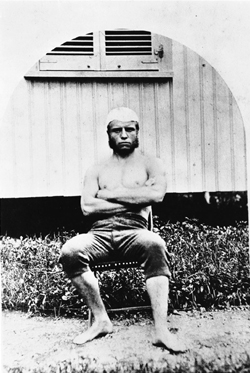
Roosevelt at Harvard University in 1877. Desperate to become masculine he worked-out everyday with free weights.
T.R. at Harvard. (Courtesy of the Theodore Roosevelt Collection, Harvard College Library)
Also, 1876 was a presidential election year, with his father backing Rutherford B. Hayes of Ohio and Uncle Rob behind Samuel J. Tilden of New York. T.R. didn’t get very involved even if, like all good young Republicans, he believed the campaign hoopla: “Hurrah for Hayes and Honest Ways!” Politics was thin gruel to Roosevelt. He complained that both Hayes and Tilden sneered at the teachings of naturalists such as Coues and Darwin. Roosevelt instead pored over zoology books, including the new Manual of the Vertebrates of the Northern United States, whose author, David Starr Jordan, was only seven years older than himself.19 Suddenly, Roosevelt, influenced by Dr. Jordan and Uncle Rob, became interested in game fishes, particularly bass and trout; he was determined to enter Harvard as the best-rounded naturalist of his up-and-coming generation. As promised since the family trip down the Nile, Roosevelt was going to be a Harvard-trained foot soldier in the Darwinian revolution.
II
Before classes started in late September, Roosevelt tried to get his asthma under control. Unfortunately, his breathing had been thick for much of the year. It was as if a fungus had taken hold in his lungs. Because Harvard offered him only first-floor dormitory rooms, Roosevelt sought lodgings elsewhere. (Basements or ground-level rooms developed dampness and mildew, he claimed, which in turn triggered his coughing fits.) Roosevelt—already segregated from mainstream before the first day of class—rented a second floor suite in a house at 16 Winthrop Street (since torn down) just blocks from the campus. There were shady elm trees to admire from his four picture windows and, better yet, he could see the Charles River from the rooftop. Worried that he’d turn his living quarters into a taxidermy studio, Roosevelt’s overprotective sister Bamie prepared the rooms, fixing up his study and alcove.20 “Ever since I came here I have been wondering what I should have done if you had not fitted up my room for me,” he wrote to Bamie in earnest gratitude. “When I get my pictures and books, I do not think there will be a room in College more handsome.”21
Within two or three weeks Roosevelt had transformed his Winthrop Street quarters into a virtual vivarium. Mounted birds cluttered his desk and a well-used portfolio of Audubon’s Birds of America was placed on his shelf like an old friend, soothing and familiar. Stuffed owls, deer antlers, bottles of formaldehyde, arsenic paste, wren’s nests, and colorful eggs abounded—and those were just the inanimate objects. Roosevelt was like a golden retriever; you never knew, when he entered 16 Winthrop Street, whether he would be carrying a wounded squirrel or a kicking rabbit. Then there were the live finches and tadpoles, mice litters, and a formicary. One evening, his landlady—a Mrs. Richardson—nearly tripped over one of his escaped turtles; her face turned white with fright. Even though Roosevelt’s rent money was good, the notion of having a philotherian tenant made her uneasy.22
Having untamed animals running around indoors marked young Theodore as an eccentric at Harvard. This wasn’t necessarily a bad thing, since singularity had its time-honored virtues. After all, Cambridge was replete with brilliant characters. Oliver Wendell Holmes scouted the out-door bookstalls for rare editions, and Henry Wadsworth Longfellow could be seen strolling down Brattle Street window-shopping for elegant canes. The great historian Francis Parkman was sometimes found in the library working onMontcalm and Wolfe, and Charles Francis Adams served as university “overseer.” Charles Darwin’s chief American supporter, the botanist Asa Gray, was no longer teaching at Harvard, but he lived near the campus and was available to answer questions about evolution if any student knocked on his front door. Ralph Waldo Emerson was spied from time to time poking around the campus. (His remark “Nature encourages no looseness, pardons no errors” always appealed to Roosevelt’s bare-knuckled Darwinian sensibility.23) Being different brooked no condensation at Harvard if you were intellectually astute.24
While other freshmen were enthralled that William James and George Santayana were on the Harvard faculty, Roosevelt bemoaned the fact that professor Louis Agassiz—who, like Uncle Rob, had published a landmark book on Lake Superior—had died three years before. During the last year of his life Agassiz—founder of Harvard’s Museum of Comparative Zoology, which soon rivaled its counterparts in London and Paris—traveled to Brazil as an ichthyologist, participated in a deep-sea dredging project sponsored by the U.S. Coast Survey, and founded the Anderson School of Natural History at Penikese Island off the southern coast of Massachusetts. “Study nature, not books” was Agassiz’s dictum. Clearly Roosevelt would have had a lot to learn from the charismatic zoologist, even though Agassiz had been an antievolutionist to the bitter end. One got the feeling Roosevelt had wanted to challenge Agassiz in class over the accuracy of On the Origin of Species. (The old-fashioned Agassiz had fought against having evolution as part of the museum.25)
Perhaps because Roosevelt was autodidact, he wasn’t inspired by any of the geology or zoology professors at Harvard. This attitude caused some classmates to consider Roosevelt a presumptuous snob, and it caused some of the faculty to write him off as lazy and pedantic. These professors weren’t pathfinders or explorers like Audubon or Darwin, and their lectures, without trailblazing deeds, did little to stir the imagination. Microscopes and laboratory garb didn’t interest Roosevelt in the least; the mastodon in Boylston Hall certainly did. A slightly above-average student, earning a cumulative seventy-five in his freshman year and an eighty-two as a sophomore, Roosevelt struggled most with foreign languages.26 Nevertheless, he excelled in German, perhaps because he had lived with a German family in Dresden. Still, he extolled the virtues of Americanism every chance he could, and a slow-burning resentment toward European claims of intellectual superiority was detectable in his letters and diaries. He lampooned the smallness of England and the boorishness of Germany (although the primitive Volk-moot of the ancient German forests always interested him). Perhaps because they were predominately of Dutch ancestry, the Roosevelts often blamed Germany for the worst influences on American life. For example, in his novel Five Acres Too Much (1869), Robert B. Roosevelt complained that Staten Island was “overrun by sour-kraut-eating, lager-beer-drinking, and small-bird-shooting Germans, who trespass with Teutonic determination wherever their notions of sportsmanship or the influence of lager leads them.”27
As for natural history, his major, Roosevelt’s excellence became legendary. However, the example of his faculty adviser, Professor Nathaniel Southgate Shaler, turned Roosevelt off even more from the idea of becoming a scientific naturalist. Ostensibly, Roosevelt should have liked Shaler, who was a prized student of Agassiz and who specialized in the study of what were then called earth sciences. Serving as a captain in the Union Army during the Civil War, Shaler fought nobly; he returned to Harvard as a twenty-seven-year-old professor of zoology and geology in 1865 and would stay at Harvard the rest of his life. By the time Roosevelt arrived to take his Introduction to Geology course in 1876, Professor Shaler had made Harvard the center of American geological research, and his The First Book of Geology was considered a new classic in the field.28 Training students in how to biologically observe natural selection was a specialty of Shaler’s; he was one of the first Americans to adopt Darwin’s specimen collection methods.29
But for a young man who’d already shot plovers in the Middle East (as well as the Adirondacks), and was the son of a New York millionaire, Shaler’s explanations about shifting tectonic plates and paleontology seemed dull; the professor might be a young Turk, but he had abandoned nature’s awesome drama, Roosevelt believed, by an overreliance on arcane theories about ancient dirt and meteorite rock. It was naive of Roosevelt to think that naturalists were buckskin-clad outdoorsmen like Audubon or Wilson, spending their lives in the wild. To Roosevelt, Shaler was a pedant who talked about how the mechanisms of evolution still needed to be ironed out instead of hitting the trail on a treasure hunt. Roosevelt wanted to learn about types of skunks, not faux erudition from a self-conscious Kentuckian struggling to become a prig, poor man. Theodore challenged his professor regularly, until they squared off one afternoon. “Now look here, Roosevelt, let me talk,” an exasperated Shaler stated. “I’m running this course.”30
Roosevelt whizzed his way through a slate of courses in the natural history department: Comparative Anatomy and Physiology of Vertebrates, Elementary Botany, Physical Geography and Meteorology, Geology, and Elementary and Advanced Zoology.31 And in truth, even though Roosevelt refused to give him any credit, Shaler was an inspirational teacher, known for taking students on geology field trips in the tradition of his mentor, Agassiz. Roosevelt, in fact, went on an excursion with Professor Shaler to study glacially formed cliffs. Nevertheless, Roosevelt, in a swipe at Shaler, lamented that Harvard’s president, Charles Eliot, had failed to hire a first-rate “faunal naturalist, the outdoor naturalist, and observer of nature.”32 Yet Eliot believed T.R. and Shaler were two peas-in-a-pod, regardless of intellectual differences.33 Likewise, Roosevelt would convey to Gifford Pinchot that no matter what their squabbles had been, Shaler, in fact, was “a very dear friend of mine.”34
Despite his apparent eccentricities, Theodore was popular with and respected by his classmates. Nobody ever questioned his bedrock honesty or inbred decency. Years later, Richard Welling—in an article in American Legion Monthly—revealed perhaps the strangest personality trait of Roosevelt at Harvard. Whenever Roosevelt was performing gymnastics indoors—doing somersaults, skipping rope, or doing pull-ups—he acted hesitant and clumsy. His caution and trepidation were evident. As Welling bluntly put it, Roosevelt was “verily a youth in the kindergarten stage of physical development.” But when Welling went ice-skating with Roosevelt at Fresh Pond—a kettle-hole lake that served as a reservoir for Cambridge—with the wind-chill factor around zero, the brutal cold would send everybody else home shivering, but Theodore would get an adrenaline rush, shouting, “Isn’t this bully!” He had no fear of frostbite or pneumonia.* This was unusual behavior. Welling realized his friend was overcompensating for something. Nature at its most brutal flipped some switch of fortitude in Roosevelt’s peculiar makeup. “Roosevelt had neither health or muscle,” Welling concluded. “But he had a superabundance of a third quality, vitality, and he seemed to realize that this nervous vitality had been given in order to help him get the other two things.”35
Detachment might be the best word to characterize Roosevelt’s measured indifference to Harvard in 1876 and 1877. Even though his grades were good, he didn’t buy into all of the traditional aspects of undergraduate life as one would have expected. Regularly he would send his father updates from Cambridge, describing in detail his asthma flare-ups and his prayer sessions at the local church. There were soirees at Chestnut Hill and Beacon Hill to report, usually with reassurances that his morals were intact, but his reportage from Harvard seemed contrived. It was his two touchstone places—Oyster Bay and the Adirondacks—that continued to arouse his enthusiasm. And he thought a lot about Maine.
III
Ever since Frederick Osborn had drowned in the Hudson River, a void had existed in Roosevelt’s life. He needed a close chum to share his enthusiasm for ornithology, someone with whom to prowl his favorite hunting grounds come summer break. Now, as a Harvard freshman, he found such a friend in Henry “Hal” Davis Minot of Roxbury, Massachusetts. Hal, a lanky young man with piercing blue-gray eyes and a thin brown beard, had already written a booklet: The Land and Game Birds of New England would be published the following spring. Together Theodore and Hal hatched plans to spend the next summer collecting warblers and thrushes. “Our lessons will be over by the twentieth of June,” Roosevelt excitedly wrote to his parents from Harvard, “and then Henry Minot and I intend leaving immediately for the Adirondacks, so as to get the birds in as good plumage as possible, and in two or three weeks we will get down to Oyster Bay, where I should like to have him spend a few days with us. He is a very quiet fellow, and would not be the least trouble.”36
Haunted by his humiliation at Moosehead Lake, Roosevelt—to improve his physique—boxed regularly during his freshman year. He learned how to throw a pretty good one-two punch, but his eyesight was terrible and he was never light on his feet. What made him quite remarkable in the ring, however, was his godawful ability to take a thrashing, to be pummeled unmercifully but still come back for more. This wasn’t a recipe for winning matches, but it did win the respect of his classmates. Clearly, Roosevelt had a genius for pushing the limits. Instead of hopping onto a streetcar to downtown Boston as most of his classmates would do, Roosevelt often chose to walk the three or four miles. As an oarsman, Roosevelt preferred rowing when a heavy nor’easter kicked up, seeking the challenge of advancing forward in rivers and lakes when the wind was least favorable.
As planned, during the summer of 1877—between his freshman and sophomore years—Roosevelt spent weeks camping in the Adirondacks with Minot. Because Edith had been excited about spending time with Theodore at Oyster Bay, the news that birds came first may have bruised her feelings. As the historian Edmund Morris joked in The Rise of Theodore Roosevelt, Edith “could compete with the belles of Boston, but what were her charms compared with those of the Orange-Throated Warbler, the Red-Bellied Nuthatch, and the Hairy Woodpecker?”37 As soon as classes ended at Harvard on June 21, Roosevelt and Minot headed straight to Saint Regis Lake “so as to get the birds in as good plumage as possible.”38 Once again Moses Sawyer served as the trusted guide through the rugged Adirondack forests, on what turned out to be the most serious bird collecting trip of Roosevelt’s life. Spurred on by his classmate, he made careful notes and pulled together his own first publication on birds: it was modeled on Minot’s The Land and Game Birds of New England, which had just been published by Estes and Lauriat (in cooperation with the Naturalist Agency of Salem, Massachusetts) to fine peer reviews. In fact, Harper’s New Monthly, which had just been launched, commended The Land and Game Birds to “all who care for out-door sights and sounds.”39
The resulting booklet by Roosevelt, The Summer Birds of the Adirondacks, not much more than a broadside, was instantly the finest list on the subject in print. Although Minot was credited as coauthor, The Summer Birds was clearly Roosevelt’s accomplishment, the end product of four collecting trips to the Adirondacks. Roosevelt’s ample descriptions of nearly 100 species were based on firsthand outdoors observations. The Summer Birds, in fact, was impressive in its thoroughness. With an exacting eye, Roosevelt delineated everything from the sprightliness of juncos to the “strikingly” common on least flycatchers. With brevity he analyzed the nests of the Swainson’s thrush and Wilson’s warbler. It was clearly a work aimed at specialists—only a true-blue bird enthusiast would want such a detailed local key.
Sticking to straightforward scientific observation, Roosevelt, perhaps fearful of being trivialized as a populizer, edited his most poetic journal writing out of The Summer Birds. Here, for example, was a journal passage from June 23, 1877, that he apparently deemed too fanciful to include in his booklet. The “we” in the following journal entry refers to Minot, Sawyer, and himself:
Perhaps the sweetest bird music I ever listened to was uttered by a hermit thrush. It was while hunting deer on a small lake, in the heart of the wilderness; the night was dark, for the moon had not yet risen, but there were clouds…. I could distinguish dimly the outlines of the gloomy and impenetrable pine forests by which we were surrounded. We had been out for two or three hours but had seen nothing; once we heard a tree fall with a dull, heavy crash, and two or three times the harsh hooting of an owl had been answered by the unholy laughter of a loon from the bosom of the lake, but otherwise nothing had occurred to break the death-like stillness of the night; not even a breath of air stirred among the tops of the tall pine trees.40
Theodore spent the rest of his summer rowing around Long Island, discussing birds with his father, and preparing his little book for publication. Roosevelt considered it his highest intellectual achievement to date, proof that he had learned “how to read and enjoy the wonder-book of nature.”41 By the time Roosevelt returned to Harvard in September 1877 for his sophomore year, he was ruddy-cheeked, bronzed, hardened, and strangely handsome, and his asthma was in remission. In October a few hundred copies of The Summer Birds were printed. He received accolades from scholars—an important development in enhancing his self-confidence as a naturalist. At the time bird lists for specific locations were considered very important, as national data were just starting to be collected seriously.
No less a personage than Dr. C. Hart Merriam, in fact, a graduate of Yale University’s Sheffield Scientific School, embraced Roosevelt with open arms in the April 1878 Bulletin of the Nuttall Ornithological Club (the house organ for the first organization in North America devoted to ornithology). It was the list’s accuracy that impressed Dr. Merriam, who had just published his own Birds of Connecticut. “By far the best of these recent [bird] lists which I have seen is that of The Summer Birds of the Adirondacks in Franklin County, N.Y.., by Theodore Roosevelt and H. D. Minot,” Dr. Merriam wrote. “Though not redundant with information and mentioning but 97 species, it bears prima facie evidence of reliability—which seems to be a great desideratum in birds lists nowadays.”42
Although the down-to-earth Merriam was only three years older than Roosevelt, he was already a legend among naturalists. Born in Locust Grove, New York, on December 5, 1855, Merriam spent much of his childhood exploring the Adirondacks and hunting mammals with bow and arrow. Like Roosevelt, Merriam had put together his own wildlife museum as a boy. Hart’s mother, objecting to the stench of dead rabbits and squirrels, hired an old army surgeon to teach him taxidermy. Using corrosive sublimate and carbolic acid as his preservatives, young Merriam became something of a prodigy at his craft. In 1871 Hart’s father, a U.S. congressman from New York, playing the role of promoter and coach, took his son to meet Spencer F. Baird at the Smithsonian Institution. Once Baird saw the boy’s work he was awestruck; every specimen of bird or mammal was perfectly embalmed. Even the mounted butterflies and grasshoppers were first-rate. That same year Merriam struck up a correspondence with John Muir regarding glaciation in Yosemite Valley.
Worried that he couldn’t make a living at ornithology, Merriam, whose expertise on the subject of small mammals and fauna led to an assignment by the Hayden Survey classifying animal populations in Yellowstone National Park, was a prodigy who at age seventeen collected 313 bird skins and sixty-seven nests. His resulting fifty-page report was published in 1873 to high praise from zoological circles. Merriam went on to study at Yale University’s Sheffield Science School, and then in the medical school at Columbia University. He practiced medicine in Locust Grove from 1879 to 1885, delivering many babies. Nevertheless, if you wanted to understand elk, deer, or grizzly bears, Merriam was the man to turn to.43
With Merriam’s glowing review in the Bulletin, Roosevelt was anointed an up-and-coming naturalist of the Ivy League and was listed in the 1877 Naturalists’ Directory. He had been accepted by the fraternity of scientists as one of their own.44 The Nuttall Ornithology Club—founded as recently as 1873—had said so. That was good enough for Roosevelt. Although Merriam hadn’t yet reached fame as perhaps the top U.S. government biologist of his generation, the fact that he saluted the Harvard sophomore in such a high-minded fashion won Roosevelt over. Thereafter, he would always hold Merriam in high regard. Nobody working in the Darwinian specimen collecting circuit, Roosevelt believed, knew more about North American wildlife than Merriam. Building on Roosevelt’s Summer Birds, Merriam, in fact, in 1881 published a better “Preliminary Life of the Birds of the Adirondacks.” It was his last foray with birds before his focus shifted to mammals.
Roosevelt followed up on the success of The Summer Birds with a set of profiles, drawn from his Oyster Bay notebooks, of the seventeen rarest birds he had encountered on the North Shore. Privately published in March 1879, while Roosevelt was backpacking in Maine, Notes on Some Birds of Oyster Bay, Long Island featured an unusual range of shorebirds, all listed with their Latin names. Some of his observations were new. Others were coeval with findings of Spencer F. Baird. Dive-bombing mockingbirds had a southern range, for example, but Roosevelt found one, imitating the vocalizations of half a dozen other species near the family’s country home, Tranquility. Four different species of warblers—prairie, golden-winged, pine, and Connecticut—were matter-of-factly included in Notes. But he was most clearly proud of having shot and collected two unusual species: a fish-crow, which constantly harassed gulls to relinquish their prey; and an Ipswich sparrow, which had been discovered by a farmer in 1872. “I shot an Ipswich sparrow on a strip of ice-rimmed beach,” he later wrote, “where the long coarse grass waved in front of a growth of blue berries, beach plums, and stunted pines.”45
Meanwhile, all of the rowing in Oyster Bay and hiking in the Adirondacks was starting to pay off for Roosevelt. He no longer looked like the weakling who’d been harassed by the youths of Moosehead Lake. Physical exertion was now part of his daily routine. He rowed on the Charles River, he did sit-ups and jumping-jacks, and he crammed as much activity into each and every hour as possible.
But all wasn’t well in the Roosevelt family. Theodore Sr. had been diagnosed with stomach cancer, which the New York Times then called a “Hopeless Disease.”46 Carefully, Theodore and his brothers and sisters monitored their father’s failing health, concerned about every chill and cough. He was clearly in deep pain, and his prognosis wasn’t good. During the Christmas season, Theodore was cautiously optimistic, elated that his father’s high temperature had returned to normal. Yet, as Corinne noted, all the “fearful suffering” was turning Theodore Sr. gray when he had “not a white hair before.”47
On Christmas day, Roosevelt listed all the birds and mammals he’d collected for his museum in 1877. For the first time, he included fish (fifty-two brook trout and 120 Atlantic mackerel). Many bird species were also inventoried; it was a strong year for snipes and herons. As for big game, he’d killed his first deer with a rifle. And he felt that much similar success lay ahead because his sick father had given him a double-barreled shotgun as a Christmas present. Just holding it, feeling its lead weight, made Roosevelt anticipate future hunts.48
Later in the winter, once he was back at Harvard, word arrived that his father had died. Theodore took the grim news of February 10, 1878, as a body blow, and his grief was overwhelming. Bravely, he struggled to cope with the loss of “the one I loved dearest on the earth.”49 A curtain had fallen on his life. He had difficulties studying properly and felt haunted by his father’s visage. Roosevelt’s diary entries that winter and spring are full of lamentations: “Sometimes when I fully realize my loss I feel as if I should go wild.” “Oh Father, Father, how bitterly I miss you, mourn you and long for you.” The mainspring of Roosevelt’s life was gone. He prayed incessantly for his father, feeling terribly inferior to him in every way. Comparative anatomy and biology courses lost all appeal to Roosevelt. Slumping silently around Cambridge, he craved the recuperative powers of the wilderness.
Adding to Roosevelt’s depression, Hal decided to leave Harvard midway through his sophomore year, intending to learn law and increase the family fortune. Wasn’t it better, his friend hypothesized, to make big money and be a field ornithologist publishing popular books than to waste years in Harvard Square? Or to act like a New York dandy?
Discombobulated by his father’s death and Minot’s departure, restless beyond words, Roosevelt abandoned the notion of becoming a professional scientist. Years later, in An Autobiography, he explained how his disillusion with the professors at Harvard led him to set out on a different course. “I did not, for the simple reason that at the time Harvard, and I suppose our other colleges, utterly ignored the possibilities of the faunal naturalist, the outdoor naturalist and observer of nature,” he wrote of his defection, with a trace of contempt. “They treated biology as purely a science of the laboratory and the microscope, a science whose adherents were to spend their time in the study of minute forms of marine life, or else in section-cutting and the study of the tissues of the higher organisms under the microscope. This attitude was, no doubt, in part due to the fact that in most colleges then there was a not always intelligent copying of what was done in the great German universities. The sound revolt against superficiality of study had been carried to an extreme; thoroughness in minutiae as the only end of study had been erected into a fetish.”50
Like Minot, Roosevelt had come to the conclusion that a naturalist huntsman who lost daily communication with wilderness was inconsequential. Desperately he craved the tonic of the Adirondacks or Maine, where his mourning could be salved and his nerves steadied. Only fresh, unobstructed air would clear his head. Thoreau had left Concord and headed to Maine’s Mount Katahdin for a rebirth of vitality. To escape the institutional dourness of Harvard, Roosevelt was looking for his own Katahdin to climb. Even though he didn’t consider himself a Transcendentalist, he was thirsting for nature trails and the wide-open wilderness. And he found it in September 1878 near where Thoreau did—in the North Woods of Maine.51
As a faunal naturalist, Roosevelt was revolting against the uninspiring idea that Moosehead Lake or Mount Katahdin could best be understood by specialists studying pine cones under a microscope. Decades later, in Outdoor Pastimes of an American Hunter, he praised Thoreau for writing The Maine Woods but downgraded him for being “slightly anaemic” where hunting was concerned.52 Essentially, Roosevelt saw himself as a bridge figure between Darwinian naturalists and old-time explorers and big game hunters. A conduit between the often clashing fields of biology and the humanities. Not that he was going to bail out of Harvard as Minot had done. To the contrary. His rebellion was of the inner kind. Meanwhile, T.R. had inherited $125,000 (a fortune back then) from his father. Invested wisely, it would yield $8,000 a year, money he began spending on books, wilderness guides, and expeditions.53
On campus Roosevelt started cultivating a lasting reputation for extracurricular achievements such as rowing and boxing. He didn’t turn his back on the scientific establishment completely, for he wrote and delivered papers before the Harvard Natural History Society about “Coloration of Birds” and “The Gills of Crustaceans.” Whenever possible, he interacted with the Nuttall Ornithological Club, which was just starting to champion “citizen bird.” To aged club members, however, Roosevelt seemed a little too self-confident and “cocksure.”54
IV
At last Roosevelt had the wilderness experience he was craving. The place was Island Falls and it was tucked away in the upper reaches of Maine along the shore of Lake Mattawamkeag, an arduous ninety miles north of Bangor. Ever since Arthur Cutler spent a few weeks there with T.R.’s cousins Emlen and James West during the summer of 1876, the region’s vastness, as Cutler reported back to his pupil, had beckoned him. The North Woods of Maine had dramatic storms that rolled in from the Atlantic, crisp air, fast-moving rivers, speckled brook trout, white-tailed deer, herds of caribou, cascading waterfalls, and much more.55 Here an aspiring naturalist could find moose with huge antlers, beaver kits, and flocks of Canada geese. Here was where a real American hunter could test his mettle in the chill of the new morning. “I was not a boy of any natural prowess and for that very reason,” Roosevelt wrote, “the vigorous out-door life was just what I needed.”56
As Roosevelt eagerly anticipated hiking in the North Woods and canoeing on Lake Mattawamkeag with his West cousins, Cutler arranged for the guide from the trip two years earlier. Will Sewall was a native of Island Falls, whose mother and sister ran a lodge while he tramped all over Penobscot and Aroostook counties. Standing six feet tall, with kindly, sparkling eyes that said, “I’ve seen it all, boys,” the gravel-voiced Sewall prided himself on being a stoic and on being early to bed and early to rise. Difficult to startle, wise to the ways of the North Woods, he could forage off the forest by sapping maple trees or eating wild berries.57 Roosevelt immediately enjoyed being in his firm grip.
But there was more than backwoods hardiness to Sewall—he was a virtuous Bible-reading Yankee—who, much like Theodore Sr., frowned upon swearing, drinking, and fornicating. He knew Norse mythology and English literature as well, and he had a penchant for romantic novels like Ivanhoe and the rhyming verse of Longfellow, a fellow Mainer. Sometimes on a long hike he recited John Keats’s “The Eve of St. Agnes” aloud. It begins with the lines “St. Agnes’ Eve—Ah, bitter chill it was! The owl, for all his feathers, was a-cold; The hare limp’d trembling through the frozen grass, And silent was the flock in woolly fold.” Unschooled in Darwin, Sewall, as Roosevelt would soon learn, knew as much as Harvard scholars about Nordic figures like the one-eyed god Odin and the hammer-wielding mighty Thor. To Roosevelt, that Sewall romanticized Vikings as seafaring pagans wielding battleaxes was just another component of his charm as a storyteller.
So when Roosevelt headed north from Boston on the Maine Central (accompanied by his cousins Emlen and James West) past the sawmill centers of downstate Maine he was terribly excited both to explore the virgin sprucelands and to meet Sewall. Roosevelt had spent most of the summer of 1878 in Oyster Bay, playing the ornithologist and the swell. Now, for three weeks in September, just before having to start his junior year at Harvard, he was going to “get lost” in the wilderness. Meanwhile, Sewall’s job was to make sure he really didn’t.
Theodore and his cousins arrived at Sewall’s lodge in the first week of September 1878. Island Falls seemed more like a frontier outpost surrounded by howling wilderness than a town. It was scenic in the extreme: the largest peaks of Maine could be seen from its practically nonexistent town center. This was the great wide-open land. Even as late as 1878, glory-hound outdoorsmen could walk in practically any direction and name a creek or mountain ridge after themselves. The entire area was proof positive that you didn’t need to light out for the western territories to play Jim Bridger or John C. Frémont. Upper Maine was still raw and pristine and inhabited by Native American tribes who knew where the wild grapes grew.
After a round of greetings, the Roosevelt party was ready to set out into the surrounding wilderness. To help out on the trail, the bearded Sewall asked his clean-shaven nephew Wilmot Dow to join them. Sewall was the brains, and Dow had the sheer muscle. “Wilmot,” Roosevelt later wrote, “was from every standpoint one of the best men I ever knew.”58 Both guides were the soul of fidelity and honor. “Theodore was about eighteen when he first came to Maine,” Sewall later recalled. “He had an idea that he was going to be a naturalist and used to carry with him a little bottle of arsenic and go around picking up bugs.”59
They began by canoeing down the Mattawamkeag River until they got to the lake. Then it was another seven miles until they set up camp. As Cutler had expected, Sewall was a bracing antidote to Theodore’s Harvard blues; Roosevelt relished every minute of the outdoors strain. Nobody in the Agassiz School of Zoology, of course, would have thought of Sewall as a naturalist, but Roosevelt did. Bestowing that title on Sewall was part of his rebellion against the laboratory. Roosevelt was immediately impressed by Sewall. “I was accepted as part of the household; and the family and friends represented in their lives the kind of Americanism—self-respecting, duty-performing, life-enjoying,” he wrote, “which is the most valuable possession that one generation can hand the next.”
During their eighteen days in the woods (September 7 to 26), Roosevelt and Sewall shot grouse, flushed out bats, bathed in the river, read scripture, and doused lanterns to sleep under the stars. Instead of inventorying the behavior of birds, Roosevelt seemed bent on assessing his own survivalist abilities. Sadly, Roosevelt felt that he was falling short of the expectations he had set for himself. As if hiking 110 miles with Sewall and Dow weren’t enough, Roosevelt bemoaned how woefully inadequate he found himself as a marksman. “I don’t think I ever made as many consecutive bad shots as I have this week,” he wrote, in a way all true hunters could sympathize with. “I’m disgusted with myself.”60
Such bouts of self-criticism aside, Roosevelt excelled during these September days, and he was entranced by the beauty of the North Woods. Although Sewall thought Roosevelt a “different fellow to guide from what I had ever seen,” he marveled at the way Theodore was “posted” about the politics and literature of the times.61 Even though Theodore was struggling with asthmatic attacks—“guffle-ing” was the way Sewall put it—he admired how the young man never complained, never lagged behind, and never asked for sympathy. There wasn’t anything about Theodore, in fact, that Sewall or Dow didn’t like. “Some folks said that he was headstrong and aggressive,” Sewall later wrote, “but I never found him so except when necessary; and I’ve always thought being headstrong and aggressive, on occasion, was a pretty good thing.”62
V
When Roosevelt arrived for classes at Harvard at the beginning of his junior year, all he could talk about was the North Woods of Maine: the looming mountains, the hemlocks and elms, the mulberries, the thick pines, the birches and wildflowers. He was now a self-styled outdoorsman. “He would come back with tales of exposure and hardship,” his classmate Charles G. Washburn recalled, “and, it seemed to us, which he had enjoyed.”63
To the walls at 16 Winthrop, Roosevelt added hard-earned trophies of Island Falls—a raccoon skin and stuffed ducks. A photograph taken of his room shows it as fairly neat and tidy, with the mounted birds placed under bell jars. Whether Maine was the inspiration or not, his grades went up during his junior year; they included near-perfect scores in zoology and political economy. His natural history library grew, and he treasured a personally inscribed copy of Coues’s Birds of the Colorado Valley.64 Following the lead of his uncle Robert B. Roosevelt, he joined several clubs at Harvard, with Porcellian as his primary focus. His activities as a clubman included serving as vice president of the Natural History Society; he quit this organization during his senior year, however, in an effort to downsize social life at Harvard in favor of time spent with his new love.
That autumn Roosevelt had started dating a conservative Boston girl, Alice Lee, whose parents lived on Chestnut Hill. A beautiful seventeen-year-old, Alice was gregarious and had impeccable manners. Theodore fell for this blond, who was nicknamed “Sunshine.” With compassionate eyes, a tennis player’s physique, and a flirtatious giggle, Alice was the true first love of Theodore’s life. Although there is no evidence to suggest that she shared his enthusiasm for birds, they wandered through meadows together, collected chestnuts, and admired wisteria. Alice, however, had many suitors, and Theodore had to pour on his charm and his gentlemanly ways.
By March 1879 Roosevelt was ready for another adventure in Maine with Sewall and Dow. While other classmates headed south in search of bright weather, Roosevelt took the train north to Island Falls, arriving to find three feet of snow on the ground. Sewall picked Roosevelt up by sleigh at the depot and, with bells jingling, took him to his cabin. For the first time, Roosevelt wore clumsy-looking snowshoes. They were Indian-made with rims of white ash, closed lacing, and the highest-quality rawhide available. Three times longer than they were wide, they enabled Roosevelt to easily get traction on icy surfaces. Temperatures outside had dropped to ten degrees below zero. Ice coated all the bushes and every trace of road. Huge ten-foot snowdrifts buried low-lying cabins like coffins. At times the wind was so sharp with snow that it froze lips shut. Most sane people were huddled indoors by a fireplace, with plenty of lynx furs and wool blankets, but Roosevelt traipsed around the wintry woods in great spirits.
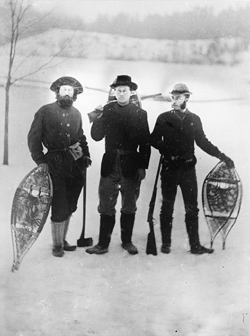
Theodore Roosevelt vacationed regularly in the North Woods of Maine as a Harvard student. In March 1878 he went snowshoeing in the wild. Here (left to right) are Bill Sewall, Wilmot Dow, and Theodore Roosevelt.
T.R. on North Woods of Maine hike. (Courtesy of Theodore Roosevelt Collection, Harvard College Library)
There was nothing passive about the way Roosevelt listened to lumberjack slang and absorbed North Woods tall tales of the Paul Bunyan variety. “Even then,” Bill Sewall recalled, “he was quick to find the real man in the very simple men.”65 Sewall, for example, had two brothers whom T.R. got to know. “Sam was a deacon,” Roosevelt recalled of the pair. “Dave was NOT a deacon. It was from Dave that I heard an expression which ever after remained in my mind.” Apparently one afternoon Dave Sewall was “speaking of a local personage of shifty character who was very adroit in using fair-sounding words which completely nullified the meaning of other fair-sounding words which proceeded them.” Finding such mealy-mouthedness disingenuous, Dave fired off the backwoods insult that they were “weasel words.” As Roosevelt recounted, Dave Sewall said, “just like a weasel when he sucks the meat out of an egg and leaves nothing but the shell.” Roosevelt always remembered “weasel words” as applicable to disingenuous oratory delivered by sham publications.66 Later in life, during his Bull Moose years, Roosevelt used the term “weasel words” in both an article in Outlook and a major Missouri address.67
There was another aspect of Sewall’s life that was similar to Roosevelt’s childhood—childhood sickness. Although he didn’t have asthma, he had been afflicted with hyperthermia, diphtheria, and hearing difficulties. Growing up fragile in such unforgiving country wasn’t an option. Sewall either had to get in shape or die. Much like Roosevelt, he began a successful fitness regime and became an inspiration for the philosophy of mind over matter. Treating lumbering as a sport, he practiced day and night with his ax, priding himself at being able to chop a sycamore down faster than anybody else in Aroostook County. As if performing for Buffalo Bill’s show, he could toss an ax in the air, catch it, and then split a pine log, all in one motion. Starting at age sixteen, he became a boss man for lumber drives, overseeing pine logs floating down the Mattawamkeag River every harvest season, the months of April to July.
Back at Harvard that spring, a self-confident Theodore acted a bit like a roughneck weaned on frozen rivers. The gloves had come off. Bile stirred in his stomach when he thought about all his anti-outdoors naturalist professors. The wilderness had been so intoxicating. One day he was in Cambridge, feeling hemmed in; the next day he was gazing at an ice-sheeted blue lake looking for moose. The North Woods had toughened him, or so he believed. The convivial ways of Sewall and Dow also lingered in him. No longer was he content behaving like an adolescent rajah collecting bird feathers and speckled eggs. Primitive Maine had knocked some of the tameness out of him, significantly. He now considered his asthma an ugly by-product of civilization’s stresses. Reading the Old Testament in Maine by a roaring fire, Roosevelt felt like an American Adam, uncontaminated by the corruptions of Tammany Hall politics or Harvard’s pecking orders. Once again Island Falls—even in a blind frenzy of snow—had redeemed his despair and fixed his determination to marry Alice Lee. “I never have passed a pleasanter two weeks than those just gone by,” Roosevelt wrote to his mother. “I enjoyed every moment. The first two or three days I had asthma but, funnily enough, this left me entirely as soon as I went into camp. The thermometer was below zero pretty often, but I was not bothered by the cold at all.”68
Just as bathing in Walden Pond had been a baptism for Thoreau, Roosevelt now felt the cleansing effect of the horizontally blowing snow in the Mooseleuk Range. It was as if Roosevelt’s worries about asthma had been stolen away by the blanket of icy whiteness. “I have never seen a grander or more beautiful sight than the northern woods in winter,” he wrote. “The evergreens laden with snow make the most beautiful contrast of green and white, and when it freezes after a rain all the trees look as though they were made of crystal. The snow under foot being about three feet deep, and drifting to twice that depth in places, completely changes the aspect of things.”69
VI
No sooner had the spring semester at Harvard begun than Roosevelt started plotting for a return visit to Maine. The spell of the North Woods had fallen over him. Some of his classmates, however, snickered that all Roosevelt learned in Maine was the art of manly bragging. Even though he would spend June and July in Oyster Bay, tending to family obligations, come August he was going to climb the peak that Thoreau had written about, the 5,268-foot Mount Katahdin. Even with Sewall as principal guide, that would be quite a mountaineering feat for a first-timer. Make no mistake about it—this was a big mountain. When a wall of white clouds hovered in the sky, you couldn’t even see the pinnacle from base camp. Mountain climbing, Roosevelt knew, was a far trickier endeavor than hiking in river valleys.
While guests at Oyster Bay were having tea and crumpets, Roosevelt was purchasing camping gear from Greenville Sanders & Sons. His private diaries list a flannel shirt, duck trousers, long underwear, a parka, wool socks, bandannas, a thick blanket, and a bag of “necessaries.” The plan was to make camp at the eastern hinge of Mount Katahdin and climb the narrow ridge among the blackflies and ticks. He hoped plenty of bull moose would be encountered around ponds and lakes as they dined on aquatic plants—Roosevelt desperately wanted a moose’s palmate antlers for his trophy collection, and he wanted to eat a moose steak. In The Maine Woods Thoreau maintained that moose meat was “like tender beef with perhaps more flavor, sometimes like veal.”70 Because Roosevelt had studied the characteristics of bull moose carefully, he understood both their rutting habits and their boreal–mixed deciduous forest habitat.
Roosevelt relished the fact that moose were the largest member of the deer family populating North America, standing six feet tall, with the males weighing up to 1,300 pounds. (A bull bison, however, can be larger, weighing up to a ton.) With their poor eyesight, moose rely on their excellent hearing to escape predators at night. Certainly Roosevelt would have identified with the way the moose turned this deficit into an asset. Their sense of smell was so heightened that a favorite saying of Maine moose hunters was “Keep the wind in your face and the sun at your back” so as not to be detected. Able to run thirty-five miles an hour, neck craning with every sudden noise, the docile-looking bull moose became astonishingly aggressive when feeling threatened. And if a hunter killed a bull moose—which usually took more than a single bullet—two or three grown men were needed to carry the carcass off. Roosevelt was also impressed with the raw strength of the bull moose.
VII
Unfortunately, there is no photograph of Roosevelt on August 23, 1879, when he arrived in Island Falls full of vim and vigor. He was carrying a forty-five-pound pack on his back and held both a shotgun and a rifle in his hands. There was no telling what oddments were inside the pack. You could have recognized him as a greenhorn from as far away as the North Pole. Along with Emlen West and Arthur Cutler, he headed over to the Sewall cabin to plan their climb. Staring at Mount Katahdin, pointing at it with his rifle, Roosevelt spontaneously decided to canoe more than twenty miles to Lake Mattawamkeag (with Emlen) just to loosen up for their big outing.
For eight days the Roosevelt-Sewall party camped and hiked in the Mount Katahdin area. (Today it’s part of Baxter State Park.) A huge mound looming out over a sea of woodlands, Katahdin had a soothing Japanese Zen-like aura. Just staring at the peak made you want to write a haiku. On a clear day from the Katahdin summit, Canada poured open on both sides of the mountain. You could see New Brunswick to the east and Quebec to the west. But that serenity was misleading. One misjudged step on the way up Katahdin could mean a broken neck or death.
About three-quarters of the way up Katahdin, both Cutler and Emlen collapsed from fatigue. Roosevelt soldiered on; he bragged in his diary that he had learned to “endure fatigue” as stoically as any lumberjack, even though his throat was burning and his joints were aching. At one juncture, he claimed he was “fagged” but was not stricken with asthma. His mind, however, was on fire. Looking toward the west, Roosevelt probably could see Moosehead Lake, where “the humiliation” had taken place. He’d come a long way since that hazing. As Hudson Stuck, a member of the first team to climb Mount McKinley in Alaska explained, first-time mountaineers like Roosevelt were embarked on a “privileged communion” with the “high places of earth.”71 And, indeed, as he was ascending Thoreau’s peak, Roosevelt’s heart filled with pure joy; he was double-charged with life, wearing everybody else out.
Once they all returned to Island Falls, Cutler and Emlen decided to call it quits. But Roosevelt wanted another wilderness adventure now, while the adrenaline was still coursing through his body like a river of fire. Full of spark and fizz, he said good-bye to his tutor and cousin and turned his sights to the caribou country around the Munsungun Lake region. The idea was for Roosevelt and Sewall to take a pirogue up the Aroostook River on a hunting jag in search of moose and caribou. They loaded up on hardtack, pork jerky, and flour, gearing up for a grueling nine or ten days combating rocks and rapids.
Refusing to take shortcuts, they forded rivers, slipped on stones in fast-moving streams, shot doves for dinner, and hiked until they dropped in clammy exhaustion. With each effort Roosevelt grew merrier. Tellingly, Cutler later wrote to Sewall that the next time T.R. came to Maine for his “semi-annual visit,” it would be easier to tether a “tame moose” for him to shoot instead of enduring an endless series of obstacle tests around the Munsungun Lake region.
Book Two of Yagyu Munenori’s The Life Giving Sword (part of his samurai meditation on martial arts) gives some insight on Roosevelt’s euphoria during this sojourn. Writing in the seventeenth century, Munenori explains a state of mind he calls “total removal,” a swooping moment when sickness of the mind disappears.72 Conquering Katahdin was the culmination of something Roosevelt’s father had told him: that the body and mind needed to run in tandem, that he had to be whole to succeed. As Roosevelt was going through “total removal,” one can only wonder what Bill Sewall thought when his eager client shouted “Bully!” or “By Jove!” every time the dugout flooded or a thunderstorm drenched them to the bone. But when they parted that September, Sewall promised to keep an eye on the Cambridge-bound Roosevelt from the North Woods. Shared experience, after all, is the cement of all friendships. They had forged an alliance that had all the power of a blood bond.
When Roosevelt left the depot at Kingman, Maine, on September 24, he didn’t know he was saying good-bye to the North Woods forever (the next summer he would visit the well-heeled Maine coast). Over the previous year, he had spent sixty-nine days with Sewall and traveled more than 1,000 miles of rugged backcountry by wagon, canoe, pirogue, and foot. Everywhere they went was as serene as a forgotten battlefield. Never again would Roosevelt write about debilitating asthma attacks or the disease of puniness. In “Jabberwocky” (in Alice through the Looking-Glass and then in The Hunting of the Shark), Lewis Carroll used a word he coined: “galumphing,” meaning, roughly, galloping triumphantly or marching exultantly with “irregular bounding movements.” No word devised before or since then has better described Roosevelt when he conquered Mount Katahdin.73 “As usual it rained,” Roosevelt noted, “but I am enjoying myself exceedingly, am in superb health and as tough as a pine knot.” 74
The fact that Roosevelt left Maine’s North Woods didn’t mean that the North Woods left him. Ardor for the state stayed with him, as permanent as a ring in a redwood tree. Later in life, Roosevelt adopted the bull moose as his political symbol. He even dubbed his Progressive Party of 1912 the Bull Moose Party. Gleefully, Roosevelt, taking a cue from Dave Sewall, constantly accused his opponents of taking every opportunity to use “weasel words.” While serving as president, Roosevelt named his Blue Ridge Mountains retreat—a secluded cabin just outside Charlottesville, Virginia—“Pine Knot.” Bill Sewall’s cabin, where Roosevelt used to lodge, became the first official historic site in Island Falls; eventually, even the lean-to hunting camp on Mattawamkeag Lake was preserved. Meanwhile, the spot along the Mattawamkeag River, where it’s believed Roosevelt read the Bible on Sundays, now has a historic marker in the ground, detailing Roosevelt’s Maine adventures in the late 1870s.
And Roosevelt wasn’t done with the straightforwardness of either Sewall or Dow. Because they “hitched well,” as Sewall put it, Roosevelt summoned them to the Dakota Territory to operate a cattle business in 1884. But that was six years away. First he had to graduate from Harvard and marry Alice Lee—those were his two primary objectives.
Near the end of his life, Roosevelt presented his wilderness days in the North Woods as the apogee of his happiness during adolescence. He became the adventitious expert on Maine. In a nostalgic essay, “My Debt to Maine,” published as part of a volume celebrating the Pine Tree State’s centennial in 1919, Colonel Roosevelt (as his byline read in Maine, My State) noted that camping out in the North Woods had been transformative for him. His memories ran deep: the soft-needled branches; collecting kindling; shoveling snow; building a rainproof bonfire; stirring up embers with a walking stick; the smell of drifting woodsmoke; the cry of a hawk, loud and clear; roasting grouse, venison, or trout on a spit; concocting new dishes like muskrat and fish-duck (merganser) stew; and ladling out Boston baked beans for breakfast. But more than anything else, those shrill high-wind whistles, all those aromas of pine and hemlock and spruce, never faded away.
Maine, to Roosevelt, was where he first found his authentic self. Men acquired the skills of survival early, in such a rugged terrain, if they wanted to succeed in life. In the North Woods, unlike official Washington or Harvard, there was no gyp game. Nor was Maine benevolent or controllable. Death by avalanche, death by frostbite, death by becoming lost—these were hazards men like Sewall and Dow had learned to overcome. The entire state had a stimulating effect on Roosevelt, almost as if it made him drunk. “I owe a personal debt to Maine because of my association with certain staunch friends in Aroostook County,” he wrote, “an association that helped and benefited me throughout my life in more ways than one.”75