
CHAPTER FIVE
I
The Harvard Athletic Association was sponsoring its spring boxing competition and twenty-year-old Theodore Roosevelt had entered in the lightweight division. The rounds were all held on campus, at the old gymnasium near Memorial Hall. Although once denounced as immoral because of its brutality, boxing in 1879 had become chic, particularly in the Boston area, where the Irish-American John L. Sullivan had brazenly challenged anyone with enough guts to fight him for a $500 wager. Even the New York Timesand Harper’s Weekly were pro-boxing, asserting that the sport enhanced physical fitness and manliness. Sullivan was nicknamed the Boston Strongboy; Roosevelt deserved a more Ivy League moniker like the Cambridge Clerk or the Harvard Horticulturist. Even though Roosevelt had been training for months, nobody imagined he’d actually be in a twenty-four-foot ring fighting for a college championship trophy.
That was precisely what happened on March 22, 1879. Besides undergoing intensive training Roosevelt had carefully studied the official Queensberry rules, determined not to lose by default owing to a technical infraction or an illegal maneuver. Grueling as it sounds, the Harvard Athletic Association organized the competition by a process of elimination. You boxed not just one match but two or three in the same day. With the gymnasium packed, his friends and classmates cheering him on, the 130-pound Roosevelt, to the shock of most present, with a couple of good right punches, actually beat a senior, W. W. Coolidge of the class of 1879, in his first square-off. It was considered something of an upset. According to the Harvard Advocate, Roosevelt “displayed more coolness and skill than his opponent.” Meanwhile, C. S. Hanks of the class of 1879 had defeated his opponent in his semifinal round. Therefore, the championship fight that afternoon would be Roosevelt versus Hanks.1
Sitting on a floor seat watching the fisticuffs was Owen Wister, an aristocratic Pennsylvanian who would go on to write the classic western novel The Virginian. Two years behind Roosevelt at Harvard, Wister was something of a class clown, famously contributing both the music and the libretto for the Hasty Pudding Club’s comic opera Dido and Aeneas. As a product of boarding schools in New England and Switzerland, Wister had become extremely erudite by the time he arrived in Cambridge. Just as Roosevelt was an accomplished ornithologist of sorts upon entering Harvard, the easy-tempered Wister had composed songs he thought rivaled the worst of Stephen Foster, which was at least a starting place in show biz. Like Roosevelt, Wister suffered from bad health. Throughout his life he had nervous breakdowns, migraine headaches, sudden tremors, and even prolonged hallucinations; and—again as with Roosevelt—only Mother Nature, it seemed, brought him relief from his physical anguish.2
A shrewd judge of character, Wister studied Roosevelt with puzzlement that afternoon in the old gymnasium, figuring he was going to get his block knocked off by Hanks. As a freshman Wister knew Roosevelt only by reputation but was pulling for him as the well-muscled underdog of the bout. According to the Advocate, it was a “spirited contest,” but Hanks got the “best of his opponent” by his impressive “quickness and power of endurance.” Yet something occurred that afternoon that Wister never forgot, and years later he showcased it as the prized anecdote of his memoir Roosevelt: The Story of a Friendship. According to Wister, amazingly, near defeat, Roosevelt, by virtue of his good sportsmanship, became the real winner of the Harvard bout. As Wister put it, the packed crowd witnessed that “prophetic flash of the Roosevelt that was to come.”
At one point during the bout, in accordance with the Queensberry rules, the referee called time-out, thereby ending a round. However, in the frenzy of the fight, Hanks didn’t hear the referee’s intervention, and just as Roosevelt relinquished his guard, Hanks smashed him in the face. Blood spurted everywhere. The audience gasped; boos and hisses filled the gym. What a cheap shot! But Roosevelt held a boxing glove up in a theatrical gesture, demanding silence from the crowd. “It’s all right,” he reassured the crowd. “He didn’t hear him.”3
As Wister recounted in his memoir, he watched mesmerized as the junior walked over to Hanks with extended hand, simply refusing to be victimized. (Some scholars, however, doubt the veracity of Wister’s story, feeling that the novelist had probably confabulated the bloody-champ aspect of the spectacle.4) With his fine eye for nuance, Wister noticed that Roosevelt’s conciliatory gesture combined dash and spirit. “He was his own limelight, and could not help it,” Wister surmised; “a creature charged with such voltage as his, became the central presence at once, whether he stepped on a platform or entered a room.”5 One can only imagine how proud Alice Lee must have felt learning that her Theodore won over the crowd’s heart by losing the boxing match with such dignity. (Wister intimated that Lee was among the spectators, but it seems unlikely.)
Although Roosevelt kept collecting a multitude of birds, as 1879 turned to 1880 he toyed with the idea of a career in politics for the first time. Business or law brought home income; ornithology clearly didn’t. Also, he was itching to be a public servant for the state of New York; politics ran deep in the family gene pool. Upon his engagement to Alice Lee in February, in fact, he wrote Minot a very telling letter about his future plans. “I have made everything subordinate to winning her,” he wrote, “so you can perhaps understand a change in my ideas as regards to science.” Roosevelt’s main goal in life, as he put it, was to “keep up” the family name.6 He and Alice would marry in October. “Natural History was to remain a genuine avocation,” his biographer Carleton Putnam rightly noted in Theodore Roosevelt: The Formative Years, “but it never loomed again as a feasible career.” 7
By Roosevelt’s senior year at Harvard his classmates respected him for more than just losing boxing bouts and misplacing turtles at 16 Winthrop with a patrician air. Everywhere he walked on campus (or took his dogcart, pulled by his favorite horse, Lightfoot) he was met with “uproarious cordiality.” The combination of having his own horse plus his doggedness and vitality had made Roosevelt legendary by his junior and senior years. Everybody had to admit that Roosevelt was sui generis, that he wore no man’s collar. Although President Eliot later scoffed that Roosevelt took “soft courses” during his last years, keeping a “very light schedule,” he nevertheless received A’s and B’s. Reading over his journal for the senior year 1879–1880 makes it clear that Roosevelt’s worst problem was insomnia. Unable to turn off his mind, he’d spend “night after night” walking by himself in the Cambridge woods near Fresh Pond, sometimes never catching even a couple of hours of shut-eye.8 It appears that Roosevelt was afflicted with some kind of mania.
In Kay Redfield Jamison’s 2004 book about manic depression, Exuberance, Roosevelt is exhibit A for this condition. His set of symptoms—propulsive behavior, deep grief, chronic insomnia, and an all-around hyperactive disposition—demonstrate both the manic and the depressive phases of bipolar disorder. Too often, Dr. Jamison argued, people mistakenly thought manic depression meant despondence and withdrawal from human endeavors. Usually it does. But those afflicted with exuberance, she argued, go in the opposite direction; behaving as relentless human blowtorches they’re unable to turn down their own flame. Diagnosing Roosevelt’s medical condition more than eighty years after his death, Jamison claimed that the highs of the exuberance phase brought many wonderful gifts; but, she warned, there was also a sharp-edged downside. Living by throwing up skyrockets—as P. T. Barnum once put it—wore one down to nothing. No sleep, for example, wasn’t good for the heart or other vital organs. Only by exhausting oneself in physical activity—like climbing Mount Katahdin or ice-skating on the Charles River in a winter storm—could an exuberant manic like Roosevelt turn himself off.9
Essentially, Roosevelt’s exuberance syndrome was both a source of power and a sometimes curse. The poet Robert Lowell once described manics like T.R. as harboring “pathological enthusiasm;”10 Jamison tended to agree. What Jamison admired about Roosevelt, however, was that he channeled his manic-depressive energies in constructive ways, taking what could have been a terrible handicap and using it as an asset. A friend of Roosevelt once colorfully explained T.R.’s ceaseless zest as the “unpacking of endless Christmas stockings,” a description Roosevelt wouldn’t have minded.11 Constantly calling life “The Great Adventure,” Roosevelt derived “literally delirious joy” from Christmas, never wanting the holiday season to end. The more candles lit and carols sung, the happier he was.12
Unfortunately, even though Roosevelt felt fit as a fiddle operating on intermittent sleep, his exultancy was taking a physical toll. On March 26, 1880, Roosevelt went to see Dr. Dudley A. Sargeant, the university physician. On the preexamination form, Roosevelt noted that asthma had bothered him since childhood. As of late, however, he was feeling well and expected a clean bill of health. After thoroughly examining Roosevelt from head to toe, however, Dr. Sargeant pulled his patient aside with troublesome news. There was something wrong with Roosevelt’s heart—it was terribly weak. If he kept exerting himself, he would die young. Sternly Dr. Sargeant told Roosevelt to cease all activity that would make his heart rate go up. Mountaineering, twenty-mile hikes, and even climbing staircases would have to stop. All exertion was unhealthy.
Such a bleak diagnosis didn’t go over well with Roosevelt. He didn’t want to live gently. If he had only a few seasons left to breathe, so be it. Instead of pampering himself or living like a baby he would fight with both fists against the tide of gloomy fatalism. Going back to being a weakling, a runt in the litter of life, was unacceptable to him. Dismissing Dr. Sargeant’s verdict out of hand, Roosevelt started planning a six-week hunting trip with his younger brother, Elliott, to the Midwest heartland. They wouldstart from Chicago, go northwest to Iowa, and eventually wind up on the western edge of Minnesota. Inspired by an earful of Elliott’s Texas bird-hunting triumphs in Galveston and the Big Thicket, eager to learn more about grouse and prairie chickens, Theodore read Coues’s pioneering Birds of the Colorado in preparation.
Later in life, as a politician, Roosevelt downplayed his Harvard years, recognizing them as a liability in a country more impressed with log cabins and cowboy mythology. Furthermore, only one in every 5,000 Americans graduated from college in 1880; merely receiving a diploma meant that one was part of an elite.13 Roosevelt’s diaries, however, show that he was elated at finishing twenty-first in a class of 177.14 And the Phi Beta Kappa graduate had even managed to publish two ornithology chapbooks, a thesis on women’s rights, and wrote chapters of The Naval War of 1812. “I have certainly lived like a prince for my last two years in college,” he recorded in his diary. “I have had just as much money as I could spend; belonged to the Porcellian Club; have had some capital hunting trips; my life has been varied; I have kept a good horse and cart; I have had half a dozen good and true friends in college, and several very pleasant families outside; a lovely home; I have had but little work, only enough to give me an occupation; and to crown all infinitely above everything else put together—I have won the sweetest girl for my wife. No man ever had so pleasant a college course.”15
After dutifully following all the rituals on commencement day—spending time, for example, with Alice Lee’s family in Chestnut Hill—Roosevelt packed up the contents of Winthrop Street and shipped them to the Fifty-Seventh Street house in New York. His plan was to first spend a few weeks in Oyster Bay and then head to the blue-green Maine coast to sun, sail, and explore. Instead of climbing Mount Katahdin, he would enjoy the tumble of the surf on Mount Desert Island, the second-largest island on the Eastern Seaboard. Surrounding the main island were numerous tiny shore islands, each with marine enchantment all its own. After some days with friends Alice would join him.
Partly because Roosevelt was writing The Naval War of 1812—an act of genuine hubris for a twenty-two-year-old—he wanted proximity to the boundless Atlantic Ocean to study the cold, buffeting waters around Mount Desert Island.* Two of Roosevelt’s favorite painters of the Hudson River school, Frederick Church and Thomas Cole, had summered around the Maine island in the 1850s. Recognizing the island as one of God’s great galleries, Church had both painted and sketched landscapes of the indented shoreline with great skill. Two of his faithful renderings—Fog of Mount Desert and Newport Mountain—were beloved by locals for generations. As for Cole, he sketched sixteen natural sites on Mount Desert Island ranging from bold headlands to strands of northern white cedar, red spruce, and black spruce. A particular emphasis was given to blasted pine standing alone on rocky cliffs and to the gorgeous islets that dot Frenchman Bay.16
Roosevelt went to Mount Desert Island with his friends Dick Saltonstall and Jack Tebbetts. They lodged four miles from Bar Harbor near Schooner Head, a huge jagged rock very near the Atlantic Ocean. The trio called the bungalow where they slept “bachelors’ hall.” Right outside their door was the stony beach where crab skeletons, seaweed tangles, and broken shell bits were washed ashore. An immediate favorite locale for Roosevelt was Cadillac Mountain, at 1,530 feet the highest point along the North Atlantic seaboard, and the first place in the United States where you could see the sunrise. Roosevelt also rode horseback over stone bridges and hunted for sea urchins among the shell heaps on Fernald’s Point. He was lulled by the murmuring ocean; he picked baskets of cranberries, collected shellfish in the tidal marsh, and gathered wild berries; and when Alice, unchaperoned, arrived, strolled “with my darling in the woods and on the rocky shores.”
To an ornithologist the sheer diversity of the marine environment of Mount Desert Island offered merriment. Seabirds such as jaegers, shearwaters, puffins, and razorbills were everywhere, prancing around in the surf then flying away when the shades of twilight fell under the full onset of the sea. At Thunder Hole, Theodore and Alice sat entranced as seawater waves rushed in and out of a perfectly formed cave while debonair black skimmers circled above. Soon, however, Roosevelt was sick again, this time stricken with cholera morbus. Dehydration, diarrhea, and body flux ensued. There were no pills or port or morphine to make him feel better. Not only was he unable to show off for Alice but, as he wrote to his sister Corinne on July 24, the infectious gastroenteritis was “very embarrassing for a lover…unromantic…suggestive of too much ripe fruit.”17 Refusing to be an invalid, Roosevelt decided to climb Newport Mountain—with Bar Harbor at its base—as a quick cure while he was recuperating. Onward and upward he went for more than 1,000 feet, peering down at the little harbor skiffs, which looked like bathtub toys from that crow’s nest vantage point. Given that he was ill, Roosevelt’s mountaineering feat at Newport can be attributed only to sheer will—a will ever growing, ever persistent in overcoming obstacles.
II
There was another reason, however, that Roosevelt didn’t collect birds on Mount Desert Island—his mind was reeling over his coming Midwest hunting trip with his brother, Elliott. Together they were going to explore the broad expanse of the Great Plains. Ever since Dresden, Theodore had been struggling to keep pace with Elliott, the most troubled of the four Roosevelt children. Handsome, irreverent, and charming, Elliott—a tenderhearted bon viant—constantly fought against fatigue, dizzy spells, and bouts of depression. He gave no meaningful signs of professional ambition; he simply excused himself from serious work, preferring pleasure. But he was very sweet-natured. According to a well-circulated family story, Elliott, when he was seven years old, took a walk one winter morning only to return without his overcoat. On being interrogated by his parents Elliott explained that he had seen a homeless “street urchin” shivering, so naturally he gave the poor lad his own coat. “I can think of many occasions in his later life when generosity of the same kind actuated him, not, perhaps, to wise giving, for unlike some people he never could learn to control his heart by his head,” his daughter Eleanor Roosevelt, first lady from 1933 to 1945, recalled. “With him the heart always dominated.”18
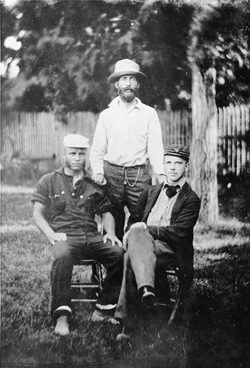
Theodore Roosevelt and his brother, Elliott, with a big game hunting coach.
T.R. and Elliott with big-game hunting coach. (Courtesy of Theodore Roosevelt Collection, Harvard College Library)
A better all-around student than Theodore, Elliott (or “Nell” as the family affectionately called him) was also a tremendous hunter and equestrian who excelled at polo.19 By 1880 Elliott had already hunted wild turkey in Florida and Bengal tigers in India. “Everything is in an advanced state in Texas,” he had written to his father from Fort McKavett, where he was bagging around a dozen birds daily. “By everything I mean all fruits, flowers and vegetables and by Texas I mean the civilized portions thereof.”20 A crack shot and excellent rider, sly as a magpie, Elliott was not overtly proper like his father; he had unfortunately inherited Uncle Rob’s libertine ways and was attracted to the bottle.21
Leaving Maine on August 6, Theodore visited Alice at Chestnut Hill and then his family at Oyster Bay. In the middle of the month Elliott and Theodore boarded a Chicago-bound train from Manhattan, ready to roll across the prairies Francis Parkman had written about so dramatically in The Oregon Trail: Sketches of Prairie and Rocky Mountain Life.22 Like Roosevelt, Parkman believed that actually visiting American landscapes was essential for gaining impressionistic reportorial material to help make a historical narrative come alive for the reader. It electrified Roosevelt that Parkman, a fellow Harvard alumnus (class of 1846), had used his classical education to honor the western frontier in serious historical prose. Roosevelt adopted Parkman—a devoted naturalist and horticulturist, with expertise in roses and lilies—as his guiding light in history studies. And Parkman knew the forests of America better than anybody else alive. To Roosevelt, Parkman, who also suffered from bad eyesight and was nearing blindness, was quite simply “the greatest historian whom the United States had yet produced.”23 Given a choice between Walden and The Oregon Trail, Roosevelt would have chosen the latter every time.
On the weekend before the Roosevelt brothers’ “Midwest tramp,” Theodore was pining for Alice in Chestnut Hill. Although he was quite excited about seeing Chicago and crossing the Mississippi River for the first time, he was already “frightfully homesick” for her. Still, there was a lot of packing and there were many good-byes to make for what was he was calling his western trip. And once they were under way to Chicago, he was filled with excitement, behaving like an able-bodied seaman about to discover the world. “Traveled all day through the wooded hills of Pennsylvania and the rolling prairie of Ohio,” Roosevelt excitedly recorded in his diary. “It is great fun to be off with old Nell; he and I can do about anything together; we never lose our temper under difficulties and always accomplish what we set about.”24
Chicago in 1880 was the regional hub for the entire Midwest. All the major grain-producing states—Iowa, Illinois, Indiana, and Nebraska—used the city as their in-transit wholesale distribution center. If Roosevelt had looked at a railroad map of the trans-Allegheny West, in fact, he would have seen clearly that Chicago was the crossroads—or like a fist with all the ubiquitous track lines extending outward like fingers. The novelist Theodore Dreiser referred to late-nineteenth-century Chicago as the “magnet” city of the Midwest and West. Pioneers overlanding to California by covered wagon or railroad, or on foot, usually began their journey in Chicago. The city had been built on the bottom lip of Lake Michigan and rebuilt after the great fire of 1871. Freighters carried timber and iron ore south from Wisconsin and Minnesota to the city’s cargo ports, warehouses, and railroad yards. Not only did railroads converge there, but the Illinois and Michigan Canal linked Lake Michigan to the Mississippi River, opening up the agricultural markets of the Midwest. In just four years the first skyscraper—the Home Insurance Building—would be erected on the corner of LaSalle and Adams streets. The city was expanding at an amazing clip.
The eye of Chicago seemed to be looking everywhere across America. As the historian William Cronon pointed out in his landmark study Nature’s Metropolis (1991), Chicago in the late nineteenth century oversaw an economic domain that stretched from the Sierra Nevada to the Appalachians, and from Duluth, Minnesota, in the north to Cairo, Illinois, in the south. All the varied ecosystems of the Great Plains about which Roosevelt would later be so enthusiastic—the Sandhills of Nebraska and the Wichita Mountains of Oklahoma, the Great Basin of Nevada and the Badlands of the Dakotas—were all linked to Chicago in one way or another.25 Given his predilection for the outdoors, Theodore wasn’t elated with Chicago; he itched to leave for the neighboring prairies. Having conquered the Adirondacks, the North Woods, and Mount Desert Island, he craved the fabled pastoral life of the Great Plains, which Washington Irving had written about in A Tour on the Prairies (1835).26 As a fan of Zebulon Pike, he had a headful of frontier myths about discovering the headwaters of the Red and Arkansas rivers (he never quite found them on this Midwest tramp). Over the coming weeks, Theodore and Elliott would hunt grouse, with the euphoria of treasure hunters, in three separate locales: Huntley, Illinois; Carroll, Iowa; and Moorhead, Minnesota, which sat on the border of the Dakota Territories.
The Roosevelt boys’ guide in Illinois was “a man named Wilcox”—his first name remains unknown—whom Theodore mentions only perfunctorily in the diaries he kept.* Clearly, to Theodore’s mind, Wilcox was no Bill Sewall or Moses Sawyer. But in a letter of August 22 to his sister Anna—posted from the Wilcox farm in Illinois—T.R. did reflect on the hardworking midwesterners he was meeting. Huntley was a tiny village with only one paved street. From the town center there was plenty of cropland to be seen in every direction, but there were virtually no woods—only a few scattered trees. “The farm people are pretty rough but I like them very much,” he wrote to Anna. “Like all rural Americans they are intensely independent; and indeed I don’t wonder at their thinking us their equals, for we are dressed about as badly as mortals could be, with our cropped heads, unshaven faces, dirty gray shirts, still dirties [dirtier] yellow trousers and cowhide boots; moreover we can shoot as well as they can (or at least Elliott can) and can stand as much fatigue.” 27
In many respects, the Midwest tramp became a hunting competition. Which brother could bag the most game? Because Elliott, who was two years younger, had already worked up his competitive appetite by flushing out prairie chickens in scrub brush in the Texas, he was the veteran. To Theodore, by contrast, it was all a new experience. He noted in his diary that it was “great fun to try this open plains shooting to which I am entirely unaccustomed among such vast, almost level fields, with so few trees.”28 After a couple of days in what Theodore referred to as the “fertile grain prairies,”29 both brothers had bagged many kinds of game birds—doves, ducks, snipes, grouse, plovers. They also collected gophers, impressed by their curved claws, used for tunneling through loose oil. “We had three good days of shooting,” he wrote to Anna, “and I feel twice the man for it already.”30
Yet ultimately the rural folks he encountered in Huntley fascinated Roosevelt more than the prairie chickens in the brush. Being a hunter and bird-watcher had taught him the art of observation, and now he was applying it to studying both rural and transient people. This would become a trademark of his future hunting and wilderness books. “I have been much amused by the people in this house, especially the labourers; a great, strong, jovial, blundering Irish boy; a quiet, intelligent yankee; a reformed desperado (he’s very silent but when we can get him to talk his reminiscences are very interesting—and startling); a good natured German boy who is delighted to find we understand and can speak ‘hochdeutch,’” he wrote to his mother on August 25. “There are but two women; a clumsy, giggling, pretty Irish girl, and a hard-featured backwoods woman who sings methodist hymns and swears like a trapper on occasion.” 31
At times on his Midwest tramp it almost seemed that Roosevelt was an onlooker, observing the styles and fashions and habits of American characters with the eye of a novelist. Although never abandoning his aristocratic bearing and always staying a bit removed, Roosevelt sometimes actually wore the garb and adopted the folkways of the regional people he encountered, in hopes of blending in. You might say he was a method actor of the Stella Adler school, playing in an American Arthuriad while mixing it up with different midwestern types like Iowa wheat farmers or Illinois dairymen. Elliott still dressed like a man of substance, sticking to gold scarves and polished boots. His wardrobe expressed his innate sense of aristocratic entitlement, and he had even taken to smoking a long-stemmed pipe. By contrast, Theodore wore dungarees and cotton work shirts and preferred his boots mud-stained. “I am afraid you would disown me if you could see me,” he boasted to his mother from the Illinois prairie. “I am awfully disreputable looking.”32
The bird collecting in Huntley, however, was a disappointment. “Before the sun was up we started off, tramping in sullen silence through the wet prairie grass,” he wrote in his diary, “but we found few birds and shot very badly.”33 Truth be told, the flat Illinois countryside lacked the geographical breadth Roosevelt had hoped to encounter. “I broke both of my guns, Elliott dented his, and the shooting was not as good as we expected,” he wrote to his sister Corinne. “I got bitten by a snake and chucked headforemost out of the wagon.”34 On August 27, after a particularly bad day’s hunting, a dejected Roosevelt recorded, “The country is shot out.”35
The Roosevelt brothers returned to Chicago for a few days to clean up and plot the next phase of their expedition. They stayed at the Hotel Sherman, which had burned down in the great fire and been rebuilt. Theodore found it off-putting and dreary. If he had wanted society life or afternoon tea, he could have gone to the Fifth Avenue Hotel. Still, he wasn’t much interested in meeting labor activists or radicals of any stripe, either. Nor did he write about the swirl of immigrants—Germans, Irish, Poles, and Swedes—who were pouring into the city. What was exciting to him, however, was Chicago’s role as the gateway to the great West. Walking the railyards he could for the first time imagine Lincoln’s rise as a populist, and the drama of Bleeding Kansas. How strange it was to think that Mary Todd Lincoln was living downstate in corn-stubbled Springfield, where her husband was buried, housebound after being released from the Bellevue Place insane asylum. It had been fifteen years since the tragedy at Ford’s Theatre, but Roosevelt still considered himself a Lincoln man. He could sense the power of Lincoln’s presence everywhere in Illinois and the surrounding prairie—the ghost of Lincoln, as the poet Vachel Lindsay wrote, haunted the streets, and “the sick world” still cried.36
Once again Wilcox collected the Roosevelts in Chicago—this time with an engineer and a former Confederate soldier in tow—for the second leg of the Midwest tramp. The party boarded the Chicago and North Western—nicknamed the “Pioneer Railroad”—and headed straight toward the Mississippi River as night fell. After crossing the Big Muddy at Davenport, their train rumbled on through Iowa City, where a state university flourished, and onto Grinnell along Rock Creek Lake, where farmers angled for crappies and bluegills in the long Indian summer. Eventually they found themselves in the small town of Carroll in western Iowa. This county seat, surrounded by strands of big bluestem grass, had a steel flour mill, eight general stores, five restaurants, and two grain warehouses, but life ran at a slow pace. People sometimes just sat by the river, a meandering brown stretch of the Des Moines. The previous year, most of the business district of Carroll had been destroyed in a fire, and the townsfolk were slowly starting to rebuild. There was nothing urban about the semi-prosperous community except the railroad depot.37
The Roosevelts leased a two-horse wagon and started hunting on the outskirts of Carroll, with a pack of eager dogs, roughly following the North Raccoon River northwest into what was considered one of the best prairie fowl hunting areas in the United States.*Theodore observed how “absolutely treeless” and “sparsely scattered over with settlers” western Iowa was.38 There was no misunderstanding why locals were called flatlanders—only the occasional low hill, high bluff, or forlorn dale was to be found in Carroll County. The creek grades were so gentle that horses and oxen meandered across them with little or no difficulty. The Homestead Act of 1862 had drawn German, Scandinavian, and Czech immigrants to western Iowa, and Roosevelt enjoyed meeting them, saluting their durable “pioneer stock.” Many of these flatlanders, however, were struggling in the 1880s; commodity prices had fallen, and it was difficult to overcome the fixed costs levied by grain elevators, railroad concerns, and butcher-yard operators.
Stricken with both asthma and cholera in town, Roosevelt nevertheless managed to bag the most game birds of his life around a plateau called Wall Lake, frequently referred to by locals as “goose pond.”39 Wildlife was abundant here. Using five Irish setters—“three of which worked well, the other two simple nuisances”—they kicked up covey after covey. Hardly trying, Roosevelt bagged thirty-eight grouse, five quail, one bittern, one grebe, and thirty-six yellowlegs (tall, long-legged shorebirds of freshwater ponds with a white rump, known for announcing themselves with a piercing “tew-tew-tew” siren wail). The sojourn in Illinois, by contrast, had yielded only thirty-five birds. And there were lots of other birds Roosevelt didn’t shoot in Iowa, only observing them in his diary. “There was a large flock of pelicans on the lake,” he noted on September 8, “and thousands of yellow-headed blackbirds.” *40
In the Iowa brakes the sodbusters had a keen sense of nature’s beauty and bounty. Even their economic problems couldn’t get them to abandon the land. There was something about the constrained landscape—whether it was the natural meadows or the planted acres of wheat—that soothed the soul. There was natural beauty everywhere in Iowa if you only knew how to look. Joy seemed to be found by modest Iowa farmers even in the dust of summer. They were what Emily Dickinson had referred to in her poem “A Narrow Fellow in the Grass” as “nature’s people.”41 Back east, city dwellers like himself studied nature too much; in Iowa people lived with it as if by the grace of God. There was a subtlety to the Iowa plains that liberated Roosevelt’s psyche in a way he hadn’t anticipated. “No nation has ever achieved permanent greatness unless this greatness was based on the well-being of the great farmer class, the men who live on the soil,” Roosevelt would write of the Midwest as president, greatly influenced by this trip. “For it is upon their welfare, material and moral, that the welfare of the rest of the nation ultimately rests.”42
III
Once again, after shooting their fill of birds in Carroll County, muscles sore, the Roosevelts headed back to bustling Chicago to regroup. Although Roosevelt never declared it right out, his brother was grating on him a little. Perceiving himself as an authentic naturalist hunter of the Mayne Reid school, Theodore wrote to his sister Corinne that Elliott, by contrast, “revels in the change to civilization—and epicurean pleasures.” Because Roosevelt never overate and never drank much more than a glass or two of alcohol, he mocked his younger brother’s gluttonous ways. “As soon as we got here [to Chicago] he took some ale to get the dust out of his throat,” Roosevelt continued, “then a milk punch because he was thirsty; a mint julep because he was hot; a brandy smash ‘to keep the cold out of his stomach’ and then sherry and bitters to give him an appetite.”43
Holed up again at the Hotel Sherman, the Roosevelts were particularly glad to be rid of Wilcox’s two companions, the prattling engineer and the unreliable ex-Confederate soldier. They visited a gunsmith, who was unable to fix their damaged rifles, so they both bought new ones. They were now more determined than ever to turn their next adventure into even more birds bagged. Leg three of their Midwest tramp would be to the Red River country of Minnesota, part of the vast Hudson Bay watershed and reportedly abounding with wildlife. Newspapers back in 1880 often called the 550-mile tributary the “Red River of the North” to help differentiate it from the southern tributary of the Mississippi River, which formed part of the border between Texas and Oklahoma. The Roosevelt brothers stayed in Moorhead, a small city located on the border of North Dakota (or the Dakotah Territory, as it was known then). That’s where their cousin Jack Elliott lived, and the brothers were excited about spending time with him flushing out ruffed grouse from the forestland. Not since Dresden had the three been together.
Unlike Harvey and Carroll, Moorhead was irrigable, and a transportation hub in the Wild West for merchandise and agricultural products, situated conveniently between the Twin Cities of Minneapolis–Saint Paul and Winnipeg, Manitoba. Founded in 1871 by William G. Moorhead, a director of the Northern Pacific Railroad, it was notorious as a “sin city” because of its 100 or more smoky bars (and, one assumes, brothels).44 There was a certain unhurried stillness in the air around Moorhead that had an enduring appeal for Roosevelt. Here, among the “guns of autumn” (as fall hunting was called in Minnesota), for the first time in his life, Roosevelt felt the lure and tug of the Wild West he had read about. Staying at a “miserable old hotel” surrounded by a strip of bars, he could imagine himself in Tucson or Dodge City, where the saloon doors always swung open. (The outlaw Jesse James had launched his career as a notorious bank robber in 1876, just over 200 miles down the road in Northfield, Minnesota.)
Taking a buggy out to the countryside with his brother and Jack Elliott, Theodore marveled at how easy it was to snare grouse in Minnesota. The great challenge in shooting these birds was that they clustered in dense, prickly thickets and usually flushed dramatically without warning.45 There was perhaps another reason that Roosevelt wanted to hunt in the lazy Red River region along the border between Minnesota and Dakotah territories. The Red River was in the middle of a crucial migratory route for dozens of bird species. Surely Roosevelt also knew that eagles and owls roosted permanently around the river bottom forests and remnant prairie.46 With the assistance of a “stub tailed old pointer” (and a Moorhead barkeeper who daylighted as a cart driver) he borrowed along the way in Saint Paul, Theodore’s goal was simple: shoot more game birds in Minnesota than he had shot in Illinois and Iowa combined; fill up those tarpaulin sacks.47
Unsurprisingly, Roosevelt relished playing a Minnesota-Dakota sportsman with shells in his jacket pocket, wandering through plowed land listening for the whir of wild ducks, and flushing ruffed grouse out of open grasslands and forest thickets. The desolate countryside was crisp and lovely in mid-September. Columns of cumulonimbus clouds ascended and spread in the blue sky. There wasn’t a hitching post for miles. Already the aspen and ash were starting to take on fall colors as dramatic as those in Vermont. This was the autumn rutting season, and the young four-point deer were challenging the eight-pointers over females. Roosevelt’s most memorable nights in Moorhead were spent camping under the stars, the fall nip adding an aura of romance to the outings. Although Theodore and Elliott were not good cooks, they had mastered the art of cleaning the chicken-sized grouse. Every night they stuffed themselves with fire-roasted bird until they burped.
For ten days in Minnesota, Roosevelt bagged more than 203 game birds, carefully listing them in his diaries: 95 grouse, 51 snipe, seventeen ducks, sixteen plovers, one goose, and so on. He had beaten his own Iowa record. Clearly Theodore was no longer collecting specimens or playing ornithologist. More telling, however, was his side note that Elliott had bagged only 201.48 That means he had beaten the “old boy” by two birds. Much of the time in western Minnesota Roosevelt had terrible asthma and was forced to sleep sitting up, dreaming intermittently, perhaps, about the prairie potholes of the Dakotas, where the hunting was supposed to be even better than in Minnesota’s Red River region.
One morning Theodore and Elliott awoke at dawn and went searching for grouse hot spots. Carefully listening for the birds’ drumming noise—which sounded like a stomach growling—the Roosevelts got their game. They also got lost in a “cold driving rain storm”—so lost, in fact, that at dusk they were forced to knock on a Norwegian farmer’s “neat but frail little house” asking to “put up for the night.”49 It was a scene straight from the pages of Giants in the Earth. According to his diary Theodore lay silently that evening in front of the fireplace while the wind blew hard outside. He was covered by a bison robe but was unable to sleep. This was his first real western experience. To Roosevelt, however, getting lost in Minnesota was “lovely,” a softer alternative to “bully.” During the coming days the Roosevelt party would camp along a bend of the Buffalo River—an eighty-eight-mile tributary of the Red River, lined with hardwoods, which looked like a poorly maintained Dutch canal.50
Roosevelt’s fierce competition with Elliott does show that he used the sport as a mechanism to enhance his manly self-worth. His grousing also reflected class-consciousness. Men with an aristocratic mien shot game birds with a retinue of guides; by contrast, the working class went after squirrels and raccoons with a mongrel dog. Game laws made sense when you were rich, looking for sport. Poor people shot game—with or without laws—just to stay alive. Much like being initiated into Porcellian at Harvard, grouse hunting to Theodore was a rite of initiation into manhood with his younger brother. The very act of flushing grouse together was a brotherly bonding experience.51
Another outcome of Roosevelt’s midwestern tramp was that he grew less interested in birds and more intrigued by the notion of hunting big game. After all, being wrapped in a buffalo robe in Minnesota wasn’t the same as either shooting a bison or seeing a thinned-down wild herd with his own eyes. “No man who is not of an adventurous temper, and able to stand rough food and living,” he soon wrote, “will penetrate to the haunts of the buffalo. The animal is so tough and tenacious of life that it must be hit in the right spot; and care must be used in approaching it, for its nose is very keen, and though its sight is dull, yet, on the other hand, the plains it frequents are singularly bare of cover; while, finally, there is just a faint spice of danger in the pursuit, for the bison, though the least dangerous of all bovine animals will, on occasions, turn upon the hunter and though its attack is, as a rule, easily avoided, yet in rare cases it manages to charge home.”52
After so many grouse, Roosevelt wanted to someday travel west of the Red River into buffalo country. (And he would have to do it soon, for the cattle were taking over.) Being in Moorhead was akin to traveling 1,400 miles to see a major attraction—buffalo—and then never entering the admission gate. He had, however, seen plenty of cattle. Between 1877 and 1885 more than 2.5 million head of cattle were slaughtered in Chicago; Roosevelt had been able to see the stockades and corrals for himself.53 What he hadn’t been able to witness on his midwestern tramp, however, were the cattle drovers herding from Fort Worth north by the ninety-ninth meridian to Ogallala, Nebraska, and from there into the northern plains of Montana, Wyoming, and the Dakotas. Because he had not seen the great herds of buffalo and cattle, Roosevelt believed he had missed the main thrust of the western expansion. He vowed to return. Nobody would have to lend him a buffalo robe. He’d earn the next one for himself.
Paradoxically, that odd night with the buffalo robe in a stranger’s home was in many respects Roosevelt’s good-bye to his rigorous outdoors life for a while. Maturity and responsibility beckoned. Perhaps the recent college graduate wanted to push on westward through the Dakotah Territories to the Bitterroots, where the elk ran in healthy herds and the geysers of Yellowstone were reliable. But he couldn’t. He was planning to start studying law in New York and he was getting married the next month. His diary, in fact, abounds with paeans to Alice Lee: “She is so pure and holy that it seems almost profanation to touch her, no matter how gently and tenderly.” “My happiness now is almost too great.”54 It was as if he couldn’t write her name without bursting a vein. Pausing in Saint Paul about to board an eastbound train, burning with impatience to get home, he sounded tired: “How glad I am it is over,” the wanderer wrote from the depot, “and I am to see Alice.”55
Once he caught up with Alice in Chestnut Hill, everything became a whirlwind. In quick succession he enrolled at Columbia law school, purchased a diamond ring, spent two weekends at Oyster Bay with his mother, rode Lightfoot far and wide, chopped down trees for winter firewood, and prepared himself for his vows at the Unitarian Church in Brookline, Massachusetts. Sometimes he took long walks across green fields, and nobody knows what he thought.
IV
Everything went flawlessly on the wedding day of Theodore and Alice, October 27, 1880. Elliott arrived on cue to serve as best man. “At twelve o’clock on my twenty-second birthday, Alice and I were married,” Roosevelt wrote in his diary. “She made an ideally beautiful bride; and it was a lovely wedding. We came on for the night to Springfield [Massachusetts] where I had taken a suite of rooms…. Our intense happiness is too sacred to be written about.”56 The newlyweds honeymooned at Oyster Bay, with plans for a long springtime journey to Europe. To T.R. marriage clearly meant that hunting had to come second or third. No longer does he fill his diaries with bird sightings. Although he never slackened his pace, still hurrying on in everything he pursued, a domestication had taken place. Never once did his marriage become imprisoning. His diary entries now mention silk jackets, pajamas, lovely drives, and even chats with Alice while she was sewing. He gloats in his diaries about how he “won” Alice, worshipping the trill of her voice and the shape of her body. Politics also rose to the forefront of his thinking. On November 2, for example, he recounted how he proudly voted for James Garfield, the Republican standard-bearer, for president.
After the New Year Theodore and Alice moved into Manhattan, to the mansion on West Fifty-Seventh Street. Life was quite good. Roosevelt had learned to dam his pent-up tears whenever his father’s memory was evoked. Wandering around the Bronx from time to time to get his nature fix amid the clamor of the new elevated railroads, Roosevelt daydreamed about the open spaces of the Far West. New York was getting crowded. Too many of the gadgets of tomorrow first showcased at the 1876 Philadelphia Exposition were now fairly commonplace. Bicycles were all the rave, as were typewriters. Theodore took to neither. (Robert B. Roosevelt, however, was a champion of both.)
Amid the many New York galas and soirees, Roosevelt, however, seemed to have deferred his need for wilderness. Besides attending Columbia law school, he was writing the last chapters of The Naval War of 1812. Books about Commodore Oliver Hazard Perry and Admiral John Paul Jones, not Elliott Coues’s newest bird key, now caught his eye. As a married man, he found that his diary writing waned, as did his taxidermy. His sketch pads were filled not with mice but with brig sloops. When drafting chapters about the Great Lakes, for example, Roosevelt never mentioned the nesting areas of plovers, gulls, or terns.
There was, however, an exception: he was writing an essay about an ornithological trip with Elliott in December 1880 aboard a twenty-one-foot sailboat around Long Island Sound. The short nautical-naturalist essay was called “Sou’-Sou’-Southerly”—the vernacular name for old-squaws (Clangula hyemalis).* On March 24, in fact, a frustrated Roosevelt wrote in his diary that he was “still working hard at…one or two unsuccessful literary projects.”57 The first of these was The Naval War of 1812; the second was the Robert B. Rooseveltish “Sou’-Sou’-Southerly.”
A strong case can be made that “Sou’-Sou’-Southerly” was the first authentic naturalist essay ever fully realized by Roosevelt.58 It was written for publication in a sporting magazine but was—for whatever reason—never published. Based on his frozen, white-capped nautical journey with Elliott in a sloop traveling from Oyster Bay to Huntington Bay, the narrative hinged on the perils of duck hunting in the bitter cold of Long Island Sound. The Roosevelts overcame ragged floes, heavy seas, and icicles overtaking their beards, all in the name of bird hunting. “The snow storm had now fairly set in, the hard flakes, mingled with flying spray, driving fiercely into our faces, and (for the short winter day was already becoming even duller and grayer as evening drew on),” Roosevelt wrote, setting the stage, “the land was entirely veiled from our sight thought not far distant. Sometimes there would be a few minutes lull and partial clearing off, and then with redoubled fury the fitful gusts would strike us again, shrouding us from stern to stern in the scudding spoon drift.”59
If all Roosevelt wrote about in “Sou’-Sou’-Southerly” was ice-laden waters and wind, then history could chalk it up as a solid first effort by an aspiring adventure writer. Many of his nautical references, in fact, gave the impression that he was showing off. And, as usual, Roosevelt also wrote with far too many semicolons. But owing to its Audubon Society overtones Roosevelt’s essay offered much more than what one expects from an initial essay—“Sou’-Sou’-Southerly” is filled with his able portraits of such winter birds as coots, dippers, sheldrakes, and bluebills. Checker-back loons wade in shallow coves trying to shelter themselves from arctic-like gusts, and black ducks with white-and-chestnut plumage shake off the curlers breaking over their water-resistant bodies. Only a committed naturalist who cared deeply about shorebirds could have written “Sou’-Sou’-Southerly.” Although Roosevelt wrote about hunting black ducks in this piece, he had also captured their magnificence in real-time camera-like prose.60
Even though Roosevelt was writing The Naval War of 1812 and perfecting “Sou’-Sou’-Southerly,” he followed through on his commitment to squire his wife around the grand capitals of Europe that summer. Emulating his father, he created a breakneck itinerary for them and kept it. Even though Alice had horrendous stomach problems they toured Irish castles, steamboated on the Rhine, shopped in Munich, and fished on Lake Como. Surprisingly, he didn’t care for much of the European art. Strangely, the sensuous women models of Rubens seemed to him like “handsome animals.”61 But for the most part Europe—as it had when he was just a little boy carting around arsenic paste—made him homesick. While he was in France and Italy, the word “wretchedness” became one of his favorite adjectives. A longing for the American wilderness returned to the forefront of his thinking. Even London’s Zoological Gardens disappointed him. Ironically, the British zoologists weren’t taking Darwinian advancements into their displays. Then there was the awful news that President Garfield had been shot and was in critical condition. “Frightful calamity for America,” he wrote in his diary.62 It seems the tragedy made him want to return home, but he didn’t.
Although they hadn’t seen each other for a few years, one of Roosevelt’s principal correspondents from that summer of 1881 was old Bill Sewall of Island Falls, who eagerly collected his young friend’s special-delivery missives from the little postal box. Clearly Roosevelt was still thinking about the Maine wild—and the exhilaration of climbing Mount Katahdin. Disregarding his Harvard physician’s recommendation to watch his heart, Roosevelt prepared to hike up the Matterhorn on his own while Alice rested in a hotel in Zermatt. Remembering all the lessons he had learned from Sewall, he had decided, quite spontaneously, to climb Switzerland’s famous peak as a retort to a cabal of snobby English climbers he had accidentally encountered in the hotel lobby. He was determined to prove to them that “a Yankee could climb just as well as they could.”63 Writing to his sister Bamie, he added that conquering the Matterhorn that August would give him at least the credential of being a “subordinate kind of mountaineer.”64
For serious mountain climbers, conquering the Matterhorn was an initiation ritual; if you could make it to the summit you were accepted as a player. The 14,690-foot Matterhorn was first successfully climbed twenty years before, in 1861, by the Englishman Edward Whymper. His 1880 book The Ascent of the Mattern was all the rage in Europe. Since Whymper’s historic climb, hundreds of others had accomplished the feat (including Lucy Walker, the first woman to make the ascent), and the Swiss Alpine Club had built a shelter for climbers to rest and sleep in at 12,500 feet, which made a big difference.65 Here is an excerpt from a long letter of August 5, 1881, that Theodore sent to his sister Anna, proud of his feat: “We left the hut at three-forty, after seeing a most glorious sunrise which crowned the countless snow peaks and billowy, white clouds with a strange crimson iridescence, reached the summit at seven, and were down at the foot of the Matterhorn proper by one. It was like going up and down enormous stairs on your hands and knees for nine hours.”66
By making it to the top of the Matterhorn, Roosevelt, in essence, felt he had conquered Europe. He also climbed the Jungfrau, a peak only slightly less difficult for experienced mountaineers. Nevertheless, in Roosevelt’s mind the wilderness of America was more divine than the tame Alps and Pyrenees. As the historian Louis S. Warren noted in The Hunter’s Game, Roosevelt—like many of his generation—had come to believe that the United States was “nature’s nation,” that the pristine landscape represented God’s best work.67
In retrospect the most amazing part of Roosevelt’s European jaunt with Alice Lee—exemplified by climbing the Matterhorn—was his stamina. Zigzagging from city to city, he nevertheless kept assiduously working on The Naval War of 1812, preparing his manuscript for publication in May–June 1882. His powers of concentration that summer were amazing. No matter what task Roosevelt undertook, he was like a boll weevil eating its way through a bale of cotton. Over the years scholars of Roosevelt as a military man have garnered plenty of useful biographical tidbits from reading his diary entries about standing at Napoléon’s tomb and contemplating Caesar, Tamerlane, and Genghis Kahn. But for the conservationist-minded, the most interesting aspect of these months abroad was Roosevelt’s rejection of European nature in favor of American wilderness. He believed that the Europeans, with the exception of Scandinavians and British, had recklessly shot out all the wildlife. Because this was Roosevelt’s first foreign trip since experiencing Maine and Minnesota, he was now touting his glorious homeland as a Garden of Eden. “The summer I have passed traveling through Europe, and through I have enjoyed it greatly,” he wrote to Sewall, “yet the more I see, the better satisfied I am that I am an American; free born and free bred where I acknowledge no man as my superior, except, except for his own worth, or as my inferior, except for his own demerit.”68
V
Upon returning from Europe, having squandered part of his inheritance, Roosevelt immediately threw himself back into the urban fray. He was happily married, enjoyed learning law, and, as an impassioned conversationalist, had an easy time making new friends. His asthma and weak heart weren’t giving him problems. He was finishing his book, which was scheduled for publication the following spring by G.P. Putnam’s Sons. To top the year off, that November he was elected to the New York state assembly from the twenty-first district.
When Roosevelt took office on January 2, 1882, he swore he’d be a steel-fisted reformer like Uncle Rob. He would hunt down thieves, swindlers, polecats, and robber barons; more controversially, he was willing to expose the frauds and shenanigans of the very governing class he was part of. He was itching to earn his spurs in the rough-and-tumble of New York politics. He wanted everything cleaner and better. It was no coincidence that the first bill he embraced would improve street cleaning in the city, and that it had a provision for the better treatment of workhorses.
Vivid stories abound about Roosevelt in Albany, dashing around in his frock coat trying to learn the rules of engagement. He was determined not to run with the wrong crowd, fearing being lampooned in the press as “politics as usual.” Fancying himself a change agent or reformer, he refused to see the world in gray, making snap judgments of his fellow legislators’ personalities that were oftentimes unfair. They were either good or evil, trustworthy or untrustworthy, front-parlor fresh or operators of smoke-filled backrooms. “He would come into that house like a thunderbolt,” Isaac Hunt, a fellow Republican legislator and Swiss cattle breeder from Watertown, recalled. “He would swing the door open and he would be half way up the stairs before that door would come together with a bang. Such a super-abundance of animal life was hardly condensed in a human life.”69
Nobody in the legislature knew quite what to make of Roosevelt. He was like a jaybird on the house roof, loud and sudden. Mocked as a “Squirt,” a “Punkin-Lily,” and a “Jane-Dandy”—and much worse—Roosevelt was held in contempt on both sides of the aisle.70 Annoyed by his reformist proclamations, irritated that he seemed above the give-and-take of politics, the longtime Republican speaker of the state house of representatives complained that with Roosevelt now in Albany the Republicans’ strength was “sixty and one-half members.” Rarely had Albany had an independent-minded legislator so determined to be nonpartisan. The Republicans, then, saw Roosevelt as an annoyance, and the Democrats loathed him no end; these bad feelings were reciprocated. “There are some twenty-five Irish Democrats in the House,” Roosevelt wrote in his diary. “They are a stupid, sodden, vicious lot, most of them being equally deficient in brains and virtue.”71 On another occasion, unafraid of sounding elitist, Roosevelt noted that Tammany Hall Democrats were “totally unable to speak with even an approximation to good grammar; not even one of them can string three intelligible sentences together to save his neck.” 72
Roosevelt’s closest friend in the New York legislature was—not surprisingly—Bill O’Neill, who lived in remote Saint Regis Falls in the Adirondacks. Much like Sewall, O’Neill was an honest backwoods type, obedient to existing laws, the owner of a rural general store who also ran a creamery. O’Neill later recalled that Roosevelt—who had published the only bird key of his Franklin County district—had constantly worried him; he was rocking the boat too much in 1882–1883 with his uncompromising reformist zeal. “In all the unimportant things we seemed far apart,” Roosevelt wrote fondly about O’Neill in An Autobiography, “but in all the important things we were close together…. Fortune favored me, whereas her hand was heavy against Billy O’Neill. All his life he had to strive hard to wring his bread from harsh surroundings and a reluctant fate; if fate had been but a little kinder, I believe he would have had a great political career.” 73
A telling sign that Roosevelt was drifting away from being a professional naturalist and toward a career in politics was a letter he wrote to Elliott Coues in April 1882, just three months after taking office. Unsentimentally, T.R. offered to donate the bulk of his “Roosevelt Museum” holdings to the Smithsonian Institution. Coues immediately forwarded Roosevelt’s letter to Spencer F. Baird, the secretary of the Smithsonian.74
Up to that point only Louis Agassiz of Harvard University had done more than Baird to promote American zoology. Raised in eastern Pennsylvania, Baird had attended Dickinson College, where he was known as the “opossum hunter.” Baird’s career was helped when, on a collecting trip in Vermont during the summer of 1847, he encountered Congressman George Perkins Marsh, the originator of the term “conservationism in modern usage.” Stunned by Baird’s self-taught knowledge of American wildlife, Marsh ended up recommending a few years later that the young outdoorsman be hired by the new Smithsonian Institution. Baird embarked on a prestigious career there, and in 1878 became its second leader. Beyond his administrative duties, Baird inventoried North American birds, sponsored wilderness explorations, promoted systematic biology, and of course tirelessly raised funds on behalf of the Smithsonian.75 If all that wasn’t enough, with the possible exception of Robert B. Roosevelt—with whom he corresponded—nobody rallied against the depletion of American fish with as much vim and vigor as Baird, who simultaneously served as the commissioner of the U.S. Commission of Fish and Fisheries.76
From young manhood onward, Baird, known for his trademark thoughtful frown, was America’s genius at collecting and classifying wild-life. Audubon respected Baird so much that he named his last bird Baird’s bunting (Ammadramus bairdi). At a time when natural history was an avocation, Baird upgraded specimen collecting to a vocation. He was a “collector of collectors,” and Robert B. Roosevelt was one of his finest clients and friends.77 When Baird was appointed as the first commissioner for the U.S. Commission on Fish and Fisheries in 1871 (by President Grant), tasked with replenishing fish populations and promoting fish culture, R.B.R. cheered. When Commissioner Baird established a salmon fertilization project in California the following year, shipping eggs by train to New York, R.B.R. was one of the first recipients. Together they tried to answer the difficult question of whether ocean fish populations could be restored. And when Baird founded Woods Hole, Massachusetts, as the largest biological laboratory in the world, R.B.R. was his guest at the ribbon cutting.
Even though Baird had never heard of young T.R., the Roosevelt name always rang magically in conservationist circles. That ring was the sound of coins: a cashed donation check from both Theodore Roosevelt, Sr., and Robert B. Roosevelt. “Dr. Coues has sent me your letter offering certain specimens to the Smithsonian Institution,” Baird wrote back. “In reply I beg to say that the same will be very acceptable to use even should there be nothing actually new, for they will give us the opportunity at least of supplying some Museum at home or abroad, and of obtaining in exchange a possible rarity…. May I ask what relation you are to my much esteemed friend Robert B. Roosevelt or Mr. Theodore?”78
Immediately upon receiving Baird’s letter Roosevelt replied. “Dear Sir: I am the son of Theodore Roosevelt and a nephew of Robert B. I am very much obliged for your kind letter, and shall send you the [bird] skins; would your collection include Egyptian skins, as I have some of them? Very truly yours.”79
Baird responded quickly, and the two men were close for the rest of their lives. “I shall be very happy indeed to have the Egyptian skins, referred to in your letter, as well as others, from different parts of the world,” Baird wrote to Roosevelt, “which you may be disposed to contribute to the museum. I am very glad to know something of your personality. I was well-acquainted with your father and, in common with all his other friends, esteemed him most highly.”80
As Roosevelt crated up his species for the Smithsonian, he did not overlook the American Museum of Natural History, which his late father had been so instrumental in starting. T.R. set aside 125 specimens for his hometown institution even though he sent the lion’s share to Washington, D.C. He was not spurning the local institution, but he wanted to contribute to the great cause of building a national wildlife collection. Perhaps the principal reason that Roosevelt gave away his collection, however, was that The Naval War of 1812 was published in May 1882, to overwhelmingly good reviews. His chapters pertaining to the Great Lakes were praised by military historians all over the world. His prose was lively, filled with brave sailors firing cannons, brigs burning, and creoles fighting to save New Orleans from the huge British armada.81 An overriding lesson from his study was that in warfare both preparation and training were essential. Roosevelt was thrilled when the U.S. government ordered that copies become assigned reading on every American naval vessel.
Upon receiving Roosevelt’s collection Baird—a prolific correspondent, who wrote about 35,000 letters a year—immediately sent an acknowledgment, saying he “was by no means prepared for so admirable or extensive a contribution, and beg to thank you very much for it. There are many specimens in the series which will be a great service to us in extending and completing the collections of the several compartments. I need hardly to say that whatever [else] you can furnish in the way of specimens of natural history will always be gladly received.”82
An affectionate name for the Smithsonian has long been “America’s attic,” a fitting designation for our vast depository of national heirlooms. Roosevelt’s birds had ornithological value in 1882, and today they are invaluable as a window into our twenty-sixth president’s youth. The thorough accession records at the Smithsonian are nothing short of awesome, and the detailed accounting of all aspects of Roosevelt’s bird specimens is something that would make even Price-Waterhouse proud. Clearly Roosevelt’s birds were valued by Baird, for they immediately became an integral part of his natural history collection. In twenty-five pages the Smithsonian provided proper binomials and data on characteristics and colorization for each and every one of the 622 bird skins T.R. had donated. Fifty-three of them came from abroad (specifically, 31 from Egypt, six from Syria, five from Austria, one from Germany, one from France, two from England). As for his U.S. birds, they overwhelmingly came from Oyster Bay, the Adirondacks, and Garrison, New York.83
What mattered most to Roosevelt, it seemed, wasn’t whether his birds ended up under glass at the Smithsonian Institution—to his mind the greatest museum in the world—but the fact that Baird had actually accepted his taxidermy as being excellent. From then on, whenever Roosevelt went hunting the Smithsonian Institution was the primary beneficiary of his prowess. Three of Roosevelt’s favorite Egyptian birds—a crocodile bird, a white-tailed lapwing, and a spur-wing lapwing—were gifted to the American Museum of Natural History. A white snowy owl he had shot near Oyster Bay in 1876 also was deeded to the New York museum. The largest bird in the arctic region, the snowy owl often migrated southward in the winter; a few were once discovered in the Caribbean. Covered with velvety, fine-textured, white, downy feathers, this owl epitomized gracefulness, swooping down and using its sharp talons to seize prey in a single elegant motion. Even before Roosevelt was famous, just a twenty-three-year-old assemblyman, this expertly mounted snowy-white became something of a tourist attraction at the American Museum. Over time, as his legend grew, this snowy owl likewise grew in significance. Today its recognized as the high-water mark of Roosevelt’s ornithological career.