
CHAPTER SIX
I
Although Theodore Roosevelt had donated his vast natural history collection to the Smithsonian Institution, he nevertheless desperately longed for the head of a free-ranging buffalo to hang on his library wall in New York. Roosevelt preferred to call them by the proper zoological classification “bison.” In Hunting Trips of a Ranchman (1895) he titled one chapter “The Lordly Buffalo” and was full of reverence for the horned species. With zoological precision he was also careful to note that there were two subspecies of the mammal in North America: Bison bison bison (Plains buffalo) and the lesser Bison bison athabascae (wood buffalo) found primarily along the Pacific Coast.*1
In late 1882, Roosevelt purchased a small brownstone off Fifth Avenue, at 55 West Forty-Fifth Street, hoping to get away from his mother’s tight grip and start a family of his own. The new home was, according to a close friend, a “pleasant” hearth where Theodore and Alice entertained guests with “the kind of generous warmth that characterized them both.”2 Roosevelt decided that his heads of indigenous game—buffalo, moose, elk, antelope, grizzly bear, etc.—would be showcased throughout the residence. “Back again in my own lovely little home,” Roosevelt wrote in January 1883 following a stint in Albany, “with the sweetest and prettiest of all little wives—my own sunny darling. I can imagine nothing more happy in life than an evening spent in my cozy little sitting room, before a bright fire of soft coal, my books all around me, the playing backgammon with my own dainty mistress.”3
By summer Roosevelt had set his sights on a country house as well. Craving open-air diversions, he acquired 155 acres of pristine land, half-wooded, near the family estate on Long Island’s north shore, and he started building an eclectic, roomy three-story mansion, with a view from upstairs of Oyster Bay and Cold Spring Harbor. Originally called Leeholm, this mansion would become known as Sagamore Hill (after the Indian Chief Sagamore Mohannis, who had deeded away rights to the property 200 years earlier).4 The estate became Long Island’s great wunder krammer (room of wonders) for natural history. Its oak-paneled library would eventually house a first-rate naturalist book collection, and the walls would groan with trophies from the West—including skins and heads of all the North American big game Roosevelt shot—running the gamut from bear to wapiti. (Sagamore Hill would also become the summer White House from 1902 to 1908.5)
That spring Roosevelt was reading Eugene V. Smalley’s History of the Northern Pacific Railroad, just released by G.P. Putnam’s Sons, the same firm that had published The Naval War of 1812 the previous year. Roosevelt had grown so enthralled with Putnam that he became a partner of the house, investing $20,000.6 The timing of Smalley’s book was propitious—near the end of the summer the second transcontinental railroad would open, with great hullabaloo. New Yorkers like Roosevelt could now easily travel to the northwest territories that Lewis and Clark had first bravely explored in 1803–1805.7 Dime novels had popularized past western heroes like Kit Carson and Jim Bridger as updates of the Leatherstocking sagas. Roosevelt wasn’t impressed by such hack writers as Ned Buntline or Prentiss Ingraham, but he touted western cowboys as the American equivalent of the British knights popularized by Sir Walter Scott. A mere train ride to the western edge of the Dakota Territory, Roosevelt hoped, would bring an array of Homeric pioneer characters into his fairly aristocratic eastern-centered orbit.
Everything about the Northern Pacific Railroad—a pet project of presidents Lincoln and Grant—enthralled an unabashed expansionist like Roosevelt. Linking Lake Superior to Puget Sound, the Northern Pacific was somehow more romantic than the first transcontinental line, the Union Pacific, which chugged from Omaha to Sacramento through the salt flats of Utah, where Mormon settlements were springing up. With the Northern Pacific, places like the Bighorns, Yellowstone National Park, the Cascade Mountains, and the Olympic rainforests were now more easily reachable from the Atlantic East. As a direct consequence of the connecting spike a greater number of emigrants and fortune seekers now departed for the Minnesota and Dakota territories in droves to grow wheat in the excellent prairie soil. Not only did History of the Northern Pacific Railroad include attractive black-and-white photographs of Pyramid Butte and a panoramic shot of the sediment-laden Little Missouri River (the largest tributary of the Missouri in the region); it also included a shot of a “Ranchman’s Log ‘Schack’” that exuded unvarnished frontier charm in a classic western landscape.8
Having already traveled on the Northern Pacific from Saint Paul to Moorhead, Roosevelt was now eager to take it farther west to a bizarre area that Smalley devoted an entire chapter to: the “Bad Lands.” Located in what is now western North Dakota,*the Badlands is a surreal jumble of scoria hills, towering buttes, buffalo wallows, grassy draws, and narrow valleys following the 560-mile Little Missouri River. Taken together the geography resembled a blasted-out Grand Canyon on a small scale. Created as the ancestral Rocky Mountains were being formed 60 million years ago, the Badlands were full of dinosaur bones and fossils, easily found on digs in sandstone beds and soft siltstone.9 (In 2007 scientists discovered in the Hill Creek Formation a rare “dinosaur mummy” of a 67-million-year-old fossilized duckbilled hadrosaur named Dakota; much of its tissue and bone was preserved in an envelope of skin.10) As in the Painted Desert of Arizona, petrified wood was scattered about the Badlands for hundreds of miles, with silica coating the dead tree trunks and old stumps.11
That spring of 1883 Theodore (with Alice) spent a lot of time at Tranquility in Oyster Bay, reading Smalley and other books pertaining to western exploration and Dakota wildlife while commissioning the architecture firm of Lamb & Rich to build Leeholm. During the workweek Theodore commuted into Manhattan on the Long Island Rail Road to take care of family business and give political speeches. At a Free Trade Club dinner in May at Clark’s Tavern, for example, he delivered an address on “The Tariff in Politics.” That evening Roosevelt struck up a conversation with Henry H. Gorringe, a blunt-spoken commodore who’d recently resigned from the U.S. Navy. One can only assume that The Naval War of 1812 was discussed, for Gorringe (like Roosevelt) was an outspoken advocate for a much larger and more modern U.S. fleet. Gorringe was so blunt, in fact, that Secretary of Navy William Eaton Chandler had found him insubordinate and forced him to resign that February.
Deeply civic-spirited, Gorringe had supported Assemblyman Theodore Roosevelt’s reformist initiatives in New York to clean up tenement buildings and improve sanitation, including the clearing of snow.12 Roosevelt and Gorringe had more in common than their interest in Oliver Hazard Perry and reformist politics: they shared a romanticized view of hunting and ranching along the Northern Pacific Railroad line. Gorringe planned to open a hunting lodge and cattle ranch in the Badlands, taking over a cantonment abandoned by the U.S. government along the languid Little Missouri River. The cantonment was originally built to protect railroad workers from Indian attacks, but Gorringe now envisioned it as a sportsmen’s resort. Roosevelt told Gorringe that he was dying to bag a free-ranger “while there were still buffalo left to shoot.”13
The response from Gorringe was a salesman-like “no problem.” Recently, newspapers such as the Bismarck Tribune and Dickinson (North Dakota) Press had boasted that a couple of hunters there had bagged ninety deer and fifteen elk in a few weeks. Gorringe was already part owner of the Pyramid Park Hotel, which he was also hoping to make into a sportsmen’s resort, in Little Missouri, a village along the Northern Pacific Railroad route. Since the days of Lewis and Clark the Little Missouri area had been considered excellent hunting country (for bears, elk, antelope, beavers, black-tails, and white-tails) by the Crow, Sioux, Arikara, Mandan, Cheyenne, and Gros Ventre Indians.14 Now, Gorringe said, it was time for the white man to take advantage of such happy grounds.
Unbeknownst to Roosevelt was that finding buffalo to shoot anywhere—even in the Badlands—was nearly impossible. For example, an outfit in Miles City, Montana, that very September had corralled wagons, bedrolls, horses, tents, pots and pans, playing cards—all the necessary provisions for a high-end Dakota-Montana buffalo hunt. It had signed up numerous eastern clients, promising the head of a 2,000-pound buffalo (plus an immense hump of the delicious muscle that supported the huge skull) for a high fee. Clearly Roosevelt wasn’t the only New York hunter craving the ultimate wall trophy, and buffalo steak by campfire under a starry sky. The Miles City outfit, however, couldn’t deliver on its sales pitch; disappointed clients, in fact, feeling ripped off, demanded a full refund.
That summer buffalo herds were disappearing from the entire northern range. One of Minneapolis’s legendary fur buyers, for example, sent able scouts trudging over the northern plains in buckskins and mackinaws looking for buffalo hides. Finding them proved to be almost impossible. Back in 1881 one Montana dealer had acquired more than 250,000 buffalo hides for his little operation; now, just two years later, he was lucky to get ten. The buffalo hunter himself was becoming extinct. “Almost every wild buffalo had been done away with,” the historian Tom McHugh lamented in The Time of the Buffalo. “All that remained was the conspicuous leftover of carrion rotting on the prairie.”15
Weeks after the Free Trade Club dinner where he met Gorringe, Roosevelt fell ill again with both asthma and cholera. Even escaping to an upscale Catskills resort in Richfield Springs didn’t help his breathing much. Although he said enthusiastically that the “scenery was superb,” being a convalescent made him feel puny. “For the first time in my life, I came within an ace of fainting when I got out of the bath this morning,” he wrote to his sister. “I have a bad headache, a general feeling of lassitude, and am bored out of my life by having nothing whatever to do, and being placed in that quintessence of abomination, a large summer hotel at a watering place for underbred and overdressed girls, fat old female scandal mongers, and a select collection of assorted cripples and consumptives.” 16
Following a familiar pattern, Roosevelt started to crave wide-open spaces as a cure-all. A Catskills hotel simply couldn’t do the trick. Another month in New York and his entire nervous system would have short-circuited. Gorringe’s Badlands beckoned him more than ever. Also gnawing at him was the fact that Elliott had returned from hunting in the dense jungles of India and had brought tiger heads; it wasn’t right for an older brother like himself to be trumped like that. Adding insult to injury, Elliott had already been stampeded by frightened buffalo in the Staked Plains of Texas, nearly losing his life for a trophy head. (Later, Theodore would commission Frederic Remington to sketch his brother’s brave technique—splitting the herd—as an illustration for his 1888 bookRanch Life and the Hunting-Trail.17)
With a tone of desperation, Roosevelt wrote Gorringe on August 23 to request that plans for their buffalo hunt be completed and the date set.18 Perhaps the fact that Alice was pregnant put him under additional stress. He was already equipped with two double-barreled shotguns—a No. 10 choke-bore made by Thomas of Chicago and a No. 16 hammerless especially made for him by Kennedy of Saint Paul. He also told Gorringe that he owned a .45-caliber Sharps, considered one of the finest buffalo guns.19
Inexplicably, however, Gorringe backed out of going, leaving Roosevelt companionless for the hunt. Still sick with asthma (but with Alice safely ensconced with her family in Massachusetts), Roosevelt left by himself for Chicago, then switched trains for Saint Paul. Writing his mother a quick letter, he boasted about “feeling like a fighting cock again.”20 Proudly heading west on the Northern Pacific, Roosevelt steamed past the Lake Park region of Minnesota and the wheat fields of the Red River valley across the billowy plains around Jamestown to nearly treeless Bismarck and on to the desolate Badlands of his dreams.
II
At around two o’clock in the morning on September 8, 1883, Roosevelt arrived in the hamlet of Little Missouri (called “Little Misery” by locals) on the western edge of the Dakota Territory. There was no waiting platform or porter to greet him; he was the sole passenger, disembarking in the still darkness. Along the Little Missouri River you could hear a rustle of cottonwoods like waves along a dock. Everything about the scene had an eerie, ethereal cast. Not far from where Roosevelt was standing, George Armstrong Custer had camped with his detachment in 1876 on his way to the fatal battle of Little Bighorn. And just a couple of days prior to Roosevelt’s arrival, the former president Ulysses S. Grant had passed through Little Missouri, riding the railroad west to Gold Creek, Montana, where he would celebrate the hammering of the gold spike connecting the Northern Pacific to the Pacific Coast. About 200 miles to the southwest, the pacified Hunkpapa leader Sitting Bull was now living on the Standing Rock Indian Reservation Agency, isolated in a patch of forlorn prairie along the present-day border between North and South Dakota; the U.S. government held him there as a prisoner of war.21 Either consciously or unconsciously, Roosevelt was about to insert himself into the closing act of the western frontier’s historical pageant.
As Gorringe had instructed, Roosevelt made his way in the pitch blackness along the main street to the Pyramid Park Hotel. The gruff manager let him in and ushered him to a cot in a large communal room. Roosevelt collapsed and fell asleep, happy to have made it to the real West at last. In the morning light, as he rose alongside touchy frontiersmen and saddle-sore wranglers, it all looked very primitive. The washbasin where he tried to shave was clogged with dirty water and stubble, and the hotel towel was soiled with alkali dust. Instead of complaining, Roosevelt seemed to relish the lack of amenities. After breakfast, when he sauntered out of the hotel, his jaw dropped at the exquisite scenery. Instead of the flat, rolling prairies he had encountered in Fargo and Bismarck, here were the ill-shaped bluffs of the fabled Badlands. He set off on a hike of six or seven miles, just to get a quick feel of the imposing landscape and the unvarnished little Dakota town. The horizon seemed infinite. He was for once speechless. “There were all kinds of things of which I was afraid at first,” Roosevelt later recalled, “ranging from grizzly bears to ‘mean’ horses and gunfighters; but by acting as if I was not afraid I gradually ceased to be afraid.”22
Although the distinctive landscape made the Badlands difficult to travel through—that was why French trappers had originally applied the designation “bad”—there were two reasons it was prime cattle country: an abundance of nourishing stem-cured grasses, and the buttes themselves, which offered heifers decent shelter during winter storms. Owing in part to Brisbin’s book (its subtitle was How to Get Rich on the Plains), cowboys and others who believed that beef was the new cash cow stampeded to the area. “Montana has undoubtedly the best grazing-grounds in America,” Brisbin wrote, “and the parts of Dakota stand next.”23
Theodore Roosevelt himself had been caught up in this cowboy uproar. Even before he read Brisbin or set foot in the Badlands, he gambled on the cattle business. Along with a Harvard classmate, Richard Trimble, he had ponied up $10,000 to be part owner of a ranch north of Cheyenne, Wyoming, called the Teschmaker and Debillion Cattle Company.24 Many Wyoming ranchers of the early 1880s preferred the label “drover” to “ranching cowboy” (a term that originated in Ireland around AD 1000), but Roosevelt preferred the latter. Somewhat naively he predicted that the spools of barbed wire would never overtake Wyoming as it had overtaken Texas. His romantic vision of himself was quite specific: a hunting cowboy on the open range. Quite correctly Roosevelt understood that cowboy culture was based on three principles: mobility, custom, and survival of the fittest. As a side project he hoped to document cowboy life for magazines such as Scribner’s and Collier’s. “It was a frontier institution,” the historian David Dary noted of the first generation of cowboys, “and it died when the frontier died.”25
By 1883, Texan grangers—merchants of fresh beef for military forts, Indian agencies, immigrant communities, and mining outfits—had discovered that longhorns loved the northern range grasses and could survive the blue winters.26 That year saw the first great Texan cattle drive to the Little Missouri; and as cowboys swarmed up north, the great Western Trail that went from Bandera through Dodge City to Ogallala was bringing cowboys from Texas to the Dakota Territory in search of open-range opportunities. Down in Pecos, Texas, the world’s first rodeo had been held (although in 1989 the New York Times noted that two Arizona communities—Prescott and Payson—also claimed bragging rights in this regard.) 27 In Omaha, Nebraska, an Iowa showman, William “Buffalo Bill” Cody, premiered his first Wild West Show; the rage for cowboys and Indians was at full throttle. Meanwhile, the completion of the Northern Pacific Railroad provided owners of livestock in the Dakota Territory relatively easy market access to both coasts. It gave outdoors enthusiasts like Roosevelt the opportunity for a quick western trip between boring sessions of the New York state legislature filled with mundane sheaves of legalese, bills, and charts.
As he recuperated from the summer bouts of asthma and cholera, Roosevelt kept focused on the buffalo trophy he wanted for his library wall. He set his sights on shooting an older buffalo, one past its prime. Too old and exhausted from the commotion of rutting to stay in the herd and unable to court cows anymore, these bulls, known as lonesome Georges, straggled hundreds of yards from the rest of the herd, providing an easier target. The sullen, sick lonesome Georges might symbolize a vanishing West, but Roosevelt would be ecstatic to find any. Their mature heads made ideal trophies.
After an initial hike around Little Missouri to get his bearings, impressed by the solemnity of it all, Roosevelt hired Joe Ferris as his Badlands guide. It was said that if anybody could track down a lonesome George it was Ferris, a Canadian (a New Brunswickian, to be exact) who had moved to the region just a year earlier. There were still, in fact, Acadian inflections in his speech. Virtually everybody said that this onetime lumberjack was a self-starter but never arrogant, an individual who always kept his wits about him—and also, most importantly, a puritan of sorts with Spartan instincts, who never bragged. Still, as Louis L’Amour once wrote of a character, if you stepped on one of Joe Ferris’s toes, the other nine would light out after you.
Ferris told Roosevelt that finding either a nimble or a dying buffalo was unlikely. The days when George Catlin could recline in a canvas chair and paint great buffalo hunts were over. From the Osage Hills of Oklahoma to the Flint Hills of Kansas all the way north to the billowing grasslands along the Canadian border, a buffalo was hard to find. Earlier that summer the U.S. government had hired a band of Sioux to slaughter around 5,000 buffalo along the Northern Pacific line, so that the grazing beasts would not cause a train wreck. If you followed the tracks across the Badlands in 1883, in fact, you would have found the bleached bones of buffalo scattered and piled high in mounds. Then, as a follow-up to the “golden spike” ceremony in Montana, the federal government—specifically James McLaughlin, superintendent of the Standing Rock Indian Agency—again dispatched the Sioux (Lakota) tribe to butcher an additional 10,000 bison. A barbarous bloodbath took place on the Great Plains, and back east the newspapers cheered. “Again, the slaughter was carried out with full federal approval,” the historian Edmund Morris later observed, offering an additional reason for the extermination of the buffalo. “Washington knew that plains bare of buffalo would soon be bare of Indians too.”28
Another pernicious enemy of the buffalo was the telegraph companies. Because buffalo were constantly being attacked by flies—black, snipe, and horse—their backs constantly itched. Regularly, buffalo looked for trees to lean into and scratch against, rubbing so hard that they frequently knocked the trees over. After the Civil War, as telegraph lines were strung across the continent, the buffalo took to the poles as scratch posts, causing them to topple. One telegraph company wizard decided that fastening bradawls to the poles might solve the problem, but the opposite happened.29 “For the first time [buffalo] came to scratch sure of a sensation in their thick hides that thrilled them from horn to tail,” the Kansas Daily Commercial lamented. “They would go fifteen miles to find a bradawl. They fought huge battles around the poles containing them, and the victor would proudly climb the mountainous heap of rump and hump of the fallen, and scratch himself into bliss until the bradawl broke or the pole came down.” With the failure of the bradawl strategy, the telegraph industry also started slaughtering the animals.30
Even though Ferris was reluctant to take Roosevelt buffalo hunting, the rich New Yorker’s money was enticing. Eyeing Roosevelt with suspicion, Ferris reluctantly agreed to be his guide. He later mocked the chore as “trundling a tenderfoot.”31
The first service Ferris rendered Roosevelt was to borrow a proper buffalo hunting gun from crotchety old Eldridge Paddock, a local trapper who also dabbled in real estate. Then the pair saddled up and headed seven miles south in a buckboard to the Maltese Cross Ranch (often referred to as the Chimney Butte Ranch), where they planned on meeting up with two other Canadians, William Merrifield and Sylvane Ferris (Joe’s brother). For the first time, Roosevelt saw black-tailed prairie dog towns like those Washington Irving had written about in A Tour on the Prairies (1835). These burrowing, yellowish-tan ground squirrels were racing about from hole to hole each yip-yip-yipping the “all-clear” sign to others in the colony, popping in and out of multichambered burrows.32
Nothing had prepared Roosevelt for the awesome rugged reaches of the Badlands that he encountered on his horse ride with Ferris in the noontime September heat.33 With delighted murmurs of awe, Roosevelt was essentially following the so-called Custer’s Trail he had read about back in New York. The geography was forbiddingly different, a memorial to stark erosion and sculptured sandstone. There was a prehistoric quality to the outcroppings and battlements, and fierce wind had shaped clay in a helter-skelter fashion unique in the world. (The closest geological counterparts to the Badlands were the arroyos of the Gobi and Namib deserts.34) General Alfred Sully, an old Indian fighter, had famously called the arid Badlands “hell with the fires out.” The Sioux—like the French—called the terrain Mako Shika (“land bad”). Writing in an 1876 edition of the esteemed journal The American Naturalist, to which Theodore Roosevelt subscribed, J. A. Allen described the area as a “boundless expanse” that reminded him of a “fierce sea.”35
More than any other landscape that Roosevelt would ever encounter, the Badlands had an inspiring resilience that swept him away into an almost spiritual state of appreciation. To him the desolate stretch of ridges and bluffs seemed “hardly proper to belong to this earth.”36 The towering buttes and scarred escarpments told geological stories of the prehistoric upheavals, the deposits, the erosion of forgotten times.37 There was, he said, a sacredness to the Badlands silhouette against the oceanic sky that exuded a cosmic sense of God’s Creation as described in Genesis. A cowboy could disappear into the Badlands and never be heard from again. Everything to Roosevelt, in fact, seemed magically contorted. Famously, he joked that the Badlands reminded him of the way Edgar Allan Poe wrote tales and poems.38 These buff buttes and towering sandstone pinnacles seemed to change shades by the hour, from heliotrope red to horizon blue to nickel gray to a blaze of different oranges. Everywhere bands of brownish yellow formed by shale exposed heavily cut Badlands ravines. “In coloring they are as bizarre as in form,” Roosevelt would write. “Among the level, parallel strata which make up the land are some of coal. When a coal vein gets on fire it makes what is called a burning mine, and the clay above it is turned into brick; so that where water wears away the side of a hill sharp streaks of black and red are seen across it, mingled with the grays, purples, and browns.”39
When Roosevelt and Ferris finally arrived at the Maltese Cross Ranch, they were met with reserve. Roosevelt wore spectacles; he spoke in a falsetto voice, which to the uninitiated could be as irritating as a whistle; and his talk was peppered with “by Joves” and “my boys,” dead giveaways that he was an aristocratic swell who never before had been west of the Yellowstone divide. “When I went among strangers I always had to spend twenty-four hours in living down the fact that I wore spectacles,” Roosevelt recalled, “remaining as long as I could judiciously deaf to any side remarks about ‘four eyes’ unless it became evident that my being quiet was misconstrued and that it was better to bring matters to a head at once.”40
Day after day fanciful hunters like Roosevelt came to kill game in the Dakotas, and enthusiastic comparisons were made to the bush country of British East Africa, where everything was wild. As advertised, wild-life truly did prolifically flourish in the Badlands region. Tree-rich bottomlands, for example, created an ideal habitat for browser animals of all shapes and sizes. Hunters often marveled at the swelling, verdureless red surface extending as far as the eye could see. But then autumn ended and the hunters fled, and the long winter of the Badlands, routinely colder than the bluest days in Maine, hammered down with a numbing thud and all locals were left to eat venison jerky, stay warm, and wait for the springtime thaw.
Although both Ferris and Merrifield—Roosevelt’s ranching partners—were cordial, they were clearly lukewarm about hunting down a tired old buffalo with an aristocratic swell. The two of them wore identical expressions, which read, “Not likely.” In any event, they were busy raising 150 cattle, hoping for a big payday when heifers were sold.
Luckily for Roosevelt, shortly after their arrival at the Maltese Cross Ranch, a hungry bobcat (weighing approximately twenty-five pounds) got loose in the chicken coop, creating havoc and sending feathers flying. All four men raced out of the ranch cabin—an edifice of a story and a half with a high-pitched shingled roof—to ambush the agile predator. The bobcat got away, but the attendant laughing and cursing broke the ice. The initially cold attitude toward Roosevelt dissipated in favor of cowboy camaraderie.41Still, only when Roosevelt offered to pay did Sylvane and Merrifield grudgingly lend him a mare for his buffalo quest.
Although lonesome Georges were more easily hunted than other Great Plains game like antelope or white-tailed deer, the chase still presented a serious challenge. Far from being a “tame amusement,”42 as Roosevelt put it, a buffalo could turn mean and with a belching snort charge like a mad bull in an unexpected flash. The novelist Thomas Berger accurately noted the inherent danger when he wrote in Little Big Man that “buffalo run a mile in one minute and will stampede on a change of wind.”43 Roosevelt, in his conservation-tinged hunting essays, was somewhat defensive about his compulsion for shooting an endangered species. “It is genuine sport,” he insisted; “it needs skill, marksmanship, and hardihood in the man who follows it, and if he hunts on horseback, it needs also pluck and good riding. It is in no way akin to various forms of so-called sport in vogue in parts of the East, such as killing deer in a lake or by fire hunting, or even by watching at a runaway.”44
III
Roosevelt took a real shine to William Merrifield, later writing in his diary that Merrifield was “a good-looking fellow who shoots and rides beautifully, a reckless, self-confident man.”45 The evening of the bobcat’s attack, Roosevelt slept on the hard clay floor at the one-room Maltese Cross Ranch cabin, insisting on high-minded principle that he’d never stoop so low as to take another man’s bed. Perhaps he wanted to replicate that evening of the buffalo robe three Septembers earlier in the Red River valley. At any rate the gesture was keenly noted by Joe Ferris and Bill Merrifield. Rising at dawn, Roosevelt saddled up his horse (named “Nell” after his brother Elliott), grasped the reins, and trotted south to hunt his buffalo trophy. Jouncing beside him was Joe Ferris, whose horse pulled a wagon full of outback supplies.
For once Roosevelt seemed to be at a loss for words as they followed a creek meandering across a valley tucked between skyscraper rock and curtain wall. The hypnotic landscape was the promised land for anybody afflicted with even a touch of claustrophobia. Nobody has ever visited North Dakota and felt hemmed in. Like all creeks in the Badlands this one ran into the Little Missouri River. If you studied an aerial photograph, the topography looked like random lines on a hand palm or leaf veins squiggling in all directions. There was a trickling creek, it seemed, around every bend. As if living out the dream of an “old regular” or half-breed trapper, Roosevelt experienced in the Badlands the freedom to live without the shackles of the urban world. Windswept plains, unmapped wilds, the howls of hungry coyotes—all this was part of the Badlands experience for Roosevelt.
What Roosevelt had to offer Joe Ferris—and every Dakotan he rode with—was his encyclopedic knowledge of Badlands birds. A particular favorite of his were the nocturnal thrashers. Ferris was no doubt impressed that his hunting partner could identify sparrow species or melodic songsters just by tilting his ear. “One of our sweetest, loudest songsters is the meadow-lark,” Roosevelt wrote. “This I could hardly get use to at first, for it looks exactly like the eastern meadow-lark, which utters nothing but a harsh, disagreeable chatter. But the plains air seems to give it a voice, and it will perch on the top of a bush or tree and sing for hours in rich, bubbling tones.”46
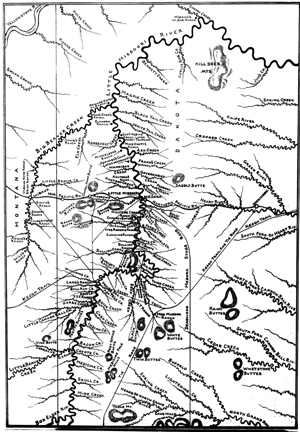
Map of the Little Missouri River in the Dakota Badlands with all its creeks and offshoots.
Map of the Little Missouri River. (Courtesy of T.R. Medora Foundation)
Roosevelt and Ferris made it by dusk to their destination—a ramshackle, rat-infested cabin in a field situated at the mouth of Little Cannonball Creek. Out to greet them with extended hands were Gregor Lang and his sixteen-year-old son, Lincoln, who were operating the Neimmela Ranch for the rich London capitalist Sir John Pender.47 According to Lincoln, Roosevelt was full of hearty cheer, saying, “Dee-lighted to meet you!” In his memoir, Ranching with Roosevelt, Lincoln recalled the wild-eyed “radio-active” enthusiasm of the future president. “I could make out that he was a young man, who wore large conspicuous-looking glasses, through which I was being regarded with a pair of twinkling eyes,” Lang wrote. “Amply supporting them was the expansive grin overspreading his prominent, forceful lower face, plainly revealing a set of larger white teeth. Smiling teeth, yet withal conveying a strong suggestion of hang-and-rattle.”48
After supper Roosevelt held court, telling the Langs his stories about the world at large. Even after the others fell asleep, Gregor, a sharp-whiskered Scotsman, and Theodore kept going at the big issues of the day, locking horns over literature and politics. This was the beginning of a lifelong friendship Roosevelt would have with the Langs. As fellow plainsmen on the prowl for buffalo during the next week, Roosevelt and his new hired friends grew closer. What Roosevelt relished about buffalo hunting, it seemed, was that social class was temporarily suspended. A man’s skill and courage were the criteria for acceptance.
The next morning, Roosevelt’s hunt party traveled together in a heavy rain, between conical buttes, anxious to find a single lonesome George or a small band of younger bulls. The soaking made it impossible to track any buffalo, and it made the Badlands clay (often called gumbo) slimy and slippery; this was very dangerous for their horses, who could easily break a leg trying to climb hillocks.49 With creeks rising quickly and rain pounding down on their backs, Roosevelt’s party spent most of the time avoiding ooze holes and slow sand. At the rate they were going Roosevelt would have been lucky to bag a turkey vulture or common skunk. When a mule deer finally appeared, Roosevelt took aim and missed. It was an embarrassingly bad shot. Quickly Joe Ferris took a try and got his kill. Deeply impressed by the Canadian’s marksmanship, Roosevelt shouted, “By Godfrey I’d give anything in the world if I could shoot like that.”50
That smallish deer was the high-water mark of the hunt for the first four days. Ferris hinted that it might be wise to venture back to Little Missouri and dry off for a spell; but Roosevelt insisted they grind on. Lincoln Lang was surprised at how calm Roosevelt seemed to be in the teeth of a downpour. He positively glowed in the deluge. At one point, wallowing in the flash-flood puddles, he applied mud to his face as an emollient, almost like a Lakota Sioux putting on war paint. The other men watched in shocked silence, but Lincoln dubbed him the Great White Chief.51
Despite the unrelenting bad weather, Roosevelt continued to be entranced by his surroundings. The winds were as fierce as those along any seashore. The light—when it got a chance to break through the clouds—was often an amazing chartreuse. Like the ocean floor, much of the region was still unknown to cartographers. Every day in the Badlands he encountered some new revelatory feature of intense geological interest. Here he felt like a French-Canadian voyageur far away from the stresses of civilization. This, of course, wasn’t the first time Roosevelt had succumbed to the lure of a wild place; he had similar bouts of euphoria in the Adirondacks and the North Woods. But this was somewhat different; and he began to entertain the romantic notion of becoming a Dakotan rancher. Even the clumps of box elder and prickly plants appealed to him. “Clearly I recall his wild enthusiasm over the Badlands,” Lincoln Lang later wrote. “It had taken root in the congenial soil of his consciousness, like an ineradicable, creeping plant, as it were, to thrive and permeate it thereafter, causing him more and more and more to think in the broad gauge terms of nature—of the real earth.”52
After days of striking out the Roosevelt party caught a break. They discovered fresh spoor, and off they went in pursuit. Suddenly, there was a buffalo in sight, but upon hearing their clamor it galloped off. For several miles Roosevelt chased the bull through a rough patch of prickly shrubs and eroded gullies, to no avail. Later that afternoon, the men came across three buffalo grazing within fairly easy firing distance. Roosevelt quickly dismounted, took aim, and fired. The bullet penetrated the flesh of one, but the wounded buffalo ran off. Desperate for his big game trophy, Roosevelt chased the buffalo for seven or eight miles, only to miss with his next shot. Once again the buffalo got away. Once again Roosevelt was embarrassed.
Even though Roosevelt loved hunting, he was not a great shot; his poor eyesight prevented that. “Whatever success I have had in game-hunting,” Roosevelt later wrote, “has been due, as well as I can make it out, to three causes: first, common sense and good judgment; second, perseverance, which is the only way of allowing one to make good one’s own blunders; third the fact that I shoot as well at game as at a target. This did not make me hit difficult shots, but it prevented my missing easy shots, which a good target shot will often do in the field.”53 What he brought to hunting was instead a bookish knowledge of the species’ habits and coloration. But Roosevelt was so excited by the windswept panoramas that he didn’t comprehend his own clumsiness with a rifle. That evening by the campfire, he remained optimistic about bagging his trophy. It was raining again the next morning when the Roosevelt party stumbled upon a couple of grazing buffalo. Theodore fired and missed his mark again. This time, at least, he could blame the weather.
The hardships Roosevelt endured in pursuit of the buffalo were many. Ants had built huge communities eight or nine feet deep. On one occasion, crawling in the sage to get closer to a bull, Roosevelt stumbled right into a cactus patch, and his hands were suddenly filled with needles as if they were pincushions; they stayed swollen for days. When the hunt party decided to charge at a couple of buffalo, Nell got spooked and tossed its head dramatically backward, causing Roosevelt’s rifle to smack against his forehead. According to Roosevelt the blood literally “poured” into his eyes from the stitchable gash.54 As the blood congealed, however, he spoke excitedly about the prospect of returning home with a purple scar. That evening, his face bruised, forced to sleep in the cold rain, with nothing but dry biscuit in his stomach, Roosevelt glowed with enthusiasm, refusing to engage in tremulous self-pity. It was the experience of freezing while skating at Cambridge all over again. A miserable Joe Ferris, shivering under a wet blanket, marooned in the backcountry darkness, was baffled that evening to hear Roosevelt exclaim, “By Godfrey, but this is fun!”55
Doggedly Roosevelt kept hunting through the broken plains and pony paths along Little Cannonball Creek for his buffalo trophy. All a frustrated Joe Ferris could remember thinking was that “bad luck” was following them “like a yellow dog follows a drunkard.”56 On the morning of September 20 Merrifield and Sylvane Ferris left the hunt for an entirely unanticipated reason: Roosevelt, in a fit of exuberance, had handed them a $14,000 check to guarantee his partnership in the Maltese Cross Ranch. Roosevelt was to become a Dakota rancher. As if they had just won the lottery, Merrifield and Sylvane were ecstatic to be trusted with an investment check and tapped to be his highly paid new managers. The two were catching a train to Minnesota to iron out all the business and banking details. Basically, by signing his name once, Roosevelt had bought the boys hundreds of new cattle on spec.
Roosevelt’s luck finally changed as, for the first time in his life, he ventured into Montana Territory, hoping to find his buffalo. Noticing that his horse was sniffing something in the air, Roosevelt dismounted, jogged up to a ridge, and peered over. There, grazing on grass, was a buffalo. “His glossy fall coat was in fine trim and shone in the rays of sun,” he later wrote, “while his pride of bearing showed him to be in the lusty vigor of his prime.” This wasn’t a lonesome George in size, but close enough. Stealthily Roosevelt advanced, one quiet foot at a time, to get within range. When he was about fifty yards away he fired a single shot. The bullet entered the buffalo’s massive shoulder. “The wound was an almost immediately fatal one,” Roosevelt wrote, “yet with surprising agility for so large and heavy an animal, he bounded up the opposite side of the ravine, heedless of two more balls, both of which went into his flank and ranged forwards, and disappeared over the ridge at a lumbering gallop, the blood pouring from his mouth and nostrils.”57
Sprinting ahead Roosevelt, sweating profusely, followed the blood trail until he found the buffalo “stark dead” in a ditch. All the buttes surrounding Roosevelt now took on a special glow. Hopping from foot to foot, Roosevelt encircled the buffalo, whooping and chanting as if he were White Bull or Two Moons in an effort to pay this “lordly buffalo” due reverence. A perplexed Joe Ferris had never imagined any white man behaving in such a queer fashion, imitating a Sioux or Cheyenne. An exhilarated Roosevelt, in an act of spontaneous generosity, next opened his wallet and handed Ferris $100. “I never saw any one so enthused in my life,” Ferris recalled, “and, by golly, I was enthused myself…. I was plumb tired out…I wanted to see him kill his first one as badly as he wanted to kill it.”58
That evening the men stuffed themselves on buffalo steak, Roosevelt claiming that the meat from the hump tasted best; this was contrary to George Catlin’s promotion of buffalo tongue being the true delicacy. To Roosevelt buffalo meat was barely distinguishable from beef. The hunters didn’t sever the head or skin the carcass, however, until the following day. “The flesh of this bull tasted uncommonly good to us,” Roosevelt wrote, “for we had been without fresh meat for a week.” The New York Worldhad caricatured him as a Harvard-educated aristocrat, but from now on he’d be an all-American buffalo hunter.59
IV
When Roosevelt returned to Little Missouri on September 23, to spend another night at the Pyramid Park Hotel before heading east, he was a changed man. Francis Parkman had been right: only by living out the western experience could a scholar effectively write about it. Roosevelt’s fifteen-day growth of beard in the Dakota wilderness, and his rumble in the West, had strengthened him both mentally and physically. Now, as he slept on a cot at the Pyramid Park Hotel, he felt that he was one of the hardy trappers in the Jim Bridger vein, not Jane Dandy or Lil’ Punkin. In Manliness and Civilization: A Cultural History of Gender and Race in the United States 1880–1917, the historian Gail Bederman dissects Roosevelt’s obsession with becoming a “man’s man.” Pointing out how his political opponents in New York used to ridicule him as the “exquisite Mr. Roosevelt,” Bederman argues that Roosevelt’s “cowboy of the Dakotas” persona was an attempt to stamp out any traces of effeminacy. No longer would he be publicly insulted as “given to sucking the knob of an ivory cane,” a phallic insult Roosevelt had been forced to endure, for he was now a virile buffalo hunter straight out of “Cowboy Land.”60
Bederman also explains the two different strains of masculinity that Theodore was juggling at age twenty-four. From his father he had inherited Victorian codes of “moral manliness” including unselfishness, chastity, physical strength, honesty, and altruism. Yet, as noted, his father had rejected serving as a Union soldier in the Civil War, hiring a surrogate in his place. Young T.R. had been humiliated by his father’s wartime decision. So perhaps he tried overcompensating in his effort to embrace the ethos of frontier masculinity in which a propensity for violence was often rewarded. Killing an animal, winning a fistfight, and declaring a duel, in other words, were obvious ways to cultivate his deficient “natural man” side. Therefore, Roosevelt felt a need to emulate Indians while simultaneously conquering them, and a need to worship big game like buffalo only to hunt them down. The Victorian mannered man turned to prim Europe whereas the “natural” American always had a westward focus. “On his first trip to the Badlands in 1883, he was giddy with delight and behaved as much like a Mayne Reid hero as possible,” Bederman wrote. “He flung himself into battle with nature and hunted the largest and fiercest game he could find. As a child, he had been attracted to natural history as a displacement of his desire to be a Western hero. Now, shooting buffalo and bullying obstreperous cowboys, he could style himself as the real thing.”61
Roosevelt’s solid Victorian morals, however, were never expunged as he became a Great Plains hunter and Dakota rancher. Unlike most men wanting a buffalo head, he actually thought about, and was angered by, the possibility that the great herds might become extinct. His Harvard education in Darwinian biology and naturalist studies gave him a perspective on western wildlife that no ordinary cowboy or hunter could have had. As Lincoln Lang later noted, every day Roosevelt increasingly came to understand the “definite purpose of every natural [object] he saw in the Bad Lands.”62 In the coming decades, his “man’s man” side hunted big game while the intellectual Harvard part of his personality would preserve things of great environmental beauty and consequence.
Considered in the light of Bederman’s thesis, hunting in the Dakota hills and killing a buffalo were the culmination of a series of masculine initiation rites T.R. had put himself through starting in Maine in 1871 with the incident at Moosehead Lake. Overall, life was going well—he had established himself as a historian, a lawyer, and a reform politician; the very fact that Alice was pregnant proved (to his mind) his virility; his health, while still fickle, was on an upswing. No wonder Roosevelt felt ebullient as he boarded his eastbound train. For in addition to everything else, he no longer believed himself to be a weakling or tenderfoot. Any remaining hints of self-disgust had been vanquished. Although he went to exaggerated extremes to get there and was physically spent by exaltation and fatigue, Roosevelt now saw himself as a western man, not a rich boy whose father had refused to serve in the Civil War.
Once Roosevelt had his buffalo head onboard the train, he was ready to journey back to New York in a Pullman berth. Roosevelt wrapped his prize (weighing approximately twenty-five to thirty pounds) in burlap, loaded it onto a Northern Pacific railroad car, and headed east to Saint Paul.63 Unlike Texas longhorns, buffalo were singularly unimpressive if you stripped off their horns, just two stubby prongs jutting upward. A rack of deer or elk antlers was, by contrast, far more impressive. But a buffalo head, in all its grandeur, had become coveted all over America for saloon and library walls. The Union Pacific railroad system even acquired buffalo heads to hang in all its scattered depot offices.64
Roosevelt returned to Alice as a conquering hunter hero. Of course he proudly hung his buffalo head (a taxidermist in Saint Paul had mounted it) in their Manhattan home. That fall, he talked excessively about the freshness and vigor of the West. After winning a third term in the New York state legislature, he put himself forward for speaker of the assembly at the end of the year, offering a capsule biographical sketch that claimed he was a man of Harvard, Albany, and the Dakota Territory.65 Yet when he lost the speakership, he characteristically found the silver lining. “The fact that I had fought hard and efficiently…and that I had made the fight single-handed, with no machine back of me, assured my standing as floor leader,” he wrote. “My defeat in the end materially strengthened my position, and enabled me to accomplish far more than I could have accomplished as Speaker.”66
Starting in January 1884 Roosevelt found himself working almost full-time in Albany. He wanted nothing less than to break up the political machines of both parties in New York City and was also consumed with passing a series of municipal reform laws. Strapped for cash after writing the fat check in the Dakotas for cattle, Roosevelt decided to lease out his brownstone and move back into the house on West Fifty-Seventh Street with his mother. T.R.’s sister Bamie, married to Douglas Robinson, had recently given birth, and she also moved in. Alice suddenly had two family members—Mittie and Bamie—to look after her as her own pregnancy moved into its ninth month. Meanwhile, the construction of Leeholm (Sagamore Hill) continued. “How I did hate to leave my bright, sunny little love yesterday afternoon,” Roosevelt wrote to Alice in early February from Albany. “I love you and long for you all the time.”67
Just days later tragedy struck the Roosevelt clan. On February 13, Theodore received a telegram announcing that Alice had just given birth to a girl. A plethora of hearty congratulations were telegraphed from fellow legislators and friends. Cigars were lit and glasses hoisted in his honor. But then a second telegram arrived. Although it didn’t survive, it was probably from Elliott and read something like: “There is a curse on this house. Mother is dying, and Alice is dying too.”68 (For that is what Elliott later told his brother in person at midnight.) Alice was afflicted with Bright’s disease (medically termed acute or chronic nephritis), and his mother had typhoid fever. A panic-stricken Theodore raced to board a train for Grand Central Station. The fog through Dutchess County was pea-soup thick as if village after village were floating in clouds. All he could do was sit and pray. It was around midnight when he finally arrived in Manhattan and made his way to West Fifty-Seventh Street. The pall of death hung all about as he entered the parlor and climbed the stairs to see Alice and the baby on the third floor.
Alice was drifting into and out of consciousness. As Roosevelt took her in his arms, his spirit broke down. It was as if the fog had entered his throat. With his surety evaporated, he simply didn’t know what to do except clutch her and sob. As he watched her head sinking into the pillow his emotions ran the gamut from contempt of God to guilt for being away in Albany. Her breathing was soft and low, and he berated himself for not being a better husband. Bright’s disease ravaged the kidneys—its symptoms included vomiting, high fever, and excruciating back pain. Breathing became difficult, the body became puffy, and the urine turned bloody. It was death by slow torture.69
The situation was no better on the second floor. Roosevelt’s mother was in utter misery, with a sustained fever of over 104 degrees as well as gastroenteritis and diarrhea. In the 1880s, when there were no antibiotics, death took one out of every ten patients afflicted with typhoid. The situation was beyond bleak. Mother had always been his one-woman support system. Without her he feared being rudderless.
On February 14 (Valentine’s Day) Mittie died at two o’clock in the morning. Twelve hours later so did Alice.70 Two days later a cold spell gripped New York as two hearses made their way to the Presbyterian Church on Fifty-Fifth Street and Fifth Avenue. All the leading philanthropists and politicians in the city—including the Astors and Harrimans—arrived to pay their last respects to the deceased Roosevelt women.71 The New York Times and New York Sun covered the double funeral as if it were an important event.72 After an opening prayer, the old hymn “Rock of Ages” was sung by a chorus of mourners paying their respects. On top of the two rosewood coffins were wreaths of roses and green vines. Following the benedictions, Roosevelt’s mother and wife were buried at Greenwood Cemetery next to his father. During these painful days of February, Roosevelt returned to keeping his diaries. “The light has gone out of my life,” he wrote, and his words were accompanied by a huge cross on the page. A couple of days later he added, “For joy or for sorrow my life has now been lived out.”73
Nobody will ever know the depths of the private pain that Roosevelt felt as winter changed into spring. For months afterward, everybody used kid gloves when dealing with him. His former tutor Arthur Cutler wrote to Bill Sewall in Maine that Theodore was stuck in a “dazed, stunned state.” Roosevelt himself put on a stoic veneer when writing to Sewall: “It was a grim and evil fate, but I have never believed it did any good to flinch or yield for any blow, nor does it lighten the blow to cease from working.”74
During sleepless nights that spring, Roosevelt would sit in a rocking chair, silent as smoke, and read natural history books. The world seemed quite diabolical. He wondered whether the Badlands—where even the half-clad buttes had an unstable equilibrium—might be the best place to heal and hatched a plan to light out for the Dakota Territory following the Republican National Convention in Chicago. Perhaps solace could be found in a ranch house with undraped windows surrounded by roping corrals and branching chutes. A saddle horse would probably be his best companion, his true equal and friend.
People always devise their own ways of coping with loss. Roosevelt took the route of bottling up his emotions, seldom mentioning his wife by name, submerging her memory, and never reminiscing about her legacy to his daughter Alice. Oddly, he didn’t even invoke her name in his own An Autobiography. It was as if Roosevelt believed he could best respect his beloved wife in silence. Nevertheless, upon a return visit to North Dakota, he holed up in the Maltese Cross cabin and edited a volume of memorials about Alice; he had it privately printed by G.P. Putnam’s Sons. “She was beautiful in face and form, and lovelier still in spirit; as a flower she grew, and as a fair young flower she died,” he wrote in the introduction. “Her life had been always in the sunshine; there had never come to her a single great sorrow; and none ever knew her who did not love and revere her for her bright, sunny temper and her saintly unselfishness.” 75
Despite his grief Roosevelt that spring nevertheless engaged in politics at Albany with full fervor. Even though he loved the notion of General William T. Sherman as the Republican nominee for president, he reluctantly settled on the more pedestrian James G. Blaine. More and more his political coach was Henry Cabot Lodge of Massachusetts. Although Lodge didn’t share Roosevelt’s enthusiasm for the wilderness he was keenly interested in organized fox hunts. A trusting Roosevelt used Lodge as a confidant and sounding board. Unlike Roosevelt, Lodge was terse, calculating, and unemotional. But he was also deeply honest, loyal, and a gentleman. Both shared a bedrock belief in the virtues of American exceptionalism. Both were dogged in their pursuit of western expansion. That spring Roosevelt and Lodge traveled together by train to Chicago for the smoky bedlam of the Republican National Convention. (Roosevelt left his infant daughter, whom he’d soon nickname Mouseskeins, in the care of his sister Bamie.) Although Lodge knew that Roosevelt had developed a reputation as a reformer, he was surprised at what a folk hero his New York friend had become with the western Republican delegates, merely for shooting a buffalo in the Dakota Territory. A rumor circulated at the convention that when the territory became a state, Roosevelt would probably be its first U.S. senator.
V
For his part, Roosevelt couldn’t wait to get out of Chicago. As soon as the convention was wrapped up, with Blaine as the nominee, he took a train to Saint Paul. Near a nervous breakdown, his entire exhausted body in low-grade pain, Roosevelt turned into a semi-recluse, not wanting to read newspapers or receive telegrams from anybody. Arriving in the Little Missouri area on June 9, he went directly to the Maltese Cross Ranch, anxious to begin his life as a cowboy and hunter.76
Since September Merrifield and Ferris had tended to Roosevelt’s cattle herd of around 440 head; only twenty-five had been killed by wolves or the cold.77 The coulees and buttes, as hoped, had adequately protected the herd. Riding around the region and seeing the new buildings that had sprung up in the boomtown of Medora bolstered Roosevelt’s morale—even if he still couldn’t imagine life without Alice and Mittie. In another burst of Rooseveltian enthusiasm, he wrote Gregor and Lincoln Lang a $21,000 check to acquire 1,000 new cattle. His investment in the Badlands was now more than $35,000.
In photographs taken at the time, Roosevelt is often wearing a custom-made buckskin suit. He had commissioned the outfit from a seamstress in Amidon, North Dakota, because its “inconspicuous color” was ideal for hunting antelope; it caused, he wrote, “less rustling” than other fabrics “when passing among projecting twigs.” But the show-off in him also wanted the fringed suit and its accompanying hunting shirt because they were “the most picturesque and distinctively national dress ever worn in America,” the uniform in which “Daniel Boone was clad when he first passed through the trackless forests of the Alleghanies…. It was the dress worn by grim old Davy Crockett when he fell at the Alamo.”78
Despite his fanciful wardrobe, Roosevelt, as rancher, was a workhorse (not a showhorse). He participated with a vengeance in round-ups and brandings, becoming a decent roper and a cool presence during stampedes. While his horsemanship wasn’t exceptional he always had a good rapport with his mount. He learned how to braid a halter and bridle rein as if born on the range. With the crack of dawn he was up, anxious to perform morning chores. Whether it was going to find a stray or fixing a fence or coping with foul weather, Roosevelt always volunteered, at least to the point of showing to Merrifield and Ferris that the elitist in him had disappeared forever.79
Intoxicated with the Badlands, Roosevelt decided to ask his North Woods friends Bill Sewall and Wilmot Dow to come jump-start his North Dakota ranch with him at the Maltese Cross. Generously Roosevelt insisted he would share all profits with them. They would all reunite in the West as business partners and kinsmen.
Roosevelt spent only three weeks in the Badlands. On June 30 he headed back east to spend time with his baby daughter in Massachusetts. But his thoughts kept returning to the West, as he thought about building a second ranch, to be called the Elkhorn, about twenty-five miles north of Medora. The Maltese Cross was too close to town, attracting a constant stream of locals eager to shoot the breeze with a newsy New Yorker. If he wanted to write books about the Badlands, he would need solitude. His tentative plan was to divide his time between New York and the Little Missouri River area (the building of his Sagamore Hill estate continued).
No sooner did Theodore arrive back east than he wrote Bill Sewall another letter. To Roosevelt, Sewall was like one of the characters Chekhov wrote about who were the salt of the earth but were so virtuous that they never tasted success; he was now hoping to change this. “If you are afraid of hard work and privation, do not come west,” Roosevelt wrote to Sewall. “If you expect to make a fortune in a year or two, do not come west. If you will give up under temporary discouragements, do not come west. If, on the other hand, you are willing to work hard, especially the first year; if you realize that for a couple of years you cannot expect to make much more than you are now making; and if you also know at the end of that time you will be [in] receipt of about a thousand dollars for the third year, with an unlimited rise ahead of you and a future as bright as you yourself choose to make it, then come.”80
In late July, Roosevelt announced to the New York press that he would indeed, though reluctantly, back James G. Blaine for president—causing a wave of speculation that he was abandoning his reformist independence to embrace the Republican machine. Before he once again headed west a reporter for the New York Tribune buttonholed Roosevelt and asked about his sudden advocacy of Blaine. Roosevelt snapped that he was “disinclined to talk about the political situation” yet happy to discuss his newfound “life in the West.”81
Accompanying Roosevelt on this trip to the Badlands were Sewall and Dow (the straight talk in Roosevelt’s letter had worked). They had journeyed down from Maine to join their boss at the New York railroad station and take the Chicago Limited. TheNew York Herald reported that Roosevelt was carting along on the train all sorts of western paraphernalia—a heavy monogrammed saddle, angora chaps, a pearl-handled revolver, and silver-inlaid bits and spurs. He had temporarily purchased only squatters’ rights, so the game plan was to start living in an existing dilapidated hut at once and then purchase 1,000 new shorthorn cattle in Minnesota. Timber for a new primary ranch house—a close approximation to the “Ranchman’s Log ‘Schack’” as featured in the History of the Northern Pacific Railroad—would be cut in September, and construction would commence early the next year. Referring to the neophytes from Maine as his “backwoods babies,” Roosevelt got a huge kick out of pointing out, from the train window, Wisconsin dells, Minnesota lakes, and emerging rimrock canyons of the Badlands. Writing to Bamie on August 12, Roosevelt said that his lumberjack friends exhibited “absolute astonishment and delight at everything they saw” as they traversed the upper Midwest and that their “very shrewd and yet wonderfully simple remarks were a perfect delight to me.” 82
From the outset, however, Sewall had reservations about the Badlands as cattle country. He understood Roosevelt’s infectious excitement about the surreal terrain, but it seemed too arid for cattle. After meeting the Ferris brothers and Merrifield and working long days to get the Elkhorn Ranch built to Roosevelt’s specifications, Sewall wrote to his brother in Maine what he really thought of the whole “range management” enterprise: “Tell all who wish to know that I think this is a good place for a man with plenty of money to make more” he said, “but if I had enough money to start here I never would come.”83
What Sewall didn’t fully comprehend was that Roosevelt was multitasking: ranching at the Maltese Cross and Elkhorn was an excuse to hunt and write a popular book about his adventures. Never thrifty with money, essentially a horrific businessman, Roosevelt was less concerned that he had squandered one-fifth of his fortune in the cattle business than he was with collecting naturalist data and hunting anecdotes for the book he wanted to write about the Badlands. In addition, just being in the Dakota Territory was a balm to his grief, bringing him much-needed clarity. Life was short, he felt, so make the most of it. In fact, no sooner were the first logs split for the Elkhorn Ranch than Roosevelt announced that he was ready for a 1,000-mile hunt on horseback. The very name of the range he wanted to explore—the Bighorn Mountains—had him salivating.
VI
Located in both southern Montana Territory and north-central Wyoming Territory, the Bighorns—a sister range of the Rockies—had a truly varied ecosystem for more than 200 miles, with everything from sheer mountain walls to tall grasslands, from glacier-cut valleys to alpine meadows populated by an amazing array of raptors. Accounts of the mountain men who first saw Cloud Peak and Black Tooth Peak abruptly rising out of the rolling prairie were legendary. Jim Bridger had floated through the lofty Bighorns on a raft, and Jedediah Smith had been mauled by a grizzly bear not too far away. When escaping General Crook’s Army in 1876 the Sioux had taken refuge in the lodgepole pine and spruce forests of the Bighorns as if these were the last haven on earth.84 The exaggerated reports of wild animals trappers said this eastern front range of the Rockies had more game animals than the human eye had ever seen—and particularly the thought of hunting a grizzly bear inspired Roosevelt to undertake the most arduous expedition of his life so far.
Most of the Bighorn peaks were rounded on top, with flanks that gently sloped. The glacial lakes throughout the range were as bright blue as those in Alberta or the Yukon. Temperatures during the winter months could unexpectedly drop to forty degrees below zero in a few hours. Yet, compared with other Rocky Mountain zones, the Bighorns received little snow. All the spring rains emanated from general weather systems. Vegetation encountered in the Bighorns depended completely on whether one was below or above the timberline. Lumber companies were eyeing the area as a prime source of timber.85
To ride horseback and hike into the Bighorns, Roosevelt took with him Merrifield and Norman Lebo, an old Union soldier and blacksmith from Ohio. Sewall and Dow stayed at the Maltese Cross and Elkhorn ranches to tend the cattle. While Roosevelt and Merrifield rode horses, Lebo followed with the “prairie schooner” supply wagon.86 From Medora to the foothills of the Bighorns was nearly 300 miles across the chilly flatlands toward the town of Buffalo, Wyoming. With no map to guide them the trio simply mounted and started heading toward the Montana line as if nomadic characters in a Zane Grey novel. “We had no directions as to where the Big Horns were,” Merrifield recalled, “except that they lay to the southwest.” 87
No sooner did the trio reach Montana than a storm appeared. Horrific cloudbursts filled the big sky as lightning bolts popped and boomed. Day turned to night. Heavy raindrops fell, and their horses tried to run away. The odor of ozone, stronger than in the East, was almost intoxicating. “The storm rolled down toward us at furious speed and the wind shrieked and moaned as it swept over the prairie,” Roosevelt recalled in Hunting Trips of a Ranchman. “We spurred hard to get out of the open, riding with loose reins for the creek…. The first gust caught us a few hundred yards from the creek, almost taking us from the saddle, and driving the rain and hail in stinging level sheets against us.”88
The detailed diaries Roosevelt kept of the trek to the Bighorns tell exciting stories of shooting duck at Lake Stanton (filled with cutthroat trout) and hearing coyotes wail all night when the men camped along the Powder River. Nearly every Wild West cliché happened to Roosevelt on the trail: a non-injurious shooting powwow with the Cheyenne; the near-loss of their wagon to quicksand; the hunting of enough grouse to feed a village; magnificent herds of white-tailed deer. At one point Roosevelt miraculously shot two deer with a single bullet. “I elevated the sights (a thing I hardly ever do) to four hundred yards,” he wrote, “and waited for the second buck to come out further, which he did immediately and stood still just alongside of the first. I aimed above his shoulder and pulled the trigger. Over went the two bucks!…This was much the best shot I ever made.”
A full three days before reaching them, Roosevelt could see the Bighorns rise in the distance over the plateau. He couldn’t wait to hike up into them—after all, he had climbed both the Matterhorn and Mount Katahdin. But his enthusiasm was dangerously naive. Already the September nights in the Wyoming mountains were bitter cold. The weather was known to be freaky; it didn’t snow much, but that didn’t mean three or four feet couldn’t be dumped within a couple of hours. Packhorses—even first-rate ones—would have a hard time making it up the sides of the steep ridges. Challenging nature, they would have to leave their horses in the valley. Because of the spruces, of course, there would be plenty of wood to build a bonfire. But this was no guarantee of survival. Many men had perished in the Bighorns mistakenly believing that fire trumped sleet; it never did. Even the most sure-footed mountaineer was no match for the raw natural powers of this Wyoming wilderness. Whether it was wolf packs prowling or wind whistling through the canyons, only a fool wasn’t reduced to humbleness in such potentially lethal terrain. At the curl of twilight everything was ghostly and mysterious beyond even the deepest backcountry of the Adirondacks. “If I listened long enough, it would almost seem that I heard thunderous voices laughing and calling to one another,” Roosevelt wrote, “and as if at any moment some shape might stalk out of the darkness into the dim light of the embers.”89
Roosevelt took to calling the elk “lordly,” just as he had done with the buffalo. Even though the naturalist in him carefully studied every coloration and trait variation of those he killed, he began seeing the elk as almost holy. Nonhunters might be perplexed by this, but the northern Cheyenne would have completely understood the spiritual aspect of Roosevelt’s search for game. “From morning till night I was on foot,” he wrote, “in cool, bracing air, now moving silently through the vast, melancholy pine forests, now treading the brink of high, rocky precipices, always amid the most grand and beautiful scenery; and always after as noble and lordly game as is to be found in the Western world.”90
Since his boyhood, grizzly bears had enthralled Roosevelt. Carefully he studied all their zoological traits, realizing that they were essentially shy and not predatory. The sheer hulk of the omnivorous grizzly—a member of the brown bear family often weighing up to 1,300 pounds—made it the true king of the Rockies. With their astounding senses of hearing and smell, grizzlies were hard to hunt. But as any trapper could testify, they had terrible eyesight, and if you happened to stumble upon one in a refuge like the Bighorns it could lunge without warning or retreat. Come October, all the grizzlies would hibernate in dens until late April. So Roosevelt knew that his best chance for getting a large, full-grown grizzly was in September. But this was also the time of year when the bears had spent months actively digging for rodents and roots, so that their claws were the longest. As Darwin would have appreciated, these fearsome claws had an additional purpose besides warding off predators: they enabled grizzlies to dig winter dens with relative ease.91
The damp afternoon when Roosevelt stumbled upon his first grizzly provides one of the classic stories in American outdoor literature. Roosevelt’s desire for precision and suspense was urgent, even if the latter wasn’t always fulfilled. As recounted inHunting Trips of a Ranchman, the odyssey began at sunset on September 12, 1884, when he happened to encounter bear tracks. It’s a testimony to Roosevelt’s familiarity with bears that he knew the bear was a grizzly. A strange “eerie feeling” of expectancy swept over him. Alone, he followed the footprints from tree stand to stand. As darkness neared, however, he could no longer see anymore. It was time to head back to camp. He vowed to pick up the bear’s trail in the morning.
Upon waking, Roosevelt and Merrifield checked on the carcass of an elk they had killed. To their surprise a grizzly had gnawed the body during the night. Wearing moccasins so as not to scare away game, the two men began following the bear marks. The mingling odors of pine and sweat filled Roosevelt’s nose. He drank it all in. “When in the middle of the thicket we crossed what was almost a breastwork of fallen logs, and Merrifield, who was leading, passed by the upright stem of a great pine,” Roosevelt recalled. “As soon as he was by it he sank suddenly on one knee, turning half round, his face fairly aflame with excitement; and as I strode past him, with my rifle at the ready, there, not ten steps off, was the great bear, slowly rising from his bed among the young spruces.”92
And what a huge grizzly it was, standing about nine feet tall and weighing more than 1,200 pounds. It would have been impossible for Roosevelt to have found a better specimen for his North American mammal collection.93 “He had heard us but apparently hardly knew exactly where or what we were, for he reared up on his haunches sideways to us,” he wrote. “Then he saw us and dropped down again on all fours, the shaggy hair on his neck and shoulders seeming to bristle as he turned toward us. As he sank down to his forefeet I had raised the rifle…Half-rising up, the huge beast fell over on his side in the death throes, the ball having gone into his brain, striking as fairly between the eyes as if the distance had been measured by a carpenter’s rule.”94
The killing of this first grizzly bear was cathartic. During the coming days Roosevelt bagged two more: a mother and a cub. Why was he was so compelled to slaughter an animal he loved so deeply? How could he have shot a baby face-to-face? Roosevelt would claim that he needed multiple specimens for scientific study. He would claim that the bear meat went into the evening pot. But both answers were bunk. Quite simply, he enjoyed shooting the birds and animals he loved the most. The brutality of such acts never seemed to bother Roosevelt, for he considered himself privileged as a Darwinian biologist, a big game hunter, and a naturalist.
Feeling like a champion hunter, Roosevelt descended with Merrifield and Lebo out of the Bighorns carrying enough trophies to fill the walls of a small Wyoming lodge. They arrived in the town of Buffalo on September 18 full of superlatives, and rented rooms at the Occidental Hotel.95 That evening Roosevelt, the harried traveler, dined with U.S. Cavalry officers at Fort McKinney, listening to snatches of conversations about the peace settlements with the northern Cheyenne.96
Even though Lebo was a blacksmith, the Roosevelt party’s horses were going lame from collapsing in creeks and ravines.97 Although local wisdom dictated that any cowboy needed about a dozen mounts for round-ups or 1,000-mile treks, the Roosevelt trio started their journey back to Medora with just a couple of horses.98 On October 1 they got caught in what Roosevelt called a “furious hurricane” that whirled with “driving rain squalls.”99 For a couple of days they were forced to hide out in butte alcoves, desperate to stay warm and dry. By the time the weather cleared, Roosevelt had had enough. Leaving Lebo behind with the prairie schooner of supplies, he started riding off with Merrifield toward Medora. With winter around the corner and a presidential election just weeks away, Roosevelt was eager to return to New York with his fine trophies.
In Hunting Trips of a Ranchman, Roosevelt wrote eloquently of what it was like to be an adventurer in the Bighorns and to see your ranch appear on the open range, promising clean sheets and a library shelf packed with books by Shakespeare and Hawthorne. He bowed to the unassailable beauty of the West. If nothing else, the Badlands had encouraged Roosevelt to be more poetic as a writer. He was inspired by nature, and his writing now took on a more colorful cast. Whatever hardships he endured had been distilled into only postcard memories. Clearly, he had the talent to succeed as a wilderness writer. As the naturalist E. O. Wilson of Harvard once aptly noted, field biologists have a lot more “gee whiz” or “sense of wonder” than other kinds of scientists.100
“The rolling plains stretched out on all sides of us, shimmering in the clear moonlight; and occasionally a band of spectral-looking antelope swept silently away from before our path,” Roosevelt wrote. “Once we went by a drove of Texan cattle, who stared wildly at the intruders; as we passed they charged down by us, the ground rumbling beneath their tread, while their long horns knocked against each other with a sound like the clattering of a multitude of castanets. We could see clearly enough to keep our general course over the trackless plain, steering by the stars where the prairie was perfectly level and without landmarks; and our ride was timed well, for as we galloped down into the valley of the Little Missouri the sky above the line of the level bluffs in our front was crimson with the glow of the unrisen sun.”101