
CHAPTER SEVEN
I
At some point in the fall of 1884, Roosevelt conceived of assembling his jottings about the Badlands and the Bighorns into a book. Updating Captain Mayne Reid, he considered how Hunting Trips of a Ranchman (as he called the project) could combine vivid natural history with tales of big-game hunting; he wanted to offer an antidote to the artificiality of money-driven urban life, which he felt was hampering the democratic spirit as well as feminizing a generation of American men.1 Always a romantic, Roosevelt originally intended to write Hunting Trips at the Elkhorn and Maltese Cross ranches, even though there was no decent reference library in the entire Dakota Territory. Pragmatism, however, eventually held sway (as it usually did with Roosevelt), and he ended up composing Hunting Trips back east.
By October, in fact, Roosevelt was back in Manhattan, having abandoned his plan of getting away to Dakota. With the presidential election looming, he put Hunting Trips on hold and threw himself wholeheartedly into the heated political contest. Using Bamie’s home at 689 Madison Avenue as his pied-à-terre, Roosevelt stumped incessantly for the Republican, James G. Blaine. The fact that the Democratic nominee, Grover Cleveland, was hounded by charges of adultery and had fathered an illegitimate child increased Roosevelt’s zeal to elect Blaine. According to the New York Sun, Theodore, forever the puritan, chafed at the unholy notion of a womanizing rogue becoming commander in chief.2 (Perhaps if Roosevelt had fully known that Cleveland was a true outdoorsman, he would have been less antagonistic.) In private, however, Roosevelt didn’t care for the partisan stammerings of either candidate. They were both, he believed, old-school mugwumps while he was a new-school reformer. In any case, Blaine was accused of representing “rum, Romanism, and rebellion,” and whether these charges proved decisive or not, went down in defeat on Election Day. (Cleveland won by a relatively close margin: 219 electoral votes to 182.3) Writing to Henry Cabot Lodge, who had himself lost a congressional race in Massachusetts, Roosevelt carped that the Republican Party had been done in by so-called “Independents” whom he deemed “pharisaical fools and knaves.” 4
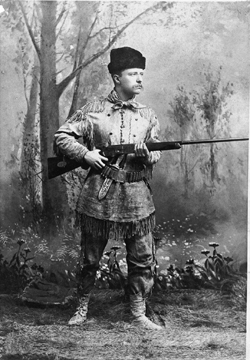
Theodore Roosevelt wearing a customized Badlands hunting costume. This photograph was used to promote Hunting Trips of a Ranchman.
Roosevelt in customized Badlands costume (Courtesy of Theodore Roosevelt Collection, Harvard College Library)
Disappointed by Blaine’s loss, Roosevelt headed back to the Badlands just two days after the elections in November, eager to gather material for Hunting Trips and to track bighorn sheep along the Montana line. His spirits rose once he was on a horse. He spent a few days at the cabin at Maltese Cross, catching up with Dakotan friends. Then, with hard snow falling, he trotted north on his horse Manitou. The solitude of the Elkhorn Ranch, he figured, would offer minimum distractions and he could start writingHunting Trips in earnest.
The prairie winds of the Dakota Territory could be ruthless, and Roosevelt, traveling by himself, was nearly blinded when snow squalls started blowing in his face. As he forded the Little Missouri River the ice cracked and fear ran up and down his spine. Then, to use Jack London’s term in The Call of the Wild, 5 the “dominant primordial beast” welled up in Roosevelt. Undaunted by his precarious predicament, he took the inclement weather as a challenge. By twilight, new snow was falling so heavily that Roosevelt was forced to seek shelter in a lean-to that he luckily stumbled upon. He’d forgotten to bring hard tack with him, so dinner consisted of only tea as snowdrifts layered up against his door.6 Roosevelt reported in his private diary that he slept, warm and without vexation, by a small fire while wolves—which he deemed “the beast of waste and desolation”—howled nearby.7 At daybreak a narrow band of light appeared in the east, intimating that the storm had subsided.
Having endured the wintry ordeal, a famished Roosevelt grabbed his shotgun and hunted sharptail grouse in the sparkling white snowdrifts. Pioneers in the Dakota Territory and Minnesota used to claim that the brushland was so filled with sharptails that when they flocked the sun was blocked (although this was a dubious claim, because grouse don’t rise that high), and indeed Roosevelt bagged five that day. “The sharptails fly strongly and steadily, springing into the air when they rise, and then going off in a straight line, alternately sailing and giving a succession of rapid wing-beats,” Roosevelt wrote. “Sometimes they will sail a long distance with set wings before alighting, and when they are passing overhead with their wings outstretched each of the separate wing feathers can be seen, rigid and distinct.”8
Immediately, Roosevelt roasted two grouse over a small fire. They were uncommonly tasty. Fortified, he continued on to the frozen trail to the Elkhorn. Upon arriving at the ranch, he was cheerfully greeted by Sewall and Dow. Roosevelt was pleased to learn that his hardy cattle were in relatively fine shape. The idea of going on a hunt was bandied about, but the trio decided to first procure firewood—lots of firewood—for the blustery winter days ahead. For hours they chopped down trees and collected kindling. The jocular Maine lumberjacks teased Roosevelt, saying that he was a rank amateur when it came to felling trees. As Dow mockingly told a rancher after three days of clear-cutting cottonwoods, “Well, Bill cut down fifty-three, I cut forty-nine, and the boss, he beavered down seventeen.”9 Always attuned to animal metaphors, Roosevelt knew he was being good-naturedly mocked. Beavers gnawed down cottonwoods and willows slowly and painstakingly, eating bark while they worked. For a tenderfoot trying to be a bull moose, being perceived by his workers as a “beaver” was a real put-down.
Nevertheless, with temperatures dropping to thirty degrees below zero, Roosevelt wisely retreated back to the Maltese Cross, where the primitive creature comforts of Medora were near at hand. He spent hours reading poetry, shooting mule deer, and lunching with the Marquis de Mores at his château in Medora. Roosevelt loved his winter outfit of coonskin cap, long overcoat, and fur-lined gloves. But most of his free time was spent indoors, writing, and his deep love and appreciation for the wilderness in winter became evident in his prose. With a craftsman’s care he began pondering the power of death, the howling prairie, and the bitter cold. New England poetry was, of course, famous for bleakness, and Roosevelt imitated its tone. The deep-seated sentiment of “iron desolation” permeated his writing. (The naturalist John Burroughs had used iron as a poetic metaphor for a forest’s forlornness in his 1879 book Locusts and Wild Honey, which greatly influenced Roosevelt.10) “When the days have dwindled to their shortest, and the nights seem never ending, then all the great northern plains are changed into an abode of iron desolation,” Roosevelt wrote. “Sometimes furious gales blow out of the north, driving before them the clouds of blinding snow-dust, wrapping the mantle of death round every unsheltered being that faces their unshackled anger. They roar in a thunderous bass as they sweep across the prairie or whirl through the naked cañons; they shiver the great brittle cottonwoods, and beneath their rough touch the icy limbs of the pines that cluster in the gorges sing like the chords of an aeolian harp.”11
One winter day Roosevelt was informed that some bighorn sheep were climbing buttes only twenty-five miles from the Maltese Cross. Ever since he had first arrived in the Badlands, he had wanted a ram’s head for his trophy collection at Sagamore Hill. The hunt itself would be recorded in Chapter 7 of Hunting Trips of a Ranchman, “A Trip after Mountain Sheep.” With Merrifield at his side, Roosevelt rode deep into the “fantastic shapes” of the “curiously twisted” Badlands.12 Because bighorns lived in rocky precipices, they didn’t leave detectable footprints, so Roosevelt had only his rifle and luck to guide him.13
Stalking bighorn was a difficult proposition requiring mountaineering skills, stamina, and tenacity. Larger than a deer, a bighorn ram weighed around 300 pounds and was swift and sure-footed. “In his movements he is not light and graceful like the pronghorn and other antelopes, his marvellous agility seeming rather to proceed from sturdy strength and wonderful command over iron sinews and muscles,” Roosevelt wrote. “The huge horns are carried proudly erect by the massive neck; every motion of the body is made with perfect poise, and there seems to be no ground so difficult that the big-horn cannot cross it. There is probably no animal in the world his superior in climbing, and his only equals are the other species of mountain sheep and the ibexes.”14
Eventually, after days of unstable tracking on slippery ledges and knifelike ridges, Roosevelt got his handsome sheep. Although Roosevelt admitted that it was a lucky shot, he claimed that skill was also a factor. Strapping the ram onto his horse Manitou’s back, he brought the prize to the Maltese Cross ranch and feasted on mountain “mutton.”15
For Roosevelt, his wilderness experiences always got back to his desire for good health and bragging rights. “I have just returned from a three day trip in the Badlands after mountain sheep; and after tramping over the most awful country that can be imagined I have finally shot a young ram with a fine head,” he wrote to his sister Anna. “I have now killed every kind of plains game.”16 (By the time Roosevelt became president in 1901, the bighorn sheep in the Badlands had been wiped out.)
As Christmas 1884 approached, however, the merciless “iron desolation” and strange landforms of the interior plains were too much for Roosevelt. He was homesick for his daughter Alice (or Baby Lee, as he often called her). The numbing Dakota cold proved unrestful and intellectually unproductive. Scooping up his notes for Hunting Trips once again, Roosevelt boarded the eastbound train. He was frustrated because writing about the Badlands while in the Badlands had proved elusive. After enduring the sad holiday in New York—the eggnog parties and Christmas packages were not the same without his mother and his wife—Roosevelt hunkered down to write seriously about the Badlands and Bighorns. Nothing could distract him from the arduous chore at hand. UnlikeThe Naval War of 1812, this first-person effort would be a memoir from Dakota, Montana, and Wyoming intermixed with Burroughsian observations on natural history, the sportsman’s code, hunting stories, warnings about biological conservation, and cowboy lore.
After Roosevelt settled down to write, and consuming pots of black coffee, he pushed himself relentlessly, usually writing for two or three sessions a day. By February 1885, he had written 95,000 words, and the next month Hunting Trips, a collocation of wilderness experiences, was finished. The pace had exhausted him. But once Roosevelt’s depleted health was restored, after days of almost nonstop sleep, he returned to Medora to spend a few weeks checking up on his ranches.17 Early on, Roosevelt—a bit out of practice in the saddle—was tossed from Manitou into the frigid Little Missouri River. Chunks of ice kept him from being swept away in the current, and somehow he managed to get a grip on the situation and save himself and his horse. Perversely, he was delighted by the thrill of being near death and by the tingly, numbing cold water. Days later, abruptly, he purposely tossed himself into the river to relive the experience. “I had to strike my own line for twenty miles over broken country before I reached home and could dry myself,” he boasted to Bamie. “However it all makes me feel very healthy and strong.”18
Meanwhile, G.P. Putnam’s Sons was preparing to publish Hunting Trips (dedicated to Elliott Roosevelt, “That Keenest of Sportsmen and Truest of Friends”) in July, as a so-called sporting book.19 No other well-known politician in America, the advance notices boasted, could have written such a gripping hunting narrative. A photograph of Roosevelt posed in a fringed buckskin suit, Winchester rifle at his side, was used to promote the author as a gentleman-sportsman. Taken in a New York studio, the photo, a contrived combination of Buffalo Bill and John James Audubon, reeked of Broadway hokeyness, right down to the backdrop of ferns and an artificial grass carpet. But the actual book, filled with etchings and woodcuts and published in a first edition of only 500 copies, printed on quarto-size sheets of handwoven paper, remains a true collector’s item. Although it had a strong conservationist ethos, Hunting Trips was primarily aimed at gentleman-sportsmen like the writer, aristocrats who could afford hunting holidays, chuck-wagon hands, and what was then a hefty retail price of fifteen dollars.20
All of Roosevelt’s major outdoors adventures between 1880 and 1884 were vividly recounted in Hunting Trips of a Ranchman (subtitled Sketches of Sport on the Northern Cattle Plains). Putting his college education to good use, he wrote about Minnesota grouse, Montana buffalo, Dakota Territory bighorn sheep, Great Plains antelope, and Bighorns bears. Chronology was abandoned, often to the reader’s confusion, in favor of biological and topographical edification. Showcasing his erudition as a naturalist was Roosevelt’s first priority; recounting thrilling hunts was a close second. Most chapter titles, in fact, had to do with wildlife: “Water Fowl,” “The Grouse of the Northern Cattle Plains,” “The Deer of the River-Bottoms,” “The Black-Tail Deer.” Roosevelt wrote that the American West was a Darwinian laboratory full of amazing wildlife action. “The doctrine seems merciless, and so it is; but it is just and rational for all that,” Roosevelt wrote about On the Origin of Species. “It does not do to be merciful to a few, at the cost of justice to the many.”21
The villains of Hunting Trips were the “swinish game butchers” who ruthlessly hunted for hides “not for sport or actual food,” and who cold-bloodedly murdered the “gravid doe and the spotted fawn with as little hesitation as they would kill a buck of ten points.”22 Whenever T.R. turned polemical on behalf of good sportmanship, he echoed the ethical sentiments and concerns of his uncle Robert B. Roosevelt and the sporting press, such as Forest and Stream. Like Uncle Rob pontificating on the essential beauty of shad, trout, and eels, throughout Hunting Trips Roosevelt gave loving naturalist observations about the elk, antelope, and buffalo he had hunted. Not all, however, was blood and thunder. There was an “Indian guide” feel to much of the prose. For example, Roosevelt wrote quietly about stumbling upon a white-tailed deer’s resting spot with the “blades of grass still slowly rising, after the hasty departure of the weight that has flattened them down.” 23 Reading Hunting Trips makes it abundantly clear that Roosevelt deeply respected these deer.
Although cherry-picking is required, genuine conservationist beliefs can be excavated from the pages of Hunting Trips. For example, true western outdoorsmen, Roosevelt wrote, would have to become citizen-protectors of the wildlife being devastated by bands of destructive rogues. In almost every chapter he feared the day when elk, buffalo, and prairie chickens would vanish forever. “No one who is not himself a sportsman and lover of nature can realize the intense indignation with which a true hunter sees these butchers at their brutal work of slaughtering the game, in season and out,” he wrote in Hunting Trips, “for the sake of the few dollars they are too lazy to earn in any other and more honest way.”24 By expressing such views in 1885, Roosevelt was pitting himself against the railroad behemoths, telegraph companies, real estate brokers, and even Buffalo Bill, whom he respected as a master horse-breaker.25 Although there are only a few such passages—in a book that promoted the joys of big game hunting—Hunting Tripsnevertheless marked the beginning of Roosevelt’s great crusade for the conservation of deer, elk, antelope, big-horn sheep, and bears. Wringing a livelihood from the “outdoors” literary marketplace instead of U.S. naval history now became an all-important occupational pursuit for Roosevelt to juggle along with politics, ranching, and managing the family trust. And in wildlife protection he had found his cause.
Hunting Trips received impressive reviews that July. The New York Times, for example, said that the book was clear-eyed and would seize “a leading position in the literature of the American sportsman.” Although the first part of the review focused on Roosevelt’s ethnological delineation of cowboy culture, the Times also noted that his naturalist writing on the survivalist tactics of white-tailed deer was exemplary. “The common deer, or whitetailed deer, found in almost any State in the Union, he tells us was not so plentiful five years ago on the northern plains as it is to-day,” the unidentified reviewer wrote. “With this deer its increase seems to be due to its particular habits. It seeks the densest coverts, is fond of wet and swampy places, and is rarely jumped by accident. It demonstrates the survival of the fittest.”26
Overnight Hunting Trips became the seminal study of both the Badlands and the Bighorns. The core message Roosevelt conveyed was that hunting big game was good for the American soul. Bouts of barbarism, Roosevelt believed, reawakened the primitive and the savage in a man, to good effect. It was a theme that pervaded his writings for the rest of his life. “In hunting, the finding and killing of the game is after all but a part of the whole,” he later wrote. “The free, self-reliant, adventurous life, with its rugged and stalwart democracy; the wild surroundings, the grand beauty of the scenery, the chance to study the ways and habits of the woodland creatures—all these unite to give to the career of the wilderness hunter its peculiar charm. The chase is among the best of all national pastimes; it cultivates that vigorous manliness for the lack of which in a nation, as in an individual, the possession of no other qualities can possibly atone.” 27
II
One mixed review, however, caught Roosevelt’s attention amid the cavalcade of raves.28 The thirty-five-year-old naturalist George Bird Grinnell, the esteemed editor of Forest and Stream, did compare Hunting Trips to Francis Parkman’s The California and Oregon Trail and Lewis H. Garrard’s Wahtoyah and the Taos Trail because of its “freshness, spontaneity, and enthusiasm” on the other hand, Grinnell criticized Roosevelt for generalizing too much about the western species he had encountered while hunting, for failing to discuss color variations properly, and for other inaccuracies of zoological detail. The slightly patronizing review observed that although the youthful Roosevelt had studied a particular antelope herd in Montana, the herds in Manitoba or Saskatchewan were not necessarily identical to it. Grinnell believed that Roosevelt was talented, but that to be a real Darwinian zoologist he should have spent more time doing field observations before rushing into print with his first impressions, which were sometimes inaccurate despite being well written. “Mr. Roosevelt is not well known as a sportsman, and his experience of the Western country is quite limited, but this very fact in one way lends an added charm to this book,” Grinnell wrote, damning Roosevelt with faint praise. “He has not become accustomed to all the various sights and sounds of the plains and the mountains, and for him all the difference which exists between the East and the West are still sharply defined…. We are sorry to see that a number of hunting myths are given as fact, but it was after all scarcely to be expected that with the author’s limited experience he could sift the wheat from the chaff and distinguish the true from the false.” 29
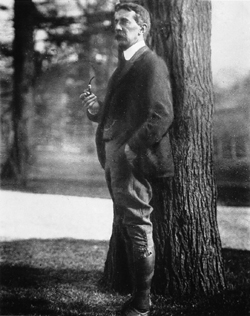
George Bird Grinnell was the editor of Forest and Stream and a co-founder of the Boone and Crockett Club with Theodore Roosevelt. The New York Times deemed him the “father of conservation.”
George Bird Grinnell. (Courtesy of John F. Reiger)
The review stung Roosevelt, who prided himself on the scientific exactitude of his animal descriptions. Grinnell, it seemed, had taken Roosevelt down a notch. Doubly frustrating was the fact that Grinnell had championed Roosevelt’s conservation activism inForest and Stream the previous year, praising his efforts in the New York state assembly to halt the damming of streams that fed the Hudson River. “It is satisfying to see,” Grinnell had written, “now and then, in our legislative halls, a man whom neither money, nor influences, nor politics can induce to turn from what he believes to be right to what he knows to be wrong.”30 But now, in 1885, Grinnell had become Roosevelt’s enemy.
After reading the review, Roosevelt stormed into the offices of Forest and Stream demanding a meeting. Always cordial, Grinnell agreed, and they sat together for hours going through Hunting Trips almost page by page. To Roosevelt’s surprise, the erudite editor seemed to know more about bighorn sheep and white-tailed deer than he did. Once Roosevelt’s bruised ego was salved, the conversation turned to conservation issues, specifically big game protection. “I told him something about game destruction in Montana for the hides, which, so far as small game was concerned, had begun in the West only a few years before that,” Grinnell recalled; “though the slaughter of the buffalo for their skins had been going on their extermination had been substantially completed. Straggling buffalo were occasionally killed for some years after this, but much longer and by this time…the last of the big herds had disappeared.” 31
By the time Roosevelt left the headquarters of Forest and Stream no lingering animosity or grudge would spoil his new friendship with George Bird Grinnell, who fast became as close a friend as Henry Cabot Lodge. When it came to saving wildlife the two men were in sync. And Roosevelt had learned a lesson: never again would he leave himself vulnerable to charges of faking about nature or of mischaracterizing species. Instead of being rivals, Roosevelt and Grinnell united in what would become a lifelong crusade to save the big game animals of the American West from extinction.32 “Roosevelt called often at my office to discuss the broad country that we both loved, and we came to know each other extremely well,” Grinnell recalled decades later. “Though chiefly interested in big game and its hunting, and telling interestingly of events that had occurred on his own hunting trips, Roosevelt enjoyed hearing of the birds, the small mammals, the Indians, and the incidents of travel of early expeditions on which I had gone. He was always fond of natural history, having begun, as so many boys have done, with birds; but as he saw more and more of outdoor life his interest in the subject broadened and later it became a passion with him.”33
It was easy to see why Roosevelt was captivated by Grinnell, who was nine years his senior. Grinnell, a native of Brooklyn, was an explorer, rancher, hunter, bird-watcher, ethnologist, published author, first-rate editor, and western folklorist. (And as if that weren’t enough, the New York Times would later call him the “father of American conservation.”34) Like the Roosevelts, the Grinnells had deep roots in the United States, having arrived in Rhode Island as far back as 1630.35 A real sophisticate, always impeccably dressed, with a pipe close at hand, he knew more about the American West, and more about North America’s 650 mammal species, than any other scholar alive. Puff-puff-puffing, he would discuss why kit foxes were the pygmies of the fox group and why the spotted skunk had the strongest scent of the species.
When Grinnell was seven, his family had moved to Audubon Park in upper Manhattan, the thirty-acre estate that had served as the great ornithologist’s last home. The hallways there were cluttered with overhanging elk and deer antlers, “which supported guns, shot pouches, powder flasks, and belts.”36 The grounds were full of wild animals for Audubon to study and draw. The walls of Audubon Park, in fact, groaned with paintings and hunting trophies once belonging to the great Audubon.37 A close friendship developed between the young Grinnell and Audubon’s widow, Madame Lucy. The old barn was filled with ornithologists’ collections of skins and specimens, and Grinnell absorbed Audubon’s influence. The nearby Hudson River became his bird-watching laboratory. “In winter the river was often very full of ice, and eagles and crows were constantly seen walking about on the ice, no doubt feeding on refuse and the bodies of animals thrown into the stream north,” Grinnell wrote in a partially unpublished memoir. “The crows used to roost on a cedar-covered knoll north of the Harlem River in what is now the Bronx, not very far from Highbridge, and each morning they flew low among the tree tops.”38
As an undergraduate at Yale, Grinnell had the same problems in the classroom that Roosevelt would have at Harvard. He was too enamored with the idea of following in the footsteps of his idol to sit still in the classroom. Grinnell’s life mission crystallized when he read Audubon’s 1843 account of traversing the Missouri and Yellowstone rivers. A passage Audubon wrote in his journal, a lament about the buffalo slaughter on the Great Plains, was seared into Grinnell’s mind and became, in a sense, a mission statement. “What a terrible destruction of life,” Audubon wrote, “as it were for nothing…as the tongues only were brought in, and the flesh of these fine animals was left to beasts and birds of prey, or to rot on the spots where they fell. The prairies are literally covered with the skulls of the victims.”39
Then Audubon had fired off a verbal challenge that would launch the modern conservation movement. “This cannot last,” Audubon said of the buffalo slaughter. “Even now there is a perceptible difference in the size of the herds, and before many years the Buffalo, like the Great Auk, will have disappeared; surely this should not be permitted.”40
Those last six words—“surely this should not be permitted”—galvanized Grinnell. With the encouragement of Professor Othniel C. Marsh (no relation to George Perkins Marsh), the leading paleontologist in the United States, Grinnell volunteered to work on a Yale-sponsored Great Plains dinosaur dig in 1870, writing that he was “bound for a West that was then really wild and wooly.” 41
Grinnell had read every one of Mayne Reid’s books as a boy, so the American West beckoned to him like the star of Bethlehem. While collecting fossils at Antelope Station in Nebraska, Grinnell encountered buckskin scouts, drifters, gold-seekers, Christian farmers, itinerant preachers, and Plains Indians. It was just the first of many trips west, during which he befriended such legendary figures as Charley Reynolds, Buffalo Bill, and Frank and Luther North. By the time he reviewed Roosevelt’s Hunting Tripsin July 1885, he not only had been part of the Marsh Paleontological Expedition but had made scientific discoveries in support of Darwinism, had accompanied Lieutenant Colonel George Armstrong Custer to the Black Hills in 1874 when gold was discovered, and had joined Captain William Ludlow of the Army Corps of Engineers the next year in surveying Yellowstone.42 And nobody alive wrote about duck hunting with more authority than Grinnell.43 Believing that Native Americans had been “shamefully robbed” by the U.S. government, Grinnell worked side by side with Plains tribes, 44 inspiring enough trust and confidence that many of the Indian bands gave him a special name: to the Pawnee, he was “White Wolf,” an honorary member of the tribe; to the Cheyenne he waswikis(“migratory bird”); to the Blackfeet he was “Fisher Hat,” in recognition of his ability to find fish in seemingly depleted streams; and to the Gros Ventres he was “Gray Clothes,” because of the dull suit he often wore.45 By 1885 he was known as theAmerican expert on the ethnology of the Plains Indians. The anthropologist Margaret Mead saluted Grinnell’s pioneering efforts on behalf of saving Indian tribal culture as recently as 1960, using the word “classic”46 to describe his book about the Cheyenne.47(The great western writer Mari Sandoz did the same in 1962.48)
So when Roosevelt stormed into Grinnell’s office at Forest and Stream he was dealing with a heavyweight. Starting in 1882, using the magazine as a soapbox, the editor began crusading to save natural resources. Among other environmental causes he promoted seasonal licenses, laws against killing young animals, the need to preserve habitat, and the need for game wardens. Grinnell was small in stature, with large ears, and usually sported a well-trimmed mustache or goatee; his regal personality stood in sharp contrast to that of the bombastic Roosevelt. Grinnell was also soft-spoken, self-effacing, and humble—yet there was nothing timid about his approach. When he spoke about the American West, people listened. He believed strongly that scientists should get mud on their boots, and he dreamed of forest reserves, bison parks, restocked rivers, and greenbelts around western cities. To the scientific-minded Grinnell, there was an interconnectedness to nature. Even if the United States had the best game laws in the world, they meant nothing without forest protection. Last but not least, Grinnell encouraged states to create zoological societies—a lobbying campaign at which he proved successful in New York.
As a self-appointed watchdog for Yellowstone National Park, Grinnell constantly denounced overcommercialization and federal mismanagement. After witnessing hunters slaughter elk and deer in the park in 1875, he had written a scolding letter promoting big game conservation there and included it in the Ludlow Expedition report. Over the years to come, with a great deal of success, Grinnell would lobby the U.S. Senate to preserve the territorial integrity of Yellowstone. “My account of big-game destruction [in Yellowstone] much impressed Roosevelt, and gave him his first direct and detailed information about this slaughter of elk, deer, antelope, and mountain-sheep,” Grinnell recalled. “No doubt it had some influence in making him the ardent game protector that he later became, just as my own experiences had started me along the same road.”49
Early in 1886, a few months after the publication of Hunting Trips, Grinnell helped form the Audubon Society to protect birds from extinction. From the get-go he had no stronger ally in those efforts than Theodore Roosevelt. As the historian John Reiger observed in 1972 in The Passing of the Great West, “Grinnell, the originator and amalgamator of ideas, prepared Roosevelt for Gifford Pinchot, the President’s famous environmental administrator.”50 It was the alliance of Roosevelt and Grinnell (not Roosevelt and Pinchot) that launched the modern conservation movement in earnest. To Roosevelt, Grinnell was an American treasure whose likeness should have been cast in granite.
III
By late August 1885, following the publication of Hunting Trips, Roosevelt was back in the Badlands. The Elkhorn Ranch was now completely built, with eight rooms, a large stone fireplace, numerous windows, and a center hall—all adorned with taxidermy. Buffalo robes, deer antlers, and bearskins were strewn about the place. There were so many mule deer sheds and elk sheds on the piazza that it looked like an antler museum. Roosevelt converted the cellar into a photography darkroom; taking pictures of nature was yet another of his hobbies. There were two stables, together often housing as many as thirty horses. Roosevelt entertained and wrote at the Elkhorn (most of the real ranching work, however, was done from the Maltese Cross), 51 and especially enjoyed sitting on the porch facing the piazza-like area in front of the ranch house. “Just in front of the ranch veranda is a line of old cottonwoods that shade it during the fierce heats of summer, rendering it always cool and pleasant,” Roosevelt wrote. “But a few feet beyond these trees comes the cut-off bank of the river through whose broad sandy bed in the shallow stream winds as if lost except when a freshet fills it from brim to brim with foaming yellow water.”52
The big news around Medora was that Marquis de Mores had been arrested for murdering Riley Luffsey, a buffalo hunter who loathed de Mores’s barbed wire. De Mores was now in jail in Bismarck, awaiting trial. Furthermore, there was a rumor that he was furious at Roosevelt over land boundaries, cattle prices, Roosevelt’s rude ranchhands, and much else. Because Roosevelt was essentially a squatter, in the last years before fences and deeds transformed the open range into fixed property, enforcing boundaries was constantly a cause of friction. Sharp letters were exchanged between the two rich cattlemen. Talk of a pistol duel was even bandied about, but it proved empty. Eventually de Mores was found not guilty of murdering Luffsey.53 In any event, his arrest had been, at worst, an unpleasant distraction to Roosevelt, who had founded the Little Missouri Stockmen’s Association and prided himself on his western leadership role even more than on being a New York assemblyman. And the stockmen’s association did more than settle land and brand issues. Because of a drought, brushfires were common in the Badlands that summer. As head of the association, Roosevelt worked side by side with his neighbors to put out the blazes, many started by Plains Indians angry at white settlement.
By September 16 Roosevelt was headed back east, stopping at the Bismarck jail for a brief visit with de Mores. In the spring, writing Hunting Trips had left Roosevelt physically depleted, but now he was in high spirits back home in New York. He attended the state Republican convention in Saratoga Springs and spent time with his little Alice. Friends were impressed by his general happiness and vitality. For the first time since his wife’s death, he was open to the idea of a new romance. This changed attitude allowed him to reconnect with his childhood sweetheart, Edith Carow. “For nineteen months (since the deaths of Alice and Mittie) they had successfully avoided each other,” Sylvia Jukes Morris wrote in Edith Kermit Roosevelt. “But sometime early that fall, either by chance or design, they met.”54
Deeply refined, quietly attractive, and unmarried, Edith Carow was then twenty-four and still infatuated with Theodore. As Roosevelt had been winning elections and writing critically acclaimed books, his sister Bamie had constantly updated Edith, with whom she’d remained friends. Victorian etiquette called for a long mourning period, so as Theodore and Edith grew closer, they were very discreet. Even after Edith accepted Roosevelt’s proposal that November, they behaved in public only as friends for a full year. Somehow three years “in waiting” seemed much more socially appropriate than only two.
That Christmas season Roosevelt circulated at numerous social gatherings with Edith at his side. Nevertheless, he didn’t use her full name in his diary, referring to her as only “E” and reserving all his affection in the journal for Alice. No love letters between the two survive—Edith ordered their correspondence destroyed—and, in fact, it’s quite possible there weren’t any. By all accounts, Edith was an intensely private woman, with a unique ability of tamping down Roosevelt’s over-the-top enthusiasms. “Edith was not the sort of person to encourage rhapsodies anyway,” according to the historian Edmund Morris. “She disapproved of excess, whether it be in language, behavior, clothes, food, or drink.”55
Keeping Sagamore Hill running and maintaining the Dakota ranches were expensive propositions for Roosevelt. As marriage plans were privately discussed, he dreamed of having a large family. Keeping bloodlines alive mattered to him a great deal. Although he could live comfortably on his trust fund, he needed book advances to feel financially secure. At Henry Cabot Lodge’s suggestion Roosevelt signed a contract with Houghton Mifflin to write a biography of Thomas Hart Benton, the senator from Missouri who from 1821 to 1851 had fervently encouraged westward expansion.56 It would be part of a new series called American Statesmen. During January and February 1886 Roosevelt started writing Thomas Hart Benton in earnest, taking advantage of New York’s fine research libraries. Edith’s company was welcome, too, but still he kept thinking about the Badlands. A conscientious businessman, he knew, always checked up on his investment. Imagining Sewall and Dow suffering in the cold, worried that his dogies and yearlings wouldn’t make it through the winter, he returned to Medora at the end of the winter planning to write Benton there while collecting new material for a sequel to Hunting Trips. “I got out here all right, and was met at the station by my men,” he wrote to Bamie on March 20 from the Elkhorn. “I was really heartily glad to see the great, stalwart, bearded fellows again, and they were honestly pleased to see me. Joe Ferris is married, and his wife made me most comfortable the night I spent in town. Next morning snow covered the ground; but we pushed to this ranch, which we reached long after sunset, the full moon flooding the landscape with light. There has been an ice gorge right in front of the house, the swelling mass of broken fragments having been pushed almost up to our doorstep…. No horse could by any chance get across; we men have a boat, and even then it is most laborious carrying it out to the water; we work like Arctic explorers.”57
Four days later thieves stole Roosevelt’s boat (an unusual object in the semiarid Badlands) by using a knife to cut the towline tied to the piazza. As chairman of the Little Missouri Stockmen’s Association of Dakota-Montana, Roosevelt had been given the position of deputy sheriff of what is today Billings County.* He felt it was his duty to catch the scoundrels, so once he calmed down he hatched a plan. They would construct another scow and then light out after the thieves. (You could almost hear the wheels turning: what a good article or essay the catching of the crooks would make in Century magazine.) So the new boat was built, and off they went in hot pursuit, like Pat Garrett. Disconcertingly, Roosevelt, always bent on self-improvement, brought along copies of Leo Tolstoy’s Anna Karenina and Matthew Arnold’s collected poetry with him so as not to be bored.
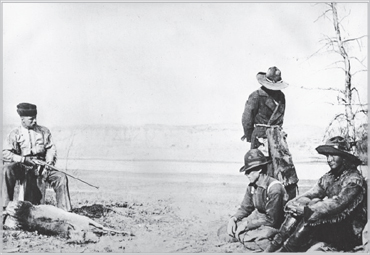
Theodore Roosevelt guarding the thieves who stole his boat. The staged photo was taken in September 1884.
T.R. guarding the boat thieves. (Courtesy of Theodore Roosevelt Collection, Harvard College Library)
For a few days Roosevelt—with the help of a wagon driver—tracked the thieves in this new boat, sleuthing for clues along the riverbank. Occasionally he found fortuitous footprints as clear as if sealed in wax. Most of his daytime hours, however, were spent navigating around ice floes. For supper he killed deer and rabbits. After pursuing his prey more than eighty miles he captured the three thieves (Burnsted, Pfannenbach, and Finnegan) at Cherry Creek in McKenzie County. By the time he marched back to Dickinson, all six men had blistered feet and frostbitten toes. Typically Roosevelt boasted that the man-hunt was a “bully affair” (and he got his whopping good story to write about for Century). If he felt exhausted he moaned in silence. He even finished Anna Karenina along the way for good measure. Typically vainglorious, Roosevelt later had reenactment photographs taken of himself, his rifle keeping his three weary prisoners at bay. Nevertheless everybody in Dickinson was abuzz about their daring new deputy sheriff. “He was all teeth and eyes,” the town doctor, Victor Stickney, wrote of first encountering T.R. “His clothes were in rags from forcing his way through the rosebushes that covered the river bottoms.”58
News of the bravery of Roosevelt, Dow, and Sewall spread from Stark and Billings counties all the way back to New York. With Edith steaming across the Atlantic for the summer to spend time with her family in Europe, Roosevelt basked in his new status in the Badlands. No longer was he Jane Dandy or Lil’ Pumpkin in the Dakota Territory. The combination of writing Hunting Trips plus the episode of the boat thieves had transformed him into a minor Wild West legend. Everywhere he went in Medora or Dickinson, people cuffed him on the back in admiration. Locals—even Sewall and Dow—called him “Mr. Roosevelt,” and meant it. (Since the death of Alice he bristled if anybody dared call him “Teddy.”) The consensus was that the New York politician was a “fearless bugger.”59
That spring and summer Roosevelt felt “strong as a bear, full of healthiness of mind.”60 Constantly he wrote naturalist riffs about shimmering cottonwoods, low buttes, and prairie grasses. Taken together his prose amounted to a love song to the Badlands. “I have my time fully occupied with work of which I am fond; and so have none of my usual restless, raged wolf feeling,” he wrote to his sister Anna on May 15. “I work two days out of three at my book or papers; and I hunt, ride and lead the wild, half adventurous life of a ranchman all through it.”61
By Independence Day, Roosevelt had finished Thomas Hart Benton. Most of it had been written in the cool quiet of mornings at his desk at the Elkhorn Ranch, with its view of the Little Missouri River. When Benton was published, reviewers hailed it as workmanlike and a success.62 Nothing more than that. What Roosevelt most admired about Benton, it seemed, was his belief in the regenerative power of the American West, the fact that he championed frontiersmen with the “tenacity of a snapping turtle.”63 In discussing Benton’s support of westward expansion, Roosevelt insisted that the federal government should have acquired even more territory: the Baja peninsula from Mexico; and British Columbia, Saskatchewan, and Manitoba from Great Britain. (His experience hunting in Minnesota made him want all of Canada to belong to the United States.) Only the United States, he maintained, knew how to properly manage land and rivers. He was acting as the wilderness warden of America. “No foot of soil to which we had any title in the Northwest should have been given up,” he wrote; “we were the people who could use it best, and we ought to have taken it all.”64 The United States, he argued, needed to “swallow up the land of all adjoining nations who were too weak to withstand us.” (In Roosevelt’s obsession with the western lands, conservationists could perhaps see the seeds of his future belief in vast forest reserves.)
Although the only book Roosevelt actually wrote at Elkhorn was Benton (and perhaps a couple of chapters of Hunting Trips of a Ranchman) the conservationist and scholar Lowell E. Baier—a longtime official of the Boone and Crockett Club—nevertheless called the Badlands cabin the “cradle of conservation” in an important 2007 article in the Theodore Roosevelt Association Journal.65 It was at the Elkhorn, that Roosevelt found his voice to caution against careless growth, deforestation, wildlife depletion, and environmental degradation. That July Fourth, Roosevelt traveled from the Elkhorn to a Dickinson’s Independence Day ceremony. He boasted about the largeness of the American landscape, its “big prairies, big forests and mountains.” Addressing an admiring crowd of ranchers and farmers, Roosevelt warned that the “Far West” might be raped by those who exercised their democratic rights “either wickedly or thoughtlessly.” 66
IV
Between March and August 1886, Roosevelt wrote six articles for The Outing Magazine, each time using the Elkhorn Ranch as his lead.67 This was a coup for the glossy magazine edited by Poultney Bigelow, a Yale-educated outdoors enthusiast.68 Outing, aimed at men, was rolling in advertising revenue because of its popular dog and horse stories. One contributor to Outing, trying to describe the magazine’s readership, said it was for “plain, uneducated, shrewd minded men of sport.”69 Illustrated with drawings by J. R. Chapin, R. Swain Gifford, and J. B. Sword, among others, the action-packed pieces by Roosevelt bemoaned the depletion of game in the West. One was titled “The Last of the Elk.” Although all these articles were tied together by hunting and bravado, Roosevelt nevertheless discussed nongame birds like avocets and stilts.70
Although Roosevelt admired the illustrators assigned to his own articles, he was astonished by the exquisite pen-and-ink sketches of an obscure artist named Frederic Remington that he discovered elsewhere in the magazine, accompanying stories about the Apache Wars along the Arizona-Sonora border. Impressed by Remington’s clear, honest eye, Roosevelt decided to tap him to illustrate future stories he planned on writing about the Badlands for Century.
In the Outing article “The Ranch,” Roosevelt expressed his environmental concerns in earnest. “To see the rapidity with which larger kinds of game animals are being exterminated throughout the United States is really melancholy,” he grumbled. “Fifteen years ago, the Western plains and mountains were places fairly thronged with deer, elk, antelope, and buffalo…. All this has now been changed, or else is being changed at a really remarkable rate of speed. The buffalo are already gone; a few straggling individuals, and perhaps here and there a herd so small that it can hardly be called more than a squad, are all that remain. Over four-fifths of their former range the same fate has befallen the elk; and their number…is greatly decreased. The shrinkage among deer and antelope has been relatively nearly as serious. There are but few places left now where it is profitable for a man to take to hunting as a profession; the brutal skin-hunters and greasy Nimrods are now themselves sharing the fate of the game that has disappeared from before their rifles.”71
In August 1886 Roosevelt took another hunting trip, with Merrifield as sidekick, this time to the Coeur d’Alene mountains of Montana and Idaho in search of white goats. He would draw on this trip for two essays about these sure-footed climbers, which he considered the “queerest wild beasts in North America.” Roosevelt, in fact, wrote naturalist essays about mountain goats (he sometimes called them white goats) for both his second book on the Badlands (Ranch Life and the Hunting-Trail, published in 1888) and Harper’s Round Table in 1897. They were among his very best prose efforts. Even though Roosevelt thought that the meat of mountain goats was musky (and that trying to compete with them in mountain climbing was a fool’s errand), he developed a deep fondness for them. Tracing their lineage back to the Himalayas, Roosevelt described their agility, long tail, and distinctive hump. “If a goat is on its guard, and can get its back to a rock,” he enthused, “both wolf and panther [mountain lion] will fight shy of facing the thrust of the dagger-like horns.”72
The hunt for the white goat marked the beginning of Roosevelt’s injecting the “fair chase” doctrine (or code of ethics) into his personal relationships with westerners. Roosevelt employed a market hunter, Joe Willis, as his guide in the Coeur d’Alene mountains.73 Up to this point Roosevelt had treated his rugged, unwashed guides almost as equals (although he insisted that they all call him “Mr. Roosevelt,” never by his first name). Not anymore—on the white goat hunt, Roosevelt continually lectured Willis about changing his careless hunting habits. Grinnell would later describe how Theodore “made himself agreeable as usual and preached so effectively the doctrine of game preservation that he wholly converted Willis, who up to this time had been a skin and meat hunter, considering game animals valuable only for the dollars they yielded the hunter. Roosevelt was constantly doing such individual useful work in conservation matters.”74
Once back in Medora with his new white goat trophies, Roosevelt received a jolt. A gossip columnist in New York had broken the news that he was secretly engaged to Edith Carow, who was spending the summer with family in Europe. Angry but embarrassed, he wrote to his sister Bamie, who’d been kept in the dark: “I am engaged to Edith and before Christmas I shall cross the ocean and marry her,” he confessed. “You are the first person to whom I have breathed a word on this subject.” He flogged himself for not staying devoted to his late wife. “I utterly disbelieve in and disapprove of second marriages; I have always considered that they argued weakness in a man’s character. You could not reproach me one half as bitterly for my inconstancy and unfaithfulness as I reproach myself. Were I sure there was a heaven my one prayer would be I might never go there, lest I should meet those I loved on earth who are dead.”
Politically, the autumn of 1886 wasn’t a good one for Roosevelt, either. Never fond of caution, he had quite impetuously decided to run for mayor of New York City, but he lost to Abram Hewitt, the nominee of Tammany and other Democratic organizations. Before Roosevelt had time to contemplate his rashness, he steamed off to Britain on an ocean liner to marry Edith. Bamie was one of the few people invited to the December wedding in London at St. George’s Church along Hanover Square. Just a few British men in top hats and women in silks attended. It was a very low-key event.75
While Roosevelt was in Europe for a fifteen-week honeymoon, disaster struck the Badlands. According to Lincoln Lang, starting in November ice-dust particles as sharp as glass fragments swirled about in cyclone-like gusts. There were whiteouts, and Lang later wrote that the rush of frigid air “coldly burns the skin as it strikes. It finds its way into your nostrils and then into your lungs, rapidly chilling you through and paralyzing the senses.”76 By New Year’s Day 1887, temperatures in the Dakota Territory had plummeted to forty-one degrees below zero. Beleaguered Badlanders boarded up windows, hoping to keep the deadly winds from blasting into their homes. Outside, stock literally froze in their tracks or died in snowdrifts, unable to feed on the buried grasses.77
At the end of January, another blizzard hit the area. Ice killed off most of the vegetation. Foodstuffs were suddenly in short supply. Snowdrifts were now ten to fifteen feet high against the buttes. Huge cattle herds had no safe place to huddle and stay warm. The Montanan painter Charles M. Russell later drew a series of stark illustrations showing skeletal cattle, all rib cage, in the grip of famine. Near death, some cattle even rammed their heads through cabin doors hoping desperately for warmth. Even the most sinewy cowboy was afraid of the wind chill and snow squalls along the ice-chewed rock formations. It was, as Edmund Morris aptly dubbed it, the “Winter of the Blue Snow.” 78
Roosevelt didn’t know how cataclysmic the “Winter of the Blue Snow” had been in the Dakota Territory until he arrived back in New York from his honeymoon. After reading reports of dead cattle across the Great Plains (from Merrifield and Ferris) he promised to travel to Medora soon to survey the devastation. But he had to keep his priorities straight. Family always came ahead of business—his father had taught him that rule. So Roosevelt settled into Sagamore Hill, spent time with little Alice, and reconnected with friends. Edith was now pregnant; that September she would give birth to Theodore Roosevelt, Jr. (his first son). Roosevelt also needed to discuss his future in politics with Henry Cabot Lodge and his other trusted advisers. Worried that he was cursed when it came to both business ventures and electoral politics, Roosevelt now feared that he had lost his entire Dakota herd and could soon be financially insolvent. Feeling stuck, his intuition gone, not sure whether to advance or retreat from North Dakota, Roosevelt brooded over the cruel fickleness of fate.
Once Roosevelt finally arrived in the Badlands, in April, he was shocked by what he saw. Around 60 to 75 percent of the cattle in the northern plains had frozen to death, and the dead cattle were still piled up along buttes and in bottoms. Day in and day out he tried to inventory his losses. “The land was a mere barren waste,” Roosevelt wrote; “not a green thing could be seen; the dead grass eaten off till the country looked as if it had been shaved with a razor.”79 America’s great range had been ravaged. Less than half of Roosevelt’s own herd had survived the series of blizzards. For once he was hard-pressed to find a silver lining. The only optimistic observation he could muster was that at least a thaw was under way. No longer, however, was the spring roundup a glorious, fun event. Instead of branding and roping, dour-faced local ranchers collected rotting carcasses and scattered bones in wooden carts as if bubonic plague had stricken the region. The winter of 1886–1887 had made the Elkhorn and Maltese Cross ranches nearly go bust as a business venture. “I am bluer than indigo about the cattle,” Roosevelt wrote to his sister. “It is even worse than I feared; I wish I was sure I would lose not more than half the money ($80,000) I invested out here. I am planning to get out.” All told, his net loss would be $23,556.68.80
For the first time in his life nature had been cruel to Roosevelt. The magic of the Badlands had turned menacing and gruesome. No longer was he writing prose hymns about the Missouri lark being the “sweetest singer” or snow geese “nibbling and jerking at the grass.”81 The wildlife seemed to have died or disappeared. Within a few years Medora would become nearly a ghost town, and the open-range cattle business would be steadily diminished. Nevertheless, over the coming decades, Roosevelt continued to boost North Dakota, telling people that in the Badlands he found vigor based on self-assuredness.82
Even though Roosevelt would return to Medora in the coming years (his last visit was in October 1918), his days as a serious rancher were over. Although he didn’t abandon the cattle business entirely in 1887—keeping, for example, his ranch brand—after the “Winter of the Blue Snow” he was always downsizing. His years of genuine residency—September 7, 1883, to December 5, 1887—were history. Yet Roosevelt was rich in glorious memories. Even the gray alkali dust, layers of sandstone, and heaps of debris, it seemed, took on a romantic cast in his highly selective mind. Years later, after being president, he told Senator Albert Fall that his days in North Dakota had been far and away the best of his entire life. “Do you know what chapter or experience in all my life I would choose to remember, were the alternative forced upon me to recall one portion of it, and to have erased from my memory all the other experiences?” he asked himself and then answered. “I would take the memory of my life on the ranch with its experiences close to Nature and among the men who lived nearest her.”83
Although North Dakota provided the “romance” of his life, it was also where his worries about the depletion of America’s natural resources took root. Nobody championed the conquering of the West by the U.S. Army, mountaineers, homesteaders, trappers, farmers, and ranchers more than Roosevelt. Already in 1887—as he worked on a biography of Gouverneur Morris, author of much of the Constitution and creator of the U.S. decimal coin system—Roosevelt planned on writing a multiple-volume work he calledThe Winning of the West, an epic history in the Parkman tradition tracing American continental expansionism from Daniel Boone in 1774 to the death of Davy Crockett in 1836. Roosevelt even considered the genocide of Native Americans—which was indeed explored when the work first came out in 1894—as heroic. “The most ultimately righteous of all wars is a war with savages, though it is apt to be also the most terrible and inhuman,” he wrote. “The rude, fierce settler who drives the savage from the land lays all civilized mankind under a debt to him.”84
Because Roosevelt had lived on the Dakota frontier, he felt ideally suited to write a paean to westward expansion. In many ways, he saw The Winning of the West as merely the logical next step following the publication of Hunting Trips of a RanchmanandThomas Hart Benton. Even though the Allegheny upcountry of the 1770s was vastly different from the Badlands of the 1880s, Roosevelt found them deeply connected.85 “We guarded our herds of branded cattle and shaggy horses, hunted bear, bison, elk, and deer, established civil government, and put down evil-doers, white and red, on the banks of the Little Missouri, and among the wooded, precipitous foot-hills of the Bighorn, exactly as did the pioneers who a hundred years previously built their log-cabins, beside the Kentucky or in the valleys of the Great Smokies,” Roosevelt wrote in the preface of Volume 1 of The Winning of the West. “The men who have shared in the fast-vanishing frontier life of the present feel a peculiar sympathy with the already long-vanished frontier of the past.”86
Such triumphalist “white man’s burden” sentiments aside, Roosevelt nevertheless worried that the United States’ innate sense of opportunity had recently degenerated into exploitation. America knew how to conquer, but it was failing in the art of properly managing its hard-won resources. The West’s virgin woodlands were rapidly being logged and its rolling prairies plowed. Wetlands were being drained, and streams were being fished out. Everywhere Roosevelt went in the Dakota Territory, the topsoil had been leached of nutrients and signs of erosion were commonplace. It sickened him to see wild ungulates being poisoned and slaughtered because they supposedly ate the same grasses as cattle and sheep. Even the very wilderness of the West was disappearing in a maze of train tracks, barbed wire, telegraph lines, and meat-processing plants.
As Roosevelt surveyed the Dakota Territory in 1887, finding it nearly impossible to hunt a buffalo, elk, or pronghorn, he understood that the “winning of the West” had been accomplished at the expense of natural resource management, and it made him melancholy. Saving the American West from environmental ruin after the winter of 1886–1887 became a high priority for public policy. Even while he was counting cattle casualties from the “blue snow,” he was planning future western trips: to the Selkirks of British Columbia, the Bitterroots of Wyoming and Idaho, Yellowstone National Park, and the Two Ocean Pass of Wyoming. Each sojourn reinforced his newfound belief that the western terrain was a fragile ecosystem.87