
A Year Among the Indians, 1615–16
It is not the act of a warrior, as you call yourself, to behave cruelly toward women who have no other defence than their tears, and who … one should treat with humanity.
—Champlain to Iroquet, war chief of the Algonquin Petite-Nation, 16151
AS SPRING APPROACHED IN 1615, Champlain was anxious to leave for America. At the end of February, he left Paris for Rouen and met his merchant-partners. The meetings went well. Old investors rallied to the enterprise, and new ones came forward.2
Champlain asked the merchants to support a few missionaries in Canada and wrote that “our associates were well pleased with this.” On the last day of winter, March 20, 1615, he organized yet another meeting in Rouen, so that the venture capitalists could meet the Récollet fathers. Each group was vital to the success of New France, but together they made a difficult combination. One part of the problem was the eternal tension between God and mammon. Another was the continuing strife between Protestant investors and Catholic clergy.3
Other leaders might have kept these groups apart. Champlain brought them together in the same room. He was effective in the role of intermediary, conciliator, and what the French call a porte-parole.4 “We sojourned together for some time,” Champlain later recalled. The Récollet fathers grew more enthusiastic for their mission. The venture capitalists promised to “assist the said fathers to the utmost” and offered “to keep them in provisions.”5
In early April Champlain led the Récollets and some of the merchants down the river Seine from Rouen to Honfleur, where a great ship was loading for New France. In that small but busy port, Champlain had raised enough money to charter the Saint-Étienne, a large navire of 350 tons. She was a good ship and a fast sailor. Once again her captain was Champlain’s old friend and shipmate Pont-Gravé.6
• • •
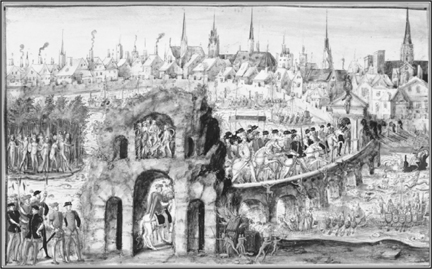
Rouen in 1550. This city on the lower Seine was the center of commerce and capital in Normandy. Champlain often met with his investors here and had much business before its courts. He suff ered many defeats at the hands of monied men who regarded his dream as a drain on their capital—which it was.
In Honfleur, Champlain recalled, “we remained some days, waiting for our vessel to be fitted out, and laden with the necessary things for so long a voyage.” Mountains of provisions and trading goods on the quayside were carried aboard the Saint-Étienne and stowed below. More investors signed on, and the crew was rounded out with seamen from the port of Le Havre, across the Seine.7
These rough seafaring men were a vital part of colonial enterprise, but they are often anonymous in its history. At Honfleur Champlain turned his attention to them in a new way. He encouraged the Récollet fathers to look after their spiritual condition. In Champlain’s words, each seaman and soldier was invited “to examine his soul, to cleanse himself of his sins, to receive the sacrament and put himself in a state of grace so as to become afterward more free (plus libre) in his own conscience and in God’s keeping, when he exposed himself to the mercy of the waves in a great and dangerous sea.”8
Here we see the continuing growth of Champlain’s Christian faith—and its special character. There was little theology in his thinking and no ecclesiology at all, but much of Christian piety. In the best spirit of the universal Catholic Church, Champlain’s piety reached out to embrace all humanity—an attitude very different from that of the Calvinists who founded New England and New Netherland. Champlain believed that Christianity made men more free, “plus libre” in his phrase. He was thinking of grace as liberation from sin, and of Christianity as the freedom to be one with Christ in communion with other free souls. These ideas were growing more important in his own life, and in the history of New France.9
While Champlain looked to the spiritual condition of his migratory flock, he also tended to the expedition’s material needs. One of his last tasks was to load shallops aboard his ship, and to acquire several midsized shallow-draft vessels, designed for exploration and trade on the St. Lawrence River. Champlain called them his barques. They were larger than a shallop and smaller than an ocean-going navire. One wonders how he got them to America. Were they knocked down in the hold or nested together on the weather deck of the Saint-Étienne? Such techniques worked better for small shallops than for middling barques. Did they come at the end of a towline? A long tow was dangerous in a following sea. Or did his moyennes barques sail independently? Perhaps the Saint-Étienneled them in convoy across the ocean, like a mother duck with her straggling brood. Whatever the method, Champlain was delighted with the result. His versatile moyennes barques were vital to the life of New France.10
At last the work was done. Passengers and crew approached the moment of departure, when a seaman’s pulse begins to race and even landsmen share the excitement of a fresh start. On April 24, 1615, Champlain and Captain Pont-Gravé came aboard the Saint-Étienne. The Récollet fathers blessed the ship and all who sailed in her. Deckhands hauled in the long, heavy anchor cable until it was “up and down.” On command the ship’s anchor came “aweigh” from the bottom. Topmen raced aloft, and released the billowing sails from their gaskets. On the weather deck, hands went to braces, and the sails began to fill. The wind and tide carried the ship away from her mooring. As she gathered steerage way the pilot guided her safely out of Honfleur’s tight little harbor into the brown current of the Seine, and turned her prow toward the deep blue water of the North Atlantic.
It was a late crossing, and a lucky one. In fine spring weather, the Saint-Étienne spread her sails before a “very favorable wind,” and they went flying across the western ocean. The timing of the voyage made a difference. Champlain noted with relief, “We made the voyage without meeting any ice, or other hazards, thanks be to God, and in a short time arrived at the place called Tadoussac on the 25th day of May.” Allowing for the long passage up the St. Lawrence River, which often took ten days or more, the ocean crossing to the Grand Banks must have lasted no more than twenty days. It was a passage of surprising speed for an east-west voyage, and a tribute to the seamanship of her commanders.
Between the two of them, Pont-Gravé and Champlain had made more than fifty crossings of the North Atlantic, and they never lost a large ship at sea. A lucky voyage was one thing. A long run of lucky voyages was quite another, and it had deep meaning for men who went down to the sea in ships. With every voyage, Champlain was gaining a reputation as a fortunate commander. Seafaring men are superstitious that way. They know what a rogue wave can do, or a white squall that could strike without warning and blow a navire as big as the Saint-Étienne on her beam-end.
In their day and ours, sailors who survive those events come to believe in fortune as a driving force in their dangerous world. They observe from experience that some people have good fortune and others do not. They also think that fortune is a fickle goddess, and make every effort to propitiate her. Even in our own time, seamen with postgraduate degrees in science will go out of their way to avoid starting a long voyage on a Friday. Modern naval officers trained to reason and empiricism make a habit of never setting their caps upside down, in fear that they might fill with water and sink. They like to sail with lucky captains and dread a leader who is thought to be a Jonah.
In the early modern era, it was not quite the same. A deep belief in fortune (which we possess) coexisted with a spirit of fatalism that is alien to our world. Champlain and many mariners never learned to swim, even though they lived their lives on the water. In the seventeenth century most European seamen seemed to believe that they were destined by fate and fortune to float or sink, and there was nothing much that they could do about it. In the sixteenth and seventeenth centuries those feelings were deepened by a religious belief that a man’s fortune was not a matter of random chance—not a throw of the dice or a turn of the wheel. It was a sign of divine purpose. A verse in Tyndale’s Bible summarized that idea in a sentence: “The Lord was with Joseph, and he was a luckie felowe.”11
Champlain shared that way of thinking. So did his shipmates, from the grizzled captain to the greenest hand. He tells us that when the Saint-Étienne dropped anchor at Tadoussac on May 25, 1615, the first act of all these men was to fall on their knees and “offer thanks to God” for their good fortune, and for having guided us so seasonably to this haven of safety.” The men who sailed with Champlain on yet another fortunate voyage were coming to believe that the Lord was with their leader. Like Joseph, he was a “luckie felowe.”12
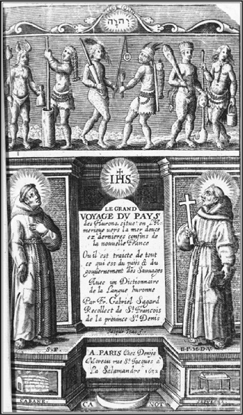
In 1615, Champlain brought four Récollet missionaries to New France. They were followed by Gabriel Sagard, who lived among the Huron (1623–24) and published his Long Voyage to the Land of the Hurons in 1632. Its title page combines icons of his Franciscan order with images of Huronia. The text borrows from Champlain, and adds excellent ethnography and a Huron glossary. His Histoire du Canada (1635) includes Huron sheet music and more details of Champlain’s life.
• • •
In Tadoussac harbor, the ship’s carpenters aboard the Saint-Étienne went to work on Champlain’s flotilla of river craft. Masts were stepped and rigged for sails. Locust tholepins were driven into gunwales and adjusted for oars and sweeps. Merchants checked inventories of trade goods. The holy fathers polished their communion silver and made preparations for their mission to the Indians. Champlain adjusted his instruments. All were eager to be on their way.
The first boats were ready on May 27. That very day, Champlain and the Récollets departed, heading upriver from Tadoussac to Quebec. The journey took nearly a week against the winds and currents on the St. Lawrence River. They arrived on June 2 and found the settlement in better condition than they had expected. Champlain wrote that the Récollet fathers “were greatly encouraged to find a place that was completely different from what they had imagined.”13
Good as it may have been, Champlain was never satisfied. He assembled the habitants and ordered them to make it better. As always, he was full of energy and purpose, and he imposed his will on the settlement. This was not an open system. Champlain conscripted the labor of the habitants for what he believed to be the general good. He ordered some to clear land. Others were told to build a new residence for the Récollet fathers, with a chapel where they could celebrate mass.14
When these projects were well begun, Champlain was off again, sailing upstream from Quebec. With him went Pont-Gravé, several Récollet fathers, a party of soldiers, and the seamen who worked the boat. The Récollets were amazed by the scale of the river, and overwhelmed by the beauty of the countryside. Champlain wrote of the “delight of our Fathers” on seeing “the extent of so grand a river, filled with many beautiful islands, and bordered by the banks of a fertile land.”15
They continued to their destination, a large island that is now part of the city of Montreal. Just beyond was the head of navigation on the river—the wild rapids that Champlain had run in his shirt.16 Below the island was the Rivière-des-Prairies. Its open meadows became a meeting place for Europeans and Indians of many nations. Champlain and his party came ashore and found that a crowd was already waiting for them. They were Huron, Algonquin, and others. All greeted the French warmly, Champlain especially. “As soon as I reached the rapids,” he wrote, “I visited among these people, who wanted very much to see us, and were joyous at our return.” He recorded the surprise of the Récollet fathers, who were astonished to meet “a very large number of strong and hardy men, who made clear that their spirit was not as savage as their customs.”17
This gathering, warm as it may have been, was a collision of cross-purposes. The Indians had a particular object in mind. They complained that their ancient foes “were continually along their trading paths, and prevented them from passing.” This time they were not speaking of the Mohawk, who had stopped their northern attacks after Champlain’s campaigns against them. These raids came from central Iroquoia. The Onondaga and Oneida nations were plundering fur routes along the upper St. Lawrence Valley and the Ottawa River. The Huron and the Algonquin were deeply concerned about security in their own country.18
Champlain discussed the subject with Pont-Gravé, and they agreed that “it was very necessary to assist them, both to engage them the more to love us, and also to provide the means of furthering my enterprises and discoveries, which apparently could only be carried out with their help, and also because this would be to them a kind of pathway and preparation for coming to Christianity.” They were convinced that another quick campaign against the central Iroquois was a path to peace in New France, as it had been with the Mohawk five years before.19
At the Riviére-des-Prairies Champlain convened a tabagie: “We summoned them all to an assembly,” he wrote, “in order to explain our intentions.” Working through an Indian interpreter, Champlain explained that he hoped to go beyond the Sault-Saint-Louis and visit the western nations. He wanted to “examine their territory” and explore the way to the “western sea.” Once again he offered to “help them with their wars.”20
Champlain and the Indian leaders discussed these questions. They agreed to send a strong force against the central Iroquois. It would be a grand alliance of Indian nations in the St. Lawrence Valley, with others near the Great Lakes and even beyond. The Indian leaders at the assembly promised to muster 2,500 warriors. Champlain offered to go back to Quebec and return with as many Frenchmen as possible.
They also discussed strategy and tactics, on which the Indians and Champlain had different ideas. He wrote, “I began to explain the means we must employ fighting.” The speech does not survive, but to judge from words and acts that followed, he proposed a bold campaign against one of the large fortified towns in the very center of Iroquoia. Champlain had in mind a punitive expedition, executed with great power and speed. He favored campaigns of rapid movement with strong concentration of force. The object was to strike a hard blow against an important target, take a heavy toll of their warriors, and make a quick retreat. This was not a war of conquest or extermination. Champlain’s purpose, whenever he took up arms, was never to make war on women, children, and the elderly. He warred only against warriors. The object was to deter future attacks and to create a foundation from which peace could grow.
His Indian allies were thinking in other terms: not a punitive expedition in the European sense, but a revenge raid to retaliate for old losses, and a mourning raid to replace them with new captives. Their differences with Champlain did not emerge at the tabagie. The emphasis was on combined effort, and all agreed on the main lines of the campaign.
The Indians were eager to get started, but Champlain pointed out that the expedition “could not take less than three or four months,” and he had to go back to Quebec and settle some “essential matters.” He promised to return in four or five days.21 Champlain sailed quickly down the river to Quebec on June 26 and found that all was well. Two Récollet fathers, John and Pacifique, had fitted out the chapel and celebrated Holy Mass on Sunday, June 25, which Champlain believed to be the first there.22 Unhappily, a third Récollet, Father Joseph Le Caron, had gone up-country with twelve Frenchmen. “This news troubled me a little,” Champlain wrote. He had hoped to take the men on his expedition. “I could have ordered many things for the voyage which now I was not able to do, because of the small number of men, and also because not more than four or five knew how to handle firearms.”23
Undeterred, Champlain left Quebec on Tuesday, July 4, and hurried up the river to the rapids for his rendezvous with the Indians. He was late, and they were gone. After two weeks with no sign of him, the Indians had despaired of his arrival and departed for their homes. A rumor spread that he had been killed by the Iroquois.
Champlain arrived just after they had gone and went racing after them. He took his servant, an interpreter, and ten Indian paddlers in two big canoes. They left the Rivière-des-Prairies and went up the river, determined to go forward with his expedition. It was a hard journey. From the great rapids of the St. Lawrence River to Huronia, the distance was nearly five hundred miles upstream against the current and prevailing wind, with many painful portages. They did it in twenty-three days, the Indians bending over their paddles and singing their rhythmic canoe songs, as their glistening blades flashed in the bright summer light.24
For the first part of the journey, Champlain followed the line of his earlier travels in 1613–14. Then he detoured far to the north to keep clear of the western Iroquois and especially the Onondaga, whose war parties were much feared. Beyond Morrison Island, Champlain’s party left the Ottawa River and entered “an ill-favored region full of pines, birches, and a few oaks, very rocky, and in many places rather hilly.” They were crossing the Laurentian shield of Canada, which Champlain described as “a wilderness, being barren and uninhabited,” full of “rocks and mountains and not ten arpents of arable land.” But even in this “frightful and abandoned land,” Champlain found an abundance of sorts—a “grand quantity of blueberries,” blüets as he called them, “in such plenty that it is marvelous.”25
Along the way he met many Indian nations, talked with them, and encouraged alliances with the French. He visited again with the Morrison Island Algonquin, whom he knew well. In another poor region, he met a group called the Otaguottouemin, who lived by hunting, fishing, and harvesting a huge abundance of blueberries, which they dried and ate through the winter.26
Champlain portaged around several rapids to Lake Nipissing, where the nation of that name gave him “a very kind reception.” Then he went yet another thirty leagues to the French River and made his way to Lake Huron, which he called the Lake of the Attigouautan, after the Bear clan of the Huron nation. He traveled forty-five leagues along its shore, marveling at its size. He called it la mer douce, the sweet-water sea. It was a disappointment to him that way, as he was he searching for salt water that promised a route to China. But he felt better when he caught lake trout that were four and a half feet long. The pike were of the same size, and the sturgeon reached as much as nine feet, “a very large fish and marvelously good eating.”27
Near the lake he came to yet another Indian nation called the Cheveux-Relevés or High Hairs, with pierced nostrils and ears fringed with beads. Their hair was “raised very high, and arranged and combed better than our courtiers.” Champlain became especially fond of the Cheveux-Relevés and delighted in their ways. He gave their senior chief a metal hatchet and quizzed him about his country, “which he drew for me on a piece of bark.”28
From Lake Huron, Champlain crossed Georgian Bay and entered the country of Huronia. Measured against the vast distances of Canada, it appears very small on a map of this great nation, but Champlain explored it on foot and had a different impression. “The whole country which I visited on foot extends for some twenty to thirty leagues,” he wrote, “and is very fine.” He reckoned that it had an area of about forty by sixty miles, roughly 2,400 square miles. Champlain calculated the latitude of Huronia at approximately 44 degrees, well south of the lower St. Lawrence Valley. Its growing season was long enough to produce abundant crops of corn, and he was impressed by the quality of its soil. “This country is very fair and fertile,” he wrote, and he took pleasure in traveling through it.29
If he was surprised by the extent of Huronia, Champlain was amazed by its population. He described the land as “a well cleared country” and “well peopled with a countless number of souls.” He tried to count them and came to a rough estimate of thirty thousand inhabitants.30 He was astonished by the number of towns, and still more by their size and strength. The town of Carhagouha (not the largest) impressed him with its massive triple palisade, thirty-five feet tall, as high as a four-storey building.31
The Huron villages were surrounded by big cornfields, some larger than a thousand acres. He found bumper crops in the fields, much of them nearly ripe in mid-August. The production of corn exceeded consumption. Champlain observed that the Huron raised crops for export to other Indian nations. He wrote, “They are covered in the pelts of deer and beaver, which they acquired from Algonquins and Nippissing for Indian corn and meal.” Huronia became the breadbasket of other Indian nations. It also produced an abundance of squashes and sunflowers, plums and small apples, raspberries, strawberries, and nuts.32
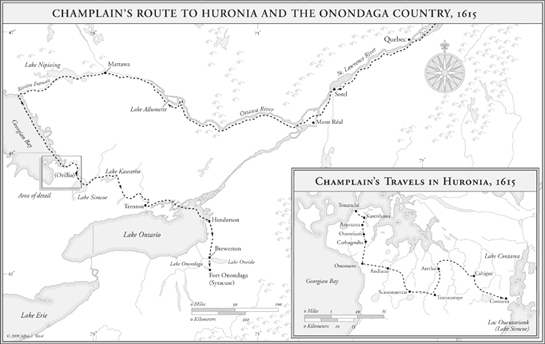
Champlain tells us that he visited most of Huronia’s major towns and many of its villages in a systematic way. He became increasingly aware of the open structure of politics in Indian cultures. Each Huron village had separate sets of leaders for every clan that lived there. Champlain met with many of these men. It was an extraordinary effort in frontier diplomacy that consumed much of the month of August. In the end, it may have had two consequences, one of them unintended. Champlain broadened his own base of support among the Huron, but at a price. In the process, he may have weakened the already limited authority of the most eminent leaders in Huronia. That problem would come to haunt him in the weeks to follow.33
On August 17, 1615, Champlain reached the town of Cahiague, “the chief village of the country,” larger than Carhagouha. Here the warriors of Huronia were asked to gather for the campaign against the central Iroquois. He wrote: “I was received with great joy and gratitude by all the natives of the country, who had abandoned their project, thinking that they would never see me again, and that the Iroquois had captured me. This was the cause of the great delay which had happened in this expedition.”34
It was agreed that they would make a long march from Huronia into the center of Iroquoia and launch a bold attack on a major town of the Onondaga nation, which Champlain called Entouhonoron or Antouhonoron. These people had been raiding to the north across Lake Ontario, which he knew as the Lake of the Entouhonoron, the Lake of the Onondaga.35
While Champlain waited for the war parties to gather, he explored the town of Cahiagué. It was an extraordinary place. He counted two hundred large lodges, with a population in the range of three thousand to perhaps six thousand people. It was protected by a massive palisade with seven rows of posts. The strength of its defenses was a measure of the scale of fighting between the Huron and the Iroquois.36
By the last week of August the Huron warriors had assembled. They set off on September 1, passing from Cahiagué to the land near the attractive modern town of Orillia between Lake Couchiching and Lake Simcoe, where they paused for the Algonquin war parties to join them. Champlain’s visits had borne fruit. The Algonquin Petite nation turned out in force, with their war chief Iroquet. So did the Morrison Island Algonquin and their chief Tessoüat. Other nations also came forward.37
The Huron and Algonquin hoped that yet another major Indian nation would join them from the southern side of Iroquoia. These were the Susquehannock, who lived in what is now Maryland, Pennsylvania, and southern New York. The Iroquois were at war with them as well. The Susquehannock were allies of the Huron and had heard good things about the French. They had captured three Dutch traders who were with the Iroquois and let them go, thinking they were Frenchmen. They offered to join the attack on the central Iroquois with five hundred men. The Huron told Champlain that the Susquehannock were good fighters, but they could be reached only by a long detour around the country of the Seneca. The Huron decided to send a delegation of twelve of their best warriors. Champlain’s truchement, his interpreter Étienne Brûlé, asked to go along, and it was agreed.38
On September 1, the main force of Huron and Algonquin warriors was at last ready, and off they went together. Champlain had between ten and thirteen French arquebusiers; the Indians mustered at least five hundred warriors, probably more.39 The size of the expedition is not clear, but it was large enough to cause a major problem of logistics. Champlain wrote, “we advanced by short stages, hunting continually.” He described a hunt by “400 or 500” Indians, who formed a line and drove the deer onto points of land surrounded by lakes and rivers. The deer threw themselves into the water and were killed with sword blades attached to long poles. Champlain wrote, “I took a peculiar pleasure in watching them hunt in this manner, noting their skill.”40
The French joined the hunt with their firearms, and caused an accident. An arquebusier aimed at a stag and wounded an Indian warrior, which threatened to disrupt the expedition. Indians did not believe in accidents. Champlain wrote that “a great clamor arose.” It was settled with presents to the wounded man and his family, “the ordinary method of allaying and ending quarrels.”41
It was a very long distance from Cahiagué to the center of Iroquoia, a journey of forty days from their departure on September 1. Most of it was done by canoe. Indian guides led them through a long chain of lakes with short portages: today’s Cranberry, Balsam, Cameron, Sturgeon, Pigeon, Buckhorn, Deer, Clear, and Rice lakes, and the Otonabee and Trent rivers. That route took them south from Huronia to the northeast shore of today’s Lake Ontario.42
There they launched their canoes and set out across the northeastern corner of Lake Ontario, by way of islands that gave them passages of no more than seven miles in open water. This ingenious route brought them to the eastern shore of Lake Ontario, south of today’s Sacket’s Harbor, below a cape called Pointe à la Traverse. The Indians carefully hid their canoes in deep woods, which was vital to the success of their mission. If they lost their canoes they would be trapped in enemy country. The canoes were cached with great skill.43
On October 5 or thereabouts, they started on the last leg of their long journey. Champlain wrote that they went due south by foot along a “sandy beach,” across “many small streams and two little rivers” that flowed into Lake Ontario. As always, Champlain studied the region, and wrote that the countryside was “very agreeable and handsome,” with many ponds and prairies, and “an endless variety of game.” He admired the “beautiful woods” with their “great number of chestnut trees (chastiaigners), and sampled the abundant chestnuts, and found them to be good eating (de bon goust).” With Champlain in command, even a military campaign had a way of becoming a triumphant tour gastronomique.44
They followed the coast of Lake Ontario to its southeastern corner. Here, very near the present Selkirk Shores State Park, they crossed the Salmon River (more good eating), and turned away from the lakeshore into the forest. They made another long march along the line of today’s New York Highway 11 and Interstate Route 81, into the heart of Iroquoia. It was a dangerous place for them. This part of the journey took four days to go about forty miles, over several large creeks and the Oneida River, which they crossed near the present town of Brewerton. They were marching through the country of the Oneida to the land of the Onondaga nation.45
When they entered the Onondaga country, Champlain’s Indian allies changed their march discipline. They began to move forward in silence and great stealth. In deep woods, their scouts surprised a small Onondaga party of three men, four women, and four children who were “going to catch fish.” They were taken prisoner and brought to the main body. An Algonquin warrior of the Petite nation ran up, seized a woman, and cut off her finger, “for a beginning of their usual torture.”
Champlain rushed to her defense. “I came at once,” he wrote, “and reprimanded the chief,” who was his friend Iroquet. Champlain was very angry. He said to Iroquet, “This is not the act of a warrior, as he calls himself, to behave cruelly toward women who have no other defence but tears, and whom by reason of their weakness and helplessness we should treat with humanity.” Those were his words: on doibt traicter humainement. He told Iroquet that the torture of women would be judged as coming from a “base and brutal disposition,” and if any more of this cruelty followed, the French would not assist them in their war. Iroquet replied that the enemies did the same to them, but if it was displeasing to Champlain, nothing more would be done to the women. He promised to torture only the men.46
But that response was not the end of it. According to a later account by Jesuit father Paul Le Jeune, another Algonquin warrior of the Morrison Island nation heard Champlain’s words and was enraged by the interference of this meddlesome Frenchman. He turned defiantly on Champlain and said, “See what I shall do, since you speak of it.” He seized an Iroquois infant who had been nursing at the breast of its mother, took it by the foot, and smashed its head against a rock or a tree. The French were appalled by the murder of this innocent baby—and still more by the way that “these proud spirits (ces superbes) spoke to a captain who had arms in hand.” The alliance between the French and the Indians threatened to fly apart—in the middle of Iroquoia.47
Then suddenly another crisis came upon them. The scouts at the head of the column came in sight of their target—a large fortified town of the Onondaga nation. It lay on a good-sized stream that flowed into the southern end of Lake Onondaga in what is now the city of Syracuse, New York.48 Champlain had already worked out a careful plan of attack. He proposed that his arquebusiers remain out of sight and wait for a battle to develop. When the Onondaga warriors emerged from the fort, the French would intervene at the critical moment, some of them from the flanks, as they had done twice against the Mohawk.
At first contact with the enemy the plan came apart. As his Indian allies came within sight of the fort, a small group of Onondaga warriors rushed out to fight them. Some of the allies raced forward in quest of captives. The operation dissolved into a chaos of small fights, and the Iroquois began to get the upper hand. Champlain watched with concern as more Indians from both sides joined the fight and the tide of battle turned against his allies. He called to his arquebusiers and led them forward. They opened fire, and the Onondaga recoiled in shock. Champlain thought that many of them had never seen European soldiers armed with “thundersticks.”
The Onondaga retreated into the fort with their dead and wounded. Champlain also fell back, with wounded Indians whom he had rescued from the field. He was in a state of fury. To protect a few impetuous warriors, he had lost the vital element of tactical surprise that had worked so well against the Mohawk. He remembered that he used “hard and unpleasant words” and warned the Indian war chiefs that “if every thing went according to caprice … evil alone would result, to their loss and ruin.”49
• • •
Champlain studied the Onondaga town, which was more a castle than a fort. It was surrounded by four massive palisades of heavy interlocked timbers thirty feet high. On the top were galleries or parapets protected by double timbers that were proof against French musketry. The castle had an ample supply of water, and a system of gutters and waterspouts that could be used to put out fires along its wooden walls. Altogether Champlain thought that the Onondaga fort was stronger than the towns of the Huron.
Champlain invited his Indian allies to a council of war and recommended a new plan. Drawing on his experience of European siegecraft, he proposed that they construct a “siege engine” called a cavalier. This was a protected platform on stilts, higher than the palisades, with loopholes for firearms. Then he suggested that they build large shielded enclosures called mantelets, and use them to approach the palisades and set the walls ablaze.
It was agreed. With incredible speed the Indians and the French built a big cavalier. Two hundred men pushed it forward, within a “pike’s length,” about sixteen feet, of the palisade. From its high platform, French arquebusiers began to fire into the town, loading their weapons with three or four balls at each discharge. They had an abundance of ammunition, and they raked the interior of the crowded Onondaga fort for three hours, inflicting heavy losses on the defenders. Champlain wrote, “Those on the Cavalier killed and maimed many of them.”50
Champlain started the next maneuver. Other Indians came forward under cover of the mantelets. They piled kindling against the palisades and started fires. But they did it on a side of the fort where the wind was against them, and the defenders used their gutters to pour water on the flames. The attackers ran short of kindling, the fires went out, and the frustrated attackers emerged from their mantelets. They fired arrows that had little effect, screaming defiance at the enemy. Champlain wrote, “One could not make oneself heard, which troubled me greatly. In vain I shouted in their ears…. They heard nothing, on account of the great noise they were making.”51
Champlain observed that the Onondaga “took advantage of our confusion” and returned in strength to their ramparts. The defenders aimed great numbers of arrows at their attackers. The French fired back and inflicted severe losses, but more Onondaga warriors replaced their fallen comrades. Champlain wrote that the arrows “fell upon us like hail.” Two of the three leading Huron chiefs were wounded. Then Champlain went down, hit by several arrows. One penetrated an unprotected spot on his leg. Another went into his knee. He fell to the ground, unable to walk, and wrote that the wound caused “extreme pain.” Despite his injury, he believed that victory was in reach and urged his allies to “turn against the enemy again.” The Indians refused. Champlain said, “My discourses availed as little as if I had been silent.” He observed that “the chiefs have no absolute control over their men, who follow their own wishes and act as their fancy suggests, which is the cause of their confusion and spoils all their enterprises.”52
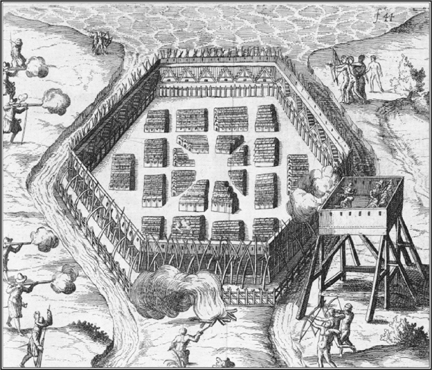
Champlain’s sketch of his attack on the Onondaga fort in 1615, at Lake Onondaga. He tried to capture it with a European siege engine called a “cavalier,” while his allies tried to burn the palisade. Champlain thought the attack a failure, but Indians on both sides judged it a highly successful revenge raid. It led to a long period of peace.
The Indians fell back from the fort, but under heavy pressure from Champlain, they agreed to wait four or five days in hope that the Susquehannock might join them. The next day a great wind came up, and Champlain saw another opportunity to burn the wooden castle. Once again the Indians did not agree, and “would do nothing.” They continued in their camp around the fort for a few days, waiting for word of the Susquehannock. Onondaga war parties came out of the fort and small skirmishes took place. Champlain wrote that the Onondaga again got the upper hand in these engagements, and withdrew only when Champlain sent forward his arquebusiers, “which the enemy greatly feared and dreaded.”53
Finally, on October 16, the Huron and Algonquin would wait no longer for the Susquehannock, and decided to go home. Champlain, for all his frustration, sympathized with them. “They must be excused,” he wrote, “for they are not trained soldiers (gens de guerre) and moreover they do not submit to discipline or correction, and do only what they think right.” The siege of the Onondaga fort was at an end.54
Champlain judged the battle by the measure of his intention, and believed that he had been defeated. His object had been to capture the Onondaga “castle,” and in this he failed completely. He succeeded only in charring a small part of the outer palisade, did no damage to its structure, and was compelled to retreat. Champlain always wrote of this battle as a defeat, and he regarded the entire mission as a failure. For many years most scholars, including this historian, shared that view. Marcel Trudel went further and concluded that the assault on the fort was not merely a defeat but a disaster for New France. He believed that it marked the beginning of the great expansion in Iroquois power.55
More recently, historical ethnographers have approached the same question in a different way. Working from their familiarity with Indian cultures, they studied the campaign by the standards of Indian warfare and came to a surprising conclusion. Bruce Trigger, a leading ethnohistorian of the Huron, found that “none of the Indians involved regarded the campaign of 1615 as a defeat for Champlain or his allies.” After this battle and the two fights against the Mohawk, Trigger observed that the Iroquois Five nations “did not wish to fight the French.” He added: “The question that must be asked is why, after the French had played a leading role in killing about 160 Mohawks in 1609 and 1610, and attacking the Oneida [Onondaga] settlement in 1615, these tribes were not more vindictive.”
Trigger’s answer was complex, involving relations between the Iroquois and the Dutch, and other opportunities to the south and west. An important factor was the high cost to the Iroquois of hostilities against the French. In the attack on the Onondaga castle, Champlain’s arquebusiers killed and wounded many Indian defenders of the fort. We have no count of casualties, but the firing was heavy and prolonged, the range was point-blank, and the cost must have been severe to this small Iroquois nation. Champlain’s allies withdrew successfully with few losses of their own. Trigger concluded that Indians on both sides regarded such an attack as a success.56
An ethnohistorian of the St. Lawrence Indians agreed with Trigger. José António Brandao also wrote that the campaign succeeded by the standards of Indian warfare. The attackers made a bold march into the heartland of the Iroquois League, launched a major assault on one of its most formidable strongholds, and inflicted heavy casualties on Onondaga warriors who had been raiding the St. Lawrence Valley. From the perspective of Indian culture, the attack was brilliantly effective as a revenge-raid, and it appears to have been regarded that way by Indians of many nations.
Brandao observed that it was also a success when measured against another of Champlain’s larger purposes, which was to deter Iroquois attacks to the north. After his campaign, “none of these groups, nor the [Iroquois] confederacy as a whole, was eager to wage war against the new French settlers and their native allies. Instead, the Iroquois tried to make peace with their native foes.” He added, “Even though he had aided the Algonquins, Hurons and Montagnais against the Iroquois, Champlain did not appear to rule out the hope of peace among these groups. Indeed, at first Champlain looked favorably on peace efforts between the Iroquois and his native allies.”57
William Fenton, an ethnohistorian of the Iroquois, also agreed with Trigger and Brandao. He wrote that after the battle of the Onondaga fort, Iroquois raids to the north were much reduced. For twenty years, the Onondaga and Mohawk were careful not to fight the French. Fenton observes that major Iroquois hostilities did not revive until 1640, by his reckoning. Champlain’s campaign against the Onondaga was a successful example of limited war for purposes of peace and stability.58
After the battle, Champlain was immobilized by his wounds. His Indian allies took command and organized the withdrawal with practiced skill. The Onondaga came after them, urgently seeking prisoners for their own ceremonies of revenge. They got none. Champlain wrote, “The enemy followed us about half a league, but at a distance, to try to capture some of those who formed the rear-guard, but their efforts proved vain, and they withdrew.” Champlain was much impressed by the conduct of the withdrawal, which showed a discipline that had been lacking in the attack. He wrote of his allies that “they conduct their retreats very securely, putting the wounded and the elderly in the middle, and strong forces on the front, flanks and rear, without breaking ranks until they reach a place of safety.”
Even so, it was a terrible ordeal, especially for Champlain himself. They had to march seventy-five miles to their canoes. Champlain was unable to walk, as were “many of their wounded.” To leave them behind was to condemn them to death by the unspeakable agony of Iroquois torture—and also to forfeit the victory of a revenge-raid. The Indians improvised large baskets, or paniers, as Champlain described them. The wounded warriors were put into the baskets and “bound in such a manner that it was impossible to move any more than a little child in its swaddling clothes.” The paniers were strapped to the backs of very strong Indians who carried them to safety.59
“It caused the wounded great and extreme pain,” Champlain later testified. “I can say this indeed with truth from my own case, having been carried for several days because I was unable to stand, chiefly because of the arrow in my knee. Never did I find myself in such a hell as during this time, for the pain I suffered from the wound in my knee was nothing in comparison with what I endured tied and bound on the back of one of our Indians. This made me lose patience, and as soon as I was able to stand, I got out of this prison or more accurately this hell that I was in.”60
If the wounded were “greatly fatigued,” so were their carriers. Able-bodied Indians took turns, and the way was long and hard. On October 18, just after the withdrawal began, they were overtaken by heavy snow, hail, and “a strong wind which caused us much trouble.” The Indians kept on with a stoic determination that Champlain admired. At last they reached Lake Ontario, and found their canoes still safely hidden.
Champlain asked to be taken back to Quebec, which the Indians had promised to do after the campaign. But the chiefs did not agree. Four individual Indians came forward and offered to take Champlain and his French arquebusiers to their settlement. The warriors did so in defiance of their chiefs and “of their own accord, for as I have said before, the chiefs have no authority over their companions.” But they needed canoes, and the Indian leaders insisted that there were none to spare. Champlain was very unhappy. The Indians were breaking a promise, and he was “badly equipped for spending the winter with them.” Gradually it dawned on him that the Indians had a complex purpose in mind. “I perceived that their plan was to detain me with my comrades in their country, both for their safety and out of fear of their enemies.” His allies worried that a small party might be intercepted by the Iroquois, with fatal results for the alliance. Further, they wanted Champlain to be part of their “councils and assemblies, and to join in decisions about what might be done for the future against their enemies.”61
It was soon clear that protests had no effect. Champlain wrote, “Not being able to do anything, I had to resign myself to be patient.” He decided to make the best of his situation and use the time to observe the ways of the Huron and their neighbors: “During the winter season, which lasted four months, I had leisure enough to study their country, their manners, customs, modes of life, the form of their assemblies, and other things which I should like to describe.”62
An ethnohistorian, Elisabeth Tooker, compared Champlain’s studies of the Huron with those of the Jesuits who followed him. She observed that the Jesuits were men of great learning who described the religion of the Huron in depth but were superficial on other aspects of their culture. Champlain’s studies were in her judgment “less cultivated but not less precise.” He had less interest in Huron religion but was “more attentive to other aspects of culture neglected by the Jesuits, in particular the life cycle, inheritance, and modes of subsistence.” He studied them as a participant-observer, “a man among men, who took part in military expeditions, hunted big game with them, and later wrote of his experiences.”63
The Huron treated Champlain very well. The chief named Atironta (Champlain called him Darontal) gave Champlain his cabin, with abundant supplies and furniture. He was invited to join a great deer hunt, which Champlain called their “noblest sport.” He hunted with the men of the nation as they drove the deer into an enclosure 1,500 paces on a side, made of wooden stakes eight or nine feet high. The Indians imitated wolf cries, drove the animals into the trap, and killed 120 deer. He was astounded by the skill of the Indian hunters, by their success in working together, and by their very elaborate forms of organization.64
Champlain also studied the flora and fauna of Huronia. Like many hunters, he loved animals, birds, and plants. While on a hunt, he wrote: “[I observed] a certain bird which seemed to me peculiar, with a beak almost like that of a parrot, as big as a hen, yellow all over, except for its red head and blue wings, which made short successive flights like a partridge. My desire to kill it made me chase it from tree to tree for a very long time, until it flew away in good earnest.”
He tried to retrace his steps but could not find the Huron hunting party, and soon he was completely lost in a trackless forest. He had no compass or map, and for three days no sun. But he was armed, and killed a few birds, and cooked them over a fire. Finally he found his way. Champlain did not tell us how, but he appears to have adopted the old Indian method of following watercourses downstream, which took him to a lake where he was able to locate the hunting party. The Huron were appalled, and required him always to take a compass and a skilled Indian guide, “who knew so well how to find a place whence he had set out, that it was a strange and marvelous thing to see.”65
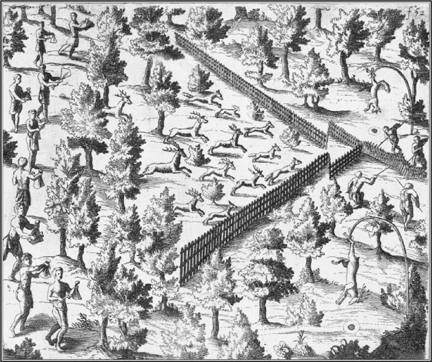
The Huron invited Champlain to join their communal deer hunts in October 1615. He sketched their skillful methods of driving large numbers of deer into pens and trapping others with snares. He respected their skill as hunters and their mastery of collective effort.
Champlain was amazed by the stamina of the Indian hunters. On the return to their villages, he carried a weight of twenty pounds, which with his other equipment soon exhausted him, and probably did nothing good for his wounded knee. He observed that the Huron carried loads of a hundred pounds without apparent strain over very long distances and at a rapid pace. Few Europeans matched their powers of endurance.66
Champlain traveled widely in Huronia. He described the larger region as “almost an island which the great River of St. Lawrence surrounds, passing through several lakes of great size on the shore of which live many nations speaking different languages, having fixed places of residence, given to cultivation of the earth, but with different manners and customs, and some better than others.”67
Champlain also visited other nations nearby. He especially liked to stay with the Cheveux-Relevés, who were among his favorites of all the many Indian nations. He visited the western Algonquin, and persuaded the Huron to take him to the Petun or Tobacco nation. Champlain also wanted to make a journey to the Neutral nation, as they were called, but the Huron did not agree. Perhaps they worried that a French alliance with the Neutral might weaken their position and even open negotiations with the Iroquois. Possibly they feared that some mishap might befall Champlain. Whatever the reason, the Huron kept him away from the Neutral nation. Blocked in that way, Champlain went in the opposite direction. He visited the Nipissing and built another alliance.
One day Champlain came back from a visit to the Nipissing and found big trouble among his allies. The Petite nation of the Algonquin and their chief Iroquet were wintering with the Huron as was their custom, and exchanging furs for food. The Huron had given them an Iroquois captive, “expecting that Iroquet would exercise on this prisoner the vengeance customary among them.” Iroquet took a liking to the captive, found him to be a good hunter, treated him as a son, and set him at liberty.
The Huron were very angry, and sent a warrior to kill the prisoner, which was done in the presence of the headmen of the Algonquin Petite nation, who were doubly outraged by the murder and the breach of manners, and killed the killer. Now it was the turn of the Huron to be insulted. They took up arms, surrounded the Algonquin village, and attacked. Iroquet was wounded by two arrows, and his lodges were looted. The Algonquin were greatly outnumbered and agreed to pay fifty wampum belts, a hundred fathoms of wampum, many axes and kettles, and two female prisoners. It was a great price to pay, and it brought no peace. The two nations were full of rage against each other, each nourishing a sense of injustice.
At that point two Hurons from Cahiagué asked Champlain to intervene and reconcile the angry parties. Champlain acted quickly and with great tact. He sent his interpreter, probably Thomas Godefroy, to collect the facts, being careful “not to go myself, so as not to give suspicion to either party.” Then he brought together the “leading chiefs” and “elder men” of both sides, and they agreed to accept Champlain’s role as arbitrator. He told them that “the best course was for all to make peace and remain friends,” and that they had dealt with each other in ways “unworthy of reasonable men, but should rather be left to brute beasts.” Peace was restored.68
In a village that he called Carmaron, Champlain had another encounter. He was sleeping in a crowded lodge and found himself assaulted by fleas, “which were in great number and a torment to us.” Champlain rose from his bed in the middle of the night and walked outside into the darkness of the sleeping village. In Huronia, young women and men did that for a very different purpose—not to escape the fleas but to catch a mate. They made a custom of midnight trysts, which were an important part of trial marriages in their culture. It was thought perfectly proper for nubile young women to have experimental unions with many men, sometimes twenty or more, before settling down with one of them. This was a rational custom of what might be called informed choice, but it was very far from Champlain’s folkways.
As he walked alone in the sleeping village, a young woman approached and offered herself to him. Probably she assumed that he was abroad for that reason. Why else would a single man be wandering alone through a Huron village in the middle of the night? Champlain was shocked. “I declined with thanks,” he said, “sending her away with gentle remonstrances,” and he returned to the fleas.
In this encounter, the young Indian woman was keeping one code, and Champlain another. One wonders which of them was more surprised. Many young Frenchmen were delighted to embrace these bold and free young women. Others went a different way—Catholic priests, Indian shamans, and Champlain. He was a soldier and a man of the world who acted like a holy man. It was so unusual that Indians and Europeans talked about him with amazement and admiration in his lifetime and afterward. Among the Indians, his abstinence added to his orenda, or spiritual power.69
Champlain’s impression of the Huron was in many ways very positive. He greatly admired their agriculture and huge fisheries, marveled at their skill in hunting, and came to form high respect for their woodcraft. As before with many other nations, he found these Indians to be the equal of Europeans in their intelligence, and superior in physical strength and the proportion of their bodies. He thought that they excelled Europeans in courage and stamina. “All of these people,” he wrote, “are of a very cheerful disposition although many among them are of a sad and saturnine complexion. They are well proportioned in body; the men big and well shaped, as also the women and girls are pleasing and pretty, both in figures, faces and complexion…. Some of the women are very powerful and of extraordinary height.”70
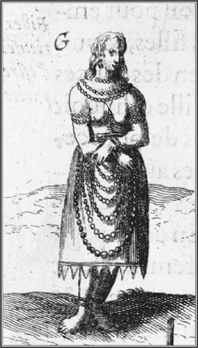
Champlain’s sketch of a Huron girl adorned with strings of wampum. He wrote that they were “well shaped, strong, and robust … many pleasing and pretty in figure, complexion, and face, everything in proportion.” He wrote, “After night comes, the young women run about from one lodge to another, as do the young men who possess them when it seems good to both, but with no violence, leaving the choice entirely to the young woman.”
In Champlain’s thinking, the many good qualities of American Indians were countered by three great negatives: ni foi, ni loi, ni roi; no faith, no law, no king. He and other French leaders in his circle believed that the Indians had souls, which were denied by some Europeans. Champlain agreed with his good friend Paul Le Jeune who wrote: “I believe that all souls are made of the same stock, and they do not differ substantially…. Their soul is a naturally fertile soil, but it is loaded down with all the evils that a land abandoned since the birth of the world can produce.” Champlain believed that the Indians had nothing like the universal faith of the Christian religion.71 He added, “It is a great misfortune that so many poor creatures should live and die without any knowledge of God, and even without any religion or law, whether divine, political or civil.”72 He was interested in their beliefs, studied their ideas of spirits, and talked with their shamans. From this he concluded that in a Christian sense, “they adore and believe in no God nor in any such thing, but live like brute beasts (bestes bruttes).”73
Linked to the absence of faith and universal religion, in his sense, was the absence of law. “As for their laws,” he wrote, “I did not see that they have any, nor anything approaching them; as indeed is the case, inasmuch as there is no correction, punishment or censure of evil-doers except by way of revenge, rendering evil for evil, not as a matter of law but through passion, engendering wars and quarrels which exist among them most of the time.”74 He understood their custom as lex talionis, the law of retaliation, which punished one wrong by the commission of another. In Champlain’s thinking, this rule of conduct was not truly an idea of law, which for him was a principle of right, grounded in an idea of universal justice and equity: lex equitatis.
In the absence of what he believed to be loi et foi, true law and true faith, Champlain regarded the ethics of Indian culture as primitive and inhumane. The leading example was the treatment of prisoners, who were condemned to suffer unimaginably in horrible rituals of sadistic savagery. Some of these helpless victims had done nothing wrong, and yet were wronged themselves in retribution for similar acts that had been committed by others. Champlain regarded this custom of lex talionis as one that betrayed the absence of true law, which rested on an idea of universal right—not a wrong for a wrong.75
Champlain also believed that the culture of North American Indians lacked the authority of kingship and the discipline of subordination. He disapproved of the way that Indian children were raised, with a latitude of indulgent liberty that created young people “so bad and perverse in disposition that they often strike their mothers, and some of the more ill-tempered strike their fathers when they have gained strength and power, that is, if father or mother do something they dislike, which is a kind of curse that God sends them.”76
He also disapproved of the way Indian warriors treated women and compelled them to “serve as mules.” And “as to the men,” he wrote, “they do nothing but hunt deer and other animals, fish, build lodges and go on the war path. Having done this, they visit other nations to trade and exchange, and on their return do not cease from feasting and dancing, with which they entertain one another, and afterwards they go to sleep, which is their finest exertion.”77
In the late twentieth century, some ethnographers have severely chastised Champlain for these attitudes. They have criticized him for being uncomprehending of Indian culture, and ethnocentric in his judgments. It is true that Champlain had a strong and abiding Christian faith, a deep belief in an idea of law as the rule of universal right, and an allegiance to kingship and subordination. At the same time, he was deeply interested in the ways of the Indians, lived with them for long periods, traveled with them, and fought beside them in three campaigns. He knew intimately the Etchemin and Mi’kmaq, Montagnais and Algonquin, Huron, and many other Indian nations. He understood their complex politics and their way of war.
There were limits to his understanding. He was not fluent in Indian languages and worked through interpreters on important occasions, though he could communicate directly in pidgin speech, as he often did. His understanding of Indian groups was incomplete and sometimes erroneous. But he deeply respected the Indians, admired their character, and wrote that “their spirit was not as savage as their customs.” Champlain also believed that Indians could become Christians and learn to live by an idea of law as universal right. At the same time they would remain Indians, and their unique culture should preserve its integrity. Champlain believed that people are capable of complex identities. He knew that it was possible to be Huron and Christian at the same time. Also he thought it was possible for the French to be faithful to their ways and respectful of others.
Here again, in Champlain’s winter among the Huron we see his grand design for New France, as a vision of Indians and French living close to one another, preserving the best of their cultures, guided by principles of universal faith, and respectful of universal law. Champlain was indeed ethnocentric in some of his attitudes, but his thinking was more generous and large-spirited than some of the judgments that have been made against him.
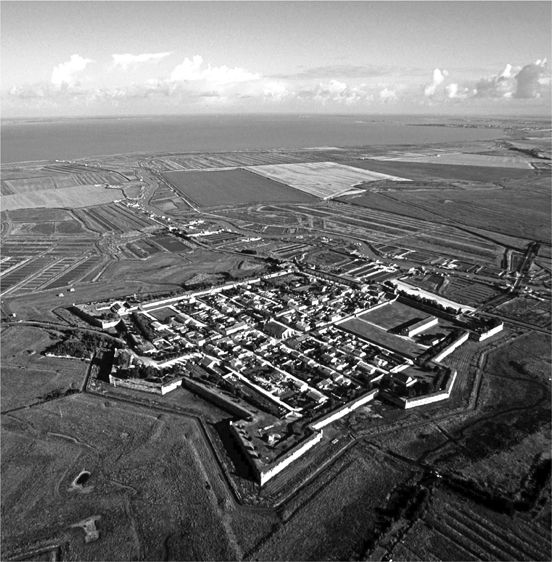
CHAMPLAIN’S NATIVE BROUAGE, IN THE PROVINCE OF SAINTONGE
Samuel Champlain (1570?–1635) was raised in the flourishing small seaport of Brouage, seen here in an aerial photograph. Today it lies more than a mile inland from the Gulf of Saintonge, with the Bay of Biscay and the Atlantic Ocean in the distance. In Champlain’s youth, the busy town was crowded with people from many nations. He grew accustomed to diversity and was consumed with curiosity about the world. The sea became his school, and his father (a ship captain) was his teacher. The surrounding province of Saintonge was a borderland between different French regions, economies, cultures, and languages. It produced leaders such as Champlain and the sieur de Mons who learned to work with others unlike themselves. (A1)
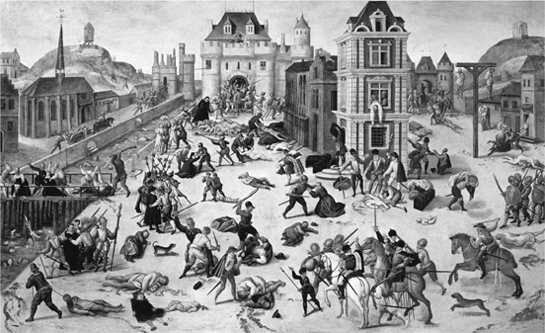
THE WARS OF RELIGION IN FRANCE, 1562–1598
François Dubois, “Massacre of Saint Bartholomew’s Day,” is a chronicle of horror in Champlain’s world. In one day, August 24, 1572, Catholics killed thousands of Protestants in Paris. France suffered nine civil wars of religion in four decades, with deaths reckoned in millions and atrocities beyond description. In that era of cruelty and violence, Henri IV (1553–1610) became king of France in 1589. Baptized a Protestant, he converted to Catholicism (three times), defeated his many rivals in heavy fighting, united the people of France, and in 1598 established a new regime that was dedicated to humanity, peace, and tolerance. Champlain became a soldier in the royal army, served in the largest religious war, and made Henri’s purposes his own. (A2)
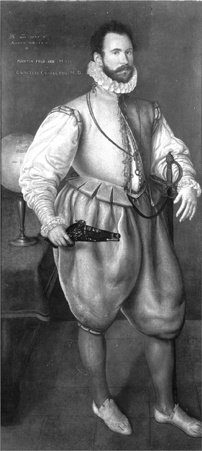
FROBISHER AND CHAMPLAIN
In 1594, Champlain soldiered with Martin Frobisher, an English seaman with a reputation for courage and cruelty. They had a common interest in the exploration of America, but did it in very different ways. This portrait shows Frobisher with the world at his elbow, pointing a pistol toward the artist, who gave his subject a hard eye and an angry look. (A3)
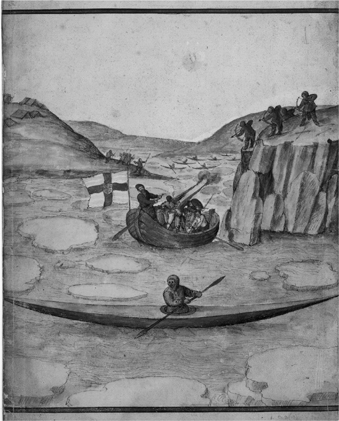
TWO APPROACHES TO AMERICA
Frobisher treated the Indians with brutality. In 1577, he trapped and killed many Inuits, seized an older woman, and stripped off her clothing “to see if she were cloven footed.” He did not think of her as a human being. John White’s scene of this “Skirmish at Bloody Point” was a celebration of violence. Champlain’s approach would be far removed from Frobisher’s. (A4)
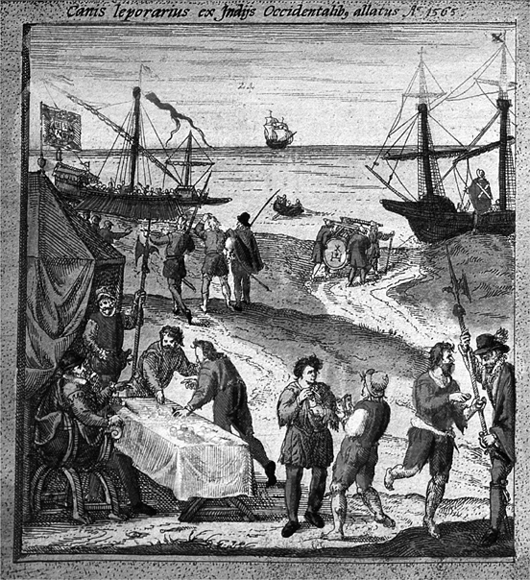
CHAMPLAIN’S MISSION TO NEW SPAIN
After the wars of religion, Champlain visited New Spain in 1599. This image from Georg Hoefnagel’s Civitates Orbis Terrarum shows his Spanish shipmates—seamen in bright clothing called bizarria, soldiers with weapons in hand, an owner paying wages, and highly skilled officers who taught Champlain much about navigation and the new world. (A5)
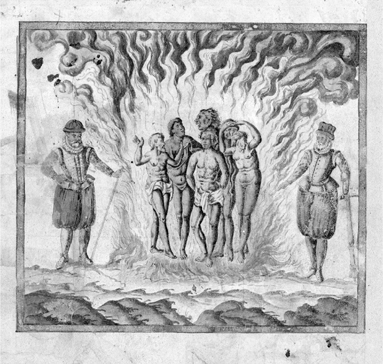
CHAMPLAIN’S DRAWINGS OF SPANISH BRUTALITY TO THE INDIANS
In New Spain, Champlain was deeply interested in American Indians and African slaves. He talked with them at every opportunity and was shocked by Spanish cruelty and exploitation. For his report to the king, he painted this image of Indians burned alive by the Inquisition. (A6)
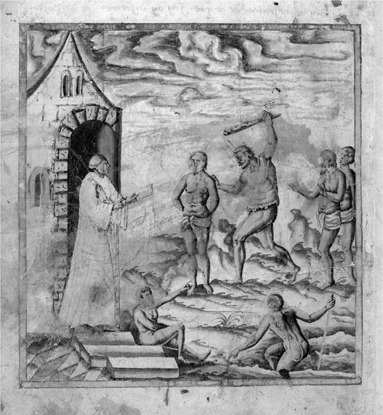
CHAMPLAIN’S OUTRAGE AT RELIGIOUS CRUELTY
Another of Champlain’s paintings showed Indians being beaten for not attending Mass. This pious French Catholic was most deeply offended by atrocities committed in the name of Christ by Spanish priests with the blessing of the Church. (A7)
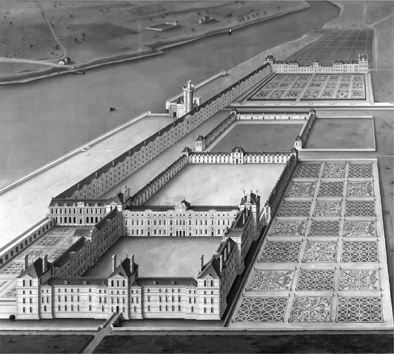
THE LOUVRE’S GRAND GALERIE
On his return to France in 1601, Champlain reported to the king and received a pension “to keep me near his person.” He worked in the basement of the Louvre, which Henri IV made into a Center of Study by scientists, humanists, artisans, and cartographers. A friend described Champlain as a “royal geographer,” one of many in the Louvre. (A8)
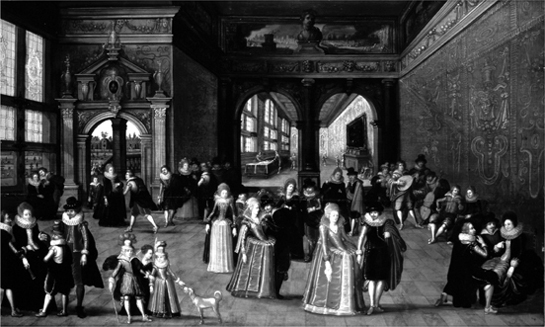
A BALL IN THE COURT OF HENRI IV
For Champlain the court was also a school of manners, where he studied the art of pleasing others. Some of his most important work for America was done as a courtier in France, where he became highly skilled at the art of politics in a complex monarchy. (A9)
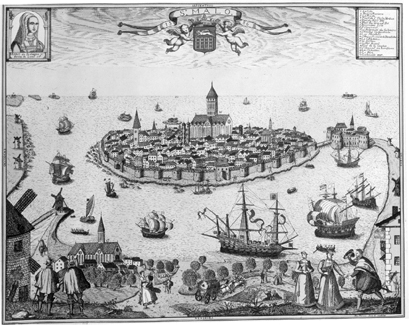
CATHOLIC ST. MALO WITH ITS GREAT CATHEDRAL
In 1602–03, Champlain’s interest began to center on North America. He visited the Breton port of St. Malo, and worked closely with Malouin captains such as François Gravé, sieur DuPont (Pont-Gravé to his friends), who had much experience of the new world. (A10)
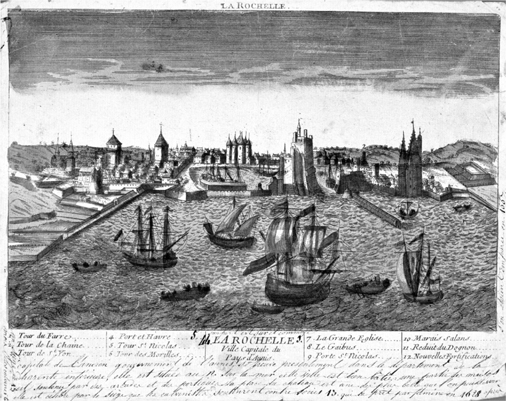
THE PROTESTANT FORTRESS OF LA ROCHELLE
Champlain worked with the Protestant merchants of La Rochelle and Catholics in Honfleur and Dieppe, who had a long acquaintance with North America. He began to develop a “grand dessein” for New France in a spirit of tolerance and humanity similar to the policies of Henri IV and different from Catholic New Spain and Calvinist New England. (A11)
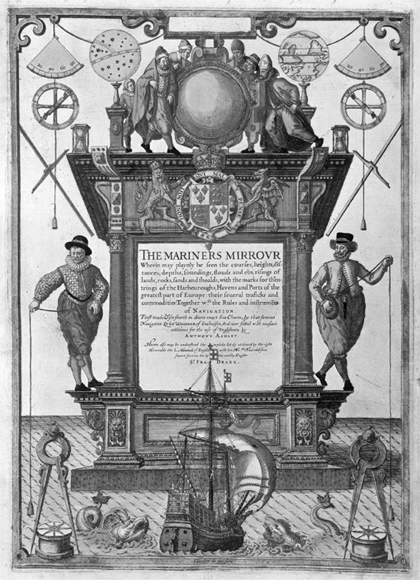
TREATISES ON NAVIGATION IN CHAMPLAIN’S ERA
Champlain also worked with ships’ chandlers in Dieppe. He mastered the science of navigation and studied works such as Wagenaer’s Mariner’s Mirrour in its first English edition (1588?), and Pedro de Medina’s Regimiento de Navegacion (1543, 1595). Champlain also wrote his own treatise about the duty of a mariner and the art of leadership in large causes (1632). (A12)