
Another New Master, 1616–19
When the head is sick, the members cannot be in good health.
—Samuel Champlain, ca. 16161
ON AUGUST 3, 1616, Champlain and Pont-Gravé sailed down the St. Lawrence River, homeward bound for France. They were blessed with fine weather and made a happy crossing in thirty days from Tadoussac to Honfleur. On arrival, their mood suddenly changed. They were astonished to hear that the viceroy of New France was a prisoner in the Bastille.2 The prince de Condé had been arrested on the orders of the queen regent herself, for the capital crimes of treason, rebellion, and lèse majesté. Champlain was deeply alarmed for the viceroy, and also for the fate of New France. He wrote, “The detention of My Lord the Prince led me to think that our rivals (nos envieux) would not be slow in spewing out their poison, for when the head is sick, the members cannot be in good health.”3
Champlain recalled that “from this moment, affairs changed their complexion.” The man who arrested Condé replaced him as viceroy of New France. He was Pons de Lauzière, marquis de Thémines de Cardillac, marshal of France. His appointment as viceroy was confirmed by the queen regent on October 25. Events were moving rapidly at court, and they were deeply threatening to Champlain’s design. One of his rivals approached Thémines and asked to be the viceroy’s lieutenant for New France. We do not know his name. Champlain contemptuously referred to him only as a “certain personage,” and tells us that he offered a bribe to Thémines, promising to treble the viceroy’s annual income by extorting large sums from merchants who wished to trade in New France. Whoever this “certain personage” may have been, he was successful, and the queen appointed him lieutenant for New France. Suddenly Champlain was unemployed.4
He responded as he always did when the grand design was in danger. Champlain fought back with every resource at his command, and recruited others to help. Condé, from his luxurious cell in the Bastille, brought a series of lawsuits against the new viceroy. The duc de Montmorency also filed a suit for his own outstanding claims. Maréchal de Thémines found himself in a tangle of litigation, with two princes of the blood against him.5
These contending parties were soon caught up in a larger and more dangerous game. Champlain began to discover what had been happening in France during his absence. In 1615, while he had been in Huronia, Marie de Medici had grown deeply unpopular in France. She sought a Spanish alliance by proposing to marry her son and daughter to the children of Philip III in Spain. Many people in France disliked these policies, and they detested the queen’s close circle of Italian friends at court. Especially hated were her Italian intimates, Concino and Leonora Concini, whose corruption had become an open scandal. It was one thing for the wealth of the kingdom to flow into French pockets, but quite another when it passed to foreigners.
Anger grew rapidly throughout the country in 1615 and 1616. Marie de Medici felt that power was slipping away, and she specially feared the prince de Condé. After the death of her younger son, Condé stood second in line to inherit the throne. He despised the corrupt circle around the queen. Others rallied to him, and he raised an army in the countryside. Once again the kingdom of France teetered on the brink of civil war. Fighting actually began in 1615 when Condé’s supporters took possession of the town of Méry in Champagne. In a battle that followed, allies of Champlain’s viceroy killed Champlain’s friend the sieur de Poutrincourt, proprietor of Port-Royal in Acadia. He was mourned by many Frenchmen, who blamed their hated Italian queen regent for provoking the trouble.6
In the summer of 1616, Condé rode into Paris to attend the Royal Council and was received with rejoicing by the people of the city. Nobles left the court and flocked to his mansion. In Richelieu’s words, the Louvre became a solitude, and “Condé’s house became what the Louvre had been.”7 Marie de Medici gave way to panic. On September 1, 1616, she ordered that Condé be arrested and confined in the Bastille. The princesse de Condé, an appealing figure, insisted on joining her husband in prison and gave birth to a stillborn child—further outraging the country.8
Marie de Medici chose the path of repression. At the urging of her French adviser Armand Jean de Plessis Richelieu, Bishop of Luçon, she assumed more powers and gave greater favors to her Italian circle, the Concinis in particular. She banished from court the most respected French ministers of Henri IV. Among the victims of her wrath were Champlain’s strong supporters Chancellor Brûlart-Sillery and President Jeannin, who had been very close to Henri IV and had supported Champlain and his design for New France. Sillery’s office was of such a nature that the queen regent could not remove him. She could only order him from her presence, but he was still around. Her ill-considered action increased her isolation.9
Then, writes historian Victor Tapié, “a new character appeared on the stage—the King.” Louis XIII was nearly sixteen years old, no longer a child. He was very frail, often in ill health, and suffered from many ailments, including the tuberculosis that would kill him at the age of forty-three. He had a dark, restless spirit and an explosive temper. His mother had left his upbringing in the hands of a governess, Madame de Monglat. His father, Henri IV, regarded him with profound disappointment and instructed his caregiver to “beat the Dauphin as often as possible,” to make a man of him.10
In his childhood Louis XIII had been kept on the fringe of power, but after the death of his father he had been anointed king, and in 1616 he was coming of age. He hated his mother’s Italian friends, and strongly sympathized with his father’s faithful servants, in particular Chancellor Sillery, a man of exceptional character and intellect. After the queen banished Sillery from court, he visited the young king to say farewell. It was an emotional scene. Many others observed that the young king wept. The queen appeared not to notice her son’s distress.
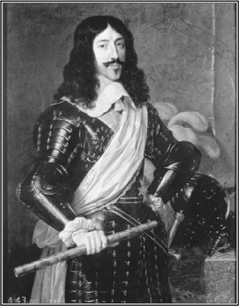
Louis XIII by Philippe de Champaigne is an image of a young, sickly, and deeply troubled king who looked old beyond his years. He aspired to the title of Louis Le Juste, but also to absolute dominion. He tried to help Champlain, but they had different ideas about New France.
The king’s adviser, Charles d’Albert de Luynes, urged him to assert himself and save the country from the Concini. Suddenly the king began to act. He recalled his father’s old ministers and ordered the arrest of the queen’s favorite, Concino Concini, on a charge of embezzlement. The king’s guards were instructed to seize Concini at court and kill him if he fought back. Concini was apprehended on the bridge of the Louvre. He resisted, and was instantly put to the sword. His wife, Leonora Galigaï Concini, was imprisoned, accused of witchcraft and executed. The queen regent feared for her life, but her son the young king showed her more pity than she had shown to him. He allowed her to retreat to a château at Blois, where she raged against the ingratitude of children. With her in this domestic exile went her French adviser Richelieu. His career was thought to be over. The event was nothing less than a coup d’état. It ended the regency of Marie de Medici, removed her closest advisers, and installed the young king in her place.
With young Louis XIII now in power, France took a long step on the road to royal absolutism. He would have a turbulent reign. The king himself was a deeply troubled young man and his private life was in disorder. He was thought to be bisexual in a strongly heterosexual world, and he surrounded himself with beautiful young creatures of doubtful gender who came and went in rapid succession. Some of these royal favorites tried to turn their intimacy into power. There were reports of a homosexual affair between the king and François de Barradat, who would be banished from the court for political intrigue and perhaps other things. He was replaced by Claude de Saint-Simon and then fifteen-year-old Henri d’Effiat, the marquis de Cinq Mars, a bold young man who dared to challenge the greatest ministers in the kingdom. The king also had mistresses and a very complicated platonic triangle involving the beautiful Marie de Hautefort. Young Louis XIII was unstable in these relationships. He trusted few people and was withdrawn, silent, and dangerously “secretive.” He turned on people who thought they were his friends. It was said that he sometimes ordered the arrest of former associates “without warning or outward emotion, and a touch of cruelty.”11
Through it all, the king tried to steer a middle course for France. In his religious policy, Louis XIII continued his father’s Edict of Nantes and supported toleration of Protestant worship, but he also formed a closer connection with Catholic leaders. Protestant churches were ordered to return lands and buildings to the Catholic Church, which increased its wealth and power. The young king also changed his mother’s foreign policy. He sought to expand the power of France through the world—an opportunity for Champlain.
• • •
In the midst of all this turmoil, Champlain regained his job. He never explained how it happened. Suddenly his rival appears to have resigned the office of lieutenant for Quebec, perhaps in fear of his life. The viceroy, Thémines, appointed Champlain to his old position as lieutenant in New France. Confirmation by the king followed speedily on January 17, 1617.12
For Champlain one problem was solved, but many others remained. He was deeply worried about conditions in Canada, and even more concerned about support for his project at court. To judge from his writings, he was most troubled by his financial backers. The monied men of Rouen were growing restless. They had invested in Champlain’s company in the hope of gaining a monopoly of the fur trade in New France, and had done well in 1615 and 1616.13
Most of these investors had never shared Champlain’s dream for North America. They supported exploration, which promised to enlarge the fur trade, but they were not enthusiastic about colonization, which entailed heavy costs and threatened to disrupt their business. Champlain insisted that settlements were vital to the success of commerce in the long run, but business leaders were more concerned about the short run. He complained to the investors about “the small results they had shown in forwarding the growth of the settlement,” and warned that “nothing was more likely to break up the company,” unless more families were sent out “to put the land in cultivation.”14
The investors also worried about the strife at court, which created a climate of uncertainty that was not good for business. They were not happy to learn that they might be liable for large sums to three viceroys at once: Condé under their old contract, and Thémines under the new arrangement, with other claims for compensation still outstanding from the duc de Montmorency. The investors were also supporting the Récollet fathers as well as the habitants at Quebec. The cost of Champlain’s design kept rising. And if all that were not enough, merchant capitalists in La Rochelle, Saint-Malo, and other towns were renewing their appeals for liberty of commerce.15
Champlain was losing patience with court intrigues and litigation, and wrote, “Let us leave them to their pleading, and go and make ready our ships.”16 In the early winter months of 1617, he found an opportunity for a quick voyage to New France. He traveled from Paris to Honfleur, where a ship was waiting. Even before he could sail, yet another attempt was made to remove him from his office as the king’s lieutenant in New France. This time it came from Daniel Boyer, a merchant associated with the Rouen Company. Champlain described him as a malicious enemy and grand chicaneur.17
Just as Champlain was about to sail, Boyer appeared in Honfleur. Claiming to represent the entire company, he reported that the parlement had issued an order that required that “their lordships the Prince de Condé, Montmorency, and Thémines, without prejudice to their rights, should be debarred from receiving any part of the money to which they could lay claim.” Therefore, said Boyer, the associates of the company could not pay Champlain as their deputy on pain of a heavy fine for violating a court order. As they could not pay him, Champlain could “no longer claim the honor of functioning as lieutenant of my Lord the Prince.”18
Champlain was infuriated. He had been appointed by three viceroys and confirmed by the king. His title to the job was clear, and debt litigation had nothing to do with it. Further, Boyer claimed to act in the name of a company that Champlain had founded. “Here was my reward from these gentlemen,” he said. They had done very well by their investments, and now they were trying to eliminate him in hope of squeezing a few more livres out of the fur trade. The more Champlain thought about it, the more angry he became. He turned the full force of his rage against Boyer. “All this was no concern of mine,” he said, and he sent Boyer on his way, maybe at the point of a sword. When the other partners heard about it, they “shifted the responsibility to Boyer, saying that what he had done was without authorization.” Once again, Champlain had survived.19
Champlain sailed from Honfleur on March 11, 1617, aboard the Saint-Étienne, commanded by his friend Captain Morel, a good seaman and an old hand in the North American trade.20 It would be a very short stay in New France. Champlain reached Tadoussac on June 14, and he was back in Paris by July 22, when he signed a legal document. He must have left Quebec no later than the first week in July, which means that he was in New France for a few weeks at most.21
Short as it was, Champlain turned his visit to a constructive purpose. He took with him Pont-Gravé as “conducteur en chef” of trading operations, plus three Récollet fathers, Joseph Le Caron, Denis Jamet, and Paul Huet.22 Most important, he brought out the first French family to settle permanently in Quebec and support themselves by farming. The head of the family was an old friend, Louis Hébert, the young Parisian apothecary who had sailed with Champlain on exploring voyages and helped start the first settlements in Acadia. The Hébert family lived near the Louvre and were part of the American circle there. They were connected by marriage to Jean de Biencourt de Poutrin-court, and by friendship to the sieur de Mons and Champlain.23
Young Hébert had experienced New France first hand. In 1616, Champlain convinced him to settle at Quebec, with a contract from the company and a large grant of land. Hébert decided to emigrate with his entire family: his wife, Marie Rollet, and three children—Anne, a teenager; Guillemette, about eleven years old; and Guillaume, still very small. Also with him were his brother-in-law Claude Rollet and a servant named Henri Choppard.24
When the Héberts arrived at Honfleur to begin their journey, they were shocked to learn that the company would not honor its contract. One suspects the grand chicaneur Daniel Boyer was at work again, with a faction in the company that strongly opposed colonization. The Hébert family had sold their property in Paris and could not return. A bitter compromise was forced upon them. Hébert would receive only half the land and money that he had been promised, and the company would continue to charge interest of 20 percent even on what he had not been given! They also required that Hébert, his wife, and servant would have to work for the company in the fur trade. Altogether the conduct of the company to the Héberts was even more cruel and faithless than it had been to Champlain.25
But Louis Hébert was another man with a dream—a true believer in the idea of New France. He agreed to emigrate even on very unfavorable terms, confident that he could improve his condition in America. In Quebec, Champlain did all in his power to help the Héberts. He ordered employees of the company to work for the Hébert family and build them a sturdy stone house. For many years the Hébert home was the only private family residence in Quebec. With great labor the Héberts established a working farm, tilled it without a plough, and raised food enough to feed themselves and others at Quebec. Hébert also contributed his skill as an apothecary, treating Europeans and Indians equally. Like Champlain, he respected the Indians, welcomed them to his home, and treated them fairly. They in turn regarded him and his family with great affection.
Champlain also helped the family acquire more land along the St. Charles River. They became major landowners, and Louis Hébert began to appear in the records as the sieur de Hébert. Two daughters married Frenchmen in Quebec, and the family began to multiply. The family became an important presence in New France; the Récollet fathers wrote much about them, as did the Jesuits and Champlain. They played a major role in the survival of Quebec through its early years and brought an urgently needed element of stability and order to the new settlement.
Their example was also important to Champlain in another way. The success of their farm demonstrated that his dream of a self-supporting French population was practicable in America. But the Héberts were unique: the only firmly established farming family for many years. They demonstrated that it was possible, but also very difficult.26 In 1617, between fifty and sixty French were reported to be living in Quebec, mostly traders and seamen. Nearly all were men and boys who had no intention of settling permanently. Quebec was more like a military post or transitory work camp than an established community.
But there were some elements of stability. The Récollet fathers became an important presence in New France. These devoted friars came to carry the gospel to the Indians. They also worked among French seamen and traders, and built a small chapel at Tadoussac, where large ships anchored for the season. There were also three Récollets in Quebec and one in Huronia. They went to work with a will, and appear to have made themselves useful and well liked by the French and the Indians.27
For the coming winter in Quebec, Champlain once again chose as commander Jean Godet du Parc, the young nobleman from Perche. He had wintered at Quebec in 1609–10 and had been put in command during the following winter. By all accounts he was able, experienced, and trustworthy. The settlement was in very good hands.28
On this quick trip in 1617, Champlain did not have time to go up the river. When he wrote about this short visit, he said that “nothing happened worthy of note.” He meant that he was unable to go exploring, or meet with the Indians—things he loved to do. But he was deeply worried about events in France, and felt an urgency to get back.29
Champlain returned to Paris in July and joined his wife, Hélène Boullé, in their home on the rue St. Germain de l’Auxerrois. Together they worked at repairing their troubled marriage. On July 22, 1617, they went together to a leading firm of notaries and signed a contract with a young woman of good family, arranging for her to be a lady’s maid and companion to Hélène. It was a routine legal transaction, very spare in its details, but it tells us something about all the parties. The maid’s name was Isabel Terrier, daughter of a merchant named Richard Terrier. Champlain and Hélène both signed the contract, and it is interesting to see how the notaries described them. Champlain was no longer merely the “sieur de Champlain,” but the “noble homme Samuel de Champlain, Captain in Ordinary to the King in the Western Navy.” Hélène was elevated to “the demoiselle, Madame Eslayne Boullé, his wife.” With each successive legal document, Samuel Champlain and his wife appeared to be of higher rank.
Richard Terrier and his daughter Isabel agreed that she would serve four years, and Isabel’s father warranted that she was “honest and of good character.” Her new master and mistress promised to pay a salary of thirty livres tournois each year, and to advance money to outfit her according to her station. Samuel Champlain and Hélène Boullé were working together at the daily business of life. They were spending more time with each other, but still there were no children.30
In Paris Champlain went to work organizing a new base of support for New France. Troubles continued with Daniel Boyer and the merchants of Rouen, and resentments were growing among investors in Saint-Malo, and La Rochelle as well. Champlain dealt with these problems by turning to financial leaders in Paris. He approached the Chamber of Commerce in that city, and submitted a letter to “Gentlemen of the Chamber.” In twenty paragraphs he made an argument for the economic promise of North America. It highlighted the importance of the new world for the kingdom of France and for individual investors. The tone of the document was different from Champlain’s other promotional writings. It was an appeal to reason, with much discussion and hard evidence of “certain facts,” specific numbers, and precise estimates of profit, but always for what Champlain called “the honor and glory of God, the increase of this realm, and the establishment of a great and permanent trade.”31
First on Champlain’s long list of investment opportunities were the cod fisheries, which he estimated to yield a gross profit of a million livres annually. Champlain reckoned that between 800 and 1,000 French vessels were annually engaged in the North American cod fisheries every year, which was probably accurate, and the number was growing. Champlain asserted that returns of equal value could be found in other fisheries for salmon, sea sturgeon, sea trout, herrings, sardines, eels, and other fish. He reviewed the profits of the whaling industry in oil and bone, and the value of walrus tusks for ivory (“better than elephant’s teeth”) and the vast abundance of seals, which together were worth nearly as much as the cod fisheries.32
Next, Champlain described American forests, with many varieties of trees of “marvelous height” that were suitable for shipbuilding. He had brought home small amounts of sawn oak which were excellent for window frames and wainscoting, white pine that were perfect for masts, conifers in great variety that were good for pitch, tar, and turpentine, and other trees that were suitable for potash. For each product, he estimated the value of an annual crop. He told the Chamber of Commerce about mines that held no promise of gold but were rich in iron, copper, and other minerals. And he mentioned quarries that yielded building stone of the highest quality.
Champlain discussed the trade in furs, beaver pelts, moose hides, deerskin, and buffalo robes. He mentioned the abundance of hemp in America, of a “quality and texture in no way inferior to ours,” and wrote of the possibilities for agriculture, field crops, vines, fruit trees, and herds of cattle on grazing land. Finally, Champlain also described the great rivers and lakes of North America, and wrote hopefully of finding a “short route to China” by way of the St. Lawrence River, noting that he had been working for sixteen years with “little assistance.” He said that he needed help to plant permanent colonies, and asked the Chamber of Commerce to come to his support, as he made his case to the king.
The appeal worked. The Chamber of Commerce agreed to do as he asked. Its officers sent a very strong letter of support to the king on February 9, 1618. They asked Louis XIII to provide Champlain with the means to establish three hundred families in New France. Champlain informed the members of the Royal Council of what the chamber had done, and prepared an address for the king himself.33
Champlain had nothing like the direct access to the throne that he had enjoyed in the reign of Henri IV. He carefully prepared another letter, and addressed it directly “To the King and the Lords of His Council.” Its central argument was different from his appeal to the Chamber of Commerce. He began by reminding them of the work that he had done as an explorer, “both in the discoveries of New France and of various nations and peoples whom he has brought to our knowledge, who have never been discovered before but by him.”34 He told them what had come from these discoveries: information about passages to the “north and south seas,” and the promise of “reaching easily to the kingdom of China and the East Indies.” He spoke of the “planting there of divine worship, by the efforts of the Récollet friars,” and he informed them of the “abundance of merchandise that could be drawn from the countryside every year, through the diligence of workers who might go there.”35
He reminded them of the great stake that France had in North America, where “more than a thousand vessels go each season for fishing and whaling fisheries,” and he asked him to think how much would be lost “if this country would be given up and abandoned to the English and Dutch,” who were “jealous of our prosperity and would seize upon it and enjoy the fruits of our labors”—as indeed they had already done by burning the settlements of the Jesuits on Mount Desert Island and destroying the colony of Poutrincourt in Acadia, and attacking fishing boats in the north.36
Champlain made frequent reference to what had been done and could be done “for the Glory of God” and “the honor of His Majesty.” He made an argument with changes in emphasis that reflected the king’s interests. The first purpose was the establishment of Christianity “among an infinite number of souls.” The second was for the king to become “master and lord of a country nearly 1,800 leagues in length,” and he described its beauty and abundance in lyrical terms.37 A third purpose was to find a passage to China and the East Indies by way of the St. Lawrence, which he had already ascended to a distance of more than four hundred leagues, and beyond that was a great lake more than three hundred leagues in length. He observed that the king could derive a great and notable profit from the “taxes and duties on merchandise from China and the East Indies—I value more than ten times greater than all those levied in France.38
At the center of this great empire, Champlain proposed to build a capital town “as large as Saint-Denis,” and “if it please God and the King,” to call it Ludovica, or Louistown. In it he wanted to erect a great church called the Church of the Redeemer, to commemorate the conversion of the people in this country. On the high ground above Quebec, Champlain proposed that a great fortress should be constructed to control the river, and he planned another town on the opposite shore of the river. To that end he asked for more Récollet friars (the propagation of the faith was again first on the list), and three hundred French families to populate the country, with a military force of three hundred men. Champlain estimated the cost of provisioning this population at 15,000 livres a year for three years. Thereafter he hoped that it could support itself. Mindful of the king’s deep concern about corruption, he proposed that the baron de Roussillon, one of the commissioners of the Chamber of Commerce, should be appointed manager of funds. None of it would be handled by Champlain himself.39
It was an extraordinarily bold statement, carefully crafted for Louis XIII, and it succeeded completely. The king and his council agreed with enthusiasm. On March 12, Louis XIII signed a letter recognizing the authority of Champlain in command in New France, and ordering his subjects to help implement the plan. “Chers and bien aimez,” it began. “Dearly beloved, on information that has been given to us, that heretofore there has been bad management in the establishment of families and workmen who have been brought to Quebec and other places in New France, we write this letter to you, to declare to you our wish that things might go better in the future, and to make known to you that it is our pleasure that you should assist the sieur de Champlain as far as you can conveniently do so, with the things requisite and necessary for executing the commands that he has received from us … and to carry on all work that he shall judge necessary for establishing the colonies that we wish to plant in the said country, in the interest of our service and for the advantage of our subjects.”40
The king added another phrase that Champlain might have preferred to do without: “All those things were to be done without allowing the said exploration and colonization to disturb or hinder your factors, clerks and agents in the business of the fur trade, in any manner and fashion whatsoever, during the period which we have allowed you.” The letter ended with a royal commandment to all concerned: “In this do not fail. For such is our pleasure. Given at Paris, the 12th day of March, 1618.”41
It was a triumph of court politics. In a systematic campaign, Champlain had shifted his base and broadened it. He gained the strong support of the Paris Chamber of Commerce, the Royal Council, and most important the king himself. It was an extraordinary and hard-won achievement. In a moment of crisis, Champlain had found an opportunity—and made the most of it.
Acting with astounding speed, within a few days of the king’s letters Champlain decided to make another quick trip across the Atlantic. On March 22, 1618, he and his brother-in-law Eustace Boullé left Paris for Honfleur, “our usual place of embarkation.” They were delayed there for two months. Champlain attributed the problem to “contrary winds,” and he did not entirely mean the weather. Ill winds of another sort were blowing in the trading towns. Whatever the problem, it was sorted out in about sixty days. They sailed on May 24, 1618, aboard a grand vaisseau of the Company of New France, a vessel commanded by Pont-Gravé, who was also responsible for the commercial part of the voyage.42
They made a quick crossing and anchored at Tadoussac on St. John’s Day, June 24, 1618. Everything was done in haste. Champlain and Pont-Gravé went immediately up the St. Lawrence River in a petite barque de port of 10 or 12 tons and reached Quebec on June 27. There they remained for a week. Champlain met and talked with the Récollet fathers and found them flourishing. He also visited with the Héberts and was delighted with the condition of their farm. “I inspected everything,” Champlain wrote, “the cultivated land which I found sown and filled with fine grain, the gardens full of all kinds of plants such as cabbages, radishes, cucumbers, melons, peas and beans, and vegetables as fine and as well forward as in France.”43
Champlain remained in Quebec a little more than a week and then continued upriver to Trois-Rivières, reaching that place in two days on July 5. He was concerned about relations between the French and Indians, which had begun to fray while he was gone, particularly in regard to questions of law, order, and justice.44 It was a problem of great difficulty. The French colony was surrounded by much larger populations of Indians. Leaders on both sides wanted to maintain good relations. It was hard to do so among the European residents, who included many troubled characters. It was harder among the Indians, who gave great latitude to individual acts, and it was hardest when these two turbulent groups met and mixed.
Champlain met such a problem on this trip. It centered on the murder of two Frenchmen in 1616. One victim was a locksmith; the other, a seaman named Charles Pillet. This very tangled case filled many pages in Champlain’s published Voyages. “Regarding the account of the affair,” he wrote, “it is almost impossible to extract the truth.” The incident began when one of the two Frenchmen quarreled with a Montagnais Indian. “Through some jealousy,” the Frenchman “beat the said savage,” and “invited others to beat him severely.” There was broad agreement that the Indian had been “ill-treated.”
The Montagnais warrior watched for an opportunity to take revenge. With a comrade he enticed the Frenchman and a friend into the woods. The two Indians murdered the Frenchmen, tried to disguise their deaths as a boating accident, lashed the bodies together, weighted them with heavy stones, and threw them into the water.45 They reckoned without the river, which swept up the bodies and washed them on the shore, where they were discovered with clear marks of the crime. The event caused anger on both sides, and trouble began to grow among the Montagnais and the French.46 Each feared the wrath of the other, and both were “seized with mistrust.” So strong were these emotions that French and Indian leaders feared that a war could break out—even “perpetual warfare.”47
Indian leaders sought to settle the problem by offering reparations, as was their custom. This solution was not acceptable to the French, whose ideas of justice required punishment of the guilty. The murderers were persuaded by other Montagnais to seek a third solution. They surrendered themselves to the French, hoping to confess and receive pardon for the crime. But when one of the murderers entered the French settlement he was arrested, the drawbridge was raised, and the French flew to arms. Some demanded instant execution. Others urged restraint. The Indians surrounded the settlement in great numbers, and tensions rose very high. Then Récollet father Joseph intervened. He recommended that the murderers not be punished immediately but that they should await “the return of the vessels from France, so that following the advice of the captains and others, they could reach a definitive judgment, and with more authority.”48
At that point, Champlain arrived. He made clear his feeling that murder could not go unpunished without inviting more violence in the future. But he also knew that very different ideas of justice prevailed among French and Indians. A European-style execution of the murderers could start a sequence of escalating acts of retribution that could lead to war.49
Champlain proceeded with caution, and with close attention to detail. First he tried to discover the facts of the case. Then he convened a council of elders, consulted with the reverend fathers, met at length with Montagnais leaders, and discussed the case with other Indian nations. An important part of his method was to listen and consult at length. He invited ideas from all sides, and many suggestions were made. At one point the leaders of other Indian nations proposed that they themselves should execute the murderers, which would have started a full-scale war in the St. Lawrence Valley.50
Champlain chose another solution: “We all decided that it was agreed that the savages should feel the enormity of the murder, and yet not to proceed to an execution.” With the helpful advice of the Récollet fathers, he went a different way: the chief murderer would be required to acknowledge his guilt, and would be returned to his people. Guarantees of good behavior should be given by his nation, and by his own father. Two of his sons would be surrendered as hostages, and put in the custody of the Récollet fathers, who would offer them instruction in the Christian religion and the French language. By this means, wrote Champlain, “we decided to settle this matter amicably, and to pass things over quietly.”51
The tangled case of the Montagnais murderers brought out Champlain’s idea of multiethnic justice that was fundamental to his grand design. He faced many difficult problems of order and justice in New France. By trial and error, he found ways to resolve many of them in this same spirit. He rejected the ancient idea of justice as the rule of retribution, which had adherents on all sides. He also rejected the European idea of trial and execution for a murder (which was unacceptable to many Indian nations). And he could not accept the Indian custom of settling murders merely by reparation (which was unacceptable to Europeans). In place of these different ideas of justice, he led others in the invention of another set of principles that combined equity and balance with humanity and restraint. He insisted that murder must be punished, but he favored the rule of moderation, and diminished the rigor of customary law on all sides. Most important, he searched for a way to keep the peace, establish a rule of law, and create a standard of justice that all could accept.
On July 5, 1618, Champlain sailed upstream to Trois-Rivières and found a great gathering of Indians who were eager to talk. He wrote that “All the savages of my acquaintance, and with whom in their own country I had become intimate, were awaiting me with impatience and came to meet me, and as though very pleased and happy to see me again, embracing me one after another with demonstrations of great joy.”52
They asked “if I would again assist them in their wars against their enemies, as I had done in the past and I had promised them; by which enemies they are cruelly troubled and harassed.” At Trois-Rivières he also met “several different nations of Indians not known to the French or to the Indians at our habitation.” They also asked the French to “help them in their wars.”53 This was a difficult problem for Champlain. He observed that “there is not a single tribe that lives at peace except the Neutral Nation.” Champlain wanted to have alliances with as many Indian nations as possible, but primarily for the sake of peace. He was willing to lead punitive expeditions against aggressors, but his strategic goal was to stop the killing. This war-weary old soldier hoped for a new world that would be at peace with itself.54
The tabagies at Trois-Rivières ended on July 14, 1618. That day Champlain went to Quebec, where he took leave of the Récollets. He embarked twelve days later with the Récollet fathers Paul and Pacifique, who had wintered there for three years, “in order that they might report both what they had seen in the said country and what could be done there.” They were in Tadoussac on July 27, sailed for France on July 30, and reached Honfleur on August 28, 1618, “with a favorable wind, to everybody’s satisfaction.”55
In Paris, Champlain moved his household to the faubourg Saint-Germain-des-Prés, rue de Vaugirard, parish of Saint-Sulpice. It was a neighborhood much favored by courtiers and the king’s ministers, not to be confused with the palace at Saint-Germain-en-Laye, which was one of the king’s favorite residences, and the birthplace of the dauphin, the future Louis XIV.56
Champlain spent much of his time at court. He went to work again, returning to the perennial problem of building support for New France. He did it in several ways at once, always with the object of reaching the king, and keeping America in his thoughts. While Champlain was at court, New France began to appear in court entertainments, in which Louis XIII took a great interest. The court ballet was an elaborate art form, developed in Italy during the Renaissance. It became very fashionable in France, and it was written that “the art of the dance [itself] is perfectly French.”57
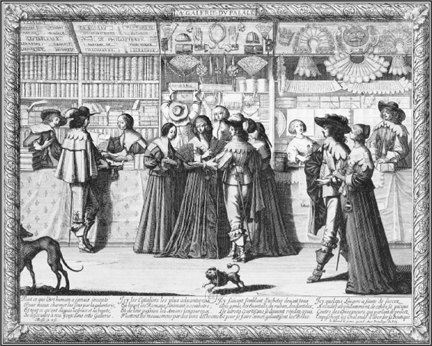
Abraham Bosse’s genre scene of the “galerie du palais” shows fashionable “courtisans” at a stall that sold ribbons, gloves, lace, and fans, while a “cavalier” browses in a bookstall such as those of Jean Berjon and Claude Collet, who sold Champlain’s works “at the palace,” and helped him to promote the cause of New France.
A leading French scholar, François Moureau, has described it as a form of belle danse as distinct from danse de bal. The ballet du cour required a full orchestra with winds and brass, in addition to the traditional twenty-four violins of the king. It used complex scenery and gave much attention to creative costume-design, in which Italians had long been masters.
The center of these productions was the king himself. Louis XIII made the court ballet his hobby. He participated actively as a composer, designer, and dancer. He never played himself but usually appeared in other allegorical roles, such as Apollo, “or as the sun,” as later did his son, Louis XIV.58 Many of the high nobility followed his lead, and joined with professional dancers in these spectacles. Great nobles competed with one another for royal favor by dancing “before the king in ballets heroic, allegoric and farcical.”59
Champlain did not appear as a character in these ballets. One scholar has written that “none of the founders of New France appear there,” but Indians were very prominent. These works were marked by “the presence of a new exoticism, that of America, at the center of a form that was ritualized and politicized.”60 Moureau writes, “If one analyzed this repertory over a long period, which runs from the last decade of the reign of Henri IV to the death of his successor (1643), for half a century the American thread is clearly visible in the fabric of the spectacle.”61
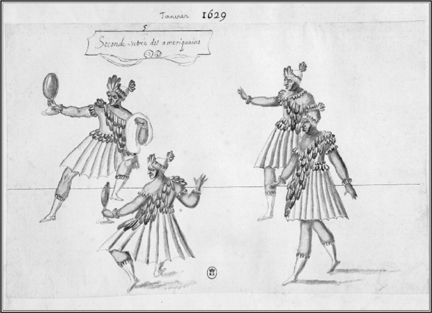
In the reign of Louis XIII, the humanity of American Indians became a dramatic theme in elegant court ballets. The King himself produced these spectacles, and often appeared as Apollo or the Sun, shining above all the people of the world. Nobles and courtiers performed them with the help of professional dancers.
The interpretation of the Indians changed in an interesting way. In the late sixteenth century, they appeared in court ballets mostly as stylized figures from New Spain and Brazil. During the reign of Louis XIII, they became more prominent and more North American. The Court Ballets were advertisements for New France and its native people. In this effort, the king himself, the high nobility, choreographers, and set designers dramatized Champlain’s grand design.
Champlain also tried to win a large public to the cause of New France by publishing another volume of his Voyages, with striking illustrations of many tribes of North American Indians. While he had been at sea in 1618, Champlain had used the time to draft another book about New France. It was finished in the fall, and published as Voyages et descouvertures faites en la Nouvelle France, depuis l’année 1615. As with all Champlain’s books, this one was written for a very special purpose and it was addressed mainly to a single reader, Louis XIII, who held the success of New France in his hands. Champlain dedicated his book to the king, with gratitude for his past support and an appeal for his continued sponsorship of New France.
It was an honest book, entirely open in its promotional purposes, straightforward in its history, and candid in its account of problems in the colony. Champlain wrote that the king’s subjects had been working hard in the new world, “so that Your Majesty may be declared the lawful Lord of our labors, and of the good that shall result therefrom, not only because the land belongs to you, but also because you have protected us against so many kinds of persons who had no other design than by troubling us, to hinder the success of so sacred an undertaking.”62
Champlain appealed to the king’s interest in the Indians, and described them in very sympathetic ways. He wrote in the preface that his last books had given more attention to the land and its exploration. This one centered on “manners and mode of life of the Indians, narrated with many particulars of such a nature as to satisfy an inquiring mind.”63 The book was an argument that France should “send out people and colonies to instruct them in the knowledge of God, the glory and the triumphs of Your Majesty, so that with French speech they may also acquire a French heart and spirit.”64 For that attitude, some ethnographers have condemned Champlain. But the Indians understood and respected this extraordinary man, even as they preferred to keep their own beliefs.
Much of the work was about religion, the missionary activities of the Récollets, and the progress of the Christianity in the new world. Champlain also wrote about the problems of founding a colony in America, and was painfully honest about the battle at the Onondaga fort. He also wrote plainly about the difficulties of reconciling large purposes in New France with the very different goals of merchants in France.65
Champlain’s book circulated as a manuscript at court. It was read and approved by members of the Royal Council, and published by the king’s printer, Claude Collet, in the palace at the “Galerie des Prisonniers,” with the “privilege of the King.” The date of publication by royal license was May 18, 1619.
Other good things happened as Champlain’s star rose at court. On Christmas Eve, December 24, 1618, the author received a welcome present from His Majesty, a pension for 600 livres a year. Three weeks later, January 14, 1619, Champlain also received the unpaid balance of his wife’s dowry, another 1,500 livres from her father, Nicolas Boullé, secretary of the king’s chamber. It was yet another sign of how the winds were blowing. Champlain’s long campaign to win the support of Louis XIII was producing results.
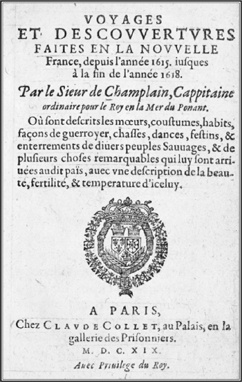
Title page of Champlain’s Voyages et Decouvertures. This, Champlain’s third published book, was published in 1619 as part of a successful effort to win the king’s support. It was dedicated to Louis XIII, described events from 1615 to 1618, and gave close attention to the Indians. The king was fascinated from the moment when as a child he was given a red canoe by de Mons and Champlain.
This success at court did not help Champlain with his investors in the west of France. Champlain was having more trouble with the old company, especially with the merchants in Rouen. As he had pointed out in his new book, their goals were fundamentally opposed to the founding purpose of New France. Champlain noted that some merchants “aimed only at their private gain.”66 He wrote that he had “no other purpose than to see the country inhabited by industrious people, for the clearing of land,” so that the colony could support itself. He had seen too much hunger and even starvation when the ships were late in the spring, particularly “when the ships had been nearly two months behind their usual date, and there had been almost a tumult and revolt.”67 Champlain and the merchants differed not merely in their purposes, but also in the time frame of their thinking. Merchants planned very precisely one season at a time. They complained that “affairs in France were so unsettled that although they had gone to great expense they held no position of security to themselves, since they had seen what had happened in the case of the sieur de Mons.” They were very intolerant of political uncertainty and had little interest in planning for the long run.68 They also sought to lower the costs of their operations, in hope of increasing their returns. They felt that colonizing ventures added heavy expenses. But that was only part of the problem. Champlain knew that they were also “afraid of something more serious, if the country became inhabited their power would wane,” and “a little later they would be driven away by those whom they had installed at great cost.”69
In New France itself, a different sort of conflict rose between the company’s employees and Champlain’s colonists such as the Hébert family, who complained of exploitation, and justly so. This animosity became a major discouragement to migration and a friction-point between colonizers and investors. Yet another problem was religion. Some of the investors in the western towns were Protestant. As Champlain noted, “they had anything at heart rather than that [the Catholic religion] should be established there, but they agreed to maintain friars because they knew it was His Majesty’s desire.”70
Champlain tried to work with the investors. He thought they had an agreement for the number of new colonists “besides those already there.” On December 21, 1618, he drew up an aide-mémoire in elaborate detail: eighty people to be brought to Quebec and maintained there for the year 1619, with clothing, bedding, weapons, tools, two tons of lime, 10,000 curved roof tiles or 20,000 flat, ten thousand bricks, livestock including bulls, heifers and sheep; seeds and other supplies; weapons and officers to control arms and ammunition, and on top of everything else a dinner service for the leaders with thirty-six table settings. The document was signed by investors Le Gendre, Vermulles, Bellois, Dustrelot, and also Pierre Dugua. The sieur de Mons was becoming more visible in his continuing support of the grand design for New France, as Louis XIII warmed to the enterprise.71
Unhappily, the support that Champlain received from several merchants was strongly opposed by others. In the spring of 1619, Champlain’s agreement with the merchants came apart, just as he was preparing to move his wife and their servants to America for an extended stay. Hélène had at last agreed to accompany her husband. Together they went to Honfleur and prepared to board a ship for America. They were stopped by agents of the company and told that the directors would not allow Champlain to be in command of its ships or the colony. He wrote that the prime mover was again his enemy Daniel Boyer, who had persuaded the merchants that Champlain was unfit to lead the colony. They insisted that the “sieur de Pont must remain in command over the people of their settlement.” Champlain would be allowed to serve only as an explorer, mapmaker, and artist.72
Champlain refused to agree. He took his family to Rouen, and met with the merchants. “I showed them the articles,” he wrote, and he insisted that “as the Lieutenant to the Prince I had the right of command over the settlement, and over all the men who might be there, save and except only the store where their head clerk was.”73 The merchants were defiant. Champlain showed them the king’s letter. To Champlain’s amazement they refused again, and the ship sailed without him.74
With his family Champlain returned to Paris. While his wife and servants unpacked, he went directly to the Royal Council and reported that the merchants of Rouen had defied a direct order from the king himself. The council gave complete support to Champlain. They confirmed him as lieutenant for New France, and expanded his powers to include full command “at Quebec and in other parts of New France.”75
Now the merchants were in trouble. Louis XIII did not take kindly to subjects who defied his royal will. This was a capital crime, and the punishment was to be broken on the wheel before a howling mob in Paris. The directors of the company were quick to reverse themselves, and laid the blame entirely on Daniel Boyer. Suddenly Champlain was acceptable to them as commandant in Quebec. It was too late to sail in 1619, but he began to make preparations for the following year. He did not ask the merchants for their support. Champlain demanded it in the name of the king and they obeyed. Once more, Helen Boullé and the servants began to pack.76