
Two Models, 1620–24
CHAMPLAIN … It is my pleasure to write you this letter, to assure you that I shall be very agreeable to the service that you will render me, especially if you keep the country in obedience to me, making the people there live as closely in conformity with the laws of my kingdom as you can.
—Louis XIII to Champlain, May 7, 16201
We must give fortune a trial sometimes…. With the assistance of the people of these lands, one should be able to do something worthy of record.
—Samuel Champlain, ca. 16202
IN THE YEAR 1619 the destiny of New France lay in the hands of two people. One was Samuel Champlain, now in middle age and a veteran of long service in America. The other was King Louis XIII, aged eighteen and already with nine years on the throne of France. Each had a vision of the new world. Champlain and his American circle shared a dream of humanity and peace, in an age of cruelty and violence. The king and his ministers served an ideal of order and justice, under the absolute authority of an all-powerful monarch who claimed the name of Louis le Juste. Together, these leaders framed a set of institutions for New France.3
In the fall of that year, Louis XIII and his advisers took up the problem of organizing their disordered American dominion. The king himself began that process by making peace in his own family. On October 20, he ordered his cousin the prince de Condé to be released from prison after three years’ confinement. On November 9, Condé was received at Chantilly. In a formal ceremony he swore an oath of obedience, and the king solemnly proclaimed his innocence. All of Condé’s many privileges were restored, including his former office as viceroy for New France. He was granted 3,000 livres, and gave half the money to the Récollet friars for their work in America. Everybody was happy except the man who had put him in the Bastille and taken his job. The maréchal de Thémines was dismissed as viceroy.4
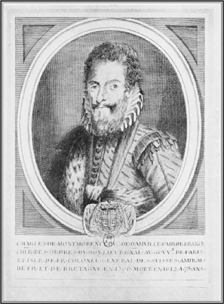
Henry, second duc de Montmorency at Dampville, succeeded Condé as viceroy of New France from 1620 to 1625, and was one of the most able men in that office. He shared Champlain’s purposes, resisted the absolutism of Richelieu and Louis XIII, supported the rights of parlements, and was executed for treason in 1632, at the age of 38.
Condé had lost interest in New France, and he sold the office to his brother-in-law for 30,000 livres. The new viceroy was Henri de Montmorency, duc of Damville and Montmorency, governor of Languedoc, and admiral of France. He came from one of the ancient noble families of France and was described as “brave, rich, gallant, and liberal,” in the old sense of liberal as generous and large-spirited. Montmorency was much admired for his style. It was said that he danced well, looked splendid on a horse, and had “the most agreeable manners in the world.” He was also intelligent and well informed about world affairs. In his office as admiral, Montmorency took a serious interest in commerce and colonies as a way of strengthening the maritime power of France. He was sympathetic to Champlain’s large purposes.5
Champlain thought it an excellent appointment and believed that “everything would be better managed for the honor of God, the service of the King, and the good of the Country.” Champlain himself may have helped to arrange it, working with another powerful man at court, the sieur de Villemenon, intendant of the French Admiralty in 1620 and a key figure in the events that followed.6 Immediately after Montmorency became viceroy of New France, he made two appointments. On March 8, 1620, he chose Champlain as his lieutenant for New France, and commandant in Quebec. At Villemenon’s urging, he also created a new office of intendant for New France.
The office of intendant was becoming very important in France by 1620. The word itself has no English equivalent and is inadequately translated as “steward” in bilingual dictionaries. French intendants functioned as instruments of royal absolutism. They were responsible for seeing that the wishes of the king and his council were carried out. They kept higher authorities informed about the performance of officials, the enforcement of edicts, the review of accounts, and the supervision of administration. Intendants were not what we would call line officers; they were not in the chain of command, but they had great influence.7
Champlain understood the importance of intendants, and was quick to see that they could be useful for the purposes of his grand design. Rather than thinking of them as rivals or threats, Champlain perceived them as potential allies, and he formed a good working relationship with men such as Villemenon. Here again, he was very flexible and highly skilled at the art of working within the developing institutions of royal absolutism in France.
On March 12, the job of intendant in New France went to Jean-Jacques Dolu, a man of strength and presence who was highly placed as one of the king’s advisers, and also as grand audiencier (chief usher) at court. Champlain and Dolu appear to have known each other, and got on well. Dolu supported Champlain’s vision and strengthened his powers as commandant. Champlain in turn was careful to respect Dolu. They began to work comfortably together even before their appointments were confirmed by the king.8
An early test of their relationship came in the spring of 1620. Champlain went to Honfleur and made arrangements for the dispatch of two ships to New France. Once again he met strong opposition from the merchants of the old company of Rouen and Saint-Malo. Champlain wrote that “there was still some dispute about the command I was to exercise in the country.” After a confrontation that he described as a bit of a brouillerie, or free-for-all, he called for help. The new intendant Dolu came quickly to his support and told the merchants in no uncertain terms that the king himself intended Champlain to have “entire and absolute command over the entire settlement and everything in it, except what concerned the storehouse for their goods.” He added a stern warning that “if their men were unwilling to obey the wishes of his Majesty,” Champlain had full authority and power to “arrest their ship.”9
The merchants continued to protest, and took their case to other officers at the Admiralty. They got nowhere, and Louis XIII himself intervened. Champlain wrote that the merchants finally “listened to reason.” They had succeeded only in diminishing their credit with the king and his ministers, who increasingly regarded their resistance as an act of lèse majesté. The merchants of Rouen were allowed to send trading ships to New France for one more year, but the days of their company were numbered.10
Champlain returned to North America in 1620 with greater powers than ever before. He held the rank of captain in the king’s navy, the office of lieutenant to the absentee viceroy of New France, and the role of commandant in Quebec. He had the full cooperation of the intendant, the confidence of the viceroy, and the active support of Louis XIII himself, who sent him on his way with a personal letter. The king wrote carefully: “I shall be very agreeable to the service that you will render to me on this occasion, especially if you keep the country in obedience to me, making the people there live as closely in conformity with the laws of my kingdom as you can.”11 It was a strong expression of support, but also a statement of purpose that was not the same as Champlain’s. The king instructed Champlain to impose a top-down system of absolute authority over the Indians, which he was unable to do and unwilling to attempt. Always he made a point of working with the Indians in another way.
Armed with his new powers, Champlain sailed from Honfleur in May 1620, aboard the ship Saint-Étienne. Traveling with him for the first time was his wife, Hélène, with her companion and maid, Isabelle Terrier, a retinue of household servants, and Champlain’s manservant, a young man who would later be sent to live among the Indians and learn their language. Champlain called them his family, and it was a large one. But there were no children.12
Also aboard were three Récollet friars in their brown Franciscan robes, led by Georges le Baillif, a man of noble birth who had been strongly recommended by the viceroy and was “highly regarded by the king.” Others who came out to Quebec were Intendant Dolu himself and an officer named Baptiste Guers, who functioned in yet another royal office as commissionnaire to the viceroy, the intendant, and Champlain. There was also a small detachment of the king’s soldiers—only a handful, but sufficient to show the flag, patrol the river, man the guns at Quebec, guard the commandant’s habitation, and keep order in the settlement. Champlain was their commander. They were merely a corporal’s guard, but he assumed yet another title: Lieutenant General for New France.13
Saint-Étienne left Honfleur very late in the season, on May 8, 1620. Champlain wrote that they had a rough passage in stormy seas, and his family “suffered much discomfort.” They reached Gaspé after about seven weeks on June 24 and sailed up the St. Lawrence River toward Tadoussac, keeping very close to the south shore.14 Champlain was concerned about his wife’s safety, and took many precautions on this voyage. Illegal traders were on the river in fast-sailing, heavily armed vessels, and some were selling arms to the Indians. Not knowing who might be lurking in Tadoussac, Champlain took his ship into a secluded cove called Moulin-Baude two miles downriver, and dropped anchor on July 7. He made sure that Tadoussac harbor was safe, then broughtSaint-Étiennein. “All praised God,” he wrote, “to find ourselves safely at our journey’s end, and I most of all on account of my family.”15
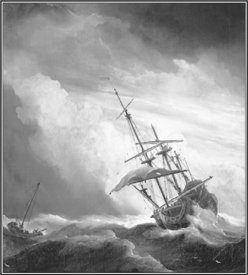
The Gust of Wind, by Willem van der Valde, typical of conditions that Champlain met on many Atlantic crossings, and especially on the rough voyage in 1620 when his wife, Hélène, and their household came to America.
On July 11, 1620, Champlain and his party transferred to a small barque and continued up the St. Lawrence River to Quebec. The arrival was carefully staged as a piece of political theater. He sent ahead a vessel filled with supplies for the settlement and brought another boatload of provisions, which guaranteed a warm welcome from the hungry habitants. Then he came ashore in high state, led a procession to the chapel, and once again “gave thanks to God.” The next morning, a Récollet father sang a mass and delivered a “sermon of exhortation.” He reminded the congregation of their obligation to “devote themselves to the service of His Majesty and the seigneur de Montmorency.” Champlain noted that the sermon ended in a declaration that “everyone must act in obedience to my commands, according to his Majesty’s Patents, as bestowed upon His Grace the Viceroy and given to me as his lieutenant.”
After the sermon, the new commandant summoned the entire population of Quebec. “I assembled all the people,” he wrote, “and commanded Commissioner Guers to read aloud the King’s commission to the Viceroy, and that of his Grace the Viceroy.” All this was done “so that no one could plead ignorance.” When the reading was complete, the settlers were invited to cry “Vive le Roi,” and cannon were fired as “an expression of joy.” Champlain concluded: “Thus I took possession of the habitation and the country, in the name of My Lord the Viceroy.” He also asked Commissioner Guers to write an account of the ceremonies, “for use when and where required.”16
One of its most important uses was to reassure Champlain’s superiors in Paris. He was carefully staging ceremonies that were fundamental to the regime in France. The complex ritual of masses and sermons joined the sanctity of the church to the prerogatives of the state. Other rituals in the order of procession and acts of obeisance enacted the concept of order as a hierarchy of estates in which everyone was assigned a place. They linked power to authority, and authority to legitimacy, through the solemn recitation of patents and edicts and royal commands, not by Champlain himself but by a royal commissioner. These rituals were combined with the discharge of cannon, and a parade of soldiers in the king’s uniform that combined the lilies of France, the cross of Jesus, the arms of the Bourbon dynasty, and the royal cipher of Louis XIII. The habitants themselves played a part in a ritual of consent. They were put on notice that if authority failed, power would be backed by force. The results were evident in the flow of events. Champlain faced no recurrence of the mutiny that had threatened his life at Quebec in 1608, although rebellions happened frequently in other French and English colonies.17
After the ceremonies, Champlain ordered an inspection of the colony. He sent Commissioner Guers and six men upriver to Trois-Rivières, “to learn what was going on in those parts.” Others went downstream on the same errand. They spread the news of Champlain’s arrival and extended his authority through the valley of the great river.
While that was happening, Champlain himself inspected the settlement of Quebec. On a stormy day he slogged through muddy pathways from one wretched shanty to the next and was appalled by what he found. In his words, the settlement was “in a desolate and ruinous condition.” The roofs were leaking and “the rain was coming in everywhere, and the wind blew in through all the seams in the planks.” Worse, he found that “the storehouse was on the edge of falling down, the courtyard was filthy and disgusting, and one of the dwellings had collapsed.”18
Champlain attributed this state of things to failures of leadership. “As to the settlement,” he wrote, “it was in a very wretched state owing to the fact that the workmen had been taken off to build a dwelling for the Récollet Fathers about half a league distant on the banks of the River St. Charles, and also two other dwellings, one for the said Hébert at his farm, and one near the settlement, for the locksmith and his baker, who could not be accommodated in the precinct of the dwellings.” Champlain added that he felt not anger, but “pity” for the colonists.19
One can only imagine what the feelings of his wife, Hélène, must have been. This beautiful young woman had been raised in an opulent Paris household, and at the court of the king himself. She was asked to live in a hovel that would have been thought unfit for animals in her world. Her reaction was perhaps reflected in the tone of Champlain’s account, which had a sense of urgency about it. “I set the men to work at once, both stone masons and carpenters, and in a short time a building was habitable for us.”20
Champlain was also shocked to discover that the settlement was indefensible against attack. English and Dutch ships had been prowling the coast. Some of them were heavily armed, with crews that outnumbered the entire French population of Quebec. “We can hold our ground only by force,” he warned. He was thinking of attacks not only by other European powers but also by pirates and predators who flourished in American waters. At the same time, Champlain was concerned about the Indians. Some of the Montagnais were beginning to show signs of distance and even hostility in a manner very different from their earlier attitudes. He wrote, “Some people think that we are too strong for anyone to venture to attack us in this situation.” Champlain warned that this was a dangerous assumption: “Mistrust is the mother of security.”21
On written instructions from the king and the viceroy, which he had helped to draft, Champlain ordered the workers in the colony to build a new fort, large enough to shelter the entire population of Quebec “in a very good situation, on a mountain that commanded the channel of the St. Lawrence River.” He called it Fort St. Louis.
The partners of the trading company were not pleased with this project, which they regarded as a distraction from their commercial purposes, and a heavy expense. Champlain, for his part, complained of their greed and folly, and their habit of planning for the short run. “It is not always best to follow the feelings of people who think only of momentary gain,” he wrote. “It is necessary to think farther ahead.”22 He worked on a different timescale from the merchant-adventurers, who centered their thoughts on immediate returns. He also had a different way of reckoning profit and loss, not merely in monetary terms but by the test of material progress toward a larger goal.23
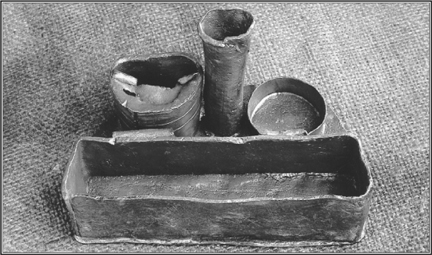
This lead and tin writing set was found on the site of Champlain’s habitation, and might have been used by him. It includes a quill holder, ink well, and sand dish (for drying the ink) and a box for pencils, a penknife, letter opener, sticks of sealing wax, and small seals. It is in the Interpretation Center, Place Royale, Quebec.
Through the first year, Champlain kept some of his laborers at work on the fortification of Quebec and ordered others to repair the storehouse. Here again he was planning for the long run. These buildings were not temporary structures. For the storehouse he found a local source of “excellent limestone” and erected a solid building that was meant to last for centuries. Champlain’s design for the storehouse was also an instrument of control. He added an outside entrance to the cellar, “closing up a trap-door that was in our warehouse, through which some persons often went to drink our liquors without any compunction.”24
Some of the dwellings were also built of stone, as was the farm of the Hébert family. Champlain meant to encourage as many people as possible to live on the land. Twelve years after settlement, Quebec was still dependent on food from France. He intended to change all that by using public resources to promote private effort in agriculture, with small farmers producing for their own gain. Like other French leaders, he did not favor communal farming, which had been tried without success in the early years of Jamestown and Plymouth.
• • •
Hélène was a strong presence in the small colony. Her husband tells us that she chose to come to America of her own free will. On arrival they were met by a small boat under the command of her brother Captain Eustache Boullé, who had been in the country for two years. He had expected to greet the commandant and was amazed to discover that Hélène too was on board. Champlain wrote that Boullé “was utterly astonished to see his sister, and to learn that she herself had made up her mind to cross a sea so dangerous, and was greatly pleased, and she and I still more so.”25
The tone of the marriage had changed very much for the better. Hélène was now twenty-two years old. As befitting her husband’s station, she had come with many servants and a well-dressed lady-in-waiting, Isabel Terrier, to keep her company. With Champlain’s manservants, they made a ménage of more than half a dozen people. This was the first time that a commandant of Quebec had maintained something like a domestic establishment in New France. Its presence changed the character of the settlement.26
Hélène had a great impact in Quebec, and she was long remembered by Indians and Europeans alike. The Indians were not prepared for her. In Acadia, Lescarbot wrote that male settlers had told the Indians that the ladies of France wore beards and mustaches. Then Hélène arrived, and the Indians were overwhelmed by her beauty, youth, grace, and refinement, as indeed were the French habitants. Francis Parkman wrote: “Madame de Champlain was still very young. If the Ursuline Tradition is to be trusted, the Indians [were] amazed at her beauty, and touched by her gentleness.”27
She was also very bright. Like her husband she was filled with curiosity about this strange new world of North America, and she became deeply interested in the Indians. After settling in, Hélène studied the Algonquian languages of the St. Lawrence Valley, and learned them well enough to teach Indian children. Indian women also gathered around her. She nursed them through their illnesses, comforted them in their troubles, and talked to them of her Christian faith.
A happy story has come down to us about her work with them. It was recounted in the nineteenth century by N.-E. Dionne, who wrote that it had been “the fashion of the time for a lady of quality to wear … a small mirror, and the youthful Hélène observed the custom.” The Indian women were fascinated by the mirror, which she wore on a chain around her neck. They gathered round and studied their reflection. One of the women asked why she could see her own reflection so close to Hélène’s breasts. Hélène replied, “because you are so near my heart.” One Indian remarked, “A lady so handsome, who cures our diseases, and loves us to so great an extent as to bear our image near her breast, must be superior to a human being.”28
This “pretty story of the mirror, jolie histoire du miroir,” as one scholar calls it, was passed down by the Ursuline sisters who later lived with Hélène in France and knew her well. We have no reason to doubt its authenticity. It helps us to understand this remarkable young woman and her complex relationship with her husband. Since the discovery of documents about their troubled early years together, historians have tended to bring out the worst in the relationship and to extend it over the entire span of the marriage. An historical novelist has built a breathless two-volume work of romantic fiction on that assumption without a shred of evidence. Other sources strongly suggest that the marriage improved with time and maturity. Despite Champlain’s many Atlantic crossings, the couple managed to spend most of their time together. Historian Marcel Trudel calculated that in their three hundred months of married life (actually 255 months from December 1610 to December 1635, not including the initial separation), they spent more than 181 months living together.29
When they were apart, business records indicate that Hélène supported Champlain’s work, managed his investments in commercial companies, defended his interests, and championed his grand design. We have very little information about her, but every piece of evidence for the later years of their marriage, and especially in the period from 1618 to 1633, indicates that they grew closer to one another than historians have assumed from their early troubles. Champlain and his wife lived and worked harmoniously together in Quebec. They shared an interest in the Indians, a spirit of humanity, and a growing piety. She also appears to have won the affection of Indians and habitants in Quebec, and especially the Hébert family, who asked her to be godmother for their children.
Another person who strongly supported Champlain in Quebec was the intendant, Jean-Jacques Dolu. The viceroy and the king had ordered him to go with Champlain, live in Quebec, observe closely, and report on conditions in the colony. Champlain wrote that Dolu’s primary task in New France was “to introduce good order (bon règlement) there,” and he noted that the intendant “busied himself in it with entire devotion, burning with zeal to do something for the advancement of the glory of God and of the country, and to put our company into a better condition of prosperity than it had been.”30
They seem to have got on very well in America, as they had in France. Champlain wrote, for example, “I saw him on this subject and made him understand the situation, and gave him notes for his instruction.” Dolu returned to France in the late summer of 1620 and made his report. Early the next spring, the first ships of the season brought a bag of mail for Champlain, with letters from Viceroy Montmorency and the king himself. Dolu had delivered his evaluation. In the words of one historian it was a “damning report” on conditions in the colony but with high praise for Champlain. The letters that followed from the king were very positive, and Viceroy Montmorency doubled Champlain’s salary.31
While the weather was still warm in 1620, Champlain began to prepare for the winter. He always remembered the colonies that had failed because they ran short of food, and he himself had lived through the agony of scurvy at Sainte-Croix, Port-Royal, and Quebec. He was determined that it would not happen again. “I took stock of the provisions,” he wrote, “so as to make them last till the return of the vessels [in the spring].”32
The ships had brought from France a large supply of food, more than enough to support the entire population for a year. He reckoned the population that would winter over at “sixty persons all told, men, women, friars and children.” As winter came, he made a point of keeping them all occupied and well fed. When spring arrived in 1621, he wrote, “Everyone was in good health, save one man who was killed by the fall of a tree, which crushed his skull.”33 Nobody died of scurvy or any other illness—a great achievement for an infant colony in the seventeenth century. Thereafter, under Champlain’s command there would be no major problem with scurvy, except a small outbreak at Trois-Rivières in 1634–35. The habitants of Quebec began to receive more varied provisions from France. Champlain wrote that one vessel brought “some puncheons of cider, biscuits, peas and dried plums.”34 Spruce beer, which has antiscorbutic properties, may have helped, but the only remedy mentioned explicitly by Champlain was fresh meat.35
Constant labor was required to get provisions from France, to barter with the Indians, and to extract a flow of food from farms in the colony. The French learned from the Indians how to hunt in the winter before the animals went away to bear their young, and struggled to master the intricate techniques of eeling in the fall. The cruelest season was always the early spring before the relief ships arrived, often not until June or even later.36 One year, for example, the supply ships were very late, and Champlain had only enough flour and cider to last until June 10. After it ran out, the colonists survived on migan, made from Indian corn and fish. The ships finally reached Quebec on July 10, a month after the provisions were gone. Hunger continued to be a problem in a land of plenty, but Champlain succeeded in preventing the worst ravages of malnutrition with much help from the Indians.37
Quebec was a raw and very rough frontier settlement. Merchants in trading companies and captains of ships in the St. Lawrence River cared little for the authority of a distant Crown. The king’s officers were unable to keep the peace along the full length of the great river. As in many new colonies, there was much crime—even assault and murder—and a growing concern among the habitants about the problems of order.
On August 18, 1621. Champlain and Father Le Bailiff called a general assembly of Frenchmen in Quebec, about sixty men altogether. Most of the colonists turned out, except officers of the trading company who stubbornly refused to acknowledge Champlain’s authority. This was not the first such assembly in Quebec. An earlier one had convened in 1616, but it had been organized by the Récollets and concerned itself mainly with religious questions.38 This one was a secular event led by the “principal French inhabitants,” who came together to “advise on the most proper means” to deal with “the ruin and desolation of all this country.”39
These gatherings were nothing like lawmaking assemblies in English colonies. The people of Quebec worked within the French tradition of the cahier général de doléances, a meeting to draw up a petition of grievances. The assembled group elected Le Bailiff as their deputy and resolved to send him to the king and the viceroy with a list of their complaints. In the manner of a cahier, it began with professions of faith and loyalty to the king. The petitions celebrated the country and its prospects for growth but expressed deep unhappiness about the lack of law, order, and security. They asked for a judicial system that would put an end to “robberies, murders, assassinations, lechery, and blasphemy.” They were worried about the English and the Iroquois, and wanted a strong fort with a garrison of fifty soldiers. And they asked that Champlain be given more money. They requested that Protestants should be kept out of the colony, a judgment that differed from the attitude of tolerance that Champlain favored. And they asked that schools be founded for Indian and French children. Altogether they demanded more control from above, not less as in the British colonies.
Le Baillif carried this petition to France, and the king in Council responded positively to the complaints. He ordered changes in the trading companies, supported the Récollets, strongly backed Champlain, gave him more money as the habitants had asked, and ordered the recruitment of families for New France. But he did not endorse the idea of assemblies and deputies for Quebec. No reference to this assembly appeared in any of Champlain’s writings. It is interesting that Champlain supported the assembly in Quebec but gave it no recognition in France. If he included it in any of his books, it was removed by censors in Paris. This early assembly was soon forgotten, except in the writings of some of the Récollet fathers and in the few manuscripts that found their way to the Bibliothèque Nationale in Paris.40
The assembly in Quebec was an advisory body of principal inhabitants. They met on the invitation of leaders to present grievances and submit a petition to the king, the viceroy, and the governor of Quebec. Even so, such meetings were not welcome in France. This was the road not taken in Quebec.
In 1621, Champlain also issued laws for New France, which appear to have been primarily of his own devising. He proclaimed them only in response to what he took to be urgent problems. He was, for example, troubled by two families who had been in New France for two years: one headed by a butcher, the other by a needle maker. They had settled on the land with the understanding that they would farm it. Champlain sent a commissioner to “examine what they had done.” He learned they “had not cleared a single yard of land, but simply gave themselves to hunting, fishing, sleeping and getting drunk in company with those who gave them the means to do so.” He decided to banish them from the colony. “I sent them back as useless creatures who cost more than they were worth,” he said.41
After the fact, Champlain issued edicts to legitimate his act. “To avoid troublesome disputes and keep all parties to their duty,” he wrote, “I thought right to make certain ordinances, which I caused to be published on the twelfth of September.”42 Historian John Dickinson observed that this “first Canadian legislation” was not enacted by an assembly or even by a council. It was framed by the will and judgment of one man. Scholars believe that Champlain issued other ordinances to regulate prices, proclaim holy days, prohibit the sale of liquor to the Indians, and preserve peace within the colonies. But no texts have as yet been found.43
To proclaim a law was one thing; to enforce it was quite another. Champlain had to maintain order among a turbulent set of colonists and neighbors in a disorderly and sometimes violent world. He had to keep peace between Catholics and Protestants, Indians and Europeans, soldiers and civilians, seamen and shopkeepers, farmers and traders, rival companies and royal officials. He had a distinctive way of dealing with these questions. When he faced a fundamental threat such as Duval’s conspiracy, the 1608 attempt to kill Champlain and seize the colony, he acted decisively and did not hesitate to use force when he thought it necessary. But in nearly all cases, Champlain preferred to reject force as a solution. He began by introducing a tone of reason, and sought the path of peace. First, he asked questions about what had actually happened, listened carefully to answers, and consulted with others in difficult cases. Then he tried to identify vital issues that could not be compromised without damage to the colony or to his larger purposes. Within that framework he tended to become a mediator in an effort to reconcile rival interests, resolve conflicts of principle, and harmonize different ideas of ethics and justice in a way that all parties could regard as just.
The religious life of the colony continued to be a cause of friction. During the reign of Henri IV, as we have seen, the sieur de Mons and Champlain had adopted the king’s solution for New France: an established Catholic Church and a toleration of Protestants. They encouraged religious diversity and brought a Protestant minister as well as Catholic priests to Sainte-Croix and Port-Royal. That experiment was not successful.
The death of Henri IV had brought a change of policies in France and America. Marie de Medici and Louis XIII both maintained the Edict of Nantes, but gave more support to the Catholic Church and showed less tolerance of Protestants. Some of their ministers actively discouraged the presence of Protestants in New France. Yet many French merchants and seamen were Huguenots. This friction increased when Viceroy Montmorency brought in the Compagnie de Caën, led by Guillaume and Émery de Caën. Guillaume was Protestant and Émery was Catholic. Their traders and seamen were also of both faiths.
Champlain received strict instructions from France about Guillaume de Caën: “As to the exercise of his religion I was to tell him that he was not to practice it either on land or on sea, and as to anything further I was to use my own judgment.”44 Aboard ship in the St. Lawrence, de Caën was “accustomed to have his [Protestant] prayers in his cabin, at the stern of the vessel, while the Catholics were at their devotions in the bow.” In de Caën’s absence, his Catholic lieutenant Raymond de Ralde assumed command and insisted that the Catholics should “do their praying in the cabin, and the so-called Reformers should be in their proper place, and do theirs in the bow.” Champlain wrote that “on this point a great dispute arose.” It was settled only with the intervention of the Récollet fathers, who helped Champlain to keep the peace.45
Later the same issue exploded again. A Jesuit priest complained to Champlain that Protestant sailors “paid no attention to the restrictions,” and sang their psalms in such a way that “all the Indians could hear them from the shore.” Champlain allowed the sailors to keep singing. “There is no use talking to them,” he wrote wisely. “It is their great zeal for their faith that impels them.”46
Champlain always sought a solution to these problems in the spirit of Henri IV. He maintained the Catholic Church as an establishment but protected the right of Protestants to worship. He also worked out a series of flexible compromises that allowed both groups freedom of conscience, but asked them to exercise those rights in ways that did not offend others.
Other issues tested the limits of liberty of expression in New France, and Champlain responded in an unexpected way. He ordered the burning of a book in Quebec. It was called the Anti-Coton, an attack on Father Pierre Coton, the Jesuit confessor and friend of Henri IV, and an acquaintance of Champlain. The author suggested that the Jesuits, and Coton in particular, had a hand in the murder of Henri IV. His book passed from “room to room” and was reported to have been widely read in the settlement. Catholic priests demanded that the book be suppressed. Champlain ordered that it be burned. His primary motive was to keep the peace and to discourage attacks on others, rather than to repress heresy or punish dissent. But whatever the cause, the result set a precedent for restraints on liberty of speech and press in Quebec. In time these restrictions would multiply. The habitants of Canada were not encouraged to think of themselves as free people. In New France, limits on liberty and freedom were imposed by the will and judgment of an absolute ruler who was accountable only to another absolute ruler in Paris.
If liberty means the right to speak and worship freely, and if freedom means the right to vote and to trial by one’s peers, there was little liberty or freedom in Quebec. Its denial severely diminished the growth of New France. Had French authorities actively encouraged dissenters to settle in the new world, the history of North America might have been very different. The colonies of New France would have been more disorderly but also more dynamic, and much quicker to grow. But this was another road not taken in the history of New France.47
While Champlain dealt with these difficult problems, he also continued his policy in regard to the Indians. His approach was fundamentally different from that of the founders of New Spain and New England, and also from that of earlier French leaders such as Cartier. He never wanted to conquer or enslave the Indians, and never imagined that he could control them. Always he regarded them as people who were fully equal to Europeans in powers of mind, and thought them superior in some ways. There was much about their culture that he did not like. Champlain often repeated his belief that the North American Indians had neither faith nor law. But he admired their many strengths, treated them with respect, tried to learn from them—and they reciprocated.
How did he do it? First, he spent time with them, sitting in councils, listening to speeches, inquiring about their customs, asking them to map the country on sheets of bark. Champlain wanted to learn what they knew. He also had a keen sense of their vital interests, and tried to construct alliances from which all parties had much to gain. Between 1620 and 1624, he also sent more young men to live among the Indians. Nicolas Marsolet went to the Montagnais in the Saguenay country; young Jean Nicollet and Jean Richer lived among the Nipissing. Brûlé and Du Vernay worked in Huronia, and Olivier Le Tardif dwelled among the Algonquin, to mention only a few. At one feast alone, the Algonquin nations of the upper St. Lawrence and Ottawa rivers agreed to take eleven Frenchmen, each with his own Indian minder.48
There were many strains in these relations. In 1620, Champlain had a major problem with the Montagnais. From his earliest meeting in 1603, and for many years thereafter, they had been allies. But when Champlain returned to the colony in 1620 after a two-year absence, he perceived clear signs of growing distance, and even hostility. A major problem was trade in the lower St. Lawrence Valley. The Montagnais wanted to trade with ships of many nations. Champlain wrote, “We prevent other vessels from trading with them, and though on the other hand we give them the best possible treatment, this is the friendship they show us.” His first efforts at dealing with the problem were ill conceived. Champlain himself wrote that he “came down on them sharply.”49 The Montagnais were furious, and relations went from bad to worse. Champlain wrote: “We have no worse enemies than these Indians; for they say that if they were to kill off our men, other vessels would come, the owners of which would be greatly pleased, and that they would themselves be much better off than they are, owing to getting goods more cheaply from the Rochelais or the Basques. Among the Indians, the Montagnais are the only ones who talk in this fashion.”50
Relations sank so low, Champlain tells us, that some Montagnais began to plan a surprise attack on Quebec and Tadoussac, an event that would have changed the history of New France in a fundamental way. Somehow he dealt with it. He wrote only that “measures were taken” to nip the plan in the bud.51 Champlain immediately went to work repairing relations with the Montagnais. He gave them more trade privileges and better terms than interlopers could match. He also invited some of them to settle on cleared land and to add a little farming to their hunting and gathering economy. Champlain believed that part of the problem of the Montagnais was their extreme vulnerability to famine. They were a hunting and gathering people who maintained very little by way of food stocks. In their approach to survival, they were very different from other Indian nations such as the Huron and Iroquois and Saco, and others to the south.
Much of the Montagnais territory in the Saguenay Valley did not lend itself to agriculture. There was better land near Quebec on the southwestern range of their country. Champlain offered them seed stock and the use of open fields that the French had cleared. He told them if they could bring the land under cultivation, they could gather a crop of corn for their use, and “if they did so we would regard them as brothers.” Champlain did not wish to turn them entirely from hunting to farming, but to create a mixed economy of the sort that many Indian nations practiced in North America. His object was to improve their condition, encourage them to lay up something for the winter, and help them escape the terrible periods of hunger and starvation that he had witnessed.52
In the spring of 1622, Champlain supported a Montagnais captain he called Miristou, whose father had followed Anadabijou as a powerful chief. Champlain wrote that Miristou “had a very strong and special liking for the French” and “was ambitious of commanding and being the head of the band as his father had been.” Champlain helped Miristou gain power. In turn, Miristou paid him 105 beaver skins, and Champlain spent them to put on a great feast for the Montagnais. As a leader of his people, Miristou worked with Champlain to improve relations.53
Champlain tried throughout this period to make peace with the Iroquois, and with much success. He urged the Algonquin and Montagnais to “live at peace” with the Mohawk, and offered to help them. Some Indian leaders said they were “sick and tired of the wars they had, which lasted over fifty years,” since the mid-sixteenth century. “Their fathers had never been disposed to enter into a treaty, owing to the desire they had to wreak vengeance for the murder of relatives and friends who had been killed.”54
Champlain kept talking, and persuaded his Indian allies to send a peace mission to the Mohawk. A delegation of very brave Montagnais warriors went into Iroquois country, and they were well received. On June 6, 1622, two Mohawks came to talk with the St. Lawrence nations at Trois-Rivières and met Champlain at an Indian camp near Quebec. There was feasting and dancing. After he returned to Quebec, Champlain received a visit from the Iroquois negotiators, who had come “en pourparlers de paix; for peace negotiations.” The Mohawk dined with the French and Indian leaders, danced together once more, and Champlain gave them another feast. It was all very hopeful. “Thus we made good progress,” Champlain wrote. “Voilà un bon acheminement.”55
But it would be the old story yet again. Many people of all nations wanted peace but a single person could start a war. Such a man was a Montagnais warrior called Simon by the French. Champlain wrote that “he seemed to have a kind of craze, a thing to which they are often subject, principally when against the will of all the captains and companions, they wish to make war against their enemies the Iroquois.”56 Just as peace talks were making progress, Simon announced that he would launch his own personal war on the entire Iroquois confederacy. The Montagnais leaders could not control him, and they asked Champlain to intervene and “cure him of his frenzy.” Champlain tried to reason with him, but Simon said that Iroquois were “worthless, that they were worse than dogs, and that the idea had consequently taken hold of him that he would never be satisfied until he had the head of one of them, and so he was resolved to go with three others on the warpath.” Champlain concluded that “he was obstinate and no remonstrance could move him,” so he dealt with him in another way. “I used threats to deter him,” Champlain said, and “he went off to his cabin in a meditative mood.” Whatever Champlain’s threat may have been, it worked. Simon decided on reflection not to go to war against the Iroquois, and the chiefs thanked Champlain for what he had done.57
Three months later, a Montagnais peace mission went to the Iroquois, who “gave them a hearty welcome.” But Simon tagged along, and Champlain wrote that on the way home “this perfidious, treacherous and evil man murdered an Iroquois in cold blood.” The Montagnais delegation “had much difficulty in making amends for the crime.” Champlain commented, “One rogue (coquin) can wreck all sorts of good enterprises.”58 But both sides genuinely wanted peace, and the Iroquois judged that the man who had killed their companion had “acted from his own malice,” without the support of his nation. They sent six people to confirm a peace with “all the Indians.” Champlain helped with this difficult peacemaking, and it succeeded in a limited way. A peace began to operate in 1624, more as a modus vivendi than a formal agreement. But it held for nearly a decade.59
It was a constant struggle to keep the peace in the St. Lawrence Valley. Small skirmishes between Indian nations sometimes threatened to explode into full-scale war. One such incident occurred when the Huron complained that some of the Algonquin had treated them badly, closing some routes to them, levying tolls on their goods, “and not content with that, robbed them into the bargain.” With Champlain’s encouragement, the nations came together near Quebec, “held an assembly of their own,” and “on all these matters … were brought into agreement.” With much trial and many errors, Champlain and Indian leaders created conditions for a peace among the Indian nations in the St. Lawrence Valley for many years.60
At the same time Champlain pursued his vision for the French settlement at Quebec. The project closest to his heart was the development of agriculture, in the hope of making Quebec self-supporting, as he was confident it could be. He encouraged the planting of fields and gardens and orchards, and gave close attention to their progress. He imported plants and seeds from Europe and studied the native flora with close attention. Every spring, as soon as the fields thawed, he began sowing. Champlain delighted in the natural world and kept a botanical calendar of spring events.61 In the fall he experimented with winter crops of grain. He wrote in 1622, “I spent the time in preparing the gardens for autumn sowing, so as to see what would come of it in the spring, and took a singular pleasure in the work.”62
Champlain sought to bring more land into cultivation. In 1624, he and Guillaume de Caén visited the Île d’Orléans just below Quebec, and planned to begin farming there. Farther downstream Champlain saw another opportunity at Cap Tourmente, where natural meadows produced large crops of hay. The critical limit on animal husbandry in North America was the quantity of fodder that was needed to sustain animals through the winter. Champlain and de Caén studied the meadows at Cap Tourmente, and concluded that it was “a good place for pasturing cattle.” They began to harvest hay for the colony and planned a settlement there to raise livestock.63 Champlain built roads and paths around Quebec, including “a small road to Fort St. Louis,” completed by November 29, 1623. Another road, “both for men and beasts,” ran along the St. Charles River. “I employed all hands,” he wrote, “and so well did they do their work that it was soon finished.”64
In Quebec itself Champlain started his most ambitious project. The habitation was falling apart again, as it did every year. Champlain wrote, “The opinion was that it would take less time to build a new one than annually to be repairing the old one.” He drew up plans for a new structure “thirty-six yards in length, with two wings of twenty yards in each side and four small towers at the four corners of the structure, a ravine in front, commanding the river, the whole encircled by ditches and a drawbridge.”65
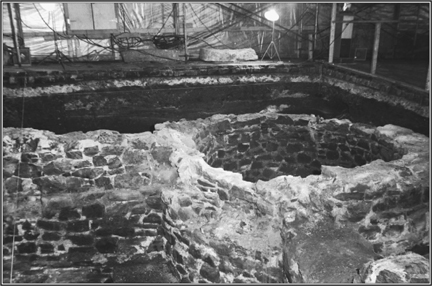
Champlain’s second habitation was begun in 1624, severely damaged by British invaders, and rebuilt in 1633. Th ese solid stone foundations supported handsome round towers. The evidence of archaeology confirms Champlain’s written accounts in this and many other details.
During the fall of 1623 he began to gather materials: “a quantity of lime made, trees cut down, stone brought in, and materials generally prepared for the mason work, carpentry and heating.” He put eighteen men to work, and wrote that, “with this small number we managed to accomplish a great deal.” Carpenters made windows and doors, and cut thirty-five beams and fifteen hundred boards for the buildings, with framing timbers for the roof.66 In the spring of 1624, the heavy work of construction began. On May 6, 1624, the masons began to lay stone for the foundation. Champlain wrote, “I placed a stone on which were engraved the arms of the King and those of my lord de Montmorency, with the date and my name in writing as Lieutenant.”67
There were many setbacks. On May 20, a violent gale blew the roof off Fort St. Louis and destroyed a gable of Hébert’s stone farmhouse. Champlain ordered his workmen to repair the damage, which delayed his other projects. But by the end of May, the first story of the new habitation was rising, with doors and windows in place and joists laid for the second floor. Work continued through the summer, and by early August construction was “well advanced.” Most of this work was done under the orders of Champlain himself; very little was undertaken by private enterprise.68
As the month of September approached, Champlain had a hard choice to make. Should he stay for another winter, or return to France? After four years in Quebec, his wife was growing restless and wanted to go home. Champlain tells us only that he decided to go back to France with his family, “having now wintered in the country nearly five years, during which time we were ill-supplied with fresh provisions and with other things very sparingly.”69 He left with many projects underway, and some very near completion. The handsome new habitation was almost done. Champlain tells us that he “left the new buildings in a forward state, built up to fourteen feet in height, with fifty-two yards of wall made, with some joists on the first floor, and with all the other beams ready to put in place; with boards sawn for the roof; most of the wood dressed and piled up for the framework of the roof of the dwelling, and all the windows made, as well as most of the doors, so that all that was needed was to put them in.” He added, “I left two kilns full of quicklime, with stone drawn on the spot, and all that was left to do in order to have the whole wall erected, as to build up seven or eight feet, a thing that could be done in a fortnight, the materials being at hand.”
Champlain also ordered the work to continue on the fort. “I requested them to collect fascines and other things for finishing the fort,” he wrote, “although in my own mind I felt pretty sure that they would do nothing of the sort, since they had the greatest dislike of the work, notwithstanding that the safety and preservation of the country depended on it, a thing they either could not or would not comprehend.” Champlain left behind Émery de Caën, Catholic nephew of Guillaume de Caën, to continue the work and “to command in my absence at Quebec.” The resident population had risen to sixty people.70
On August 21, 1624, Champlain sailed from Tadoussac to Miscou Island on the fishing coast. With his family aboard, he decided to wait for Pont-Gravé and other fishermen to finish their work, so that they could all sail in company. Pont-Gravé finally completed his catch on September 6. That night they sailed in a fleet of four ships: one with Champlain, Hélène, and Guillaume de Caën on board, another commanded by La Ralde, a third by Pont-Gravé, and a fourth small patache d’avis of 45 to 50 tons, commanded by one of the Cananée family, which sent several captains into the American trade.71
It was well that they sought safety in numbers. The Peace of Vervins was wearing thin, and the French government was unable to protect even its coastal waters. Champlain’s four ships sailed in convoy across the Atlantic and crossed soundings near Britain on September 27, 1624. That day Captain Cananée’s small patache parted company, under orders to sail to Bordeaux with dispatches. Later Champlain learned that she was captured on the coast of Brittany by Islamic pirates, “who carried off the men they found on board and made slaves of them.” Captain Cananée died in captivity, the fate of many Christian seamen in that era.72 Champlain himself had a bad moment when he sighted a strange vessel. His fleet of armed merchantmen gave chase but could not catch her. On October 1, they entered the port of Dieppe, “praising God for having brought us to a safe harbor.”73