
Richelieu’s Hundred Associates, 1625–27
The Sieur de Champlain shall … bring into subjection, submission and obedience, all the peoples of the said country.
—Orders from the duc de Ventadour and Cardinal Richelieu, 16251
The Sieur de Champlain … was one of the few men capable of living among the Savages as he had done…. In all the years he had dwelled among these native people, he had never been suspected of any dishonesty.
—Gabriel Sagard on Champlain, 16362
CHAMPLAIN remained at Dieppe for a few days and then went to Paris with his wife and servants, and tout mon train, as he put it. He traveled in high state, as suited a man of consequence. In the city, Champlain moved again to a house on the rue Saintonge in the fashionable Marais-Temple district near the Place Royale, not far from the Louvre. His new home was close to his wife’s family and suggests a concern for her feelings. He also sold his uncle’s country estate near La Rochelle, perhaps to pay for it.3
While his family settled in, he went to the palace at Saint-Germain “to see the King and my Lord of Montmorency, the Viceroy of New France.” The meetings were a success. Champlain wrote: the viceroy “presented me to His Majesty, to whom I gave an account of my voyage, as I did to several gentlemen of the Council, to whom I had the honor of being known.”4
Champlain discovered a major change among the councillors who were closest to the king. For many years, some of the strongest men around the throne had been supporters of the design for New France. A leader of this American circle was Nicolas Brûlart, marquis de Sillery, the long-serving chancellor of France. With him was his son Brûlart Puysieulx, secretary of state for foreign affairs. Both men had encouraged Champlain in the reign of Henri IV. They helped him again during the regency of Marie de Medici and in the early years of Louis XIII. But after 1620, the Brûlarts were called “the greybeards” by the younger generation who hoped to succeed them. In 1621 they lost their offices and were replaced by ambitious but undistinguished placeholders.5
The king searched for a statesman of higher ability and at last he found his man. Armand Jean du Plessis de Richelieu was thirty-six years old at the time. He was born in Paris, the youngest son of a mid-ranking noble family from Poitou. At his christening, his parents raised a banner above his crib: “Regi Armandus, Armand for the king.” His grandmother taught him to calculate the worth of people by counting the number of quarterings in their coat of arms. Those attitudes shaped his character in a fundamental way.6
Richelieu’s father was a soldier and a holder of high office who had died in the wars of religion with his affairs in disorder. One of the family’s most valuable assets was the bishopric of Luçon. Their claim was challenged by the clergy. To serve the urgent needs of the family, Richelieu was sent into the Catholic Church and nominated Bishop of Luçon at the age of twenty-one.7 Richelieu took his vows without enthusiasm. Though he wrote on religious subjects, he was worldly in his outlook. All his life he was close to his beautiful niece Marie-Madeleine de Vignerot du Pont Courlay, madame de Combalet, the future duchesse d’Aiguillon. She was his companion for many years, and her likeness was carved into Richelieu’s tombstone. Some historians have suspected that Richelieu “indulged in relations that were not only amorous but incestuous,” but he was always discreet. It was said that “he loved women, and feared scandal.”8
He became a dutiful son of the church, but Richelieu was passionately drawn to the pursuit of politics. He sat in the Estates General in 1614, joined the circle around Marie de Medici, rose and fell with her, was banished from court by the king, and then brought back to restore relations with his mother. In 1620, Richelieu’s star began to rise again. Louis XIII asked the Pope to make him a cardinal, which was done in 1622. He joined the Royal Council on April 29, 1624, and within a year, Cardinal Richelieu became the king’s “first minister.” He served in that capacity until his death in 1642.
Richelieu had a genius for power and influence. “Listen well, and speak little,” he liked to say.9 Rivals were ruthlessly pushed aside; one of his strongest challengers found himself arrested on the king’s orders. At the same time, he was very corrupt and used his public offices to build one of the largest fortunes in France.10 Everyone at court feared this extraordinary man, with his piercing brown eyes that seemed to see everything and reveal nothing. Dressed in brilliant red robes with pristine white collars, adorned with a blue silk ribbon and a Maltese Cross of diamonds and gold, he became one of the most striking figures at court. Often in his company was his mentor and friend Père Joseph, a Capuchin monk in sandals and gray robe—the original éminence grise behind Richelieu’séminence rouge.11
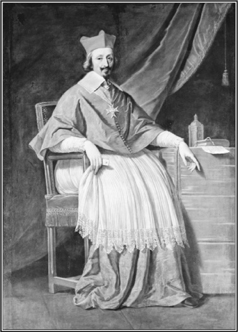
Cardinal Richelieu, after Philippe de Champaigne’s portrait in 1636. This much-hated man believed that leaders are not bound by ordinary rules. He was intelligent, watchful, silent, cruel, and relentless in his service of raison d’état. Richelieu tried to turn New France away from the purposes of Henri IV and Champlain, with mixed results.
Richelieu was a man of intelligence and complexity, a bundle of paradoxes. He became a man of great wealth but lived a very frugal life. He insisted that “all things must be done according to reason,” but he was swayed by intense emotions, and in moments of high tension he “gave way to tears” that embarrassed him. He studied humanity with a clinical eye, but was more comfortable in the company of cats. This saturnine figure was said to prefer the feline to the human species.12
Always he acted on an ethical imperative that was distant from the ways of Champlain and his humanist circle. On the great question of means and ends, the heritage of Christianity is divided. On one side is Christ’s golden rule of always treating others as one would wish to be treated. On the other is the idea of a higher law that releases privileged people from lower ones. It is akin to St. Paul’s ethical rule that “unto the just, all things are just.” Champlain and the sieur de Mons came down on one side of this great question; Richelieu on the other. The cardinal believed that higher ends sanctified any means. More than that, he worked out a code of conduct for public office which was in many ways the inversion of private morality. He believed that for kings and greatministers, deception was a duty and cruelty a virtue. On the subject of deception he wrote, “To know how to deceive is the knowledge of kings.” He added in one of his many maximes d’état, “One may employ any means against one’s enemies.”13
In regard to cruelty he went further and declared: “Harshness towards individuals who flout the laws and commands of state is for the public good; no greater crime against the public interest is possible than to show leniency to those who violate it.” Rarely was Richelieu accused of leniency. In his hubris, he was alleged to have said, “Give me six lines written by the hand of the most honest man, and I will find something there to hang him.”14
Richelieu not only practiced this inverted code but also preached it to others in high places. Many European rulers were persuaded by his thinking, which became one of the defining features of Europe’s ancien régime. This philosophy of ruthlessness appeared to get results. It could be brutally effective in the short run, but the idea that the end justified any means had an ironic way of failing at the very end. Richelieu used it to build an absolute monarchy in France, but it fatally injured the legitimacy of that regime. In the fullness of his power, he was feared and obeyed; but by the end he was hated and despised. One historian has written that Richelieu’s death in 1642 was “greeted throughout France with scarcely controlled feelings of relief and joy, sentiments which, according to observers were shared by his employer, Louis XIII himself.”15
The king accused Richelieu of believing in nothing, which was not the case. The cardinal believed in kingship—in the absolute authority of a strong monarch, the hierarchy of an established church, the force of an omnipotent state, and the superiority of an ancient nobility over other mortals. He believed in the state and lived by his rule of raison d’état, which descended from Cicero’s ratio res publicae. Richelieu replaced the public interest with the power of the state, another raw imperative that he served all his life. He believed in order and thought of it as hierarchy and hegemony. In his writings, Victor Tapié found that “one particular word occurs over and over again—disorder, dérèglement,” as representing everything he was against.16
Richelieu hedged those purposes with one constraint. Unlike many leaders who lived for power and dominion, Richelieu had no love of war. Like Champlain, he had witnessed the horror of war, and had counted its cost in blood, treasure, and most of all disorder. He knew what war could do, but most of all he hated its uncertainties. As he expressed it, “war is one of the scourges with which it has pleased God to afflict men.”17
For all these qualities, historians have celebrated and condemned Richelieu in equal measure. He succeeded in building a strong monarchical state and he worked to integrate a nation, but he did so by methods that separated the state from the nation and turned one against the other. In a letter to Louis XIII he wrote: “I promised Your Majesty to employ all my industry and all the authority which it pleased you to grant me to ruin the Huguenot party, to abase the pride of the great nobles, to reduce all your subjects to the obedience that they owe you, and to restore your name among foreign nations to the position it should rightly hold.” Even within his beloved France, he made entire orders and denominations of humanity into his bitter enemies.18
In his effort to strengthen the state and the monarchy, Richelieu was deeply hostile to the high nobility, and especially to princes of the blood who regarded the state with suspicion and the monarch as their equal. These free spirits also had an idea of their own liberties and fiercely defended the rights of provincial assemblies. One of the most able and outspoken of them was the viceroy of New France, Henri II, duc de Montmorency, who placed the law above the king and sometimes put regional parlements above the monarchical state. Richelieu regarded him with suspicion—and more than a little jealousy. The cardinal came from the lesser nobility; Montmorency had the rank, manners, and bearing that Richelieu could never hope to match, and was also a close companion of the king.19
As Richelieu moved to the center of power, Montmorency withdrew. He gave more attention to his role as governor of Languedoc, in defense of its ancient liberties. In the fall and winter of 1624–25, Montmorency decided to give up his job as viceroy of New France. He was sick of strife and litigation with investors. Champlain tells us that “the troubles that sprang from this source were in part the cause of my lord Montmorency’s resignation.” But only in part. Another factor was the rise of Richelieu.20 Even as Montmorency gave up the office he was careful to keep it in the family, and sold it for 100,000 livres to his nephew.21 The new viceroy was Henri de Lévis, duc de Ventadour, prince de Maubuisson, and comte de la Voulte. He also came from the high nobility, but had a different character and did not pose a threat to Richelieu. Ventadour, as we shall call him, was twenty-eight years old in 1625 and he had just come into his inheritance on the death of his father in December, 1624. He had been trained as a soldier and had fought in campaigns against the Huguenots, but his great passion was religion. Ventadour was devoted to the Roman Catholic Church.22
The quality of Ventadour’s faith appeared in the condition of his marriage. A few months before his father’s death, he took the hand of Marie Liesse de Luxembourg, heiress to one of the largest fortunes in France. They knew each other very well, having grown up in the same household where Marie Liesse had been raised by Ventadour’s mother. They were engaged to be married when she was eight years old and he was twenty-three. On their wedding day four years later she was a child bride, less than half her husband’s age.
Their marriage was similar in some ways to that of Samuel Champlain and Hélène Boullé. The duke and duchess of Ventadour had no children. Their marriage appears never to have been consummated. Both husband and wife were very devout, so much so that in 1629 they mutually agreed to separate and lead lives of chastity and Christian devotion. Marie Liesse entered a convent, Carmel d’Avignon. Ventadour founded a holy society called the Compagnie du Saint-Sacrament. He summarized its purposes in half a sentence: “to cover the land of France with a flowering of good works.” In 1643, he would be ordained a priest.23
Ventadour agreed to become viceroy of New France for a religious purpose. His central goal was to spread “the Catholic Apostolic and Roman Faith and Religion” among the American Indians and Europeans in the new world.24 He strongly supported the Récollet fathers, and at the urging of his spiritual adviser, Father Philibert Noyrot, he also encouraged the Jesuits to work in New France. In January, 1625, three more Jesuit fathers and two brothers went to Quebec.25
One of Ventadour’s first acts as viceroy was to confirm Champlain as his chief lieutenant in New France, with a commission dated February 15, 1625. In doing so he followed every previous viceroy and general of New France since 1604. The sieur de Mons, the comte de Soissons, the prince of Condé, the marquis de Thémines, and the duc de Montmorency all had chosen Champlain as their lieutenant and had come to think of him as their indispensable man in New France.26
Ventadour went further. He avowed his “entire confidence” in Champlain, and praised him for his “intelligence and judgment, capacity, practical skill and experience,” as well as for his “good diligence, and the knowledge that he possesses of the country, arising from the various navigations, voyages and visits that he has made there.”27 He gave Champlain more authority than before, with full power to appoint and replace military officers in the ranks of captain and ensign, “on our behalf, as may be required.” Champlain acted quickly and awarded a captain’s commission to his able young brother-in-law, Eustache de Boullé, who had much experience of New France and had worked closely with Champlain. He also selected an ensign named Destouches, of a naval family prominent in the Old Regime.28
When the viceroy gave Champlain his commission, he added a personal request. In Champlain’s words, Ventadour asked that “for this year [1625] I should remain near to him, in order to instruct him in the affairs of the said country, and to give order to some of my own affairs in Paris.” Champlain was happy to agree, and the center of his activity shifted to the Hôtel de Ventadour, the duke’s mansion in Paris.29
The most urgent problem was that of the commercial companies. There were now two of them.30 One was the old Company of Rouen and Saint-Malo. The other was the new Company de Caën, based in Dieppe, Paris, and Orleans. Only a few men (Ézechiel de Caën for one) belonged to both. The two groups differed in their origins but shared the same interest in extracting quick profits from a monopoly of the fur trade. Neither was happy with Champlain’s relentless effort to expand permanent settlements at their expense. Some leaders complained that the colonizing effort was doomed to fail. Others feared that it might succeed and that colonists would become competitors.
Several leading investors continued to be very hostile to Champlain in a personal way. Chief among them was a faction within the old company led by his enemy Daniel Boyer, together with Boyer’s Dutch kinsman Corneille de Bellois, a Flemish merchant named Louis Vermuelen, and another investor named Mathieu Duisterlo, who was identified as German. These merchants came from other countries and had no loyalty to France. They cared nothing for the founding of French colonies in North America. Their only purpose was to buy beaver pelts and sell them at a profit. They thought that Champlain’s grand design was bad for business and resented his victories even more than his defeats.31 While Champlain was in New France between 1620 and 1624, these conflicts had grown more intense. Boyer’s friends were highly litigious. Both companies and the viceroy were caught in a tangle of lawsuits. It seemed that the only people in France who consistently made money out of America were the lawyers.
In 1625, the duc de Ventadour summoned the leaders of both companies to the Hôtel de Ventadour in the hope of achieving “a friendly understanding between the two parties.” His gesture was in vain. Champlain wrote that the meetings were marked by a “good deal of contention.” Champlain and Venta-dour tried to buy out the old company, and offered its shareholders a payment of 37 percent on their capital of 60,000 livres if they would withdraw from the fur trade and surrender all other claims. They refused, and rejected every effort by Champlain and the viceroy to intervene.32
Ventadour and Champlain referred the dispute to the court of Admiralty. The old shareholders tried to block the proceedings, and the viceroy took the matter directly to the Royal Council. With the leadership of Richelieu, the council acted decisively. In the name of the king, it ordered the old shareholders to accept a payment of 40 percent on their capital, and withdraw forthwith from trade in the St. Lawrence Valley. In 1626 the Company of Rouen and Saint-Malo ceased to take an active role in New France.33
The Company de Caën was offered a monopoly of the fur trade on condition that it appoint Catholics to command its ships. This was agreed. The fisheries remained open to all comers. Fishermen were also allowed to take up to twelve beaver pelts for each vessel, but they had to sell them to agents of the Company de Caën at a fixed price. On these terms, it was hoped that trade and colonization could revive.34
No sooner had the problem of the quarreling companies been resolved than more trouble landed on the viceroy’s desk. In the late summer and fall of 1625, letters began to arrive from Jesuits and Récollets in New France. They testified that conditions in the colony had sadly declined in the year since Champlain had left. These accounts had a broad reach. Jesuit father Philibert Noyrot returned to France and made similar reports to many people at court, where his judgment carried great weight. Jesuit Charles Lalemant also sent letters to Champlain and the heads of both religious orders. Récollet father Joseph Le Caron wrote an address directly to the king and had it printed in Paris.35
These writers all agreed that many things were going wrong in Quebec. Some of it was the eternal complaint about the winters in New France. Lalemant wrote, “Our Frenchmen have even told me that they dragged their maypole over the snow on the first day of May.” The fathers warned that the settlers were desperately short of food, and that “nothing is to be hoped” from the Indians in the way of provisions. The colony was shrinking. Champlain had left sixty habitants in the late summer of 1624–25. In his absence, that number fell to fifty-two over the winter of 1624–25, and forty-three in 1625–26.36
The fathers also described growing tensions between the French and the Indians. The missionaries were having trouble reaching the natives, and some Indian interpreters were reluctant to help them. Letters from both the Jesuits and Récollets showed increasing hostility to the Indians. The fathers complained that they were not treated with respect, and that the Indians “consider the French to be less intelligent than they.” One wrote of their missions that “the promise of success is not yet very great, so crude and almost bestial are the natives.”37
Father Lalemant was very negative about the people he had come to convert. He wrote that they “commit all kinds of shameless acts, without disgrace or attempts at concealment” and “as to cleanliness among them, that never enters into the question; they are very dirty.” Most of all he complained that they were violent and cruel, and could not be trusted. They even “kill their fathers and mothers when they are so old that they can walk no longer.”38 These letters expressed growing fear of the Indians. “There is no security for our lives among these savages,” Lalemant wrote. “If a Frenchman has in some way offended them, they take revenge by killing the first one they meet…. If during the night they dream they must kill a Frenchman, woe to the first one whom they meet alone.”39
This fear and hatred of the Indians never appeared in Champlain’s writings, nor was it widely evident when he was present in New France and running the colony. Sometimes he was very displeased with particular acts by individual Indians, and with some of the Montagnais in particular, but he had nothing like this general attitude of terror, hysteria, and loathing toward the native people. The letters that came from Quebec in Champlain’s absence were graphic evidence of his impact when he was present in the colony.
The bulk of these letters also complained about something else—the misconduct of the French merchants. Missionaries of both orders were very angry with the de Caën company, especially with Émery de Caën, who had briefly replaced Champlain as commander in Quebec, and his cousin Guillaume de Caën, who commanded the company’s ships in the St. Lawrence. Jesuits and Récollets reported that Protestant leaders of the company refused to accommodate them. According to an account by Father Lalemant, when the Jesuits arrived, Émery de Caën told them “it was impossible to give us lodging in the settlement or at the fort, and we must either return to France or withdraw to the Récollet fathers.” The Récollets took them in and they survived, but in a state of fury against the merchants.40
The Récollets added another complaint that de Caën was not providing for the security of the colony. Le Caron wrote that Champlain’s fort had been grossly neglected. He reported that it was guarded by two poor women and its only sentinels were two chickens. On top of everything else, trade was not flourishing under the de Caëns. Lalemant wrote, “An old man told me that he had seen as many as twenty ships in the port of Tadoussac, but now since this business has been granted to the [de Caën] association, which today has a monopoly over all others, we see here not more than two ships which belong to it, and that only once a year.”41
Récollet father Joseph Le Caron agreed with his Jesuit colleagues and urged sweeping reforms. His memorial was a broad indictment of the Company de Caën and its leaders in Quebec. Le Caron wrote that it was “impossible to establish the Catholic faith when the colony is run by Protestants.” He urged that the viceroy should live in Quebec, and that only Catholics should be allowed to come to Canada, or venture into the interior. Further, Le Caron thought that the de Caën company had failed to meet its responsibilities and should forfeit its monopoly. He urged that markets should be as open as in France, and that a system of “free” trade be established—for everyone but Huguenots.42 There was an air of desperation in these letters. Lalemant begged Champlain to come quickly. He wrote, “We are awaiting your arrival, to determine what will be well to do.”43
This chorus of complaint from Quebec was clearly heard in Paris. In the spring of 1626, Vendatour asked Champlain to return quickly to New France and “take up his residence at Quebec.”44 The viceroy’s instructions repeated the imperial phrases of Louis XIII, and echoed the state-building purposes of Cardinal Richelieu. Further, at Quebec, “and other places which the said sieur de Champlain shall consider suitable,” he was “to order the construction and building of such forts and fortresses as he shall judge useful and necessary.”45 Champlain hurried to the port of Dieppe and went to work with the leaders of the Company de Caën. Together they outfitted five vessels for New France. Champlain went aboard the ship Catherine with Récollet father Le Caron and Captain Raymond de La Ralde, a Catholic who was commissioned as admiral of the fleet. A second vessel, La Flèque, was commanded by Émery de Caën. The Jesuits chartered a small vessel of 80 tons called Alouette to bring their strength to seven members of their order in the colony, with twenty workmen. Two other unnamed vessels of 200 and 120 tons completed the expedition.46
Champlain’s ship weighed anchor on April 15, 1626, and tacked to and fro in the roadstead of Dieppe waiting for the other ships. On April 24, they finally departed together for New France. Increasingly ships were sailing in convoy, and with good reason. International tensions were rising, and conditions were growing more dangerous on the Atlantic. On April 27, they sighted a strange sail that Champlain took to be a corsair or a smuggler. As a captain in the king’s marine, he ordered the entire convoy to give chase. Champlain wrote that they “pursued it for some three hours; but as it sailed better than we did, we gave up the chase and came about” and steadied on a course for America.47
It was a slow passage. Large convoys meant longer voyages, as the ships were forced to keep company with the slowest sailor, and time was lost when they separated in the night. On May 23 they ran into a great storm that lasted two days. LittleAlouettedisappeared with the Jesuits aboard, and Champlain feared the worst. But she miraculously survived and made her own way to America. The ships were at sea for more than two months and six days, “delayed as we were by bad weather.”48
At last, on July 5, Champlain reached Quebec. He was happy to find the habitants in good health, but was shocked to discover that “not a thing had been done” to finish the buildings since he left two years before.49 With the new arrivals aboard his ships, Champlain counted fifty-five people in the settlement, of whom twenty-four were laborers on the company’s payroll. He set them to work on the fort and the dwellings. The Company de Caën resisted and once again refused to keep its contractual promise. Champlain wrote: “They should have given me ten men to work at His Majesty’s fort. Even though the Sieur de Caën and all of his associates signed an agreement to do so, and although his Majesty and the Viceroy desired it, still they oppose it, and hinder it to the utmost of their power … as long as trading goes on, that is enough for them.”50
But this time Champlain prevailed, and the laborers went to work for him. Once the buildings were on their way to improvement, he turned to another purpose. An important goal was to make the settlement self-sustaining, at least for its own food. The Île d’Orléans near Quebec looked to be a good site, with fertile soil and ample water. It offered an abundance of good farmland, but Champlain had a shortage of farmers at Quebec in 1626. The settlement of the Île d’Orléans would have to await a larger flow of migration.
In the meantime he gave his attention once again to Cap Tourmente on the north side of the St. Lawrence River, thirty miles downstream from Quebec. Here was a perfect place to raise cattle, with open grassland that did not require the enormous labor of land clearing.51 In 1623, Champlain had visited Cap Tourmente with the sieur de Caën, and both men thought it was “a very fine place” for farming, with “everything that one might desire for that purpose.” Later that year, the meadow grass began to be harvested and large quantities of hay were carried to Quebec. When Champlain returned to Canada in 1626, one of his first acts was to go to the meadows near Cap Tourmente and choose a site for a settlement. He picked a place on a small creek where pinnaces and shallops could land at high tide, with the meadows nearby, a great growth of trees, and an abundance of snow geese.52
Champlain moved decisively with all his resources. “I resolved to build as soon as possible,” he wrote. “Although we were then in July, I nevertheless decided to employ the greater part of all the workers in Quebec.” The farm at Cap Tourmente was called into being by Champlain and the leaders of the colony. No major decision was left to the will of any individual except himself. Like much of the culture of Quebec—and unlike Acadia, the fishing coast and the western frontier—the building of the settlement was highly ordered and controlled from the top down. But Champlain tried to run its daily operations by private enterprise as he had done many times before.53
Champlain ordered his workers to build “a dwelling, a stable sixty feet long, and more than 20 feet wide, and two other cottages each eighteen by fifteen feet, constructed of wood and clay after the fashion of those in the villages of Normandy.” The evidence of modern archaeology confirms the accuracy of Champlain’s description and adds depth to his brief passage. Excavations by Canadian archaeologists have discovered that the farm buildings at Cap Tourmente were indeed built on the model of Norman peasant architecture, in an old tradition of half-timbered clay construction, just as Champlain wrote. Wooden posts were set in clay, about a yard apart. Between the posts, walls were made of densely packed, or “puddled,” clay. This ancient method was neolithic in its origin, widely used in Belgium and Normandy but uncommon in the south of France. Here again, in the years of Champlain’s lieutenancy, we find a strong connection between the culture of Quebec and that of northwestern France.54
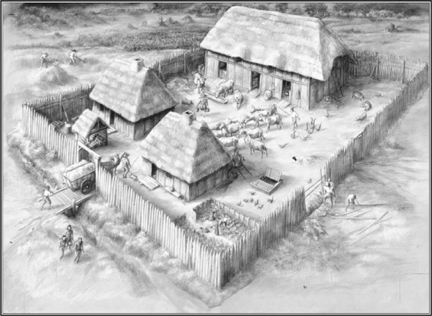
Champlain constructed this farm at the natural meadows on Cap Tourmente in 1626. Artist Francis Back based this reconstruction on the work of Jacques Guimont and a team of archaeologists sponsored by Parcs Canada, 1992–93. Here again archaeology confirms the accuracy of Champlain’s texts, and deepens our historical knowledge.
The farm buildings at Cap Tourmente were not as strongly built as their Norman models: the walls were about eight inches thick, compared with fifteen or twenty inches in the north of France. The dwellings were low and dark, with small windows covered by translucent oiled paper. Archaeologists were puzzled by a lack of evidence of stone fireplaces; probably the interiors were heated with clay fireplaces. The buildings were grouped together to form a small village, to which the Récollets later added a chapel. By September of 1626, the farm was habitable.
To run the farm, Champlain sent farmer Nicolas Pivert with his wife, Marguerite Lesage, and their young niece, a “petite fille.” To help them he added five workers and entrusted them with cattle that had been brought from France. Champlain also sent provisions that had been shipped in graystone pottery crocks of Norman design. Archaeologists have found much evidence of what they ate. They raised Indian corn and enjoyed a mixed diet of fresh beef and pork, fish from the river and geese and ducks from the marshes, as well as beans and other dried provisions from France. It was a diverse diet, and a key to the survival of the colony. Champlain was always very mindful of food, which he recognized as essential to the morale of the habitants. The traces of food that archaeologists have found at the farm could have made a fine Norman cassoulet. One might imagine Champlain on his visits sitting down to such a dish, with good bread and a sturdy wine. In its regard for gastronomy, this was a very French colony.55
Champlain watched over the farm through the winter and was happy that the workers survived in good health. In the spring he sent more than half of the workers to finish the buildings at the cape and to help bring in hay for the following winter—which was essential to the survival of livestock in North America—and the farm began to flourish.56
Champlain also ordered the workers to fortify the farm and erect a strong palisade, “not only against the Indians, but principally against the enemies from Europe.” It was needed. Two drovers that he sent to help with the cattle were attacked and killed by a renegade Montagnais raiding party. This incident “distressed me greatly,” Champlain wrote. He went to the scene and found that the drovers had been murdered “as they lay asleep, about half a league from our habitation.” He was shocked by the gratuitous violence of the assault. “We went to get the bodies, which had been dragged into the river in order that they might be carried away by the tide…. Their skulls had been smashed by blows with axes, and there were many other wounds by swords and knives.”57
The French were angry and frightened. Some wanted to kill several Montagnais in retaliation. In Spanish, English, and Dutch settlements, a policy of retribution was adopted more frequently than any other. Champlain rejected it out of hand. He declared: “As to taking vengeance upon a number who were not guilty, there would be no sense [raison] in that. It would be a declaration of open war, and would ruin the country.”
Instead he invited all the Montagnais captains to a meeting. He showed them the bodies of the murdered Frenchmen, and told them that these acts were wrong and unacceptable. He asked them to join in a search for a solution that all could accept as just. Some of the Montagnais inspected the bodies and tried to blame the Iroquois. Champlain would have none of that, and he made clear that the murders were clearly the work of Montagnais. Much earnest discussion followed. Champlain persuaded the captains to agree that the killings were in truth the work of Montagnais men, but they insisted that they had no idea who the murderers might have been. Champlain also refused to accept that judgment and pointed out that it did not respond to the problem at hand. He reasoned with them: if peace were to prevail on the St. Lawrence River, justice had to be done in a way that all the people of the valley could accept as legitimate. More discussion followed, and at last a solution was found. The Montagnais captains agreed that they would deliver several of their own children to Champlain as hostages for the keeping of peace. This was done. The hostages were treated with humanity, the killing stopped, and Champlain slowly began to rebuild trust between the French and the Montagnais. It was an achievement much valued in both nations.58
Afterward, in the winter of 1627–28, a group of Montagnais came to Champlain and said that they wished “to join with us in a closer friendship than ever before, and to remove any distrust of them we could possibly have.” To cement that relationship they had decided to entrust the French with three young girls, aged eleven, twelve, and fifteen. Champlain wrote that he was “greatly astonished by the offer” and by the request of the Montagnais to “have them instructed and treated like those of our own nation, and to have them marry if that seemed right to us.”
After much reflection, Champlain agreed to take them in. Some writers have been suspicious, but the clergy watched carefully and testified that nothing was amiss. Champlain named the girls Faith, Hope, and Charity. The Récollet missionary Gabriel Sagard wrote that they were instructed for two years in religion and in “the small skills of young women.” Champlain added that they learned “needlework both plain and fancy, which they did very well, besides which they were very civilized.” Sagard reported that “thesebonnes filles honored Champlain as their father and he treated them as his daughters.” Amity between the French and the Montagnais was much restored.59
At the same time Champlain also renewed his efforts to improve relations with the Iroquois. In August a canoe arrived from the “River of the Iroquois, with news that they had killed five Dutchmen, who had previously been their friends and allies.” The Iroquois had also gone to war against the Mohicans to the south, and small parties were skirmishing with the Algonquin, Montagnais, Huron, and the Neutral to the north and west. Champlain dealt indirectly with this problem by rescuing two Iroquois captives from torture and death. He kept one a prisoner and made sure he was treated humanely. The other was sent home as a gesture of good will. And in the spring of 1627, Champlain dispatched a French emissary to the Iroquois on a mission of peace. Slowly relations with the Iroquois did get better. Attacks diminished in the St. Lawrence Valley.60
Champlain also tried to maintain his policy of religious tolerance within the colony, a task that in some ways was more difficult than keeping the peace with his Indian neighbors. Jesuit priests and Récollet brothers demanded that Protestants be excluded from Quebec. In the summer of 1626, Jesuit father Philibert Noyrot was ordered to carry that request back to France, where he was very well connected at court. When Noyrot met with Cardinal Richelieu and the king, he tried to convince them that Henri IV’s Edict of Nantes, which had guaranteed Protestants the freedom to practice their religion, should be revoked in New France, and that only Catholics should be allowed to settle there. But what, then, was to be done about the many Protestant seamen and traders in Quebec?61
Champlain, Ventadour, Richelieu, and Louis XIII were not of one mind on this contentious question. The king favored toleration. He strongly supported his father’s policy in the Edict of Nantes, prohibited general attacks on Protestants at court, and was very close to Protestants in his household, such as his valet de chambre Beringhen and his physician Héroard. He insisted that Protestants should be loyal to the Crown and required them to grant toleration to Catholics in Huguenot towns. In the same spirit, he protected the right of Protestants to worship freely throughout his realm, including New France.62
Ventadour did not support toleration. As viceroy he tried to forbid Protestant worship in New France, and issued orders to ship captains in 1626 that Protestant seamen could sing their Huguenot hymns and psalms on ships at sea, but not in the St. Lawrence River. Clearly he meant New France to be an entirely Catholic colony.63
Richelieu took a third position. He subordinated religious questions to the raison d’état. In 1627 he was largely responsible for letters patent to the Company of Canada, which required that it “populate the colony with native-born French Catholics.” But he insisted that the colonies in America would be governed by all the laws of France, which included the Edict of Nantes and protected Huguenot seamen and traders.64
Champlain’s views were complex. His own Catholicism was growing stronger, so much so that he began to refer to Protestantism as a “religion prétendue réformée; a religion that claims to be reformed.” With the sieur de Mons and Henri IV, he had always agreed that the Catholic Church should be fully established in the New France, and that all missionary work with the Indians would be done by Catholics, but he also believed that Huguenots should be allowed into the colony and fully protected in their right to worship privately in their own way. But Champlain also had to follow contradictory instructions from Louis XIII, Ventadour, and Richelieu.65
He solved the problem by quiet compromise. A test case arose in 1626 when the ship Catherine anchored in the St. Lawrence River with a mostly Protestant crew and Raymond de La Ralde, who was staunchly Catholic (and also strongly anti-Jesuit), as its captain. Ralde mustered his crew and told them that the viceroy “did not wish them to sing their psalms in the Great River, as they had done at sea.” Champlain was aboard at the time. He wrote that the men “began to murmur and say that they ought not to be deprived of that liberty.”66 After much conversation, he found a middle way. “Finally,” he wrote, “it was agreed that they should not sing their psalms, but they should assemble for prayer, since near two-thirds of them were Huguenots.”67 Champlain commented, “and so out of bad debt one gets what one can.” That was his policy: a compromise that kept the peace in the colony, and allowed Catholics and Huguenots to coexist. It preserved a spirit of toleration and humanity that was fundamental to his grand design.68
• • •
While Champlain was at work in Quebec, more reports from the Jesuits and Récollets reached Cardinal Richelieu and persuaded him that sweeping changes were necessary in the commerce of New France. In October, 1626, the cardinal decided to take personal control. He added to his many powers a new office as “grandmaster, chief, and general superintendent of the Navigation and Commerce of France.” By the spring of the following year, Ventadour was out as viceroy, and Richelieu replaced him as the man in charge of New France.69
The cardinal wasted no time. First, he dealt summarily with the persistent problem of the rival trading companies. In the spring of 1627, the Company de Caën lost its monopoly and trading privileges in New France. It was replaced by an entirely new company that Richelieu created. He named it the Compagnie de la Nouvelle France. It was also called the Compagnie du Canada but came to be more generally known as the Compagnie des Cent-Associés, the Hundred Associates, after the number of its stockholders.70
The Company of the Hundred Associates began with a capital of 300,000 livres. Richelieu required each investor to pay in 3,000 livres, and all profits would be reserved by the company for three years. On the list of the hundred stockholders dated January 14, 1628, Richelieu appeared as number 1. Samuel de Champlain was number 52. As he was in Quebec at the time, his wife, Hélène, paid his capital of 3,000 livres in full—another sign that she now strongly supported his endeavors. Many investors were Royal Councillors and holders of high office at court. Others were merchants and financiers—a few from Rouen and Bordeaux, and many from Paris. Several members were Champlain’s friends who came to New France: Charles Daniel, Isaac de Razilly, Charles Saint-Étienne de la Tour. The mercantile families who had dominated the earlier companies were excluded: there were no Boyers from Rouen and no de Caëns from Dieppe. Altogether the company was closely controlled by Richelieu, and could also be called the cardinal’s ring.71
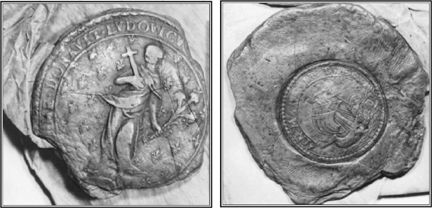
The seal of Richelieu’s Company of New France (the Hundred Associates). The obverse shows a figure holding a crucifix and the lilies of France, with the motto “me donavit Ludovicus Decimus Tertius, 1627; Louis XIII gave me, 1627.” The reverse shows a ship and a seaman’s prayer: “ in mari viae tuae; in the sea your way [to salvation].”
The entire colony of New France was made a fief of the company. It claimed a vast territory in North America from Florida to the Arctic Circle. The company was required to support settlement on a larger scale than ever before. It was run by Richelieu himself with a board of twelve directors. Half were court officials; the rest were merchants, mostly from Paris. Champlain, Razilly, and Daniel did not sit on the board.72
In a few months, Richelieu had put New France on a stronger material base than ever before. At the same time, Champlain had invigorated the settlement of Quebec. He had repaired the buildings in the town, rebuilt the fort, and led the settlement toward self-sufficiency. He had improved relations among the clergy, traders, and habitants. He aligned his actions with the new policies of Cardinal Richelieu. Most important, he stopped a threatening decline in relations with the Indians and restored amity with the Huron, the Algonquin, and many of the Montagnais, while he also made peace with the Iroquois.
Champlain had made real progress on many fronts, but in other ways the tiny settlement remained fragile. Its population was very small and in most years grew scarcely at all. In the winter of 1627–28, Champlain wrote that “55 people, men, women and children depended on the habitation for subsistence, not including the native inhabitants.”73 Other European settlements, by comparison, were expanding rapidly. By 1628, the Dutch had 270 colonists in New Netherland. The English Pilgrims at Plymouth were 300 strong in 1629. A census of Virginia counted 1,275 English settlers and 22 Africans in 1624. Massachusetts had 506 English Puritans in 1630. New France had dangerous neighbors, and tensions were building.