
The British Conquest, 1628–29
The advice I give to all adventurers is this: seek a place where you can sleep in safety.
—Champlain, Voyages, 16321
IN 1625, France and England went to war. It had been a long time coming. Since the death of Henri IV, the monarchs of England, Spain, and France had been striving with one another in rivalries of high complexity. Each country was ruled by an ambitious king and an able minister: Charles I and the Duke of Buckingham, Philip IV and the Count-Duke Olivares, Louis XIII and Cardinal Richelieu.2
Their goals were similar: absolute authority at home, a strong hand in Europe, and an expanding empire in America. But ambitions exceeded resources, and they all were weary of incessant war, especially the French. In 1624, Louis XIII proposed an Anglo-French alliance, and he suggested that it be cemented by the marriage of his sister Henrietta Maria to England’s Charles I, with a dowry of 2,400,000 livres. Charles agreed, and the wedding followed in May, 1625. It brought a bright hope of lasting peace between England and France, but the marriage itself made the alliance more difficult. Henrietta Maria was devoted to her Catholic faith, and the English people were strongly Protestant in 1625. She was bitterly unhappy, and the marriage was riven by quarrels. At one point the queen was so overcome with fury at her exile in London that she rammed her arm through a glass window. All hope of harmony collapsed in the bloody aftermath. On top of that, half the dowry had not been paid, and Charles urgently needed the money.3
These troubles were reinforced by turmoil in France over the Huguenots of La Rochelle, who made their city into a fortress—a Protestant state within the state. Louis XIII regarded them as disobedient subjects and attacked. Charles I supported them, and two angry royal brothers-in-law went to war. A large British force came to the aid of the Huguenots and was defeated in heavy fighting at the Isle of Ré.
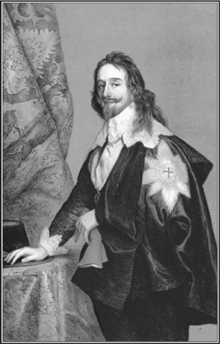
“Charles I as Garter Knight,” a portrait by Anthony Van Dyke, 1632. This English king aspired to absolutism on the French model. He tried to rule his restless people without a Parliament, and involved them in unsuccessful wars with France, Scotland, and Ireland. He also authorized British mercenaries to seize New France.
La Rochelle proved too strong for the French to take by assault. Richelieu decided to starve it into submission and gave the war his own brutal touch. The town was besieged, and Rochelais who tried to escape were driven back inside the walls or summarily hanged, even women and children. The population of La Rochelle fell from 27,000 to 8,000 starving people. Finally, that small remnant surrendered, and Louis XIII entered the gates in triumph on November 1, 1628. He destroyed its fortifications, banished a few leaders, and pardoned the rest. The largest churches became Catholic, but Protestants were allowed to worship under the Edict of Nantes.4
Richelieu and Louis XIII had succeeded in defeating the “Huguenot state within a state,” but at heavy cost. The Anglo-French war spread to America. Charles I and his ministers resolved to destroy the settlements of New France and seize the Atlantic fisheries. But the English king lacked money for a proper military force. He attacked New France with mercenary bands of ill-disciplined freebooters who went to war on speculation and were paid by plunder.
Charles authorized two families of Scottish lairds, the Alexanders of Stirling and the Stewarts of Ochiltree, to seize Acadia. James Stewart attacked with two large ships and a pinnace. In a small cove he found a Basque fisherman named Michel Dihourse, of Saint-Jean-de-Luz, drying his cod. Stewart seized the ship and its catch, and plundered the Basque crew. Then he built a fort, using the guns he had taken from the Basques, and announced that no Frenchman could fish or trade on the coast without paying ten percent of his goods. Those who refused would lose their ships and their liberty.5
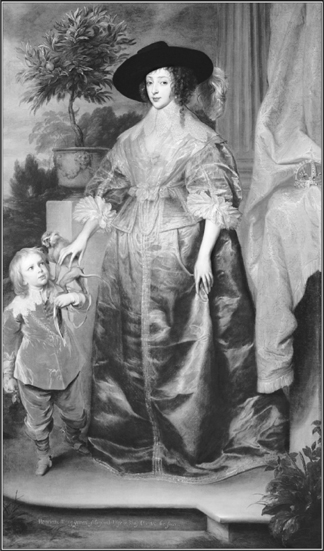
Henrietta Maria with her “pet dwarf” Sir Jeffrey Hudson, 1633. This beautiful sister of Louis XIII became the wife of Charles I. he wedding was meant to cement an alliance, but she hated Protestant England, the dowry was not paid, and war followed between two infuriated brothers-in-law. Quebec was seized and Champlain captured.
In 1627 yet another set of mercenaries appeared on this crowded stage. They were a family of entrepreneurs with a Scottish name, English origins, and a French residence. The family patriarch was Gervase (or Jarvis) Kirke, a merchant who was born in Derbyshire, traded in London, and lived in Dieppe among a colony of Scottish adventurers on the rue Écosse. There he married Elizabeth Gowding (or Goudon), daughter of another merchant in that busy town. They had five sons: David, Louis, Thomas, John, and James (or Jarvis), all born and raised in Dieppe. Together the family ran a flourishing international business with one base in England, another in France, and a web of partnerships on both sides of the law.6
The Kirkes received a commission from Charles I to seize French shipping in the St. Lawrence River. In 1628 they sent out an expedition and began to intercept French vessels bound for Quebec. The commander was David Kirke. Champlain called him the General, but he was not a soldier or seaman. David Kirke was a businessman. A Huguenot who knew him well said that he was “a wine merchant in Bordeaux and Cognac, ignorant of the sea, knowing nothing of navigation, having made only two voyages.” Serving under him were his brothers, “Vice Admiral” Thomas Kirke and “Captain” Louis Kirke. Their pilot was a fugitive French Huguenot, Captain Jacques Michel, who knew the coast of New France and had scores to settle with Catholic leaders after the siege of La Rochelle.7
When war began, Richelieu’s Company of the Hundred Associates was preparing to dispatch a very large convoy to New France. Its directors asked for a delay until their ships could be protected. Richelieu refused. With little knowledge of the danger but much confidence in his own judgment, he rejected the warnings of informed advisers and insisted that the ships must sail. On January 28, 1628, a royal proclamation ordered them to depart for Quebec forthwith.8
The company directors obeyed, much against their better judgment. Everything went wrong, as they feared. In the uncertainty of war, the Hundred Associates were unable to raise capital. The best they could do was 56,000 livres, not nearly enough. Richelieu insisted again, and their only recourse was to borrow 164,720 livres at ruinous rates of interest. Without the money in hand, they outfitted the largest expedition that had been sent to New France. At the Cardinal’s demand, the company gambled everything on this enterprise.
It began by sending a single ship with food and supplies that were urgently needed in Quebec. Then it dispatched four large merchant vessels: Estourneau, Magdaleine, Suzanne, and another of unknown name. A small barque was separately chartered by Jesuit father Philibert Noyrot. On board these vessels were two other Jesuits, Charles Lalemant and François Ragueneau, with two Récollets, Daniel Doursier and François Girard de Binville. Altogether the ships carried four hundred people, mostly colonists. The company made a major effort to recruit families, with some success. It was the largest group of French settlers that had been sent to America.
In command was Admiral Claude Roquemont de Brison, a founding member of the Company of the Hundred Associates. He had been selected by Richelieu and was the very model of the cardinal’s idea of a leader. Roquement was a highborn nobleman, a devout Catholic churchman, a strong supporter of Royal absolutism, and an obedient servant of the cardinal. He was an officer of proven courage, but man of little intellect and less judgment. He knew nothing of New France and was unfamiliar with its waters.9
After many delays, the convoy sailed from Dieppe on April 28, 1628. It was a troubled voyage from the start. The fleet ran into a major storm. Then it was menaced by two ships with crews from La Rochelle who were eager to attack Richelieu’s fleet with the same ruthless determination that he had brought against their city. The convoy escaped. After seven weeks at sea, it reached the uninhabited waste of Anticosti Island at the mouth of the St. Lawrence River, where Roquement erected a cross among the seals and polar bears. They sailed south to the Gaspé coast, and Roquemont learned from fishermen that a squadron of powerful British ships had taken possession of Tadoussac and were seizing French vessels in the river.
These Britons were the Kirke brothers and they were out in force. While the French ships had been preparing to sail, the Kirkes had arrived on the coast of North America with a formidable fleet of three or four big ships, all heavily armed and filled with large crews of men at arms. They began by seizing French fishing vessels at Miscou Island in the Bay of Chaleur, south of the Gaspé Peninsula. The Kirkes also captured a large Basque trading ship and intercepted the first provision ship that the Hundred Associates sent out that year, with supplies for the settlers of Quebec. Now with six ships, the Kirkes sailed up the St. Lawrence River and anchored in Tadoussac harbor.10
In Quebec, Champlain and the French settlers were desperately short of food. Dry rations always ran low in the late spring, and by June they were nearly gone. Champlain wrote: “All our provisions were exhausted, excepting some four or five barrels of quite bad biscuit, which was not much, and some peas and beans, to which we were now reduced without any other commodities.” Their supply ships were overdue, and they did not know why. Was it trouble in Europe? Politics at home? Weather on the North Atlantic? Every morning they looked anxiously down the great river in hope of sighting a sail, but there was nothing. Champlain remembered, “We were waiting for news from day to day, not knowing what to think.”11
The settlers had left their river barques at Tadoussac, as was the custom. Champlain retained only a small shallop at Quebec. It was not caulked or seaworthy, and he wrote that Quebec “was without a single sailor, or any man with knowledge enough to fit out and navigate a vessel.”12 He asked a Montagnais, whom the French called La Fourière, to go down the river in search of news. On June 18, La Fourière returned and said that “he had not heard of any vessels having arrived off the coast.”13
On July 9, two men arrived on foot from Tadoussac. They brought news that lifted hearts in Quebec. Six vessels had anchored there together, “an extraordinary thing for a trading voyage,” Champlain wrote. Who were they? Several parties of Indians came with contradictory stories. They recognized one man aboard the ships. He was Jacques Michel, a Frenchman and a Huguenot. But whose side was he on? Champlain ordered a young interpreter “of the Greek nation” to disguise himself as an Indian, go down the river by canoe, and discover who these visitors might be.14
The Greek interpreter set off with two Indians. An hour later he was back with another canoe carrying a wounded Frenchman named Foucher, who had been taking supplies to the farm at Cap Tourmente. Close behind was Father Joseph, who came running to Quebec along the riverbank. They had a grim story to tell.15
Father Joseph had gone from Quebec on a routine mission to administer the sacraments to the French workers at the farm on Cap Tourmente, thirty miles down the river. He had gone only a short distance when two canoes of Montagnais came paddling upstream at “incredible speed.” The Montagnais shouted, “A terre! A terre! Sauvez-vous! Get ashore! Save yourselves!” They explained, “The English have arrived at Tadoussac, and went this morning to ravage and burn Cap Tourmente.”16
Then Father Joseph came upon a drifting canoe with Foucher “stretched out full-length in the bottom, half dead from the bad treatment by the English,” his mustaches severely singed by fire. In a panic Father Joseph left him there, afloat in the river. He and his paddlers hurried ashore, hid their canoe in the woods, and ran overland to Quebec.17
Champlain began to piece together the story. The big ships at Tadoussac were British. Their commander David Kirke had sent fifty men, heavily armed, upstream to Cap Tourmente, where they attacked the defenseless French settlement and captured the workers who lived there: four men, a woman and a little girl. In a carnival of sadistic violence, the raiders killed some of the animals in the pasture, locked others in their stables, and set the buildings on fire. One can imagine the screams of the terrified animals, the shock of the French farmers, and the terror of the child.
The raiders then burned two houses into which Foucher had retreated, laid waste to the fields, and “destroyed everything they could, even to the caps worn by the little girl.” Somehow Foucher got away, severely injured, and he did not know what had happened to the other French people at the farm. The English raiders failed in their primary task; six cattle escaped. The Montagnais caught five and ate them. Champlain sent a boat to the cape to see if anything had been left. The French found one lonely cow wandering in the woods.18
Champlain was saddened by the destruction of the farm and deeply shocked by something worse. Foucher reported that several Montagnais warriors had joined the British, guiding them to the farm and “helping them to kill our cattle and pillage the houses of our people, just as if they had been our enemies.” Only a few Montagnais actually assisted the raiders, but many knew what was happening and said nothing to Champlain. This was an ominous development. If he lost the support of his Indian allies, the future of New France was bleak and his vision was merely a chimera.19
Early in the morning of July 9, a strange pinnace silently approached Quebec. Fifteen or sixteen armed men came ashore and marched on the settlement, “thinking to surprise our men in their beds.” By pretending to be friends, they were able to capture four Québécois. The alarm was sounded, and the habitants mustered at the fort. Champlain wrote: “Being now only too sure that the enemy was at hand, I set all hands to work making entrenchments around the habitation, and barricades on the ramparts of the fort which were not completed…. I assigned the men to the places.” The garrison went on high alert.20
The next day the French saw a small shallop on the river, moving toward the houses of the Jesuit fathers at St. Charles, near Quebec. Champlain sent men with arquebuses into the woods to stop them and discovered that they were “our own people.” In the boat were the forlorn French prisoners who had been taken at Cap Tourmente: farmer Privert, with his wife and his little niece. Also with them were six Basque captives who had been seized by the British. They carried a letter from David Kirke, addressed to Samuel de Champlain.21
Kirke announced that he had a commission from the king of England to take possession of New France, and that eighteen ships of war had been sent from England on that errand. His claim was roughly correct, counting the vessels of Alexander and Stewart that had been sent to Acadia. Kirke informed Champlain that he had seized the post at Miscou Island and had taken all the French pinnaces and shallops on that coast, as well as those at Tadoussac. He announced that he had captured a vessel of the French company with supplies for Quebec and had destroyed the farm at Cap Tourmente, “for I know that when you are short of food and supplies, I will gain more easily what I desire, which is to have your settlement.” The rest of the letter offered easy terms and menacing threats.22
Champlain responded in his accustomed way. First, he ordered the letter to be read aloud “in the presence of the sieur du Pont and myself, and several other principals of our habitation, whom I had ordered to assemble for the reading, and to advise on how we should respond.” They talked together. Champlain listened carefully, then spoke. He urged that they should call the British bluff and if necessary they must fight. They agreed, and stood by him. Champlain said, “We concluded that … if he wanted to see us closer at hand he ought to come here and not menace us at such a distance.”
Champlain sent a reply of elaborate courtesy and complete defiance. It began by praising the king of England and his officers as gentlemen of courage and generosity, and explained that “were we to surrender a fort and settlement, conditioned as we now are, we should not be worthy of the name of men in the presence of our King.” He told Kirke that the French had lost little at Cap Tourmente and had “grain, Indian corn, peas and beans, not to mention what this country produces.” Champlain warned, “honor demands that we fight to the death.” He invited the British commander to visit Quebec, and added, “I am confident” that on seeing and reconnoitering it, you will judge it not so easy of access as perhaps someone has led you to believe, nor its defenders to be persons destitute of courage to defend it.” He concluded, “We are now waiting from hour to hour to receive you, and to resist if we can, the claims that you have on these places, from which I remain, Sir, your affectionate servant, CHAMPLAIN.”23
The Basques carried Champlain’s letter down the river to David Kirke. According to Champlain, Kirke “made enquiries of the Basques,” then decided to “assemble all the men in his vessels, and notably his officers, to whom he read the letter.” These British leaders were businessmen, not soldiers. They met in council and decided not to attack. Champlain’s bluff had worked. He wrote that the Kirkes believed “we were better supplied with provisions and ammunition than we were.”24
In fact, Champlain had only about fifty pounds of gunpowder and “very little in the way of fuse or other supplies.” Even if the British did not attack, he could barely hold Quebec, for his garrison had very little to eat, only seven ounces of peas a day. “If they had pushed on,” he recalled, “it would have been very hard for us to resist them because of the wretched condition that we were in.” Champlain later commented, “All of this shows that on such occasions it is a good thing to put on a bold appearance.”25
David Kirke knew much about Champlain’s condition, but he was an entrepreneur, more interested in profit than glory. Champlain’s Fort St. Louis on the heights above Quebec was a formidable position. Further, this determined Frenchman believed deeply in a cause, and he did not make his choices by a calculation of profit and loss, which to a businessman made him dangerously unpredictable. The Kirkes had already realized a large return by the plunder of ships and supplies, and they had seized many valuable cargoes of furs and fish. He ordered his men to burn the French barques that were too small to sail across the ocean. Then the Kirkes weighed anchor and sailed down the river, with the intention of returning the next year.26
While these events were happening up the river, the newly arrived convoy of French ships lay at anchor downstream. The company’s admiral, Roquemont de Brison, appears to have called a council. He knew that a strong British force was upstream at Tadoussac, but he was also aware that the French settlers at Quebec were in urgent need of supplies.
Roquement and his officers made a brave but brainless decision. They decided to sail upriver to Quebec under cover of fog, hoping that the British ships would not see them. If need be, they would fight their way through, a foolish choice for a commodore in command of four armed merchantmen with women and children on board. He did not know the river, and a much more powerful British force was blocking the way. It was a desperate decision, but they made it with courage, advancing, as Sagard wrote, “entre la crainte et l’espérance; between fear and hope.” They also sent a small shallop ahead, with ten men under the command of junior officer Thierry Desdames. His orders were to discover if Quebec was still in French hands.27
The French and British vessels got underway at about the same time, the French sailing upstream from Gaspé with the four large merchantmen, and the English coming down from Tadoussac with their five or six large ships, plus the smaller French pinnace that they had captured. The British vessels were armed as men-of-war, with larger crews, bigger batteries, and heavier weight of metal. The two fleets sighted each other on July 17, in the St. Lawrence River, downstream from the present site of Rimouski. With much luck and more fog on the river, the French might have succeeded in getting through, for the great river was more than thirty miles wide at that point. But the English were alert and they discovered the French with great “diligence,” as their enemies observed.28
The English ships were upstream and had the advantage of the current, the riverine equivalent of the weather gage, which in the days of sail brought an important advantage in control. The prevailing wind was in their favor as well, blowing from the west behind their backs, and the French were unable to maneuver and slow to close the distance.29 Aboard the English flagship, David Kirke and the French Huguenot pilot, Captain Michel, decided to remain at extreme range, beyond the reach of the French guns, and “batter them with the cannon,” in which they had the advantage.30
The English ships anchored fore and aft to maintain their position in the current, brought their broadsides to bear on the French fleet, and opened fire. Richelieu’s admiral put his ships in a position where they were within reach of the enemy’s guns, but the English were out of range. The French commander remained in that position for fourteen or fifteen hours. By one count more than twelve hundred shots were fired by both sides, and the heavier English guns began to strike home. The French took casualties, including Admiral Roquemont himself. There were no reports of British losses—evidence that the battle was indeed fought beyond the range of most French guns.31
The French resisted stubbornly in this very one-sided engagement, but after fifteen hours they ran low on ammunition. In desperation they fired whatever they could find, even the weights on their lead lines. Then, one by one, their guns fell silent. Unable to continue the fight against an enemy who had the advantage of strength, numbers and position, the French surrendered. All major ships of the Hundred Associates and their long-awaited cargo were lost, and the four hundred souls aboard were taken prisoner.
The British acted with humanity. They promised to protect the virtue of the women and girls, agreed to treat the priests with respect, and received the officers with honor. Also, they provided shipping to carry the passengers and crew home to France—all but the leaders, who were held for ransom by the Kirkes, always looking for a chance to turn a profit.32
One little French barque got away. Later Champlain was told by Indians of what he called the Canadien nation that “a small French vessel coming up while it was going on, and not wishing to take part in it, made its escape, partly by rowing and partly by sailing; and it was learned that it was the vessel of the Jesuit father Noyrot, who had separated a good while before from the sieur de Roquement.” Champlain observed that “they could easily have run up to Quebec to help us; as it was, they returned to France.”33
After the battle, the Kirkes spent ten days at Gaspé refitting their ships. They had failed to take Quebec, but they succeeded in their other purposes and realized a very large profit on their investment in war. Altogether they captured eighteen vessels in the coastal waters of New France and burned another dozen that they were unable to carry away. They had spared two ships “to take the French families, crews, women and children back to France. The largest colonizing effort by the Hundred Associates had ended in a complete loss.34
The Kirkes returned in triumph to England with many large prizes and much plunder, including 138 cannon, large quantities of supplies, and trade goods. It was a highly successful business venture. The choices they made throughout the expedition, especially the choice to turn away from Quebec and attack the French ships down the river, had the effect of minimizing losses and maximizing profits, at considerable cost to the imperial purposes of England.35 Even so, David Kirke would be knighted by Charles I, and his coat of arms was augmented by a canton with the arms of French commander Claude de Roquement—the lion “couchant and collared with a chain, prostrating himself to the mercy of his vanquisher.” In 2003 archaeologists in Newfoundland discovered a gold seal bearing Kirke’s new arms and the emblem of a flaming heart.36
While the French and the English squadrons were meeting in battle, the small French shallop got past the enemy force, and hugged the riverbank in a patch of fog. The crew dragged the boat ashore until the British were gone, then continued upstream to Quebec.
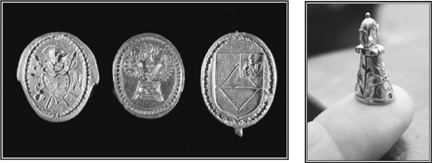
The arms of David Kirke, British conqueror of Quebec. In 2003 archaeologists in Newfoundland found three very small enameled gold seals. Charles I added a rectangle to them, with the arms of French Admiral de Rocquement, whose fleet Kirke captured in battle on the St. Lawrence River in 1628.
They found the French commandant in a towering rage. Champlain was under heavy strain. He furiously upbraided the young captain of the shallop, and told him he should have sailed downriver to find out who won the battle. The officer replied that he had no orders to do so. Champlain complained that the arrival of eleven men only increased the number of mouths to feed from their dwindling supply of peas. It was a rare moment when Champlain lost control of himself, and treated a junior officer with cruelty and injustice. But he recovered his self-discipline and wrote, “There was no remedy for it; I gave them the same ration as everyone else.”37
What followed was a year of agony for Champlain and the habitants of Quebec. Approximately seventy-three people had been living there in the winter of 1627–28. About fifty-six lived in the habitation, of whom eighteen were laborers. Another six lived at the Hébert-Couillard farm, three with the Récollets, and eight in the Jesuit compound at St. Charles. In the summer another six or eight had returned from the farm on Cap Tourmente, and eleven arrived in the shallop that so displeased Champlain. With various interpreters, traders, waifs, and strays, the population of Quebec was probably between ninety and a hundred souls in the winter of 1628–29.38
Champlain had little food for them. They still had a supply of dried peas and beans, enough for a ration of seven ounces a day, “and so we had to go through a very wretched time.” Even in the previous summer, Champlain wrote, “we were eating our peas very sparingly, which diminished our strength greatly, most of our men becoming feeble and sickly.”39 He put the entire colony on short rations and took the smallest share for himself. The opposite had been done in other starving colonies. At Virginia in its first terrible year, the leaders took the lion’s share, and most survived the winter. Colonists of lower rank at Jamestown received much less, and most of them died. In Quebec, Champlain wrote, the smallest share went to “those who were with me in the fort, we being the worst provided of all in every respect.”40
Champlain looked for other ways of stretching the rations by grinding peas into meal. He tried it first with wooden mortars, but it was slow work. He asked the artisans if they could make a millstone. They found suitable materials, shaped the stones, and set them up. “The necessity we were in,” Champlain wrote, “thus caused us to devise what in the previous twenty years had been considered impossible. The mill was finished with diligence, and each man brought his week’s allowance of peas … from which he got good peasemeal, which made our soup stronger, and did us much good, and put us again in a little better condition than before.”41
In the fall came the season of eel fishing, “which helped us considerably,” Champlain wrote. The French had still not mastered the art of eeling, which often was done in the dark, by two Indians in a canoe—one holding a torch to attract the eels, and the other spearing them with a long weapon much like a harpoon, or a whaler’s lance. The Montagnais were “skillful fishers” of eels, but they guarded the secrets of their fishing. Champlain wrote that they “gave us few and sold them very dear, our men giving their coats and other possessions for fish. We bought 1200 with goods from the storehouse, giving new beaver-skins in exchange … ten eels for one beaver…. These were distributed to all, but it did not amount to much.”42
When the season of winter hunting arrived, some of the Indians helped them, in particular the Montagnais captain Chomina, who supported his friend Champlain. Other Indians brought in “a few moose, although only a small number for so many persons.” Champlain sent out French hunters, who killed a very large moose but kept most of it themselves, “devouring it like ravenous wolves.” Champlain reproached them for their selfishness and did not let them go hunting again.43
In the cold months of 1628–29, the people of Quebec were growing weak with hunger. On top of everything else, the winter was long and hard. The habitants had to bear the heavy labor of cutting firewood and hauling it more than a mile. It made for “fatiguing work all the winter,” but they stayed warm through the coldest part of the year, and scurvy did not return.44
By the spring their meager supply of vegetables was almost depleted, and no word had reached the starving settlement from France. Champlain wrote of “children crying with hunger.” The habitants lacked bread, wine, salt, butter—and hope. They had dry provisions for only a month, and Champlain was deeply worried. “All this caused me great anxiety,” he wrote.45
They had to live by hunting and gathering. Champlain urged his companions to devote themselves to fishing. He wrote that “the others did their best to catch fish, but owing to the lack of nets, lines, and hooks, we could not do much.” He added, “Powder for hunting was so precious that I preferred to suffer rather than use what little we had, which was between thirty and forty pounds, and that of very poor quality.46 Our only recourse, though a miserable one, was to go in search of herbs and roots,” Champlain recalled. “While awaiting the harvest we went every day to look for roots for food, which was very fatiguing.” They searched the forest for anything that could sustain life. “We had to go six and seven leagues to get them at a cost of great trouble and patience, and without finding enough to live on.” Still, they harvested plants and roots such as solomon’s seal, clintonia borealis, and bulbs of wild lilies.47
Starvation proved a great stimulus to agriculture in Quebec. They had enough seeds to sow crops both at the Hébert farm and the Jesuit garden. By the spring of 1629, many fields were cultivated around the settlement. The Jesuits tilled their own fields, but Champlain wrote that they “had only enough cleared land in seed to support themselves and their servants, to the number of twelve.” Even so, they gave Indian corn and turnips to the habitants, and shared enough food to sustain the children in the settlement.48The Récollet fathers had more land in crops, and they were only four in number. Champlain wrote, “They promised us that if they had more from their four or five arpents of land sown with several sorts of grain, vegetables, roots and garden herbs, they would give us some.” There were several small Montagnais farms near the settlement. One of them was tilled by the Indian convert La Nasse, who had a cabin near the Jesuits, and he helped too.49
The Hébert-Couillard farm was also beginning to become productive. The widow Hébert and her son-in-law “had between six and seven acres sown,” mostly in “peas and other grains.” They produced enough to meet their own needs and supply a small surplus of seven barrels of peas and barley for the settlement. In the summer, they also contributed each week a small basin of barley, peas, and Indian corn, “about nine ounces and a half of weight, which was a very small quantity among so many persons.” It was mixed into a “potage of farina,” half peas, half barley, mixed with roots that they found in the woods, and flavored with forest herbs, “which helped a little.” Even on the edge of starvation, these French habitants gave some attention to gastronomy. The Héberts held back part of the produce to feed their family and Champlain looked the other way. He wrote, “I pretended not to see what was going on, though I was enduring considerable privation.”50
The French habitants had garden plots as well. Champlain was very active in promoting them, and it is interesting to see how he went about it. In this, as in other realms, he tried to encourage individual enterprise, and understood that confiscation and forced labor would be counterproductive. He encouraged people throughout the colony to raise crops for themselves, and asked them to contribute their surplus to others. In this period of adversity he was developing an agricultural base for Quebec, by an open method of mixed enterprise, which was more successful than the conscription and collective labor that prevailed in other colonies. It was also more effective than laissez-faire.51
In this desperate moment, the Indians supported the French in a very substantial way. Champlain had asked the Huron to take in twenty Frenchmen “so as to lighten our burden.” They agreed, and fed them through the winter and the spring of 1628–29.52 The Huron also gave Father Brébeuf fifty pounds of cornmeal for the colony. The Récollet fathers added two sacks of corn meal from the Huron, and Pont-Gravé traded for another.53 In midsummer, the Huron sent the Frenchmen back to Quebec. On July 17, 1629, Champlain wrote, “Our men from the Huron country came in twelve canoes.”54
There was no food for them in the settlement. Champlain turned to another Indian nation and sent them “to the settlement of the Abenaki to live on their Indian corn till spring.” He dispatched others to the Etchemin in the south, and a few to the nation he called the Canadien in Gaspésie. On June 15, Thierry Desdames took the shallop downriver to Gaspé, met Juan Chou, a captain of the Canadien Indians, who “did their best to welcome them” and promised that “in case our ships did not arrive, we would want nothing that their hunting could provide.” Chou also gave the French a barrel and a half of salt, and offered to take “twenty of our companions and distribute them among his own people to spend the winter, where they would be secure against hunger, at a cost of two beaver skins per person.” Champlain wrote that the Canadien strongly supported the French, and “had a great aversion to our enemies.”55
The Montagnais were divided. Their leader Choumina and his brother tried to help. Champlain wrote that Choumina “offered to go to the coast of the Etchemins where the English live, to barter for powder. Choumina also asked that a Frenchman who lived two day’s journey inland from that coast to be given to him [as a companion], which request was granted in order to try every possible expedient for holding our ground.” He started July 8, left the great river, and went some distance into the Etchemin country, but “found the water so low that they were obliged to return.”56
Champlain charged these French emissaries with another assignment. Even in deep adversity, he continued to gather knowledge about the new world. He could not leave the settlement with so many uncertainties and hardships there. Instead, he sent interpreters in many directions to gather information on the countryside, study the rivers and waterways, and get to know the “peoples and nations inhabiting those regions, and their modes of life.”57
While Champlain was struggling with these problems in the late spring of 1629, the English returned.58 The Kirke brothers, all five of them this time, arrived at Gaspé on June 15, 1629. Their attack in 1628 had whetted the appetites of British entrepreneurs. The wealth of the fur trade and fisheries was vastly attractive, and the small settlements of New France seemed ripe for the plucking. To that end, William Alexander and a group of Scottish investors had joined the Kirkes to form the Company of Adventurers to Canada, also called the English and Scottish Company. In February of 1629, Charles I gave them a monopoly of the fur trade in the St. Lawrence Valley and adjacent places. They also received a commission to destroy all French settlements.59
This time they were stronger than before. Two fleets came to North America. Alexander led one to Acadia; the other under David Kirke sailed to the St. Lawrence. They intercepted the small French vessel that Champlain had sent in search of aid. The Kirkes learned in detail about the condition of Quebec, and its shortage of food and ammunition. There could be no bluff this time.
On the morning of July 19, 1629, Champlain’s servant went out of the fort to gather a breakfast of roots and berries. At about ten o’clock he came running back and said that English vessels were behind Point Lévis, a league away from the settlement. Champlain mustered his men and “put in order the little we had to prevent a surprise at the fort and the habitation.” The Jesuits and Récollets “came as fast as they could on hearing the news.”
Champlain convened a council of “those I judged proper to advise as to what we should do in this extremity.” After a short discussion, “it was agreed that considering that we were powerless, without provisions, powder or matches, and destitute of help, it was impossible to hold out, and that we must therefore seek the most advantageous terms that we were able to get.”60
When the tide came in, the English crossed to Quebec and sent a boat with a white flag to seek a parley. Champlain hoisted a flag on the fort to let them know that they could approach. An English gentleman with impeccable manners came ashore and handed Champlain a letter from the Kirke brothers—Louis Kirke who had come to take command of the fort, and Captain Thomas Kirke, his brother and “vice admiral” on the river. Their letter was drafted with exquisite courtesy. It began by reminding Champlain of his correspondence the year before, and reported that David Kirke “has instructed us to assure you of his friendship, as we assure you of ours.” They added with an air of regret that they knew well the “extreme destitution in which you are with respect to everything.” The Kirkes invited Champlain to “place the fort and habitation in our hands,” and assured him of “the best treatment for yourself and your people, and also of as honorable and reasonable a settlement as you could desire.” There was no threat, no abuse, no expression of hostility or contempt.61
Champlain responded with the same courtesy. “Gentlemen,” he wrote, circumstances “have put it out of our power to prevent the carrying out of your design,” but he added “Your claims … will only be realized now on condition of your carrying into effect the offer you made to us, of terms which we will communicate very shortly.” In the meantime, he insisted that the English should not come ashore “until everything has been resolved between us, which will be for tomorrow.”62
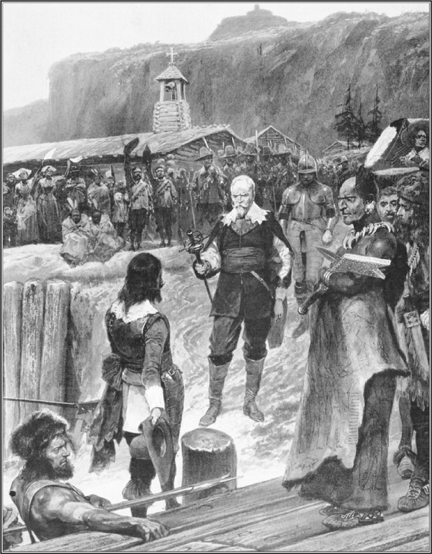
Champlain’s surrender of Quebec to Louis Kirke, July 19, 1629. In the foreground is a British mercenary with a boarding pike. An elderly but very fit Champlain is immaculate in black velvet, white lace, slashed sleeves, and a scarlet sash. The habitants salute their defiant leader, who promised to recover the colony.
Champlain did not wait for terms to be offered. He drafted them himself. First on his list was that Kirke should produce his commission as proof that their campaign was an act of legitimate warfare. He also asked that a ship be assigned to take all the people of Quebec (nearly a hundred persons) back to their country, including the Jesuits and Récollets, and two of the native Montagnais girls who “were given to me two years ago.” Third, he asked that the French “be allowed to leave with weapons and baggage and other articles of every kind, and that in exchange for furs a sufficiency of provisions be given to us; and no violence towards anyone.”63
The Kirkes granted most of Champlain’s demands. They promised to produce their Royal commission in Tadoussac, offered passage to England and then to France, and allowed the officers to keep their arms, clothes, and furs. Others were given their clothing and one beaver pelt; but the fathers were allowed only their “cassocks and their books.” Only one of Champlain’s requests was refused, but it was one that he cared deeply about. He was denied permission to take his adopted Indian children to France.64
Champlain and his officers discussed the terms and decided to accept them as “the best to be done in these extremities.” On July 20, the English sailed up to Quebec in three vessels, a flyboat and two pinnaces, with twenty-two guns and 150 men. Champlain went aboard the flyboat and talked with Louis Kirke about his Indian girls. Champlain made clear that his relationship with them was paternal and that the girls wanted very much to go to France. “I managed to dispel the doubts that Captain Louis [Kirke] had entertained on the subject, so that he granted me permission to take them away, at which the girls greatly rejoiced.”65
Then Louis Kirke came ashore with his men, and in Champlain’s words “acquitted himself of the duty like a man of character.” He insisted that Champlain should retain his quarters, and sent English guards to protect the chapel, the Jesuits, and the Récollets. Champlain requested that the fathers be allowed to say a mass, and Kirke agreed. Champlain asked for an inventory of all that was in the fort and the habitation, and Kirke agreed once again. The inventory survives and gives us a clue to the armament of Quebec, which made it a place of considerable strength, but with only forty pounds of powder, not enough to stand a siege. Kirke offered his provisions to the hungry people of Quebec.66
Four Frenchmen joined the Kirkes, and their conduct was very different. Le Baillif, a former clerk of the Company de Caëns who had been dismissed for bad conduct, turned his coat and joined the British. Champlain wrote that he was “without either faith or morals, though he calls himself a Catholic…. We had every kind of courtesy from the English, but from this wretch only injury.”67 Another turncoat was Pierre Raye, a wagon maker of Paris and “one of the most perfidious traitors and scoundrels of the lot.” And two interpreters, Étienne Brûlé and Nicolas Marsolet, also went to work for the British, much to Champlain’s fury.68
The next day Louis Kirke ordered his drummers to beat assembly for his men. He went to the fort and hoisted the flag of England. The scarlet cross of St. George on its white field caught the wind on the river and flew above the ramparts of Quebec. The English fired salutes from the ships in the river and from the ramparts about the town.69
Some of the French habitants did not want to leave Quebec. The Héberts and the Couillards, who had land, wished to stay in America, even under English rule. Champlain wrote: “Louis Kirke was courteous, and, although the son of a Scot who had married in Dieppe, he was French in disposition and always had a liking for the French nation. He wished as much as possible to help the French families and others from France to remain, liking their conversation and finding their manners “more agreeable than those of the English, to whom his nature seemed averse.”70
Kirke promised the French habitants that they could keep their land and houses and remain in them, and would be “as free to do so as they had been under the French.” He promised that they could trade with the Indians, and if they were not happy they could return to France.71 “They asked my advice,” Champlain wrote. He told them that he hoped that the French would resume possession “through the grace of God,” and advised them to stay for a year. They responded that they would do as he suggested. With that decision a strong French presence continued in Quebec, even as the English took control.72
Champlain was treated with courtesy by Louis Kirke, and he was allowed to live undisturbed in his quarters at the fort. But it was an agony for him to watch the English conquest of Canada.73 Finally he could bear it no longer, and he asked Louis Kirke: “Let me go down to [Tadoussac], and await there the departure of the vessels, passing my time with the General [David Kirke] who was there.” It was agreed. Champlain’s personal belongings were put aboard the English flyboat.74
In Tadoussac, Champlain found that the Kirkes were present in great strength, far beyond the resources that the French had been able to muster in America. In addition to the three small vessels that had come up the river to Quebec, the Kirkes had five large ships of 300 or 400 tons, “very well equipped with cannon, powder, balls and devices for throwing fire,” and about six hundred men.75
Thomas Kirke turned him over to David Kirke, who gave the French commander “a very kind reception.” They reviewed the surrender that had been negotiated in Quebec. There was trouble on only one point. To Champlain’s surprise he was again refused permission to take his Indian wards to France. One of them, Faith, had chosen to stay with her people in America and that had been arranged. The other two, Hope and Charity, wanted very much to visit France. But Nicolas Marsolet tried to stop them. He wanted to have the girls for himself and told David Kirke that the Montagnais people did not wish them to leave for France. Champlain and the girls themselves called Marsolet a liar.
It came to a head when the Kirkes invited the British captains, Champlain, Marsolet, and the girls all to dine at the same table. The girls were so unhappy that they refused to eat or drink. Hope attacked Marsolet, calling him a traitor, and accused him of trying to seduce her. She turned toward him and said, “If you come near me again, I shall plunge a knife into your breast, though I should die for it a moment after.” Charity joined in and said to Marsolet, “If I had your heart in my hands, I should eat it more readily and with greater spirit than I should eat any of the meats on that table.”
David Kirke did not know whom to believe, and was afraid of displeasing the Montagnais. He ordered the Indian girls to remain in America, despite their tears and pleading. They attacked Marsolet with the “courage of Amazons” and said that they would follow Champlain to France if they had to do it in a canoe. But David Kirke was adamant, and the girls were forbidden to go.76
In other respects Champlain was treated very well. He was careful never to aid his British captors in any way, or to recognize the legitimacy of their conquest. But in personal terms he and David Kirke got along. In one amazing scene, the captive and captor went hunting together. “We passed the time with the General hunting,” Champlain wrote, “game in that season being abundant and consisting principally of larks, plovers, curlews and sandpipers, of which more than twenty thousand were killed.” hey were shooting for the pot, to feed the many French captives and British seamen for whom they were responsible. But these two gentlemen of the old regime were also shooting for pleasure.77 After the hunt, they went fishing together with the Indians, “for salmon and trout which they brought us in very good quantity, and for smelts, which were caught in nets, and other fish, all very excellent.”78
In the course of their conversations, Champlain told the “general” of some news from France. “I informed him that Émery de Caën had assured me positively that peace had been made, having learned it from persons worthy of credit as he was leaving La Rochelle.” If true, the Kirkes’ conquest of Quebec was unlawful. David Kirke was contemptuous of this report. “Has he the articles?” he insisted.
“No,” Champlain replied.
“Then,” said Kirke, “it is only an idle rumor.”79 But Champlain had put David Kirke on notice. If these persistent reports of peace were true, the conquest of New France was an illegal act. It could not stand, and Champlain was determined to undo it.