
A persistent problem for students of Champlain is his date of birth. We have no formal record of his baptism and no firm evidence of his age at any moment in his life. He never told the reader how old he was in his writings, nor did anyone who knew him. In the early modern era, this was also the case for Columbus, Cabot, Verrazzano, and Cartier, to name but a few. These men were born before laws that required registration of vital events. Church records were often incomplete, lost or destroyed, especially in France during the wars of religion and the revolutions that followed. Champlain’s native town of Brouage changed hands in the strife between Protestants and Catholics during the sixteenth century; town records that survived the fighting were destroyed by an arsonist before 1690.
It is unlikely that a birth record will ever be found for Champlain. More probable is a chance discovery of some reference to his age in a primary source, but nothing of that sort has turned up to the date of this writing.1
In the absence of firm evidence, scholars have suggested three birth dates for Champlain. The first appeared in Pierre Damien Rainguet’s Biographie saintongeaise ou dictionnaire historique de tous les personnages (Saintes, 1851), which tells us that “ce navigateur célèbre naquit à Brouage d’une famille de pêcheurs, en 1567; this famous navigator was born at Brouage of a family of fishing folk, in 1567.” Rainguet himself was a public official, a notary, and a prolific writer who lived at Saint-Fort-sur-Gironde, approximately thirty miles south of Champlain’s birthplace. He devoted his life to the history of his region and knew its records and local lore. But scholars have found errors in his work, and he gave no source or citation. Another historian has written in frustration, “We have no means of knowing whether the editor had access to material since lost, or whether he was merely guessing.”2
In the 1860s, a very able French Canadian scholar and editor of Champlain’s works, the Abbé C.-H. Laverdière, tested the accuracy of Rainguet’s estimate by comparing it with two passages in Champlain’s writings. One was Champlain’s statement that he had been maréchal des logis for several years in the army of Brittany under the maréchal d’Aumont, who died in August, 1595. Laverdière wrote that this rank was “a post of confidence, given only to a person of some experience,” and he believed that Champlain would have had to be about twenty-five when he was appointed, perhaps in 1592. On that assumption, Laverdière calculated that Champlain must have been born around the year 1567.
Laverdière made a mistake in understanding Champlain to say that he had served several years under d’Aumont, who died in 1595. Champlain wrote that he had served several (quelques) years under d’Aumont, St. Luc, and also Brissac, who survived the war. It ended in 1598, when Champlain was still in service. One cannot subtract several years from d’Aumont’s death date, as Laverdière did, to reach a conclusion that Champlain was serving as an aide from as early as 1592. The earliest date that can be supported by the evidence is 1594. Therefore Laverdière’s inference of a birth date in 1567 may by its own assumptions be several years too early.3
Laverdière also made another test against a passage in which Champlain wrote of his colleague François Gravé, sieur du Pont (also called Pont-Gravé or Du Pont Gravé) in 1619, “son âge me le ferait respecter comme mon père; his age would lead me to respect him as my father.” Laverdière reckoned that Pont-Gravé must have been “at least ten or twelve years older” than Champlain, and he quoted Gabriel Sagard as saying that Pont-Gravé was about sixty-five years old in 1619, which yielded a birth date of 1554 or 1555. Assuming twelve years between the two men, Champlain would have been born about 1567. On the basis of that reasoning, Laverdière concluded that a birth date of 1567 would have been “not far from the truth.”4
Laverdière’s judgment was widely accepted in the nineteenth century. Champlain’s birth date was identified as 1567 on monuments in France and in Canada. Biographers, editors and reference works adopted it. Bishop spoke for many scholars when he wrote, “on the whole, 1567 seems about right.”5
Other scholars went a different way, and a second estimate emerged in the late nineteenth and early twentieth centuries. The Canadian biographer Narcisse-Eutrope Dionne wrote without explanation in 1891 that “l’immortel fondateur de Québecy vit le jour, vers l’année 1570; the immortal founder of Quebec was born there around the year 1570.” One of the most influential Canadian historians of the twentieth century agreed. Marcel Trudel wrote: “On calcule généralement qu’il est né vers 1570, sinon en 1567; the usual calculation is that he was born around 1570, if not in 1567.” Others began to adopt the judgment of “vers 1570.” As late as 1972, the American historian Samuel Eliot Morison accepted this conclusion, and wrote in his clipped Boston English that Champlain was born “about 1570, natal day unknown and year doubtful.” This estimate has been repeated in many other works.6
In 1978, yet another birth date was proposed by Jean Liebel, a French historian and biographer of Champlain’s associate Pierre Dugua, sieur de Mons. In the course of his research, Liebel discovered a new piece of evidence that was relevant to this question. In the records of the cathedral-church at Saint-Malo, he found the baptismal record of François Gravé du Pont, dated November 27, 1560, which made him a little younger than other scholars had believed. Sagard had guessed that Pont-Gravé had been baptized in 1559 or the year before; Laverdière reckoned that his date of birth was between 1555 and 1557. Liebel’s discovery shifted a benchmark that scholars had used to estimate Champlain’s age.
Liebel published an article, arguing that if Champlain respected Gravé du Pont “as a father,” there must have been “at least twenty years” between their ages, not twelve as Laverdière had reckoned. On the basis of that assumption and the new evidence of Pont Gravé’s baptismal date, he concluded that Champlain was born in 1580.7
There are several difficulties here. For one, Liebel’s discovery moved Gravé du Pont’s baptism by between one and six years, but he used it to move Champlain’s birth date by ten or thirteen years. For another, Liebel had an “axe to grind,” as a Yankee would say. He believed that the subject of his biography, Pierre Dugua, sieur de Mons, had received too little credit for the founding of Quebec, and Champlain had been given too much. Liebel took particular exception to the idea often engraved on monuments in Canada, that Champlain was “the founder of Quebec.” He insisted that the title properly belonged to his hero, de Mons, who gave Champlain the means, the men, the material and the provisions to construct the habitation at Quebec.8
In making his case Liebel wrote: “The word ‘founder’ that one sees in our own time, so often following his name implies a man not only rich and powerful, but also aged…. The grades, titles and qualities with which one had bestowed on Champlain after his death were totally excessive if one had no reason to suppose an age in proportion to them.” He concluded that in 1608, the year when Quebec was founded, Champlain was 28, not 38 or 41.9
Whatever Liebel’s purposes may have been, the validity of his historical argument is an empirical question, and the accuracy of his statements is a separate issue from his motives for making them. After Liebel’s article appeared in 1978, several French and Canadian scholars were quick to accept it. In a collection of essays on Champlain, published in 2004, most writers who discussed the subject of Champlain’s birth agreed with Liebel. Nathalie Fiquet wrote that “the theory that he was born around 1580 seems to best correspond to the image conveyed by his writings.” Other scholars agreed that the evidence “would make Champlain’s birthdate around 1580.”10 But is Liebel’s thesis consistent with the evidence? Let us look again at the sources. Although Champlain never mentioned his age or his date of birth, at least four sets of clues appear in his writings and other documents.
The first clue comes from Champlain’s army service records. This evidence appears not only in Champlain’s Brief Discours as Liebel asserts, but also in pay records of the army, which Robert Le Blant and René Baudry have found and published. In the year 1595, they tell us, Champlain received pay as a fourrier, a quartermaster officer, in the months of March and April. By the end of that year, he was identified as the “ayde du Sieur Hardy, marschal de logis de l’armee du roy; assistant to the sieur Hardy, marshall of lodgings in the king’s army.” The paymaster’s records show that he received extra money in 1595 for a “certain secret voyage in which he made an important service to the King.” He also had been present at the siege of Crozon in 1594, and distinguished himself in that bloody assault sufficiently to have been mentioned in the history of that battle. In 1597 he also appears in military records as “captaine d’une compagnie” of troops at Quimper, a garrison town in southern Brittany midway between Brest and Blavet, where he is also known to have served in those years.11
Moreover, throughout the period from 1595 to 1597, army records referred to him in all but one instance as the “Sieur de Champlain.” He was given a title of respect and a particule de noblesse. These distinctions did not necessarily imply nobility, but they were reserved for officers of rank, and gentlemen in positions of honor and trust.
To conclude that Champlain was born in 1580 is to assert that in the midst of a war he was given offices of trust and distinctions of honor at the age of fourteen or fifteen. It might have been so for members of the royal family, or princes of the blood, or sons of great noble families, but Champlain was not of that rank. And this was active duty in time of war. It is reasonable to think that he was older than fourteen or fifteen—perhaps in his early twenties, when he served in positions of high responsibility with the army of Brittany in 1595–97, such as a captain in command of a company. This would indicate a birth year around 1570, plus or minus several years.
A second set of clues appears in several statements that Champlain made about the years that he spent at sea. One of these passages appeared in a dedicatory letter to the queen regent in 1613. Writing of “the art of navigation,” Champlain declared, “It is this art which won my love at a very early age, and inspired me to venture nearly all my life on the turbulent waves of the ocean.”12 This passage becomes significant in relation to another preface to Champlain’s Traitté de la marine et du devoir d’un bon marinier in 1632. Champlain wrote of “having spent thirty-eight years of my life in making many sea voyages.”13
It is a simple statement, but what exactly did he mean? One could understand him in at least three ways. Perhaps Champlain meant to say that he had logged the equivalent of thirty-eight years of what the navy calls sea duty; but this is impossible. To survey his many voyages, as in Appendix B below, is to discover that for all his many voyages, the total time actually spent at sea did not come even close to thirty-eight years. Clearly, this was not what he had in mind.
Or he may have meant that he had been going to sea for a period of thirty-eight years from the date of his statement. That is the way Liebel read this passage, and he takes it to mean that Champlain began to go to sea in 1594, which would have made a total of thirty-eight years by 1632, when this passage was published. Liebel’s interpretation runs into several difficulties. First, Champlain told us that he had gone to sea at an earlier age. Second, it is not what Champlain actually wrote. He did not state that he had been going to sea for a period of thirty-eight years, but that he had spent or passed (passé) thirty-eight years in making sea voyages. The difference between these two statements becomes important when we remember that in the period from 1594 to 1632, Champlain spent many years ashore, sometimes two or three years at a time. When we construct a chronology of his voyages, we find that he was at sea in twenty-two years out of thirty-four between 1598 and 1632. To reach his total of thirty-eight years at sea he would have had to make voyages in at least sixteen years before 1597.
To reach a total of thirty-eight years, Liebel’s thesis that Champlain was born in 1580 would have required Champlain to have made sea voyages in sixteen of the seventeen years from 1580 to 1597, which is highly improbable. An inescapable conclusion is that Champlain began his sea voyages before 1580. If Champlain’s statements about his years at sea were correct, Liebel’s estimate of his birth date must be mistaken.
There is also another problem in Liebel’s thesis. Let us consider Champlain’s statement that he had been drawn to “the art of navigation” at a “very early age,” and had ventured, as he wrote, “nearly all of my life on the turbulent waves of the ocean.” From this statement it is reasonable to think that Champlain’s voyages did not begin in the year 1594 as Liebel argues, but much earlier when as a boy Champlain was sailing with his father, who was an experienced pilot and probably his teacher. Historians in Brouage believe that Champlain also spent some of his early years ashore, perhaps attending an academy in the town.
If Champlain had been born in 1570, he would have had to have been at sea in sixteen of his first twenty-seven years from 1570 to 1597, and this would have allowed him to have spent his infancy in his mother’s arms and some years in school. A birth date of 1570 fits this frame better than does a birth date of 1580. It is also consistent with the literal meaning of Champlain’s statement about his thirty-eight years of sea voyages and his interest in the art of navigation at a very early age. To study this evidence is to find that Liebel’s thesis requires us to believe that Champlain began his sea voyages at the age of one.
Then there is a third clue that was discussed by Laverdière in 1870 and became the basis of Liebel’s argument. This is Champlain’s statement that when he thought of Pont-Gravé he thought of him as a father because of his age.14 Most scholars accept Liebel’s discovery that Pont-Gravé was baptized on November 27, 1560, but there is a problem of interpretation here. How large an age-difference was necessary for Champlain to think of Pont-Gravé as a father? Liebel’s answer is at least twenty years. Laverdière believed that ten or twelve years could have done it.
In the United States Navy, during and after the Second World War, young seamen and midshipmen tended to think in paternal terms of chief petty officers or commissioned officers who were often much less than twenty years their senior. Officers in turn called enlisted men “son,” even when their ages were less than a decade apart. A published example appears in a memoir of John A. Williamson, a lieutenant aboard USS English, a destroyer escort that sank six Japanese submarines in twelve days. Halfway through that campaign, Williamson was on his way to the wardroom for that elixir of the old Navy, a cup of coffee, when a “young seaman” came up to him:
“Lieutenant Williamson,” he said, “can I have a word with you? … Are we really sinking those submarines, sir?”
“Yes, we really are,” said the lieutenant.
“Sir, how do you feel about killing all those men?”
Williamson recalled, “I had no good answer, but I didn’t let him know that.” Instead, he said, “Son, war is killing. The more of the enemy we kill, and the more of the enemy we can kill, and the more of his ships we can sink, the sooner it will be over…. We are in a war that we must win, for to lose it would be far worse.”
Later Williamson commented, “My young inquisitor seemed relieved. At least he thanked me. But somehow when I reached the wardroom, that cup of coffee didn’t taste as good as I thought it would.”
The “young seaman” in this story would probably have been no younger than seventeen, plus or minus a year. Lieutenant Williamson was twenty-five or twenty-six. They were nine years apart, and yet they spoke literally as if they were father and son.15
In short, Liebel is certainly correct about the age of Pont-Gravé. His discovery of the baptismal record is a useful contribution. But Laverdière was correct about the difference in age that might have sustained a feeling of paternal respect. Ten years could have done it, or even less depending on the circumstances. We have no hard evidence here to settle this question, which will always remain a matter of interpretation. Suffice to say that Champlain’s statement is consistent with the possibility that only ten years separated them.
We also have a fourth clue, which rules out the possibility of a birth date much earlier than 1570. In 1634 Champlain wrote to Richelieu, suggesting that he himself should lead a punitive expedition against the Iroquois. Bishop writes: “Make every allowance for a valiant old gentleman’s sense of well-being; he could still not be over seventy. That gives us 1564 as the earliest possible date.”16
In short we have four suggested birth dates for Champlain in the secondary literature. They yield the following age patterns through his life cycle:
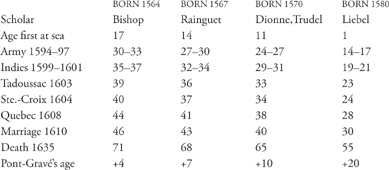
In my judgment, a date of birth around 1570 is most probable. The earliest recorded estimate of 1567 could also be correct. A birth date as early as 1564 is at the outer limit of possibility and highly improbable. A date of 1580 is beyond that limit and impossible. I conclude that Champlain was born around the year 1570, plus or minus several years.