
AQUILLIUS ordered Nicomedes IV to lead his army into Pontus, ravaging the countryside as they advanced. They were unaware that Mithradates could call on an overwhelming force, far beyond what the Romans could have anticipated. According to Appian, Mithradates commanded 250,000 soldiers and 50,000 cavalry (including all the reserves and commitments that Mithradates could count on from allies around the Black Sea and Armenia). According to Memnon, Mithradates had 190,000 infantry, 10,000 cavalry.1
Mithradates, in his mid-forties, had little combat experience. For this first crucial battle of his career, Appian says that Mithradates personally took charge of the troops massed at Sinope, placing Dorylaus at the head of the Greek phalanx. The fabulous wealth of Pontus was on display in the ranks of hoplites with beautifully wrought bronze helmets and breastplates, gilded spears, and shields flashing with jewels. There were bowmen, slingers, and peltasts (fighters armed with light swords and javelins), noble Persian-Cappadocian knights, and Scythian and Sarmatian archers mounted on tough steppe ponies adorned with golden trappings. His ally Tigranes had contributed 10,000 Armenian cavalry riding large Parthian steeds. Mithradates’ 300 warships and 100 pirate biremes displayed magnificent prows and luxurious decor. No expense was spared: the pageantry impressed his own soldiers and sailors as well as the populace, and it intimidated the enemy.2
As supreme commander, Mithradates took a strong hand in planning strategy. He found a vantage point from which to direct the action and dispatch more troops as needed. Among his experienced field generals were the brothers Archelaus (who had skirmished with Sulla) and Neoptolemus, who had helped subdue Scythia.
In a rare gesture of trust, Mithradates appointed his son Arcathius, a young man of twenty, to lead the prized Armenian cavalry. Hellenistic kings were usually loath to allow blood relatives to command forces that could be turned against them. Historians ask, Why would Mithradates, whose paranoia was notorious, give this important command to his son? I think the answer lies in Mithradates’ admiration for Alexander. Philip of Macedon had famously placed his eighteen-year-old son Alexander in charge of the cavalry at the important battle of Chaeronea in 338 BC. Alexander’s audacious maneuvers had turned out to be the key to Philip’s great victory. Now in 89 BC, while Mithradates assumed the commanding role of a Xerxes or Darius the master strategist, observing the battle from a high vantage point, he cast his son in the role of young Alexander.
At the Amnias River, Mithradates’ generals brought out only a small force, 40,000 light infantry and Arcathius’s 10,000 Armenian cavalry, greatly outnumbered by the Bithynian-Roman coalition.3 But hidden behind the ranks of men and horses, a deadly surprise awaited the invaders: Mithradates’ 130 war chariots equipped with whirling scythes.
Chariots, known to Greek traditionalists from the epic poems of Homer, had enjoyed renewed popularity after the Romans conquered Greece. But these days chariots were used only for racing or parades, not war. In the circus in Rome, fancy chariots were drawn by prancing show horses, even by ostriches and tigers. War chariots with rotating, sickle-shaped blades projecting from the axles were an archaic weapon of the distant past, perfected by Mithradates’ ancestor Cyrus the Great.
An aficionado of chariot warfare as well as of racing, Mithradates was aware that these Persian terror machines hadn’t dominated a battlefield since Alexander fought Darius III in the fourth century BC. Mithradates would have studied the battle at Gaugamela, in 331 BC, when Alexander defeated Darius. In that case, Alexander’s troops had been well prepared for Darius’s death machines. The Macedonians simply opened their lines to let the scythed chariots pass by and then attacked them from the rear.4
Alexander’s surprise tactic had essentially ended the era of chariot warfare. On this day in 89 BC, however—more than two hundred years later—Mithradates was counting on his contemporaries’ having forgotten Alexander’s evasive maneuver.
THE MITHRADATIC WARS BEGIN, 89 BC
As Nicomedes’ great army approached across the plain, Mithradates’ general Neoptolemus sent his men out to seize a rocky hill. The battle began. Bithynian skirmishers swarmed the hill, and Neoptolemus quickly advanced with more men, yelling for Arcathius to bring up his cavalry. Arcathius’s Armenian horsemen charged into Nicomedes’ phalanx, a risky decision that could have resulted in heavy casualties. The move seems to mimic young Alexander’s feat at Chaeronea. Was he attempting to replicate Alexander’s coup, using cavalry as a shock weapon to charge head-on instead of harassing the enemy’s flanks? The tactic worked: Arcathius’s cavalry charge bought more time for Neoptolemus’s phalanx to engage the startled enemy.
As Arcathius chased the enemy cavalry off the field, bloody fighting erupted behind him. Would Nicomedes’ superior numbers prevail? Neoptolemus’s men were falling back. Archelaus rushed to his brother’s rescue, leading a wedge of soldiers in from the right, forcing the Bithynians to turn and fight off the fresh troops. Cleverly, Archelaus yielded ground to them little by little, drawing the Bithynians away from his brother’s men, giving them the chance to rally.
Nicomedes’ Bithynian phalanx was now bunched up, the men standing back-to-back, straining to defend themselves on two fronts of the brother-generals’ assaults. Peering through the dust swirling over the fight, Craterus, Mithradates’ chariot master, grinned. The beleaguered phalanx presented his ideal target. Receiving the gleeful signal from his commander in chief, Craterus unleashed his chariots. The drivers whipped their powerful horses into a full-speed gallop. Suddenly 130 war chariots surged out and bore down like guided missiles on Nicomedes’ men. The vicious blades, spinning at a velocity three times the speed of the wheels, churned through the densely packed enemy. The shock was overwhelming, the carnage terrible.
At the time of this battle, the natural philosopher Lucretius (100–55 BC) was a boy in Italy. Lucretius later wrote a hair-raising description of a scythed chariot attack. His introductory phrase, “They say,” suggests that this scene was based on the memories of survivors or witnesses.5
They say the scythed chariots, ravenous for slaughter, sheared off limbs so suddenly that legs and arms fell writhing on the ground before a man even felt any pain. In the ardor of battle, one soldier continued to fight, not realizing that his left arm and shield had been carried off in the wheel. Meanwhile his companion attempted to rise on one leg, while his other lay twitching its toes in a pool of blood.
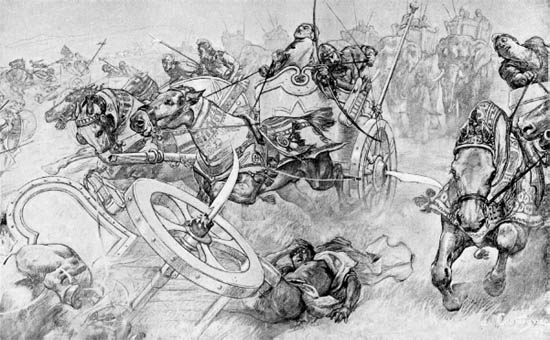
FIG. 7.1. Scythed chariot attack. Andre Castaigne, 1899.
Nicomedes’ soldiers, wrote Appian, were “aghast to see their mangled comrades sliced in two and still breathing, hanging on the scythes. . . . Overcome by the hideousness of the slaughter, the ranks scattered in confusion.” Nicomedes narrowly escaped: he and his Roman entourage fled to Aquillius’s camp on the border, the same direction taken by his cavalry. Abandoned by their king, some of Nicomedes’ soldiers still fought valiantly, wading through the bodies of dismembered comrades. But they were soon surrounded and overcome.6
Half of Nicomedes’ forces were dead. The survivors surrendered that night. Mithradates’ jubilant army overran the abandoned camp and captured the entire train of supplies. The Pontic generals were delighted to discover that the terror-stricken Nicomedes had left behind his war chest, filled with silver and gold—treasure drained, as they knew, from Anatolia. Thousands of prisoners were marched to Sinope.
Mithradates came out to receive the prisoners. Glowing with victory, the king addressed them. One can imagine Mithradates boasting that a modest number of righteous soldiers fighting on the side of Truth and Light, and led by superior Greek generals, had overcome a much larger invading army. He could point out that most of his vast troops had not even engaged in the fight. The losers may have fought courageously, but they had been misled by the forces of Darkness. Gesturing at the wagons of abandoned supplies he’d captured from Nicomedes, Mithradates made a surprising announcement. All the captives were free to go. His men divided up the supplies, handing out Nicomedes’ provisions, food, clothing, and coins to each enemy soldier for his journey home.
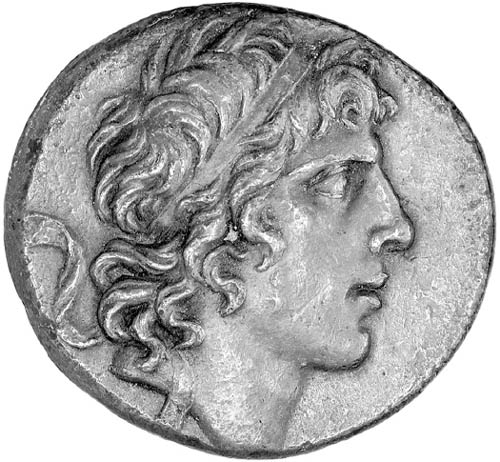
FIG. 7.2. Mithridates VI Eupator, silver tetradrachm, Ephesus mint, 88/87 BC. The reverse shows Pegasus and the Pontic star and crescent. 1967.152.392, bequest of A. M. Newell, courtesy of the American Numismatic Society.
This benevolent act, and others like it, broadcast by word of mouth, gave Mithradates a reputation for clemency toward his enemies. Philanthropia, mercy toward captured foes, was a Greek ideal embraced by Hellenistic monarchs. Like them, Mithradates admired Alexander’s reputation for being as “gentle after victory as he is terrible in battle.”7 Is this when Mithradates began referring to himself as Eupator, the “Good Father”?
Many survivors of the disastrous Roman-Bithynian invasion of Pontus were mercenaries and draftees from Galatia and Phrygia. With no incentive to return to Bithynia or help the losers Nicomedes and Aquillius, they joined the Pontic army. Bithynia and Paphlagonia fell to Mithradates’ control. News of his spectacular victory and his magnanimous freeing of prisoners of war spread over the land, convincing many cities to take up his cause, eager to welcome Mithradates “as god and savior.” Ancient writers tell how the populace of many Anatolian cities dressed in white garments and flocked to greet Mithradates, requesting his help against the Romans and acclaiming him with divine titles.8
MEANWHILE IN THE ROMAN CAMPS
Nicomedes had scurried away to Aquillius’s encampment, where he had to explain to his masters how he lost so many men, all his supplies, and his war chest. Appian says that Aquillius and the Roman generals were horrified by the fiasco. Too late they realized that they had heedlessly “kindled a great strife without good judgment.” But even more alarming, they had lost a war they had begun without any public decree from the People of Rome. They were now nothing but rogue enemy combatants trapped in hostile territory, with no backing from the Senate.
An exultant Mithradates rode out from Sinope on his finest horse, with an advance guard of 100 Sarmatians. The party ascended Mount Scoroba in the Olgassy Mountains. From these lofty peaks rising above dense pine forests they could look down toward Aquillius’s vulnerable camp. There were numerous native sanctuaries in these mountains: it is likely that Mithradates performed a sacred fire ceremony here to thank the gods Ahuramazda, Mithra, and Zeus the Warrior for his great victory.
On the ascent of Mount Scoroba, Mithradates’ 100 Sarmatians surprised 800 of Nicomedes’ cavalrymen trying to reach Aquillius’s camp. Even though they outnumbered the Sarmatian horseman 8 to 1, the Bithynians fled in terror from the nomads. The Sarmatians captured most of them and brought them to Mithradates. The king gave these men supplies and released them. Like their compatriots, they, too, joined the Pontic cavalry.
Down in Aquillius’s camp, Nicomedes had a frightening premonition. In the middle of the night, he fled again, to the camp of Cassius. Aquillius, in fear of Mithradates’ rapid advance, ordered his 40,000 soldiers and 4,000 cavalry to retreat. He hoped to reach the stronghold of Protopachion (eastern Bithynia). But Mithradates’ army, led by Neoptolemus and Nemanes (an Armenian commander sent by Tigranes) overtook him that same day. This battle went very badly for Aquillius: nearly 10,000 of his men lay dead on the field. Neoptolemus captured Aquillius’s camp and brought 300 prisoners to Mithradates. Following his well-established practice of philanthropia, he treated them kindly and set them free. The 300 joined the good fight.9
But Aquillius had escaped, taking plenty of money with him. He reached the banks of the Sangarius and crossed the dark, swirling river by night. Then he headed southwest toward Pergamon, where he had once been the administrator of Rome’s Asian Province.
Meanwhile, Cassius and Nicomedes retreated southwest to a stronghold called the Lion’s Head, near Nysa on the Maeander River, east of Tralles. These sophisticated, wealthy towns had supported Aristonicus’s Sun Citizens’ revolt in 133–129 BC. But a pro-Roman citizen of Nysa named Chaeremon supplied Cassius’s men with 60,000 bushels of grain at the Lion’s Head. Archaeologists have discovered an inscription at Nysa from Cassius thanking Chaeremon for his support.10
Originally Cassius had about 40,000 men, but most of them had peeled off to join Mithradates. Panicked by Mithradates’ relentless approach, Cassius tried to levy raw recruits from the countryside. His centurions drafted a mob of farmers, shopkeepers, “artisans, and rustics.” These people were hostile to the Romans and sympathetic to Mithradates. Appian says that Cassius attempted to train these “unwarlike men” but had to give up in frustration. Cassius moved farther east to Apamea, a prosperous trading center. A long-established Jewish community, this town also sided with Mithradates. A severe earthquake struck Apamea just as Cassius arrived. Forced to flee again, Cassius now gave up any idea of fighting and simply hoped to reach Rhodes, the independent island allied with Rome.
Mithradates and his army soon arrived in Apamea, hot on Cassius’s trail. After viewing the earthquake damage, Mithradates donated one hundred talents to repair the buildings. He was well aware that Alexander had once been very generous in repairing quake-damaged Apamea.11
SWEEPING VICTORIES IN ANATOLIA
As he took control of his new domains, Mithradates named governors to administer the territories. His administrative style was practical and flexible. Some lands (Colchis, the Bosporus) were designated vice-kingdoms; others he considered vassal-kingdoms (for example, Cappadocia under his son Ariathes and possibly even Armenia under Tigranes). Still other areas were administered by military leaders or governors. In a striking move, harking back to his Persian origins, Mithradates revived the ancient Persian title for his governors in Greater Phrygia: he called them satraps.
With Mithradates closing in, the Roman sympathizer Chaeremon of Nysa had to run for his life. With his sons, Chaeremon fled to Tralles, making for Ephesus. They were joined by many other fugitives. Mithradates’ victories were sweeping all before him. There was an exodus of inland Roman settlers moving toward the large coastal cities, where they sought refuge among the larger Italian populations, hoping to escape to Italy or safe islands. The road to Tralles, winding across deep gorges and stinking, yellow-orange streams, was lined with tombs. The fugitives passed through an ominous landscape of caves sacred to Pluto, god of the Underworld. The caverns emitted clouds of sulphurous gases, deadly to birds and animals, avoided by all except the strange eunuch priests of Cybele.12
Mithradates, arriving in Nysa, was enraged to find Cassius’s monument in the city square thanking Chaeremon for his aid. Spies informed Mithradates that the traitor had fled with streams of Romans and sympathizers toward the coast. Two remarkable inscriptions, urgent public proclamations from Mithradates to his satrap in Nysa, were discovered in the late 1800s. These ancient “Wanted Dead or Alive” posters, disseminated throughout the land, contain crucial information about Mithradates’ plans, his intelligence operations, political rhetoric, and administrative style—and his vengeful compulsion to destroy all Romans and their local supporters.13
The first letter reads:
King Mithradates to the Satrap Leonippus, Greeting
Whereas Chaeremon, a man most hateful and most hostile to our state, has always consorted with our most detested enemies, and now—learning of my approach—has removed his sons Pythodorus and Pythion to a place of safety and has himself fled, Proclaim that if anyone captures Chaeremon or Pythodorus or Pythion alive, he will receive 40 talents, and if anyone brings me the head of any of these three, he will receive 20 talents.
Mithradates soon received an update from his spies. Now he knew that Chaeremon had reached Ephesus and had sent his sons with Cassius on to Rhodes. The king dictated another public decree to his satrap:
Chaeremon has arranged the escape of the fugitive Romans with his sons to Rhodes. Now—learning of my approach—he has taken refuge in the Temple of Artemis in Ephesus. From there, he continues to communicate with the Romans, the common enemy of mankind. His confidence in the face of the crimes he has committed could be the starting point of a movement against us. Consider how you may by any means bring Chaeremon to us, or how he may be arrested and imprisoned until I am free of the enemy.
Clearly, Mithradates saw Chaeremon and other Roman collaborators in Anatolia as a threat as dangerous as the Romans themselves. They must not be allowed to survive and connive with Romans to create a resistance movement. The counterinsurgents had to be rooted out with the help of the Anatolian populace. Mithradates’ phrase, “Romans, the common enemy of mankind,” stands out as a powerful play on words. According to the Romans’ own, widely known propaganda, Rome called itself the “common benefactor (or savior) of mankind.” Mithradates’ clever rewording twists Rome’s self-image into a parody that resonated with anti-Romans throughout the land.14
Mithradates’ agents were also searching for Aquillius and Nicomedes. Nicomedes was hurrying toward Pergamon, hoping to catch up with Aquillius. But Aquillius was already heading for Rhodes, desperate to meet up with Cassius and escape to Rome.
What about Oppius, the third Roman general in this unauthorized war? Oppius had camped in Cappadocia with forty thousand men, most of whom deserted after the defeat of Nicomedes. Oppius now made his way with the remnant to Laodicea on the Lycus River and appealed to the prosperous city of Aphrodisias for reinforcements. In 1982, archaeologists found two inscriptions showing that Oppius received that aid. Meanwhile, Mithradates led his triumphant armies across Phrygia, demolishing Rome’s hold on Provincia Asia.15
When Mithradates routed the Roman coalition, he received an exuberant welcome in Bithynia, Galatia, Cappadocia, and Phrygia. On the march, he confiscated great quantities of gold and silver, which had been amassed by former kings, and he took possession of a great deal of military equipment. The location of these treasures must have been surveyed during Mithradates’ early reign. Directing his generals to secure southwestern Asia Minor, Mithradates himself led the advance through Phrygia, his ranks swelling with followers as town after town pledged allegiance to the savior-king. He was being hailed as a liberator in the very land where Aristonicus had based his Sun Citizens’ revolt of 133–129 BC. Ever mindful of auspicious events, Mithradates went out of his way to pitch his tent near the old inn once occupied by Alexander the Great, a place he’d visited on his fact-finding mission.16 That early reconnaissance was paying off a thousandfold now.
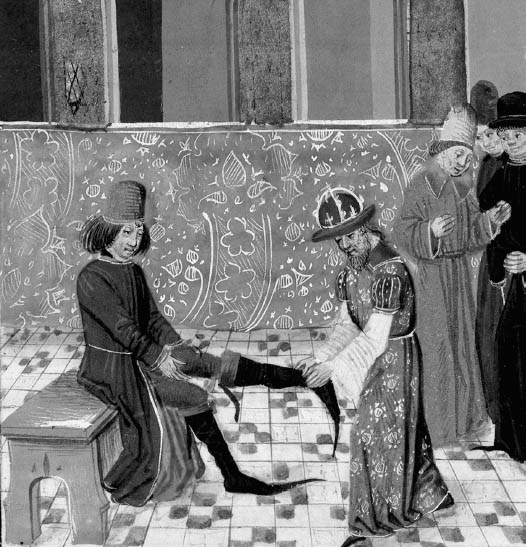
FIG. 7.3. Captive Roman general (right) forced to serve Mithradates (left). Faits et dits memorables, Français 289, folio 482, Bibliothèque National de France.
Because it was occupied by Oppius and his men, Laodicea on the Lycus—famed for black sheep—was the first place to resist Mithradates. Mithradates surrounded the town and sent a messenger. “Laodiceans,” proclaimed the herald, “King Mithradates promises that none of you will be harmed if you turn over the Roman general Oppius!”
The Laodiceans allowed Oppius’s soldiers to depart; many joined Mithradates. Then, as a mocking crowd gathered, the Laodiceans prodded Oppius’s lictors (color guard), wearing red tunics and carrying his legion standards, out the city gate, and then Oppius himself. Oppius would spend the next few years as a kind of pet captive in Mithradates’ retinue. The king never harmed Oppius but enjoyed exhibiting the tame Roman general as his personal servant in each city he visited.17
NEW WORLD ORDER
Aphrodisias joined Mithradates’ cause. An inscription describes how the city had previously sent envoys to Rome to plead for relief from corrupt tax farmers before the Senate on behalf of all the Greek cities in Asia Minor.18 Some pockets of resistance still remained, especially in Lycia, allied with Rhodes: Patara, Telmessus, Apollonis, Termessus, Stratonicea, Magnesia on the Maeander, and Tabae were still holding out. Mithradates sent troops to beseige them, commanded by Pelopidas, the ambassador who had confronted Aquillius and the Roman generals in their camp before the war. Other cities—Tralles, Pergamon, Adramyttion, Caunus, Cnidus, Mytilene, Miletus, Erythrae, Smyrna, Iasus, Ceramus, Magnesia near Sipylus, Arycanda, Ephesus, and the islands of Cos, Lesbos, Samos, and Chios—all willingly went over to Mithradates. Rhodes was the only hope now for Cassius and Aquillius.
When the news of Mithradates’ great victories reached the Roman fleet blocking the entrance to the Black Sea, the Greek sailors began shouting with joy. They took over the ships for Mithradates, who now controlled the entire Black Sea as well as the Aegean. Mithradates established his new headquarters in the magnificent palace of King Attalus III on the fortified acropolis of Pergamon, former capital of Rome’s Asian Province. In the palace, anything that remained of Attalus’s old botanical gardens and toxicological notes and specimens would have intrigued Mithradates and his medical team. The king bestowed the name of his childhood companion Dorylaus on a city in Phrygia, Dorylaion. Mithradates began minting beautiful silver tetradrachms with his portrait in Pergamon, and the city of Smyrna also stamped bronze coins with his likeness. Other cities, including Ephesus, Miletus, Tralles, and Erythrae, issued new gold staters to trumpet their independence from Rome.19
Hearing of his victory, the desperate Italian rebels, fighting for their lives in Italy, sent envoys to Mithradates. The leader of the Marsi, Silo, begged Mithradates to join forces. In response to the requests to send an army to Italy to help overthrow the Romans, Mithradates “promised that he would lead his armies to Italy after he had brought Asia under his sway.” Archaeologists have discovered special-issue gold and silver coins with images of Dionysus (god of liberation) and Mithradatic devices commemorating the communications between Mithradates and the insurgents in Italy from this time.20
Mithradates’ first acts as the savior of Anatolia were social reforms aimed at redressing complaints against the Romans and their supporters. In what the historian Luis Ballesteros Pastor calls the “Mithridatic Revolution,” Mithradates relieved public and private debts, canceling loans owed to Roman and Italian creditors, winning support from the middle and lower classes. Mithradates also granted everyone exemptions from taxes for five years, which pleased the wealthy. These radical acts underline Mithradates’ own great wealth, now enhanced by the treasuries he had recently confiscated. But one could also say that Mithradates’ new order championed a hybrid sort of government, a benign Persian-influenced monarchy enlightened by Greek democratic traditions, offering a real alternative to Rome’s oppressive administration of its provinces during the late Republic. The oligarchies controlled by the Roman consuls were broken up in Anatolia, and in the next year Mithradates would order his cities to grant broad citizenship and civic rights.21
Thinking ahead, Mithradates must have been contemplating his options for dealing with the large numbers of Roman residents that still remained in Anatolia. He could not risk the emergence of a Roman resistance movement abetted by local sympathizers like Chaeremon. If he could take over the Aegean and Greece, Rome would be forced to withdraw from the eastern Mediterranean. The Adriatic Sea would become the new boundary between East and West, between Mithradates’ dominions and Rome’s. If the fighting continued, mainland Greece was the traditional battlefield for struggles pitting Eastern against Western powers. Mithradates sent envoys to Athens to broadcast the good news and to let them know he planned to liberate Greece.22
It may have been at this time that Mithradates bestowed gifts of his magnificent armor to the cities of Nemea and Delphi in Greece. According to ancient writers, a sense of Mithradates’ extraordinary size could be gauged from his helmets, breastplates, greaves, and weapons. The armor, which glittered with precious metals and gems, was impressively large—probably deliberately oversized. Mithradates may have admired the enormous armor of the mythic heroes of the Trojan War displayed at Troy, and he certainly knew the famous story of Alexander’s psychological warfare tricks in India. Alexander ordered his blacksmiths to forge several pieces of huge armor and weapons, which he left along with gigantic horse equipment at his camp, in order to frighten the Indian armies into submission.23
Historians ancient and modern have marveled at Mithradates’ extraordinary success in the First Mithradatic War. In less than a year he had gone from a minor king of a rich little realm on the Black Sea to one of the most powerful rulers in the ancient world. In 89 BC, Mithradates gave a public speech recounting his spectacular victories, castigating the Romans, and exhorting his followers to continue the fight. Pelopidas, Xenocles, Metrodorus the Roman Hater, and other philosopher-statesmen probably helped prepare Mithradates’ text. Dressed in his finest Persian robe and trousers, wearing rings of agate (thought to make one’s speech convincing), Mithradates would have delivered this oration in the great Theater of Pergamon. Outdoor amphitheaters were often used for political gatherings; Pergamon’s held ten thousand people.
The speech has been preserved by ancient historians. Probably many different versions of this crucial oral presentation—essentially a policy statement and declaration of war—circulated orally and in writing among Mithradates’ enemies as well as his followers. Mithradates, maestro of public relations, would certainly have distributed copies to his allies. In a departure from his usual brevity, the historian Justin stated, “I consider this speech worthy of including in entirety in my abridged version of Trogus’s history, just as it was originally written.” Justin sought out a full copy of the speech that he considered original and verbatim. Modern historians have pointed out what they see as exaggerations and distortions for propaganda and rhetorical effects, but these might also confirm that Justin’s version reflects parts of Mithradates’ actual speech. There are some obvious signs of later additions by hostile writers: for example, it seems unlikely that Mithradates would publicly brag that he had murdered Socrates the Good of Bithynia and his nephew King Ariathes of Cappadocia.
Whether or not the version Justin published is the word-for-word speech delivered by Mithradates that day in Pergamon, it is an accurate summary of Mithradates’ program, his foreign policy, and his rationale for war with Rome. It offers the best insights we can have into Mithradates’ vision of himself as the inheritor and unifier of Greek and Persian cultures—the ideal alternative to Rome—and it explains his compelling appeal to so many diverse groups outside Rome.24
DECLARATION OF WAR
Mithradates’ speech is quite long. Here is the essential substance, combining paraphrase with direct quotations from Justin’s version.
It would have been desirable [began Mithradates] to have had the opportunity to decide whether to be at war or at peace with the Romans. But even the weakest person must defend himself and retaliate when attacked. Now it is obvious the Romans were not simply hostile. They have begun a great war and now they must pay the consequences.
I am confident of victory. You know as well as I do that the Romans can be beaten. We have already defeated Aquillius and Nicomedes and driven the Romans out of Cappadocia. The Romans are not invincible: The Samnites of Italy have defeated Roman armies. King Pyrrhus of Epirus won three battles against them. Hannibal was victorious in Italy for more than sixteen years—and it was not Roman military strength that defeated Hannibal in the end, but the bitter rivalries of his own people.
The Romans have enemies everywhere. In Anatolia, the Romans have hammered deep hatred into our peoples, by their corrupt government, rapacious tax-collecting, and public auctions of our property. Ever since Rome was founded, the native Italians have carried on perpetual wars with Rome, fighting for independence. The Gauls—famed for their spirit and valor—invaded Italy and took over many Roman cities. The Romans are terrified of the Gauls and pay them ransom, but we can count the Gauls as our friends. Italy is being overrun by many thousands of these courageous peoples. Right now the Teutones and Cimbri are assailing Rome like a whirlwind!
Mithradates’ intelligence sources were formidable; his spies and friends in Italy and the provinces kept him very well informed. In the next portion of the speech he revealed what he had learned about Rome’s struggles with Italian tribes and the impending civil war.25
At this very moment, all of Italy has risen up in war, following the lead of the Marsi and the Samnites. These peoples are demanding not just independence, but also a share in the government and the rights of citizenship. At the same time, Rome is also torn by internal strife among its leading men. This conflict is just as bloody as the war with the Italians, and much more dangerous for Rome’s survival.
Even if the Romans could pursue individual wars against each of these enemies, this collective assault will overwhelm them. How [asked Mithradates] can they imagine they could have their hands free for a war with us? We must fight the Romans sooner or later. Let us seize this chance and swiftly build up our strength. The Romans have their hands full of trouble—now is the time!
Here Mithradates set out his grievances against Rome.
The Romans started a war against me when I was just a child, from the moment they took away Greater Phrygia, which they had granted to my father. This land already belonged to my great-grandfather Mithradates II, who received it as dowry when he married the sister of Seleucus II. Ordering me to leave Paphlagonia was another act of war! My father had inherited Paphlagonia peacefully.
I complied with all these harsh Roman decrees. I relinquished Phrygia and Paphlagonia. I removed my son from Cappadocia, even though I had won it fairly and the Cappadocians requested my friend Gordius as their king. I even killed Socrates the Good when the Senate wanted to take over Bithynia. But did any of this mollify the Romans? No. They became more oppressive every day.
The Romans sent Nicomedes of Bithynia—the son of a vulgar dancing girl!—to attack Pontus. When I tried to defend my kingdom, they made war on me.
But I’m not the only victim of the Romans, continued Mithradates.
The Romans hate the power and majesty of great kings of great lands. They cheated my grandfather, King Pharnaces I, who should have inherited Pergamon. They even mistreat their allies. After King Eumenes II of Pergamon helped the Romans crush King Antiochus the Great, the Gauls, and the Macedonians, the Romans declared Eumenes an enemy and destroyed his son, Aristonicus. No one rendered the Romans greater service than the African King Masinissa of Numidia, who helped Rome defeat Hannibal. Yet they turned on his grandson Jugurtha, and viciously paraded him as a slave in chains before throwing him in prison to die.
Why do the Romans hate great and good kings? Is it because their own history is filled with a string of shameful kings? Lowly Latin sheepherders, Sabine soothsayers, exiles from Corinth, slaves from Etruria—these were the Roman royalty.
The Romans are so proud of their founders, Romulus and Remus. By the Romans’ own account, their founders were suckled at a she-wolf’s teats! That explains why the entire Roman population has the temperament of wolves! Like wolves, the Romans have an insatiable thirst for blood and a ravenous hunger for power and riches.
My pedigree is superior to that motley Roman rabble, boasted Mithradates.
My family can be traced back on my father’s side to Cyrus and Darius, the founders of the Persian Empire. On my mother’s side, I am related to Alexander the Great and Seleucus Nicator, founders of the Macedonian Empire. Moreover, not one of the peoples in my new kingdom has ever fallen under foreign domination or been ruled by foreign kings. Even Alexander the Great never ruled Pontus, Cappadocia, Paphlagonia, Bithynia, or Armenia—not to mention Scythia!
Before me, only two other kings, Darius and Philip, had ventured to even enter Scythia, much less subdue it. Any campaign beyond the Black Sea means extreme hardship and great risk. Not only are the nomads fierce and courageous, but they have no towns or property and their land is protected by desert wastes and freezing mountains. Those great kings barely escaped alive from Scythia! When I went to Scythia, I was just a raw novice at war. Yet now, I draw most of my strength against the Romans from my allies in Scythia!
Our war against the Romans on our own land is entirely different. Our climate is mild. No soil is more fertile than ours, no land has as many important cities. If we take courage and pursue this war, I promise you we’ll spend more time celebrating than fighting, more time counting our riches, than going on campaign. Think of the wealth of Phrygia, Lydia, Ionia! We don’t even have to storm these lands; all we have to do is occupy them!
I’ve already recovered all of Pontus, Cappadocia, Paphlagonia, and the Bosporus, my rightful dominions. I’m the only man in the world to have subdued fierce Colchis and Scythia. My soldiers and my enemies can testify to my fairness and generosity.
All Asia has been awaiting me, declared Mithradates. Just imagine what a great army we can achieve if you follow me to glory!
After arousing the fervor of his followers by word and deed, Mithradates, savior-king of Asia, plunged into the thick of his lifelong struggle against Rome. The primary objectives now were to consolidate his power in southern Anatolia, demonstrate naval supremacy in the Aegean, expel the Romans from the East, and liberate Greece. If the Senate chose to send either Sulla or Marius to oppose him, he wanted to have the best advantage. It would be better to defeat the Romans later, in Greece, than to have to fight them in the lands he now occupied. So, with the Anatolian coast and the entrance to the Aegean in his control, Mithradates called on pirate fleets and other allied ships to join the Pontic armada sailing out from the Black Sea to the Aegean to take Rhodes. That island was also the destination of Aquillius and Cassius.
LOOT AND LOVE
Mithradates continued to march across southern Anatolia, accompanied by a retinue of speechwriters, eunuchs, doctors, bodyguards, and troops. The citizens of Ephesus celebrated Mithradates’ arrival by toppling statues erected by the Romans in their city. Mithradates sailed over to the island of Cos where he was received with jubilation. The people of Cos turned over a vast hoard of money and treasures that had been placed in the Temple of Asclepius for safekeeping by the queen-regent of Egypt, Cleopatra III (wife of Ptolemy VIII, descendant of the best friend of Alexander the Great). One of the treasures was her grandson, the young son of the reigning ruler, Alexander, in Egypt. Malleable royal heirs could come in handy: Mithradates took the boy into his court and raised him with his other sons.
Cleopatra’s treasure included splendid works of art, statuary, paintings, vases, faience, gems, jewelry, royal costumes, and coffers of gold and silver coins. This caravan of valuables was sent under heavy guard to Pontus. One very special item, stored in a cedar chest and carefully labeled, was the vintage cloak of faded purple that had adorned the shoulders of the great Alexander. Mithradates’ possession of this priceless heirloom reassured the king and his followers that he was the true inheritor of Alexander’s legacy, the one who could liberate Greece from the Roman yoke.
Mithradates also carried away a large hoard of money, eight hundred talents, from Cos. According to the Jewish historian Josephus, the money was intended for the Temple in Jerusalem, deposited on Cos by Jews of Anatolia for safekeeping.26
Next, Mithradates took Stratonicea, where Macedonian and indigenous traditions mingled: the city had supported Aristonicus’s revolt. It was in Stratonicea (according to Appian, or perhaps in Miletus, as Plutarch wrote), that a self-possessed young Macedonian woman caught Mithradates’ eye. The daughter of Philopoemen, a prominent citizen, Monime was a beauty “much talked about among the Greeks.” Plutarch recounted the fascinating story of her courtship. The fate of Mithradates’ first wife, his sister Laodice, was common knowledge, and so was the king’s resistance to making any woman his official queen after Laodice’s treachery. Mithradates was strongly drawn to Monime. Thinking he would make her the jewel of his harem, he began negotiations with her father.
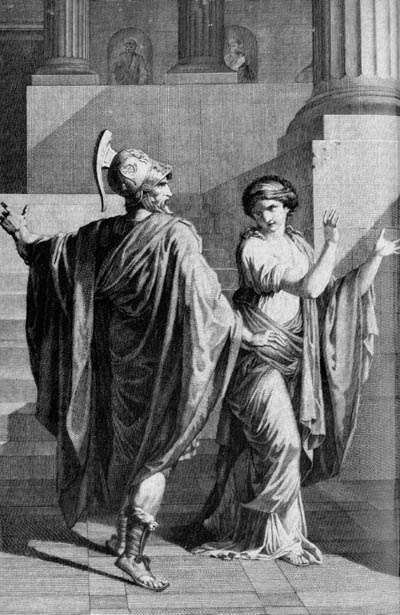
FIG. 7.4. Mithradates and Monime, who negotiated for the title of queen. Illustration for Racine’s play Mithridate, artist unknown.
But Monime herself rejected Mithradates’ offer of fifteen hundred gold pieces. She held out for more. Monime demanded a marriage contract and insisted that Mithradates give her the royal diadem and title of queen. Mithradates found Monime irresistible. Raised among strong, willful women, and as a gambler extraordinaire, Mithradates was attracted to powerful personalities whose intelligence complemented his own. For the past dozen years, the king’s only female companionship had been casual trysts in his harem. As Monime knew, victory is an aphrodisiac. Mithradates, reveling in his great good fortune and feeling expansive, agreed to her conditions. The royal scribes prepared the marriage contract, and the gold was turned over to Philopoemen. Mithradates appointed Monime’s father as his overseer in Ephesus. After the king tied the purple and gold ribbon around the head of his new queen, the pair withdrew to the private rooms of the palace in Pergamon to become better aquainted.27
MEANWHILE IN ROME
Alarming news reached Rome, telling of the unauthorized attack on Pontus by Nicomedes IV, instigated by Aquillius. The senators heard messengers recount details of the ignominious defeat, the flight of the three Roman generals, followed by Mithradates’ triumphant sweep through the Province of Asia. The loss of Roman honor and possessions demanded a quick and decisive response. The Senate declared war (after the fact!) on King Mithradates VI Eupator. The two rival consuls, Marius and Sulla, cast lots to see who would win the command of this long-expected Mithradatic War. The gods did not favor Marius. It was Sulla who won the coveted generalship.
But the city of Rome was torn by civil strife and murder, and almost all Italy was in open rebellion. Rome’s available troops were already fighting on many fronts; how could the Senate spare legions to send across the Mediterranean? Sulla was too embroiled in the civil war against Marius and his allies to depart for Asia. Mithradates’ excellent intelligence sources had again given him impeccable timing. Rome’s delayed military response would allow him time to build more ships and naval seige engines to attack Rhodes, while Mithradates’ armies marched to liberate Greece.
The crisis atmosphere in Rome was compounded by a hard economic reality. There was no money to finance Sulla’s legions. The senators voted to take an unheard-of emergency measure. “So limited were their means at the time, and so unlimited were their ambitions,” wrote Justin, that the Senate seized the ancient treasures of Rome’s legendary King Numa, the successor of the founder, Romulus. King Numa had set aside his special treasure six hundred years earlier with instructions that it was to be used only for holy sacrifices to the gods. While Mithradates was in his counting house happily counting out his gold, the Senate’s agents were desperately selling Rome’s most sacred treasure to the highest bidders. Appian commented that the market price of Numa’s legacy came to only nine thousand pounds of gold. “This was all Rome had to spend on so great a war.”28
Rhodes, meanwhile, was Mithradates’ immediate target. The island prepared for war, calling on Telmessus and its other allies in Lycia for aid.
AQUILLIUS CAPTURED
Aquillius had managed to reach the coast across from Lesbos. Oppius, he had heard, was Mithradates’ sorry captive; Nicomedes IV was sailing to Rome; Cassius’s whereabouts were unknown. Aquillius commandeered a boat to take him to Mytilene on Lesbos. There he hoped to arrange passage back to Italy. According to the historian Diodorus, Aquillius found refuge with a local doctor. But the citizens of Mytilene sided with Mithradates. They sent a posse of “their most valiant young men to the house where Aquillius was staying. They seized Aquillius, put him in fetters,” and rowed him back to the mainland, where they turned him over to Mithradates’ men. The soldiers set the prize prisoner on a donkey and paraded him before jeering crowds. All along the road to Pergamon, the soldiers forced the captive to repeat his name—Manius Aquillius—and confess his crimes against the people of Anatolia.29
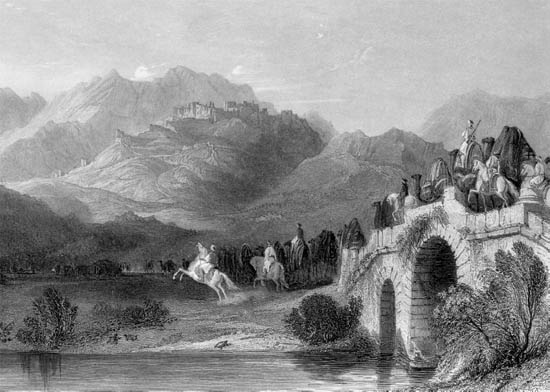
FIG. 7.5. Road to Pergamon, the acropolis and Mithradates’ palace in the distance. Steel engraving, T. Allom, 1840, courtesy of F. Dechow.
All recognized the man’s name on the way to Pergamon. Fearful Romans in the area kept a low profile and stayed home. Everyone else spit on the memory of the captive’s notorious father, the elder Manius Aquillius, former Roman governor of Pergamon, erstwhile capital of Rome’s Asian Province. Deeply hated for crushing taxes, he had hatched schemes so egregious that he’d been prosecuted for extortion, yet acquitted. All remembered how Aquillius senior had poisoned innocent men, women, and children trapped in the cities that supported the Sun Citizens’ rebellion.
Exploitation by tax profiteers like Aquillius and his son had kept resentment boiling in Anatolia, which the Romans viewed as an El Dorado overflowing with gold and natural resources theirs for the plundering. When Mithradates was a youth in exile, the elder Aquillius had interfered in his mother’s realm of Pontus, draining its treasury with high-interest loans. Officially, provincial tax rates were supposed to be set in Rome, but the office of tax collector was sold to the highest bidder, who then squeezed as much as he could for personal profit while the Roman courts of justice turned a blind eye. Aquillius the younger had headed the provincial commission in Asia, and, like his father, he was guilty of levying corrupt taxes and bribery. And now, as everyone knew, Aquillius’s arrogant son had blackmailed and ordered the king of Bithynia, Nicomedes IV, to invade Pontus, out of pure greed.30
Jubilation and revenge inflamed the Greeks and Anatolians who turned out to castigate the shackled Roman on his humble mount. As humiliating as the procession was, Aquillius dreaded his meeting with King Mithradates more. The tables were turned, the Romans were on the run, and Mithradates ruled Asia.
The man on the donkey could not imagine what awaited him in Pergamon.
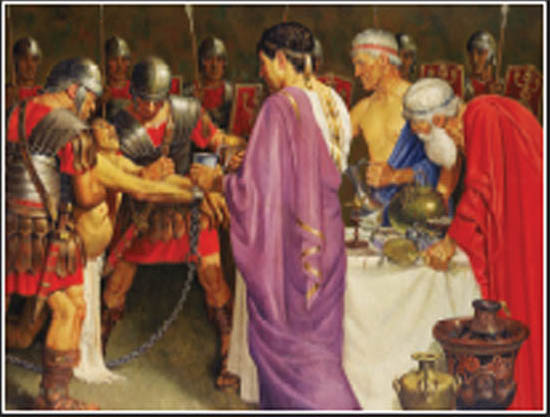
PLATE 1. Mithradates testing poisons on a condemned criminal. The doctors Papias and Krateuas (right) display monkshood (Aconitum apellus), ginger (Zingiber officinale), and gentian (Gentiana lutea). “The Royal Toxicologist,” by Robert Thom, History of Pharmacy, Pfizer. American Pharmacists Association Foundation.
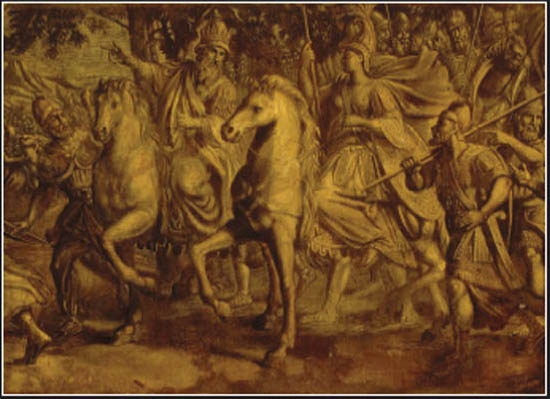
PLATE 2. Mithradates and Hypsicratea, riding to battle. “Hypsicratea, concubine of Mithradates, follows her mate to battle,” by Antoine Paillet, 1672. Chateau de Versailles. Réunion des Musées Nationaux/Art Resource, NY.
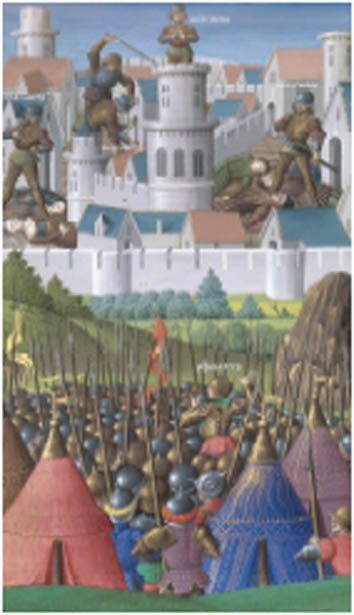
PLATE 3. Scenes from Mithradates’ life story, depicted within the castle, beginning with poisoning his mother and brother (far left); Mithradates besieged (center); his death (right); and ending with the rebellion of Pharnaces (foreground). Medieval manuscript illustration. Miroir historial; speculum historiale/Mithridate, Français 50, folio 172, Bibliothèque National de France.
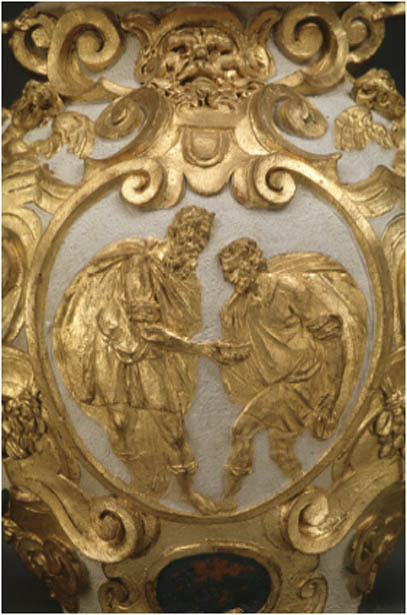
PLATE 4. Mithradates (left) takes the antidote, offered by his herbalist Krateuas (right). This elaborate gold and terracotta Mithridatium jar, decorated with scenes from Mithradates’ life, is one of a pair of sixteenth-century drug jars with glazed, watertight interiors. These jars would have been prominently displayed by the owner or apothecary. Annibale Fontana, ca. 1570, detail 90.SC.42.1 J. Paul Getty Museum, Los Angeles.
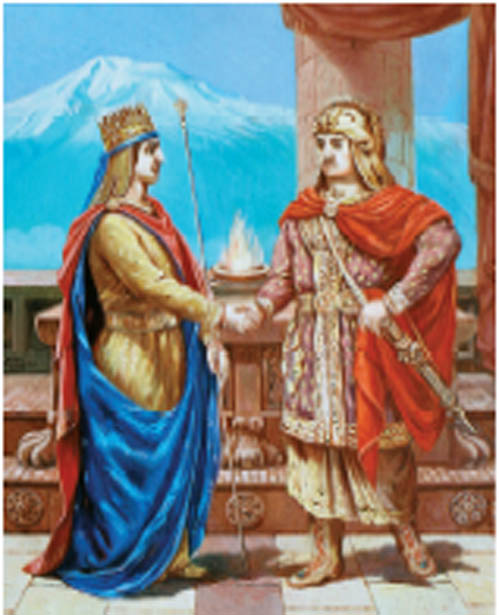
PLATE 5. Mithradates the Great in lionskin cap (right) and Tigranes in tiara (left) seal their alliance in Tigranes’ palace in Artaxata, Armenia. Painting by Rubik Kocharian, 2008, portrays the friends clasping hands, dressed in costumes like those in contemporary images of Persian-influenced Hellenistic kings.
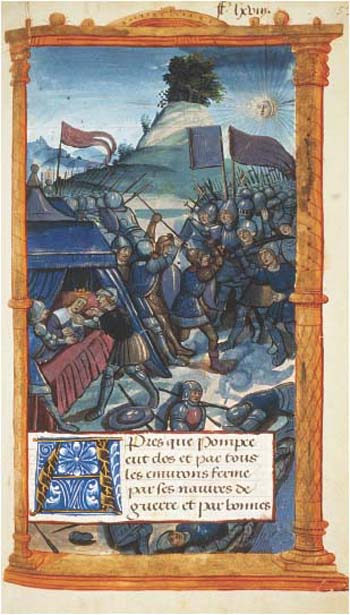
PLATE 6. Moonlight Battle. Mithradates awakened by friends (left) as Pompey attacks by the full moon. Plutarch’s Life of Pompey, ca. 1500, presented to Louis XII of France. Koninklijke Bibliotheek, The Hague.
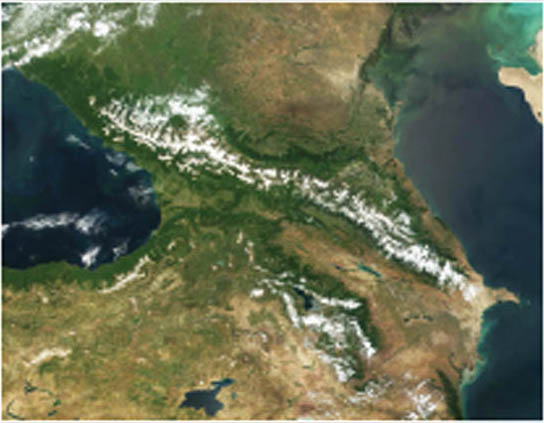
PLATE 7. Caucasus Mountains, between the Black Sea and the Caspian Sea. Mithradates probably crossed the Daryal Pass in the center of the range. NASA Visible Earth satellite image, www.visibleearth.nasa.gov.
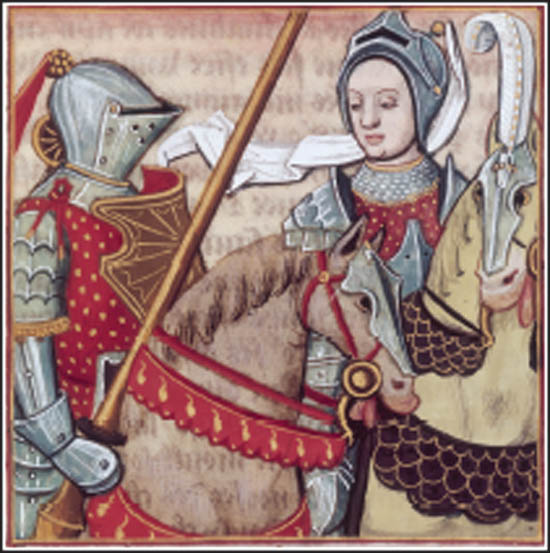
PLATE 8. Mithradates (incognito) and Hypsicratea, departing. Des dames de renom, De mulierbus claris/Hypsicratea, Français 599, folio 67, Bibliothèque National de France.
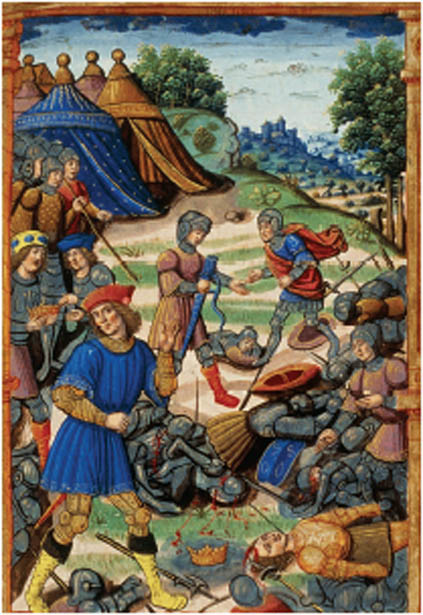
PLATE 9. Pompey turns away from the corpse of Mithradates, while men fight over his crown and scabbard. Plutarch’s Life of Pompey, ca. 1500, presented to Louis XII of France. Koninklijke Bibliotheek, The Hague.
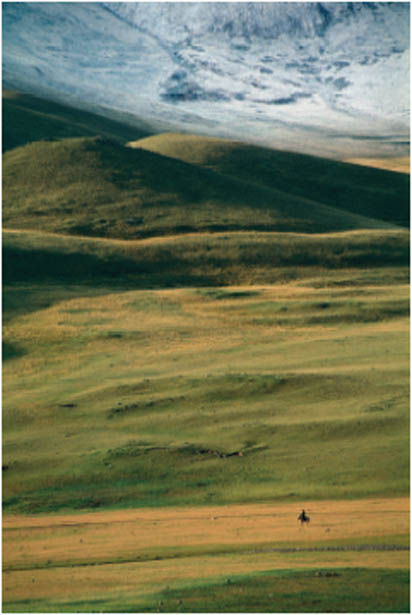
PLATE 10. Horseman on the steppes. Photo by David Edwards/National Geographic.