
IN THE PALACE at Pergamon, Mithradates was enjoying two honeymoons, one political and the other personal. Between romantic interludes with his new love Monime, the king reveled in his victories and devised a public punishment for Aquillius. The Roman deserved to die for invading Pontus and preying on Anatolia. The king’s heralds summoned the populace to the Theater of Dionysus, perched on a steep hillside of the Acropolis, where Mithradates had recently delivered his speech declaring war on Rome.
The crowd watches as a super-hot bonfire is stoked in the center of the theater. Next, a “giant” figure well known in Pergamon, a freakishly tall soldier called Bastarna (from the Bastarnae of Carpathia), appears, riding a huge horse at a stately pace around the fire, dragging a long chain. At the end of the chain stumbles Aquillius. Suspense builds, and a dramatic recitation of the prisoner’s crimes incites the audience.
Next, with exaggerated ceremony, heaps of gold coins from Mithradates’ treasury are trundled out. The glittering coins ring out as men laboriously tip them into a large stone crucible suspended over the fire. Within a few minutes, the coins are melted down. A glimmer of what is in store begins to dawn on the crowd and Aquillius. Then his captors force his jaws open and pour the molten gold down the greedy Roman’s throat. A diabolical last meal for a glutton for gold.1
In its shocking visual impact, the dramatically staged execution of Aquillius recalls Mithradates’ public stabbing of his nephew Ariathes in full view of the opposing armies in Cappadocia. A generation later, in 53 BC, the king of Parthia copied Mithradates and poured gold down the throat of another rich Roman invader loathed for his greed, M. Licinius Crassus. The raw symbolism of death by molten gold catapulted this atrocity into a byword for cruel—if poetically just—revenge in the Middle Ages and beyond. The image of angry, colonized people forcing the imperialist to have his fill of gold was still deeply seared into the popular consciousness some fifteen hundred years later. European historians and artists appropriated the same scene to imagine how Moctezuma, the last king of the Aztecs, punished the Spanish conquistadors’ insatiable lust for the yellow metal.2
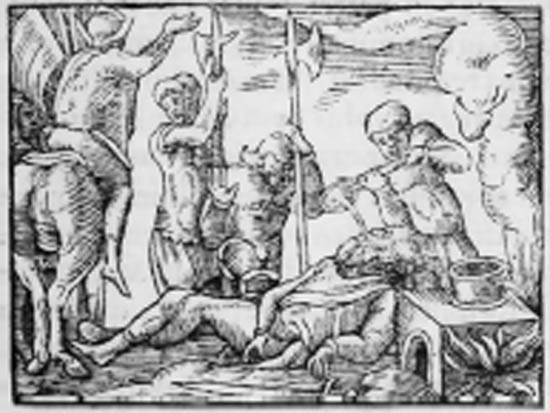
FIG. 8.1. The horrific execution by molten gold—just deserts for greedy Romans—became an icon of poetic justice after 88 BC, when Mithradates ordered the death of Aquillius. This image shows the execution of M. Licinius Crassus by the Parthian king, in imitation of Mithradates’ execution of Aquillius a few years earlier. Pierre Coustau, Pegma, 1555, Glasgow University Library, Special Collections.
In 88 BC, however, Mithradates’ vicious execution of one detested Roman was soon overshadowed by an even more horrific event: the cold-blooded massacre of tens of thousands of Italian-speaking residents in Provincia Asia.
DEATH TO THE ROMANS
After Mithradates shattered the Roman coalition armies and began his sweep down through central Anatolia, Romans and their sympathizers fled before him to the coast. Among them were Chaeremon of Nysa and his family and the Roman general Cassius. Mithradates’ decrees offering rewards for Chaeremon cast new light on the situation in the Roman province, not fully explained in the ancient texts. The inscriptions tell us that Italian refugees—bringing their households and slaves—were flowing into Ephesus, Adramyttion, Caunus, and other major cities near the coast.
So, in the months before the massacre of 88, great numbers of Romans and Italians were already camping out in temple sanctuaries for safety. Soldiers from the defeated Roman legions also joined this stream of refugees. This means that the Latin-speaking populations of these cities soared in the months before the order to kill them was actually carried out. By converging in a few major cities, the desperate fugitives became even more vulnerable. This mass exodus helps account for the terrible success of Mithradates’ order, which effectively wiped out the Roman presence in Asia Minor.
The adventures of one Roman who survived are hinted at in the ancient sources. It was rumored in Rome that the former provincial officer, Rutilius Rufus, had escaped death during the massacre because he disguised himself in Greek clothes. Some Italians did avoid the fate of their countrymen by wearing distinctive Greek clothing, but it is more likely that Rutilius Rufus was spared because he was so respected in Anatolia for trying to protect the province from ruthless tax collectors. It was well known that the Roman Senate had punished Rutilius for his leniency, convicting him on trumped-up charges. In 92 BC, he had settled in Smyrna, north of Ephesus, where he was welcomed by the populace with honors and flowers.
It seems that friends in Smyrna warned Rutilius about the massacre and arranged for his safe passage to Mytilene, Lesbos, the same island where Aquillius was captured. Italian scholar Attilio Mastrocinque recently suggested that Rutilius may have played a role in turning Aquillius over to Mithradates. The ancient historian Theophanes of Mytilene had even spread a story implicating Rutilius in the planning of the massacre of 88 BC. In any event, we know that Rutilius survived to write an influential memoir about the Mithradatic Wars. Sadly, Rutilius’s Memoriae no longer exists, like so much of the literature of the ancient world.3
Appian reported that a few Italian refugees gathered on Rhodes. Among them were Cassius, Aquillius’s cocommander in the fiasco, and the sons of Chaeremon of Nysa. His sons survived, but Chaeremon remained in Ephesus and was believed to have died with the other Romans inside the temple. The stories of why Rutilius lived and why Chaeremon chose to stay behind are just two of the thousands of personal tales of heroism and cowardice, survival and slaughter, now lost to history.
The awful events that day in Ephesus, Pergamon, Adramyttion, Caunus, Tralles, and other cities were recounted in chapter 1. Other pro-Mithradatic cities where massacres occurred include Nysa, Apamea, Cnidus, Miletus, Smyrna, Erythrae, and the Aegean islands of Cos, Lesbos, and Chios. We know they were regarded as complicit, because these places were singled out for severe punishment by Sulla, the Roman general who came to avenge the massacre.4
The massacre raises a host of questions. How was it coordinated? When exactly did it occur? Where was Mithradates? How could he be so certain that so many people would carry out the command? We’ve already seen how deep resentment arose over harsh Roman occupation, taxation, and slavery in the Greek world and Anatolia. Mithradates’ victories had the hated Romans on the run. But the savagery of the attacks in 88 BC tells us that Italian settlers were loathed to an extraordinary degree, by all classes of society. The reasons are multilayered.
The Roman historian J.P.V.D. Balsdon documented Rome’s “good and bad press” gleaned from ancient authors. Many observers admired traditional Roman culture and battle prowess, courage, and virtue, but Balsdon notes that Romans of this era were also widely disliked for their “insensitivity and offensiveness abroad.” Marcus Cornelius Fronto, a prominent Libyan-Italian orator (b. AD 95 in Carthage), wrote that the “Romans lack warmth; they are a cold people.” Diodorus of Sicily, a Greek historian who wrote just after the Mithradatic Wars, remarked that “in days of old, the Romans adhered to the best laws and customs [and] over time they acquired the greatest and most splendid empire known to history. But . . . the ancient practices gave way to pernicious tendencies.” Relations between Roman officials and the colonies tended to be poisoned by “mutual suspicion and power imbalance,” even among local elites. Arrogance and superiority led to a stereotype of the “Ugly Roman” businessman aggressively seeking profit and power, bankrupting and enslaving local families.
Typical Roman views of the indigenous people of the Near East were stereotyped too. Romans considered Anatolians stupid and inferior, natural slaves. The physical attributes of enslaved populations were crassly compared. For example, Romans claimed that Syrians, Jews, and Greeks of Asia Minor were naturally submissive. They purchased Bithynians and Syrians for bearing litters because of their height; Gauls were said to be better than Spaniards for tending herds, and so on. Romans tossed off insulting proverbs and odious ethnic slurs, such as “Carians are only useful for testing poisons” and “All Phrygians improve with beating.”5
Mithradates’ personal and political motives for the massacre were even more complex. It’s interesting to speculate whether he knew of the similar massacre of Romans in Numidia during the Jugurthine War. In Vaga during a festival, ordinary folk and nobles together had carried out the premeditated slaughter of Roman soldiers and their families garrisoned in the town (108 BC). Marius, a veteran of the Jugurthine War, may have described this massacre to Mithradates at their meeting, but Mithradates could have heard it from any number of other sources. Did the slaughter at Vaga and similar reprisals against Roman immigrants and traders during Jugurtha’s war serve as a model for the massacre of 88 BC? If so, did Mithradates anticipate a harsh Roman response to his own plan? After Vaga, the avenging Roman general Metellus ordered his soldiers to chop all the inhabitants into little pieces. Mithradates had to know that Rome would seek revenge for his order, but he must have believed that troubles at home in Italy would prevent a quick response. He may also have anticipated the devastating financial collapse that the Roman losses in Asia precipitated. He thought he had time to secure Greece and take Rhodes, so that war with Rome could be fought far from his Pontic homeland and would be confined to crushing Sulla’s legions on Greek soil.6
The ruthlessness and scale of the massacre—among other dark incidents—raises questions about Mithradates’ psychology, for moderns anyway (notably, no ancient writers thought him mad). Danish scholar Tønnes Bekker-Neilsen recently considered whether Mithradates possessed a “borderline” or “psychotic” personality disorder, based on a checklist of modern psychiatric characteristics. Some traits exhibited by Mithradates—a grandiose sense of self-worth; a charismatic, manipulative personality; theatricality; impulsive and callous behavior; criminal versatility—appear to match the patterns of some psychopaths. Other traits, however, such as promiscuous sexual behavior, paranoia, and seeking opportunities to exert power, even political murders, were normal in the cutthroat world of Hellenistic kings. Some psychopathological traits do not apply, since Mithradates reportedly experienced deep emotions including love, anxiety, remorse, and depression; he took responsibilty for his own actions; maintained long-term relationships; and planned long-term goals. The recently created category, “successful psychopath,” might best describe Mithradates: one who exhibits ruthless, exploitative, grandiose behavior, but whose mitigating social traits and intelligence allow that person to achieve success and acclaim. Today such people succeed in politics, law, medicine, and sports, areas that Mithradates also excelled in (see appendix 1).7
According to Memnon, Mithradates “killed 80,000 Romans scattered throughout the cities of Anatolia because he received word that they were hindering his designs.” Rose Mary Sheldon, a historian of ancient espionage, suggests that Mithradates may have learned that the Roman community was forwarding intelligence to Rome to sabotage his plans. Memnon’s claim and Mithradates’ drastic order suggest that a resistance or saboteur movement had already arisen, led by Romans and their supporters. This notion is also supported by Mithradates’ “Wanted” posters for Chaeremon.8
Mithradates may have ordered the massacre to show solidarity with the Italian rebels, in response to their requests for aid in defeating the Romans. Some have suggested that besides removing opponents and potential troublemakers, confiscations of Roman property brought much wealth to Mithradates. Certainly the resulting collapse of credit in Rome, which had been based on exorbitant taxation and profits in Asia, was a boon to Mithradates. The satraps of the murderous cities promised to divide the confiscated Roman property with Mithradates. But it seems safe to say that money was not his main object—he was already richer than the legendary kings Midas and Croesus combined. When Mithradates later accused Chios of not sharing the confiscated property with him, it was a matter of punishing traitors, rather than a concern for lost profit.9
Mithradates’ plans were subtle and carefully laid. In previous chapters, we saw how Mithradates employed oblique control, alliances, bribery, assassinations, military maneuvers, rhetoric, propaganda, and cunning diplomacy in the first two decades of his reign, to persuade the Romans that they should withdraw from Anatolia and Greece. Now it was outright war. It would seem that two pressing motives led Mithradates to order the elimination of the Roman people remaining in Anatolia. Although his victories sent many Romans—including thousands of legionaries—into flight, many remained, especially in the cosmopolitan ports. These cities were notorious for switching sides; as commercial centers they depended on business. Mithradates knew they could not be trusted to remain loyal should the war with Rome begin to go badly. He could not afford to allow a resistance movement to coalesce around resident Romans and their sympathizers in the lands he now occupied, while he was engaged in Greece and Rhodes.
Second, the killing ensured and publicized the widespread credible commitment to his cause. All the cities and territories whose diverse but well-integrated citizenry—Greeks, Jews, and Anatolians—had agreed to murder Romans were now irrevocably bound to Mithradates. Another benefit of the “ethnic cleansing” included freeing numerous slaves and debtors who would join his forces, bolstering the king’s reputation for generosity toward non-Romans, rich and poor alike.10
Mithradates may have issued the order from Ephesus, but his location on the day itself is unknown. Scholars of ancient intelligence wonder how the clandestine order was delivered—orally? in writing? in code? Numerous ancient accounts describe top-secret missives inscribed on wax tablets or hidden in the soles of sandals, inside dead rabbits, under horse blankets, braided into women’s hair or horses’ tails, or even tattooed on the shaved scalps of messengers. Mithradates’ “intelligence coup” is still a great puzzle, remarks Sheldon. “We do not know, to this day, how Mithridates coordinated this feat, how he communicated with his agents, or how he kept such a deadly plan secret” for a month, especially in places like Tralles, where the order was discussed in the assembly.11
The year 88 BC was crammed with gripping events. It is impossible to determine the exact sequence of the execution of Aquillius, the massacre of Romans, the battle for Rhodes, and the Greek campaign. But one thing is certain: the massacre plot was set in motion at least thirty days in advance, allowing Mithradates to concentrate on his two-pronged operation: the all-important liberation of Greece and the conquest of Rhodes.
ATHENION, MITHRADATES’ ENVOY IN ATHENS
Greeks in Anatolia, the Aegean islands, and mainland Greece saw Mithradates Eupator as a heroic freedom fighter who could restore democracy to democracy’s homeland. In the months before the massacre, the citizens of Athens voted to send the philosopher Athenion to Pergamon for an audience with Mithradates, requesting him to free Greece from Rome’s grasp. It was traditional for philosophers to act as ambassadors, but this must have happened over the objections of Romans in Athens or perhaps in secret.
Mithradates warmly welcomed Athenion and presented him with typically sumptuous gifts—a gold and agate ring carved with the king’s likeness and a fine purple robe. The men became good friends. Athenion wrote many letters home assuring the Athenians that Mithradates would restore their democratic constitution and cultural life, promising peace and great benefits, including relief from debts.
Athenion’s story is recounted, in a negative light, by the supercilious, imperial-era author Athenaeus, who lived in Egypt in the late second century AD. In his Learned Banquet, a miscellany of Roman gossip and popular culture, Athenaeus wrote that “after all Asia had revolted to join the King,” the philosopher Athenion sailed back to Athens. All Athens—men, women, and children, citizens and foreigners—turned out in the parklike setting of the Kerameikos, the cemetery along the Sacred Way, to welcome Athenion as he entered the great Dipylon Gate. Athenaeus’s description, written two hundred years later during the height of the Roman Empire, is filled with sarcasm directed at all those who had once placed their hope in Mithradates’ “revolution.” But Athenaeus’s sources did have access to contemporary, possibly eyewitness reports of Athenion’s return. Keeping in mind that Athenaeus certainly twisted the story for the amusement of his smug, elite imperial audience, we must read between the lines to imagine the emotions of the Roman Athenians of Mithradates’ day.12
Athenaeus berates Athenion as a “preposterous freak of fortune,” a demagogue who traded his “ragged philosopher’s cloak for a purple robe” to be “conducted with obnoxious pomp into Athens in a silver-footed litter.” Athenaeus portrays the Athenians as credulous fools to hope that Mithradates could bring them a “glorious” future. He ridicules the adoring crowds who gathered outside the philosopher’s new “mansion adorned with costly couches, paintings, statues, and displays of silver plate.” Athenaeus depicts the procession by litter, the rich garments, and the flashy gold ring as signs of Athenion’s arrogance, hypocrisy, and greed. Obviously, however, all these things had been traditional gifts from King Mithradates, intended to show the Athenians that Athenion was his true envoy.
The Kerameikos and the Sacred Way were filled with throngs of excited citizens converging on the Agora, the public square where Athenion was to speak. Along the way, speeches, sacrifices, and libations were offered in his honor. In the Agora, Athenion climbed onto a large wooden platform in front of the Portico of Attalus, the grand covered marketplace. On the stage where the Roman generals who controlled Greece held tribunals, Athenion delivered his dramatic message from King Mithradates to the assembled people of Athens. Athenion began with a self-effacing comment, traditional in democratic Greek oratory. “O Athenians, the state of affairs of my country compels me to tell you what I know. But the situation and the magnitude of the news to be discussed overwhelm me!” At this, a great cheer went up from the audience, urging him to continue.
I tell you, then, of things which could never have been hoped for, nor imagined in a dream. King Mithradates is now master of Bithynia and of Cappadocia, and he is master of all Asia, as far as Pamphylia and Cilicia. The kings of the Armenians and Persians are his guards, he is lord of all nations around the Black Sea and Pontus. Mithradates’ dominions now encompass a vast territory. The Roman commander, Oppius, has surrendered and is in the king’s retinue as a prisoner. Manius Aquillius, the consul who once celebrated a Triumph in Rome for his victory over Sicilian slaves, is now dragged around behind a horse ridden by the giant ogre Bastarna. The Romans living in Asia are bowing down before the gods, others are donning Greek clothing, and many recent Roman citizens are reverting to their original nationalities.
Every city in Asia is honoring Mithradates with divine honors and calling him a god! Oracles everywhere promise him dominion over the whole world. He is sending armies to Thrace and Macedonia and even Europe is coming over to his side. Not only are the Italian rebels sending ambassadors to Mithradates, but the Carthaginians too, all begging to ally with him for the destruction of the Romans.
Here Athenion paused and wiped his face, giving the multitude time to absorb and exclaim over this news.
Athenians! We must not bear this state of anarchy any longer, imposed by the Roman Senate while it controls our government. The Romans have closed our temples and let our schools fall to dust. Our theaters are off limits and our courts of justice and schools of philosophy are silenced. They have even taken the Pnyx, our sacred place of Assembly, away from the people!
After this rousing speech, the crowd rushed to the Theater of Dionysus and voted to elect Athenion general of the citizen army. Athenion accepted the generalship, a one-year post. “Now, Athenians,” he declared, “you yourselves are your own generals, and I am commander-in-chief. If each of you exert everything in your power to cooperate, I shall be able to do as much as all of you put together!” Nine archons, high officials, were selected, following ancient democratic practice. Archaeologists have discovered an inscription with their names, showing that the men were all from prominent Athenian families.
Athenaeus (like other Roman-era writers) characterized the philosopher as a dictator seizing power: “Athenion thus appointed himself tyrant.” Yet as Athenaeus himself describes, Athenion was democratically elected by the majority of citizens in Athens, according to the traditional process set out in the ancient Athenian constitution. Other contradictions in Athenaeus’s account reveal his antidemocratic biases and his resort to stock insults. For example, he calls Athenion’s mother a “lowly Egyptian slave” and accuses him of growing fabulously wealthy as a philosophy teacher, even while he reviles him as impoverished. The historian Strabo, writing in the generation after the Mithradatic Wars, also asserted that Mithradates “placed tyrants in Athens who violently oppressed the city.” In fact, as modern historians agree, these leaders were elected by majority vote, by an electorate that included all classes.13
The restoration of democracy in Athens gave Athenion a mandate in a city previously controlled by Roman conquerors and elite sympathizers among the citizenry. Athenaeus’s report of what happened next in Athens is elaborately detailed, portrayed as a “reign of terror” by the democratic majority. The events he describes were probably based on the experiences of Romans and pro-Roman Greek aristocrats who escaped prosecution and death after Athenion’s election. Athenion placed guards at the city’s gates, but many Romans and their sympathizers fled over the walls by night. Athenion sent out soldiers in pursuit, killing some and imprisoning others. Citizen assemblies and people’s courts were convened. Athenians who collaborated with Romans were tried for treason. The convicted were beaten or executed, their property confiscated. Later that year, because of disruptions in trade, food and supplies became scarce in the city. Athenion had to order strict rations on barley and wheat. In Athenaeus’s snide words, the “ignorant Athenians were forced to subsist on grain that was barely enough to keep a chicken alive.”14
Had Mithradates informed Athenion of his secret plans to wipe out Romans in Anatolia? Did Athenion order similar actions in Athens? The violence against Romans and their supporters in Athens after Athenion’s election does parallel what was occurring in the cities of Anatolia in 88 BC. Mithradates appealed to both rich and poor, but any opposition that arose always came from aristocratic quarters. As in Athens, Roman collaborators among Anatolian oligarchic families lost their lives. For example, in Adramyttion, one of the towns where Romans were massacred, the local philosopher-statesman Diodorus, a partisan of Mithradates, was elected general. Diodorus had some members of the city council killed—undoubtedly these were aristocratic supporters of Rome.15
The restored democracy in Athens, with Athenion and his successor Aristion elected on anti-Roman platforms, prepared the way for the coordinated arrival of Mithradates’ liberation forces in Greece. A host of barbarian allies, led by his son Arcathius, marched out from Pontus across Bithynia and Thrace to northern Greece. At the same time, a large Pontic fleet and army, commanded by Metrophanes, occupied Euboea and Thessaly. Meanwhile, Archelaus’s troops took Delos by force. The sacred island served as the treasure house of the Aegean, controlled by Rome. Traditionally allied with Athens, the Greek residents of Delos had welcomed Mithradates early in his reign and honored him with the monument decorated with statues of the king and a dozen of his friends. But now Delos was pledged to aid Rome. After the massacre in 88 BC, the Italian residents who dominated the island took up hammers and smashed the fine marble portraits in the Mithradates Monument on Delos, obliterating the faces of Mithradates and his friends.
All the while, Mithradates’ shipbuilders had been expanding his navy for the attack on Rhodes, still loyal to Rome. Now, bidding farewell to Queen Monime, Mithradates boarded his flagship as supreme naval commander of the fleet bound for Rhodes. The Rhodians hurried to “strengthen their walls and harbors and erect engines of war everywhere,” recruiting reinforcements from the mainland.16
THE BATTLE FOR RHODES
Rhodes, as Mithradates was well aware, had defended itself forcefully against Demetrius Poliorcetes, “Besieger of Cities,” back in 305/304 BC. That grueling siege went down in history as one of the greatest battles in antiquity. Demetrius’s engineers had erected the tallest, most powerful mechanized siege tower ever built. The “City Taker” was 130 feet high, weighed 160 tons, and was equipped with 16 heavy catapults. It required relays of more than 3,000 men to activate it. Iron plates fireproofed the wooden tower, and curtains of soaking wet wool and seaweed protected the windows from the Rhodians’ fusillades of fiery arrows and flaming oil grenades. Demetrius had also deployed a 180-foot-long battering ram manned by 1,000 soldiers, and he constructed huge drills for boring through walls. Despite all this technology, however, Rhodes had repelled the invader after a year of fierce fighting. Both sides won everlasting fame. Demetrius’s glorious failure was materialized for all to see. The Rhodians melted the metal from his abandoned siege equipment to create the massive Colossus of Rhodes.17
Mithradates intended to outdo Demetrius. Planning his attack by sea and land, Mithradates’ engineers constructed a sambuca, an immense tower mounted on two ships. It had a movable wicker bridge, for scaling city walls from the sea. Meanwhile, Mithradates’ land forces massed at Caunus; from there they would sail to join the Pontic navy at Rhodes.
Appian and other historians described the battle for Rhodes. As Mithradates’ grand navy, decked out with magnificent carved figureheads and fancy equipment, hove into view, the people of Rhodes took drastic, “scorched earth” measures, destroying and burning the outskirts of the city to deny Mithradates shelter and food. The Rhodian navy, commanded by the experienced and bold Greek admiral Damagoras, advanced, ready to attack the Pontic ships head-on. Mithradates, sailing ahead in his quinquereme (the largest warship of the day), saw that he greatly outnumbered the Rhodians and ordered his vessels to encircle the enemy. But Damogoras quickly withdrew within Rhodes’ walled harbor, and the Rhodians prepared to fight from their city walls. Mithradates camped in the burned-over suburbs outside the city, while his ships continually probed the harbor.18
But the Rhodians maintained their defensive advantage. Damagoras sent a bireme (a small, fast ship with two decks of rowers) to engage one of Mithradates’ merchant vessels. Mithradates sent a multitude of warships into the fray, fighting with zeal, but his sailors were inexperienced and undisciplined compared to the expert Rhodians. Damogoras skillfully rammed Mithradates’ vessels. The Rhodians came away with a great many costly figureheads and rich spoils, as well as a Pontic trireme and crew.
The next day, Damogoras took six swift ships out to search for a lost ship. Mithradates’ royal quinquereme and twenty-five of his fastest ships set off in pursuit. Damogoras cleverly evaded Mithradates all day, drawing him far out to sea. At sunset, as Damagoras expected, Mithradates ordered his ships to turn back. At that point, Damagoras plowed into them, ramming the enemy ships in the dark. During the confusion, while Mithradates was yelling orders at his sailors, one of his allied triremes—from Chios—rammed hard into Mithradates’ own ship. The king’s quinquereme somehow survived the jarring impact. In the thick of battle, Mithradates continued fighting. But Damagoras sank two Pontic ships and drove two others all the way to the Lycian coast.
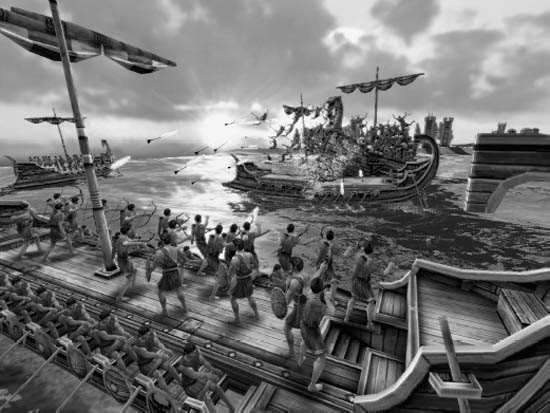
FIG. 8.2. During the naval battle for Rhodes in 88 BC, Mithradates’ ship was rammed by an allied Chian ship (center). (Foreground) archers aim fire missiles. Rise and Fall: Civilizations at War video game screenshot, courtesy of Midway Games, Inc.
Rattled by the surprising successes of the outnumbered Rhodians, Mithradates brooded suspiciously on the collision with the Chian ship during the night battle. Was it deliberate? He had the Chian pilot and the lookout sailor flogged. From that day on, says Appian, Mithradates “conceived a hatred for all Chians.” Someday he would find a way to get even.
Ominous prodigies began to undermine Mithradates’ morale. In the burned-over countryside, where Mithradates was camped, a gang of crows suddenly attacked a vulture. Then that night, a “huge star” (a meteorite?) fell on the very spot where the vulture had been pecked to death. The king’s Magi and soothsayers muttered grimly.
The campaign for Rhodes was not going well. Where were his land forces? Mithradates’ troops were supposed to board merchant vessels and triremes in Caunus and join him. In fact, they had set sail, but a massive storm drove the battered fleet toward Rhodes in no condition to fight. Damagoras’s navy sailed out and “fell upon the ships while they were still scattered and suffering the effects of the tempest. Damagoras captured some ships, rammed and sank others, and burned still more.” The Rhodians took four hundred prisoners that day.
Some Rhodian deserters appeared in camp requesting a meeting with Mithradates. Perhaps things were looking up. The men led the king to the highest mountain on the island, a two-hour climb up to the walled Temple of Zeus. Here Mithradates decided to station some soldiers, with instructions to create a fire signal later that night. Then he sent half of his army under cover onto his ships, directing the other half to sneak into positions with scaling ladders. At the fire signal from the mountain, all would attack Rhodes by land and sea simultaneously. But some Rhodian sentries posted on another hill detected the sneaky movements and lit a fire. Mithradates’ army and the naval contingent, thinking this was the fire signal from Zeus’s temple, were tricked into attacking too early. The Rhodians rushed to their walls and beat off Mithradates’ men. Somehow, it seemed that the Rhodians had been prepared for his surprise attack. Had those “deserters” been double agents?
It was time to bring up the sambuca. The enormous contraption, astride two ships, drew up alongside the outer seawall of the Temple of Isis, great mother goddess of Asia. The back wall of her temple formed part of the harbor fortifications. Mithradates’ men labored to operate the pulleys of the sambuca to raise the bridge to the top of the wall, so that the soldiers, massed in small ships below with ladders, could swarm into the city.
The Rhodians were struck with fear at the sight of the colossal siege machine. Its approach must have aroused anxiety for Cassius and the little group of Roman refugees inside the walls too. Mithradates’ troops began to clamber up the sambuca. Suddenly a great cheer went up among the Rhodians. Mithradates’ grand structure was collapsing under the weight of all the men. And just at that moment, a glowing apparition of the goddess Isis appeared atop her temple! The goddess hurled a great fireball down onto thesambuca and the men clinging to it. The huge contraption fell burning into the sea.
The Rhodians had long been masters of fire power. During the fight against Demetrius in 305 BC, the entire night sky was lit up by spectacular fire missiles dipped in burning pitch and sulphur. Demetrius had been stunned: Rhodians fired more than eight hundred flaming projectiles in a single night! Now Mithradates was beginning to appreciate Demetrius’s decision to sue for peace with Rhodes. Was the vision of the goddess throwing masses of fire an illusion caused by a burst of awesome Rhodian incendiary power? Another meteor? A case of freak lightning? It didn’t matter: for Mithradates’ dispirited army, Isis’s anger was a very bad omen.
Mithradates despaired of taking Rhodes. Undefeated but displeased, he sailed away to the coast of Lycia, leaving the charred remains of his sambuca floating in the sea below the temple walls. Damagoras, itching to finish off Mithradates, would have another chance, but that duel lay years ahead.19
THE FURIES
On the coast of Lycia, Mithradates and his general Pelopidas decided to lay siege to Patara (Lycian Pttara), an ally of Rhodes and Rome. Nearby, the Temple of Apollo boasted an oracle nearly as famous as Delphi. If Mithradates consulted this oracle, he and his soothsayers observed a school of sacred fish summoned by a flute, as Apollo’s priests scattered bits of meat on the water. If the fish devoured the scraps, all was well; if they flipped the offering away with their tails, things looked bad. Given the trajectory of Mithradatic omens in this campaign, the fish probably turned tail.
Lycia was also the center of worship of the Anatolian and Greek mother goddesses Eni, Cybele, and Leto, the mother of Apollo and Artemis. Leto’s sanctuary has been uncovered by archaeologists in the lush Xanthus valley near Patara’s shore. Mithradates ordered his men to cut down the old trees along the beautiful white sand beach. He knew this grove was sacred to Leto, but he desperately needed wood to rebuild his siege machines. That night, however, the king tossed and turned in his tent. The goddess Leto appeared in a dream and warned Mithradates to spare her sacred trees. Mithradates and his Magi took dreams very seriously—they analyzed and recorded not just the king’s dreams but those of his concubines as well.20
More bad news came in the morning. Some other Greek islands had defected, joining Delos, pledging to help Rome. They must be punished. Resourceful enemies, angry gods, evil omens, bad weather, stubborn fish, now even his once-loyal allies—everything seemed to be turning against him. Suspicion coiled in Mithradates’ guts; paranoia raised its Hydra heads. First Isis, now Leto. Mother goddesses in particular seemed upset with him. How to placate them? The dour seers in his entourage began murmuring the names of the Furies, she-demons of justice who haunted murderers, especially those who had killed their own mothers and families. These horrid hags, carrying scorpion whips, hair writhing with poisonous serpents and eyes dripping blood, were relentless avengers, hounding a murderer till he or she went insane with guilt and terror. The Furies had sent famous Greek heroes over the brink of madness, and mortals—even emperors—feared them. Mithradates, steeped in Greek myth and drama, may well have believed he was being pursued by the Furies for his murders, particularly of his mother and siblings.
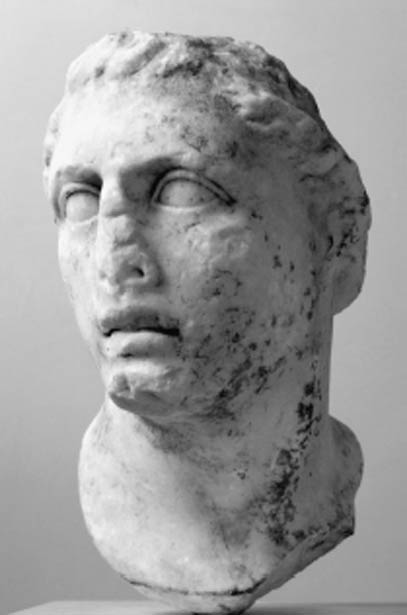
FIG. 8.3. Mithradates portrait, marble, life-size. Photograph © The State Hermitage Museum, St. Petersburg.
Could this be the explanation for the sensational story that Mithradates sacrificed a virgin to the Furies after the failure to take Rhodes? The incident appears in a list of omens by the Roman historian Livy, now lost but preserved in the Book of Prodigies by A. Julius Obsequens. For the year 88 BC, several prodigies were reported in Rome associated with “Mithradates’ preparations for war with Rome’s allies.” Some, like the apparition of Isis at the battle for Rhodes, are confirmed by other sources.
Mithradates and his Magi went to a sacred Grove of the Furies, a forest of dark yew trees. Pregnant sheep and turtledoves were the usual sacrificial animals for the Daughters of the Night. Just as Mithradates began to kindle the fire for his sacrifice of the ewe and dove, the sound of supernatural laughter filled the grove. According to Livy and Obsequens, this terrified everyone present, interrupting the ritual. Mithradates’ Magi conferred and instructed the king that he needed to sacrifice a virgin on the altar of the Furies. A young girl was procured. The next evening Mithradates began the incantations again, the knife poised over the victim’s neck. But all of a sudden, the girl herself began laughing in a frightening, mirthless way. Her hysterical laughter, echoing the horrible laughter of the Furies, completely disrupted the sacrifice.
Is it plausible that Mithradates really intended to sacrifice a human being? It seems shocking, but the practice was not unknown in his or in the Roman world. According to Herodotus, the Magi took pleasure in killing living things with their bare hands: animals, snakes, birds, butterflies, and ants. We know that the Magi sometimes ordered human sacrifice, ritually killing young boys and girls to ensure victory in battle. For example, when Xerxes invaded Greece in 480 BC, his Magi buried alive nine children abducted from Greek families. For their part, Athens and Sparta had killed Persian ambassadors as ritual sacrifices, and some Greek generals made vows to the Furies before battle—either to excuse the slaughter of innocents or to ask the Sacred Avengers to support their cause. Mithradates knew the Greek plays of Aeschylus, Sophocles, and Euripides, describing how King Agamemnon sacrificed his own virgin daughter Iphigenia to ensure good sailing winds at the beginning of the Trojan War.
But human sacrifice was not just something from old myths or deep antiquity. Surprisingly, in 97 BC, just a decade before Mithradates lost Rhodes, the Roman Senate found it necessary to pass a decree outlawing human sacrifice. The Druids in Gaul and cults in Spain and Carthage practiced human sacrifice, but the Senate’s decree was directed at preventing such “barbarian” practices in the city of Rome itself. Indeed, the Romans had sacrificed humans in recent memory. During the Hannibalic Wars, the Romans buried alive two Greeks and two Gauls, as ordered by the soothsayers who interpreted the Sibylline Books. The Romans had carried out a similar sacrifice as recently as 114 BC, just before the Jugurthine War, again burying alive two Greeks and two Gauls.21
These recent precedents, combined with Mithradates’ knowledge of Persian and Greek kings who sacrificed virgins at the beginning of their great wars, lend plausibility to the ancient reports that Mithradates attempted to sacrifice a young girl. It is impossible to know whether the murders of his mother, brother, and sister—not to mention the murder of eighty thousand Roman residents—weighed on Mithradates’ conscience. But a sacrifice to the Furies could appease angry divinities, absolve bloodguilt, and ensure victory in what Mithradates saw as a just war. The ritual could also be a useful propaganda move to demonstrate his religious commitment. What is so fascinating about the Roman account of Mithradates’ human sacrifice is that it was reported in Rome without any sense of surprise or outrage. The fact that the sacrifice of the maiden was not actually carried out only adds to the credibility of the account.
After these untoward events, Mithradates abandoned the siege of Patara. He could use the excuse that trying to take Rhodes and Patara at this time was forbidden by the gods. Leaving Pelopidas to continue the war in Lycia, Mithradates ordered Archelaus to “gain allies by persuasion or by force” in the Aegean en route to Greece. Delegating the war to his generals, the king returned to Pergamon to concentrate on manufacturing more weapons and siege machines, building more ships, and raising more reinforcements for Greece. He celebrated his forty-sixth birthday in grand trencherman style. Appian tells us that Mithradates also spent a good deal of time enjoying himself in the arms of his new wife, Monime. While the king had been away at war, the lovers had exchanged many billets-doux filled with longing and lust.22
The setbacks—possibly exacerbated by misgivings about his own murderous tactics—triggered paranoid behavior in Mithradates. The near miss with the Chian trireme at Rhodes led him to distrust his allies. The king resorted to harsh retributions, establishing tribunals to try those who were conspiring against him, much like the trials already going on in Athens and Adramyttion. People accused of inciting revolution against the king or supporting the Romans were brought before Mithradates and his judges. Many were convicted, but these courts do not appear to have been simply rubber stamps for juridical murder. As we saw, Mithradates had appointed the orator Metrodorus as an expressly independent judge. Perhaps Metrodorus was to thank for the acquittal of a fellow orator, Diodorus Zonas of Sardis, who had frequently pleaded Mithradates’ cause in Rome. Falsely accused by some sycophants in Mithradates’ court of urging cities to revolt, Diodorus was able to prove his innocence and survived the king’s wrath.23
Despite the stalemate in Rhodes, Mithradates’ rule extended from the Black Sea and most of western Asia to Greece, and his navy ruled the Aegean Sea. The extermination of Romans in Asia had gone like clockwork. Mithradates’ vast stores of money were multiplying, he enjoyed his new love and basked in popular adulation, and his armies and navies were undefeated. His generals were advancing on Greece by land and sea, to complete the capstone in Mithradates’ new version of Alexander’s great Greco-Persian Empire. Now everything depended on the Greek campaign.